
Here’s a report from Emily Benson writing in The High Country News. Click through and read the whole article. Here’s an excerpt:
If the Delta tunnels deal sinks, it could mean increased pressure on the already-strapped Colorado.
California’s water supply relies in part on a system of canals — the State Water Project and the federally-managed Central Valley Project — fed by the Sacramento-San Joaquin Delta, the estuary upstream of San Francisco Bay. The canals irrigate 3 million acres of farmland and supply drinking water for 25 million people south of the Delta. Two pump stations drive the system, but they’re so powerful that they can reverse the current of the rivers and trap fish, imperiling endangered species like Delta smelt. Environmental regulations stipulate that the pumps power down at certain times, allowing water to flow to the bay instead of the farms and cities at the other end of the canals.
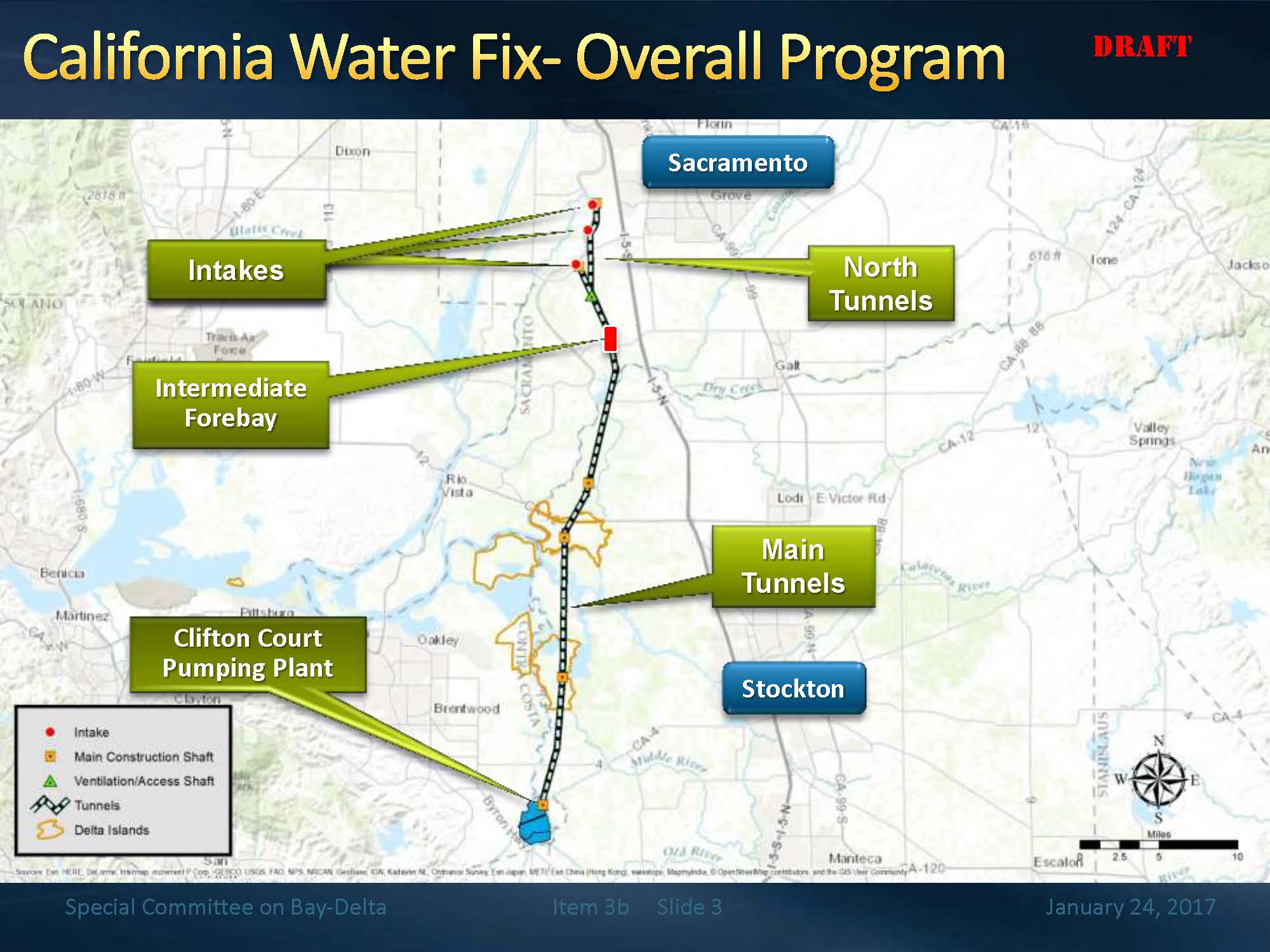
The Delta tunnels project, also called California WaterFix, would consist of two huge tunnels 30 miles long and 40 feet in diameter — more than twice as tall as a semi-truck. By altering how water moves through the Delta, state officials say the tunnels would make California’s water supply more reliable while helping to keep threatened fish species away from the pumps. Opponents say continuing to divert critical freshwater flows would further destroy the delicate ecosystem of the Delta. Better options include conservation measures like drip irrigation and regional self-sufficiency, especially as water supplies dwindle under a changing climate, says Barbara Barrigan-Parrilla, the executive director of environmental group Restore the Delta. “The water supply reliability that they’re promising is not going to be there with climate change,” she says.
A reliable supply of water from the Delta is crucial for the Metropolitan Water District of Southern California, which serves 19 million people in Los Angeles and other southern California cities. On average, Metropolitan gets more than half its water from the State Water Project; the rest comes from the Colorado River, says Bill Hasencamp, the water district’s manager of Colorado River resources.
If the Delta tunnels aren’t built — and government officials don’t find another way to shore up water supplies to Metropolitan and other water districts — that could leave Southern California more reliant on the Colorado, says Jeff Kightlinger, the general manager of Metropolitan. The issues in the Bay Delta are one of the major obstacles that California faces in agreeing to the “drought contingency plan,” an agreement among California, Arizona and Nevada on how to pull less water from the Colorado River during droughts. “We need to understand with some certainty where we stand on the Delta to make commitments on the Colorado River,” Kightlinger says.
Water agencies plan to finish the drought contingency plan next year, and Kightlinger says he’s still hopeful that they can stick to that timeline. Though last winter’s wet weather gave water managers a slight reprieve in urgency, climate change is shrinking the water supply in the Colorado Basin over the long term. “We know we’re going to need (the drought contingency plan) eventually,” Kightlinger says. “The more progress we can make now, ahead of a crisis, the better off we’re going to be.”
From 10News.com (Joe Little):
A $16 billion-dollar plan to upgrade California’s water system would increase a ratepayer’s water bill upwards of $3 a month. However, the Metropolitan Water District and Department of Water Resources said the upgrade is necessary to update a 50-year-old system, improve water reliability, and protect the Sacramento-San Joaquin Delta environment.
“It’s absolutely essential that we take care of this,” said Department of Water Resources Director Grant Davis. “This resource is akin to the heart and lungs of the state of California.”
San Diego County gets roughly 30% of its water from the delta. MWD officials said it’s still cheaper than desalination or purified recycled water.
If approved by several state water agencies and organizations, California WaterFix would take years to complete. The Metropolitan Water District, which sells the Delta water to the San Diego County Water Authority, will vote on WaterFix October 10th. The Westlands Water District voted against the project Tuesday. However, water officials were unclear what impact that would have on the overall project.