Coyote Albuquerque February 2015 photo by Roberto E. Rosales via the Albuquerque Journal.
I’ll be live-tweeting from the Colorado Water Congress Annual Convention today. Follow along on Twitter @CoyoteGulch or better yet, follow the conference hash tag #CWCAC2018.
There is a new way to put water back in Colorado’s parched rivers.
After more than a year of back and forth with Pitkin County officials, the nonprofit Colorado Water Trust announced Tuesday a pilot agreement with a Carbondale rancher to increase streamflows in the Crystal River during dry years.
The three-year agreement will compensate Bill Fales and Marj Perry, who own the 600-acre Cold Mountain Ranch just west of Carbondale, for retiming their irrigation practices to leave water in the Crystal River when it needs a boost.
Although the Water Trust has spearheaded water leasing arrangements to benefit other rivers in Colorado, the Cold Mountain Ranch deal is the first to involve the timing of irrigation diversions.
For Zach Smith, a staff attorney for the environmental nonprofit Water Trust, the pilot agreement is an important test for whether this type of conservation program can work for ranchers and rivers.
“That’s great for the Crystal itself,” Smith said, “and it’s also great for the Water Trust as we try to figure out how to design projects for working ranches.”
Under the terms of the agreement, the Water Trust will monitor flows in the river and, if flows fall to 40 cubic feet per second (cfs), the ranch may voluntarily shift its diversion scheduling. The Water Trust will then measure the changes in the ranch’s irrigation practices and pay Fales and Perry $175 per cfs per day to encourage that shift. Once streamflows reach 55 cfs, the payments would cease.
The pilot agreement can restore as many as 6 cfs per day in the Crystal River for a maximum of 20 days in August and September (no other months are included), offering a maximum payout of $21,000 per year to Cold Mountain Ranch.
The new deal is the culmination of a multi-year effort to help boost streamflows in the Crystal River, which runs from the Elk Mountains above Marble to its confluence with the Roaring Fork River at Carbondale.
During the drought of 2012, demand for water outpaced supply and the Crystal went dry, prompting the Water Trust to look for new sources of water for the river’s benefit.
Although the Colorado Water Conservation Board has an environmental instream flow right on the Crystal, the water right dates from 1975, far lower in priority than the major agricultural water rights on the Crystal — and thus is of little to no use when the river most needs water.
The Water Trust began consulting with local ranchers and farmers whose senior water rights could be useful during times of drought, asking whether they would be willing to lease some of their irrigation water for the Crystal’s benefit. And many were.
However, most of them, including Fales, were wary of arrangements that involved too much bureaucracy. So the Water Trust devised a more flexible deal, requiring no filings in water court.
Fales was the first to volunteer. He offered to let some of his water rights from the Helms Ditch, which dates from 1899, for the Crystal’s benefit and assumed Pitkin County would be on board, as well. (The county co-owns a conservation easement on Cold Mountain Ranch and had to approve the deal with the Water Trust.)
Instead, the rancher found himself embroiled in a frustrating disagreement with Pitkin County officials who insisted that Fales’ willingness to forgo some of his water when the river needed a boost would put his water rights at risk.
For John Ely, the Pitkin County attorney, the biggest problem was that if Fales kept producing the same amount of alfalfa with less water, his water rights could one day be diminished in water court under the “use it or lose it” principle. This was especially concerning to Ely because the county had paid $7.5 million for the conservation easement on Cold Mountain Ranch.
“If you’re preserving agricultural property, you’re not preserving much if you don’t have the water that goes with it,” Ely said.
The new arrangement addresses the county’s concerns. Instead of reducing his annual water use, Fales will simply shift the timing of his diversions to align with the Crystal’s needs.
The end result, Smith said, will bring the same environmental benefits for the river without affecting Cold Mountain Ranch’s water rights.
What’s more, the pilot agreement marks the first step toward implementing the Crystal River Stream Management Plan, released in 2016, which helped quantify the ecological needs of the river. And it means Pitkin County can finally fulfill its long-stated goal of putting more water in local rivers through the Healthy Rivers and Streams program.
For Smith, the process of working out this kind of arrangement also has broader lessons for other water conservation efforts involving conservation easements. Back in 2012, the Water Trust thought it had a leasing agreement that could be rolled out in different river basins throughout Colorado. Now, Smith said, he’s learned that what works in one community might not work for another.
“We need to be flexible,” he said.
Editor’s note: Aspen Journalism is covering rivers and water in collaboration with The Aspen Times, Glenwood Springs Post Independent, Vail Daily and Summit Daily News. The Times and the Post Independent published this story on Wednesday, Jan. 24, 2017.
Here’s the background from Sarah Tory writing for Aspen Journalism:
Bill Fales is a self-described “sucker for experiments.”
The soft-spoken, unassuming 64-year-old grows alfalfa on his 600-acre ranch just west of Carbondale. For 45 years, Fales has irrigated the fields of Cold Mountain Ranch with water from the Crystal River, which flows 35 miles from its headwaters in the Elk Mountains to the Roaring Fork River.
In spring 2016, the Colorado Water Trust, a Denver-based nonprofit devoted to improving river health, announced a new water conservation initiative to ranchers in the Crystal River valley. Fales was eager to jump on board.
It sounded simple enough: The Water Trust would compensate any ranchers willing to leave some of their irrigation water in the Crystal River to boost flows during dry times. In 2013, Colorado had passed a law protecting water rights registered in conservation programs, and Fales assumed his interest would be met with approval.
Instead, the rancher found himself embroiled in a bewildering disagreement with Pitkin County officials who insisted that Fales’ willingness to forgo some of his water when the river needed a boost would put his water rights at risk.
Why, Fales wondered, was it so hard to do something he thought was good?
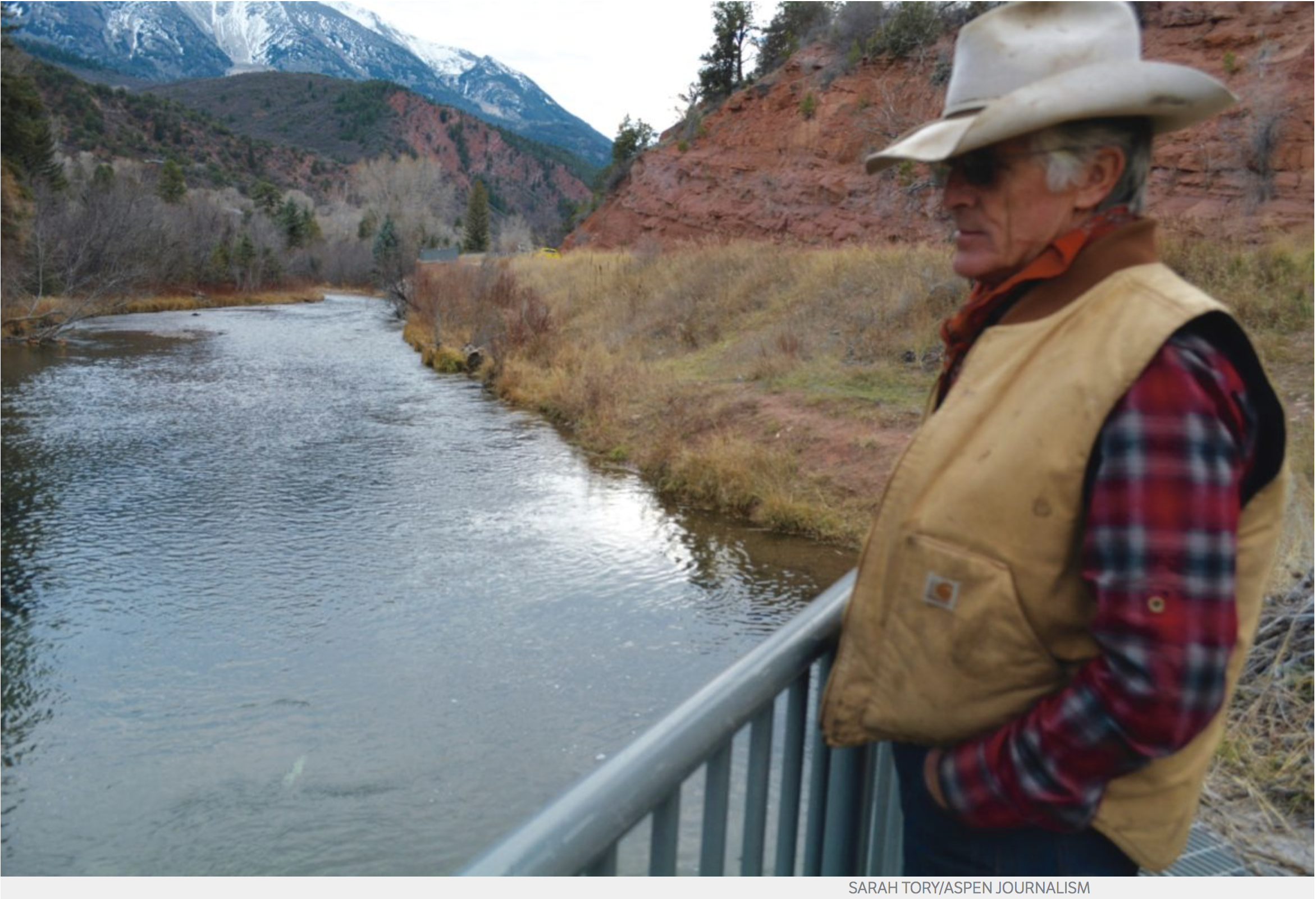
Bill Fales pictured on his ranch overlooking the Crystal River. His property is one of the last handful of true operating ranches in Pitkin County.
Wary of bureaucracy
Cold Mountain Ranch is one of the few remaining working ranches in Pitkin County, and Fales always felt protective of the land’s open space and agricultural value. To protect his property from development, he sold a conservation easement on the entire ranch in 2009 to Pitkin County and the Colorado Cattlemen’s Agricultural Land Trust. Under the terms of the easement, the water rights that came with the ranch could not be sold separately from the land.
When it came to water conservation initiatives, however, the West’s system of private water rights often clashed with environmental priorities. That was true of the Crystal River valley, as well. When the Colorado Water Trust first put out the call to local farmers and ranchers in 2012 — a dry year — asking if they would be willing to lease some of their water for the river’s benefit, most of them, including Fales, were wary of the bureaucracy involved in the arrangement.
“It took away your whole ability to make decisions — they’d come and shut off your headgate at one of two predetermined dates,” he said.
Still, Fales knew that ranchers and farmers — and their senior water rights — had an important role to play in helping the Crystal, especially during times of drought.
The Colorado Water Conservation Board (CWCB) has an environmental instream flow right on the Crystal for 100 cubic feet per second from May 1 to Sept. 30 and for 60 cfs from Oct. 1 to April 30. The water right dates from 1975, far lower in priority than the major agricultural water rights on the Crystal — and thus of little to no benefit. During drier years, the river regularly drops well below 100 cfs.
Since most ranchers in the Crystal River valley were uninterested in a formal water-leasing arrangement offered by the state, the Water Trust devised another more flexible option, requiring no filings in water court. The arrangement allowed irrigators to let water flow past their headgates to benefit the Crystal’s flows during dry periods.
When the Water Trust advertised the program to ranchers in the Crystal River valley in spring 2016, Fales was the first to volunteer. They settled on a target flow of 40 cfs, which the recently completed stream management plan showed was an important indicator for river health and also a realistic goal for ranchers.
Fales planned to use his water right on the Helms Ditch, which includes an original right for 2.93 cfs with an appropriation date of 1899 and an enlargement right for 3.07 cfs dating to 1924. He irrigates about 100 acres with the water right.
If the river fell below 40 cfs, Fales would decide if he could turn off the headgate for a short period of time and in exchange, the Water Trust would pay him $175 per cfs of water left in the river per day.
Fales isn’t sure how much water he would be able to leave in the river, as it depends on the time of year and his irrigation demands.
However, an application for “approval of a water conservation program” prepared in December 2016 in anticipation of it being submitted to the Colorado River District, which has the ability to approve such programs, did set parameters on the effort. It said Fales could choose to leave up to 6 cubic feet per second of water in the river at a time, for up to 45 days between July 1 and Sept.30, and up to 535 acre-feet a year overall.
The application says “the exact amount of water in any year to be conserved will vary based on Cold Mountain Ranch’s discretion, river calls, and hydrologic conditions.”
The draft application, which was never formally submitted to the River District, has a footnote observing that “the River District recognizes the precise quantification of water savings may be difficult or impossible” and that “estimates and a description of the method of estimation are sufficient.”
Whatever amount of water is left in the river would flow downstream for at least two miles without a chance of it being diverted by another structure.
And Fales hopes that after a week or two of his not diverting water, other irrigators might step up and turn down their headgates, too, so that collectively they could help the river without causing undue burden on any one rancher.
For Fales, volunteering for the program felt important in another way, as well.
“Putting our head in the sand is not a solution,” he said. “If we don’t come up with something ourselves, the state will tell us what to do or the Front Range will come knocking.”
One of three irrigation ditches that delivers water from the Crystal River to Bill Fales’ Cold Mountain Ranch. Fales owns some of the most senior water rights on the river, which he hopes he can use to help improve its flow during dry periods.
A map provided as part of an application for the water conservation program at Cold Mountain Ranch to the Colorado River District, from December 2016. Source: Colorado Water Trust
Confusing signs from county
In fall 2016, Fales presented his proposal to reduce his water for the purpose of boosting flows in the Crystal River to the Colorado Cattlemen’s Agricultural Land Trust and Pitkin County officials, who both have a stake in the conservation easement on his ranch. The land trust offered a few amendments, but was otherwise on board. Pitkin County, however, was less enthusiastic.
“I thought they’d give me a big kiss and a hug,” Fales said. “They have their Healthy Rivers and Streams program whose goal was to put water back in the river — which they’ve never done — and now we’d finally be able do that.”
Unbeknownst to Fales, the county had become increasingly protective of agricultural water rights on properties with conservation easements — especially the county attorney, John Ely, the architect of Pitkin County water policy.
He saw all sorts of interests pulling at the Western Slope’s water, from climate change to dramatic growth along the Front Range to Colorado’s legal obligations to deliver a certain amount of water from the Colorado River to other states like Arizona and California. There also was Colorado’s own water laws, which encourage water to be used — anywhere. Already, water from Pitkin and Garfield counties’ Roaring Fork River was diverted hundreds of miles across the mountains to Aurora and Colorado Springs.
“We clearly recognize that if water rights disappear from here then our land has a real possibility of drying up and the water will be used somewhere else,” Ely said.
For Ely, senior agricultural water rights protected much of the county’s water from getting diverted over the Continental Divide. The flip side, of course, is that the agricultural diversions are drying up sections of these rivers.
Still, when it came to water rights, Ely did not want to take any risks — even small ones. Although the conservation easement on the Cold Mountain Ranch allows the owner to temporarily reduce their water for the purpose of maintaining or improving streamflows, Fales’ proposal with the Water Trust was too informal for Ely’s taste.
Under state water law, only the CWCB has the authority to keep water destined for the environment in the river, but Fales and the Water Trust had bypassed the state in crafting their agreement.
Ely feared that another water user would claim the water Fales left in the Crystal. And he worried, too, that if Fales kept producing the same amount of alfalfa with less water, his water rights could one day be diminished in water court under the “use it or lose it” principle. This was especially concerning to Ely because the county had paid $7.5 million for the conservation easement on Cold Mountain Ranch.
“One of our central concerns was once the water was in the river there was no mechanism to keep it there,” Ely said. “If you’re preserving agricultural property, you’re not preserving much if you don’t have the water that goes with it.”
In response to Ely’s concerns, Fales and Zach Smith, the Water Trust lawyer who put together the Cold Mountain Ranch proposal, solicited the input of various environmental organizations and water policy experts to find out if the water Fales left in the Crystal would help the river.
And crucially, was Fales imperiling the Cold Mountain Ranch water rights that Pitkin County had invested in?
Smith and Fales received responses from Trout Unlimited, the Aspen Valley Land Trust, and the Colorado Division of Water Resources.
All of those contacted were in favor of the proposal and saw no problem with regard to Fales’ water rights and his making an application to the River District seeking approval for it.
“Once approved by the River District the plan will protect the Helms Ditch right from abandonment, diminution of historical consumptive use, and any assertion of waste,” Alan Martellaro, the Division 5 engineer at the Colorado Division of Water Resources, wrote in an email to Ely on January 11, 2017. “I believe the application is a simple, good first step toward balancing agricultural and ecological river needs in the Crystal River valley desired by the Water Trust and Bill Fales.”
Meanwhile, Fales, Smith, and Pitkin County officials began meeting to try to resolve their disagreements over the proposal. John Currier, the chief engineer at the Colorado River District, attended one of the meetings.
“I don’t think it’s risky at all from a water-rights protection perspective,” Currier later said. He conceded, however, that someone could, in the future, argue that Fales had been wasting his water if he continued to grow the same amount of alfalfa with less water. The risk, he said, was remote.
The whole ordeal has left Fales feeling frustrated and confused.
“We’re supposed to be one of the most environmentally minded counties, so to say to farmers that they should maximize their diversions is really bizarre,” he said.
In search of a new arrangement
Fales, the Water Trust, and Pitkin County officials continued to meet in the hopes of resolving their differences about the Cold Mountain Ranch proposal. After all, they wanted the same thing: more water in the river.
Although they’re still sorting out the details, Fales, Ely, and the Water Trust are optimistic the new arrangement will satisfy both parties: Instead of reducing his water use, the Water Trust will pay Fales to coordinate the timing of his irrigation diversions with the river’s needs so that he turns down his headgate when the Crystal is running low and back on again when the river is flowing well.
Dale Will believes a successful agreement could ripple throughout the area. Will is acquisition and special projects director at the Pitkin County Open Space and Trails program, and the program’s former director.
“That’s why everyone is focused on Cold Mountain Ranch,” Will said. “Not because Bill [Fales] by himself can solve the problem, but because if they can make his proposal work, they can expand it to our other agricultural land.”
Editor’s note: Aspen Journalism is covering rivers and water in collaboration with the Glenwood Springs Post Independent, The Aspen Times, the Vail Daily, and the Summit Daily News. The story was published on Tuesday, Jan. 2, 2017 by the Post Independent and The Times.