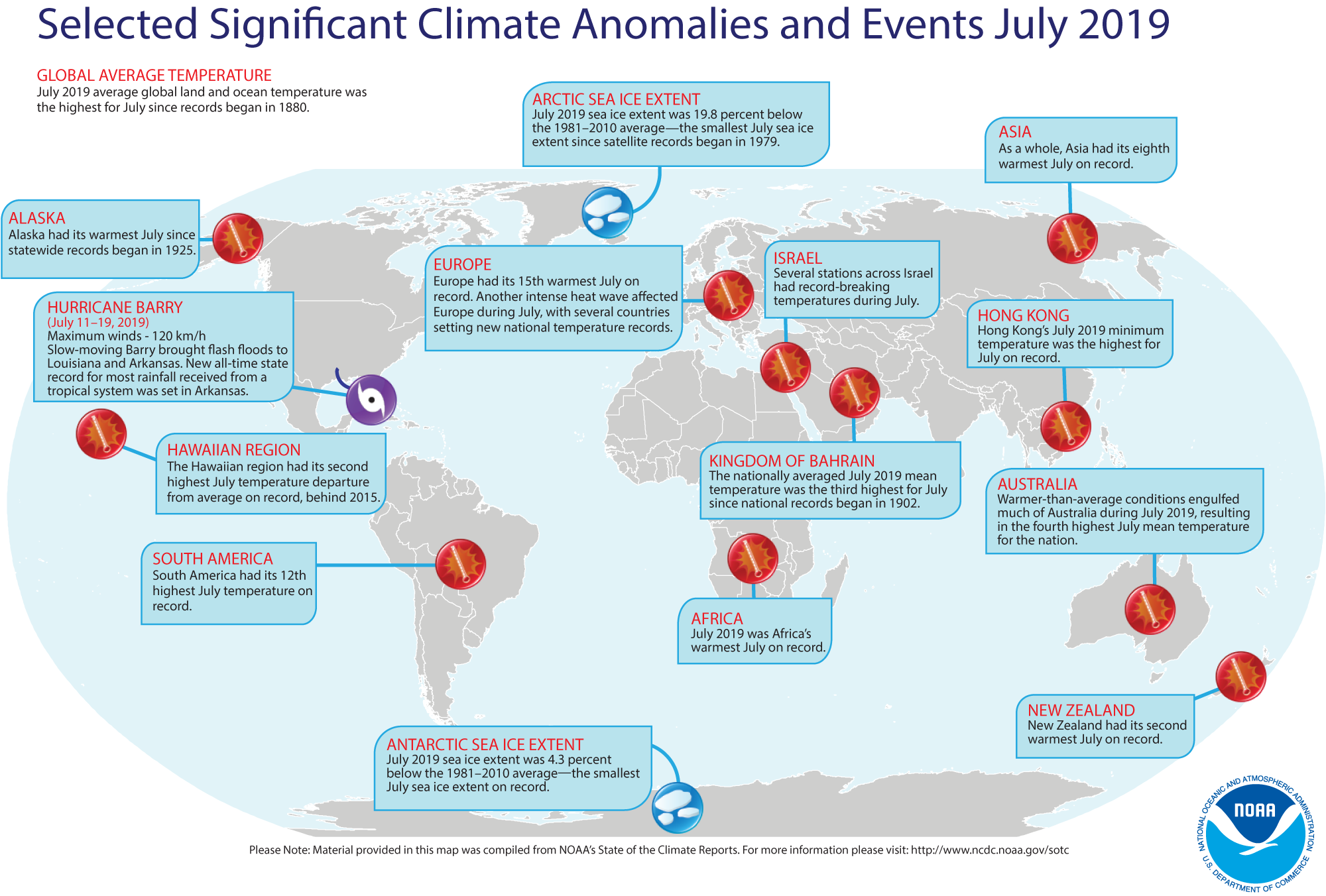
@NOAA: “[July 2019] Warmest month overall in the 140-year NOAA global temperature dataset record” #ActOnClimate

From NOAA:

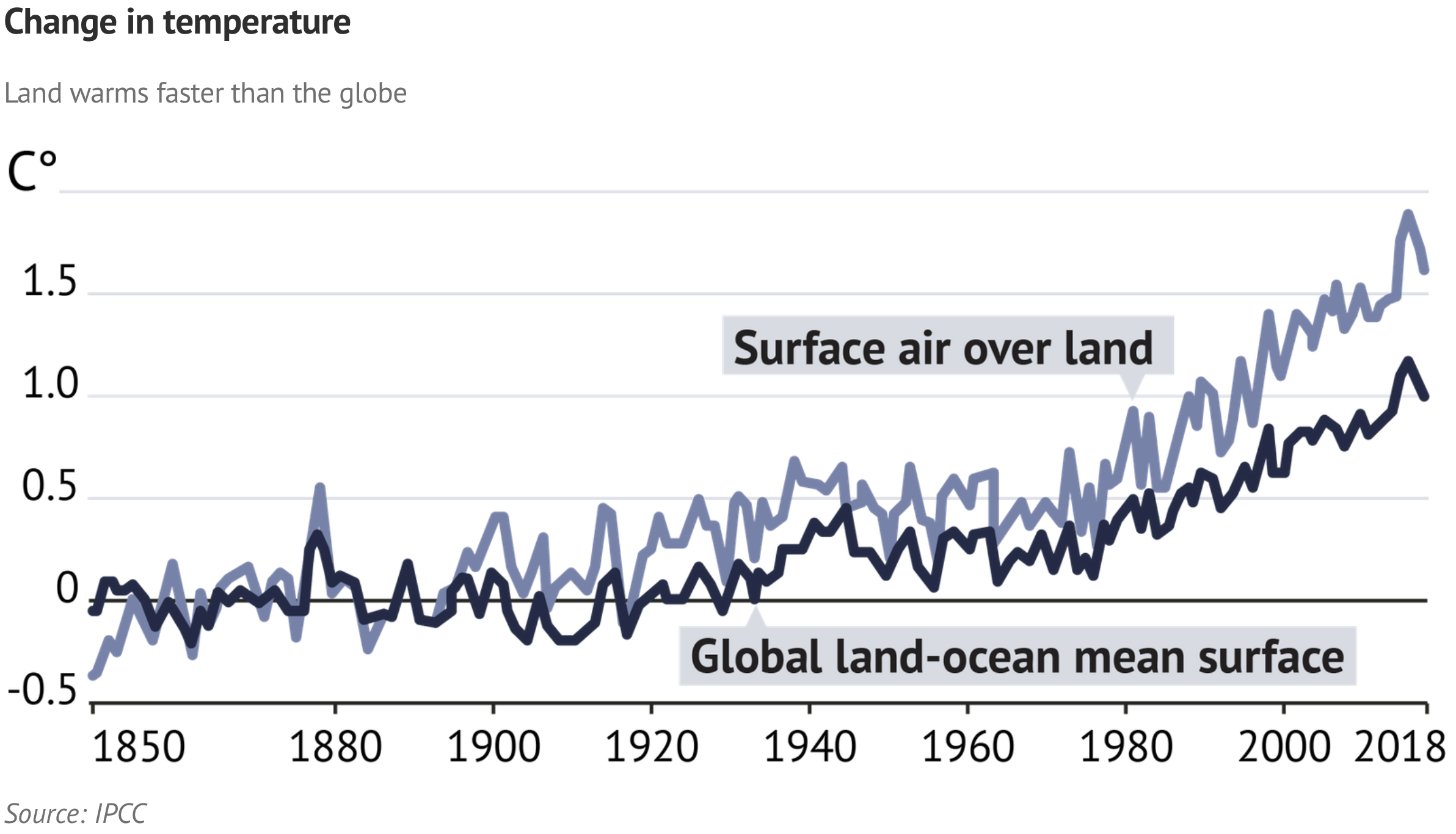
The global land and ocean surface temperature departure from average for July 2019 was the highest for the month of July, making it the warmest month overall in the 140-year NOAA global temperature dataset record, which dates back to 1880. The year-to-date temperature for 2019 tied with 2017 as the second warmest January–July on record.

This monthly summary, developed by scientists at NOAA National Centers for Environmental Information, is part of the suite of climate services NOAA provides to government, business, academia, and the public to support informed decision-making.

July 2019 Temperature

  • The July temperature across global land and ocean surfaces was 1.71°F above the 20th century average of 60.4°F and was the highest for July in the 1880–2019 record. July 2019 bested the previous record—set in 2016—by 0.05°F.
    • Nine of the 10 warmest Julys have occurred since 2005, with the last five years (2015–2019) being the five warmest Julys on record. July 1998 is the only value from the previous century among the 10 warmest Julys on record.
    • Climatologically, July is the globe’s warmest month of the year. With July 2019 being the warmest July on record, at least nominally, this resulted in the warmest month on record for the globe.
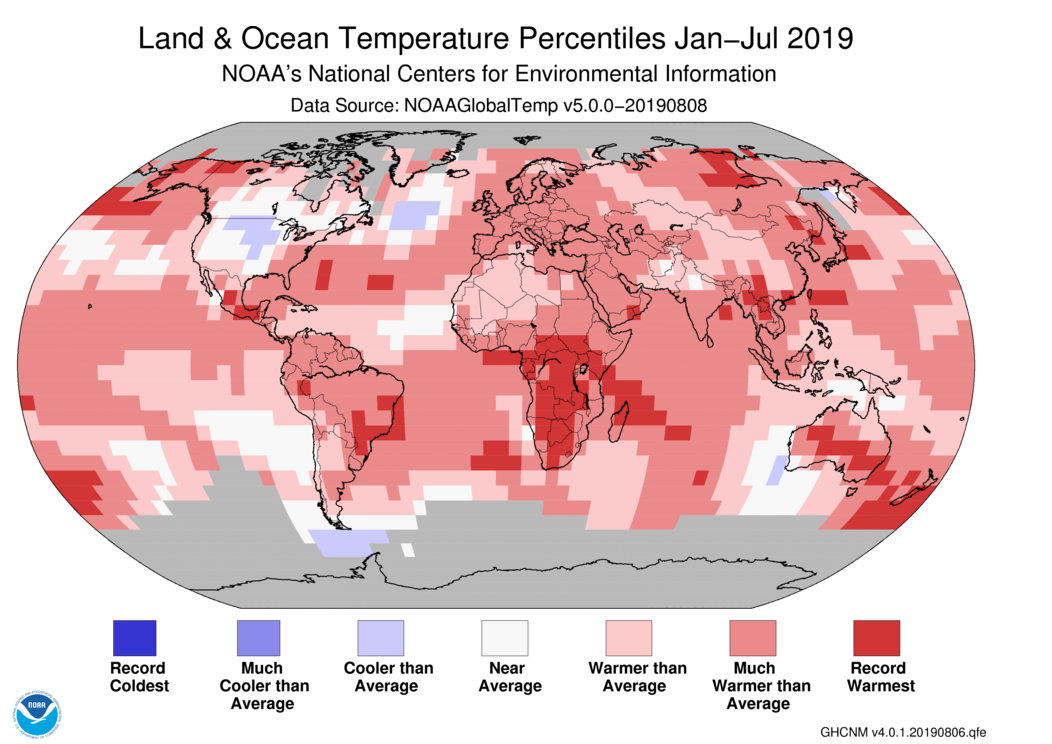
    • Record warm July temperatures were present across parts of North America, southern Asia, southern Africa, the northern Indian Ocean, and the Atlantic Ocean, as well as across the western and northern parts of the Pacific Ocean. No land or ocean areas had record cold July temperatures.
  • The July globally averaged land surface temperature was 2.21°F above the 20th century average of 57.8°F and the second-highest July land temperature in the 140-year record. July 2017 holds the record for the highest July global land temperature departure from average at 2.23°F.
    • The most notable warm temperature departures from average were present across Alaska, central Europe, northern and southwestern parts of Asia, and parts of Africa and Australia, where temperatures were at least 2.7°F above the 1981–2010 average or higher. The most notable cooler-than-average temperatures were present across parts of Scandinavia and western and eastern Russia, where temperatures were at least 2.7°F below average or cooler.
    • Regionally, North America, Africa, Asia, Oceania, the Hawaiian region, the Caribbean region, and the Gulf of Mexico had a July temperature departure from average that ranked among the 10 warmest Julys on record. Of note, Africa had its warmest July at 2.97°F, besting the previous record set in 2015 by 0.32°F.
  • The July globally averaged sea surface temperature was 1.51°F above the 20th century monthly average of 61.5°F and the highest global sea surface temperature for July on record. Compared to all months, this value tied with September 2015 as the sixth highest monthly global ocean temperature departure from average among all months (1,675 months) on record. The 10 highest global ocean monthly temperature departures from average have all occurred since September 2015.

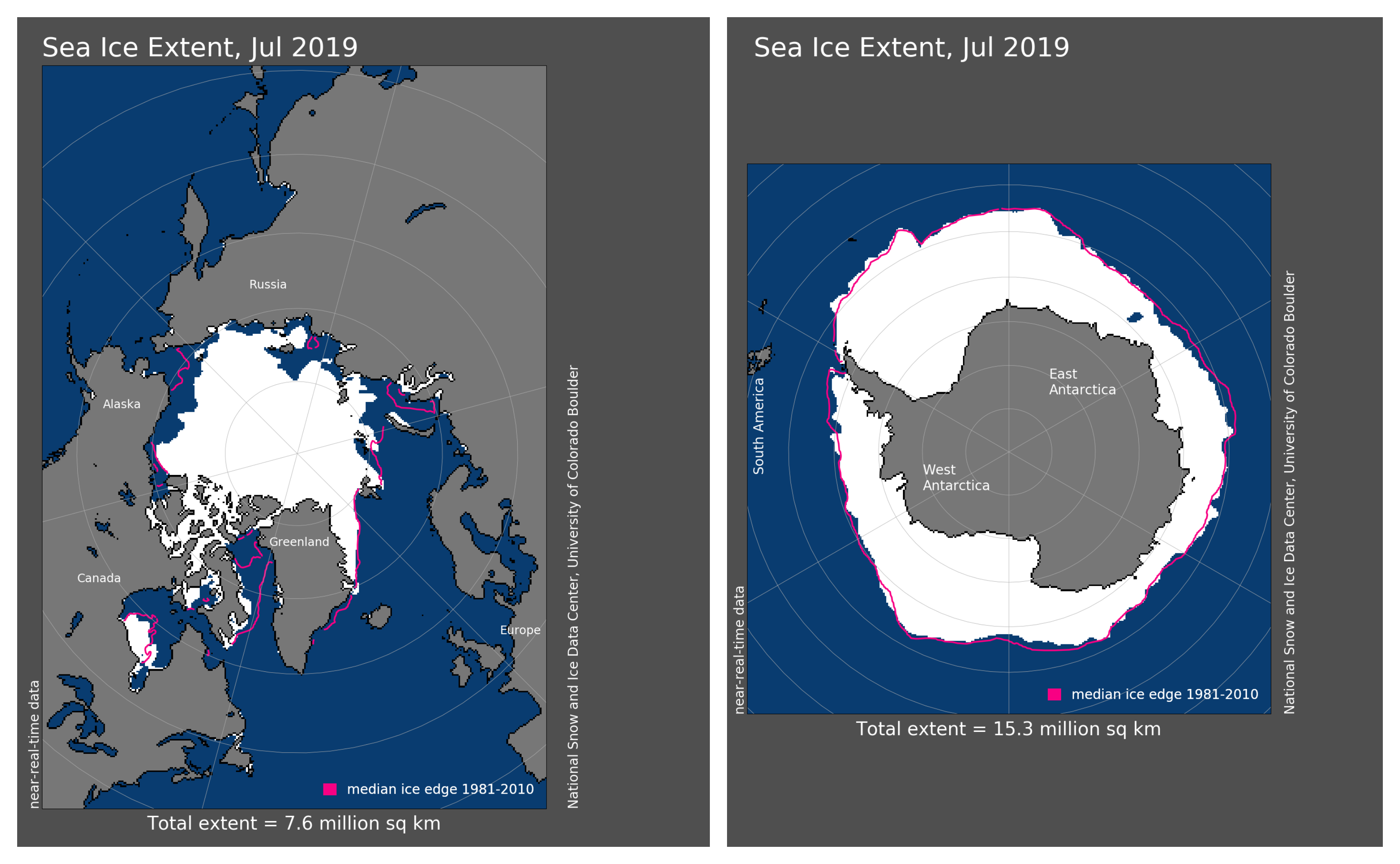
  • The Arctic sea ice extent set a record low for July at 726,000 square miles (19.8%) below the 1981–2010 average and 30,900 square miles below the now second-lowest July sea ice extent set in 2012, according to an analysis by the National Snow and Ice Data Center using data from NOAA and NASA. During July 2019, sea ice loss occurred at an average rate of 40,800 square miles per day, surpassing the 1981–2010 average of 33,500 square miles. Only seven other years (1990, 1991, 2007, 2009, 2013, 2015, and 2018) had a daily rate of sea ice loss exceeding 38,600 square miles.
  • The July 2019 Antarctic sea ice extent was 260,000 square miles (4.3%) below the 1981–2010 average and was the smallest July extent in the 41-year record. This value is slightly below the previous record set in 2017 (250,000 square miles).

Year-to-date (January–July 2019)

  • The year-to-date temperature across global land and ocean surfaces was 1.71°F above the 20th century average of 56.9°F — tying with 2017 as the second highest for January–July in the 140-year record. Only January–July 2016 (+1.96°F) was warmer.
    • The most notable warm temperature departures from average were present across parts of the Northern Hemisphere, specifically Alaska, western Canada, and central Russia, where temperature departures from average were at least +3.6°F or higher. Meanwhile, the most notable cool temperature departures from average were present across much of the contiguous United States and southern Canada, where temperatures were at least 1.8°F below average or cooler.
    • Record warm January–July temperatures were present across the southern half of Africa and parts of North America, South America, Asia, Australia, New Zealand and its surrounding ocean, as well as parts of the western Pacific Ocean, Atlantic Ocean, and western Indian Ocean. No land or ocean areas had record cold temperatures during January–July 2019.
    • Regionally, South America, Europe, Africa, Asia, and Oceania had a January–July temperature that ranked among the five highest such periods on record, with South America and Oceania having their second warmest year-to-date on record.
  • The year-to-date globally averaged land surface temperature was 2.63°F above the 20th century average of 46.8°F. This value was the third highest for January–July on record, behind 2016 (+3.20°F) and 2017 (+2.74°F).
  • The year-to-date globally averaged sea surface temperature was the second highest for January–July in the 1880–2019 record at 1.37°F above the 20th century average of 61.0°F. Only July 2016 (+1.49°F) was warmer.
This Tasty Seaweed Reduces Cow Emissions by 99%—and It Could Soon Be a Climate Gamechanger — Good News Network #ActOnClimate #WeCanFixIt

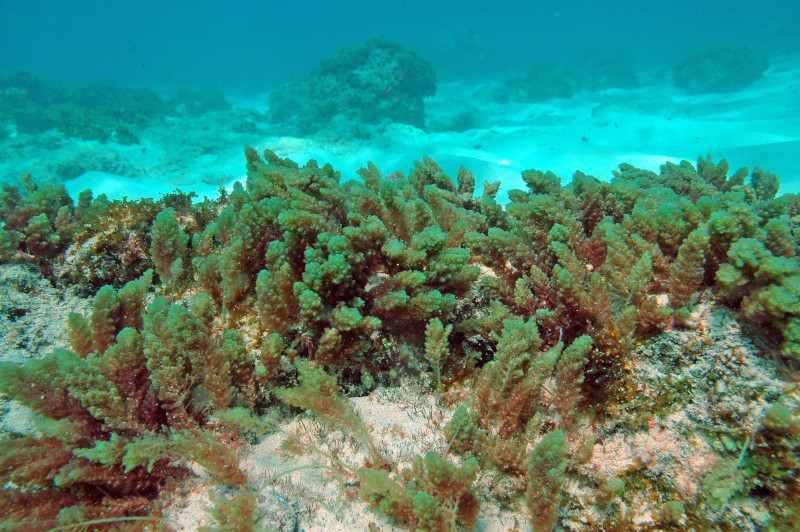
Asparagopsis taxiformis, (limu kohu) formerly A. sanfordiana, is a species of red algae, with cosmopolitan distribution in tropical to warm temperate waters By Jean-Pascal Quod – The uploader on Wikimedia Commons received this from the author/copyright holder., CC BY-SA 3.0, https://commons.wikimedia.org/w/index.php?curid=33353890

From The Good News Network:

A puffy pink seaweed that can stop cows from burping out methane is being primed for mass farming by Australian researchers.

The particular seaweed species, called Asparagopsis, grows prolifically off the Queensland Coast, and was the only seaweed found to have the effect in a study five years ago led by CSIRO. Even a small amount of the seaweed in a cow’s diet was shown to reduce the animal’s gases by 99%.

Associate Professor Nick Paul, who is the leader of the Seaweed Research Group at the University of the Sunshine Coast (USC), said that if Australia could grow enough of the seaweed for every cow in the nation, the country could cut its greenhouse gas emissions by 10%.

“Seaweed is something that cows are known to eat. They will actually wander down to the beach and have a bit of a nibble,” Dr. Paul said.

“When added to cow feed at less than 2% of the dry matter, this particular seaweed completely knocks out methane production. It contains chemicals that reduce the microbes in the cows’ stomachs that cause them to burp when they eat grass.”

The USC team is working at the Bribie Island Research Centre in Moreton Bay to learn more about how to grow the seaweed species, with the goal of informing a scale-up of production that could supplement cow feed on a national—and even global scale.

“This seaweed has caused a lot of global interest and people around the world are working to make sure the cows are healthy, the beef and the milk are good quality,” Dr. Paul said.

“That’s all happening right now. But the one missing step, the big thing that is going to make sure this works at a global scale, is to make sure we can produce the seaweed sustainably.

Putting safety on the shelf … literally — News on TAP

Family photos push an important message to work safely each and every day. The post Putting safety on the shelf … literally appeared first on News on TAP.

via Putting safety on the shelf … literally — News on TAP

@USBR Announces 2020 #ColoradoRiver Operating Conditions #LakeMead #LakePowell #COriver #DCP #aridification

Lake Mead December 2017. Photo credit: Greg Hobbs

From Grist (Nathanael Johnson):

For the first time in history, low water levels on the Colorado River have forced Arizona, Nevada, and Mexico to cut back the amount of water they use. It’s the latest example of climate change affecting daily life, but also an encouraging sign that people can handle a world with less: These orderly cutbacks are only happening because seven U.S. states and Mexico had agreed to abide by conservation rules when flows subside, rather than fight for the last drops.

“It is a new era of limits,” said Kevin Moran, who directs the Environmental Defense Fund’s Colorado River efforts…

A Bureau of Reclamation study of Colorado River levels, released Thursday, triggered the cutbacks. The Rocky Mountains finally turned white with heavy snow last winter, but despite a galloping spring runoff, drought persists and bathtub-ringed reservoirs in the Grand Canyon are low. In its study, the Bureau highlighted the unique circumstances: “This 20-year period is also one of the driest in the 1,200-year paleo record.”

Rising temperatures brought on by rising carbon emissions are partly to blame. “Approximately one‐third of the [Colorado River] flow loss is due to high temperatures now common in the basin, a result of human caused climate change,” wrote scientists Brad Udall and Jonathan Overpeck in a study published in 2017 that anticipated water will only become scarcer in the future.

But these water-use reductions are also an example of people binding themselves to rules to deal with scarce resources, rather than going to court, or war. The cutbacks come from an agreement hammered out by the Southwestern states and Mexico to impose limits on themselves.

“It’s not necessarily well known or talked about, but this collaboration between the states and Mexico is one of the most successful cross-border water management stories in the world,” Moran said.

From the Associated Press (Felicia Fonseca) via The Las Vegas Sun:

Arizona and Nevada are faced with the first-ever cuts to their Colorado River water supply in 2020.

But the cuts aren’t expected to be overly burdensome for either state because they’ve been conserving and storing water for years…

Arizona will leave 7% of its allocation in Lake Mead under a drought plan approved earlier this year by several states that rely on the river. Nevada will leave 3%.

Mexico also gives up 3% under a separate accord.

The states and Mexico can recover the water if Lake Mead rises to a certain level.

Lake Mead, behind Hoover Dam, shows the effects of nearly two decades of drought. (Image: Bureau of Reclamation)

From The Nevada Independent (Daniel Rothberg):

The decision to implement those cuts came on Thursday after federal water managers released a study that serves as a key benchmark for Southwest states. That forecast predicted that Lake Mead would start 2020 at 1089.4 feet above sea level, below the 1090-foot trigger for the cuts.

By forgoing water in dry years, the states store more water in Lake Mead, a reservoir that has decreased over the past two decades because of overuse, drought and climate change. If the reservoir drops further, states would be required to take more cuts to their allotment. When reservoir levels rise, the states are allowed to access the stored water for future use.

In practice, the cuts will have no effect on Nevada’s short-term water security or water management. The Southern Nevada Water Authority is expected to voluntarily conserve about nine times more water this year than the required cuts under the drought plan in 2020. Since 2003, Nevada has used less water than what the state is allowed to take under the river’s interstate compact.

In 2017, the state used about 80 percent of its allotment, largely in part because of indoor water recycling and conservation programs that incentivize removing grass. This year the water authority is on track to use even less. That means Nevada is likely to leave substantially more water in the reservoir this year — as much as 75,000 acre-feet — than what is required by the cuts — about 8,000 acre-feet — next year. (An acre-foot is an agricultural term for the amount of water that can fill an acre to a depth of one foot. Nevada’s allocation is 300,000 acre-feet).

Bronson Mack, a water authority spokesman, said that the agency has cut its Colorado River water use by 25 percent since 2002, even as Las Vegas’ population has grown by 40 percent…

But the cuts are still significant, said John Fleck, a University of New Mexico professor who has a forthcoming book, “Science Be Dammed,” that looks at the history, politics and hydrology of the river. They mark the first time the states have been required to use less than their allocation…

It is also a recognition of a future where there is expected to be less — not more — water to go around. Even though above-average levels of snow fell across much of the West this year, the long-term trend in the Colorado River is toward declining streamflow. Research has found that high temperatures have made runoff less efficient. Scientists say that climate change could further reduce the river’s flow and make managing it more difficult, even as demands grow.

Heavy precipitation made a difference this year. When the U.S. Bureau of Reclamation released its 2019 forecast last year, the study predicted an official shortage in 2020. Water users avoided that declaration, although the federal water agency warned that they are not out of the clear.

Changes in the northeastern reaches of Lake Powell are documented in this series of natural-color images taken by the Landsat series of satellites between 1999 and 2017. The Colorado River flows in from the east around Mile Crag Bend and is swallowed by the lake. At the west end of Narrow Canyon, the Dirty Devil River joins the lake from the north. (At normal water levels, both rivers are essentially part of the reservoir.) At the beginning of the series in 1999, water levels in Lake Powell were relatively high, and the water was a clear, dark blue. The sediment-filled Colorado River appeared green-brown. To see the complete series go to: earthobservatory.nasa.gov/WorldOfChange/LakePowell. Photos via NASA

From The Colorado Sun (Jason Blevins):

“This is a big deal for everybody on the Colorado River system,” said Jim Pokrandt, the head of community affairs for the Glenwood Springs-based Colorado River Water District.

The study won’t have much of an impact on Colorado, where the Upper Basin Drought Contingency Plan has water users hammering out the details of “demand management.” Those details include asking for temporary, voluntary and compensated curtailment of water rights to build a bank of Colorado water in Lake Powell before mandatory cuts are imposed by the federal government.

Pokrandt said the dawning of mandatory cuts in the Lower Basin increases the urgency of demand-management talks in Colorado. Without a demand-management plan encouraging water users to volunteer their water rights in Colorado, the state could see mandatory cuts, where “nobody gets paid,” he said.

“The news from the Lower Basin is a reminder that 2019’s snowpack cannot give us a false sense of security,” Pokrandt said, recalling that Colorado’s super-snowy 2011 was followed by an exceptionally dry 2012. “This is a reminder of the importance of what the Upper Basin states have to do for their own Drought Contingency Plan.”

[…]

hat’s called demand management. Across Colorado, water districts and water users are studying whether demand management will work.

“Nobody knows if it will be feasible,” said Pokrandt, whose 15-county district spans the Western Slope, noting that the Colorado Water Conservation Board just launched its Demand Management Workshop to educate the state’s water users on the idea of temporarily suspending water rights for cash in order to build a bank of Colorado water in Lake Powell. “Determining feasibility will be a long process.”

Lake Powell will enter 2020 in the “Intentionally Created Surplus Condition,” which allows for the release of the usual 8.23 million acre-feet of water in 2020 to fill Lake Mead. It also means the Upper Basin states will increase their own banked storage in the reservoir, enabling them to better weather low-snow years with a protected cache of extra water.

Total storage in both reservoirs is 55% of capacity, compared with 49% at this time last year.

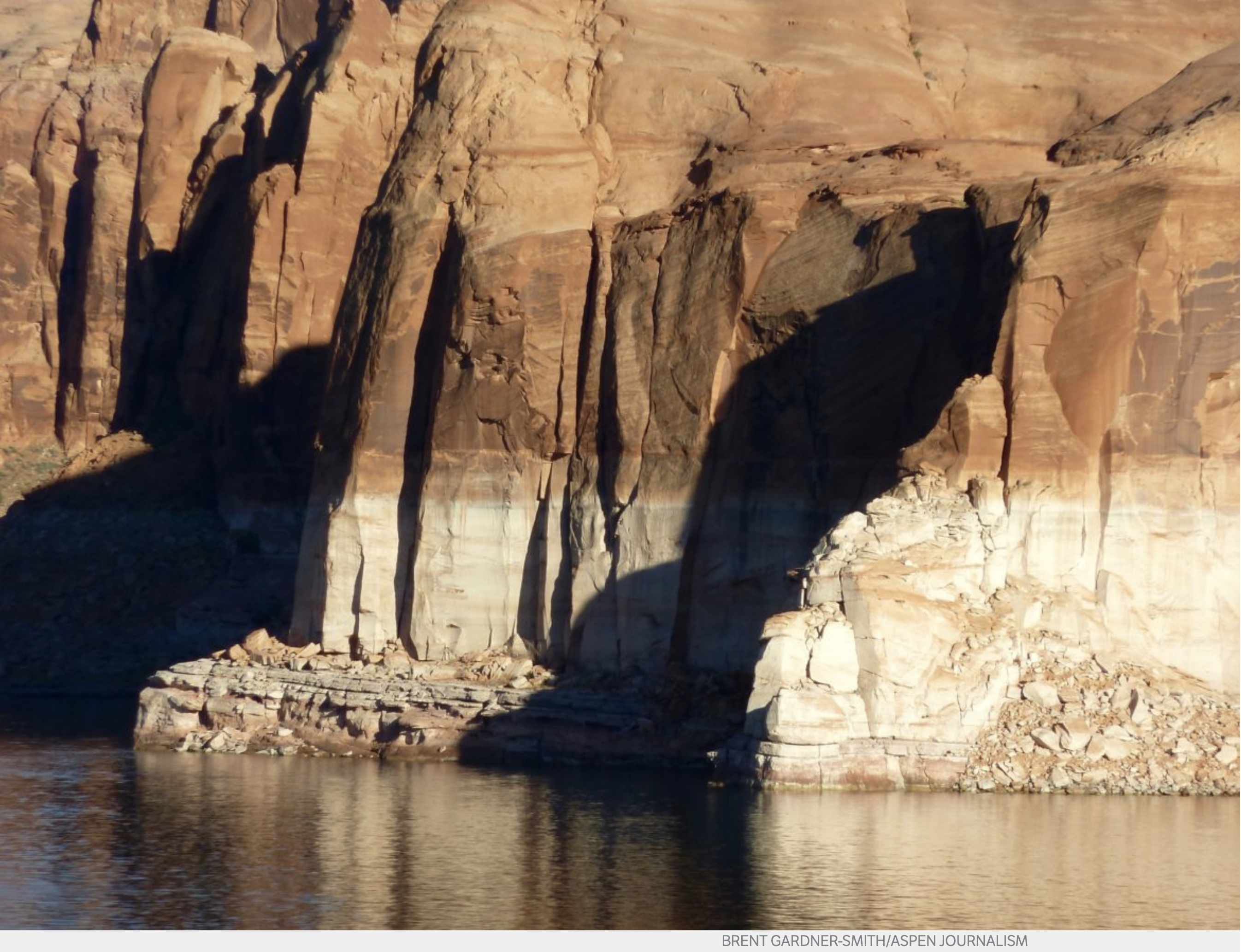
The bathtub ring in Lake Powell in October 2014. Today, the reservoir is under 40 percent full and water managers in Colorado, Utah, Wyoming and New Mexico are working on demand management programs that would reduce water use and send more water to the big reservoir that sits on the mainstem of the Colorado River. Photo credit: Brent Gardner-Smith/Aspen Journalism

Potentially harmful blue-green algae confirmed in multiple Colorado lakes — 9News.com

Sloans Lake at sunrise via Redbubble.com

From 9News.com (Caitlin Hendee):

Boulder residents are advised to keep their children and animals out of Wonderland Lake in north Boulder and a similar warning was issued for Quincy Reservoir in Aurora.

Sloan’s Lake is the only body of water in Denver that has tested positive for the algae. Signs are posted there warning people not to swim or wade in the lake, though health officials said they haven’t heard of anyone getting sick from it.

Thunderbird Lake in southeast Boulder also has reports of blue-green algae. Swimming and wading are not allowed there.

Blue-green algae is a bacteria found in non-flowing freshwater that can be fatal to animals if ingested. The algae naturally occurs in aquatic ecosystems and can appear rapidly – especially during the summer with hot weather and in slow-moving water bodies, such as lakes, according to the Colorado Department of Public Health and Environment…

According to the Colorado Department of Public Health and Environment, harmful algae blooms often have the following characteristics:

  • May look like thick pea soup or spilled paint on the water’s surface.
  • Can create a thick mat of foam along the shoreline.
  • Usually are green or blue-green, although they can be brown, purple or white.
  • Sometimes are made up of small specks or blobs floating just at or below the water’s surface
  • Blue-Green algae bloom

    Yes, your water utility is an Emmy-award winner! — News on TAP

    Denver Water documentary, ‘Written in Water,’ wins regional award for best historical documentary. The post Yes, your water utility is an Emmy-award winner! appeared first on News on TAP.

    via Yes, your water utility is an Emmy-award winner! — News on TAP

    Arizona Department of Water Resources statement on the Bureau of Reclamation’s August 24-month Study — Arizona Water News #ColoradoRiver #COriver #aridification

    PRESS RELEASE FOR IMMEDIATE RELEASE CONTACT: Doug MacEachern August 15, 2019 […]

    via Arizona Department of Water Resources statement on the Bureau of Reclamation’s August 24-month Study — Arizona Water News

    Eco-vandals shut down high country water diversions bound for the #FrontRange, causing $1 million in damage — @WaterEdCO

    From Water Education Colorado (Jerd Smith):

    Vandals caused an estimated $1 million worth of damage to the City of Northglenn’s collection system on top of Berthoud Pass earlier this month, shutting the system down for several days. As the Grand County Sheriff investigates, Northglenn water officials say they fear the damage is the work of eco-vandals, upset over ongoing diversions from the drought-stressed upper Colorado River to the Front Range.

    For years, the City of Northglenn has captured water on top of Berthoud Pass and delivered it down to its customers north of Denver.

    But on Aug. 2, when water should have been flowing freely, the reading on the measuring gauge on what’s known as the Berthoud Pass Ditch fell to zero. On investigation, the city found the system had been vandalized, with diversion structures torn apart and locks cut, allowing millions of gallons of water to flow back into the Fraser River, a tributary to the upper Colorado River, instead of Northglenn’s ditch.

    “It seemed very intentional,” said Tamara Moon, Northglenn’s manager of water resources. “They did a doozy on us.”

    Roughly $100,000 worth of damage was done to the diversion system, with another $900,000 in water lost, according to the Grand County Sheriff’s office.

    Lesser damage to the structure, part of which can be accessed off a hiking trail near the old Berthoud Pass ski area, occurred in March, Moon said.

    But she believes now that both efforts are linked to the political tension over transmountain diversions from the water-stressed upper Colorado River to the Front Range.

    Two major expansion projects, including an effort by Denver Water to bring more water from the Fraser River and one by Northern Water to bring over more from the upper Colorado River near Granby, have sparked major lawsuits by several environmental groups, including Save The Colorado, WildEarth Guardians and the Sierra Club, among others. The lawsuits are pending in court…

    Though Northglenn isn’t involved in either project, Moon said the fact that her city’s diversion system is pulling from the same watershed has likely exposed it to the frustration over the diversions.

    The week the system was disabled, Northglenn was delivering water to the City of Golden, one of its customers on the system.

    Golden lost several days’ worth of water as a result of the incident, but because its system, like most, has benefited from an abundance of water this year, the temporary cut-off didn’t affect the city’s ability to provide water to its own customers.

    “It really hasn’t had an impact on us,” said Anne Beierle, Golden’s deputy director of public works. “From our perspective though, it’s a little disconcerting and it’s disappointing. If it turns out to be [eco-vandalism], it is unfortunate.”

    The Grand County Sheriff’s office is still investigating the incident.

    Grand County, home to Winter Park and Granby, is also one of the most heavily diverted counties in Colorado, with millions of gallons of water from the upper Colorado and Fraser rivers being diverted to the Front Range to serve dozens of communities.

    “This was a purposeful, deliberate act,” said Lieutenant Dan Mayer, the Grand County Sheriff’s public information officer.

    The four diversion gates that were broken were roughly one-half mile apart, Mayer said. “Somebody wanted to break these gates. You had to [hike in to] find them.

    “We have a lot of water agencies running [water] out of here. But we haven’t seen any incidents like this at other systems. It makes it seem as if it could very well be some kind of eco-terrorism, and we would very much like to find out who did it.”

    Mayer said the charges any suspect would face include felony theft, felony criminal mischief, and first degree criminal tampering and trespass, all of which could result in significant jail time and fines.

    In addition to installing new diversion gates and locks, Northglenn’s Moon said the city is installing remote cameras in an effort to better monitor the site and to be able to identify the culprits should they return.

    “We don’t even have power up there,” she said. “There’s not a lot more we can do.”

    Jerd Smith is editor of Fresh Water News. She can be reached at 720-398-6474, via email at jerd@wateredco.org or @jerd_smith.

    View down Clear Creek from the Empire Trail 1873 via the USGS

    @USDA Using Flexibility to Assist Farmers, Ranchers in Flooded Areas #ActOnClimate

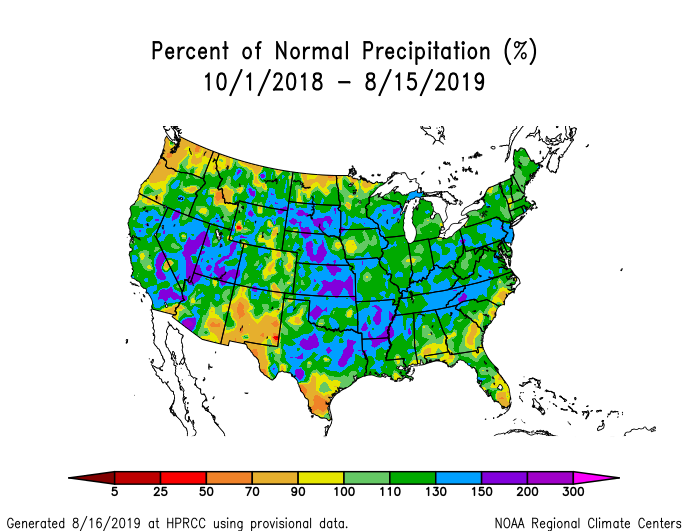
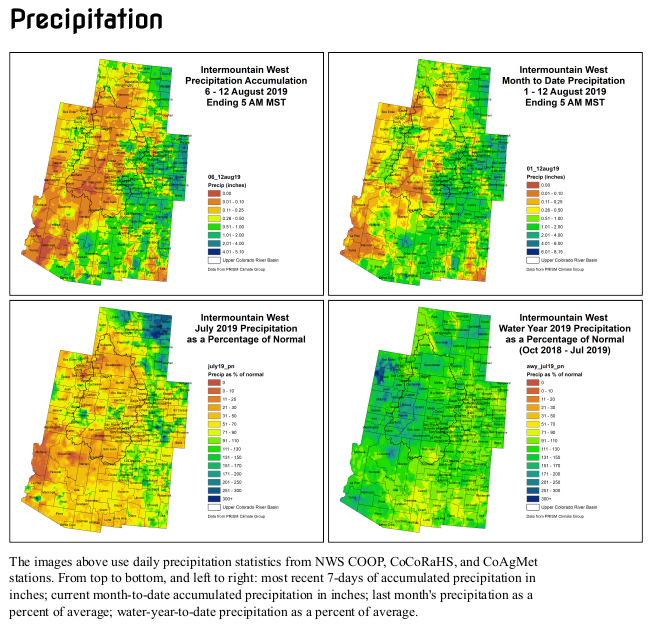
    Percent of normal precipitation Water Year 2019 via the Regional Climate Centers.

    Here’s the release from the USDA:

    The U.S. Department of Agriculture’s (USDA) Risk Management Agency (RMA) today announced it will defer accrual of interest for all agricultural producers’ spring 2019 crop year insurance premiums to help the wide swath of farmers and ranchers affected by extreme weather in 2019. Specifically, USDA will defer the accrual of interest on spring 2019 crop year insurance premiums to the earlier of the applicable termination date or for two months, until November 30, for all policies with a premium billing date of August 15, 2019. For any premium that is not paid by one of those new deadlines, interest will accrue consistent with the terms of the policy.

    “USDA recognizes that farmers and ranchers have been severely affected by the extreme weather challenges this year,” said U.S. Secretary of Agriculture Sonny Perdue. “I often brag about the resiliency of farmers but after a lifetime in the business, I have to say that this year is one for the record books. To help ease the burden on these folks, we are continuing to extend flexibility for producers with today’s announcement.”

    RMA Administrator Martin Barbre added, “This administrative flexibility is not unprecedented but is a move RMA takes seriously and only under special circumstances like we’re experiencing today. Growers typically have some crop harvested and cash flow to make their billing date, but with so many late planted crops, this year will be an anomaly.”

    America’s farmers and ranchers have been especially challenged throughout the 2019 crop year, struggling through severe flooding and excessive moisture conditions across the grain belt and in many other rural communities, with some areas also dealing with extreme heat and drought. Such weather conditions are expected to take a serious toll on acres planted, crop yields, and crop quality as harvest begins. One of the largest operating costs for producers is crop insurance premiums paid to their Approved Insurance Provider. Many spring crop insurance premiums are due to be paid before October 1.

    Without the interest deferral, policies with an August 15 premium billing date would have interest attach starting October 1 if premiums were not paid by September 30. Now, under the change, policies that do not have the premium paid by November 30 will have interest attach on December 1, calculated from the date of the premium billing notice.

    USDA announced Monday that U.S. farmers filed prevented planting claims on more than 19 million acres during the 2019 crop year. Earlier this summer, USDA announced a series of flexibilities to reduce stress on producers affected by weather, including: providing more time for cover crop haying and grazing by moving the start date from November 1 to September 1, 2019; allowing producers who filed prevented planting claims then planted a cover crop with a potential for harvest to receive a $15 per acre Market Facilitation Program payment; holding signups in select states for producers to receive assistance in planting cover crops; and extending the crop reporting deadline in select states. USDA also will provide producers with prevented planting acreage additional assistance, which will be announced in the coming weeks, through the Additional Supplemental Appropriations for Disaster Relief Act of 2019.

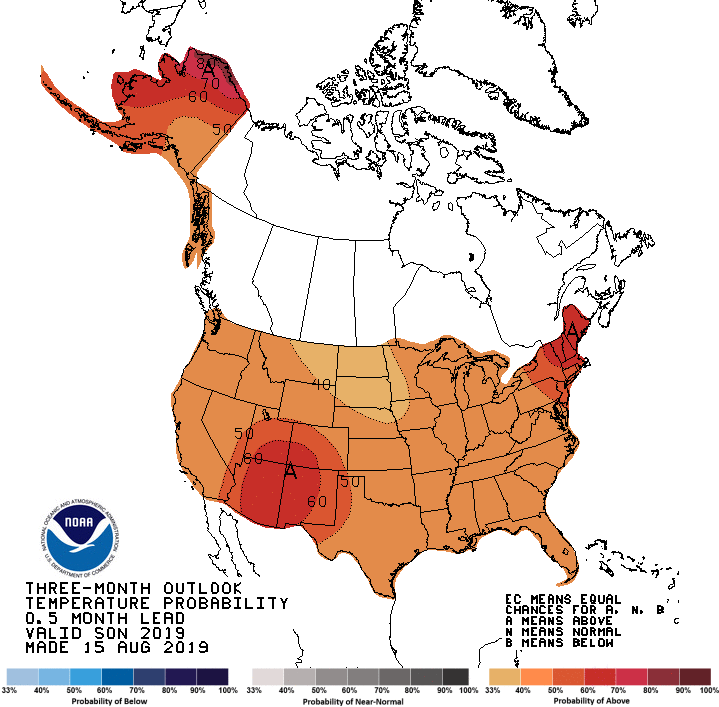
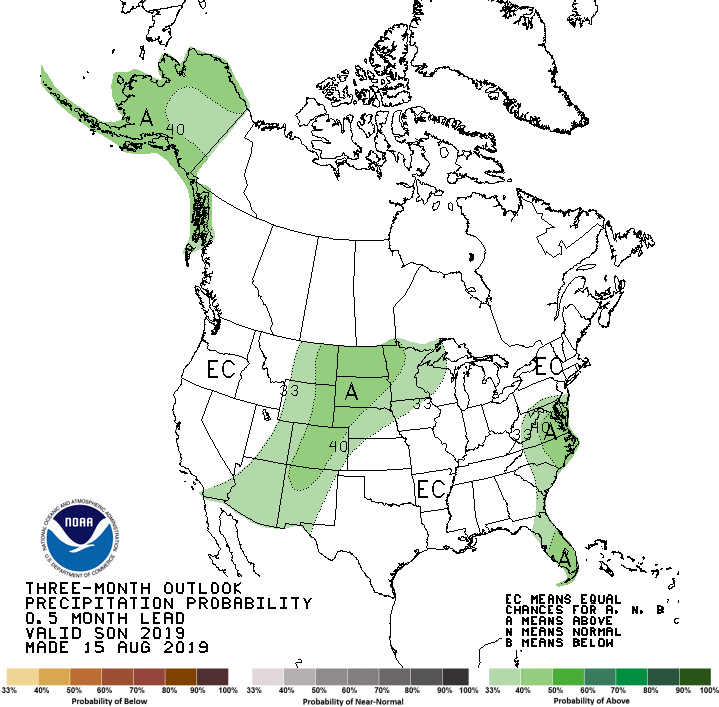
    The latest seasonal outlooks released from the Climate Prediction Center: Warmer, wetter that normal, #drought not expected to develop for the #ColoradoRiver Basin #COriver #aridification

    Seasonal temperature outlook through November 30, 2019 via the Climate Prediction Center.
    Seasonal precipitation outlook through November 30, 2019 via the Climate Prediction Center.
    Seasonal drought outlook through November 30, 2019 via the Climate Prediction Center.

    @USBR Announces 2020 #ColoradoRiver Operating Conditions: #LakeMead operations = Normal or ICS Surplus Condition in Calendar Year 2020, #LakePowell operations = Upper Elevation Balancing Tier in Water Year 2020 #DCP #COriver #aridification

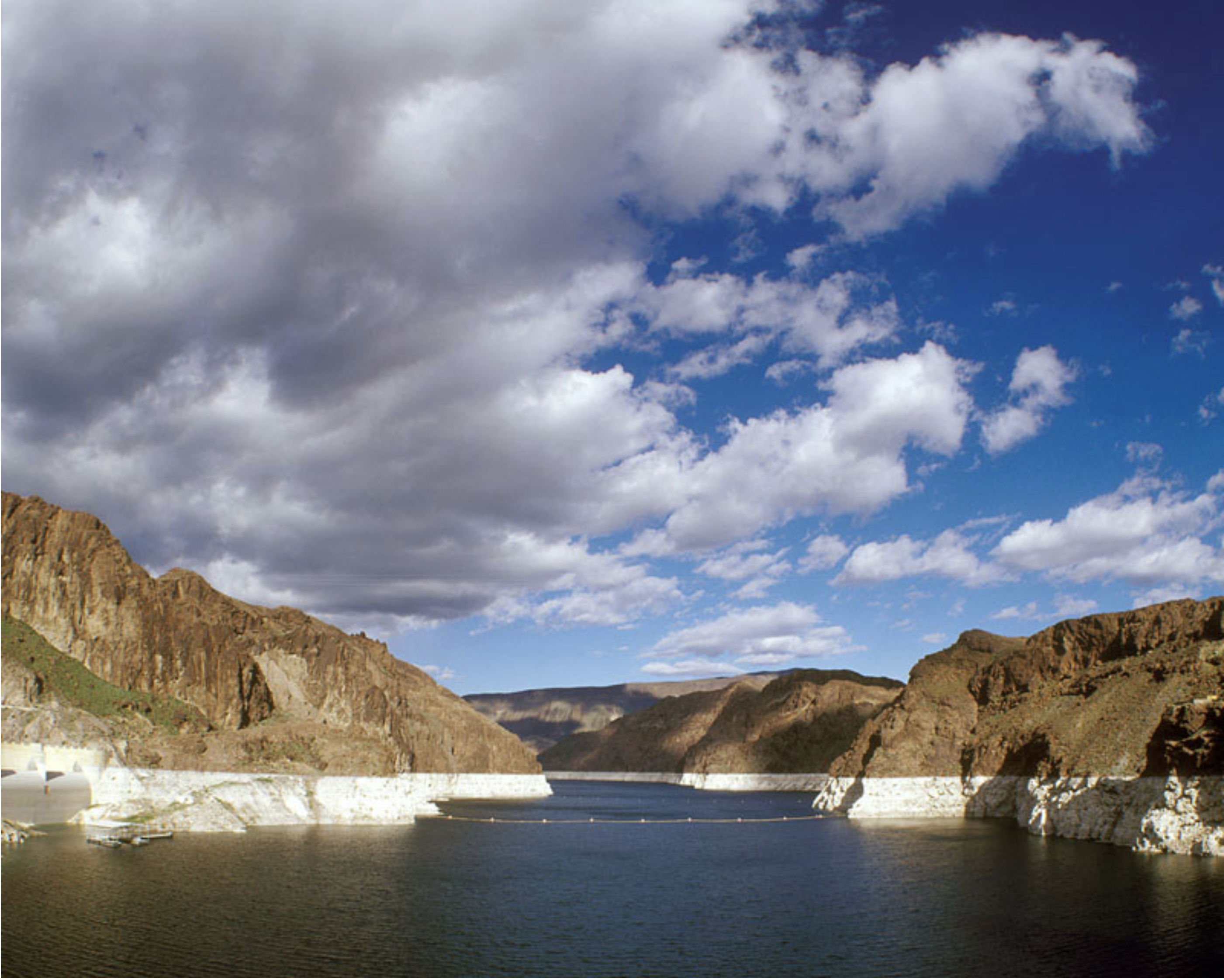
    Lake Mead. Photo credit: Bureaus of Reclamation

    Here’s the release from the Bureau of Reclamation (Patti Aron/Marlon Duke):

    The Bureau of Reclamation today released its Colorado River Basin August 2019 24-Month Study, which sets the annual operations for Lake Mead and Lake Powell in 2020. Based on projections in the 24-Month Study, Lake Mead will operate in the Normal or ICS Surplus Condition in Calendar Year 2020 and Lake Powell will operate in the Upper Elevation Balancing Tier in Water Year 2020 (October 1, 2019 through September 30, 2020).

    The Upper Basin experienced above average snowpack, and runoff was 145% of average this past spring, raising Lake Powell’s elevation by more than 50 feet since early April. Total Colorado River system storage today is 55% of capacity, up from 49% at this time last year. In addition, critical drought contingency plans adopted by the seven Basin States, federal government and Mexico earlier this year are now in place to reduce risks to the system.

    “While we appreciate this year’s above average snowpack, one good year doesn’t mean the drought is over. We must remain vigilant,” said Commissioner Brenda Burman. “I applaud everyone who came together this year to get the drought contingency plans done. The additional actions under the contingency plans will help ensure the reliability of the Colorado River system for the 40 million people dependent upon it.”

    The August 2019 24-Month Study projects Lake Mead’s January 1, 2020, elevation to be 1,089.4 feet, about 14 feet above the Lower Basin shortage determination trigger of 1,075 feet. Lake Powell’s January 1, 2020, elevation is projected to be 3,618.6 feet — 81 feet below full. Because Lake Mead is projected to begin the year below the drought contingency plans threshold of 1,090 feet, Arizona, Nevada and Mexico will make water savings contributions to Lake Mead in 2020.

    Despite the above average 2019 snowpack, the Colorado River Basin continues to experience its worst 20-year drought on record, dating back to 2000. This 20-year period is also one of the driest in the 1,200-year paleo record. The August 2019 24-Month Study can be found at https://www.usbr.gov/lc/region/g4000/24mo.pdf

    DCP’s Tier Zero Begins a New Era from the Central Arizona Project (Chuck Cullom):

    Today, the U.S. Bureau of Reclamation issued its August 24-Month Study Report, a two-year outlook projecting water supply and operating conditions in the Lower Colorado River Basin..

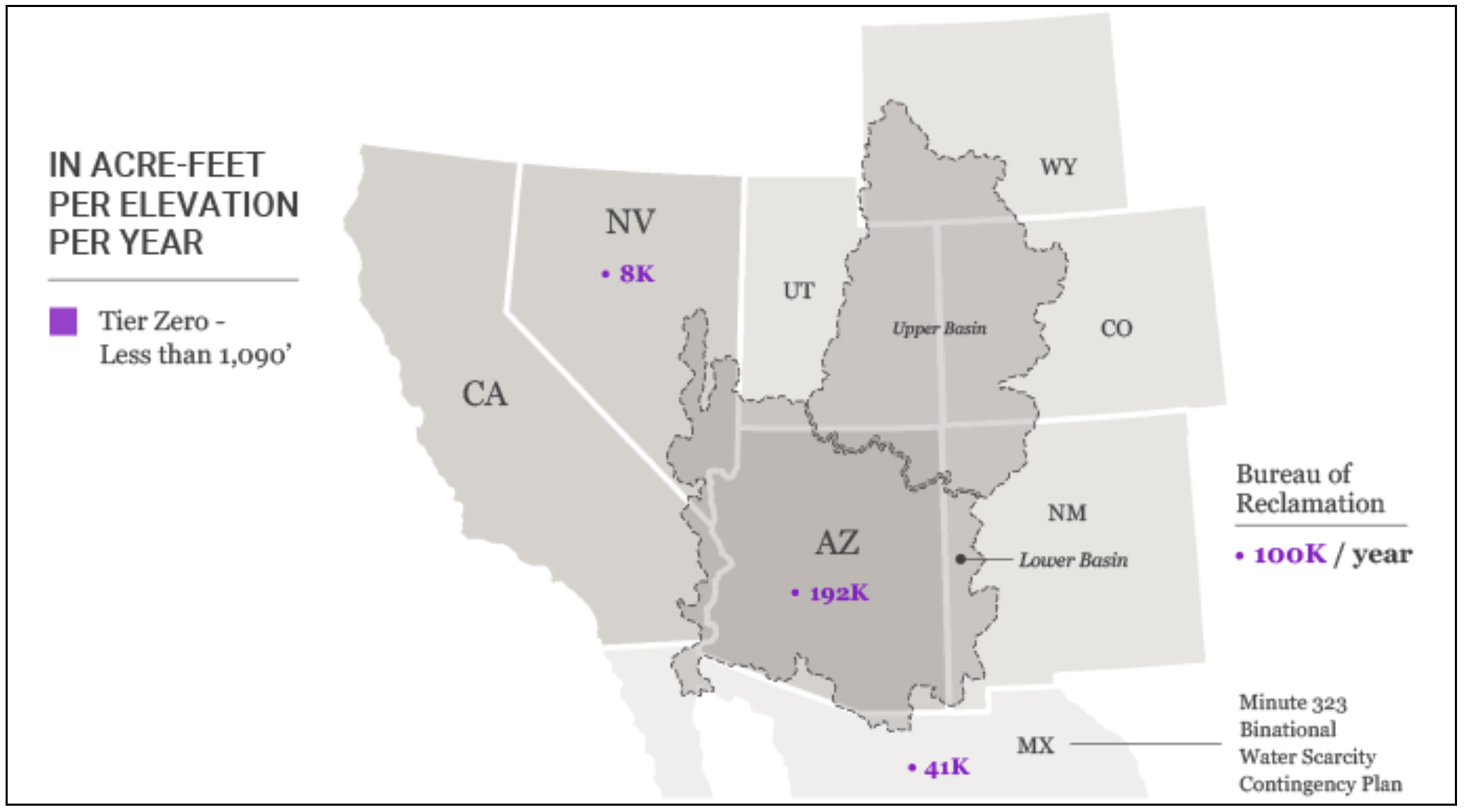
    The August Report defines, among other things, the operating conditions for Lake Mead for 2020, and includes the recently enacted Lower Basin Drought Contingency Plan (DCP). At the end of 2019, the projected Lake Mead elevation – the measuring stick for whether there is a shortage declaration on the river for 2020 – is just shy of 1090’. And, for the first time, the Lower Colorado River Basin will formally implement reductions outlined in the DCP at the new Tier Zero beginning January 2020.

    What does this mean?

    In short, it shows that in its first year, DCP is already working.

    While the Basin experienced a stellar snowpack year and subsequent phenomenal run-off, because Lake Mead is projected to end 2019 below elevation 1090’, the Lower Basin States (Arizona, California and Nevada) will be in a DCP Tier Zero shortage condition next year. Under Tier Zero, Arizona’s Colorado River supplies will be reduced by 192,000 acre-feet; Nevada’s will be reduced by 8,000 acre-feet; and California takes no reductions. In addition, Mexico will reduce its water use by 41,000 acre-feet, due to Minute 323, an agreement under the 1944 Treaty for water users in both countries. [ed. emphasis mine] Because of Arizona’s Colorado River priority system and agreements amongst water users, the Central Arizona Project (CAP) will take 100% of Arizona’s reductions under Tier Zero. CAP’s supplies will be reduced by 192,000 acre-feet, representing 12% of its normal annual Colorado River water supply. For CAP customers, this means eliminating the water that would have been available for underground storage, banking and replenishment. Water going toward CAP agricultural uses will be reduced by about 15%.

    The Tier Zero reduction to CAP, while significant, is largely equivalent to the amount of Colorado River water CAP has been leaving voluntarily in Lake Mead since 2015 as part of our Lake Mead Conservation Program. In essence, CAP and its water users have been planning and preparing for Tier Zero reductions for the past five years. The difference is that those previous contributions were voluntary – now, under DCP, these contributions are mandatory.

    Through the DCP, Arizona continues to prepare for a drier future. This year, CAP, along with the Gila River Indian Community and the Colorado River Indian Tribes, is contributing and storing 236,000 acre-feet in Lake Mead. Next year, even with the Tier Zero reductions, these same water users, along with the Mohave Valley Irrigation and Drainage District, will continue to conserve and store additional water in Lake Mead. These efforts are part of Arizona’s plan to implement DCP developed collaboratively by the Arizona water community and legislative leaders. The plan balances the impacts of DCP amongst water users and provides additional protection to the Colorado River system, giving us a road map to follow for the next several years.

    Tier zero cuts. Graphic credit: Central Arizona Project

    From Arizona Central (Ian James):

    Arizona, Nevada and Mexico will be required to take less water from the Colorado River for the first time next year under a set of agreements that aim to keep enough water in Lake Mead to reduce the risk of a crash.

    The federal Bureau of Reclamation activated the mandatory reductions in water deliveries on Thursday when it released projections showing that as of Jan. 1, the level of Lake Mead will sit just below a threshold that triggers the cuts.

    Arizona and Nevada agreed to leave a portion of their water allotments in the reservoir under a landmark deal with California called the Lower Basin Drought Contingency Plan, which the states’ representatives signed at Hoover Dam in May.

    California agreed to contribute water at a lower trigger point if the reservoir continues to fall. And Mexico agreed under a separate accord to start contributing to help prop up Lake Mead, which is now 39 percent full…

    Reservoirs were approaching levels last year that would have triggered a shortage and required deeper cuts, but heavy snow across much of the Rocky Mountains this winter boosted runoff and raised reservoir levels. The river’s reservoirs are now at 55% of total capacity, up from 49% at the same time last year.

    But Lake Mead is still projected to be just below the threshold of 1,090 feet above sea level at the beginning of next year. That will put the reservoir in a zone called “Tier Zero,” at which the first cuts take effect.

    “While we appreciate this year’s above-average snowpack, one good year doesn’t mean the drought is over. We must remain vigilant,” federal Reclamation Commissioner Brenda Burman said in a statement. She applauded the seven states that depend on the river for coming together to finish the set of drought-contingency plans. Burman said the actions laid out under those agreements “will help ensure the reliability of the Colorado River system for the 40 million people dependent upon it.”

    Arizona will see a cut of 192,000 acre-feet in water deliveries next year, or 6.9% of its total allotment of 2.8 million acre-feet. Nevada’s share will be reduced by 8,000 acre-feet, while Mexico’s will take 41,000 acre-feet less. That water will remain in Lake Mead, and will only be recovered once the reservoir rises above an elevation of 1,100 feet.

    The cuts under the Drought Contingency Plan, or DCP, represent 12% of the total water supply for the Central Arizona Project, which delivers water by canal to Phoenix, Tucson and other areas. Chuck Cullom, manager of Colorado River programs for CAP, said this reduction will mean “eliminating the water that would have been available for underground storage, banking and replenishment,” and cutting CAP deliveries to agriculture by about 15%.

    #Drought news: D0 (Abnormally Dry) expanded northward a bit into areas north of the #FourCorners near the #Colorado/#Utah border

    Click on a thumbnail graphic to view a gallery of drought data from the US Drought Monitor.

    Click here to go to the US Drought Monitor website. Here’s an excerpt:

    This Week’s Drought Summary

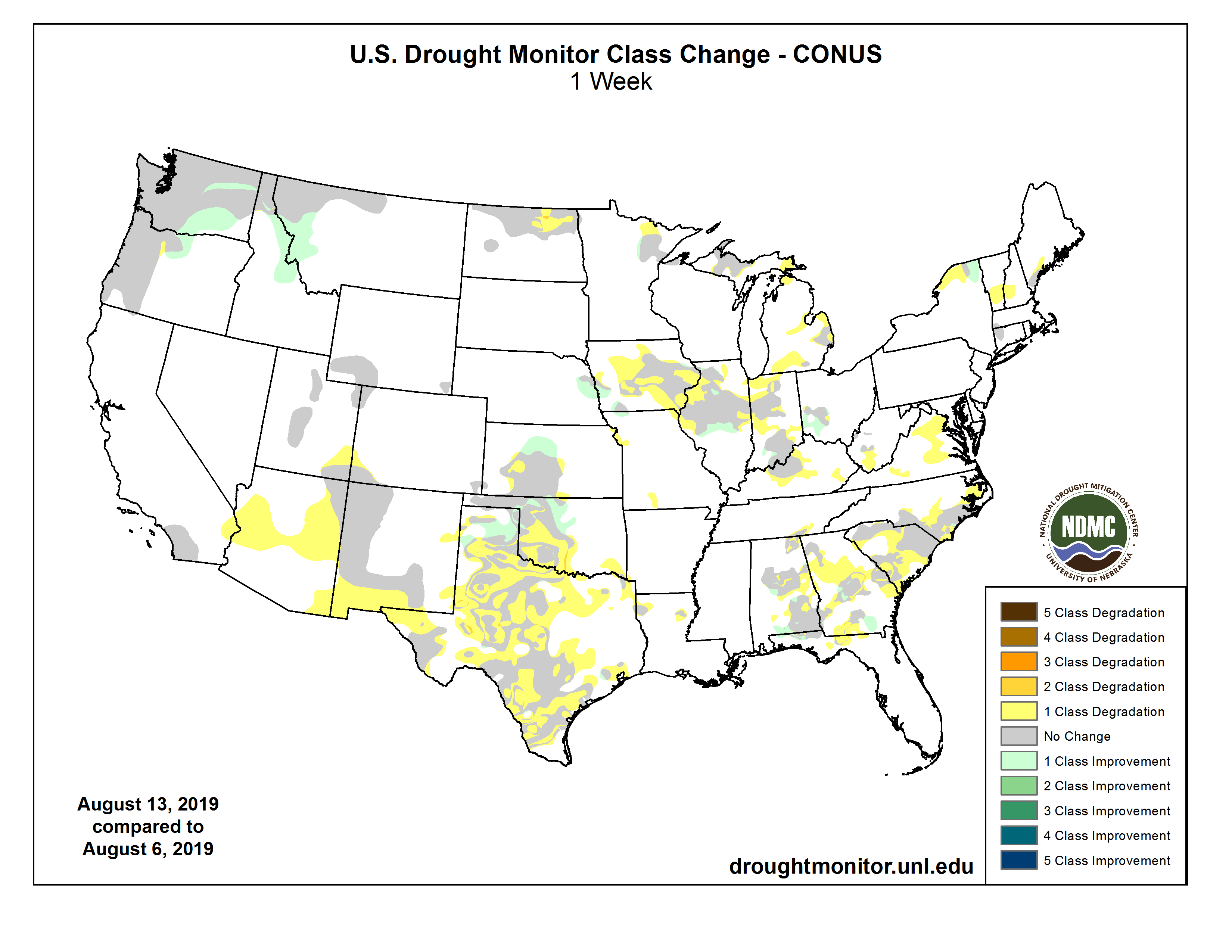
    Rainfall this week was highly variable across the eastern two-thirds of the country, which is not unusual during summer. Heavy rain was common in the High Plains, and from the Texas Panhandle and central Oklahoma northward in the Great Plains. Generally 2 to locally 5 inches of rain soaked the Plains from northern and eastern Kansas northward into the central Dakotas, and similar totals were spottier in central Montana, in the middle Mississippi Valley, across northern Minnesota, from the central Ohio Valley through the central Appalachians, over northern New England, and from the Florida Peninsula into southeastern Georgia. Scattered to isolated amounts of 2 to 3 inches were observed from the western half of Tennessee southward to the central Gulf Coast. Farther east, despite isolated moderate rains, only a few tenths of an inch fell on most of the upper Southeast, southern Appalachians, Carolinas, and middle Atlantic region. Several patches from northern California through the Pacific Northwest and northern Idaho recorded 0.5 to locally 2 inches, but most sites received light rain at best. The central and southern Sections of the Rockies and Intermountain West also observed generally light precipitation while no measurable rainfall was almost universal from the Red River to the Rio Grande in Texas, and in central and southern sections of California. The total area enduring abnormal dryness and drought increased, most noticeably in the Ohio Valley, the Midwest, and Texas. Widespread improvement was limited to a broad swath of Alaska from interior northeastern sections to near the Aleutians…

    High Plains

    Several inches of rain doused a broad area from eastern Kansas northwestward through South Dakota, western North Dakota, and the northern High Plains. Dryness and drought were confined to central and southern Kansas, east-central Nebraska, and northern North Dakota, where a small area of severe drought was introduced. In contrast to areas farther north, central and south-central Kansas recorded only 0.5 to locally 2.0 inches of rain since mid-July…

    West

    Periodic light to moderate rain has fallen for a few weeks now from central and southern Washington eastward through southwestern Montana, prompting improvement in some former D0 to D1 regions there, and in adjacent Oregon. Farther south, abnormal dryness persisted in several areas from southwestern Wyoming through Utah and western Colorado; D0 expanded northward a bit into areas north of the Four Corners near the Colorado/Utah border. Across the southern Rockies and southwestern deserts, deficient monsoon rains continued, and increasing moisture deficits prompted a broad expansion of abnormal dryness from southeasternmost California through eastern Arizona, and farther south from southeastern Arizona across southern New Mexico.

    South

    No measurable rain fell on a large area from the Red River Valley southward through Texas east of the Big Bend, extending eastward into southwestern Arkansas and central Louisiana. In contrast, most of northeastern Oklahoma and northern Arkansas were doused by 2 to locally 6 inches of rain. Less remarkable rainfall amounts exceeding one-half inch were recorded in the Texas Panhandle, central and northern Oklahoma, southwestern Tennessee, and Mississippi, with heavy rains approaching 4 inches reported in a few scattered areas. Dryness and drought expanded and intensified, with some degree of dryness now covering northeastern Texas, part of northern Louisiana, central and western Oklahoma, and roughly the western two-thirds of Texas from the upper reaches of Deep South Texas northward to the central Panhandle and the Big Bend. Severe drought was noted in parts of southern Texas, west-central Texas, and in a strip from southwestern Oklahoma westward along the southern fringes of the Texas Panhandle. Parts of these D2 areas received 3 to 6 inches less rainfall than normal over the past 60 days, including most of southwestern Oklahoma and adjacent Texas. Dating back to mid-July, most of Oklahoma (outside the northeastern quarter) and Texas were at least an inch short of normal rainfall; 30-day rainfall totals below 0.5 inch fell on southwestern Oklahoma and a broad swath of central and southern Texas from the Red River and lower Panhandle southward to the lower Rio Grande Valley…

    Looking Ahead

    During the next 5 days (August 15 – 20, 2019) should bring heavy rains of at least 1.5 inches across the central Great Plains and much of the Midwest, with 3 to 5 inches forecast from northwestern Missouri and adjacent areas northward through central and eastern Iowa. Amounts exceeding 1.5 inches are also forecast for the Mississippi Delta and along the immediate Gulf and southern Atlantic Coasts. A few patches along the Atlantic Coast from southeastern Georgia through North Carolina should receive 3 to 4 inches. Moderate rains of 0.5 inch or more are anticipated in parts of upstate New York, northern New England, and inland areas near the central Gulf and southern Atlantic Coasts. Similar amounts are expected in most of the western Great Lakes, Midwest, Great Plains from Kansas into the central Dakotas, and upper Mississippi Valley. A few tenths of an inch should fall on the middle Atlantic region, the rest of the central and northern Great Plains and Mississippi Valley, and parts of central and northern Texas and adjacent Oklahoma. Little or no rain is expected in the rest of the 48 contiguous states, including the interior Southeast, the Ohio Valley, southern Texas, and most areas from the Rockies westward. Daytime high temperatures should average 3°F to 6°F below normal in the northern one-third of the Plains, and near 3°F below normal in north-central Florida. In contrast, daily highs are forecast to average around 3°F above normal in the middle Atlantic region, and 3°F to locally 9°F above normal from the southern half of the Great Plains westward through most of the Rockies, the Intermountain West, the Great Basin, and California away from the immediate coast.

    The CPC 6-10 day outlook (August 21 -25, 2019) favors above-normal precipitation in the Alaskan Panhandle, parts of the Pacific Northwest, the northern Great Plains, the Mississippi Valley, southeast Texas, the Ohio Valley, the Southeast, and the middle Atlantic region. Meanwhile, enhanced chances for subnormal precipitation cover most of Alaska, although no tilt of the odds in either direction is indicated from the Kenai Peninsula westward through the Borough of Dillingham. Below normal precipitation chances are also elevated in upstate New York, most of New England, the central and southern Great Plains from central Texas through southwestern South Dakota, most of the High Plains, and the central Rockies. Neither precipitation extreme is favored elsewhere. Above-normal temperatures are favored across most of the country, with elevated chances for subnormal temperatures restricted to northwestern Montana, most of central and eastern Alaska, and the northern Alaska Peninsula. Neither positive nor negative temperature anomalies are favored in parts of the northern Rockies and in the lower Mississippi Valley.

    US Drought Monitor one week change map ending August 13, 2019.

    @USDA NRCS announces $1.9 million in funding for 15 Soil Science Collaborative Research projects focused on soil science and soil survey research

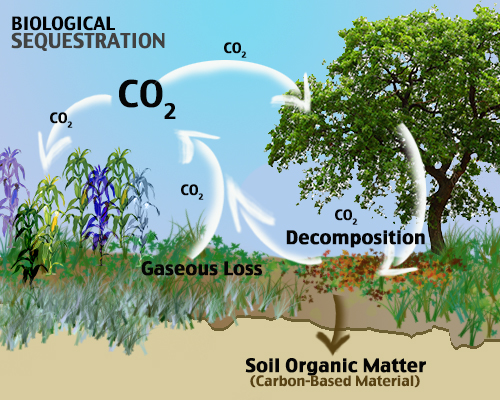
    Carbon sequestration is a term used to describe processes by which carbon dioxide (CO2) is either removed from the atmosphere or captured and diverted from an emissions source for long-term storage. There are two primary kinds of carbon sequestration: biological carbon sequestration (also referred to as terrestrial) and carbon capture and sequestration (CCS).

    Here’s the release from the USDA:

    The U.S. Department of Agriculture’s (USDA) Natural Resources Conservation Service (NRCS) today announced $1.9 million in funding for 15 Soil Science Collaborative Research projects focused on soil science and soil survey research.

    The information gained from the collaborative research will advance NRCS’ ability to provide scientifically based soil and ecosystem information to help address important natural resources issues facing our nation.

    “NRCS is investing in universities across the country to leverage their scientific knowledge and expertise to support our conservation mission.,” said NRCS Chief Matthew Lohr. “By engaging a diverse group of scholars through research, we can identify innovative solutions and technological advancements that will increase our contributions to both science and society.”

    Now in its 12th year, the current Soil Science Collaborative Research projects were selected from among 32 applications. Projects were selected based on nationally identified needs in communities and landscapes.

    Universities selected to receive funding for research projects include:

  • Alcorn State University
  • Brooklyn College of the City University of New York
  • Colorado State University
  • Kansas State University
  • New Mexico State University
  • North Carolina State University
  • Purdue University
  • University of Arizona
  • University of California
  • University of Massachusetts
  • University of Tennessee
  • University of Texas – Rio Grande Valley
  • University of Wyoming (two projects)
  • Virginia Institute of Marine Science
  • A detailed description of the projects is available online.

    The information accumulated from these annual projects has helped NRCS develop integrated technical tools and information to assist planners and land managers in predicting and assessing soil health, ecosystem and landscape sustainability and the implementation of sustainable management systems.

    “NRCS is a world leader in soil research,” said Dave Hoover, director of the NRCS National Soil Survey Center. “This prioritized investment in science-based tools will develop innovative data sharing and information delivery tools and products to reach multiple stakeholders around the world from underserved audiences to the most technically advanced.”

    NRCS accepts proposals once a year. Interested researchers can learn more on the Soils Research Page.

    Guest Commentary: A wet year has filled our reservoirs but we must prepare for the drought to come — The Denver Post (@CORiverTed) #ColoradoRiver #COriver #DCP #aridification

    Changes in the northeastern reaches of Lake Powell are documented in this series of natural-color images taken by the Landsat series of satellites between 1999 and 2017. The Colorado River flows in from the east around Mile Crag Bend and is swallowed by the lake. At the west end of Narrow Canyon, the Dirty Devil River joins the lake from the north. (At normal water levels, both rivers are essentially part of the reservoir.) At the beginning of the series in 1999, water levels in Lake Powell were relatively high, and the water was a clear, dark blue. The sediment-filled Colorado River appeared green-brown. To see the complete series go to: earthobservatory.nasa.gov/WorldOfChange/LakePowell. Photos via NASA

    From The Denver Post (Ted Kowalski):

    Time and water are alike in a lot of important ways. Both are finite resources that we can take for granted, or that we can manage carefully for great benefit.

    On Thursday, as the Bureau of Reclamation (BOR) issues its official projections for water levels at Lake Powell and Lake Mead, it’s important to think about where we were a year ago — following two extremely dry years; where we are today, after an extraordinarily wet winter; and, most importantly, where we want to be in another year — or ten years.

    In the year since the last BOR report, water security in the West took a huge step forward with the signing of the drought contingency plans (DCPs) — landmark agreements that update how the Colorado River is used, shared and managed across seven states and two countries. These DCPs combined with proactive conservation measures and a year of major snowfall mean that we’ve been able to avert dangerously low water levels at Lake Mead. So it can be tempting to relax a bit — but we have to ask ourselves, “how will we use this moment to prepare for the future?” We have to be smart about using the time and water we have right now.

    Common sense tells us that one wet winter does not alter or solve the fundamental challenges facing the water supply across the Colorado River Basin. As a reminder, 2011 was also a wet year in the Colorado River Basin, but it was immediately followed by 2012 and 2013 — the driest two-year period on record — causing rapid drops in water levels at Lake Powell and Lake Mead, which are the two main water supplies for the Colorado River.

    As an additional reminder, approximately one in eight Americans rely on the Colorado River. The stakes only go higher as the water levels go lower. As water usage in the West continues to outpace the supply, we have to continue making bold, structural improvements to our water management strategies and systems.

    In Colorado, as well as in Wyoming, New Mexico, and Utah, a key component of the DCPs is for the states to explore whether, and how to, develop and implement a demand management program. That means that each state needs to thoughtfully agree on how best to conserve while ensuring that there’s enough water to keep communities, farmers, and businesses thriving — now and for future generations. It’s not an easy task.

    Still, there are reasons to be hopeful. First, as we saw with the DCPs, it is in our reach to do big, important things. In order to make those agreements possible, leaders from seven states, tribes, cities, advocacy groups, businesses, farmers and others across the Colorado River Basin had to partner with federal leaders from the U.S. and Mexico during some of the most politically divisive times in generations. And even with all of that, they were able to find ways to take care of their own needs while still recognizing the needs of their neighbors.

    Looking ahead to demand management planning, that same spirit of innovation, collaboration, and shared mission will continue to serve the people of the Colorado River Basin well.

    Demand management programs are being investigated in the Upper Basin. These types of programs involve temporary, voluntary and compensated reductions in water use. The water that would be conserved by demand management is water that otherwise would have been used — but is instead conserved and saved. So, for example, demand management means that farmers could opt to fallow some of their fields in the off season in order to conserve additional water (without losing their water rights).

    Demand management can offer multiple benefits: it can ensure that there’s enough water in the river to keep the system healthy, it can safeguard the water supply for communities who depend on it, and it can protect our vibrant agricultural communities.

    For several years, people all across the Colorado River Basin have been working together to begin testing water conservation projects and their workability. These pilot projects are critically important, as they allow us to learn about the benefits and shortcomings of how a demand management program may work. We cannot wait until all of the theoretical questions have answers. In short, we need to continue to learn by doing.

    We are in a moment right now where we have saved enough time and water to buy ourselves the opportunity to make meaningful change. We know that this moment, this time, and our water will not last indefinitely. We have to act fast and together for a more secure water future — our communities and environments depend on it.

    Ted Kowalski is the senior program officer for the Walton Family Foundation’s Colorado River Initiative.

    Republican River Water Conservation District board meeting, August 20, 2019

    Shirley Hotel Haxtun, Colorado via History Colorado

    From the Republican River Water Conservation District (Deb Daniel) via The Julesberg Advocate:

    The Board of Directors of the Republican River Water Conservation District will be holding its regular quarterly meeting in Haxtun, Colorado. The date, time, and location of the meeting and a summary of the agenda for the meeting are provided below.

    Regular Meeting of the RRWCD Board Date: Tuesday August 20, 2019 Time: 10:00AM to 4:15PM

    Agenda: Consider and potentially approve minutes of previous meetings; Board President’s report, General Manager’s report and consider and potentially approve quarterly financial report and expenditures. Report from the Compact Compliance Pipeline operator; receive report from chairmen of all RRWCD committees; receive program updates and reports from the RRWCD’s engineer, federal and state lobbyists reports, legal counsel reports. Public Comment will be at 1:00PM rrwcd Report by State Engineer’s Office and Attorney General’s Office, Consider grants applications from Groundwater Management Districts, consider various Resolutions including, RRWCD meeting date changes, increasing area of EQIP program to include acres from boundary change, approve edits in RRWCD By-laws, and consider edits made to Board Manual, and consider water use fee on acres brought into the RRWCD boundary due to HB19-1029. Consider contract with well owners who have augmentation plan to the Lower South Platte If necessary, the RRWCD Board of Directors will hold an executive session to receive legal advice on legal questions and litigation concerning South Fork water rights; to discuss and determine positions, develop strategies, and instrauct negotiators concerning the purchase or lease of water rights; determine positions and instruct negotiators concerning water supply acquisition, receive legal advice on legal questions related to such agreements, contracts and easements, discuss program applications; Compact Compliance and discussions with Kansas (to the extent subject to privilege), and the Compact Compliance Pipeline and Bonny Reservoir

    Location: Haxtun Community Center
    145 South Colorado
    Haxtun, CO 80731

    For further information concerning the details of this meeting, please contact:

    Deb Daniel, General Manager
    Republican River Water Conservation District
    Phone 970-332-3552 Email deb.daniel@rrwcd.com
    RRWCD Website http://www.republicanriver.com

    Republican River Basin. By Kansas Department of Agriculture – Kansas Department of Agriculture, Public Domain, https://commons.wikimedia.org/w/index.php?curid=7123610

    Blue-green algae found at Pikeview Reservoir — @CSUtilities

    Cyanobacteria. By NASA – http://microbes.arc.nasa.gov/images/content/gallery/lightms/publication/unicells.jpg, Public Domain, https://commons.wikimedia.org/w/index.php?curid=5084332

    Here’s the release from Colorado Springs Utilities:

    There is an increasing occurrence of toxic blue-green algae in reservoirs across the United States this year, forcing the limitation of recreational access to the bodies of water for public safety.

    In a recent test at Pikeview Reservoir, a popular fishing lake in central Colorado Springs and part of our water system, the bacteria was identified.

    While the reservoir is still safe for fishing, as a precautionary meaure, humans and pets are prohibited from entering the water until further notice. Anglers are directed to thoroughly clean fish and discard guts.

    We have removed Pikeview as a source for drinking water until the reservoir is determined to be clear of the algae. There are no concerns about this affecting water supply for our community.

    Presumptive testing has indicated levels of less than 5 mcg/L.

    Sickness including nausea, vomiting, rash, irritated eyes, seizures and breathing problems could occur following exposure to the blue-green algae in the water. Anyone suspicious of exposure with onset of symptoms should contact their doctor or veterinarian. For questions regarding health impacts of exposure, contact the El Paso County Health Department or Colorado Department of Public Health and Environment.

    Warming temperatures have contributed to the growth of the bacteria.

    From The Colorado Springs Gazette (Liz Henderson):

    The popular fishing lake that lies just south of Garden of the Gods Road tested above acceptable limits for the bacteria the news release read. The water is still safe to fish in, but humans and pets are not allowed. Anglers are asked to clean the fish thoroughly and remove guts, according to the news release.

    The reservoir has been removed as a drinking water source, Utilities stated, however there are no concerns about the tainted water affecting the community.

    Reservoir agreement helps trout by borrowing endangered fish water — The Grand Junction Daily Sentinel

    From The Grand Junction Daily Sentinel (Dennis Webb):

    Some rejiggering of reservoir operations in the upper Colorado River watershed is taking the heat off trout in Grand County through the early release of water that had been set aside for endangered fish in Mesa County.

    The approach is being made possible by storing water elsewhere so it can be released for the endangered fish when they need it later.

    Under the agreement involving the U.S. Fish and Wildlife Service, the U.S. Bureau of Reclamation and Colorado River District, an additional 35 cubic feet per second of water started being released last week from Lake Granby, also known as Granby Reservoir, in the Colorado River headwaters. That nearly doubled Colorado River flows immediately downstream.

    The increased flows help reduce daytime temperatures in the river, which had begun topping 60 degrees and threatening the health of trout. The releases involve water normally stored in Granby for use in boosting flows in the river near Grand Junction for endangered fish such as the humpback chub and razorback sucker.

    The endangered fish still will get water under the deal, however. In exchange for the additional water coming out of Granby, the river district is withholding 35 cfs of water from Wolford Mountain Reservoir, which sits above Kremmling on Muddy Creek, a Colorado River tributary. That’s below the problem stretch of the Colorado River, thanks to inflows to the river coming from Muddy Creek and other tributaries, so the Wolford water that’s being withheld doesn’t hold the importance to the trout that the released Granby water does.

    “There’s plenty of water in the river except for in that stretch below Granby,” said Jim Pokrandt, a river district spokesman.

    Pokrandt said the Colorado River is currently a “free river” right now in Colorado. There are no calls on it to meet the needs of senior water rights holders when flows are more limited. But the upper stretch in Grand County in the Hot Sulphur Springs area is depleted due to transmountain diversions to the Front Range.

    Withholding the Wolford water means it will be available for the endangered fish during lower-flow periods on the Colorado River in Mesa County, in lieu of the water that is being released from Granby.

    Seldom Seen: A Poignant Look Back at Glen Canyon Before the Dam — Yale Environment 360 #ColoradoRiver #COriver

    Ken Sleight the original Monkey Wrencher photo via Salon

    From Yale Environment 360

    Ken Sleight remembers the stunning beauty of Glen Canyon before it was flooded by a massive dam in the 1960s. Taylor Graham’s film “Seldom Seen Sleight” – winner of the Yale Environment 360 Video Contest – shows the magnificent landscape lost and offers hope it might someday be restored.

    When Ken Sleight first floated through Utah’s Glen Canyon in 1955, he fell in love with its majestic landscape of red rock ravines and lush green Colorado River riverbed. He became a rafting guide, leading trips through a place where, he says, “You were in heaven, actually.”

    But even then, the mammoth Glen Canyon Dam was being built downstream in Arizona, and when the dam was completed in 1963, the canyon was flooded. Sleight, now 88, watched as the water quickly rose up the cliff walls, obliterating the riverbanks and side canyons.

    Taylor Graham’s film “Seldom Seen Sleight” — the winner of the 2019 Yale Environment 360 Video Contest – focuses on Sleight, now 89, as he describes the Glen Canyon he knew before it was flooded. Using never-before-seen archival footage, the film provides a poignant view of the pre-dam canyon and what has been lost.

    Sleight — who was the inspiration for the character Seldom Seen Smith in Edward Abbey’s The Monkey Wrench Gang — voices support for a campaign, now gaining interest, to take down the Glen Canyon Dam and restore that stretch of the Colorado River. “I seldom go down there anymore,” he says. “I have it in mind what it all was. We lost most of it. But you keep praying for something to happen, and it’s happening, I think. I just wish they would hurry it up a little.”

    About the Filmmaker: Taylor Graham is a multimedia storyteller and National Geographic Explorer interested in water sustainability issues and protecting the world’s free-flowing rivers. Graham recently spent a year in India as a Fulbright-Nehru Research Scholar, where he produced a series of documentary shorts about India’s diverse water challenges. He is currently completing work on a National Geographic Society-funded documentary film, Glen Canyon Rediscovered, for which he and his team completed a 350-mile through-paddle of the Colorado River and Lake Powell.

    About the Contest: The Yale Environment 360 Video Contest honors the year’s best environmental films, with the aim of recognizing work that has not previously been widely seen. Entries for 2019 were received from six continents, with a prize of $2,000 going to the first-place winner.

    Here’s a Coyote Gulch post which about Ken Sleight and his views about de-commissioning Lake Powell (Lake Foul).

    Heeding a Spiritual and Sacred Call to Protect the #ColoradoRiver — Walton Family Foundation #COriver #aridification

    From the Walton Family Foundation (Morgan Snyder):

    Native American tribes are seeking a greater voice as stewards of a river that’s been home for millennia

    Water is life. Water is the giver and sustainer of life.

    For Daryl Vigil, a member of the Jicarilla Apache Tribe in northern New Mexico, these words hold deep cultural, spiritual and personal meaning.

    They are drawn from a vision statement that Daryl and leaders of the Ten Tribes Partnership, a coalition of tribes in the Colorado River basin, wrote five years ago to guide them in efforts to gain a greater voice for Native Americans in how the river’s water is used and conserved.

    Daryl Vigil. Photo credit: Lincoln Institute for Land Policy

    “As Native Americans, our traditional interaction with rivers has always been one of reverence,” Daryl says. “We have understood this is the only Earth we have and that water is sacred. So we took what we needed and we made sure that if we took too much, we gave back what we didn’t need.”

    It’s an ethos every water user in the basin would do well to embrace. The Colorado provides water for nearly 40 million people and is key to the economic and environmental health of seven U.S. states and two states in Mexico.

    It also the lifeblood of 26 federally recognized tribes living on 29 Indian reservations within the basin’s 244,000-square-mile territory.

    For millennia, the river has shaped the culture and lifestyle of native peoples.

    But as the West was settled and developed – and as demands on the river increased – tribes were left out of water management decisions and have not seen the benefits derived from laws governing water use in the West.

    Daryl’s mission is to change that. As water administrator for the Jicarilla tribe, temporary executive director for the Ten Tribes Partnership, and co-facilitator of the Water & Tribes Initiative, he is leading efforts to develop a process for Colorado River water use decisions that is more inclusive of tribes. He is also helping tribes build capacity to develop their own water rights.

    Collectively, Native American tribes in the basin have 2.9 million acre feet of quantifiable water rights – roughly 20% of the system’s water – with many water claims still unresolved.

    Tribal water rights are also among the most senior in the basin, giving tribes the potential to play a major role in balancing supply and demand for water as well as restoring the river’s environmental health.

    In a policy brief, the Water & Tribes Initiative described the exclusion of tribes from decisions about the river’s management as a “socio-economic and environmental injustice.”

    “Almost across the board, everyone is now saying tribes need to be at the table,” Daryl says. “If any other entity had (rights to) that volume of water, they’d be at the head of the table.”

    Tribes face myriad challenges constraining their ability to develop economic benefit from the river. A lack of water infrastructure – such as dams, reservoirs, conveyance and irrigation – means many are underutilizing their rights on the river, essentially allowing other users to access tribal water for free.

    For some tribes, such as the Navajo Nation, one of the Ten Tribes members, it’s a struggle just to provide their own residents with a safe, secure water supply.

    “They have to haul water on a daily basis,” says Daryl. “Their development of water rights is really about providing water to their people.”

    At the other end of the spectrum, Gila River Indian Community has demonstrated the value tribes can bring to water management decisions. The community played a major role in successful water conservation negotiations for the new Drought Contingency Plan.

    Several tribes are actively exploring the potential for developing water markets to share, or lease, water to other river users.

    “Our strategy is to help tribes build capacity,” says Daryl.

    The Walton Family Foundation, along with the Babbitt Center for Land and Water Policy, is supporting the Water & Tribes Initiative in the Colorado River Basin.

    The intent of the initiative, which is co-facilitated by Daryl and Matthew McKinney, is to enhance the capacity of tribes to advance their needs and interests with respect to water and advance sustainable water management through collaborative decision-making. This work includes helping the Ten Tribes Partnership write their first strategic plan.

    The foundation wants to ensure that the oldest water rights in the basin are well-represented and respected in future basin-wide policy discussions and decisions.

    In everything that the Ten Tribes Partnership and the Water & Tribes Initiative is doing, Daryl says they are mindful of their vision as stewards of the river.

    It calls on them to “lead from a spiritual mandate to ensure that this sacred water will always be protected and be available” and carry out their “responsibility of protecting the delicate, beautiful, balance of Mother Earth for the benefit of all living creatures” on the river.

    “That holds us to account about who we are going to be in this process, as native human beings,” Daryl says.

    “We want to make sure the river is available for our children and those who come after us. I think that’s our personal responsibility as human beings, to ensure we protect what it is that gives us life.”

    @ColoradoClimate: Weekly #Climate, Water and #Drought Assessment of the Intermountain West

    Click here to read the current assessment. Click here to go to the NIDIS website hosted by the Colorado Climate Center.

    2°C: BEYOND THE LIMIT: Extreme climate change has arrived in America — The Washington Post #ActOnClimate #aridification

    Graphic credit: The Washington Post (Note: NOAA does not provide data for Alaska or Hawaii for this time period.)

    Here’s an in-depth report from The Washington Post ( Steven Mufson, Chris Mooney, Juliet Eilperin and John Muyskens. Photography by Salwan Georges). Click through and read the whole article and to enjoy the photographs. Here’s an excerpt:

    America’s hot spots

    Nationwide, trends are clear. Starting in the late 1800s, U.S. temperatures began to rise and continued slowly up through the 1930s. The nation then cooled slightly for several decades. But starting around 1970, temperatures rose steeply.

    At the county level, the data reveals isolated 2-degree Celsius clusters: high-altitude deserts in Oregon; stretches of the western Rocky Mountains that feed the Colorado River; a clutch of counties along the northeastern shore of Lake Michigan — home to the famed Sleeping Bear Dunes National Lakeshore near Traverse City.

    Along the Canadian border, a string of counties from eastern Montana to Minnesota are quickly heating up.

    The topography of warming varies. It is intense at some high elevations, such as in Utah and Colorado, and along some highly populated coasts: Temperatures have risen by 2C in Los Angeles and three neighboring counties. New York City is also warming rapidly, and so are the very different areas around it, such as the beach resorts in the Hamptons and leafy Westchester County.

    The smaller the area, the more difficult it is to pinpoint the cause of warming. Urban heat effects, changing air pollution levels, ocean currents, events like the Dust Bowl, and natural climate wobbles such as El Niño could all be playing some role, experts say.

    The one U.S. region that has not warmed since 1895: the South, where data in some cases even shows a modest cooling.

    The only part of the United States that has not warmed significantly since the late 1800s is the South, especially Mississippi and Alabama, where data in some cases shows modest cooling. Scientists have attributed this “warming hole” to atmospheric cycles driven by the Pacific and Atlantic oceans, along with particles of soot from smokestacks and tailpipes, which have damaging health effects but can block some of the sun’s intensity. Those types of pollutants were curtailed by environmental policies, while carbon dioxide remained unregulated for decades.

    Since the 1960s, however, the region’s temperatures have been increasing along with the rest of the country’s.

    The Northeast is warming especially fast.

    Ridgway State Park smallmouth-bass tournament yields big results — #Colorado Parks and Wildlife

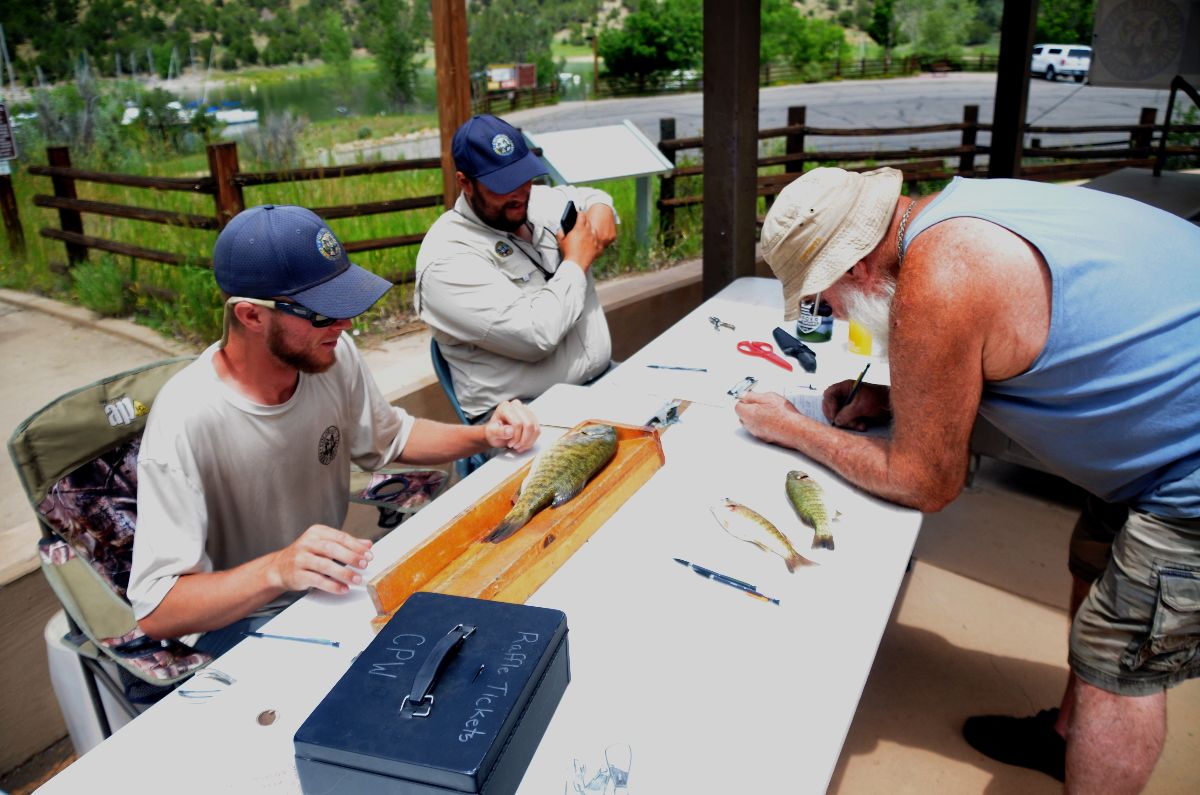
    A CPW staffer measures a fish last month at the Ridgway State Park Bass Tournament. Anglers caught more than 1,400 fish during the month-long tournament. Photo credit: Colorado Parks and Wildlife

    Here’s the release from Colorado Parks and Wildlife (Joe Lewandnowski):

    Anglers who participated in the 2019 smallmouth bass tournament at Ridgway State Park, again, helped Colorado Parks and Wildlife on its mission to preserve native fish species.

    For the fifth year in a row, licensed anglers caught hundreds of smallmouth bass that are a threat to Colorado’s native fish that live downstream in the Gunnison and Colorado rivers. A total of 79 registered anglers removed 1,498 smallmouth bass in the month-long tournament that ended July 27. Smallmouth bass are non-native and were introduced illegally to Ridgway Reservoir about 10 years ago. They are predators and could wipe out populations of native fish downstream.

    “In the five years of the tournament we have reduced the population of smallmouth bass in the reservoir by 79 percent,” said Eric Gardunio, aquatic biologist for CPW in Montrose and the organizer of the tournament. “It is truly amazing what these anglers can do. They are participating directly in wildlife management in Colorado.”

    Before the first tournament in 2015, Gardunio estimated there were 3,632 adult smallmouth bass in the reservoir. Adult fish measure six inches in length or more. Now it is estimated that only 763 adult fish live in the reservoir.

    “We are making substantial headway in suppressing the population of smallmouth that were introduced illegally to Ridgway Reservoir,” Gardunio said.

    The Ridgway tournament targets smallmouth bass because they could escape from the reservoir and migrate downstream to a section of the Gunnison River that is considered “critical habitat” for native fish.

    “The work by CPW staff along with the help of anglers shows that through targeted management techniques we can enhance survival of rare aquatic species,” said John Alves, senior aquatic biologist for the Southwest Region for Colorado Parks and Wildlife.

    With assistance from the Colorado Water Conservation Board, CPW was able to offer $12,000 in prize money to tournament participants.

    Chase Nicholson of Ouray was the big winner this year, catching 571 smallmouth and the top prize of $5,000 for most fish caught. He also won $500 for smallest fish caught – 3.3 inches. Nicholson tied with Tyler Deuschle of Delta for biggest fish caught, 17.2 inches they split the $500 prize. Second place for most fish caught went to Lawrence Cieslewicz of Montrose, who caught 283. He also won the grand-prize raffle for an additional $2,500. Chris Cady from Delta turned in 128 fish and placed third for most fish caught.

    #ElNino has ended: Here’s what that means for #Colorado and our upcoming winter season — TheDenverChannel.com #ENSO

    From TheDenverChannel.com (Mike Nelson):

    Using Pacific sea surface conditions to forecast winter weather for Denver and the eastern plains is tricky. The great distance between our state and the ocean means that storms will change dramatically as they traverse the mountains and California, the vast dry region of Arizona, Nevada and Utah and our Colorado mountains. By the time a potent Pacific storm finally gets to Denver and the Front Range, there is often not much moisture left.

    There have been a few memorable winter storms in the Denver area during an El Niño. The Christmas Eve blizzard of 1982 was in an El Niño year, as was the October 1997 storm and the blizzard of March 2003. But, we have also had many heavy snows during non-El Niño winters.

    The opposite of El Niño is La Niña, which is a large area of cooler sea surface conditions. La Niña winters tend to be drier in much of Colorado, especially the central and southwestern mountains and often have more stronger winds. The jet stream favors a northwest-to-southeast pattern across the nation. This position of the jet stream favors the northern mountain areas, such as Steamboat and Winter Park.

    In the Denver area, La Niña winters see more frequent lighter snow storms and a few good cold outbreaks. There tends to be more Chinook wind events as well, so temperatures can fluctuate quite a bit along the Front Range.

    A neutral pattern (not El Niño or La Niña) means that we will not see either of these forcing mechanisms play a major role in our upcoming cold season. There are other factors that come into play though, including changes in warm and cold water positions in the Atlantic Ocean – less famous than El Niño or La Niña, but also important.

    At present, while we are still weeks away from the leaves changing color and the average high temperature is still near 90 degrees, we have only a basic outlook for the winter ahead. Here’s what it looks like so far:

  • Slightly warmer than average with near to above average snowfall for the northern mountains
  • Near to slightly below average snowfall for the central mountains
  • Likely a drier than average snow season for the southwest mountains
  • Denver and the Eastern Plains are harder to predict, but as of now: Near average precipitation, fewer big snowfalls, more light to moderate snow
  • Temperatures in Denver should stay a little warmer than average with a few good, bracing cold snaps. Frequent strong wind events are expected in January and February.

    Farmers use tech to squeeze every drop from #ColoradoRiver — The Associated Press #COriver #aridification

    From The Associated Press (Dan Elliott):

    This U.S. Department of Agriculture station outside Greeley and other sites across the Southwest are experimenting with drones, specialized cameras and other technology to squeeze the most out of every drop of water in the Colorado River — a vital but beleaguered waterway that serves an estimated 40 million people.

    Remote sensors measure soil moisture and relay the readings by Wi-Fi. Cellphone apps collect data from agricultural weather stations and calculate how much water different crops are consuming. Researchers deliberately cut back on water for some crops, trying to get the best harvest with the least amount of moisture — a practice called deficit irrigation.

    In the future, tiny needles attached to plants could directly measure how much water they contain and signal irrigation systems to automatically switch on or off…

    Researchers and farmers are running similar experiments in arid regions around the world. The need is especially pressing in seven U.S. states that rely on the Colorado River: Arizona, California, Colorado, Nevada, New Mexico, Utah and Wyoming.

    The river has plenty of water this summer after an unusually snowy winter in the mountains of the U.S. West. But climatologists warn the river’s long-term outlook is uncertain at best and dire at worst, and competition for water will only intensify as the population grows and the climate changes.

    The World Resources Institute says the seven Colorado River states have some of the highest levels of water stress in the nation, based on the percentage of available supplies they use in a year. New Mexico was the only state in the nation under extremely high water stress.

    The federal government will release a closely watched projection Thursday on whether the Colorado River system has enough water to meet all the demands of downstream states in future years…

    The researchers’ goal is understanding crops, soil and weather so completely that farmers know exactly when and how much to irrigate.

    “We call it precision agriculture, precision irrigation,” said Huihui Zhang, a Department of Agriculture engineer who conducts experiments at the Greeley research farm. “Right amount at the right time at the right location.”

    The Palo Verde Irrigation District in Southern California is trying deficit irrigation on alfalfa, the most widely grown crop in the Colorado River Basin…

    Sensors placed over the test plots indirectly measure how much water the plants are using, and the harvested crop is weighed to determine the yield.

    “The question then becomes, what’s the economic value of the lost crop versus the economic value of the saved water?” said Bart Fisher, a third-generation farmer and a member of the irrigation district board.

    Blaine Carian, who grows grapes, lemons and dates in Coachella, California, already uses deficit irrigation. He said withholding water at key times improves the flavor of his grapes by speeding up the production of sugar…

    He also uses on-farm weather stations and soil moisture monitors, keeping track of the data on his cellphone. His drip and micro-spray irrigation systems deliver water directly to the base of a plant or its roots instead of saturating an entire field.

    For Carian and many other farmers, the appeal of technology is as much about economics as saving water.

    “The conservation’s just a byproduct. We’re getting better crops, and we are, in general, saving money,” he said.

    But researchers say water-saving technology could determine whether some farms can stay in business at all, especially in Arizona, which faces cuts in its portion of Colorado River water under a drought contingency plan the seven states hammered out this year.

    Drone-mounted cameras and yield monitors — which measure the density of crops like corn and wheat as they pass through harvesting equipment — can show a farmer which land is productive and which is not, said Ed Martin, a professor and extension specialist at the University of Arizona.

    “If we’re going to take stuff out of production because we don’t have enough water, I think these technologies could help identify which ones you should be taking out,” Martin said.

    Each technology has benefits and limits, said Kendall DeJonge, another Agriculture Department engineer who does research at the Greeley farm.

    Soil moisture monitors measure a single point, but a farm has a range of conditions and soil types. Infrared images can spot thirsty crops, but only after they need water. Agricultural weather stations provide a wealth of data on the recent past, but they can’t predict the future.

    Pilot Dan Hesseliusl with drone aircraft. Photo credit the University of Colorado.

    Electric vehicles can reduce the #Colorado’s emissions more than anything else #ActOnClimate #KeepItInTheGround

    Leaf, Berthoud Pass Summit, August 21, 2017.

    From Vox (David Roberts):

    The Colorado legislature has had an extraordinarily productive year so far, passing a stunning array of climate and clean energy bills covering everything from clean electricity to utilities, energy efficiency, and a just transition. The list is really pretty amazing…

    It got me thinking: Just how big a role are EVs going to play in decarbonization? How should policymakers be prioritizing them relative to, say, renewable energy? Obviously, every state and country is going to need to do both eventually — fully electrify transportation and fully decarbonize electricity — but it would still be helpful to better understand their relative impacts.

    Nerds to the rescue!

    A new bit of research commissioned by Community Energy (a renewable energy project developer) casts light on this question. It models the carbon and financial impacts of large-scale vehicle electrification in Colorado and comes to two main conclusions.

    First, electrifying vehicles would reduce carbon more than completely decarbonizing the state electricity sector, pushing state emissions down 42 percent from 2018 levels by 2040 — not enough to hit the targets on its own, but a huge chunk. Second, electrifying vehicles saves consumers money by reducing the cost of transportation almost $600 a year on average.

    Rapid electrification is a win-win for Colorado, a driver of decarbonization and a transfer of wealth from oil companies to consumers — but only if charging is managed intelligently.

    EVs bring carbon and consumer benefits

    First, the headline: Electrifying EVs…reduces emissions a lot.

    In the EV-grid scenario, electricity sector emissions fall 46 percent — the number is lower because about a third of the additional electricity demand from EVs is satisfied by natural gas — but overall state emissions drop 42 percent, more than two and a half times as much, representing 37 million metric tons of carbon dioxide. That’s thanks to an 80 percent drop in transportation emissions…

    As I said, that in itself is not enough to meet the state’s emissions target. The state will have to force some additional cleaning of the electricity sector (and deal with other sectors) to do that, as this year’s package of legislation reflects. (I asked Clack if Vibrant ran a scenario without any new natural gas. Yes, he said. “It was $1 billion per year more expensive [around 1¢/kWh, or 15.9 percent more] and decreased emissions by an additional 14.8 metric tons per year.”)

    But the drop in transportation emissions in the EV-grid scenario is sufficient to reduce more overall emissions than the entire Colorado electricity sector produces. EVs are a vital piece of the decarbonization puzzle.

    The effect of all the new EVs on electricity generation is pretty simple: There will be more of it…

    As you can see, in the cleaner-grid scenario, lost coal generation is replaced by a mix of natural gas, wind, and solar. In the EV-grid scenario, it’s roughly the same mix, just a little more of each — the addition of EVs raises total electricity demand by about 20 percent.

    Bonus result: “The increase in generation capacity increases employment in Colorado’s electricity sector by approximately 68 percent by 2040.”

    […]

    And now, here are the fun parts.

    Shifting from internal combustion engine vehicles (ICEV) to EVs would save Colorado consumers a whole boatload of money, for the simple reason that electricity is a cheaper fuel than gasoline. Here are the average savings for a Coloradan that switches from ICEV to EV between 2018 and 2040…

    So the average Coloradan will save between $590 and $645 a year — nothing to sneeze at. “The total savings between 2018 and 2040 are estimated to be $16 billion,” Vibrant says, “which equates to a savings of almost $700 million per year.”

    You might think, with all the new EV demand added to the grid, electricity rates would go up. In fact, relative to the cleaner-grid scenario, the EV-grid scenario has an extremely small impact on rates (0.7 percent difference at the extreme)…

    EVs are a climate triple threat

    What this modeling makes clear is that when it comes to clean energy policy, EVs are a triple threat for Colorado (and, obviously, for other states, though the impacts will vary with weather and electricity mix).

    For the electricity sector, as long as their charging is properly managed, EVs can provide much-needed new tools to help manage the influx of renewable energy…

    For the transportation sector, EVs can radically reduce carbon emissions and local pollution. (Yes, EVs reduce carbon emissions even in areas with lots of coal on the grid.)

    And for consumers, EVs save money, not only because the fuel is cheaper (and getting cheaper all the time) but because EVs are much simpler machines, with fewer moving parts and much lower maintenance costs.

    Especially in states with electricity sector emissions that are already low or falling, transportation is the next big place to look for emission reductions, and EVs are one of the few options that can reduce emissions at the necessary scale and speed. Colorado is right to encourage them.

    Interview with Doug Kenney: Planning for a Drier Future in the #ColoradoRiver Basin — Public Policy Institute of #California #COriver #aridification

    Lake Mead, behind Hoover Dam, shows the effects of nearly two decades of drought. (Image: Bureau of Reclamation)

    From the Public Policy Institute of California (Lori Pottinger):

    The Colorado River has experienced decades of over-allocation of its waters, making it harder to address the added challenges that climate change is bringing. The recently adopted Drought Contingency Plan (DCP) was an important step toward addressing the basin’s chronic water shortages, but more work is needed to prepare for a hotter, drier future. We talked to Doug Kenney—director of the Western Water Policy Program at the University of Colorado and a member of the PPIC Water Policy Center research network―about managing the basin for long-term water sustainability. Kenney organized a conference in June that covered these issues in depth.

    Douglas Kenney. Photo credit: University of Colorado Boulder

    PPIC: Talk about the basin’s over-allocation problem.

    Doug Kenney: The current problem with the river’s water budget is in the lower basin. For much of this century, California, Arizona, Nevada, and Mexico have consistently pulled about 1.2 million acre-feet more water out of Lake Mead than enters it each year. That’s basically five years of water supply for Las Vegas. You can get away with that much overuse by drawing down reservoir storage—which is what we’ve been doing—but that’s not sustainable. So we need to accelerate efforts to scale back consumption. That’s what the DCP was designed to do—it’s mandated belt tightening.

    In the upper basin states it’s a very different situation—water use in Colorado, New Mexico, Utah, and Wyoming is currently at a stable and reasonable level. But future use is expected to increase, while natural inflows are declining as the region continues to warm from climate change. The upper basin states can legally develop more water supplies, but the reality is that water isn’t likely to be reliably available. There’s a disconnect between how much water the upper basin states were promised and how much actually exists.

    PPIC: What is needed to achieve sustainable management in the basin?

    DK: The primary emphasis has to be on using less water. Given that most water in the basin is used for agriculture, that sector has the greatest potential to save water. Paying farmers to fallow some fields is probably the most appealing option. However, there are legal, financial, and cultural issues to deal with.

    In most of the west, efforts to incentivize agricultural demand management have been pretty primitive—with the exception of Southern California, which has had major success trimming farm water use in the Imperial and Palo Verde water districts. Those programs aren’t perfect, but they are happening at a sufficiently large scale to make a significant contribution to addressing the regional water budget problem. In most other places in the basin, these types of programs are much smaller, and there’s a lot of skepticism about scaling these efforts up. The politics are very delicate, as these mechanisms would reallocate water from farms to cities. But you can’t ignore the math or the economics. Some sort of agricultural demand management will have to be a core element of any sustainable water use plan in the basin. The challenge is to do it in a way that is fair and protects the socioeconomic fabric of rural areas.

    PPIC: What’s next for the basin’s water planning?

    DK: The next steps are big ones. The operation of Powell and Mead is governed by interim guidelines that expire after 2026. Some key arrangements between Mexico and the US also expire then. The states are required to begin negotiating new rules to replace the expiring arrangements no later than 2020. This figures to be a really complex and very politically difficult negotiation, so there’s real interest in setting up the right process to get it done. That’s where many of us are focused right now—identifying the process that gives the negotiations the best chance for success.

    PPIC: The DCP didn’t address ecological and health problems at California’s troubled Salton Sea. What’s next for the sea?

    DK: At this point it’s about figuring out how to pay for what everyone knows has to be done. I’m convinced we’ve reached a turning point on the Salton Sea. There’s momentum within and outside of California to find a solution. It was disappointing that the DCP didn’t address the issues, but it wasn’t due to a lack of concern or effort—essentially, folks ran out of time. But I hear a consistent message from every sector and state: we need a solution for the sea. There’s an old maxim in this basin: anything is possible if all seven states can agree to it. I’m hopeful that this can apply to the Salton Sea crisis.

    Salton Sea shoreline screen shot of drone video June 11, 2016. Credit Palm Springs Desert Sun.

    Should Rivers Have Same Legal Rights As Humans? A Growing Number Of Voices Say Yes — National Public Radio

    Satellite imagery of a toxic algal bloom on Lake Erie in 2011. The image is gorgeous, but microcystis aeruginosa, the green algae pictured here, is toxic to mammals.
    NASA Earth Observatory via Popular Science.

    From National Public Radio (Ashley Westerman):

    In early July, Bangladesh became the first country to grant all of its rivers the same legal status as humans. From now on, its rivers will be treated as living entities in a court of law. The landmark ruling by the Bangladeshi Supreme Court is meant to protect the world’s largest delta from further degradation from pollution, illegal dredging and human intrusion…

    Following the ruling, anyone accused of harming the rivers can be taken to court by the new, government-appointed National River Conservation Commission. They may be tried and delivered a verdict as if they had harmed their own mother, Matin says.

    “The river is now considered by law, by code, a living entity, so you’ll have to face the consequence by law if you do anything that kills the river,” [Mohammad Abdul Matin] says.

    What is environmental personhood?

    Bangladesh follows a handful of countries that have subscribed to an idea known as environmental personhood. It was first highlighted in essays by University of Southern California law professor Christopher D. Stone, collected into a 1974 book titled Should Trees Have Standing? Toward Legal Rights for Natural Objects. Stone argued that if an environmental entity is given “legal personality,” it cannot be owned and has the right to appear in court.

    Traditionally, nature has been subject to a Western-conceived legal regime of property-based ownership, says Monti Aguirre with the environmental group International Rivers.

    “That means … an owner has the right to modify their features, their natural features, or to destroy them all at will,” Aguirre says.

    The idea of environmental personhood turns that paradigm on its head by recognizing that nature has rights and that those rights should be enforced by a court of law. It’s a philosophical idea, says Aguirre, with indigenous communities leading the charge…

    In 2008, Ecuador became the first country to enshrine the legal rights of nature in its constitution. Bolivia passed a similar law in 2011. Meanwhile, New Zealand in 2017 became the first country to grant a specific river legal rights, followed by the Indian state of Uttarakhand. This year, the city of Toledo, Ohio, passed what is known as the Lake Erie Bill of Rights to protect its shores, making it one of several U.S. communities to have passed legislation recognizing the rights of nature

    In a 2018 study co-authored with Julia Talbot-Jones, O’Donnell shows that the onus of enforcement will fall on whoever is deemed the guardian of the waterway. And that can be anyone from a court-appointed body to the government itself — which may have chosen not to participate in environmentally friendly practices in the past — to nongovernmental organizations.

    In Ecuador, says O’Donnell, the Global Alliance for Rights of Nature and others sued a construction company trying to build a road across the Vilcabamba River and initially won in court.

    But when the construction company didn’t comply with the court’s ruling, “the NGO could not afford to run a second case,” says O’Donnell.

    What’s more, the trans-boundary nature of rivers makes enforcement inherently difficult. This issue has come up in India, where the high court in Uttarakhand state in 2017 recognized the Ganges and Yamuna rivers as legal persons because of their “sacred and revered” status. The court named the state government as their guardians.

    Soon after, the state government appealed to the Indian Supreme Court, arguing “that their responsibilities as guardians of the rivers were unclear because the rivers extended well beyond the border of Uttarakhand,” says O’Donnell…

    he struggle to achieve this paradigm shift is also taking place on the shores of Lake Erie, in Toledo, Ohio. Earlier this year, the city passed an ordinance that would allow the its citizens to sue on behalf of the lake, arguing that it had gotten so polluted, there was no choice.

    The ordinance’s constitutionality was immediately challenged by a farm in a federal lawsuit. The farm argued the ordinance made it vulnerable “to massive liability” when it fertilizes its fields “because it can never guarantee that all runoff will be prevented from entering the Lake Erie watershed.” Then the state of Ohio joined that lawsuit, arguing it — not the citizens of Toledo — has the “legal responsibility” for environmental regulatory programs.

    “What’s interesting is the state of Ohio intervening on behalf of the polluter, not on behalf of the people who passed the law,” says Tish O’Dell, the Ohio community organizer for the Community Environmental Legal Defense Fund.

    The lawsuit is ongoing, though O’Dell predicts the ordinance will ultimately be overturned.

    “But what I would say to people is it doesn’t matter what happens in the courts in Toledo with this case, because the genie has been let out of the bottle. And as hard as they want to try to put it back in, the people shouldn’t let them,” O’Dell says. “I mean, we have to change our environmental protection in this country and across the world, because obviously what we’re doing isn’t working.”

    @POTUS administration guts Endangered Species Act #TrumpShame

    Greenbacks and Colorado River cutthroat via DNR

    From CBS4 Denver (Shaun Boyd):

    Multiple species — including Colorado’s state fish — could be impacted by changes to the Endangered Species Act. The Trump administration plans to unveil the new rules in detail later this week. They will, among other things, allow the government to put an economic cost on saving a species and limit the consideration of climate change on a species survival…

    Hailey Hawkins with the Endangered Species Coalition agrees changes are needed, but she says the changes proposed by the Trump administration will make things worse.

    “In the long run, if our species don’t receive full protections immediately, that’s going to create more backlog and more red tape down the road,” Hawkins said.

    Hawkins is especially concerned that economics may be used to determine whether a species receives protection.

    “Life is priceless. You can not put a price tag on a species. Extinction is forever. It’s something that will never ever go away and the price of that and the price to our heritage and our culture is too big to sacrifice,” she said.

    There are numerous species of fish and wildlife in Colorado that have federal protection, including the Greenback Cutthroat Trout, Colorado’s state fish. While all of the species have state protections as well, Hawkins says the state lacks the resources to recover those species. The new rules also limit the consideration of climate change on a species survival by restricting potential impacts to the foreseeable future…

    Gov. Jared Polis shared the following statement with CBS4 about the possible Endangered Species Act changes.

    “This rollback of the landmark Endangered Species Act is just awful. The Endangered Species Act is a huge success and has successfully brought so many species back from the brink of extinction like the bald eagle and grizzly bear. 34 of the more than 1,400 species protected under the Endangered Species Act call Colorado home and are a critical piece of the natural beauty of this state. When species become extinct it disrupts previously healthy ecosystems which could, in turn, ruin the outdoor experience for anglers, hunters and Colorado’s thriving outdoor industry and economy. Colorado’s ecological diversity is part of our strength.”

    Job Announcement: General Manager Position Northern Colorado Water Association Wellington, #Colorado

    From email from the Northern Colorado Water Association:

    The Northern Colorado Water Association (NCWA), a Colorado non-profit corporation, which provides potable water service to approximately 1,500 rural customers in northern Larimer County, is seeking a General Manager. NCWA provides domestic water to the rural area roughly between Fort Collins and the Wyoming border; and between the foothills and the Interstate 25 corridor. Existing sources of water supply include wells and connections to area water districts. The current General Manager is retiring at the end of 2019 and it is anticipated that the replacement would start around December 1, 2019.

    If you are qualified and interested in applying for this position, please email your resume and a letter of interest identifying your unique qualifications to perform the required duties to rich.ncwa@cowisp.net by September 1, 2019.

    Duties of the General Manager include the following:

    Provides overall company management, subject to review and approval by the Board of Directors.

    Provides overall company management, subject to review and approval by the Board of Directors.

    Responsible for all aspects of financial management including:

  • Budgeting
  • Billing
  • Revenue
  • Expenditures
  • Payroll
  • Cash flow
  • Banking
  • Investments
  • Insurance
  • Taxes
  • Coordination with outside accountants/auditors
  • Preparation of monthly reports of financial activities for the Board of Directors
  • Performs continual monitoring, assessment, and identification of the water system’s capability to provide reliable water service to existing and future customers including:

  • Evaluation of water system supply capability
  • Determination of ability to serve new taps
  • Identification of needed capital improvements
  • Assessing maintenance needs
  • Evaluation of raw water supplies
  • Long range strategic planning
  • Coordination with outside consultants/jurisdictional agencies
  • Participates in extensive communication and coordination with the Water System Operator relative to field activities and system operation

    Responsible for human resource activities including;

  • Hiring employees
  • Compensation
  • Performance evaluation
  • Acquiring and administering employee benefits
  • Filing periodic government reports
  • Addresses customer questions and/or complaints

    Attends Board of Directors meetings, prepares agendas, takes minutes, and advises the Board of the company’s activities, status, etc.

    Organizes the annual Membership meeting, provides legal notice, secures proxies, and provides a report of the company’s activities during the previous year to the attendees

    Administers the acquisition and maintenance of office equipment and software

    Acquires and coordinates legal counsel when appropriate.

    Organizes and maintains company records

    Other activities that may arise or be directed by the Board

    Photo credit: Melissa Wiseheart via the Northern Colorado Water Association

    @USDA: Farmers Prevented from Planting Crops on More than 19 Million Acres

    2019 Nebraska flooding. Photo Credit: University of Nebraska Lincoln Crop Watch

    Here’s the release from the Department of Agriculture:

    Agricultural producers reported they were not able to plant crops on more than 19.4 million acres in 2019, according to a new report released by the U.S. Department of Agriculture (USDA). This marks the most prevented plant acres reported since USDA’s Farm Service Agency (FSA) began releasing the report in 2007 and 17.49 million acres more than reported at this time last year.

    Of those prevented plant acres, more than 73 percent were in 12 Midwestern states, where heavy rainfall and flooding this year has prevented many producers from planting mostly corn, soybeans and wheat.

    “Agricultural producers across the country are facing significant challenges and tough decisions on their farms and ranches,” USDA Under Secretary for Farm Production and Conservation Bill Northey said. “We know these are challenging times for farmers, and we have worked to improve flexibility of our programs to assist producers prevented from planting.”

    Cover Crops

    USDA supported planting of cover crops on fields where farmers were not able to plant because of their benefits in preventing soil erosion, protecting water quality and boosting soil health. The report showed where producers planted 2.71 million acres of cover crops so far in 2019, compared with 2.14 million acres at this time in 2018 and 1.88 million at this time in 2017.

    To help make cover crops a more viable option, USDA’s Risk Management Agency (RMA) adjusted the haying and grazing date of cover crops, and USDA’s Natural Resources Conservation Service held signups in select states that offered producers assistance in planting cover crops. Meanwhile, USDA added other flexibilities to help impacted producers, including adjusting the deadline to file acreage reports in select states.

    About the Report

    This data report aggregates information from crop acreage reports as of August 1, 2019, which producers file with FSA to maintain program eligibility and to calculate losses for various disaster assistance programs. The crop acreage data report outlines the number of acres planted, prevented from planting, and failed by crop, county and state. To find more information, view the Aug. 12 report.

    Because some producers have not completed their filing and data are still being processed, FSA will make available subsequent data reports in September, October, November, December and January. You can find reports from 2007 to the present on FSA’s Crop Acreage Data webpage.

    To receive FSA program benefits, producers are required to submit crop acreage reports annually regarding all cropland uses on their farm. This report includes data for producers who had already filed for all deadlines in 2019, including the mid-July deadlines, which are for spring-seeded crops in many locations.

    Other Prevented Planting Indicators

    In addition to acreage reports filed with FSA, producers with crop insurance coverage for prevented planting file claims with their insurance providers. These claims are provided to RMA and may differ from the prevented planted acres reported to FSA. More information on prevented plant coverage is available on the RMA website.

    Official USDA estimates of total acres planted, harvested and to be harvested, yield, and production are available from USDA’s National Agricultural Statistics Service at http://nass.usda.gov.

    #Runoff news: #LakePowell may have peaked for the season on August 3, 2019 #ColoradoRiver #COriver #aridification

    #ClimateChange could threaten Carbondale’s water supply — @AspenJournalism

    The Ella Ditch, in the Crystal River Valley, placed a call for the first time ever during the drought-stricken summer of 2018. That meant the Town of Carbondale had to borrow water from the East Mesa Ditch under an emergency water supply plan.

    From Aspen Journalism (Heather Sackett):

    A new climate study and a first-ever call on a tributary of the Crystal River offer a glimpse of the future for Carbondale’s water supply.

    A Vulnerability, Consequences and Adaptation Planning Scenario report by the Western Water Assessment found a strong upward trend in local temperatures over the past 40 years, which could threaten local water supplies.

    “This report sort of drove the message home that (climate change) is here and it’s no longer a conceptual discussion — it’s a pragmatic discussion,” Carbondale Mayor Dan Richardson said. “It was sobering from that perspective.”

    According to the report, the average temperature since 2000 has been 2.2 degrees warmer than the 20th-century average. Water year 2018 was more than 4 degrees higher than the 20th-century average and was the warmest recorded in the past 120 years.

    Warmer temperatures are bad news for the watershed because they have an overall drying effect, even if precipitation remains constant. According to the report, Roaring Fork River streamflows since 2000 have been about 13% lower than the 20th-century average, due, in part, to warmer temperatures. By 2050, a typical year in the Roaring Fork Valley is projected to be warmer than the hottest years of the 20th century, which means mild drought conditions even during years with average precipitation.

    “Just the warming temperatures alone are enough to tell us drought will be a concern in the future and drought conditions are likely to persist for longer,” said WWA managing director Benét Duncan. “What does that mean for the water supply?”

    The Town of Carbondale treats water at its facility on Nettle Creek, a tributary of the Crystal River. The town nearly had to shut the plant down during the summer of 2018 because of a senior call on the downstream Ella Ditch. Photo credit: Town of Carbondale

    Drought illustrates vulnerability

    The summer of 2018’s historic drought illustrated a vulnerability in Carbondale’s water supply that surprised local officials. Senior water-rights holder Ella Ditch, which serves agriculture lands south of Carbondale, placed a call for the first time Aug. 8.

    This meant that because there wasn’t enough water in the Crystal for Ella Ditch to divert the amount to which it was legally entitled, junior water-rights holders, including Carbondale, had to reduce their water use — threatening the domestic water supply to roughly 40 homes on the Nettle Creek pipeline.

    “We had a situation last summer where we were inches away from having to shut down our water-treatment plant at Nettle Creek because there was a more senior call on the river,” Richardson said. “When you look at the water rights we have on paper, most municipalities feel confident their water portfolio is resilient and can stand the test of time, but that was paper water. And when it comes to wet water, we were pretty vulnerable.”

    Carbondale applied for and received an emergency substitute water-supply plan from the state engineer. The emergency plan allowed for a temporary change in water right — from agricultural use to municipal use — so that another irrigation ditch could provide water to the town.

    The East Mesa Ditch Co., whose water right is senior to Ella Ditch’s, agreed to loan the town 1 cubic foot per second of water from Sept. 7 to Dec. 7 under the agreement. However, Carbondale had to borrow the water only until Sept. 28, when the call was lifted on Ella Ditch. East Mesa Ditch is located upstream from Ella Ditch. Both are used to irrigate lands farther downstream on the east side of the Crystal River.

    The town didn’t pay East Mesa Ditch for the water but paid the company about $5,000 in legal and engineering fees to draw up the water loan agreement, according to Town Manager Jay Harrington.

    A wake-up call

    Although Carbondale has other sources it can turn to for municipal use, including wells on the Roaring Fork, the summer of 2018 and the VCAPS report were a wake-up call.

    “Nettle Creek is a pretty senior right, and we didn’t anticipate it to be called like it was,” Harrington said.

    Potential solutions to another Ella Creek call outlined in the report include moving away from Crystal water sources to Roaring Fork sources and providing upstream pumps to the homes on the Nettle Creek pipeline.

    “I think (the report) gives one of the clearest pictures of where we are heading and what we need to look at as a municipality as the climate changes,” Harrington said.

    Editor’s note: Aspen Journalism is collaborating with the Aspen Times and Glenwood Springs Post-Independent on coverage of water and rivers.

    #Colorado Farmers Market Week highlights direct-to-consumer role — Ag Journal #farmersmarket

    Sorry, I missed National Farmers Market Week (August 4-11, 2019). Here’ a report Candace Krebs that’s running in The Ag Journal:

    Farmers markets play an essential role in providing farmers with direct access to consumers while allowing them to earn retail prices for what they produce.

    With seasonal markets now brimming with produce, it’s an ideal time to celebrate Colorado Farmers Market Week, which was designated by Governor Jared Polis to coincide with National Farmers Market Week during the first full week in August.

    “We’re very excited to have the support of the governor’s office to highlight farmers markets across Colorado,” said Rosalind May, executive director of the Colorado Farmers Market Association.

    Since the U.S. Department of Agriculture introduced the snappy catchphrase “Know Your Food, Know Your Farmer” back in 2012, weekly visits to seasonal outdoor markets have become a routine part of life for many shoppers.

    “Farmers markets serve as small business incubators for farmers and value-added producers,” May said. “We’re at a time when people really want to know where their food comes from. People are really looking for that connection.”

    The markets also play an important public health role by creating access to fresh, local food in their communities. Many of them accept Supplemental Nutrition Assistance Program (SNAP) vouchers and use double-up food bucks to stretch those funds even further.

    “We can provide better access to fresh fruits and vegetables for recipients while supporting local farmers at same time,” May said.

    Countless farms have used the markets to get started, expand, diversify or bring the next generation into their operations.

    Jeni Nagle, sales director for Ela Family Farms of Poania, has been bringing fresh fruit and prepared items like applesauce, jams and fruit butters to the Boulder Farmers Market since 2006.

    “We are actually able to grow new farmers because of this market,” she said on a recent Saturday morning as shoppers streamed by.

    In addition to being among the largest in the state, the Boulder market consistently ranks among the top ten farmers markets nationwide, attracting an estimated 70,000 visitors a year. It is so popular that getting a space to sell there can take years on a waiting list.

    Nagle said a number of factors contribute to the success of the market, starting with the fact that it is organized as a nonprofit run by the farmer vendors.

    “They keep the fees low,” she said.

    Farmers markets do best when they prioritize the needs of the growers, May confirmed, adding that many of the markets charge lower fees to farmers than to other vendors and give them more stall space.

    They also rally around them when crops are lost to hail or other natural disasters, making it a point to educate customers about the risks inherent in farming.

    In short, community support is vital.

    “Support from cities and local businesses adds to the strength of the markets and makes them vastly easier for the market managers to run,” she said. “Some of the markets are even run by the cities, and that can make a huge difference.”

    As an example, she cited the Greeley market, which is run by a city employee and housed under a special shade structure the city built.

    The surrounding farms are what give many Colorado communities their character, but loss of water rights, lack of labor and cheaper foreign imports are chipping away at that legacy.

    Nagle said small orchards are dying out all over Colorado simply because it’s just not economically feasible to sustain them.

    “The only way we can keep going is with direct marketing,” she said. “Without being able to charge retail prices, all of the Ela apple trees would be gone. That’s why our direct customers are so important to us.”

    Ela Family Farms is an organic operation that relies on 11 farmers markets in the Denver area to help pay the bills.

    Ironically, it was here in Boulder where Steve Ela’s family first got into fruit production. Ela’s grandfather planted his first orchard in the Boulder area before the family eventually migrated west to Paonia, where their farm is located now.

    As old family orchards die out, a renewed interest in old apple varieties is being rekindled. At the University of Colorado-Boulder, researchers started the Boulder Apple Tree Project in 2017 to seek out and map old orchards and graft heirloom varieties onto hardier rootstock so they wouldn’t be lost for good.

    “I’m in awe that those might be the same apples my grandfather tended,” Ela said during a cider-tasting workshop held in Denver in mid-July.

    Ela grows 32 different apple varieties, including some that are considered worthy of protecting due to their rarity and unique flavor.

    Farmers markets have helped rejuvenate demand for novelty products, enhancing biodiversity and keeping things interesting for growers as well as shoppers.

    At the Boulder market, fourth generation Kersey farmer Kyle Monroe was beaming about a recent interview he did with National Public Road in which he shared the story of what he calls the “Greeley wonder cantaloupe.”

    “My great grandfather saved the seeds from it, and now we are bringing it back out of extinction,” he said with obvious satisfaction. “We even sent some of the seed to Svalbard, in Norway, to be put in the seed vault there.”

    Monroe said the one-of-a-kind melons can weigh almost 20 pounds by harvest.

    Despite his enthusiasm, Monroe was also candid about the challenges market growers face.

    That morning he and three other workers scrambled to pick 250 bushels of produce before heading out to the markets.

    Labor shortages and water skirmishes are taking a toll, he said.

    He credited the burgeoning hemp movement as a factor making it more difficult than ever to hire and retain good help.

    In fact, Monroe is planning to try the government’s H-2A program for the first time next year, even though many growers complain that it’s expensive, inflexible and often unreliable.

    The program is costly because it requires employers to provide transportation and housing for foreign workers and sets a pay level based on salaries in the area. But a big positive in Monroe’s mind is that it also limits foreign workers to working only for the farm that brings them in.

    The U.S. Department of Agriculture recently announced that it is proposing some changes to the H-2A program, evoking praise from the Colorado Fruit and Vegetable Growers Association, Western Growers and other industry groups.

    The proposed rules are intended to streamline and simplify the process. Suggested provisions include electronic filing of job orders and applications, some flexibility for post-certification modifications, staggered entry of H-2A workers, updates to how the “adverse effect wage rate” is calculated and other changes intended to add flexibility and make the paperwork less burdensome.

    Back in May, Agriculture Secretary Sonny Perdue visited with Colorado produce growers at Sakata Farms in Brighton to discuss ways to make the program easier to use.

    Like Robert Sakata, who heads up the fruit and vegetable growers association, Monroe has stopped growing sweet corn, even though it is a popular summer staple. There’s just too much hassle involved in harvesting it and not enough labor to go around, Monroe said.

    On top of that, many customers now prefer to buy their corn already shucked, he said.

    Highlands Square farmers market in Denver. Photo credit: Colorado.com

    A rancher-led group is boosting the health of the #ColoradoRiver near its headwaters — @WaterEdFdn #COriver

    From the Water Education Foundation (Gary Pitzer):

    Western Water Spotlight: a Colorado partnership is engaged in a river restoration effort to aid farms and fish habitat that could serve as a model across the west

    Strategic placement of rocks promotes a more natural streamflow that benefits ranchers and fish. (Source: Paul Bruchez)

    “What used to be a very large river that inundated the land has really become a trickle,” said Mely Whiting, Colorado counsel for Trout Unlimited. “We estimate that 70 percent of the flow on an annual average goes across the Continental Divide and never comes back.”

    Ranchers on the river who once relied on floodwater from the Colorado River to irrigate their hayfields now must pump from the river to irrigate. The river is shallow, sandy and warm in spots. Irrigation ditches have sloughed. The stretch of the river near Kremmling has not been working well for ranchers or the environment.

    Now, a partnership of state, local and conservation groups, including Trout Unlimited, is engaged in a restoration effort that could serve as a template for similar regions across the West. Centered around the high plateau near Kremmling, a town of about 1,400 people in northern Colorado about 100 miles west of Denver, the partnership aims to make the river function better for people and the environment.

    Rancher and fly fishing guide Paul Bruchez (Source: Russell Schnitzer, used with permission)

    Paul Bruchez, a fifth-generation rancher of 6,000 acres near Kremmling who also runs fly fishing expeditions for tourists, sees the river’s challenges from both perspectives.

    “Some of us involved with fly fishing care deeply about the environmental conditions within the river corridor,” said Bruchez. “Other landowners are more focused on the agricultural sustainability. But the one thing we agreed about is that things were collapsing.”

    Restoring a Healthier River

    The partnership, known as the Irrigators of the Lands in the Vicinity of Kremmling (ILVK), obtained grant funding in 2015 to start the process of assessing the river’s conditions and identifying possible pilot projects, such as stabilizing riverbanks and reviving irrigation channels across a meandering 12-mile stretch of the Colorado River. As projects are identified, ILVK members attempt to prioritize them and apply for grants with the project costs evenly divided between grantors and landowners, Bruchez said.

    River improvements often have immediate benefits for irrigation infrastructure.

    “Many of our irrigation laterals had washed into the river system and there was no large-scale look at the system as a whole and how it connects,” Bruchez said. “A lot of these simple bank stabilization projects not only create habitat but are literally safeguarding some of our irrigation laterals that we all rely on to deliver the water to our crops.”

    The key, he said, is realizing that less can be more in re-establishing a proper flow regime. “You set the stage for the river then you let the river do the work itself instead of getting in there and manipulating everything,” he said.

    Story continues below slideshow.

    This slideshow requires JavaScript.

    Trout Unlimited is a full partner in the project. It applied for all the funding and is the fiscal agent and manager of the grants. Whiting and Bruchez consult on project management, retention of consultants and scope of work.

    “It’s a complete win for everybody. It’s just a question of money,” Whiting said. “It’s been so successful and such a good story and so far, we have been able to draw quite a bit of funding and turn that into impressive improvements for the river and the ranchers.”

    The partnership has obtained $2.6 million in grants from funders such as the Colorado Water Conservation Board ($500,000), the U.S. Department of Agriculture’s Natural Resources Conservation Service ($2 million) and the Gates Family Foundation ($120,000).

    Four miles downstream from Bruchez, the Colorado River becomes a smaller river with warmer temperatures that have spurred algae growth. “The minimum stream level of the Colorado River at Kremmling is 150 cubic feet per second,” said rancher Bill Thompson. “That’s not much.”

    Thompson, who ranches about 400 acres, moved to Kremmling in 1959. He said he’s spent about $200,000 to match grant funding for two grade-control projects that have raised the river channel 18 inches near his property. While helping him get the water he needs, the structures also help create fish habitat.

    “I speed the water up, I’ve got them [fish] more oxygen and I’ve cooled [the water] down,” he said. “It’s a healthier river now because of it.”

    River projects are undertaken to be cost-effective. “We are trying to do this in a capacity where it is more affordable,” Bruchez said. “These are not people that live on limitless budgets that are doing this for building Disneyland fish habitat. These are multigeneration ag producers that just want to be able to irrigate.”

    Overcoming Skeptical Landowners

    Moving water great distances helps meet Colorado’s water supply demand. The Continental Divide spans the length of the state, with watersheds on the west side flowing toward the Pacific Ocean and those on the east feeding the Atlantic Ocean. The more rural Western Slope of the Rockies gets most of Colorado’s precipitation, about 80 percent, and a vast network of storage and conveyance infrastructure moves water to major cities like Denver, Boulder and Aurora.

    That diversion has come at the expense of the Colorado River in the area near Kremmling. “Where you had a very large river there is now a very small river,” Whiting with Trout Unlimited said. “It doesn’t have enough water; it is overly wide and shallow, and it gets really hot.”

    Prior to the diversions, the Colorado River’s floodwaters washed over the land and helped prepare it for planting.

    “You didn’t even need a water right,” said Thompson, the longtime rancher. “All you had to do was take your rake out there and scrape off the logs and the willows and start haying.”

    Getting to a place where landowners agreed to commit themselves to projects took time. “It’s fair to say most landowners were pretty skeptical,” Bruchez said. “These are people that like private lives. They don’t like public dollars; they don’t like meetings and they don’t like talking about stuff. They like doing their thing.”

    Eventually a cost-sharing structure emerged that focused on improving the condition of the river, with grant funding helping to cover the gap beyond out-of-pocket expenses for traditional repairs. River fixes run the gamut, from rebuilding lost banks to altering the channel with rock that makes the current meander, ebb and flow. This, in turn, stimulates the production of insects that fish feast on. Bruchez said anglers tell him the results are “off the charts.”

    Calming Suspicions

    A restored Colorado River means good things for the ranchers near Kremmling and the trout that thrive in its waters. How much further work happens and at what scale remains to be seen, but it’s clear that the merits have been demonstrated. For her part, Whiting said the next challenge and hard conversation will entail finding ways to leave more water in the river.

    Beyond the physical improvements to the river, the interaction between stakeholders has also worked well, Bruchez said, especially with trans-mountain diverters such as Denver Water. “We all view it now as a one-river thing, and when we all work together and are able to talk about the issues, we can solve problems,” he said. “If we all go to our corners and put up our fists, it doesn’t work so well.”

    The Upper Colorado River meanders through the high plateau around Kremmling, Colorado. (Source: Russell Schnitzer, used with permission)

    Whiting said partnerships between landowners and outside agencies work best when people like Bruchez are there to serve as a bridge.

    “They can go in and say, ‘These guys are not coming to take your water, they are not here to take your land,’” she said. “All these suspicions can be calmed when you have a trusted source who walks stakeholders through it.”

    As 2019 moves toward 2020, more bank and river channel work is scheduled. Centered at the swirl of activity, Bruchez said he wants to keep things in perspective.

    “We’ve got a lot of work to do and we are trying to not get too big for our britches,” he said. “We also recognize there are river-system challenges all over the country, especially in the Southwest, and we are hoping as a collective group that this project is enough of a success that we can really try and demonstrate to others how people can come together and accomplish a successful project, especially by reasonably affordable techniques of installation.”

    Reach Gary Pitzer: gpitzer@watereducation.org, Twitter: @gary_wef
    Know someone else who wants to stay connected with water in the West? Encourage them to sign up for Western Water, and follow us on Facebook and Twitter.

    Click here to read Coyote Gulch posts about Paul Bruchez’s influence.

    Restoring forests means less fuel for wildfire and more storage for carbon — EurekaAlert! @ESA_org #ActOnClimate

    In areas that experience low-severity burns, fire events can serve to eliminate vegetative competition, rejuvenate its growth and improve watershed conditions. But, in landscapes subjected to high or even moderate burn severity, the post-fire threats to public safety and natural resources can be extreme. Photo credit: Colorado State Forest Service

    From the Ecological Society of America (Zoe Gentes):

    When wildfires burn up forests, they don’t just damage the trees. They destroy a key part of the global carbon cycle. Restoring those trees as quickly as possible could tip the scale in favor of mitigating severe climate change.

    Lisa A. McCauley, a spatial analyst at The Nature Conservancy, explains how quick action to thin out vegetation will actually increase carbon storage in forests by the end of this century. Her new paper is published in the Ecological Society of America’s journal Ecological Applications, and she will present the findings this August at ESA’s 2019 Annual Meeting in Louisville, KY.

    “With predictions of widespread mortality of western U.S. forests under climate change,” McCauley states, “our study addresses how large-scale restoration of overly-dense, fire-adapted forests is one of the few tools available to managers that could minimize the adverse effects of climate change and maintain forest cover.”

    Forests are a vital carbon sink – a natural sponge that pulls carbon out of the atmosphere through plant photosynthesis. Because carbon dioxide (CO2) emissions from human activities are a major cause of climate change, forests do humanity a huge service by disposing of much of its gaseous waste.

    Unfortunately, wildfires are more common than they used to be. Higher tree density, more dry wood for fuel, and a warmer, drier climate have caused an increase in the frequency, size, and severity of wildfires in western U.S. forests. Restoring forests in a timely manner is critical in making subsequent wildfires are less likely. The U.S. Forest Service states that rehabilitation and restoration takes many years, and includes planting trees, reestablishing native species, restoring habitats, and treating for invasive plants. There is an urgent need for such restoration in the southwest U.S. to balance out the carbon cycle.

    Enter, the Four Forest Restoration Initiative (4FRI). The U.S. Forest Service began the 4FRI in 2010 to restore 2.4 million acres (3750 square miles) of national forests in Arizona. The goals of the 4FRI are to restore the structure, pattern, composition, and health of fire-adapted (dependent on occasional fires for their lifecycle) ponderosa pine ecosystems; reduce fuels and the risk of unnaturally severe wildfires; and provide for wildlife and plant diversity. Doing so involves a full suite of restoration projects that are carried out by US Forest Service personnel, partners and volunteers, and contractors. Managers of the four forests – the Kaibab, Coconino, Apache-Sitgreaves, and Tonto – are engaged in a huge, collaborative initiative to with a diverse group of stakeholders to explore the best methods for restoring the ponderosa pine forests in the region.

    One such exploration is a study in which researchers, including McCauley, use computer simulations to see how the carbon cycle and wildfire severity between the years 2010-2099 would be influenced by different rates of restoration of about 1500 square miles of forest.

    A potential drawback to a very rapid restoration plan is that it includes the thinning out (harvesting) of dense, dry trees — possibly by controlled burns — to get rid of plants that could act as potential wildfire fuel. Reduction in overall vegetation could mean that the overall carbon uptake and storage of these forests would drop.

    “The conventional wisdom has been that forest restoration in the western U.S. does not benefit carbon stocks,” McCauley says. “However, with wildfire size, frequency and severity increasing, we believe that additional research is needed across more forests so that we can better understand the fate of carbon and forest cover, particularly for fire-adapted forests where tree densities exceed historical norms and the risks of climate-induced forest loss are increasing.”

    Interestingly, the simulations show that despite early decreases in the ecosystem’s stored carbon, a rapid restoration plan increases total carbon storage by 11-20%, which is about 8-14 million metric tons of carbon by the end of the century. This is equal to the removal of carbon emissions from 67,000-123,000 passenger vehicles per year until 2100.

    “By minimizing high-severity fires,” McCauley explains, “accelerated forest thinning can stabilize forest carbon stocks and buy time – decades – to better adapt to the effects of climate change on forest cover.”

    Restored forests provide other benefits than just increased carbon storage in the next century. A restored fire-adapted forest would be less dense, with fewer trees but more diversity, allowing more sunlight to penetrate the canopy, increasing cover of grass and encouraging a more diverse understory. The wildfires that do occur would burn at lower severity as ground fires that consume grasses rather than torching canopies that kills trees.

    McCauley says this study is unique because it is a large, landscape-scale study that uses data from a real-world restoration project–the largest restoration being implemented in the U.S. The results are indeed promising, indicating that restoration is likely to stabilize carbon and the benefits are greater when the pace of restoration is faster.

    Wildfire mitigation projects help reduce damage from the #LakeChristineFire burn scar

    From The Aspen Times (Scott Condon):

    A large catch basin that Eagle County sculpted into the mountainside above Basalt in recent weeks prevented significantly more water, mud and debris from swamping part of the Hill District during [the August 4, 2019] flash flood, officials said Thursday.

    Eagle County Road and Bridge Department used heavy equipment to dig out a settlement pond and then used the dirt removed to regrade the hillside above the Basberg Townhouses. Boulders were placed in two drainage channels that led the water to the settlement pond. While water topped the pond during Sunday’s downpour, a lot of it was captured. Thick, sludge-like water was still in the pond Thursday.

    This summer, the town of Basalt also created berms, added curb and gutter and installed a swale to direct water, all just uphill from the Basbergs…

    The work was part of a $1.35 million Emergency Watershed Protection Program project. The federal government supplied a $1.23 million grant through the Natural Resources Conservation Service. The state of Colorado contributed $153,359. Basalt, Eagle County and Colorado Parks and Wildlife are undertaking in-kind projects valued at $153,359, or 12.5%, to cover a local match.

    The grant was administered by Basalt. Projects were identified by the Natural Resources Conservation Service. Engineering was provided by SGM, a consultant for Basalt town government.

    Basalt Town Manager Ryan Mahoney said about 20% of the work has been completed. Additional projects have been identified above Basalt, on the hillside overlooking Ace Lane’s Tree Farm property in El Jebel and on Basalt Mountain where it drops steeply to Upper Cattle Creek where several historic cabins are located.

    Mahoney said he felt work performed at and around a culvert at the intersection of Pinon and Cedar drives in the Hill District also softened the blow of the flash flood.

    The town widened the area around the entrance to the culvert but it was still overwhelmed by the amount of water roaring down from a usually dry gulch on the mountain.

    “We’ve got some river pigs — big concrete blocks — at the bottom of the drainage,” he said. “Those are to hold debris back.”

    […]

    Governments teamed to install three rain gauges on Basalt Mountain so the risk of flash flooding can be better assessed in the future. Those rain gauges were calibrated this week to ensure accurate readings.

    In addition, National Weather Service meteorologists visited Basalt Mountain with local emergency responders this week to get a better feel for the lay of the land. Thompson said Sunday’s storm demonstrated that different sections of Basalt Mountain can experience vastly different weather.

    The projects funded through the Emergency Watershed Protection Program will continue through the summer and into fall. All told, work will be undertaken in nine drainages, Mahoney said.

    @CWCB_DNR’s August Confluence Newsletter is hot off the presses

    Click here to read the newsletter. Here’s an excerpt:

    Nominate A Local Water Hero

    Vote for your local basin water hero! Do you know someone that deserves to be recognized for their water industry service, outstanding contributions, or innovative thinking? Anyone is eligible. Anyone can vote. Winners will be recognized at the C-9 Statewide Summit of Colorado’s 9 Basin Roundtable in September. Vote here today!

    ‘Warning flag’: IPCC finds rapid land warming threatens food security — Sydney Morning Herald #ActOnClimate #aridification

    From The Sydney Morning Herald (Peter Hannam):

    Temperatures over the world’s land areas are warming at about twice the global rate, expanding deserts in Australia, Africa and Asia, and hitting food security hard, a new UN report finds.

    The Intergovernmental Panel on Climate Change (IPCC) found that surface air temperatures between 2006 and 2015 were 1.53 degrees warmer than the pre-industrial average of 1850-1900. By contrast, the combined warming of land and oceans was 0.87 degrees, the IPCC’s special report on land said.

    Compared with current conditions, though, land areas have warmed by about 1.8 degrees, and global mean temperatures by 1.1 degrees, said Stefan Rahmstorf from the Potsdam Institute for Climate Impact Research.

    “Climate change, including increases in frequency and intensity of extremes, has adversely impacted food security and terrestrial ecosystems, as well as contributed to desertification and land degradation in many regions,” the report’s Summary for Policymakers said.

    The report, compiled by 107 authors from 52 nations and released in Geneva on Thursday, noted humans typically relied on land for their homes and the great bulk of their food, fibre and feed for animals.

    Mark Howden, director of the Climate Change Institute at the Australian National University and an IPCC vice-chair, said the report was “a warning flag” about the threats and “how hard we need to go” to cut greenhouse gas emissions.

    Land’s effect on climate

    About a quarter of the earth’s ice-free land was already subject to human-caused degradation, with soil losses as much as 100 times higher than soil formation, the report said.

    Australia, sub-Saharan Africa and parts of east and central Asia were singled out as regions where rising evapotranspiration (caused by hotter temperatures and reduced rainfall) were causing deserts to expand.

    Climate change would “ramp up” existing degradation, such as through erosion caused by more intense rainfall events, Professor Howden said.

    But land would also affect the climate because land-clearing, methane from livestock, fertiliser, and other emissions related to farming and forestry are major sources of greenhouse gases.

    “Just under a third of our emissions come from our food systems, globally,” he said.

    On the flip side, reducing land clearing and increasing soil carbon sequestration would help reduce the damaging trends, as would consumers switching to more plant-based diets rather than meat-based ones, the report said.

    Here’s the link to the IPCC report Climate Change and Land: Summary for Policy Makers:

    This Special Report on Climate Change and Land responds to the Panel decision in 2016 to prepare three Special Reports during the Sixth Assessment cycle, taking account of proposals from governments and observer organizations. This report addresses greenhouse gas (GHG) fluxes in land-based ecosystems , land use and sustainable land management in relation to climate change adaptation and mitigation, desertification, land degradation6 and food security. This report follows the publication of other recent reports, including the IPCC Special Report on Global Warming of 1.5°C (SR15), the thematic assessment of the Intergovernmental Science Policy Platform on Biodiversity and Ecosystem Services (IPBES) on Land Degradation and Restoration, the IPBES Global Assessment Report on Biodiversity and Ecosystem Services, and the Global Land Outlook of the UN Convention to Combat Desertification (UNCCD). This report provides an updated assessment of the current state of knowledge8 while striving for coherence and complementarity with other recent reports.

    Farmington, #NewMexico: San Juan Water Commission meeting recap

    From Farmington Daily Times (Hannah Grover):

    The lower basin states of Arizona, Nevada and California have created a drought contingency plan while the upper basin states including New Mexico, Colorado, Utah and Wyoming have a different drought contingency plan.

    These two plans fall under a companion agreement between the upper and lower basin states as well as federal legislation signed into law earlier this year.

    The key component of these agreements is to keep water levels in Lake Powell from dropping below 3,525 feet in elevation and to keep water levels in Lake Mead above 1,090 feet in elevation.

    The upper basin states will be responsible for maintaining the levels in Lake Powell.

    The San Juan Water Commission learned about the drought contingency plan during a meeting on Aug. 7 in Farmington.

    Here are three things New Mexico residents should know about the Drought Contingency Plan:

    The outflow at the bottom of Navajo Reservoir in New Mexico. Photo: Brent Gardner-Smith/Aspen Journalism

    1. Navajo Lake is a key component

    …New Mexico Interstate Stream Commission Lawyer Dominique Work said the first step will be to look at operations at Lake Powell to determine if less water could be released. If that does not work, the response plan will look at different storage reservoirs — Flaming Gorge, Aspinall and Navajo Lake.

    All three reservoirs can release water into rivers that eventually flow into Lake Powell.

    One of those three storage reservoirs could be chosen to release water to keep the levels at Lake Powell above 3,525 feet…

    How much electricity the turbines in the bowels of Glen Canyon Dam can generate depends upon how much water is delivered from the Wind River Range of Wyoming and the high mountains of Colorado into Lake Powell. Photo/Bureau of Reclamation.

    2. The 3,525 feet water level was chosen for hydropower generation

    Lake Powell produces hydropower that provides electricity to utilities in Wyoming, Utah, Colorado, New Mexico, Arizona, Nevada and Nebraska. According to the U.S. Bureau of Reclamation, the hydropower plant at Glen Canyon Dam produces about five billion kilowatt hours of power each year.

    Electric utilities in Farmington and Aztec both receive power from Lake Powell.

    If the lake levels drop below 3,490 feet, the hydropower plant cannot work…

    Hay fields under Meeker Ditch 2. Photo credit: Brent Gardner-Smith/Aspen Journalism

    3. Plan also allows upper basin states to place water in storage

    Another key aspect of the plan is it allows the upper basin states to develop a plan to store up to 500,000 acre-feet of additional water in Navajo Lake, Flaming Gorge and Aspinall. This water would be released if needed to fulfill Colorado River Compact requirements…

    However, the 500,000 acre-feet of water must come from water rights that would otherwise have been used if it had not been put into storage. For example, a farmer could choose to put an acre-foot of water into storage and let their field go fallow.

    The upper basin states must develop a demand management program before they can begin putting water in storage in the reservoirs.

    @USBR: The next Aspinall Operations meeting will be held on Thursday, August 15th, at the Elk Creek Visitor Center at Blue Mesa Reservoir. Start time is 1:00 PM

    What a drier and hotter future means for the arid #Southwest — Yale Climate Connections #ActOnClimate

    Colorado River “Beginnings”. Photo: Brent Gardner-Smith/Aspen Journalism

    From Yale Climate Connections (Daisy Simmons):

    Water shortages, wildfires, and algal blooms to become more common.

    “It’s a dry heat” is usually considered a positive expression, a relief on high-temperature days, and salve for the reality that the southwestern U.S. has never been what you’d call water-rich. But now human-caused climate change is adding new credence to the region’s bone-dry reputation – and not in a good way.

    For starters, that’s because regional temperatures are on the rise, according to a late 2018 federal government assessment report. Between 1901 and 2016, temperatures increased across the Southwest, with the greatest upturns in California and Colorado. This warming trend – together with its diminished snowfall – have intensified recent droughts.

    Meanwhile, growing population, aging infrastructure, and groundwater depletion are also compounding long-standing water scarcity issues in the region.

    These mounting pressures have a bevvy of potential implications, from human health and ecological function, to food and energy supply. Consider:

  • Food production is deeply affected by drought, and recent years have seen crops and livelihoods across the region, ruined.
  • Recent droughts have dried out forests, altering habitats and making them more susceptible to fire.
  • Indigenous tribes across the region are experiencing adverse effects of drought, such as declines in traditional staple foods like acorns and corn.
  • Less snowpack means less water available for hydropower. In states like California, at times, when hydropower supply goes down, carbon emissions go up.
  • And that’s just the nutshell. To really understand the potential effects of climate change on water supply, it’s useful first to crack into the basic history of water in the American West.

    The Southwest’s history with water

    Aridity long has been a defining characteristic of the region, from 19th-century maps that labeled it the “Great American Desert,” to those of its states consumed by the Dust Bowl of the 1930s. Cities in the region have grown undeterred by this thirstiness, with 32 percent growth in the last quarter of the 20th century alone. In fact, western states comprise nine of the top 10 slots in population growth over the past century, based on Census records from 1917-2017.

    Humans, of course, could not build cities without access to water, so massive efforts have been made all along the way to connect drier areas with wetter ones. Diversions from the Colorado River, as a prime example, have redirected its flow hundreds of miles away, to major cities like Los Angeles and Phoenix, using dams and aqueducts to divvy up the river’s waters (ultimately weakening the river, but that’s a story for another day).

    Today, the American West is home to more people than ever – along with their fundamental thirst for water. And the region’s hard-won water supply doesn’t just support the locals, either. It also affects the millions of people across the country and around the globe who eat food grown in agriculture hubs like California, home to an estimated two-thirds of all the country’s fruits and nuts.

    The trouble is, climate change is already making water harder to come by in these parts. According to the Fourth National Climate Assessment cited above, human-caused climate change is making the West hotter, with greater temperature increases there than in any other region, and drier; and with “chronic” deficits of precipitation expected in the future, particularly in the Southwest.

    What ‘drier, hotter’ means for water across the West

    Roughly three-quarters of the country’s water supply comes from surface water, that is, rivers, streams and lakes, which are replenished naturally by rain or snow. The rest comes from groundwater, also replenished by precipitation.

    But under the drier and hotter conditions of climate change in the western U.S., there’s less precipitation falling to fully replenish what’s being consumed.

    Consider these additional key conditions increasingly affecting water supply in the Southwest:

    1. Warmer winters are reducing snowpack across the West.

    In the high mountains of the West, winter snowpack is a critical piece of the water supply picture. As these “frozen reservoirs” melt through spring and summer, they keep mountain-fed rivers and streams flowing fast all season long, filling up reservoirs to contribute to regional water supply all year long.

    California, for example, receives 75 percent of its rain and snow in the watersheds north of Sacramento. As snow from the Sierra Nevada mountain range melts to fill reservoirs in the spring and summer, it provides roughly 30 percent of the state’s water supply throughout the year.

    But the region’s snowpack has been declining dramatically for decades. A new study of long-term snowfall in the western U.S. found declines, one-third of them “significant,” in snowpack at more than 90 percent of monitored sites.

    Why? Because the long-term trend toward warmer winters is causing more winter precipitation to fall as rain. And what snow has fallen is often melting earlier, flooding riverbeds and overwhelming reservoirs in spring, then leaving drier conditions behind as the summer months tick on.

    Complicating matters further is the fact that warmer air temperatures in summer also mean more water is lost to evaporation.

    2. Western states have always endured drought, but it’s getting worse.

    Droughts have historically plagued the Southwest, but the region is now considered “one of the more sensitive regions in the world” for heightened risk of drought sparked by climate change. For example, the California drought that stretched from 2011 to 2017 is now considered one of most extreme in the state’s history.

    One reason drought is becoming more intense and frequent? Warmer temperatures also leads to higher evaporation rates and plant transpiration, increasing water loss in soil and plants.

    It’s important to note here that increasing drought doesn’t mean precipitation is off the table. Climate change is also associated with more extreme weather in the region, including, at times, periods of heavy precipitation followed by possible flash flooding, causing what’s been called “precipitation whiplash.”

    In addition to implications for water supply, drought is also a major cost sink. Since tracking began in 1980, drought is the second most economically costly of U.S. weather and climate disasters, costing a net $247 billion as of 2019.

    3. Warming weather can lead to harmful algal blooms.

    Warmer air temperatures and less snow-fed water can contribute to warmer water, a potential boon to algae growth. Although naturally occurring, algae can sometimes grow out of proportion to its ecosystem and create harmful, even toxic, water conditions.

    Algal blooms can also be compounded by excess nutrient pollution that pours in during the severe weather events increasingly associated with climate change. More than just creating murky water, these blooms can produce toxins that can infiltrate a city’s drinking water supply, as recently evidenced in Oregon.

    More research is needed to understand the direct links between algal bloom and climate change, but some of the worst blooms on record have occurred within the past decade or so.

    So what solutions may lie ahead?

    Rising temperatures and more frequent and severe droughts are expected to ramp up competition for water across the western U.S., whether for civic use, agriculture, or hydropower production. So what can be done?

    There are a few ways communities are working to protect water supply into the future.

    Phoenix, Arizona, for example, has been preparing for increasing drought in several key ways. For starters, it’s been banking water since 1996, to save for a non-rainy day. The fast-growing city also recycles wastewater, uses gray water in agriculture, and is working on “toilet-to-tap” technology. Private citizens are increasingly answering the call: In 2000, roughly 80 percent of city buildings were surrounded by lawns; now it’s estimated at just 14 percent. Plus Arizona, along with other states in the Colorado River basin, recently signed onto an interstate Drought Contingency Plan, which aims to reduce the risk of declining water levels.

    Cities can also modernize aging infrastructure to help keep water from being lost to old, leaky pipes and unprotected channels, which are prone to evaporation. In Los Angeles for example, one-fifth of the city’s water pipes were built in 1931 – and are considered the culprits behind nearly half the city’s water loss.

    Landscape restoration is another way forward. In the West, restoration efforts could include increasing natural water storage by restoring prairies and meadows around headlands, which soak up melting snow and hold it for later release.

    These and other actions will be needed to sustain water supply for the West’s booming populations. But experts agree that the most powerful, long-term fix for this problem must include addressing the underlying threat: climate change.

    “#Colorado is the #Southwest’s water cooler” — Michael Cox #ColoradoRiver #COriver #aridification

    Here’s a guest column from the Michael Cox via The Montrose Press:

    All hell needs is water.

    That iconic declaration could have been uttered by any number of famous writers, government officials and even men and women of the cloth. In fact, it was the observation of an undertaker from Prescott, Arizona. Budge Ruffner was forced to become a mortician when his father won the funeral home in a card game on Whiskey Row. Budge was a better philosopher/writer than he was an embalmer. He was a student of the history of this corner of the nation. And so, one of his books, published by the University of Arizona, carried this astute observation as the title.

    For much of the great Southwest, from El Centro to Amarillo, and from Idaho to the Mexico border, one of the only things that ever really stood in the way of progress or economic stability was the availability of a dependable water supply. Sunny and dry with, in many cases, fertile soil, the desert only needed moisture, as is testified to whenever it rains in the desert and a profusion of flowers burst forth.

    The Uncompahgre River Valley is technically high desert, even though a river runs through it. Early, it seemed like a nice place to live and the river valley soil proved rich. But the water came and went — it went more often than it came. Farming was a gamble at best. Often the summer months would see the river reduced to a trickle.

    The solution came when one of those early farmers, Frank Lauzon, put forth the idea of a tunnel bringing water from the much bigger, and more consistent, Gunnison River to the Montrose valley. The longest irrigation tunnel in the world turned Montrose into a fertile place to grow everything from beans to a sweet corn variety that is now in demand worldwide.

    But that is not the happy ending to the story. The prince is still a frog. And frogs need more water. What happens with water in Montrose and on the Western Slope of Colorado eventually affects places like Phoenix, Tucson, El Paso, Las Vegas, Denver and Omaha. Yes Omaha. That’s where the South Platte River, born in Colorado, joins the Missouri River. Omaha depends on the South Platte and the Missouri. Over here on the Western Slope we are the watershed that produces one of the most embattled, highly regulated and now overused rivers in the U.S., The Rio Colorado and its tributaries.

    The Colorado River itself is born in the Rockies and flows in multiple iterations to the Gulf of California. It has not been a wild river for a very long time. It is damned at Glen Canyon, Boulder Canyon, Parker, Davis Camp, Imperial and Morales. On the way, 1 million acre feet (AF) go to Las Vegas, 1.5 million to the Central Arizona Project, half-a-million to California’s Coachella Valley, 4.4 million to the Imperial Valley, plus more to other municipalities, a dozen Indian tribes and other entities. At Morales Dam on the Mexican border it gives the last of itself, a guaranteed 1.5 million acre feet to the Mexican farm lands and Mexicali, Baja, California. The river itself never reaches the ocean anymore.

    Colorado is the Southwest’s water cooler.

    Here is the bottom line, when it comes to water in the Southwestern U.S.: We have it, they want it. It has always been that way. Colorado has always been the water cooler for the rest of the southwest. Without it, lettuce doesn’t grow in the Imperial Valley. Palm Springs doesn’t water golf courses. Phoenix or Tucson don’t keep growing. Believe it or not, they all care how much water Montrose and Delta farms take out of the rivers. Which isn’t all that much.

    Agriculture on the Western Slope uses about 1.4 million acre-feet per year. The cities and towns use about 77,000 acre feet per year. There are about 80,000 acres under cultivation, primarily in Delta and Montrose counties. Those farms and ranches are a major part of the economy here. But, there are folks in Phoenix (and Denver) who would sooner those farms went fallow. That’s what causes concern for people like Steve Anderson, the General Manager of the Uncompahgre Valley Water Users Association (UVWUA).

    How much water is kept and used in the Uncompahgre River Valley depends on a staggering number of factors, the most important of which are the water rights connected to the land.

    “We are somewhat insulated in that the water rights are connected to the land,” Anderson explained. “Those senior rights are federal, connected to the agreements made when the Bureau of Reclamation facilitated the Gunnison tunnel. The rights will always been connected to the land.”

    That is important because under that arrangement, a landowner cannot simply sell his water rights to, say, a downstream entity.

    The UVWUA, which has 3,500 shareholders (landowners), gets a constant 1,000 cubic-feet per second (CFS) flow from the tunnel, 24/7, April through October. To be sure, there are folks both on the Front Range and downstream who think that is more water than is really needed in the Montrose and Delta Valleys.

    “There will always be pressure on areas like the Western Slope to cede water to the populated areas,” says Anderson. “When push comes to shove, the votes are there to change the rules.”

    It is no secret that, while there is a big mountain between Denver and Montrose, there are those who would see water moved over the mountains to satisfy the needs of the growing Denver/Colorado Springs corridor. That is in fact already being done. There was a series of clandestine, closed door meetings involving those who control those diversions in which they deeply explored the idea of mandatory, non compensated curtailing of certain Western Slope water rights, to the point of creating a scenario that would bankrupt Montrose farmers and communities. Those secret meetings were outed by the Colorado River District, a public policy agency chartered to provide planning and policy guidance regarding the Colorado River Basin. State Rep. Marc Catlin is a member of the river district board. He is also a former manager of the UVWUA and a farmer. “My life’s equity is water. It is a big deal to me,” he has been quoted as saying.
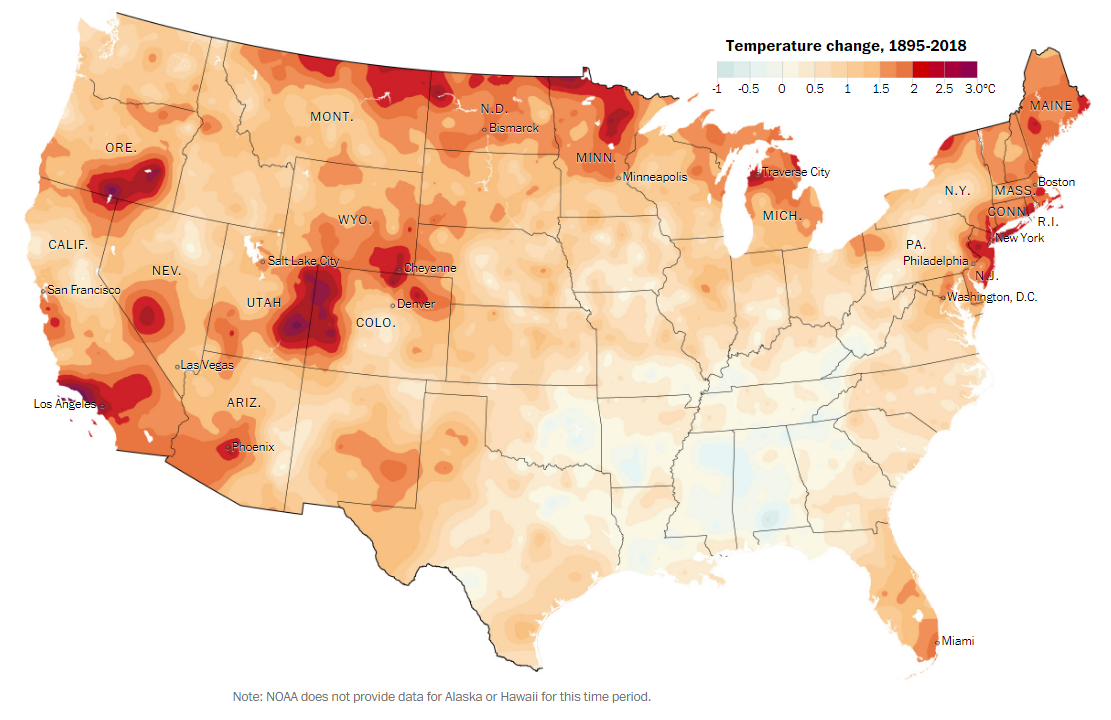
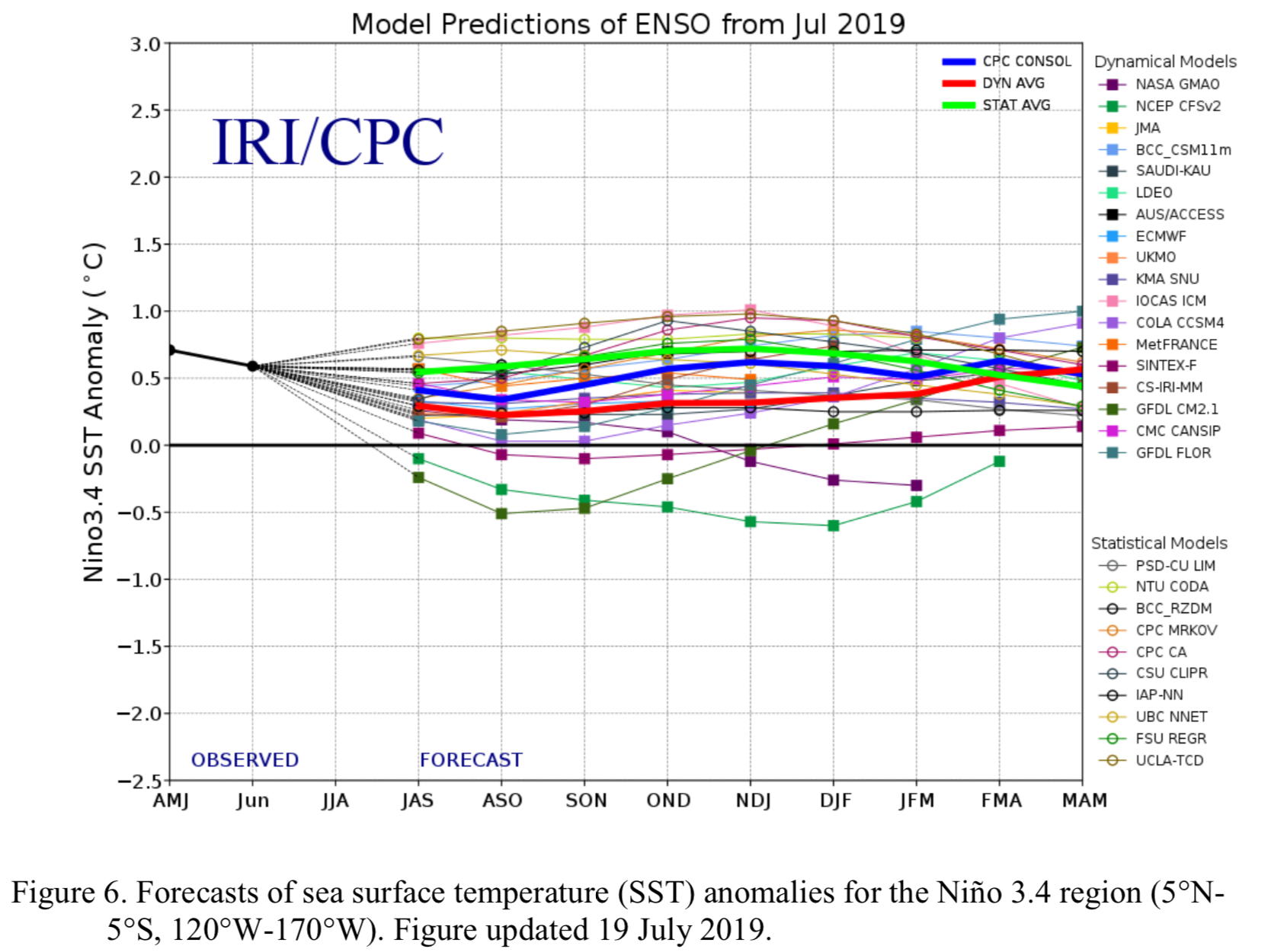
    There has always been the pervasive attitude among the urban entities who use the Colorado River, that cities are more important than agriculture, recreation and environment. It is interesting to note that water lifted over the mountains to the Eastern Slope may not necessarily wind up coming from taps in Denver. It could end up going into the South Platte system to satisfy guarantees to the downstream users in Nebraska.

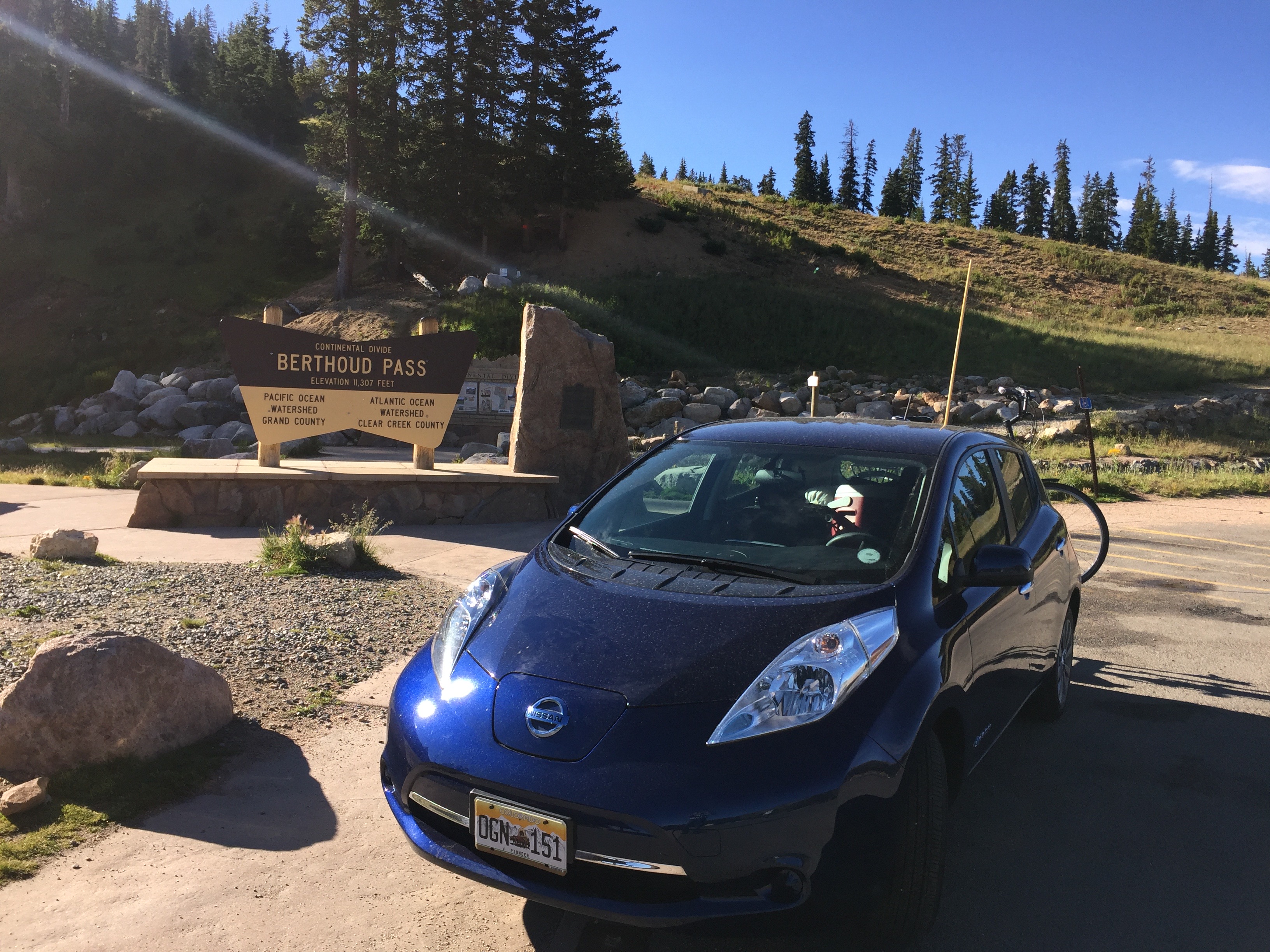
    But why is everybody worried about water and river flows, we just ended a drought? The Colorado snowpack reached a record level…The upstream reservoirs, like Blue Mesa, are at 90-plus percent capacity. Lake Powell, the master pool for all downstream withdrawals, is up almost 20 feet from last year (although it is still down almost 80 feet from a full pool).

    The rest of the Lake Powell numbers give us a clue. The releases from the dam, with two months to go in the water year (October to September), are already at 100 percent of minimum withdrawal. According to the Colorado River District figures, the compacts that govern downstream releases call for a 7.5 million acre feet minimum draw down of Powell. The fact is, the lake has had a rolling average release of more than 9 million acre feet per year over the past ten years, several of which had well below average input from upstream. The sum is that only 4.5 million acre feet per year went into the lake over the past ten years and 9.1 million was released. The current wet year not withstanding, the river is very much overused, now and for the foreseeable future.

    Coloradans cannot be complacent.

    Insulated by senior rights, or not, the Uncompahgre Valley has vultures circling and they are thirsty. Big money and many times more votes make laws and rules change. According to Catlin, Anderson and anyone else involved, like agriculture water users and growing small cities like Montrose, have to be part of the fight to make sure the local economies remain viable with enough water for all uses.

    Catlin campaigned on water as his main issue last year.

    “It’s the biggest issue on the Western Slope,” he said. “We are in a drought, the Colorado River’s in a drought, and the Front Range and Southern California are wanting us to stop farming our land so that they’ll have water. I’m really not in favor of that because it seems to me that we are asking one segment of our society to change how they live so that other people can continue in the same way they always have.”

    Catlin’s remarks last winter came ahead of the current improved condition. Even, so the issue remains.

    The Colorado Farm Bureau ranks water as its top issue. Montrose County Farm Bureau director Hugh Sanburg said last month that dealing with losing more and more water downstream is a major issue for the bureau. Sanburg is a cattle rancher in the Eckert area at the foot of the Grand Mesa.

    But, put agriculture aside, there is another facet that Catlin and Anderson both talk about.

    “We are not talking about just water rights for farmers, we also are talking about recreation based on water,” Anderson said. “We keep shipping all the water to the cities and when those folks come out here to fish and paddle their kayaks, there won’t be any water.”

    Is there an answer?

    To quote MacBeth, “maybe, maybe not.” The problem is not unique to the Uncompahgre River Valley and the tributaries of the Colorado River. Water has always been an issue, everywhere. Range wars have been fought over it. Millions of hours and dollars have gone in long court cases. Predictions have been horribly wrong.

    Anderson says a new water plan for Colorado is needed.

    “It is going to cost a lot of money, as much as 100 million dollars,” he said.

    What do we get for $100 million?

    “We get storage, infrastructure, education and management,” Anderson declared.

    The Colorado Water Conservation Board, on which Anderson serves, has taken on the task. The draft of Colorado’s Water Plan is now public. The primary thrust of the plan is conservation. The funding for the project comes from a wide assortment of organizations from the Colorado Water Trust to the Gates Family Foundation. In all, there are 21 entities that have signed on for the project. In some cases there is reason to believe that some of those 21 have competing goals for water use.

    Next week: The Water Plan and what it means for the Western Slope.

    Michael A Cox is a Montrose-based content developer and author. He may be reached at mcox@burrocreekpictures.com

    #ColoradoSprings: Detention ponds helping to improve safety — The Colorado Springs Gazette

    From The Colorado Springs Gazette (Patrick Nelson):

    Water left behind by severe weather in northeast Colorado Springs has some neighbors are concerned about rising water in ponding basins near their homes.

    Taxpayers agreed to pay more money for improvements to the stormwater system in the Colorado Springs area and while some folks in Wolf Ranch were concerned about a detention pond filling up, the experts say it’s evidence the stormwater system is doing its job.

    On the surface it’s calm, but the stormwater system below this detention pond in Wolf Ranch is moving thousands of gallons of water down stream. Seeing this normally dry basin full of water had some neighbors on edge. Even some of the wildlife came in for a closer look, but stormwater expert Richard Mulledy says the system is performing at a high level.

    “You’ve got to give it an “A”,” said the Colorado Springs Stormwater Enterprise Manager. “I mean, it really took a hard hit and we didn’t see anything major.”

    Just down the road near Research Parkway and Black Forest Road, work is going on to build another detention pond to help mitigate flooding during severe weather.

    “Our stormwater infrastructure is enormous. we’re 195 square miles we’re actually the largest landwise city in the state,” said Mulledy.

    It’s become a requirement for new neighborhoods because if there isn’t somewhere for the water to go it could cause major problems.

    “If this facility wasn’t here you would’ve seen that giant flash flood come down erode the banks, flow over the top of roads, that’s when you see people’s backyards caving in. things like that,” said Mulledy.

    The water in this Wolf Ranch detention pond will completely drain into Cottonwood Creek within 72-hours. Across the city, ponds like this are used to control the water flow making areas near waterways safer downstream all the way to Pueblo.

    Colorado Springs with the Front Range in background. Photo credit Wikipedia.

    #ColoradoSprings closes Prospect Lake in Memorial Park due to positive blue-green algae testing — Colorado Springs Gazette

    From The Colorado Springs Gazette (Liz Henderson):

    Prospect Lake in Memorial Park has been closed indefinitely after a test found toxic blue-green algae in the water, Colorado Springs officials said Friday.

    A “precautionary water sample,” taken from the lake Friday morning by the Colorado Department of Public Health and Environment, tested positive for mycrocystin toxin, also known as blue-green algae.

    The lake’s swim beach was roped off and closure signs were posted. Fishing areas remain open, but anglers are encouraged to clean the fish and remove guts. Rentals are not available, and pets are not allowed.

    “Given today’s positive test for mycrocystin toxin, we have closed Prospect Lake for usage,” said Erik Rodriguez of the city’s Parks, Recreation and Cultural Services in a statement. “CDPHE will continue to test weekly until the bacteria clears up.”

    In the meantime, the city has banned swimming, bathing, paddleboarding, motorized and nonmotorized boats even with permits, tubing and water skiing.

    Prospect Lake in Memorial Park. By Beverly & Pack – Colorado Ballon Classic 2009, Labor Day Weekend, Prospect Lake in Memorial Park in Colorado Springs, CO. Uploaded by Tomer T, CC BY 2.0, https://commons.wikimedia.org/w/index.php?curid=19191608

    @EPA and the shame of this @POTUS administration: “They’re gutting science across the agencies, across the departments, across the government” — Christine Todd Whitman

    In a historic win of the common man against a powerful corporate, chemical giant Monsanto was ordered to pay $289m damages to a man who claimed he got cancer after being directly exposed to the company’s glyphosate-based weedkillers, including the widely used Roundup. Screenshot from meaww.com

    From the Associated Press via the The Aurora Sentinel:

    EPA won’t approve warning labels for Roundup chemical

    The Trump administration has instructed companies not to warn customers about products that contain glyphosate, a move aimed at California as it fights one of the world’s largest agriculture companies about the potentially cancer-causing chemical.

    The U.S. Environmental Protection Agency says it will no longer approve labels warning glyphosate is known to cause cancer. The chemical is marketed as a weed killer by Monsanto under the brand Roundup.

    California requires warning labels on glyphosate products because the International Agency for Research on Cancer has said it is “probably carcinogenic.”

    The EPA disagrees, saying its research shows the chemical poses no risks to public health.

    “It is irresponsible to require labels on products that are inaccurate when EPA knows the product does not pose a cancer risk,” EPA Administrator Andrew Wheeler said in a statement. “We will not allow California’s flawed program to dictate federal policy.”

    California’s Safe Drinking Water and Toxic Enforcement Act, approved by voters in 1986, requires the government to publish a list of chemicals known to cause cancer, as determined by a variety of outside groups that include the EPA and IARC. The law also requires companies to warn customers about those chemicals.

    California regulators have twice concluded glyphosate did not pose a cancer risk for drinking water. But in 2015, the IARC classified the chemical as “probably carcinogenic,” triggering a warning label under California law. Monsanto sued, and last year a federal judge blocked California from enforcing the warning label until the lawsuit is resolved.

    Federal law regulates how pesticides are used and how they are labeled. States are often allowed to impose their own requirements, but they can’t be weaker than the federal law, according to Brett Hartl, government affairs director for the Center for Biological Diversity.

    Hartl said it is unusual for the EPA to tell a state it can’t go beyond the federal requirements.

    “It’s a little bit sad the EPA is the biggest cheerleader and defender of glyphosate,” Hartl said. “It’s the Environmental Protection Agency, not the pesticide protection agency.”

    In a letter to companies explaining its decision, Michael L. Goodis, director of EPA’s registration division in its Office of Pesticide Programs, said the agency considers labels warning glyphosate to cause cancer to “constitute a false and misleading statement,” which is prohibited by federal law.

    From CNN New via NBC4i.com:

    Bristol Bay. By own work – maps-for-free.com, CC BY-SA 3.0, https://commons.wikimedia.org/w/index.php?curid=3709948

    EPA scientists ordered to allow Alaska mine to move forward; could endanger wildlife

    In a major environmental reversal, EPA scientists have been ordered to get out of the way of a massive, controversial copper and gold mine slated for a highly sensitive area in Alaska.

    The order may have originated from the President himself.

    The meeting took place on the tarmac during an Air Force One stopover June 26. Alaska Gov. Mike Dunleavy, a pro-mining, pro-business, anti-EPA governor, met with Donald Trump for nearly a half-hour.

    Dunleavy has been pushing for approval of a massive gold and copper mine known as the Pebble Mine, planned for Alaska’s Bristol Bay watershed, home to the breeding grounds for one fo the world’s largest and most pristine sockeye salmon fisheries.

    After his meeting on Air Force One, Dunleavy said, “He (Trump) really believes in the opportunities here in Alaska and he’s doing everything he can to help us on our mining concerns.”

    Inside EPA sources now tell CNN the very next day, June 27, top EPA officials in Washington held an internal video conference with Seattle, and told staff the EPA was removing a special protection for Bristol Bay, and, in essence, clearing the way for what could be one fo the largest open-pit mines in the world.

    That internal announcement was a “total shock” to top EPA scientists, sources told CNN, because their environmental concerns were overruled by Trump political appointees at EPA headquarters in Washington.

    Bristol Bay and its tributaries are regarded as one of the world’s most important salmon fisheries, roughly half the world’s sockeye salmon come from there.

    It’s been protected since 2014, when after three years of study, the Obama-era EPA used a rare provision of the Clean Water Act — to basically veto any mining that could pose a threat.

    “EPA scientists writing a mine ‘would result in complete loss of fish habitat’ that was ‘irreversible.’ It’s mindboggling that it’s still being considered at all,” said Christine Todd Whitman, former EPA administrator.

    Todd Whitman is a Republican, former New Jersey governor, and under President George W. Bush, ran the EPA. She has joined several other former EPA chiefs to publically oppose the mine.

    “The potential damage is overwhelming,” she said. “The opposition to it up there is amazing and everywhere. I mean, this was a huge, the potential of over 80 miles of streams, thousands of acres, could be damaged from this project.”

    This is the second time during the Trump administration the political appointees at the EPA have decided to remove special protections for Bristol Bay to pave the way for this huge mine.

    In 2017, President Trump’s first EPA administrator, scandal-plagued Scott Pruitt, canceled the protections after a private meeting with the mine company’s CEO.

    After a report exposed the meeting and the lack of scientific debate behind the reversal, Pruitt backed down and put the protections back in place.

    Now, another private meeting, this time with the president himself, has led to yet another win for the mine, and the removal of environmental protections for this pristine watershed.

    “One of the most troubling things about this administration, I mean there are a lot of things that trouble me, but on the environmental side is this disregard of science,” Todd Whitman said. “They’re gutting science across the agencies, across the departments, across the government.”

    If the order is followed through with, Todd Whitman sees a number of lawsuits possibly being filed.

    “Environmental groups, native Alaskans, you’ll have a host of lawsuits, I’m convinced,” she said…

    At EPA headquarters, Andrew Wheeler, the former coal company lobbyist who now runs the agency, has a tie to Pebble Mine, too. He has recused himself from decision making on the project because his former law firm represents the mine.

    EPA scientists said political and business favors are driving decision making.

    One top EPA official said, “We were told to get out of the way and just make it happen.”

    The EPA said the Obama-era protections were outdated and the mine still has to go through the approval process.

    When asked about the internal EPA meeting on June 27, at first, the EPA denied it happened, but when presented with evidence, they admitted the meeting took place.

    Sources said the meeting is when officials told scientists the decision had been made and their work was not needed.

    There are advantages to commuting by bicycle #Denver #Colorado

    Coyote Gulch on the Clear Creek Trail near Little Dry Creek Lake in the industrial area of S. Adams County August 9, 2019.
    Clear Creek Trail near Little Dry Creek Lake in the industrial area of S. Adams County August 9, 2019.

    Jennifer Gimbel named to @Northern_Water Board

    Jennifer Gimbel. Photo credit: Northern Water

    Here’s the release from Northern Water (Jeff Stahla):

    Jennifer Gimbel of Loveland has been chosen to serve on the Northern Water Board of Directors and Municipal Subdistrict Board of Directors.

    She will represent Larimer County and replaces Bill Fischer, who passed away May 7. By state law, directors are chosen by the chief judge of the district court.

    Gimbel has an extensive background in state and federal water policy.

    She currently is the senior water policy scholar for the Colorado Water Center, based at Colorado State University. In this position she teaches a graduate seminar on water issues and develops policy strategy papers on issues facing the Colorado River and the Upper Basin states, of which Colorado is one.

    Before that, she served as the principal deputy assistant secretary for water and science in the Department of the Interior and was deputy commissioner for external and intergovernmental affairs for the Bureau of Reclamation.

    From 2008 to 2013, Gimbel was the director of the Colorado Water Conservation Board, a group within the Department of Natural Resources that works to protect and develop the state’s water resources.

    “Water is such an important part of our lives and our future,” she said. “It is an honor to be appointed to the Northern board, which has been and continues to be important in water supply and policy not only in Northern Colorado but also in all of the state.”

    Gimbel enjoys hiking and reading. She has two adult children and two grandchildren.

    Jack Holmes: One solution to numerous water projects — The Vail Daily “Valley Voices”

    Eagle River Basin

    Here’s a guest column about water projects for the upper Eagle River Valley, from Jack Holmes, that’s running in theThe Vail Daily:

    There are at least five water-related project proposals being considered for the Upper Eagle River Valley from Dowd Junction to the top of Tennessee Pass in the next 50 years. These include several tributaries of the Eagle River.

    One combined project could take care of all major stakeholders and turn the area into a model for the future. The alternative will be five decades of litigation and a patchwork of projects that will be costly to all communities.

    It is not about who will get the water. That is settled by Colorado Water Law and the 1989 Memorandum of Understanding. It is about whether the parties involved will work together, which happened during the drought of the early 2000s, or go in separate directions, which was the case during the middle 1950s.

    The common project would be an Upper Eagle Pipeline and Storage Co. from Dowd Junction to Tennessee Pass. Storage, if needed, could be at Bolts Lake and Camp Hale. The 20-mile-long pipeline would follow the route of the Eagle River, the Railroad, the U.S. 24 highway or some combination thereof depending on what works and preserves the existing scenic corridor between Dowd Junction and Tennessee Pass.

    That is the lowest continental divide pass in the Central Rockies. Those wanting to move or store water would need to pay accordingly. A trench and bury pipeline approach would seem to a good approach.

    This proposal would give all major parties what they need at a reasonable cost. Memorandum of Understanding obligations could be met. To be sure, this would require some compromise. Camp Hale restoration might need to shift from some limited and expensive wetland restorations to a series of small reservoirs but probably would get more visitors to honor the 10th Mountain Division. Extensive wetlands are a few miles away on Homestake Creek in the original Camp Hale boundaries.

    Building the one project pipeline and reservoirs would require funding, but it should cost less than tunnels, which are problematic to begin with because of potential seismic activity that would destroy the tunnels. In fact, the concept could be sold as a demonstration project worthy of grant funding.

    While moving of water is not attractive to environmentalists, the concentration of project impacts in a well-established corridor makes sense. To be sure, the rail corridor would need to be preserved for possible future use, but an adjoining pipeline could be helpful in this regard.

    If Front Range communities are more willing to pay for initial construction than Western Slope entities, the first phase of the project could start at the junction of Fall Creek and the Eagle River.

    A major environmental question is how much effort should be spent to erase existing environmental impacts in the Eagle River and its Homestake Creek tributary basins above their lower Red Cliff junction. Such actions could merely shift impacts to the other basin at great public and environmental expense.

    Anybody familiar with these issues knows that this proposal is a simplified summary. However, it also is known that 50 years in court and countless engineering and field hours can be curtailed by working together. The public has every right to insist that every attempt be made to arrive at a unified approach. While there are some good studies of limited areas, consideration of the larger area is missing at this point.

    Jack Holmes is Professor Emeritus of Political Science at Hope College in Holland, Mich., and vice-chair of the Holy Cross Wilderness Defense Fund. He has backpacked in the Holy Cross Wilderness since 1959 and is a summer resident on Homestake Creek above Red Cliff. For many years, he taught a summer course on wilderness politics.

    Minturn councillors say no to water project

    Mountains reflect off of Bolts Lake, back in the day, as seen from US 24 S in Colorado. Photo via
    LessBeatenPaths.com.

    From The Vail Daily (Edward Stoner):

    Minturn turned down a proposal Wednesday that would have provided enough water for substantial growth within the town, including the Battle Mountain developer’s proposal to build up to 712 homes near Maloit Park and Tigiwon Road.

    The Minturn Town Council voted 7-0 to deny the proposed deal between Minturn, the Eagle River Water and Sanitation District and the Battle Mountain developer.

    Most residents who spoke at the meeting opposed the deal.

    “We need to control our water,” said Minturn resident Woody Woodruff. “We can’t turn over that control to somebody else, because water is going to set the future of this town.”

    The developer had asked for a decision to approve or deny the deal Wednesday.

    Earle Bidez, mayor pro tem, cited continued concerns on the part of Minturn with the agreement — as well as an increasingly “negative” tone from the developer.

    “We have not been able to reach a deal with the district,” he said. “We didn’t get far enough with Battle Mountain to know what we would have ended up with. But I don’t think we can get there from listening to (residents) for the last few months. The negotiation would have to change very much to get there.”

    Minturn currently provides its own water from Cross Creek, separate from the rest of the valley’s supply. But the water from Cross Creek is limited — more water is needed if the town wants to grow significantly.

    Under the proposal, the developer would have paid for a $5.6 million water pipe, or “interconnect,” that would have connected the Eagle River Water and Sanitation District’s water supply to Minturn’s, providing more water for growth and a redundant supply in case of emergency. The developer also offered more than $3 million in other infrastructure improvements for Minturn, whose aging water system is in need of significant repairs.

    The deal also would have allowed the Eagle River Water and Sanitation District to build a $48 million reservoir at Bolts Lake, which is now dry.

    It would have been contingent upon the developer receiving the approvals it needs to build the 712 homes.

    Cross Creek Trail. By Photo credit: Kim Fenske, CC BY-SA 3.0, https://commons.wikimedia.org/w/index.php?curid=12597269

    Gross Reservoir Expansion Project hits new milestone — News on TAP

    Denver Water hires Kiewit Barnard to help finish design work on the $464 million project. The post Gross Reservoir Expansion Project hits new milestone appeared first on News on TAP.

    via Gross Reservoir Expansion Project hits new milestone — News on TAP