The state needed an above-average snow year this winter to reverse the drought’s momentum. Forecasts for the next few months aren’t optimistic, either.
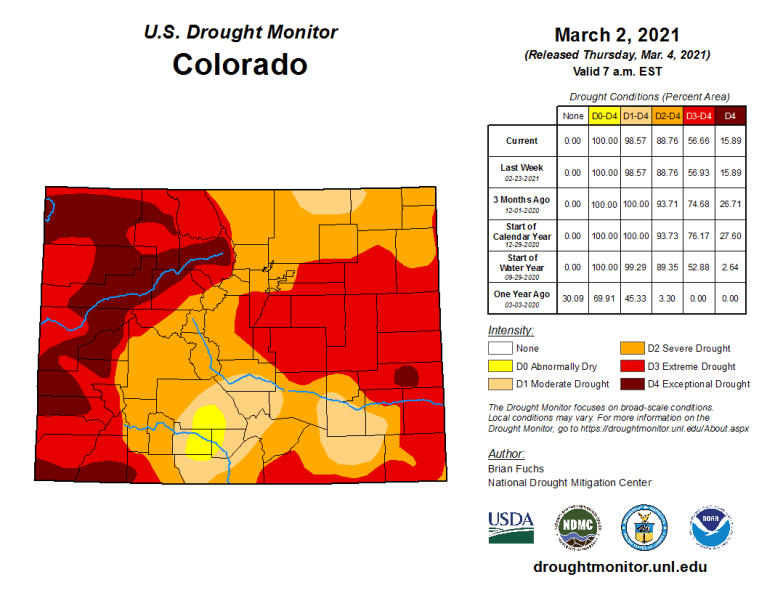
Last week’s snowstorms across the Front Range were enough to downgrade some areas from “extreme” drought to “severe,” according to the latest national drought monitor report released Thursday by the University of Nebraska. And the previous week’s map had downgraded much of the San Luis Valley from “moderate” drought to “abnormally dry.”
That’s the good news. The bad news: 98.57% of the state is still in drought, to varying degrees. And experts aren’t confident that conditions will improve anytime soon.
Colorado Drought Monitor March 2, 2021.
Unlike tornadoes, hurricanes or other weather events, drought is a phenomenon that builds over time, and its effects compound as it persists. Brian Fuchs, a climatologist with the National Drought Mitigation Center and the author of this week’s drought monitor report, noted that some regions of the state, particularly the southwest, have been drier than average for multiple years. This time last year, 45.33% of the state was in drought, none of which was classified in the worst two categories.
As of Thursday’s report, 56.66% of the state’s drought is “extreme” or “exceptional.” Colorado’s current drought conditions are the result of a combination of earlier-than-average snowmelt last spring, a lack of summer monsoons and a warm, dry autumn that led the state to use even more of its water reserves. Add this winter’s lackluster snowfall and it becomes a tricky situation.
“If it took a number of years to get into drought, what will it take over the next several years to come out of drought?” Fuchs said.
Answering that question is a complicated task. The order of operations is important, too; soils need to rehydrate first, soaking up runoff like a sponge, before the water can continue on to rivers and streams.
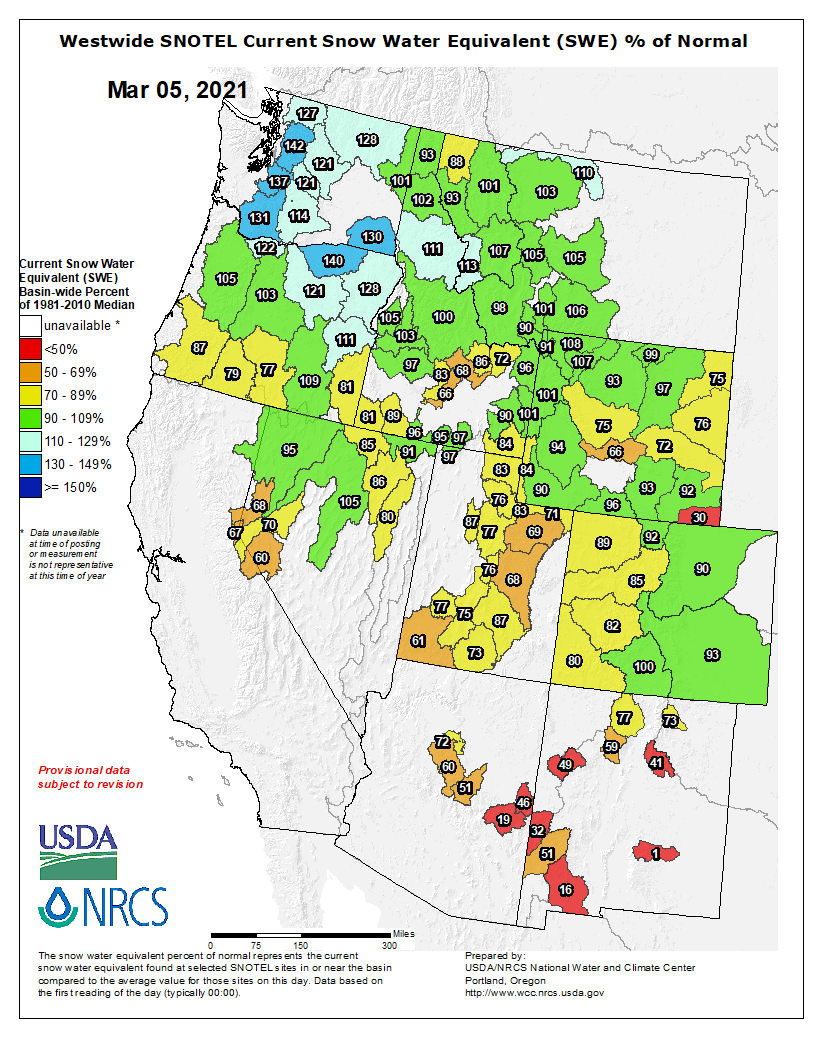
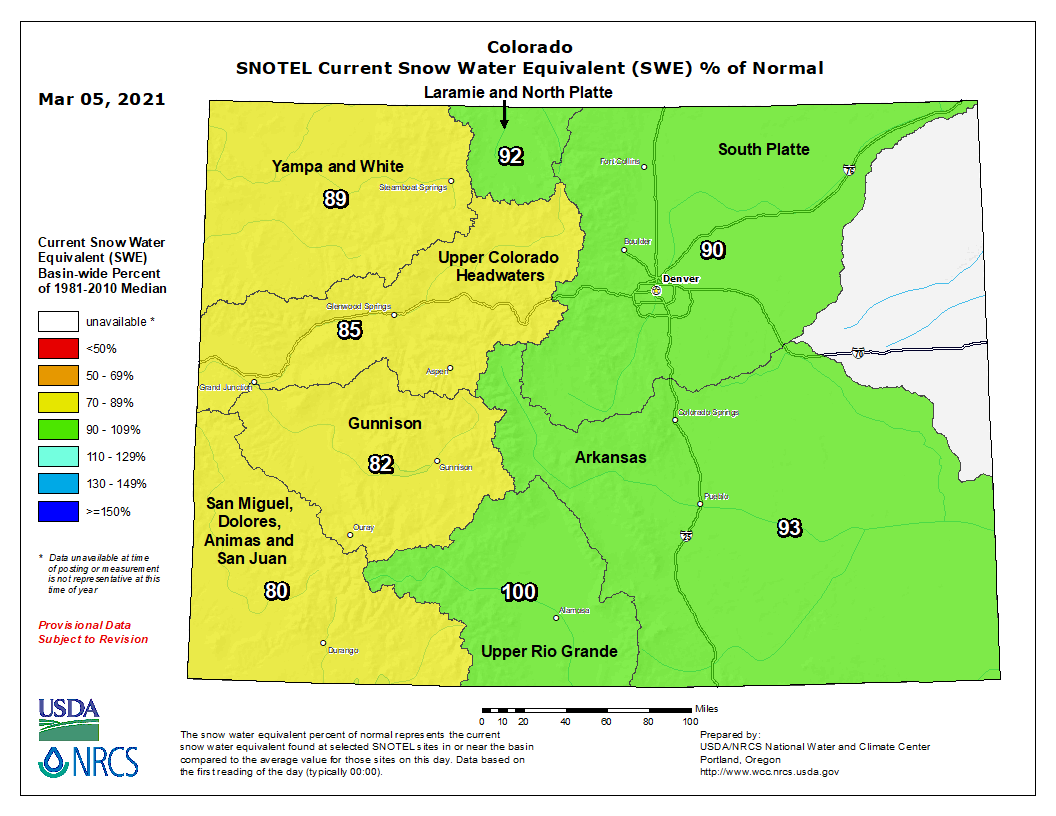
In an ideal scenario, the state would have received above-average snowpack this winter to saturate dried-out soils, store up enough moisture for better runoff this spring and summer and refill reservoirs. But snow-water equivalent estimates for Colorado’s eight alpine river basins are at least a little below their 30-year averages, according to reports from the National Resource Conservation Service…
Colorado snowpack basin-filled map March 5, 2021 via the NRCS.
The spring months are often perceived as Colorado’s snowiest time of year, but Assistant State Climatologist Becky Bolinger says that’s really only true for the Front Range. Higher elevations should be receiving sizable moisture loads all winter long, and despite recent storms, models for the next few months are not encouraging.
“Unfortunately it’s little battles that are being won in a bigger war,” Bolinger said. “One winter can be prepared for, and that’s why we have reservoirs and that’s why we monitor this. A winter like this, where we came in already struggling is definitely going to be a bigger concern.”
“We’re going to need an extended period of cooler and wetter conditions to pull us out of that and it’s not what the outlooks are showing at this point,” [Russ Schumacher] said.
Colorado is coming off a brutal fire season. More acreage was lost to wildfire in 2020 than in any other year in recorded history.
Schumacher noted that the West has been dry for most of the past 20 years, with drier years leading to catastrophic fires…
“We live in a naturally dry place,” he said. “Droughts are a big part of Colorado’s history.”
But weather patterns have not helped.
“We’ve had three summers in a row with a failed monsoon in western Colorado and also very hot conditions,” he said.
But he does not think that is a permanent shift. Climate change, he believes, is having some role and variability.
“There is some research pointing to as the climate warms, the frequency of having those wet years, it’s actually in western Colorado that might go down.”
And that’s one of the areas of the driest conditions in Colorado right now…
Snowpack, which is at 81% of average (84% of normal) is an asset to the mountains, the Front Range and even other states across the West as a water resource. Water restrictions could be coming if March and April snow does not add up and average temperatures rise.
In a move to make sure Utah’s interest in Colorado River water is protected, the Legislature…passed [H.B. 297 Substitute — Colorado River Amendments] establishing the Colorado River Authority of Utah.
Critics complained the new entity was created to push development of the Lake Powell Pipeline, but its supporters say other states in the Colorado River Basin have similar government groups to protect their allocation of what’s been described as the hardest working river in the West, supplying water to 40 million people.
In the same vein of protecting Utah’s water assets, lawmakers endorsed [H.B. 29 Substitute — Statewide Aquatic Invasive Species Emergency Response Plan] to set up a statewide invasive aquatic species emergency response plan.
The measure targets the spread of quagga mussels and supports the aggressive efforts by the Utah Department of Natural Resources and other agencies battling the invasive species, which has infected the waters of Lake Powell.