
Click the link to read the article on the Gizmodo website (Peter Deneen). Here’s an excerpt:
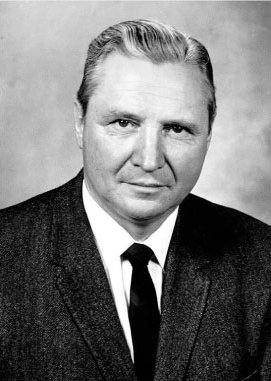
The date is Feb. 9, 1997, and the man responsible for one of the most egregious environmental follies in human history is sitting at a restaurant in Boyce, Virginia, with the leader of the movement seeking to undo his mistake. Of the hundreds of dams Floyd Dominy green lit during his decade running the Bureau of Reclamation, none are as loathed as his crown jewel, the Glen Canyon Dam. In 1963, Dominy erected the 710-foot (216-meter) tall monument to himself out of ego and concrete, deadening the Colorado River just upstream of the Grand Canyon, drowning more than 250 square miles (648 square kilometers) in the heart of the Colorado Plateau, and inventing Lake Powell in the middle of a sun-baked desert. After a couple of drinks, Dominy asked his dinner guest, Glen Canyon Institute founder Richard Ingebretsen, for an appraisal of the effort to drain Lake Powell. “It’s pretty serious, Mr. Dominy,” Ingebretsen recalled telling him, holding back the seething discontent of the broad coalition he represented. When Ingebretsen described his hypothetical plan to drill through the twin boreholes bestriding Glen Canyon dam, Dominy replied, “Well, you can’t do that. It is 300 feet of reinforced concrete.” Then Dominy did something extraordinary—he lowered his glasses, pulled out a pen, and diagrammed precisely how he would do it on a cocktail napkin. A stunned Ingebretsen could hardly believe what was happening.
“This has never been done before,” Dominy said. “But I have been thinking about it, and it will work.”

In the 58 years since Glen Canyon was flooded, memory of what was lost has mostly been forgotten. Submerged beneath the water lies a desert canyon like none other that stretches some 200 miles (322 kilometers). The Colorado River was the wildest river in North America before it was arrested by the Bureau of Reclamation during the frenetic dam-building era last century. But in this section of the river, the current flowed calmly through fern-covered walls. “It was a kind of Eden,” as Elizabeth Kolbert described it in The New Yorker this summer, “more spectacular than the Grand Canyon and, at the same time, more peaceful. It was a fairy-tale maze of side canyons, and side canyons with their own side canyons, each one offering a different marvel.” Hundreds of ephemeral streams and tributaries joined the Colorado River here, each of them achingly abundant with riparian habitat and mind-bending geomorphology, where beavers and fish thrived beneath soaring rainbows of salmon-colored rock arches.

Glen Canyon is a natural wonder that’s been wasting the past six decades as an unnecessary water storage facility for the Bureau of Reclamation. The last time Lake Powell was as low as it is today, Neil Armstrong had yet to set foot on the moon. But the climate crisis and decades of water overuse have sent Powell’s shoreline receding. The telltale bathtub ring of the previous high water mark isn’t the only sign of change; habitats that were swallowed by the reservoir have sprung back to life—baby cottonwood trees, canyons full of frogs and maidenhair ferns, birds, bees, bears, and beavers have reclaimed their old territory…

Dominy’s dam, which the former House Interior Committee Chair Mo Udall as well as five-term Arizona Sen. Barry Goldwater have called “the biggest mistake in their legislative careers,” killed what was the biological heart of the Colorado River. With more than 79 species of plants, 189 species of birds, and 34 species of mammals, it was an ecological marvel. The canyon was also home to a staggering array of Indigenous sites and artifacts dating back hundreds of years, all of them now underwater. All that was traded away for the longest reservoir in the world, with approximately 2,000 miles of coastline. Unfurled, Lake Powell’s shoreline would stretch from Maine to Florida. Its primary function? To temporarily detain water for metered release to replenish Lake Mead. As Kolbert put it, Dominy built a reservoir for a reservoir. The redundant Glen Canyon Dam harnesses the Colorado River just upstream from Lee’s Ferry, an arbitrary point chosen to delineate “upper basin” states—Colorado, New Mexico, Utah, and Wyoming—from “lower basin” states—Arizona, California, and Nevada. Separating the river into two jurisdictions is seen as one of the original sins for the world’s most litigated river. Ingebretsen said Lake Powell was born as a security measure, founded on the distrust between upper and lower basin states.
Red Bull mfg in Glendale = 1 MILLION gallons a day
NEW Nestle plant will average 1.5 MILLION gallons a day
Intel chip plants = 5 MILLION a day (minimum)
Coca Cola = 1.5 MILLION a day
WHEN are the “journalists” not the copywriters, going to INVESTIGATE the obscene amount of water being used by these beverage plants????
AZ feeds the USA winter veggies, guess weget to start drinking Red Bull, Nestle Creamer instead.
Can’t someone there act like a real journalist and call out the corporations PROFITING off our water??????
Terri,
I’m not understanding your point here. Ag uses by far the most water in the Colorado River Basin. Check out this Coyote Gulch post about the basin: https://coyotegulch.blog/2022/09/29/whos-really-using-up-the-water-in-the-american-west-vox/
Thanks for commenting.
John Orr
Ag does use by far the most water. These figures for the beverage plants are literally drops in the bucket. Eliminating Lake Powell would be a travesty. All the bantering about how beautiful Glen Canyon is are true. Having the canyon filled with water excentuates that beauty even more, and makes it much more accessible for everyone to enjoy. It’s a true desert oasis, and the coolest place I have ever seen. It would be neither of those things without Lake Powell. It would be way better to keep Lake Powell even if all we needed it for was recreation. Forget the fact that it is an essential resource that nomatter what side your on it cannot be denied that it simply has to be there. Only small groups with selfish reasons are even trying to deny that. We simply cannot live without it, and very thankfully so. We need more dams in the Colorado River system, not less. That is never not going to a fact nomatter who likes it, and who doesn’t.
Sean,
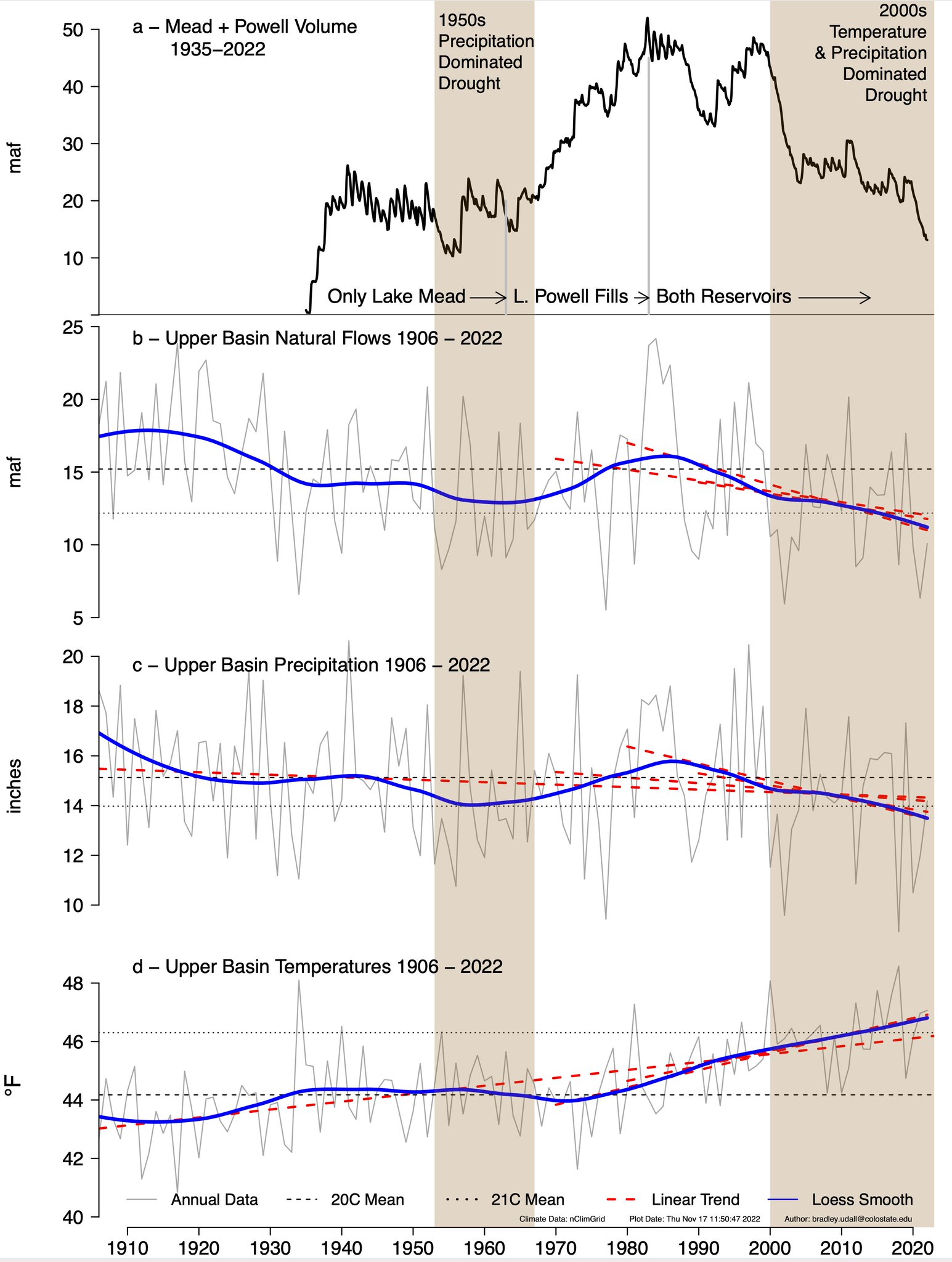
I first saw Lake Powell from Hite Marina (a marina no longer) in 1973 and I thought it was the most beautiful site I had ever seen, then I started hiking the canyons. The hydrology of the Colorado River will not support more dams and most likely Lake Mead and Lake Powell will never fill again. Check out this graphic by Brad Udall: https://coyotegulch.blog/wp-content/uploads/2022/11/brad-udall-4-panel-graph-mead-powell-colorado-river-flows-temperature-precip-112022.jpeg.
Thanks for commenting.
John Orr
http://coyotegulch.blog/
Wow drain the most beautiful lake on this planet You’re crazy. Maybe people need to come up with a real solution instead of prayer for rain and snow. Maybe make another natural gas power plant, and fill the lake back up and use that for power on average or above average snow pack years. Bottom line California is the problem.
Matt,
Well the solution is steady heavy snowfall in the mountains so how do you propose we put that solution into practice. We are at the mercy of the Climate Crisis and Lake Mead and Lake Powell will never fill again. The solution is to end greenhouse gas emissions as soon as possible. No more methane gas power plants would be a good start.
Check out this 4-panel graphic from Brad Udall to understand the situation for the 2 reaservoirs: https://coyotegulch.blog/wp-content/uploads/2022/11/brad-udall-4-panel-graph-mead-powell-colorado-river-flows-temperature-precip-112022.jpeg
Thanks for commenting.
John Orr
http://coyotegulch.blog/
It’s not just happing in the west it’s happying in Blue Mesa reservoir and the upper part of Colorado I just praying for a Great spectacular runoff this year to fill up these reservoirs especially lake Mead.
Jeffrey,
So far so good for snowpack. Thanks for commenting.
John Orr
http://coyotegulch.blog/
I’m sure you are correct. I’m clinging to hope that conservation efforts, and some above recent average moist years will keep the reservoirs viable (I know, fat chance). I go to Blue Mesa a couple times a year. It is scary low. Went to Flaming Gorge last year. It is scary low. Mead and Powell are in the news daily. The situation is bad, and much more dire than most want to believe. California keeps voting down desalination plants, but I don’t think they are going to have a choice in the near future. Their water allocation from the Colorado river is way to much, and they are doing the least to combat the situation. I wouldn’t feel bad if a cut, or even elimination of California’s water rights was implemented. I know that’s rough and unfair to say, but they are the only state in the pact right next to an unlimited water resource, they use the most Colorado River water, and they are doing the least to conserve it. If we can’t do it, Mother nature is going to do it for us, and soon.
After working at Dangling Rope Marina for 3 summers in college, this lake is near and dear too my heart.
I don’t know why the government can’t come in a blow up century old water rights that don’t apply to the region any more. They need to carve out new rights to all of the states that make sense for the water levels today and not rely on rules from 1920. It would take me half a day with all the governors in the west to redraw everything and make everyone live with it.
Gregory,
It would take a lot of time and litigation to wrangle the water rights from the states, they are not federal rights to dole out. Thanks for commenting.
John Orr
http://coyotegulch.blog/
Drain it? No – close all the gates until it’s full. Then do the same thing for the rest of them. Do the same thing with every lake/reservoir. Do this NOW. Literal *decades* of warnings should be considered to be more than sufficient by any reasonable person.
It’s happening all over the world all man made lakes take a long look to what’s coming do something or not it will be dried up again.
Arthur,
Thanks for commenting and I agree drying is happening all over the world because a warmer atmosphere is a thirstier atmosphere.
John Orr
http://coyotegulch.blog/
This is a great article covering the history the Colorado River that has led us to the situation we find ourselves in today. A follow-up article covering the agricultural interests in the region and the amounts of water they receive would help understand the complexities of the issue. Water intensive crops such as cotton and alfalfa are grown in Arizona. Irrigating crops in the desert southwest may no longer be in the best interest of all stakeholders.
Dave,
Thanks for commenting, Peter Deneen from Gizmodo hit it out of the park. You might enjoy perusing the “Colorado River Basin” category on Coyote Gulch (right side of the blog, not sure how to find them on a phone). I have published a ton of posts lately in the lead up to the Colorado River Water Users Association Conference in Los Vegas next week.
John Orr
http://coyotegulch.blog/
Well to say it is a drought is a bit of a misnomer. Having lush green golf courses in the desert screams “resource mismanage ment” not draught.
LW,
You’re right. Here in Colorado one city — Aurora — just passed an ordinance prohibiting new golf courses in the city. One of the reasons that was cited to their council was that they get much of their water supply from the Colorado River Basin and therefore they should set an example in this age of aridification.
Thanks for commenting.
John Orr
http://coyotegulch.blog/
I would recommend the government stop trying to manipulate the weather and and allow natural weather to take over again. Geoengineeringwatch.org
Rob,
Thanks for commenting. What geoengineering projects are being implemented that concern you?
John Orr
http://coyotegulch.blog/