
Click the link to read the paper on the Annals of Global Health website (Nadia Gaber, Lisa Bero, and Tracey J. Woodruff). Here’s the abstract:
Background: Per-and polyfluoroalkyl substances (PFAS) are a class of widely-used chemicals that persist in the environment and bioaccumulate in humans and animals, becoming an increasing cause for global concern. While PFAS have been commercially produced since the 1940s, their toxicity was not publicly established until the late 1990s. The objective of this paper is to evaluate industry documents on PFAS and compare them to the public health literature in order to understand this consequential delay.
Methods: We reviewed a collection of previously secret industry documents archived at the UCSF Chemical Industry Documents Library, examining whether and how strategies of corporate manipulation of science were used by manufacturers of PFAS. Using well established methods of document analysis, we developed deductive codes to assess industry influence on the conduct and publication of research. We also conducted a literature review using standard search strategies to establish when scientific information on the health effects of PFAS became public.
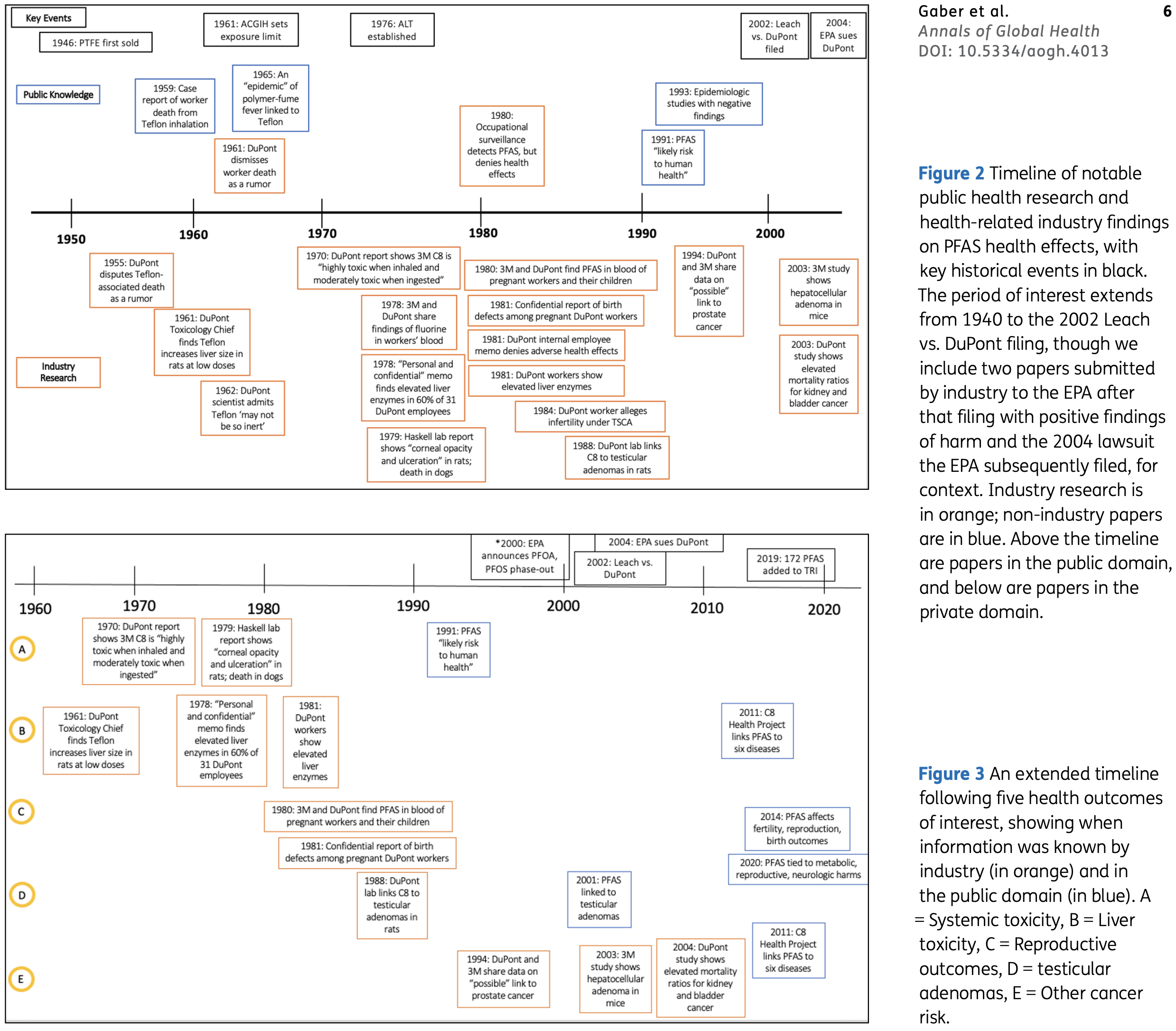
Results: Our review of industry documents shows that companies knew PFAS was “highly toxic when inhaled and moderately toxic when ingested” by 1970, forty years before the public health community. Further, the industry used several strategies that have been shown common to tobacco, pharmaceutical and other industries to influence science and regulation – most notably, suppressing unfavorable research and distorting public discourse. We did not find evidence in this archive of funding favorable research or targeted dissemination of those results.
Conclusions: The lack of transparency in industry-driven research on industrial chemicals has significant legal, political and public health consequences. Industry strategies to suppress scientific research findings or early warnings about the hazards of industrial chemicals can be analyzed and exposed, in order to guide prevention.
KEY MESSAGES
IMPLICATIONS FOR POLICY MAKERS
- This paper analyses how the chemical industry, using industry documents, delayed disclosing the harms of PFAS, costing billions of dollars in health and environmental damages globally.
- Many countries are pursuing legal and legislative action to curb PFAS production that may be aided by the timeline of evidence presented here.
- The production of chemical toxicity research should be in the best interest of protecting the public’s health, including designing the research question, funding studies, and publishing favorable and unfavorable findings.
- Legal settlements against chemical manufacturers should include documents disclosure in order to ensure transparency and accountability for industries and their products.
- Public health and environmental policy makers should move towards precautionary principles of chemical regulation.
IMPLICATIONS FOR THE PUBLIC
This paper examines previously secret documents held by DuPont and 3M, the largest manufacturers of PFAS, also called “forever chemicals.” We show how the chemical industry used the tactics of the tobacco industry to delay public awareness of the toxicity of PFAS and, in turn, delayed regulations governing their use. PFAS are now ubiquitous in the population and environment. Consumer awareness can advance calls for safer products by demanding publicly available studies of harm. Public pressure can also influence legislators to pass more health-protective environmental and
chemical regulations.