
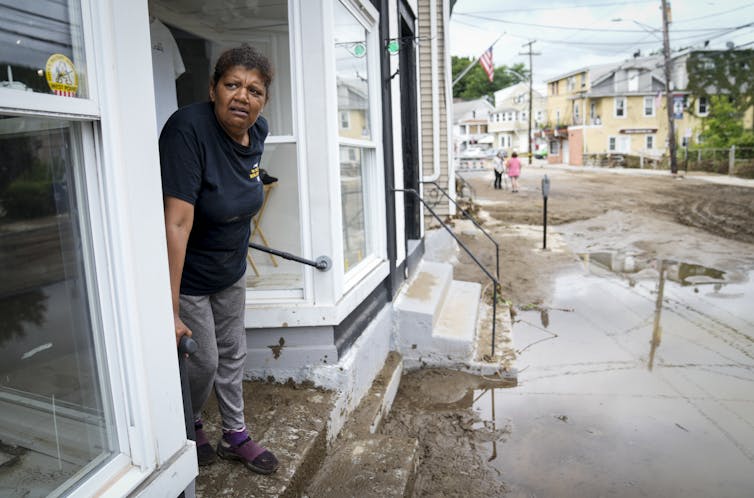
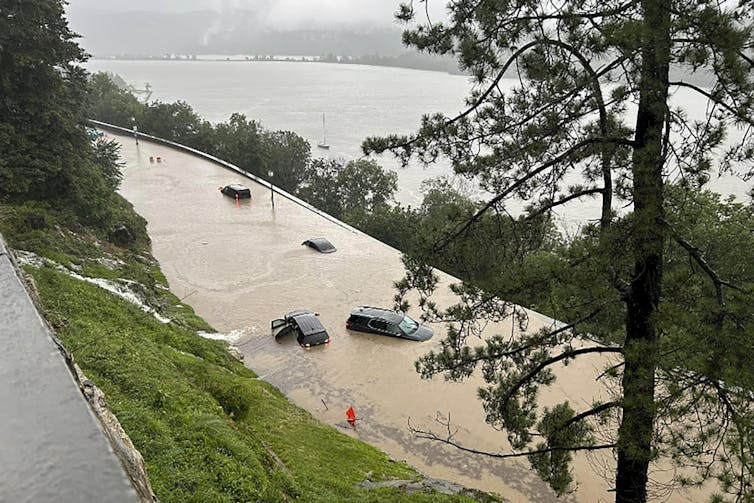
A powerful storm system that hit the U.S. Northeast on July 9 and 10, 2023, dumped close to 10 inches of rain on New York’s Lower Hudson Valley in less than a day and sent mountain rivers spilling over their banks and into towns across Vermont, causing widespread flash flooding. Vermont Gov. Phil Scott said he hadn’t seen rainfall like it since Hurricane Irene devastated the region in 2011.
Extreme water disasters like this have disrupted lives in countries around the world in the past few years, from the Alps and Western Europe to Pakistan, India and Australia, along with several U.S. states in 2022 and 2023.
The role of climate change is becoming increasingly evident in these types of deluges.
Studies by scientists around the world show that the water cycle has been intensifying and will continue to intensify as the planet warms. An international climate assessment I co-authored in 2021 for the Intergovernmental Panel on Climate Change reviewed the research and laid out the details.
It documented an increase in both wet extremes, including more intense rainfall over most regions, and dry extremes, including drying in the Mediterranean, southwestern Australia, southwestern South America, South Africa and western North America. It also shows that both wet and dry extremes will continue to increase with future warming.
Why is the water cycle intensifying?
Water cycles through the environment, moving between the atmosphere, ocean, land and reservoirs of frozen water. It might fall as rain or snow, seep into the ground, run into a waterway, join the ocean, freeze or evaporate back into the atmosphere. In recent decades, there has been an overall increase in the rates of precipitation and evaporation.
A number of factors are intensifying the water cycle, but one of the most important is that warming temperatures raise the upper limit on the amount of moisture in the air. That increases the potential for more rain.
This aspect of climate change is confirmed across all of our lines of evidence. It is expected from basic physics, projected by computer models, and it already shows up in the observational data as a general increase of rainfall intensity with warming temperatures.
Understanding this and other changes in the water cycle is important for more than preparing for disasters. Water is an essential resource for all ecosystems and human societies, and particularly agriculture.
What does this mean for the future?
An intensifying water cycle means that both wet and dry extremes and the general variability of the water cycle will increase, although not uniformly around the globe.
Rainfall intensity is expected to increase for most land areas, but the largest increases in dryness are expected in the Mediterranean, southwestern South America and western North America.
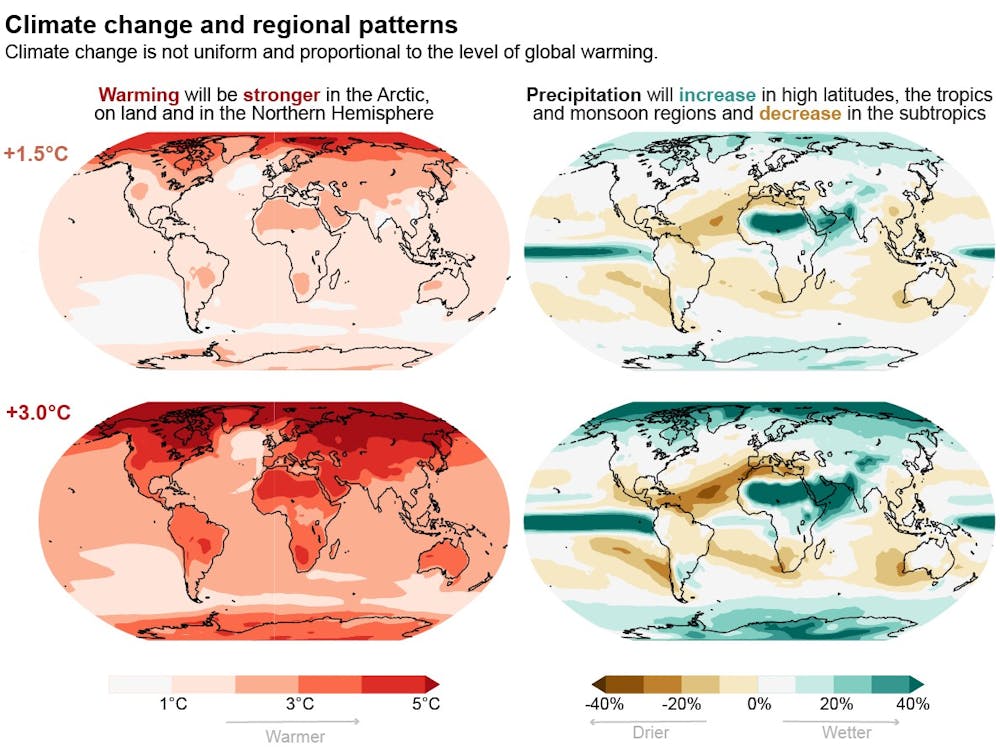
Globally, daily extreme precipitation events will likely intensify by about 7% for every 1 degree Celsius (1.8 degrees Fahrenheit) that global temperatures rise.
Many other important aspects of the water cycle will also change in addition to extremes as global temperatures increase, the report shows, including reductions in mountain glaciers, decreasing duration of seasonal snow cover, earlier snowmelt and contrasting changes in monsoon rains across different regions, which will impact the water resources of billions of people.
What can be done?
One common theme across these aspects of the water cycle is that higher greenhouse gas emissions lead to bigger impacts.
The IPCC does not make policy recommendations, but the results show what the implications of different choices are likely to be.
One thing the scientific evidence in the report clearly tells world leaders is that limiting global warming to the international target of 1.5 C (2.7 F) will require immediate, rapid and large-scale reductions in greenhouse gas emissions.
As the evidence shows, every fraction of a degree matters.
This updates an article originally published July 29, 2022, with flash flooding in the Northeast.
Mathew Barlow, Professor of Climate Science, UMass Lowell
This article is republished from The Conversation under a Creative Commons license. Read the original article.