Feds close to releasing draft environmental review of #ColoradoRiver management options — Jennifer Solis (NevadaCurrent.com) #CRWUA2025 #COriver #aridification

Bureau of Reclamation’s Acting Commissioner Scott Cameron speaks at the annual Colorado River Water Users Association’s conference. (Photo: Jeniffer Solis/Nevada Current)

Click the link to read the article on the Nevada Current website (Jennifer Solis):

December 18, 2025

In the next few weeks, the public will get their first look at a critical document two and a half years in the making that will define how the Colorado River is managed for the next decade.

The Bureau of Reclamation – which manages water in the West under the Interior Department – is on track to release a draft environmental review by early January with a range of options to replace the river’s operating rules, which are set to expire at the end of 2026.

Several elements of the draft were shared during the annual Colorado River Water Users Association’s conference in Las Vegas at Caesars Palace Wednesday.

Negotiations between federal officials and the seven western states that rely on the Colorado River have largely remained behind closed doors since 2023, but any new operating rules will be required to go through a public environmental review process before a final decision can be made.

Interior Department Assistant Secretary for Water and Science, Andrea Travnicek, said the agency is committed to meeting the self-imposed January deadline in order to finalize new rules before the current ones expire.

ā€œThe Department of the Interior recognizes a shrinking timeline is in front of us in order to operate under a new potential agreement,ā€ Travnicek said.

In an unusual move, federal water officials said the draft will not identify which set of operating guidelines the federal government would prefer, which is typically included in environmental reviews. 

ā€œWe will not be identifying a preferred alternative, but we anticipate the identification of that between the draft and the final,ā€ said Bureau of Reclamation’s senior water resource program manager, Carly Jerla.

Instead, the draft environmental review will list a broad range of possible alternatives designed to enable states to continue working towards a seven-state consensus agreement on how to share the river’s shrinking water supply. 

ā€œWe want to continue to facilitate, but not dictate these operations. The goal here is to inform decision makers and encourage parties to adopt agreements that put consultation and negotiation first,ā€ Jerla continued.

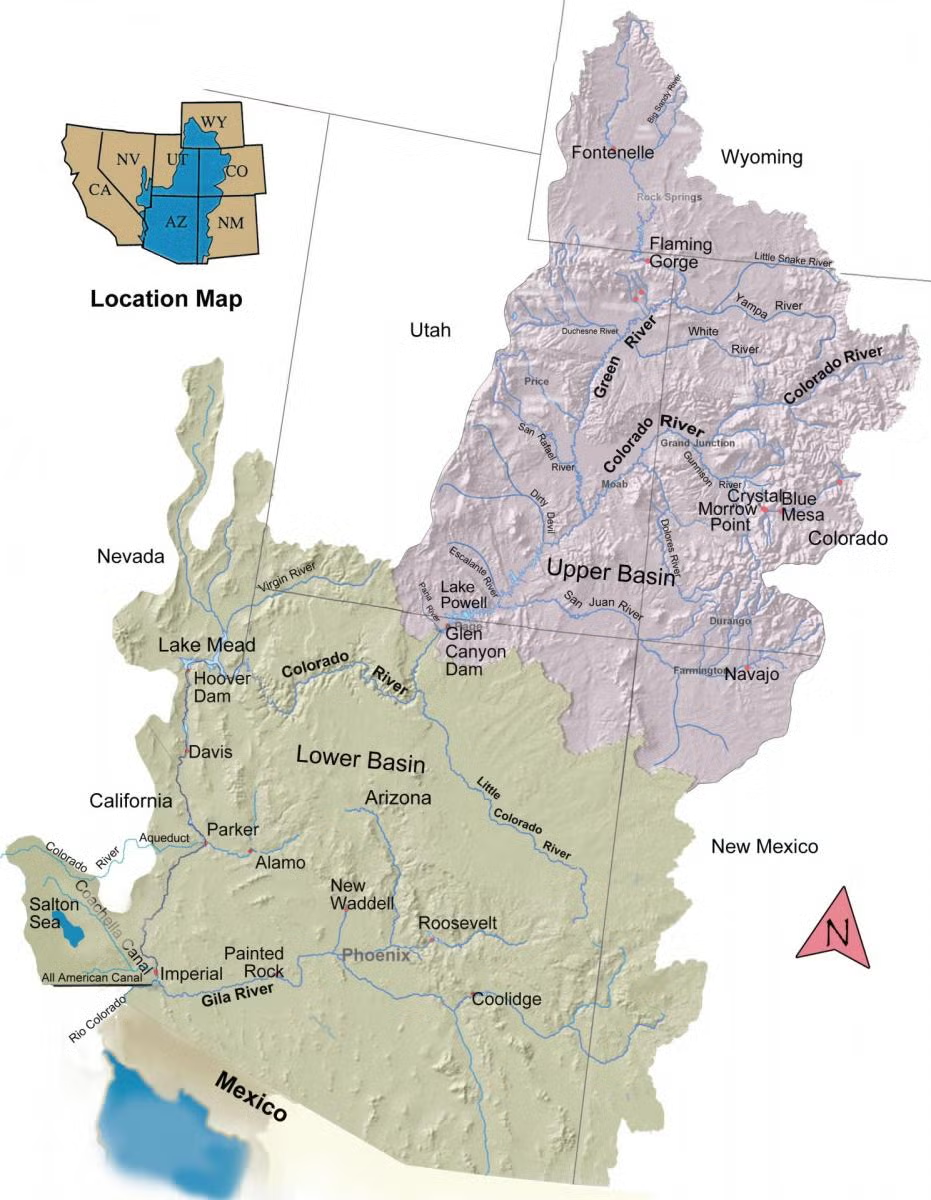
The Colorado River Basin spans seven U.S. states and part of Mexico. Lake Powell, upstream from the Grand Canyon, and Lake Mead, near Las Vegas, are the two principal reservoirs in the Colorado River water-supply system. (Bureau of Reclamation)

Lower Basin states — California, Arizona, and Nevada — and Upper Basin states — Colorado, Wyoming, Utah and New Mexico — have been at an impasse for months over how to manage the Colorado River’s shrinking water supplies.

Last month, the states missed a federally-imposed deadline to submit a preliminary seven-state consensus plan that could replace the river’s operating guidelines after days of intense closed-door negotiations.

States’ last chance to share a final consensus-based plan will be mid-February 2026 in order to reach a final agreement in the summer  with implementation of the new guidelines beginning in October 2026.

The Bureau of Reclamation’s Acting Commissioner Scott Cameron said he and other federal officials have intensified efforts to bring states to a consensus, flying out West every other week since early April to meet with the seven states’ river negotiators.

ā€œThere are a number of issues from decades past that some people are having some difficulty getting past,ā€ Cameron said, adding that states must ā€œbe willing to set aside previous perceived inequities and unfairness.ā€

One of the biggest disagreements between the Upper and Lower Basin states is over which faction should have to cut back on their water use, and by how much.

Lower Basin states want all seven Colorado River states to share mandatory water cuts during dry years under the new guidelines. The Upper Basin, which is not subject to mandatory cuts under current guidelines, say they already use much less water than downstream states and should not face additional cuts. [ed. Also, the UB states face cuts every year from Mother Nature with the variability, but generally lower, snowpack each season.]

Despite states missing past deadlines, Cameron said he was ā€œcautiously optimisticā€ states will reach a consensus deal by the February deadline.

ā€œIt’s not unusual in the negotiating process that tougher decisions get made the closer you get to the deadline. And frankly, there are tough decisions that have to be made,ā€ Cameron said.

On Tuesday, California’s biggest water districts said they were willing to ā€œset aside many of their legal positionsā€ in order to reach a seven-state agreement.

The Bureau of Reclamation provided a broad overview of the components that will be included in draft’s range of options, including guidelines to reduce water deliveries from Lake Mead during shortages, coordinated reservoir operations for Lake Mead and Lake Powell, and storage and delivery mechanisms for conserved water.

Jerla, Reclamation’s senior water resource program manager, said the draft alternatives will include some components previously proposed by states.

She said the agency has adopted a number of temporary operational agreements since 2008 to address changing conditions on the river. Those agreements have served as test runs for a long term agreement and emphasized the need for more flexibility when managing the river from year-to-year.

ā€œWe want to preserve ourselves the flexibility to come back to the table, to do reviews, to make consensus adjustments if needed,ā€ Jerla said.

That flexibility to operations will likely be needed again this year due to a less-than-average upcoming snow season, that combined with a dry spring or early summer in 2026, could create conditions for another low runoff year.

ā€œWe’re monitoring the forecast, and we’re seeing not a great start to water year 2026. It’s still early in the year, but the way things are setting up it isn’t looking good,ā€ Jerla said.

Figure 1. Graph showing active storage in Colorado River basin reservoirs between January 1, 2021, and November 30, 2025. Credit: Jack Schmidt/Center for Colorado River Studies

The two biggest reservoirs in the country, Lake Powell and Lake Mead, are currently at a fraction of their full capacity. Lake Mead is at 32% capacity, while Lake Powell is at 28%. 

Additionally, water inflow into the reservoirs in 2026 are projected to most likely be 75% of the average, according to the federal agency. The minimum probable inflow forecast for 2026 is 44% of average, indicating a potentially very dry year.

John Entsminger — Southern #Nevada Water Authority #CRWUA2025

#Drought news December 19, 2025: Across the central Rocky Mountains of #Wyoming and #Colorado continued warmth and limited snowfall hindered #snowpack development

Click on a thumbnail graphic to view a gallery of drought data from the US Drought Monitor website.

Click the link to go to the US Drought Monitor website. Here’s an excerpt:

This Week’s Drought Summary

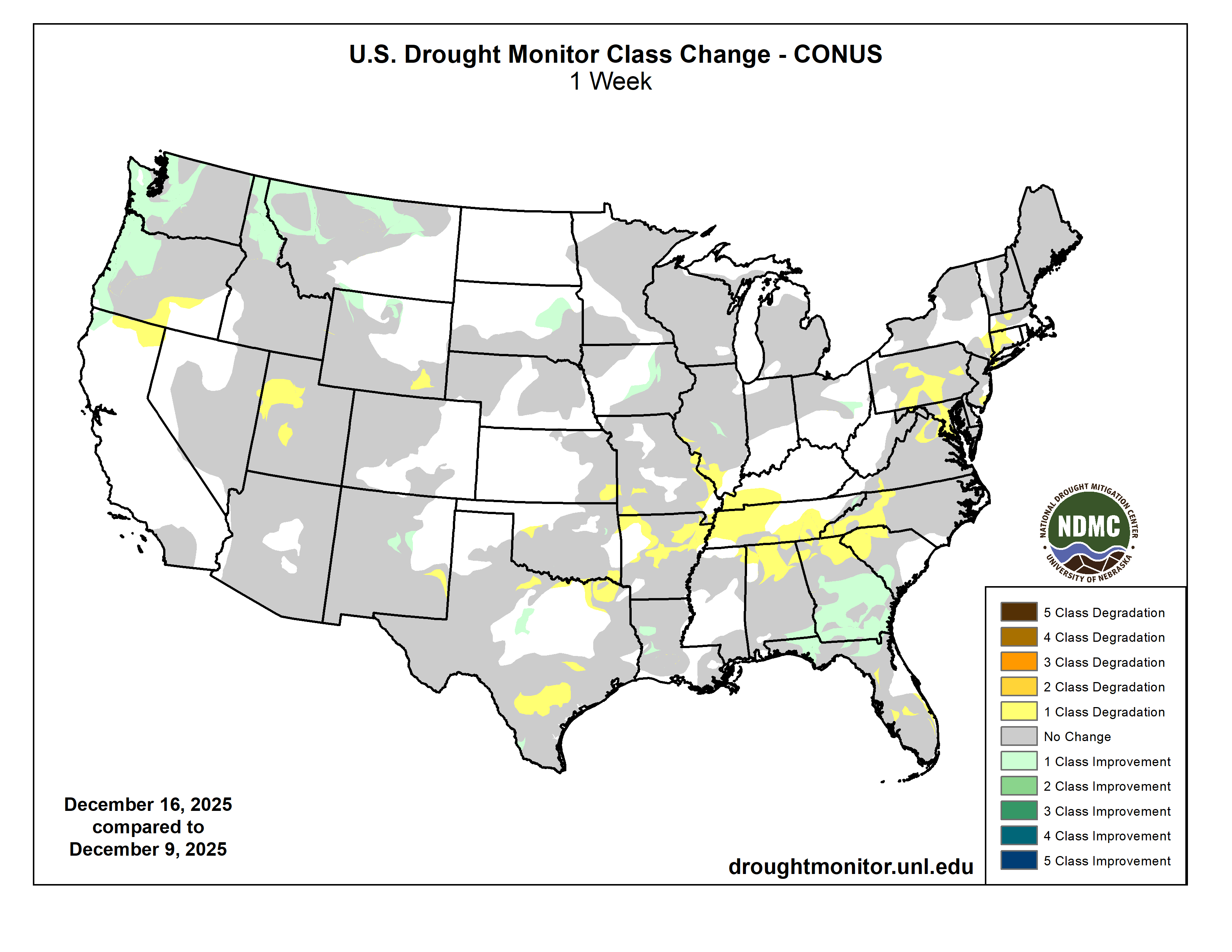
This week, temperature and precipitation patterns varied sharply across the country. Temperatures were generally warmer in the West and colder in the east, with much of the Cascades and Rocky Mountains running well above normal while the Midwest experienced much colder-than-normal conditions. Multiple Pacific storm systems brought widespread precipitation to the Pacific Northwest and northern Rockies, falling as rain at lower elevations and snow in the mountains; however, despite recent snowfall, snowpack remains below normal for mid-December. East of the Rockies, precipitation was more limited and uneven, and where it did occur across the northern Plains and Midwest, it often fell as snow. As a result, drought conditions improved mainly across parts of the Pacific Northwest and northern Rockies. Additional localized improvements occurred in parts of the Southeast, where lingering benefits from rainfall in prior weeks continued to support soil moisture and streamflows. In contrast, areas farther south and east that missed meaningful precipitation saw conditions persist or worsen. Across portions of the southern Plains, lower Mississippi Valley, Ohio Valley, Mid-Atlantic, and Northeast, continued precipitation deficits and declining streamflows led to degradations. In the Midwest, colder temperatures limited precipitation to fall as snow, slowing hydrologic response and resulting in mostly localized changes…

High Plains

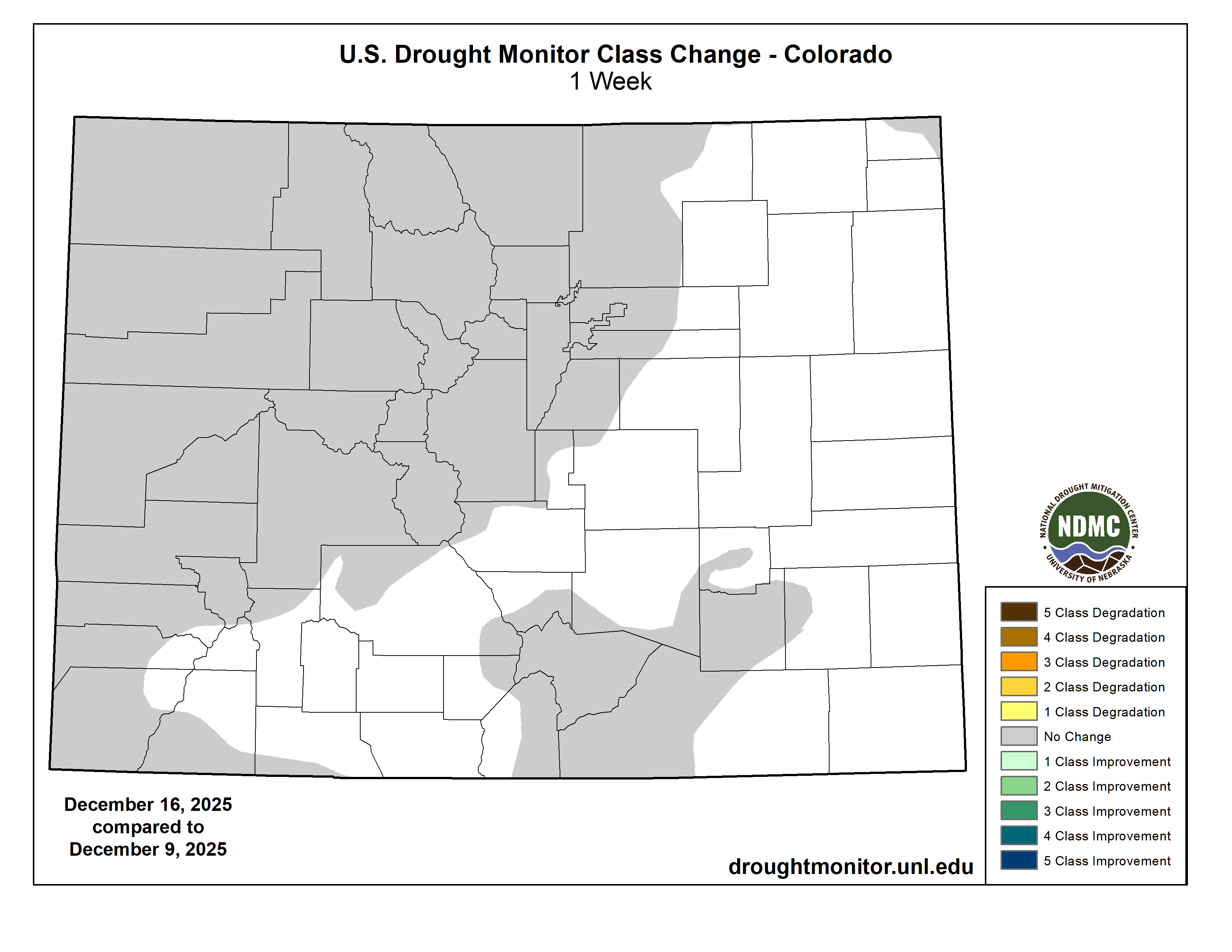
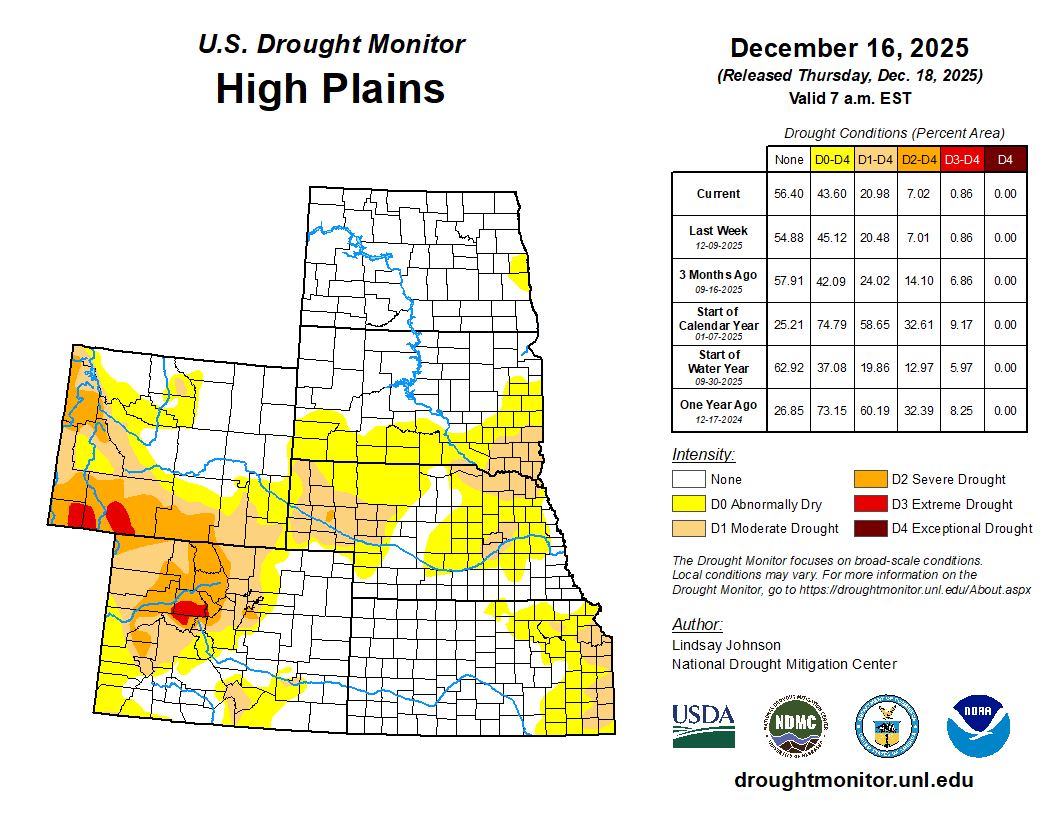
The High Plains remained largely unchanged this week. Areas of less than one inch of precipitation fell across some areas of the Dakotas and northeastern Wyoming. In east-central South Dakota, this precipitation led to minor improvements with the removal of some abnormal dryness (D0). Nebraska, Colorado, and most of Kansas remained unchanged. In southeastern Kansas along the Kansas-Missouri border, hydrologic deficits led to further deterioration and the expansion of moderate drought (D1). In southeastern Wyoming, frequent strong winds and above-normal temperatures combined with continued lack of precipitation contributed to further degradation and the expansion of moderate drought (D1)…

Colorado Drought Monitor one week change map ending December 16, 2025.

West

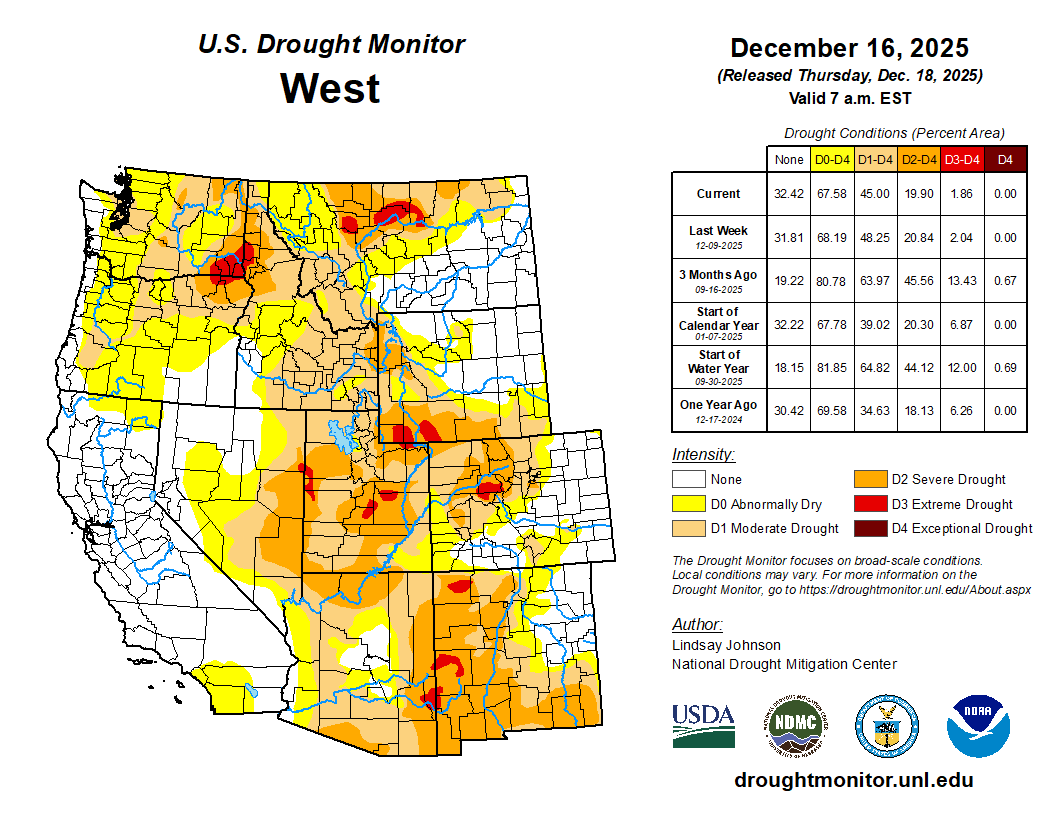
Across the West, drought changes were mainly determined by precipitation. In Washington and northern Oregon, multiple Pacific storm systems, associated with atmospheric river moisture, brought widespread precipitation to the Pacific Northwest. Precipitation fell mainly as rain at lower elevations and snow in the mountains, contributing to ongoing flooding in parts of western Washington and supporting widespread one-class improvements along the coast and nearby interior areas. Since the end of November, snowpack in the Cascades has slightly improved, though snow water equivalent (SWE) values remain below normal for this time of year, particularly where warmer temperatures limited snow accumulation. Across central and southern Oregon and into northern California, conditions show rapid short-term drying. [I spoke with Jeff Deem (Airborne Snow Observatories Inc.) at the Colorado River Water Users Association conference last week and he said that he flew over Lake Tahoe recently and there was NO SNOW.] However, last-minute (Dec. 15-16) rainfall of 1 to 2 inches along Oregon’s coast was enough to bring improvements where it fell while the areas that missed out on the precipitation saw abnormal dryness (D0) expanded.

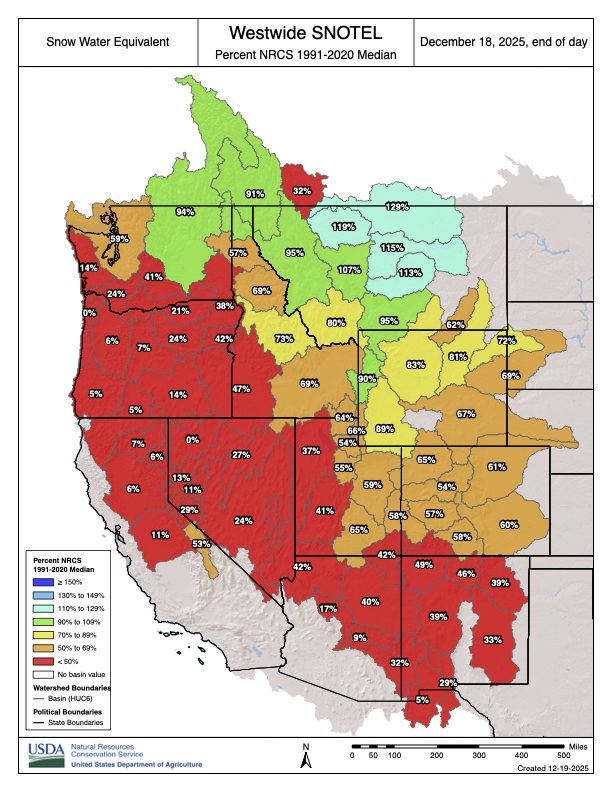
In the Northern Rockies, repeated precipitation supported one-class improvements across northern Idaho and northwestern Montana. Lower elevations experienced rain or mixed precipitation, while higher elevations received snow, leading to SWE improvements in northern and central Idaho and western Montana. Despite this week’s precipitation, much of Idaho’s snowpack remains below normal with SWE at 70 percent of normal, while snowpack across western and central Montana showed the greatest improvement, with SWE near or above 90 percent of normal for this time of year. Farther east and south across central and western Montana, more widespread precipitation supported a swath of one-class improvements.

Westwide SNOTEL basin-filled map December 18, 2025. via the NRCS.

Across the central Rocky Mountains of Wyoming and Colorado, conditions were more mixed. Portions of the north-central Rockies received enough snowfall to lead to localized improvements, with SWE in some headwater areas approaching near-normal early-season levels. Elsewhere, c. Across much of western and central Utah, SWE remains below 50 percent of normal, supporting one-class degradations in north-central and central Utah. In the Southwest, localized changes were made in New Mexico, with improvements in central New Mexico where longer-term precipitation from earlier periods continued show hydrologic improvement, while precipitation deficits led to the expansion of moderate drought (D1) in the southeast part of the state…

South

Drought conditions across the South generally worsened this week, as limited precipitation did little to improve the growing moisture deficits. Louisiana and some areas of Mississippi saw some improvements due to precipitation, including the removal of severe drought (D2) in west-central Louisiana. In Texas and Oklahoma, ongoing precipitation deficits led to further expansion of abnormally dry (D0) and moderate drought (D1) conditions. In south-central Texas, longer-term hydrologic stress continued and intensified with the expansion of severe (D2) and extreme drought (D3). Across Arkansas and Tennessee, despite cooler than normal temperatures, dry conditions continued to worsen with growing precipitation deficits, drying soils, and decreasing streamflows leading to the expansion of abnormal dryness (D0) and moderate drought (D1)…

Looking Ahead

According to the National Weather Service’s 5-day (Dec. 18-23) quantitative precipitation forecast, the heaviest precipitation is forecast across the West, particularly along the Pacific Northwest coast and into northern California, where widespread totals may exceed 5 inches in some areas. Additional moderate to heavy precipitation is expected across the Cascades and into parts of the northern Rockies, with totals generally ranging from 1 to 4 inches. Lighter but still notable precipitation is forecast to extend eastward into portions of the central Rockies and the northern Plains. Across the central and eastern U.S., precipitation is expected to be more scattered and generally lighter. Portions of the Midwest, Ohio Valley, Southeast, and Gulf Coast may receive light to moderate precipitation, generally ranging from 0.5 to 2 inches. Farther east, a band of precipitation is indicated along parts of the East Coast, with locally higher amounts possible from the Southeast into the Mid-Atlantic and portions of the Northeast. Overall, the forecast highlights a wetter pattern in the West and more limited, variable precipitation across much of the central and eastern U.S.

The Climate Predictions Center’s 6 to 10 day temperature outlook (Dec. 22–26) shows an increased likelihood of above-normal temperatures across much of the central and southern U.S., extending from the West Coast through the Plains and into the Southeast. The highest probabilities for above-normal temperatures are centered over the southern Plains and Southwest, with much of the interior West, Rockies, and central Plains also favored to be warmer than normal. Near-normal temperatures are indicated across parts of the Pacific Northwest and the Great Lakes. Below-normal temperatures are most likely across portions of the Northeast, particularly northern New England, while Alaska shows a strong signal for below-normal temperatures across much of the state. Hawaii is favored to see above-normal temperatures during the period. In terms of precipitation, the 6 to 10 day outlook indicates an increased likelihood of above-normal precipitation across much of the West, including California, the Pacific Northwest, and parts of the Great Basin and northern Rockies. Near- to above-normal precipitation probabilities also extend into parts of the interior West. In contrast, below-normal precipitation is favored across much of the central Plains, lower Mississippi Valley, Southeast, and Florida, with the strongest signal centered over the southern Plains and Gulf Coast region. Near-normal precipitation probabilities are indicated across parts of the Great Lakes and Northeast, while Alaska shows mixed signals, with below-normal precipitation favored in southern portions and near-normal conditions elsewhere.

US Drought Monitor one week change map ending December 16, 2025.

The latest Seasonal Outlooks through March 31, 2026 are hot off the presses from the #Climate Prediction Center

#CRWUA2025 Day 3 #ColoradoRiver #COriver #aridification

Sunset December 18, 2025 near Colorado City, Arizona.

Click the link to view the conference posts on Twitter(X) (Click the “Latest” tab).

I apologize, I missed the first Session Friday, “Near-term analysis of Colorado River Basin Storage” with Eric Kuhn, Sarah Porter, and Jack Schmidt. Here’s the link to “Colorado River Insights 2025: Dancing with Deadpool“. Their contribution is in Chapter 1, “Colorado River Reservoir Storage – Where We Stand”.