Map of the Colorado River drainage basin, created using USGS data. By Shannon1 Creative Commons Attribution-Share Alike 4.0
From email from Brian McNeece:
December 31, 2025
I arrived late to the Upper Colorado River Commission meeting in Las Vegas, having briefly gotten lost in the disorienting maze of garishly lit slot machines, escalators reaching to the heavens, and hallways with a vanishing point at infinity. Could there be a more incongruous place to hold a convention about something so natural and sublime as water?
Just as I took my seat, Becky Mitchell, the forceful, passionate commissioner from the state of Colorado, said something puzzling and important. “The Lower Basin states continue to overuse their allocation of Colorado River water.”
And thus, in my very first minutes at the Colorado River Water Users Association (CRWUA) conference, I had my theme for the next three days. Because, in fact, that is not true. The Lower Basin states of Nevada, Arizona, and California are not overusing their allocation. In fact, last year, they used 6 million acre-feet, 1.5 maf less than their allocation. Why would Ms. Mitchell say that?
I asked this question numerous times in the next few days. I got some arcane answers. Perhaps Ms. Mitchell doesn’t accept that Arizona isn’t charged Gila River water as part of its allocation. Maybe she thinks the Lower Basin should be charged for evaporation losses below Glen Canyon Dam.
One Colorado water attorney brought his own charts to breakfast and showed me how the Lower Basin states had in fact been overusing their allocation—in the past. True, but we’re talking about now. Ms. Mitchell has not answered my email request for an explanation.
Ms. Mitchell apparently stands alone in her assertion that even now, the Lower Basin is overusing water. For after she spoke, neither Brandon Gebhart of Wyoming, nor Gene Shawcroft of Utah, nor Estevan Lopez of New Mexico repeated her claim.
As leader of the Upper Colorado River Commission, Ms. Mitchell has also protested that Mother Nature cuts her users when it doesn’t rain, and therefore Upper Basin states cannot take any more cuts.
But in fact, the Upper Basin has dozens of reservoirs above Lake Powell that right now are holding around 5 million acre-feet of water—about a year and a half of storage at recent Upper Basin use. The Upper Basin has wiggle room for taking emergency cuts.
Even those water users who are directly cut by Mother Nature can take cuts—during wetter years. Currently, the state of Colorado has a provision in its water law known as Free River, which means that when the flow in a creek exceeds the volume needed to fulfill all local water rights, users along the creek are free to divert all the water they want. In 2023, the South Platte River was in Free River condition for 64 days. This should stop.
Read: Prior Appropriation. A free river is a river or stream reach where the natural flow is sufficient to satisfy all existing decreed water rights, so no administrative curtailment (a “call”) is required.
Jason Turner, an attorney for Colorado River water Conservation District, told the audience that Free River, despite appearances, is not wasteful of water that could otherwise go to the next reservoir downstream. No, he said, this water helps bring moisture deep into the soil, preventing the pasture grass from dying during the later dry months of the year.
Every user on the Colorado River would love to invoke Free River—use as much as you want when times are flush. But seeing the Colorado River system as a whole, times are not going to be flush. The whole region is getting drier, and we have to reduce water north and south.
With her two claims, Ms. Mitchell has extended her character beyond passion and resolve; she is holding positions that challenge the foundation of the Law of the River going back to the Compact of 1922.
It seems that Ms. Mitchell is the adamantine wall preventing progress toward new rules for operating the Colorado River watershed after the interim rules expire next September. The word on the convention floor was that she is willing to ride her position into court, a risky move that almost everyone else wants to avoid. The solution is for the other states to negotiate a deal without Colorado.
Members of the Colorado River Commission, in Santa Fe in 1922, after signing the Colorado River Compact. From left, W. S. Norviel (Arizona), Delph E. Carpenter (Colorado), Herbert Hoover (Secretary of Commerce and Chairman of Commission), R. E. Caldwell (Utah), Clarence C. Stetson (Executive Secretary of Commission), Stephen B. Davis, Jr. (New Mexico), Frank C. Emerson (Wyoming), W. F. McClure (California), and James G. Scrugham (Nevada). CREDIT: COLORADO STATE UNIVERSITY WATER RESOURCES ARCHIVE via Aspen Journalism
This has happened before. Arizona refused to ratify the Colorado River Compact after its commissioner Winfield S. Norviel signed it in 1922, but the deal went forward anyway. Arizona finally ratified the agreement in 1944.
The structural deficit refers to the consumption by Lower Basin states of more water than is allocated by the compact. The deficit, which includes losses from evaporation, is estimated at 1.2 million acre-feet a year. (Image: Central Arizona Project circa 2019)
The Lower Basin states of Nevada, Arizona and California have volunteered to continue taking 1.5 maf of cuts into the future, but if deeper cuts are needed, they propose that the Lower Basin and Upper Basin share reductions fifty-fifty. Maybe those numbers can be adjusted somewhat. Wyoming, Utah, and New Mexico, it’s time to make a deal. Colorado can sign on later. Everyone needs to do her part.
[ed. The 1.5 MAF satisfies the structural deficit because the Lower Basin has never been charged for shrink, and it is a significant commitment. However, the Lower Basin folks are talking around the fact that no one has the authority to order mandatory cuts by Colorado diverters; No one has the technology to “color” (account for) the water in the Colorado River due to measurement uncertainty, the lack of structures in place, hundreds of river miles with gaining and losing reaches; The classic paper water vs. wet water dilemma; Prior Appropriation — if the water is in the stream, and a diverter has a decree that is in priority, the it is lawful for the diverter to divert and water bypassed by upstream diverters; Any uncompensated restriction would be a “taking” so a funding stream is needed to pay for compensated savings.]
Left to right: Becky Mitchell, Tom Buschatzke, Brandon Gebhart, John Entsminger, Keith Burron, Gene Shawcroft, JB Hamby, Estaven Lopez. Photo credit: Yes To Tap via X (Twitter)
Colorado River water could enable a pumped storage hydropower project intended to make the region’s electric grid more resilient.
KEY POINTS
One of the longest-duration pumped storage hydropower projects in the country is proposed for Navajo Nation land in the Four Corners region.
The project received a $7.1 million Department of Energy grant this year for feasibility studies.
Pumped storage hydropower is the largest form of energy storage in the U.S.
Standing in a breezy parking lot on Navajo land in the state’s far northwest corner, Tom Taylor looked toward the western horizon and then upwards at the furrowed mass of the Carrizo Mountains less than 10 miles away.
If all goes to plan, the infrastructure that could one day spill from the mountain’s flanks and through its core will become an essential piece of the region’s electric grid, able to store surplus electricity from renewable energy and other power sources for when it is needed later.
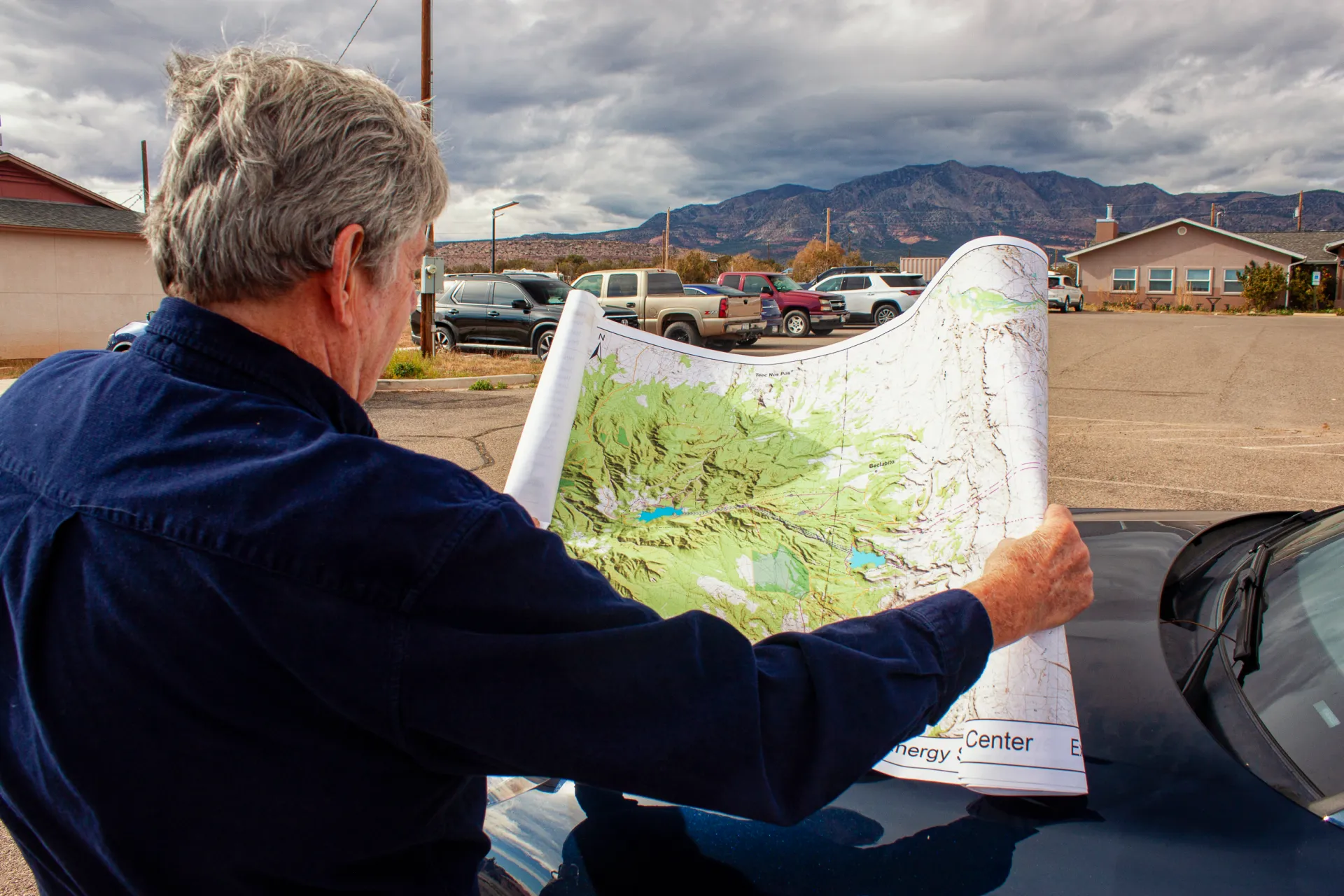
Fighting the wind that chilly November morning, Taylor used both hands to pin a detailed map against the hood of his Porsche Macan. A jumble of dashed lines and blue splotches representing proposed power lines, reservoirs, a water-supply pipeline, and access roads were printed atop the real-world geography on display in front of us.
“This will be a battery that lasts a long time,” Taylor said, holding tightly to the map.
JOAN CARSTENSEN
The project is the $5 billion Carrizo Four Corners Pumped Storage Hydro Center, which is designed to be one of the largest long-duration energy storage projects in the country. Pumped storage moves water between two reservoirs at different elevations. Water is pumped uphill when excess electricity is available and released to generate electricity when power demand warrants it.
Taylor, a former mayor of Farmington and a state House representative from 2000 to 2014, is employed by Kinetic Power, the three-person, Santa Fe-based outfit behind the Carrizo proposal. The company sees the project as a way to make the region’s electric grid more durable and cost-effective, not only by smoothing the intermittent nature of wind and solar but also as a bulwark against energy emergencies like the winter storm in 2021 that caused blackouts and 246 deaths in Texas. The twinned reservoirs, using water sourced from a Colorado River tributary nearby, would have the capacity to generate 1,500 megawatts over 70 hours – a form of battery that could provide the equivalent output of a large nuclear plant for nearly three days.
“We believe that the key is delivering economic value,” said Thomas Conroy, Kinetic Power’s co-founder, who has four decades of experience developing energy projects.
What seems straightforward when placing lines on a map is much less so in three dimensions. Carrizo Four Corners, which is still in the exploratory stage and is at least five years away from breaking ground, has nearly as many questions as answers at this point. What is the geology within the Carrizo Mountains? Will it support a 3,300-foot-deep shaft, a subterranean powerhouse, and dam abutments? How will drought affect the water supply? What cultural sites and wildlife might be at risk from construction? What are the power market dynamics?
Answering those questions is the goal of a $7.1 million, two-and-a-half-year Department of Energy grant that Kinetic and its six university and research partners secured in August. (The state of New Mexico and the research partners are also contributing $7.1 million.) On the political side, will future Navajo administrations feel as favorably toward Carrizo as current president Buu Nygren?
The technical questions are but one piece of an ambitious project that touches many of the most pressing questions about natural resources in the American West today: energy development, water use, and the relationship between federal law and tribal law.
Connecting Water and Energy
Though the details are still to be worked out, the project can be described in broad strokes.
The Federal Energy Regulatory Commission, which oversees federal hydropower licensing, granted Kinetic a preliminary permit in 2021. In February 2025 FERC extended the permit, which allows for site investigations but no construction work, for another four years.
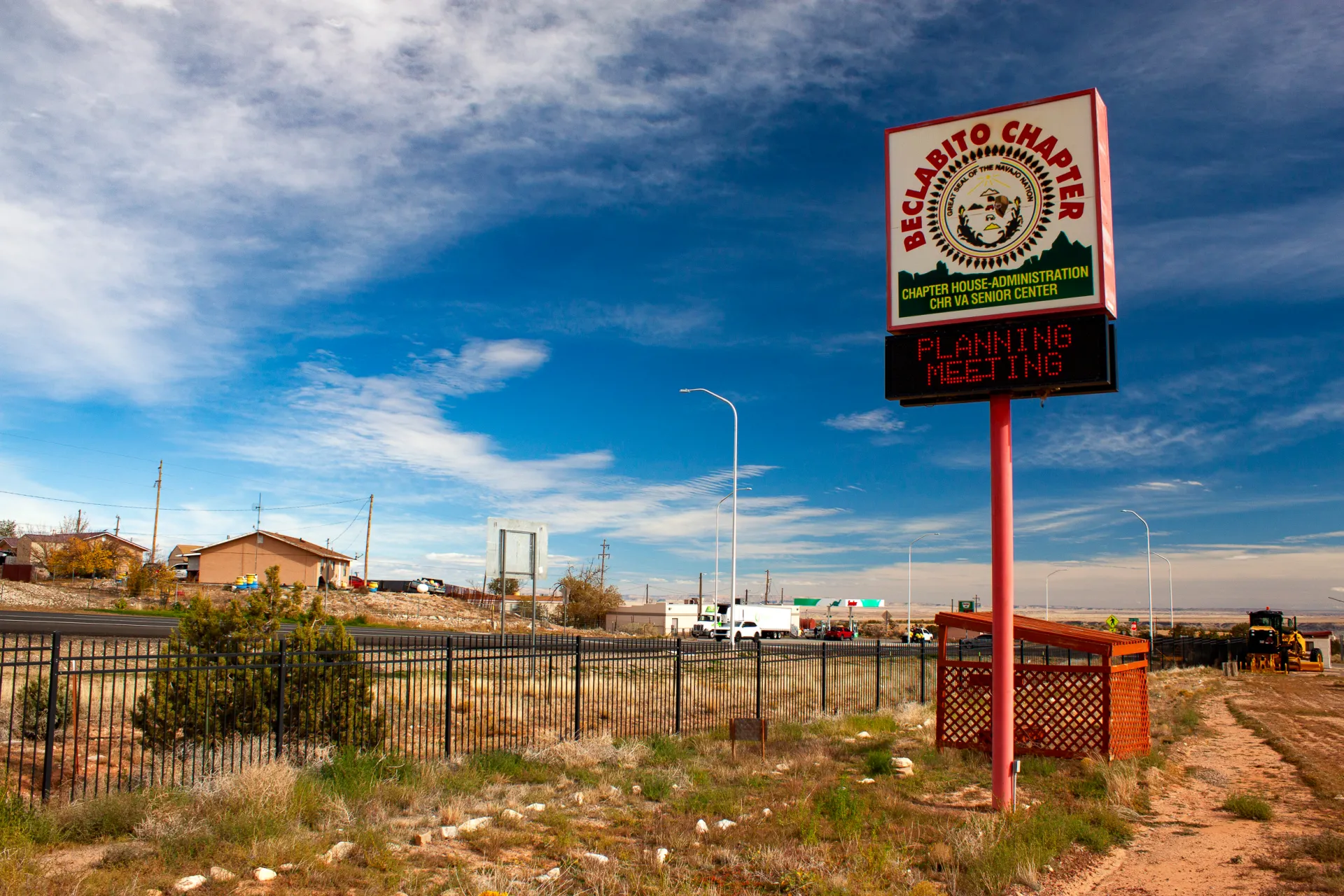
The company envisions two “off-channel” reservoirs that would not dam a flowing river. The lower reservoir will be near Beclabito. The upper, in the high reaches of the Carrizo Mountains. Both are on Navajo land, but on different sides of the Arizona-New Mexico border.
The powerhouse that holds the electricity-generating turbines will be located underground, some 3,300 feet below the upper reservoir. Some of the longest pumped storage tunnels in the country will be required to connect the reservoirs and the powerhouse.
Despite the geotechnical challenges, Conroy is particularly enthused by the site, which he said is the most optimal in Arizona and New Mexico – and possibly the entire country – to locate a pumped storage hydropower project.
The site stands out for four reasons, he said. It is near existing transmission corridors and grid connections due to the region’s legacy of enormous coal-fired power plants. And it will have a comparatively low capital cost for the energy it will produce.
The other two reasons relate to water. Because of the extreme height differential between the upper and lower reservoirs – almost three Empire State Buildings – less water will be required to produce a unit of energy than for reservoirs with a gentler gradient. And because the upper reservoir site is a deep canyon, surface area and thus evaporation will be minimized.
“Water is just top of mind here in the Southwest,” Conroy said. “And our project is as water-efficient as can be made.”
Water to fill the reservoirs would be drawn from the San Juan River, a tributary of the Colorado, via pipeline. The water would come from the Navajo Nation’s San Juan rights, which have been quantified but are not fully used.
How much water? In its FERC permit application, Kinetic estimated that the initial fill, which will take one and a half to two years, would require 38,300 acre-feet. To cover subsequent evaporation losses, the reservoirs would need to be topped up with 2,635 acre-feet per year. Those numbers will be refined in the feasibility studies.
“It’s what, about 1,300 acres of corn?” Taylor said, doing a rough mental calculation of the equivalent water consumption for the annual evaporation loss. “I think this is more valuable than 1,300 acres of corn.”
Saving for Tomorrow
So far the project has threaded the federal government’s fraught energy politics. The Trump administration is hostile to wind and solar, which in their eyes reek of liberal values. Two water-based technologies – hydropower and geothermal – have escaped condemnation and are listed in the administration’s energy dominance documents. The DOE grant that Carrizo secured is a holdover from the Biden administration’s infrastructure bill, which provided up to $10 million for feasibility studies for pumped storage projects that would store renewable energy generated on tribal lands.
Storage is the holy grail of renewable energy. Human civilization has advanced, from the dawn of agriculture to the artificial intelligence revolution today, by being able to carry a surplus from one season and one year to the next. So it is with wind and solar. To maximize their utility and counteract their intermittent nature, engineers have been searching for cost-effective ways to store energy when the sun shines and when the wind blows for the days when neither of those things happen.
“If you want to improve the resiliency of the system, you either build more firm capacity instead of more renewable, or you build longer storage,” said Fengyu Wang, a New Mexico State University assistant professor who is the principal investigator for the DOE grant.
Storage has taken many forms. Some are fantastic mechanical configurations – lifting heavy objects and dropping them, or forcing air into caverns and releasing it. Thermal options use molten salt to trap the sun’s heat. The most familiar are batteries, which leverage chemical energy. But the most common, at least in the U.S., is pumped storage hydropower.
The 43 pumped storage facilities in the U.S. represent the bulk of the country’s utility-scale energy storage. They accounted for 88 percent of the total in 2024, according to Oak Ridge National Laboratory. That is changing quickly, however, as more battery storage comes online. The share for pumped storage was 96 percent in 2022.
Still, long-duration storage is where pumped storage shines. According to Oak Ridge, the median battery storage is two hours. For pumped storage, it is 12 hours. Longer duration provides more buffer, not only from day to day but also season to season.
In that regard, Carrizo would signify a huge leap. The only comparable pumped storage project under consideration in the U.S. is Cat Creek, in Idaho. Even though its duration is 121 hours, its generating capacity is less than half, at 720 megawatts.
Carrizo will have a different use case than other U.S. pumped storage projects, Conroy said. Many facilities have one customer and one generator. A nuclear plant, for instance, might be paired with a pumped storage system so that the nuclear plant can run continuously.
For Carrizo, there might be a consortium of utilities that have multiple generating sources feeding into this project and moving the water uphill. They would take delivery of that power across a large region with different climatic conditions and different needs for when and how they use the stored power. That means operating the facility will be more complicated than a traditional pumped storage project. One thing is certain, Conroy said: the Navajo will have an equity stake.
Tribal Outlook
Caution on the part of the Navajo would be understandable. The tribe’s lands have long been the center of energy developments with environmentally ruinous but economically helpful outcomes.
Uranium mining to fuel the Manhattan Project and then the nation’s reactors polluted rivers and groundwater, as did the coal mines that fed Four Corners Power Plant and the now-shuttered Navajo Generating Station and San Juan Generating Station. On the other hand, these developments provided employment and income. Navajo Mine, which supplies Four Corners Power Plant, accounts for about 35 percent of the Navajo Nation’s general fund.
Navajo and other tribal lands in the Four Corners region have been the target for a handful of pumped storage proposals in recent years. The Navajo Nation opposed three projects proposed for the Little Colorado River watershed, which were either withdrawn by the developer or denied a permit by FERC. Two other projects – Carrizo and Sweetwater, both using San Juan River water – are still in development. Sweetwater, a smaller project with eight hours duration, is being co-developed with the Ute Mountain Ute Tribe. A third project, Western Navajo Pumped Storage, which would be located near the former Navajo Generating Station, received a FERC preliminary permit in August.
Carrizo has not run into the same level of opposition as the other proposals. In part that is due to the proposed use of the San Juan River instead of groundwater, said Erika Pirotte, an assistant attorney general in the Navajo Nation’s water rights unit. Many Navajo communities rely on groundwater, and using it for pumped storage was viewed as unreasonable.
The lack of strong opposition is also because of Kinetic’s engagement with the Navajo Nation. The company has held meetings with the Beclabito, Red Valley, and Teec Nos Pos chapters, in addition to meetings with Navajo Nation agencies and Buu Nygren, the Navajo Nation president. Kinetic has a memorandum of understanding with Nygren, who also signed a letter of support for the project’s DOE grant application.
“We have the support of the council,” Conroy said. “We have a very high level of support from the president, and he is just extraordinarily interested in this project and seeing that it moves forward.”
From the Navajo perspective, what is interesting are the “ancillary benefits” that could come from the water supply pipeline, Pirotte said. Once the reservoirs are filled and the pipeline’s full capacity is not needed, the extra space could be repurposed for tribal water supply uses.
“That’s why the feasibility studies are really important for the Nation, because they help us understand to what extent Navajo Nation resources would be used for the project,” Pirotte said.
None of this is immediately around the corner, Conroy cautions. The DOE grant extends for more than two years. The FERC permitting process could be another two to four years. With Congress and the Trump administration talking about faster permitting and better coordination, that timeline is a best guess.
And then there is the question of tribal authority in the permitting process, not just for the Carrizo project but for other such developments. Will FERC abide by its 2024 stance that preliminary permits for hydropower projects on tribal lands require tribal consent? The Trump administration would like to see that policy scrapped. If FERC approves a project must a tribe assent to all the associated infrastructure? Will the Navajo be allowed to conduct reviews and issue permits?
And then there is construction, the biggest component. That will take four to six years, Conroy said.
Even on an ambitious timeline, Carrizo is not operating until the mid-2030s.
“I’m 77,” Taylor said. “I probably won’t see it.”
This story was produced by Circle of Blue, in partnership with The Water Desk at the University of Colorado Boulder’s Center for Environmental Journalism.
Map of the San Juan River, a tributary of the Colorado River, in Arizona, Colorado, New Mexico and Utah, USA. Made using USGS National Map data. By Shannon1 – Own work, CC BY-SA 4.0, https://commons.wikimedia.org/w/index.php?curid=47456307