
January 2026
Click the link to access the report on the United Nations University Institute for Water, Environment and Health website (Madani K., Mir Matin, Aria Farsi, Luying Wang, Amir AghaKouchak, Mohammed Azhar, Jenna Elshurafa, Sogol Jafarzadeh, Tafadzwanashe Mabhaudhi, Ali Mirchi, Abraham Nunbogu, Mojtaba Sadegh, Robert Sandford, Manoochehr Shirzaei, William Smyth, Hossein Tabari, MJ Tourian, Farshid Vahedifard).
Global water bankruptcy in brief
- The planet has entered the Global Water Bankruptcy era. In many basins and aquifers, long-term water use has exceeded renewable inflows and safe depletion limits, and parts of the water and natural capital—rivers, lakes, aquifers, wetlands, soils, and glaciers—have been damaged beyond realistic prospects of full recovery.
- Billions remain water insecure. Nearly three-quarters of the world’s population lives in countries classified as water-insecure or critically water-insecure. Around 2.2 billion people still lack safely managed drinking water, 3.5 billion lack safely managed sanitation, and about 4 billion experience severe water scarcity for at least one month a year.
- Surface waters are shrinking at scale. A growing number of major rivers now fail to reach the sea or fall below environmental flow needs for significant parts of the year. More than half of the world’s large lakes have lost water since the early 1990s, affecting around one-quarter of the global population that depends directly on them for water security.
- Wetlands have been liquidated on a continental scale. Over the past five decades, the world has lost roughly 410 million hectares of natural wetlands—almost the land area of the European Union—including an estimated 177 million hectares of inland marshes and swamps, roughly the size of Libya or seven times the area of the United Kingdom. The loss of ecosystem services from these wetlands is valued at over US$5.1 trillion, roughly equivalent to the combined annual GDP of about 135 of the world’s poorest countries.
- Groundwater depletion and land subsidence are widespread and often irreversible. Groundwater now provides about 50% of global domestic water use and over 40% of irrigation water, tying both drinking water security and food production directly to rapidly depleting aquifers. Around 70% of the world’s major aquifers show long-term declining trends.
- Excessive groundwater extraction has already contributed to significant land subsidence over more than 6 million square kilometers—almost 5% of the global land area—including over 200,000 square kilometers of urban and densely populated zones where close to 2 billion people live. In some locations, land is sinking by up to 25 centimeters per year, permanently reducing storage capacity and increasing flood risk.
- Cryosphere loss is liquidating critical “water savings”. The world, in multiple locations, has already lost more than 30% of its glacier mass since 1970. Several low- and mid-latitude mountain ranges risk losing functional glaciers within decades, undermining the long-term security of hundreds of millions of people who rely on glacier- and snowmelt-fed rivers for drinking water, irrigation, and hydropower.
- Agricultural heartlands are running down their water capital. Roughly 70% of global freshwater withdrawals are used for agriculture. Around 3 billion people and more than half of the world’s food production are located.
- in areas where total water storage—including surface water, soil moisture, snow, ice, and groundwater—is already declining or unstable. More than 170 million hectares of irrigated cropland—roughly the combined land area of France, Spain, Germany and Italy—are under high or very high water stress.
- Land and soil degradation are amplifying water-related risks. More than half of global agricultural land is now moderately or severely degraded, reducing soil moisture retention and pushing drylands toward desertification. Salinization alone has degraded roughly 82 million hectares of rainfed cropland and 24 million hectares of irrigated cropland—together more than 100 million hectares of cropland—eroding yields in some of the world’s key breadbaskets.
- Drought is increasingly anthropogenic and extremely costly. Over 1.8 billion people were living under drought conditions in 2022–2023. Drought-related damages, intensified by land degradation, groundwater depletion and climate change rather than rainfall deficits alone, already amount to about US$307 billion per year worldwide—larger than the annual GDP of almost three-quarters of UN Member States.
- Water quality degradation is shrinking the truly usable resource base. In many basins, pollution from untreated or inadequately treated wastewater, agricultural runoff, industrial and mining effluents, and salinization means that a growing share of water is no longer safe or economically viable for drinking, food production or ecosystems—even where nominal volumes have not yet declined dramatically.
- The planetary freshwater boundary has been transgressed. Global evidence shows that two important elements of the freshwater cycle—“blue water” (surface and groundwater) and “green water” (soil moisture)—have been pushed beyond a safe operating space, alongside planetary boundaries for climate, biosphere integrity, and land systems.
- Existing governance and agendas are no longer fit for purpose. In many basins, the sum of legal water rights, informal expectations and development promises far exceeds degraded hydrological carrying capacity in the absence of effective governance institutions to address water bankruptcy. The current global agenda focused primarily on WASH (Water, Sanitation, and Hygiene), incremental efficiency gains and generic IWRM (Integrated Water Resources Management) prescriptions is insufficient to address structural overshoot, irreversibility and the rising risks of social instability and conflict associated with water bankruptcy.
Executive Summary
Water is the quiet infrastructure of everything the United Nations cares about: human security and prosperity, food and energy security, biodiversity, environmental resilience, public health, climate stability, and peace. The UN Sustainable
Development Goal 6 (SDG 6) captures this centrality by committing the world to ensuring the availability and sustainable management of water and sanitation for all. Yet, the world is still very far from meeting SDG 6. About 2.2 billion people still lack safely managed drinking water, 3.5 billion lack safely managed sanitation, and about 4 billion people experience severe water scarcity for at least one month per year. Nearly 75% of the world’s population lives in countries classified as water-insecure or critically water-insecure with progress toward SDG 6 is far off track for 2030. These figures indicate that water-related risks are now systemic rather than marginal.
For decades, the global policy and science communities have warned of an escalating “water crisis” and called for accelerated action to avert it. Those warnings were not wrong, but they are now incomplete. The language of crisis—suggesting a temporary emergency followed by a return to normal through mitigation efforts—no longer captures what is happening in many parts of the world. This report by the United Nations University Institute for Water, Environment and Health (UNU-INWEH) on the 30th anniversary of its inception responds to this gap by offering a new, more precise diagnosis and recommendations for a new governance agenda fitting the water realities of the Anthropocene in the 21st century. The report is a wake-up call and an open invitation to the policy community to use water as a powerful bridge to promote cooperation to address some of the most critical security, peace, justice, development, and sustainability challenges of our time.
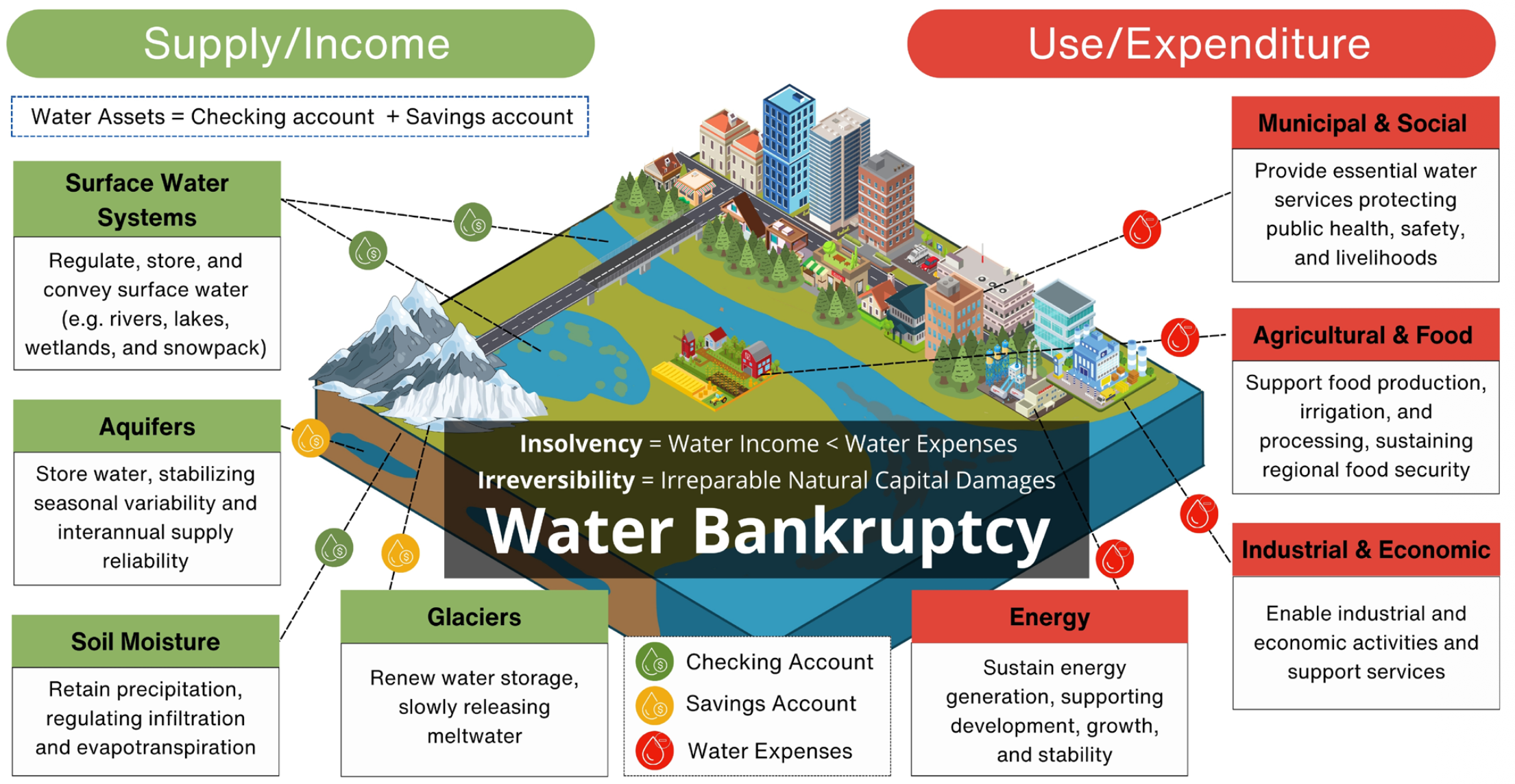
The central message of this report is direct: the world has entered the era of Global Water Bankruptcy. In many regions, human–water systems are already in a post-crisis state of failure. Over decades, societies have withdrawn more water than climate and hydrology can reliably provide, drawing down not only the annual “income” of renewable flows but also the “savings” stored in aquifers, glaciers, soils, wetlands, and river ecosystems. At the same time, pollution, salinization, and other forms of water quality degradation have reduced the fraction of water that is safely usable.
The consequences of water bankruptcy are now visible on every continent: rivers that no longer reach the sea; lakes, wetlands, and glaciers that have shrunk or disappeared; aquifers pumped down until land subsides and salt intrudes; forests and peatlands drying and burning; deserts and dust storms expanding, and cities repeatedly brought to the brink of “Day Zero.” These are not simply signs of stress or episodes of crisis. They are symptoms of systems that have overspent their hydrological budget and eroded the natural capital that once made recovery possible, with knock-on effects for food prices, employment, migration and geopolitical stability.
The report calls for the recognition of the state of ‘Water bankruptcy’ as a persistent post-crisis condition of a human–water system in which long-term water use has exceeded renewable inflows and safe depletion limits, causing irreversible or effectively irreversible degradation such that previous levels of water supply and ecosystem functions cannot realistically be restored. In a bankruptcy state, some damages are physically irreparable on human time scales: compacted aquifers do not rebound, subsided deltas do not rise, extinct species do not return, and lost lakes cannot be restored within planning horizons. Others are technically reversible only at costs so high, or over periods so long, that they are effectively irreversible for policy and planning purposes. This is what distinguishes water bankruptcy from two better-known states: water stress, where high pressure still allows recovery, and water crisis, where an acute, time-bound shock can in principle be overcome.
Water bankruptcy is not only about the ‘insolvency’ of the system but also about its ‘irreversibility’. The shift from crisis to bankruptcy has profound implications for how the world approaches both mitigation and adaptation. Crisis management is essentially restorative: it aims to survive a shock and get back to the previous normal, often through mitigation efforts, short-term emergency measures, and supply-side fixes. Bankruptcy management is different. In finance, declaring bankruptcy is the precondition for a fresh, more sustainable start: debts are recognized, claims are written down, and a new balance sheet is constructed to prevent further collapse. In the same way, managing water bankruptcy calls for a transformational fresh start in human–water relations. It demands a deliberate combination of efforts for mitigation plus adaptation to new hydrological and environmental normals.
Bankruptcy management acknowledges the failure of the current development system and water management model and irreversibility of some damages, while recognizing the urgency of preventing additional damages through transformative reforms. Mitigation attempts seek not only to restore the lost past but also to avoid pushing more basins into bankruptcy and to slow the erosion of remaining water-related natural capital. In the meantime, adaptation efforts are focused on functioning more efficiently within tighter hydrologic incremental efficiency gains and generic IWRM limits through reconfigured economics, governance prescriptions—is no longer fit for purpose in the institutions, and development models, while Anthropocene or for an era of growing geopolitical recognizing non-stationary climatic and changed tensions and stalled multilateral processes. It environmental conditions.
The report reframes the water governance for achieving the goals of the Rio Conventions challenge for a post-crisis era. Rather than asking and the 2030 Agenda, aligning local and national only how to avoid a future water crisis, it asks what it priorities with global climate, biodiversity and means to govern human–water systems on a water-land commitments, and offering common ground bankrupt planet: how to admit insolvency where it between the Global North and Global South as exists; how to manage irreversibility honestly; how well as between rural and urban, left and right to share unavoidable losses fairly; and how to design constituencies. It proposes that water be used as institutions, development pathways, and financial a bridge between fragmented policy arenas and frameworks that prevent further overspending of a divided world, helping to re-energize stalled hydrological capital and damage to the underlying negotiations on the triple planetary crisis. The natural capital.
The report emphasizes that water bankruptcy is also “Water for Sustainable Development” in 2028, a justice, security and political economy challenge. and the 2030 deadline for SDG 6 are identified as Water bankruptcy management must therefore critical milestones for embedding water-bankruptcy be explicitly equity-oriented: securing basic diagnostics, monitoring frameworks and just-human needs and critical services; safeguarding transition support into global governance. environmental flows; providing compensation and social protection where livelihoods must change; and strengthening grievance and conflict resolution mechanisms at local, national, and transboundary levels. Without this justice lens, necessary reforms risk fueling social unrest and undermining the political viability of transitions.
Finally, the report situates Global Water Bankruptcy within the wider multilateral landscape and the realities of a fragmented world. It argues that the current global water agenda—focused primarily on safe drinking water, sanitation and hygiene (WASH), incremental efficiency gains and generic IWRM limits through reconfigured economics, governance prescriptions—is no longer fit for purpose in the institutions, and development models, while Anthropocene or for an era of growing geopolitical recognizing non-stationary climatic and changed tensions and stalled multilateral processes. It environmental conditions. calls for a new water agenda that recognizes water as both a constraint and an opportunity sector The report reframes the water governance for achieving the goals of the Rio Conventions challenge for a post-crisis era. Rather than asking and the 2030 Agenda, aligning local and national only how to avoid a future water crisis, it asks what it priorities with global climate, biodiversity and means to govern human–water systems on a water-land commitments, and offering common ground bankrupt planet: how to admit insolvency where it between the Global North and Global South as exists; how to manage irreversibility honestly; how well as between rural and urban, left and right to share unavoidable losses fairly; and how to design constituencies. It proposes that water be used as institutions, development pathways, and financial a bridge between fragmented policy arenas and frameworks that prevent further overspending of a divided world, helping to re-energize stalled hydrological capital and damage to the underlying negotiations on the triple planetary crisis. The natural capital. upcoming UN Water Conferences in 2026 and 2028, the conclusion of the International Decade for Action The report emphasizes that water bankruptcy is also “Water for Sustainable Development” in 2028, a justice, security and political economy challenge. and the 2030 deadline for SDG 6 are identified as Water bankruptcy management must therefore critical milestones for embedding water-bankruptcy be explicitly equity-oriented: securing basic diagnostics, monitoring frameworks and just-transition support into global governance.
This UNU-INWEH report is not another warning about a crisis that might arrive in the future. It is a declaration that the world is already living beyond its hydrological means and that many human–water systems are operating in a state of water bankruptcy. Recognizing this post-crisis reality is not an act of resignation; it is the starting point for a more honest, science-based and justice-oriented agenda that uses mitigation and adaptation to build a fresh, more sustainable balance between societies and the water on which they depend—before the remaining natural capital is lost.
Key Policy Messages
- The world is already in the state of “water bankruptcy”. In many basins and aquifers, long-term overuse and degradation mean that past hydrological and ecological baselines cannot realistically be restored. While not every basin or country is water-bankrupt, enough critical systems around the world have crossed these thresholds—and are interconnected through trade, migration, climate feedbacks, and geopolitical dependencies—that the global risk landscape is now fundamentally altered.
- The familiar language of “water stress” and “water crisis” is no longer adequate. Stress describes high pressure that is still reversible; crisis describes acute, time-bound shocks. Water bankruptcy must be recognized as a distinct post-crisis state, where accumulated damage and overshoot have undermined the system’s capacity to recover.
- Water bankruptcy management must address insolvency and irreversibility. Unlike financial bankruptcy management, which deals only with insolvency, managing water bankruptcy is concerned with rebalancing demand and supply under conditions where returning to baseline conditions is no longer possible.
- Anthropogenic drought is central to the world’s new water reality. Drought and water shortage are increasingly driven by human activities—over-allocation, groundwater depletion, land and soil degradation, deforestation, pollution, and climate change—rather than natural variability alone. Water bankruptcy is the outcome of long-term anthropogenic drought, not just bad luck with hydrological anomalies. Water bankruptcy is about both quantity and quality. Declining stocks, polluted rivers, and degrading aquifers, and salinized soils mean that the truly usable fraction of available water is shrinking, even where total volumes may appear stable.
- Managing water bankruptcy requires a shift from crisis management to bankruptcy management. The priority is no longer to “get back to normal”, but to prevent further irreversible damage, rebalance rights and claims within degraded carrying capacities, transform water-intensive sectors and development models, and support just transitions for those most affected.
- Governance institutions must protect both water and its underlying natural capital. The existing institutions focus on protecting water as a good or service disregarding the natural capital that makes water available in the first place. Efforts to protect a product are ineffective when the processes that produce it are disrupted. Recognizing water bankruptcy calls for developing legal and governance institutions that can effectively protect not only water but also the hydrological cycle and natural capital that make its production possible.
- Water bankruptcy is a justice and security issue. The costs of overshoot and irreversibility fall disproportionately on smallholder farmers, rural and Indigenous communities, informal urban residents, women, youth, and downstream users, while benefits have often accrued to more powerful actors. How societies manage water bankruptcy will shape social cohesion, political stability, and peace.
- Water bankruptcy management combines mitigation with adaptation. While water crisis management paradigms seek to return the system to normal conditions through mitigation efforts only, water bankruptcy management focuses on restoring what is possible and preventing further damages through mitigation combined with adaptation to new normals and constraints.
- The world has an untapped, strategic opportunity to capitalize on water as a powerful bridge in a fragmented world. Water can align national priorities with international priorities and improve cooperation between and within nations. Roughly 70% of global freshwater withdrawals are used for agriculture, much of it by farmers in the Global South. Elevating water in global policy debates can help rebuild trust not only between the Global South and Global North, but also within countries—bridging rural and urban communities and easing polarization across left and right constituencies.
- Water must be recognized as an upstream sector. Most national and international policy agendas treat water as a downstream impact sector where investments are focused on mitigating the imposed problems and externalities. The world must recognize water as an upstream opportunity sector where investments have long-term benefits for peace, stability, security, equity, economy, health, and the environment.
- Water is an effective medium to fulfill the global environmental agenda. Investments in addressing water bankruptcy deliver major co-benefits for the global efforts to address its environmental problems while addressing the national security (e.g., employment, national stability, and food security) concerns of the UN member states. Elevating water in the global policy agenda can renew international cooperation, increase the efficiency of environmental investments, and reaccelerate the halted progress of the three Rio Conventions to address climate change, biodiversity loss, and desertification.
- A new global water agenda is urgently needed. Existing agendas and conventional water policies—focused mainly on WASH, incremental efficiency gains and generic IWRM guidelines—are not sufficient for the world’s current water reality. A fresh water agenda must be developed that takes Global Water Bankruptcy as a starting point and uses the 2026 and 2028 UN Water Conferences, the conclusion of the Water Action Decade (2028), and the 2030 SDG 6 timeline as milestones for resetting how the world understands and governs water.