Ancient energy sources power the future: The AI Age perpetuates #fossilfuel burning. — Jonathan P. Thompson (High Country News) #climate

Welcome to the Landline, a monthly newsletter from High Country News about land, water, wildlife, climate and conservation in the Western United States. Sign up to get it in your inbox. Screenshot from the High Country News website.

Click the link to read the article on the High Country News website (Jonathan P. Thompson):

January 29, 2026

The latest iteration of the Information Age appears to have arrived in full-force, manifested as AI, the digital cloud, remote work and the mass migration from the material world into cyberspace. 

A couple of decades ago, when I was feeling optimistic, I envisioned this future as a Jetsons-esque world, where the noisy clang of machinery would give way to a soft electrified hum while robots and artificial intelligence performed menial and mundane tasks, freeing us to live like George Jetson, working a leisurely nine hours a week as a digital index operator at a space sprocket firm. 

This new era would be a vast improvement over the worn-out Industrial Age, mainly because it would come with an energy transition. We would ditch our clanky old machinery — all the smokestacks and pollution and internal combustion engines — trading them for sleek cars that, if not flying, would at least be electric, powered by cleaner, gentler and quieter forms of energy, like wind and solar. 
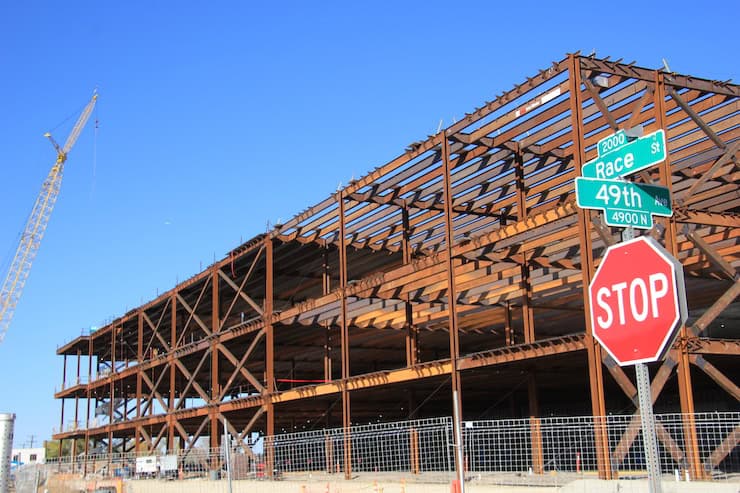
Data center construction at 49th & Race, Denver. Photo credit: Allen Best

But now, the future is here and AI is everywhere, whether you want it to be or not. It can’t yet wash the dishes, and even though it’s begun taking people’s jobs, it hasn’t erased the need to work for a living. It can, however, correct your spelling errors, help researchers crunch huge datasets, diagnose illnesses and even provide what passes for mental health counseling. It can also inject language you never intended into your messages without your knowledge, churn out inane emails and stilted high school essays, and casually plagiarize artists, writers and journalists. 

This new age has its marvelous aspects, I suppose, but it is also disappointing — even baffling. It’s true that it has coincided with the clean(er) energy transition; coal-burning for power generation has been declining since 2007, while solar, wind and battery storage have boomed. And yet instead of allowing us to abandon the most outdated component of the Industrial Age — the production of power via fossil fuel combustion — the Information Age has helped perpetuate this dirty habit. Our most futuristic, newfangled technologies continue to rely on prehistoric energy. 

Every AI query or other cyber-operation that relies on cloud computing is processed by data centers, warehouse-like buildings housing row after row of servers that churn through digital information. Each individual operation might use a fairly small amount of power, but a single data center handling millions of queries per day can guzzle as much electricity as an entire city. 

And now, the buildup of energy-intensive, AI-processing hyperscale data centers threatens to outpace the energy transition, while giving fossil fuel-boosters justification for continuing to rely on dirty energy sources. To meet the burgeoning demand for power, utilities are nixing plans to shutter old coal and nuclear plants, and data center developers are even constructing new natural gas generators to power their facilities. 

Each time you or I queue up an old Jetsons episode on YouTube or ask ChatGPT whether a video was real or fabricated by Grok, the request travels at roughly the speed of light to a data center. Perhaps that data center happens to be a grid-connected facility in, say, the Phoenix metro area, where hyperscale data centers are sprouting like cheatgrass. The facility’s GPUs and CPUs run off electricity funneled in from transmission lines that connect to power plants spread across the utility’s entire grid. 

That means there’s a good chance that some of that power is coming from the Four Corners coal power plant in northwestern New Mexico, or from natural gas plants burning methane from the oil and gas fields in the nearby San Juan Basin. 

How did all that coal and methane get there in the first place? We have to go back some 145 million years to the beginning of the Cretaceous period, when a shallow, briny sea covered much of what is now the Interior West. Over thousands of millennia, the sea advanced and retreated numerous times, laying down layers of sediment — sand, mud, clay — each time, supplemented by silt carried by huge rivers originating in adjacent mountain ranges.

An artist’s reconstruction of a ‘Sarabosaurus dahli’ swimming with ammonites and fish in southern Utah 94 million years ago. Andrey Atuchin/Bureau of Land Management

Embedded within the sediment was organic material, including plants, algae, bacteria, plankton and other microorganisms — along with much larger creatures, from Cretalamna (a megatooth shark) to the Sarabosaurus dahli, which might have resembled some combination of fish, seal and lizard. As the sediment piled up and was subjected to heat and pressure, each layer was transformed into a rock formation: the Dakota sandstone, the Mancos shale, the Mesa Verde sandstone and more. Meanwhile, the organisms decomposed in an oxygen-free environment, eventually transforming into crude oil and methane, or natural gas. 

In the Late Cretaceous, before the dinosaurs went extinct 66 million years ago, the sea retreated for the final time, leaving behind vast freshwater swamps in what is now the San Juan Basin. The climate back then was downright sultry — rainy and warm and almost tropical. Trees and plants grew profusely in and around the shallow marshes, and fallen leaves and toppled trees decayed rapidly, leaving behind deep accumulations of decayed vegetal matter, or peat. Ultimately, this, too, would be transformed by pressure, heat and millions of years into thick, methane-infused coalbeds that are now part of the Fruitland formation.
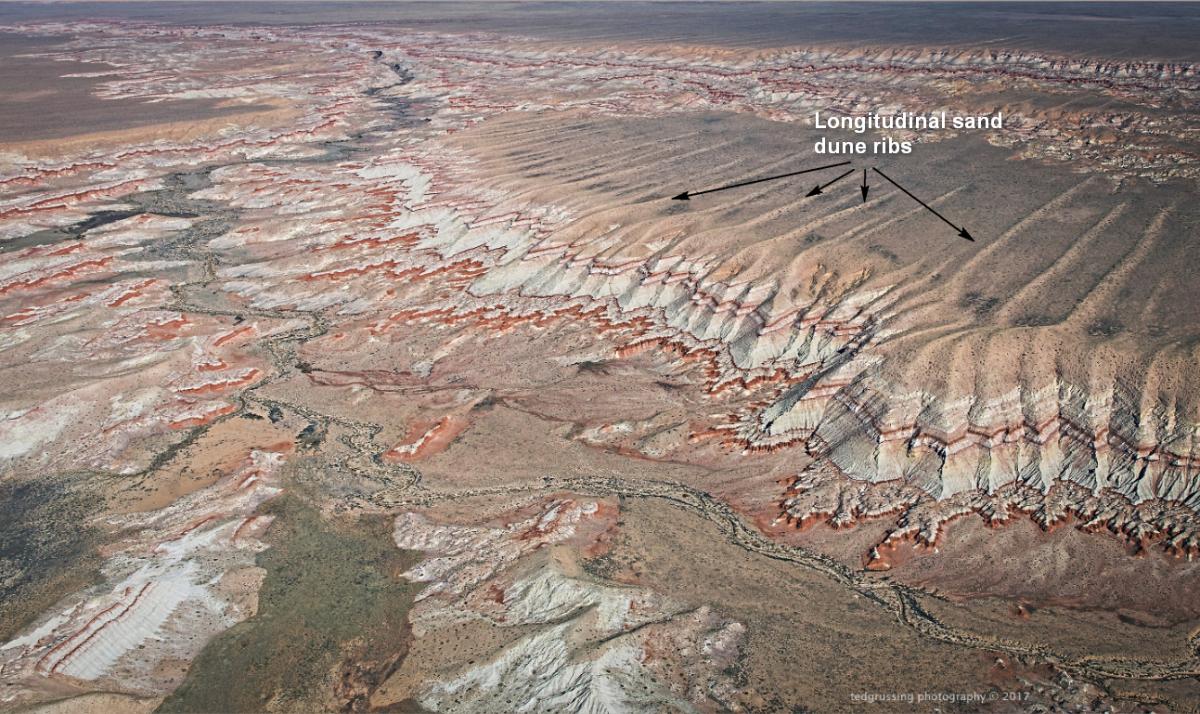
Coal Mine Canyon is lined with reddish sandstones and siltstones of Mesozoic age. The Canyon is situated in a remote locale bordering the eastern edge of the Painted Desert. On the mesa above the canyon, are longitudinal sands dunes. The quality of coal in the canyon is poor and active coal mining was discontinued decades ago. Photo credit: Ted Grussing/University of Arizona

These days, huge draglines with house-sized shovels tear into the earth at the Navajo Mine, exhuming the remnants of those swamps at a rate of about 14,000 tons daily. The carboniferous rocks are then shipped a few miles north to the Four Corners power plant. In the nearby gas fields, drillers have poked tens of thousands of holes in the ground and hydraulically fractured the rock formations to get at the hydrocarbons, the physical memories of ancient sea creatures, which are then processed and piped to natural gas power plants.

The fuels are burned, releasing carbon and other pollutants that have been stored for millions of years underground, to generate enough steam to turn turbines to spark an electromagnetic field and send electrons across the desert in massive transmission lines to the Arizona grid. From there, they travel to the data center’s server banks, businesses and homes, ultimately ending up in the outlet next to your bed where you charge your phone. 

Fossil fuel combustion made the Industrial Age possible and continues to drive much of society, both in and out of cyberspace. Yet when you factor in the immense amounts of time, human labor, energy and downright violence required to extract and process and transport these fuels, the whole endeavor seems increasingly bizarre. The strangeness is only magnified by the fact that this ancient form of energy powers the newfangled technology of the Information Age, especially when the same technology has given us access to an abundance of renewable, cleaner forms of power.

#ColoradoRiver governors express cautious optimism after ‘historic’ DC meeting Caitlin Sievers (ArizonaMirror.com) #COriver #aridification

A high desert thunderstorm lights up the sky behind Glen Canyon Dam — Photo USBR

by Caitlin Sievers, Arizona Mirror
January 30, 2026

With the deadline to reach a water usage agreement looming, leaders from the seven Colorado River Basin states expressed cautious optimism that their “historic” meeting in Washington, D.C., will spur the compromise needed to reach a consensus.

U.S. Secretary of the Interior Doug Burgum called the meeting at the request of Arizona Gov. Katie Hobbs, after the states blew past a Nov. 11 deadline to reach an agreement. The new Feb. 14 deadline was set by the Bureau of Reclamation, which manages water in the West under the Interior Department. 

Arizona stands to see the largest cuts if the states can’t reach an agreement, because its Central Arizona Project is one of the newest users of the river water, making it legally one of the first to be cut.

The Colorado River is a vital source of drinking water for 40 million people in the seven basin states, Mexico and 30 Native American tribes, and provides water for farming operations and hydroelectricity. 

One of the biggest disagreements between the Lower Basin states — Arizona, Nevada and California — and Upper Basin states — Colorado, New Mexico, Utah, and Wyoming — is over which faction should have to cut back on their water use, and by how much.

“This is one of the toughest challenges facing the West, but the Department remains hopeful that, by working together, the seven basin governors can help deliver a durable path forward,” Burgum, the former governor of North Dakota, said in a statement. “Looking at this as a former governor, the responsibility each of them carries to meet the needs of their constituents cannot be understated, and we are committed to partnering with them to reach consensus.”

The meeting in the nation’s capital lasted more than two hours, Christian Slater, a spokesman for Hobbs, told the Arizona Mirror. The governors of all of the basin states attended the meeting, except for Gov. Gavin Newsom of California, who had a prior family commitment and sent California Natural Resources Secretary Wade Crowfoot in his place. 

“It’s actually a pretty historic meeting, and I don’t use those words lightly,” John Entsminger,  Nevada’s Colorado River negotiator, said. “I’ve been working on the river for more than 25 years, and I’ve never seen that many governors and a cabinet secretary in one room talking about the importance of the Colorado River.”

In a post on X Friday afternoon, Hobbs described the meeting as meaningful and productive. 

“I was encouraged to hear Upper Basin governors express a willingness to turn water conservation programs into firm commitments of water savings,” Hobbs wrote. “Arizona has been and will continue to be at the table offering solutions to the long-term protection of the river so long as every state recognizes our shared responsibility.”

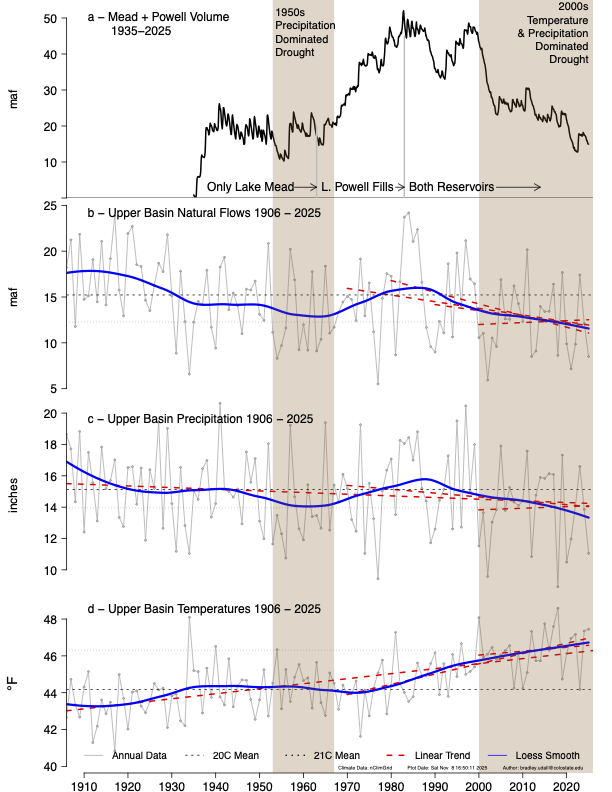
Udall/Overpeck 4-panel Figure Colorado River temperature/precipitation/natural flows with trend. Lake Mead and Lake Powell storage. Updated through Water Year 2025. Note the tiny points on the annual data so that you can flyspeck the individual years. Credit: Brad Udall

Reaching a water usage agreement is vital to the basin states because the Colorado River’s water supply has been in decline for around 25 years due to a persistent drought spurred on by climate change. The decline is expected to continue into the future. 

Water levels in the two major reservoirs on the river, Lake Mead and Lake Powell, have also been in decline for the last quarter century. 

“One thing is certain: We’ll have less water moving forward, not more,” New Mexico Gov. Michelle Lujan Grisham said in a statement. “So, we need to figure this out. There is still a lot of work ahead to get to an agreement, but everyone wants an agreement, and we’ll work together to create a pathway forward.”

Lower Basin states want all seven states to share mandatory water cuts during dry years under the new guidelines. But the Upper Basin, which is not subject to mandatory cuts under the current guidelines, argue that they already use much less water than downstream states and should not face additional cuts during shortages.

State negotiators for both the Upper and Lower Basin have said they would prefer a seven-state agreement over alternative river management options proposed by the federal government.

Tom Buschatzke, director of the Arizona Department of Water Resources, told reporters last week that the Grand Canyon State does not like the options proposed by the federal government as they place almost the entire burden for cuts on Lower Basin states. 

The Colorado River Compact dates back to 1922, when the seven states made their initial agreement, allocating 7.5 million acre-feet of water each year to be shared by the Upper Basin states and another 7.5 million to be used among the Lower Basin states. 

In 2025, for the fifth year in a row, the federal government imposed water allocation cuts on the Colorado River  due to the ongoing drought and Arizona’s cut amounts to a loss of 512,000 acre-feet of water for the year. 

“Today’s discussion was productive and reflected the seriousness this moment requires,” Colorado Gov. Jared Polis said in a statement. “Since 2022, Colorado and the Upper Basin states have shown up to the negotiating table ready to have hard conversations. We have offered sacrifices to ensure the long-term viability of the Colorado River and we remain committed to working collaboratively to find solutions that protect water for our state, while supporting the vitality of the Colorado River and everyone who depends on it.” 

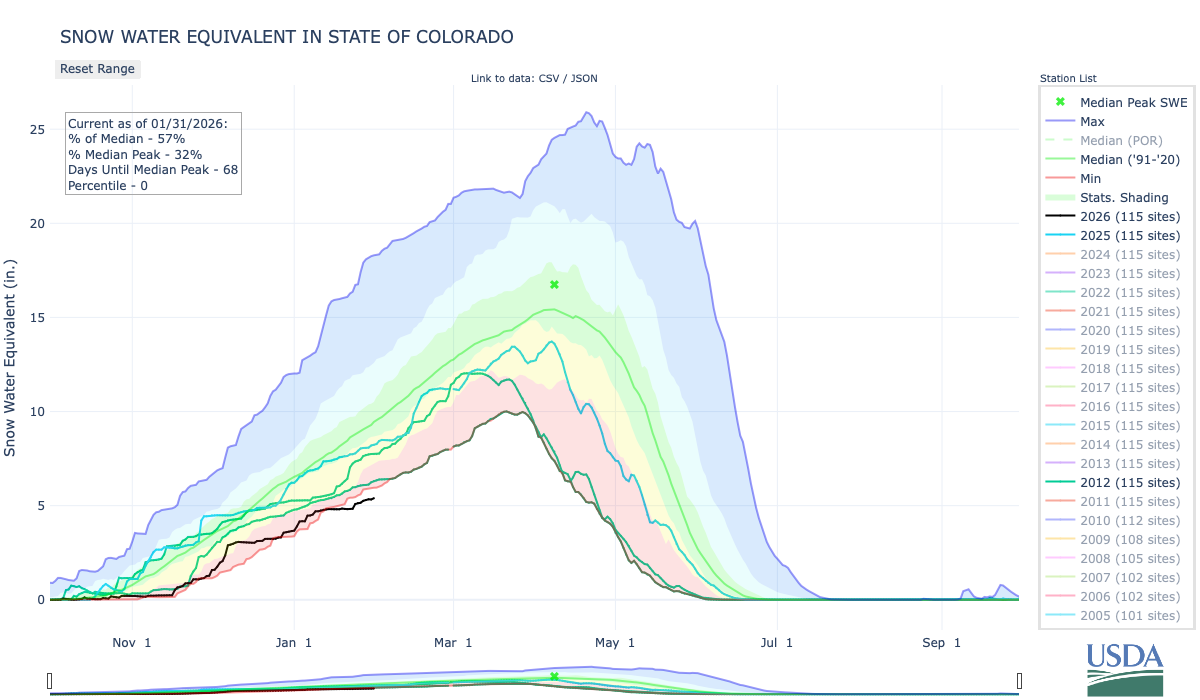
Complicating matters this year is scant snowpack in the Rocky Mountains. Small snowpack means very little runoff, the source for almost all of Colorado’s water. 

The Lower Basin states have undertaken significant conservation efforts for Colorado River water since 2014 and have reduced their consumption from 7.4 million acre-feet in 2015 to just over 6 million in 2024.

The Upper Basin states have increased their usage in the past five years, from 3.9 million acre-feet in 2021 to 4.4 million in 2024. 

Buschatzke, who attended the meeting in D.C. on Friday alongside Hobbs, has remained insistent that it’s time for the Upper Basin states to do their part. Hobbs’ statement indicated that the states had made some progress toward that. 

If the states can’t reach an agreement and are forced to take one of the federal government’s proposals, it will likely lead to litigation — something that the states agree they would prefer to avoid. 

“We all have to keep working together,” Entsminger said. “We have to find a compromise, and we have to find a way that the states stay in control of this process and don’t turn it over to the courts.”

Last year, Arizona put a total of $3 million to its Colorado River legal defense fund, and Gov. Katie Hobbs’ proposed budget for this year would put another $1 million toward that fund. 

Entsminger said that he thinks the meeting improved the chances of the states meeting  the Feb. 14 deadline. 

“Whether we have a final deal on February 14 or not, we’re still going to have to keep working,” he said. “That’s not to say I don’t think we’ll meet the deadline, but I do think we keep working until we have a deal, regardless of what day in the future that occurs.”

Jeniffer Solis of the Nevada Current contributed to this report.

Map of the Colorado River drainage basin, created using USGS data. By Shannon1 Creative Commons Attribution-Share Alike 4.0