#Colorado has tens of thousands of abandoned hardrock mines. Congress just passed a billย to help more groups clean them up — Colorado Public Radio

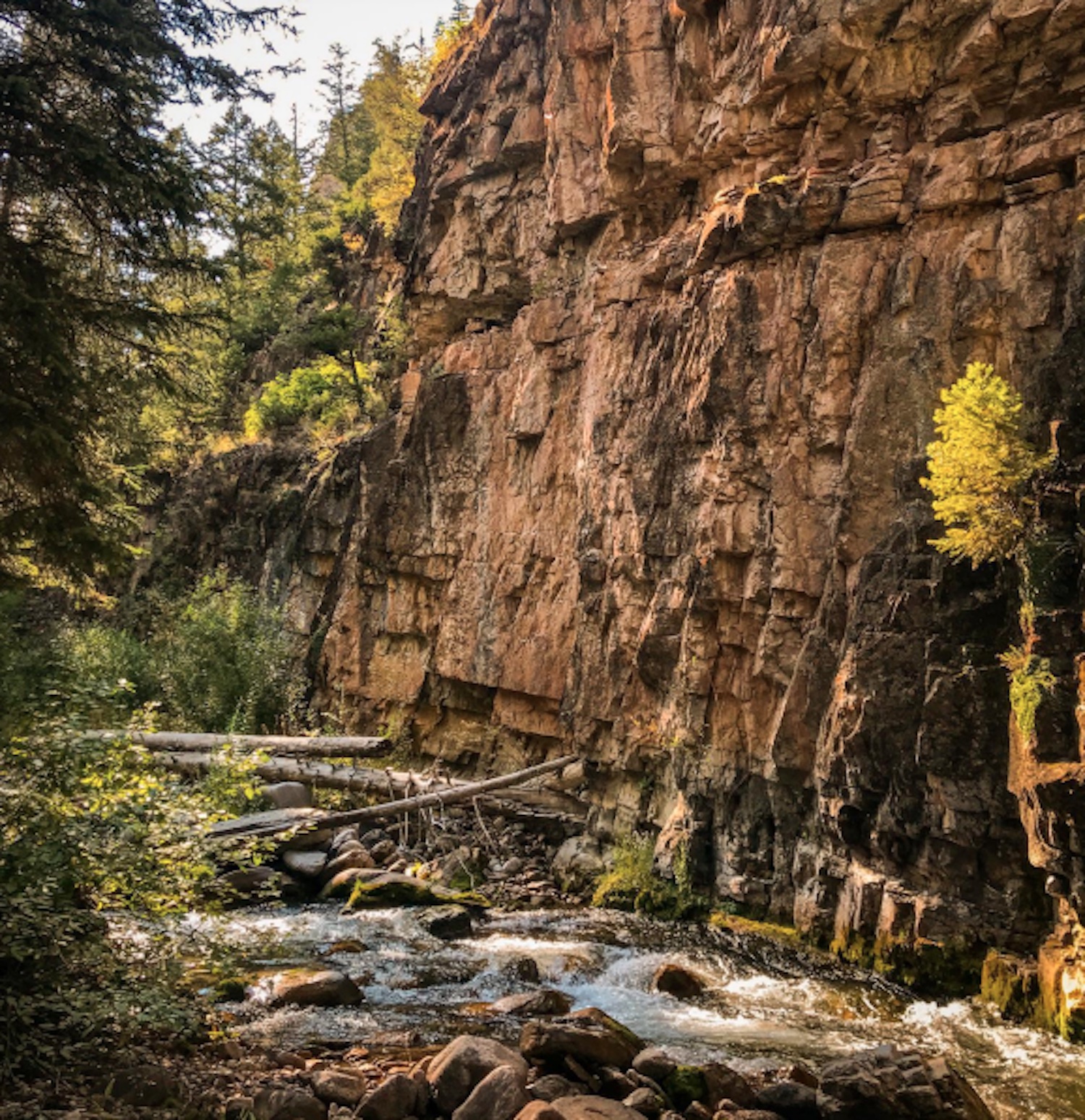
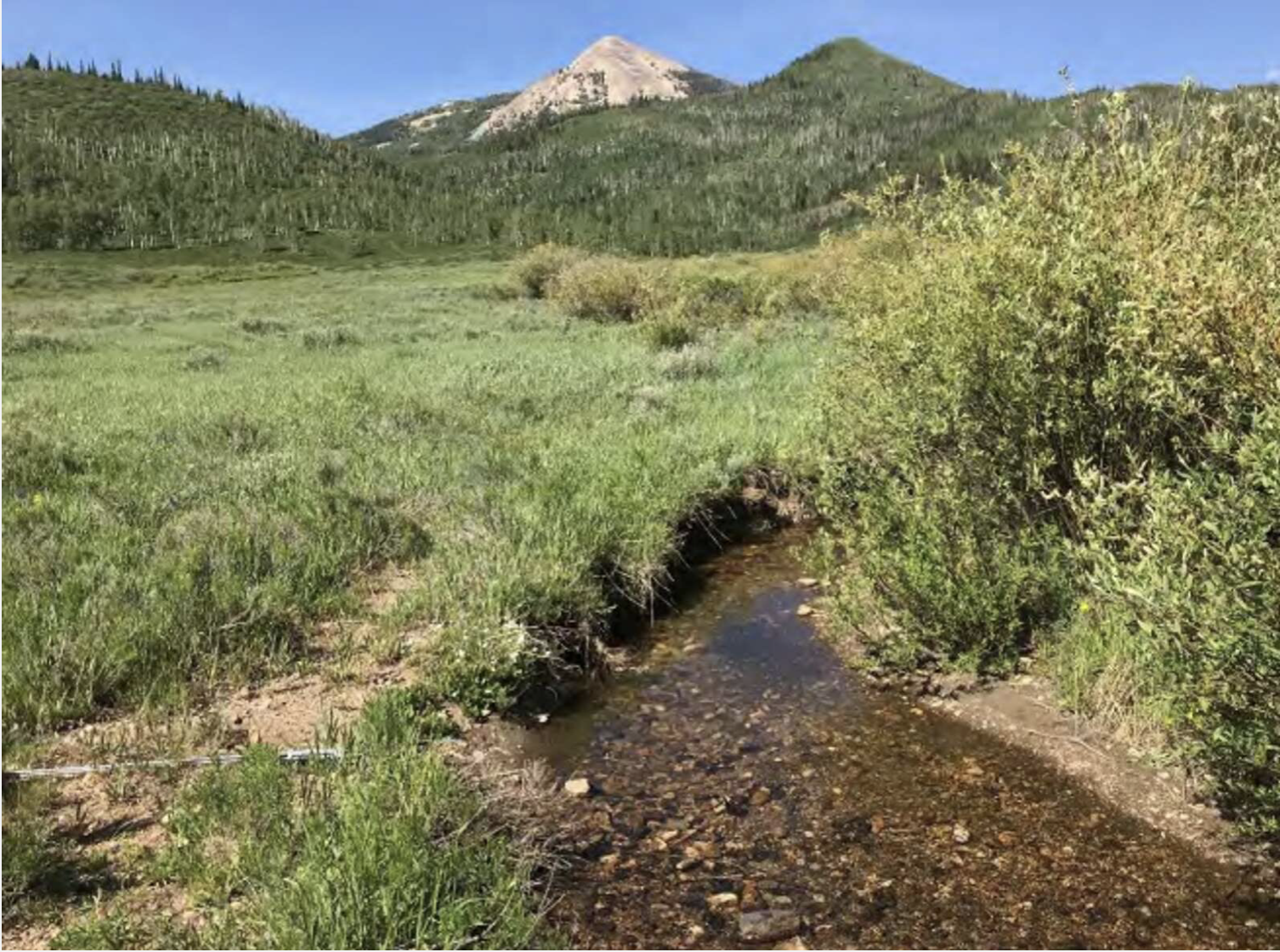
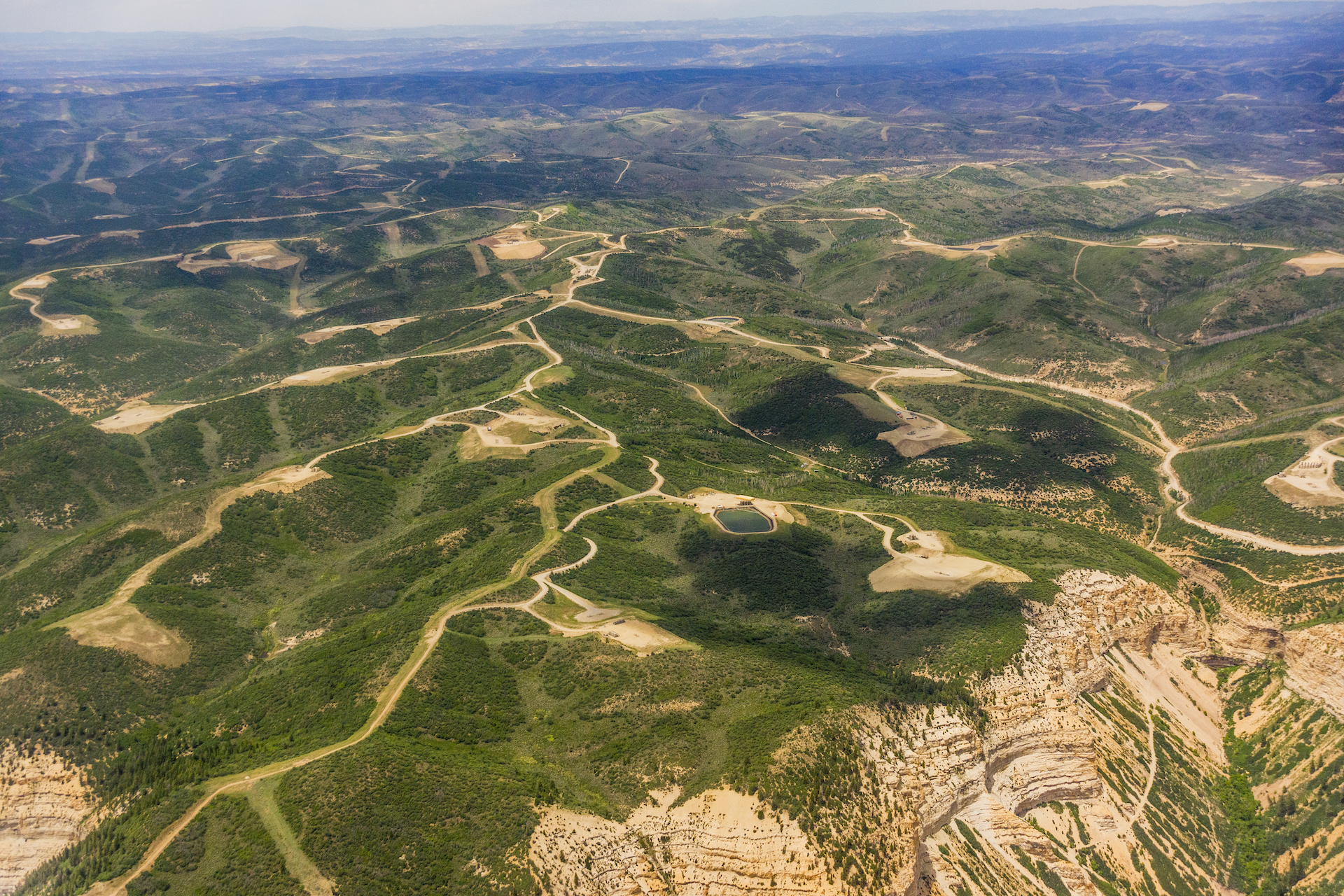
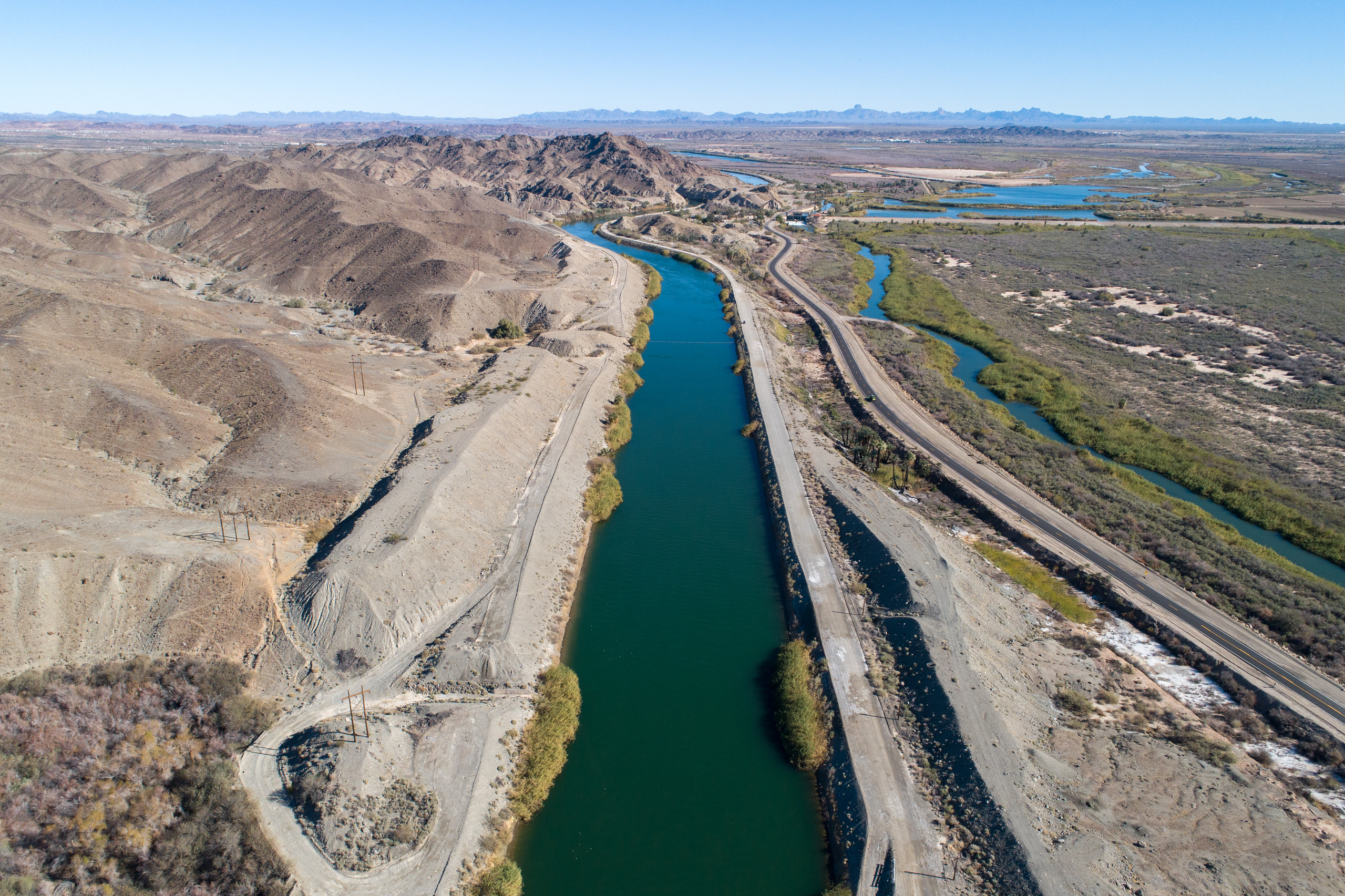
The Brooklyn Mine, northwest of Silverton, is among the worst polluters in the Animas River watershed. An innovative restoration project successfully planted 900 trees on a mine waste rock pile to help repair the landscape./ Courtesy of U.S. Forest Service

Click the link to read the article on the Colorado Public Radio website (Caitlyn Kim). Here’s an excerpt:

December 10, 2024

The U.S. House on Tuesday approved the Good Samaritan Remediation of Abandoned Hardrock Mines Act, via voice vote. The bill passed the Senate in July and now goes to President Joe Bidenโ€™s desk. The bill sets up a pilot program under the Environmental Protection Agency to allow โ€œgood Samaritansโ€ to clean up and improve water quality around abandoned hard rock mine sites without being subject to liability for pre-existing pollution…

Colorado Sens. John Hickenlooper and Michael Bennet are original co-sponsors of the Senate bill, while Colorado Reps. Brittany Pettersen, Joe Neguse, Lauren Boebert, Jason Crow and Yadira Caraveo co-sponsored the House version. Hickenlooper said the bill is important for all Mountain West states because current liability rules make clean up work too risky.

โ€œIf someone, a good Samaritan, comes along and wants to help try to fix [an old mine leaking pollution] and theyโ€™ve got a great idea โ€ฆ they canโ€™t do it because the moment they touch anything to do with that pollution, they own it. In other words, they can be sued.โ€ Hickenlooper said. โ€œThis is all about trying to let people clean up the mess that people made a century ago without being liable for it.โ€

[…]

Itโ€™s estimated there are as many as 140,000 abandoned hardrock mines in the U.S., with about 23,000 in Colorado. The legislation sets up 15 pilot projects over seven years. Ty Churchwell, mining coordinator for Trout Unlimited, said passage of this bill is โ€œa big, big deal.โ€ The non-profit is one of only a few that do this kind of work, with much of it done by state mine remediation agencies.

Historic water rights settlements yet to deliver lifeline to Navajo Nation — The Navajo Times #ColoradoRiver #COriver #aridification #CRWUA2024

Navajo Reservation map via NavajoApparel.com

Click the link to read the article on the Navajo Times website (Donovan Quintero). Here’s an excerpt:

December 15, 2024

At the Colorado River Water Users Association conference last week in Las Vegas, Nevada, representatives from the 25th Navajo Nation Council, the Navajo Nation Department of Justice, the Office of the President and Vice President, and the speakerโ€™s office outlined the significant water challenges facing Navajo communities and the opportunities presented by ongoing water rights settlement agreements. Crystal Tulley-Cordova, a hydrologist with the Navajo Nation Department of Water Resources, stated at the conference that the tribe is committed to safeguarding water resources across its 27,000-square-mile Navajo Nation, which spans Arizona, Utah, and New Mexico…Tulley-Cordova explained that the Navajo Nation has historically relied on groundwater, which can take thousands of years to recharge…

Three key water rights settlement acts are critical to the Navajo Nationโ€™s water future, Tulley-Cordova stated. The Northeastern Arizona Indian Water Rights Settlement Act of 2024, the Navajo Gallup Water Supply Act of 2023, and the Navajo Nation Rio San Josรฉ Stream System Water Rights Settlement Act of 2024 provide opportunities to secure water rights and avoid costly litigation…

The CRWUAโ€™s 2024 report highlighted significant developments and challenges in water management, particularly emphasizing the efforts of the Ten Tribes Partnership. The partnership, established in 1992, includes tribes with federally recognized water rights in the Colorado River Basin, such as the Navajo Nation, the Ute Indian Tribe, and the Southern Ute Indian Tribe, which collectively hold rights to approximately 20% of the riverโ€™s mainstream flow…The Navajo Nation was a focal point of the report, with updates on key infrastructure projects such as the Navajo-Gallup Water Supply Project. The initiative, supported by federal legislation, will deliver reliable drinking water to underserved Navajo communities by 2029. Recent advancements include the awarding of a $267 million contract for the San Juan Lateral Water Treatment Plant, one of the projectโ€™s cornerstone facilities. The report also highlighted innovative collaborations, such as the Jicarilla Apache Nationโ€™s efforts to use its settlement water rights creatively. By leasing water to the state of New Mexico, the tribe supported endangered species preservation while funding essential water delivery projects. These collaborative approaches demonstrate how tribal water rights can address both ecological and human needs.

Voices: We represent the Upper Basin states, and itโ€™s time we manage the #ColoradoRiver we have โ€” not the one we want — Brandon Gebhart, Estevan Lopez, Becky Mitchell and Gene Shawcroft (The Salt Lake Tribune) #COriver #aridification #CRWUA2024

Colorado River “Beginnings”. Photo: Brent Gardner-Smith/Aspen Journalism

Click the link to read the article on The Salt Lake Tribune website (Brandon Gebhart, Estevan Lรณpez, Becky Mitchell and Gene Shawcroft). Here’s an excerpt:

December 6, 2024

As representatives of the Upper Basin states of Colorado, New Mexico, Utah and Wyoming, we are committed to a fair, common sense, data-driven approach that balances the needs of all stakeholders. Our approach is to adapt Colorado River operations and uses to the annual available water supply using the best available science and tools while we continue to meet our responsibilities and commitments to our communities, our states and the Basin. We are planning for and will manage the river we have, not the river we want…More than 90% of the riverย comes from the annual snowpack, which occurs almost entirely in the Upper Basin. Warming temperatures are making river flows increasingly volatile and uncertain and have intensified since the Colorado River Compact was signed in 1922. Getting the next set of Colorado River operating rules right demands that we manage uses within the river we have.

Udall/Overpeck 4-panel Figure Colorado River temperature/precipitation/natural flows with trend. Lake Mead and Lake Powell storage. Updated through Water Year 2024. Credit: Brad Udall

Annual hydrologic variability forces the Upper Basin states to manage uses within the means of the river, which hinders our ability to develop our full compact apportionment. Each year, water managers across the Upper Basin shut off water users when flows are low, adapting uses to the available supply. This is painful to individual Upper Basin water users but is necessary to continue to manage our uses consistent with actual hydrology and the rights and obligations under the 1922 Compact.

As part of the negotiations to establish post-2026 operating rules,ย we have offered an Upper Division States Alternative, a common-sense, data-driven solution to the Colorado Riverโ€™s challenges. Our proposal benefits the entire basin by aligning uses and operations with actual water supply and includes voluntary conservation in the Upper Basin. Reclamation has released a description of potential Colorado River water management alternatives to guide development of the post-2026 Colorado River operating rules. We believe the Upper Basin Alternative is within the range of options outlined by Reclamation…Climate change is already here in the Colorado River Basin. Adapting to actual hydrologic conditions, which the Upper Basin does every year out of necessity, can provide a model for equitable and sustainable river use across the entire system. With the current guidelines expiring in 2026, our shared responsibility must be to prioritize the Colorado Riverโ€™s future by aligning water use with the available supply. Itโ€™s time to live within the means of the river we have.

#ColoradoRiver talks tackle usersโ€™ competing water demands — The Las Vegas Sun #COriver #aridification #CRWUA2024

Map of the Colorado River drainage basin, created using USGS data. By Shannon1 Creative Commons Attribution-Share Alike 4.0

Click the link to read the article on the Las Vegas Sun website (Ilana Williams). Here’s an excerpt:

December 8, 2024

Sessions at this yearโ€™s conference, themed โ€œPiecing the Puzzles Together,โ€ were designed to help fit together the various competing interests among Colorado River water users, including tribal, municipal, agricultural, conservation and environmental concerns, said Gene Shawcroft, president of the Colorado River Water Users Association. Climate change and explosive growth in the region have introduced new variability and instability that was not affecting the river when the 1922 Colorado River Compact was signed and require discussions to craft a solution…Water stakeholders across the basin have a responsibility to solve the puzzle for the people of the American West, Shawcroft said. There is also a responsibility to manage the river in an efficient way to ensure its future…

The 1922 Colorado River Compact is still enforced, but the operating guidelines are being negotiated, said Jennifer Pitt, the Colorado River program director at the National Audubon Society. The long-term guidelines, referred to as Post-2026 Operations, will revisit the 2007 Interim Guidelines and other operating agreements that expire in 2026, including drought contingency plans and Minute 323, which allows Mexico to continue to store water in Lake Mead, according to the associationโ€™s 2023 report.

#ColoradoRiver states fear a long legal battle as talks falter over shortage rules — AZCentral.com #COriver #aridification #CRWUA2024

Udall/Overpeck 4-panel Figure Colorado River temperature/precipitation/natural flows with trend. Lake Mead and Lake Powell storage. Updated through Water Year 2024. Credit: Brad Udall

Click the link to read the article on the AZCentral website (Brandon Loomis). Here’s an excerpt:

December 6, 2024

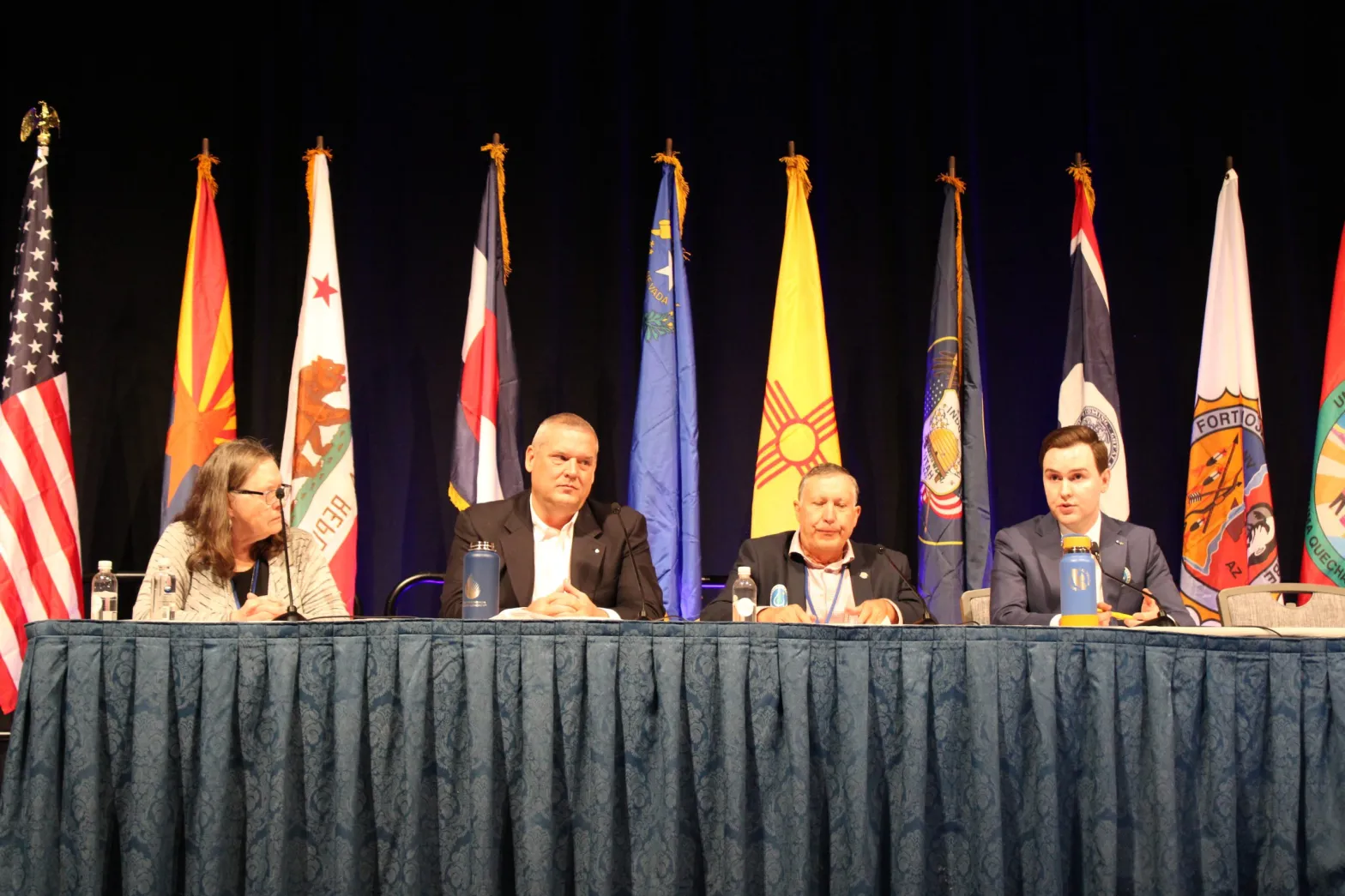
State water officials lobbed pointed criticisms at each other on Thursday during successive programs at the Colorado River Water Users Association conference. J.B. Hamby, Californiaโ€™s lead river negotiator, said his state and Arizona wonโ€™t keep reducing what they take from the river simply to watch upstream states increase their diversions โ€œand building pipelines to more golf courses.โ€ Brandon Gebhart of Wyoming responded by calling such positions โ€œsaber-rattling,โ€ โ€œdistractionsโ€ and โ€œbullshit.โ€

[…]

After listening to the back-and-forth on Thursday, a former Interior secretary and Arizona governor said the talks may require a high-level mediator appointed by the White House. Thatโ€™s what it took to get the states to agree to their initial water-sharing compact in 1922, Bruce Babbitt told The Arizona Republic, and it would help now…Officials from Arizona have begun discussing the option of triggering a โ€œcompact callโ€ if that happens, referring to language in the compact that they believe should cause the Interior Departmentโ€™s Bureau of Reclamation to enforce the compact on behalf of the Lower Basin. Central Arizona Project board members began the week by passing a resolution calling on federal officials to analyze the option of such a compact call…The Rocky Mountain states upstream from Lees Ferry say they already take their share of cuts in low-snow years. Instead of reducing releases from the big reservoirs that the Lower Basin uses, the Upper Basin has to cut back according to whatโ€™s flowing down headwater streams. Those reductions average more than a million acre-feet a year, according the New Mexicoโ€™s [Estevan Lopez]. The upper states have never approached using their full half, New Mexico compact Commissioner Estevan Lopez said, and aridification has force reductions from a high point of 5.1 million acre-feet.

โ€œItโ€™s highly likely that we in total wonโ€™t be able to develop much more than that based on hydrology,โ€ he said.

#ColoradoRiver Basin tribes enter new water agreements with outgoing Biden administration — KJZZ #COriver #aridification #CRWUA2024

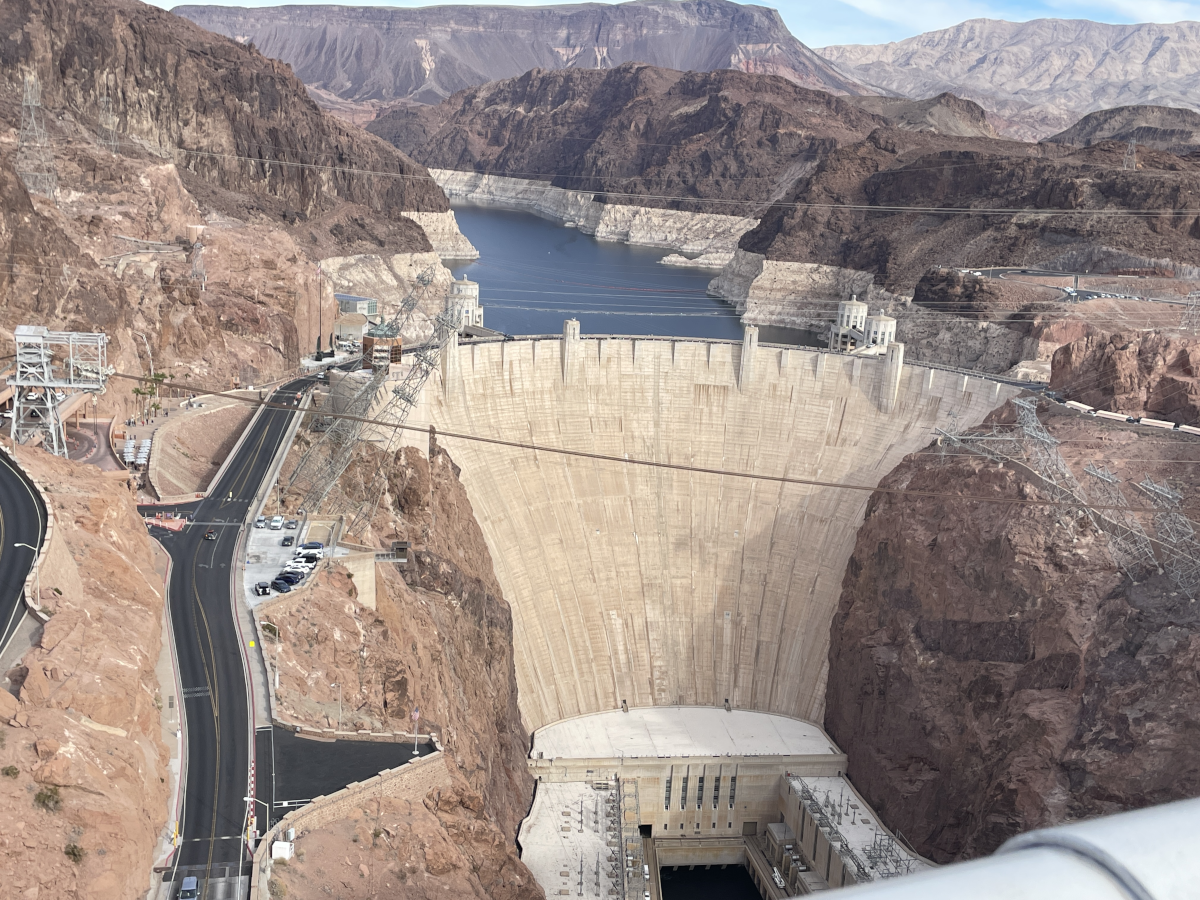
Hoover Dam from the U.S.-93 bridge over the Colorado River December 3, 2024.

Click the link to read the article on the KJZZ website (Gabriel Pietrorazio). Here’s an excerpt:

December 5, 2024

The future of managing water in the West remains uncertain following the presidential election. But a handful of Colorado River Basin tribes are celebrating a series of new water infrastructure investments from the outgoing Biden administration. Inside a cramped room at a Las Vegas resort, leaders from five federally recognized Southwestern tribes came together during the annual Colorado River Water Users Association conference…

The San Carlos Apache Tribe and Fort Yuma Quechan Indian Tribe, which straddles the Arizona-California border, met with the Bureau of Reclamation to extend water-saving agreements during a signing ceremony on Wednesday. San Carlos has agreed to not withdraw 30,000 acre feet from Lake Mead in exchange for $12 million from the federal government,ย while Fort Yuma Quechan will collect $5.2 million to leave 13,000 acre feet alone. Colorado River Indian Tribes Chairwoman Amelia Flores signed a letter of intent to fund a $5 million planning study to construct a new reservoir for its main canal through Reclamationโ€™s Native American Affairs Technical Assistance Program, which provides support to develop, manage and protect their water resources…Additionally, the Ute Mountain Ute Tribe, which spans the Four Corners states of Utah, Colorado and New Mexico, signed a repayment contract for the Animas-La Plata Project that has been ongoing for 14 years. Itโ€™ll also allocate the tribe 38,000 acre feet of storage in Lake Nighthorse, a reservoir near Durango, Colorado…Lastly, the White Mountain Apache Tribe has been awarded $21.5 million from the Inflation Reduction Act to help plan and design a rural water system to divert, store and distribute water from the White River for some 15,000 residents across the Fort Apache Reservation in eastern Arizona.

Cleanup of abandoned mines could be getting easier in the West — KUNC

Prior to mining, snowmelt and rain seep into natural cracks and fractures, eventually emerging as a freshwater spring (usually). Graphic credit: Jonathan Thompson

Click the link to read the article on the KUNC website (Rachel Cohen). Here’s an excerpt:

December 12, 2024

More than 140,000 abandoned hardrock mines scatter federal lands in the Western U.S. Their cleanup could be getting easier, thanks to a bill that cleared its final hurdle in Congress this week…Finally, this week, the U.S. House of Representatives passed a bipartisan bill called theย Good Samaritan Remediation of Abandoned Hardrock Mines Act, which the Senate had already passed this summer. It creates a pilot program under the Environmental Protection Agency that allows nonprofits, governments or landowners to clean up old mines without taking on the risk…

โ€œHistorically, the fear of litigation and liability that might trail a would-be โ€˜good Samaritanโ€™ has kept us from doing a lot of that clean-up work,โ€ said Chris Wood, the president and CEO of Trout Unlimited, which works to remediate mine tailings to improve water quality. Wood said the organization faces obstacles to do as much cleanup as it would like because of the liability concerns. Heโ€™s been working to remove these hurdles for two decades.

After ‘once-in-a-generation’ funding helped save #ColoradoRiver water, an uncertain future for #conservation — Alex Hager (KUNC) #COriver #aridification

Bureau of Reclamation commissioner Camille Calimlim Touton (left) smiles at JB Hamby of the Imperial Irrigation District at a conference in Las Vegas on December 4, 2024. The federal government has sent hundreds of millions of dollars to the Southern California farming district to incentivize farmers to use less water. Photo credit: Alex Hager/KUNC

Click the link to read the article on the KUNC website (Alex Hager):

December 14, 2024

Where the farm fields meet the desert in Southern Californiaโ€™s Imperial Valley, farmer John Hawk looks out over a sea of green.

โ€œIt really is an emerald gem that we have,โ€ he said. โ€œWith the water, we can do miracles.โ€

The Imperial Irrigation District uses more water from the Colorado River than any other single entity โ€“ farm district, city, or otherwise โ€“ from Wyoming to Mexico. As climate change shrinks the riverโ€™s supplies, its biggest users are facing increasing pressure to cut back on their demand.

โ€œDo we need to conserve? Absolutely,โ€ Hawk told KUNC in 2023. โ€œWe need to conserve, but we need to be paid for the conservation.โ€

Last year, the federal government took Imperialโ€™s farmers up on that suggestion. Over the course of three years, it agreed to send more than $500 million to the district to use less water and leave it in Lake Mead, the nationโ€™s largest reservoir. That money comes from the Biden Administrationโ€™s Inflation Reduction Act.

Water leaders in the West and Washington D.C. alike have lauded the effort as a pivotal way to boost the reservoir, which has dropped to all-time low levels in recent years. Similar spending has saved water on farms and tribal land across the region. It has also made city utilities more efficient. But now, on the cusp of Donald Trumpโ€™s return to the White House, those who use the riverโ€™s water are worried that funding could disappear.

โ€œAll these programs cost money,โ€ said Gina Dockstader, a fourth-generation farmer who sits on the Imperial Irrigation District board of directors. โ€œAll this investment, all this infrastructure costs money, and without these additional funds, these farmers can’t afford to put it in by themselves.โ€

John Hawk, a farmer in California’s Imperial Valley, walks across an irrigation canal on June 20, 2023. “We need to conserve, but we need to be paid for the conservation,” he said. Photo credit: Alex Hager/KUNC

The federal government needs to keep water in Lake Mead and the nationโ€™s second-largest reservoir, Lake Powell. Without conservation, water levels could drop low enough to cause the shutoff of massive hydropower generators. Even lower water levels could make it impossible to send water from big reservoirs to the Colorado River on the other side of the dams that hold them back.

When the Biden Administration set aside $4 billion of the Inflation Reduction Act for Colorado River work, it lifted some weight off the shoulders of anxious water managers, who could use it to incentivize water conservation and stave off catastrophe at those reservoirs.

Those measures also bought time for negotiators working on new, long-term rules for sharing the riverโ€™s water. Nevadaโ€™s top water negotiator, John Entsminger, called the federal spending a โ€œonce-in-a-generation windfall.โ€

On the campaign trail, then-candidate Donald Trump said he would claw back unspent funds from the Inflation Reduction Act. That could jeopardize the expensive programs that have brought a wave of temporary peace and certainty for the Colorado River basin.

โ€œIt would be really disappointing if that went away,โ€ said Hannah Holm with the conservation group American Rivers. โ€œPeople are pretty pessimistic.โ€

American Rivers receives funding from the Walton Family Foundation, which also supports KUNC’s Colorado River coverage.

Holm said the need for water conservation, and funding to make it possible, will only get more important in the future. Climate change is expected to keep shrinking the amount of water in the river and necessitate more cutbacks to the regionโ€™s water use.

โ€œIf that funding doesn’t materialize,โ€ she said, โ€œWe just won’t be as able to adapt as well to the conditions we already have, let alone the conditions that are coming our way.โ€

The Biden Administrationโ€™s infrastructure funding reached a wide variety of water-related projects. Holm cited forest restoration work that helps decrease the likelihood of forest fires, whichย can addย dirt, ash, and harmful debris to rivers that supply drinking water.

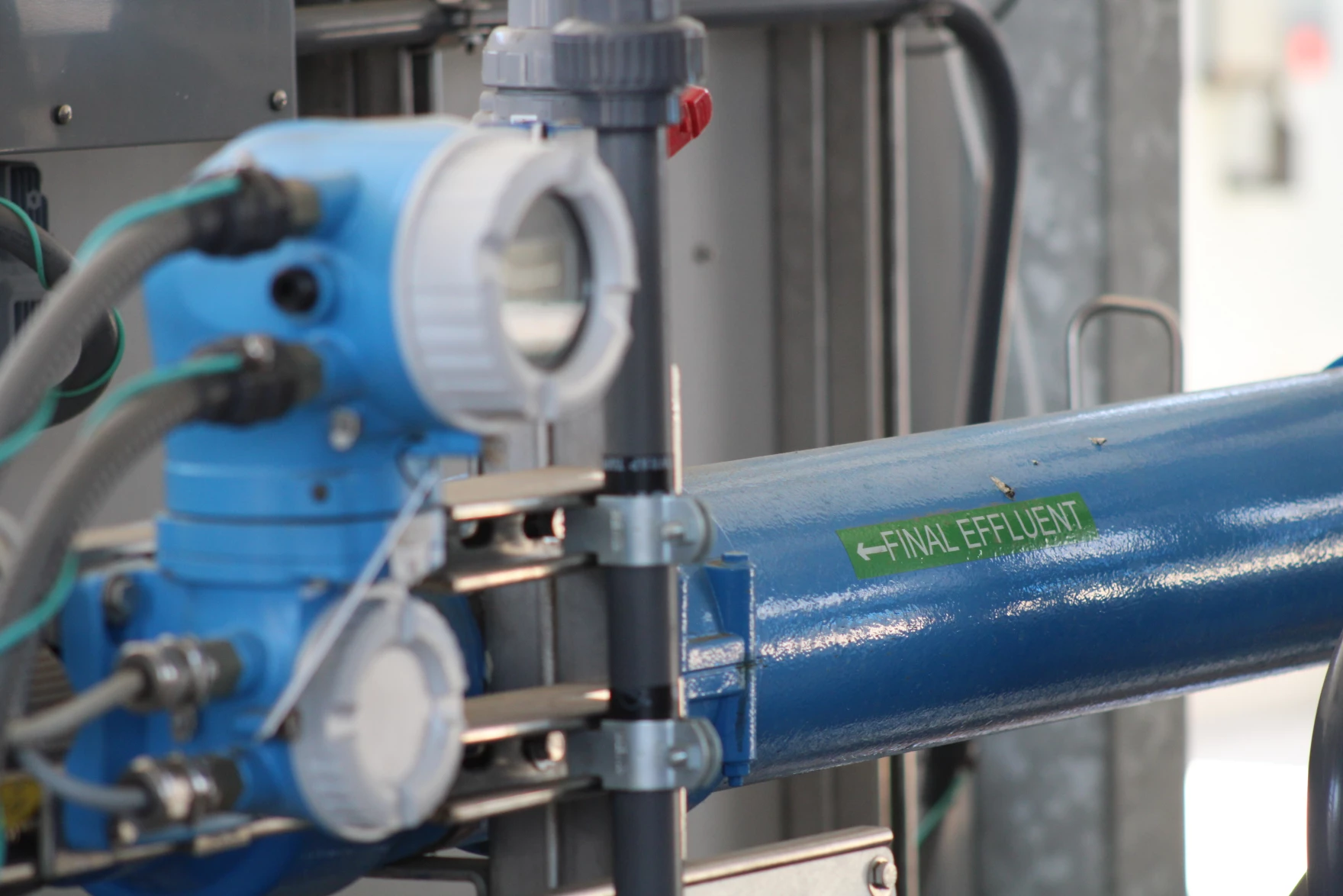
A pipe carries treated wastewater out of a water recycling demonstration facility in Carson, California on May 26, 2022. Cities are modernizing their water treatment systems to make them more efficient, often with the help of federal funding. Alex Hager: KUNC

City facilities that treat water for drinking were also on the long list of entities that received federal funding under the Biden Administration.

In the Los Angeles area, for example, the Metropolitan Water District of Southern California is spending massive amounts of money on equipment that will help steel its network against future water shortages. That agency is spending more than $3 billion on a water recycling facility, where it will safely turn sewage back into drinking water instead of cleaning it to a lower standard and releasing it into the ocean.

โ€œIn the long run, it’s going to be vital for us,โ€ said Deven Upadhyay, Metropolitanโ€™s interim general manager. โ€œIn the short run, it looks to be pretty expensive compared to the other resources we have. So the federal dollars really do help.โ€

Meanwhile, as farms and cities tighten the screws on their water use, the negotiators shaping the big-picture future of the Colorado River are stuck at an impasse. The seven states that use its water are split into two camps, divided by deep ideological differences about who should cut back on their water use going forward.

State water officials are projecting optimism that Trumpโ€™s second term will not shake up their talks, citing a historical precedent of stability within federal water agencies that is mostly unaffected by turnover in the White House.

Holm said the future they are negotiating, though, will look different if there is less federal money to ease the pain of water reductions.

โ€œIn order to be able to make less water do more,โ€ she said, โ€œWe need to be able to manage it a lot more precisely. That takes investment in science, in infrastructure, in monitoring, in figuring out different ways of moving water around. And none of that happens by itself.โ€

City facilities that treat water for drinking were also on the long list of entities that received federal funding under the Biden Administration.

In the Los Angeles area, for example, the Metropolitan Water District of Southern California is spending massive amounts of money on equipment that will help steel its network against future water shortages. That agency is spending more than $3 billion on a water recycling facility, where it will safely turn sewage back into drinking water instead of cleaning it to a lower standard and releasing it into the ocean.

โ€œIn the long run, it’s going to be vital for us,โ€ said Deven Upadhyay, Metropolitanโ€™s interim general manager. โ€œIn the short run, it looks to be pretty expensive compared to the other resources we have. So the federal dollars really do help.โ€

Meanwhile, as farms and cities tighten the screws on their water use, the negotiators shaping the big-picture future of the Colorado River are stuck at an impasse. The seven states that use its water are split into two camps, divided by deep ideological differences about who should cut back on their water use going forward.

State water officials are projecting optimism that Trumpโ€™s second term will not shake up their talks, citing a historical precedent of stability within federal water agencies that is mostly unaffected by turnover in the White House.

Holm said the future they are negotiating, though, will look different if there is less federal money to ease the pain of water reductions.

โ€œIn order to be able to make less water do more,โ€ she said, โ€œWe need to be able to manage it a lot more precisely. That takes investment in science, in infrastructure, in monitoring, in figuring out different ways of moving water around. And none of that happens by itself.โ€

This story is part of ongoing coverage of the Colorado River, produced by KUNC in Colorado and supported by the Walton Family Foundation. KUNC is solely responsible for its editorial coverage.

Map of the Colorado River drainage basin, created using USGS data. By Shannon1 Creative Commons Attribution-Share Alike 4.0

A sign of hope on the Colorado River — John Fleck (InkStain.net) #COriver #aridification

A high desert thunderstorm lights up the sky behind Glen Canyon Dam — Photo USBR

Click the link to read the article on the InkStain.net website (John Fleck):

December 5, 2024

One of the hopeful notes coming out of the recent Colorado River discussions is the way the operation of Glen Canyon Dam in a more flexible way, to accommodate a broader range of values, is back on the table. The USBR alternatives released ahead of this weekโ€™s Colorado River Water Users Association, while requiring some tea leaf divination because of their brevity, seem to leave the door open for this discussion.

Jack Schmidt and I have a new white paper offering some assistance, based on our understanding of the legal and regulatory structure around Grand Canyon National Park and Glen Canyon National Recreation Area. The idea behind what weโ€™re arguing isnโ€™t to wag a regulatory finger and say, โ€œThe law requires us to do X.โ€ Rather, weโ€™re saying, โ€œThe law enables us to do X,โ€ where for โ€œXโ€ we argue for the consideration of a wider range of social, cultural, and environmental values as we make decisions about how to divide the water up between Lake Mead and Lake Powell.

On Biden’s Energy Dominance: The U.S. is the globe’s biggest oil and gas producer โ€” without the drill, baby, drill BS — Jonathan P. Thompson #ActOnClimate

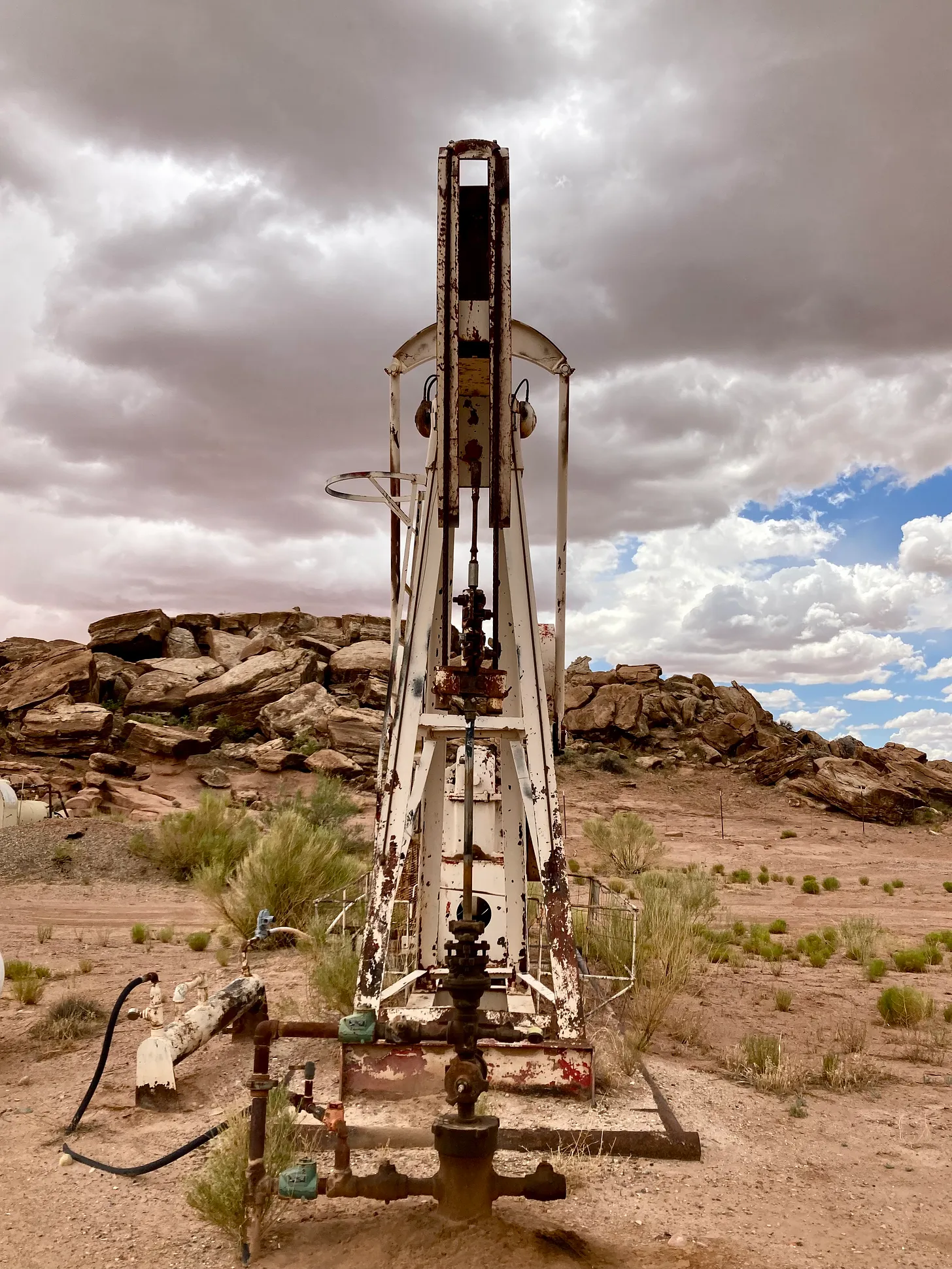
Pumpjack in the Aneth Oil Field in southeastern Utah. Jonathan P. Thompson photo.

Click the link to read the article on The Land Desk website (Jonathan P. Thompson):

November 27, 2024

๐Ÿ“ˆ Data Dump ๐Ÿ“Š

The Land Desk is taking a break from its regularly scheduled programming to set something straight. It has come to our attention that one or more of our readers donโ€™t realize that under the Biden administration the United States has become the planetโ€™s leading oil and gas producing powerhouse. Well, it has, mostly on the strength of a drilling frenzy on public, private, and state land in the Permian Basin of New Mexico and Texas. 

For those who pay attention, this shouldn’t come as a surprise. But apparently it is news to those who have been duped by President-elect Trumpโ€™s claims that his โ€œdrill, baby, drillโ€ agenda will bring an end to Bidenโ€™s alleged โ€œwar on energyโ€ and make America energy-dominant again. There is no war on energy, and under the Biden administration the U.S. has been more โ€œenergy dominantโ€ than ever before. In fact, it is the globeโ€™s leading producer (and consumer) of petroleum and natural gas. 

The United Statesโ€™ crude oil and petroleum production surpassed both Saudi Arabiaโ€™s and Russiaโ€™s in 2013, during the Obama administration, and has continued climbing ever since. Now the U.S. produces more crude oil than any nation in history. This is largely due to advances in drilling technology opening up new sources of hydrocarbons, but is also driven by global oil prices. Source: U.S. Energy Information Administration.

This is not something to celebrate, or for the outgoing administration to take pride in โ€” all that oil and gas gets burned, adding more greenhouse gases to the atmosphere and exacerbating the climate crisis. Itโ€™s just the facts, which include: 

  • U.S. oilfields are producing more crude oil and natural gas than ever before, and production continues to increase steadily, particularly from the Permian Basin.ย 
  • 13.4 million barrels per day: Crude oil production from U.S. oil fields in August 2024. In August 2008 it was 5 million barrels per day.
  • The U.S. is the globeโ€™s leading producer of crude oil, extracting as much crude oil and other petroleum liquids as Saudi Arabia and Russia combined.ย 
  • 21.91 million barrels/day; 11.13 million b/d; 10.75 million b/d: U.S.; Saudi Arabia; and Russia crude oil and other petroleum liquid production in 2023. They are the worldโ€™s top three producers.
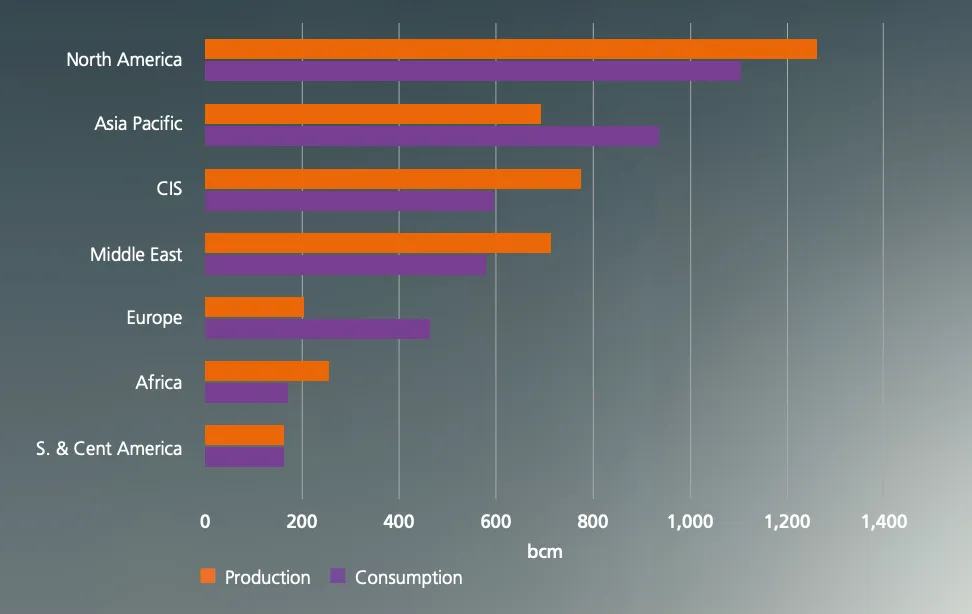
  • The U.S. is even more methane-dominant,ย producing 25% of the globeโ€™s natural gas.
Natural gas production and consumption for various regions. Source: Statistical Review of World Energy.
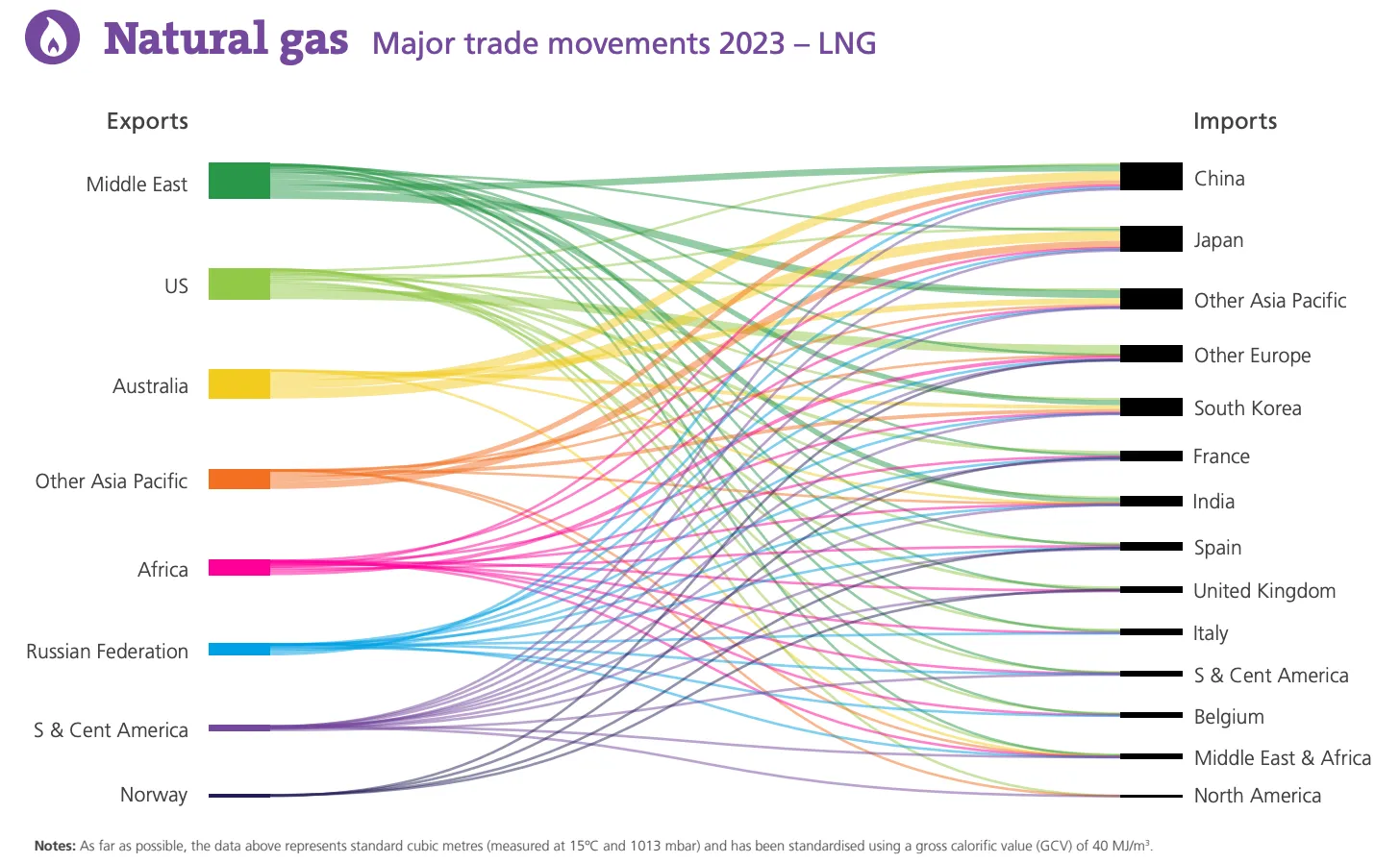
  • The U.S. is exporting more liquefied natural gas, crude oil, and petroleum products than ever before, becoming one of the worldโ€™s leading exporters of hydrocarbons.
The United States exports nearly as much LNG, or liquefied natural gas, as all Middle Eastern producers combined. Source: Statistical Review of World Energy.
  • The U.S. is a net exporter of crude oil and other petroleum products, making it more โ€œenergy independentโ€ than it has been since the early 1900s โ€” if you fall for that sort of thing.
While the U.S. continues to import millions of barrels of crude oil each day, it exports substantially more petroleum products as a whole, making it a net exporter to the tune of over 5 million barrels per day. Source: Energy Information Administration.
  • The U.S. also continues to import large volumes of crude oil, because oil is a global commodity and many of the nationโ€™s refineries are equipped to handle โ€œsourโ€ crude from the Middle East.ย 
  • Oil and gas corporations have enjoyed tremendous profits during the Biden administration.
ExxonMobil pulled in $13.2 billion in operating profit during the third quarter of this year. Source: Tradingeconomics.com

Whether this is because of or in spite of or totally unrelated to the Biden administrationโ€™s policies is open to debate. Biden revived or implemented a handful of new regulations on oil and gas drilling during his term, some of which have only just begun to take effect. And the Bureau of Land Management offered less acreage for federal oil and gas leasing than previous administrations. But the agency also handed out about as many drilling permits, on average, as the Obama and Trump administrations. 

That the oil and gas industry was able to reap such bounty regardless is partially due to the fact that, intentionally or not, Bidenโ€™s policies were crafted to allow drilling to continue at a rapid pace while still giving the taxpayers a better return and protecting more fragile areas. This included designating (intentionally or not) the Permian Basin as a de facto oil and gas sacrifice zone. A huge majority of the drilling permits issued under Biden were for federal land on the New Mexico side of the Permian Basin, and the Environmental Protection Agency delayed its response to rising pollution in the area, allowing drilling to go on unfettered. Nearly all of the domestic crude oil and natural gas production growth of the last several years has come from the Permian Basin. 

The Biden administration issued around the same number of drilling permits, on average, as the Obama and first Trump administrations. But it handed out far more permits in New Mexicoโ€™s Permian Basin than ever before. Source: BLM.

The incoming Trump administration has announced plans to roll back Biden-era environmental protections and expedite oil and gas drilling permitting and leasing on federal lands shortly after taking office. This will almost certainly include opening up more acreage in Wyoming, Utah, and Alaska to leasing. And theyโ€™ll try to issue more drilling permits in those places, too. 

But even if companies lease more land or pull more permits in Wyoming, they wonโ€™t necessarily put them to useโ€” most oil and gas leasing is speculative, anyway, meant to build up a corporationโ€™s land-holdings to entice more investment. And petroleum firms currently are sitting on thousands of unused federal drilling permits. These days the industry has shown little interest in developing areas outside of the Permian Basin, and the Biden administration has more or less let it run rampant down there, leading to the current state of U.S. energy dominance. 

Oil and gas production from the Permian Basin will continue to increase for the foreseeable future regardless of who is in the White House. But you shouldnโ€™t expect Trumpโ€™s โ€œdrill, baby, drillโ€ agenda to further increase drilling or oil and gas production โ€” or to lead to lower gasoline prices. In fact, Trumpโ€™s threatened tariffs on Canada will actually increase gas prices in some parts of the U.S., because we get quite a bit of crude oil from them. Besides, his policies are not really aimed at bolstering production or bringing down your prices. They are intended to cut costs for petroleum corporations, thereby increasing their profits, which are already ridiculously high. And it will come at the expense of human health and the environment. [ed. emphasis mine]


โ›๏ธMining Monitor โ›๏ธ
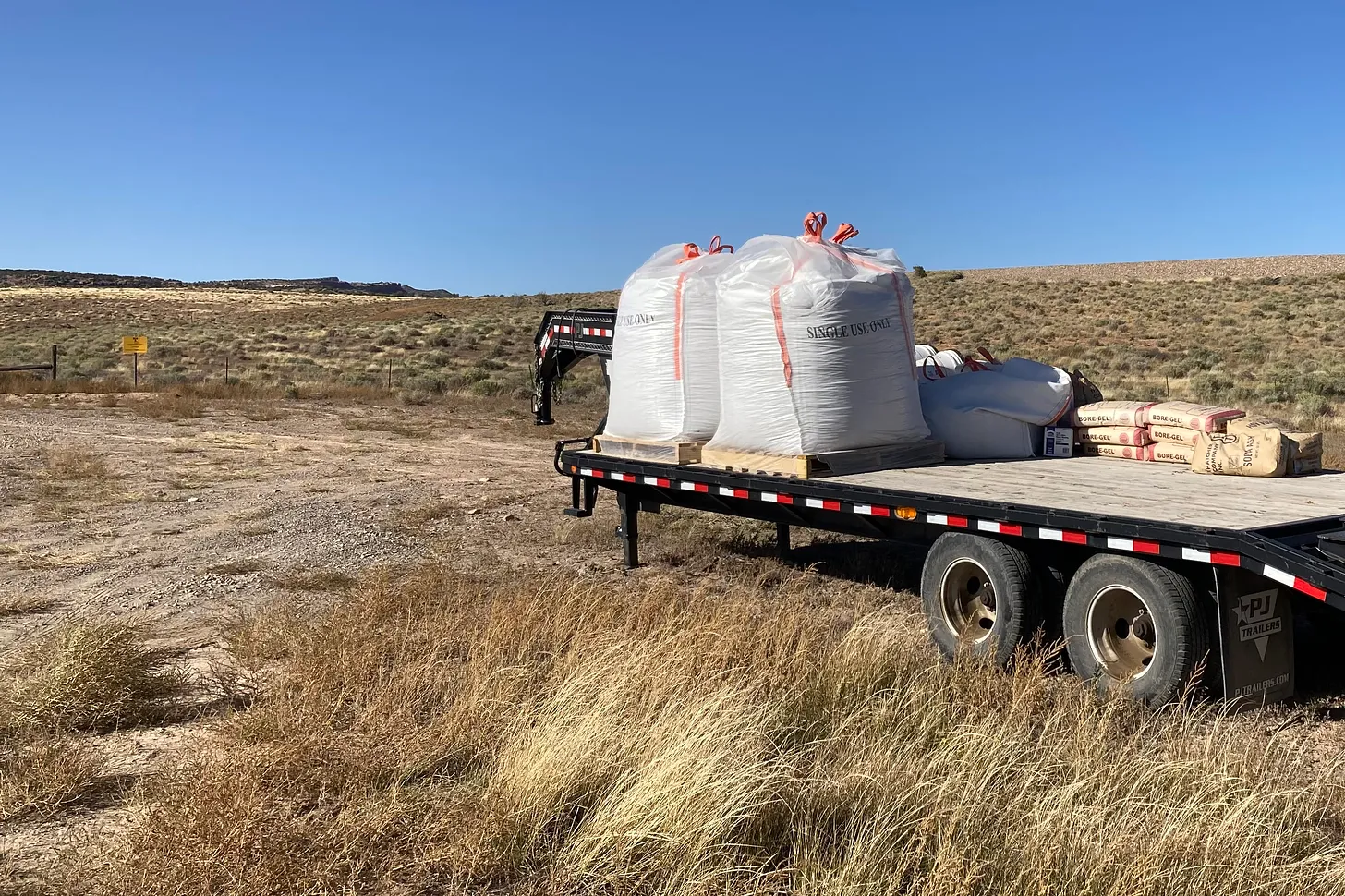
Drilling material near Slick Rock, Colorado. Jonathan P. Thompson photo.

My email box has been hopping with press releases from various lithium and uranium mining companies tooting their horn about their latest acquisition or exploratory drilling campaign in the Four Corners Country, which tends to get my hackles up. And yet, among the noise is still very little news about actual mining. I have to admit Iโ€™m a bit surprised by the lack of ore production, given all of the hype over the last few years. 

I did visit one of the more contentious exploratory drilling projects just outside Slick Rock, Colorado. They werenโ€™t drilling when I was there, but a flatbed trailer loaded down with drilling material was on hand, right next to the radioactive-symbol signs warning folks of the presence of a uranium mill tailings repository. Anfield, one of the bigger companies operating in the area, is behind that project. 

Anyway, hereโ€™s a sampling of the hype โ€” and a bit of whatever the opposite of hype is:

  • Thor Energy says it hasย begun drilling at its Wedding Bell Project, which sits right near the San Miguel-Montrose county line in the Uravan Mineral Belt in western Colorado. The area has seen heavy prospecting (and a bunch of road-building) in the past.ย 
  • Pegasus Resources says itย has secured drilling permitsย โ€” contingent upon posting a reclamation bond โ€” for its Energy Sands and Jupiter claims along the San Rafael Swell, west of Green River, Utah, and just north of I-70 where it intersects the Swell. Theyโ€™re planning on drilling 48 exploratory wells on 50โ€™x50โ€™ pads.ย 
  • C2C Metalsย acquired five groups of uranium mining claimsย in the Uravan Mineral Belt, including the Eula Belle and Mum-Whitney claims in Montrose County and the Norther, Spud Patch, and Dulaney extension in San Miguel County. The claims cover a total of about 5,400 acres.ย 
  • American Battery Materials says it hasย received the โ€œnecessary agency approvalsโ€ย โ€” pending the posting of a financial bond โ€” to reenter an old oil and gas well in the Lisbon Valley of southeastern Utah to search for lithium.ย 
  • And then thereโ€™s the anti-hype: Even as all of these projects appear to be ramping up the exploratory phase, one of the few companies thatโ€™s actually producing lithium is shutting down. Thatโ€™s right. U.S. Magnesium, which extracts lithium and magnesium and other materials from Great Salt Lake brine, isย idling its operations and laying off 186 employees, according toย KUER. They cite โ€œdeteriorating market conditions for lithium carbonate.โ€ That is, the price for the stuff isnโ€™t high enough to make mining it profitable.ย 
  • More information and locations of most of these projects can be found at theย Land Deskโ€™s Mining Monitor Map.

๐Ÿ“ธย Parting Shotย ๐ŸŽž๏ธ

I guess this sort of thing was inevitable? The Family Farm Alliance is now offeringย โ€œMake Alfalfa Great Againโ€ย hats. It makes me wonder what that would mean, exactly? Maybe they want to genetically engineer it to use less water? Hmmmโ€ฆ

Credit: Family Farm Alliance via The Land Desk

#Colorado passes #California in the fast lane of EV sales — Allen Best (@BigPivots) #ActOnClimate

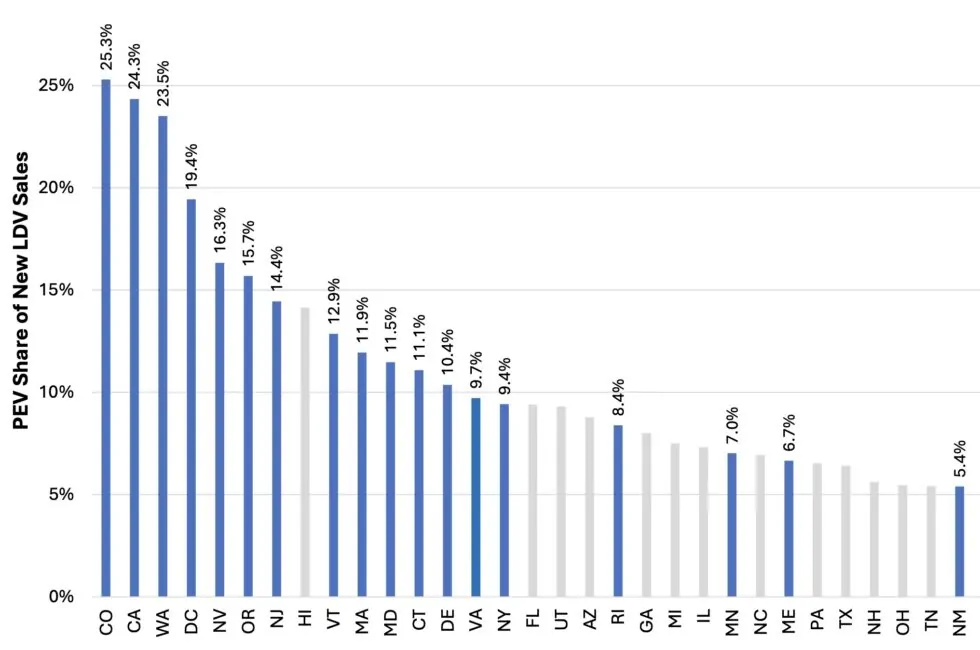
EVs and plug-in hybrids were 25.3% of all new-car sales in third quarter of this year. What might slow the momentum? Credit: Allen Best/Big Pivots

Click the link to read the article on the Big Pivots website (Allen Best):

December 5, 2024

Colorado earlier this year surpassed California in the sales of electric vehicles and plug-in hybrids.

From July through September, 25.3% of all new cars sold in Colorado were EVs or plug-in hybrids. Thatโ€™s a 5.4% increase from the April-June time period. California, the perennial leader in EV sales, recorded 24.3% increase during the same period.

Washington state was next on the sales list at 23.5% followed by District of Columbia at 19.4% and Nevada at 16.3%, according to data from the Northeast States for Coordinated Air Use Management.

In Colorado, 82% were full electric vehicles and 18% were plug-in hybrid electric vehicles.

Spurred by the most lucrative incentives in the nation, Colorado has been on a roll in EV sales throughout 2024.

โ€œColoradoโ€™s nation-leading progress in electric vehicle adoption is a key part of our ambitious efforts to achieve net-zero emissions in Colorado by 2050,โ€ said Will Toor, executive director of the Colorado Energy Office.

โ€œBetween investments in charging infrastructure and generous incentives to bring down purchase and lease costs, our commitment to making electric vehicles an affordable and reliable option for Coloradans is paying off.โ€

Colorado still lags California in EV sales for the first cumulative nine months of 2024, according to the Colorado Automobile Dealers Association.

Travis Madsen, the transportation program manager for the Southwest Energy Efficiency Project, concurred with that assessment. โ€œThings are heading in the right directionโ€ he said.

Next year, Colorado will offer somewhat smaller incentives and whether the federal incentives will remain intact is an open question. โ€œWe will be tasked with keeping the momentum going,โ€ said Madsen.

Carrots aplenty line the path to the sales lot. All Coloradans can get a $5,000 state tax credit for purchasing or leasing those new EVs (battery electric and plug-in hybrid electric) with manufacturerโ€™s suggested retail prices under $80,000. An additional $2,500 can be applied against purchase of EVs with suggested retail prices of under $35,000.

The $5,000 state tax credit is available through the end of this year. It drops to $3,500 starting in January 2025.

Income-qualified Coloradans exchanging an eligible old or high-emitting vehicle can also take advantage of a $6,000 rebate through the Vehicle Exchange Colorado program for a new EV purchase or lease and a $4,000 rebate for a used EV purchase or lease.

Madsen pointed out that the income-qualified EV rebate program offered through Xcel Energy was a great success, although all available funds have now been reserved. The program had a budget of $6 million, and somewhere around 1,200 customers claimed financial help for purchase of new or used EVs. โ€œThe $6 million budget went pretty fast,โ€ he said.

See also: Why this Arvada family decided to lease an electric car

 In addition, Coloradans may be eligible for a $7,500 federal tax credit for the purchase or lease of certain EV models that meet specific manufacturing requirements. A $4,000 federal tax credit is available for used EV purchases and leases.

Might those federal tax credits be curbed? The national press has chewed over the possibility that Republicans under Trump, who has been heavily influenced by Elon Musk, may try to reduce or eliminate the tax breaks for EV buyers.

Madsen said he would not be surprised if the incoming administration changes the tax credit for individual vehicle purchases or leases, but is more optimistic that the commercial EV tax credit that was made available through the Inflation Reduction Act of 2022 will prove more durable. That tax credit has helped dealers offer better deals on EV leases even for models that do not qualify for the individual credit.

Republicans hold a slim five-vote majority over Democrats in the House of Representatives, 220 to 215. Battery factories and other components of EV manufacturing can be found in quite a few congressional districts represented by Republicans. Madsen speculates that some Republicans may vote against efforts to slow the momentum of EV adoption, because the credit is providing economic benefits in a diverse array of locations across the country.

Meanwhile, car manufacturers continue with plans to roll out new models such as the Chevy Equinox EV. Madsen sees no fundamental changes. โ€œIf federal support declines, they might manufacture fewer vehicles,โ€ he said. โ€œThose kinds of changes are possible.โ€

Also at issue has been the confidence level for charging. Colorado, in some cases working with the federal government, now has more than 5,500 publicly available charging ports. Another $5 million has been awarded by the state to install an additional 576 ports via the Charge Ahead Colorado program.

First road charge for Coyote Gulch’s Leaf in Granby May 19, 2023. Note the Colorado Energy Office’s logo below the connectors on the unused charger.

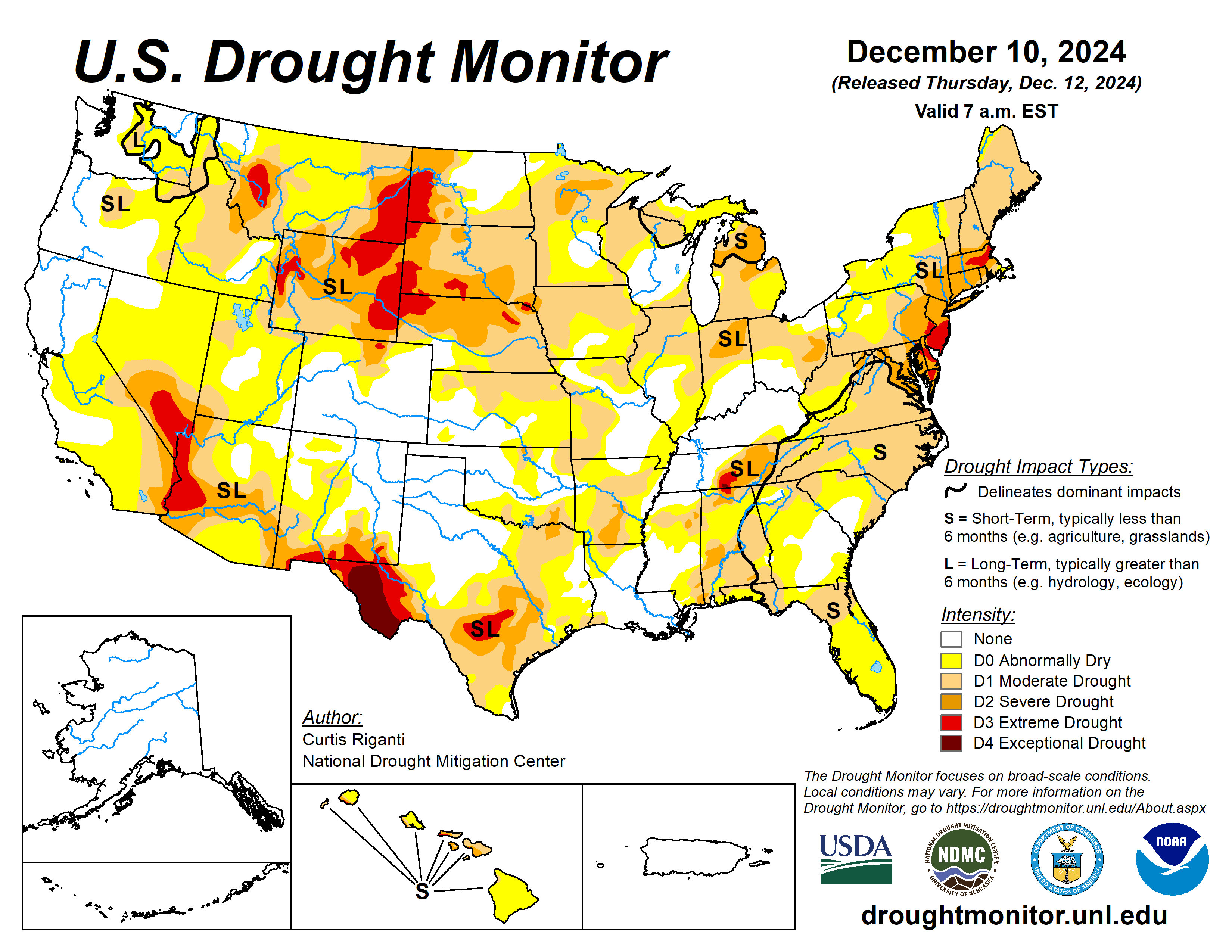
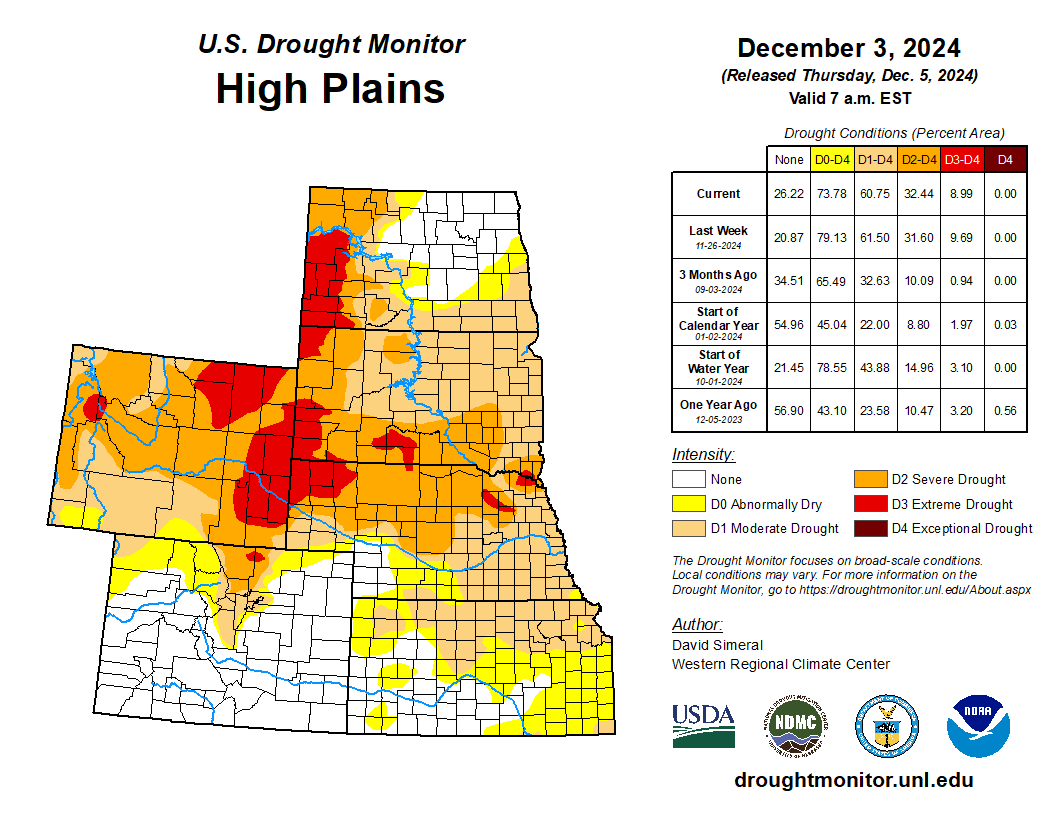
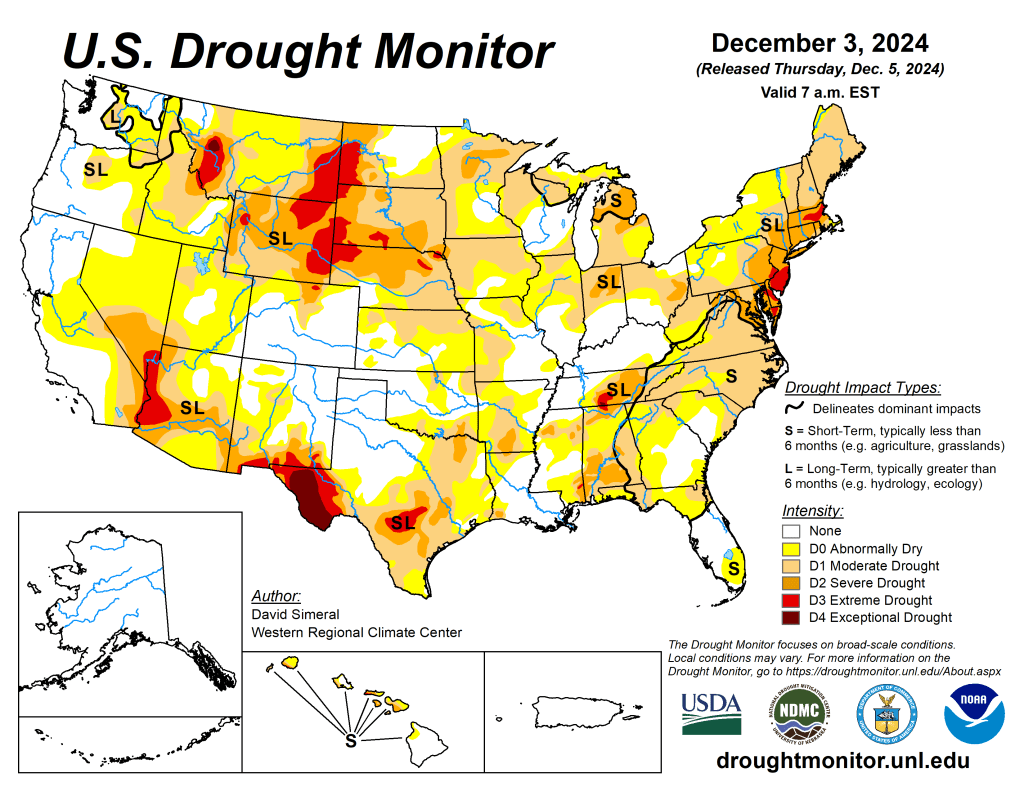
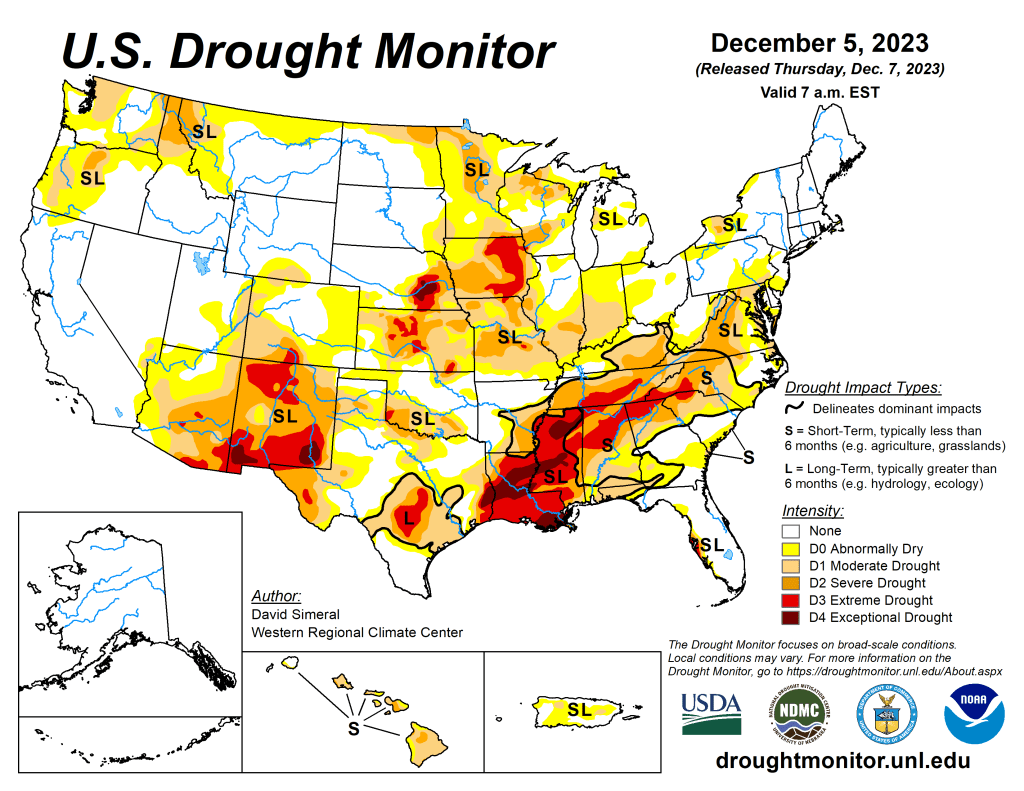
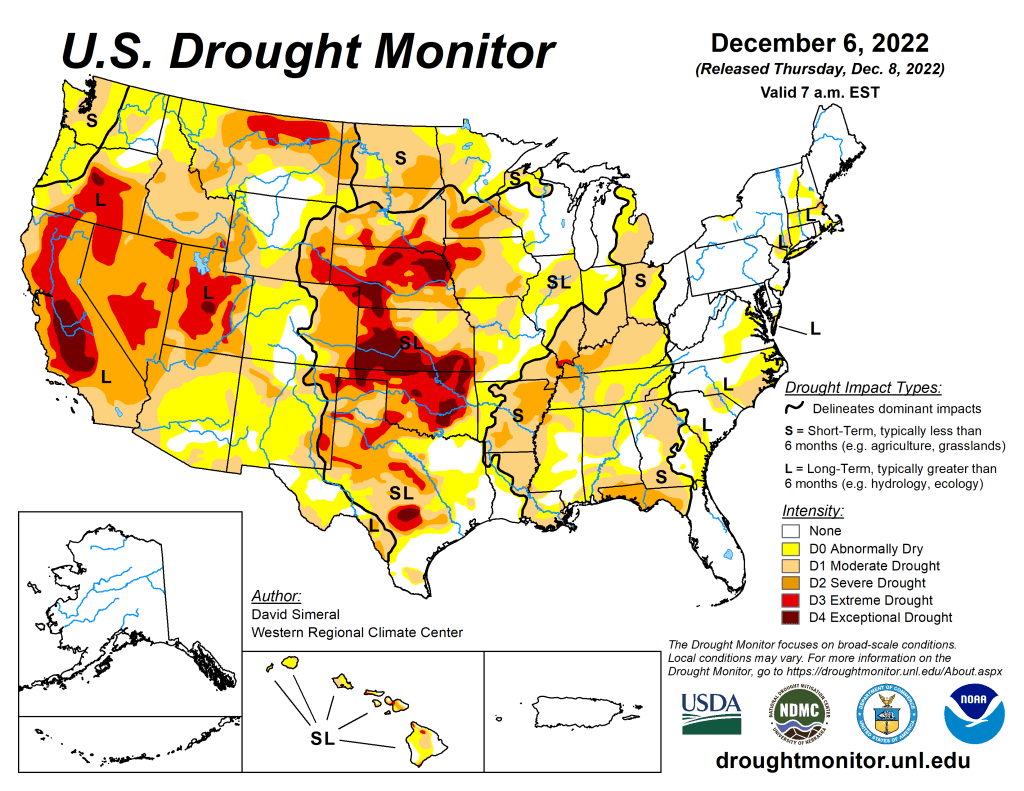
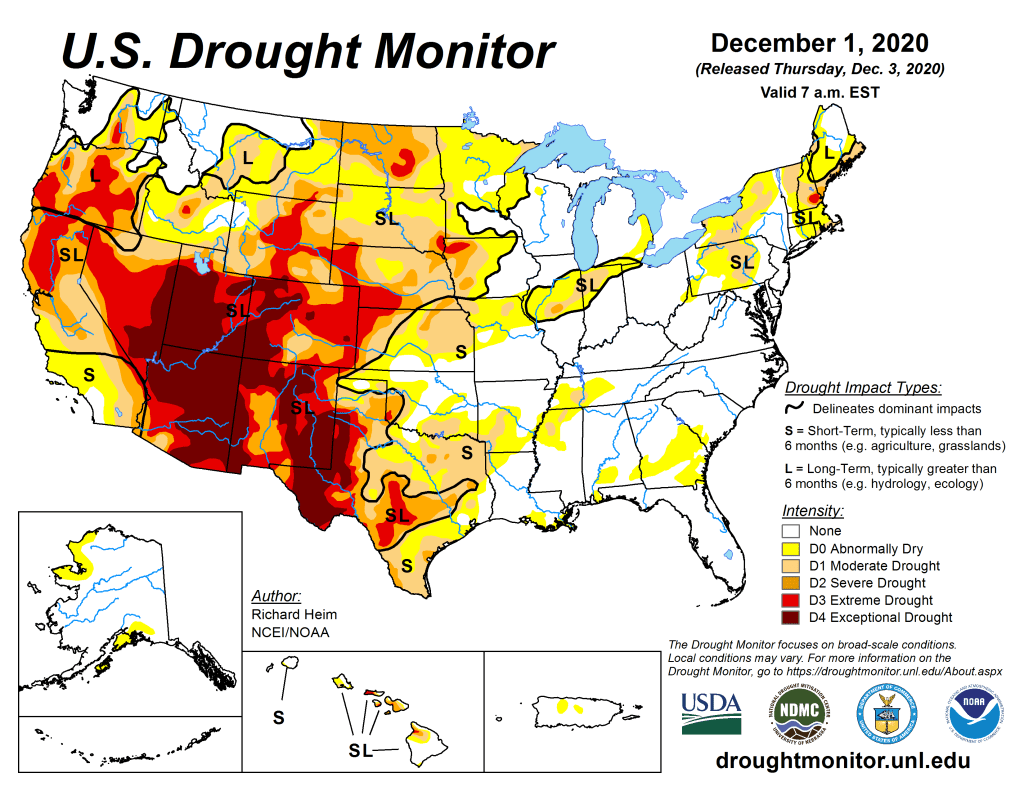
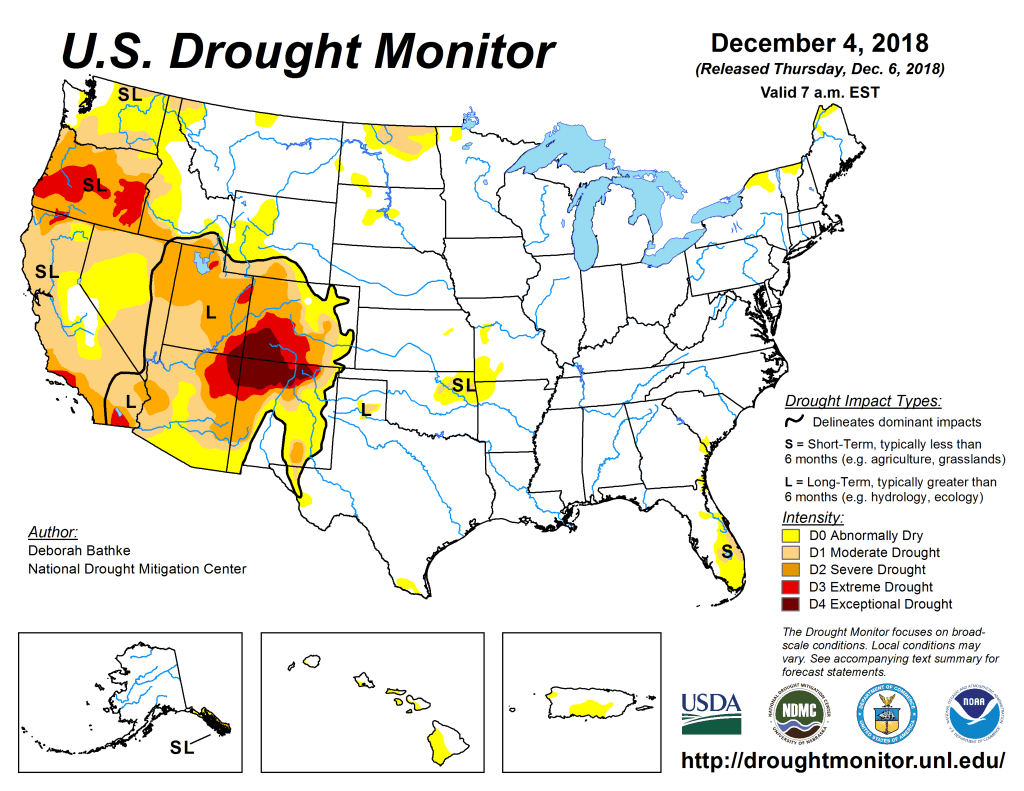
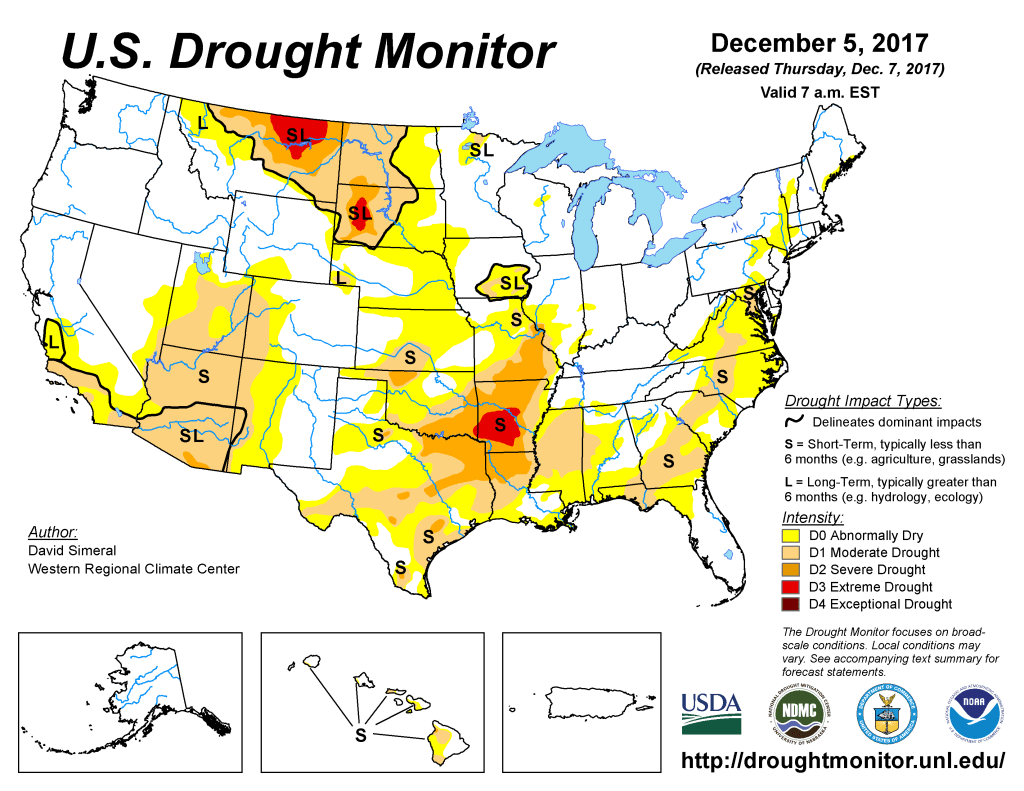
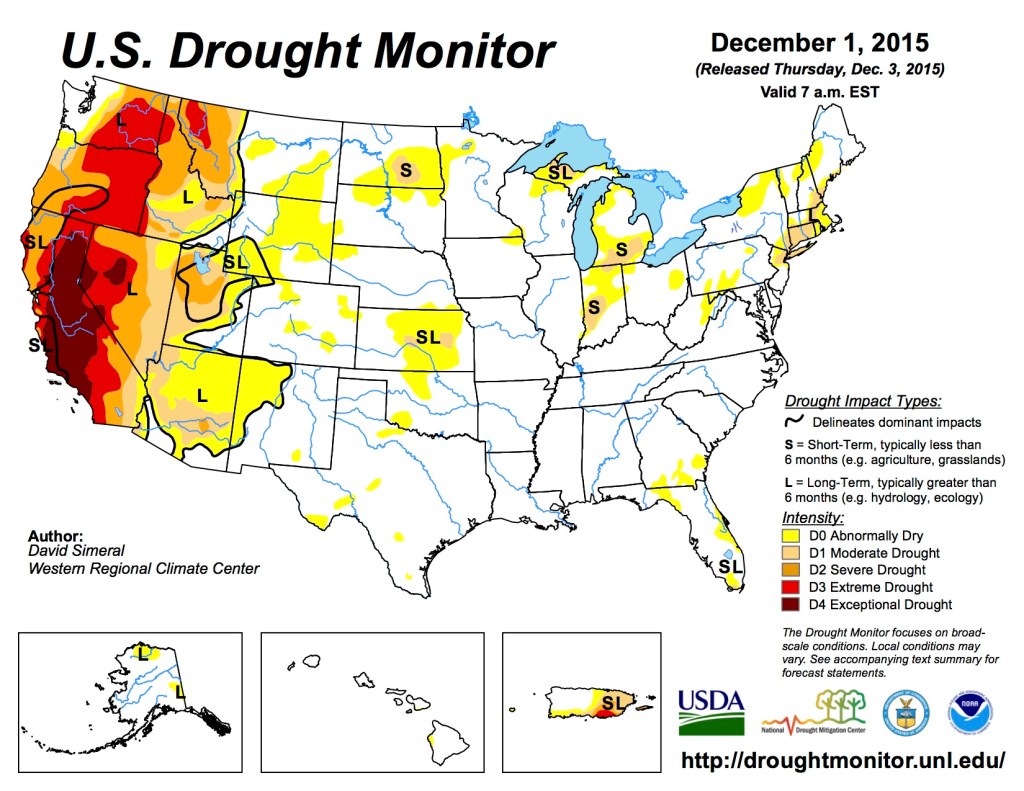
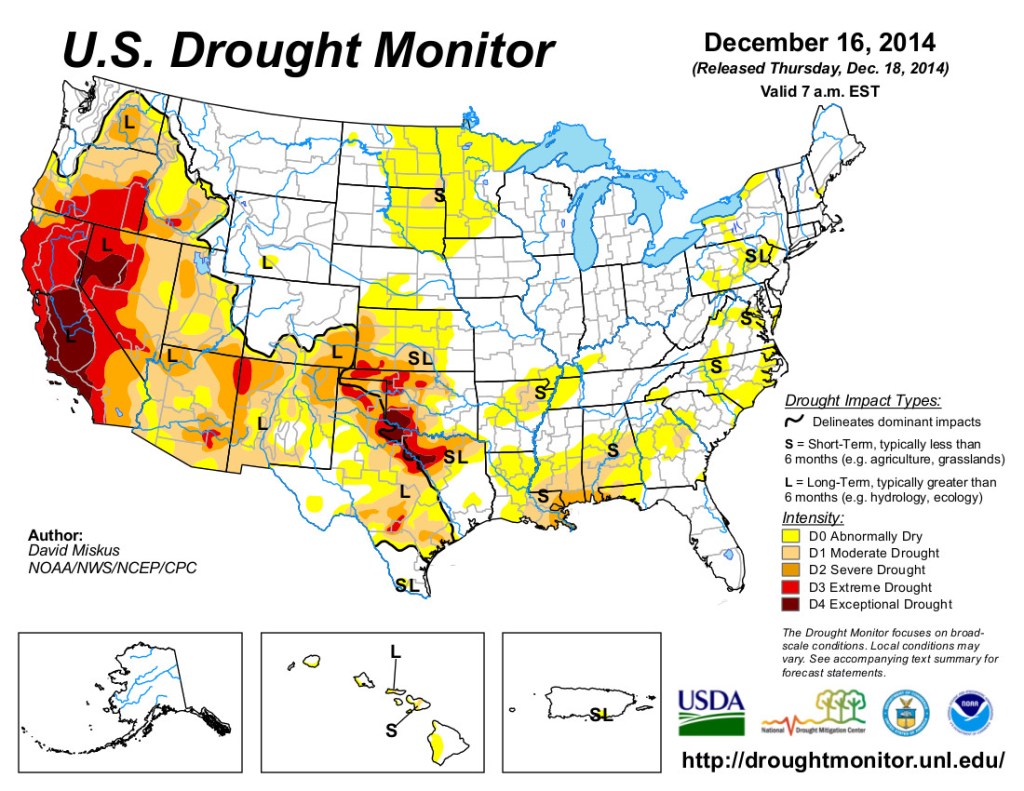
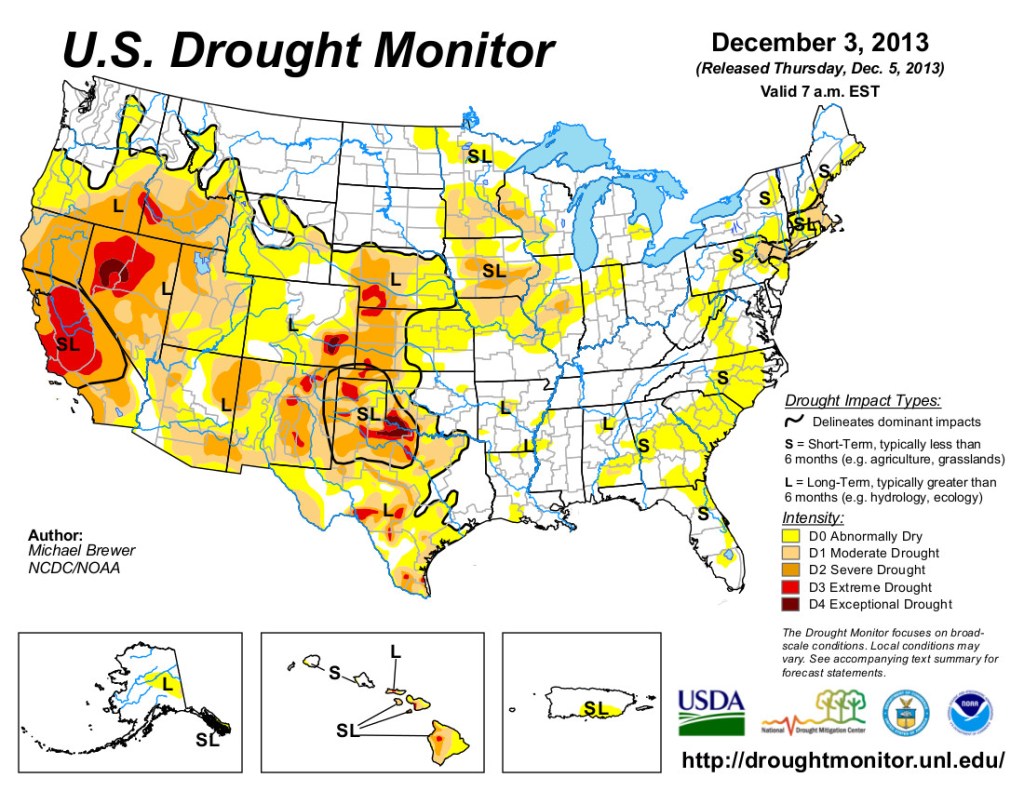
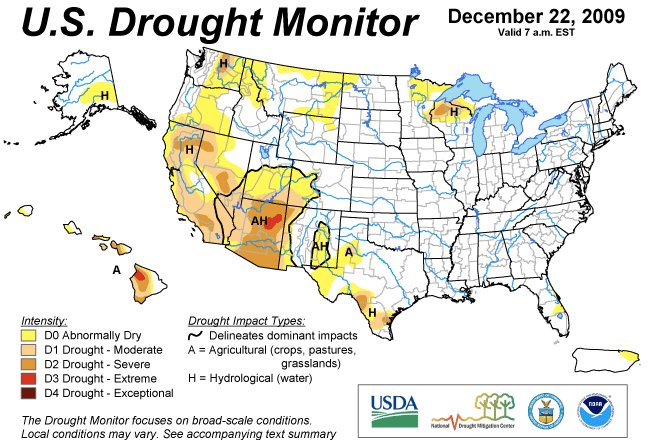
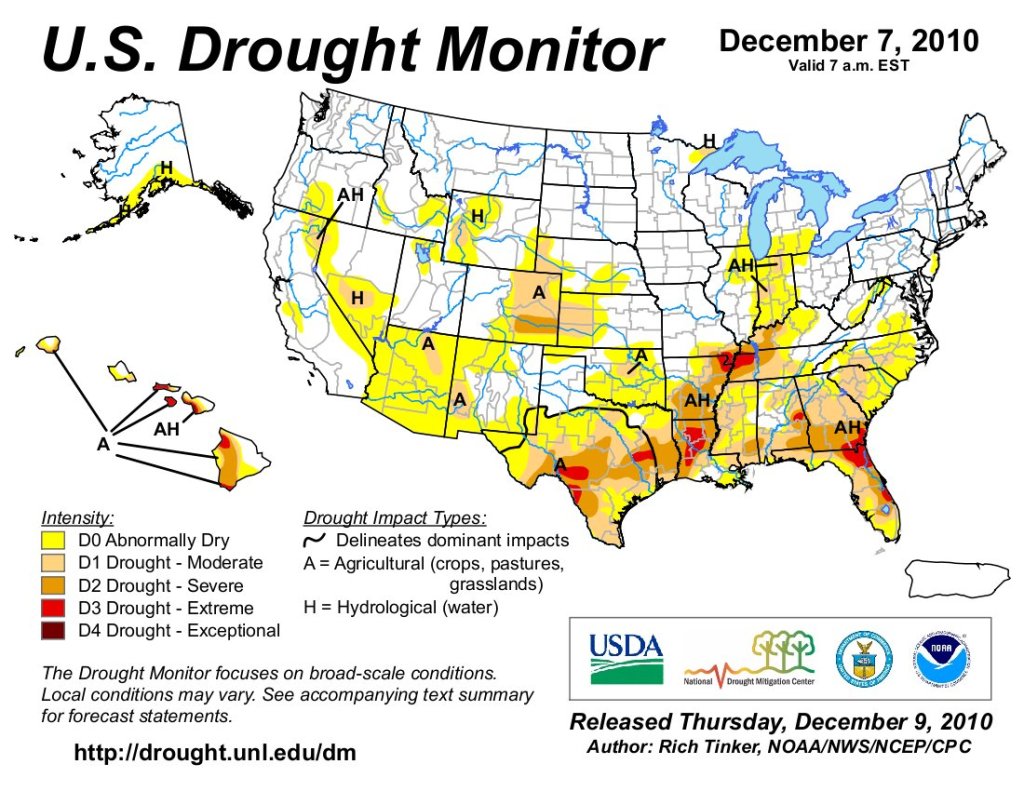
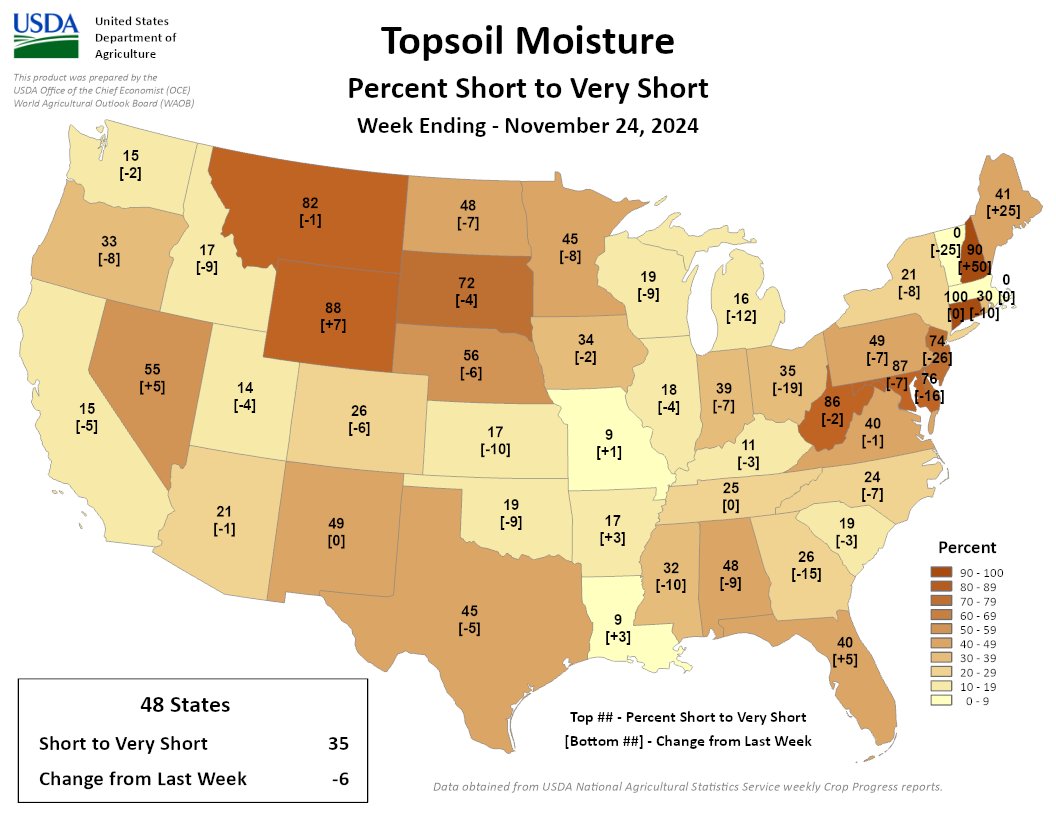
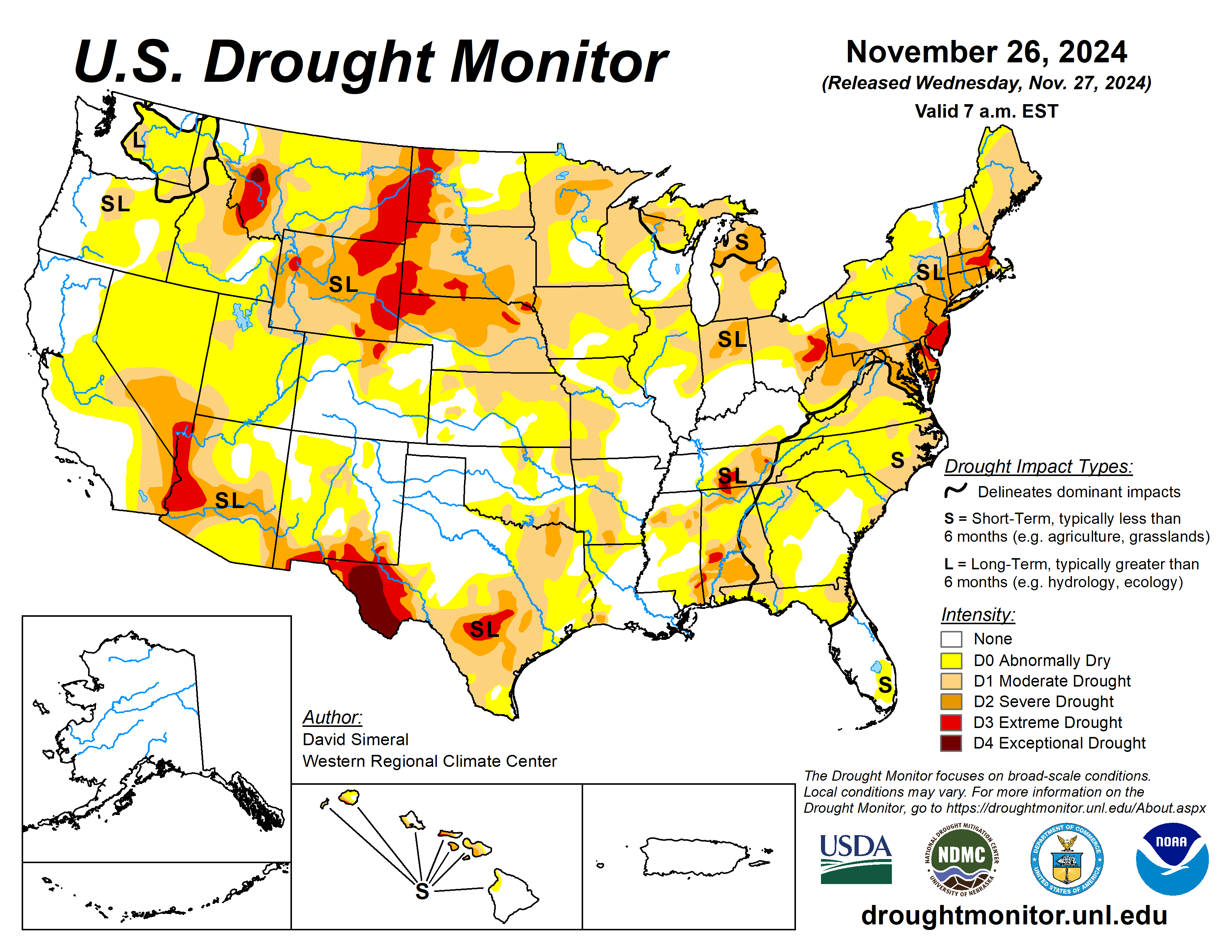
#Drought news December 12, 2024: Most of the West finished this week either within 5 degrees of normal or 5-10 degrees warmer than normal

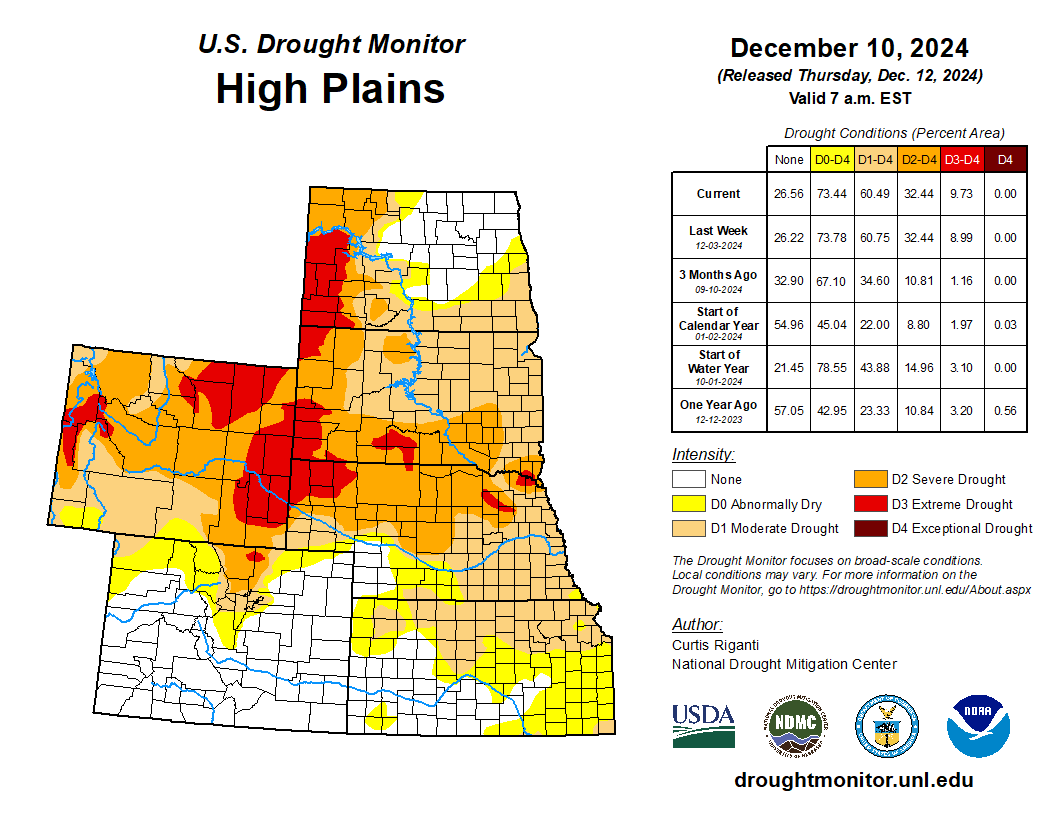
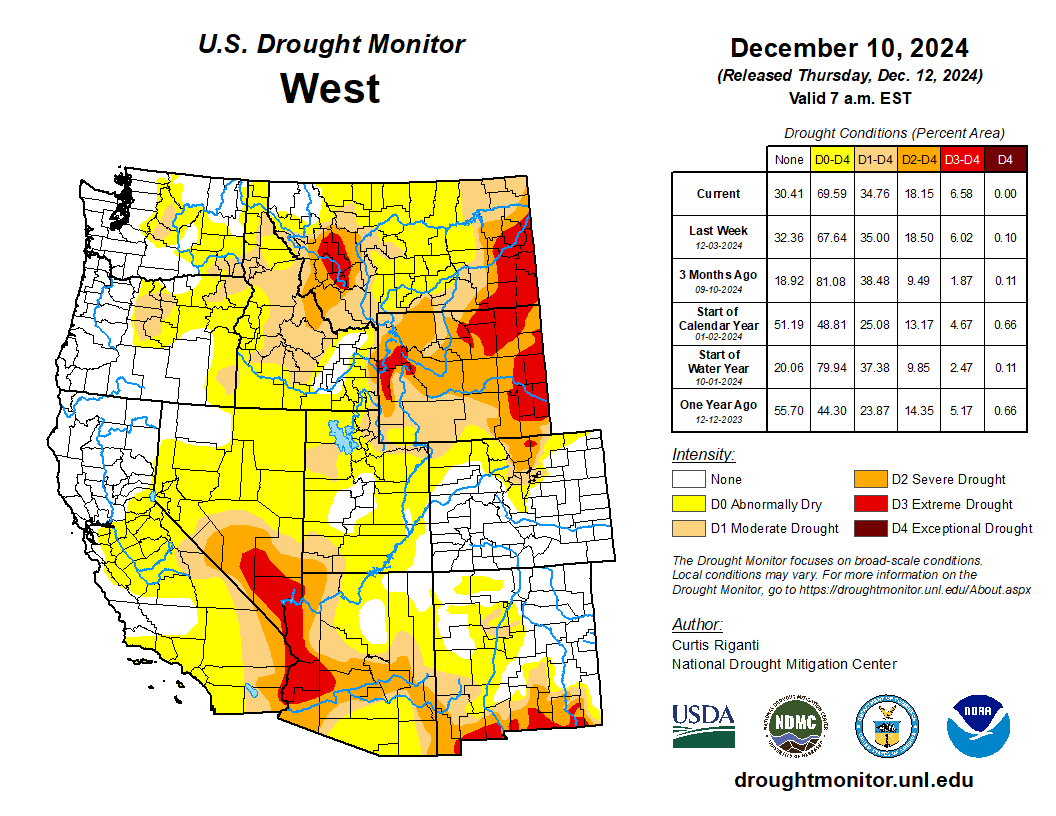
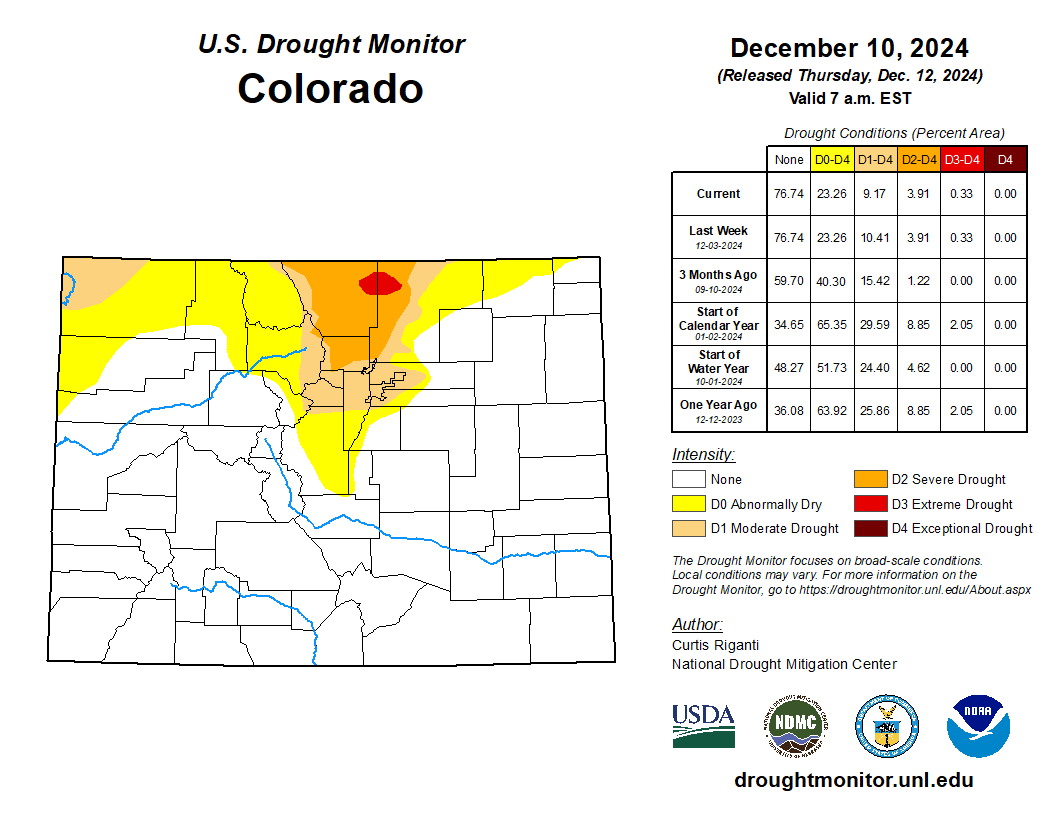
Click on a thumbnail graphic to view a gallery of drought data from the US Drought Monitor website.

Click the link to go to the US Drought Monitor website. Here’s an excerpt:

This Week’s Drought Summary

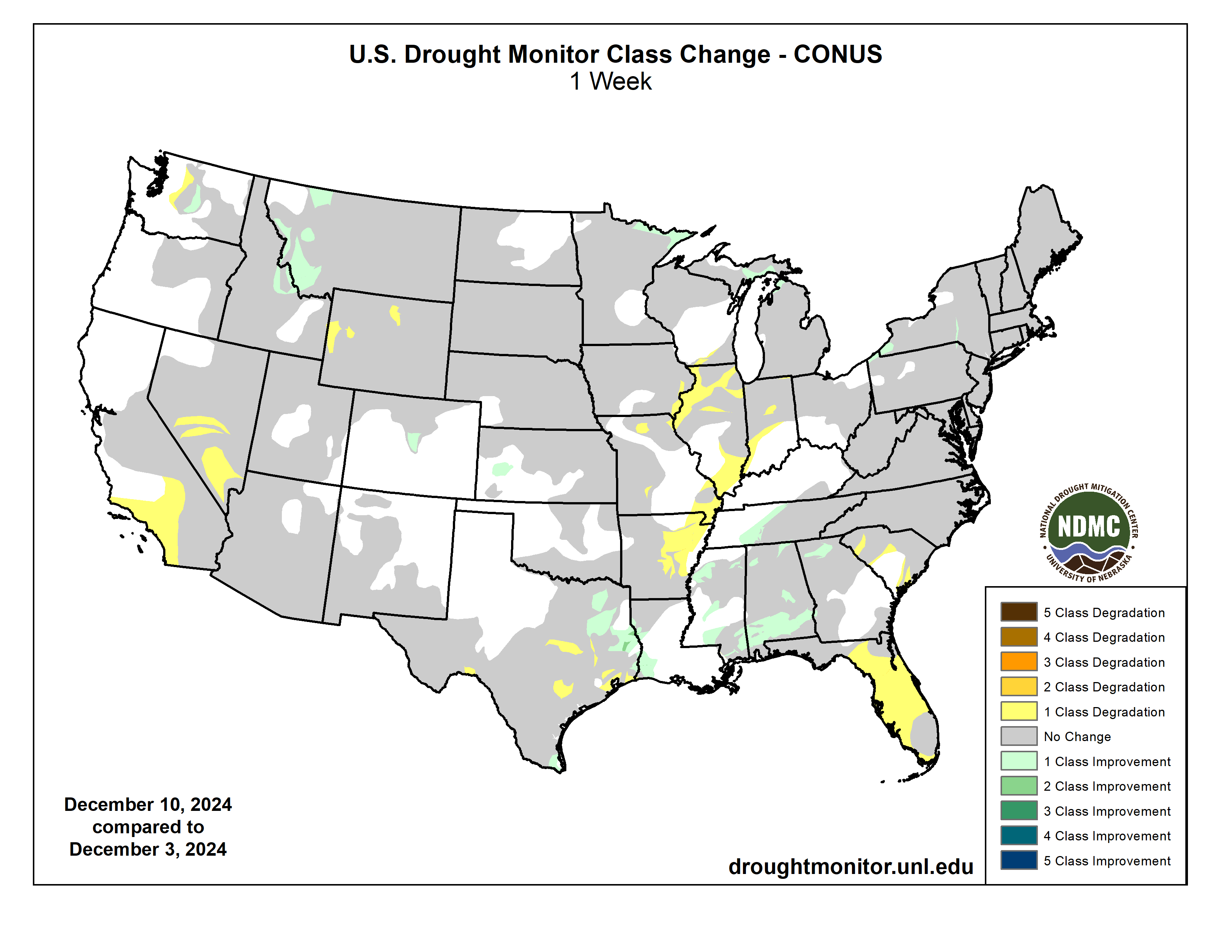
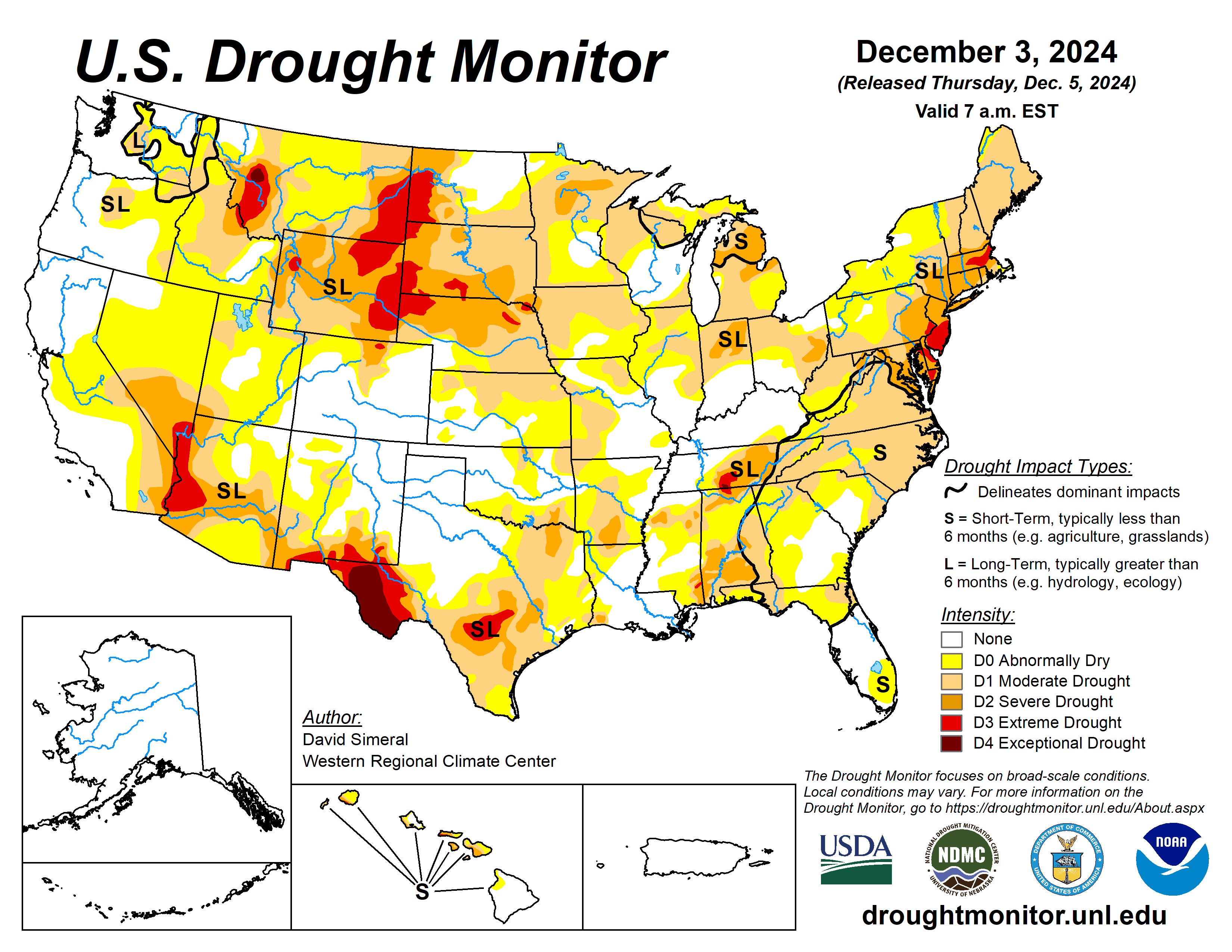
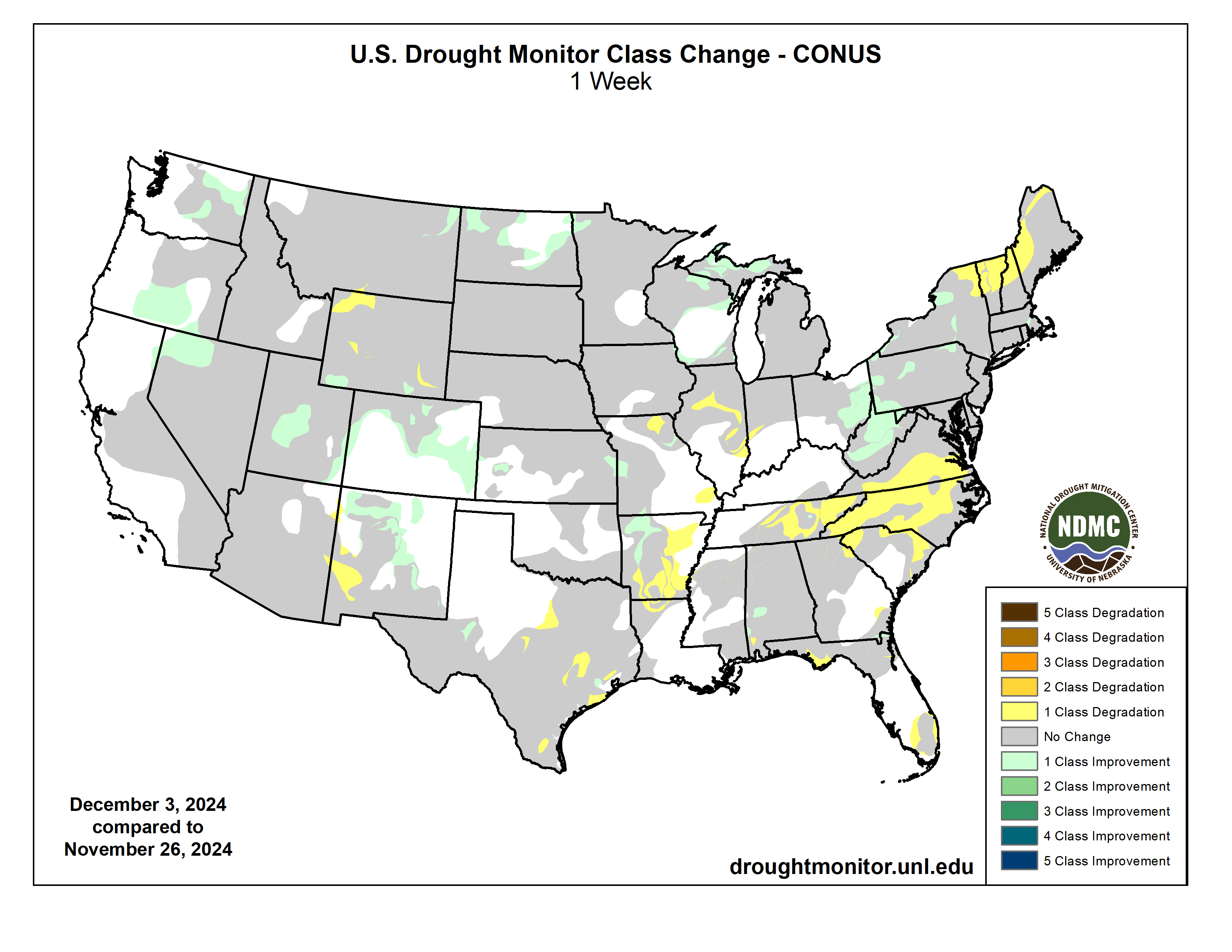
Rains, locally heavier, fell across roughly the east half of Texas this week, with heavier amounts (locally 4-7 inches) falling in parts of the central Gulf Coast region. Lighter precipitation amounts fell in parts of Mississippi, Alabama, Georgia and Tennessee, and in the Ohio River Valley. Snow, some of it lake effect, fell in parts of the Upper Great Lakes, and heavier lake effect snow fell downwind from Lakes Erie and Ontario. Most of the Great Plains and West was dry this week, except for high elevation areas of western Montana and northern Idaho and in western parts of Oregon and Washington. Degradations in drought conditions occurred in southern California and southern Nevada, parts of high elevation Wyoming, across portions of the Mississippi River Valley, in the Florida Peninsula and in parts of Texas. Generally drier weather in Hawaii led to widespread degradations as well, mostly on the windward sides of the islands. Improvements occurred in parts of east and deep south Texas, western Montana and central Washington, Mississippi, Alabama, Georgia and Tennessee, in the Upper Peninsula of Michigan and northeast Minnesota, and in Erie County, Pennsylvania and southwest and south-central New York…

High Plains

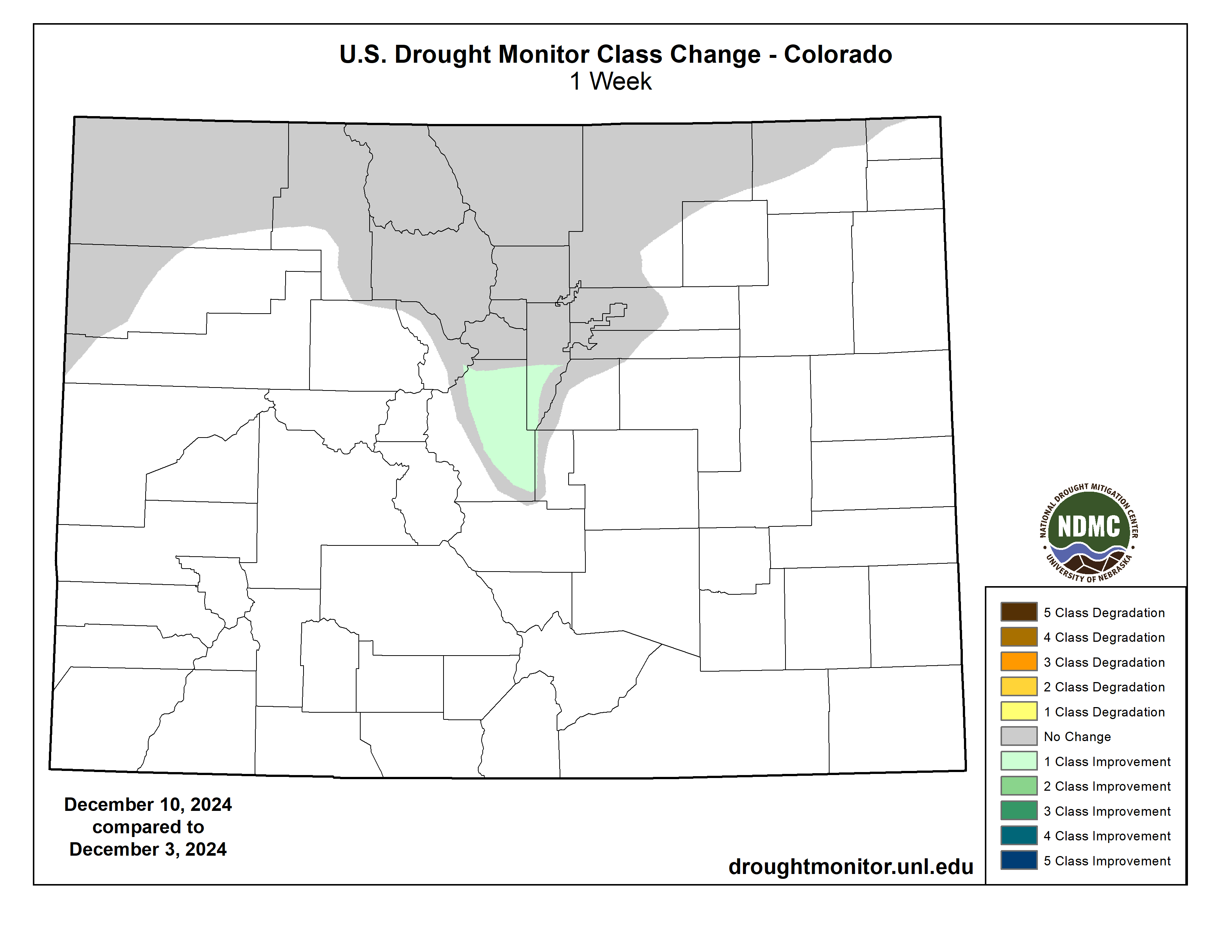
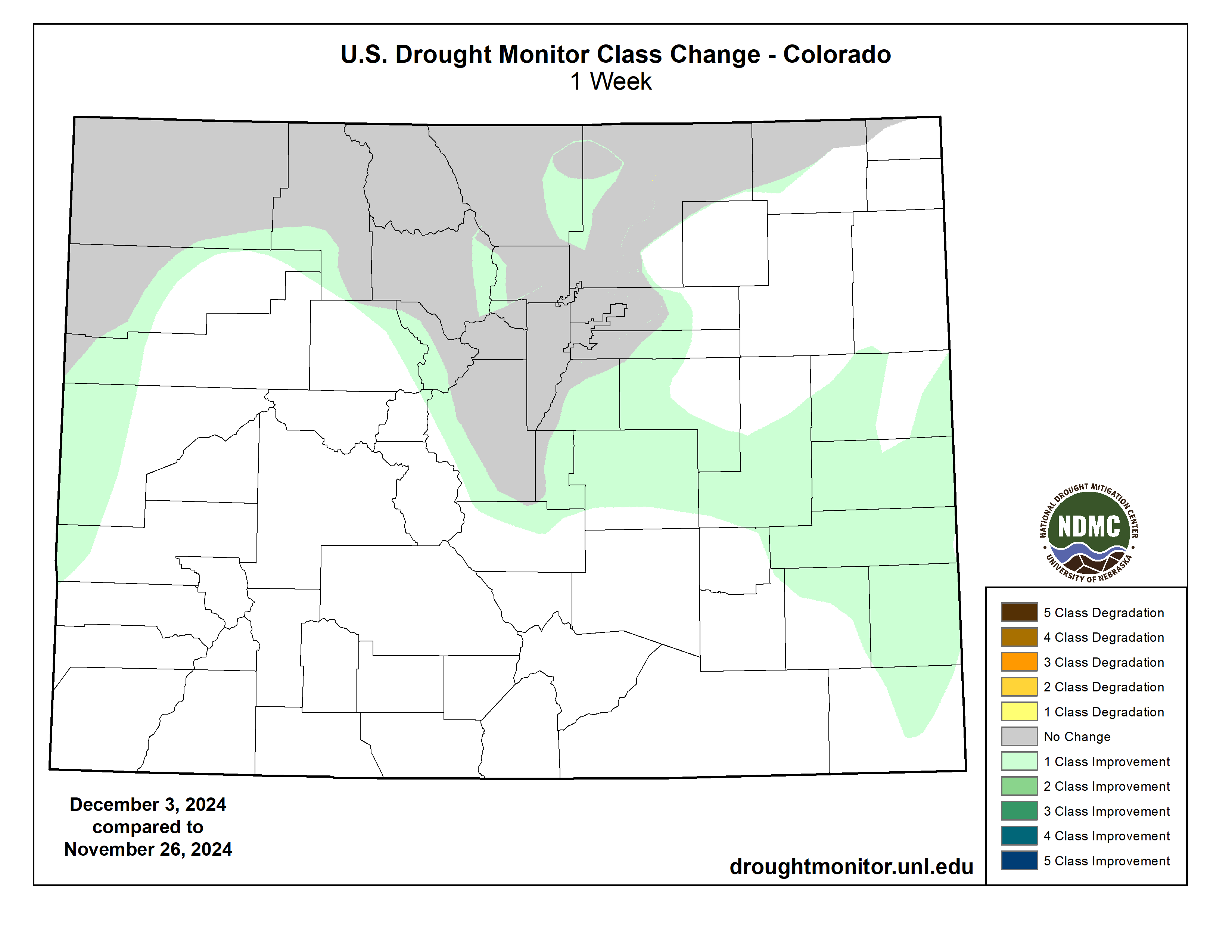
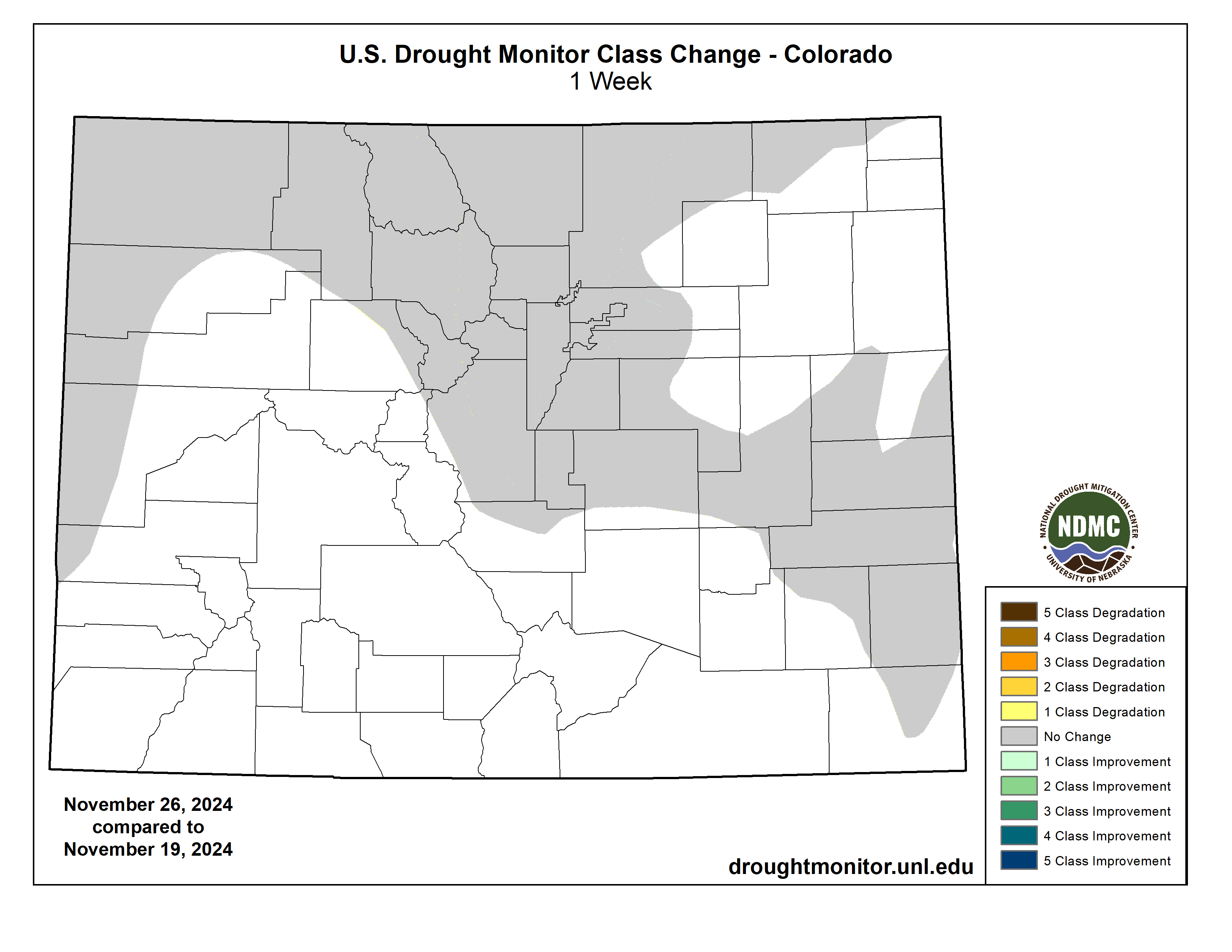
Except for parts of the Front Range of the Rocky Mountains in Colorado, weather across the High Plains region was mostly dry this week. Temperatures were primarily warmer than normal, ranging from 3-12 degrees above normal in most areas (with locally warmer readings). Drought and abnormal dryness coverage remained mostly unchanged. Moderate drought coverage was reduced southwest of the Denver area as precipitation deficits lessened there. Abnormal dryness was also removed from west-central Kansas after conditions were reassessed there following wetter-than-normal weather over the last couple of months. Well-below-normal early season snowpack and short- and long-term precipitation deficits led to expansion of extreme drought in parts of the Wyoming, Wind River and Bighorn mountain ranges in Wyoming. Water usage is currently restricted to essential use only, due to low well levels, in the communities of Auburn and Peru in southeast Nebraska, where moderate drought is ongoing…

Colorado Drought Monitor one week change map ending December 10, 2024.

West

Primarily dry weather occurred in the West this week, except for western Washington, western Oregon, western Montana and northern Idaho. Most of the West finished this week either within 5 degrees of normal or 5-10 degrees warmer than normal. Central and eastern Montana saw widespread temperatures range from 10-15 degrees above normal. Widespread improvements to drought conditions occurred in western Montana and adjacent Idaho due to lessened short- and long-term precipitation deficits and increased soil moisture. In central Washington, small adjustments (both improvements and degradations) occurred in abnormal dryness and moderate drought areas where streamflow amounts and short- and long-term precipitation deficits changed. Short-term precipitation deficits continued to mount in southern and central Nevada and in southern California, leading to expansion of drought and abnormal dryness areas there…

South

Widespread rains fell across parts of the south this week, especially in eastern Texas, Louisiana, Mississippi and western Tennessee, while the rest of Texas, most of Arkansas, and Oklahoma remained mostly dry. Western Texas was mostly 3-9 degrees warmer than normal, while Mississippi was mostly near normal or 3-6 degrees below normal. In between these areas, temperature anomalies varied but were mostly within 3 degrees of normal. Due to lessened precipitation deficits and increased streamflow and soil moisture, drought areas were reduced in coverage in central Tennessee, parts of Mississippi, western Louisiana and parts of east Texas. Short-term precipitation and streamflow deficits continued to build in northeast Arkansas, leading to widespread expansion of abnormal dryness and moderate drought there. In parts of southeast and south-central Texas, conditions worsened where soil moisture and streamflow deficits grew amid growing precipitation deficits. In far southern Texas, heavy rains led to local improvements near the mouth of the Rio Grande. In Bexar County, Texas, certain types of fireworks were temporarily banned from sale or usage due to ongoing drought conditions, while lake and reservoir levels dropped to 20% capacity in the Corpus Christi area…

Looking Ahead

Through the evening of Monday, Dec. 16, the National Weather Service Weather Prediction Center is forecasting at least an inch of precipitation in the middle Mississippi River Valley, lower Ohio River Valley, western Tennessee, northwest Mississippi, eastern Texas, southeast Oklahoma, northern Louisiana and Arkansas. Precipitation of at least 1 inch is also forecast in parts of eastern New England and in a few areas downwind (east) of lakes Erie and Ontario. Heavy precipitation is also forecast in northern and northwest California and southwest Oregon, where locally up to or over 5 inches of precipitation is possible. At least 1.5 inches of precipitation is also forecast in many areas of western Washington and Oregon, while mostly lesser amounts are forecast in eastern Washington and Oregon and in parts of Idaho. The Southwest, western Great Plains, southeast Alabama, southern Georgia and the Florida Peninsula are forecast to remain mostly dry.

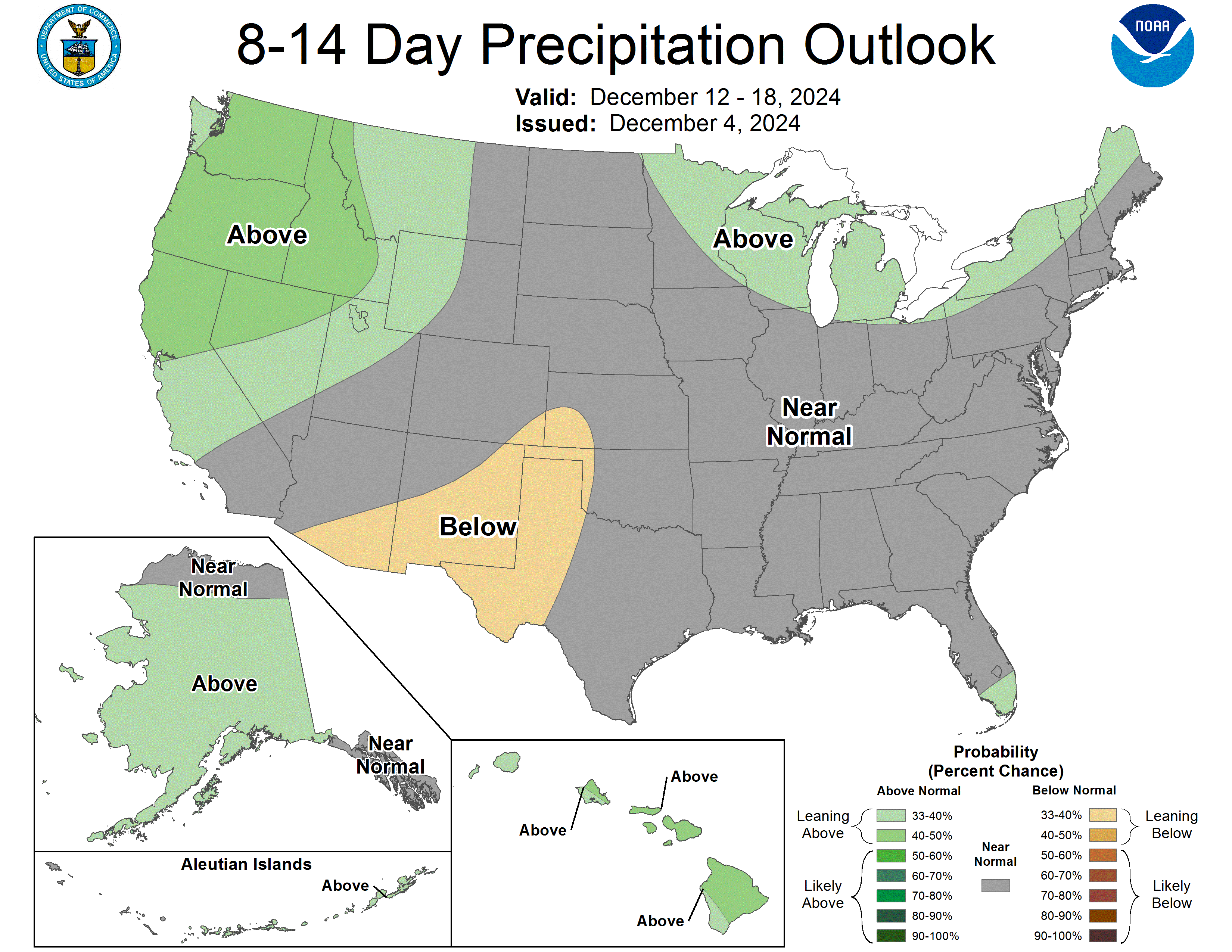
The National Weather Service Climate Prediction Centerโ€™s 6-10 day forecast, covering December 17-21, favors warmer-than-normal temperatures across almost the entire U.S., except for eastern Missouri, Illinois and parts of the Upper Midwest. Forecaster confidence is high for above-normal temperatures in the West, New England, southern Alaska and Hawaii. Precipitation amounts are likely to be below normal for this period across most of the central and northern Great Plains and the West, except for northwest Washington and Oregon, where above-normal precipitation is slightly favored. Above-normal precipitation is also favored in central and southern Texas, the Florida Peninsula, and the Atlantic Coast. Above-normal precipitation is also favored in southern Alaska, while drier-than-normal weather is favored in northern Alaska and in Hawaii.

US Drought Monitor one week change map ending December 10, 2024.

Audubon Supports Northeastern #Arizona Indian Water Rights Settlement #ColoradoRiver #COriver #aridification

Golden Eagle. Photo: Daniel O’Donnell/Audubon Photography Awards

Click the link to read the article on the Audubon website (Jonathan Hayes and Haley Paul):

December 7, 2024

Congress can pass historic legislation to ensure three Tribes have the water they need to sustain their homelands

The Navajo Nation, the Hopi Tribe, the San Juan Southern Paiute Tribe, and other parties in Arizona have come to an historic agreement with the settlement now before Congress. The Northeastern Arizona Indian Water Rights Settlement Act of 2024โ€”when passed by Congress and signed by the Presidentโ€”will ensure a reliable water supply for these Tribes in northeastern Arizona and the region.  

The agreement will do this in part by managing groundwater in the region, by settling long-running claims among in-state parties and the Tribes to the Little Colorado River, and by settling Tribal claims to water from the Colorado River.  

The settlement is the result of innovative and creative thinking among the Navajo Nation, the Hopi Tribe, the San Juan Southern Paiute, and other non-Tribal parties. The settlement provides flexibility for the Tribes to distribute water to their people. We note concerns raised by representatives of the states of Utah and Wyoming regarding the potential for this settlement to allow, within the state of Arizona, delivery of Colorado River water across the Upper Basin โ€“ Lower Basin divide. The Navajo Nationโ€™s water management challenges are many; this geographic feature should not be one of them. Approving the settlement with this provision is crucially important to the Navajo Nation and should not be considered to set a precedent for other parties.  

The settlement not only replaces conflict over scarce water resources with cooperation, but it will also provide five billion dollars in funding to the Tribes so that they will be able to deliver safe and reliable drinking water to tens of thousands of people. This settlement is vital to the Navajo people because:ย 

  • Roughly a third of the Navajo Nation households lack running water.ย 
  • The average cost for Navajos to haul water to their homes, ranches, and sheep camps is $133 per thousand gallons, about 70 times more than the cost paid by other water users in Arizona. Without the settlement, thousands of Navajos will continue to haul water an average of more than 30 miles round trip to meet their daily water demands.ย ย 
  • The settlement provides certainty on the Colorado River to the benefit of all the 39 settling parties.ย ย 

It is long past due for these three Tribes to have the water they need to sustain their permanent homelands. Arizona, and the entire Colorado River Basin, will benefit from the certainty provided from this water settlement. 

Audubonโ€™s focus on birds means we also prioritize the protection of the habitat they need. Riparian and riverside habitat is of outsized importance for birds and other wildlife. This habitat relies on healthy groundwater levels to sustain flowing rivers and streams and the rich plant life and wildlife they support. Groundwater sustains seeps and springs that provide not only water supplies to people, but also valuable habitat to birds and other wildlife. Likewise, the Colorado River and the Little Colorado River are lifelines in an arid environment. This settlement will help protect these precious water resources. 

In Navajo “Tรณ รฉรญ iinรก atรฉ” means “with water, there is life.” At Audubon, we are guided by what birds tell us; and this is why much of our conservation work is targeted at finding win-win solutions for water for people and birds. We urge Congress to support the advancement of S. 4633/H.R. 8940 this session. This water rights settlement is crucial to ensuring the continued and the increased vitality of the Navajo Nation, the Navajo people, and all the Tribes and people in the Colorado River Basin who will benefit from this historic settlement. 

The Powell-Ingalls Special Commission meeting with Southern Paiutes. Photo credit: USGS

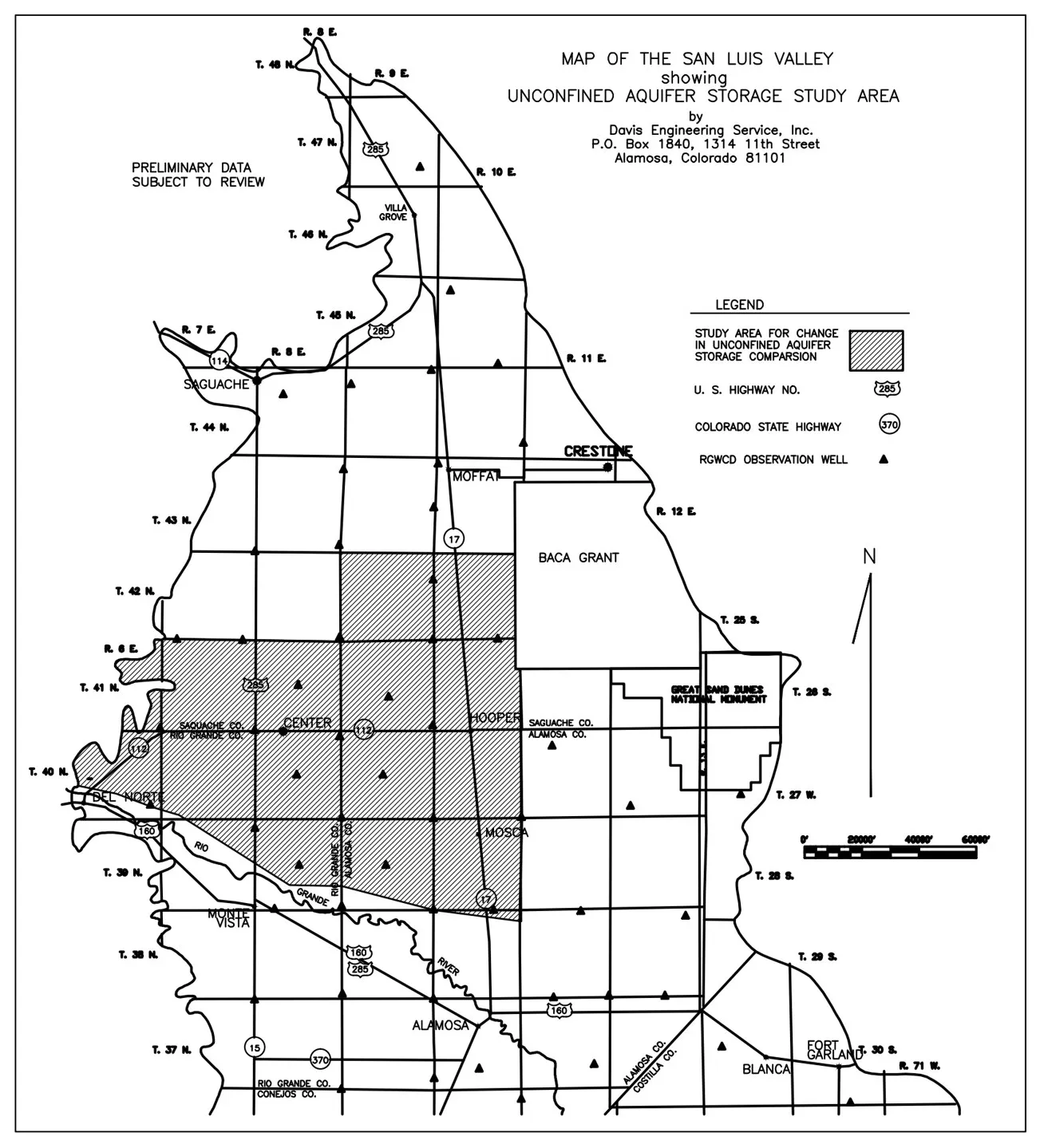
The complexities of a sustainable Subdistrict 1: Groundwater modeling expert discusses the nuances of one-for-one pumping and recovering groundwater levels — @AlamosaCitizen #RioGrande #SanLuisValley

Credit: Rio Grande Water Conservation District

Click the link to read the article on the Alamosa Citizen website:

December 8, 2024

Call it a meeting of the minds โ€“ Willem A. Schreรผder, the CU computer scientist behind the groundwater modeling of the Upper Rio Grande Basin, and a group of San Luis Valley irrigators who are racing against time to reduce groundwater pumping in what state water engineers call โ€œone of the most productive irrigated farming areas in the state.โ€

Schreรผder spent more than an hour at a Dec. 4 meeting with farmers who form the governing board of Subdistrict 1 of the Rio Grande Water Conservation District. They wanted to know if the subdistrictโ€™s upcoming Fourth Plan of Water Management, which calls for irrigators to limit their groundwater pumping to the amount of surface water that naturally flows in, is going to work. 

Itโ€™s called one-for-one pumping, and while the plan has been approved by the Subdistrict 1 board, the Rio Grande Water Conservation District board and the state engineer, it still needs sign off from the state water court, which likely wonโ€™t happen until 2026.

While all the Valleyโ€™s farmers face pressure to reduce groundwater pumping in the face of a changing climate, itโ€™s the crop producers in Subdistrict 1 who are on the clock and under state orders to recover groundwater levels of the unconfined aquifer and maintain a sustainable irrigation water supply by 2031.

Itโ€™s Schreรผderโ€™s mathematicsโ€™ modeling that clues in the Colorado Division of Water Resources to the response the river system and aquifers are having through a steady reduction of groundwater pumping over the past two decades.

Schreรผderโ€™s expert witness testimony explaining the Rio Grande Decision Support System (RGDSS) model has been the subject of state water court proceedings and undoubtedly will be again in upcoming cases.

His session with Subdistrict 1 managers yielded a few insights, notably:

  • The recharge of streams should occur as close to the point of where the groundwater pumping occurred, a problem that has particularly come to light around Saguache Creek and the groundwater pumping that occurs in that area of the Valley.
  • The formation of the newย Southern Colorado Water Conservancy Districtย will complicate the RGDSS model in ways Schreรผder still has to figure out.
  • As much as the RGDSS model can be useful in showing the response of the river to less groundwater pumping, there is always an imbalance even if irrigators are perfectly recharging the same amount as theyโ€™ve pumped out.

What follows is a partial, edited transcript of the conversation to get at some of the more pertinent questions. Jake Burris, president of the Subdistrict 1 board of managers, opened the discussion:

Burris: The first question I would throw at you is, the anchor of the amended plan, should we be successful, is that we would only pump imported water as itโ€™s brought in. Live within our means, sort of speak. If that is the case, is it unreasonable to assume that we would not be generating any new depletions at that point?

Schreรผder: New depletions anywhere, or a particular stream?

Burris: Anywhere, any stream.

Schreรผder:ย So the short answer is โ€˜Noโ€™ in the sense that yes, we probably still will have the depletions, and what it comes down to is that the one-for-one plan essentially is one that deals with an average. So weโ€™re looking at a districtwide or subdistrict-wide average balance, whereas when we talk about stream depletions, weโ€™re talking about time, place, amount. And so itโ€™s very easy to construct a hypothetical situation where if you look at where the pumping occurs and where the recharge occurs, that those recharges in pumping are not exactly coincident and as a result, the distance between where you recharge and where you are pumping basically directs depletions to a particular direction. And so what could very likely occur is that on one stream you actually have an accretion and on another stream you have depletion. So on average you tend to be sort of in balance with the surface network, but the people on the stream that is depleted, are not going to be happy. . .So unless the way that the one-for-one works is that the recharge occurs in exactly the place where the pumping occurs, you likely will have depletions to some streams.โ€

Burris: So itโ€™s not just simply an issue from an administrative standpoint of us utilizing our recharge on an average. Thatโ€™s irrelevant. It is a logistics and timing problem, regardless?

Schreรผder: Thereโ€™s both a temporal and spatial component to that. Think about for example, the depletions to the Rio Grande and Iโ€™m making up numbers here, but just to make the argument easier, letโ€™s say 50 percent of your depletions occur in year one and then 30 percent in year two and 10 percent in years three and four. So itโ€™s front-loaded as far as when the depletions occur, and youโ€™re working on a five-year average and letโ€™s say for those first five years, or first four of the five years, letโ€™s say thereโ€™s negative 25,000 acre-feet of pumping to managed recharge. . .and then in the last year, year five, we basically have a 100,000 acre-feet of pumping in excess of recharge. So because half of that occurs in year one, and the offsets from two years and three years and four years and five years ago are lesser amounts, even though on the five-year average you are in balance, you could have a situation that on the Rio Grande in that first year after the big pumping you do not have an impact. So itโ€™s both the temporal scale at which things happen, as well as the spatial scale. Itโ€™s also a reflection of where did that recharge occur and where did the pumping occur. If you average it out, they donโ€™t fall right on top of each other.

Burris: The way the model then is I guess essentially looking at it for lack of a better way, but from a temporal and spatial standpoint, Sub 1โ€™s aquifer itself is irrelevant. Itโ€™s not looking at it from a form of recharging an aquifer as a whole and recharging for all the wells as a conglomerate. Itโ€™s looking at the individual wells and the areas around each well?

Schreรผder: As far as the model is concerned, yes.

Burris: I think thatโ€™s our big disconnect, or at least I should speak for myself there. The way Sub 1โ€™s structured is with the way the aquifer system is and the way we treat the wells and recharges, itโ€™s in totality. Itโ€™s as a conglomerate, and so you canโ€™t take that perspective in any way to the model?

Schreรผder: Thatโ€™s right? And so thereโ€™s actually three parts to this. The first is as far as Subdistrict 1โ€™s one-for-one is concerned, to a large part thatโ€™s going to address sustainability because what you put in and what you take out balances, that should be sustainable. So thatโ€™s the one part. The other part then, of course, is the groundwater modeling, which tries to figure out just exactly where the spring depletions occur. And then the third part to that is well, we need to calculate these response functions and the response function needs to capture the essential behavior of the model so that we have a simpler way of actually applying the inputs and predict what the depletions are. The problem that we are going to face in the future is that so far the response function approach has actually worked pretty well because what we found is that if you simply look at what the imbalance between pumping and recharge is in the โ€™90s and early 2000s, it did a pretty good job of predicting where the stream depletions would be if all you do is to calculate the net consumptive use and you run it through that function, and then you get the stream depletion prediction. But what if we go one-for-one and the next CU (consumptive use) is zero a lot of time, how are we going to figure out a response function that we can then use to predict what the stream depletion is? 

Burris: It is a possibility to reconsider conceptually how the model is I guess, the framework of the model? Or are we pretty much stuck with how the system is now, if that makes sense?

Schreรผder: I think we are fairly confident in the framework of the model because it is able to reproduce what has happened historically pretty well. The question that weโ€™re struggling with is โ€˜How do we ask the what-if question?โ€™ Had there not been wells or had the wells only operated in a way where the pumping matched the recharge, what would the stream depletions have been? And thatโ€™s a little bit more tricky question that we need to answer now. In the past, because there was always an imbalance between pumping and recharge, it sort of worked out. But if we are actually finding that we are leaving the response function zeros a lot, and if the model does all of the superimposition of individual wells in terms of one answer, and then we average things and we run that sort of the response function, we donโ€™t come up with that same answer, thatโ€™s the problem, right? Thatโ€™s the definition of non-linear. Linear means if you have a function that translates an input to an output, all you have to do is average the inputs and the function will give you the same average on the outputs. Whereas in the non-linear system, if you run the individual items through the function and you then average the results, you donโ€™t get the same answer. And thatโ€™s what we are struggling with. Will we be able to properly linearize that?

Burris: Iโ€™ll throw one more question at you and then Iโ€™ll let somebody else talk. What is the difference in impacts specifically, Iโ€™ll say, to Saguache Creek as far as the model sees them between unconfined wells and confined wells? Is the classification different in the model? Is the impact different, or are those treated the same sort of like we treat them the same in Sub 1?

Schreรผder: Theyโ€™re different in the sense that, because in the confined aquifer you typically have lower storage co-efficients, the columns of depression that accumulate for those tend to spread out wider and faster than they do in the unconfined aquifer. And so since the model basically just stacks all of those on top of each other and then calculates the total, it takes into consideration the fact that confined and unconfined wells behave differently. But as far as, can you tell me exactly how confined wells are, what the total is from confined wells and whatโ€™s the total from the unconfined wells? Iโ€™ve not tried to make that separation. We always just consider it in total because again, this is a non-linear system. So how you evaluate individual wells versus all of the wells in the subdistrict as a whole, if you add up all the individual wells, it doesnโ€™t add up to the total for the subdistrict as a whole. So itโ€™s a little difficult to make that clear distinction between the two.

Credit: Rio Grande Water Conservation District

The seventh iteration of the RGDSS model is being finalized by Schreรผder, which led to this exchange with another of the Subdistrict 1 managers. The conversation also then delved into the new Southern Colorado Water Conservancy District.

Sub1 Board: When will we have, โ€˜This is the final seven version?โ€™ Do we need to take action soon or can we wait a month or two for you to finalize it?

Schreรผder: So I am hoping, we have a meeting on Dec. 17, I think is the date, and Iโ€™m hoping to finalize the model for that, or at least get peopleโ€™s agreement that this is good enough that we should be moving on to the application of the model. So now we start asking the model questions, and itโ€™ll probably be several months if not a year before we go from OK, we now have a modelโ€™ translating that into, do we ask the right question for each zone and then what are the response functions that are coming out of that? So itโ€™s probably going to be at least a year before we have the answer that will apply for the next five or 10 years.

Sub 1 board member, on the Sustainable Water Augmentation Group known as SWAG: SWAG forming their own subdistrict and I guess trying to do it alone, how would you see that changing those fields and their new conservation district now outside of our subdistrict. Would that impact this data set?

Schreรผder: Well, I guess to the extent that they do their own thing, they give us more site-specific information, weโ€™ll try to incorporate that into the model. The difficult thing that we need to figure out is, โ€˜How do we deal with it separate from the rest of Sub 1?โ€™ And thatโ€™s not going to be easy.

Sub 1 board member: Just clipping those wells out of our dataset, youโ€™re saying itโ€™s not just as straightforward as, โ€˜Hey, these ones are closer to Saguache and theyโ€™re no longer in the map.โ€™ Does that help the math?

Schreรผder: Well, and I mean thatโ€™s part of the problem, right, is itโ€™s sort of obvious that yeah, those guys are probably having a bigger impact on Saguache Creek than the rest, but how do we actually run the model in such a way that we can actually quantify that? And thatโ€™s one of the problems that you have an nonlinear system, is if you start breaking it up into lots of little parts, the answer doesnโ€™t sum up to the total and that becomes problematic in terms of how do you figure out what the total impact on the stream is and how to distribute that back to individual people? And itโ€™s something that weโ€™ve worked very hard to avoid, but theyโ€™re sort of forcing our hand and I donโ€™t know exactly what the answers can be.

Sub 1 board member: You mentioned the substantial decrease in pumping over the last 10, 15 years in Subdistrict 1. Is there a scenario where if that were to continue or if wells were continuing to be retired in Sub 1, that that cone of depression would no longer reach Saguache Creek or we would no longer have applications in any scenario?

Schreรผder: Itโ€™s that balance, right, between where the recharge occurs and where the pumping is. So if we basically do one-for-one and we can put the recharge exactly where weโ€™ve pumped, then there should be no net cone of depression. And so thatโ€™s the problem, right? Thereโ€™s always an imbalance, and so even if you are perfectly recharging the same amount as you are pumping, itโ€™s always going to push the cone of depression in one direction.

Jake Burris: I once again will reiterate how appreciative I, and we are, that youโ€™re willing to make the trip down here and talk to us. It was hugely helpful, at least for me, just the general perspective o,f itโ€™s drastically different how we treat Sub 1 and administer it versus how the model sees it, I guess is how Iโ€™ll put it. But we do appreciate you taking the time.

Schreรผder: Well, and again, let me just reiterate. The sustainability requirement, thereโ€™s the modelโ€™s predictions of impact, and then the response functions themselves, and the way that the response functions work right now, by definition, if you had no net CU (consumptive use), there would be no depletion. But thatโ€™s the existing response functions, and thatโ€™s one of the things that we need to figure out at the end of phase seven is, OK that particular model of response function is probably not going to work again. So what are we going to do to fix that?

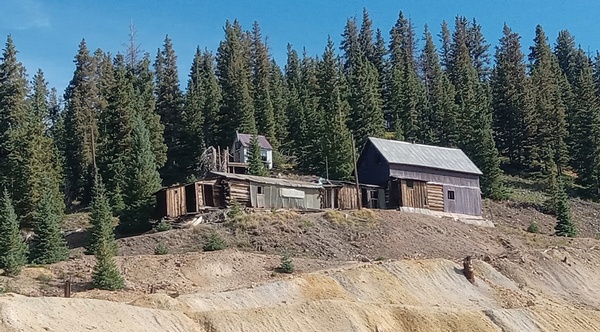
San Luis Valley Groundwater

Seven statesโ€™ #ColoradoRiver negotiators, all at same conference, didnโ€™t meet together: โ€œTensions are extremely highโ€ — Elise Schmelzer (The #Denver Post) #CRWUA2024 #COriver #aridification

Las Vegas has reduced its water consumption even as its population has increased. (Source: Southern Nevada Water Authority)

Click the link to read the article on The Denver Post website (Elise Schmelzer). Here’s an excerpt:

December 6, 2024

Policymakers, academics, irrigators and water attorneys gathered in the Nevada desert this week to discuss the future of the highly contentious river that makes modern life possible for so many people across a vast swath of the American Southwest. The current guidelines that dictate how water is shared among the seven Colorado River basin states are set to expire at the end of 2026, and government leaders must create a new plan before then.

Udall/Overpeck 4-panel Figure Colorado River temperature/precipitation/natural flows with trend. Lake Mead and Lake Powell storage. Updated through Water Year 2024. Credit: Brad Udall

To do so, they must decide who will get less water โ€” and when โ€” as climate change shrinks the riverโ€™s flows.

โ€œThe tensions are extremely high this year,โ€ said Tanya Trujillo, water policy advisor and deputy state engineer for New Mexico. โ€œOf the 20 years Iโ€™ve been coming to this conference, this is the one with the least-good relations among the states.โ€

[…]

Carly Jerla speaking at the Colorado River Water User’s Association Conference December 5, 2024. Photo credit: USBR

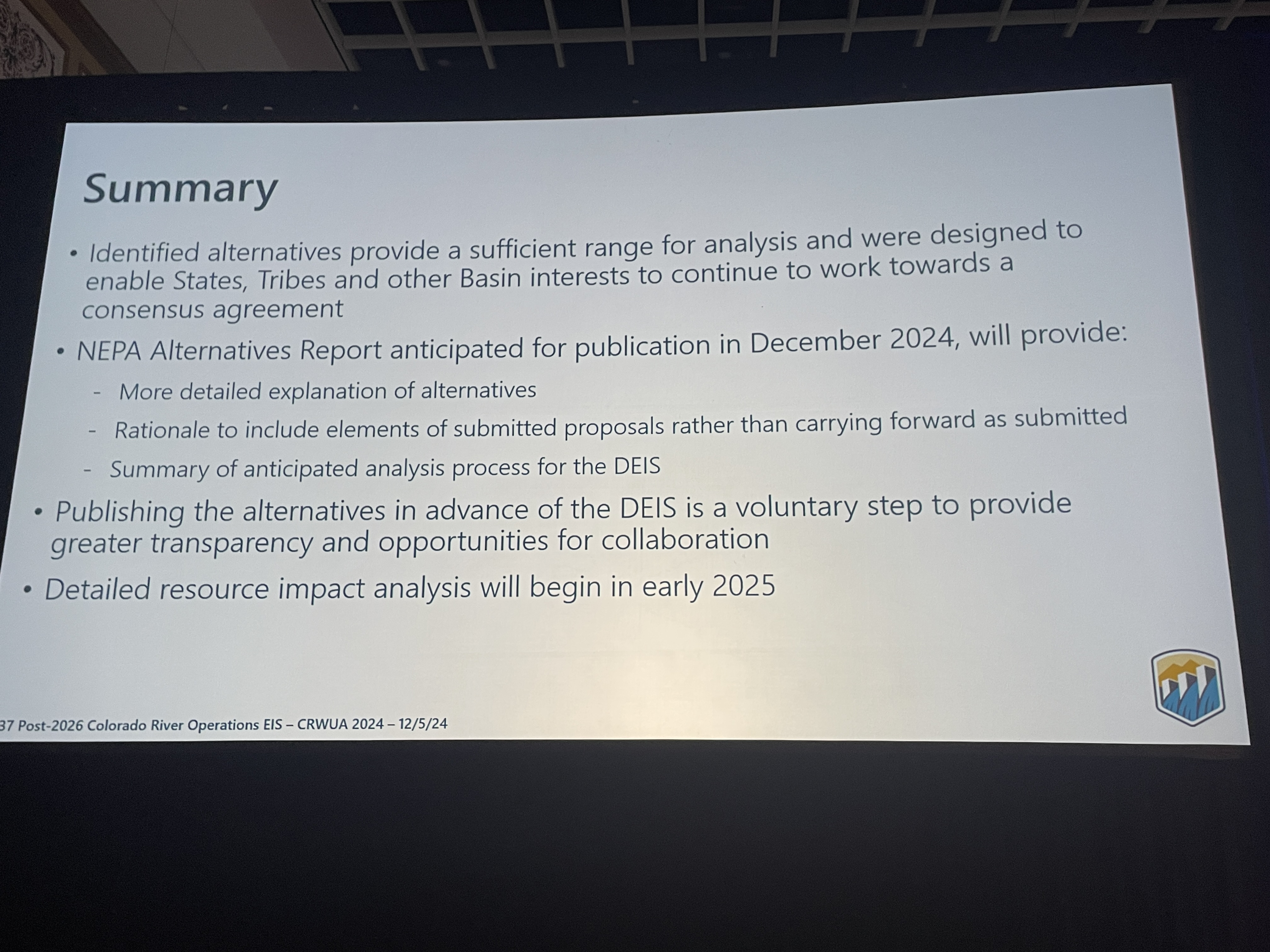
The U.S. Bureau of Reclamation, which operates Lakes Mead and Powell, must create a new operating plan for the reservoirs before current guidelines expire at the end of 2026. The bureau is halfway through the process, said Carly Jerla, senior program manager at the agency. The bureau must complete environmental analyses of potential operating guidelines, take public comment and make a final decision by August 2026, she said.

โ€œWe need to be moving, as a basin, a lot faster in this second half than we did in our first halfโ€ of the process, Jerla said…

Upper Basin negotiators believe their basin should be exempt from mandatory water-use cuts imposed by the federal government because water use in the basin is already restricted by the amount of precipitation. While the Lower Basin can use water stored in Mead and Powell in dry years, Upper Basin states do not have large upstream reservoirs and must instead rely on snowpack and rainfall. Historically, the Upper Basin has never been able to use its full allocation of water, negotiators from the basin said. Water users in Colorado have their water cut off every year because there is not enough, Mitchell said. The Lower Basin must acknowledge those losses and recognize that the Upper Basin has been living with the impacts of climate change for years, she said.

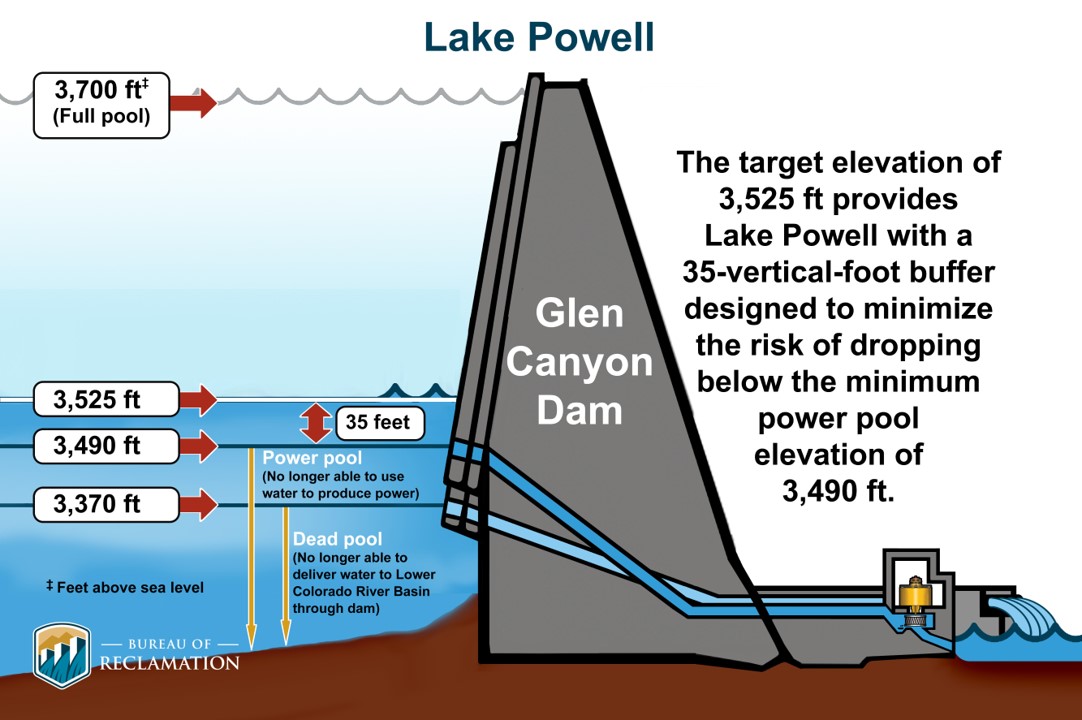
Lake Powell key elevations. Credit: Reclamation
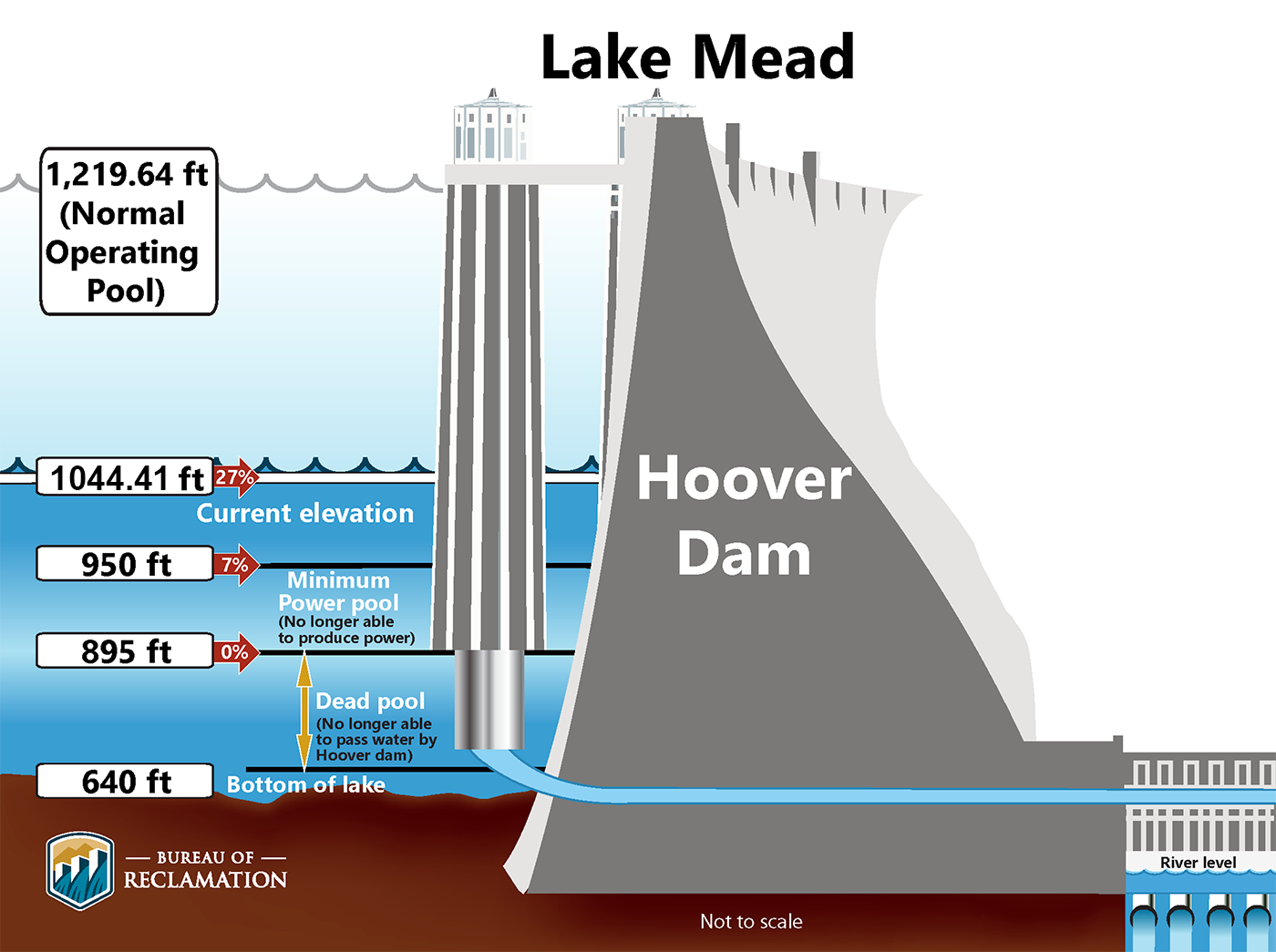
Lake Mead key elevations. Credit: USBR

Does our current approach to #ColoradoRiver accounting hide a looming problem? — John Fleck (InkStain.net) #COriver #aridification

NASA satellite images show water decline in Lake Mead from 2000, at left, to 2022, the largest reservoir in the United States. Credit: Colorado State University

Click the link to read the article on the InkStain website (John Fleck):

My colleagues with theย Colorado River Research Group have a new policy brief out todayย taking another whack at the question of โ€œassigned waterโ€ โ€“ water kinda sorta conserved, but left in storage so water agencies can pull it out again at some future date. Think โ€œIntentionally Created Surplusโ€ (ICS). At this point, nearly 40 percent of the water in Lake Mead is tagged as some agencyโ€™s private storage account, rather than being available for general system use.

This is the issue Arizona Stateโ€™s Kathryn Sorensen (one of my CRRG colleagues) has been raising, and that Kathryn (with help from Sarah Porter and I)ย wrote about in October. The new CRRG paper argues that, as we move toward expanding the assigned water programs available to basin water users, we need to be mindful of the risks.

Map of the Colorado River drainage basin, created using USGS data. By Shannon1 Creative Commons Attribution-Share Alike 4.0

Deficit Spending — Jack Schmidt (Center for #ColoradoRiver Studies) #COriver #aridification

Click the link to read the article on the Center for Colorado River Studies website (Jack Schmidt):

December 3, 2024

Drawdown of the Colorado Riverโ€™s reservoirs now slightly exceeds the amount of gain that occurred during the 2024 snowmelt season. For the next four months until snowmelt begins again, the basinโ€™s reservoirs will be drawing from the excess accumulated in 2023, demonstrating the immense challenge in balancing water consumption with supply.

In Detail…

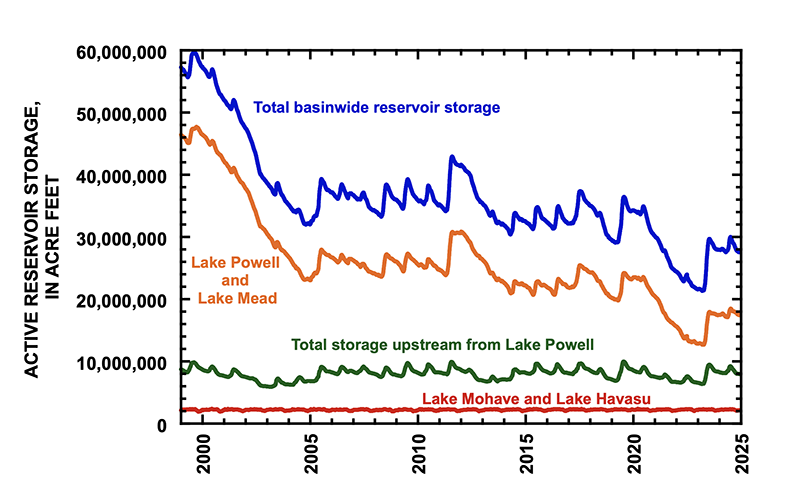
On 30 November 2024, total basin reservoir storage was 27.5 million af (acre feet)1, approximately two yearsโ€™ supply at todayโ€™s rate of consumptive use and loss (Fig. 1). That amount is 43% of the maximum system contents of July 19832 and is the same amount as at the beginning of July 2021 when the basinโ€™s water managers were beginning to get worried. Conditions are not quite as bleak as in summer 2021, because that yearโ€™s snowmelt season had already passed. Now, we can hope that the 2025 snowmelt season might be a good one. Nevertheless, reservoir storage is the bank account from which we draw to maintain the economy of the American Southwest and parts of northwestern Mexico. It would be preferable for there to be more water in that account.

Figure 1. Graph showing total storage in 46 reservoirs (blue line) in the Colorado River basin since 1 January 1999. Also shown are the total contents of Lake Mead and Lake Powell (orange line), total contents of Lake Mohave and Lake Havasu (red line), and 42 reservoirs upstream from Lake Powell (green line) which includes reservoirs managed by the federal and state governments, municipalities, and water districts. Credit: Jack Schmidt/Center for Colorado River Studies.

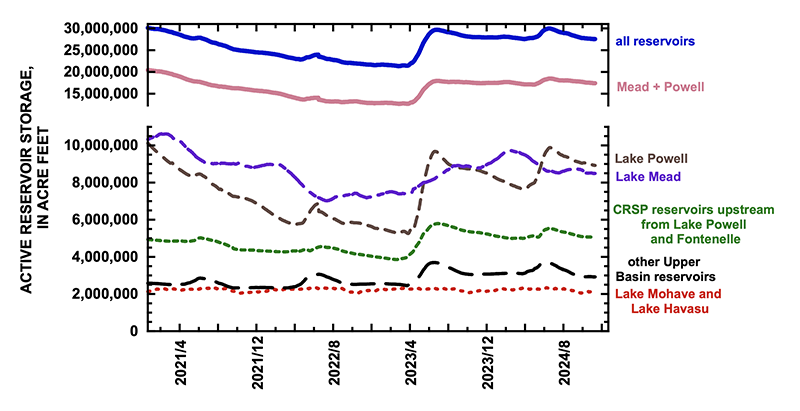
Approximately 63% of current total reservoir storage is in Lake Mead and Lake Powell. Presently, there is approximately 400,000 af more water in Lake Powell than in Lake Mead, but the contents of Lake Powell are slowly being depleted. The contents of Lake Mead held fairly constant during the past month. The contents of Lake Powell decreased by approximately 4300 af/day during November, but the contents of Lake Mead decreased by only 800 af/day (Fig. 2). Upstream from Lake Powell, Colorado River Storage Project (CRSP) initial unit reservoirs, as well as Fontenelle Reservoir, decreased by only 600 af/day in November, and other Upper Basin reservoirs lost even less (400 af/day).

Figure 2. Graph showing total basin reservoir storage (blue line), and storage in different parts of the Colorado River watershed between 1 January 2021 and 30 November 2024. Credit: Jack Schmidt/Center for Colorado River Studies

Basin reservoir storage must be increased to improve the security of our water supply. We need to increase the balance in our โ€œbank account,โ€ and the only way to do that is to spend less than the amount of our actual water โ€œincome.โ€ Most of our income arrives during the snowmelt season of late spring and early summer. Mid- and late-summer, fall, winter, and early spring is the period when we spend the snowmelt-season income, although summer rains and groundwater inflow offset some of our uses.

Occasionally, we have an unusually snowy winter, and the basinโ€™s reservoirs significantly refill. 2023 was one of those years. Reclamation estimates that the natural flow of the Upper Basin3 was 17.4 million af in 2023, the third largest of the 21st century (after 2011 and 2019), and total basin storage increased by 8.38 million af, only exceeded by the increase in storage in 20114. 2024 was a moderately snowy winter.

2024 was a different story, however. The NRCS estimated that the peak snow water content in 2024 was 14% greater than the 30-year average, but dry soils and other effects of a warming climate limited natural flows to between 11.9 and 12.1 million af, which is less than the average for the 21st century5. In 2024, the basinโ€™s reservoirs increased in storage by 2.45 million af. The drawdown of the basinโ€™s reservoirs as of 30 November was 2.46 million af, slightly more than the gain from snowmelt (Fig. 3). The contents of Lake Mead and Lake Powell increased by 1.39 million af in 2024, and the drawdown in those two reservoirs has been 1.07 million af this year. During the next four months, the basin will begin drawing from storage that accumulated in 2023.

Figure 3. Graph showing reservoir storage between 1 January 2023 and 30 November 2024, highlighting the amount of reservoir recovery during the past two snowmelt seasons and the amount of intervening reservoir drawdown. The drawdown of the basinโ€™s reservoirs since July 2024 slightly exceeds the recovery that occurred due to snowmelt in 2024. Credit: Jack Schmidt/Center for Colorado River Studies

Drawdown of the basinโ€™s reservoirs has been much greater in 2024 than in 2023. The amount of drawdown between early summer and today is slightly more than the median drawdown for the past 15 years6ย and is 43% greater than the drawdown at this time last year (Table 1). The drawdown of Lake Mead and Lake Powell in 2024 is slightly less than the median for the past 15 years7ย but is 98% greater than it was at this time last year.

The total reservoir drawdown between early summer and 30 November is now 14% greater than in all of last year, and drawdown in Mead and Powell also exceeds the total drawdown in those reservoirs last year (Table 2). We did well last year, but not so well this year. Credit: Jack Schmidt/Center for Colorado River Studies
Credit: Jack Schmidt/Center for Colorado River Studies

There are many details ignored in this overview. Reservoir drawdown in the Upper Basin is not only determined by consumptive use, but also by reservoir operating rules that require winter drawdown and by requirements to provide environmental flows. Water use in southern California is significantly affected by water supply available from northern California, the Owens River, and locally. Nevertheless, every drop of water released from upstream is used, lost, or stored in a downstream reservoir, and total basin storage is the only available supply to make up the shortfall between annual precipitation and annual use.

Conservation in the Lower Basin and in Mexico is reducing drawdown in Lake Mead, and the storage contents of Lake Mead are likely to increase during the next few months as water is delivered from upstream. Drawdown of the total contents of Lake Mead and Lake Powell is still 0.32 million af less than what accumulated there from the 2024 inflow season and a 2024 deficit might not occur is Lower Basin water use is drastically reduced or if Upper Basin reservoirs are emptied.

Efforts to date to reduce water consumption in the basin have been significant, and required a significant investment by the federal government. Despite those efforts, we have four months ahead of us before snowmelt in 2025 begins, and we are likely to begin deficit spending unless radical changes in use are immediately implemented. The challenge faced by the federal government, Mexico, the seven basin states, every tribe, and every water user is immense and is not solely restricted to negotiating the post-2026 agreements. We remain in a water crisis today, and the time to greatly reduce water consumption is right now in the present moment. [ed. emphasis mine]

  • [1]ย Basin reservoir storage is for 46 reservoirs reported by the Bureau of Reclamation in its Hydrodata baseย https://www.usbr.gov/uc/water/hydrodata/reservoir_data/site_map.html.
  • [2]ย There was 63.6 million af of storage in the basin on 15 July 1983. Some of this storage exceeded the generally accepted capacity of some reservoirs, notably Lake Powell.
  • [3]ย at Lees Ferry
  • [4]ย Basin reservoir storage increased by 8.78 million af in 2011.
  • [5]ย Natural flows for calendar year and water year 2024 were 12.1 and 11.9 million af, respectively, based on Reclamationโ€™s 12 September 2024 estimate. The average natural flow at Lees Ferry between 2000 and 2024 was 12.4 million af/yr, based on Reclamationโ€™s estimates.
  • [6]ย The median drawdown between the summer peak and 30 November during the past 15 years was 2.26 million af for the 46 reservoirs of the watershed.
  • [7]ย The median drawdown between the summer peak and 30 November during the past 15 years was 1.16 million af for the total contents of Lake Mead and Lake Powell.
  • [8] ย Includes drawdown of Lake Mohave and Lake Havasu.
ten tribes
Graphic via Holly McClelland/High Country News.

How many species could go extinct from #ClimateChange? It depends on how hot it gets — National Public Radio #ActOnClimate

A kea about to land on a white vehicle, with wings outspread showing their orange underside. By klaasmerderivative work: CC BY-SA 2.0

Click the link to read the article on the National Public Radio website (Jonathan Lambert). Here’s an excerpt:

To consider how climate change could cause some extinctions, imagine a tiny mountain bird that eats the berries of a particular mountain tree. That tree can only grow at a specific elevation around the mountain, where it’s evolved over millennia to thrive in that microclimate. As global temperatures rise, both the tree and the bird will be forced to rise too, tracking their microclimate as it moves uphill. But they can only go so far.

“Eventually, they reach the peak, and then there’s nowhere else to go,” says Mark Urban, a biologist at the University of Connecticut.

Scientists call this mountain phenomenon the “escalator to extinction” and it’s just one way climate change is already squeezing plants and animals from their habitats. Researchers have conducted hundreds of studies projecting how different species might respond to different levels of climate change, finding varied results. In anย analysis published Thursdayย in the journalย Science, Urban sought to bring all those studies together…If countries meet the shared goal of limiting warming to 1.5 degrees Celsius, 1.8% of species will be at risk of extinction by the end of the century, Urban reports. But if global warming gets out of hand, warming four or five degrees Celsius, as many as 30% of species could be at risk…He points to confounding complexities in how species might respond to such climate extremes that scientists don’t yet know. More critters may simply not be able to cope, or ecosystems that lose species after species may collapse altogether. Additionally, many rare species are understudied, or not even discovered, and might be especially vulnerable in ways that don’t show up in this analysis…Different species face some different risks. Amphibians, including frogs and salamanders, are more vulnerable, Urban found, perhaps because their habitats are more sensitive to environmental changes. Species that live on islands, mountains and in freshwater could face more challenges, too. Targeted conservation efforts could help slow losses, Urban says, but they’re ultimately no substitute for reducing emissions.

Upper and lower basin states hit tough impasse at annual #ColoradoRiver conference — #Utah News Dispatch #CRWUA2024 #COriver #aridification

The Colorado River is pictured near Moab on Sunday, Feb. 18, 2024. (Photo by Spenser Heaps for Utah News Dispatch)

Click the link to read the article on the Utah News Dispatch website (Jennifer Solis):

December 8, 2024

Western states that rely on the Colorado River are in a heated deadlock over how to manage the troubled river, and are doubling down on their own regional plans, despite growing pressure from the federal government to reach a compromise.

Top water officials for the seven Colorado River Basin states โ€” Arizona, California, Nevada, Colorado, New Mexico, Utah, and Wyoming โ€” gathered for the Colorado River Water Users Association conference at the Paris Hotel and Casino in Las Vegas Thursday.

But for the first time in years, representatives from Lower Basin states โ€” Nevada, Arizona, and California โ€” and Upper Basin states โ€” Colorado, New Mexico, Utah, and Wyoming โ€” did not appear on a panel together or meet during the conference to negotiate the future of the Colorado River.

โ€œItโ€™s been customary that we get together beforehand,โ€ said Colorado River Commissioner for Colorado, Becky Mitchell, during a news conference. โ€œUnfortunately, we werenโ€™t able to do that. I donโ€™t think that means that we will never be able to do that again. It just means this time we werenโ€™t.โ€

Map of the Colorado River drainage basin, created using USGS data. By Shannon1 Creative Commons Attribution-Share Alike 4.0

Nine months ago, the two basins submitted competing water management plans to the federal government after state negotiators could not reach a consensus on how to share the riverโ€™s dwindling water supply.

Since then, the basin states have not moved any closer to negotiating a compromise on how to equitably share and cut Colorado River water use once current management rules expire in 2026, leaving states up a creek without a paddle.

One of the biggest sticking points between the two basins is whether or not Upper Basin states should absorb mandatory water cuts during dry years, despite using significantly less than their 7.5 million acre-feet Colorado River allocation year-after-year.

Historically, Lower Basin states have used nearly all their 7.5 million acre-feet Colorado River allocation under the 1922 Colorado River Compact, compared to the 4.5 million acres-feet used by the Upper Basin states.

Lower Basin states argued all seven states should share water cuts during dry years under the new post-2026 guidelines. If they donโ€™t, downstream states warned they could face water cuts they canโ€™t feasibly absorb.

Those tensions were reflected Thursday when Lower Basin water managers told a ballroom full of water managers, researchers, agricultural producers and others from across the drought-stricken river that if their Upper Basin counterparts did not sign onto the Lower Basin plan and accept cuts, they would be at greater risk of triggering a โ€œcompact call,โ€ which could force cuts on the Upper Basin.

Upper Basin states argue they donโ€™t have the legal authority to significantly reduce flows to water users on their own under the 1922 Colorado River Compact, unlike Lower Basin states.

โ€œThey might have that authority if we make a compact call. So perhaps weโ€™ll make that compact call, then theyโ€™ll have the authority to cut flows,โ€ said Tom Buschatzke, Arizonaโ€™s top Colorado River negotiator. โ€œMaybe thatโ€™s an easy path compared to going to their water users with some voluntary program or their legislatures to get authorities to do the things we have to do in the Lower Basin.โ€

In September, Buschatzke asked Arizona Gov. Katie Hobbs to set aside $1 million for litigation in the event states canโ€™t reach a compromise and Arizona needs to take the issue to court.

โ€œI have to do my due diligence for all potential outcomes,โ€ said Buchatzke about his request.

Negotiators in both the Lower and Upper Basin states all acknowledged they have three options to decide how states will share the riverโ€™s waning water supply going forward: litigation, legislation or negotiation.

โ€œWhen we put forward our Lower Basin alternative, we were looking to offer a compromise,โ€ said JB Hamby, Colorado River Commissioner for California. โ€œWe want a seven state agreement. We donโ€™t want to have to go litigate stuff and force these really difficult outcomes in the Upper Basin.โ€

Mitchell, the Colorado River Commissioner for Colorado, was critical of how the Lower Basin states have approached negotiations with the Upper Basin.

โ€œI think going in, not willing to change your deal at all, is probably the first problem. You cannot say thereโ€™s a compromise, if we have to accept a deal in its entirety,โ€ Mitchell said, adding that Upper Basin states are open to adjustments to their plan.

To spur a compromise, the federal government released an initial outline detailing four different river management options last month, including a hybrid management option that blends components from both basin state plans.

Representatives for both camps said they would need to see more details before throwing their weight behind any of the federal management proposals.

โ€œThey did provide a bit of additional information today as to some of the elements, but still not enough,โ€ said Estevan Lopez, New Mexicoโ€™s representative on Colorado River matters, during a news conference Thursday.

Representatives for the U.S. Bureau of Reclamation said the agency intends to publish a more detailed analysis of the federal proposals by the end of the year. Maximum cuts could range from 2.1 million acre-feet to 4 million acre-feet, which could be divided based on who has the oldest rights, or distributed proportionally across all seven states.

Despite the lack of comradery among the Lower and Upper Basin states at the annual conference, both camps expressed optimism they could reach a compromise, eventually.

โ€œI want everybody from the upper basin to hear from Nevada: We believe compromise is possible. We think itโ€™s the first, second and third best option. But we need a dance partner, so letโ€™s get back to the table and make this happen,โ€ said John Entsminger, Nevadaโ€™s representative on river issues and general manager of the Southern Nevada Water Authority.

Mitchell said it was clear to her from panel presentations during the conference that all seven states want to reach a consensus plan on how to manage the future of the Colorado River.

โ€œI think thereโ€™s still a possibility. Iโ€™m still hopeful. And I think if we want a seven state consensus, weโ€™re going to have to have seven leaders come to the table,โ€ Mitchell continued.

Brandon Gebhart, Wyomingโ€™s state engineer and Colorado River negotiator, said he believes the seven Colorado River Basin states can come up with a better management plan than one imposed by the federal government, although โ€œit wonโ€™t happen next week.โ€

Udall/Overpeck 4-panel Figure Colorado River temperature/precipitation/natural flows with trend. Lake Mead and Lake Powell storage. Updated through Water Year 2024. Credit: Brad Udall

โ€œWe really need to understand that the enemy weโ€™re battling right now is not the Upper Basin, itโ€™s not the Lower Basin. Itโ€™s hydrology,โ€ Gebhart said.

Nevada Current is part of States Newsroom, a nonprofit news network supported by grants and a coalition of donors as a 501c(3) public charity. Nevada Current maintains editorial independence. Contact Editor Hugh Jackson for questions: info@nevadacurrent.com. Follow Nevada Current on Facebook and X.

Coyote Gulch’s excellent EV adventure: #Colorado, I’m coming home

Mrs. Gulch’s landscape December 8, 2024.

The Great American meditation
Two hands on the wheels two eyes on the road
Truck-stop sunsets and filling stations
Thatโ€ฒs what you see when you’re always on the go

But Iโ€ฒm headed home
Colorado, I’m headed home
Colorado, Iโ€ฒm headed home

— Excerpt from Daniel Rodriquez’s, “Colorado”

Superbloom along Utah-128 May 22, 2023. A species of globemallow (I think) in the foreground.

I have to respectfully disagree with Daniel over the notion that taking those long highway treks are a meditation. When I meditate I try to clear my mind and the highway does not fit that bill. I think of a thousand things and with a nod to Gurdeep Pandher of the Yukon I try to use the tools that keep the thoughts positive. Mrs. Gulch tops the list of course, but those great hikes, reminiscing about family, canyons, flowers, trees, mountains, the big rivers in the Midwest, the wild rivers in the West, all creep into my head. Of course there’s the road trips with Mrs. Gulch starting that first summer when we moved into my VW Bus and the last trip where we followed the Colorado River from Rocky Mountain National Park to Moab.

Anyway, I logged 3,239 Google miles on the journey and visited 9 states. Hellchild was along for the long leg of the trip so there is yet another family road trip to log into long-term memory and chat about.

I took the collection of essays “Water Bodies: Love Letters to the Most Abundant Substance on Earth” along and it is one of the most inspiring reads the I’ve known. Laura Paskus’ introduction drew me in and the other authors and poets left me wanting more at the end.

Gertie and Frank Turner on their wedding day.

One of the essays dealt with place and I believe Denver is that place for me. Four generations of my family have lived on the Northside since the end of the 19th Century. Gertie’s family gave up on dryland farming in Wyoming and Frank’s family moved down from Jamestown, likely with the collapse of the silver market beginning in 1893.

Frank told Gertie in 1906, “There’s been a terrible earthquake in San Francisco and they are paying top wages for workers. I will go out there and work and save for a year, and then we’ll be married.”

He returned in 1911 with no dough in his pockets. He did bring back his memories of hopping trains and the Northwest’s forests and rivers. They finally tied the knot.

#ColoradoRiver states bluster and bicker ahead of an uncertain future for the water supply — Alex Hager (KUNC.org) #CRWUA2024 #COriver #aridification

Water policymakers from (left to right) Utah, New Mexico, Colorado and Wyoming speak on a panel at the Colorado River Water Users Association conference in Las Vegas on December 5, 2024. State leaders are deeply divided on how to share the shrinking water supply, and made little progress to bridge that divide at the annual meetings. Photo credit: Alex Hager/KUNC

Click the link to read the article on the KUNC website (Alex Hager):

December 6, 2024

This story is part of ongoing coverage of the Colorado River, produced by KUNC in Colorado and supported by the Walton Family Foundation. KUNC is solely responsible for its editorial coverage.

States that use the Colorado River have spent the better part of 2024 deadlocked about how to share its shrinking water supplies, and annual water meetings in Las Vegas laid bare how far those states are from an agreement.

The seven states canโ€™t agree on who should feel the pain of water cutbacks during dry times. The river is getting smaller due to climate change, and states need to come up with new rules to share its water.

Colorado, Utah, Wyoming and New Mexico make up the Upper Basin. California, Arizona and Nevada represent the Lower Basin. The current rules for sharing water expire in 2026, and each group has submitted a separate proposal for new guidelines after that point.

In Las Vegas, the Colorado River Water Users Association annual conference provided a rare peek behind the curtain of talks between those states. Surrounded by the golden wallpaper and shimmering chandeliers of the Paris Hotel, policymakers showed little progress towards an agreement but brought plenty of bluster.

In recent years, negotiators from all seven states have appeared on one panel together. This year, amid their public disagreement, they appeared on stage at separate times.

State leaders made subtle and not-so-subtle jabs at their counterparts, alleging an unwillingness to use less water. Between those jabs, though, they preached the value of collaboration.

โ€œWe have this conference so that we can try to pull together, not pull apart,โ€ said Gene Shawcroft, Utahโ€™s top Colorado River official.

Some of Shawcroftโ€™s downstream neighbors also urged togetherness.

โ€œI’m not looking for a fight,โ€ said John Entsminger, Nevadaโ€™s delegate. โ€œWe need a dance partner, so let’s get back to the table and make this happen.โ€

Others were less gentle with their choice of words.

โ€œAll of the rhetoric, the saber-rattling and other distractions going on right now are [bullshit]โ€ said Brandon Gebhardt, Wyomingโ€™s top water negotiator. โ€œIt needs to stop.โ€

Despite all the calls for collaboration, state leaders didnโ€™t use the Las Vegas conference to hold closed-door policy talks like they have in past years. Tom Buschatzke, Arizonaโ€™s water director, said the states donโ€™t even have another meeting on the books.

โ€œWe are willing to meet with them,โ€ he said. โ€œWe want that meeting to be something of substance.โ€

People mingle in the hallway of the Colorado River Water Users Association conference at the Paris Hotel in Las Vegas on December 5, 2024. The event brought together more than 1,500 water experts from across the Southwest. Photo credit: Alex Hager/KUNC

Looming large in the background of this weekโ€™s water talks is the unpredictability of the next presidential administration. Those water leaders said they do not expect Donald Trumpโ€™s return to the White House will shake up the Colorado River negotiation process, but some water users and onlookers say the next administration could impact the future of the river in other ways.

The past few years have seen an influx of federal spending that Nevadaโ€™s Entsminger called a โ€œonce-in-a-generation windfall.โ€

The Biden Administrationโ€™s Inflation Reduction Act set aside $4 billion for Colorado River work.

Michael Bennet, Colorado Senator; Bill Long, Southeastern Colorado Water Conservancy District; Camille Calimlim Touton, Reclamation Commissioner; Rebecca Mitchell, Director Colorado Water Conservation Board stand with pipe for the construction of the Arkansas Valley Conduit. Photo credit: Reclamation

Some presentations at the conference felt like a bittersweet sendoff for the administration and its willingness to spend. Water leaders from around the West eulogized the work of Camille Calimlim Touton, the outgoing head of the Bureau of Reclamation, the federal agency that operates Western reservoirs.

Money from the Inflation Reduction Act has been spread far and wide across the cities, farms and native tribes that use the riverโ€™s water. While some of it has been spent on physical infrastructure, like fixing old pipes and upgrading water treatment facilities, large portions of funding have been used to conserve water, particularly in the riverโ€™s Lower Basin.

Farm districtstribes and cities have taken federal cash in exchange for using less water and leaving it in Lake Mead, the nationโ€™s largest reservoir.

โ€œAll these programs cost money, all this investment, all this infrastructure, costs money,โ€ said Gina Dockstader, who sits on the board of directors for the Imperial Irrigation District in California. โ€œWithout these additional funds, these farmers can’t afford to put it in by themselves.โ€

While the exact details of President-elect Trumpโ€™s plans for federal spending are still coming together, heโ€™s provided some indications that they will look different from the Biden administrationโ€™s.

Udall/Overpeck 4-panel Figure Colorado River temperature/precipitation/natural flows with trend. Lake Mead and Lake Powell storage. Updated through Water Year 2024. Credit: Brad Udall

Climate scientists are projecting a drier future for the Colorado River. Hannah Holm, a policy expert with the conservation group American Rivers, said the kind of water conservation programs that have been made possible by federal funding will only get more important.

โ€œIf that funding doesn’t materialize,โ€ she said. โ€œWe just won’t be able to adapt as well to the conditions we already have, let alone the conditions that are coming our way.โ€

American Rivers receives funding from the Walton Family Foundation, which also supports KUNC’s Colorado River coverage.

The clock will keep ticking for states to find some common ground on the next set of rules. A snowy winter could help buy them a little bit more time and space for negotiations by raising reservoir levels with runoff in the spring, but even record-breaking snow totals would make a relatively small dent in the long-term supply-demand imbalance along the Colorado River.

Colorado River “Beginnings”. Photo: Brent Gardner-Smith/Aspen Journalism

Water managers deadlocked on #ColoradoRiver: Both Upper and Lower basin reps say their alternative is best — Heather Sackett (@AspenJournalism) #CRWUA2024 #COriver #aridification

Attendees of the Colorado River Water Users Association watch negotiators Estevan Lopez of New Mexico and Becky Mitchell of Colorado speak on a panel Thursday at the Paris Hotel and Casino. The Upper and Lower basin states are at an impasse about how cuts will be shared and reservoirs operated after 2026. CREDIT: LUKE RUNYON/THE WATER DESK

Click the link to read the article on the Aspen Journalism website (Heather Sackett):

December 5, 2024

At the largest annual gathering of the basinโ€™s water managers on Thursday, speakers invoked Dr. Strangelove, the Hunger Games and Alice in Wonderland to convey the dire, darkly dystopian and illusory state of the negotiations for how the Colorado River will be shared in the future.

The seven representatives from the Upper Basin states (Colorado, New Mexico, Utah and Wyoming) and the Lower Basin states (California, Arizona and Nevada) are deadlocked in disagreement and for the first time in recent years did not appear on stage together at the Colorado River Water Users Association Conference at the Paris Hotel and Casino in Las Vegas. This year, representatives from the two basins had their own separate panels, underscoring their failure thus far to reach a consensus on how to share shortages and operate the nationโ€™s two largest reservoirs, Lake Powell and Lake Mead, after 2026.

Each took the opportunity to double down and reiterate their differing positions laid out in competing proposals submitted to the U.S. Bureau of Reclamation in March. Lower Basin water managers say all seven states that use the Colorado River must share cuts under the driest conditions, while Upper Basin officials maintain they already take cuts in dry years because they are squeezed by climate change and shouldnโ€™t have to share additional cuts because their states have never used the entire 7.5-million-acre-foot apportionment given to them by the Colorado River Compact.

โ€œIn the Upper Basin, itโ€™s the Hunger Games,โ€ said Coloradoโ€™s top negotiator Becky Mitchell. โ€œWe are hungry all the time. There is never enough.โ€

The two basins have not moved any closer to a consensus during their nine-month-long standoff. Mitchell said she had expected the seven state representatives to have their customary meeting before the conference started.

โ€œIโ€™ve been here since Monday thinking that we would be meeting all day Tuesday and that did not occur,โ€ Mitchell told the Colorado delegation at a breakfast Thursday morning. โ€œI am hopeful that we can still come together again to talk and work towards a mutually agreeable solution.โ€

Credit: USBR

The current river management guidelines were developed in response to drought conditions in the first years of the 20th century and set shortage tiers based on reservoir levels that spell out which states in the Lower Basin will take cuts as levels fall. But these guidelines did not go far enough to protect reservoir levels from drought and climate change, and in 2022 Lake Powell flirted with falling below a critical elevation to make hydropower.

Lake Mead key elevations. Credit: USBR

Perhaps to spur the basin states toward a solution, in November, Reclamation released an outline of five potential paths forward, including a โ€œNo Actionโ€ alternative, which is unlikely to be chosen. None of the management options adopted either the Upper or Lower basin proposals, but instead include a โ€œbasin hybridโ€ that is a mash up of elements from both.

Proposed coordinated reservoir operations for Lake Powell and Lake Mead from Carly Jerla at the Colorado River Water Users Association Conference December 5, 2024.

Carly Jerla, a senior program manager with Reclamation gave an overview of each of the options Thursday and said the agency intends to publish a report with more detail on the alternatives by the end of the year. Maximum cuts could range from 2.1 million acre-feet to 4 million acre-feet and could be shared based strictly on priority of who has the oldest rights or distributed proportionally across all seven states.

Upper Basin officials said in a prepared statement that they cannot speak directly to Reclamationโ€™s potential alternatives and need more information before they can analyze them.

โ€œThe Upper Division States continue to stand firmly behind the concepts embodied in the Upper Division Statesโ€™ Alternative, which performs best according to Reclamationโ€™s own modeling and directly meets the purpose and need of the federal action,โ€ the statement reads.

The negotiators from the Lower Colorado River Basin states speak on a panel Thursday at the Colorado River Water Users Association Conference in Las Vegas. From left, panel moderator Jennifer Gimbel, John Entsminger of Nevada, Tom Buschatzke of Arizona and JB Hamby of California. CREDIT: LUKE RUNYON/THE WATER DESK

Reclamation officially kicked off the post-2026 guidelines development process in June 2023 with a Notice of Intent. The current guidelines expire at the end of 2026 and new ones must be in place by August of that year, meaning water managers have just over a year and a half to complete the National Environmental Review Act process for implementing new management rules.

โ€œWe have a year and a half left to identify a preferred alternative, put out a draft EIS, put out a final EIS, develop the implementation and adopt a record of decision,โ€ Jerla said. โ€œSo we need to be moving as a basin a lot faster in the second half than we did in our first half.โ€

On their panel, Lower Basin representatives gave an overview of their proposed alternative, plus their water conservation tallies over the past two decades, some of which was forced by the shortage agreements under the current guidelines.

โ€œWeโ€™re asking the Upper Basin to come with us to help further protect the river, but only in those really hot, dry (years),โ€ said Tom Buschatzke, Arizonaโ€™s top negotiator.

At this yearโ€™s conference, there was talk about the longtime elephant in the room, something Colorado River water managers have previously said they want to avoid at all costs: litigation over the Colorado River Compact. Upper Basin water managers believe that as long as they donโ€™t use more than the 7.5 million acre-feet allocated to them, they will not be in violation of the compact. But Lower Basin officials believe that regardless of the Upper Basinโ€™s use, the upstream states could be subject to a compact call if they donโ€™t deliver 7.5 million acre-feet a year.

As river flows continue to decline due to climate change, the basin states could be inching closer to a compact call, which could force cuts on the Upper Basin.

Buschatzke addressed his September request of Arizona Gov. Katie Hobbs to set aside $1 million for litigation in case of a compact call.

โ€œCompact compliance is out there, it is a potential issue,โ€ Buschatzke said. โ€œI have to do my due diligence for all potential outcomes.โ€

But the principals remained committed to finding agreement among the seven states. Top Nevada negotiator John Entsminger said he wants the Upper Basin states to know heโ€™s not looking for a fight.

โ€œI want everybody from the Upper Basin to hear from Nevada: We believe compromise is possible,โ€ he said. โ€œWe think itโ€™s the first, second and third best option. But we need a dance partner. So letโ€™s get back to the table and make this happen.โ€

Map of the Colorado River drainage basin, created using USGS data. By Shannon1 Creative Commons Attribution-Share Alike 4.0

Water negotiators spar as time runs out to stabilize #ColoradoRiver — The Las Vegas Review-Journal #CRWUA2024 #COriver #aridification

Carly Jerla speaking at the Colorado River Water User’s Association Conference December 5, 2024. Photo credit: USBR

Click the link to read the article on the Las Vegas Review-Journal website (Alan Halaly). Here’s an excerpt:

December 5, 2024

At the second day of the Colorado River Water Users Association conference, the Bureau of Reclamation provided more details about itsย five proposed paths forwardย for post-2026 river operating guidelines. And both the Upper and Lower Basin states spoke openly about their frustrations in separate panels about talks that havenโ€™t yielded compromises needed to sustain the system that provides water to more than 40 million people, including Las Vegas residents. Rather than considering the competing proposals set forth by the Lower and Upper basins this year, the bureau put together a โ€œBasin Hybridโ€ plan that regulators feel is the beginning of a compromise. Some have suggested that the disagreement couldย result in a costly Supreme Court caseย against the federal government…

The fate of the Colorado River is something that would directly affect Southern Nevada, a region of the state that sources 90 percent of its water from Lake Mead. Scientists say the river has faced unprecedented shortages in the 2020s, with less water available for use than ever because of climate change and historic overuse. Thus, the need for sweeping changes to 2007 operating guidelines that will no longer apply in 2026.

The structural deficit refers to the consumption by Lower Basin states of more water than enters Lake Mead each year. The deficit, which includes losses from evaporation, is estimated at 1.2 million acre-feet a year. (Image: Central Arizona Project circa 2019)

Depending on how conversations proceed, the Lower Basin states of Nevada, California and Arizona could continue to bear the brunt of mandatory cuts to their allocations from the river. The Lower Basin has proposed basin-wide cuts should a shortage exceed 1.5 million acre-feet, the amount of water known as the โ€œstructural deficitโ€ that the river loses to evaporation and transport…The Upper Basin states of Colorado, New Mexico, Utah and Wyoming have argued that declining snowpack and a lack of reservoir storage already set them back 1.2 million acre-feet. Northern states have floated puttingย more dams and reservoirs on the riverย that could, in total, store the equivalent of Nevadaโ€™s allotment from the river.

โ€œWe really need to understand that the enemy weโ€™re battling right now is not the Upper Basin; itโ€™s not the Lower Basin. Itโ€™s hydrology,โ€ said Brandon Gebhart, Wyomingโ€™s state engineer and Colorado River negotiator. โ€œAll of the rhetoric and other distractions going on right now are [bullshit]. It needs to stop.โ€

Carly Jerla’s summary slide at the Colorado Water User’s Association Conference December 5, 2024.

Experts urge caution in taking #ColoradoRiver negotiations to U.S. Supreme Court — The Las Vegas Review-Journal #COriver #aridification #CRWUA2024

Map credit: AGU

Click the link to read the article on the Las Vegas Review-Journal website (Alan Halaly). Here’s an excerpt:

December 5, 2024

Most who work on the Colorado River concur: A courtroom is the last place decisions about water should be made. But as total agreement between the Upper and Lower Basinย seems more like a pipe dream with each passing month, a court battle has become a possibility while U.S. states, Native American tribes and Mexico chart a path forward as operating guidelines for the river expire in 2026. It would be an expensive, decadeslong legal fight against the Bureau of Reclamationโ€™s decision that would likely make its way to the Supreme Court. At the annual Colorado River Water Users Association conference in Las Vegas on Wednesday, a panel of legal experts who have worked on interstate water cases spoke about the challenges such a case might bring. The bottom line: Engineers are far better equipped to solve water issues than judges, and all efforts should be made to keep post-2026 Colorado River negotiations out of the courtroom.

โ€œThe court has a limited understanding of technical water cases,โ€ said Jeff Kightlinger, ex-general manager of the Metropolitan Water District of Southern California. โ€œIt has a very limited ability to draft nuanced, long-term solutions.โ€

[…]

“New plot using the nClimGrid data, which is a better source than PRISM for long-term trends. Of course, the combined reservoir contents increase from last year, but the increase is less than 2011 and looks puny compared to the โ€˜holeโ€™ in the reservoirs. The blue Loess lines subtly change. Last year those lines ended pointing downwards. This year they end flat-ish. 2023 temps were still above the 20th century average, although close. Another interesting aspect is that the 20C Mean and 21C Mean lines on the individual plots really donโ€™t change much. Finally, the 2023 Natural Flows are almost exactly equal to 2019. (17.678 maf vs 17.672 maf). For all the hoopla about how this was record-setting year, the fact is that this year was significantly less than 2011 (20.159 maf) and no different than 2019” — Brad Udall

The breakdown of talks between the Upper and Lower Basin states has centered on whether the Upper Basin states should be required to take cuts to their allocations from the river as climate change reduces water availability…Arizonaโ€™s [Tom Buschatzke], however, has publicly signaled that the state isย eyeing $1 millionย in state funds to retain a lawyer if it becomes necessary. But that doesnโ€™t mean leaders are satisfied with that option.

โ€œI do not want litigation. There is uncertainty with litigation,โ€ Arizona Department of Water Resources Director Tom Buschatzke said at a meeting earlier this year. โ€œWe see that in other basins, with judges running rivers. Itโ€™s not good for anybody.โ€

#Drought news December 5, 2024: (2-digit HUC) SWE levels (% of median) — #MissouriRiver 75%, Upper #ColoradoRiver 110%, Great Basin 111%, Lower Colorado 72%, #RioGrande 124%, and #ArkansasRiver-White-Red 149%

Click on a thumbnail graphic to view a gallery of drought data from the US Drought Monitor website.

Click the link to go to the US Drought Monitor website. Here’s an excerpt:

This Week’s Drought Summary

This U.S. Drought Monitor (USDM) week saw improvement in areas of the Northeast, Midwest, and the West. In the Northeast, very heavy snowfall accumulations (up to 5+ feet in some areas) were observed in downwind locations of Lake Ontario and Lake Erie in New York, and northwestern Pennsylvania. The highest totals were observed downwind of Lake Erie between Erie, Pennsylvania and Buffalo, New York. Further south, 2-to-8-inch accumulations were observed in areas of the Appalachian Mountains in West Virginia, leading to improvements on the map in drought-affected areas. In the Upper Midwest, heavy lake-effect snowfall impacted much of Upper Peninsula Michigan as well as areas downwind of Lake Michigan in Northern Michigan and southeastern Michigan. In other parts of the Midwest, light accumulations (1 to 4 inches) were logged in Minnesota, Missouri, Illinois, Indiana, and Ohio. In the Southeast and South, dry conditions prevailed across both regions except for light precipitation accumulations in isolated areas of Alabama, Georgia, Florida, South Carolina, and southeastern Texas. In Florida, short-term dryness led to additional expansion of areas of drought in the Panhandle region. Elsewhere in the Southeast, areas of drought expanded on the map in Virginia, North Carolina, and South Carolina in response to short-term dryness and declining streamflow levels. In the High Plains, dry conditions prevailed across much of the region; however, some light snowfall was observed in the eastern portion of the Dakotas. Out West, drier conditions prevailed this week across much of the region, although areas of northern Arizona, northern New Mexico, and Colorado experienced snow in the higher elevations. In terms of reservoir storage in areas of the West, Californiaโ€™s reservoirs continue to be at or above historical averages for the date (December 3) with the stateโ€™s two largest reservoirs, Lake Shasta and Lake Oroville, at 113% and 109% of their averages, respectively. In the Southwest, Lake Powell is currently 37% full (59% of typical storage level for the date) and Lake Mead is 33% full (53% of average), with the total Lower Colorado system 42% full as of December 2 (compared to 43% full at the same time last year), according to the U.S. Bureau of Reclamation…

High Plains

On this weekโ€™s map, only minor changes were made in the region, including in areas of North Dakota in response to recent snowfall events and above-normal precipitation during the past 30-day period. Some minor improvements were made also in west-central Kansas, where precipitation has been above normal during the past 30โ€“60-day period. For the week, the region was generally dry except for some light snowfall across portions of the Dakotas. In terms of average temperatures for the week, cooler-than-normal temperatures (2 to 25 deg F below normal) prevailed, with frigid temperatures observed across North Dakota…

Colorado Drought Monitor one week change map ending December 3, 2024.

West

Out West, areas of the region received mountain snowfall during the past week, including the Southern Sierra Nevada, the eastern Great Basin, ranges of south-central Utah, and the Colorado Rockies. On the map, storm events during the past several weeks led to continued improvements in drought-affected areas of Washington, Oregon, California, Nevada, Utah, Colorado, and New Mexico, while some degradation occurred in isolated areas of Arizona, New Mexico, and Wyoming. Looking at the regional snowpack situation, the Natural Resources Conservation Service SNOTEL network is reporting (December 3) the following region-level (2-digit HUC) SWE levels (% of median): Pacific Northwest 126%, Missouri 75%, Upper Colorado 110%, Great Basin 111%, Lower Colorado 72%, Rio Grande 124%, Souris-Red-Rainy 94%, and Arkansas-White-Red 149%. In California, the California Department of Water Resources is reporting statewide snowpack at 157% of normal for the date (December 2). For the week, average temperatures were below normal across much of the northern tier of the region, with the greatest departures observed in northern Montana where temperatures ranged from 10 to 25 degrees below normal. In the Desert Southwest, areas of southern Arizona and New Mexico were 5 to 10 degrees above normal…

South

Across the region, generally dry conditions prevailed this week with the exception of light precipitation in isolated areas of Mississippi and Tennessee. On the map, some minor degradations were made in areas of Texas after another dry week, including in the southern North Central, northeastern Edwards Plateau, northeastern South Central, and along the Upper Coast. According to the latest USDA Texas Crop Progress Report (November 25), pasture and range conditions were rated at 62%, poor to very poor, with producers around the state continuing to use supplemental feed for livestock. Elsewhere, a mix of short- and long-term dryness led to further expansion and intensification of drought in the eastern half of Tennessee where numerous stream gauges are reporting flows in the 2nd to 9th percentile (far below normal) range. The USDA reports that producers in Tennessee are continuing to use supplemental feed and hauling water for livestock. In Arkansas, areas of drought were introduced in response to a combination of factors including short-term precipitation deficits, low streamflows, and declining soil moisture…

Looking Ahead

The NWS Weather Prediction Center 7-Day Quantitative Precipitation Forecast calls for moderate-to-heavy precipitation accumulations ranging from 2 to 4 inches (liquid) across areas of the Pacific Northwest, including the Olympic Mountains and Cascades of Washington. In the South, areas of eastern Texas, Louisiana, Mississippi, Alabama, western Georgia, and southern Tennessee are forecasted to receive accumulations ranging from 2 to 6+ inches. Elsewhere, light accumulations (<1 inch) are expected in areas of the Northern Rockies in the Panhandle of Idaho, northwestern Montana, and locations across the Upper Midwest and Northeast. The Climate Prediction Center (CPC) 6-10-day Outlook calls for a moderate-to-high probability of above-normal temperatures across much of the West, the Central and Northern Plains states, and the eastern third of the contiguous U.S. Meanwhile, near-normal temperatures are expected across much of the South and in the Four Corner states. In terms of precipitation, there is a low-to-moderate probability of above-normal precipitation across the eastern third of the contiguous U.S., eastern Texas, eastern portions of the Midwest, and areas along the entire greater U.S.-Canada border. Elsewhere, below-normal precipitation is expected across portions of the West including California, Nevada, Utah, Arizona, and New Mexico.

US Drought Monitor one week change map ending December 3, 2024.

Just for grins below is a slideshow of early December US Drought Monitor maps for the past few years.

400-year-old #NewMexico farm thrives after switch to organic, #solar — Public News Service #RioGrande

New Mexico’s Don Bustos has passed on his organic farming knowledge to more than 225 farmers around the state. (Photo courtesy FarmersMarketInstitute.org)

Click the link to read the article on the Public News Service website (Roz Brown). Here’s an excerpt:

December 2, 2024

A 4.5 acre farm surrounded by New Mexico’s Sangre de Cristo Mountains is where owner Don Bustos fuses centuries of tradition with modern advances to feed local communities.ย  The Santa Cruz Farmย has been in the hands of Bustos’ family for more than 400 years. Working with experts at New Mexico State University, the owner said he gravitated to organic farming long before others adopted such practices.ย  The 68-year-old Bustos said he hasn’t used any major chemicals or pesticides in more than 20 years.

“We do 72 different varieties of produce 12 months a year using nothing but solar energy,” said Bustos. “I grow a lot of the traditional corn, the green chili. We still have our same seed, we still have our same corn seeds, the same melons – and then we got a lot into the specialty crops.”

Bustos said he believes much of his success is due to taking risks, leaning on scientific advances while also adhering to sacred family traditions and ancestral farming practices.ย  In addition to solar power, the farm relies on water from a New Mexico acequia – an ancient irrigation ditch – that flows north through the state.

In addition to farming his land, Bustos spent more than a decade working for the American Friends Service Committee – training other New Mexico farmers how to successfully grow organic produce in the middle of winter. Now, he’s well-known for squash, asparagus, leafy greens and other fresh foods.

Effort continues to win Wild and Scenic designation for #DeepCreek in Eagle County — The #Vail Daily

The bottom of Deep Creek is a unique area of Eagle County. A large group of stakeholders has been working for years to obtain federal Wild and Scenic Rivers designation for a roughly 15-mile stretch of the creek between Deep Lake and the Colorado River. Photo credit: BLM

Click the link to read the article on the Vail Daily website (Scott N. Miller). Here’s an excerpt:

November 29, 2024

Deep Creek is one of Eagle Countyโ€™s most remarkable places. Years-long efforts continue to preserve that western Eagle County landscape. A 15-mile stretch of Deep Creekย nearly a decade agoย was found suitable for preservation under the 1968 Wild and Scenic Rivers Act.ย That actย aims to preserve streams that are free-flowing and have โ€œoutstanding, remarkable values.โ€ Part of the criteria also includes lack of dams or reservoirs along the stream. Deep Creek would seem to meet those criteria, especially given that it has unique geological features in its canyon and unique plant life in some stretches…

But like any federal status, thereโ€™s a long to-do list to accomplish, and designation takes an act of Congress. The Deep Creek designation also has a lot of interested parties. The creek is in two counties โ€” Garfield and Eagle. The portion of the creek eligible for designation is all on federal land, but authority for that land is split between the Bureau of Land Management and the U.S. Forest Service. The creek also sits in two congressional districts, Coloradoโ€™s 2nd and 3rd. The 3rd will be represented in January by Grand Junction Republican Jeff Hurd. Boulder Democrat Joe Neguse represents the 2nd. Smith is the Bureauโ€™s liaison to a large stakeholder group named Deep Creek Wild and Scenic Stakeholder Group, which began meeting in 2017. The Colorado River District is part of that group, in part because the district hopes to augment the creekโ€™s flow in the spring runoff season…

While many of us see Deep Creek from the overlook along Coffee Pot Road on the way to Deep Lake, the headwaters of the creek, there are trails to the canyonโ€™s bottom. Smith has hiked in and noted Deep Creek has โ€œcompletely naturalโ€ hydrology, with a โ€œglobally rare ecosystem.โ€ In addition, there are caves among the canyon walls and other features for those willing to put in the work.

The #Arizona Department of Water Resources Helps Finalize Two Historic Tribal Water Rights Settlement Agreements

Little Colorado River. Photo credit Arizona Department of Water Resources

Click the link to read the article on the ADWR website:

December 2, 2024

Governor Katie Hobbs on Nov. 19 officially concluded decades of negotiations and court battles over tribal water rights when she signed two settlements involving four Arizona Native American tribes.

Arizona Governor Katie Hobbs at signing ceremony November 19, 2024. Photo credit: ADWR

The Arizona Governor signed the Northeastern Arizona Indian Water Rights Settlement Agreement, which settled long-standing claims with the Navajo NationHopi Tribe, and the San Juan Southern Paiute Tribe. In addition, she signed the Yavapai-Apache Nation Water Rights Settlement Agreement with the Yavapai Apache Nation of north-central Arizona. 

Both agreements with the federally recognized tribes are now before Congress

โ€œI want to thank Governor Hobbs for her leadership in helping us reach this historic agreement,โ€ said President Buu Nygren of the Navajo Nation. 

โ€œI also want to thank the team at the Arizona Department of Water Resources for all of their work,โ€ President Nygren added. โ€œWith their help, I’m confident we can build a consensus with the seven Basin States to get this through Congress.โ€

Timothy L. Nuvangyaoma, Chairman of the Hopi Tribe, also acknowledged the governorโ€™s achievement as well as the work of ADWR toward making it happen.

In a press statement, the Arizona Governorโ€™s Office observed that โ€œ(f)or decades, generations of tribal members have fought to secure water supplies for their homelands and put an end to years of litigation. Through the extraordinary efforts of the tribes, northern Arizona communities, and the State, a resolution has been reached and an agreement brokered, providing water reliability for tribal and non-tribal parties alike.โ€

The Northeastern Arizona agreement settles outstanding tribal water rights claims to the Colorado River, the Little Colorado River, and groundwater sources in Northeastern Arizona. Water infrastructure funded through this settlement will help alleviate the lack of safe, reliable water supplies for members of all three Tribes, and help ensure the access to clean running water that all Arizonans deserve.  

C.C. Cragin Reservoir Photo credit: ADWR

Additionally, the Northeastern Arizona agreement ratifies a treaty that provides the San Juan Southern Paiute Tribe with 5,400 acres after sharing territory with the Navajo Nation for the last 160 years. 

Governor Hobbs also signed the agreement with the Yavapai Apache Nation, which secures safe and sustainable water supplies for the Nation, while also preserving and protecting the Verde River. It includes building a 60-mile water pipeline from C.C. Cragin Reservoir on the Mogollon Rim to deliver water to the Yavapai-Apache Nation, providing water certainty to the Nation and neighboring non-tribal communities.

Coyote Gulch’s excellent EV adventure: Las Vegas for #CRWUA2024

Hoover Dam from the U.S.-93 bridge over the Colorado River December 3, 2024.

Hellchild drove the final leg to Las Vegas yesterday and insisted on stopping to see the engineering marvel and river death infrastructure that is Hoover Dam. We got a quick glimpse of the Colorado River from U.S.- 93 along the way but the scenery was mostly desert mountains and desert landscape. We wondered what the area looked like before cattle and other human influences.

Discover Yourย Bluesky Digital Persona — BlueskyRoast.com

Below is my Bluesky digital person. You can find yours at BlueskyRoast.com.

#ArkansasRiver Compact Administration 2024 Annual Meeting / Final Notice & draft agendas

Arkansas River Basin via The Encyclopedia of Earth

From email from Kevin Salter:

Below is the final notice for the upcoming Arkansas River Compact Administration Annual and Committee Meetings to be held on December 12thย and 13th.ย  Please note that the meeting dates and location were changed at the ARCA Annual Meeting held in December 2023.ย  Also attached are the draft agendas for the ARCA committee and Annual meetings.

The ARCA Committee and Annual meetings will be held at the Clarion Inn, 1911 E Kansas Ave, Garden City, KS 67846,

The 2024 Annual Meeting of the Arkansas River Compact Administration (ARCA) will be held on Friday, December 13, 2024, commencing at 9:00 am CST (8:00 am MST).  If necessary, the annual meeting may be recessed for lunch and reconvened for the completion of business in the afternoon.  The public is invited to attend the Annual Meeting.

The Engineering, Operations, and Administrative/Legal Committees of ARCA will meet on Thursday, December 12, 2024, starting at 2:00 pm CST (1:00 pm MST) and continuing to completion.  The public is invited to attend the Committee meetings.

Meetings of ARCA are operated in compliance with the federal Americans with Disabilities Act.  If you need a special accommodation as a result of a disability, please contact Stephanie Gonzales at (719) 688-0799 at least three days before the meeting.

The meeting announcement and draft agendas can be found on ARCAโ€™s website under โ€œUpcoming Meetings:โ€

Upcoming meetings URL

Once on the website, you may access the announcements, draft agendas, and meeting materials by using the beige links circled in red as shown in the picture below.

If you have any questions please feel free to contact Andrew or myself.

Kevin Salter

Division of Water Resources

Kansas Department of Agriculture

4532 W Jones Ave Suite B

Garden City,  KS  67846

    Kevin.Salter@ks.gov

    (620) 276 – 2901

Andrew Rickert

Program Manager

Interstate, Federal, and Water Information Section

P 303-866-3441 x 3249  |  M 720-651-1918

1313 Sherman St., Room 718, Denver, CO 80203

andrew.rickert@state.co.us | cwcb.colorado.gov 

Coyote Gulch’s excellent EV adventure: “Get your kicks, on Route 66”

Tower Building in Shamrock, Texas erected in the early 1930s on U.S. Route 66.

On the drive from Thanksgiving dinner to CRWUA with Hellchild I was able to trace some of the route of old U.S. 66. I’ve really enjoyed the drive from Missouri to Arizona so far and last night we feasted on some great Indian (East) food in Holbrook. Forested hills to more open country, then Cholla and Mesquite, the mesa country in New Mexico, beautiful desert landscapes W. of Albuquerque, the S. edge of the Colorado Plateau in the Ponderosa pine forest, and farms, ranches, and windmills galore all the way! We didn’t have a good map but we crossed the Arkansas, Pecos, Rio Grande, and Little Colorado rivers over the past couple of days. Las Vegas is the destination today.

Plaque on the Tower Building in Shamrock, Texas erected in the early 1930s on U.S. Route 66.

The Tesla Model Y has performed flawlessly and the charging is a breeze due to the integration with the onboard navigation.

Along route U.S. 66 in Tucumcari, New Mexico.

NAT KING COLE ROUTE 66

How much water do Colorado communities actually need? In one, surprisingly little — Jerd Smith (Fresh Water News)

Front yard in Douglas Countyโ€™s Sterling Ranch are sparse on turf. Houses use well below the average volumes for Colorado. Photo/Allen Best

Click the link to read the article on the Water Education Colorado website (Jerd Smith):

November 25, 2024

Douglas County is adding new homes like crazy. Some of its towns plan to double in size in the next 30 years, but these new homes use shockingly little water, blowing up traditional water planning rules and raising questions about how much water Colorado communities need to grow.

Sterling Ranch, for instance, has more than 10 years of data showing that the master-planned community of 3,400 residences just off Interstate 25 near Littleton uses just 0.18 acre-foot of water for each single family home, about 30% less than most urban homes, where 0.25 to 0.50 acre-foot per home is the norm. An acre-foot equals 326,000 gallons.

The community conserves by requiring water-wise lawns, using super-efficient showers and toilets, and installing separate meters for indoor and outdoor use. It also uses recycled water for its parks.

In response, Douglas County has allowed Sterling Ranch to adopt much lower water standards for the thousands more new homes it plans to build. The community will hold 12,500 homes when it is fully built.

Since 2013, Douglas County commissioners have twice allowed the community to dedicate less water to new homes, agreeing to a reduced standard of 0.40 acre-feet, from 0.75 in 2013 and to 0.24 in 2021. Next month, Sterling Ranch and its water district, Dominion Water and Sanitation, will ask the county for the authority to set the standards in the future as it sees fit, without county review, something that incorporated cities, such as Parker and Castle Rock do now.

Lindsay Rogers, a municipal water conservation analyst with Western Resource Advocates, said the lowering of water demand standards is welcome news.

โ€œThe new standard is a good approach,โ€ she said, and very different from traditional planning efforts in Colorado, where cities routinely ask for much more water than is actually needed, placing higher demands on rivers and underground supplies and raising the cost of water service, a major contributor to higher home prices.

โ€œWe want to see counties, cities, and water providers setting a water dedication that is as closely aligned as possible with the water use on site,โ€ she said.

โ€œSterling Ranch is a great example who has done this well, and has proven savings, and should be rewarded for its efforts,โ€ she said.

More and more homes

Like other arid Western states being blistered by drought, warming temperatures, and lower stream flows, Coloradoโ€™s water future is not assured. The Colorado Water Plan predicts that the state could need up to 740,000 acre-feet of new water supplies by 2050 under the most dire planning scenarios, where the climate warms intensely and growth surges.

Cities are looking to add tens of thousands of homes to put roofs over the heads ofย  new residents. Someย estimates indicate as many as 325,000 new homesย will be needed.

But if new homes can operate with 30% less water than they once did, would that lessen future shortages and provide the state some breathing room? Possibly.

But itโ€™s not likely to do much, according to Kat Weismiller, acting head of the water supply planning section at the Colorado Water Conservation Board, because the scale of development is small.

โ€œWe look at a range of drivers, including social values, around water conservation and development to understand future water demands. While the new development at Sterling Ranch is innovative and sets an important example for how we can develop new communities in a water-efficient way, at this time, the scale of this type of development is fairly limited and it would be unlikely to meaningfully shift the way we forecast water needs at the state level or entirely close the gap,โ€ she said.

Ultra-water-efficient homes

The trend toward ultra-water-efficient homes appears to be on an upward trajectory.

Another large Douglas County development under consideration, the Pine Canyon Ranch on Castle Rockโ€™s border, asked for and has been given preliminary approval by the Douglas County Planning Commission to build 800 new homes and 1,000 townhomes and apartments with just 0.27 acre-feet of water per home.

Kurt Walker owns Pine Canyon Ranch. His family has been trying to annex into Castle Rock for 20 years. Tired of waiting for the city to act, the Walker family went to the county. Its plan calls for a sophisticated recycled water system and water-efficient homes.

The plan has drawn opposition from Castle Rock and others worried about the potential use of nonrenewable groundwater, and added traffic and congestion. If the land is annexed into Castle Rock โ€” talks are underway again โ€” the city would likely supply the water, bringing the ranchโ€™s groundwater into its own water system, which uses a combination of surface water, recycled water and groundwater. Castle Rock requires new homes to come with 1.1 acre-feet of water.

Walker said he believes a deal will eventually be reached with Castle Rock. But he defends his familyโ€™s use of the nonrenewable groundwater it owns. In Colorado, landowners typically own rights to the water contained in the aquifers beneath their land.

โ€œIf I really wanted to maximize the amount of houses on my property, I would not have reduced the water standard to 0.27. โ€ฆ Our plan would leave about 50% of our groundwater rights in the ground, untouched,โ€ Walker said. โ€œIf I was in this just to put as many houses on this property as I could, I would have taken everything out of the aquifer that I could. That could have added 600 or 700 houses onto what we proposed. But we didnโ€™t do that.โ€

Water stored in Coloradoโ€™s Denver Basin aquifers, which extend from Greeley to Colorado Springs, and from Golden to the Eastern Plains near Limon, does not naturally recharge from rain and snow and is therefore carefully regulated. Courtesy U.S. Geological Survey.

A look into the past

There was plenty of that type of development in the 1970s as Douglas County began to boom. Developers tapped its groundwater repeatedly. The water was so pure, it needed little treatment. Other cities, such as Denver, brought water over mountains from miles away. But here, it could just be pulled up through a water well. This helped keep the cost of building homes low and lured developers who built Highlands Ranch, Parker and Castle Rock.

But those underground water supplies proved to be fragile. Some aquifers can be recharged from snowmelt and rain, but these, in the Denver Basin, are sealed in rock formations which recharge slowly. As pumping increased, the aquifers declined. Soon, wells began to fail and alarms began ringing.

The water picture today is much different. In 1985, state lawmakers forced well owners to limit their pumping by extracting just 1% of available water supplies each year, in the hope of extending the aquifersโ€™ life for 100 years.

Now, though the Denver Basin aquifers continue to supply millions of gallons of water to Douglas County communities, the declines have slowed, and water districts and cities have moved to develop and use renewable surface supplies from rivers, and from recycled water plants.

And the county itself is much more concerned about future water supplies today. Though it does not own reservoirs and pipelines, it guides water use, as other counties do, by regulating how much water developers must bring to the table before they are approved to begin building.

This year it created its own Water Resources Commission and is creating a 25-year water plan. The county has been criticized for not creating a longer-term plan, say 100 or 300 years, as nearby counties have done. But County Commissioner George Teal said the 25-year plan is only a first-step.

โ€œWe plan on a 20-year horizon right now,โ€ he said. โ€œIt doesnโ€™t mean we wonโ€™t do a 100-year plan at some point.โ€

Some say itโ€™s time to stop groundwater use entirely

Steve Boand, a former county commissioner and water consultant, has been monitoring the health of the countyโ€™s groundwater supplies for decades.

He supports lower water requirements for new homes, but he wants the county to go further and outlaw building solely with nonrenewable groundwater, something he acknowledges isnโ€™t on the countyโ€™s political radar right now.

โ€œItโ€™s up to community planners to figure out what the right balance is โ€” 0.5 is OK, if a house only needs 0.3, and 0.2 can be allocated to other uses, like park land,โ€ Boand said. โ€œWe have to try these things to see if they will work.โ€

Western Resource Advocatesโ€™ Rogers says sheโ€™s encouraged by the data, at Sterling Ranch and elsewhere, that shows new homes can be built with much lower water profiles. That they are also likely to encourage more growth is real but less concerning, she said.

โ€œItโ€™s possible that these new standards will mean more homes,โ€ she said. โ€œBut growth is happening, and it is going to continue whether it is in Douglas County or other places in Colorado. The fact that the growth is happening in places like Sterling Ranch, where they have all of these efficiencies in place, is a good thing.โ€

More by Jerd Smith

#NewMexicoโ€™s acequias outline 2025 legislative priorities: Community ditches need tens of millions in infrastructure funding, representatives say — SourceNM

A diversion on the Mimbres River in southern New Mexico in February 2023. (Photo by Megan Gleason / Source NM)

Click the link to read the article on the SourcNM website (Austin Fisher):

November 29, 2024

After unprecedented disasters, local governments in charge of centuries-old community ditches in New Mexico are asking state lawmakers for tens of millions of dollars more than usual to maintain and rebuild acequias.

The New Mexico Acequia Commission and the New Mexico Acequia Association outlined their joint legislative priorities for the upcoming session last week. 

There are more than 700 acequias across New Mexico, and these irrigation ditches support communities and families rooted in the practice. Some of the ditches are decades, if not hundreds of years old, and the practices are ancient โ€“ as Pueblo peoples used irrigation methods before Spanish colonization. Acequias are often loosely and locally governed, often by volunteers. 

But a rapidly changing climate making water more scarce and disasters like fires and flood increasingly devastating is putting the traditional practices at risk.

Lawmakers in 2003 empowered acequias to approve or deny water transfers without having to go through state officials first, and in 2019 set aside $2.5 million per year to build and maintain irrigation infrastructure.

However, that is not enough, acequia advocates say. According to a rough estimate, in the coming decades, acequias will need about $68 million to maintain or improve their irrigation infrastructure, said Paula Garcia, the executive director for the grassroots Acequia Association.

โ€œWe donโ€™t have complete data on all the infrastructure needs across the state but with that snapshot, Iโ€™m confident the need is in the tens of millions every year,โ€ she said.

There is no one state agency devoted to acequias, instead, thereโ€™s responsibility held across multiple state departments โ€“ including the New Mexico Office of the State Engineer or the New Department of Agriculture. 

Acequias will likely face challenges in getting the funding they need from the Legislatureโ€™s budget hawk, Sen. George Muรฑoz, who chairs the powerful Senate Finance Committee. In September, as state agencies were preparing their budget requests for next year, he called for โ€œa disciplined approachโ€ to spending public money.

Cost sharing for infrastructure, disaster assistance

The acequias are urging lawmakers to give $10 million to the Interstate Stream Commission to help pay for infrastructure repairs, which require local governments to pay a 25% cost-share, Garcia said. Acequias need the state to step in because they do not have the power to tax.

Acequiasโ€™ inability to pay for debris removal has become more urgent since 2022, and resulted in โ€œastonishingโ€ delays in rebuilding acequias destroyed by wildfires, Garcia said. She called for debris removal after flooding to be more institutionalized and not just a reaction to emergencies.

For example, Garciaโ€™s own acequia in Mora County is in its third year without water and wonโ€™t be rebuilt until 2026.

โ€œIt seems like every time we have a disaster, weโ€™re reinventing the wheel,โ€ Garcia said. โ€œItโ€™s not good for our state.โ€

Paula Garcia, director of the New Mexico Acequia Association, drives through the Hermits Peak-Calf Canyon burn scar Sept. 13, 2022. (Photo by Patrick Lohmann / Source NM)

After the Hermits Peak-Calf Canyon fire, the state Department of Transportation quickly hired contractors to remove debris, Garcia. But the debris removal process is uncertain, she said, and not easy to stand up in real time when disaster strikes.

โ€œUnless we figure this out as a state, there are going to be communities that are left behind because they canโ€™t do that cost-share,โ€ Garcia said.

Acequias are supporting the Interstate Stream Commissionโ€™s request to double the Acequia and Community Ditch Infrastructure Fund from $2.5 million per year to $5 million. The fund is used to pay for planning, designing and building irrigation systems or matching funds for other state and federal programs. 

The current $2.5 million alloted is only meeting about half of the requests coming through the program, Garcia said.

While there are state funds for tribal infrastructure and colonias, there is no comparable fund for acequias, said Rep. Susan Herrera (D-Embudo).

These water systems which allow small farming and ranching operations to exist almost entirely rely on volunteers, and they canโ€™t be maintained or fixed using only one-time money, Herrera said. Those volunteers are also getting older and the number of people who can work on a ditch is getting smaller, she said.

โ€œIโ€™ve told my volunteers: if you want to shut down the state, everybody can go on strike in the north and not do water systems for a year. See what happens,โ€ Herrera said.

Settling water rights disputes

The acequias are supporting the New Mexico Department of Agricultureโ€™s request to increase its Acequia and Community Ditch Fund from about $830,000 per year to $1.5 million.

The fund is used to pay for attorneys and experts in determining who has the right to what water. There were a total of $1.3 million in requests for help in the previous fiscal year, according to the acequiasโ€™ presentation.

The acequias are also supporting the State Engineerโ€™s $40 million request to help pay costs resulting from court settlements over water rights, which finalize the oldest water rights in the state held by the Pueblos and also acequiasโ€™ water rights, Garcia said.

Water rights agreements between sovereign nations and American governments must be approved by Congress.

Congress has approved final settlements in four separate cases involving Native nations in New Mexico, and there are still four where Congressional approval is pending but federal legislation has been introduced, according to the acequiasโ€™ presentation.


Other acequia priorities

  • Amend the Community Governance Attorney Act so the state Department of Justice and acequia-serving nonprofits can hire attorneys specializing in land grants, acequias and colonias.
  • Boost funding for community and youth education programming about acequias from $492,000 to $750,000, and codify it into state law.
  • Increase the Acequia Commissionโ€™s annual budget from $88,000 per year to $160,000, which would allow them to hire a full-time worker.
  • Set aside $500,000 for the State Auditorโ€™s Office so they can hire accountants to help acequias audit their finances, rather than requiring the acequias to hire the accountants themselves.

Global Atlas Expands Reach of NOAA Microplastics Database

Virtually indestructible plastic on a black rock beach in Hawaii. Photo credit: Eric Johnson/NOAA

Click the link to read the release on the NOAA website:

November 19, 2024

Marine microplastics are an urgent issue. Much of the world population consumes seafood as a source of protein, andย microplasticsย can threaten this sustainable food source.ย 

With further research, scientists can gauge how microplastics impact human health, fishing industries, and our marine ecosystems. 

Understanding the existing distributions and quantities of microplastics in the global ocean is a vital first step towards combating microplastic pollution. This requires scientists, researchers, and decision-makers to have access to large-scale, long-term comprehensive microplastics data.

Atlas of Ocean Microplastics

Debuting in 2024, the Atlas of Ocean Microplastics (AOMI) is a database of ocean surface microplastics data created by Japanโ€™s Ministry of the Environment, AMOI is created in collaboration with researchers, research institutions, and governments around the world. Data from the NCEI Marine Microplastics Product are available through AMOI, which is in keeping with NCEIโ€™s commitment to data findability, accessibility, interoperability, and reuse of digital assets (FAIR Principles). AOMI is also sharing microplastics data with NCEIโ€™s Marine Microplastic database, making both databases more complete to best serve users. 

Since the data are from many different publicly-available sources, AOMI quality controls the data and adds a comparability grade to each data according to the Guidelines for Harmonizing Ocean Surface Microplastic Monitoring Methods. AOMI also visualizes where the data was collected and thus the distribution of ocean surface microplastics around the globe on an interactive map

AOMI is available to the public. Users can view and download all data for free, and filter the data according to their own purposes and uses. 

Marine Microplastics Unraveled

Microplastics, including those found in the marine environment, are pieces of plastic or fibers less than 5 mmโ€”smaller than a sesame seed. Any plastic product, including single-use plastics like bottles and plastic bags, along with plastics in items like cosmetics, can eventually become marine pollution.

There are many different types of microplastics, including beads, fragments, pellets, film, foam, and fibers. 

Some microplastics are made to be small for a specific purpose. These primary microplastics can be plastic pellets that are melted and used to create larger plastic items, or the microbeads that may be found in personal care products, such as toothpaste, face washes, and cosmetics. 

Secondary microplastics come from larger pieces of plastics, such as beverage bottles, bags, and toys. Sun, heat, wind, and waves can cause these plastics to become brittle and break into smaller and smaller pieces that may never fully go away. Microplastics are also created when pieces of plastic break off during use. For example, particles of synthetic tires can break off during regular use and through wear and tear. 

Similarly, our clothing, furniture, and fishing nets and lines may produce plastic microfibers, another type of secondary microplastics. These fibers are extremely common on shorelines across the United States, and are made of synthetic materials, such as polyester or nylon. Through general wear or washing and drying, these tiny fibers break off and shed from larger items.

No matter where we live on the globe, we all have a role to play inย taking actionย in reducing plastic waste through more responsible behaviors to help keep our environment clean. Products like the AOMI and the NCEI Marine Microplastics Product give everyone access to microplastic concentration data that can guide future work and help visualize our progress.ย 

Water rates are going up 30% for residents in #FortCollins-#Loveland Water District — The Fort Collins Coloradoan

Service area map via the Fort Collins-Loveland Water District.

Click the link to read the article on the Fort Collins Coloradoan website (Rebecca Powell). Here’s an excerpt:

November 26, 2024

Fort Collins, Loveland, Timnath and Windsor residents who get their water from the Fort Collins-Loveland Water District will see a 30% increase or more in rates for 2025…Residents who reach higher tiers of water use and homeowners association accounts that go over allotments will be hit even harder if they don’t find ways to reduce. But after hearing from representatives of HOAs, the Fort Collins-Loveland Water District board backed off charging “irrigation customers” five times as much when they go over their allotments, which were assigned at the time their accounts were created but haven’t been enforced. Instead, this segment of ratepayers, which includes commercial customers and parks, will pay twice as much as the normal rate for overages…The board approved the rate increases for 2025 on Nov. 19…

Base fees for residential, commercial and irrigation customers are increasing 30%. On top of that, rates per 1,000 gallons of water are increasing 30% across all tiers for residential customers. The 30% rate increases also apply to the three or four developments in what is known as “The City of Fort Collins service area as defined by IGA.”

[…]

The water district is also introducing a new fourth tier for residential customers. The cost of water will be five times higher than the next closest tier โ€” for extremely high water use that exceeds 50,000 gallons per month…

  • Fees for single-family development taps will increase anywhere from 19% to 31%.
  • Fees for multifamily development taps will increase 15%.
  • Fees for commercial development taps will increase 33%.
  • Fees for new irrigation taps will increase 33%.

Topsoil Moisture % short/very short — NOAA

35% of the Lower 48 is short/very short, 6% less than last week. Soil moisture conditions improved in much of the U.S. this week. The exceptions? ME, NH, FL, AR, LA, WY, NV. Dry soils persist in the NE & Northern Rockies.

#Snowpack news: After winter storm surge, #Colorado snowpack levels may flatten amid week-long dry spellย — Summit Daily

Colorado snowpack basin-filled map November 29, 2024 via the NRCS.

Click the link to read the article on the Summit Daily website (Robert Tann). Here’s an excerpt:

November 29, 2024

Snowpack levels in Coloradoย continue to outperform past years, with the latest surge driven by an intense series of winter storms that brought multiple feet of fresh snow across the High Country…Statewide snowpack levels reached 134% of the 30-year-median as of Friday, Nov. 29, according toย data from the Natural Resources Conservation Service. Itโ€™s the highest level for this time of year in the past 10 years…River basins with the highest snowpack levels are concentrated in the southern half of the state, with snowpack in the Arkansas River Basin โ€” which stretches from north of Colorado Springs to the New Mexico border โ€”ย standing at nearly 200% of normal as of Friday. The central-mountain Colorado Headwaters River basin stood at 134% while the Yampa-White-Little Snake River Basin โ€” which includes Steamboat Springs โ€” stood at 103%. Snowpack levels typically peak in April, though the dates vary by basin…

Back-to-back storms late last week and through Wednesday have helped ski areasย open acres of new terrain, with Copper Mountain becoming the first resort in Coloradoย to net 100 inches of snowfallย this season.

Colorado Snow Water Equivalent graph November 29, 2024 via the NRCS.

#ColoradoRiver District seeks federal funding to acquire Shoshone rights as Trump presidency brings uncertainty — Steamboat Pilot & Today #COriver #aridification

View of Shoshone Hydroelectric Plant construction in Glenwood Canyon (Garfield County) Colorado; shows the Colorado River, the dam, sheds, a footbridge, and the workmen’s camp. Creator: McClure, Louis Charles, 1867-1957. Credit: Denver Public Library Digital Collections

Click the link to read the article on the Steamboat Pilot & Today website (Ali Longwell). Here’s an excerpt:

November 29, 2024

Last week, the governmental entity created to represent Western Slope water usersย submitted its 600-page applicationย for $40 million from the Inflation Reduction Act, which allocated $4 billion toward drought mitigation efforts. The application falls under the Bureau of Reclamationโ€™s Upper Colorado River Basin Environmental Drought Mitigation funding opportunity, also known as the Bucket 2E funding.ย ย  The $40 million would go a long way toward the $98.5 million needed for the Colorado River District to purchase the water rights from Xcel Energy. So far, the district has raised around $56.9 million fromย the state legislature, its board and the various Western Slope municipalities and utilities it serves.

While the districtโ€™s request for federal dollars hasย received support from the majority of Coloradoโ€™s federal congressional delegation, the Inflation Reduction Act is likely to be targeted by Trump as he takes office in January. While the president-elect is unlikely to repeal the Inflation Reduction Act completely, he hasย promised to rescind any unspent fundsย under the act.ย  The bureau is expected to award the Bucket 2E grants in the spring…Regardless of this uncertainty, Amy Moyer, the Colorado River Districtโ€™s director of strategic partnerships, said the district โ€œremains steadfast in its commitment to securing the Shoshone water rights and protecting the long-term health of the Colorado River.โ€

Romancing the River: Bluffing a Call, Calling the Bluff — George Sibley (SibleysRivers.com) #ColoradoRiver #COriver #aridification

Black Canyon of the Gunnison River. Photo credit: NPS

Click the link to read the article on the Sibley’s Rivers website (George Sibley):

Breaking news! The Lower Colorado River Basin is threatening the Upper Basin with a โ€˜Compact Callโ€™ if it does not agree to share some major cuts in river use! Well, actually the news broke a week ago โ€“ and now thereโ€™s more news: just as I was wrapping this analysis of the โ€˜Callโ€™ up yesterday, the Bureau put out for our consideration five options for river management up to and beyond the 2026 termination of the โ€˜Interim Guidelines.โ€™

So weโ€™ll interrupt our out-of-the-box exploration for management options for living with a desert river in an intelligent universe, and try to figure out whatโ€™s going on back in the surreal world of the โ€˜Compact boxโ€™ โ€“ looking at the โ€˜Callโ€™ situation here, then get into the five management options in a couple weeks after the dust has settled.

The Lower Colorado River Basin has attempted to break the stalemate between the two Compact-designated Colorado River Basins, by telling the Upper Basin that, if they do not agree to share some major cuts when the river situation grows desperate again, then in that desperate time they will issue a โ€˜Compact callโ€™ on the Upper Basin to deliver the whole 7.5 million acre-feet (maf) on average they claim the Compact obligates the Upper Basin to deliver regardless of the water situation upriver.

There has been no formal Upper Basin Commission response to that threat, but Coloradoโ€™s Commissioner, and director of the Colorado Water Conservation Board, Becky Mitchell, essentially called the bluff, and put the blame for Lower Basin problems back on the Lower Basin. The Upper Basin has argued that, if the situation becomes so desperate that the Lower Basinโ€™ share cannot be delivered without draining Powell Reservoir, then the Upper Basin users will already be experiencing extreme shortages levied by nature.

This Hobsonโ€™s choice from the Lower Basin hinges on Article III(d) of the Colorado River Compact, which says, โ€˜The States of the Upper Division will not cause the flow of the river at Lee Ferry to be depleted below an aggregate of 75,000,000 acre-feet for any period of ten consecutive years.โ€™ Does this mean, as Lower Basin states will argue, that the Upper Basin has a โ€˜delivery obligationโ€™ of 75 maf over any ten-year period, regardless what is happening weatherwise in the Upper Basin? Or does it mean, as Upper Basin states are likely to argue, should argue, that if the flow to the Lower Basin were to fall below that 75 maf over a ten-year period due to circumstancesย otherย than human uses in the Upper Basin states (drought, dead pool in Powell Reservoir due to excessive releases, the atmosphereโ€™s growing โ€˜evaporative demand,โ€™ et cetera), causing โ€˜the flow to be depletedโ€™ below the 75 maf minimum, then responsibility for the depletionย does notย fall on the water users in the Upper Basin, but on changing natural processes beyond human control. The Upper Basin could, maybe should, argue that this condition in the Compact is simply a reminder to Upper Basin users, to be careful in using their 7.5 maf half of the river (cue bitter laughter), to not infringe on the Lower Basinโ€™s 7.5 maf half of the river.

And so far as the Compact goes, that reminder is all there is. Nowhere in the Compact is there any provision for a โ€˜Compact call,โ€™ or any other procedure when or if the flow at Lee Ferry (the โ€˜Mason-Dixon lineโ€™ between the two Basins) were to fall below that 75 maf over ten years. A โ€˜call,โ€™ the reader might remember, is an unneighborly procedure in the appropriations doctrine that remains the foundation of water law in all seven Colorado River Basin states: if downstream water users with senior rights are not able to get all of their appropriated water, they can place a โ€˜callโ€™ on upstream users with junior rights, who have a legal obligation to let enough water go past their headgates to fill the seniorsโ€™ rights.

Members of the Colorado River Commission, in Santa Fe in 1922, after signing the Colorado River Compact. From left, W. S. Norviel (Arizona), Delph E. Carpenter (Colorado), Herbert Hoover (Secretary of Commerce and Chairman of Commission), R. E. Caldwell (Utah), Clarence C. Stetson (Executive Secretary of Commission), Stephen B. Davis, Jr. (New Mexico), Frank C. Emerson (Wyoming), W. F. McClure (California), and James G. Scrugham (Nevada) CREDIT: COLORADO STATE UNIVERSITY WATER RESOURCES ARCHIVE via Aspen Journalism

A seven-way division of the use of the river, however, proved to be nearly impossible. Each commissioner had come with the charge to protect their own stateโ€™s glorious future, to develop their vast acreage of potentially irrigable land, their mineral resources, et cetera. No factual studies existed to support the glorious visions. And when the water requirements for those visions were all added up, they would have required a river half again larger than even the overly optimistic flow numbers provided by the Bureau of Reclamation.

The Bureau hovered around the Compact meetings, eager to โ€˜make concreteโ€™ the final purpose stated in that Compact preamble: โ€˜to secure the expeditious agricultural and industrial development of the Colorado River Basin, the storage of its waters, and the protection of life and property from floods.โ€™ The Bureau wanted to build big dams on the Colorado River, and โ€˜expeditious agricultural and industrial developmentโ€™ was the rational cloak the Bureau and the commissioners could throw on over the romantic urge to just take on the conquest of Fred Dellenbaughโ€™s โ€˜veritable dragonโ€™ of a river.

Herbert Hoover, U.S. Secretary of Commerce and chair of the Compact Commission, and an engineer by training and romantic inclination, also wanted to build big dams. And when the commissioners grew frustrated atย ย their failure to resolve an equitable seven-way split of the use of the river after several days of looking at magical numbers, he worked hard to keep them from just dropping the whole idea, reminding them that Congress would not approve funding for Colorado River projects until the seven states all felt satisfied that a share of the river would be there for them when they were ready to grow like California.

Still, he was unable to pull them together for a serious working meeting until November, nearly the end of the year they had given themselves to create their interstate compact. He was able to lure them with an idea he and Delph Carpenter, Coloradoโ€™s commissioner, had cooked up over the summer: instead of the currently impossible seven-way division based on vague visions, they would work out a two-way division, dividing the river into two Basins, the four tributary states mostly above the riverโ€™s canyon region as an Upper Basin, and the three states mostly below the canyons as a Lower Basin, and each Basin could have the use of half the river, to divide further among each Basinโ€™s states at their leisure.

Holed up at the posh Bishopsโ€™ Lodge just north of Santa Fe, with 28 formal meetings in 11 days and who knows how many off-the-record breakfast and bar caucuses and drafting sessions, they came up with a Compact that no one loved, but six of the seven thought they could live with, to satisfy Congress that they were all on the same page.

The seventh state was Arizona. Arizonaโ€™s commissioner, W.S. Norviel saw from the start that this two-basin idea caged the thousand-pound gorilla, California, to the satisfaction of the four Upper States, but left his state in the cage with the gorilla. He signed off on the Compact โ€“ possibly so Hoover would let them go home โ€“ but his state legislature refused to ratify the Compact. And all the other six states only ratified it after months of persuasion that it was as good as they were going to get.

The Colorado River near Black Canyon before Hoover Dam. Photo via InkStain.

Congress, on the other hand, was sufficiently infected with the romance of conquest to be willing to ratify the Compact with only six of the seven states on board. The next step was the Boulder Canyon Project Act in 1928, clearing the way for the construction, begun under President Hoover, of Hoover Dam, Parker Dam, the Imperial Weir Dam and the All-American Canal โ€“ a massive project that was about the only thing happening in America in the Great Depression, and which was adopted by the Roosevelt administration as the model for the Public Works Program and several other New Deal programs to put America back to work on big visions.

But at the base of all that is the rushed and rickety Colorado River Compact, the ricketiness of which was acknowledged by most of the commissioners โ€“ and by Hoover himself, who in one of the later November compact meetings, summarized the emerging compact as โ€˜a temporary equitable division, reserving a certain portion of the flow of the river to the hands of those men who may come after us, possessed of a far greater fund of information; that they can make a further division of the river at such a time, and in the meantime we shall take such means at this moment to protect the rights of either basin as will assure the continued development of the river.โ€™ (Italics added) If the legal and political infrastructure isnโ€™t quite in place โ€“ never mind: go ahead and build the physical structure anyway.

We have the whole chain of laws, subsequent compacts, court decisions, interim guidelines and other fixes that have tried to shore up the Compact โ€“ the Law of the River โ€“ but nothing that really addresses the matter of the 7.5 maf promise to both basins that the river cannot support โ€“ and that the Lower Basin now seems to be considering, on the basis of that Article III(d) obfuscation, as an appropriated right that the gives them a kind of seniority over the Upper Basin.

Isnโ€™t that what this โ€˜Compact Callโ€™ threat is? Hasnโ€™t the Lower Basin essentially tried to graft the Compact onto the appropriations doctrine in order to threaten the Upper Basin with a โ€˜Compact call,โ€™ despite the expressed intent of the Compact to create an equitable division that would preclude post-Compact appropriation calls between states?

Iโ€™ll leave it there, hoping that someone with a greater fund of information can explain this to me. Watch the โ€˜Commentsโ€™ section here.

And then weโ€™ll dig into the Bureauโ€™s recommendations in a week or two. And forget, for the time being, trying to think outside the Compact box; it demands our attention, love it or not.

Colorado River “Beginnings”. Photo: Brent Gardner-Smith/Aspen Journalism

Public lands are an asset — Pete Kolbenschlag (Colorado Farm & Food Alliance @ColoFarmFood)

Coyote Gulch and Mrs. Gulch after the climb out of Coyote Gulch at Jacob Hambiln Arch (2000).

From email from Pete Kolbenschlag:

The Westโ€™s public lands are an iconic and a cherished asset that belong to all Americans. They are also deeply rooted in the practicality of place, in the agricultural and hardscrabble ways of the Westโ€™s rural towns and far-flung communities. Public lands have been established over decades, and are still enduring now, as a public asset. 

Public lands are an especially American legacy, founded in an anti-nobility tradition as an investment in the nation and in our shared future. These lands are part of the character and history of those who live here, and few would easily give them up. Still, there is also another legacy that continues to this day that runs contrary to all that. Privatizing the public domain has been on the to-do list of robber-barons and others for over 100 years. 

Photo credit: Greg Hobbs

Public lands provide ecological services, like ensuring a good water supply, making our businesses, farms, communities and lives here possible. But few would say that the management of public lands has not been fraught with problems, resources often neglected, policy captured by industries and interests it is meant to regulate. 

Too often those with a narrow and self-interested agenda hide behind the well-founded misgivings people have about how public lands are managed. Most recently it is the State of Utah as stalking horse, advancing a court challenge that seeks to undermine the very foundations of Americaโ€™s public lands. According to an alert from Backcountry Hunters & Anglers: โ€œThe catch is simply this: the transfer of public lands from federal to state governments is the pathway to streamlined privatization. Despite the Stateโ€™s adamant claims that it intends to โ€œkeep public lands in public hands,โ€ the reality of the matter is that the bar for sale is significantly lower under State control than it is under the current federal management system, which has proven to be very effective at retaining lands in the public domain.โ€ 

Westerners who have been around awhile can often see these plays to take the publicโ€™s lands for what they are. Often wearing the familiar look of the rural West and pulling on a populist appeal, these ploys serve a specific and narrow set of interests. Many seasoned observers are not surprised to see these same deep-pocketed interests at it again, seeking to turn public lands to their own purposes. 

At the start of the 20th Century many large livestock operations, absentee speculators, and fly-by-night operators intent on exploiting the Westโ€™s resources wanted the publicโ€™s lands turned over to their purposes and to benefit their needs. And those with this agenda have made significant progress at various times, so we know what is at risk. We also know which interests stand to gain the most from taking Americaโ€™s public assets away: itโ€™s not the public. 

Oil and gas infrastructure is seen on the Roan Plateau in far western Colorado. (Courtesy of EcoFlight)

This time it’s dressed up in a novel legal argument engineered for the Supreme Court, which is a reason for real concern. But itโ€™s not a new agenda. The motivations and monied-interests behind it are as old as the American West itself. When I first arrived in the West it was the โ€œWise Use Movement,โ€ which was itself just the Sagebrush Rebellion repackaged. And while the agenda is not novel, the threat this time is significant. Many point to a Supreme Court that has recently favored corporate over community interests. Undemocratic forces that seek to monetize public resources for private gain have strong allies in powerful positions. 

Public land agencies evolved from the needs of a growing nation and from on-going conflicts. National Forests were reserved, in the case of the North Fork Valley, to protect downstream- from upstream-agriculture because the headwaters were being poorly managed and overgrazed by sheepherders, impacting fruitgrowers in Paonia. Western range wars were also a thing at the turn of the previous century, and western Colorado saw its share. Public lands management began, in part, to ensure a more equal footing for use of the publicโ€™s shared parks, open spaces, and wildlife lands. 

The Bureau of Land Management grew out of the grazing service, general land office and other Interior Department agencies. The land office had been administering the Homestead and similar acts, and when the โ€œfrontier was closed,โ€ federal lands โ€“ which had been seized, secured and opened up with federal treasure (provided mostly by eastern taxpayers) โ€“ became a public asset to be managed for broader benefit. Grazing reform, mineral leasing laws, and other rudimentary land management practices were established to protect resources that the public relied on. 

Pete Kolbenschlag, founding Director at Colorado Farm & Food Alliance

Elections matter and America has again chosen its leaders. Now our water, natural resources, and the right to have a liveable climate could all be in the balance, again. Luckily an antidote to the misappropriation of public wealth is also part of the western body politic. In western Colorado we will have a new Congressman and our national public lands will be managed with a different agenda. 

Make sure that your governmentโ€™s representatives and agencies, along with your family and friends, businesses you shop at and customers you serve, all know how important public lands are to you. These places are at the core of the West. Be ready to act. Speak up for your public lands now.  

Pete Kolbenschlag is a long-time public lands activist and currently the director of the Colorado Farm & Food Alliance based in Paonia, Colorado.

Draining #LakePowell Won’t Solve Crisis — the Associated Press

“New plot using the nClimGrid data, which is a better source than PRISM for long-term trends. Of course, the combined reservoir contents increase from last year, but the increase is less than 2011 and looks puny compared to the โ€˜holeโ€™ in the reservoirs. The blue Loess lines subtly change. Last year those lines ended pointing downwards. This year they end flat-ish. 2023 temps were still above the 20th century average, although close. Another interesting aspect is that the 20C Mean and 21C Mean lines on the individual plots really donโ€™t change much. Finally, the 2023 Natural Flows are almost exactly equal to 2019. (17.678 maf vs 17.672 maf). For all the hoopla about how this was record-setting year, the fact is that this year was significantly less than 2011 (20.159 maf) and no different than 2019” — Brad Udall

Click the link to read the article on the Associated Press website (Tom Howarth). Here’s an excerpt:

As the American Southwest grapples with a historic water crisis, some advocacy groups, such as the Glen Canyon Institute (GCI), propose drastic measures likeย draining Lake Powellย to address the diminishing flow of the Colorado River. However, Arizona’s top water official, Tom Buschatzke, has warned that this approach could exacerbate the problem rather than resolve it. Buschatzke, the director of the Arizona Department of Water Resources, outlined the risks of removingย Lake Powellย from the equation in the broader water management system. His argument underscores the importance of maintaining the reservoir as a buffer against the volatility of theย Colorado River’sย flow.

“Bigger reductions in the flow of the river that might attend to climate change are something that is being looked at,” Buschatzke toldย Newsweek. “But if you take Lake Powell out of the equation, the yield of the system is going to go down.”

[…]

“There will be wet years in which you won’t have storage to save the water,” he said. “So the overall yield over a longer-term average has to go down without Lake Powell. That means you have less usable water, and that might not be the outcome you’re trying to achieve.”

[…]

A bend in Glen Canyon of the Colorado River, Grand Canyon, c. 1898. By George Wharton James, 1858โ€”1923 – http://digitallibrary.usc.edu/cdm/ref/collection/p15799coll65/id/17037, Public Domain, https://commons.wikimedia.org/w/index.php?curid=30894893

The proposal to drain Lake Powell also highlights a broader philosophical divide in water management: incremental fixes versus transformative changes. According to Buschatzke, large-scale reforms, while potentially impactful, are fraught with challenges…Groups like the GCI disagree with Buschatzke, arguing that bypassing Glen Canyon and adopting a “Fill Mead First” policy could not only help manage water in the system more effectively but also recreate the landscape lost when Glen Canyon Dam was first constructed in the 1960s. As the levels of the lake have receded in recent years, plants and animals have reclaimed in the shores in what’s been dubbed anย “ecological rebirth.”

#Drought news November 28, 2024: The NRCS SNOTEL network is reporting (November 25) the following region-level (2-digit HUC) SWE levels: #MissouriRiver 78%, Upper #ColoradoRiver 96%, Lower Colorado 127%, #RioGrande 145%

Click on a thumbnail graphic to view a gallery of drought data from the US Drought Monitor website.

Click on the link to go to the US Drought Monitor website. Here’s an excerpt:

This Week’s Drought Summary

This U.S. Drought Monitor (USDM) week saw widespread improvement in drought-related conditions across areas of the Pacific Northwest and Northern California in response to a series of strong Pacific storms including a powerful atmospheric river that delivered significant rainfall accumulations to the lower elevation coastal areas and heavy mountain snow. In the coast ranges of Northern California, 7-day rainfall totals exceeded 25+ inches in some areas, according to preliminary data from the National Weather Service (NWS) California-Nevada River Forecast Center. The series of storms boosted mountain snowpacks above normal levels across the Cascades (Oregon, Washington), Blue Mountains (Oregon), Sawtooth Range (Idaho), and the northern and central Sierra. In the Desert Southwest, drought expanded and intensified on the map across areas of southern Nevada and Arizona in response to persistent dry conditions and record warm temperatures during the past 6-month period. In the Midwest, improving short-term conditions due to recent precipitation events across areas of the region led to widespread improvements in drought-affected areas. In the Northeast, light-to-moderate precipitation accumulations, including beneficial snowfall, led to a reduction of areas of drought coverage in Pennsylvania and West Virginia. In the Southeast, rainfall last week and overall improving conditions (soil moisture, streamflows) led to the removal of areas of drought on the map in Alabama, Georgia, and Florida.

In terms of reservoir storage in areas of the West, Californiaโ€™s reservoirs continue to be at or above historical averages for the date (November 25) with the stateโ€™s two largest reservoirs (Lake Shasta and Lake Oroville) at 111% and 105% of their averages, respectively. In the Southwest, Lake Powell is currently 37% full (59% of typical storage level for the date) and Lake Mead is 32% full (53% of average), with the total Lower Colorado system 42% full as of November 18 (compared to 43% full at the same time last year), according to the U.S. Bureau of Reclamation. In Arizona, the Salt River Project is reporting the Salt River system reservoirs 75% full, the Verde River system 57% full, and the total reservoir system 73% full (compared to 81% full a year ago). In New Mexico, the stateโ€™s largest reservoir along the Rio Grande is currently 7% full (17% of average). In the Pacific Northwest, Washingtonโ€™s Franklin D. Roosevelt Lake is 90% full (103% of average for the date), Idahoโ€™s American Falls Reservoir on the Snake River is 35% full (86% of average), and Hungry Horse Reservoir in northwestern Montana is 82% full (100% of average)…

High Plains

On this weekโ€™s map, only minor changes were made in the region including in eastern Nebraska and western North Dakota. For the week, precipitation across the region was generally light and primarily restricted to eastern portions of the Dakotas and Nebraska as well as western and northern portions of Kansas. However, some isolated moderate-to-heavy snowfall accumulations were observed in the Dakotas last week, including 14 inches reported at Lake Metigoshe State Park in northern North Dakota. In terms of average temperatures, cooler-than-normal temperatures (3 to 9 deg F below normal) were observed across the Dakotas, while the southern portion of the region experienced temperatures 1 to 5 deg F above normal in eastern Nebraska and Kansas…

Colorado Drought Monitor one week change map ending November 26, 2024.

West

Out West, a series of powerful Pacific storms delivered heavy rain and mountain snow accumulations to the Pacific Northwest and Northern California. Impacts from the series of storms included damaging winds, major power outages, flash flooding, road closures, landslides, and debris flows. In the Coastal Range, an NWS observing station northwest of Santa Rosa, California reported a 7-day total of 24 inches of rain. Overall, the series of storms led to widespread removal of areas of drought on the map across the Pacific Northwest as well as areas experiencing short-term dryness across Northern California. Looking at the regional snowpack situation, the NRCS SNOTEL network is reporting (November 25) the following region-level (2-digit HUC) SWE levels: Pacific Northwest 179%, Missouri 78%, Upper Colorado 96%, Great Basin 125%, Lower Colorado 127%, Rio Grande 145%, Missouri 78%, Souris-Red-Rainy 128%, and Arkansas-White-Red 157%. In the Desert Southwest, areas of Extreme Drought (D3) expanded on the map this week in northwestern Arizona, extending northward into southern Nevada, in response to a combination of short and long-term precipitation deficits and record heat observed during the past 6-month period. Elsewhere in the region, the atmospheric river last week boosted snowpack conditions in Montana, helping to improve drought-affected areas in the northwestern part of the state…

South

Across the region, generally dry conditions prevailed this week, especially in the western portion of the region, with little or no precipitation observed across the western half of Texas and Oklahoma. However, light to moderate rainfall (2 to 4+ inches) was observed in isolated areas of southern Louisiana and Mississippi leading to minor improvements in drought-affected areas of southeastern Mississippi. For the week, average temperatures were near normal across the southern extent of the region while northern portions ranged from 3 to 6 degrees F above normal. On the map, deterioration occurred in isolated areas of Texas including the Trans Pecos, South Texas, and the southern Edwards Plateau, while improvements were made in the Panhandle and east Texas. Looking at reservoir conditions in Texas, Water for Texas (November 26) was reporting statewide reservoirs at 72% full, with many reservoirs in the eastern part of the state in good condition, while numerous reservoirs in the western portion of the state were experiencing continued below-normal levels…

Looking Ahead

The NWS Weather Prediction Center (WPC) 7-Day Quantitative Precipitation Forecast (QPF) calls for light-to-moderate precipitation accumulations ranging from 1 to 2 inches (liquid) across areas of the Intermountain West including the Colorado Rockies and ranges in central and southern Utah. Lighter accumulations are expected in the southern Sierra, North Cascades, and areas of the northern Rockies. Along the Gulf Coast of Texas and Louisiana, light accumulations (<1 inch) are forecasted for the 7-day period. In the Upper Midwest and areas downwind of the Great Lakes in the Northeast, accumulations of <1 inch are expected. The Climate Prediction Center (CPC) 6-10-day Outlook calls for a moderate-to-high probability of above-normal temperatures across the West and near-normal temperatures across the Plains states. Conversely, below-normal temperatures are expected across the Eastern tier. In terms of precipitation, there is a low-to-moderate probability of above-normal precipitation across much of Texas and Louisiana as well as areas of the northern Plains. Elsewhere, below-normal precipitation is expected across much of the West, Central and Southern Plains, Southeast, Mid-Atlantic, and New England.

US Drought Monitor one week change map ending November 26, 2024.

Tools for better environmental adaptation as we manage the #ColoradoRiver — John Fleck (InkStain.net) #COriver #aridification

Raft in the Big Drop Rapids, Cataract Canyon. By National Park Service – National Park Service, Public Domain, https://commons.wikimedia.org/w/index.php?curid=8327636

Click the link to read the article on the InkStain website (John Fleck):

November 15, 2024

I put up a slide for my University of New Mexico water resources graduate students during class yesterday afternoon with two pictures โ€“ the emerging canyons at the upper end of Lake Powell, and a smallmouth bass.

When Lake Powell gets low, we get a) the remarkable emergence of Cataract Canyon, and b) warm water invasive smallmouth bass sneaking through Glen Canyon Damโ€™s outlets, headed downstream to dine on the endangered humpback chub. My University of New Mexico colleagues and collaborators Benjamin Jones and Bob Berrens famously dubbed these โ€œgreen-vs-greenโ€ tradeoffs:

Managing for one โ€“ keeping Lake Powell high to keep smallmouth bass out of the Grand Canyon โ€“ inevitably conflicts with the other โ€“ keeping Lake Powell low to protect the emerging environmental values of Cataract Canyon.

Inย a new white paper out today, my colleagues Jack Schmidt, Eric Kuhn, and I argue for the creation of a process to better incorporate and manage the multiplicity of values along the Cataract Canyon/Lake Powell/Glen Canyon/Grand Canyon/Lake Mead stretch of the Colorado River as we develop new post-2026 river operating guidelines. We recognize that keeping water flowing to taps and headgates across the Colorado River Basin is the primary motivation behindย the new operating guidelines being developed by the Bureau of Reclamation. We argue that, as the community is writing those rules, we have an opportunity to incorporate a broader set of community values.

In particular, we argue that more creative water accounting methods would allow water to be either held upstream in Lake Powell for later delivery, or send downstream early to Lake Mead, in order to better take into account what Benjamin and Bob called the โ€œmultiple dimensions of societal value.โ€

The white paper elaborates on our formal proposal submitted in March to Reclamation as part of the agencyโ€™s Post-2026 decision process.

Map credit: AGU

Road trip do-over: Not an excellent EV adventure so far

Tesla Model Y from Avis November 26, 2024.

So when I got to the Hertz rental office yesterday they did not have a Polestar as I had reserved so the clerk said they would substitute similar vehicle, a Suburu Solterra. I thought, “Okay, that might be a nice ride.”

I motored east on I-70 thinking that I would do a first charge in Limon where I had charged my Leaf before because it showed up on a map from an app recommended by Hertz. When I arrived at the charging location the chargers were all offline. When I checked the ChargePoint app later the location didn’t show up which tells me that it has been closed.

It was a bummer but I had enough charge to get Flagler where I had also charged my Leaf there once before. When I connected I was immediately stunned by the charger telling me that it would take more than two hours to 100%. This can’t be right I thought, the charger (Electrify America) is capable of providing 350 KW of shared charge. I called Hertz and was told that the Solterra does not charge at Level 3. The only cars they have that charge at Level 3 are Teslas and Polestars.

I charged enough to get back home (3% charge when I arrived), hooked up to my Level 2 charger for an hour or so, then returned the car.

While charging at Flagler I called Avis to rent a Tesla. I picked up the car (Model 3) this morning and it crapped out just before Central Park Avenue on I-70. After being towed back to Avis I now have a different Tesla (Model Y) and am heading out again.

Coyote Gulch outage

I’m heading out for Thanksgiving dinner with Hellchild and then to Las Vegas for the Colorado River Water Users Association Conference December 4-6, 2024. Posting my be intermittent. Hertz didn’t have a Polestar this morning so I’m in a Suburu Solterra.

Despite Biden Administration Proposals to Address #ColoradoRiver Shortages, a Solution Is Far Off — Inside #Climate News #COriver #aridification

The All American Canal, the largest diversion on the Colorado River, passes through Winterhaven, CA on its way to the Imperial Valley. The Colorado River is seen flowing next to it.

Click the link to read the article on the Inside Climate News website (Wyatt Myskow):

November 21, 2024

The Biden administration on Wednesday released four alternatives to address the drought-stricken Colorado Riverโ€™s water shortages, giving seven states, 30 tribes and the 40 million people who rely on the river a taste of how the vital waterway will be managed in the coming decades. 

But the announcement offers little in the way of hard details, with a draft environmental impact statement analyzing the impacts of the Department of Interiorโ€™s proposed alternatives pushed back to next year. The states, meanwhile, remain divided over the path forward to deal with shortages on the river. Over the past year, the seven Colorado River Basin statesโ€”Arizona, California, Colorado, Nevada, New Mexico, Utah and Wyomingโ€”along with tribes and the federal governments have been in negotiations over the โ€œPost-2026 Operationsโ€ for the river that will dictate how to deal with water shortages. The riverโ€™s current drought guidelines, drafted in 2007, will expire at the end of 2026. 

โ€œWe continue to support and encourage all partners as they work toward another consensus agreement that will both protect the long-term stability of the Colorado River Basin and meet the needs of all communities,โ€ said Laura Daniel-Davis, the acting deputy secretary of the Department of Interior. โ€œThe alternatives we have put forth today establish a robust and fair framework for a Basin-wide agreement. As this process moves forward, the Biden-Harris administration has laid the foundation to ensure that these future guidelines and strategies can withstand any uncertainty ahead, and ultimately provide greater stability to the 40 million water users and the public throughout the Colorado River Basin.โ€ 

The river that enabled the Southwestโ€™s rapid growth and vital agricultural production has seen its flows diminished roughly 20 percent over the past two decades by a megadrought. Climate change and years of overuse of the riverโ€™s resources have led the systemโ€™s massive reservoirsโ€”lakes Mead and Powellโ€”to fall to just a third of their capacities. That prompted steep cuts in allocations of the riverโ€™s water to Arizona, California and Nevada, and tense negotiations over its future. Further declines at the reservoirs could cause their respective dams to reach minimum power pool, where they can no longer generate electricity, or dead pool, when the water drops too low to flow through the concrete damsโ€™ plumbing.

The Colorado River Basin is regulatorily split in two. The Upper Basin consists of Colorado, Wyoming, Utah and New Mexico. The Lower Basin is composed of Arizona, California and Nevada, which historically has used more of the river. Under the 1922 Colorado River Compact, which divided up the riverโ€™s resources and is the bedrock document for how it is governed, the Upper Basin is required to allow the Lower Basin statesโ€™ allocation of water to flow downstream before it can use its half of the river. If the Upper Basin fails to send the required amount of water, its own allocation could be cut. 

Earlier this year, each basin submitted its own proposals for how it would manage the riverโ€™s water post-2026, but there was little agreement between their plans. The Upper Basin argued that, since it does not have large reservoirs and its users already have to make cuts anytime there is drought, it should be able to send less water downstream and the Lower Basin should bear responsibility for cutbacks. Under the Lower Basinโ€™s proposal, all users would be forced to take cuts based on the total amount of water held in eight reservoirs across the entire system. Meanwhile, tribes have submitted their own proposals and comments, as have environmental groups.

The two basins remain deeply split, and though both sides are committed to coming to an agreement, itโ€™s possible that the question of how Colorado River water will be divided and distributed between the basins will have to be settled in court, KUNC reported earlier this week. The Upper Basin representatives also maintain it has the right to take more water out of the river, given it does not use its full share, something thatโ€™s drawn the ire of its lower basin counterparts, environmental groups and water attorneys.

The Interior Department will analyze the four options presented Wednesday in an environmental assessment, with a final decision planned for 2026 on how to advance the process the Biden administration began and that President-elect Donald Trumpโ€™s administration will have to take over. One alternative is the federal governmentโ€™s plan to โ€œachieve robust protection of critical infrastructure,โ€ like Hoover and Glen Canyon dams and the large amounts of hydropower they produce, along the river. Another combines that plan with comments from tribes and others. A third follows a proposal submitted by environmental groups, while the fourth combines the proposals of the states and tribes. 

โ€œBig picture: Thereโ€™s still a lot of conflict about how Lake Powell will be managed,โ€ said Kyle Roerink, the executive director of the Great Basin Water Network. A key difference between the alternatives is how water would be released from Lake Powell, the massive reservoir in the middle of the river system. He said the Upper Basinโ€™s proposal would use it as a โ€œpiggy bankโ€ to store water for them while the Lower Basin, which has priority rights to the water, wants to see it used to deliver what it is owed by the upstream states.

The states themselves say it will take time to fully analyze the proposals put forth by the Bureau of Reclamation, which oversees the riverโ€™s management, but neither side seems excited about the options, though theyโ€™ve admitted the need to continue working together.

โ€œThere are some really positive elements to these alternatives, but at the same time I am disappointed that Reclamation chose to create alternatives, rather than to model the Lower Basin statesโ€™ alternative in its entirety,โ€ said Tom Buschatzke, the director of the Arizona Department of Water Resources, in a statement. โ€œThe Lower Basinโ€™s alternative didnโ€™t start at one extreme or the other, and it showed unequivocally that the Lower Basin was willing to take the first tranche of cuts.โ€ 

In a statement, Colorado River Commissioner Becky Mitchell said that โ€œColorado continues to stand firmly behind the Upper Division Statesโ€™ Alternative, which performs best according to Reclamationโ€™s own modeling and directly meets the purpose and need of this federal action.

โ€œThe Upper Division States Alternative is supply-driven and is designed to help rebuild storage at our nationโ€™s two largest reservoirs,โ€ she said. โ€œThe Alternative protects Lake Powellโ€™s continued ability to release water downstream into the future to continue to meet our obligations and protect our significant rights and interests in the Colorado River.โ€

Roerink likened the Biden administrationโ€™s efforts to bring water users together as โ€œherding catsโ€ and said that Wednesdayโ€™s decision may help bring them back to the table to find a solution. But the divide between the two basins remains wide. โ€œChange is scary,โ€ he said.

This article originally appeared onย Inside Climate Newsย (hyperlink to the original story), a nonprofit, non-partisan news organization that covers climate, energy and the environment. Sign up for their newsletterย here.

Audubonโ€™s Jennifer Pitt Testifies before Congress on #ColoradoRiver Habitats: Audubon supports bills that support wildlife habitat amid changing #climate #COriver #aridificationd

Audubonโ€™s Jennifer Pitt testifies before Congress on Colorado River habitats. Photo: Caitlin Wall/Audubon

Click the link to read the release on the Audubon website (Jennifer Pitt):

November 20, 2024

The following is the oral testimony of Jennifer Pitt, Audubon’s Colorado River Program Director before a House Natural Resources Subcommittee on Water, Wildlife and Fisheries:

Chair Bentz, Ranking Member Huffman, and members of the Subcommittee, thank you for holding this hearing on proposed legislation addressing water management in the western United States. My name is Jennifer Pitt and I serve as the Colorado River Program Director for the National Audubon Society, with over 25 years of experience working on water issues in the Colorado River Basin. National Audubon Society is a leading national nonprofit organization representing more than 1.4 million members and supporters. Since 1905, we have been dedicated to the conservation of birds and the places they need, today and tomorrow, throughout the Americas using science, advocacy, education, and on-the-ground conservation. Audubon advocates for solutions in the Colorado River Basin that ensure adequate water supply for people and the environment. 

Audubon supports H.R. 9515, the Lower Colorado River Multi-Species Conservation Program Amendment Act of 2024. The Program constructs habitats along the Colorado River below Hoover Dam, and that habitat is essential not only for the 27 species the program targets, but also for many of the 400 species of birds that rely on the Lower Colorado River, including Yellow-billed Cuckoos, Sandhill Cranes, and Yuma Ridgwayโ€™s Rails. Today, because the Program spending does not keep pace with the collection of funds from non-federal partners, about $70 million is held in non-interest-bearing accounts. If these funds were held in an interest-bearing account, the Program would have about $2 million in additional funds per year, and be more able to maintain program implementation in the face of increasing costs. 

Audubon appreciates the inclusion of H.R. 9969 in this hearing. This bill directs Reclamation and the Western Area Power Administration, in consultation with the Glen Canyon Dam Adaptive Management Work Group, to enter into a memorandum of understanding to explore and address potential impacts of management and experimental actions to help control invasive fish passage in the face of drought and declining water levels. Rapidly changing conditions on the Colorado River warrant the experimental approach of adaptive management, with the Work Group bringing together varied interests to a consensus on how to protect downstream resources and strike a balance on river operations. Results of this collaboration include improved sediment flows that help maintain sandy beaches used by plants and animals that dwell in the floodplain, as well as by people traveling the canyon by boat.  

The context for these bills is the current crisis on the Colorado River. Climate change continues to ravage the Colorado River Basin, which is now in its 25th year of drought. The forecast for this winter is for above-normal temperatures and below-normal snowpack, which could impact Colorado River water supply. With a 2026 deadline looming for the expiration of existing federal guidelines for operation of federal Colorado River infrastructure โ€“ with implications for water supply reliability for people and the river itself โ€“ human nature is creating unacceptable risks. Colorado River water managers are preparing for conflict to protect their share of an increasingly scarce water supply, rather than focusing on holistic solutions.  

Earlier this year, Audubon joined with conservation partners in submitting to Reclamation our Cooperative Conservation Alternative for consideration in the post-2026 NEPA process for developing Colorado River Operating Guidelines. Cooperative Conservation is designed to improve water supply reliability, reduce the risk of catastrophic shortages to farmers and cities, create new flexible tools that can protect infrastructure, incentivize water conservation, help Tribes realize greater benefits from their water rights, and improve river health. We urge Reclamation and all Colorado River Basin parties to consider our approach as they proceed through the NEPA process. 

From a birdโ€™s eye view, the whole system matters. That needs to hold true for water users who must figure out how to share the Colorado River. The old adage applies: united we stand, divided we fall. The Colorado River community โ€“ in particular Upper Basin and Lower Basin interests โ€“ must stop thinking parochially and start thinking about how we survive drier times together.  

I would like to thank Congress for funding water conservation programs, such as WaterSMART and the Cooperative Watershed Management Program, and the crucial funding in the Bipartisan Infrastructure Law and the Inflation Reduction Act, both of which include funding to improve the resilience of the Colorado River Basin. With this funding, and states working together, we have avoided a crisis, but we are still just one bad winter away from catastrophic shortages. To be effective, this funding needs to get out of federal coffers and into the hands of water users and water managers, to incentivize water conservation and efficiency, to improve the health of the forests and headwater streams that are the riverโ€™s source, and to stabilize the river itself โ€“ the natural infrastructure that supplies water to more than 40 million people. Congress will need to help in the future with additional funding to support continued resilience investments in the Colorado River Basin as warming continues. 

Thank you very much for the opportunity to testify and I would be happy to answer your questions.

Public land protectors are ready for a fight — Jennifer Rokala (WritersOnTheRange.org)

The Citadel, Bears Ears National Monument, Dave Marston photo

Click the link to read the article on the Writers on the Range website (Jennifer Rokala):

November 18, 2024

President Donald Trumpโ€™s first term was a disaster for Americaโ€™s public lands. While the prospects for his second term are even more bleak, Westerners across the political spectrumโ€”even those who voted for Trumpโ€”stand ready to oppose attempts to sell off Americaโ€™s public lands to the highest bidder.

As for Trumpโ€™s pick for Interior Secretary, North Dakota Governor Doug Burgum: If Burgum tries to turn Americaโ€™s public lands into an even bigger cash cow for the oil and gas industry, or tries to shrink Americaโ€™s parks and national monuments, heโ€™ll quickly discover heโ€™s on the wrong side of history.

Public lands have strong bipartisan support in the West. The annual Conservation in the West Poll, last released by the Colorado College State of the Rockies Project in February 2024, found that nearly three-quarters of votersโ€”including Republicansโ€”want to protect clean water, air quality and wildlife habitats, while providing opportunities to visit and recreate on public lands.

Thatโ€™s compared to just one-quarter of voters who prefer maximizing the use of public lands available for drilling and mining. According to the poll, which surveyed voters in Arizona, Colorado, Idaho, Montana, Nevada, New Mexico, Utah, and Wyomingโ€”80 % of Westerners support the national goal of conserving 30 % of land and waters in America by the year 2030.

Bipartisan support for more conservation and balanced energy development has been a cornerstone of the pollโ€™s findings since it began in 2011. Under the leadership of President Joe Biden and Interior Secretary Deb Haaland, the current administration has made progress over the past four years in bringing public land management in line with the preferences of Western voters. That includes better protecting the Grand Canyon, increasing accountability for oil and gas companies that operate on public land, and putting conservationโ€”at lastโ€”on par with drilling and mining on public land.

The President-elect may find it hard to immediately block what Westerners want. After Trump took office in 2017 promising to transform public land management, his team was unprepared and used its power to benefit its own interests, ignoring the wishes of the American people.

Trumpโ€™s first Interior secretary, Ryan Zinke, misused his position to advance his dream of owning a microbrewery in Montana. Trumpโ€™s second Interior secretary, oil and gas industry lobbyist David Bernhardt, put his finger on the scale in the interest of a former client. Trumpโ€™s choice to run the Bureau of Land Management, William Perry Pendley, served illegally without being confirmed by Congress.

We worked hard to shed light on this corruption and defend public lands from Trumpโ€™s attacks. Still, Trumpโ€™s Interior department allowed oil and gas companies to lock up millions of acres for bargain basement prices.

In his second term, Donald Trump will attempt to shrink national monuments like Bears Ears in Utah and permit drilling and mining in inappropriate areas. The president-elect has already committed to undoing President Joe Bidenโ€™s energy and environmental policies.

Project 2025, the policy handbook written by former Trump officials, clearly lays out a plan to gut the Interior Department and remove environmental safeguards that ensure the health of our public lands.

Project 2025 would give extractive industries nearly unfettered access to public lands, severely restrict the power of the Endangered Species Act, open millions of acres of Alaska wilderness to drilling, mining and logging and roll back protections for spectacular landscapes like Bears Ears and Grand Staircase-Escalante national monuments. It would also remove protections for iconic Western species such as gray wolves and grizzly bears.

What can we do about this assault? The law and public opinion are on our side. Public land protections are stronger today than ever, thanks in large part to the grassroots efforts of Tribes, local community leaders and conservation organizations.

We know much of whatโ€™s in Trumpโ€™s public lands playbook, and we will fight back. Weโ€™ll continue to shine a light on corruption within the Trump administration and hold it accountable.

Our partners will work in Congress to stop bad policies and projects from going forward. We are ready to take action in the courts and in the streets. And weโ€™re not waiting until Inauguration Day to start.

Jennifer Rokala is a contributor to Writers on the Range, writersontherange.org, an independent nonprofit dedicated to spurring lively conversation about Western issues. She is executive director of Center for Western Priorities, a nonpartisan public lands advocacy group.