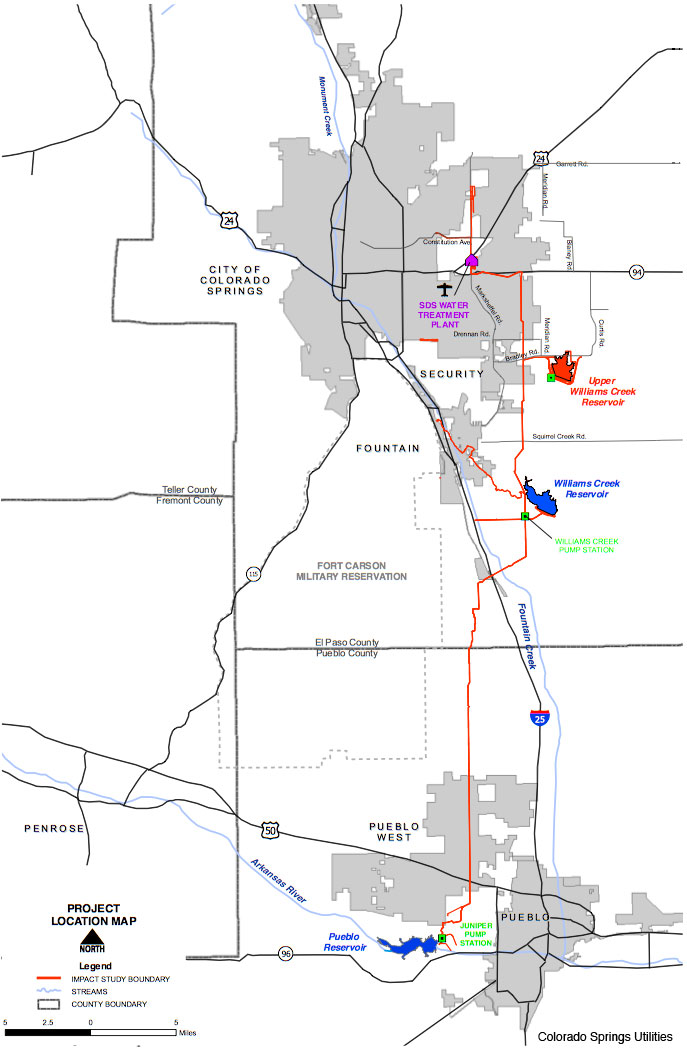
Southern Delivery System moving along

Southern Delivery System route map -- Graphic / Reclamation
Southern Delivery System route map — Graphic / Reclamation

From The Pueblo Chieftain (Chris Woodka):

Colorado Springs Utilities got a clean bill of health from Pueblo County’s weed manager Monday and answered questions raised at a Sept. 25 hearing about revegetation along the 17-mile route of the Southern Delivery System through Pueblo County.

Still, commissioners want more time to study documents submitted and continue a public hearing on SDS 1041 permit commitments to 9 a.m. on Dec. 8.

Utilities needs to fulfill conditions of Pueblo County’s 1041 permit for SDS in order to turn on its pipeline from Pueblo Dam to Colorado Springs next April. Revegetation compliance also would release $674,000 Pueblo County is holding under of the permit.

Utilities revealed it has spent more than $5.3 million on revegetation work already.

Colorado Springs provided point-by-point assurances on 17 issues raised on Sept. 25, when experts from both camps agreed Utilities had tackled the problem with state-of-the-art methods. Utilities also provided documentation from contractors that the work was done correctly, and that most landowners were satisfied with the work.

“We need to work through the (final) issues to protect the citizens of Pueblo County,” said Commissioner Terry Hart, who made a motion to take the comments under advisement and continue the hearing. “What we’re trying to do is look at the work in its totality.”

Hart, along with Commissioners Liane “Buffie” McFadyen and Sal Pace, had little criticism of Utilities’ report, which pledged further work with landowners as well as reviewing procedures already put in place to bring land disturbed by SDS construction back to its original condition or better.

“It’s light years ahead of other projects,” Hart said.

Bill Alt, who manages Pueblo County’s weed control program through the Turkey Creek Conservation District, agreed. Alt toured the pipeline route last week and said Colorado Springs has lived up to its responsibilities to reseed ground disturbed by SDS.

“The grass is up and doing well,” Alt said.

“Some of the tamarisk has been dug up by the roots and removed, and the topsoil has been replaced as in any mining operation.”

The problem is that the areas on either side of the 150-foot path of SDS are still susceptible to tumbleweeds (Russian knapweed) and tamarisk, which could still find their way back onto the treated area, particularly on the route north of U.S. 50, Alt said.

Some landowners have mowed or grazed the revegetated areas prematurely instead of allowing new grasses a chance to get established, he added.

“Everything is fine for what we looked at,” Alt said. “We did not go on Walker Ranches, although I would like to go because that’s where the erosion is.”

The Walker Ranches crossing is being handled under a $7.4 million settlement as a result of a jury verdict.

Colorado Springs also said it is working on a settlement with Dwain Maxwell, a Pueblo West resident who complained about the project at an earlier hearing. Utilities also has taken on a separate project to divert floodwater around a property just south of Walker Ranches in Pueblo West.

From KOAA.com (Jessi Mitchell):

As part of the deal, the utility company had to repair the land after digging up 50 miles of dirt to bury the 66-inch pipe, restoring at least 90% of the vegetation that was in place before. CSU showed the county that they have gone above and beyond the requirements, but commissioners have not yet released them from the commitment.

“The work that we’ve got done so far is already light-years ahead of other projects,” admits commissioner Terry Hart. Pueblo County commissioners applauded CSU for its nearly $5.4 million efforts to re-seed and irrigate the lands it plowed through to plant the SDS pipeline.

Landowners agree, giving high praise in a report to the way workers left things better than before.

CSU’s SDS permitting and compliance manager Mark Pifher says, “We put in a very extensive irrigation system. If I had to guess, it’s probably the biggest irrigation system ever installed in Colorado.

Commissioners had lots of questions when they first met to review the re-vegetation process in September, many of which addressed future concerns over erosion and management of the property. Pifher says doing a good job is about more than protecting the pipeline; it is about respecting the landowners as well. “It’s important that you do it with a mindset that this is like your property,” says Pifher, “how would you like it restored and put back into its historic condition, if you will.”

Bill Alt has been working closely with the group to oversee the management of noxious weeds throughout the easements, which have been removed on the property in question, but remain nearby and are likely to spread. Alt suggests CSU send a notice to the owners about maintaining the landscaping moving forward. “It needs some tender, loving care,” says Alt, “and it’s good for your property because it keeps the property value up. It’s not something you’re ashamed to show a realtor or other people.”

Commissioners will meet with Colorado Springs Utilities again Dec. 8 to make sure no other questions arise before checking re-vegetation off the long SDS checklist. The only other big issue standing in the way of water flowing north is Colorado Springs’ stormwater management efforts.

To access all official documents on the SDS, including CSU’s latest report, click here.

Suthers: Flood funding needed — The Pueblo Chieftain

Fountain Creek
Fountain Creek

From The Pueblo Chieftain (Chris Woodka):

Colorado Springs Mayor John Suthers made a strong statement for stormwater funding in his state of the city speech Wednesday.

In doing so, he prominently highlighted the reason it is needed is to reduce the harmful impact to Pueblo from increased flows on Fountain Creek caused by growth in Colorado Springs. Spring rains caused millions of dollars in damage in both counties this spring.

“As recently as the late 1960s, our neighbor to the south, Pueblo, was larger than Colorado Springs. Since then Colorado Springs has grown to be about four times the size of Pueblo and that means considerably more impervious surfaces contributing to stormwater flow into Fountain Creek, with impacts on Pueblo,” Suthers said.

The mayor carefully reviewed the history of the stormwater enterprise approved by Colorado Springs City Council in 2005. It generated about $15 million per year until 2009, when council abolished the fee on a 5-4 vote in an interpretation of a public vote.

In the meantime, Colorado Springs negotiated a 1041 permit with PuebloCounty for the Southern Delivery System that included reliance on the stormwater enterprise.

“Pueblo contends that in issuing the permit they were relying on the fact Colorado Springs would continue funding a stormwater enterprise and is considering a lawsuit to revoke or amend the permit,” Suthers said. “I and members of the City Council, which also serves as the utility board, have been negotiating with Pueblo in an attempt to resolve the matter.”

Pueblo County has hired Wright Water Engineers to document the relationship of higher impact flows on Fountain Creek and growth in Colorado Springs.

“We would like to avoid litigation that would delay SDS from going online in 2016,” Suthers said.

Suthers and council are proposing a plan to provide $19 million annually for at least 10 years, and highlighted specific budget areas where the money would come from. He also referred to last year’s vote where Colorado Springs and El Paso County voters narrowly rejected a regional drainage authority.

“While Pikes Peak area voters declined to pass a stormwater proposal in November 2014, this is a complex problem that is not going away and needs to be addressed,” Suthers said. “And I emphasize that this is a public safety issue for the citizens of Colorado Springs as well as those of Pueblo.”

Fountain Creek: “The annual maintenance of the levee [in Pueblo] has been neglected” — Ken Wright

Fountain Creek
Fountain Creek

From The Pueblo Chieftain (Chris Woodka):

It’s like adding insult to injury.

As if flooding on Fountain Creek weren’t bad enough, mountains of sand are stacking up north of Pueblo waiting to descend on the channel through the city.

Dealing with it will take cooperation from the north and decades to correct.

“It’s like a big anaconda eating an animal and moving it down,” said Ian Paton, part of the Wright Engineering team hired by Pueblo County commissioners to analyze the problem. Commissioners heard a status report on what will be an ongoing study on Friday.

The problem may be bigger than previously thought, Paton explained.

The net gain of sediment in Fountain Creek works out to about 370,000 tons a year between Fountain and Pueblo, causing the river to shift its flow in the channel as the increasing amount of material obstructs its path. It keeps piling up year after year as it eats away 20-foot cliffs.

And, it has become worse since 1980, when Colorado Springs started booming in population and major infusions of water from outside sources — Homestake, Blue River and the Fountain Valley Conduit — began putting more water into Fountain Creek.

Southern Delivery System, a 66-inch diameter pipeline from Pueblo Dam to Colorado Springs, could increase Fountain Creek flows 60-100 percent, while depleting the Arkansas River through Pueblo. Water quality will become an increasing concern as more sediment is churned up.

“Population is the driving factor,” said Andrew Earles, Wright’s top water resources engineer. “To have growth, you need water, and since the 1970s, you’ve been putting more and more water into Fountain Creek.”

Additional water has allowed more growth, and increased base flow threefold.

But the growth also has increased impervious surfaces — roofs, parking lots and streets — by 10 percent of the total watershed area upstream of Security, and caused base flows, high flows (the kind seen this spring) and big floods to become more intense at all times.

The Waldo Canyon and Black Forest fires of 2012 and 2013 have caused storms to generate up to 100 times the damage that would have occurred prior to Colorado Springs’ growth surge, Earles explained.

“We can’t turn back the clock. We can’t put it back to the way it was in the 1950s and ’60s,” Earles said. “We can put it in better shape for the future.”

A big part of that will be developing ways to deal with increased flows into Fountain Creek at the source.

That would include detention of floods, bank stabilization and control of tributaries in ways that reduce damage on the main stream.

Wright Engineers evaluated Colorado Springs and El Paso County estimates of 454 flood control projects that could cost $723 million to complete for their benefit to Pueblo County. About two-fifths of the projects totaling $537 million would reduce destruction to Pueblo.

Colorado Springs officials are proposing $19 million annually to bring stormwater control back to the level it was before its City Council abolished the stormwater enterprise in 2009.

“So far we agree with their list,” said engineer Wayne Lorenz.

Lorenz said a dam between Fountain and Pueblo is “worthy of consideration,” but cautioned that such a oneshot solution could fail.

“A dam is more of a treatment for a symptom rather than a cause,” Lorenz said. “We can’t put all our eggs in one basket with a dam because it might not happen.”

Commissioners are also concerned that projects be maintained.

In Pueblo, the Fountain Creek levees are in need of repair in order to provide the same protection they were designed to give 25 years ago.

“The levee is badly silted and vegetated, and it would take $2 (million)-$ 5 million to bring it back to standards,” said Ken Wright, head of the engineering firm.

“The annual maintenance of the levee has been neglected.”

The fear is new projects on Fountain Creek could sink in the same boat.

“We need to make sure we’re not just building projects, but have the money to maintain them,” said Pueblo County Commissioner Terry Hart.

Southern Delivery System testing to start up next month

Southern Delivery System route map -- Graphic / Reclamation
Southern Delivery System route map — Graphic / Reclamation

From The Colorado Springs Gazette (Billie Stanton Anleu):

Decades of planning and an $829 million investment in Colorado Springs Utilities’ biggest water project ever will be put to the test next month, and the folks behind the Southern Delivery System can’t wait.

Like children anticipating new bicycles for Christmas, project leaders are eager – not anxious – for the tests to begin. Their confidence is matched only by their pride in the project…

The water will flow from the Pueblo Dam through three new pump stations to a 100-acre water treatment plant built in Colorado Springs. The plant’s developed area alone could hold 77 football fields, noted Kim Mutchler, of CSU government and corporate affairs.

The entire system is to begin water delivery next April. But before it does, more tests will be done through September and October.

Since pipeline construction began in 2011, every piece of pipeline has been tested upon arrival, with each section water-tested once installed. Pump station testing started in July and is continuing into the fall, and small tests have been done for several months at the treatment plant.

Next month, tests are expected to begin sending water through multiple stages of treatment. Then several system-wide tests will be done through the fall before SDS starts serving customers next year…

Some of the biggest savings, says SDS Program Director John Fredell, came from the 3.62 percent interest rate on $180 million in 40-year bonds issued in September 2010. In all, $475 million in bonds have been issued.

But unforeseen cost cuts came, too, as engineers and others reviewed completed designs and plans, then unabashedly pointed to better, less expensive ways to accomplish what needed to be done.

To wit:

– The sprawling campus envisioned for the water treatment plant and its 10 million-gallon tank was reconfigured to put all essential functions under one roof, saving 4 miles of piping and more than $65 million.

– A contract engineer from the Broomfield-based MWH insisted that the three pump stations could be built for under $100 million, contrary to the contractor’s contention. So the project was rebid and built for $75 million. “Those are the benefits of having a really experienced engineer on your projects,” Fredell said.

– Several million more dollars were saved when a program leader noted that single welds instead of double welds could be used on pipes not handling high pressure.

– Another $10 million was saved when Dan Higgins, then the SDS construction manager, decided the pipeline beneath I-25 and Fountain Creek should be one long tunnel rather than a series of short tunnels using extensive open trenches, as envisioned by a consulting engineer. The new method also minimized impacts to floodplains, wetlands and mature trees.

SDS leaders also changed the type of pumps used, opting for more expensive $1 million vertical pumps – 11 in all – that will last longer, have lower electric costs and produce a higher discharge pressure, so another pump station didn’t have to be built in Pueblo.

“The most expensive commodity is electricity to push the water,” Fredell said.

But the humongous project also has brought financial benefits hidden to the casual observer.

When the SDS started in 2009, along with the recession, “We wanted this to be our own stimulus,” Fredell said. “We went on the road to Pueblo and El Paso and Fremont counties and did workshops on how to work with us.

Last section of pipe for Southern Delivery System photo via The Colorado Springs Gazette

“Only one company in Colorado can build this size diameter pipe. We got other companies from out of state to bid. But they (the Colorado firm) got over $100 million worth of business during the recession. This project helped keep them from having layoffs.”

Contracts set a goal of giving 30 percent of business to Colorado companies, with a penalty for those that didn’t.

“They’ve exceeded the local spend,” Fredell said. “We’ve had over 300 Colorado companies involved and spent $650 million through June, total, and $550 million has stayed in Colorado – $269 million to employers in El Paso County” plus $73 million in Pueblo County and $208 million elsewhere in the state.

The toughest part of the project has been the permitting and planning, he said, with more than 200 major permits obtained, and about 350 total.

The greatest challenges there were creating the 3,000-page Environmental Impact Statement (EIS), which took five years, and obtaining the 1041 Permit from Pueblo County.

The EIS was handled by Keith Riley, SDS deputy program director for CSU, with help from Bill Van Derveer, assistant SDS program director with MWH.

“The two of them were just brilliant in the way they approached it, got the science for the EIS, got all the people together, and worked well with all the agencies, including the EPA (U.S. Environmental Protection Agency),” Fredell said.

Two other key players, both now retired from CSU, were Gary Bostrom, chief water services officer, and Bruce McCormick, also a water services officer.

“That’s one of the things I’m proudest of, the people we’ve had work on this thing. They were just ingenious,” Fredell said. “The credit goes to people like that.

“This project has been so much fun. I’ve gotten all my white hair on this project. It’s definitely challenged everybody.”

Drip irrigation for your xeriscape — Colorado Springs Utilities

Drip irrigation graphic via Sonoma County Nurseries Resource

From the Colorado Springs Utilities Re:Sources blog:

I thought I knew enough about xeriscape to feel I could successfully convert a portion of my lawn to low-water plants and shrubs. That is, until I was reminded that my irrigation system will need to change too.

Whether you’re replacing grass or establishing new planting areas, xeriscape plants only need water those plants at their root zone. Drip irrigation is an efficient way to deliver water directly to the soil at the root zone of each plant, eliminating most evaporation. When used properly, drip irrigation systems can increase your water efficiency by up to 50 percent.

If you’re the handy type, you might try retrofitting your current system to drip irrigation. Take a few minutes to watch our drip irrigation video to learn more.

When you make the switch, remember that we offer a drip irrigation conversion rebate. Residential customers can save up to $200 and business customers up to $1,000, when you convert a portion of your lawn irrigation system to a drip irrigation system.

Get started today to start soaking in the savings.

Transmountain diversion concepts discussed in Rifle — Aspen Journalism #COWaterPlan #ColoradoRiver #CORiver

Homestake Dam via Aspen Journalism
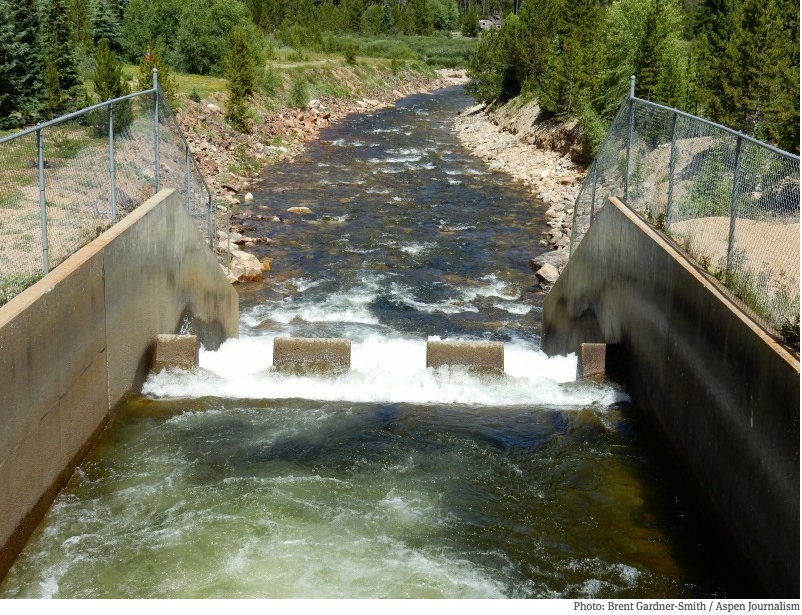
The dam that forms Homestake Reservoir on Homestake Creek, a tributary of the Eagle River. An agreement allows for more water to be developed as part of this transmountain diversion project.

From Aspen Journalism (Brent Gardner-Smith):

James Eklund, the director of the Colorado Water Conservation Board, invoked his Western Slope heritage at a “Summit on the Colorado Water Plan” hosted Saturday in Rifle by the Garfield County commissioners.

“The mantra I grew up with in Plateau Valley was not one more drop of water will be moved from this side of the state to the other,” said Eklund, whose mother’s family has been ranching in the Plateau Creek valley near Collbran since the 1880s.

Eklund was speaking to a room of about 50 people, including representatives from 14 Western Slope counties, all of whom had been invited by the Garfield County commissioners for a four-hour meeting.

The commissioners’ stated goal for the meeting was to develop a unified voice from the Western Slope stating that “no more water” be diverted to the Front Range.

“That argument had been made, probably by my great-grandparents, my grandparents and my parents,” Eklund said. “And I know there are a lot of people who still want to make that argument today, and I get that. But it has not done us well on the Western Slope.

“That argument has gotten us to were we are now, 500,000 to 600,000 acre feet of water moving from the west to the east. So I guess the status quo is not West Slope-friendly. We need something different. We need a different path. And these seven points provides that different path.”

The “seven points” form the basis of a “draft conceptual framework” for future negotiations regarding a potential transmountain diversion in Colorado.

The framework is the result of the ongoing statewide water-supply planning process that Eklund is overseeing in his role at the CWCB.

Eklund took the helm two years ago at the CWCB after serving as Gov. John Hickenlooper’s senior deputy legal counsel, and he’s been leading the effort to produce the state’s first water plan, which is due on the governor’s desk in December.

The second draft of the plan includes the seven points, even though the Colorado River Basin Roundtable, which meets monthly in Glenwood Springs under the auspices of the CWCB, is still on the record as opposing their inclusion in the water plan. That could change after its meeting on Monday.

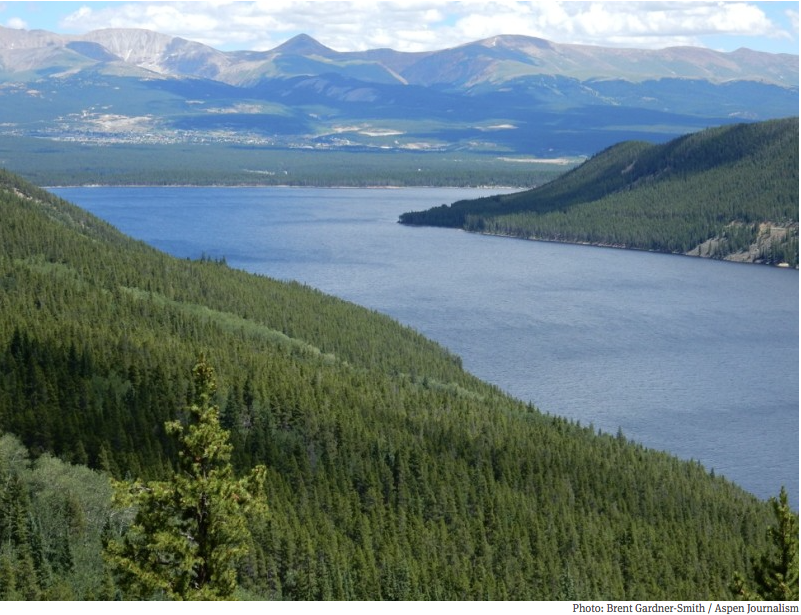
The outflow of the Bousted Tunnel just above Turquoise Reservoir near Leadville. The tunnel moves water from tributaries of the Roaring Fork and Fryingpan rivers under the Continental Divide for use by Front Range cities, and Pitkin County officials have concerns that more water will someday be sent through it.

Not legally binding

The “seven points” seeks to define the issues the Western Slope likely has with more water flowing east under the Continental Divide, and especially how a new transmountain diversion could hasten a demand from California for Colorado’s water under the 1922 Colorado River Compact.

“The seven points are uniquely helpful to Western Slope interests because if you tick through them, they are statements that the Front Range doesn’t necessarily have to make,” Eklund said in response to a question. “If these were legally binding, the Western Slope would benefit.”

Under Colorado water law a Front Range water provider, say, can file for a right to move water to the east, and a local county or water district might have little recourse other than perhaps to fight the effort through a permitting process.

But Eklund said the points in the “conceptual framework” could be invoked by the broader Western Slope when negotiating a new transmountain diversion.

As such, a diverter might at least have to acknowledge that water may not be available in dry years, that the diversion shouldn’t exacerbate efforts to forestall a compact call, that other water options on the Front Range, including increased conservation, should be developed first, that a new transmountain diversion shouldn’t preclude future growth on the Western Slope, and that the environmental resiliency of the donor river would need to be addressed.

“We’re just better off with them than without them,” Eklund said of the seven points.

The downstream face of the dam that forms Homestake Reservoir on Homestake Creek, a tributary of the upper Eagle River. A tunnel moves water from Homestake Reservoir to Turquoise Reservoir, near Leadville.

A cap on the Colorado?

Eric Kuhn, the general manager of the Colorado River District, which is based in Glenwood Springs and represents 15 Western Slope counties, told the attendees that three existing agreements effectively cap how much more water can be diverted from the upper Colorado River and its tributaries above Glenwood Springs.

The Colorado Water Cooperative Agreement, which was signed in 2013 by 18 entities, allows Denver Water to develop another 18,000 acre-feet from the Fraser River as part of the Moffat, or Gross Reservoir, project, but it also includes a provision that would restrict other participating Front Range water providers from developing water from the upper Colorado River.

A second agreement will allow Northern Water to move another 30,000 acre feet of water out of the Colorado River through its Windy Gap facilities, but Northern has agreed that if it develops future projects, it will have to do so in a cooperative manner with West Slope interests.

And a third agreement known as the Eagle River Memorandum of Understanding will allow Aurora and Colorado Springs to develop another 20,000 acre feet of water as part of the Homestake project in the Eagle River basin, but will also provide 10,000 acre feet for Western Slope use.

“So effectively these three agreements, in effect, cap what you’re going to see above Glenwood Springs,” Kuhn said.

The Moffat, Windy Gap and Eagle River projects are not subject to the “seven points” in the conceptual agreement, and neither is the water that could be taken by the full use of these and other existing transmountain projects.

“So when you add all that up, there is an additional 100,000 to 150,000 acre-feet of consumptive use already in existing projects,” Kuhn said.

But beyond that, Kuhn said Front Range water providers desire security and want to avoid a compact call, just as the Western Slope does.

“We’ve been cussing and discussing transmountain diversions for 85 years,” Kuhn added, noting that the Colorado Constitution does not allow the Western Slope to simply say “no” to Front Range water developers.

“So, the framework is an agenda,” Kuhn said, referring to the “seven points.” “It’s not the law, but it is a good agenda to keep us on track. It includes important new concepts, like avoiding over development and protecting existing uses.”

rquoise Reservoir, which stores water brought under the Continental Divide from the Eagle, Fryingpan and Roaring Fork river headwaters.

Vet other projects too?

Rachel Richards, a Pitkin County commissioner, told the attendees that she would like to see more water projects than just new transmountain diversions be subject to the seven points.

As part of the state’s water-supply planning efforts, state officials have designated a list of projects as already “identified projects and processes,” or IPPs, which are not subject to the seven points.

“We would like to see the same environmental standards, and community buy-in standards, applied to increasing existing transmountain diversions or IPPs,” Richards said, noting that the “IPPs” seem to be wearing a halo.

“They need to go through just as much vetting for concern of the communities as a new transmountain diversion would, and we’re probably going to see a lot more of them first,” she said.

At the end of the four-hour summit on the statewide water plan, Garfield County Commissioner Mike Sampson said he still had “real concerns” about the long-term viability of Western Slope agriculture and industry in the face of growth on the Front Range, but he offered some support for the seven points.

“I think the seven points is probably a good starting position,” Sampson said.

He also said Garfield County would make some edits to a draft position paper it hopes will be adopted by other Western Slope counties.

On Saturday, the draft paper said “the elected county commissioners on the Western Slope of Colorado stand united in opposing any more major, transmountain diversions or major changes in operation of existing projects unless agreed to by all of the county(s) from which water would be diverted.”

But Sampson was advised, and agreed, that it might be productive to reframe that key statement to articulate what the Western Slope would support, not what it would oppose.

Editor’s note: Aspen Journalism is collaborating with the Glenwood Springs Post Independent and The Aspen Times on coverage of rivers and water. The Post published this story online on July 25, 2015.

More Colorado Water Plan coverage here.
State water board rules against Glenwood’s proposed whitewater rights — Aspen Journalism #ColoradoRiver

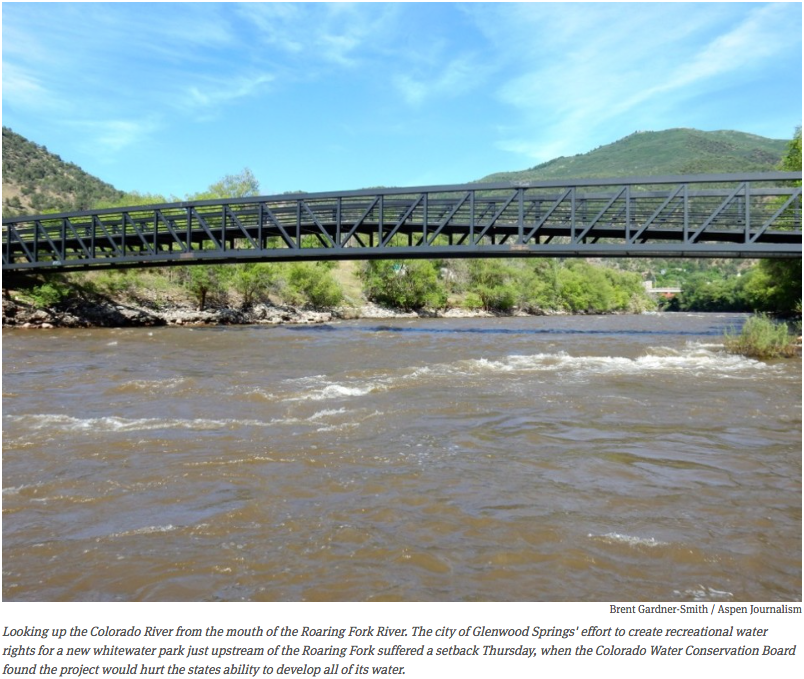
Upstream view of the Colorado River at the mouth of the Roaring fork River

From Aspen Journalism (Brent Gardner-Smith):

IGNACIO — The ongoing effort by the city of Glenwood Springs to establish a new water right for three potential whitewater parks on the Colorado River was dealt a setback Thursday by the directors of the Colorado Water Conservation Board.

The CWCB board voted 8-to-1 to adopt staff “findings of fact” that the proposed water rights for a “recreational in-channel diversion,” or RICD, would “impair Colorado’s ability to fully develop its compact entitlements” and would not promote “the maximum beneficial use of water” in the state.

James Eklund, the director of the CWCB, and a nonvoting board member, was asked after the meeting what he would tell a kayaker in Glenwood about the board’s vote on Thursday.

“These are complicated issues,” Eklund said. “The CWCB values recreational water projects and takes very seriously its charge to strike a balance among recreational, environmental and consumptive uses. The proponent’s data and analysis weren’t able to demonstrate that the RICD as proposed struck this balance to the satisfaction of the CWCB.”

The CWCB board is required by state law to review all applications made in water courts for new recreational water rights, and to make a determination if the water right would prevent the state from developing all the water it legally can.

Colorado’s “compact entitlements” stem from the 1922 Colorado River Compact, which requires seven Western states to share water from the larger Colorado River basin.

The compact requires that an unspecified amount of water be divided between Colorado, Utah and Wyoming, and estimates of the amount of water Colorado can still develop under the compact range from zero to 400,000 acre-feet to 1.5 million acre-feet.

Mark Hamilton, an attorney with Holland and Hart representing Glenwood, told the CWCB board members Thursday that there would be “no material impairment” to the state’s ability to develop new water supplies.

“If the issue really is what’s the additional upstream development potential, we would point out that significant upstream development can still occur,” Hamilton said.

Hamilton also said that the recreational water right would be non-consumptive, meaning the water would stay in the river and simply flow over u-shaped, wave-producing concrete forms embedded into the riverbed.

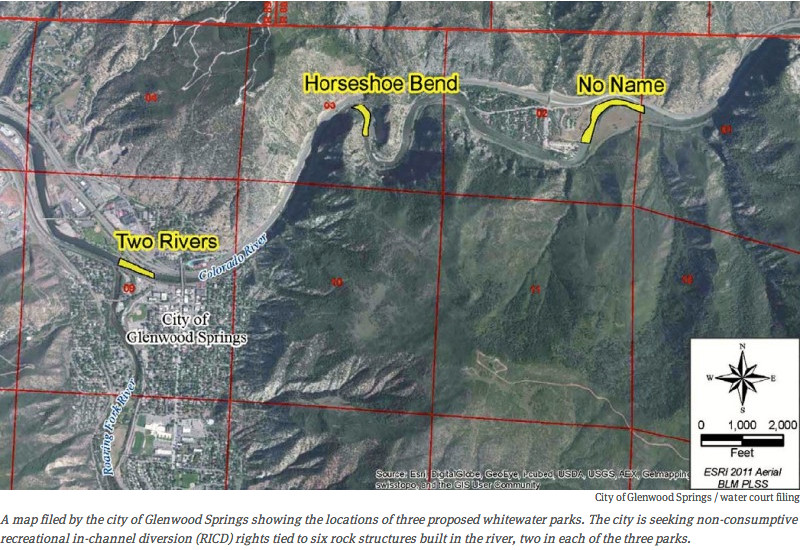
Glenwood is seeking the right to call for 1,250 cubic feet per second of water to be delivered to three whitewater parks at No Name, Horseshoe Bend and Two Rivers Park, from April 1 to Sept. 30.

It also wants the right to call for 2,500 cfs for up to 46 days between April 30 and July 23, and to call for 4,000 cfs on five consecutive days sometime between May 11 and July 6 in order to host a whitewater competition.

Aurora and Colorado Springs, together as partners in the Homestake transmountain diversion project, are opposing Glenwood’s water rights application, which was filed in December 2013.

“We do not oppose reasonable RICDs, but we believe this RICD claim is extraordinary by any measure,” Joseph Stibrich, the water resources policy manager for the city of Aurora, told the CWCB board, which was meeting in Ignacio on the Southern Ute Indian Reservation.

“We believe that a water claim of over 581,000 acre feet will seriously impair full development of Colorado’s compact entitlement,” Stibrich said. “This claim will severely impact the state of Colorado’s ability to meet its future water needs.”

Stibrich also said “this RICD is going to shift the burden of water supply development to meet the future needs of the state to the Yampa, to the Gunnison, and to the Rio Grande basins, while promoting further dry-up of irrigated lands throughout the state.”

Denver Water is also opposing Glenwood’s water rights application.

As part of the Colorado River Cooperative Agreement, Denver Water agreed not to oppose a RICD application from Glenwood, but only if Glenwood did not seek a flow greater than 1,250 cubic feet per second, which is the same size as the senior water right tied to the Shoshone hydropower plant.

Casey Funk, an attorney with Denver Water, said the utility stands by its agreement, but since Glenwood has asked for more than 1,250 cfs, it is opposing the city’s water court application. However, Funk said Denver Water is willing to keep negotiating with Glenwood.

The city made the case on Thursday that it was asking for more than 1,250 cfs on only 46 days between April and September, and it was doing so because the stretch of the Colorado from Grizzly to Two Rivers Park was more fun to float at 2,500 cfs than 1,250 cfs.

According to testimony Thursday, Glenwood also offered to include a “carve-out” in its water right to allow for 20,000 acre-feet of water to be diverted, stored and transported upstream of the proposed whitewater parks at some point in the future.

But that did not do much to sway the concerns of the CWCB staff.

“Staff is concerned with this provision, as it does not include water rights for transmountain diversions,” stated a July 15 memo to the CWCB board from Ted Kowalski and Suzanne Sellers of the CWCB’s Interstate, Federal & Water Information Section.

The CWCB staff memo also found that Glenwood’s recreational water rights would “exacerbate the call on the river and materially impact the ability of the state to fully use its compact entitlements because the RICDs will pull a substantial amount of water downstream.”

Peter Fleming, the general counsel for the Colorado River District, suggested the CWCB board give the parties in the case more time to continue negotiating before it ruled on its staffs’ findings.

The River District, which is also a party to Glenwood’s water court case, represents 15 counties on the Western Slope.

“We think that compact issues are effectively done,” Fleming told the board about Glenwood’s application. “We believe there is sufficient water above the RICD to develop.”

But the CWCB board did not take Fleming’s suggestion, and after relatively little debate and discussion, a motion was made to accept the staff’s findings that Glenwood’s RICD failed two of the three criteria the CWCB board was supposed to rule on.

“I think it is really unfortunate that the board took the approach they did,” said Nathan Fey, the Colorado stewardship director for American Whitewater, after the board’s decision against Glenwood.

American Whitewater and Western Resource Advocates are both parties in the water court case, and they are supporting Glenwood’s application.

“It is unclear what evidence the staff presented that shows it is of material impairment to developing our water, or maximizing use of the state’s water,” Fey said. “Those are significant concerns, but I don’t think the state made a very strong case on those points. And it sounds like we would prefer to see another transmountain diversion and some future use on the Front Range, rather than protect the current river uses we have in our communities, like Glenwood Springs, now.”

The board’s finding will now be sent to the Division 5 Water Court in Glenwood Springs, where the city filed its water rights application and the process is still unfolding.

And while the CWCB board’s determination is not binding on a water court judge, it has to be considered by the court as part of the ongoing case.

But Hamilton, Glenwood’s attorney, said after the meeting that the court would also need to consider additional balancing information presented by Glenwood.

It could be an uphill journey for Glenwood, though, as the CWCB staff has also been directed by the CWCB board to remain a party in the water court case and to defend its “findings of fact,” which includes more issues than were considered by the CWCB on Thursday.

Given the board’s vote on Thursday, Stibrich of Aurora said settlement discussions with Glenwood Springs are now likely.

“I’m certain they will make overtures to us and we’ll talk,” Stibrich said. “We’ll see if something can be reached or not.”

Editor’s note: Aspen Journalism is collaborating with the Glenwood Springs Post Independent and The Aspen Times on coverage of rivers and water. The Post Independent published this story online on July 16, 2015.

More whitewater coverage here.

City of Glenwood Springs proposed whitewater parks via Aspen Journalism

Settlement calms the waters — The Pueblo Chieftain

Southern Delivery System route map -- Graphic / Reclamation
Southern Delivery System route map — Graphic / Reclamation

From The Pueblo Chieftain (Chris Woodka):

Colorado Springs Utilities will have an easier time meeting conditions of its 1041 permit for the Southern Delivery System with Pueblo County as a result of a settlement agreement with Walker Ranches.

The $7.1 million settlement reached June 16 includes $5.78 million to pay a $4.75 million judgment awarded by a Pueblo jury in May plus interest dating back to 2011. Another $1.34 million covers the court costs and expenses incurred by Walker Ranches.

But the agreement does much more.

Pueblo County commissioners are making plans for a compliance hearing later this year on several conditions included in the 1041 permit, including Colorado Springs’ promises to revegetate the entire route of the SDS pipeline through Pueblo County and the provision that landowners would not pay out-of-pocket expenses.

But any issues concerning Walker Ranches are resolved, according to the settlement.

The Pueblo Chieftain obtained a copy of the confidential settlement agreement through a Colorado Open Records Act request after the document was alluded to at the June 26 meeting of the Fountain Creek Watershed Flood Control and Greenway District.

The agreement blocks Gary Walker, principal owner of the ranches, and Utilities from discussing its contents without mutual consent.

Walker had been vocal about damage to the ranchland before and after the jury trial.

The agreement specifies three conditions and accompanying mitigation appendices in the 1041 permit that pre-empt any complaints about compliance from Walker Ranches.

It still leaves open the question of Pueblo County determination of compliance regarding revegetation.

In return, Colorado Springs will address several of Walker’s concerns which it fought in court.

Those include fencing off the area being revegetated, paying Walker $300 per acre annually for the area that is being fenced, working with Walker on improving drainage and modifying the language in its easement if it interferes with future conservation easements.

Future construction activities on the easement are to be addressed separately, according to the settlement.

In addition to revegetation questions, the county is looking at whether Colorado Springs is complying with its commitment to control stormwater.

Colorado Springs Mayor John Suthers and City Council President Merv Bennett outlined plans for stormwater funding to Pueblo City Council this week. Suthers also has met individually with Commissioners Liane “Buffie” McFadyen, Terry Hart and Sal Pace.

Colorado Springs wants to include Pueblo County and other entities in a stormwater agreement that would provide input about whether stormwater improvements benefit Pueblo. Stormwater control is important because of the increased base flow in Fountain Creek as a result of more water coming through the SDS pipeline.

More Southern Delivery System coverage here

Colorado Springs Utilities to pay $7.1 million to settle lawsuit with Pueblo County rancher — Colorado Springs Gazette

Southern Delivery System route map -- Graphic / Reclamation
Southern Delivery System route map — Graphic / Reclamation

From The Colorado Springs Gazette (Billie Stanton Anleu):

Utilities announced the settlement Thursday. It had appealed the jury decision May 7, followed by Walker’s appeal May 14. Under the settlement, both appeals will be dismissed.

The city-owned utilities company also will fence revegetated areas on the ranches to protect them from cattle and will erect berms to reduce erosion across the 5.5-mile easement Walker provided for installation of the Southern Delivery System pipeline.

The rancher and Utilities had agreed that the easement was worth $82,900, and the pipeline was installed there in 2012…

But the SDS easement caused problems, Walker said at trial, with rain eroding the pipeline scar and Utilities introducing soils contaminated with seeds of invasive species. He also said the pipeline jeopardized a $25 million conservation easement he was negotiating with the Nature Conservancy for $1,680 an acre on 15,000 acres.

The settlement says both parties are committed to work together to manage and maintain the right-of-way.

Utilities said the pact gives it “additional certainty” about SDS costs, thus minimizing risk to ratepayers.

“It has always been our intent when working with property owners to use the court process as a last resort,” SDS program director John Fredell said in a news release. “By successfully resolving these issues with Mr. Walker, we can focus on completing the required revegetation on his property and finishing the SDS project on time and under budget.”

From the Colorado Springs Independent (Pam Zubeck):

Colorado Springs Utilities and Pueblo County rancher Gary Walker have come to terms to settle a lawsuit over land needed for the Southern Delivery System water pipeline.

The city-owned utility will pay Walker Ranches $7.1 million, ending litigation that led to a jury award of $4.75 million earlier this year and subsequent appeals filed by both the city and Walker.

More Southern Delivery System coverage here.

Southern Delivery System: Springs, Walker settle for $7.1M — The Pueblo Chieftain

From The Pueblo Chieftain (Chris Woodka):

Colorado Springs Utilities and Gary Walker have reached a $7.1 million settlement for the damage to Walker Ranches from the Southern Delivery System pipeline.

The pipeline crosses 5.5 miles of the 63,000-acre property on its route from Pueblo Dam to Colorado Springs. The $841 million SDS project is scheduled to go online next year and will supply water to Colorado Springs, Fountain, Security and Pueblo West.

On May 6, a jury awarded Walker $4.75 million, which included a $4.665 million judgment beyond the $82,900 stipulated value of the easement across Walker Ranches. Damages plus interest would have brought the total payment to $5.78 million, according to a joint press release.

Utilities disputed the amount, and filed an appeal on May 7. Walker Ranches appealed the decision on May 14. Those appeals were dismissed as part of the settlement reached June 16, but announced on Thursday.

The final agreement resolves all claims for $7.1 million, the press release said.

Utilities will also install fencing on Walker Ranches to prevent cattle from entering the area of the SDS pipeline scar that is being revegetated, and will work with Walker to erect berms on the property to reduce erosion.

The agreement also commits both parties to work together in the future to protect the right of way.

Utilities said the settlement provides more certainty about the ultimate cost of the project, reducing the possibility of an expensive appeals process.

“It has always been our intent when working with property owners to use the court process as a last resort,” John Fredell, SDS program director, said in the news release. “By successfully resolving these issues with Mr. Walker, we can focus on completing the required revegetation on his property and finishing the SDS project on time and under budget.”

Walker, when contacted by The Pueblo Chieftain , declined to comment because of the conditions of the settlement.

During the trial, Walker claimed the SDS project had compromised a $25 million conservation easement on 15,000 acres he was negotiating with the Nature Conservancy. He has used about $13 million from past easements to expand the ranches, which is part of a long-term plan to prevent further urban sprawl in northern Pueblo County.

Ray Petros, Pueblo County’s special counsel, said he has not seen the settlement agreement, so he is uncertain about how the county’s 1041 permit for SDS would be affected. The county is teeing up compliance hearings later this year on revegetation and Fountain Creek flood control, which are referenced in conditions that are part of the 1041 permit.

More Southern Delivery System coverage here and here.

The Pueblo County Commissioners hire Wright Water Engineering to review SDS 1041 permit compliance

Southern Delivery System route map -- Graphic / Reclamation
Southern Delivery System route map — Graphic / Reclamation

From The Pueblo Chieftain (Jeff Tucker):

If rushing water had to threaten a county road, the timing couldn’t have been better for the Pueblo Board of County Commissioners.

The commissioners on Wednesday unanimously approved a contract with Wright Water Engineering to the accompaniment of text messages from the public works department informing them that the surging Fountain Creek was threatening a portion of Overton Road.

The $115,000 contract will allow the county to tap into Wright Water’s expertise as it continues to evaluate whether Colorado Springs has complied with provisions of the permit regarding stormwater control that allowed Colorado Springs to build the Southern Delivery System water pipeline from the Pueblo Dam to Springs.

County Land Use Attorney Gary Raso said that in his conversations with the engineers at Wright, they were very familiar with the Fountain Creek and its issues in the past.

The Fountain serves as the primary drainage for Colorado Springs, along with other communities including Fountain, Monument, Security and Widefield.

“Pueblo County is incurring significant costs due to the failures of the north,” said Commissioner Terry Hart.

But the study focuses on Colorado Springs, particularly whether the city’s lack of any sustainable funding for stormwater improvement projects that would mitigate the impacts to Fountain Creek is a violation of the agreement.

The county is waiting until August to decide whether to issue a showcause hearing to Colorado Springs on whether to revoke or make significant changes to the agreement.

Again, the commissioners discussed the impact of the various burn scars in the area, including the Waldo Canyon burn scar.

But Commissioner Sal Pace noted that the Springs had eliminated its stormwater enterprise long before the Waldo Canyon Fire devastated the community.

“I think talking about the burn scar is a distraction,” Pace said. “These problems existed before the Waldo Canyon Fire. It implies that this is a new problem because of an act of God, when it was an act of man.”

Commission Chairwoman Liane “Buffie” McFadyen noted that the burn scar brings the overall lack of stormwater infrastructure into greater focus.
“This particular set of storms, combined with the burn scar, combined with the lack of infrastructure, will give Wright engineering a worst-case scenario,” she said.

More Southern Delivery System coverage here and here.

Pueblo County considering show cause 1041 hearing for Southern Delivery System

Southern Delivery System route map -- Graphic / Reclamation
Southern Delivery System route map — Graphic / Reclamation

From The Pueblo Chieftain (Chris Woodka):

Pueblo County is a step closer to calling for a hearing to decide whether to repeal or significantly alter the provisions of a 1041 permit allowing the Southern Delivery System to be built through the county.

On Monday, commissioners gave direction to staff to release a report to Colorado Springs detailing the progress of an investigation into whether that city’s lack of any specific funding for storm water permits constitutes a violation of the permit.

According to the report, staff’s recommendation is that, so far, the investigation shows there’s enough evidence to go forward with a show cause hearing on the 1041 document. But staff also asked for permission to hold off on issuing such an order until the first of August.

Waiting two months would give staff time to continue working with Colorado Springs, hire Denver-based Wright Water Engineering as a storm water consultant and give the new mayor and city council in Colorado Springs time to assess the issues for themselves.

“I am confident that there is some probability of success in coming up with some solutions to bring to the board, either as revised conditions or new amendments to the agreement,” said Ray Petros, water counsel to Pueblo County.

Petros said that it’s been six years since there was any dedicated funding in place for Colorado Springs’ storm water improvements and in that time, the number of infrastructure improvements that could help mitigate flows and improve water quality in the Fountain Creek have backlogged to the point that nearly $534 million worth of projects are awaiting completion.

Staff has been investigating the issue since April. Petros said it has been difficult to ascertain what high-priority projects have been completed or what kind of money has actually been spent on projects that would be beneficial to Pueblo County.

At the core of the investigation is the Springs’ decision to disband its storm water enterprise in 2009, along with the failure at the polls in 2014 of a measure to establish a new enterprise.

“Our issue has been from Day 1 that the 1041 permit requires some kind of dedicated funding,” said Commissioner Terry Hart. “No pun intended, but it’s been six years of water under the bridge and we’re painfully aware of that.”

Petros quoted a few passages within the 1041 permit that mentioned the funding source specifically, including the environmental impact statements attached to the permit.

The original staff report noted that the delay also gave Colorado Springs Utilities time to respond to information requests, but Hart said he felt Pueblo should set the timeline on that response.

Public Works Director Alf Randall said that the information requested by staff wasn’t complicated but understood if Colorado Springs staffers preferred to wait until the new mayor and council were sworn in.

Randall also said it would be good to have the information once Wright Water’s contract with Pueblo was finalized.

“I don’t understand what would be highly complex about providing staff a list of projects in 2015,” Randall said.

He said he thought it could be done by June 1.

The commissioners then directed that the June 1 deadline be included in the memo to Colorado Springs.

There are likely more investigations to follow. Commissioner Sal Pace asked staff to consider land purchases, reclamaneighbors. tion issues and potential impacts to Pueblo West homeowners in the investigation.

But the investigation came from a resolution focusing specifically on storm water issues.

All three commissioners said they would like to see future investigations into those other issues.

The commissioners also noted that the past week’s rainfall was a reminder of the urgency for the improvements, as runoff from Colorado Springs churned mud and debris in Fountain Creek and eroded property along Overton Road.

“We have a job to advocate for our constituents and I think the representatives from Colorado Springs, whether they like the process or not, would agree there’s been an impact to the community,” said Commission Chairwoman Liane “Buffie” McFadyen.

More Southern Delivery System coverage here and here.

Colorado Springs Utilities plans to appeal judgment that favored Pueblo-area rancher — The Colorado Springs Gazette

Southern Delivery System route map -- Graphic / Reclamation
Southern Delivery System route map — Graphic / Reclamation

From The Colorado Springs Gazette (Billie Stanton Anleu):

Colorado Springs Utilities has filed notice that it intends to appeal a jury’s $4.6 million judgment in favor of rancher Gary Walker, who let Utilities build a 5.5-mile pipeline on his land for the Southern Delivery System.

Walker and Utilities had agreed that the easement was worth $82,900, and the pipeline was installed on his northern Pueblo County land in 2012 as a conduit for the Southern Delivery System, or SDS.

That regional project is designed to pump Arkansas River water from the Pueblo Reservoir to Colorado Springs, Fountain, Security and Pueblo West, delivering up to 96 million gallons a day to those communities. Water delivery was expected to begin in 2016.

At trial, Walker’s counsel said Walker was negotiating a conservation easement worth more than $30 million with the Nature Conservancy, but degradation of the utility easement destroyed those prospects.

Colorado Springs, which owns Utilities, “had no opportunity to prepare a rebuttal to this surprise, unprecedented argument,” said the notice of intent to appeal filed late Thursday.

The notice questions, among other things, how a property value can be agreed upon at $82,000 and then valued at more than $30 million before a jury, and whether it was appropriate to deny the jury an opportunity to view the property.

The Pueblo County District Court jury deliberated for nine days before rendering its verdict April 23.

Neither Walker and his attorneys nor the Nature Conservancy returned calls Friday.

But SDS spokeswoman Janet Rummel said storms on the land drained water onto the pipeline alignment, causing erosion after the easement had been restored.

“We’ve been working ever since to fully restore it,” Rummel said. “His attorney was claiming actually not as much about the reclamation, but really about his lack of ability to ensure future conservation easements on his property. We really saw no evidence presented that that was the case. That was changing the big concern at the 11th hour of this trial. We need to take into account the effects on our ratepayers.”

Utilities paid Walker about $720,000 to move his cattle and laid irrigation lines along the easement to ensure that plants for restoration would survive, she said.

“From our perspective, we’ve gone above and beyond to address the concerns raised.”

The Fountain Creek Watershed, Flood Control and Greenway District isn’t taking a position on the legal battle, said Executive Director Larry L. Small. But the district is supposed to receive $10 million every year for five years to mitigate the extra flow that Fountain Creek will experience.

“If this drags on, it could impact SDS from becoming operational – and our revenue. That wouldn’t be too good because we’re waiting for that money to begin doing the work we need to do.”

From The Pueblo Chieftain (Chris Woodka):

Rains along the Southern Delivery System pipeline scar through Walker Ranches is again causing flooding problems in northern Pueblo County.

“Prior to the SDS crossing Walker Ranches, we never had floods like these from that area,” said ranchver Gary Walker. “Mother Nature’s defenses took care of it.”

Walker is involved in litigation with Colorado Springs over the 5.5-mile stretch of buried 66-inch diameter pipeline. A jury in April awarded Walker $4.665 million in damages, which Colorado Springs is appealing.

On Friday, rains created a river of mud along the pipeline route, causing some flooding in adjacent areas. Walker supplied aerial photos to The Pueblo Chieftain that show water crossing and sheet off the pipeline scar, with several hundred feet of plastic irrigation pipe — used for revegetation — hanging above a chasm of rushing water.

Walker said this is a violation of Colorado Springs Utilities’ commitments under Pueblo County’s 1041 permit for SDS because the area has not been returned to pre-construction conditions.

He first raised the issue of the pipeline route, which crosses arroyos, in 2008. He wanted the pipeline to follow the route of the Fountain Valley Conduit, constructed in the 1980s, which he said would be less damaging to his ranchland.

“Now Walker Ranches will become part of the flooding problem to downstream residences of Fountain Creek and the Arkansas River,” Walker said. “These are not Biblical events. Our weather is just returning to normal and our drought is ending, as any ‘old-timer’ like me will tell you.

From The Pueblo Chieftain (Chris Woodka):

Colorado Springs Thursday appealed a $4.665 million jury award for damages to Walker Ranches by the Southern Delivery System water pipeline.

The appeal was made in Colorado Court of Appeals in Denver.

The city’s lawyers said the April 23 verdict was delivered after a nine-day trial without any other findings or calculations.

The city’s lawyers added they had no chance to rebut the closing argument of Walker Ranches’ lawyers that the SDS pipeline across 5 miles of the property had diminished the value of surrounding land and that testimony did not support the verdict.

They also claimed the basis for diminished value of the property was not revealed until opening arguments and the value itself only in closing arguments.

A court judgment on the $4.665 million award was entered Wednesday by Pueblo District Judge Jill Mattoon.

Gary Walker, whose family owns the land, said the Nature Conservancy was negotiating with him to buy conservation easements for $1,680 per acre on about 15,000 acres, about $25 million.

“The city had no opportunity to reply to this surprise, unprecedented argument,” Colorado Springs attorneys wrote in the appeal.

Neither side disputed the value of the $82,900 150-foot-wide utility easement for a buried 66-inch diameter pipeline which Colorado Springs offered $1,400 an acre.

Colorado Springs’ filing lists 14 points of law, as well as a catch-all “any other issues” that were not covered by crossappeal.

Among the points raised by Colorado Springs lawyers is whether conservation can be considered the highest and best use for property, a topic Walker elaborated on in an interview with The Pueblo Chieftain after the trial.

Walker explained that conservation is the main purpose for Walker Ranches and illustrated that by pointing out that the millions of dollars from previous conservation easements was used to purchase more land with the intent of preserving ranch land and open spaces for future generations.

Colorado Springs’ attorneys also raised the question of whether Mattoon erred by denying the jury an opportunity to view the property.

More Southern Delivery System coverage here.

Southern Delivery System: Jury awards rancher $4.6M — The Pueblo Chieftain

Southern Delivery System route map -- Graphic / Reclamation
Southern Delivery System route map — Graphic / Reclamation

From The Pueblo Chieftain (Chris Woodka):

A Pueblo jury late Thursday awarded rancher Gary Walker a $4.6 million judgment against Colorado Springs Utilities for the Southern Delivery System pipeline crossing Walker Ranches in Northern Pueblo County.

Walker contends the amount is far short of what the pipeline has cost him. During the trial, he contended that the conditions of the SDS easement have jeopardized a $25 million conservation easement he was negotiating with the Nature Conservation for $1,680 an acre on 15,000 acres.

Walker said the conditions of the utility easement through his property allow for access that negates the value of the conservation easement, and that soils from offsite that were used as fill are contaminated with seeds from invasive species. Rain storms already have caused erosion on the pipeline scar and the damage could be greater in the future.

He also said he is fearful that Colorado Springs will take action against him if normal ranch activities interfere with the SDS permanent easement that is 100 feet wide across 5.5 miles of Walker Ranches.

The jury awarded Walker $4.665 million in damages in addition to the $82,900 actual value of the easement. The actual value was part of Judge Jill Mattoon’s instructions to the jury.

“We stung Colorado Springs, but it will do little to protect the next little guy or rare environmental landscape that gets in their way,” Walker said in a written statement provided to The Pueblo Chieftain. “My attorneys were amazed at CSU’s response against one rancher. It was like using a tank to kill a fly.”

The rancher charged that Colorado Springs drove up litigation costs intentionally. In December, Walker won a Pueblo District Court decision on costs of about $500,000 to that point, but the state Supreme Court pushed the decision back until the trial concluded. In that case, Walker said Colorado Springs had needlessly delayed trial.

“Colorado Springs punished us a great deal both financially and emotionally but I am glad we did it and I would do it again even though we lost a lot more than we gained,” Walker said. “Our financial loss is minor when compared to the loss of another open space and protected wildlife habitat area.”

Walker plans to raise the issue of how he was treated by Colorado Springs to Pueblo County commissioners, who issued a 1041 permit for SDS in 2009.

“My hope is that Pueblo County stands their ground and protects everyone by holding the city of Colorado Springs and their utility company to the terms of the 1041 contract they signed in 2009,” Walker said.

Walker also indicated that he is nervous about whether he will actually be able to collect the $4.6 million, since he expects Colorado Springs to appeal.

Colorado Springs has not indicated if it will ap- peal the judgment.

“We are disappointed in the outcome and will be exploring our options to protect the interests of those residents who are helping to fund the SDS project and will be impacted by this outcome,” said Janet Rummel, SDS spokeswoman for Colorado Springs Utilities. “We do not believe the result was supported by the evidence presented.”

She contended that Colorado Springs has worked to address Walker’s concerns and to offer fair compensation for the easements, along with paying $720,000 to relocate cattle during construction.

“We will continue to work with Mr. Walker and all easement holders on the SDS alignment to complete successful restoration and revegetation, as well as to responsibly maintain the condition of our easements,” Rummel said.

More Southern Delivery System coverage here.

Southern Delivery System: Closing arguments expected to conclude today in Walker Ranch lawsuit

Southern Delivery System route map -- Graphic / Reclamation
Southern Delivery System route map — Graphic / Reclamation

From The Pueblo Chieftain (Chris Woodka):

Closing arguments are expected to wrap up sometime today in a jury trial to determine the value of the Southern Delivery System easement across Walker Ranches in Pueblo County.

Expert witnesses for Colorado Springs testified Tuesday, the seventh day of the trial.

Attorneys for both sides indicated the testimony would wrap up soon and they were preparing to present closing arguments today. After that, the jury will begin its deliberations.

Court records indicate Gary Walker was offered $100,000 for easements on a 150-foot wide strip 5.5 miles long through Walker Ranches in northern Pueblo County. Colorado Springs, which is building SDS, also paid Walker $720,000 to relocate cattle during three years of construction.

Construction on SDS began in 2011, and includes 50 miles of underground pipeline 66 inches in diameter in Pueblo and El Paso counties. The final phase of construction in Pueblo County is the Juniper Pump Station being built near Pueblo Dam.

Walker claims the choice of pipeline route has contributed to erosion and diminished the value of his land. His court records claim SDS has caused $25 million worth of impact on his ranches, which total 65,000 acres. He’s also claiming damages under Pueblo County’s 1041 permit for SDS, which protects landowners from out-of-pocket expenses and requires Colorado Springs to use eminent domain only as a last resort.

District Judge Jill Mattoon is presiding over the trial.

More Southern Delivery System coverage here.

Trial opens on Walker’s SDS costs — The Pueblo Chieftain

Southern Delivery System route map -- Graphic / Reclamation
Southern Delivery System route map — Graphic / Reclamation

From The Pueblo Chieftain (Chris Woodka):

A contentious jury trial over the value of easements for the Southern Delivery System pipeline crossing Walker Ranches opened Monday in District Judge Jill Mattoon’s courtroom.

Colorado Springs Utilities offered about $100,000 for the easements, and has paid rancher Gary Walker $720,000 for moving cattle to alternate grazing pastures. Walker claims the value of SDS impacts on his land are $25 million, according to court documents. The 66-inch diameter pipeline has a 50-foot permanent easement and 100-foot temporary easement across 5.5 miles of Walker Ranches.

The total length of the SDS pipeline from Pueblo Dam to Colorado Springs is about 50 miles.

Walker spent about eight hours on the stand Monday and Tuesday testifying about the impact SDS has had on his cattle, violating existing conservation easements, introducing toxic materials and invasive species and other issues he has experienced since Colorado Springs constructed the underground pipeline in 2011. Water from the pipeline scar flooded other areas of the ranches and contributed to erosion, Walker said.

Walker stressed throughout that he does not believe he has been treated fairly in his dealings with Colorado Springs.

“After dealing with Colorado Springs since 2011, I’m worried about anything that occurs between you and I,” Walker pointedly told Colorado Springs attorneys during a testy cross-examination.

Colorado Springs in February won an appeal to the state Supreme Court to overturn a $500,000 judgment for court costs awarded by retired District Judge Victor Reyes in December. Walker had claimed Colorado Springs delayed the trial while he accrued costs for expert witnesses.

Colorado Springs is questioning Walker’s basis for damages, claiming conservation easements do not affect the parcels where the pipeline was built and that Pueblo County’s 1041 permit is an agreement between Colorado Springs and Pueblo County, not individual landowners. One of the conditions of the 1041 permit states that landowners should not have out of pocket expenses because of real estate transactions related to SDS.

Because of the large volume of documents in the case, the trial is expected to take about two weeks.

More Southern Delivery System coverage here.

Water in the West and California’s drought: Why Colorado Springs should care — Colorado Springs Utilities

Colorado Springs circa 1910 via GhostDepot.com

From Re:Sources Blog (Patrice):

Living in the West offers many advantages. Wide open spaces, majestic mountains and amazing recreational opportunities, to name a few. Still, there are challenges and water is certainly one them.

If you’ve seen the recent news, extreme drought is taking its toll in California. In light of this, we caught up with our own water planners – Abby Ortega and Leon Basdekas – to learn if what’s taking place with our neighbors could affect our community and why we need to stay involved in what’s happening around the region.

Some of our customers many ask, could what’s taking place in California happen in Colorado?

Extreme drought can happen anywhere, and we are certainly not immune. We continuously monitor our water supply situation and maintain a storage reserve in our reservoirs to meet customer demand for at least one year.

Why should we take an interest in or follow what’s happening with drought in the West?

In Colorado Springs and across the Front Range, we are heavily reliant on the Colorado River for our water supply. The Colorado River starts in Colorado, but we only keep a portion of the flow for use in the state per the Colorado River Compact. The Colorado River also serves Arizona, Utah, Nevada, Wyoming, New Mexico and California (see below for a breakdown). There is also an obligation to Mexico. When any of the states or Mexico are in an extreme drought, their reliance on the Colorado River water may increase, possibly resulting in ripple effects that could negatively impact us. At any given time, the Colorado River supplies about 70 percent of our community’s water. Drought can also affect the levels in Lake Powell and Lake Mead, which part of the western United States relies on for power production.

Will Colorado Springs experience any impact from the situation in California?

The California drought will not have direct impacts to our community’s water supply yet. We are working closely with the Upper Basin States to create a proactive contingency plan in the event that storage levels in Lake Mead and Lake Powell drop to critical levels.

What is Colorado Springs Utilities doing to help protect our community from this type of situation?

Maintaining a dependable water supply for Colorado Springs residents and businesses is one of our community’s greatest challenges. Continuous long-term water planning is the reason we have a reliable water system today that supports our economy and quality of life. For us, planning is part of our daily responsibilities and includes factors such as water sources, demand, water rights, infrastructure, storage and much more. In addition, we are currently updating our Integrated Water Resource Plan, which provides the roadmap for sustainably addressing water supply and demand issues, while reflecting our community values.

What can customers do to help?

The intelligent use of water will always be a priority for our community, which has done a great job of adapting to our semi-arid climate. Our customers continue to find ways to use water wisely and we can help. A good place to start is our website, which has free xeriscape class schedules, efficiency ideas, DIY videos, and more. Folks should also join in the conversations we’re having through the Integrated Water Resource Plan process. There are opportunities for input, whether online or at upcoming meetings.

More Colorado Springs Utilities coverage here.

Southern Delivery System: The Pueblo County commissioners take first step to evaluate Colorado Springs’ 1041 permit compliance

Fountain Creek Watershed

From The Pueblo Chieftain (Jeff Tucker):

The Pueblo Board of County Commissioners got a first look at a resolution that will allow the board to retain legal counsel along with engineering consultants and other staff to evaluate whether Colorado Springs’ lack of any consistent stormwater funding is a deal-breaker for the Southern Delivery System.

The board took no official action on the measure, instead instructing attorneys Gary Raso and Ray Petros to fine-tune the resolution before it comes back for a vote.

The crux of the issue is the failure of a ballot measure in Colorado Springs in November that would have created a dedicated funding source for stormwater improvements in Colorado Springs that could mitigate the impact of runoff into the Fountain Creek.

The work that would be cleared by the resolution will allow staff to examine what’s been done so far and what still needs to be done for Colorado Springs to comply with the stormwater requirement in the SDS 1041 permit.

“We need to develop a factual basis for any action we take,” said Raso. “It would be the first time that Pueblo County would have an independently established set of facts about the stormwater flowing through the Fountain Creek.”

Petros told commissioners Monday that Colorado Springs has provided staff a summary of its stormwater expenditures.

Colorado Springs has indicated that it has budgeted $17 million this year for more improvements, but Petros said there’s yet to be any indication what those improvements are or if they’re among the 239 projects worth more than $534 million identified in 2013.

Commissioner Sal Pace said he wants a clear picture on what projects Colorado Springs has planned that directly mitigate impacts on the Fountain Creek and which ones are aimed at fixing the challenge of runoff from the various burn scars in the area.

It’s possible that building flood control projects for the burn scar will have an impact on the flooding in Fountain Creek. But Commission Chairwoman Liane “Buffie” McFadyen wondered whether the impacts of the Waldo Canyon Fire are accounted for under the current agreements over the SDS, since those were signed before the first spark of the catastrophic fire ever landed.

McFadyen also worried that the work set forth in the resolution may be at odds with the needs of the county’s own constituents in Pueblo West. The metro district ties into SDS.

“I don’t want to see Pueblo West used in a way that could be interpreted as gamesmanship in all of this,” she said.

Commissioner Terry Hart noted that the $50 million being paid to the Fountain Creek Watershed Flood Control and Greenway District likely won’t be enough to pay for the mitigation projects in Pueblo County and asked Petros and Raso to include a specific date in the resolution as to when the information will be ready.

Petros suggested the end of June, to give the newly elected mayor and City Council time to get sworn in after April 7 elections and for next month’s lawsuit over compensation by Colorado Springs to Walker Ranches to run its course.

However, Hart said he’d like to see it sooner.

“I didn’t create this problem,” he said. “What created this problem was the failure of the question in November.”

More stormwater coverage here.

The Fountain Creek District is focusing on maximizing SDS payments from Colorado Springs

Southern Delivery System route map -- Graphic / Reclamation
Southern Delivery System route map — Graphic / Reclamation

From The Pueblo Chieftain (Chris Woodka):

Big money for flood control on Fountain Creek would become available in January the year after Southern Delivery System begins delivering water.

But the district that will receive the $50 million in payments over five years wants to make sure the money is safe from Taxpayer’s Bill of Rights legislation that could erode the funds.

Most likely, the money would begin arriving in 2017, provided that Colorado Springs meets all conditions of its agreement with Pueblo County.

Last week, the Fountain Creek Watershed Flood Control and Greenway District board asked Pueblo County commissioners and Colorado Springs Utilities to amend the 1041 agreement on SDS to make payments to its newly created enterprise, rather than the district. The resolution passed 9-0.

“The money has to be redirected so we can comply with the TABOR spending limit,” Executive Director Larry Small explained.

The money has to be spent on flood control projects that directly benefit Pueblo County, and the district has studies in progress to determine what sort of projects it could be applied.

The Fountain Creek district is looking at a dam or detention ponds between Colorado Springs and Pueblo to reduce the damage from large floods. It is also tackling the questions of impacts of temporary storage on water rights raised by farmers downstream on the Arkansas River.

TABOR puts limits on how much spending can increase by publicly funded entities in Colorado, year over year. Small gave his board projections that showed the full $50 million would not be available. The district intends to use the money to leverage other sources of payment.

Conservancy districts, including Southeastern and the Lower Ark, have long used enterprises to deal with funds collected and spent on top of property taxes. Under state law, the Fountain Creek district can assess up to 5 mills in property tax with voter approval, but it has never approached voters in El Paso and Pueblo counties to initiate any tax.

More Fountain Creek coverage here.

Southern Delivery System: “It’s a wonderful, wonderful day to celebrate” — John Fredell

From The Colorado Springs Gazette (Jakob Rodgers):

The last 50-foot pipe of the 50-mile-long Southern Delivery System arrived at a construction site Wednesday, marking a key milestone for the project as it nears completion next year both on time and under budget.

“We put to rest a lot of doubters that we’d get this done,” said Lionel Rivera, Colorado Springs’ former mayor, who helped approve the project.

With Kool & The Gang’s “Celebration” playing in the background, a truck hauled the massive blue pipe to a site just south of Pikes Peak International Raceway. Crews will place it underground in the coming weeks, completing a system spanning from Pueblo Reservoir to a new water treatment facility in Colorado Springs, which is under construction.

More than 7,000 of the steel, 66-inch-diameter pipes were installed since in 2010. That included a mile-long stretch bored 85 feet below Interstate 25 – a tunnel that was $10 million cheaper than creating a surface trench, according to Colorado Springs Utilities.

Current and former elected officials from across southern Colorado, along with several contractors who have worked on the project, were among scores of people on hand to watch the pipe being delivered. Many signed their names on it.

“It’s great – we’ve been at this a long time,” said John Fredell, the Southern Delivery System’s program director. “It’s a wonderful, wonderful day to celebrate.”

Three pump stations and the treatment facility are expected to be completed this year, with the system up and running for customers in Colorado Springs by the first quarter of 2016, Fredell said.

The project is on track to cost $841 million, below Colorado Springs City Council’s approved budget of $880 million in 2009, which did not account for inflation or rising material costs. The council also serves as Utilities’ board. Those savings rise to about $150 million when factoring in the cost of inflation and increases in material costs, said Fredell, who credited design changes to the pipeline and water treatment facility for much of the savings.

From the Denver Business Journal (Cathy Proctor):

One of the biggest water projects in the western U.S. will hit a major milestone this month, when the last piece of 50 miles of pipe is laid for the Southern Delivery System, the $841 million project to bring new water supplies to Colorado Springs and nearby communities.

The project includes 50 miles of pipeline, three pump stations and a water treatment plant. It will deliver water from the Pueblo Reservoir to Colorado Springs, Fountain, Security and Pueblo West.

More than 7,000 sections of blue-colored, welded, steel pipe 50 feet long and most of it 66 inches in diameter were installed on the project during the last 3 1/2 years of construction.

The project spent $204 million on pipe and installation, according to the Colorado Springs Utilities.

“The pipe is the main artery for this water project and we are extremely pleased with how the pipeline construction went,” said John Fredell, the program director for the Southern Delivery System project.

The project is in the final year of construction and Fredell said the costs are expected to be nearly $150 million under the original budget…

Northwest Pipe (Nasdaq: NWPX), based in Vancouver, Washington, manufactured the SDS pipe at its Denver plant.

Three contractors installed the pipe, Garney Construction, headquartered in Kansas City with an office in Littleton; ASI/HCP Contractors of Pueblo West; and the heavy civil division of Layne, a construction firm based in The Woodlands, Texas, which has four offices in Colorado.

Construction is continuing on other elements of the Southern Delivery System project, including a $125-million water treatment plant and pump station that will have the capacity to treat and pump 50 million gallons of water per day. Three pump stations will help move water uphill, about 1,500 feet in elevation, from the Pueblo Reservoir, also are under construction.

Construction on the remaining portions of the project are expected to be finished by the end of 2015.

From KRDO (Rana Novini):

Community leaders gathered Wednesday to celebrate the completion of pipeline construction for the Southern Delivery System (SDS). The project consists of more than 7,000 50-foot sections of steel pipe that have been installed over the last three and a half years. The pipe will transport water stored in the Pueblo Reservoir north to Pueblo West, Fountain, Security and Colorado Springs.

“It’s taken many years and it’s taken many city councils and it’s taken many leaders and many workers to accomplish this,” said Colorado Springs City Councilman Merv Bennett. “Our friends to the south, the Lord gave them the Arkansas River as their delivery system. To the north, Denver has the South Platte River as their delivery system. We have Fountain Creek and we ran out of that water in 1912.”

Proponents of the SDS argue the pipeline will ensure Colorado Springs and surrounding areas can continue to grow, especially toward eastern El Paso County. The region will have to worry less about drought and watering restrictions.

“Water is important. It’s the lifeline of a community,” said Lionel Rivera, former mayor of Colorado Springs. “It’s the way you grow and I think we’ve ensured the water supply for at least the next 50 years.”

Rivera was mayor from 2003 until 2011 and helped get the project rolling. He said Tuesday that it was one of the most rewarding things he did as mayor.

“It’s very exciting, a little bit emotional to see that pipe,” Rivera said. “It just made me think of all the stuff we had to go through to get this approved. We were told back when we started it that it couldn’t get done from a political standpoint, but we proved the doubters wrong.”

The project has had opponents over the years, many from Pueblo who are concerned over stormwater issues.

Though pipeline construction is complete, workers still need to build water treatment plants and pump stations. The first drop of water is expected to be delivered in spring 2016.

From The Denver Post (Bruce Finley):

Construction crews are poised to lay the final pipeline link for Colorado’s biggest water project in decades — an $841 million uphill diversion from the Arkansas River to enable population growth in Colorado Springs and other semi-arid Front Range cities.

Eleven 2,000-plus horsepower pumps driven by coal-fired power plants will propel the water from a reservoir near Pueblo through a 50-mile pipeline with an elevation gain of 1,500 feet.

This is the first phase, moving up to 50 million gallons a day, for a Southern Delivery System that utility officials estimated will eventually cost $1.5 billion.

“It means we will have greater water security,” Colorado Springs utilities spokeswoman Janet Rummel said. “Businesses need water. Our communities need water to survive. It means we can continue to serve our population as it grows.”

Water challenges loom across Colorado, with state officials projecting a 163 billion-gallon shortfall. A few years ago, drought forced Colorado Springs to stop watering municipal parkways and gardens.

The diverted water can be used only within the Arkansas River Basin, officials said, ruling out sales to south Denver suburbs. And the river water, after treatment, must be returned to downstream farmers.

Colorado Springs residents have been paying for the project through water bills, which increased by 52 percent over four years. Utility officials spent $475 million from bonds.

The water will flow by next March, officials said. At full buildout, the system will store water in two new reservoirs east of Colorado Springs.

The new north outlet works at Pueblo Dam -- Photo/MWH Global
The new north outlet works at Pueblo Dam — Photo/MWH Global

From The Pueblo Chieftain (Chris Woodka):

The Southern Delivery System pipeline’s completion was marked by a contingent of El Paso County officials and a smattering of Pueblo County folks as well.

For John Bowen, president of ASI Constructors of Pueblo West, the SDS project has meant bread on the table as well as water in the pipes.

“It’s generated $50 million in contract values for our company,” Bowen said during a ceremony to mark completion of the SDS pipeline from Pueblo Dam to Colorado Springs. “We were able to grow as a business during a time when a lot of contractors were laying people off.”

ASI was the primary contractor for the connection at Pueblo Dam, as well as 12 miles of the 50-mile SDS pipeline route, and relied on 70 local businesses for support services. The SDS project generated $800,000 in wages for ASI workers.

More Southern Delivery System coverage here and here.

Southern Delivery System: 1 mile bore under I-25, Fountain Creek, and the railroad should be completed 1st quarter

Southern Delivery System route map -- Graphic / Reclamation
Southern Delivery System route map — Graphic / Reclamation

From The Colorado Springs Gazette (Monica Mendoza):

A giant teeth-gnashing machine is boring its way 85 feet under Interstate 25, two sets of railroad tracks and Fountain Creek. The machine is cutting a 1-mile long tunnel about 20 miles south of downtown Colorado Springs for a section of a massive pipeline project that will carry millions of gallons of water from the Pueblo Reservoir to Colorado Springs. It is the most complicated and dangerous part of the 50-mile stretch of the Southern Delivery System project, said Brian Whitehead, Colorado Springs Utilities project manager. If all goes as planned the tunnel should be completed in the first quarter of 2015.

“This is the last section of the pipe to be constructed and the most complex part,” Whitehead said. “There are risks – it’s not something anyone can do.”

Construction on the biggest Utilities project in its history began in 2010. The Southern Delivery System project was envisioned as the way for the city to handle future growth, said Jay Hardison, Colorado Springs Utilities water treatment plant project manager. It took years to plan and receive the proper permits from federal, state and county officials. The plan also was reviewed and approved by the Federal Aviation Administration because the new water treatment plant and holding tank off Colorado 94 are in the flight line near Colorado Springs Airport.

SDS cost, water rates

– Project cost: $841 million.

– Utilities customers’ water rate increased by 12 percent in 2011 and 2012 to cover cost of project.

– Utilities customers’ water rate increase by 10 percent in 2013 and 2014.

Southern delivery system timeline

2009: Final approvals and permits secured.

2010: Construction started.

2011: Construction began at Pueblo Dam and on the raw water pipeline.

2012: Pueblo Dam connection complete.

2014: Raw water pipeline construction complete.

2015: Raw water pump stations expected to be complete.

2016: Water treatment plant and finished water pump stations expected to be completed and SDS delivers water to Colorado Springs, Fountain, Security and Pueblo West.

2020-2025: Phase 2 could begin to expand capacity at the water treatment plant

Source: http://www.sdswater.org

More coverage from Monica Mendoza writing for The Colorado Springs Gazette:

At the start of the economic recession in 2008-09 work slowed at the Northwest Pipe company, which manufactures pipe in Denver. Then in 2010, the contracts for the massive $841 million Southern Delivery System project started dropping, said John Moore, Northwest Pipe operations manager. Colorado Springs Utilities was building a 50-mile pipeline from Pueblo Reservoir to Colorado Springs.

“When it dropped, we went from hanging on, hibernation mode, to Pueblo and production,” Moore said. “At the apex, we had 235 people employed working two shifts. For us it meant business was up.”

Utilities has hired 380 businesses in Colorado to plan and build the pipeline and water treatment plant, spending an estimated $489 million on contracts in the state. Of that, Northwest Pipe won $110 million in work.

The company made four to five pipes a day. In all it manufactured 7,000 pieces of pipe for the project. Beyond the direct contracts, there was a ripple effect, Moore said.

“Anytime you have a project this size, you are coordinating with suppliers and trucking companies,” Moore said. For example, during peak production, as many as 25 trucks a day left Northwest Pipe’s manufacturing facility. “We used local suppliers – the truck company was local.”

“The other thing that might be missed in the number is that most of the people who work on these crews putting the pipe in, there is a lot of inspection required, people making sure they are doing things right,” Moore said. “We have reps coming in, there is a huge travel industry associated with this project in rental cars, hotels and air travel.”

There is about one mile of pipeline left to complete in the project. Then Northwest Pipe will be done and moving on to water projects in Texas and other states, Moore said. The company has nine manufacturing plants across the country.

“Across the country, water infrastructure is getting old – water pipes are getting old,” Moore said.

More Southern Delivery System coverage here and here.

Why saving water makes sense, and how one Front Range utility does it award-winningly well

The Lower Ark District is scoring Colorado Canal shares to keep the water in the Arkansas Valley

Straight line diagram of the Lower Arkansas Valley ditches via Headwaters

From The Pueblo Chieftain (Chris Woodka):

The Lower Arkansas Valley Water Conservancy District is purchasing Colorado Canal water rights from the Ordway Feedyard.

“We’re purchasing the shares within the next 30 days to make sure the water stays in the Arkansas Valley,” said Jay Winner, Lower Ark general manager. “It’s about a $4 million package.”

The Colorado Canal once irrigated 50,000 acres in Crowley County, but has largely fallen into the hands of Colorado Springs and Aurora through purchases made in the 1980s.

Earlier, in the 1970s, canal shareholders began selling off shares of Twin Lakes to Colorado Springs and Pueblo. Later Aurora and Pueblo West also bought big blocks of Twin Lakes shares.

The Lower Ark purchase from Ordway Feedyard includes 276 shares paired with Lake Henry storage, and 282 shares paired with Lake Meredith storage.

The feedlot has other sources of water to meet its own needs, most significantly a 15-year lease signed in 2012 with the Pueblo Board of Water Works to supply 700 acre-feet of augmentation water annually for a pipeline completed last year.

In another matter, the Lower Ark board last week accepted two conservation easements on the High Line Canal for Jason and Jennifer Stites. The easements are for a total of 224 acres with 18 shares of High Line water, for a cost of about $360,000. The easements were split for estate planning purposes, according to Lower Ark Conservation Manager Bill Hancock.

More Lower Arkansas Valley Water Conservancy District coverage here.

Pueblo County green lights hydroelectric project at Pueblo Dam

The new north outlet works at Pueblo Dam -- Photo/MWH Global
The new north outlet works at Pueblo Dam — Photo/MWH Global

From The Pueblo Chieftain (Chris Woodka):

A project to add hydropower to the north outlet at Pueblo Dam has gotten an initial OK from Pueblo County. The county planning department recommended a finding of no significant impact for the project under its 1041 permit process. The FONSI is issued if a project is not expected to have significant social, economic or environmental impact to the county.

Pueblo County commissioners heard the report Monday.

The permit is named for the 1974 HB1041 that allows cities and counties to regulate projects with statewide impact.

The Southeastern Colorado Water Conservancy District, Colorado Springs Utilities and Pueblo Board of Water Works are partners in the project.

The hydropower plant would generate 7 megawatts of electric power and cost about $20 million. A loan will be sought in 2015 through the Colorado Water Conservation Board to finance the project.

In September, the Southeastern board heard an update on the project, and learned it would be at least 2018 before power is produced.

The outlet was modified during construction of the hook-up for the Southern Delivery System, the $841 million pipeline being built by Colorado Springs.

It also provides the primary flow to the Arkansas River and can be modified in the future to cross-connect with the south outlet, which serves Pueblo, Pueblo West, the Fountain Valley Conduit and the future Arkansas Valley Conduit.

The project partners are negotiating about who would purchase power generated at the dam.

More Southern Delivery System coverage here.

Colorado Springs Utilities named “WaterSense Partner of Year” — Monica Mendoza

From The Colorado Springs Gazette (Monica Mendoza):

Colorado Springs Utilities is the winner of the 2014 “WaterSense Partner of the Year” award. The team celebrated Wednesday at the Colorado Springs Utilities Board meeting.

The award comes from the U.S. Environmental Protection Agency, which publicly recognized Utilities was honored in Las Vegas at the WaterSmart Innovations Conference.

Utilities was presented the award for its “commitment to water efficiency and efforts to educate Americans about WaterSense during 2013.”

By producing and promoting WaterSense labeled products, new homes and programs, WaterSense partners helped Americans save 271 billion gallons of water in 2013 alone —enough water to supply all U.S. homes for 26 days, Utilities officials said. More than 1,500 utility, manufacturer, retail, builder and organizational partners participated.

Colorado Springs Utilities was honored as a 2014 WaterSense Partner of the Year for helping low-income and non-profit housing providers improve efficiency with WaterSense retrofits, supporting apartment owners and managers in property upgrades, helping builders incorporate WaterSense Home certification and educating customers through events, classes, and its WaterSense product demonstration at its Conservation and Environmental Center.

“WaterSense is a crucial venue to discuss conservation and performance,” said Ann Seymour, Utilities water conservation manager. “By leveraging the WaterSense program, we can reach our conservation goals, as well as help customers save water, energy, and money. It’s a true example of win-win.”

Twin Lakes Reservoir and Canal Co, Aspen and the #ColoradoRiver District reach deal

From the Aspen Daily News (Brent Gardner-Smith):

The city of Aspen and Front Range water interests have reached a compromise 20 years in the making that allows more water to be sent east when the spring runoff is plentiful, in exchange for bolstering flows when the Roaring Fork River is running low in the fall. The deal is between the Twin Lakes Reservoir and Canal Co., which operates transbasin diversion tunnels underneath Independence Pass, and the city of Aspen and the Colorado River District, which works to protect water rights on the Western Slope.

The deal, which has its roots in a 1994 water court application from Twin Lakes that sought to increase diversions during the runoff in high-snowpack years. It will leave 40 acre-feet of water in Grizzly Reservoir when Twin Lakes exercises its rights under the 1994 proposal. That water will be stored in the 500-acre-foot reservoir and released into the Roaring Fork for about three weeks in late summer, when seasonal flows are at their lowest. The water must be called for and released in the same year it was stored.

Grizzly Reservoir, located about 8 miles up Lincoln Creek Road near the Continental Divide, is a component of the transbasin-diversion system. A tunnel underneath the reservoir channels water underneath the mountain to the south fork of Lake Creek in the Arkansas River basin, on the other side of the pass.

Additionally, under the deal, the River District will have the right to store 200 acre-feet of water in Grizzly Reservoir and can call for up to 150 acre feet of that water in a year. Importantly, that 200 acre-feet can be stored long-term in the reservoir until it is called for by the River District, which manages water rights across the Western Slope.

Another 600 acre-feet will be provided to the River District for seasonal storage in Twin Lakes Reservoir, also on the east side of Independence Pass. The district will then trade and exchange that water with various entities, which could lead to more water staying on the Western Slope that would otherwise be diverted through other transbasin tunnels.

Twin Lakes diverts an average of 46,000 acre-feet a year from the headwaters of the Roaring Fork and sends it to Colorado Springs and other Front Range cities. The city of Colorado Springs owns 55 percent of the shares in the Twin Lakes Reservoir and Canal Co., entities in Pueblo own 23 percent, entities in Pueblo West own 12 percent, and Aurora owns 5 percent.

Aspen and the River District intend to cooperatively use the stored water in Grizzly Reservoir to boost late-summer flows in the Roaring Fork as it winds through Aspen proper.

Water already flowing
The stretch of the Roaring Fork River below the Salvation Ditch on Stillwater Drive typically runs below environmentally sound flows each year for about eight weeks, according to city officials. And given that this spring saw a high run-off, the three parties to the agreement managed some water this year as if the deal was already signed.

“At the close of the current water year (which ended the last day of September), Twin Lakes started making releases of some of the water stored for the River District, followed by release of the 40 acre-feet, as directed by Aspen and the River District,” Phil Overeynder, a special projects engineer for the city, wrote in an Oct. 3 memo to city council. “These releases had the effect of increasing flows in the Roaring Fork through the Aspen reach by approximately 20 percent and will last for approximately a three-week period at the end of the lowest flow conditions of the year.”

Overeynder added that “both Aspen and the River District believe that this agreement, while not perfect, is of real and meaningful benefit to the Roaring Fork.”

Aspen City Council approved the agreement on its consent calendar during a regular council meeting on Monday. The agreement is on the River District’s Tuesday meeting agenda, and Twin Lakes approved it last month.

The deal still needs to be accepted by Pitkin County and the Salvation Ditch Co. in order to satisfy all of the details of the water court’s 2001 approval of the 1994 water rights application.

Junior and senior rights
In addition to its junior 1994 water right, Twin Lakes also holds a senior 1936 water right that allows it to divert up to 68,000 acre-feet in a single year and up to 570,000 acre-feet in a 10-year period.

Originally, the water diverted by Twin Lakes was used to grow sugar beets to make sugar, but it is now primarily used to meet the needs of people living on the Front Range.

The 1936 water right still has some lingering restrictions in high-water years, according to Kevin Lusk, an engineer with Colorado Springs Utilities who serves as the president of the board of the private Twin Lakes Reservoir and Canal Co. Under its 1936 right, when there is plenty of water in the Arkansas River and the Twin Lakes Reservoir is full, Twin Lakes is not allowed to divert water, even though it is physically there to divert, Lusk explained. So in 1994 it filed in water court for a new water right without the same restrictions so it could divert more water to the east. It was dubbed the “Twin Junior,” water right.

The city of Aspen and the River District objected in court to the “Twin Junior” and the agreement approved Monday is a long-delayed outcome of the case.

Aspen claimed that if Twin Lakes diverted more water in big-water years, the Roaring Fork wouldn’t enjoy the benefits of the high water, including flooding the Stillwater section and replenishing groundwater supplies. That process, the city argued, helps the river in dry times.

“We don’t necessarily agree with the theory behind it,” Lusk said of the city’s claim, but added that Twin Lakes agreed to the deal as part of settlement negotiations.

And since 2014 turned out to be a high-water year, Twin Lakes exercised its right to divert water under its 1994 Twin Junior right, and worked cooperatively with Aspen and the River District to release 40-acre feet of “mitigation water” as described in the pending deal.

The new agreement between the city, Twin Lakes and the River District is in addition to another working arrangement between Twin Lakes and Aspen related to the Fryingpan-Arkansas diversion project, which diverts water from the headwaters of the Fryingpan River.

That agreement provides 3,000 acre-feet of water each year to be released by Twin Lakes into the main stem of the Roaring Fork beneath a dam near Lost Man Campground, normally at a rate of 3 to 4 cubic feet per second.

More Twin Lakes coverage here.

How will CSU’s $50 million for Fountain Creek mitigation be spent?

Southern Delivery System route map -- Graphic / Reclamation
Southern Delivery System route map — Graphic / Reclamation

From The Pueblo Chieftain (Chris Woodka):

While the decision of how to spend $50 million for flood control on Fountain Creek to benefit Pueblo will be made by the parties directly involved, other input will be needed.

“Anyone who wants to come to the table and says, ‘We want to find out where money for these projects will be available,’ is welcome,” Pueblo County Commissioner Terry Hart said.

Last week, Hart made a pitch to the Fountain Creek Watershed Flood Control and Greenway District to begin planning now for the arrival of $50 million in payments from Colorado Springs Utilities after Southern Delivery System goes online in 2016. That money is seen as seed money for projects that could amount to $150 million or more identified in a corridor master plan. The money was negotiated by Pueblo County under its 1041 agreement with Utilities in 2009 for the construction of the SDS water supply pipeline through the county. It is to be used for flood control projects on Fountain Creek that benefit Pueblo County. When the district was established later in 2009, it became the recipient of the money.

“At a minimum, Pueblo County, CSU and the Fountain Creek district need to be involved, and they will have the final say,” Hart said.

But the city of Pueblo and the Lower Arkansas Valley Water Conservancy District also should have input about how the money will be used, Hart said.

The greatest potential damage from Fountain Creek flooding is within the city of Pueblo and in the communities of the Lower Ark Valley downstream from Fountain Creek.

“The Lower Ark District was instrumental in developing the corridor plan, and we definitely need the technical input from the city of Pueblo,” Hart said.

The corridor plan, a joint effort of Utilities and the Lower Ark district, identifies projects between Fountain and Pueblo that could cost several times the $50 million that was earmarked under the 1041 agreement. Pueblo already has participated in pilot projects to demonstrate flood control techniques.

In addition to technical assistance, Pueblo County’s attorneys will have to be involved to determine whether projects meet the conditions of the 1041 permit. This will be important to avoid the kinds of dispute that developed when the Lower Ark raised objections about how its contributions to the district were being spent.

“I see this new committee working in concert with the steering committee (Utilities, Lower Ark and the Fountain Creek District),” Hart said.

More Fountain Creek coverage here.

Colorado Springs Utilities: Northfield Reservoir is getting a $3.4 million facelift

Northfield Reservoir via The Mountain Jackpot

From The Mountain Jackpot (Beth Dodd):

The dam at Northfield Reservoir, built back in 1890, is getting a $3.4 million facelift…

The Northfield Water System is part of a collection of 25 reservoirs that supplies water to Colorado Springs and other communities including Green Mountain Falls, Chipita Park, and Cascade. It is located in the rugged country between Woodland Park and the Air Force Academy. It was purchased by Colorado Springs Utilities for about $1.25 million in 1949. Today the system includes Rampart, Nichols, and Northfield Reservoirs.

Colorado Springs Utilities is making modifications and upgrades to the Northfield Dam to comply with state dam safety recommendations. The State Engineer’s Office currently classifies Northfield Dam as a small, significant hazard dam. The 124 year old structure is a 30 foot high, 350 foot long earth embankment with a storage volume of 245 acre feet of water. The spillway is an uncontrolled overflow concrete structure at the south end around 6 feet below the crest of the dam. A water treatment plant, just downstream of the dam, was retired from service in 1996.

The Northfield Dam Modification Project will be conducted by ASI Construction. They have three main tasks to complete. They will construct a new spillway with flow meters and a regulation gate and remove the old spillway. They will raise the height of the embankment by about 8 feet and provide new roads and grading downstream from the dam. Finally, they will demolish the old water treatment plant and associated structures. The work will include removal or abandonment of unused pipes, the inspection and possible replacement of the steel outlet pipe, and reclamation of the area after the end of construction.

More infrastructure coverage here.

SECWCD board meeting recap: North outlet works hydropower in 2018?

Pueblo dam releases
Pueblo dam releases

From The Pueblo Chieftain (Chris Woodka):

The Pueblo Dam could start generating hydropower as soon as 2018. The Southeastern Colorado Water Conservancy District got an update Thursday on its proposal to construct hydropower on the new north outlet works from project manager Kevin Meador.

“We’re a couple of years from bidding the project,” Meador said. “I’m feeling optimistic at this point.”

The district, in partnership with Colorado Springs Utilities and the Pueblo Board of Water Works, is working on a lease of power privilege proposal with the federal Bureau of Reclamation. It should be finalized in February.

An unknown in the project is whether Black Hills Energy, the primary power supplier for the area, will enter a power purchase agreement for the hydropower.

“That could go very smoothly or take a while,” Meador said.

If a Black Hills agreement is not reached, another provider could be approached, including Colorado Springs Utilities.

Utilities constructed the new north outlet works as part of the Southern Delivery System. It will be owned by Reclamation as soon as a contract checklist is completed, said Roy Vaughan, Fryingpan-Arkansas Project manager for Reclamation. The hydropower plant would generate 7 megawatts of electric power and cost about $20 million. A loan will be sought in 2015 through the Colorado Water Conservation Board to finance the project. Construction would begin later next year, Meador said.

“Generation could begin in the early spring of 2018,” he said.

More Southeastern Colorado Water Conservancy District coverage here.

Colorado Springs: Reduced water rates for Parks?

Pikes Peak with Garden of the Gods in the foreground

From The Colorado Springs Gazette (Monica Mendoza):

Mayor Steve Bach said he needs to slash about $6 million from the 2015 budget, and hinted that the nearly $4 million parks watering bill from Colorado Springs Utilities is among the reasons.

Bach said he is not ready to release all of the 2015 budget details, but he did say that part of the budget problem is the high cost of water. There is no discount for the city’s parks, something he said is typical in many cities. Bach did not say if the parks budget would be cut or if he would trim from other areas.

Last year’s general fund budget was $245 million, with $14 million spent on parks, recreation and cultural services. Bach will present his proposed budget to the City Council in October. City Council will host a series of budget hearings in November and is expected to vote on the budget in December.

The price of the city’s parks watering bill has been an issue for more than a decade – long before the current council and mayor began their water wars. For years, the city administration has asked for a discounted water rate from Utilities. For years, Utilities had said no.

Chuck Fowler, a member of the City Committee, which has offered input to the mayor on the budget, said there should be a benefit to having a city-owned utility, and it should be a discount on water for city parks.

“If you owned your own carwash, you would think you could bypass the meter to get your car washed,” he said…

Water bills have doubled for Utilities customers in the past five years, said councilman Merv Bennett. The money has been used to pay for the Southern Delivery System project, a 53-mile pipeline that will pump water from Pueblo Reservoir to Colorado Springs. That project is scheduled to be completed in 2016.

Bennett said the Utilities board could consider reducing water rates for the city’s parks after the SDS project is completed, but not likely before then.

“It comes down to is (park watering) the responsibility of the taxpayer or the ratepayer,” Bennett said. “This council is of the mindset that it is the cost of running the city.”

Bennett and other council members wanted to strike a compromise between Utilities and the city during the last budget session. But once the budget was approved in December, talks broke down…

“I’m disappointed that we couldn’t come up with a solution,” Bennett said…

Council president Keith King said Utilities cannot afford to offer a discounted rate to the city because of the major capital projects in the works. “If you make one group a better deal, who picks up the price of that better deal?” he asked. “We base the (water rates) on the true cost of service. Those are legitimate numbers.”

More Colorado Springs Utilities coverage here.

SDS construction reaches Colorado Springs ahead of schedule and under budget — The Colorado Springs Gazette

Southern Delivery System route map -- Graphic / Reclamation
Southern Delivery System route map — Graphic / Reclamation

From The Colorado Springs Gazette (Emily Donovan):

Huge pipes being tunneled underground near the intersection of Powers Boulevard and Constitution Avenue is the first big sign after almost two decades of work to increase the water available to the Colorado Springs area by a third…

Pipeline construction at the busy intersection is ahead of schedule, expected to be complete in September rather than November, said SDS spokesperson Janet Rummel…

A $125 million facility that will be able to process 50 million gallons of water a day, the treatment plant on the east side of Colorado Springs is halfway constructed, also ahead of schedule. Construction began in March 2013 and will be finished in fall of 2015. The plant is expected to put out drinking water in April 2016…

SDS construction is estimated to cost $847 million – $147 million less than the original estimation in 2009.

Rummel said money was saved by asking engineers to make designs that would be cost-effective without damaging drinking water quality, like keeping every part of the water treatment plant under the same roof instead of separate buildings.

This means SDS will cause less of a utilities rate increase for CSU customers than originally expected in 2009…

“This is the future of Colorado Springs,” said Jay Hardison, CSU water treatment plant project manager.

More Southern Delivery System coverage here and here.

Pueblo Board of Water Works board meeting recap

Colorado Springs circa 1910 via GhostDepot.com

From The Pueblo Chieftain (Chris Woodka):

Colorado Springs will be taking a more regional approach and looking at risk factors as it develops its 50-year water plan. That’s a shift from the 1996 water resources plan that focused solely on supply and led to Southern Delivery System, said Brett Gracely, water resources manager for Colorado Springs Utilities.

“We are seriously evaluating the timing of future SDS components,” Gracely told the Pueblo Board of Water Works Tuesday.

Utilities is updating the plan that will determine its actions in water development after SDS comes online in 2016. The plan will look at watershed health, fire vulnerability and climate change, as well as social values and tradeoffs. It also will incorporate traditional factors like water supply, demand and quality.

“Because of changes in technology and software, we can run thousands of scenarios through our models,” Gracely said.

Another key difference is that Colorado Springs Utilities is not planning on building another $1 billion pipeline as a result of this plan, but more carefully evaluating its options after SDS.

“It’s a completely blank page,” Gracely said. “But it will have no effect on SDS phase I.”

The first phase is a 50-mile pipeline from Pueblo Dam to Colorado Springs, served by three pump stations and a treatment plant. The second phase of SDS includes the construction of two reservoirs on Williams Creek southeast of Colorado Springs.

Water board members Tom Autobee and Kevin McCarthy questioned Gracely on what conservation measures Colorado Springs envisions in order to cut demand. Reduced water use after the 2002 drought has been complemented by a tiered rate structure that makes expanded water use more costly, he explained. Colorado Springs also has dropped minimum landscaping requirements that at one time would have encouraged greater water use.

“What is your telescope telling you about West Slope imports?” McCarthy asked.

“Warmer weather is what we’re expecting,” Gracely replied. “Half the (climate) models are showing it will be wetter, and half drier, but they all say it will be warmer.”

More Pueblo Board of Water Works coverage here.

Colorado Springs: What do the next 50 years look like after SDS is completed?

Arkansas River Basin -- Graphic via the Colorado Geological Survey
Arkansas River Basin — Graphic via the Colorado Geological Survey

From The Pueblo Chieftain (Chris Woodka):

With Southern Delivery System nearing completion, Colorado Springs is going to work on a plan to provide water for the next 50 years.

“There is a lot of uncertainty in the West when it comes to water,” Leon Basdekas, project manager for Colorado Springs Utilities integrated water planning, told the Fountain Creek Watershed Flood Control and Greenway District board Friday.

Utilities’ last water plan was in 1996 and focused almost entirely on supply. It provided options about how to develop water rights that Colorado Springs obtained in the Arkansas Valley during the 1980s. Among the options were direct reuse, reservoirs and pipelines. The water plan eventually led to SDS, a $940 million pipeline from Pueblo Dam to Colorado Springs that will be completed by 2016. Those types of options still will be considered.

“Everything is on the table,” Basdekas said.

But the new plan also will look at demand, water quality, infrastructure, energy, regulation, legal issues and public opinion, he added. The goal is to develop a sustainable future supply that also respects social values, Basdekas said.

Among the biggest challenge is managing risk during climate change. Severe drought in 2012-13 was only one indication of how future water supplies could be affected.

At the same time, Colorado Springs is looking for as much public input as possible as it begins looking at the next 50 years.

“We need public involvement, so we just don’t go into a dark room and come out with a plan,” he said.

More Arkansas River Basin coverage <a href="

SDS: There is no Plan B — Colorado Springs Business Journal

The new north outlet works at Pueblo Dam -- Photo/MWH Global
The new north outlet works at Pueblo Dam — Photo/MWH Global

From The Colorado Springs Business Journal (John Hazlehurst):

CSU’s ongoing billion-dollar bet is the Southern Delivery System. Scheduled to go online in 2016, SDS will convey water from Pueblo Reservoir via a 66-inch-diameter underground pipeline to Colorado Springs. It will expand the city’s raw water delivery capacity by an eventual 55 million gallons per day (MGD), a nearly 50-percent increase in system capacity…

“What we’re hoping for is a record snowpack,” CSU Chief Financial Officer Bill Cherrier said in late March, “followed by a hot, dry summer.”

Cherrier said it with a smile, but he had neatly summarized CSU’s dilemma. Water in the reservoirs must both be replenished and sold. The sell side of the equation is driven by fixed costs, including system maintenance and replacement, energy costs and continuing capital investment. But buyers don’t care about CSU’s problems; they prefer to water their lawns with free water from the skies.

Per-capita water use has dropped sharply in the past 20 years, leading to corresponding reductions in the city’s long-term consumption estimates.

“The Base (i.e. revenue) forecast is for an estimated service area population (city, suburban, Green Mountain Falls, military) of about 608,552 and about 106,000 AF/yr for demand,” wrote CSU spokesperson Janet Rummel in an email. “The ‘hot and dry’ scenario uses the same service area population and estimates about 120,000 AF/yr demand. This particular ‘hot and dry’ scenario equates to an 80 percent confidence interval and adds about 13 percent to annual demands.”

That’s a precipitous drop from the high-side estimate of the 1996 water resources plan, which forecast a population in 2040 as high as 900,000 and water demand of 168,150 acre-feet. The base forecast, at 106,000 acre-feet annually, is only 1,800 acre-feet more than the community used in 2000, 40 years previously.

Does that mean CSU’s water managers dropped $841 million into a new water delivery system that we may not need until 2016? Does this prove that the project, originally conceived to furnish water for the Banning-Lewis Ranch development, is now entirely unnecessary?

Perhaps not…

“SDS is not a short-term solution,” Rummel said in a 2010 email. “The time to build a major water project is not when you have run short of water … [we need] to better prepare our community for drought, climate change and water supply uncertainty on the Colorado River.”

Many factors entered into the decision to build SDS. In 1996, there was no discussion of system redundancy, of having an additional water pipeline that could serve the city in case one of the existing conduits needed emergency repair. But 18 years later, the pipelines are that much more vulnerable to accident or malfunction.

In 1996, population growth and per capita water use were expected to continue indefinitely at historic levels. But they didn’t. Commercial and industrial use declined, and price-sensitive residents used less water. Indoor use declined as well as outdoor, thanks to restricted-flow shower heads and low-flush toilets.

SDS stayed on track. In the eyes of the water survivalists who conceived and created the project, the city’s rights on the Arkansas River had to be developed. They saw long, hot summers in the city and dry winters in the mountains. Opponents could make any arguments they liked, but these five words trumped them all.

Use it or lose it.

Undeveloped water rights are like $100 bills blowing down the street — someone will grab them and use them for their own benefit…

“This will be our last pipeline,” said CSU water resources manager Gary Bostrom. “We will never be able to develop a new water delivery system. When SDS is finished, that’s it.”

Bostrom’s peers in Las Vegas, Phoenix, San Diego and Los Angeles have reason to envy him. Colorado Springs has won the water wars. We’ve bought ourselves decades of time. Whether we save or squander this liquid bounty is up to us.

In 2040, the city may have 30,000 to 50,000 acre-feet a year of unneeded delivery capacity. That cushion will allow for decades of population growth and for the introduction of sophisticated irrigation techniques that will preserve our green city and minimize water use.

In years to come, members of the Colorado Springs City Council will decide how to preserve the city’s future. Will they heed Bostrom’s warning and encourage radical conservation? Will new developments be required to xeriscape, and preserve trees with drip irrigation devices?

More Southern Delivery System coverage here and here.

Southern Delivery System update: $359 million spent so far, >44 miles of pipe in the ground

Southern Delivery System route map -- Graphic / Reclamation
Southern Delivery System route map — Graphic / Reclamation

From The Pueblo Chieftain (Chris Woodka):

Tunneling under Fountain Creek is proving more difficult than expected for the Southern Delivery System. Some pipeline near Pueblo Dam has been laid in solid rock. And the temporary irrigation system to provide water for native vegetation over the pipeline scar through Pueblo County contains 50 miles of pipe (main line and laterals) and 15,000 sprinkler heads. Those were some of the highlights of a progress report by Mark Pifher, SDS permit manager, to the Lower Arkansas Valley Water Conservancy District Wednesday.

“The tunneling project was more difficult than we thought,” Pifher said. The work was being done just over the El Paso County line from the west side of Interstate 25, with a tunnel-boring machine 85 feet below ground.

Because of the difficulty, a second borer from the east side one mile away is being used.

“They had better meet in the middle,” Pifher joked.

More than 44 miles of the 50 miles of 66-inchdiameter pipeline from Pueblo Dam to Colorado Springs has been installed; a treatment plant and three pump stations are under construction; and a Fountain Creek improvement project has nearly been completed, he said. All of the pipeline in Pueblo County has been installed, and revegetation has begun on 323 acres that were disturbed in Pueblo West and on Walker Ranches. The irrigation system is so large that it has to run in round-the-clock cycles seven days a week, Pifher noted.

“It’s apparently the largest sprinkler system in the state,” he said.

Another 484 acres has been planted with native seed in El Paso County.

As of March, $359 million has been spent on SDS, with $209 million going to El Paso County firms, $65 million to Pueblo County companies, $900,000 to Fremont County contractors and $84 million to businesses in other parts of Colorado.

More Southern Delivery System coverage here.

Pueblo West Utilities Board members and staff are trying to make sense of SDS MOU with Colorado Springs

Pueblo West
Pueblo West

From The Pueblo Chieftain (Chris Woodka):

Pueblo West is pondering whether it even needs to turn on Southern Delivery System early after the metro district board waded through the process that led up to a controversial memorandum of understanding that would allow that to happen. The MOU apparently represents years of complex negotiations between Colorado Springs attorneys.

Three board members, Chairman Lew Quigley, Mark Carmel and Judy Leonard, voted on May 27 to talk about the MOU in open session, rather than behind closed doors.

But at Tuesday’s metro board meeting — devoted solely to water issues — board members and staff wrangled over what the document means and how it should be drafted.

The MOU could pave the way for Pueblo West to begin using a new 36-inch pipeline from the north outlet on Pueblo Dam ahead of schedule. It’s needed because Pueblo West is reaching the limits of its current delivery line, and to provide redundancy if anything should happen to its sole supply source, said Manager Jack Johnston. Johnston said the MOU was merely conceptual, and the argued that details of it needed to be explained in executive session.

“This is really our bus to drive,” Johnston said.

Carmel countered that a more open discussion in public among Pueblo West, Colorado Springs needed.

Pueblo County commissioners and attorneys objected to details of the agreement which required Pueblo West to obtain approval of 1041 permit conditions, saying Colorado Springs is attempting to bully the metro district.

“This was presented to me as an ultimatum. … I suspect this new board will go back to the drawing board to give you a new direction,” Carmel said. He wanted to delay action until a full board could act — board member Jerry Martin was not at Tuesday’s meeting.

Quigley objected to discussing the agreement in executive said that a meeting behind closed doors was needed to explain how the agreement related to several other lawsuits in order to protect Pueblo West’s legal position.

Board member Barbara Bernard favored discussing such an agreement in executive session if necessary.

“Yes, I want to know how we got to this point,” she said. “I need as much counsel as we can have.”

From The Pueblo Chieftain (Chris Woodka):

Colorado Springs Utilities was trying to make sure the clock wouldn’t start ticking if Pueblo West got water early under a controversial agreement.

That’s how Mark Pifher, permit manager for Southern Delivery System, explained the situation Wednesday to the Lower Arkansas Valley Water Conservancy District during his update on SDS progress.

The agreement was to have been discussed in executive session on May 27 by the Pueblo West Metropolitan District, but newly elected board member Mark Carmel objected to talking about it behind closed doors, claiming the agreement would hold Pueblo West “hostage.”

The issue escalated when Pueblo County commissioners and attorneys claimed Colorado Springs was using bully tactics to pressure Pueblo West into gaining county approval of 1041 permit conditions from the county.

“Pueblo West wanted delivery of the water as soon as possible,” Pifher said. “The concern we had was that if the water is delivered to Pueblo West, will all the other conditions be expedited?”

Among those conditions is the beginning of $50 million payments to the Fountain Creek District and other Fountain Creek issues. Utilities and the Lower Ark have been in negotiations over Fountain Creek issues for the past nine years.

“What we’re asking is that Pueblo West go to the commissioners so those other conditions will not be triggered,” Pifher said.

The agreement also contained a provision that would require Pueblo West to stop using the new pipeline if Colorado Springs did not meet SDS conditions.

On Tuesday, the Pueblo West board discussed the agreement with Manager Jack Johnston and attorney Harley Gifford.

Carmel and board President Lew Quigley wanted an open discussion of the agreement. Johnston said it had been negotiated over several years by staff and attorneys. Gifford said it is tied to other legal issues that need to be discussed in executive session.

The 36-inch water line from the north outlet is nearly complete and would provide redundancy for the existing 24-inch line Pueblo West has connected to the south outlet. The new line would provide up to 18 million gallons per day in addition to the 12-million-gallon capacity of the existing line.

More Southern Delivery System coverage here and here.

“This proposed MOU is a heavy-handed tactic by [Colorado Springs Utilities]” — Ray Petros

Pueblo West
Pueblo West

From The Pueblo Chieftain (Chris Woodka):

Pueblo County officials believe Colorado Springs Utilities is trying to pressure Pueblo West for help in meeting 1041 permit requirements for the Southern Delivery System. After obtaining a copy of a draft memorandum of understanding that was to be considered by the Pueblo West metro board in executive session last month, two commissioners and the county’s water attorney say it’s the same type of coercion Utilities tried to exert on the county earlier.

“It’s bully tactics. I think it’s terrible and totally inappropriate,” said Terry Hart, chairman of the county commissioners. “This is the second time in a couple of months where Utilities is trying to negotiate approval of 1041 conditions. In this case, it pits Pueblo West against Pueblo County, when there’s no good reason to do it.”

Commissioner Sal Pace agreed: “Whether Pueblo West has access to its own water has nothing to do with conditions on Fountain Creek.”

Water attorney Ray Petros was equally blunt: “This proposed MOU is a heavy-handed tactic by Utilities to withhold water deliveries to Pueblo West as a lever against the county in the event the county had to consid­er suspending the SDS permit.”

Pueblo West has not approved the MOU, and Jack Johnston, the metro district manager, portrayed it as a working document “at the staff and attorney level.”

However, newly elected Pueblo West board member Mark Carmel objected at his first official meeting to considering the deal in executive session. He was backed by Chairman Lew Quigley and board member Judy Leonard.

Johnston said a document for public consideration would be ready for discussion in open session, probably in mid-June.

But the document provided to The Chieftain by Carmel, and shared with the county, asks Pueblo West to get the county to sign off on several conditions of the 1041 permit before Pueblo West can turn on SDS.

Among other things, the agreement instructs Pueblo West to obtain written confirmation from Pueblo County that four politically charged conditions of the county’s 1041 permit have been met or “will not be triggered . . . by use of SDS facilities.”

Those conditions include the payment of $50 million to a special district for Fountain Creek flood control, the Pueblo Arkansas River flow program, the adaptive management scenario for Fountain Creek and Colorado Springs stormwater management. Each of those has led to complicated political negotiations or even court cases for Colorado Springs. Pueblo West has been in court with Pueblo County over the flow program.

Pueblo County ran into the same tactics when it asked Utilities to release interest money from the $50 million early to fund dam studies on Fountain Creek, Hart and Pace noted.

“In any event, holding Pueblo West hostage casts Springs’ Utilities as a bully,” Petros said. “It’s certainly counterproductive to a cooperative approach for addressing environmental mitigation of the SDS Project.”

More Southern Delivery System coverage here and here.

Fountain Creek dam study funding source up in the air

Fountain Creek Watershed

From The Pueblo Chieftain (Chris Woodka):

Faced with silence so far from Colorado Springs City Council, the Fountain Creek district will seek another direction on funding an evaluation of flood-control strategies. The Fountain Creek Watershed Flood Control and Greenway District board Friday voted to seek $135,000 in state funds to launch the $205,000 study.

Other funds would be: $30,000 from Colorado Springs Utilities and its partners in the Southern Delivery System; $25,000 in district money redirected from another grant; and $15,000 in in-kind engineering services from Utilities.

The board wants to look at whether it makes more sense to build a large dam on Fountain Creek or several detention ponds. The money being sought would be sufficient to both identify and evaluate sites along Fountain Creek where structures could be built.

“This gets us started, but one of the drawbacks is timing,” said Pueblo County Commissioner Terry Hart, a Fountain Creek board member.

The commissioners last month approved a resolution to use interest money from Colorado Springs’ upcoming $50 million payment to the district under Pueblo County’s 1041 agreement on SDS.

The commissioners sent a letter to Colorado Springs Council President Keith King, who has not brought up the issue with other council members.

“It’s council’s decision,” Hart said.

The state money could take longer to arrive because the $135,000 is being sought through the Water Supply Reserve Account. The application would be heard by the Arkansas Basin Roundtable as soon as June, then forwarded to the Colorado Water Conservation Board for consideration in September. After that, it could take several months to get a contract in place, meaning nothing will happen before the end of the year.

“I think Utilities is saying, ‘Try it this way,’ ” Hart said. “But we’ve lost all of 2014.”

More Fountain Creek coverage here.

The Southern Delivery System has been a long time coming

Southern Delivery System route map -- Graphic / Reclamation
Southern Delivery System route map — Graphic / Reclamation

Here’s part one of an in-depth look at the Southern Delivery System from John Hazlehurst writing for the Colorado Springs Business Journal. Click through and read the whole article. Here’s an excerpt:

Contending that the denial [of Homestake II] had been arbitrary and capricious, the two cities [Aurora and Colorado Springs] appealed the decision to the courts. In a comprehensive description of the city’s water system and possible future sources of supply given to City Council in 1991, CSU managers said that “extensive litigation is expected to continue.”

Denied by the Colorado Court of Appeals and the Colorado Supreme Court, the cities appealed to the U.S. Supreme Court, which declined to hear the case.

City officials were stunned. They couldn’t believe that a coalition of Western Slope “enviros” and ski towns had prevented them from developing water to which the city had an undisputed right. They had believed the Environmental Protection Agency’s 1990 decision to scuttle Denver’s proposed Two Forks Dam near Deckers on the South Platte River was an outlier, not a sign of things to come…

Slow to recognize that mountain communities now had the power to kill their water development plans, Utilities officials looked at another alternative. Instead of taking water directly from the wilderness area, the city proposed to build a dam on the mainstem of the Arkansas at Elephant Rock, a few miles upstream of Buena Vista.

A grassroots rebellion against the project was soon evident, as hand-lettered signs appeared along U.S. Highway 24, which parallels the Arkansas. The signs carried a simple message: “Don’t Let Colorado Springs Dam this River!”

It soon became clear that Chaffee County commissioners would not issue a construction permit for any such project, dooming it before the first planning documents were created…

If trans-mountain diversions or dams on the Arkansas were no longer feasible, that left a single alternative for developing the city’s water rights. CSU would have to let its water flow down to Pueblo Reservoir, construct a diversion structure on the dam, and pump it uphill to Colorado Springs.

It would be, water managers believed, the easiest project to build and permit.

“It was just a pipeline,” said CSU water resources manager Gary Bostrom, who has worked 35 years for Utilities. “What could go wrong?”[…]

“We didn’t really understand the importance of partnering with and involving the public in decision-making,” said [Gary Bostrom], “until the Southern Water Project.”[…]

The plan for the Southern Delivery System was presented to City Council in 1992. Among the material submitted to councilmembers was a comprehensive description of the city’s existing water system. Water managers made sure Council was aware of the importance of the task before them.

“The massive scope of this project,” CSU staff noted, “requires a very long lead time to allow for complexities of numerous permitting processes, land acquisition, litigation, design, financing and construction.”

Of all the variables, CSU managers and elected officials gave the least weight to those that may have been the most significant…

“We weren’t worried about hydrology,” said Bostrom. “The years between 1980 and 2000 were some of the wettest years on record. The water was there for the taking. Shortages on the Colorado weren’t part of the discussion.

“We knew about the Colorado River Water Compact of 1922 (which allocated Colorado River water between Mexico and the upper and lower basin states), but it wasn’t something we worried about.”

Then as now, 70 percent of the city’s water supply came from the Colorado River. SDS would tap the city’s rights on the Arkansas, diversifying the portfolio.

“We have to plan for growth,” said Bostrom. “That’s what history tells us. We know that it will be expensive, but the cost of not building a system well in advance of need would be much greater. People complained about the cost of the Blue River (trans-mountain diversion) project in the 1950s, but we wouldn’t have a city without it — we wouldn’t have the Air Force Academy.”

But even as the project moved slowly forward, the comfortable assumptions of a wet, prosperous future began to unravel.

“Exactly 15 years ago today (April 29, 1999),” said Bostrom, “we were in the middle of a flood — remember? We didn’t know it, but that was the day the drought began.”

More Southern Delivery System coverage here and here.

Snowpack/runoff news: Colorado Springs Utilities will not impose watering restrictions this season #COdrought

From The Colorado Springs Gazette (Monica Mendozq):

A snowy winter in the Upper Colorado Basin is the city’s water savior. It’s the snowpack that fills Utilities’ reservoirs, which in recent years had dipped to below normal levels and had officials nervous about having enough water in storage for emergencies.

Once this year’s snow melts, Utilities expects it will have 2.3 years of water in storage – or about 73 percent of capacity. That’s a pretty good place to be, said Abby Ortega, Utilities water planner.

“We are expecting to fully recover storage levels to normal,” Ortega said.

Still, Utilities will roll out a $600,000 conservation campaign encouraging residents to water their lawns three days a week or less.

The Southern Delivery System is on time and under budget, according to @CSUtilities

The new north outlet works at Pueblo Dam -- Photo/MWH Global
The new north outlet works at Pueblo Dam — Photo/MWH Global

From the Colorado Springs Business Journal (Marija B. Vader):

Wayne Vanderschuere, general manager of the Colorado Springs Utilities water services division, said the Southern Delivery System will be completed on schedule and $150 million under the original budgeted amount.

More Southern Delivery System coverage here and here.

Fountain Creek: The Fountain Creek District hopes to have a flood mitigation design in hand soon

Fountain Creek swollen by stormwater November 2011 via The Pueblo Chieftain

From The Pueblo Chieftain (Chris Woodka):

A district formed to fix Fountain Creek is moving ahead with a road map to build flood control dams between Fountain and Pueblo. The entire process could take 3-12 years to complete, with the type of structures chosen and the availability of money the determining factors.

On Friday, Larry Small, executive director of the Fountain Creek Watershed Flood Control and Greenway District, broke down the process into bite-sized pieces for the board, which was formed five years ago by the state Legislature to resolve Fountain Creek differences between Pueblo and El Paso counties.

Phase 1 would be to compare three alternatives that were modeled in a U.S. Geo­logical Survey study completed this year. It would cost $60,000 and take up to a year to complete. Those include a large dam, a series of about 10 smaller dams or several midsize dams that would capture about the same amount of water.

“Maybe building fewer and bigger dams may be better than 10 small dams,” Small said.

Small said other alternatives in the USGS study either provided only local protection on other parts of Fountain Creek, or no protection at all to Pueblo in the event of a large flood. The study would corroborate past studies and identify — but not solve — issues with each of the alternatives. It would also use the USGS study to provide a visualization of floods of varying intensity, Small said.

The next phase would then compare the options by looking at engineering, easements, permits, costbenefit analysis and other factors.

“We want to be in a position that will allow us to begin building when the money becomes available,” Small said.

That money will start coming when Colorado Springs begins payment of the bulk of $50 million that it agreed to pay the district under Pueblo County’s 1041 permit for Southern Delivery System. The funding for the study would come from prepayment of nearly $300,000 in interest on the $50 million under the terms of the 1041 permit.

Pueblo County Commissioners and Colorado Springs still are negotiating the details of the prepayment, said Commission Chairman Terry Hart.

“What we’re trying to do is pave the way for the money, so the project can move forward,” Hart said.

More Fountain Creek watershed coverage here and here.

Southern Delivery System: Colorado Springs Utilities has spent $26.6 M on land-related expenses

Southern Delivery System route map -- Graphic / Reclamation
Southern Delivery System route map — Graphic / Reclamation

From The Pueblo Chieftain (Chris Woodka):

Colorado Springs has spent $26.6 million to acquire land for its $984 million Southern Delivery System. Most of the money was spent in El Paso County, although properties in Pueblo West and on Walker Ranches were purchased either permanently or for temporary easements.

Pipeline easements totaled $961,681 for 388 acres in Pueblo County, compared with $2.5 million for 486 acres in El Paso County.

Another $1 million was paid to buy homes in Pueblo West.

The big money was paid for other features of the project in El Paso County, a total of about $22 million.

“It would be misleading to simply do the math on the values above and conclude that more was paid for land in El Paso County than Pueblo County,” said Janet Rummel, spokesman for Colorado Springs Utilities, in an e-mail responding to a request from The Pueblo Chieftain.

Permanent easement prices ranged from 50-90 percent of fee value, while temporary easements are valued at 10 percent per year, varying from one to four years.

“The fee value of land depends primarily on location, but also is subject to size, shape, development entitlement and improvements, if any,” Rummel explained.

“Within the raw water pipeline alignments for SDS, fee values for easements and facilities ranged from $1,389 per acre to almost $20,000 per acre,” Rummel said. “Pueblo West properties were generally valued in the range between $10,900 to $13,000 per acre.”

At the high end of that scale were 6 homes on about 10 acres in Pueblo West purchased for $1.044 million.

But even below that scale were 103 acres, two-thirds in permanent easements, on Walker Ranches, which could be purchased for $82,900, or about $804 per acre. Utilities also paid Walker $600,000 to relocate cattle during construction, as required by Pueblo County’s 1041 permit.

Gary Walker will contest the amount of the easement payment in court this November, one of four cases still in dispute.

Walker also has raised complaints, most recently during a county public hearing, about erosion along the pipeline route. The bulk of the money, however, has gone for the treatment plant, pump station and reservoir sites in El Paso County.

Utilities paid $259,519 for 43 acres for the Bradley Pump Station; $2.4 million for 124 acres at the treatment plant and $19.3 million for a future reservoir site on Upper Williams Creek.

At the reservoir site, T-Cross Ranches, owned by the Norris family, received $9,500 per acre for 791 acres ($7.5 million), while the state land board received $10,500 per acre for 1,128 acres ($11.8 million).

SDS is a pipeline project that will deliver up to 96 million gallons of water daily from Lake Pueblo to Colorado Springs, Fountain, Security and Pueblo West.

The figures do not include money Utilities paid to purchase homes in Jimmy Camp Creek at a reservoir site that later was abandoned.

Transmountain diversions: “I think the Twin Lakes company needs to be more open-minded” — Jay Winner #COWaterPlan

Twin Lakes collection system

From The Pueblo Chieftain (Chris Woodka):

Twin Lakes Reservoir & Canal Co. took umbrage at the way working drafts of an upcoming state water plan viewed its future. A report prepared by the Interbasin Compact Committee uses an example of a way to create new supply, suggesting that Twin Lakes could cut back its diversions from the other side of the Continental Divide in drought years to aid the Western Slope. Trouble is, Twin Lakes has no plans to do that, said Kevin Lusk, who is president of the Twins Lakes company as a representative of Colorado Springs Utilities, the majority shareholder in Twin Lakes.

“In our discussions, we’re trying to keep what we’ve got, and we have no intentions of increasing the use,” Lusk told the Arkansas Basin Roundtable Wednesday.

Lusk asked for a retraction of the statement by the Arkansas Basin Roundtable and from the basin roundtable chairs. The document was discussed in a March 17 conference call among roundtable chairs and alluded to in an Aspen Daily News story. Several roundtable members questioned how the statement landed in the document, since it was not discussed at a meeting.

“It was cited as an example in the process as we move forward,” said Betty Konarski, chairwoman of the roundtable.

Lusk said the distribution of the information is detrimental to Twin Lakes. While there have been past discussions along the same lines, the company has never committed to changing its operations to accommodate the Western Slope.

“Twin Lakes is not considering a reduction of diversions. We haven’t agreed to do it or not to do it,” added Alan Ward, water resources manager for the Pueblo Board of Water Works, the second largest Twin Lakes shareholder. “We wouldn’t have a reason to give any of it up unless there was some benefit to us. It’s gravity-flow and inexpensive water for us.”

But a minority Twin Lakes shareholder, the Lower Arkansas Valley Water Conservancy District, said the company should be more open to actions that could have a statewide benefit. comments,” said Jay Winner, general manager of the Lower Ark district. “I think the Twin Lakes company needs to be more open-minded. It’s looking at what’s good for Colorado Springs Utilities, not the whole state.”

More Colorado Water Plan coverage here.

Colorado Springs Utilities has acquired most of the land access needed for the Southern Delivery System

Southern Delivery System route map -- Graphic/Reclamation
Southern Delivery System route map — Graphic/Reclamation

From the Colorado Springs Independent (Pam Zubeck):

Outside of a handful of parcels tied up in eminent-domain court actions, the city has amassed the vast majority of land needed to complete the 66-inch-diameter line across Pueblo and El Paso counties. And as for those in court, Utilities has been granted possession; at issue is determination of their value.

Which leaves only one other property acquisition needed for the pipeline itself, and a couple dozen others for related projects. Overall, the land-acquisition project is on schedule, if significantly over budget.

“We are pleased to be nearly complete with acquiring the land needed for SDS,” says Utilities project manager John Fredell in a statement. “We have worked hard to be fair with property owners and appreciate their cooperation to advance this critical project for our community and partners.”[…]

The city’s initial foray into acquiring property for the project, in 2003 and 2004, caused an uproar, and a tightening of city real estate acquisition procedures. Utilities, in some cases without Utilities Board approval, had made offers for homes near Jimmy Camp Creek, northeast of the city, for up to three times the homes’ assessed values, plus six-figure moving costs — in one case, $340,000. The city paid $6.1 million for 14 properties and then allowed the former owners to rent for $300 a month indefinitely.

Within a few years, the city abandoned the Jimmy Camp area as a reservoir site due to archaeological values and other factors, and instead chose Upper Williams Creek near Bradley Road.

In 2009 and 2010, Utilities tangled with Pueblo West residents and left some hard feelings in its wake. The buried pipeline, which traverses the back portions of residential lots, can’t be built upon, which residents say renders their yards unusable.

Resident Dwain Maxwell, who’s forced Utilities into condemnation court, says he was paid $1,850 for land his appraisal said was worth $16,500. Meanwhile, he estimates Utilities has spent four times that amount on attorneys. “I feel like they’ve not been honest with us,” he says today.

Gary Walker of Pueblo County is also still in condemnation court with the city, and declined to be interviewed for this story. But he notes in an email that he’s been recognized repeatedly for his stewardship of the land at his ranch, and was the first to sign up for the reintroduction of the black-footed ferret under federal rules. “How do you put a price on the destruction of something so important as our environment?” he asks.

In 2012, Utilities went up against the Norris ranching family for a chunk of land for Upper Williams Creek Reservoir. After the Norrises moved to create their own reservoir, a deal was reached in which the city paid the family $7.5 million for 791 acres.

But the biggest single acquisition was land next to the Norris property owned by the State Land Board. The city paid more than $11.8 million for 1,128 acres, the highest per-acre price paid for pipeline property…

Utilities needs to acquire about 15 additional properties for the reservoir site, but the reservoir won’t be built until SDS’ second phase, from 2020 to 2025, as demand requires. The city also needs 11 more properties for a section of pipe for treated water, Rummel says.

So far, the city has spent $34.6 million on land for SDS. That’s about 38 percent more than the $25 million estimate in 2009 for 274 parcels in Phase 1 and reservoir land. If costs for surveys, appraisals, real estate fees and closings are added, the cost is $45 million, or 22 percent more than the 2009 “all-in” estimate of $37 million.

Water rates, meantime, haven’t increased as much as earlier predicted. Ratepayers saw 12 percent hikes in 2011 and 2012, and 10 percent increases in 2013 and 2014. A 5 percent hike is expected in 2015. Previously, 12 percent annual jumps were forecast from 2011 through 2017.

More Southern Delivery System coverage here and here.

Arkansas Valley Conduit backers hope to make deal for excess capacity in the Pueblo Dam south outlet works soon

Pueblo Dam
Pueblo Dam

From The Pueblo Chieftain (Chris Woodka):

A plan is hatching to get pipe in the ground ahead of schedule for the Arkansas Valley Conduit. It would reduce the initial costs of the project and allow some negotiations to proceed even with a reduced amount of federal funding, said Jim Broderick, executive director of the Southeastern Colorado Water Conservancy District, project sponsor.

“We were under the impression that all the money had to be in place up front before negotiations began, but the Bureau of Reclamation decided that’s not the case,” Broderick said. “If those negotiations are successful, we’ve got pipe in the ground and the conduit can begin to move ahead.”

That means Reclamation will be able to begin negotiations with the Pueblo Board of Water Works and Colorado Springs Utilities for use of the joint use pipeline that leads from the south outlet of Pueblo Dam to the Whitlock Treatment Plant.

The Pueblo water board owns the pipeline and the treatment plant. Colorado Springs Utilities paid the water board $3.5 million to upsize the pipeline by one foot in diameter, planning to use it for the Southern Delivery System. Since that time, SDS has taken a different route to move water from Lake Pueblo through the north outlet on the dam, and would not need the additional capacity.

The pipeline from the south outlet has a total capacity of 248 million gallons per day. Of that, 40 mgd is reserved to serve Comanche power plant and 140 mgd to serve Pueblo.

By paying to upsize the pipeline, Colorado Springs reserved 68 mgd, but the conduit would only require 14 mgd, said Terry Book, executive director of the Pueblo water board.

Reclamation also must negotiate with the Pueblo water board for locating a treatment plant at Whitlock to filter water used in the Arkansas Valley Conduit. By moving those discussions ahead, the federal cost will be reduced from $12 million to about $3 million in the coming year, but more funds would be required to begin actual design work, Broderick said.

Meanwhile, Colorado lawmakers continue to fight for more federal funding.

During a U.S. House committee hearing this week, Rep. Scott Tipton, R-Colo., told Reclamation officials the conduit is a high priority.

“The members of the Colorado delegation are committed to the Arkansas Valley Conduit. Reclamation knows that this project offers an effective regional answer to meeting federally mandated Safe Drinking Act standards,” said Tipton.

More Arkansas Valley Conduit coverage here and here.

Southern Delivery System on track to be online in 2016

The new north outlet works at Pueblo Dam -- Photo/MWH Global
The new north outlet works at Pueblo Dam — Photo/MWH Global

From The Pueblo Chieftain (Chris Woodka):

he Southern Delivery System is on course to begin operating in 2016.

“It will be complete for testing purposes in 2015,” SDS Permit Manager Mark Pifher told the Lower Arkansas Conservancy District in an impromptu update Wednesday.

SDS is a 50-mile pipeline from Pueblo Dam to Colorado Springs. When completed, it will serve Colorado Springs, Fountain, Security and Pueblo West. Nearly all of the pipeline is in the ground, and construction has begun at three pumping stations, including one near Pueblo Dam, Pifher said. While all parts of SDS will be complete by next year, the system will require months of testing before it is put into use.

“When it’s finished, the water won’t be delivered,” Pifher said. “It won’t be pushing water to customers until 2016.”

The Lower Ark district has been in negotiations for years with Colorado Springs on the impacts of SDS, particularly increased flows on Fountain Creek. Pifher updated the Lower Ark board on the progress of stormwater meetings in Colorado Springs.

A committee of El Paso County citizens is working toward putting a stormwater enterprise proposal on the November ballot. Fees would be about the same as under the former enterprise, which Colorado Springs City Council abolished in 2009, Pifher said.

The Lower Ark board also got a review of the U.S. Geological Survey of dams on Fountain Creek from USGS Pueblo office chief David Mau. Noting the study was funded by Colorado Springs (under its 1041 agreement with Pueblo County), Pifher said an alternative for 10 side detention ponds south of Fountain held the most promise for reducing flood impacts on Pueblo. Pifher also downplayed the immediate impacts of SDS on Fountain Creek.

“When we turn it on, it will carry 5 million-10 million gallons per day,” Pifher said.

Over 50 years, that will increase flows up to 96 million gallons per day.

“It will take some time to grow into demand on that system,” Pifher said.

More Southern Delivery System coverage here and here.

Fryingpan-Arkansas Project update: Reclamation approves cross-connection for the North and South outlet works

The new north outlet works at Pueblo Dam -- Photo/MWH Global
The new north outlet works at Pueblo Dam — Photo/MWH Global

From The Pueblo Chieftain (Chris Woodka):

Ever since it began storing water 40 years ago, the Pueblo Dam has been evolving as the needs of water users change. The next step will integrate the south outlet works with the newly constructed north outlet works on the face of the dam to provide more reliability to the urban populations that depend on Lake Pueblo as a source of water. The cross-connection is part of the package approved last week by the Bureau of Reclamation. Other pieces are the Arkansas Valley Conduit and a master contract for some members of the Southeastern Colorado Water Conservancy District.

“We get a better quality of water coming out of the reservoir. That cuts down on chemicals used for taste and odor issues,” said Terry Book, executive director of the Pueblo Board of Water Works.

The cross-connection will allow users of both outlets to continue using the dam when one outlet or the other is closed in an emergency or for planned maintenance.

“When one goes down, you can pull from the other side and still get part of your water,” Book said.

The dam was completed in 1974, but the south outlet — as the name implies, is on the south side of the Arkansas River — wasn’t used until 1983, when Pueblo West took its initial diversion of water. Two years later, the Fountain Valley Conduit, which serves Colorado Springs and four nearby water providers, began drawing from the south outlet. Pueblo hooked onto the south outlet in 2002, after gaining a license in 2000. The south outlet also supplies the Pueblo fish hatchery, operated by Colorado Parks and Wildlife.

The north outlet — formerly the primary outlet for the Arkansas River — was completed last year as part of the Southern Delivery System, which will begin serving Colorado Springs, Fountain, Security and Pueblo West in 2016.

The Southeastern district, Colorado Springs and Pueblo water board are jointly developing a hydropower project at the north outlet works, which also continues to provide water to the Arkansas River.

There also are three gates that can empty water into the basin below the dam when the north outlet is closed. The Bessemer Ditch also has a direct connection to Pueblo Dam.

Before the interconnect is constructed, it would require a 40-year contract between Reclamation and those parties using the outlets.

More Fryingpan-Arkansas Project coverage here and here.

Glenwood Springs RICD application draws 13 statements of opposition #ColoradoRiver

City of Glenwood Springs proposed whitewater parks via Aspen Journalism

From the Glenwood Springs Post Independent (John Stroud):

One of the 13 formal “statements of opposition” filed in the case as of Thursday comes from another of Glenwood Springs’ major recreational attractions, the Glenwood Hot Springs Pool.

The Hot Springs, in a Feb. 27 water court filing, renewed its long-standing concerns that any whitewater park features constructed in and along the river near the springs’ aquifer could potentially harm the springs.

“Operation of the [proposed] Two Rivers Whitewater Park facilities may inundate and damage portions of the Colorado River riverbed and adjacent river banks,” which could in turn damage the Hot Springs Pool facilities, according to the filing by Hot Springs attorney Scott Balcomb.

At issue would be a proposed location for a potential new whitewater park at the east end of Two Rivers Park, just above the confluence with the Roaring Fork River. It’s one of three possible locations identified in the city of Glenwood Springs’ request filed late last year for a recreational in-channel diversion, or RICD. The others are near the No Name rest area on I-70 in Glenwood Canyon, and in the Horseshoe Bend section of the river just east of town, by the No Name Tunnels…

The city now hopes to build on the economic success of the whitewater sports boom by building a second play park. To accomplish that, however, it will have to negotiate with the various entities that have filed as opposers to make sure their concerns are satisfied. That could take several years, said Mark Hamilton, a water attorney who is representing the city of Glenwood Springs in ushering the case through Colorado’s water court.

“For a case like this, that’s not unexpected,” he said of the number of entities that have taken the formal step of opposing the city’s RICD request.

Just because an entity files a statement of opposition doesn’t necessarily mean that they will ultimately object to the request, Hamilton explained. It just means that they want to be party to the negotiations so that any current or future concerns are heard as the plans take shape, he said.

Hamilton said he believes the proposed Two Rivers Park location would be far enough downstream from the hot springs that it should not be a concern.

“Obviously, everybody acknowledges that the Hot Springs Pool is and will continue to be an important part of Glenwood Springs’ economy, and their concerns are something that will have to be a part of this discussion,” Hamilton said…

Other heavy hitters that have filed to be part of the discussions include the Denver Water Board, the state’s largest water utility which owns significant water rights on the Colorado River, plus the city of Colorado Springs, the Colorado River Water Conservation District, the Colorado Water Conservation Board and several upstream and downstream water users.

Denver Water would not have been able to oppose the request by Glenwood Springs under the recent new Colorado River Cooperative Agreement it signed with Western Slope water interests, except that the request is for more water during certain times of the year than Denver had agreed to in that deal, Hamilton also said.

The city’s request seeks a “shoulder season” base flow of 1,250 cubic feet per second during the month of April each year and again from July 24 through Sept. 30. That is less than the 1,280 cfs Denver Water agreed it would not object to. However, Glenwood also requests a maximum flow rate not to exceed 4,000 cfs for up to five days between May 11 and July 6 each year, and 2,500 cfs for as many as 46 days between April 30 and May 10 and July 7-23.

The extra amount during those times could impair Denver Water’s ability to divert water under the separate Shoshone relaxation agreement, according to the utility’s statement of opposition filed Feb. 28. Further, the request could also affect Denver Water’s ability to implement its agreement with Grand County for municipal, snowmaking and environmental purposes, the utility claims.

Grand County, which recently had its own RICD request OK’d, filed a formal statement of support for the Glenwood Springs request.

“Grand County has been actively involved in efforts to preserve, protect, restore, and improve streams in the headwaters of the Colorado River and its tributaries and resolve various controversies with Denver Water,” the county stated in support of Glenwood’s application. “The [RICD] that this application seeks is consistent with Grand County’s efforts.”

Hamilton said the case has been assigned to a water referee in Glenwood Springs to oversee the initial negotiations. There will also be an administrative hearing before the Colorado Water Conservation Board, which will make a recommendation on the request.

He noted that the Grand County case is nearing completion after about 3-1/2 years, while a similar request recently granted to the town of Carbondale for a RICD on the Roaring Fork River took multiple years to process as well.

From the Aspen Daily News (Brent Gardner-Smith):

Three of the objectors are municipal water providers on the Front Range — Denver Water, Aurora Water, and Colorado Springs Utilities. They depend on water from the Colorado River basin and are concerned about new recreational water rights limiting their future water management options.

Three entities — the Colorado Department of Transportation (CDOT), the BLM and the Glenwood Hot Springs Lodge and Pool — are concerned about the proposed locations of the whitewater parks.

The Colorado River District, which represents 15 counties on the Western Slope, is generally supportive of Glenwood’s application, according to the district’s attorney Peter Fleming, but like the Front Range entities, it also has concerns about limiting the amount of water available for future junior water rights upstream of the proposed whitewater parks.

The West Divide Water Conservancy District, based in Rifle, simply told the court it “is the owner of vested water rights that may be injured by the granting of this application.”

Another four entities say they just want to monitor the case: the town of Gypsum; the Orchard Mesa Irrigation District in Palisade; the Ute Water Conservancy District and the Grand Valley Water Users Association, both in Grand Junction.

The Colorado Water Conservation Board (CWCB) also filed a statement, as it routinely does for applications of a new “recreational in-channel diversion right,” or RICD. The state agency is charged with reviewing such proposals and sending findings to water court.

And Grand County has filed a document perhaps unique to water court — a “statement in opposition in support of application.” This means Grand County supports Glenwood’s applications, but wants to be involved in the case via the filing of a required statement of opposition…

Technically, there were 13 statements of opposition filed in the case. The three Grand Valley water users, however, filed a joint application, so there are a total of 15 objecting entities. And Aurora and Colorado Springs, in addition to each filing a statement, also filed together as the Homestake Steering Committee. The two cities are partners in the Homestake Reservoir on the headwaters of the Eagle River, which flows into the Colorado River at Dotsero, which is located above the three proposed whitewater parks…

He said he expected that Denver Water would file an objection, as Glenwood has asked for the rights to more than 1,250 cubic feet per second (cfs) of water. That rate of flow is the same as the senior water right held by Xcel Energy for the Shoshone hydro plant, which also is above the three proposed whitewater parks…

And that’s the amount of water for a Glenwood whitewater park that Denver Water said it could support in the recently finalized Colorado River Cooperative Agreement, which was signed by Denver Water and 17 other entities.

“One of the provisions for support was that the recreational in-channel diversion wouldn’t exceed 1,250 cfs at the Dotsero gage,” said Travis Thompson, a media coordinator with Denver Water. “This is the amount of water needed to mimic the senior Shoshone call.”[…]

Hamilton, Glenwood’s water attorney, said the requested water rights sought above 1,250 cfs are “purely based on kayakers and boaters saying it sure would be great to have that much flow.”

He said he’s in discussions with Denver Water about Glenwood’s application and will soon be talking with all the objectors in the case…

And the Glenwood Hot Springs Lodge and Pool is concerned that wave-creating structures built in the river near the hot springs pool could harm the underground aquifer that supplies hot water to the pool. Kjell Mitchell, the president and CEO of the Hot Springs Lodge and Pool, said engineering studies have shown the boundary of the underground aquifer extends from above the pool to below Two Rivers Park. The city has proposed that one of its whitewater parks be built just above Two Rivers Park.

“The primary issue of our concern is the potential scouring of the river which could create a hole in the bottom of the river and damage the aquifer,” Mitchell said.

More whitewater coverage here.

Cascade: Water rates going up

pikespeak

From The Colorado Springs Gazette (Matt Steiner):

Jennifer Tanaka, an attorney for the Cascade Metropolitan District, said the $25 increase for residents with a standard, three-quarter inch tap will help the district offset costs related to a legal dispute with Colorado Springs Utilities. CSU has been leasing water to the western El Paso County town as part of a pact signed in 1990.

“The board made it clear that the fee is only for the purpose of repaying the city,” Tanaka said of the decision made at Tuesday’s meeting. “Once everything is paid off, the fee goes away.”

According to Tanaka, a trial between CSU and the district was avoided by an agreement made in mid February. The Cascade Metropolitan District has an outstanding debt of $495,000 owed to the utilities company.

More Arkansas River Basin coverage here.