Could Good Samaritans Fix Americaโ€™s Abandoned Hardrock Mine Problem? — Daniel Anderson (Getches-Wilkinson Center)

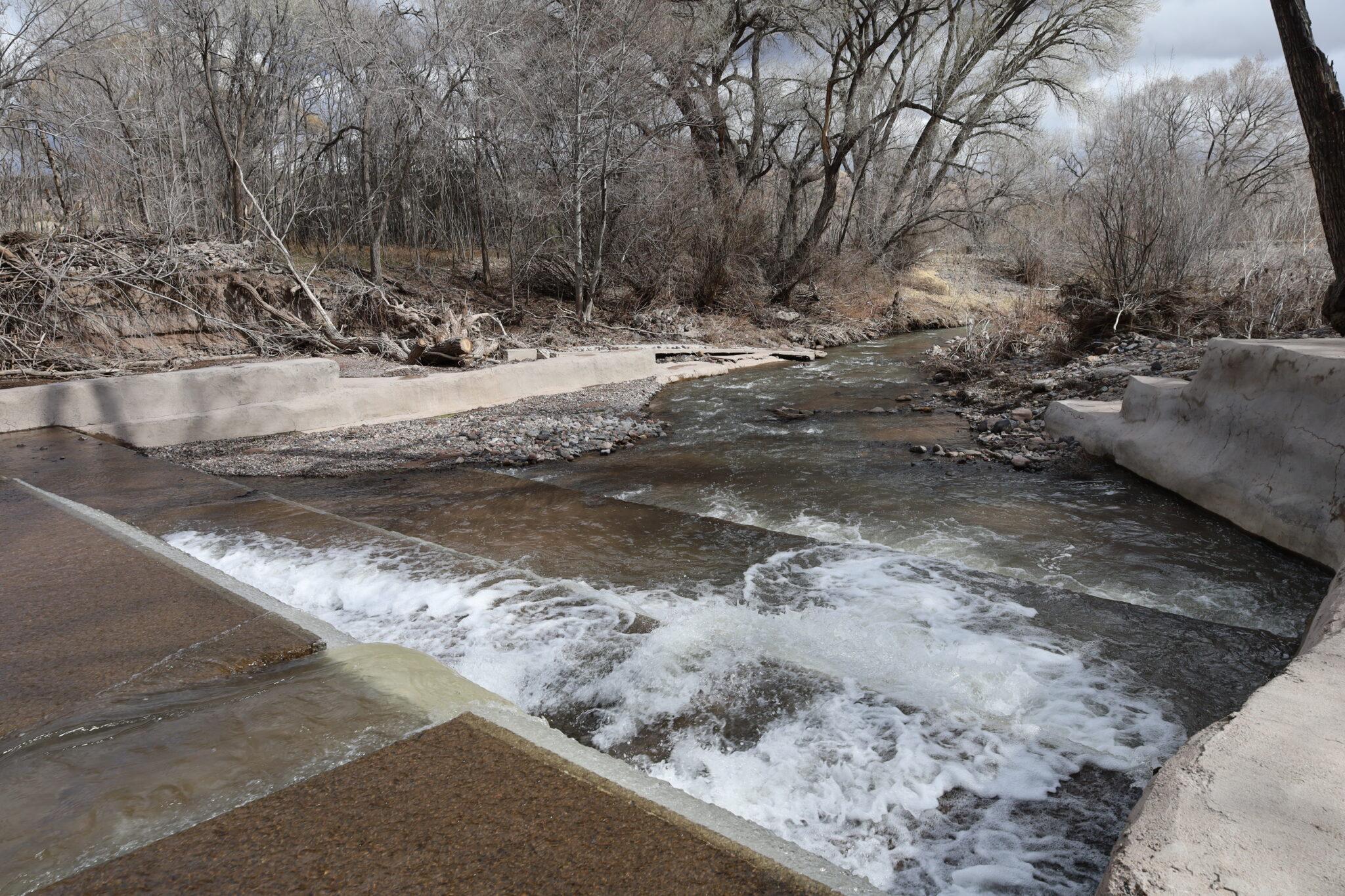
Photo credit: Trout Unlimited

Click the link to read the article on the Getches-Wilkerson Center website (Daniel Anderson):

October 20, 2025

Until the passage of the Comprehensive Environmental Response, Compensation, and Liability Act (CERCLA) in 1980, miners across the American West extracted gold, silver, and other valuable โ€œhardrockโ€ mineralsโ€”and then simply walked away. Today, tens of thousands of these abandoned hardrock mines continue to leak acidic, metal-laden water into pristine streams and wetlands. Federal agencies estimate that over a hundred thousand miles of streams are impaired by mining waste. Nearly half of Western headwater streams are likely contaminated by legacy operations. Despite billions already spent on cleanup at the most hazardous sites, the total cleanup costs remaining may exceed fifty billion dollars.

So how did we end up here? In short, the General Mining Law of 1872 created a lack of accountability for historic mine operators to remediate their operations, but CERCLA and the Clean Water Act (CWA) arguably add an excess of accountability for third parties trying to clean up abandoned mines today.

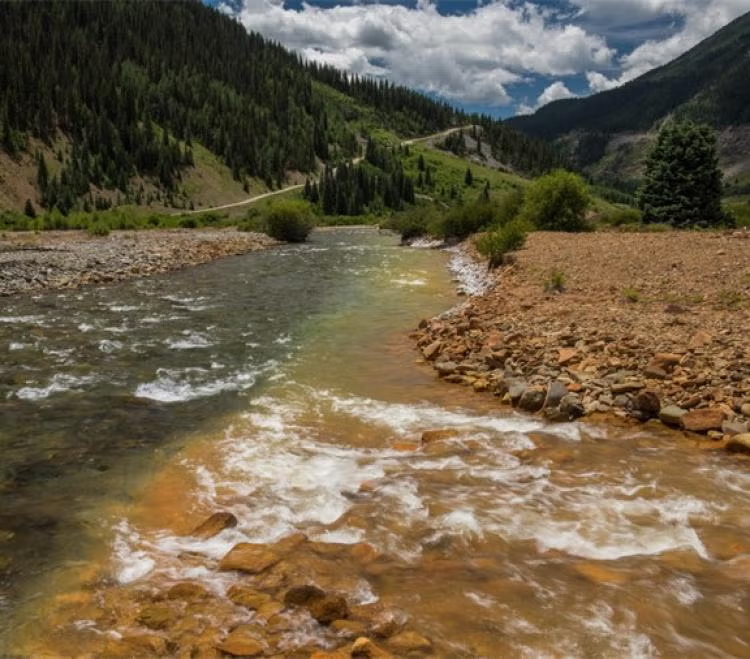
The Animas River running orange through Durango after the Gold King Mine spill August 2015. Photo credit: Jonathan P. Thompson/The Land Desk

The first legislation to address this problem was introduced in 1999. Many iterations followed and failed, even in the wake of shocking images and costly litigation due to the Gold King Mine spill that dyed the Animas River a vibrant orange in 2015. Finally, in December, 2024, Congress passed the Good Samaritan Remediation of Abandoned Hardrock Mines Act of 2024 (GSA).

The GSA is a cautious, bipartisan attempt to empower volunteers to clean up this toxic legacy. The law creates a short pilot program and releases certain โ€œGood Samaritansโ€ from liability under CERCLA and the CWA, which has long deterred cleanup by groups like state agencies and NGOs. EPA has oversight of the program and the authority to issue permits to Good Samaritans for the proposed cleanup work.

Despite the promise of this new legislation, critical questions remain unanswered about the GSA and how it will work. Only time will tell whether EPA designs and implements an effective permitting program that ensures Good Samaritans complete remediation work safely and effectively. EPA now has the opportunity as the agency that oversees this program to unlock the promise of the GSA.

The GSA left some significant gaps unanswered in how the pilot program will be designed and directed EPA to issue either regulations or guidance to fill in those gaps. EPA missed the statutory deadline to start the rulemaking process (July, 2025) and is now working to issue guidance on how the program will move forward. EPA must provide a 30-day public comment period before finalizing the guidance document according to the GSA. With EPAโ€™s hopes of getting multiple projects approved and shovels in the ground in 2026, the forthcoming guidance is expected to be released soon. While we wait, itโ€™s worth both looking back at what led to the GSA and looking ahead to questions remaining about the implementation of the pilot program.

A Century of Mining the West Without Accountability

The story begins with the General Mining Law of 1872, a relic of the American frontier era that still governs hardrock mining on federal public lands. The law allows citizens and even foreign-based corporations to claim mineral rights and extract valuable ores without paying any federal royalty. Unlike coal, oil, or gasโ€”which fund reclamation through production feesโ€”hardrock mining remains royalty-free.

As mining industrialized during the 20th century, large corporations replaced prospectors. Until 1980, mines were often abandoned without consequences or cleanup once they became unprofitable. The result: an estimated half-million abandoned mine features will continually leach pollution into American watersheds for centuries.

CERLCA Liability Holds Back Many Abandoned Mine Cleanups

Congress sought to address toxic sites throughย CERCLA, also known as the Superfund law, which makes owners and operators strictly liable for hazardous releases. In theory, that ensures accountability. In practice, it creates a paradox: if no polluter can be found at an abandoned site, anyone who tries to clean up the mess may be held responsible for all past, present, and future pollution.

The Clean Water Actโ€™s Double-Edged Sword

Even state agencies, tribes, or nonprofits that treat contaminated water risk being deemed โ€œoperatorsโ€ of a hazardous facility. That fear of liabilityโ€”combined with enormous costsโ€”has frozen many potential Good Samaritans in place. Federal efforts to ease this fear have offered little more than reassurance letters without real protection.

The Clean Water Act compounds the problem. Anyone who discharges pollution into a surface water via any discernible, confined and discrete conveyance must hold a point source discharge permit. By requiring these permits and providing for direct citizen enforcement in the form of citizen suits, the CWA has led to significant improvements in water quality across the country. That said, courts have ruled that drainage pipes or diversion channels used to manage runoff from abandoned mines may also qualify as point sources. As a result, Good Samaritans who exercise control over historic point sources, like mine tunnels, could face penalties and other liabilities for unpermitted discharges, even when they improve overall conditions.

The 2024 Good Samaritan Act Steps onto the Scene

After decades of failed attempts, the Good Samaritan Remediation of Abandoned Hardrock Mines Act was signed into law in December, 2024. The GSA authorizes EPA to create a pilot program, issuing up to fifteen permits for low-risk cleanup projects over seven years. Most importantly, permit holders receive protection from Superfund and Clean Water Act liability for their permitted activities. This legal shield removes one of the greatest barriers to cleanup efforts.

Applicants can seek either a Good Samaritan permit to begin active remediation or an investigative sampling permit to scope out a site for potential conversion to a Good Samaritan permit down the road.

In either case, applicants must show:

  • they had no role in causing, and have never exercised control over, the pollution in their application,
  • they possess the necessary expertise and adequate funding for all contingencies within their control, and
  • they are targeting low-risk sites, which are generally understood to be those that require passive treatment methods like moving piles of mine waste away from streams or snowmelt or diverting water polluted with heavy metals below mine tailings toward wetlands that may settle and naturally improve water quality over time

Under the unique provisions of the GSA, each qualifying permit must go through a modified and streamlined National Environmental Policy Act (NEPA) review process. EPA or another lead agency must analyze the proposed permit pursuant to an Environmental Assessment (EA). If the lead agency cannot issue a Finding of No Significant Impact (FONSI) after preparing an EA, the permit cannot be issued. The GSA therefore precludes issuance of a permit where the permitted activities may have a significant impact on the environment.

The pilot program only allows forย up toย fifteenย low riskย projects that must be approved by EPA over the next seven years. Defining which remediations are sufficiently low-risk becomes critical in determining what the pilot program canย proveย aboutย theย Goodย Samaritanย modelย for abandoned mine cleanup. To some extent, โ€œlow riskโ€ is simply equivalent to a FONSI. But the GSA further defines the low-risk remediation under these pilot permits as “anyย actionย toย remove,ย treat,ย orย containย historicย mineย residueย toย prevent, minimize, or reduce (i) the release or threat of release of a hazardous substance, pollutant, or contaminant that would harm human health or the environment; or (ii)ย aย migrationย orย dischargeย ofย aย hazardousย substance,ย pollutant,ย orย contaminant that would harm human health or the environment.”

This excludes โ€œany action that requires plugging, opening, or otherwise altering the portal or adit of the abandoned hardrock mine siteโ€ฆโ€, such as what led to the Gold King mine disaster. Many active treatment methods are also excluded from the pilot program, therefore, because they often involve opening or plugging adits or other openings to pump out water and treat it in a water treatment plant, either on or off-site. As a result, the Good Sam Actโ€™s low-risk pilot projects focus on passive treatment of the hazardous mine waste or the toxic discharge coming off that waste, such as a diversion of contaminated water into a settlement pond.

The GSA requires that permitted actions partiallyย orย completelyย remediateย theย historic mine residue at a site. The Administrator of EPA has the discretion to determine whether the permit makes โ€œmeasurable progressโ€. Every activity that the Good Samaritan and involved permitted parties take must be designedย to โ€œimprove or enhance water quality or site-specific soil or sediment quality relevant to the historic mine residue addressed by the remediation plan, including making measurable progress toward achieving applicable water quality standards,โ€ or otherwise protect human health and the environment by preventing the threat of discharge to water, sediment, or soil.ย The proposedย remediation need not achieve the stringentย numeric standardsย requiredย byย CERCLAย orย theย CWA.

Furthermore, it can be challenging to determine the discrete difference between the baseline conditions downstream of an acid mine drainage prior to and after a Good Samaritanย remediationย isย completed.ย Notย onlyย doย backgroundย conditionsย confuseย the picture, but other sources of pollution near the selected project may also make measuring water quality difficult. This may mean that the discretion left to the EPA Administrator to determine โ€œmeasurable progressโ€ becomes generously applied.

Finally, once EPA grants a permit, the Good Samaritan must follow the terms, conditions, and limitations of the permit. If the Good Samaritanโ€™s work degrades the environment from the baseline conditions, leading to โ€œmeasurably worseโ€ conditions, EPA must notify and require that the Good Samaritantake โ€œreasonable measuresโ€ to correct the surface water quality or other environmental conditions to the baseline. If these efforts do not result in a โ€œmeasurably adverse impactโ€, EPA cannot consider this a permit violation or noncompliance. However, if Good Samaritans do not take reasonable measures or if their noncompliance causes a measurable adverse impact, the Good Samaritan must notify all potential impacted parties. If severe enough, EPA has discretion to revoke CERCLA and CWA liability protections.

Recently, EPA shared the following draft flowchart for the permitting process:
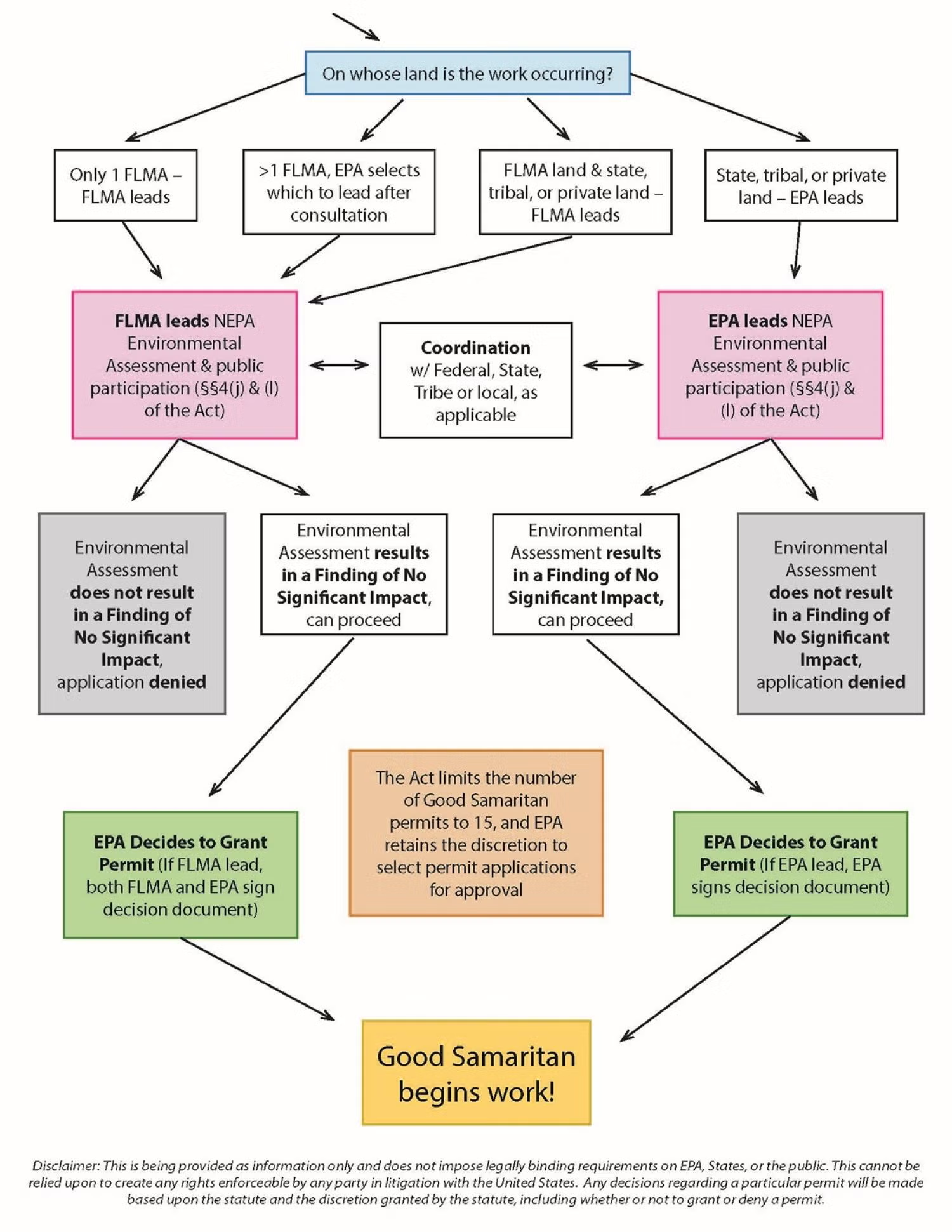
Disclaimer: This is being provided as information only and does not impose legally binding requirements on EPA, States, or the public. This cannot be relied upon to create any rights enforceable by any party in litigation with the United States. Any decisions regarding a particular permit will be made based upon the statute and the discretion granted by the statute, including whether or not to grant or deny a permit.

Challenges Facing the Pilot Program Implementation

Despite its promise, the pilot programโ€™s scope is limited. With only fifteen Good Samaritan permits eligible nationwide and no dedicated funding, the law depends on states, tribes, and nonprofits to provide their own resources. The only guidance issued so far by EPA detailed the financial assurance requirements that would-be Good Samaritans must provide to EPA to receive a permit. Definitions provided in this financial assurance guidance raised concerns for mining trade organizations and nonprofits alike with EPAโ€™s proposed interpretations of key terms including โ€œlow riskโ€ and โ€œlong-term monitoringโ€. Crucial terms like these, along with terms impacting enforcement when a permitted remediation action goes awry, like โ€œbaseline conditionsโ€, โ€œmeasurably worseโ€, and โ€œreasonable measuresโ€ to restore baseline conditions, are vague in the GSA. How EPA ultimately clarifies terms like these will play a large role in the success of the GSA in its ultimate goal: to prove that Good Samaritans can effectively and safely clean up abandoned hardrock mine sites. The soon-to-be-released guidance document will therefore be a critical moment in the history of this new program.

Funding the Future

Funding remains the greatest barrier to large-scale remediation efforts. Coal mine cleanups are funded through fees on current production under the Surface Mining Control and Reclamation Act. Current hardrock mining, however, still pays no federal royalty. A modernized system could pair Good Samaritan permitting with industry-funded reclamation fees, ensuring that those profiting from todayโ€™s mining help repair the past. Without this reform, the burden will remain on underfunded agencies and nonprofits. However, this General Mining Law reform remains politically unlikely. In the meantime, the GSA creates a Good Samaritan Mine Remediation Fund but does not dedicate any new appropriations to that fund. Grants under Section 319 of the CWA (Nonpoint Source Pollution) and Section 104(k) of CERCLA (Brownfields Revitalization) programs may help, but funding opportunities here are limited.

The GSA includes provisions that allow Good Samaritans to reprocess mine waste while completing Good Samaritan permit cleanup work. These provisions include a key restriction: revenue generated from reprocessing must be dedicated either to the same cleanup project or to the GSA-created fund for future cleanups. A January 20, 2025 executive order to focus on domestic production of critical minerals led to a related Interior secretarial order on July 17, 2025, for federal land management agencies to organize opportunities and data regarding reprocessing mine waste for critical minerals on federal lands. Shortly after these federal policy directives, an August 15, 2025, article in Science suggested that domestic reprocessing of mining by-products like abandoned mine waste has the potential to meet nearly all the domestic demand for critical minerals. Legal and technical hurdles might prevent much reprocessing from occurring within the seven-year pilot program. Reprocessing projections aside, the political appetite for dedicated funding for the future may still grow if the GSA pilot projects successfully prove the Good Samaritan concept using a funding approach reliant on generosity and creativity.

Despite Significant Liability Protections, Good Samaritans Face Uncertainties

While the new law should help to address significant barriers to the cleanup of abandoned mines by Good Samaritans, uncertainties remain. The GSA provides exceptions to certain requirements under the Clean Water Act (including compliance with section 301, 302, 306, 402, and 404). The GSA also provides exceptions to Section 121 of CERCLA, which requires that Superfund cleanups must also meet a comprehensive collection of all relevant and appropriate standards, requirements, criteria, or limitations (ARARs).

In States or in Tribal lands that have been authorized to administer their own point source (section 402) or dredge and fill (section 404) programs under the CWA, the exceptions to obtaining authorizations, licenses, and permits instead applies to those State or Tribal programs. In that case, Good Samaritans are also excepted from applicable State and Tribal requirements, along with all ARARs under Section 121 of CERCLA.

However, Section 121(e)(1) of CERCLA states that remedial actions conducted entirely onsite do not need to obtain any Federal, State, or local permits. Most GSA pilot projects will likely occur entirely onsite, so it is possible that Good Samaritans might still need to comply with local authorizations or licenses, such as land use plans requirements. While it appears that GSA permitted activities are excepted from following relevant and applicable Federal, State, and Tribal environmental and land use processes, it is a bit unclear whether they are also excepted from local decision making.

The liability protections in the GSA are also limited by the terms of the statute. Good Samaritans may still be liable under the CWA and CERCLA if their actions make conditions at the site โ€œmeasurably worseโ€ as compared to the baseline. In addition, the GSA does not address potential common law liability that might result from unintended accidents. For example, an agricultural water appropriator downstream could sue the Good Samaritan for damages associated with a spike in water acidity due to permitted activities, such as moving a waste rock pile to a safer, permanent location on site.

Finally, the GSA does not clearly address how potential disputes about proposed permits may be reviewed by the federal courts. However, the unique provisions of the GSA, which prohibit issuance of a permit if EPA cannot issue a FONSI, potentially provide an avenue to challenge proposed projects where there is disagreement over the potential benefits and risks of the cleanup activities.

Measuring and Reporting Success of the Pilot Program

The Good Samaritan Act authorizes EPA to issue up to fifteen permits for low-risk abandoned mine cleanups, shielding participants from Superfund and Clean Water Act liability. Applicants must prove prior non-involvement, capability, and target on low-risk sites. Each permit undergoes a streamlined NEPA Environmental Assessment requiring a FONSI. To be successful, EPA and potential Good Samaritans will need to efficiently follow the permit requirements found in the guidance, identify suitable projects, and secure funding. The GSA requires baseline monitoring and post-cleanup reporting for each permitted action but does not require a structured process of learning and adjustment over the course of the pilot program. Without this structured, adaptive approach, it may be difficult for Good Samaritan proponents to collect valuable data and show measurable progress over the next seven years that would justify expanding the Good Samaritan approach to Congress. EPAโ€™s forthcoming guidance offers an opportunity to fix that by publicly adopting a targeted and tiered approach in addition to the obligatory permitting requirements.

The EPAโ€™s David Hockey, who leads the GSA effort from the EPAโ€™s Office of Mountains, Deserts, and Plains based in Denver, has suggested taking just such a flexible, adaptive approach in public meetings discussing the GSA. EPA, working in coordination with partners that led the bill through Congress last year, like Trout Unlimited, intends to approve GSA permits in three tranches. EPA currently estimates that all fifteen projects will be approved and operational by 2028.

The first round will likely approve two or three projects with near-guaranteed success. If all goes according to plan, EPA hopes to have these shovel-ready projects through the GSA permit process, which includes a NEPA review, with the remedial work beginning in 2026. These initial projects will help EPA identify pain points in the process and potentially pivot requirements before issuing a second round of permits. This second tranche will likely occur in different western states and might increase in complexity from the first tranche.

Finally, the third tranche of permits might tackle the more complex projects from a legal and technical standpoint that could still be considered low risk. This may include remediation of sites in Indian Country led by or in cooperation with a Tribal abandoned mine land reclamation program. Other projects suited for the third tranche might include reprocessing of mine waste, tailings, or sludge, which may also require further buy-in to utilize the mining industryโ€™s expertise, facilities, and equipment. These more complex projects will benefit most from building and maintaining local trust and involvement, such as through genuine community dialogue and citizen science partnerships. The third tranche projects should contain such bold choices to fully inform proponents and Congress when they consider expanding the Good Samaritan approach.

EPA appears poised to take a learning-by-doing approach. But the guidance can and should state this by setting public, straightforward, and measurable goals for the pilot program. This is a tremendous opportunity for EPA and everyone who stands to benefit from abandoned mine cleanup. But this is no simple task. Each permit must be flexible enough to address the unique characteristics at each mine site, sparking interest in future legislation so more Good Samaritans can help address the full scale of the abandoned hardrock mine pollution problem. But if EPA abuses its broad discretion under the GSA and moves the goalposts too much during the pilot program, they may reignite criticisms that the Good Samaritan approach undercuts bedrock environmental laws like the Clean Water Act. If projects are not selected carefully, for instance, the EPA could approve a permit that may not be sufficiently โ€œlow riskโ€, or that ultimately makes no โ€œmeasurable progressโ€ to improve or protect the environment. Either case may invite litigation against the EPA under the Administrative Procedure Actโ€™s arbitrary and capricious standard or bolster other claims against Good Samaritans.

While the GSA itself imposes only a report to Congress at the end of the seven-year pilot period, a five-year interim report to Congress could help ensure accountability. If all goes well or more pilot projects are needed, this interim report could also provide support for an extension before the pilot program expires. The guidance issued by EPA should only be the beginning of the lessons learned and acted on during the GSA pilot program.

Seizing the Window of Opportunity

The GSA represents a breakthrough after decades of gridlock. It addresses the key fears of liability that stymied cleanup. Yet its success will depend on how effectively the EPA implements the pilot program and the courage of Good Samaritans who are stepping into some uncertainty. If it fails, Americaโ€™s abandoned mines will continue to leak toxins into its headwaters for generations to come. But if the program succeeds, it could become a model for collaborative environmental restoration. For now, the EPAโ€™s forthcoming guidance could mark the first steps toward success through clear permitting requirements and by setting flexible yet strategic goals for the pilot program.

If you are interested in following the implementation of the Good Samaritan Act, EPA recently announced it will host a webinar on December 2, 2025. They will provide a brief background and history of abandoned mine land cleanups, highlight key aspects of the legislation, discuss the permitting process, and explain overall program goals and timelines. Visit EPAโ€™s GSA website for more information.

Download a PDF of the paper here. 

Map of the San Juan River, a tributary of the Colorado River, in Arizona, Colorado, New Mexico and Utah, USA. Made using USGS National Map data. By Shannon1 – Own work, CC BY-SA 4.0, https://commons.wikimedia.org/w/index.php?curid=47456307

Federal Water Tap, October 20, 2025: Abandoned Mine Cleanup Application Review to Begin This Fall, EPA Says — Brett Walton (circleofblue.org)

The โ€œBonita Peak Mining Districtโ€ superfund site. Map via the Environmental Protection Agency

Click the link to read the article on the Circle of Blue website (Brett Walton):

The Rundown

  • Democrats on budget committees tell EPA and Interior to halt potentialย staff cutsย during the shutdown.
  • White House budget office says $11 billion inย Army Corps infrastructure projectsย will be paused.
  • BLM will begin an environmental analysis of a proposed expansion of aย Mojave Desert gold mineย that will need more groundwater to operate.

And lastly, EPA prepares to permit abandoned hardrock mine cleanups under a new Good Samaritan law.

โ€œIf you were a nonprofit or a county with a serious water pollution issue coming out of an old set of mine tailings, you could not work on that problem. The moment you touched it, you accepted total liability for the pollution going downstream. So nobody would ever do anything about all these 140,000 abandoned mines. Almost every one of them having some environmental problem. Almost all of it connected to water.โ€ โ€“ Sen. John Hickenlooper (D-CO) speaking with the Western Governorsโ€™ Association podcast about the problem of cleaning up abandoned mines in the western United States.

Last year the Good Samaritan Remediation of Abandoned Hardrock Mines Act was signed into law. It requires the EPA to permit 15 pilot cleanup projects to be completed within seven years. The projects can be located on private, federal, or state land.

David Hockey, acting director of the EPA Office of Mountains, Deserts, and Plains, said the agency will review project applications starting this fall. He hopes to have the first projects under construction next year and all 15 in progress by summer 2028.

By the Numbers

$11 Billion: Army Corps infrastructure projects that will be โ€œpaused,โ€ Russell Vought, the director of the White House budget office, wrote on X. Vought blamed the government shutdown for the freeze. The targeted projects are mostly in states where Democrats are in power, E&E News reports.

News Briefs

Potential Shutdown Staff Cuts
Leading Democrats sent letters to the heads of EPA and Interior asking them to halt potential job cuts at their agencies during the shutdown.

Sen. Jeff Merkeley and Rep. Chellie Pingree are the ranking Democrats on the budget committees that oversee spending by those agencies.

Their concern is over the administrationโ€™s use of โ€œreduction in forceโ€ during the shutdown to pare the federal workforce closer to President Trumpโ€™s vision of a diminished bureaucracy, even though Congress is supposed to set funding levels.

โ€œThis coordinated, government-wide approach to implementing RIFs during a lapse in appropriations appears designed to circumvent the appropriations process,โ€ they wrote in their letter to Lee Zeldin, EPA administrator.

Of particular concern, they wrote, are proposed changes and reductions to the EPAโ€™s science assessment and research division.

Similar concerns were raised in the letter to Doug Burgum, the interior secretary.

Studies and Reports

State Revolving Fund Audits
The EPA Office of Inspector General reviewed the financial documents for the state revolving fund programs, the main federal vehicle for water infrastructure funding.

The review found that 42 state drinking water programs and 43 clean water programs had an independent financial audit.

Audited financial statements help to identify wasteful and fraudulent spending.

On the Radar

Shutdown Continues
Nineteen days and counting, as of this writing.

Proposed Mojave Mine Expansion
The Bureau of Land Management will do an environmental impact analysis for a proposed expansion of the Castle Mountain open-pit gold mine in Californiaโ€™s part of the Mojave Desert.

The expansion would extend the mineโ€™s life by 30 years and would entail construction of a 32-mile pipeline to supply 2,250 acre-feet of groundwater per year.

The mine is part of FAST-41, a federal program to accelerate project permitting and environmental reviews through close interagency coordination. The project dashboardsuggests that permitting for the Castle Mountain expansion will be completed by December 2026.

Public comments are being accepted through November 20. Submit them via the above link.

A virtual public meeting will be held on November 5 to outline the project and collect public input. Register here.

Federal Water Tap is a weekly digest spotting trends in U.S. government water policy. To get more water news, follow Circle of Blue on Twitter and sign up for our newsletter.

Federal Water Tap, September 29, 2025: Federal Judge Allows Flint Residents to Continue Lawsuit against EPA — Brett Walton (circleofblue.org)

Pesticides sprayed on agricultural fields and on urban landscaping can run off into nearby streams and rivers. Here, pesticides are being sprayed on a soybean field in Iowa. (Credit: Eric Hawbaker, Blue Collar Ag, Riceville, IA)

Click the link to read the article on the Circle of Blue website (Brett Walton):

The Rundown

  • EPA finalizes new water quality standards for a 38-mile urbanized section of theย Delaware River.
  • EPA internal watchdog will begin assessments of wildfire and inland flood risk toย Superfundย sites.
  • USGS studies long-term trends forย pesticideย concentrations in groundwater, finding them declining.
  • GAO recommends that the Department of Energy hasten its reviews ofย historical PFAS useย at its sites.
  • Defense Department delaysย PFAS cleanupย at some of its contaminated sites.

And lastly, a federal judge allows a lawsuit against the EPA over the Flint water crisis to continue.

โ€œThe EPA failed to keep children and families safe during the water crisis. It is outrageous that a decade has passed without the EPA admitting its mistake and paying the citizens of Flint what they are owed. The EPA administrator should settle this lawsuit right now.โ€ โ€“ Rep. Kristen McDonald Rivet (D-MI), in a statement about a lawsuit against the EPA for its role in the Flint water crisis. A federal district judge denied the EPAโ€™s petition to dismiss the lawsuit, which was brought by city residents and alleges that the agency was negligent in its duties under the Safe Drinking Water Act.

By the Numbers

57: Department of Energy sites that are slated for an assessment of historical PFAS use. According to the Government Accountability Office, only 20 of the sites have completed an initial review. Twenty-one sites have a review in progress, and 16 have not started. More than 100 other DOE sites are not being reviewed.

News Briefs

PFAS Cleanup Delay
The Defense Department is delaying PFAS cleanup at some of its contaminated sites, the New York Times reports. New timelines are in place for about 140 sites, the Times found when comparing a Trump administration update to a Biden-era plan.

Delaware River
To protect two endangered fish species, the EPA strengthened water quality standards for a 38-mile urbanized section of the Delaware River.

The standards, which originated during the Biden administration and seek to increase dissolved oxygen levels, apply to parts of the river between Philadelphia and Wilmington, Delaware. Two species of endangered sturgeon live in these waters.

The standards will result in lower polluted discharges from industrial and municipal sewage and stormwater systems.

Studies and Reports

Pesticides in Groundwater
A U.S. Geological Survey analysis found long-term declines in pesticide concentrations in groundwater in the nationโ€™s major aquifer systems.

Across three decades of groundwater testing, the researchers found decreasing levels of most pesticides. That includes atrazine, one of the most broadly used chemicals. Twenty-one pesticides were analyzed.

Why the declines? Several factors are at play: less pesticide use, chemical degradation of pesticides in soils, and variable rainfall patterns and soil management, which can influence movement of pesticides after they are sprayed.

Some pesticides leave enduring legacies. DBCP, which was banned for agricultural use in the U.S. in 1979, was still the only pesticide in the study that exceeded human health standards in groundwater. (Though sampling for it took place only in California.)

The declines โ€œcan be viewed as encouraging results,โ€ the authors write.

But they also urge caution: โ€œmany negative human-health effects have been linked to pesticide exposure, and these negative effects can occur when pesticide concentrations are below the human health benchmarks used in this study.โ€

The study results come from sampling 59 regional well networks and comparing pesticide concentrations to health standards. These networks represent agricultural and urban land uses, as well as areas in which groundwater is a drinking water source.

On the Radar

Superfund Environmental Risks
The EPAโ€™s internal watchdog will begin two investigations into environmental risks for Superfund sites.

One assessment will look at risks from inland flooding and whether remediation plans take into account potential flood disruptions. The other will do the same analysis but for wildfire risk.

Texas Desalination
The Army Corps of Engineers issued permits for a proposed 100-million gallon per day desalination facility near Corpus Christi, Texas.

Federal Water Tap is a weekly digest spotting trends in U.S. government water policy. To get more water news, follow Circle of Blue on Twitter and sign up for our newsletter.

Federal Water Tap, September 15, 2025: EPA Says It Wonโ€™t Regulate Four #PFAS in Drinking Water — Brett Walton (circleofblue.org)

Unprotected farm fields yield topsoil as well as farm fertilizers and other potential pollutants when heavy rains occur.

Click the link to read the article on the Circle of Blue website (Brett Walton):

The Rundown

  • EPA intends to retract a Biden-era regulation for fourย PFASย in drinking water.
  • Report on childrenโ€™s health highlights MAHA concern withย fluorideย in drinking water.
  • GAO finds that the outcomes from Biden-eraย environmental justiceย focus are unknown.
  • Defense spending and harmful algal bloom bills move throughย Congress.

And lastly, Reclamation will do more analysis on anย ag-to-urban Colorado River water transferย in Arizona.

โ€œFollowing the completion of studies on fluoride, CDC and USDA will educate Americans on the appropriate levels of fluoride, clarify the role of EPA in drinking water standards for fluoride under the Safe Drinking Water Act, and increase awareness of the ability to obtain fluoride topically through toothpaste.โ€ โ€“ Excerpt from the MAHA Commissionย strategyย for improving childrenโ€™s health.

By the Numbers

$1 Billion: Federal aid to livestock producers who were affected by wildfire and flooding in 2023 and 2024. The funds, announced by USDA, are intended to offset higher feed costs.

News Briefs

PFAS Regulationโ€ฆAnd Others
The EPA says it will attempt to retract its regulation of four PFAS in drinking water, a rule that was established during the Biden administration.

The agency will keep federal drinking water limits on two forever chemicals: PFOA and PFOS. But it wants to drop federal regulation of four others: PFHxS, PFNA, PFBS, and Gen X.

The EPA is also not defending the rule in court, asking judges to invalidate it, Bloomberg Law reports.

Utilities are challenging the rule on procedural grounds as well as objecting to its cost for small systems. Public health groups point out that federal law has โ€œanti-backslidingโ€ provisions to prevent existing drinking water limits from being weakened.

The agency signaled its intention to scrap limits on the four PFAS in the Unified Agenda, a semiannual listing of the federal governmentโ€™s regulatory plans.

Other water-related regulatory actions mentioned in the agenda: perchlorate in drinking water, a definition of the โ€œwaters of the United Statesโ€ that are subject to Clean Water Act permitting, and expanding the area in which oil and gas wastewater (a.k.a โ€œproduced waterโ€) can be reused.

Water Bills in Congress
The House passed a defense spending authorization bill that includes several water provisions.

It instructs the department to provide clean drinking water from an alternative source to any household on a private well that is contaminated with PFAS due to military activities.

The bill also directs the military secretaries to assess water-supply risk at their bases. Each secretary will identify the three most at-risk bases under their command and develop a strategy to reduce water-supply risk.

The Senate, meanwhile, passed a bill that reauthorizes a federal program for harmful algal bloom research and monitoring.

Arizona Injection Well Management
The EPA granted Arizonaโ€™s application to oversee permitting for wells that inject fluids and waste underground in the state.

Studies and Reports

Water and Childrenโ€™s Health
The Make America Healthy Again Commission released its strategy for improving childrenโ€™s health.

The 20-page document refers to drinking water as a pathway for contaminants. But it provides vague direction on solutions. Federal agencies โ€œwill assess ongoing evaluations of water contaminants and update guidance and prioritizations of certain contaminants appropriately,โ€ it states.

Several contaminants are called out. Fluoride, a favored enemy for the MAHA movement, is one. Others are pharmaceuticals and PFAS. Farm chemicals are indirectly cited, in a sentence that asks the USDA to research water quality and farm conservation practices. At the same time, EPA is directed to reduce permitting requirements to โ€œstrengthen regional meat infrastructure.โ€

The report is undermined by actions other federal agencies are taking โ€“ approving new chemicals for commercial use, cutting research and enforcement budgets, not defending PFAS regulations.

Evaluating Environmental Justice Push
To help poor and disadvantaged communities overcome histories of pollution, racism, and poverty, the Biden administration ordered that they receive 40 percent of the benefits of certain federal spending. Donald Trump ended this Justice40 initiative in his first month in office.

What did the program achieve?

Thatโ€™s hard to say, according to an audit by the Government Accountability Office.

Looking at three agencies that were key players in the program โ€“ EPA, Interior, and USDA โ€“ the audit concluded that, though they modified grant programs, provided assistance, and began to track outcomes, โ€œoverall results of agency actions are unknown.โ€

On the Radar

Arizona Water Transfer
Following a court order for a more-thorough analysis, the Bureau of Reclamation will conduct an environmental impact assessment of an ag-to-urban transfer of Colorado River water that it already approved.

Queen Creek, a fast-growing Phoenix exurb, purchased water from GSC Farm, in La Paz County, on the opposite side of the state. The assessment will also consider the effects of moving the water to Queen Creek via the Central Arizona Project canal.

Cities and counties in western Arizona sued to block the water transfer.

Two virtual public meetings will be held on October 1 to gather comments. Log-in details are found here.

Senate Hearing
On September 17, the Environmental and Public Works Committee will hold an oversight hearing on the Army Corps of Engineers.

House Hearings
On September 16, an Oversight and Government Reform subcommittee will hold a hearing on weather modification. The subcommittee is led by Rep. Marjorie Taylor Greene, who incorrectly blamed Hurricane Helene on a โ€œtheyโ€ who control the weather. She introduced a bill in July to ban geoengineering, cloud seeding, aerosol injection, and other methods of altering the weather. Carbon emissions, however, are not explicitly mentioned.

Another Oversight subcommittee will hold a hearing that same day on EPA enforcement during the Biden administration.

Also on September 16, an Energy and Commerce subcommittee will hold a hearing on appliance efficiency standards, which Republicans and the president have criticized as limiting customer choice, even though they reduce water and energy consumption.

Federal Water Tap is a weekly digest spotting trends in U.S. government water policy. To get more water news, follow Circle of Blue on Twitter and sign up for our newsletter.

Ten years after a mine spill turned the #AnimasRiver yellow, basin awaits wider cleanup. โ€˜Doing things right takes time.โ€™ — The #Denver Post

This image was taken during the peak outflow from the Gold King Mine spill at 10:57 a.m. Aug. 5, 2015. The waste-rock dump can be seen eroding on the right. Federal investigators placed blame for the blowout squarely on engineering errors made by the Environmental Protection Agencyโ€™s-contracted company in a 132-page report released Thursday [October 22, 2015]

Click the link to read the article on The Denver Post website (Elise Schmelzer). Here’s an excerpt:

August 31, 2025

Three million gallons of acidic mine drainage flooded into the Animas River basin 10 years ago, turning the southern Colorado river a mustard yellow and makingย international headlines. Caused by federal contractors working to treat pollution from the Gold King Mine, theย accidental release of water laden with heavy metalsย prompted the creation of a Superfund site and a reckoning with lingering environmental harms from the areaโ€™s mining legacy, including hundreds of abandoned mines high in the San Juan mountains. A decade later, community members andย Environmental Protection Agencyย staff are still grappling with the long-term cleanup of the areaโ€™s mines and tailings piles. Forty-eight of themย now make up the Bonita Peak Mining District Superfund siteย outside Silverton. They continue to leak heavy metals into local waterways and soils.

โ€œWeโ€™re pleased that the EPA is at the point where in the next 18 months, weโ€™re going to see some decisions made about how those sites are cleaned up,โ€ said Chara Ragland, the chair ofย the siteโ€™s community advisory group.

Cement Creek photo via the @USGS Twitter feed

Studies have since shown that the Aug. 5, 2015, Gold King spill hadย little long-term environmental impactย because the water already contained so many heavy metals from runoff and other mines. Locals hope the federal Superfund cleanup process will improve water quality in the Animas River basin so that it will be cleaner than before the Gold King incident.

The โ€œBonita Peak Mining Districtโ€ superfund site. Map via the Environmental Protection Agency

#ClimateChange Is Real in #Colorado: EPA Denial of Science Comes at Major Costs — Governor Jared Polis

East Troublesome Fire. Photo credit: Northern Water

Click the link to read the release on Governor Polis’ website:

JULY 29, 2025

DENVER – Today, by repealing the 16-year-old “Endangerment Finding,โ€ which determined that greenhouse gas (GHG) pollution poses a threat to public health and welfare, the Trump administrationโ€™s U.S. Environmental Protection Agency (EPA) paved the way for more extreme weather and natural disasters, hurting Colorado communities. 

โ€œThis decision flies in the face of decades of data about the negative public health impact of greenhouse gasses including heat exposure and fire risk. Colorado is all too familiar with the impacts of climate change, seeing the three largest fires in our state’s history and the most destructive in the last five years. Despite the EPAโ€™s denial of our reality, Colorado will continue to achieve our ambitious clean energy goals to save people more on energy bills, reduce emissions and improve our air-quality and health,โ€ said Governor Jared Polis. 

Climate change is already negatively impacting Coloradans in all aspects of life. Homeownerโ€™s insurance costs are skyrocketing due to increased hail and fire claims. Extreme weather is destroying homes, jobs, and crops. In 2024, the United States experienced $27 billion in weather- and climate-related disasters. And higher temperatures are increasing the risk of illness and medical emergencies. 

Water treatment plant set for 2025 groundbreaking — Gunnison Country Times #GunnisonRiver

The water treatment process

Click the link to read the article on the Gunnison Country Times website (Alex McCrindle). Here’s an excerpt:

July 23, 2025

On July 22, after months of uncertainty about the impact of federal funding cuts and tariffs, Gunnison City Council received an update on the future of the water treatment plan project. Gunnison Public Works Director Pete Rice addressed the council with a report on funding, design and construction of the proposed plant on the Van Tuyl Ranch. The water treatment plant, estimated to cost $50 million and be one of the largest infrastructure developments in city history, is divided into three projects. The first project covers the construction of a raw water intake and three separate wells at the VanTuyl Ranch. The second and third projects focus on the water delivery system and water treatment facility. With the first project nearing approval from the Environmental Protection Agency (EPA), the city is expected to finalize its design this fall and begin construction before the end of 2025. The treatment plant initiative stems from the 2021 water master plan and a potable water evaluation. Gunnison currently relies on nine wells to source its drinking water. The system is outdated and no longer permitted by the state. Because all of the wells pull water from the same aquifer, drinking water is vulnerable to contamination and extended drought conditions. The proposed plant will allow Gunnison to pull water from the Gunnison River, in addition to the aquifer…

The first project includes the construction of a raw water intake and three separate wells. The proposed intake will be 18-feet deep alongside the Gunnison River, and cylindrical intakes will extend halfway into the river. The first project is expected to be approved by the EPA in the next four weeks, and begin construction this year with well drilling extending into 2026. The project is projected to cost $4 million, with $900,000 covering design, and $3 million going toward construction. The entire construction cost is funded by $1.75 million in congressionally directed spending, and $1.5 million from a Colorado Water Conservation Board grant. Four additional grants covered roughly $850,000 in design costs. The City of Gunnison will pay the remaining $25,000. Once complete, the water intake will have little impact on outdoor recreation, including boating and fishing, Rice said. However, construction will likely disrupt those activities for an estimated two to three months. It is currently unknown if construction can take place in the winter to minimize impact on summer recreation. Project two focuses on a complex network of pipes that will connect the raw water intake and wells, and deliver water directly to the water treatment plan. The third project is the construction of the water treatment plant itself. Rice said the second and third project design is estimated to be completed between winter 2025 and spring 2026, with construction lasting into 2029. The two projects will cost $2.7 million for design, and $40 million for construction. The majority of design costs are already funded by six grants, while the construction costs are set to be discussed at upcoming council meetings.

Map of the Gunnison River drainage basin in Colorado, USA. Made using public domain USGS data. By Shannon1 – Own work, CC BY-SA 4.0, https://commons.wikimedia.org/w/index.php?curid=69257550

Dismantling of EPAโ€™s Scientific Research Arm Fulfills Key Chemical Industry Goal — Marianne Lavelle (InsideClimateNews.com)

EPA-estimated cancer risk in the region (Cancer Alley). By MiseDominic – Own work, CC0, https://commons.wikimedia.org/w/index.php?curid=147151609

Click the link to read the article on the Inside Climate News website (Marianne Lavelle):

July 21, 2025

Companies feared rules and lawsuits based on the Office of Research and Developmentโ€™s assessments of the dangers of formaldehyde, ethylene oxide and other substances.

Soon after President Donald Trump took office in January, a wide array of petrochemical, mining and farm industry coalitions ramped up what has been a long campaign to limit use of the Environmental Protection Agencyโ€™s assessments of the health risks of chemicals.

That effort scored a significant victory Friday when EPA Administrator Lee Zeldin announced his decision to dismantle the agencyโ€™s Office of Research and Development (ORD).

The industry lobbyists didnโ€™t ask for hundreds of ORD staff members to be laid off or reassigned. But the elimination of the agencyโ€™s scientific research arm goes a long way toward achieving the goal they sought. 

In a January 27 letter to Zeldin organized by the American Chemistry Council, more than 80 industry groupsโ€”including leading oil, refining and mining associationsโ€”asked him to end regulatorsโ€™ reliance on ORD assessments of the risks that chemicals pose for human health. The future of that research, conducted under EPAโ€™s Integrated Risk Information System program, or IRIS, is now uncertain.

โ€œEPAโ€™s IRIS program within ORD has a troubling history of being out of step with the best available science and methods, lacking transparency, and being unresponsive to peer review and stakeholder recommendations,โ€ said an American Chemistry Council spokesperson in an email when asked about the decision to eliminate ORD. โ€œThis results in IRIS assessments that jeopardize access to critical chemistries, undercut national priorities, and harm American competitiveness.โ€

The spokesperson said the organization supports EPA evaluating its resources to ensure tax dollars are being used efficiently and effectively.

H. Christopher Frey, an associate dean at North Carolina State University who served as EPA assistant administrator in charge of ORD during the Biden administration, defended the quality of the science done by the office, which he said is โ€œthe poster case study of what it means to do science thatโ€™s subject to intense scrutiny.โ€

โ€œThereโ€™s industry with a tremendous vested interest in the policy decisions that might occur later on,โ€ based on the assessments made by ORD. โ€œWhat the industry does is try to engage in a proxy war over the policy by attacking the science.โ€

Among the IRIS assessments that stirred the most industry concern were those outlining the dangers of formaldehyde, ethylene oxide, arsenic and hexavalent chromium. Regulatory actions had begun or were looming on all during the Biden administration.

The Biden administration also launched a lawsuit against a LaPlace, Louisiana, plant that had been the only U.S. manufacturer of neoprene, Denka Performance Elastomer, based in part on the IRIS assessment of one of its air pollutants, chloroprene, as a likely human carcinogen. Denka, a spinoff of DuPont, announced it was ceasing production in May because of the cost of pollution controls.

Public health advocates charge that eliminating the IRIS program, or shifting its functions to other offices in the agency, will rob the EPA of the independent expertise to inform its mission of protection.

โ€œTheyโ€™ve been trying for years to shut down IRIS,โ€ said Darya Minovi, a senior analyst with the Union of Concerned Scientists and lead author of a new study on Trump administration actions that the group says undermine science. โ€œThe reason why is because when IRIS conducts its independent scientific assessments using a great amount of rigor โ€ฆ you get stronger regulations, and that is not in the best interest of the big business polluters and those who have a financial stake in the EPAโ€™s demise.โ€

The UCS report tallied more than 400 firings, funding cuts and other attacks on science in the first six months of the Trump administration, resulting in 54 percent fewer grants for research on topics including cancer, infectious disease and environmental health.

EPAโ€™s press office did not respond to a query on whether the IRIS controversy helped inform Zeldinโ€™s decision to eliminate ORD, which had been anticipated since staff were informed of the potential plan at a meeting in March. In the agencyโ€™s official announcement Friday afternoon, Zeldin said the elimination of the office was part of โ€œorganizational improvementsโ€ that would deliver $748.8 million in savings to taxpayers. The reduction in force, combined with previous departures and layoffs, have reduced the agencyโ€™s workforce by 23 percent, to 12,448, the EPA said.

With the cuts, the EPAโ€™s workforce will be at its lowest level since fiscal year 1986.

โ€œUnder President Trumpโ€™s leadership, EPA has taken a close look at our operations to ensure the agency is better equipped than ever to deliver on our core mission of protecting human health and the environment while Powering the Great American Comeback,โ€ Zeldin said in the prepared statement. โ€œThis reduction in force will ensure we can better fulfill that mission while being responsible stewards of your hard-earned tax dollars.โ€

The agency will be creating a new Office of Applied Science and Environmental Solutions; a report by E&E News said an internal memo indicated the new office would be much smaller than ORD, and would focus on coastal areas, drinking water safety and methodologies for assessing environmental contamination.

Zeldinโ€™s announcement also said that scientific expertise and research efforts will be moved to โ€œprogram officesโ€โ€”for example, those concerned with air pollution, water pollution or wasteโ€”to tackle โ€œstatutory obligations and mission essential functions.โ€ That phrase has a particular meaning: The chemical industry has long complained that Congress never passed a law creating IRIS. Congress did, however, pass many laws requiring that the agency carry out its actions based on the best available science, and the IRIS program, established during President Ronald Reaganโ€™s administration, was how the agency has carried out the task of assessing the science on chemicals since 1985.

Justin Chen, president of the American Federation of Government Employees Council 238, the union representing 8,000 EPA workers nationwide, said the organizational structure of ORD put barriers between the agencyโ€™s researchers and the agencyโ€™s political decision-making, enforcement and regulatory teamsโ€”even though they all used ORDโ€™s work.

โ€œFor them to function properly, they have to have a fair amount of distance away from political interference, in order to let the science guide and develop the kind of things that they do,โ€ Chen said. 

โ€œTheyโ€™re a particular bugbear for a lot of the industries which are heavy donors to the Trump administration and to the right wing,โ€ Chen said. โ€œTheyโ€™re the ones, I believe, who do all the testing that actually factors into the calculation of risk.โ€

ORD also was responsible for regularly doing assessments that the Clean Air Act requires on pollutants like ozone and particulate matter, which result from the combustion of fossil fuels. 

Frey said a tremendous amount of ORD work has gone into ozone, which is the result of complex interactions of precursor pollutants in the atmosphere. The open source computer modeling on ozone transport, developed by ORD researchers, helps inform decision-makers grappling with how to address smog around the country. The Biden administration finalized stricter standards for particulate matter in its final year based on ORDโ€™s risk assessment, and the Trump administration is now undoing those rules.

Aidan Hughes contributed to this report.

Western states step up to save their wetlands: The Westโ€™s vital wetlands are in trouble โ€” but states are working to safeguard them — Natalia Mesa (@HighCountryNews)

Hannah Agosta/High Country News

Click the link to read the article on the High Country News website (Natalia Mesa):

July 1, 2025

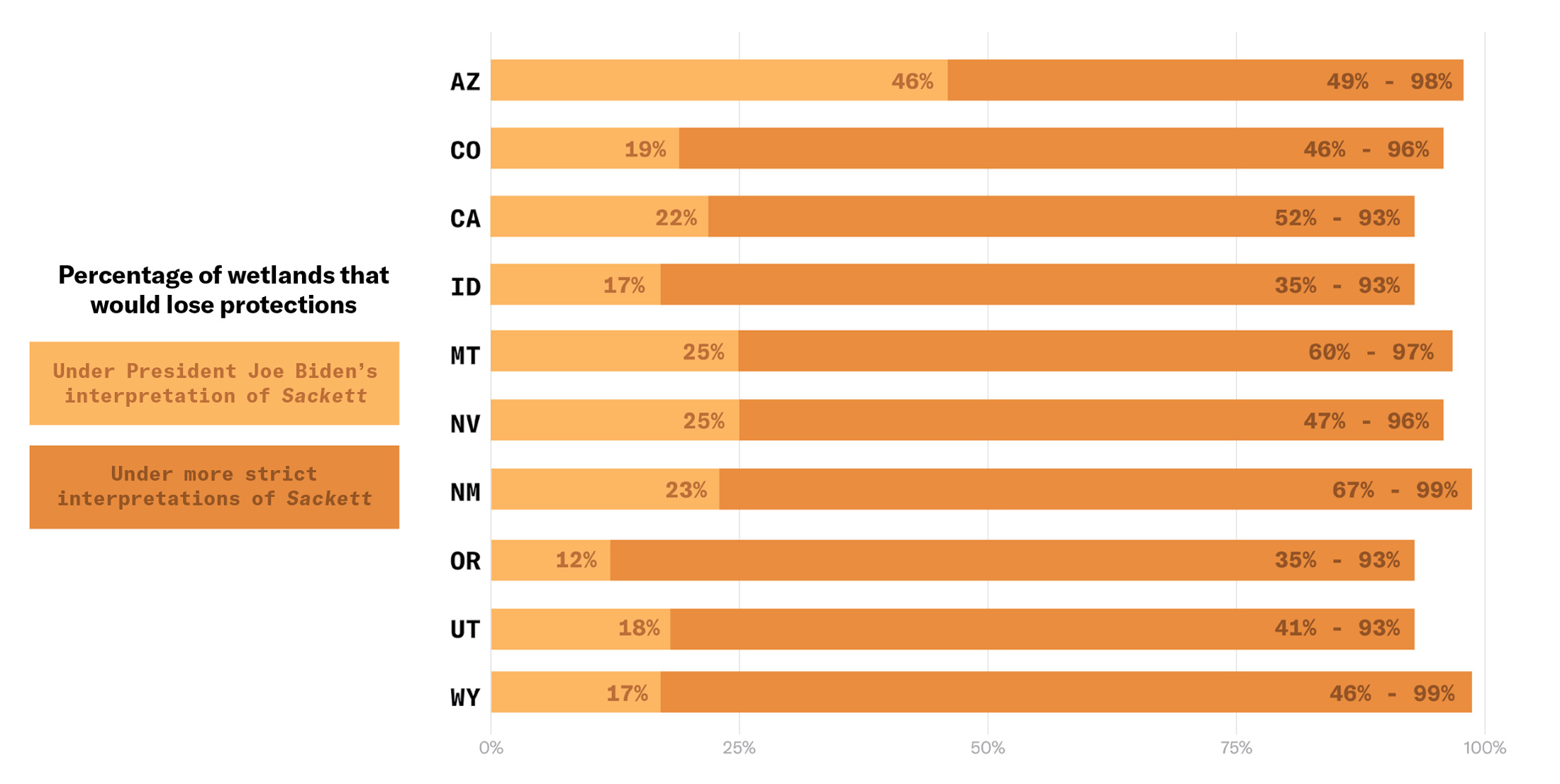
The U.S. Supreme Courtโ€™s 2023 decision on Sackett v. Environmental Protection Agency dramatically weakened protections for millions of acres of the Westโ€™s essential wetlands and streams. Under the ruling, only bodies of water with a โ€œcontinuous surface connectionโ€ to a โ€œrelatively permanentโ€ traditional, navigable water body can be legally considered part of the waters of the United States (WOTUS) and therefore covered by the Clean Water Act.

The courtโ€™s definition excludes wetlands with belowground connections to bodies of water as well as those fed by ephemeral or intermittent streams. In effect, an estimated 60% of wetlands have lost federal protection, according to a National Resources Defense Council report. The language in the decision was ambiguous โ€” exactly how wet a wetland has to be to fall under WOTUS and qualify protections was left up to federal agencies.

Wetlands are critical to both human and ecosystem health as well as for climate change mitigation. But they are also prime targets for dredging, filling and other disruptions because of their proximity to water and rich, fertile soil.

Under President Biden, the EPA broadly interpreted Sackett, focusing on protecting wetlands adjacent to bodies of water, with no explicit threshold for how often they had to be flooded. In March, however, Donald Trumpโ€™s EPA released a memoindicating that it plans to restrict all WOTUS, although itโ€™s not yet clear by how much. 

โ€œThe current EPA seems to be using Sackett as a springboard to find any perceived ambiguities and narrow the definition of WOTUS further,โ€ said Julian Gonzalez, senior legislative counsel at Earthjustice.

In the absence of federal regulations, state dredge-and-fill permitting programs can protect wetlands, and California, Oregon and Washington all have broad protections for non-WOTUS wetlands and streams. And since the Sackett decision, Colorado and New Mexico have passed laws restoring clean water protections for waters excluded from WOTUS. โ€œItโ€™s a dereliction of duty on the federal governmentโ€™s part by not appropriately protecting the waters of the U.S. and that leaves it up to the states to fill in those protections,โ€ said Rachel Conn, deputy director of Amigos Bravos, a New Mexico conservation organization.

The result is a patchwork of laws protecting the nationโ€™s wetlands. But if more Western states were to emulate their neighborsโ€™ efforts and take action, millions of acres of wetlands could be saved, even in the absence of strong federal protections. 

National Resources Defense Council estimates are based on scenarios in which the federal government adopts two interpretations of Sackett that are supported by industry and some states: one, excluding wetlands adjacent to intermittent or ephemeral streams (bottom of range), and another, excluding wetlands that are not wet or flooded most of the year (top of range). According to legal experts, the EPAโ€™s current guidance suggests that the administration will limit WOTUS significantly, excluding most wetlands. Alaska is excluded from this graph due to lack of data. Credit: Hannah Agosta/High Country News

Arizona

Wetland oversight is primarily conducted through the Surface Water Protection Program (SWPP), administered by the Arizona Department of Environmental Quality. House Bill 2691, passed in 2021 before Sackett, established the SWPP, which allows the state to protect some waters not covered under the Clean Water Act. 

Wyoming 

While Wyoming lacks a permitting program, it does bar the discharge of any pollution or wastes into its waters without a clean water permit. In addition, Wyoming established a Wetland Banking Fund before Sackett to encourage individuals and companies to preserve wetlands. It enables entities to bank wetland credits earned from wetland conservation projects and use them later to offset a developmentโ€™s impacts on wetlands, with the goal of achieving โ€œno net loss of wetland function and value in the state.โ€

Colorado

Wetland protections are primarily governed by House Bill 24-1379, a law passed in 2024 that aims to restore Clean Water Act protections to state wetlands that lost them owing to Sackett. It establishes a state permitting program.

New Mexico

The Pollutant Discharge Elimination System Act (SB 21), which was signed into law on April 8, gives the state authority to regulate surface waters. It creates a statewide permitting program and addresses polluted groundwater that falls outside federal programs.


How wetlands work

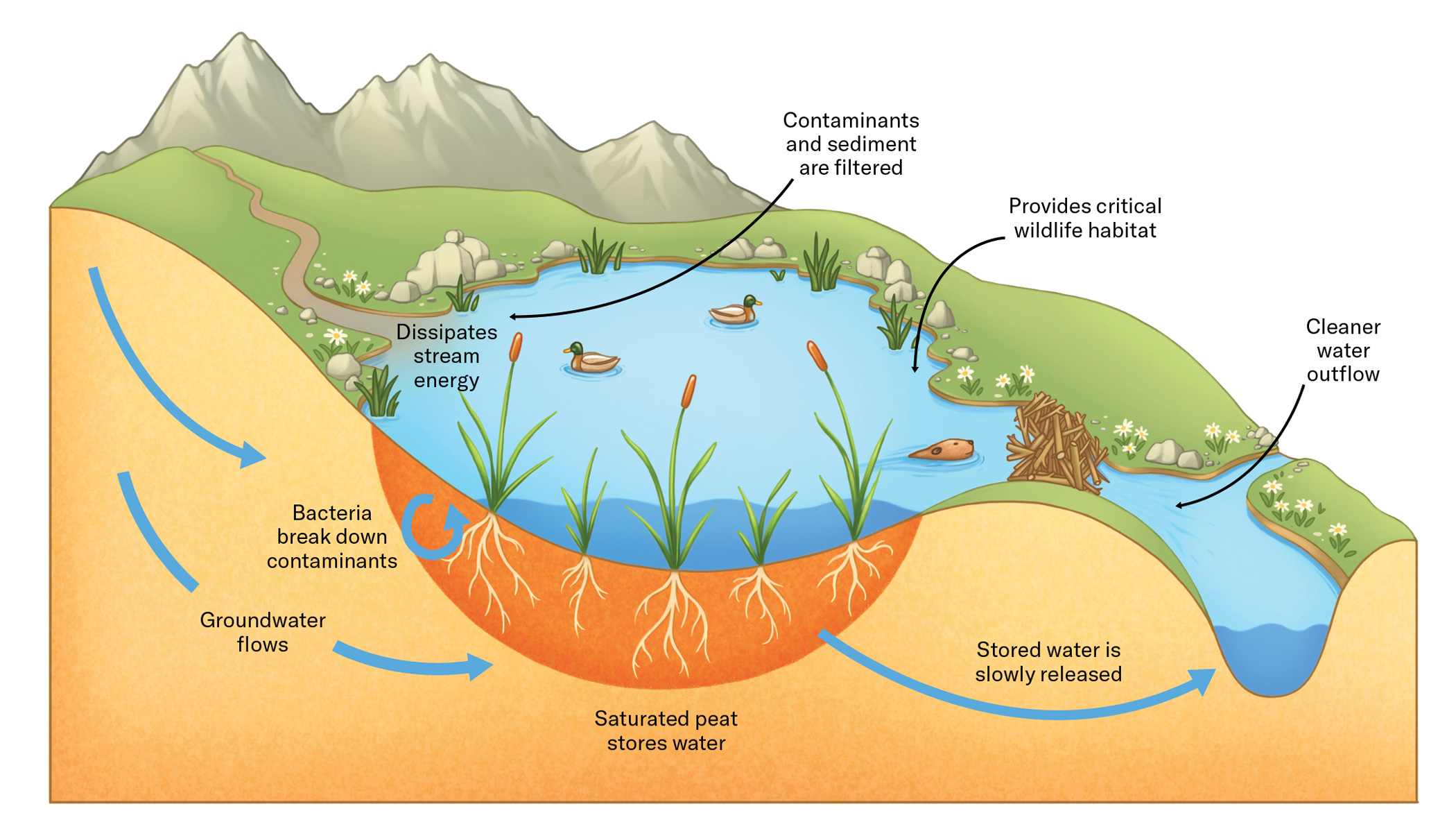
Approximately 40% of species, including half of all federally listed species, rely on wetlands, which act like sponges for excess water, offering billions of gallons of flood protection and storing this water for later use. Their plants, roots and microbes filter pollution from drinking water and also store 20%-30% of the worldโ€™s total soil carbon. But Western states have lost 50% of their wetlands since colonization, and roughly half of the regionโ€™s remaining ones are degraded.  

Illustrations by Hannah Agosta/High Country News

SOURCES: From Gold, 2024 in Science/Environmental Defense Fund, National Resources Defense Council, U.S. Fish and Wildlife National Wetlands Inventory, Wetlands International. 

This article appeared in the July 2025 print edition of the magazine with the headline โ€œIn defense of wetness.โ€

Blanca Wetlands, Colorado BLM-managed ACEC Blanca Wetlands is a network of lakes, ponds, marshes and wet meadows designated for its recreation and wetland values. The BLM Colorado and its partners have made strides in preserving, restoring and managing the area to provide rich and diverse habitats for wildlife and the public. To visit or get more information, see: http://www.blm.gov/co/st/en/fo/slvfo/blanca_wetlands.html. By Bureau of Land Management – Blanca Wetlands Area of Critical Environmental Concern, Colorado, Public Domain, https://commons.wikimedia.org/w/index.php?curid=42089248

Federal Water Tap, July 7, 2025: President Signs Budget Bill, Agencies Move to Streamline Environmental Reviews — Brett Walton (circleofblue.org)

Sensitive satellite-based instruments enable scientists to measure relative variations of Earthโ€™s gravitational field. Data gathered by NASAโ€™s Gravity Recovery and Climate Experiment (GRACE) is used in a new study to show that many continental regions are experiencing long-term aridification. Credit: NASA/JPL/University of Texas Center for Space Research

The Rundown

  • President Trumpโ€™sย budget billย targets a few water projects while eliminating some climate and environment programs.
  • Agencies move to constrainย environmental reviewsย under NEPA.
  • EPA says it will loosenย wastewater pollution rulesย for thermal power plants later this summer.
  • GAO reviewsย NASAโ€™s major projects, including the third generation of a water-tracking satellite.
  • EPA intends to take public comments on its idea to narrowย state and tribal reviewsย under Section 401 of the Clean Water Act.
  • White House orders higher fees for foreign tourists visitingย national parks.

And lastly, EPAโ€™s internal watchdog notes the risks of rising seas to federally owned Superfund sites.

โ€œIf contaminants from federal facility Superfund sites are released into the surrounding communities, the health, jobs, and environment of millions of U.S. residents may be threatened. Further, the federal funds expended to implement those remedies would have been wasted.โ€ โ€“ Report from the EPA Office of Inspector General that identifies 49 federally owned Superfund sites at risk of flooding from rising seas and increased storm surge.

By the Numbers

$658 Million: Expected baseline cost of the third generation of NASAโ€™s satellite mission that measures changes in the planetโ€™s water storage. The GRACE-C mission is scheduled for July 2029, according to a Government Accountability Office review of NASAโ€™s major projects. Operating for more than two decades, the GRACE satellites have been instrumental in tracking global groundwater depletion.

News Briefs

NEPA Overhaul
Cabinet and other agencies โ€“ including the Interior DepartmentU.S. Department of Agriculture, and Army Corps of Engineers โ€“ announced they will revise their rules for environmental reviews of major projects and prioritize shorter and quicker assessments of potential harms.

The agencies are shortening the administrative timeline for implementing a new rule, arguing that the standard notice-and-comment process would be an unnecessary delay and โ€œcontrary to the public interest.โ€

The Council on Environmental Quality, the White House arm that traditionally oversees NEPA, revoked its regulations in April in response to an executive order promoting domestic energy production. The agencies, now seeking faster, more efficient reviews, are establishing their own rules.

Besides the arrival of the new administration, recent legal rulings have also rearranged the playing field for environmental reviews.

In justifying its action, each agency cited the U.S. Supreme Courtโ€™s ruling in May in Seven County Infrastructure Coalition v. Eagle County, ColoradoThat ruling, in a case which centered on a railroad line in Utah for crude oil, allowed for narrowly focused environmental reviews that assess only a specific project and not the actions โ€“ like upstream oil drilling and downstream oil refining โ€“ it would enable.

Budget Bill
The budget reconciliation bill, which could add $3 trillion to the national debt over the next decade, barely mentioned water directly.

Among the few call outs: The bill delivers $1 billion for surface water storage and water conveyance in the western United States. The money is for projects that increase or restore capacity of Bureau of Reclamation water conveyance systems or increase their use. Increasing reservoir storage capacity โ€“ such as raising Shasta Dam, a Republican-driven idea thatโ€™s been on the table for years โ€“ is also acceptable. The money is available through September 30, 2034.

More broadly, climate and environment programs were chopped. Unobligated Inflation Reduction Act funds โ€“ those not yet committed to a recipient โ€“ were yanked back for programs on climate data, environmental justice block grants, reducing air pollution at schools, and more.

National Parks Fees
President Trump ordered the Interior Department to increase national park entry fees for foreign visitors. The additional revenue would be channeled to infrastructure improvements at the parks or to increase park access.

Still Storm Watching, For Now
NOAA said it would delay by one month the termination of certain storm-tracking satellite data, the Associated Press reports.

Studies and Reports

Superfund Sites at Risk from Rising Seas
The federal government owns 157 Superfund sites. Forty-nine of those sites are at risk of flooding from rising seas and increased storm surge.

The assessment comes from the EPAโ€™s internal watchdog, which published the report to draw attention to federal liabilities related to climate change and the nationโ€™s most toxic sites.

The at-risk Superfund sites are clustered at military sites around Chesapeake Bay, Puget Sound, and San Francisco Bay.

Arizona Groundwater Assessment
The U.S. Geological Survey published a report on water quality in the Coconino aquifer in northern Arizona, where it could be a water source for the Hopi Tribe and Navajo Nation.

On the Radar

Water Quality Permitting
The EPA is considering a rulemaking that would narrow the scope of Clean Water Act reviews undertaken by states and tribes.

These Section 401 reviews have been a target of the Trump administration. Energy companies complain that states have used their review authority to block fossil fuel infrastructure such as natural gas pipelines.

Before the rulemaking, the EPA is asking for public input. The agency opened a docket for written submissions, and it will hold two online events at a time to be announced.

File written comments at www.regulations.gov using docket number EPA-HQ-OW-2025-0272. The deadline is August 6.

Another Slogan Commission
Through an executive order, President Trump established the Presidentโ€™s Make America Beautiful Again Commission.

The commissionโ€™s objectives โ€“ โ€œpromote responsible stewardship of natural resources while driving economic growth; expand access to public lands and waters for recreation, hunting, and fishing; encourage responsible, voluntary conservation efforts; cut bureaucratic delays; and recover Americaโ€™s fish and wildlife populations through proactive, voluntary, on-the-ground collaborative conservation effortsโ€ โ€“ in some ways conflict with the administrationโ€™s desire to cut budgets and greenlight fossil fuel projects.

One of the commissionโ€™s charges is to recommend to the president โ€œsolutions to expand access to clean drinking water and restore aquatic ecosystems to improve water quality and availability.โ€ Stay tuned.

Power Plant Wastewater
Lee Zeldin, EPA administrator, said his agency later this summer will relax wastewater pollution rules for thermal power plants that burn fossil fuel and nuclear fuel.

The Biden administration placed stricter limits on these wastewater discharges last year. In a press release, Zeldin said compliance deadlines would be extended. The agency will also reconsider technological requirements for preventing polluted discharges.

Federal Water Tap is a weekly digest spotting trends in U.S. government water policy. To get more water news, follow Circle of Blue on Twitter and sign up for our newsletter.

President Trumpโ€™s First EPA Promised to Crack Down on Forever Chemicals. His Second EPA Is Pulling Back — Anna Clark (Propublica.org)

Lock and Dam No. 1 on the Cape Fear River in Bladen County, North Carolina. By Bud Davis, U.S. Army Corps of Engineers – U.S. Army Corps of Engineers Digital Visual LibraryImage pageImage description pageDigital Visual Library home page, Public Domain, https://commons.wikimedia.org/w/index.php?curid=2000782

Click the link to read the article on the Propublica website (Anna Clark):

July 2, 2025

EPA Administrator Lee Zeldin claims to prioritize combatting long-lasting chemicals called PFAS. Despite this, the agency has delayed enforcement of standards and terminated over $15 million in funding for โ€œforever chemicalsโ€ research.

ProPublica is a nonprofit newsroom that investigates abuses of power. Sign up to receiveย our biggest storiesย as soon as theyโ€™re published.

One summer day in 2017, a front-page story in the StarNews of Wilmington, North Carolina, shook up the lives of hundreds of thousands of people. The drinking water system, it said, was polluted with a contaminant commonly known as GenX, part of the family of โ€œforeverโ€ PFAS chemicals.

It came from a Chemours plant in Fayetteville, near the winding Cape Fear River. Few knew about the contaminated water until the article described the discoveries of scientists from the Environmental Protection Agency and a state university. Given that certain types of PFAS have been linked to cancer, there was widespread anxiety over its potential danger.

In the onslaught of legal action and activism that followed, the EPA during President Donald Trumpโ€™s first term took an assertive stance, vowing to combat the spread of PFAS nationwide.

In its big-picture PFAS action plan from 2019, the agency said it would attack this complex problem on multiple fronts. It would, for example, consider limiting the presence of two of the best-known compounds โ€” PFOA and PFOS โ€” in drinking water. And, it said, it would find out more about the potential harm of GenX, which was virtually unregulated.

By the time Trump was sworn in for his second term, many of the planโ€™s suggestions had been put in place. After his first administration said PFOA and PFOS in drinking water should be regulatedstandards were finalized under President Joe Biden. Four other types of PFAS, including GenX, were also tagged with limits.

But now, the second Trump administration is pulling back. The EPA said in May that it will delay enforcement on the drinking water limits for PFOA and PFOS until 2031, and it will rescind and reconsider the limits on the other four. Among those who challenged the standards in court is Chemours, which has argued that the EPA, under Biden, โ€œused flawed science and didnโ€™t follow proper rulemaking proceduresโ€ for GenX.

These EPA decisions under Trump are part of a slew of delays and course changes to PFAS policies that had been supported in his first term. Even though his earlier EPA pursued a measure that would help hold polluters accountable for cleaning up PFAS, the EPA of his second term has not yet committed to it. The agency also slowed down a process for finding out how industries have used the chemicals, a step prompted by a law signed by Trump in 2019.

At the same time, the EPA is hampering its ability to research pollutants โ€” the kind of research that made it possible for its own scientists to investigate GenX. As the Trump administration seeks severe reductions in the EPAโ€™s budget, the agency has terminated grants for PFAS studies and paralyzed its scientists with spending restrictions.

Pointing to earlier announcements on its approach to the chemicals, the EPA told ProPublica that itโ€™s โ€œcommitted to addressing PFAS in drinking water and ensuring that regulations issued under the Safe Drinking Water Act follow the law, follow the science, and can be implemented by water systems to strengthen public health protections.โ€

โ€œIf anything,โ€ the agency added, โ€œthe Trump administrationโ€™s historic PFAS plan in 2019 laid the groundwork for the first steps to comprehensively address this contamination across media and we will continue to do so this term.โ€

In public appearances, EPA Administrator Lee Zeldin has pushed back on the suggestion that his agency weakened the drinking water limits on GenX and similar compounds. Future regulations imposed by his agency, he said, could be more or less stringent.

โ€œWhat we want to do is follow the science, period,โ€ he has said.

That sentiment perplexes scientists and environmental advocates, who say there is already persuasive evidence on the dangers of these chemicals that linger in the environment. The EPA reviewed GenX, for example, during both the first Trump and Biden administrations. In both 2018 and 2021, the agency pointed to animal studies linking it to cancer, as well as problems with kidneys, immune systems and, especially, livers. (Chemours has argued that certain animal studies have limited relevance to humans.)

Scientists and advocates also said itโ€™s unclear what it means for the EPA to follow the science while diminishing its own ability to conduct research.

โ€œI donโ€™t understand why we would want to hamstring the agency that is designed to make sure we have clean air and clean water,โ€ said Jamie DeWitt, a toxicologist in Oregon who worked with other scientists on Cape Fear River research. โ€œI donโ€™t understand it.โ€

Delays, Confusion Over PFAS

Favored for their nonstick and liquid-resistant qualities, synthetic PFAS chemicals are widely used in products like raincoats, cookware and fast food wrappers. Manufacturers made the chemicals for decades without disclosing how certain types are toxic at extremely low levels, can accumulate in the body and will scarcely break down over time โ€” hence the nickname โ€œforever chemicals.โ€

The chemicals persist in soil and water too, making them complicated and costly to clean up, leading to a yearslong push to get such sites covered by the EPAโ€™s Superfund program, which is designed to handle toxic swaths of land. During the first Trump administration, the EPA said it was taking steps toward designating the two legacy compounds, PFOA and PFOS, as โ€œhazardous substancesโ€ under the Superfund program. Its liability provisions would help hold polluters responsible for the cost of cleaning up.

Moving forward with this designation process was a priority, according to the PFAS plan from Trumpโ€™s first term. Zeldinโ€™s EPA describes that plan as โ€œhistoric.โ€ And, when he represented a Long Island district with PFAS problems in Congress, Zeldin voted for a bill that would have directed the EPA to take this step.

The designation became official under Biden. But business groups, including the U.S. Chamber of Commerce, and organizations representing the construction, recycling and chemical industries, sued. Project 2025, The Heritage Foundationโ€™s playbook for the new administration, also questioned it.

Zeldin has said repeatedly that he wants to hold polluters accountable for PFAS, but his EPA requested three delays in the court case challenging the Superfund designation that helps make it possible.

The agency said in a recent motion it needed the latest pause because new leadership is still reviewing the issues and evaluating the designation in context of its โ€œcomprehensive strategy to address PFOA and PFOS.โ€

The EPA also delayed a rule requiring manufacturers and importers to report details about their PFAS use between 2011 and 2022. An annual bill that sets defense policy and spending, signed by Trump in his first term, had charged the EPA with developing such a process.

When Bidenโ€™s EPA finalized it, the agency said the rule would provide the largest-ever dataset of PFAS manufactured and used in the United States. It would help authorities understand their spread and determine what protections might be warranted.

Businesses were supposed to start reporting this month. But in a May 2 letter, a coalition of chemical companies petitioned the EPA to withdraw the deadline, reconsider the rule and issue a revised one with narrowed scope.

When the EPA delayed the rule less than two weeks later, it said it needed time to prepare for data collection and to consider changes to aspects of the rule.

In an email to ProPublica, the agency said it will address PFAS in many ways. Its approach, the agency said, is to give more time for compliance and to work with water systems to reduce PFAS exposure as quickly as feasible, โ€œrather than issue violations and collect fees that donโ€™t benefit public health.โ€

The court expects an update from the EPA in the Superfund designation case by Wednesday, and in the legal challenges to the drinking water standards by July 21. The EPA could continue defending the rules. It could ask the court for permission to reverse its position or to send the rules back to the agency for reconsideration. Or it could also ask for further pauses.

โ€œItโ€™s just a big unanswered question whether this administration and this EPA is going to be serious about enforcing anything,โ€ said Robert Sussman, a former EPA official from the administrations of Presidents Bill Clinton and Barack Obama. As a lawyer, he now represents environmental groups that filed an amicus brief in PFAS cases.

Back in North Carolina, problems caused by the chemicals continue to play out.

A consent order between the state and Chemours required the manufacturer to drastically reduce the release of GenX and other PFAS into the environment. (The chemicals commonly called GenX refer to HFPO-DA and its ammonium salt, which are involved in the GenX processing aid technology owned by Chemours.)

Chemours told ProPublica that it invested more than $400 million to remediate and reduce PFAS emissions. It also noted that there are hundreds of PFAS users in North Carolina, โ€œas evidenced by PFAS seen upstream and hundreds of miles awayโ€ from its Fayetteville plant โ€œthat cannot be traced back to the site.โ€

PFAS-riddled sea foam continues to wash up on the coastal beaches. Chemours and water utilities, meanwhile, are battling in court about who should cover the cost of upgrades to remove the chemicals from drinking water.

Community forums about PFAS draw triple-digit crowds, even when theyโ€™re held on a weeknight, said Emily Donovan, co-founder of the volunteer group Clean Cape Fear, which has intervened in federal litigation. In the fast-growing region, new residents are just learning about the chemicals, she said, and theyโ€™re angry.

โ€œI feel like weโ€™re walking backwards,โ€ Donovan said. Pulling back from the drinking water standards, in particular, is โ€œdisrespectful to this community.โ€

โ€œItโ€™s one thing to say youโ€™re going to focus on PFAS,โ€ she added. โ€œItโ€™s another thing to never let it cross the finish line and become any meaningful regulation.โ€

A letter dated April 29, 2025, notifying Michigan State University about the termination of a grant for research into PFAS, one day after the EPA said in a press release that it was committed to combating PFAS contamination by, in part, โ€œstrengthening the science.โ€ Credit: Obtained by ProPublica

Research Under Fire

The EPA of Trumpโ€™s first term didnโ€™t just call for more regulation of PFAS, it also stressed the importance of better understanding the forever chemicals through research and testing.

In a 2020 update to its PFAS action plan, the EPA highlighted its support for North Carolinaโ€™s investigation of GenX in the Cape Fear River. And it described its efforts to develop the science on PFAS issues affecting rural economies with โ€œfirst-of-its-kind funding for the agriculture sector.โ€

Zeldin, too, has boasted about advancing PFAS research in an April news release. โ€œThis is just a start of the work we will do on PFAS to ensure Americans have the cleanest air, land, and water,โ€ he said.

At about the same time, though, the agency terminated a host of congressionally appropriated grants for PFAS research, including over $15 million for projects focused on food and farmlands in places like Utah, Texas and Illinois.

Scientists at Michigan State University, for example, were investigating how PFAS interacts with water, soil, crops, livestock and biosolids, which are used for fertilizer. They timed their latest study to this yearโ€™s growing season, hired staff and partnered with a farm. Then the EPA canceled two grants.

In virtually identical letters, the agency said that each grant โ€œno longer effectuates the program goals or agency priorities. The objectives of the award are no longer consistent with EPA funding priorities.โ€

The contrast between the agencyโ€™s words and actions raises questions about the process behind its decisions, said Cheryl Murphy, head of Michigan Stateโ€™s Center for PFAS Research and co-lead of one of the projects.

โ€œIf you halt it right now,โ€ she said, โ€œwhat weโ€™re doing is weโ€™re undermining our ability to translate the science that weโ€™re developing into some policy and guidance to help people minimize their exposure to PFAS.โ€

At least some of the researchers are appealing the terminations.

About a month after PFAS grants to research teams in Maine and Virginia were terminated for not being aligned with agency priorities, the agency reinstated them. The EPA told ProPublica that โ€œthere will be more updates on research-related grants in the future.โ€

Even if the Michigan State grants are reinstated, there could be lasting consequences, said Hui Li, the soil scientist who led both projects. โ€œWe will miss the season for this year,โ€ he said in an email, โ€œand could lose the livestock on the farm for the research.โ€

Federal researchers are also in limbo. Uncertainty, lost capacity and spending restrictions have stunted the work at an EPA lab in Duluth, Minnesota, that investigates PFAS and other potential hazards, according to several sources connected to it. As one source who works at the lab put it, โ€œWe donโ€™t know how much longer we will be operating as is.โ€

The EPA told ProPublica that itโ€™s โ€œcontinuing to invest in research and labs, including Duluth, to advance the mission of protecting human health and the environment.โ€

Meanwhile, the agency is asking Congress to eliminate more than half of its own budget. That includes massive staffing cuts, and it would slash nearly all the money for two major programs that help states fund water and wastewater infrastructure. One dates back to President Ronald Reaganโ€™s administration. The other was spotlighted in a paper by Trumpโ€™s first-term EPA, which said communities could use these funds to protect public health from PFAS. It trumpeted examples from places like Michigan and New Jersey.

The EPA lost 727 employees in voluntary separations between Jan. 1 and late June, according to numbers the agency provided to ProPublica. It said it received more than 2,600 applications for the second round of deferred resignations and voluntary early retirements.

โ€œThese are really technical, difficult jobs,โ€ said Melanie Benesh, vice president for government affairs at the nonprofit Environmental Working Group. โ€œAnd the EPA, by encouraging so many employees to leave, is also losing a lot of institutional knowledge and a lot of technical expertise.โ€

The shake-up also worries DeWitt, who was one of the scientists who helped investigate the Cape Fear River contamination and who has served on an EPA science advisory board. Her voice shook as she reflected on the EPAโ€™s workforce, โ€œsome of the finest scientists I know,โ€ and what their loss means for public well-being.

โ€œTaking away this talent from our federal sector,โ€ she said, will have โ€œprofound effects on the agencyโ€™s ability to protect people in the United States from hazardous chemicals in air, in water, in soil and potentially in food.โ€

Map showing the Cape Fear River drainage basin. By Kmusser – Self-made, based on USGS data., CC BY-SA 3.0, https://commons.wikimedia.org/w/index.php?curid=5506415

Interior eviscerates public land protections, fast-tracks mining, drilling: Plus: National monument shrinkage appears imminent — Jonathan P. Thompson (LandDesk.org)

An oil and gas drilling operation in the Chaco region checkerboard of northwestern New Mexico. Jonathan P. Thompson photo.

Click the link to read the article on The Land Desk website (Jonathan P. Thompson):

April 25, 2025

๐Ÿคฏ Trump Ticker ๐Ÿ˜ฑ

For the past three months and change, the Trump administration, in a series of executive orders, has been working to dismantle the administrative state, or the framework of agencies, rules, and regulations designed to protect the nation and its citizens. For the most part, however, the Interior Department โ€” the sprawling agency that oversees much of the nationโ€™s public lands โ€” has been relatively (and suspiciously) quiet, refraining from big actions beyond merely repeating some of Trumpโ€™s orders.

That has rapidly changed in recent days as Interior Secretary Doug Burgum โ€” or perhaps Tyler Hassan, the DOGE minion Elon Musk appointed to reorganize Interior โ€” set off a figurative bomb that could demolish protections for public lands.

The most alarming move, so far, is the departmentโ€™s implementation of โ€œemergency permitting proceduresโ€ for oil and gas, uranium, coal, biofuels, and critical mineral projects on federal lands. Under this order, the department will compress the entire environmental review for these projects down to 28 days or less โ€” even for a full environmental impact statement.

โ€œBy reducing a multi-year permitting process down to just 28 days,โ€ Burgum said in a press release, โ€œthe Department will lead with urgency, resolve, and a clear focus on strengthening the nationโ€™s energy independence.โ€

If youโ€™ve ever skimmed through an EIS, you know how insane this concept is.

The Bureau of Land Management will be packing the entire process mandated by the National Environmental Policy Act, Endangered Species Act, National Historic Preservation Act, and other rules and regulations into an impossibly short timeframe.

By impossibly short, I mean that it is virtually impossible to comply with these laws and requirements โ€” which include tribal consultation, archaeological surveys and mitigation, environmental and endangered species reviews, socioeconomic impact analyses, and public comment periods โ€” in four weeks or less. So by radically compressing the timeline, Burgum is essentially telling his staff to skirt the requirements, i.e. violate the law.

Burgum uses President Trumpโ€™s claim that the U.S. is experiencing an โ€œenergy emergency,โ€ to justify the destructive rubber-stamping, and says fast-tracking project approvals is necessary to address that emergency.

Iโ€™ve said it many times, but I will say it again: There is no energy emergency. The U.S. is pumping more crude oil than ever before from the Permian Basin and other fields, it is the largest petroleum producer in the world, it is a net exporter of petroleum products, and liquefied natural gas exports are at an all-time high. The U.S. market is glutted with natural gas and the coal supply has been outpacing demand for nearly two decades. Lithium โ€” for electric vehicle batteries and grid-scale energy storage โ€” is so plentiful that prices have plummeted nearly 90% since 2022. Uranium shortage? Nope.

One could certainly argue that the power grid in the West is outdated, its operation balkanized, and that it is not up to the challenges posed by growing data center electricity demand. But aside from geothermal and hydropower (solar, wind, and transmission projects are not included), none of the categories of projects on the fast-track list would do anything to fix the grid. Even if they were, it would not justify truncating environmental reviews so severely โ€” or at all.

Environmental reviews can take a maddeningly long time, especially for big projects. But the way to speed things up is not to throw the laws and protections in the the trash bin. That will only lead to lawsuits, which likely will delay the projects even more. The only way to truly streamline permitting, while still safeguarding human health and the environment, is to beef up staffing, resources, and expertise. And thatโ€™s exactly the opposite of what Trump and Musk and Burgum are doing.

Pages from the Interior Departmentโ€™s 2026-2030 Strategic Plan Draft Framework acquired and published by Public Domain. Note that one objective is to โ€œrelease federal holdingsโ€ for housing. And that in the top one they want to โ€œreduce the costs for grazingโ€ on public land (can it go any lower?), while in the bottom one they want to โ€œincrease revenues from grazing โ€ฆ .โ€ Uh โ€ฆ okay?

But wait. It gets worse.

We might take some comfort in the fact that national monuments are off-limits to the extractive industries and Trumpโ€™s energy dominance agenda, right? Maybe not for long.

Earlier this week, the folks at Public Domain acquired a copy of the Interior Departmentโ€™s 2026-2030 Strategic Plan Draft Framework. The plan aims to, among other things: โ€œrestore American prosperity,โ€ โ€œassess and right-size monuments,โ€ and โ€œreturn heritage lands and sites to the states.โ€

The Washington Post, however, is reporting that Burgum is not necessarily waiting until next year to โ€œright-size,โ€ or shrink, national monuments. From the Post:

If they go through with the shrinkage of any or all of these national monuments, it would open up additional lands to oil and gas leasing and new mining claims, which would then be subject to the fast-tracked permitting.

Baaj Nwaavjo Iโ€™tah Kukveni-Ancestral Footprints of the Grand Canyon is especially rich in high-grade uranium deposits, and the White Canyon area in Bears Ears might also be targeted for uranium if the monument were shrunk. Grand Staircase-Escalante includes a large coal deposit on the Kaipairowitz Plateau, but itโ€™s exceedingly unlikely that anyone would be interested in mining it given the faulty economics of coal.

One thing you can be sure of is that none of this will go unchallenged. The tribal nations that proposed the designation of Bears Ears and other national monuments will sue to keep them intact, and advocacy groups and land and water protectors will support them and take the administration to court over its flouting of environmental laws.

A look across Glen Canyon National Recreation Area and into Bears Ears National Monument from the Little Rockies. Jonathan P. Thompson photo.

๐ŸŒต Public Lands ๐ŸŒฒ

For many people, the mention of Glen Canyon National Recreation Area evokes images of Lake Powell and all that entails: boats plying the blue-sky-reflecting waters and the sandstone cliffs and formations that rise up from the murky depths. That makes sense, given that the national park unit was established because the reservoir was there in 1972.

Yet the reservoir makes up just 13% of the 1.25 million-acre recreation area. The remaining 87% contains some of the more remote and spectacular country in the lower 48, shares borders with a half-dozen other national parks and monuments, and makes up the core of the Moab to Mojave Conservation Corridor.

So, the manner in which the area is managed matters โ€” a lot. And for five decades after the recreation areaโ€™s establishment, off-road vehicle travel went virtually unmanaged, allowing for a destructive free-for-all along shorelines and in remote parts of the recreation area. In 2018, the Park Service released a plan that more or less codified the pre-plan anarchy. Environmentalists sued and forced the Park Service back to the drawing board.

This January the Park Service finally issued an amended rule celebrated by conservationists for adding protections to some of GCNRAโ€™s more sensitive areas from motorized vehicle travel (this does not affect boating, by the way). It bars OHV-riding yahoos from roaring around the lakeโ€™s shore unheeded, and restricts motorized travel in the Orange Cliffs area on the north end of the recreation area adjacent to the Maze in Canyonlands.

The off-road vehicle lobby, however, was unhappy with the added restrictions, and they took their victim-complex grievances to the Utah congressional delegation, all of whom appear to have a fetish for fossil-fueled combustion-engines. Now the plan and the recreation area are being put in jeopardy by โ€” you guessed it โ€” those same Utah politicians. Sens. John Curtis and Mike Lee, along with Rep. Celeste Maloy, are asking Congress to revoke the rule under the Congressional Review Act and to prohibit the Park Service from implementing similar protections in the future.

๐Ÿ—บ๏ธ Messing with Maps ๐Ÿงญ

The National Parks Conservation Association created a nifty map showing active mining claims and mines near national parks and national monuments. It gives a good sense of how vulnerable some areas might be to new mining claims and projects if the Trump administration goes ahead with shrinking the aforementioned national monuments. You can look at the interactive version here.

One note of caution: An active mining claim โ‰  a valid mining claim. An active claim simply means it has been located and filed, and that the claimant has paid their annual maintenance fee. The validity of a claim, on the other hand, depends on the discovery of a valuable mineral deposit there, which must be demonstrated. Rights to mine are only attached to valid claims.


Parting Poem

Hereโ€™s another one from Richard Sheltonโ€™s Selected Poems, 1969-1981.

Federal Water Tap, April 21, 2025: Agencies Fast-Track Controversial #FossilFuel and Mining Projects in Great Lakes, #Arizona — Brett Walton (circleofblue.org)

Click the link to read the article on the Circle of Blue website (Brett Walton):

April 19, 2025

The Rundown

  • Army Corps expedites permit process forย Line 5 oil tunnelย that crosses beneath the Great Lakes.
  • White Houseย fast-tracks 10 mining projectsย in its quest for domestically produced minerals.
  • FEMAย cancels grant programย meant to prepare communities for weather hazards, while USDA overhaulsย climate-smart agricultureย grant program.
  • Federal agencies intend to shrink wildlife habitat protections under theย Endangered Species Act.
  • Judge sets a trial date forย Rio Grandeย lawsuit between New Mexico and Texas.
  • EPA extends public comment period for health risk assessment ofย PFAS in sewage sludge.

And lastly, the Justice Department seeks to end an agreement to improve sewage infrastructure in Alabama.

โ€œThe DOJ will no longer push โ€˜environmental justiceโ€™ as viewed through a distorting, DEI lens. President Trump made it clear: Americans deserve a government committed to serving every individual with dignity and respect, and to expending taxpayer resources in accordance with the national interest, not arbitrary criteria.โ€ โ€“ Assistant Attorney General Harmeet K. Dhillon of the Justice Departmentโ€™s Civil Rights Division, as reported by Inside Climate News.

Dhillon is referring to a Biden-era civil rights agreement with the state of Alabama that sought to improve sewage infrastructure in the stateโ€™s poorest counties, which are also majority Black. The Justice Department is trying to end that agreement.

The agreement directed Alabama agencies to take a number of actions, such as halting referral of home wastewater violations to law enforcement and expanding a public health campaign about the dangers of raw sewage. It included a sewage system assessment and an infrastructure plan for at-risk areas.

By the Numbers

$882 Million: Funding that FEMA is rescinding from the Building Resilient Infrastructure and Communities program, which was meant to prepare towns for floods, sea level rise, hurricanes, and heat. FEMA is canceling the grant program, Engineering News Record reports.

$3 Billion: Biden-era funding for the Partnership for Climate-Smart Commodities that is being retooled by the Trump administration. The U.S. Department of Agriculture said it will reevaluate the program it has rebranded as Advancing Markets for Producers to ensure that less money is spent on administrative costs. Expenditures under the previous grants that were incurred through April 13 will be paid out.

Great Lakes satellite photo via Wikipedia.

News Briefs

Line 5 Tunnel Expedited
The Army Corps of Engineers determined that the Line 5 tunnel, a proposal to drill an oil pipeline tunnel beneath the strait that separates lakes Michigan and Huron, is being put on the permitting fast track.

The determination is in response to President Donald Trumpโ€™s declaration of a national energy emergency in order to speed up the permitting and construction of fossil fuel infrastructure.

Carrie Fox, an Army Corps spokesperson, told Circle of Blue that the new permit review procedures and timeline are not known right now.

โ€œWe are coordinating with the applicant, who is Enbridge, and also coordinating with the Council on Environmental Quality, who will assist in establishing the review timeline,โ€ Fox said. โ€œSo until those steps take place, we donโ€™t have a timeline. And so we wonโ€™t know how exactly itโ€™ll change yet. We just know right now that the permit has been placed under emergency procedures, but the timeline is to be determined.โ€

Enbridge proposes drilling a 3.6-mile tunnel beneath the Straits of Mackinac. The existing seven-decade-old pipeline sits exposed on the lakebed. It has been hit by ship anchors and a rupture would be calamitous for Great Lakes ecology, tourism, and water supplies.

Six Great Lakes tribes, after learning in March that the project permitting would likely be expedited, withdrew from the federal review process in protest, the Milwaukee Journal Sentinel reports.

Mining Projects Fast-Tracked
The White House put 10 mining projects on the fast-track for regulatory approval, continuing the administrationโ€™s desire for more domestically produced minerals.

Oak Flat, Arizona features groves of Emory oak trees, canyons, and springs. This is sacred land for the San Carlos Apache tribe. Resolution Copper (Rio Tinto subsidiary) lobbied politicians to deliver this National Forest land to the company with the intent to build a destructive copper mine. By SinaguaWiki – Own work, CC BY-SA 4.0, https://commons.wikimedia.org/w/index.php?curid=98967960

The list includes the Resolution Copper mine, in Arizona, which would be located on land that is sacred to the Apache people. Tribe members have petitioned the U.S. Supreme Court to halt the project, the Arizona Republic reports.

The U.S. Department of Agriculture, the lead permitting agency for the Resolution project, will update the timeline by May 2.

The other mining projects would produce gold, phosphate, copper, lithium, and other critical minerals.

Redefining the Endangered Species Act
Two federal agencies that oversee the Endangered Species Act intend to eliminate the definition of โ€œharmโ€ because it does not fit with the new administrationโ€™s interpretation of a recent Supreme Court ruling.

The National Marine Fisheries Service and the U.S. Fish and Wildlife Service had considered harm to mean habitat destruction. No longer, after the Loper Bright decision that the administration reads as curtailing agency authority in this matter.

The only wrongful actions under the ESA would be those that โ€œtakeโ€ an animal, meaning to capture, injure, or kill it.

The proposed change would apply only to new permits and would not affect existing actions. Public comments are being accepted through May 19 via www.regulations.gov using docket number FWS-HQ-ES-2025-0034.

Studies and Reports

Army Corps Water Storage Agreements
The Army Corps could improve its communication with utilities about the fees it charges them for water storage space in its reservoirs, according to a Government Accountability Office report.

The fees are a portion of the cost to operate and maintain the reservoirs. The Corps had 438 water storage agreements nationwide, as of 2023.

Tile Drainage and Transportation
The U.S. Geological Survey published a report describing how drainage from farm fields affects downstream flows.

The only wrongful actions under the ESA would be those that โ€œtakeโ€ an animal, meaning to capture, injure, or kill it.

The proposed change would apply only to new permits and would not affect existing actions. Public comments are being accepted through May 19 via www.regulations.gov using docket number FWS-HQ-ES-2025-0034.

Studies and Reports

Army Corps Water Storage Agreements
The Army Corps could improve its communication with utilities about the fees it charges them for water storage space in its reservoirs, according to a Government Accountability Office report.

The fees are a portion of the cost to operate and maintain the reservoirs. The Corps had 438 water storage agreements nationwide, as of 2023.

View of runoff, also called nonpoint source pollution, from a farm field in Iowa during a rain storm. Topsoil as well as farm fertilizers and other potential pollutants run off unprotected farm fields when heavy rains occur. (Credit: Lynn Betts/U.S. Department of Agriculture, Natural Resources Conservation Service/Wikimedia Commons)

Tile Drainage and Transportation
The U.S. Geological Survey published a report describing how drainage from farm fields affects downstream flows.

Tile drains, common in the Midwest, move water from beneath fields into ditches.

The report was supported by state transportation departments, which want to build roads, bridges, and culverts that can withstand high water flows.

On the Radar

Future Army Corps Projects
The Army Corps is seeking proposals from states, tribes, and regional bodies for projects to be considered for future feasibility studies or improvements.

Proposals are due August 15.

PFAS in Sewage Sludge
The EPA is extending the public comment period for its draft risk assessment of two PFAS in sewage sludge, also known as biosolids.

Comments are now due August 14. Submit them via http://www.regulations.gov using docket number EPA-HQ-OW-2024-0504.

In the assessment, the agency evaluated risks to people living on or near lands where these biosolids are applied. The analysis, which looked at PFOA and PFOS, also considered risks for people whose primary consumption of water and food comes from these lands. It is not intended to assess risk for the general public.

Rio Grande and Pecos River basins. Map credit: By Kmusser – Own work, Elevation data from SRTM, drainage basin from GTOPO [1], U.S. stream from the National Atlas [2], all other features from Vector Map., CC BY-SA 3.0, https://commons.wikimedia.org/w/index.php?curid=11218868

Rio Grande Lawsuit
The lawsuit between Texas and New Mexico over water supply from the Rio Grande will have a 10-day trial starting June 9, Source NM reports.

The parties to the case, which include Colorado and the federal government, are continuing to seek a mediated solution before the trial begins.

Federal Water Tap is a weekly digest spotting trends in U.S. government water policy. To get more water news, follow Circle of Blue on Twitter and sign up for our newsletter.

Federal Water Tap, April 14, 2025: President Trump Signs Barrage of Water, Energy Executive Orders — Brett Walton (circleofblue.org)

Click the link to read the article on the Circle of Blue website (Brett Walton):

April 14, 2025

The Rundown

  • White House moves to cut funding for keystone federalย climate change reportย and targetsย โ€œunlawfulโ€ regulations.
  • President Trump signs an order to relaxย showerhead water efficiency standards.
  • Another order opposes state laws that impede hisย โ€œenergy dominanceโ€ visionย and seeks to invalidate them.
  • Yet another order requires agencies to put maximumย 5-year expiration datesย into existing energy and environmental laws.
  • EPA says it will review new studies of health outcomes fromย fluoridated drinking water.
  • Mexico says it will immediately release some water in theย Rio Grandeย basin.
April 1, 2025 seasonal water supply forecast summary. Credit: Colorado Basin River Forecast Center

And lastly, federal forecasts indicate a down year forย Colorado River runoffย and the riverโ€™s already depleted reservoirs.

โ€œThese State laws and policies are fundamentally irreconcilable with my Administrationโ€™s objective to unleash American energy.ย They should not stand.โ€ โ€“ย Executive orderย from President Donald Trump that takes aim at state climate change laws that limit carbon-emitting energy production. The order instructs the attorney general to identify state laws and policies that the Justice Department believes illegally impede energy projects, and then attempt to halt implementation of the laws. The order mentions nearly every type of energy source except solar and wind.

“The attorney general will prioritize investigating state laws that mention one of the administrationโ€™s many ideological bugbears: climate change; environmental, social, and governance initiatives; environmental justice; greenhouse gas emissions; and carbon taxes.:

Any merit to all this? No, says Ted Lamm of UC Berkeley School of Law. Accusations of state overreach in this arena are a โ€œmirage.โ€

By the Numbers

  • 67 Percent of Average: Most probable runoff into Lake Powell this year from the Colorado River, according to a federal forecast. The report covers the April-July period. The down year is not good news for Lake Powell (33 percent full) or Lake Mead (34 percent).
  • 4.1 Million Barrels Per Day: U.S. crude oil exports in 2024, a new annual record. Europe is now the biggest export market, after its decision in 2022 to ban Russian imports.

News Briefs

Rio Grande Water Negotiations
President Claudia Sheinbaum said Mexico would carry out โ€œimmediate deliveryโ€ of some water to the Rio Grande basin, an instance of trade politics influencing water policy, The Hill reports.

Under a 1944 treaty, Mexico is required over five years to deliver 1.75 million acre-feet from its side of the basin. It is far behind in the current cycle, even as deliveries have picked up this year in response to political pressure.

As of April 5, Mexico had delivered 512,604 acre-feet in this cycle.

Eliminating โ€œUnlawfulโ€ Regulations
Recent Supreme Court decisions โ€“ Sackett (wetlands), Ohio (air emissions), Loper Bright Enterprises (deference to agency expertise), among others โ€“ have curtailed the executive branchโ€™s regulatory powers. The White House now wants to institutionalize those rulings.

It will be action by subtraction, quickly.

Trump signed an executive order giving agencies 60 days to draw up a list of current โ€œunlawful and potentially unlawfulโ€ regulations and devise a plan to repeal them.

The order directs agencies to repeal these rules without public notice and comment periods, which are generally required by law. The order claims that because these unnamed rules are unlawful, getting rid of them merits an exemption from notice and comment.

Pressure Politics
Ticking a favored topic, Trump also signed an order to rescind Biden-era water conservation regulations for certain high-end showerheads.

The rule restricted multi-nozzle showerheads to a total flow rate of 2.5 gallons per minute, which has been the federal standard for showerheads since 1992. The flow rate could not apply to each nozzle individually, which would multiply water use.

The Trump administrationโ€™s previous attempt to allow multi-nozzle showerheads to flow at higher rates was criticized by the plumbing industry. IAPMO, a trade group, argued that plumbing systems in new buildings, which are built for conservation, could be undersized if higher water volumes are allowed.

Sunset Provisions
Another order seeks to cut existing and future regulations in a different way: by adding โ€œsunset provisionsโ€ that set an expiration date.

The order directs agencies to insert sunset provisions into bedrock environmental and energy laws such as the Energy Policy Act, Mining Act, Federal Power Act, and Endangered Species Act. The sunset dates are to be between one and five years after the provision is finalized. Regulations can be renewed โ€œas many times as is appropriate, but never to a date more than 5 years in the futureโ€ if they are deemed worthy.

Studies and Reports

Cutting Climate Research Funding
The Trump administration is cutting funding for the federal governmentโ€™s keystone report on climate change in the United States and its impacts, Politico reports.

The White House is cancelling a contract with the firm that oversees the U.S. Global Change Research Program, which conducts the National Climate Assessment. Ending the contract โ€œforever severedโ€ interagency climate change work, one senior official told Politico.

The National Climate Assessment is mandated by Congress, written by hundreds of academic and federal researchers, and summarizes the most recent science on climate change and its consequences for the country.

Coal Executive Order
To assist the dying U.S. coal industry, Trump signed a proclamation that gives coal-fired power plants a two-year reprieve from stricter air pollution standards.

U.S. coal production has fallen off a cliff, down more than half from its peak in 2008, according to government data. The reasons are structural and interrelated: higher production costs, stricter environmental controls, and cheaper competitors.

On the Radar

Fluoride
Lee Zeldin, the EPA administrator, said the agency will review scientific information about the health effects of fluoride as it considers potential regulatory action under the Safe Drinking Water Act.

The agency will produce โ€œan updated health effects assessment for fluoride.โ€

A federal judge ruled last year that the agency must update its fluoride regulations due to new research into health risks.

Cybersecurity Drill
The EPA will host a nationwide drill next month to prepare drinking water utilities for a cyberattack.

Sign up for the May 27 drill here.

Federal Water Tap is a weekly digest spotting trends in U.S. government water policy. To get more water news, follow Circle of Blue on Twitter and sign up for our newsletter.

Report: Can water reuse save the #ColoradoRiver?An analysis of wastewater recycling in the Colorado River Basin states — University of California Los Angeles

Click the link to read the report on the UCLA website (Noah Garrison, Lauren Stack, Jessica McKay, and Mark Gold). Here’s the executive summary:

The impacts of climate change and prolonged drought on water scarcity in the Western United States have accelerated since the end of the 20th century. The Colorado River has been strained by a history of excessive withdrawals and long-term drought. Increasingly less water is available across the seven Colorado River Basin statesโ€”Arizona, California, Colorado, Nevada, New Mexico, Utah, and Wyomingโ€”for natural ecosystems and the 40 million people that rely, in part or in whole, on its diverted flows to cities and farms. Faced with this challenge, the importance of recycled water at a large scale has never been greater. Water recycling of treated municipal wastewater is a cost-effective source of reliable, sustainable water supply; people shower, flush toilets, and wash clothes and dishes on a regular basis even in times of fluctuating water availability, and these waste flows go to publicly owned treatment works (POTWs) in urban areas.

To assess the current state of water recycling across the Colorado River Basin and its affected states, UCLA Institute of the Environment and Sustainability, in partnership with Natural Resources Defense Council, has investigated water recycling progress and policy development across the seven states in the basin. We analyzed the amount of water entering municipal wastewater treatment plants treating an average of greater than 1 million gallons per day across the 2022 calendar year, the amount these plants reclaim or reuse, and the amount they discharge back into the environment. Our analysis demonstrates that while individual treatment facilities, cities, or even regions may be making substantial progress toward water sustainability, most basin states are falling well short of their potential to reuse wastewater. Overall, the Colorado River Basin states are missing opportunities to ensure a safe, sustainable, climate-resilient supply of water in a hotter, drier future.

While across the Colorado River Basin, an average of 26% of municipal wastewater from POTWs was recycled, there are striking differences between states that are prioritizing reuse and those that are falling behind. Arizona (reusing 52% of treated wastewater) and Nevada (as much as 85%) deserve accolades for their efforts to develop the recycled water supply. California, which produces by far the largest volume of wastewater, only recycled 22% of its treated wastewater in 2022. Of the remaining four states, New Mexico recycles a similarly modest 18%, and Colorado (3.6%), Utah (less than 1%), and Wyoming (3.4%), for a variety of state-specific reasons, have made little to no progress to date on reusing meaningful volumes of treated wastewater. Further and distinct breaks appear to exist between efforts and progress made by states in the lower Colorado River Basin (Arizona, California, and Nevada) and those of the upper basin (Colorado, New Mexico, Utah, and Wyoming). In 2022, the upper basin states as a whole recycled less than 5% of their assessed influent, as compared to more than 30% for the lower basin. (See Figure EX-1 for state-by-state results of our analysis.)

Figure EX-1. Volume of municipal wastewater effluent vs. current reuse by state across the Colorado River Basin for 2022. Totals include figures for the whole state, not only for wastewater generated in the Colorado River watershed. Credit: UCLA

In addition to the lack of progress on wastewater reuse, the overall lack of data on wastewater recycling, including volume, level of treatment, and end use of the recycled water is also glaring. California maintains the most comprehensive database of recycled water, including its end uses, through the California Open Data Portal (see SWRCB, 2022). While we were able to gather data directly from individual wastewater treatment facilities in other states, determining how much water is being recycled was a significant challenge, and determining how much recycled water is ultimately directed to municipal, agricultural, or industrial users was often limited to qualitative description, if information was available at all.

All of the state results have been achieved in the absence of strong federal recycled water policy or any federal regulation. The lack of federal support for or consistency among state programs has hampered efforts and stands as a significant impediment to further growth of recycled water use. Promoting consistent and growing national water reuse will require action at both the federal and state level.

To this end, through our investigation we have developed a set of recommendations for the U.S. Environmental Protection Agency (EPA) and other federal and state partners and stakeholders. Additional detail and guidance for these recommendations is presented in the main report body and conclusions. These recommendations include the following:

Within two years, EPA, working with state partners, water agencies, and nongovernmental organizations, should develop a model state program and ordinance for recycling of municipal wastewater with minimum elements.

  • EPA should improve data acquisition and management, including developing guidance for standardized facility-level reporting and state data sharing, to ensure availability of information and comparability of data between states.
  • EPA should further develop and disseminate the latest science and technical information on treatment processes and pathogen risk assessment for different sources of water and reuse applications.
  • In partnership with the states, EPA should develop wastewater reuse goals and timelines.
  • EPAโ€”working with other federal agencies including the Bureau of Reclamation and the Departments of Agriculture, Energy, and Defenseโ€”should develop and implement funding strategies beyond those already in existence, including furthering the Pilot Program for Alternative Water Source grants.

In addition, our analysis uncovered that, across the Colorado Basin states, inconsistency between programs and overall lack of state-level oversight or even awareness of wastewater recycling efforts in several states is alarming. Recommended improvements needed at the state level for those states without these programs include:

  • Work with local water reclamation or reuse agencies to develop funding strategies to meet targets for 30%, 40%, or 50% goals.
  • Work with EPA to establish numeric targets for wastewater reuse for each state, with timelines and interim goals. Figure EX-2 provides a breakdown of the total water supply that would be made available for each state with targeted goals of 30%, 40% or 50% reuse by 2040, a number already exceeded by two of the basin states.
  • Improve data acquisition and management, as well as reporting requirements where applicable, for wastewater treatment facilities and wastewater reuse operations.
  • Conduct assessments of current state legal and regulatory requirements to identify barriers to wastewater reuse and develop formal state policies for overcoming those barriers.

Overall, substantial action needs to be taken to achieve sustainable water management across the Colorado River Basin. Better use of climate modeling, water pricing that does not encourage waste and unreasonable use, stronger water conservation and efficiency programs and requirements for agricultural and urban users, enhanced stormwater capture, greater and longer-term cutbacks in Colorado River water withdrawals, and, critically, a substantial increase in water reuse all must be embraced as climate resiliency solutions.

Figure EX-2. Recycled water volume created for each state at targeted reuse percentage of 30%, 40%, and 50%of the stateโ€™s total wastewater influent, with net increase in overall potential available water supply. Credit: UCLA

As shown in Figure EX-2, if the Colorado Basin states other than Arizona and Nevada were to increase wastewater reuse to even 40% of treated influent it could increase current recycled water availability by nearly 900,000 acre-feet per year (AFY) over current efforts. Reuse of 50% of influent would increase water availability by nearly 1.3 million AFY. This represent a significant percentage of the projected shortfall on the Colorado River, and a rsolution that should be pursued aggressively to ensure sustainable management of the river.

Map of the Colorado River drainage basin, created using USGS data. By Shannon1 Creative Commons Attribution-Share Alike 4.0

President Trumpโ€™s War on Water #Conservation — Brian Richter (SustainableWaters.org)

Click the link to read the article on the Sustainable Waters website (Brian Richter):

February 19, 2025

Donald Trump is throwing another toilet tantrum.

Heโ€™s insisting that the US Environmental Protection Agency weaken the water efficiency standard of its Water Sense label.

To claim that the elimination of water efficiency standards will โ€œlower the cost of livingโ€ is a blatant falsehood.

The EPA had previously estimated that low-flush toilets enable American families to reduce their water use by 20-60% and save $110 per year on average and $2200 over the lifetime of a toilet (note that this web page has now been removed from EPAโ€™s website).

The genesis of the Water Sense program was, interestingly, the National Energy Policy Act of 1992, passed under the administration of George HW Bush. The architects of this energy bill recognized that drinking water and wastewater plants are often the largest energy consumers within municipalities, typically accounting for 30โ€“40% of total energy consumed. The Act thus set residential fixture and appliance standards that limit the volume of water used per flush or per minute for toilets, urinals, showerheads, and faucets. Most notably, it required that every toilet installed after 1994 use just 6 L (1.6 gallons) of water per flush, a 54% reduction from the pre-legislation norm of 13 L per flush (3.4 gallons). The associated reduction in energy resulting from use of low-flow plumbing fixtures has further reduced the cost of residential water bills.

US toilet manufacturers have thus been making low-flush toilets for more than 30 years.

The Water Sense label was created to push water conservation even further. It recognizes plumbing fixtures that are 20% more efficient than required under the energy act.

These federal initiatives have had a substantial influence on residential indoor water use in the US. The 1992 Act has been credited with saving an estimated seven billion gallons per day, equating to seven times the daily water use of New York City and 18% of total daily US public water-supply use. They are a major reason for the โ€˜decouplingโ€™ of water use from population growth in the US; the graph below shows that as water-efficient plumbing fixtures began to become available in the 1980s, total water use in the US began to decrease for the first time. As cities began to encourage replacement of old water-guzzling toilets with new low-flush toilets by offering rebates on purchases of low-flush toilets, the decline in water use steepened further.

Why in the world would we want to take away the single-most important tool in the water conservation toolbox used by cities around the planet?

Source: USGS

Our manufacture of low-flush toilets and water-efficient dishwashers, washing machines, and other appliances is also important to our global trade economy. The US sold its low-flush toilets to 156 different countries last year. Similar to the sentiment of US farmers to โ€œfeed the world,โ€ US manufacturers take pride in providing water-saving devices around the world. As Bill Darcy Jr., global president and CEO of the US National Kitchen and Bath Association has put it: โ€œThe commitment to water efficiency and hygiene is more crucial now than ever.โ€ When Trump tried to weaken the efficiency standards in his first term, the International Association of Plumbing and Mechanical Officials offered a bunch of good reasons for not rolling back the standards.

Trump has falsely complained that low-flush toilets donโ€™t work properly. โ€œPeople are flushing toilets 10 times, 15 times as opposed to once.โ€ His comment reminded me of a conversation I had with the president of American Standard, a leading US manufacturer of low-flush toilets in the US. He boasted that โ€œOur toilets can flush a one-pound russet potato.โ€ I will spare you the visual imagery of the YouTuber that easily flushed 56 chicken nuggets in his low-flush toilet.

Rare earth elements found in #LincolnCreek raise new questions: Mineralized tributary and Ruby mine also source of rare earth elements in Lincoln Creek — Heather Sackett (AspenJournalism.org)

Lincoln Creek was orange just downstream of the mineralized tributary in July 2024. A team of scientists from the University of Colorado Boulder found that a mineralized tributary is also contributing rare earth elements to Lincoln Creek, in addition to other metals like aluminum. Credit: HEATHER SACKETT/Aspen Journalis

Click the link to read the article on the Aspen Journalism website (Heather Sackett):

January 25, 2025

Recent sampling shows that a high-alpine tributary of the Roaring Fork River, in addition to having high concentrations of certain metals, also contains rare earth elements. But what that means for human and aquatic health is unclear.

Scientists from the University of Colorado Boulder presented the preliminary results from water-quality sampling on Lincoln Creek over last summer at a public meeting hosted by the Roaring Fork Conservancy at the Basalt Regional Library on Thursday. 

Occupying a lesser-known corner of the periodic table, rare earth elements (which, despite their name, are commonly occurring in Earthโ€™s crust) are a set of 17 heavy metals that are used in making products such as cellphones, fiber-optic cables and computer monitors. With names such as yttrium, lanthanum and neodymium, they often turn up at sites in Colorado where there is acid rock drainage, such as upper Lincoln Creek.

โ€œYou get a phoneโ€™s worth of neodymium coming down the mineralized tributary about every 5ยฝ minutes,โ€ said Adam Odorisio, a graduate student and researcher at CUโ€™s environmental engineering department. โ€œThis translates to 96,000 phones per year. And what I think is the most striking fact in this is that this is for one tributary. You multiply this across hundreds of acid mine sites in Colorado and potentially thousands across the Western U.S. and itโ€™s very exciting for resource extraction.โ€ 

CU scientists are also monitoring other high alpine acid rock and mine drainage sites in Colorado, including the Snake River. Odorisio said the concentrations of rare earth elements in a mineralized tributary that feeds Lincoln Creek was in the middle of the pack when compared to other sites around the state.

Twin Lakes collection system

In addition to the potential for mining valuable rare earth metals, scientists are eager to learn more about their impacts to human health and aquatic environments. There are no state or federal water quality standards for rare earth elements. Lincoln Creek is a source of drinking water for Front Range cities, including Colorado Springs. 

โ€œThis is just wide open as an unknown area,โ€ said Diane McKnight, a professor at CUโ€™s Institute of Arctic and Alpine Research. โ€œItโ€™s not clear that itโ€™s something to worry about here. The water from (Lincoln Creek) that goes into the Twin Lakes system is highly diluted.โ€ 

Over nine days from June through October, the CU team collected 79 water samples from eight sites, took sediment core samples from the Grizzly Reservoir lakebed, and collected rock scrapings and bugs from the waterway. Early results also confirmed what the Environmental Protection Agency found in previous water-quality tests: The water is highly acidic, and concentrations of metals including zinc, copper and aluminum exceed standards for aquatic life. Scientists found that a groundwater source could also be adding metals to Lincoln Creek. They are still analyzing the data and plan to present more results at a spring meeting.

โ€œFor the greater scientific community, the fate of rare earth elements in aquatic systems is not well understood,โ€ Odorisio said. โ€œWe are hoping to change that.โ€

The headwaters of Lincoln Creek upstream from the Ruby Mine and mineralized tributary. Recent water sampling by scientists from the University of Colorado Boulder found rare earth elements in the creek downstream, but implications for human health and aquatic impacts are unclear. Credit: HEATHER SACKETT/Aspen Journalism

The results may be of use to the Lincoln Creek workgroup, an ad hoc group โ€“ composed of officials from Pitkin County, Colorado Parks and Wildlife, the U.S. Forest Service, Colorado Department of Public Health and Environment, Independence Pass Foundation, Roaring Fork Conservancy and others โ€“ that is trying to understand how contaminants are impacting Lincoln Creek and the Roaring Fork River. The group has hired consultants LRE Water to compile water-quality data collected by several different agencies last summer and propose options to clean up the waterways. 

โ€œThe rare earth metals is a group we havenโ€™t really thought through,โ€ said Kurt Dahl, Pitkin Countyโ€™s environmental health manager. โ€œThatโ€™s one of the things that we are talking through with the contractor, LRE Water.โ€ 

The water quality of Lincoln Creek has been under increased scrutiny in recent years as fish kills and discoloration of the water downstream of Grizzly Reservoir have become more frequent. In July, reservoir owner and operator Twin Lakes Reservoir & Canal Co. drained the reservoir for a planned dam-rehabilitation project, releasing an orange slug of sediment-laden water from the bottom of the reservoir downstream. Testing showed that the water had high levels of iron and aluminum, but not copper, which is toxic to fish.

An EPA report in 2023 determined that a โ€œmineralized tributary,โ€ which feeds into Lincoln Creek above the reservoir near the ghost town of Ruby, is the main source of the high concentrations of metals downstream. 

Prior to mining, snowmelt and rain seep into natural cracks and fractures, eventually emerging as a freshwater spring (usually). Graphic credit: Jonathan Thompson

The process that causes metals leaching into streams can be both naturally occurring and caused by mining activities. In both cases, sulfide minerals in rock come into contact with oxygen and water, producing sulfuric acid. The acid can then leach the metals out of the rock and into a stream, a process known as acid rock drainage. The contamination from acid rock drainage seems to be increasing at other locations around Colorado and may be exacerbated by climate change as temperatures rise. 

The recent water-quality-testing effort on Lincoln Creek is probably just the beginning of a long-term data-collection and monitoring program, Dahl said. 

โ€œI think thereโ€™s still a lot of energy around this,โ€ Dahl said. โ€œPeople are really invested in this, and itโ€™s going to take a couple of years to get it characterized.โ€

Aspen Journalism, which is solely responsible for its editorial content, is supported by a grant from the Pitkin County Healthy Community Fund.

This story ran in the Jan. 27 edition of The Aspen Times.

Map of the Roaring Fork River drainage basin in western Colorado, USA. Made using USGS data. By Shannon1 – Own work, CC BY-SA 4.0, https://commons.wikimedia.org/w/index.php?curid=69290878

Cleanup of abandoned uranium mines set to start after Navajo Nation, EPA reach agreement — AZCentral.com

Graphic credit: Environmental Protection Agency

Click the link to read the article on the AZCentral.com website (Arlyssa D. Becenti). Here’s an excerpt:

January 8, 2025

After years of demanding the cleanup of uranium waste at the Kerr-McGee Quivira Mines on the Navajo Nation community advocates got the news this week that the Environmental Protection Agency will remove waste rock from three areas of the site and move it to a new off-site repository. The removal of over 1 million cubic yards of radioactive waste from the sites about 20 miles northeast of Gallup will begin in early 2025, the EPA said. The waste will be taken to a new off-site repository at Red Rocks Landfill east of Thoreau, N.M. The process, including permitting, construction, operation and closure of the repository, is expected to take 6-8 years.

โ€œI feel as though our community finally has something of a win,โ€ said Teracita Keyanna, a member of the executive committee for Red Water Pond Road Community Association. โ€œRemoving the mine waste from our community will protect our health and finally put us back on a positive track to Hรณzhวซ.โ€

Commercial exploration, development, and mining of uranium at Quivira Mines began in the late 1960s by the Kerr-McGee Corporation and later its subsidiary. The mine sites are the former Church Rock 1 (CR-1) mining area; the former Church Rock 1 East (CR-1E) mining area; and the Kerr-McGee Ponds area. The mines were in operation from 1974 to the mid-1980s and had produced about 1.2 million tons of ore, making them among the 10 highest producing mines on the Navajo Nation…From World War II until 1971, the U.S. government was the sole purchaser of uranium ore, driving extensive mining operations primarily in the southwestern United States. These efforts employed many Native Americans and others in mines and mills. Between 1944 and 1986, nearly 30 million tons of uranium ore were extracted from Navajo lands under leases with the Navajo Nation. With over 500 abandoned uranium mines โ€” many say the total could be in the thousands โ€” clean up of mines has always been a battle.

Safe Drinking Water Act Turns 50: Landmark law encounters new problems, enduring challenges — Brett Walton (@circleofblue)

A water tower in Sacaton, the central town of the Gila River Indian Community. Photo ยฉ J. Carl Ganter / Circle of Blue

Click the link to read the article on the Circle of Blue website (Brett Walton):

December 16, 2024

The American public, newly conditioned to the health dangers of a polluted environment, was worried.

Media reports documented carcinogens in the lower Mississippi River. The federal government, empowered by recent legislation, sued Reserve Mining Company for dumping asbestos-like fibers into Lake Superior, thereby jeopardizing the water supply for Duluth, Minnesota, and at least four other communities. Congress had just approved groundbreaking laws for cleaner air and ecosystems. What about tap water?

Those were the circumstances in 1974 as a receptive Congress and a supportive-but-cost-conscious Ford administration debated first-ever national drinking water standards.

In the previous four years, lawmakers had passed the Clean Air Act and the Clean Water Act. โ€œNothing is more essential to the life of every single American than clean air, pure food, and safe water,โ€ Russell Train, then-administrator of the Environmental Protection Agency, wrote to President Gerald Ford. โ€œThe time is overdue for a Safe Drinking Water Act.โ€

Fifty years ago, on December 16, 1974, Ford clinched a public health victory when he signed a bill that joined the pantheon of federal environmental protection laws enacted that decade.

Today, the country still reaps the benefits. Most Americans are provided high-quality water from their taps.

โ€œAt a time when the American public is skeptical of the governmentโ€™s ability to take positive action and improve their lives, the Safe Drinking Water Act is an example of the essential work that our government can and must do to stand up for our well-being,โ€ Radhika Fox, assistant administrator for water at the U.S. Environmental Protection Agency from 2021 to 2024 told a Senate committee last month. โ€œItโ€™s a demonstration of the most basic mission of our government: to safeguard the rights and interests of its people.โ€

As the Safe Drinking Water Act begins its next half century, it is clear that the law is an essential piece of the countryโ€™s project to assure every American access to safe, reliable, affordable water. But there is still much room for improvement. By one estimate, some two million people in the country do not have running water or indoor plumbing at home. Black and Hispanic communities, especially if they are poor, are more likely to have low quality drinking water. The struggles of small water systems that serve dozens or hundreds of people remain problems.

The act was weakened in 2005, following secret meetings between the oil industry and the Bush administration, that advanced oil and gas development by exempting chemical fluids used in fracking from federal oversight.

There are also elements of drinking water provision that the act does not explicitly address. Aging infrastructure, a changing climate, decaying plumbing within buildings, and limited funding for repairs are major impediments. Private well water is not regulated.

Health and environmental groups, seeing the proliferation of chemicals in commerce and their links to cancer, kidney disease, and other chronic ailments, encourage the U.S. Environmental Protection Agency (EPA) to regulate more of these contaminants.

The agency appears to be paying attention. It decided earlier this year to set national standards for six PFAS โ€“ the persistent and toxic โ€œforeverโ€ chemicals used in non-stick, water-repellent goods and firefighting foams. They were the first additions to the roster of regulated contaminants in decades. Perchlorate, used in explosives and a concern for fetal brain development, is next on the EPA agenda, due to a court order.

A counter argument โ€“ offered most passionately by public policy experts and utility leaders โ€“ is that the EPA is focusing on the wrong risks. This line of thinking suggests that regulators are targeting new chemical contaminants when they should be more concerned about the reliability of the pipes through which water flows. Utilities and municipalities have limited funds, the argument goes, so the biggest health risks should be addressed first.

Pipe breaks โ€“ which occur by the hundreds every day in this country โ€“ can pull pathogens into water systems and do immediate harm. Plumbing systems inside buildings, which are not regulated by the Safe Drinking Water Act, can harbor Legionella bacteria, which causes Legionnairesโ€™ disease, a respiratory illness that is the countryโ€™s deadliest waterborne disease. It kills about one in 10 people it infects. A Legionnairesโ€™ outbreak in Grand Rapids, Minnesota, that began in 2023 sent 11 people to the hospital.

Chad Seidel, president of Corona Environmental Consulting, worries that the failure to invest in basic infrastructure will result in less reliable water systems that are prone to malfunctioning and spreading disease. Backsliding on infrastructure quality would be detrimental, he said.

โ€œI believe the health risks of regressing are higher than the risk of unregulated contaminants,โ€ Seidel said.

The data show that certain water providers have higher risks of failure. In 1970, the EPAโ€™s drinking water division assessed the quality of water from 969 systems. Most failing systems were small.

So it is today. Small water systems, a half century later, are more likely to violate health standards and monitoring requirements.

The country counts about 50,000 public water systems, most of them small. Many lack the financial strength or managerial know-how to successfully operate. There is a growing consensus that small systems will need to be absorbed into larger neighbors, or form regional entities that take advantage of scale to provide better service.

Amendments to the act in 1996 established a revolving loan fund that is the federal governmentโ€™s primary vehicle for financing local drinking water improvements. Despite tens of billions of dollars added to the fund in the last three decades, state and local governments still account for about 95 percent of water infrastructure spending. Utility leaders fret that Congress is starting to erode the revolving fund by extracting earmarks from its annual appropriation. In time, this will result in less money available to lend.

โ€œYou canโ€™t talk about the future of safe drinking water without talking about how to pay for it,โ€ said Rob Greer, who studies public administration at Texas A&M University.

Water utilities are lobbying for a federal program to assist low-income people with their water bills, as the government does for energy bills. During the pandemic, Congress approved a short-term water bill assistance program but it has expired. A federal program would allow utilities to raise rates to pay for needed repairs, while not burdening their poorest customers with large bills.

Even if adequate funding is secured, there are social and cultural headwinds buffeting utilities. An unknown but rising number of people do not drink their tap water. They do not trust it.

Mistrust is highest among Black and Hispanic communities who are also most likely to have tap water that exceeds federal standards or looks and tastes gross. Notorious tap water failures in Flint, Michigan, and Jackson, Mississippi, in the last decade highlight the ease by which trust can be lost.

Mistrust is illustrated by soaring sales of bottled water and the growing presence of commercial water kiosks, a trend documented by Samantha Zuhlke of the University of Iowa and Manny Teodoro of the University of Wisconsin-Madison. Both bottled water and kiosk water have less regulatory scrutiny than tap water.

Water is an intimate relationship between individuals and their government because water is the โ€œonly government service you ingest,โ€ Teodoro said.

The water treatment process

#Aspen to impose stricter requirements for lead in drinking water — The Aspen Times

Aspen

Click the link to read the article on the Aspen Times website (Westley Crouch). Here’s an excerpt:

Aspen City Council unanimously passed a first reading of an ordinance aimed at updating the cityโ€™s water service line requirements. Called Ordinance 19, it sets out to be in compliance with new federal and state lead and copper regulations…The primary goal of the ordinance is to align Aspenโ€™s water system with the U.S. Environmental Protection Agencyโ€™s Lead and Copper Rule Revisions and Lead and Copper Rule Improvements, which were finalized in December 2021…These rules, which Aspen utilities staff had to meet by Oct. 16, impose stricter requirements for lead in drinking water, including mandatory service line inventories and replacement plans for all public water systems. In that inventory, Aspenโ€™s Water Department showed that 98% of the cityโ€™s 4,121 accounts are free of lead, with the majority of pipes being copper or plastic.ย 

US air force avoids #PFAS water cleanup, citing supreme courtโ€™s #Chevron ruling: EPA says Tucsonโ€™s drinking water is contaminated but air force claims agency lacks authority to order cleanup — The Guardian

Petersen Air Force Base. Photo credit: Peterson Air and Space Museum

Click the link to read the article on The Guardian website (Tom Perkins). Here’s an excerpt:

August 12, 2024

The US air force is refusing to comply with an order to clean drinking water it polluted in Tucson,ย Arizona, claiming federal regulators lack authority after the conservative-dominatedย US supreme courtย overturned the โ€œChevron doctrineโ€. Air force bases contaminated the water with toxicย PFAS โ€œforever chemicalsโ€ย and other dangerous compounds. Though former USย Environmental Protection Agencyย (EPA) officials and legal experts who reviewed the air forceโ€™s claim say the Chevron doctrine ruling probably would not apply to the order, theย militaryโ€™sย claim that it would represents an early indication of how polluters will wield the controversial court decision to evade responsibility. It appears the air force is essentially attempting to expand the scope of the courtโ€™s ruling to thwart regulatory orders not covered by the decision, said Deborah Ann Sivas, director of the Stanford University Environmental Law Clinic…

The supreme court in late Juneย overturned the 40-year-old Chevron doctrine, one of its most important precedents. The decision sharply cut regulatorsโ€™ power by giving judges the final say in interpreting ambiguous areas of the law during rule-making. Judges previously gave deference to regulatory agency experts on such questions. The ruling is expected to have a profound impact on the EPAโ€™s ability to protect the public from pollution, and the Tucson dispute highlights the high stakes in such scenarios โ€“ clean drinking water and the health of hundreds of thousands of people hangs in the balance…

Several air force bases are largely responsible for trichloroethylene (TCE) โ€“ volatile organic compounds โ€“ andย PFASย contaminating drinking water sources in Tucson. A 10-sq-mile (26 sq km) area around the facilities and Tucson international airport were in the 1980s designated as a Superfund site, an action reserved for the nationโ€™s most polluted areas. The EPA in late Mayย issued an emergency orderย under the Safe Drinking Water Act requiring the air force to develop a plan within 60 days to address PFAS contamination in the drinking water.

On Superfund and the #GoldKingMine, 9 years later — Jonathan P. Thompson #AnimasRiver #SanJuanRiver

The Animas River running orange through Durango after the Gold King Mine spill August 2015. Photo credit: Jonathan P. Thompson/The Land Desk

Click the link to read the article on The Land Desk website (Jonathan P. Thompson):

August 6, 2024

โ›๏ธMining Monitor โ›๏ธ

It was nine years ago yesterday, while I was sitting in our Durango home, when a tweet from La Plata County popped up on my screen warning residents of an upstream spill of some sort. โ€œI gotta see this,โ€ I said to myself, running out to the old Silver Bullet and driving it to the 32nd Street Bridge. When I found the water to be its usual placid green, brimming with SUPers and boaters and scantily-clad tubers, I continued north into the broad, flat-bottomed Animas Valley, where the generous monsoon had left pastures green and cottonwoods lush. 

I turned onto Trimble Lane, passed the golf course and rows of McMansions to a little turnout by the bridge and was transfixed by the river: Turbid, electric-orange water, utterly opaque, sprawled out between the sandy banks, as iron hydroxide particles thickened within the current like psychedelic smoke.

This image was taken during the peak outflow from the Gold King Mine spill at 10:57 a.m. Aug. 5, 2015. The waste-rock dump can be seen eroding on the right. Federal investigators placed blame for the blowout squarely on engineering errors made by the Environmental Protection Agencyโ€™s-contracted company in a 132-page report released Thursday [October 22, 2015]

The crazy color was the result, of course, of the Gold King Mine spill, when contractors for the EPA inadvertently breached an earthen plug in the portal of the Gold King Mine, releasing some 3 million gallons of TANG-hued, acidic, metal-tainted water into a tributary of the Animas River, turning the waterways various shades of yellow and orange for a good 100 miles downstream. The incident drew global attention, shut down the river, and affected recreation, commerce, and agriculture, as well as inflicting trauma on the collective psyches of the riverside communities โ€” some of which still lingers today.

It really seemed, at the time, to be a turning point. After years of lurking under the public radar, abandoned mines and the ways they harm the environment, impair water quality, and sometimes harm human health were finally getting attention. There were congressional hearings on the problem, dozens of stories in the national media, and Gold King downstreamers demanded that the Upper Animas River watershed be declared a Superfund site in order to fix the problem, once and for all. 

The โ€œBonita Peak Mining Districtโ€ superfund site. Map via the Environmental Protection Agency

Nine years have passed, a Superfund site โ€” the Bonita Peak Mining District โ€” was established, numerous lawsuits have played out, and as much as $160 million has been spent responding to the initial disaster and on Superfund-related activities in the years since. And yet, no meaningful federal policy regarding abandoned mines has been passed by Congress or implemented by the White House. And while Gold King Mine discharges are being treated, keeping some harmful metals out of the streams, very little additional progress has been made on solving the larger problem of abandoned mines in the Upper Animas watershed and their effect on water quality.

It is all a bit discouraging, to say the least. Though none of it is all that surprising. 

On the federal policy part, the Biden administration issued a report last summer calling for major reforms to the 1872 General Mining Law. The proposed changes would increase protections on mining claim/lease and permitting end, so as to avoid future Gold King events. And they would establish a reclamation fee and royalties on federal hardrock minerals to help fund a restoration industry tasked with cleaning up abandoned mines. 

It all sounds great, but so far has yielded very little actual policy. Yes, the Biden administration increased mining claim fees from $165 to $200. And the Infrastructure Investment and Jobs Act and the Inflation Reduction Act did earmark billions of dollars for abandoned mine โ€” and oil and gas well โ€” cleanup. As for Congress, the closest theyโ€™ve gotten to a viable mining law reform bill is one clearing the way for corporations to use public lands as waste dumps. 

The problem is that the mining industry wields a great deal of power, especially in Nevada, Arizona, and Utah. And that means that even Democratic, otherwise green-leaning politicians tend to bow down to industry (see Sens. Jacky Rosen and Catherine Cortez Masto, both of Nevada). The Biden administration, meanwhile, has developed a case of carbon tunnel vision, and is looking to streamline and encourage mining for so called โ€œgreen metalsโ€ such as lithium, manganese, cobalt, and copper. And it has also signed on to efforts to bolster the domestic uranium mining industry to support a growing advanced nuclear reactor sector. Implementing the administration’s own recommended reforms could slow those efforts. 

Prior to mining, snowmelt and rain seep into natural cracks and fractures, eventually emerging as a freshwater spring (usually). Graphic credit: Jonathan Thompson

As for a lack of progress in the Upper Animas? Thatโ€™s a more complicated situation. In fact, itโ€™s the complicated nature that makes it so challenging. 

Superfund โ€” or CERCLA โ€” seems to work well as a blunt instrument for cleaning up old factories, waste dumps, or other contained industrial sites, and for holding the responsible parties to account. It has a good track record on some mining sites, as well, including several in the West. Even then, however, the cleanup can last for decades, and in the case of draining mines, may require water treatment in perpetuity. 

But thereโ€™s nothing straightforward or simple about the environmental legacy of mining in the Upper Animas watershed and the 48 sites within the Bonita Peak Mining District Superfund site. The mountainsโ€™ innards resemble Swiss cheese, with miles and miles of drifts and shafts in addition to natural fractures and faults that blur hydrological understanding. Indeed, mysteries remain around the exact source and pathways of the water that blew out of the Gold King in 2015. (For what is likely the most exhaustive, and exhausting, chronological dive into the Gold King/Sunnyside/American Tunnel connections, check out this old Land Desk wonkfest. But remember, only paid subscribers have access to the archives!) 

Further complicating issues is a fair amount of natural acidity and metal loading that can never be cleaned up, along with the still unanswered question of which stretches of stream may have been able to support fish before mining commenced, and which ones may feasibly be able to support fisheries in the future. In other words, what is the end goal of the project? What would โ€œfixingโ€ the problem, as downstreamers demanded in 2015, look like in terms of specific water quality improvements in specific stretches of streams? And are those desired fixes feasible? Nine years later and those questions linger. 

The saddest part of it all, perhaps, is the fact that those questions were being asked and answered, and solutions were being implemented, prior to the Gold King spill. The Animas River Stakeholders Group moved maddeningly slow at times, but they were thorough, realistic in what could be achieved, and effective. They were also efficient: Since their funding was limited, they had to prioritize projects that would give them the biggest water quality bang for their buck. They were also somewhat limited in what they could do thanks to liability issues. While moving or capping a waste pile is fairly low risk, if a โ€œgood samaritanโ€ like ARSG tries to fix a draining, abandoned mine, it could become responsible for future problems โ€” like the Gold King blowout, for example. So, ARSG relied on industry partners for draining adits, or called in the EPA. 

A lot of folks, myself included, hoped that the Superfund cleanup would incorporate ARSG as an active partner and build upon their efforts. Just imagine what the group, which was formed in 1994 and included a vast storehouse of water quality data and analysis and human expertise, could have done with EPA funding and liability protection? Instead, the EPA started virtually from scratch. The ARSG ultimately disbanded and was replaced by the citizens advisory group, or CAG. Former ARSG Coordinator Peter Butler was brought on as CAGโ€™s chair. 

Iโ€™d run into Butler on occasion while running or hiking the trails around Durango, and he always seemed a bit frustrated about the lack of progress at the Superfund site and the EPAโ€™s lack of receptiveness to the advisory groupโ€™s advice and data collection. 

Shortly after the Gold King spill, the EPA had spent many millions of dollars setting up a water treatment facility in the former mining town of Gladstone, at the mouth of the bulkheaded and defunct American Tunnel (which accessed the Sunnyside, the last operating mine in the region, which was shuttered in 1991). But it only treats drainage from the Gold King, letting acid mine drainage from other nearby adits flow unmitigated into Cement Creek, which ultimately joins up with the Animas River. Other than that, the EPA had done very little in the way of substantive remediation, and downstream water quality has remained poorer than it was in the early 2000s, when the Sunnysideโ€™s treatment plant was still up and running. (Itโ€™s a very long story, but to sum it up: Legal issues, a lack of funding, and an eviction shut treatment down in 2004, causing water quality and downstream fish populations to deteriorate).

Still, I was a bit shocked when Butler announced his resignation from the CAG late last year, and sent a letter detailing his reasons for moving on. He cited the lack of CAG influence on decision-making, the high turnover among local EPA administrators, and the EPAโ€™s failure to honor promises made to the local community prior to Superfund designation. And, he wrote:ย 

(The EPA later responded, as reported by the Durango Heraldโ€™s Reuben M. Schafir)

It was damning criticism and the EPA lost an important advisor when Butler stepped down. And while the CAG continues its work with a capable group of local advisors, Butlerโ€™s exit also seemed to signal the end of the Animas River Stakeholders Group era, in which environmentalists, bureaucrats, scientists, and industry collaborated to find working solutions to complex problems. 

It has taken me a while to write about this, in part because I do find it somewhat heartbreaking. It also worries me. Earlier this year Navajo Nation advocates and residents celebrated when the EPA finally designated the Lukachukai Mountains Mining District Superfund site after years of lobbying for it. They saw it as a guarantee that dozens of abandoned, Cold War-era uranium mines would finally be cleaned up and would stop oozing toxic material into the water and homes. And maybe it is, but how long will it take? 

The sad reality is that no one โ€” not the EPA, not the Stakeholders group, not industry โ€” will ever totally fix the problem of polluting abandoned mines in the Upper Animas watershed. All they can really do is manage it and, in an ideal world, learn from the experience and develop better and more innovative ways to carry out that management. I suppose in EPA-time, nine years isnโ€™t all that long. Thereโ€™s still time to right the ship so that the project can benefit the water and the local community. 

Wonkfest: Sunnyside Gold King Settlement, explained Jonathan P. Thompson January 24, 2022

Last weekโ€™s $90 millionย settlementย relating to the 2015 Gold King Mine Blowoutย that turned the Animas and San Juan Rivers TANG-orange for over 100 miles downstream did not bring an end to the legal saga that has dragged on for more than six years (lawsuits against the federal government are still pending). But when the agreement is finalized, Sunnyside Gold Corpโ€”the owner of the nearby, now-shuttered Sunnyside Mineโ€”will finally be free of the mess. Extricating themselves from any further liabilities has cost them about $67.6 million: $40.5 million to the feds;ย $6.1 millionย to the State of Colorado;ย $11 millionย to the State of New Mexico; and $10 million to the Navajo Nation, not to mention the tens of millions theyโ€™d already spent cleaning up a centuryโ€™s worth of mining mess.


๐Ÿฅต Aridification Watch ๐Ÿซ

Glen Canyon Dam. Photo credit: Jonathan P. Thompson/The Land Desk

Iโ€™ve seen a bunch of headlines lately to the effect of: โ€œLake Powell water hits highest level in three years.โ€ Itโ€™s accurate and itโ€™s certainly good news for everyone who relies on water from the Colorado River, but it doesnโ€™t really tell the whole story. Yes, deadpool has been delayed for another year or so, boaters have better access to the reservoir, hydropower output should be a bit better, and the ferry between Halls Crossing and Bullfrog Marinas is operating once again. 

That said, the headline is a bit of a glass half-full sort of thing. Yet in this case, it wasnโ€™t even half full, at its seasonal peak in early July it was only about 41% of capacity โ€” or 59% empty for all the pessimists. Now water levels are dropping again and likely will continue to do so until next spring, as releases exceed inflows. 

In some ways you could say that Lake Powellโ€™s levels are a microcosm of the Southwestโ€™s climate as a whole. Weโ€™ve had a few decent to downright-abundant water years, which have eased the drought in most places and helped reservoir levels recover. But the wet years have not ended the Southwest megadrought, now going on its 25th year, which is the most severe dry spell of the last 1,200 years, according to new research out of UCLA. Nor has the above-average snowpack brought Lakes Powell or Mead back to their 1980s glory days. It will take several more consecutive wet years to make that happen. 

The increase may not be enough to quell concerns about future water supplies, but the ferryโ€™s up and running again, which is a good sign. I’ve only taken it once: My dad and brother and I took the Lowrider, a 1967 Pontiac Catalina, across Lake Powell many years ago, before taking some hairball, oil-pan-busting Henry Mountain route for which the car was not appropriate. The ferry ride only lasts a few minutes, but itโ€™s kind of cool, and it allows you to see a lot more country with less driving. It only runs when the water level is above 3,575 feet, though, which means you probably only have a month or two to try it out.

Figure 4. Graph showing the distribution of reservoir storage in different parts of the Colorado River basin between 1 January 2021 and 15 July 2024. Credit: Jack Schmidt/Center for Colorado River Studies

Abandoned mines cover the West — Jonathan P. Thompson (@HighCountryNews)

Berkeley Pit and Yankee Doodle tailings pond: Butte, Montana. By NASA – http://www.nasa.gov/multimedia/imagegallery/image_feature_697.html, Public Domain, https://commons.wikimedia.org/w/index.php?curid=20856275

Click the link to read the article on the High Country News website (Jonathan P. Thompson):

July 1, 2024

In 1953, the Anaconda Minerals Company leased nearly 8,000 acres of land in central New Mexico from the Pueblo of Laguna to mine uranium for nuclear weapons. The company gouged and blasted away at the earth, constructing the three massive holes known as the Jackpile-Paguate Mine.ย 

The Jackpile-Paguate became the worldโ€™s largest open-pit uranium mine, producing some 24 million tons of ore. It employed hundreds of Laguna Pueblo members and transformed the communityโ€™s economy. But mining companies and regulators gave little thought to the safety of miners and nearby residents. Miners were exposed to radioactive and toxic heavy metals daily, even spending their lunch breaks sitting on piles of radioactive ore. Blasting sent tremors through the puebloโ€™s adobe homes, and a cloud of poisonous dust drifted into the village of Paguate, just 2,000 feet from the mine, coating fruit trees, gardens, corn and meat that was set out to dry. 

In 1982, uranium prices plummeted, and Atlantic Richfield, Anacondaโ€™s successor, shut up shop, conducted a cursory reclamation and walked away.

Aerial view of Laguna Pueblo, Rio San Jose, and Interstate 40 in New Mexico. This file is licensed under the Creative Commons Attribution-Share Alike 4.0 International license.

But the pollution didnโ€™t end when the Jackpile closed. A toxic plume continued to spread through groundwater aquifers, and the Rio Paguate, a Rio Grande tributary, remains contaminated more than a decade after the facility became a Superfund site, despite millions of dollars in cleanup work. And Laguna residents and former mine workers still suffer lingering health problems โ€” cancer, respiratory illnesses and kidney disease โ€”  from the mine and its pollution. 

There are at least 250,000 abandoned mining โ€œfeatures,โ€ including at least 4,000 involving uranium, scattered across the Western U.S. โ€” mines, waste piles, prospect holes and other infrastructure. Some are harmless and invisible to the untrained eye. Others continue to threaten the environment, people and wildlife, even after millions of dollars have been spent attempting to clean them up. Mining is hard โ€” but healing the earth and the health of the communities affected by it is immeasurably harder.ย  [ed. emphasis mine]

Data visualization by Jennifer Di-Majo/High Country News

Data visualization by Jennifer Di-Majo/High Country News

Data visualization by Jennifer Di-Majo/High Country News

โถ The Iron Mountain Mine operated from the 1870s until it was abandoned in the 1960s. It was listed as a Superfund site in the 1980s and cleanup continues, including round-the-clock treatment of draining, heavily contaminated water so acidic it can devour a metal shovel blade in less than 24 hours.

โท Cold War-era uranium mining companies left behind more than 100 waste piles contaminated with radium and heavy metals in and around the Navajo Nation community of Cove. This March, some 50 years after mining ended, it was designated as the Lukachukai Mountains Mining District Superfund site. 

โธ The Formosa Mine โ€” shuttered and abandoned in the early 1990s โ€” discharges millions of gallons of acid mine drainage into the Umpqua River each year. It was designated a Superfund site in 2007, and cleanup efforts received additional Infrastructure Act funding in 2021. 

โน Mining ended and groundwater pumps shut down at theย Berkeley Pitย in the early 1980s, allowing the massive hole to fill with acidic, heavy metal-laden water. More than 3,000 snow geese died in 2016 after landing on the Berkeley โ€œlake,โ€ which is part of the Silver Bow Creek/Butte Area Superfund site.

โบ The Bonita Peak Mining District Superfund site โ€” nearly 50 abandoned mines and related features โ€” was designated following the 2015 Gold King Mine blowout, when some 3 million gallons of acid mine drainage spewed into the Animas River drainage. 

โป Mining occurred at the Questa Molybdenum Mine from 1920 until 2014, contaminating soil, surface- and groundwater. A water treatment plant operates in perpetuity to keep contaminants from streams at a cost of more than $5 million annually. 

โผ Thousands of uranium mines were abandoned after the Cold War in the Lisbon Valley, White Canyon, and Uravan Mineral Belt in Utah and Colorado. (The USGS labels many of this areaโ€™s uranium sites as โ€œunknown.โ€)

Data visualization by Jennifer Di-Majo/High Country News

Hardrock mining introduces oxygen and water to sulfide-bearing rocks, and the resulting reaction forms sulfuric acid. The now-acidic water dissolves and picks up naturally occurring metals such as zinc, cadmium, lead, arsenic, mercury and even uranium, ultimately depositing these harmful minerals in streams or lakes long after mining ceases. Acid mine drainage is miningโ€™s most insidious, pervasive and persistent environmental hazard. 

Data visualization by Jennifer Di-Majo/High Country News

SOURCES: U.S. Geological Survey, U.S. Environmental Protection Agency, Government Accountability Office, Congressional Research Service, University of New Mexico Native American Budget & Policy Institute, Mining and Environmental Health Disparities in Native American Communities, by Johnnye Lewis et al.

We welcome reader letters. Email High Country News at editor@hcn.org or submit a letter to the editor. See our letters to the editor policy.

This article appeared in the July 2024 print edition of the magazine with the headline โ€œAbandoned mines cover the West.โ€

Column:ย With its โ€˜Chevronโ€™ ruling, the Supreme Court claims to be smarter than scientific experts — The Los Angeles Times

The U.S. Supreme Court Building, current home of the Supreme Court, which opened in 1935. By Senate Democrats – 7W9A9324, CC BY 2.0, https://commons.wikimedia.org/w/index.php?curid=92666722

Click the link to read the article on The Los Angeles Times website (Michael Hiltzik). Here’s an excerpt:

July 2, 2024

The case concerned a 40-year-old precedent known as โ€œChevron deference.โ€ That doctrine held that when a federal law is ambiguous, the courts must defer to the interpretations offered by the agencies the law covers โ€” as long as those interpretations are โ€œreasonable.โ€ On Monday,ย the court discarded Chevron deference. This may sound like an abstruse legalistic squabble, but it has massive implications for Americans in all walks of life. It could subject agency decisions on scientifically based issues such asย clean air and water regulations and healthcare standardsย to endless nitpicking by a federal judiciary that already has displayed an alarming willingness toย dismiss scientific expertise out of hand,ย in favor of partisan or religious ideologies. The ruling amounts to an apogee of arrogance on the part of the Supreme Courtโ€™s conservative majority, wrote Justice Elena Kagan in a dissent joined by Justices Sonia Sotomayor and Ketanji Brown Jackson. But itโ€™s not a new development.

โ€œThe Court has substituted its own judgment on workplace health for that of the Occupational Safety and Health Administration,โ€ Kagan wrote; โ€œits own judgment on climate change for that of the Environmental Protection Agency; and its own judgment on student loans for that of the Department of Education…. In one fell swoop, the majority today gives itself exclusive power over every open issue โ€” no matter how expertise-driven or policy-laden.โ€

Conservatives have had it in for the Chevron doctrine
for a long time; given their current majority on the court, the doctrineโ€™s death has been a foregone conclusion, awaiting only the appearance of a suitable case to use as a bludgeon. Indeed, the majority was so impatient to kill the doctrine that the courtโ€™s six conservatives chose to do so by using a case that actually is moot. That case arose from a lawsuit brought by the herring industry, which objected to a government policy requiring herring boats to pay for government observers placed on board to make sure the boats were complying with their harvesting permits. The rule was imposed under the Trump administration, but it wasย canceled in April 2023 by Biden, who repaid the money that had been taken from the boat owners โ€” so thereโ€™s nothing left in it for the court to rule on.

Interestingly, Chevron deference was not always seen as a bulwark protecting progressive regulatory policies from right-wing judges, as itโ€™s viewed today. At its inception, it was seen in exactly the opposite way โ€” as giving conservative policies protection from progressive-minded judges.

How Do Beaver Dams Affect Water Quality? — Environmental Protection Agency

A beaver dam on the Gunnison River. Photo: Brent Gardner-Smith/Aspen Journalism

Click the link to read the article on the EPA website (Melissa Payne):

June 11, 2024

Considered natureโ€™s engineers, beavers build dams across streams to create ponds. The lodges within these dams can only be accessed through underwater entrances, keeping beavers safe from predators like bears and wolves. After historical overhunting, beaver populations are growingโ€”in part because of recent reintroduction programsโ€”and are settling down in places theyโ€™ve never been found before, including Tierra del Fuego and the Arctic. Beavers are a keystone species because of their significant impact on streams, the movement of water, water quality, and the other animals that live there. Beavers can alter their environments in many ways, especially through dam construction. The effects of these dams can be different in geographical regions (also known as biomes), but scientists do not have a clear understanding of how they impact water quality, habitat, and sedimentation in floodplains. 

โ€œDue to limited study in many biomes, some research scientists and land use managers must make decisions on how the conservation, expansion, and reintroduction of beavers can alter their local streams based on findings from ecosystems that are more frequently studied and better understood,โ€ said EPA researcher Ken Fritz.

The Scientific Question

Because stream ecosystems are complex, it can be difficult to understand how disturbances and changing environmental conditions will impact the ecosystem. Additionally, the impacts of beaver dams may vary widely across biomes because the underlying watershed characteristics are different.

EPA scientists Ken Fritz, Tammy Newcomer-Johnson, Heather Golden, and Brent Johnson, in collaboration with researchers from Miami University, Ohio, conducted a scientific literature review to better understand how beaver dams impact stream systems across different biogeographical regions. Their paper, โ€œA global review of beaver dam impacts: Stream conservation implications across biomes,โ€ used 267 peer-reviewed studies to quantify the effects of beaver dams.  Literature reviews summarize the main points of scientific research already published on a specific topic, which helps determine future efforts. The paper provides a current understanding for environmental managers on how the conservation, expansion, and reintroduction of beavers can alter streams in different geographical locations.

Fig. 1. Distribution of beaver home ranges (A) and studies examined across biomes by category; B) morphology, C) hydrology, D) water chemistry, E) aquatic biota, F) habitat. Home range distribution data was attained from the International Union for Conservation of Nature (https://www.iucnredlist.org/).

What the Scientists Discovered

The literature review found that beaver dams had significant environmental effects across all studied biomes. The impacts on stream morphology (the shape of river channels and how they change in shape and direction over time) and stream hydrology (water movement) were similar across geographical regions. Stream integrity, or health, also appeared to improve with beaver conservation in all biomes. The geographical region influenced how water quality and plant and animal life changed in response to beaver dams.

Specifically, results show that while nitrate and suspended sediments (which block the sunlight that bottom-dwelling plants need to survive) decreased downstream from beaver dams, pollutants like methyl mercury, dissolved organic carbon, and ammonium concentrations increased. Total nitrogen and phosphorus concentrations tended to not be affected by beaver dams. The effects beaver dams have on pollutants vary depending on environmental conditions โ€”like temperature, sunlight, water velocity and depth โ€“ that aid in changing and transporting certain pollutants. EPA scientist Heather Golden noted that โ€œthe effects of beaver dams on water quality can often vary with time of year, or season.โ€ 

On a larger scale, beaver dams slow water flow and increase sedimentation, and most pollutants likely settle out of the water into sediments upstream of the beaver dam. These areas could become zones of high concentration of some pollutants and harmful hotspots for exposed wildlife. For certain pollutants like nitrogen, this temporary storage can provide time for microbes to convert nitrate pollution into harmless nitrogen gas, a process known as microbial denitrification.

โ€œWhen you clean your drinking water in your home, you throw away the dirty filter and put in a new one. This doesnโ€™t happen with beaver dams,โ€ said EPA researcher Tammy Newcomer-Johnson. โ€œDams slow the flow of water so that heavier particles settle out. Over time, storms and floodwaters can damage the dams and wash the sediments stored behind them downstream.โ€

The paper found that beaver dams can significantly influence the areas around them. These findings can be useful for stream conservation and restoration efforts that introduce or protect beavers. The review also found that the impacts of beaver dams were most often studied in temperate forests. Additional studies are needed in dry or cold biomes historically occupied by beavers and in new environments where beaver populations are currently expanding.

Learn More About the Science

Read the journal article: A global review of beaver dam impacts: Stream conservation implications across biomes

A String of Supreme Court Decisions Hits Hard at Environmental Rules — The New York Times #ActOnClimate #WOTUS

Click the link to read the article on The New York Times website (Coral Davenport). Here’s an excerpt:

June 29, 2024

This term, the courtโ€™s conservative supermajority handed down several rulings that chip away at the power of many federal agencies. But the environmental agency has been under particular fire, the result of a series of cases brought since 2022 by conservative activists who say that E.P.A. regulations have driven up costs for industries ranging from electric utilities to home building. Those arguments have resonated among justices skeptical of government regulation. On Friday [June 28, 2024], the court ended the use of what is known as the Chevron doctrine, a cornerstone of administrative law for 40 years that said that courts should defer to government agencies to interpret unclear laws. That decision threatens the authority of many federal agenciesย to regulate the environment and also health care, workplace safety, telecommunications, the financial sector and more…

But more remarkable have been several decisions by the court to intervene to stop environmental regulations before they were decided by lower courts or even before they were implemented by the executive branch. On Thursday, the court said the E.P.A. could not limit smokestack pollution that blows across state borders under a measure known as the โ€œgood neighbor rule.โ€ In that case, the court took the surprising step of weighing in while litigation was still pending at the United States Court of Appeals for the District of Columbia Circuit.

Iron Fen. Photo credit from report “A Preliminary Evaluation of Seasonal Water Levels Necessary to Sustain Mount Emmons Fen: Grand Mesa, Uncompahgre and Gunnison National Forests,” David J. Cooper, Ph.D, December 2003.

The court also acted in an unusually preliminary fashion last year when itย struck down a proposed E.P.A. ruleย known as Waters of the United States that was designed to protect millions of acres of wetlands from pollution, acting before the regulation had even been made final…Similarly, in a 2022 challenge to an E.P.A. climate proposal known as the Clean Power Plan, the courtย sharply limited the agencyโ€™s ability to regulate greenhouse gas emissionsย from power plants, even though that rule had not yet taken effect.

That kind of intervention has little in the way of precedent. Usually, the Supreme Court is the last venue to hear a case, after arguments have been made and opinions have been rendered by lower courts…Collectively, those decisions now endanger not only many existing environmental rules, but may prevent future administrations from writing new ones, experts say…

For example, the courtโ€™s decision to curtail the E.P.A.โ€™s authority to regulate wetlands and so-called ephemeral streams means that aboutย half the nationโ€™s wetlands could be polluted or paved without federal penalty, potentially harming thousands of species of plants and animals. In addition,ย new research has shown that the courtโ€™s decisionย also makes major American river basins vulnerable to pollution.

Whatโ€™s next after Supreme Court curbs regulatory power: More focus on lawsโ€™ wording, less on theirย goals — The Conversation

Two fishing companies challenged regulations that required Atlantic herring fishers to pay some costs for observers on their boats. Joe Raedle/Getty Images

Robin Kundis Craig, University of Kansas

Federal Chevron deference is dead. On June 28, 2024, in a 6-3 vote, the Supreme Court overturned the 40-year-old legal tenet that when a federal statute is silent or ambiguous about a particular regulatory issue, courts should defer to the implementing agencyโ€™s reasonable interpretation of the law.

The reversal came in a ruling on two fishery regulation cases, Loper Bright Enterprises v. Raimondo and Relentless, Inc. v. Department of Commerce.

This decision means that federal courts will have the final say on what an ambiguous federal statute means. Whatโ€™s not clear is whether most courts will still listen to expert federal agencies in determining which interpretations make the most sense.

While courts and judges will vary, as a scholar in environmental law, I expect that the demise of Chevron deference will make it easier for federal judges to focus on the exact meaning of Congressโ€™ individual words, rather than on Congressโ€™ goals or the real-life workability of federal laws.

Who decides what the law means?

Chevron deference emerged from a 1984 case that addressed the Environmental Protection Agencyโ€™s interpretation of the term โ€œstationary sourceโ€ in the Clean Air Act. The EPA asserted that a โ€œsourceโ€ could be a facility that contained many individual sources of air pollutant emissions. This meant, for example, that a factory with several smokestacks could be treated as a single source for regulatory purposes, as if it were enclosed in an imaginary bubble.

In upholding the EPAโ€™s decision, the Supreme Court created a two-step test for deciding whether to defer to a federal agencyโ€™s interpretation of a statute that it administers.

In Step 1, the court asks whether Congress directly addressed the issue in the statute. If so, then both the court and the agency have to do what Congress directs.

In Step 2, however, if Congress is silent or unclear, then the court should defer to the agencyโ€™s interpretation if it is reasonable because agency staff is presumed to be experts on the issue. Justice John Paul Stevens reportedly told his colleagues, โ€œWhen I am so confused, I go with the agency.โ€

The central question in both the Loper Bright and Relentless cases was whether the U.S. secretary of commerce could require commercial fishers to pay for onboard observers they were required to bring on some fishing voyages to collect catch data. Lower courts in these cases deferred to the agencyโ€™s interpretation that, under the Magnuson-Stevens Fishery Conservation and Management Act, it could require fishers to pay.

However, in an opinion by Chief Justice John Roberts, the Supreme Court majority concluded that Chevron deference contradicts the Administrative Procedure Act. This broad law governs both the procedures that federal agencies must follow and, more importantly, the standards that federal courts must use to review agency actions.

As the majority pointed out, under the Administrative Procedure Act, โ€œcourts must โ€˜decide all relevant questions of lawโ€™โ€ โ€“ explicitly including interpreting statutes.

Curbing the administrative state

Since 1984, Chevron deference has become pervasive in federal administrative law. By the Supreme Courtโ€™s count, 70 of its own decisions in that time have turned on Chevron deference.

More importantly, thousands of lower federal court decisions โ€“ more than 400 a year on average โ€“ have deployed Chevron deference on issues ranging from Social Security benefits to workplace safety standards, immigration eligibility and environmental protection requirements.

Chevron deference gave many federal agencies broad flexibility to use laws to address new and emerging problems that Congress did not anticipate. But some members of the current Supreme Court โ€“ as well as some federal appellate judges โ€“ criticized this doctrine, for two key reasons.

First, it authorized executive branch agencies to interpret federal law and forced courts to accept agenciesโ€™ reasonable interpretations. However, since the Supreme Courtโ€™s 1803 decision in Marbury v. Madison, it has been the duty of courts โ€“ not federal agencies โ€“ to say what the law is.

Second, Chevron deference arguably allowed federal agencies to grab more regulatory authority than Congress intended them to have, usurping the legislative branchโ€™s responsibility to make law and delegate authority.

EPA infographic outlining the regulatory process.
Regulatory agencies take general directions written in laws from Congress and develop specific policies to achieve the goals Congress defined. EPA

How much does Loper Bright undo?

The court majority emphasized that prior court decisions upholding agency interpretations based on Chevron deference cannot be challenged solely because of that fact. As Roberts wrote, these holdings โ€œare still subject to statutory stare decisis.โ€

Stare decisis, or โ€œthe thing is decided,โ€ is legalese for why courts will respect prior decisions. In other words, no challenger can go back to a court that relied on Chevron deference and ask the court to change its original decision that the agencyโ€™s interpretation was OK.

Thatโ€™s good so far as it goes. However, many agency interpretations of statutes can be challenged multiple times.

For example, the Clean Water Act protects โ€œwaters of the United States.โ€ In 2023, the Biden administration issued new regulations interpreting which bodies of water the law covers. Challengers who disagree with that interpretation can attack the regulations directly and argue that the agenciesโ€™ reading of the law is wrong, as the fishing companies did in the Loper Bright cases.

However, under many laws, businesses and individuals can also challenge an agency interpretation at the moment when the agency decides that a general regulation applies specifically to them. These are called โ€œas appliedโ€ challenges. After Loper Bright, any time an agency that benefited from Chevron deference goes to apply its interpretation to a new regulated entity, that regulated entity can challenge the agency interpretation โ€“ and this time the agency wonโ€™t get Chevron deference.

Will federal courts still listen to regulators?

Eliminating Chevron deference will likely worsen an existing division among judges, and justices, about how to go about interpreting statutes. It centers on how much a statuteโ€™s purpose and context should matter โ€“ or, instead, how much the judge should focus on the โ€œplain meaningโ€ of the particular words that Congress chose to use.

Suppose, for example, that a federal court faced the issue of how to define a vegetable for purposes of determining whether import taxes apply to imported tomato sauce. A plain meaning approach would emphasize that Congress decided to tax vegetables and that tomatoes are fruits; hence, tomato sauce is not subject to the import tax.

An approach focused on Congressโ€™ purpose, in contrast, would emphasize that Congress wanted to tax all imports of savory foods that the public generally considers to be vegetables. Using this approach, the Supreme Court in 1893, in fact, decided that tomatoes were vegetables subject to import taxes.

Federal agencies typically take Congressโ€™ purpose and the context in which regulators act very much into account when they decide what laws mean. For example, when the Food and Drug Administration had to distinguish proteins, which qualify as biologics for regulatory purposes, from chains of amino acids, which qualify as drugs, it focused on Congressโ€™ reasons for creating the two categories. Ultimately, the agency decided that a molecule made up of amino acids had to have a certain level of complexity to qualify as a protein, and hence a biologic.

In contrast, ever since the late Justice Antonin Scalia joined the Supreme Court in 1986, federal judges โ€“ and especially Supreme Court justices โ€“ have taken an increasingly โ€œplain meaning,โ€ or textualist approach, to statutory interpretation. The current Supreme Court, for example, would almost certainly never have allowed a tomato to be a vegetable.

Dissenting Justices Elena Kagan, Sonia Sotomayor and Ketanji Brown-Jackson, along with many other legal experts, foresee serious problems for future cases that turn on highly technical issues. What will happen when a statuteโ€™s nonexpert plain meaning makes no practical sense in a highly technical or scientifically nuanced regulatory regime, such as the FDA classifying biologics and drugs?

Gorsuch, seated, gestures during testimony.
Supreme Court Justice Neil Gorsuch, shown during his confirmation hearing on March 22, 2017, argued in 2022 that Chevron deference โ€˜deserves a tombstone no one can miss.โ€™ AP Photo/Susan Walsh

How long will the APA matter?

This ruling also may signal that the court plans to pay greater attention to the 1946 Administrative Procedure Actโ€™s primacy in federal administrative law. This statute had been in place for almost 40 years when the Supreme Court decided Chevron in 1984, and the Chevron majority did not see it as a problem at the time.

Now, however, it has become a reason to overturn Chevron deference. Other court-created glosses on administrative law may also be dead doctrines walking.

Congress can and has created different standards of review in other statutes, including the Clean Air Act that led to the Chevron decision. What if a future Congress specifically directs that the implementing agency should take the lead in interpreting a particular statute?

I expect that the Supreme Court would reach for the Constitution and declare any such delegation unconstitutional. In other words, it is probably only a matter of time before Loper Brightโ€™s overruling of Chevron deference becomes a matter of federal constitutional law.

This is an updated version of an article originally published January 17, 2024.

Robin Kundis Craig, Professor of Law, University of Kansas

This article is republished from The Conversation under a Creative Commons license. Read the original article.

How conservative judges secured a โ€˜chain sawโ€™ to derail environmental rules — The Washington Post

Coyote Gulch’s Leaf charging at Red Rock Hyundai in Grand Junction May 23, 2023. The Biden administrationโ€™s effort to boost sales of electric vehicles while cutting emissions from gasoline-powered vehicles could face a tough test in the courts

Click the link to read the article on The Washington Post website (Maxine Joselow). Here’s an excerpt:

July 1, 2024

Three years ago,ย President Bidenย promisedย to โ€œdeliver a whole-of-government approach to the climate crisis,โ€ including by makingย half of all new cars electricby 2030. Now the Supreme Court has imperiled that broad agenda โ€” and possibly other climate and environment rules for decades to come. In recent rulings, particularly two last week, the high court added obstacles tothe governmentโ€™s ability to regulate air pollution, water pollution and the greenhouse gases that are heating Earth. The decisions could empower conservative judges on lower courts throughout the country to block even more environmental regulations โ€” not only under Biden but presidents who follow him. The recent rulings are โ€œespecially valuable for conservative judges who are inclined towards striking down [environmental] regulations,โ€ said Sam Sankar, senior vice president for programs at the environmental law firm Earthjustice. โ€œThey had a knife before; they have a chain saw now.โ€

On Thursday, the Supreme Courtย put on hold the Environmental Protection Agencyโ€™s planย for cutting industrial air pollution that wafts across state lines. On Friday, the justices overturned the so-calledย Chevronย doctrine,ย severely limiting the power of federal agenciesย to regulate fundamental aspects of American life, including the environment. And court rulings in 2022 and 2023 targeted the EPAโ€™s authority toย curb greenhouse gasesย and toย protect wetlands from runoff. Together, the decisions underscore how a multiyear campaign by industry and conservative groups is successfully weakening the power of the administrative state, and the EPA in particular.

Supreme Court Overturns #Chevron Doctrine: What it Means for #ClimateChange Policy — Inside #Climate News

Denver smog. Photo credit: NOAA

Click the link to read the article on the Inside Climate News website (Marianne Lavelle):

June 28, 2024

This article originally appeared on Inside Climate News (hyperlink to the original story), a nonprofit, independent news organization that covers climate, energy and the environment. It is republished with permission. Sign up for their newsletter here

The high court sweeps away a โ€˜Goliathโ€™ of modern law, weakening agenciesโ€™ legal authority as courts weigh Bidenโ€™s policies to cut greenhouse gases.

Just as federal regulators move forward with a climate change policy rooted in dozens of complex provisions of law, the Supreme Court on Friday overturned the principle that has guided U.S. regulatory law for the past 40 years.

That principle held that a federal agencyโ€™s interpretation of the law should be honored, as long as it is reasonable, in cases where there is any question about the lawโ€™s meaning.

Now, the so-called Chevron doctrine has been swept aside by a 6-3 court split along ideological lines. Chief Justice John Roberts, who two years ago authored a major opinion limiting the Environmental Protection Agencyโ€™s authority to regulate greenhouse gases, wrote the majority opinion, reining in the power of all federal agencies. The court โ€œgravely erredโ€ in 1984 when it gave the regulators deference to decide what the laws they implement mean, he wrote.

โ€œChevronโ€™s presumption is misguided because agencies have no special competence in resolving statutory ambiguities,โ€ Roberts wrote. โ€œCourts do.โ€

In response to the argument by the Biden administration that resolving such ambiguities involves policymaking that is best left to political actors, not to unelected judges, Roberts said Congressโ€”itself a political branchโ€”expects courts to decide the meaning of the law. And Congress can always change the law, he said.

โ€œTo the extent that Congress and the Executive Branch may disagree with how the courts have performed that job in a particular case, they are of course always free to act by revising the statute,โ€ Roberts wrote.

But Congress has backed away in recent decades from substantive stand-alone bills like the Clean Air Act, and has included much of its recent health and environmental decision-making in must-pass budget legislation that can leave lawmakersโ€™ intent subject to interpretation. Experts say the end result of the decision to overturn Chevron will be increased power for the courts and less for the executive branch.

The decision to overturn Chevron fulfills a long-held wish of conservative groups that seek a smaller role for the federal government. They are led by a network funded by the Koch family, which made its billions in the petrochemical industry. Although small fishing operations brought the case against federal regulators, they were represented by a titan of conservative law, former U.S. Solicitor General Paul Clement, and lawyers for the Cause of Action Institute, which shares an address and personnel with the Koch-funded organization Americans for Prosperity.

Ironically, the 1984 case articulating the deference principle, Chevron v. Natural Resources Defense Council, was an anti-regulatory decision. In that case, a unanimous court upheld a Reagan administration air pollution regulation that environmentalists challenged as too weak. 

That rule was issued by an Environmental Protection Agency then led by the late Anne Gorsuch, a fierce opponent of regulation. Her son, Supreme Court Associate Justice Neil Gorsuch, today wrote a lengthy concurring opinion affirming the wisdom of sweeping away the Chevron precedent, finding the reason in the roots of common law, from ancient Roman law to the efforts of King George to control the American colonies.

โ€œToday, the Court places a tombstone on Chevron no one can miss,โ€ Gorsuch wrote. โ€œIn doing so, the Court returns judges to interpretive rules that have guided federal courts since the Nationโ€™s founding.โ€

In the years since Chevron was decided, courts invoked the doctrine repeatedly to uphold regulations that industries chafed at, making the case one of the most-cited in administrative law (it appears in more than 41,000 cases, according to Google Scholar.) Advocates of unfettered industry began to view the legal principle as a tool of government overreach, and called for the courts to abandon it.

No one articulated that view more memorably than Gorsuch when he was a federal appeals court judge, just months before he was hand-picked by the conservative Federalist Society to be President Donald Trumpโ€™s first addition to the Supreme Court.

โ€œWhat would happen in a world without Chevron? If this Goliath of modern administrative law were to fall?โ€ Gorsuch wrote in a 2016 immigration case. Congress would write laws, agencies would โ€œoffer guidance on how they intend to enforce those statutes,โ€ and judges would โ€œexercise their independent judgmentโ€ on those laws, not bound by what agencies said they meant, he wrote. โ€œIt seems to me that in a world without Chevron very little would changeโ€”except perhaps the most important things.โ€

Chevronโ€™s Climate Stakes

When it comes to President Joe Bidenโ€™s effort to put a national climate policy in place, the most important things may well be the outcomes of a slew of lawsuits filed against the Environmental Protection Agency and other federal agencies in the past year.

These lawsuits, most of them in the names of Republican-led states that have been joined by fossil fuel industries, essentially accuse the agencies of overstepping their legal authority with regulations to curb greenhouse gas emissions or otherwise address climate change.

The agencies in most cases are applying broad legal authority Congress gave them years before the dangers of climate change were fully recognized or even contemplated. The EPAโ€™s regulations to cut carbon pollution from the nationโ€™s two leading sourcesโ€”vehicles and power plantsโ€”are based on the Clean Air Act, passed in 1970 and amended in 1990. The Securities and Exchange Commission is seeking to standardize corporate disclosure of climate risks by relying on Great Depression-era laws that require publicly traded companies to fully inform investors of factors that could affect their financial conditions.

In some cases agencies have more explicit direction from Congress than othersโ€”for example, the Clean Air Act provisions on vehicles are more specific than those governing power plants. But in virtually all pending challenges to Biden policy, foes have identified what they see as legal ambiguities, or faults in agenciesโ€™ interpretation of the law.

โ€œItโ€™s very hard to write statutes in technical, controversial areas and not have a shred of ambiguity,โ€ said Lisa Heinzerling, a professor at Georgetown Law School, in an interview prior to the decision. โ€œEven if someone is really trying to be careful, people with enough money and enough lawyers can, after the fact, really bring ambiguity out of something that was intended to be clear.โ€

Now that Chevron has been overturned, the Supreme Court has placed the onus squarely on judges to interpret regulatory law, which typically involves application of science and knowledge of the latest technological advances.

In a scathing dissent, Associate Justice Elena Kagan said the court had removed โ€œa cornerstone of administrative law,โ€ upending the structure that supported much of the federal governmentโ€™s functions.

The Chevron doctrine โ€œhas become part of the warp and woof of modern government, supporting regulatory efforts of all kindsโ€”to name a few, keeping air and water clean, food and drugs safe, and financial markets honest.โ€

Contrary to Robertsโ€™ view, Kagan said that Congress has assigned federal agencies to address interpreting the law in regulatory areas, which often involve scientific or technical subject matter. โ€œAgencies have expertise in those areas,โ€ Kagan wrote. โ€œCourts do not.โ€ Now she said such decisions will be made by courts that have no political accountability and no proper basis for making policy.

โ€œA rule of judicial humility gives way to a rule of judicial hubris,โ€ she wrote.

A Move Long Coming

But the Supreme Court for years has been moving in the direction of giving less authority to federal agencies; the trend accelerated after Trump gave conservatives a commanding 6-3 majority with his three appointees. Although the lower courts still invoked Chevron often, the high court has not relied on the doctrine in any case since 2016. And without mentioning Chevron, the Court recently has displayed little deference for agenciesโ€™ reading of the law.

Two weeks ago, for example, the Supreme Court struck down the federal ban on โ€œbump stocks,โ€ rejecting the Bureau of Alcohol, Tobacco and Firearmsโ€™ technical and legal analysis that the rapid-fire gun accessories convert rifles to machine guns, long banned by federal law. Associate Justice Clarence Thomas wrote that a converted rifle wasnโ€™t a machine gun, in an opinion accompanied by a highly unusual set of trigger mechanism illustrations.

โ€œWhat that opinion looks like is pretty much the court figuring out on its own how guns work,โ€ Heinzerling said. โ€œThat decision is a sign of things to come.โ€

On Thursday, in a 5-4 opinion by Gorsuch, the Supreme Court put a hold on the EPAโ€™s effort to address the difficult problem of smog-forming pollutants that drift across state lines, saying the agency had not adequately explained how it would address the cost-effectiveness of the โ€œGood Neighborโ€ program over time. (Associate Justice Amy Coney Barrett broke from other conservatives in a dissenting opinion, warning the court was downplaying the EPAโ€™s role under the Clean Air Act and leaving โ€œlarge swaths of upwind States free to keep contributing significantly to their downwind neighborsโ€™ ozone problems for the next several years.โ€)

Especially relevant to climate law was the courtโ€™s 2022 decision in West Virginia v. EPA case, written by Roberts and also settled 6-3 with Republican-appointed justices in the majority. In that case, the Supreme Court set a new standard of skepticism for federal agency authority on โ€œmajor questionsโ€ of national importance, throwing out the Obama administrationโ€™s approach for cutting carbon emissions from power plants.

That case, and now the loss of Chevron deference, could well tip the balance against climate policy in the courts, experts say. A case in point is the litigation (Loper Bright Enterprises v. Raimondo, and Relentless, Inc. v. Department of Commerce) that was before the court, brought by fishing operations against the agency charged with enforcing fishing law in U.S. waters, the National Marine Fisheries Service, or NMFS. 

For three decades, NMFS has had a program of putting scientific observers on board fishing vessels to prevent overfishing and ensure compliance with other federal laws, like those to protect endangered species. Lack of observer coverage has been a chronic problem in the underfunded program and in 2020, to increase coverage to address strain on the important Atlantic herring fishery, in part due to climate change, NMFS set new rules requiring that the fishing operations pay the cost of the observers. 

The fishing operations ended up being reimbursed for 100 percent of their costs (about $30,000), but the Supreme Court did not focus on such details. Instead, it focused on what it viewed as the correct roles of agencies, Congress and the courts. Roberts wrote that it was an error for courts to give the executive agencies the benefit of the doubt whenever there was a question of the lawโ€™s meaning.

โ€œBy forcing courts to instead pretend that ambiguities are necessarily delegations, Chevron prevents judges from judging,โ€ Roberts wrote.

Tara Brock, Pacific legal director and senior counsel for the advocacy group Oceana, said the result would be less monitoring of the industry at a time when more is needed. 

โ€œThings are changing in fisheries,โ€ Brock said. โ€œSuddenly somebody in Alaska is catching species that they historically havenโ€™t. Well, what does that mean for fisheries management? Observers being present and being able to document what we are seeing on the water and having that really critical data is going to become even more valuable as climate change continues to change our oceans.โ€

But lawyers representing the fishing operations that brought the challenge said that the Supreme Court has restored balance to decision making about federal regulation.

“Toss the Chevronย deference and every time the EPA wants to close a facility leaching poisons into the drinking water, a federal court will decide the issue” — @CharlesPPierce

View of runoff, also called nonpoint source pollution, from a farm field in Iowa during a rain storm. Topsoil as well as farm fertilizers and other potential pollutants run off unprotected farm fields when heavy rains occur. (Credit: Lynn Betts/U.S. Department of Agriculture, Natural Resources Conservation Service/Wikimedia Commons)

Click the link to read the artilcle on the Esquire website (Charles P. Pierce). Here’s an excerpt:

Some time this weekโ€”I thinkโ€”the Supreme Court is going to rule on more than one case that might change radically the structure of American government. The one with all the bells and whistles is the case on absolute presidential immunity. But itโ€™s the others that may have the most sweeping impact.ย Loper Bright Enterprisesย v.ย Raimondoย andย Relentless, Inc.ย v.ย Department of Commerceย threaten what has become known as the โ€œChevron deference,โ€ whereby the federal courts must defer to the federal agencies in their interpretation of ambiguities in their statutory obligations. Toss the Chevronย deference and every time the EPA wants to close a facility leaching poisons into the drinking water, a federal court will decide the issue. That would be just as bad as it sounds. Corporate interests have been itching to get rid of the Chevron deference for as long as it has existed. The chief argument mustered against it is that it allows Congress to unconstitutionally delegate its powers to federal administrative agencies or to private entities.

The Environmental Protection Agency rejects plan to pump Moneta oilfield waste into potential drinking water — @WyoFile #ActOnClimate #KeepItInTheGround

On the Wind River Indian Reservation, Fort Washakie is home to nearly 1,800 people. (Matthew Copeland/WyoFile)

Click the link to read the article on the WyoFile website (Angus M. Thuermer Jr.):

April 24, 2024

Federal environmental officials have rejected a request by Aethon Energy to pump Moneta Divide oilfield wastewater into the Madison aquifer, saying the deep reservoir could be used for drinking water, especially by tribal nations on the Wind River Indian Reservation.

The Wyoming Oil and Gas Conservation Commission in November 2020 approved wastewater disposal into the 15,000-foot deep well, but the U.S. Environmental Protection Agency said last week the stateโ€™s decision did not align with federal rules.

Aethonโ€™s plan does not support a finding โ€œthat the aquifer cannot now and will not in the future serve as a source of drinking water,โ€ the EPA wrote in a 20-page record of decision. Aethon argued, and the Wyoming commission agreed 4-1, that the underground Madison formation was too deep and remote to be used for drinking water.

The EPA relied on the Safe Drinking Water Act as the authority under which to protect the aquifer. It also cited climate, environmental justice and tribal interests in its decision, pointing to the nearby Wind River Indian Reservation as a community that could use the water.

โ€œThe significance of that is the EPA finally didnโ€™t wimp out on us,โ€ said Wes Martel, a member of the Wind River Water Resources Control Board. โ€œWeโ€™re just glad they now have some people in place following up on their Indian policy.โ€

The Eastern Shoshone and Northern Arapaho Tribes โ€œforesee increased reliance on groundwater for drinking water purposes and anticipate needing to access deeper aquifers, such as the Madison aquifer, as the climate changes and water resources grow scarcer,โ€ the EPA wrote in a 94-page analysis of tribal interests. The agency cited historic cultural and spiritual ties to the land and water and tribesโ€™ status as sovereign nations in its decision.

โ€œWe have to make sure our future generations have a reliable source of clean water,โ€ Martel said. โ€œOur reservation, this is all we have left. Weโ€™ve got to do our best to protect it.โ€

The Powder River Basin Resource Council, along with the Wyoming Outdoor Council and others, has spent years monitoring discharge reports and industry permits and was vital in challenging pollution threats, Martel said.

The EPA understood that science, and the law did not support Aethonโ€™s request, said Shannon Anderson, organizing director and staff attorney with the resource council. โ€œThey recognized the value of our groundwater resources and the need to protect those into the future,โ€ she said, hailing the decision.

Vast quantities of water

Aethon must find a way to dispose of produced water โ€” a brine pumped from energy wells to release gas and oil โ€” as it expands the Moneta Divide field by 4,500 wells. The U.S. Bureau of Land Management authorized that expansion in 2020, leaving the question of water disposal to Wyoming, which has authority over surface and underground water quality under overarching federal standards.

Aethon must find a way to dispose of the equivalent of 120 Olympic-sized swimming pools full of produced water a day to expand the field. Aethon and Burlington Resources, a co-producer at Moneta, could generate $182 million a year in federal royalties, $87.5 million a year in Wyoming severance taxes and $106 million annually in County Ad Valorem taxes from the expansion.

An elk skull adorns a fencepost near the Eastern Shoshoneโ€™s buffalo management land on the Wind River Indian Reservation. (Katie Klingsporn/WyoFile)

But Aethon has violated state permits that allow it to pump some produced water into Alkali and Badwater creeks that flow into Boysen Reservoir, a drinking water source for the town of Thermopolis. Wyomingโ€™s Department of Environmental Quality has notified the Dallas-based investment company of its infraction and has required Aethon to reduce the salinity of surface discharges this year.

The DEQ this year listed the two creeks as โ€œimpairedโ€ and unable to sustain aquatic life. Underground injection of wastewater into the Madison was to be a new component of the disposal program.

The EPA cited climate change, drought, increasing temperatures and use of reservation surface water by others as some of the reasons to preserve the Madison aquifer.

โ€œRemoving the existing statutory and regulatory protections for a potential source of high-quality drinking water for the rural and overburdened communities in Fremont County and on the WRIR would further exacerbate existing inequities particularly with respect to historic and ongoing adverse and cumulative impacts to water resources and community health,โ€ the EPA wrote.

โ€œThus, equity and environmental justice considerations, which include Tribal interest considerations, support maintaining the existing [Safe Drinking Water Act] protections that apply to the aquifers consistent with Congressional intent to protect both current and potential future sources of drinking water,โ€ EPA documents state.

Neither Aethon nor a representative of the Oil and Gas Conservation Commission responded immediately to a request for comment Wednesday. But WyoFile received this response from Tom Kropatsch, oil and gas supervisor for the Wyoming Oil and Gas Conservation Commission, shortly after publication:

โ€œWe do not agree with EPAโ€™s decision on this application. We are still reviewing their decision and the information utilized by EPA in support of their decision. Much of this information was not part of the original application or a part of the record. EPA did not follow the standard procedure of allowing the WOGCC and the applicant to review and respond to the additional information they had available prior to making their final decision. EPA evaluated data that differs in its geographic, geologic, engineering, and other technical information. EPA also inappropriately related the proposed injection location to other areas of the state. Since the data EPA reviewed does not accurately reflect the conditions at the location of the proposed disposal well it is not appropriate to rely on it for a decision on this application. The WOGCC is reviewing EPAโ€™s decision and weighing its options for further action.โ€

Wyoming rivers map via Geology.com

$500 million for #solar energy for tribal families — Source #NewMexico #ActOnClimate

Solar panel at Positive Energy Solar on Sept. 11, 2023. (Photo by Anna Padilla for Source New Mexico)

Click the link to read the article on the SourceNM website (Joaqlin Estus):

April 29, 2024

Look for solar panels to blossom atop low-income homes in Indian Country over the next five years. Last week, the Environmental Protection Agency announced $500 million for tribes as part of $7 billion in grants for residential solar energy. Some $5.5 billion will go to states, and $1 billion to multi-state awards.

The $7 billion will benefit 900,000 households in low-income and disadvantaged communities, said EPA Administrator Michael S. Regan in a prepared statement. โ€œThe selectees will advance solar energy initiatives across the country, creating hundreds of thousands of good-paying jobs, saving $8 billion in energy costs for families, delivering cleaner air, and combating climate change.โ€

โ€œSolar is the cheapest form of electricityโ€”and one of the best ways to lower energy costs for American families,โ€ stated John Podesta, Senior Advisor to the President for International Climate Policy. โ€œTodayโ€™s announcement of EPAโ€™s Solar for All awards will mean that low-income communities, and not just well-off communities, will feel the cost-saving benefits of solar thanks to this investment.โ€

โ€œResidential solar electricity leads to reduced monthly utility bills, reduced levels of air pollution in neighborhoods, and ultimately healthier communities, but too often low-income and disadvantaged communities have been left out,โ€ U.S. Department of Housing and Urban Development Acting Secretary Adrianne Todman said in the statement.

โ€œSunlight is powering millions of homes across the nation, and weโ€™re working hard to ensure Americans everywhere can benefit from this affordable clean energy resource,โ€ stated U.S. Secretary of Energy Jennifer M. Granholm.

EPA awarded $62 million to a nonprofit Native-led organization that brings solar energy to underserved communities, the National Tribal Program of GRID Alternatives.

GRID, in a prepared statement, said โ€œthe National Tribal Program, in coalition with The Alliance for Tribal Clean Energy, Native CDFI Network, and Native Renewables, is poised to revolutionize solar energy access within Native American communities nationwide.โ€

Co-Executive Director of the National Tribal Program Talia Martin, a citizen of the Shoshone-Bannock tribes, said in a statement, โ€œThis funding will enable us to make significant strides in bridging the clean energy gap in Native American communities, supporting their capacity to harness the abundant potential of solar power while fostering tribal economic development and self-sufficiency.โ€

โ€This initiative serves as a vital step towards alleviating poverty, combating climate change, and fostering the creation of sustainable, well-paying green jobs for thousands of tribal members,โ€ said Cheri Smith, Miโ€™kmaq tribal descendant, president & CEO, Alliance for Tribal Clean Energy, in a statement. The money for tribes will support their self-determined efforts to deploy clean energy on tribal lands she said.

โ€œWe believe that everyone deserves access to affordable, and reliable energy solutions,โ€ said Suzanne Singer, Co-Founder and executive director of Native Renewables and a citizen of the Navajo Nation, in a statement. โ€œThrough collaborative efforts like the National Tribal Program, we can support Indigenous communities in their transition to a renewable energy future.โ€

In addition to GRID, the EPA announced three other tribal recipients:

Midwest Tribal Energy Resources Association Inc., Tribal Consortium $62,330,000

โ€œThe Midwest Tribal Energy Resources Association, Inc. and coalition partners GRID Alternatives, the Alliance for Tribal Clean Energy, and the Native Community Development Financial Institute (CDFI) Network will deploy Tribally-owned residential solar, along with storage and necessary upgrades, for the benefit of the 35 Tribes located in Michigan, Minnesota, and Wisconsin. The coalition, headquartered in Wisconsin, will leverage the deep expertise and experience of its members to build a program that empowers Tribes and Tribal energy champions, provides project-deployment technical assistance necessary to plan and build residentially benefiting solar projects on Tribal Lands in the Midwest, and includes workforce development to enhance tribal self-determination and self-sufficiency,โ€ reads the statement.

Oweesta Corporation, Tribal nonprofit $156,120,000

โ€œThe Tribal nonprofit Oweesta Corporation will address adoption barriers to Native residential and community solar deployment by acting as the intermediary between professional services partners, developers, Tribal governments and Tribal organizations. Oweestaโ€™s program will support an equitable spread of solar deployment across all Tribal census tracts nationwide. It will employ a systems-building approach to centralize regulatory compliance information, technical deployment, commercial solar standards, and Tribal housing expertise all within the framework of experienced Tribal Community Development Financial Institutions. Based in Colorado, Oweesta Corporationโ€™s program will operate in Tribal lands across the nation.โ€

Tanana Chiefs Conference, tribal consortium $62,450,000

โ€œAlaska Tribal Solar For All is a partnership between three organizations to provide comprehensive access to the benefits of Tribal residents of Alaska. Tanana Chiefs Conference, the Alaska Native Tribal Health Consortium, and Alaska Housing Finance Corporation each have developed programs that will provide Tribal residents throughout Alaska the opportunity to benefit from solar. Alaska maintains over 40% of the nationโ€™s federally recognized Tribes and is the state with the highest proportion of Alaska Native and American Indian residents (19.6%) in the nation. Whether a Tribal member owns a house with sufficient capacity to manage distributed generation, or a Tribal member lives in a community that operates a tiny isolated microgrid where rooftop solar isnโ€™t feasibleโ€”all Tribal residents of Alaska will have the opportunity to benefit from this project,โ€ reads the statement.

Environmental Protection Agency Announces Final Rule to Protect Water Quality Where Tribes have Treaty and Reserved Rights

North American Indian regional losses 1850 thru 1890.

Click the link to read the release on the Environmental Protection Agency website:

May 2, 2024

WASHINGTON  โ€“ Today, May 2, the U.S. Environmental Protection Agency (EPA) announced a final rule that will help protect water quality where Tribes hold and assert rights to aquatic and aquatic-dependent resources. For the first time, this action establishes a clear and consistent national framework for EPA and states to consider Tribal treaty and reserved rights when establishing Water Quality Standards under the Clean Water Act. In addition, this rule advances the Biden-Harris Administrationโ€™s commitment to uphold the United Statesโ€™ treaty and federal trust responsibility to federally recognized Tribes. When implemented, this final rule will better protect waters that Tribes depend on for fishing, gathering wild rice, cultural practices, and other uses.

โ€œPresident Biden is committed to ensuring that all people have access to clean and safe water. Strengthening our regulations to support Tribes and protect precious water resources is essential,โ€ said EPA Administrator Michael S. Regan. โ€œWith this action, EPA is establishing clear rules of the road that will support healthier Tribal communities. We look forward to partnering with Tribes and our state co-regulators to implement Clean Water Act protections consistent with Tribal treaty and reserved rights.โ€

Historically, EPA has addressed Tribal reserved rights under the Clean Water Act on a case-by-case basis in state-specific actions. This practice fostered uncertainty for Tribes, states, and entities seeking to comply with Clean Water Act requirements. EPAโ€™s final rule provides clarity and transparency by revising the federal water quality standards regulation to better protect Tribal reserved rights under the Clean Water Act. With this action, EPA is ensuring that water quality standards are established taking into consideration Clean Water Act-protected aquatic and aquatic-dependent resources where Tribes hold and assert rights to those resources under federal treaties, statutes, or executive orders. This final regulatory framework will be applied consistently while accounting for local conditions and factors to inform the development of specific water quality standards.

With this action, EPA is honoring the federal trust responsibility and striving to protect Tribal reserved rights related to water resources, consistent with commitments outlined in the agencyโ€™s 2021 action plan, Strengthening the Nation-to-Nation Relationship with Tribes to Secure a Sustainable Water Future.

โ€œThe Tribal Reserved Rights rule protects the rights of Tribal citizens, accorded by treaties, statutes, and other federal laws, to hunt, fish, and gather food in their usual and accustomed territoriesโ€”including areas under state jurisdiction,โ€ said National Tribal Water Council Chairman Ken Norton. โ€œWhen treaties are honored as the highest law of the land, as the Constitution directs, it is a victory for Tribes across the nation.โ€

“Upholding treaty reserved rights in Ceded Territories is the right thing to do, both for Tribal members and the environment. As stressors such as climate change, pollutants and development harm the environment, it is increasingly important for Tribal members to have the opportunity to exercise their rights in Ceded Territories,” said Leech Lake Band of Ojibwe Environmental Director, Brandy Toft. “It is our hope that this rule will assist to preserve the Leech Lake Band of Ojibwe’s treaty protected right to harvest resources, such as fish and wild rice for subsistence, for generations to come.”

โ€œIn the Anishinaabe (or Ojibwe) language, gibimaajiโ€™igomin nibi means โ€˜water is life,โ€™โ€ according to Jason Schlender, Executive Administrator of the Great Lakes Indian Fish and Wildlife Commission (GLIFWC). โ€œAnishinaabe people recognize that clean water sustains the more-than-human relatives (natural resources) that they rely on to continue their lifeways. It was these lifeways that our member Tribes were protecting when they reserved the right to hunt, fish, and gather on land that they ceded (or sold) in treaties with the United States. GLIFWC welcomes federal actions that will ensure that water quality is improved and sustained to ensure the continued health of our more-than-human relations.โ€

โ€œElwha Tribe is pleased that the federal rule will ensure that Tribes will be heard,โ€ said Lower Elwha Klallam Tribe Vice-Chairman Russell N. Hepfer. โ€œI always advocate for consultation to occur early and often. Water quality is important for our human health and for our resources. More important for our future generations. Elwha Tribes looks forward to consultation with EPA as this rule is implemented.โ€

The final rule will be effective 30 days after publication in the Federal Register. Learn more about EPAโ€™s final Tribal Reserved Rights rule.

Background

Water quality standards define the water quality goals for a waterbody and provide a regulatory basis for many actions under the Clean Water Act, including reporting on water quality conditions and status; developing water quality-based effluent limits in National Pollution Discharge Elimination System permits for point-sources; and setting targets for Total Maximum Daily Loads.

Biden-Harris Administration Announces $3 Billion for Lead Pipe Replacement to Advance Safe Drinking Water as Part of Investing in America Agenda

Click the link to read the release on the Environmental Protection Agency website:

May 2, 2024

EPA announces latest round of funding toward President Bidenโ€™s commitment to replace every lead pipe in the nation, protecting public health and helping to deliver safe drinking water

WASHINGTON โ€“ Today, May 2, the U.S. Environmental Protection Agency announced $3 billion from President Bidenโ€™s Investing in America agenda to help every state and territory identify and replace lead service lines, preventing exposure to lead in drinking water. Lead can cause a range of serious health impacts, including irreversible harm to brain development in children. To protect children and families, President Biden has committed to replacing every lead pipe in the country. Todayโ€™s announcement, funded by the Bipartisan Infrastructure Law and available through EPAโ€™s successful Drinking Water State Revolving Fund (DWSRF), takes another major step to advance this work and the Administrationโ€™s commitment to environmental justice. This funding builds on the Administrationโ€™s Lead Pipe and Paint Action Plan and EPAโ€™s Get the Lead Out Initiative.

Working collaboratively, EPA and the State Revolving Funds are advancing the Presidentโ€™s Justice40 Initiative to ensure that 40% of overall benefits from certain federal investments flow to disadvantaged communities that are marginalized by underinvestment and overburdened by pollution. Lead exposure disproportionately affects communities of color and low-income families. The $9 billion in total funding announced to date through EPAโ€™s Lead Service Line Replacement Drinking Water State Revolving Fund program is expected to replace up to 1.7 million lead pipes nationwide, securing clean drinking water for countless families.

โ€œThe science is clear, there is no safe level of lead exposure, and the primary source of harmful exposure in drinking water is through lead pipes,โ€ said EPA Administrator Michael S. Regan. โ€œPresident Biden understands it is critical to identify and remove lead pipes as quickly as possible, and he has secured significant resources for states and territories to accelerate the permanent removal of dangerous lead pipes once and for all.โ€

President Bidenโ€™s Bipartisan Infrastructure Law invests a historic $15 billion to identify and replace lead service lines. The law mandates that 49% of funds provided through the DWSRF General Supplemental Funding and DWSRF Lead Service Line Replacement Funding must be provided as grants and forgivable loans to disadvantaged communities, a crucial investment for communities that have been underinvested in for too long. EPA projects a national total of 9 million lead services lines across the country, based on data collected from the updated 7th Drinking Water Infrastructure Needs Survey and Assessment. The funding announced today will be provided specifically for lead service line identification and replacement and will help every state and territory fund projects to remove lead pipes and reduce exposure to lead from drinking water.

The Lead Service Line-specific formula used to allot these funds allows states to receive financial assistance commensurate with their need as soon as possible, furthering public health protection nationwide. The formula and allotments are based on need โ€” meaning that states with more projected lead service lines receive proportionally more funding.

Alongside the funding announced today, EPA is also releasing aย new memorandumย that clarifies how states can use this and other funding to most effectively reduce exposure to lead in drinking water. Additionally, EPA has developedย new outreach documentsย to help water systems educate their customers on drinking water issues, health impacts of lead exposure, service line ownership, and how customers can support the identification of potential lead service lines in their homes.

The Biden-Harris Administrationโ€™s ambitious initiative to remove lead pipes has already delivered significant results for families across the nation. Todayโ€™s latest funding will ensure more families benefit from these unprecedented resources, and support projects like these:

  • West View Water Authority inย Pennsylvaniaย has received $8 million through the Bipartisan Infrastructure Law to replace 750 lead service lines in underserved areas of the community โ€” primarily inย Allegheny County. Of that funding, more than $5.4 million is forgivable, reducing the overall financial burden on ratepayers and the community.
  • Inย Tucson, Arizona, the city received $6.95 million in Bipartisan Infrastructure Law funds to develop lead service line inventories for their nine public water systems. The city will use this inventory to develop a plan to replace lead service lines in the community and improve drinking water quality for residents โ€” many of whom live in low-income and disadvantaged communities.
  • Located in between Chicago and Milwaukee, the community ofย Kenosha, Wisconsinย has been at the forefront of the stateโ€™s efforts to remove 5,000 lead service lines in their community. To accelerate lead service line removal, Kenosha is working with EPAโ€™s Bipartisan Infrastructure Law-funded Water TA team to help customers self-inventory their service line material and apply for federal funding to remove and replace lead service lines.
  • Theย Eastern Band of Cherokee Indians, located across westernย North Carolina, has been selected to received support from the Bipartisan Infrastructure Lawโ€™s lead service line replacement funds to conduct service line inventories and prepare preliminary engineering reports for five of the public water systems on their land.

o view more stories about how the unpreceded investments from the Bipartisan Infrastructure Law are transforming communities across the country, visit EPAโ€™s Investing in Americaโ€™s Water Infrastructure Story Map. To read more about some additional projects that are underway, see EPAโ€™s recently released Quarterly Report on Bipartisan Infrastructure Law Funded Clean Water and Drinking Water SRF projects and explore the State Revolving Funds Public Portal.  

Todayโ€™s allotments are based on EPAโ€™s updated 7th Drinking Water Infrastructure Needs Survey and Assessment (DWINSA) including an assessment of newly submitted information. To date, this is the best available data collected and assessed on service line materials in the United States. Later this summer, EPA will release an addendum to the 7th DWINSA Report to Congress which will include the updated lead service line projections. EPA anticipates initiating data collection, which will include information on lead service lines, for the 8th DWINSA in 2025.
For more information, including state-by-state allotment of 2024 funding, and a breakdown of EPAโ€™s lead Drinking Water State Revolving Fund, please visit EPAโ€™s Drinking Water website.

US military bases teem with #PFAS. Thereโ€™s still no firm plan to clean them up — Grist

Petersen Air Force Base. Photo credit: Peterson Air and Space Museum

Click the link to read the article on the Grist website (Sachi Kitajima Mulkey):

April 29, 2024

Excessive levels of PFAS have been detected at 80 percent of active and decommissioned military bases.

In 2016, Tony Spaniola received a notice informing him that his family shouldnโ€™t drink water drawn from the well at his lake home in Oscoda, Michigan. Over the course of several decades, the Air Force had showered thousands of gallons of firefighting foam onto the ground at Wurtsmith Air Force Base, which closed in 1993. Those chemicals eventually leached into the soil and began contaminating the groundwater.

Alarmed, Spaniola began looking into the problem. โ€œThe more I looked, the worse it got,โ€ he said. Two years ago,ย  his concern prompted him to co-found the Great Lakesย PFASย Action network. The coalition of residents and activists is committed to making polluters, like the military and a factory making waterproof shoes, clean up the โ€œforever chemicalsโ€ theyโ€™ve left behind.

PFAS, or per- and polyfluoroalkyl substances, are a class of nearly 15,000 fluorinated chemicals used since the 1950s to make clothing and food containers, among other things, oil- and water-repellent. Theyโ€™re also used in firefighting foam. These chemicals do not break down over time, and have contaminated everything from drinking water to food. Research has linked them to cancer, heart and liver problems, developmental issues, and other ailments.

The U.S. Department of Defense, or DOD, is among the nationโ€™s biggest users of firefighting foam and says 80 percent of active and decommissioned bases require clean up. Some locations, like Wurtsmith, recorded concentrations overย 3,000 times higherย than what the agency previously considered safe.

Today, the EPA considers it unsafe to be exposed to virtually any amount of PFOA and PFOS, two of the most harmful substances under the PFAS umbrella. Earlier this month, it implemented the nationโ€™sย first PFAS drinking water regulations, which included capping exposure to them at the lowest detectable limit. As of April 19, the agency also designated these two compounds โ€œhazardous substancesโ€ under the federalย Superfundย law, making it easier to force polluters to shoulder the costs of cleaning them up.ย 

Meeting these regulations means that almost all of the 715 military sites and surrounding communities under Defense Department investigation for contamination will likely require remediation. Long-standing cleanup efforts at more than 100 PFAS contaminated bases that are already designated Superfund sites, like Wurtsmith, reveal some of the challenges to come.

โ€œThe heart of the issue is, how quickly are you going to clean it up, and what actions are you going to take in the interim to make sure people arenโ€™t exposed?โ€ said Spaniola.

A sign warning hunters not to eat deer because of high amounts of toxic PFAS chemicals in their meat, in Oscoda, Michigan. Drew YoungeDyke, National Wildlife Federation

In a statement to Grist, the DOD says its plan is to follow a federal clean up law called the Comprehensive Environmental Response, Compensation, and Liability Act, or CERCLA, to investigate contamination and determine near- and long-term clean up actions based on risk. But many advocates, including Spaniola, say the process is too slow and that short-term fixes have been insufficient. 

The problem started decades ago. In the 1960s, the Defense Departmentย worked with 3M, one of the largest manufacturers of PFAS chemicals, to develop a foam called AFFF that can extinguish high-temperature fires. The PFAS acts as a surfactant, helping the material spread more quickly. By the 1970s, every military base, Navy ship, civilian airport, and fire station regularly used AFFF.ย 

Firefighting foam containing PFAS chemicals is responsible for contamination in Fountain Valley. Photo via USAF Air Combat Command

In the decades that followed, millions of gallons flowed into the environment. According to the nonprofit Environmental Working Group, or EWG, 710 military sites throughout the country and its territories have known or suspected PFAS contamination. Internal studies and memos show that not long after 3M and the US Navy patented the foam in 1966, 3M learned that its PFAS products could harm animal test subjects and accumulated in the body. 

In a 2022 Senate committee hearing, residents from Oscodatestified about the health impacts, such as tumors and miscarriages, from the PFAS contamination at Wurtsmith. In 2023, Michigan reached a settlement after suing numerous manufacturers, including 3M and Dupont. Today, thousands ofย victims across the country are suingย the chemicalโ€™s manufacturers. While some organizations and communities have tried to hold the military financially responsible for this pollution โ€” farmers in several states recently filed suits in the U.S. District Court in South Carolina to do just that โ€”ย the DOD says itโ€™s not legally liable.

Congressional pressure on the Pentagon to clean these sites has been growing. In 2020, National Defense Authorization Acts required it to phase out PFAS-laden firefighting foam by October, 2023. Since passing that law, Congress has also ordered the department to publish the findings of drinking and groundwater tests on and around bases.

Results showed nearlyย 50 sitesย with extremely high levels of contamination, and hundreds more with levels above what was then the EPAโ€™s health advisory. Following further congressional pressure, the military announced plans to implement interim clean-up measures atย three dozenย locations, including a water filtering system in Oscoda.

According to a report by the Environmental Working Group, it took an average of nearly three years for the Department of Defense to complete testing at these high-contamination sites. It took just as long to draft stopgap cleanup plans. Today, 14 years after PFAS contamination was discovered at Wurtsmith, the first site to be tested, no site has left the โ€œinvestigationโ€ phase, and there has yet to be a comprehensive plan to begin permanent remediation on any base.

The Department of Defense says any site found to have PFAS contamination exceeding the Environmental Protection Agencyโ€™s previous guideline of 70 parts per trillion will receive immediate remediation, such as bottled waters and filters on faucets. When a site is found to be contaminated, the EPA says, the department has 72 hours to provide residents with alternate sources of water.

After six years spent working with various clean up initiatives, Spaniola says waiting for the military to take action has taken a toll on the people of Oscoda. โ€œThe community had a really good relationship with the military,โ€ he said. โ€œIโ€™ve watched that change from a very trusting relationship to a terrible one.โ€ 

Dozens of states have mandated additional requirements to treat PFAS in municipal water systems, but such efforts often overlook private well owners. Thatโ€™s leaving thousands of people at risk, given that in Michigan, where some 1.5 million people drink water from contaminated sources, 25 percent of residents rely on private wells.  

Nationwide, the Environmental Working Group found unsafe water in wells nearย 63 military bases in 29 states. While the DOD has tested private wells, it has not published the total number of wells tested or identified which of them need to be cleaned up.ย 

Typical water well

โ€œFor those who are on well water, itโ€™s a real problem until thereโ€™s a bit of recognition for some sort of responsibility for the contamination,โ€ said Daniel Jones, associate director of the Michigan State University Center for PFAS Research. He is advising cleanup efforts near Grayling, Michigan. โ€œIt sort of comes down to who has pockets deep enough to pay for the things that need to be done.โ€

The EPAโ€™s recent decision to designate PFOA and PFOS โ€œhazardous substancesโ€ under the federal Superfund law isย unlikely to provide quick financial assistance to communities, even though the agency has madeย $9 billion availableย for private well owners and small public water systems to address contamination. Whether that support reaches private well owners is up to individual states, which can work with regional EPA offices to draft project plans beforeย applying for grantsย to secure funding.

The agency has established a five-year window for water systems to test for PFAS and install filtering equipment before compliance with the newly tightened levels will be enforced. While EPA says the new PFOA and PFOS regulations do not immediately trigger an investigation or qualify them as Superfund sites on theย National Priorities List,ย decisions for each site will be on a case-by-case basis.

โ€œIt is a tremendous win for public health, it is tremendously important and cannot cannot come soon enough, particularly for military communities who have been exposed for decades,โ€ said Melanie Benesh, vice president of governmental affairs at the Environmental Working Group. Benesh hopes that the new rules help push the Defense Department to move more quickly.

PFAS contamination in the U.S. October 18, 2021 via ewg.org.

The Environmental Protection Agency, South Adams County Water and Sanitation District to break ground on drinking water treatment enhancements for #PFAS chemicals on April 25, 2024

This USGS map shows the number of PFAS detected in tap water samples from select sites across the nation. The findings are based on a USGS study of samples taken between 2016 and 2021 from private and public supplies at 716 locations. The map does not represent the only locations in the U.S. with PFAS. Sources/Usage: Public Domain. Visit Media to see details.
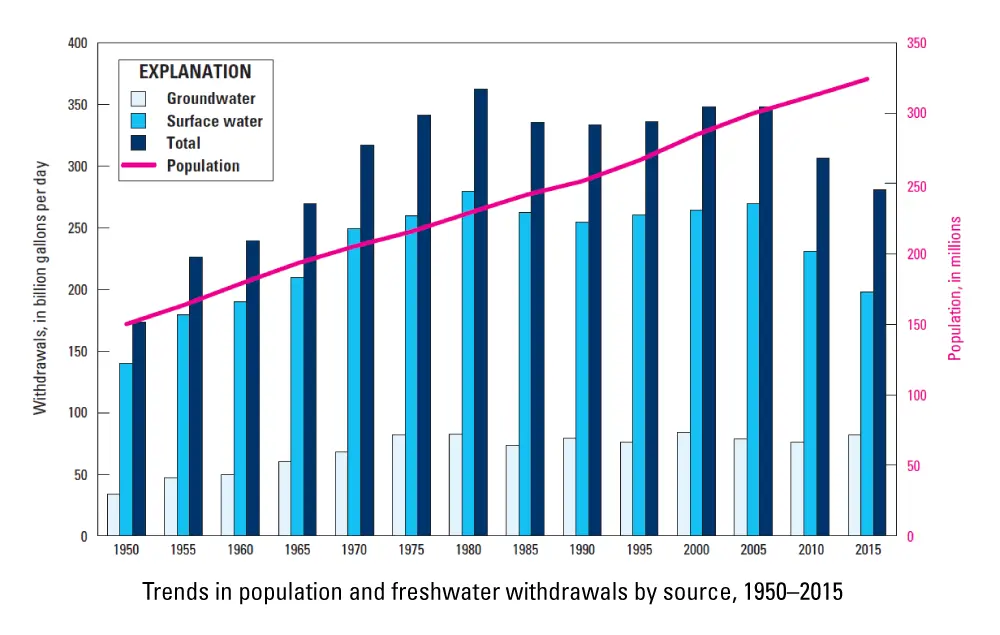
From email from the EPA:

DENVER (April 23, 2024) — On Thursday, April 25, U.S. Environmental Protection Agency (EPA) Regional Administrator KC Becker will join U.S. Senator Michael Bennet on a visit to the South Adams County Water and Sanitation District (SACWSD) to break ground on a water treatment system that will allow SACWSD to deliver high-quality drinking water that meets all state and federal regulations, including EPA regulations for to treat PFAS chemical contamination by 2029.

WHO:       

ยท       U.S. Senator Michael Bennet

ยท       EPA Regional Administrator KC Becker

ยท       South Adams County Water and Sanitation District Board President Heidi McNeely

ยท       South Adams County Water and Sanitation District Manager Abel Moreno

Additional representatives from South Adams County Water and Sanitation District will be in attendance, along with other key project partners from:

ยท       Brown & Caldwell, engineering consultant

ยท       PCL Construction, construction manager

ยท       United States Environmental Protection Agency

ยท       Colorado Department of Public Health and Environment

WHAT:  

EPA and partners will break ground on the Klein Enhancement Project. The project, a partnership with Brown & Caldwell Engineering and PCL Construction, will construct an ion-exchange water treatment system that will allow SACWSD to deliver high-quality drinking water that meets all state and federal regulations, including EPA regulations required to treat for PFAS chemical contamination. SACWSD was recently awarded nearly $61 million in federal funding to complete the construction. The project is expected to be completed in late 2026. 

Tours of existing treatment facilities and the enhancement project site will be available after speakersโ€™ remarks.

WHEN:         2 p.m., Thursday, April 25, 2024

WHERE:       7400 Quebec Street, Commerce City, Colorado 

Polluters must pay to clean up areas contaminated with PFOA, PFOS — SourceNM.com #PFAS

EPA Administrator Michael Regan (Photo by Lisa Sorg / NC Policy Watch)

Click the link to read the article on the SourceNM.com website (Lisa Sorg):

April 22, 2024

Industries that discharge toxic PFOA and PFOS compounds into the environment will now be held legally and financially responsible for the contamination, according to a final rule issued by the EPA last week.

The Department of Defense is also subject to the new requirements.

PFOA and PFOS are now classified as hazardous substances under Superfund law, which authorizes the EPA to use its enforcement powers to require polluters pay for and clean up the contamination. The designation also mandates new reporting requirements for facilities that release the compounds into the environment.
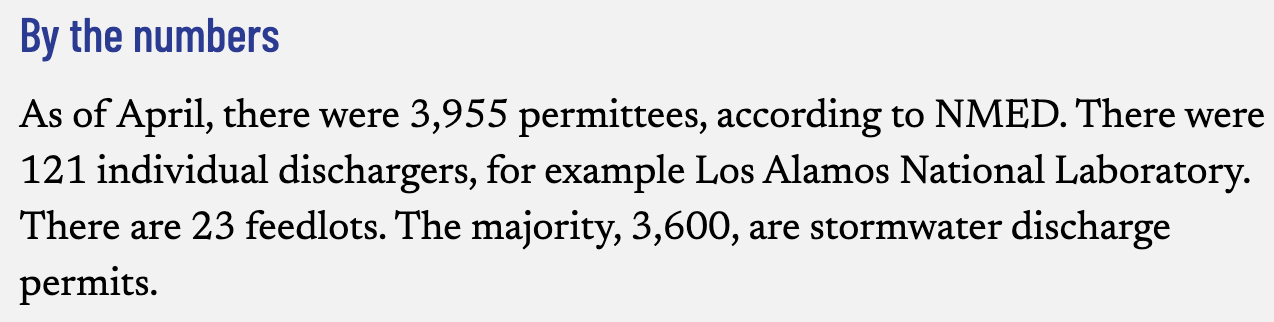
These facilities include 3M, DuPont and its spinoff company, Chemours.

โ€œDesignating these chemicals under our Superfund authority will allow EPA to address more contaminated sites, take earlier action, and expedite cleanups, all while ensuring polluters pay for the costs to clean up pollution threatening the health of communities,โ€ EPA Administrator Michael Regan said.

The EPA announced the new rule a week after setting legally enforceable drinking water standards for five types of the toxic compounds, as well as a mixture. PFOA and PFOS are among those compounds with maximum contamination limits of 4 parts per trillion.

Exposure to PFOA, PFOS and other similar compounds has been linked to multiple health problems, including thyroid and liver disorders, reproductive and fetal development problems, immune system deficiencies, high cholesterol, and kidney, testicular and other cancers.

There are several exemptions to the rule โ€” entities that receive, often unknowingly, these compounds from industrial sources: community water systems and publicly owned treatment works, municipal storm sewer systems, publicly owned/operated municipal solid waste landfills, publicly owned airports and local fire departments, and farms where biosolids are applied to the land.

When Regan announced the new drinking water standards, public utilities clamored for ways to pass the treatment costs to polluters. PFOA and PFOS, as well as other types of the toxic compounds, canโ€™t be removed through traditional treatment methods. The upgrades can run in the tens of millions of dollars. The $1 billion in federal funding to help utilities meet the drinking water standards is not enough, given the widespread contamination.

โ€œCommunities across the Southeast and the country have been shouldering the costs of PFAS contamination for far too long,โ€ said Kelly Moser, senior attorney and leader of the Water Program at the Southern Environmental Law Center. โ€œTodayโ€™s designations will help put the burden of addressing PFAS pollution back on the polluter. Now states and municipalities must use the tools they have to stop ongoing toxic PFAS pollution before more contaminated Superfund sites are created.โ€

Under the new rule, entities are required to immediately report releases of PFOA and PFOS that meet or exceed the reportable quantity of one pound within a 24-hour period to the National Response Center, as well as state, tribal and local emergency responders.

โ€œAfter decades of industry using and disposing PFOA and PFOS, EPA can now accelerate cleanups of the most contaminated sites,โ€ said Earthjustice Legislative Counsel Christine Santillana, in a prepared statement. โ€œItโ€™s highly encouraging to see EPA initiate this designation and gives hope to impacted communities that their health will be better protected.โ€

The final rule also means that federal entities that transfer or sell their property must provide notice about the storage, release, or disposal of PFOA or PFOS on the property and guarantee that contamination has been cleaned up or, if needed, that additional cleanup will occur in the future. It will also lead the Department of Transportation to list and regulate these substances as hazardous materials, according to the EPA.

Under federal law, hazardous materials can be transported only with a special permit, accompanied by a shipping manifest. Transportation documents for most hazardous substances are public through the EPAโ€™s e-Manifest database; it will now be easier to track the transport of PFOA and PFOS.

This designation of the two chemicals will also ensure that hundreds of Department of Defense installations with PFOA and PFOS contamination are finally cleaned up.

This could affect the Tarheel Army Missile Plant in Burlington, where PFOA and PFOS were found in the groundwater and soil last year. Although the military has already transferred that property to private owners, the Department of Defense is responsible for cleaning up contamination below the ground โ€” now including PFOA and PFOS.

โ€œNearly 500 military installations are contaminated with PFAS, but the DOD has failed to make PFAS cleanup a priority โ€“ and our service members and defense communities are paying the price,โ€ said Jared Hayes, a senior policy analyst at the Environmental Working Group.

The national Sierra Club had submitted public comments last year, asking the EPA to crack down on industrial dischargers.

โ€œWeโ€™re grateful that the EPA continues to find ways to fight what can only be described as an uphill battle against PFAS contamination,โ€ said Erin Carey, acting director of the North Carolina chapter of the Sierra Club. โ€œRight now, the regulation of these dangerous chemicals is far too narrow to be fully protective. With more than ten thousand of these compounds in production, we must move toward regulation of PFAS as a class, rather than this โ€˜whack-a-moleโ€™ method of regulating individual compounds. Broader and more ambitious action will be required of this agency, of industry and of our elected leaders to meaningfully tackle the terrifying and widespread threat of โ€˜forever chemicalsโ€™ in our bodies and our environment.โ€

NC Newsline is part of States Newsroom, a nonprofit news network supported by grants and a coalition of donors as a 501c(3) public charity. NC Newsline maintains editorial independence. Contact Editor Rob Schofield for questions: info@ncnewsline.com. Follow NC Newsline on Facebook and Twitter.

Drinking water for 268,000 Coloradans exceeds new limits on โ€œforever chemicals.โ€ How will providers find millions to fix the water? — The #Denver Post #PFAS

This USGS map shows the number of PFAS detected in tap water samples from select sites across the nation. The findings are based on a USGS study of samples taken between 2016 and 2021 from private and public supplies at 716 locations. The map does not represent the only locations in the U.S. with PFAS. Sources/Usage: Public Domain. Visit Media to see details.

Click the link to read the article on The Denver Post website (Noelle Phillips and Elise Schmelzer). Here’s an excerpt:

April 21, 2024

Theย 27 water systemsย identified by the Colorado Department of Public Health and Environment as exceeding the new standards range in size from Thornton, which serves about 155,000 customers, to Dawn of Hope Ranch, a religious retreat in Teller County that serves 55 people. Some of the larger utilities on the stateโ€™s list already are planning to build multimillion-dollar filtration systems, but experts say the smaller water providers will be among the last to fall into compliance. While grant money is available, experts note itโ€™s likely water customers will pay some of the costs via higher rates.

The federal regulations announced 10 days ago require drinking water providers to lower the concentration of forever chemicals below the new limit by 2029. The chemicals โ€” perfluoroalkyl and polyfluoroalkyl substances, collectively known as PFAS โ€” have been used for decades to make waterproof, nonstick or stain-resistant products and are linked to a wide range of health problems, including cancer and reduced fertility…

In Colorado, state water regulators have a good idea which water systems have PFAS in their drinking water supplies, said Christopher Higgins, a professor of civil and environmental engineering at the Colorado School of Mines, who is an expert in PFAS contamination. Fifty-six other water providers in the state have found PFAS in their water but in concentrations below the EPAโ€™s limit, including Aurora, Frisco and Gunnison…

The federal government set aside more than $10 billion to help communities test and treat drinking water for PFAS. That money is intended for rural or disproportionately impacted communities. Thatโ€™s not nearly enough, Zobell said…Unless there is a leap in PFAS-removal technology in the next three years, many providers will have to raise rates or find money elsewhere, Zobell said. Moody, with the American Water Works Association, said the financial burden has been a primary concern among water providers…There are just a handful of companies in the United States that build and install the filtration systems, Moody said. They will go after the larger contracts, leaving the smallest, more rural water companies in the back of the line because those contracts will be less profitable.

2024 #COleg: #Colorado Wetlands: Lawmakers clash as they seek state protections — Colorado Politics

Colorado River headwaters tributary in Rocky Mountain National Park photo via Greg Hobbs.

Click the link to read the article on the Colorado Politics website (Marianne Goodland). Here’s an excerpt:

April 13, 2024

This month, lawmakers looked at the dueling approaches contained in two measures seeking to implement a way for the state to manage “dredge and fill discharge” permits tied to a recent U.S. Supreme Court decision [Sackett vs. EPA] that redefined how a body of water can be protected under the Environmental Protection Agency’s “Waters of the United States” rule…Supporters of the first bill, which gives the task to the Colorado Department of Public Health and Environment, insist it’s the proper venue because it already experience dealing with permitting and water quality issues. Supporters of the second measure, which hands the responsibility to the Colorado Department of Natural Resources, maintain thatย the Department of Natural Resources is better equipped, since it already deals with related disciplines, such as water resource management, water rights law and land management.

In any case, policymakers agree that Colorado residents, industries and the wetlands needs certainty…Alex Funk with the Theodore Roosevelt Conservation Partnership told a legislative committee last August that almost 90% of fish and wildlife in Colorado rely on the state’s wetlands at some point during their lifecycle.  House Speaker McCluskie told the House agriculture committee on April 8 that since Sackett v. Environmental Protection Agency held that only permanent streams and rivers are protected under the federal Clean Water Act, those with a continuous surface connection to another permanent water body. That puts Colorado waters at risk, she said.  Pitkin County Commissioner Greg Poschman also noted that the state’s headwaters are made up of small streams that do not have year-round flow because they are under snowpack half the year โ€” suggesting Sackett would put those waters at risk.

Biden-Harris Administration Finalizes First-Ever National Drinking Water Standard to Protect 100M People from #PFAS Pollution

PFAS contamination in the U.S. October 18, 2021 via ewg.org.

Click the link to read the article on the Environmental Protection Agency website:

As part of the Administrationโ€™s commitment to combating PFAS pollution, EPA announces $1B investment through President Bidenโ€™s Investing in America agenda to address PFAS in drinking water

April 10, 2024

WASHINGTONย – Today, April 10, the Biden-Harris Administration issued the first-ever national, legally enforceable drinking water standard to protect communities from exposure to harmful per-and polyfluoroalkyl substances (PFAS), also known as โ€˜forever chemicals.โ€™ Exposure to PFAS has been linked to deadly cancers, impacts to the liver and heart, and immune and developmental damage to infants and children. This final rule represents the most significant step to protect public health underย EPAโ€™s PFAS Strategic Roadmap. The final rule will reduce PFAS exposure for approximately 100 million people, prevent thousands of deaths, and reduce tens of thousands of serious illnesses. Todayโ€™s announcement complementsย President Bidenโ€™s government-wide action planย to combat PFAS pollution.ย ย ย ย ย ย ย ย ย ย ย ย ย ย ย ย ย ย ย ย ย ย ย ย ย ย ย ย ย ย ย ย ย ย ย ย ย ย ย ย ย ย ย ย ย ย ย ย ย ย ย ย ย ย ย ย ย ย ย ย ย ย ย ย ย ย ย ย ย ย ย ย ย ย 

Through President Bidenโ€™s Investing in America agenda, EPA is also making unprecedented funding available to help ensure that all people have clean and safe water. In addition to todayโ€™s final rule, EPA is announcing nearly $1 billion in newly available funding through the Bipartisan Infrastructure Law to help states and territories implement PFAS testing and treatment at public water systems and to help owners of private wells address PFAS contamination. This is part of a $9 billion investment through the Bipartisan Infrastructure Law to help communities with drinking water impacted by PFAS and other emerging contaminants โ€“ the largest-ever investment in tackling PFAS pollution. An additional $12 billion is available through the Bipartisan Infrastructure Law for general drinking water improvements, including addressing emerging contaminants like PFAS. 

EPA Administrator Michael Regan will join White House Council on Environmental Quality Chair Brenda Mallory to announce the final standard today at an event in Fayetteville, North Carolina. In 2017, area residents learned that the Cape Fear River, the drinking water source for 1 million people in the region, had been heavily contaminated with PFAS pollution from a nearby manufacturing facility. Todayโ€™s announcements will help protect communities like Fayetteville from further devastating impacts of PFAS.

โ€œDrinking water contaminated with PFAS has plagued communities across this country for too long,โ€ said EPA Administrator Michael S. Regan. โ€œThat is why President Biden has made tackling PFAS a top priority, investing historic resources to address these harmful chemicals and protect communities nationwide. Our PFAS Strategic Roadmap marshals the full breadth of EPAโ€™s authority and resources to protect people from these harmful forever chemicals. Today, I am proud to finalize this critical piece of our Roadmap, and in doing so, save thousands of lives and help ensure our children grow up healthier.โ€   

โ€œPresident Biden believes that everyone deserves access to clean, safe drinking water, and he is delivering on that promise,โ€ said Brenda Mallory, Chair of the White House Council on Environmental Quality. โ€œThe first national drinking water standards for PFAS marks a significant step towards delivering on the Biden-Harris Administrationโ€™s commitment to advancing environmental justice, protecting communities, and securing clean water for people across the country.โ€

โ€œUnder President Bidenโ€™s leadership, we are taking a whole-of-government approach to tackle PFAS pollution and ensure that all Americans have access to clean, safe drinking water. Todayโ€™s announcement by EPA complements these efforts and will help keep our communities safe from these toxic โ€˜forever chemicals,โ€™โ€ said Deputy Assistant to the President for the Cancer Moonshot, Dr. Danielle Carnival. โ€œCoupled with the additional $1 billion investment from President Bidenโ€™s Investing in America agenda to help communities address PFAS pollution, the reductions in exposure to toxic substances delivered by EPAโ€™s standards will further the Biden Cancer Moonshot goal of reducing the cancer death rate by at least half by 2047 and preventing more than four million cancer deaths โ€” and stopping cancer before it starts by protecting communities from known risks associated with exposure to PFAS and other contaminants, including kidney and testicular cancers, and more.โ€

EPA is taking a signature step to protect public health by establishing legally enforceable levels for several PFAS known to occur individually and as mixtures in drinking water. This rule sets limits for five individual PFAS: PFOA, PFOS, PFNA, PFHxS, and HFPO-DA (also known as โ€œGenX Chemicalsโ€). The rule also sets a limit for mixtures of any two or more of four PFAS: PFNA, PFHxS, PFBS, and โ€œGenX chemicals.โ€ By reducing exposure to PFAS, this final rule will prevent thousands of premature deaths, tens of thousands of serious illnesses, including certain cancers and liver and heart impacts in adults, and immune and developmental impacts to infants and children. 

This final rule advances President Bidenโ€™s commitment to ending cancer as we know it as part of the Biden Cancer Moonshot, to ensuring that all Americans have access to clean, safe, drinking water, and to furthering the Biden-Harris Administrationโ€™s commitment to environmental justice by protecting communities that are most exposed to toxic chemicals. 

EPA estimates that between about 6% and 10% of the 66,000 public drinking water systems subject to this rule may have to take action to reduce PFAS to meet these new standards. All public water systems have three years to complete their initial monitoring for these chemicals. They must inform the public of the level of PFAS measured in their drinking water. Where PFAS is found at levels that exceed these standards, systems must implement solutions to reduce PFAS in their drinking water within five years. 

The new limits in this rule are achievable using a range of available technologies and approaches including granular activated carbon, reverse osmosis, and ion exchange systems. For example, the Cape Fear Public Utility Authority, serving Wilmington, NC โ€“ one of the communities most heavily impacted by PFAS contamination โ€“ has effectively deployed a granular activated carbon system to remove PFAS regulated by this rule. Drinking water systems will have flexibility to determine the best solution for their community.

EPA will be working closely with state co-regulators in supporting water systems and local officials to implement this rule. In the coming weeks, EPA will host a series of webinars to provide information to the public, communities, and water utilities about the final PFAS drinking water regulation. To learn more about the webinars, please visit EPAโ€™s PFAS drinking water regulation webpage. EPA has also published a toolkit of communications resources to help drinking water systems and community leaders educate the public about PFAS, where they come from, their health risks, how to reduce exposure, and about this rule. 

โ€œWe are thankful that Administrator Regan and the Biden Administration are taking this action to protect drinking water in North Carolina and across the country,โ€ said North Carolina Governor Roy Cooper. โ€œWe asked for this because we know science-based standards for PFAS and other compounds are desperately needed.โ€

โ€œFor decades, the American people have been exposed to the family of incredibly toxic โ€˜forever chemicalsโ€™ known as PFAS with no protection from their government. Those chemicals now contaminate virtually all Americans from birth. Thatโ€™s because for generations, PFAS chemicals slid off of every federal environmental law like a fried egg off a Teflon pan โ€” until Joe Biden came along,โ€ said Environmental Working Group President and Co-Founder Ken Cook. โ€œWe commend EPA Administrator Michael Regan for his tireless leadership to make this decision a reality, and CEQ Chair Brenda Mallory for making sure PFAS is tackled with the โ€˜whole of governmentโ€™ approach President Biden promised. There is much work yet to be done to end PFAS pollution. The fact that the EPA has adopted the very strong policy announced today should give everyone confidence that the Biden administration will stay the course and keep the presidentโ€™s promises, until the American people are protected, at long last, from the scourge of PFAS pollution.โ€

โ€œWe learned about GenX and other PFAS in our tap water six years ago. I raised my children on this water and watched loved ones suffer from rare or recurrent cancers. No one should ever worry if their tap water will make them sick or give them cancer. Iโ€™m grateful the Biden EPA heard our pleas and kept its promise to the American people. We will keep fighting until all exposures to PFAS end and the chemical companies responsible for business-related human rights abuses are held fully accountable,โ€ said Emily Donovan, co-founder of Clean Cape Fear.

More details about funding to address PFAS in Drinking Water

Through the Bipartisan Infrastructure Law, EPA is making an unprecedented $21 billion available to strengthen our nationโ€™s drinking water systems, including by addressing PFAS contamination. Of that, $9 billion is specifically for tackling PFAS and emerging contaminants. The financing programs delivering this funding are part of President Bidenโ€™s Justice40 Initiative, which set the goal that 40% of the overall benefits of certain federal investments flow to disadvantaged communities that have been historically marginalized by underinvestment and overburdened by pollution. 

Additionally, EPA has a nationwide Water Technical Assistance program to help small, rural, and disadvantaged communities access federal resources by working directly with water systems to identify challenges like PFAS; develop plans; build technical, managerial, and financial capacity; and apply for water infrastructure funding. Learn more about EPAโ€™s Water Technical Assistance programs.

More details about the final PFAS drinking water standards:

  • For PFOA and PFOS, EPA is setting a Maximum Contaminant Level Goal, a non-enforceable health-based goal, at zero. This reflects the latest science showing that there is no level of exposure to these contaminants without risk of health impacts, including certain cancers.ย 
  • EPA is setting enforceable Maximum Contaminant Levels at 4.0 parts per trillion for PFOA and PFOS, individually. This standard will reduce exposure from these PFAS in our drinking water to the lowest levels that are feasible for effective implementation.ย 
  • For PFNA, PFHxS, and โ€œGenX Chemicals,โ€ EPA is setting the MCLGs and MCLs at 10 parts per trillion.
  • Because PFAS can often be found together in mixtures, and research shows these mixtures may have combined health impacts, EPA is also setting a limit for any mixture of two or more of the following PFAS: PFNA, PFHxS, PFBS, and โ€œGenX Chemicals.โ€ย 

EPA is issuing this rule after reviewing extensive research and science on how PFAS affects public health, while engaging with the water sector and with state regulators to ensure effective implementation. EPA also considered 120,000 comments on the proposed rule from a wide variety of stakeholders.

Background:

PFAS, also known as โ€˜forever chemicals,โ€™ are prevalent in the environment. PFAS are a category of chemicals used since the 1940s to repel oil and water and resist heat, which makes them useful in everyday products such as nonstick cookware, stain resistant clothing, and firefighting foam. The science is clear that exposure to certain PFAS over a long period of time can cause cancer and other illnesses.  In addition, PFAS exposure during critical life stages such as pregnancy or early childhood can also result in adverse health impacts.

Across the country, PFAS contamination is impacting millions of peopleโ€™s health and wellbeing. People can be exposed to PFAS through drinking water or food contaminated with PFAS, by coming into contact with products that contain PFAS, or through workplace exposures in certain industries. 

Since EPA Administrator Michael S. Regan announced the PFAS Strategic Roadmap in October 2021, EPA has taken action โ€“ within the Biden-Harris Administrationโ€™s whole-of-government approach โ€“ by advancing science and following the law to safeguard public health, protect the environment, and hold polluters accountable. The actions described in the PFAS Strategic Roadmap each represent important and meaningful steps to protect communities from PFAS contamination. Cumulatively, these actions will build upon one another and lead to more enduring and protective solutions. In December 2023, the EPA released its second annual report on PFAS progress. The report highlights significant accomplishments achieved under the EPAโ€™s PFAS Strategic Roadmap.

Products that contain PFAS. Graphic credit: Riverside (CA) Public Utilities

Does your #Colorado town have #PFAS in its water? Thereโ€™s help for that — Fresh Water News

A whistleblower and watchdog advocacy group used an EPA database of locations that may have handled PFAS materials or products to map the potential impact of PFAS throughout Colorado. They found about 21,000 Colorado locations in the EPA listings, which were uncovered through a freedom of information lawsuit. Locations are listed by industry category. (Source: Public Employees for Environmental Responsibility analysis of EPA database)

Click the link to read the article on the Water Education Colorado website (Jerd Smith):

March 20, 2024

Nearly $86 million in federal funding to help small Colorado communities with the daunting task of removing so-called โ€œforever chemicalsโ€ from their drinking water systems will begin flowing this spring, but whether it will go far enough to do all the cleanup work remains unclear.

Small Colorado communities are scrambling to find ways to remove the toxic PFAS compounds that wash into water from such things as Teflon, firefighting foam and waterproof cosmetics.

Thanks to the infusion of federal money this year, the Colorado Department of Public Health and Environment is offering what are known as small and disadvantaged community grants to help with cleanup costs.

Around the country, the EPA is racing to help communities that have historically been left out of national funding initiatives, according to Betsy Southerland, a scientist with the Environmental Protection Network, a nonprofit that advises communities nationwide on the scientific and technical issues inherent in treating water quality problems.

โ€œThis is a massive effort,โ€ Southerland said, likening it to the nationโ€™s $15 billion-plus effort under the Bipartisan Infrastructure Law to identify and remove aging lead pipes from drinking water delivery systems.

Hundreds of communities in Colorado, large and small,ย are monitoring for PFAS, and some are planning costly new treatment plants to address the issue.

Credit: City of Greeley

Greeley, which is eligible for the new grant program, has yet to detect PFAS contaminants in its treated water because much of its current water supply flows down from the headwaters of the Upper Colorado River and is relatively clean. But the fast-growing city is also planning to develop new groundwater supplies and is therefore planning a new treatment plant capable of addressing any future contamination should it occur, according to Michaela Jackson, Greeleyโ€™s water quality and regulatory compliance manager.

Colorado lawmakers are also working on new legislation to address the widespread contamination.

Still, word of the Emerging Contaminants in Small and Disadvantaged Communities Grant Program, as it is known, has been slow to spread, Colorado public health officials said, in part because the problem is still being understood and remedies are still being studied.

โ€œEmerging contaminant funding is relatively new. Many communities are still determining if they have a project they may need to request funding for,โ€ state health department spokesman John Michael said in an email.

Just four communities have applied to date: South Adams Water and Sanitation District in Commerce City; City of La JuntaLouviers Water and Sanitation District in Douglas County; and the Wigwam Mutual Water Company in Fountain.

Each year for the next five years, the state will offer two rounds of grants, with millions of dollars committed. Communities interested in applying can explore the program here. The next grant cycle opens in July, according to Michael.

This year, perhaps as soon as this month, the U.S. Environmental Protection Agency is expected to finalize the first PFAS drinking water treatment standard, which will require utilities to remove the contaminant at levels above 4 parts per trillion.

Prior to this, the federal oversight of the contaminants was advisory, meaning utilities were not technically required to remove it, according to state health officials. The advisory rule was set at 70 parts per trillion.

Still, most water providers have been testing and monitoring for the compounds for several years, and where contamination that exceeds federal advisory guidelines has been found, many have instituted efforts to filter the toxins out and bring in new sources of cleaner water to dilute any remaining contamination.

But for small communities lacking such resources, the costs and stakes are high.

Searching for millions of dollars more

The South Adams and Water Sanitation District, which serves Commerce City and unincorporated parts of Adams County, has been hard-hit by PFAS contamination in its groundwater wells. Where the toxins have come from isnโ€™t entirely known, but could include firefighting foam used nearby at a firefighting academy owned by the City of Denver.

When PFAS was first detected in 2018, the Adams County district had to shut down its most contaminated wells, build an expensive system of filters, and buy water from Denver to dilute its water sources enough so that PFAS could no longer be detected.

It also built a cutting-edge testing lab, so that it can know within 24 hours whether its extensive treatment system is working and respond immediately if it is not.

But that isnโ€™t enough. This year it will begin building a new $80 million treatment plant, $30 million of which will come from the new state grant program. It has also been approved for a special $30 million loan from the Colorado Water and Power Development Authority. It is still pursuing additional funding to minimize the amount it will have to seek from its customers to help cover the costs, according to Abel Moreno, the districtโ€™s manager.

โ€œItโ€™s absolutely critical that we find another source of funding because we donโ€™t believe the contamination was caused by our rate payers, and we do not believe they should be asked to pay for it,โ€ Moreno said.

And itโ€™s not just initial construction costs for treatment systems that will need funding. Operating the systems and disposing of contaminated treatment equipment can cost millions of dollars as well, according to the American Water Works Association, which has been critical of the pending federal standard because it believes it will cost utilities and ratepayers too much money. It has advocated a lower treatment standard, of 10 parts per trillion.

The 4 parts per trillion standard will require โ€œmore than $40 billion of capital investment plus significant investment for operation and maintenance,โ€ said Chris Moody, regulatory technical manager at the association, in an email. โ€œThe annual impact to communities and ratepayers is expected to exceed $3.8 billion, increasing household water rates by as much as $3,500 annually.โ€

But utilities such as the South Adams Water and Sanitation District believe there is no choice but to power ahead with the PFAS cleanup.

Rocky Mountain Arsenal back in the day

Decades of living near industrial producers and the Rocky Mountain Arsenal Superfund Site, and historic concern over the safety of its drinking water, have created a deep distrust among residents. Moreno says the district is working to rebuild faith in its water system.

โ€œIt is a priority of mine to change the trajectory of the districtโ€™s water image so the people we serve in this community have confidence in the work weโ€™re doing and the water we are producing,โ€ he said.

More by Jerd SmithJerd Smith is editor of Fresh Water News. She can be reached at 720-398-6474, via email at jerd@wateredco.org or @jerd_smith.

The South Platte River Basin is shaded in yellow. Source: Tom Cech, One World One Water Center, Metropolitan State University of Denver.

Thousands of permits designed to protect #Colorado streams are expired — Fresh Water News

South Platte River near CSU Spur. Photo credit: Colorado State University

Click the link to read the article on the Water Education Colorado website (Jerd Smith):

Coloradoโ€™s health department is years behind in processing special Clean Water Act permits critical to protecting water quality in the stateโ€™s streams and rivers.

Right now, just 33% of the active discharge permits on file with the Colorado Department of Public Health and Environmentโ€™s Water Quality Control Division, are current, far below the agencyโ€™s 75% goal, according to the agency. Under the federal Clean Water Act, entities that discharge fluids into streams, including wastewater treatment plants and factories, must get approval from water quality regulators to ensure what theyโ€™re putting into the waterways does not harm them.

But it is a tough job, as pressure on streams rises due to the warming climate, populations grow, and new toxins, such as PFAS, emerge. PFAS make up a large class of chemicals used in everything from firefighting foam to Teflon. They are known as โ€œforever chemicalsโ€ because they last decades in the environment and the human body. The EPA has just begun setting regulatory standards for them. โ€œColorado could be doing better and it should be doing better,โ€ said John Rumpler, senior attorney and director of clean water at the Boston-based Environment America.

Lagging EPA standards

Permitting backlogs exist across the country, due in part to the EPAโ€™s failure to update the standards the states work to enforce, he said.

โ€œWeโ€™re tolerating more pollution in our waterways than the law should abide,โ€ Rumpler said. โ€œOld threats we have succeeded in reducing, but new ones emerge. Now we have PFAS in our waterways, urban runoff and new chemicals. Weโ€™re just not keeping up.โ€

In an email, EPA officials said theyโ€™re aware of the issue. โ€œEPA currently is in the process of evaluating permitting data for all states, including backlogs, and will be posting that information on our website by the end of January,โ€ said Rich Mylott, a spokesman for EPAโ€™s Region 8 office in Denver.

Of the more than 10,129 active discharge permits in Colorado, 67% have been continued without a formal review. The stateโ€™s Water Quality Control Division has wrestled with the problem for several years as staffing shortages and budget shortfalls grip the agency.

Though holders of expired permits are legally allowed to discharge under the Clean Water Act, the special status means dischargers face major uncertainty about what future requirements may be and how much it will cost to meet them, said Nicole Rowan, director of Coloradoโ€™s Water Quality Control Division.

โ€œWhat is challenging is when permits are backlogged and older, they arenโ€™t current with environmental regulations,โ€ Rowan said.

โ€œAnd if a facility wants to expand or change something, we canโ€™t do it because it is in that administrative state,โ€ she said.

Metropolitan Wastewater Reclamation District Hite plant outfall via South Platte Coalition for Urban River Evaluation

Those facilities operating with expired permits include Metro Water Recovery in Denver, which processes wastewater for millions of metro area residents. It is Coloradoโ€™s largest wastewater treatment plant. The agency declined an interview request, but in a statement said that resolving the backlog would help everyone.

โ€œLike many public agencies, Metro understands that the Colorado Department of Public Health and Environment is resource constrained. โ€ฆ Metro believes that it is in the best interest of all parties for permits to be renewed within a five-year cycle so that they are consistent with the current regulatory framework.โ€

The City of Aurora is also among those agencies operating with a expired permit, according to spokesman Greg Baker. Auroraโ€™s permit expired in 2017. Baker declined to comment on the impact of the delay.

In response to the problem, state lawmakers agreed earlier this year to add $2.4 million temporarily to the divisionโ€™s budget.

โ€œWhat the General Assembly did was a really big step in providing us some stability,โ€ Rowan said.

But funding lasts only until June 2025, at which point the agency must present a formal plan to lawmakers for keeping the permitting system current and adequately funded.

Rowan and others are hopeful the revamp of the system will dramatically improve the stateโ€™s ability to monitor and protect water quality. Anyone interested in participating and tracking the stateโ€™s process can do so by signing upย here. The next meeting is Dec. 18.

Fresh Water News was launched in 2018 as an independent, nonpartisan news initiative of Water Education Colorado. Our editorial policy and donor list can be viewed at wateredco.org.

More by Jerd SmithJerd Smith is editor of Fresh Water News. She can be reached at 720-398-6474, via email at jerd@wateredco.org or @jerd_smith.

EPA report says #LincolnCreek contamination is naturally occurring — @AspenJournalism #RoaringForkRiver

Lincoln Creek was yellow as it flowed into Grizzly Reservoir in September 2022. A report from the Environmental Protection Agency says metals contamination in the creek and reservoir is a result of natural causes, not a nearby mine.ย CREDIT:ย HEATHER SACKETT/ASPEN JOURNALISM

Click the link to read the article on the Aspen Journalism website (Heather Sackett):

The results of water quality testing on Lincoln Creek show that the waterway is toxic to fish and that metals concentrations have been increasing in recent years. But because the main source of the contamination is a nearby tributary โ€” and not a mine โ€” it is unclear who should take responsibility for cleaning it up.

report released this week by the Environmental Protection Agency shows that Lincoln Creek in the four miles between the Ruby Mine and Grizzly Reservoir exceeds state water quality standards for aquatic life for aluminum, cadmium, copper, iron, lead, manganese and zinc. Aluminum and copper concentrations were higher than standards set by the Colorado Department of Public Health and Environment in multiple locations: in Lincoln Creek downstream of Ruby Mine, in Grizzly Reservoir and in Lincoln Creek downstream of the reservoir.

โ€œThe high concentrations of these metals are toxic to aquatic life and make Lincoln Creek uninhabitable for fish,โ€ the report says. 

The report is based on water quality sampling data from 2022.

Karin Teague, executive director of the Independence Pass Foundation, said she is glad the report is finally out so that the community can talk about what to do about the contamination. The foundationโ€™s mission is to restore and protect the ecological integrity of the pass corridor. 

โ€œWe have a dead creek on our hands,โ€ Teague said. โ€œItโ€™s a hard thing to see, and itโ€™s a disaster for the living things that used to call the creek home. Itโ€™s bad for the wildlife and has human health implications.โ€

But those human health implications remain unclear. 

In addition to exceeding standards for aquatic life, the report says cadmium, copper, iron and nickel were present in concentrations exceeding the state standards for domestic water supply. 

Lincoln Creek feeds into the Twin Lakes Reservoir and Canal Companyโ€™s transmountain diversion system, in which Grizzly Reservoir is used as a collection pond before sending water through the Twin Lakes Tunnel to the Front Range, where it is used primarily in Front Range cities, including for drinking water. Colorado Springs Utilities owns the majority of the water in the Twin Lakes system. 

The report says there is a slight potential that the metals are contaminating drinking water, but the substantial mixing, the distance that the water travels and the filtration limit these impacts. Lincoln Creek is a tributary of the Roaring Fork River, but Aspenโ€™s domestic water supply is not affected; the cityโ€™s drinking water comes primarily from Castle Creek.ย ย 

Colorado Parks and Wildlife stocks Grizzly Reservoir with fish each year, making it a popular and scenic spot for summer alpine fishing and camping. There have been fish die-offs in the reservoir in recent years, including 2021. But CPW aquatic biologist Kendall Bakich said that since Grizzly Reservoir is diluted with water from several surrounding cleaner drainages, fish can still survive there and CPW plans to continue stocking.ย 

CPW stocks the reservoir with โ€œcatchable trout,โ€ meaning anglers can take them out and eat them. Since the trout have been raised in hatcheries with clean water and food, and have probably lived in the reservoir for only a short time (most trout that arenโ€™t caught by anglers during the summer donโ€™t survive the harsh winter in Grizzly), Bakich said they are not likely to pose a risk to human health. But CPW tested the tissue anyway of some of the few fish that made it through the winter since they would have the most exposure to the toxic metals.

โ€œWe havenโ€™t gotten the results back on those tissue samples,โ€ Bakich said. โ€œAt this point, what we know about copper and how it resides in a fishโ€™s body, it resides in the organs and people donโ€™t eat the organs. If you are harvesting fish in the summer, they have just been put in there.โ€ย 

Grizzly Reservoir was a bright shade of turquoise in September 2022. The man-made alpine lake has high concentrations of metals that are toxic to fish, according to a report from the Environmental Protection Agency. CREDIT: HEATHER SACKETT/ASPEN JOURNALISM

Natural source of contamination

The report points to natural sources as the culprit for creek contamination, referring to a โ€œmineralized tributary.โ€ The mineralized tributary in question is a drainage in a steep slope above Ruby Mine, which flows into Lincoln Creek just below the discharge from the Ruby Mine portal. Prospectors dug for gold, silver, lead and copper at now-defunct Ruby Mine in the early 1900s.

The report says that the mine discharge and the mineralized tributary have very different water chemistry and that the contamination has been traced back to the tributary, not the mine. The report estimates that the mineralized tributary contributes 98.5% of the copper contamination to Lincoln Creek.

โ€œWhile historical mining does appear to play a role in some of the impacts to Lincoln Creek, all of the data and observations point to natural sources as the major component of metals loading into Lincoln Creek,โ€ the report reads. โ€œTherefore, cleanup or removal activities associated with Ruby Mine would have minimal benefits to improve the overall quality of Lincoln Creek.โ€

The EPA is authorized to address elevated metals concentrations only from human-caused sources, not contamination from natural sources.

Yellow and white sediment settled on the streambed of Lincoln Creek in September 2022, prompting concerns from residents and local organizations, and water quality testing. A report from the EPA found that the creek has metals concentrations that are toxic to fish. CREDIT: HEATHER SACKETT/ASPEN JOURNALISM

Climate change a cause?

Water quality issues on Lincoln Creek have been a concern for years, with the creek above the reservoir often running a yellowish color, and Grizzly Reservoir often a bright turquoise. In September 2022, Lincoln Creek below the reservoir turned a milky-green color, and white and yellow sediment settled on the streambed, prompting water quality testing in the fall of 2022 and the EPA report. These conditions in 2022 could be seen downstream at the confluence with the Roaring Fork River, sparking concern for local residents and organizations. 

Although water quality issues on Lincoln Creek are not new, according to the report, the metals concentrations โ€” especially copper โ€” have increased over the past 20 years. And climate change may be to blame. 

โ€œWhile the exact cause for observed trends is not known, it is suspected that climate change may be altering hydrologic cycles and thawing once-frozen rock deep in the mountain,โ€ the report reads. โ€œThese processes could expose more metals-bearing rock to oxygen, thereby increasing potential to generate acidic drainage and dissolution of metals.โ€ 

Now that the findings have been released, the next step is figuring out what to do about the contamination and which agencies should be involved. Pitkin County Environmental Health Manager Kurt Dahl said a meeting has been scheduled for Thursday with representatives from Pitkin County, CDPHE, the U.S. Forest Service, CPW, the Roaring Fork Conservancy, EPA, and the Colorado Division of Reclamation, Mining and Safety.

โ€œBeing a natural source, (EPA) is not going to deal with it,โ€ Dahl said. โ€œIs there another agency that will deal with it? The question of what are the next steps is one of the more important pieces to answer.โ€ 

Teague hopes to learn more about the potential health risks of the contamination and that the community can figure out a solution to clean it up. 

โ€œThis is a community that cares a lot about its backyard, the health of its wild places,โ€ she said. โ€œIf we can talk about building $50 million trails, maybe we can talk about millions of dollars to bring a creek back to life.โ€

Aspen Journalism is a nonprofit, investigative news organization covering water, environment, social justice and more. Visit http://aspenjournalism.org. 

Pitkin County supports Aspen Journalism with a grant from the Healthy Community Fund. Aspen Journalism is solely responsible for its editorial content.

Map of the Roaring Fork River drainage basin in western Colorado, USA. Made using USGS data. By Shannon1 – Own work, CC BY-SA 4.0, https://commons.wikimedia.org/w/index.php?curid=69290878

The legal loopholes that threaten farmworkersโ€™ health and safety: As summer #heatwaves loom and farmworkers take to the fields, an in-depth report highlights massive gaps in regulations, especially around #pesticide use and exposure — Grist

Field workers harvesting strawberries. Photo credit: Public Policy Institute of California

Click the link to read the article on the Grist website:

An estimated 2.4 million people work on farms in the United States. Though their work is critical to agriculture and the economy alike, pesticide exposure continues to be a major occupational riskโ€”and the effects ripple out into society and the food we eat.

Pesticides can easily drift onto farmworkersโ€”and the schools and neighborhoods near fields. Current pesticide regulations arenโ€™t consistently enforced, and vulnerable workers arenโ€™t always able to seek help when there are violations. 

Exposures may continue around the clock, especially on farms where workers and their families live, says Olivia Guarna, lead author of a recent report, โ€œExposed and at Risk: Opportunities to Strengthen Enforcement of Pesticide Regulations for Farmworker Safety,โ€ by the Center for Agriculture and Food Systems at Vermont Law and Graduate School, in partnership with the nonprofit advocacy group Farmworker Justice. This is one of a series of reports addressing needed policy reforms and federal oversight of programs impacting farmworkers. 

Alongside faculty and staff in the Center for Agriculture and Food Systems, Guarna, a honors summer intern with a background in environmental issues, spent 10 weeks interviewing attorneys, officials, administrators, legal advisors, and farmworker advocates, researching how pesticide use is regulated and enforced in Washington, California, Illinois, and Florida. What Guarna didnโ€™t expect was just how complicated the regulatory scheme is. The federal Environmental Protection Agency technically has oversight over pesticide use, yet in practice receives little data from states, whose enforcement is spotty at best. โ€œThere are a lot more protections on paper than I think are actually being implemented to protect farmworkers,โ€ she says.

One of the biggest issues, according to Laurie Beyranevand, Director of the Center for Agriculture and Food Systems and one of the authors of the report, is that unlike other environmental laws administered by the EPA, the agency doesnโ€™t adequately gather data from the states, making enforcement of existing standards more difficult. 

In Florida, the report found, inspections are virtually never a surprise. โ€œFarmworkers report that when inspectors come to the farms, growers know they are coming, and they get to prepare,โ€ says Mayra Reiter, project director of occupational safety and health for Farmworker Justice. โ€œInspectors donโ€™t get to see what goes on day-to-day in those workplaces.โ€

Washington is considered one of the more progressive states in terms of farmworker protections. Yet between 2015 and 2019, Guarna discovered the average violation rate there was 418%, meaning that multiple violations were found on every inspection performed. 

In California, when violations are found, fines are often not levied, the report concluded. Even when penalties are issued, theyโ€™re often for amounts like $250 โ€” token fines that growers consider to be part of the cost of doing business. Only a single case reported in California between 2019 and 2021 involved a grower being fined the more significant sum of $12,000.

Still, California is one of the few states that makes information readily available to the public about what chemicals are being applied where. Elsewhere, itโ€™s virtually unknown. Washington, Florida, and Illinois do not require pesticide use reporting at all. 

โ€œYou have the farmworkers being directly exposed, and thereโ€™s so little transparency on whatโ€™s in our food,โ€ Guarna says. โ€œItโ€™s not just farmworkers who are affected โ€” drift is a big problem when itโ€™s close to schools and neighborhoods. Thereโ€™s just so little we know. A lot of the health effects happen years down the road.

In some instances, toxic exposure has become quickly and tragically evident when babies are born with birth defects. Within a span of seven weeks in 2004 and 2005, for example, three pregnant farmworkers who worked for the same tomato grower, Ag-Mart, in North Carolina and Florida, gave birth to babies with serious birth defects, like being born without arms or legs. Floridaโ€™s Department of Agriculture and Consumer Services issued two complaints against Ag-Mart in 2005, alleging 88 separate violations of pesticide use laws altogether. Ultimately, 75 of those violations were dismissed. Ag-Mart was fined a total of $11,400.

Yet thousands of poisonings continue to happen each year, Farmworker Justice says. In August 2019, for example, a field of farmworkers in central Illinois was sprayed with pesticides when the plane of a neighboring pesticide applicator flew directly overhead, the report noted. Several workers turned up at local emergency rooms with symptoms of chemical exposure. 

Despite these incidents, Illinois does not mandate that medical providers report suspected cases of exposure. Only because a medical provider at the hospital personally knew someone in the local public health departmentโ€”who in turn contacted connections at the Illinois Migrant Council and Legal Aid Chicagoโ€”did the exposure result in legal action.

Workers often live on the farms where they work, exposing them to chemicals virtually round-the-clock, Reiter adds. โ€œWe know from farmworker testimonies that when they return to their homes, they can smell the pesticides, and it lingers for days after they return,โ€ she says.

Vulnerable legal status can make it difficult for farmworkers to report exposures. Millions of farmworkers hail from Mexico, Guatemala, and elsewhere in Central America, according to Farmworker Justice, although significant numbers also come from countries like Jamaica and South Africa. An estimated half of farmworkers in the U.S. are undocumented

Millions of others come on H2-A guest-worker visas that allow them to come to the country for seasonal jobs of up to 10 months. These temporary visas are tied to specific employers, so workers fear being deported or otherwise retaliated against if they raise complaints about safety violations.

โ€œBecause [workers] are looked at as expendable, theyโ€™re regularly exposed to neurotoxic pesticides that can be carried into their home settings,โ€ says agricultural policy expert Robert Martin, who recently retired from John Hopkins Center for a Livable Future. โ€œTheyโ€™re largely immigrants, and they donโ€™t have a lot of legal protections. The advocates they do have, like Farmworker Justice, are terrific, but theyโ€™re really taken advantage of by the system because of their legal status.โ€

Inherent conflicts of interest also present legal loopholes. The state agencies charged with enforcing federal and state pesticide safety laws, like state Departments of Agriculture, are often the same agencies that promote the economic interests of the ag industry. And farmworkers know it. โ€œThat sort of cultural conflict is a big issue,โ€ Guarna says. โ€œFarmworkers have become deeply skeptical of departments of agriculture, and skeptical that they have farmworkersโ€™ interests at heart. They fear their complaints are going to fall on deaf ears.โ€

While the EPA is legally required to maintain oversight over state agencies, in practice, they only require states to report about federally funded workโ€”and the vast majority of state programs are funded by state budgets. Mandatory and universal standards for inspections and responses to violations would help tremendously, the report concludes. โ€œOne of our recommendations is that there should be whole-of-program reporting where states, tribes, and territories have to report all their activities,โ€ Guarna says. โ€œThere are some very discrete fixes that can be made that would have a huge impact, so I am hopeful about that.โ€

Among the reportโ€™s 17 policy recommendations is to ensure that enforcement of pesticide safety gets delegated to an agency that is specifically tasked with protecting the health of workers. This could include transferring enforcement to state departments of labor or health, or even creating a new authority specifically dedicated to pesticide regulation.

โ€œExposed and At Riskโ€ follows aย previous reportย from the Center for Agriculture and Food Systems that focused on the two major threats facing farmworkersโ€”heat stress and pesticide exposure. It focused on opportunities for states to take action to better protect farmworkers, and was written in collaboration with the Johns Hopkins Center for a Livable Future. That collaboration also led to aย third report, called โ€œEssential and in Crisis: A Review of the Public Health Threats Facing Farmworkers in the U.S.,โ€ which recently explored the public health and environmental impacts of industrial agriculture. Martin, who co-authored these findings, explains that the concentrated power and wealth of large agribusiness companies has consequences for both worker safety and the environment.ย 

Following corporate consolidation since the 1980s, โ€œthere are fewer meat, seed, pesticide companies, and their combined economic power really keeps the status quo in place,โ€ Martin says. โ€There are some pretty direct public health threats of these operations.โ€

As โ€œExposed and at Risk,โ€ notes, the regulatory system should be structured in a way that works to protect farmworkers. But currently, federal regulators lack sufficient data to even identify the tremendous gaps in enforcement. Requiring states to develop comprehensive reporting systems would be a small step toward protecting the foundation of American agriculture.


Vermont Law and Graduate School, a private, independent institution, is home to a Law School that offers both residential and online hybrid JD programs and a Graduate School that offers masterโ€™s degrees and certificates in multiple disciplines, including programs offered by the School for the Environment, the Center for Justice Reform, and other graduate-level programs emphasizing the intersection of environmental justice, social justice and public policy. Both the Law and Graduate Schools strongly feature experiential clinical and field work learning. For more information, visit vermontlaw.edu, Facebook, Twitter and Instagram.

Final Report: Practical #PFAS Treatment with Sawdust — Environmental Protection Agency

PFAS contamination in the U.S. October 18, 2021 via ewg.org.

Click the link to access the report on the EPA website:

Objective:

This project aims to develop a new functionalized sawdust anion exchange resin for PFAS removal and to develop new cost-effective treatment processes using functionalized sawdust (FS). The hypothesis of this research is that cellulose-based sawdust can be functionalized into anion exchange resin, which can remove negatively charged PFAS in drinking water. This research will improve water management practices, and technical methods to minimize the PFAS risks to human, ecosystem and the environment. The specific research objectives of the proposed work are to: 1) Functionalize sawdust into biomass-based anion exchange resin; 2) Determine PFOA and PFOS removal from drinking water using functionalized sawdust column tests. The first objective helps students to understand the natural biomass (sawdust) from planet can be used for cleaning drinking water, which is related to peopleโ€™s health. The second objective helps student to understand how much of PFAS existing in tap water, which is related to the polymer production from industries. This will help students to recognize the critical balance between prosperity of industry and protection of human health and the ecosystem. This project enables the student team to identify the community issues in our drinking water system. Undergraduate students will be trained in the area of sustainability, analytical chemistry, process design and environmental protection.

Summary/Accomplishments (Outputs/Outcomes):

In this Phase I project, functionalized sawdust has been chemically synthesized with epichlorohydrin and dimethylamine and characterized by Fourier transform infrared spectroscopy. The kinetic and isothermal adsorption experiments with FS have been performed and samples have been collected for liquid chromatography coupled to quadrupole time-of-flight mass spectrometry (LC-QToF) analysis. It has been observed that the functionalized sawdust can remove 93% of PFOA and 84% of PFOS in batch process. For the adsorption kinetics, the adsorption sorption rate constant of PFOA and PFOS is 0.1739 g/mg/h and 0.1022 g/mg/h respectively. The initial adsorption rate of PFOA and PFOS is 15.12 mg/g/h and 7.25 mg/g/h, respectively. The results suggested that the adsorption of PFOA and PFOS on FS was very fast and majority of adsorption can be completed within 2 h. The results have been summarized in the 2020 Progress Report.

Adsorption isotherm is critical to evaluate the sorption capacity of adsorbents as well as understand the PFAS and FS interactions. For the adsorption isotherm, series concentrations (ranging from 5-250 mg/L) of PFOA and PFOS solutions were absorbed with 0.2 g FS, respectively. The bottles were maintained on the shaker (200 rpm) for 120 h. The residual concentration of PFAS compounds have been quantified by LC-QToF analysis. As showed inย Fig. 1, two commonly used models, the Langmuir and Freundlich were adopted to describe the experimental data and assess the adsorption behavior of the PFAS on each media. The adsorption isotherms show that the FS possesses high adsorption capacity 209.26 mg/g for PFOA and 161.80 mg/g for PFOS according to the Langmuir fitting (Table 1). The Langmuir adsorption model is based on the assumption of a structurally homogeneous adsorbent, monolayer adsorption and equivalent adsorption sites. The Freundlich model assumes adsorption on a heterogeneous surface. A good fit with the Langmuir model indicated monolayer adsorption of PFAS on the FS. The adsorption isotherm results in this study suggested that the synthesized FS showed high adsorption capacity for PFOA and PFOS removal…

Conclusions:

Our goal for the Phase I project is to develop a new functionalized sawdust anion exchange resin for PFAS (especially PFOA and PFOS) removal and to develop new cost-effective treatment processes using FS. To achieve this goal, the commercial sawdust has been functionalized by reaction with epichlorohydrin and dimethylamine. FTIR was used to characterize the functional groups changes along with the functionalization reactions. It can be observed that functional groups (such as hydroxyl group) have been significantly changed after functionalization, which indicated the occurrence of functionalization reactions. To assess the efficiency of FS in PFAS removal, we also adsorption kinetic and adsorption isotherm of PFOA and PFOS in batch process.  Based on the adsorption kinetics, we found that adsorption of PFOA and PFOS on FS was very fast and majority of adsorption can be completed within 2 h in batch condition. Based on Langmuir and Freundlich model, we also determine adsorption isotherms to assess the adsorption behavior of the PFAS on each media. The result suggested that the synthesized FS showed high removal efficiency and high adsorption capacity for PFOA and PFOS removal according to the Langmuir fitting. Through this study, we believe that we have successfully synthesized sawdust-based anion exchange resin, which possessed high adsorption capacity of PFOA and PFOS removal from water system. We recommend that more PFAS compounds should be tested with this new developed technology and a techno-economic analysis is needed to assess the cost of advantages of FS for PFAS removal.  

#NewMexico environmental agency bracing for #water law changes — Source NM #WOTUS

A diversion on the Mimbres River in southern New Mexico pictured on Feb. 21, 2023. Environmental advocates are concerned that intermittent and seasonal rivers and many wetlands protections will be rolled back across the country as the result of a U.S. Supreme Court water decision on May 25, 2023. (Photo by Megan Gleason / Source NM)

Click the link to read the article on the Source NM website (Danielle Prokop):

After landmark SCOTUS ruling limits what waters federal agencies protect under Clean Water Act, advocates concerned that NM is vulnerable.

A U.S. Supreme Court ruling changed water law overnight last week โ€“ and the impacts will ripple through New Mexico over coming months.

New Mexicoโ€™s complicated water landscape, coupled with the fact itโ€™s one of three states that does not have a state agency regulate pollution in surface water, leaves it uniquely vulnerable, officials for the New Mexico Environment Department said.

The case

In their 9-0 decision in a case calledย Sackett vs. EPAย the court ruled the federal government overreached in the case of Idaho couple Chantell and Michael Sackett. The court said the wetlands on their property were not classified as โ€œwaters of the United States,โ€ and multiple rounds of permitting in order to infill and build a house on that land.

โ€œWaters of the United States,โ€ legal designation for the waters protected in 1972 Clean Water Act, which allows the federal government to limit pollutants such as livestock waste and industrial discharge and construction runoff.

The opinion limits the definition of what wetlands would be protected alongside โ€œnavigable waters,โ€ defined in other cases as โ€œrelatively permanent, standing or continuously flowing bodiesโ€ โ€“ likes streams, oceans rivers and lakes.

โ€œThese wetlands must qualify as โ€œwaters of the United Statesโ€ in their own right,โ€ Justice Samuel Alito wrote for the majority opinion. โ€œIn other words, they must be indistinguishably part of a body of water that itself constitutes โ€œwatersโ€ under the [Clean Water Act].โ€

While all the justices concurred with the judgment โ€“  to send the case back to lower courts for further proceedings in the Sackettsโ€™ favor โ€“ Justice Brett Kavanaugh, joined by four other justices disagreed with the majority narrowing the definition from โ€œadjacentโ€ wetlands to โ€œadjoiningโ€ wetlands.

New Mexicoโ€™s vulnerabilities

That distinction leaves New Mexico โ€“ and other parts of the arid Southwest โ€“ high and dry, said Tannis Fox, an environmental attorney for conservation nonprofit Western Environmental Law Center.

Fox said the rules limiting how much and what type of pollution from wastewater plants, construction sites and agriculture will still protect the stateโ€™s largest rivers but canโ€™t say the same for tributaries.

โ€œThere are waters, same with wetlands within the entirety of a watershed, that are now at risk of not being protected under the Clean Water Act,โ€ she said. โ€œIf there were a point source discharge into that body of water, you may not have to get a permit.โ€

The New Mexico Environment Department estimated that 93% of New Mexicoโ€™s streams and rivers are intermittent โ€“ seasonal rivers for example โ€“ or ephemeral โ€“ only running when thereโ€™s heavy rain, in a comment to the EPA in 2019.

These include โ€œlocalized monsoonal downpours, ephemeral arroyos, cienegas, effluent-dependent streams, playa lakes, and other man-made reservoirs, waterways,โ€ and canals.

The oxbow, a horseshoe curve of the river that has transformed over time into a marsh, as seen from the San Antonio Bluffs on Albuquerqueโ€™s Westside. Consecutive years of drought dried parts of the marshland that are crucial habitats for birds, beavers and other animals. (Photo by Diana Cervantes for Source NM)

Fox said this raises the question for existing permits on pollution, and future permitting landscape. The U.S. Environmental Protection Agency directly administers pollution programs for New Mexico, Massachusetts and New Hampshire.

Currently, the agency reviews EPA permit applications, and โ€œcertifiesโ€ them based on if they meet state water quality standards.

Environment Protection Agency Region 6 officials โ€“ which oversees New Mexico, Texas, Oklahoma Arkansas and Louisiana โ€“ declined an interview or comment.

In a written statement, EPA Administrator Michael Regan, said he was disappointed by the decision, saying it โ€œerodes longstanding clean water protections.โ€ He said the agency will review the decision, โ€œand consider next steps,โ€ but did not elaborate further.

Fox said New Mexicoโ€™s broad definition of waters of the state enshrined in the stateโ€™s constitution offers some protection beyond the federal definition, but itโ€™s hard to enforce without a state permitting program.

โ€œThe immediacy of the need for a surface water program dramatically changed between today and yesterday,โ€ Fox said.

Where is the state in getting a permitting program?

Since the court limited the federal scope, state officials said they anticipate more litigation to determine which waters will be protected, slowing down efforts to develop its own permitting program.

New Mexico Environment Department Secretary James Kenney said the science, technical and legal staff may have their hands full if permits are terminated prematurely.

โ€œBecause we may very well disagree that while not a โ€œwater of the U.S.,โ€ we still have waters of the state to protect,โ€ he said.

Kenney said the agency plans to bring rules for the program by December 2025, based on current funding and staff.

Thereโ€™s several layers of red tape to get there, though.

The agency has to draft a resolution to be passed by the state legislature, seek input from New Mexicans and tribes, bring rules to itโ€™s pollution authority board for passage, and get EPA approval after the statute passes.

Currently, the agency is funded for outreach in 2023.

Kenney said the ruling should be a โ€œwake-up callโ€ for lawmakers.

โ€œRight now, we have $680,000 and a special appropriation to carry us through fiscal year 24. Maybe, maybe that increases so that we can get something done sooner,โ€ he said, adding that there would probably be a presentation during the interim session.

As far back as 2019, the agency has testified that if the Clean Water Act no longer applies, more strict state and federal laws governing hazardous waste may apply. Kenney said he understands that for permit holders, this is a โ€œnonstarter,โ€ as hazardous waste laws have more restrictions and culpability.

Kenney warned that individuals and entities should think twice before petitioning to remove the permit and failing to include the state agency in that discussion.

โ€œI will have no sympathy with respect to what transpires as a result of that, whether thatโ€™s protracted litigation, or robust enforcement for failing to include us in that discussion,โ€ he said.

State of #Colorado approves settlement with the federal government for natural resources damages at Bonita Peak Mining District Superfund Site #GoldKingMine #AnimasRiver #SanJuanRiver

This image was taken during the peak outflow from the Gold King Mine spill at 10:57 a.m. Aug. 5, 2015. The waste-rock dump can be seen eroding on the right. Federal investigators placed blame for the blowout squarely on engineering errors made by the Environmental Protection Agencyโ€™s-contracted company in a 132-page report released Thursday [October 22, 2015]

Click the link to read the release on Colorado Attorney General Phil Weiser’s website (Lawrence Pacheco):

May 11, 2023 (DENVER) โ€” The Colorado Natural Resources Trustees today approved a $5 million settlement with the federal government to resolve natural resource damages claims at the Bonita Peak Mining District Superfund Site, including damages from the 2015 Gold King Mine blowout.

The United Statesโ€™ alleged liability stems from two different sources. The U.S. Forest Service and the U.S. Bureau of Land Management manage federal lands within the Bonita Peak Mining District where mining activity historically occurred. Federal law imposes liability for natural resources injuries on owners of sites where they occur. In addition, the trustees alleged the U.S. Environmental Protection Agency was partly liable for the Gold King Mine release.

The Colorado Division of Reclamation, Mining and Safety began reclamation efforts at the Gold King Mine in 2008. Beginning in 2014, EPA initiated Superfund response activities focused on assessing a blockage in an adit at the Gold King Mine. On August 5, 2015, while EPA contractors were scraping away material from above the blockage, acidic pressurized water began leaking from the mine. The flow quickly increased in volume and released three million gallons of acid mine-impacted water that had been impounded behind the blockage. The contamination then released into downstream waters including the Animas and San Juan Rivers. EPA immediately conducted an emergency response to address the discharging Gold King mine with an interim water treatment plant.

The EPA listed the Bonita Peak Mining District Superfund Site encompassing several dozen abandoned mines on the National Priorities List in September of 2016 and is currently taking response actions to assess and respond to releases of hazardous substances into surface water from historic mining activities within the site. To date, the EPA has spent over $75 million on response efforts at the site.

The $5 million settlement with the federal government announced today will enable the trustees to fund projects to restore damaged natural resources from the spill and other releases of hazardous substances within the Bonita Peak Mining District Superfund Site. The trustees will consult with regional stakeholdersโ€”including local governments, not-for-profit groups, and community membersโ€”to solicit proposals, and allocate the money for environmental restoration projects.

โ€œThe damage to Southwestern Colorado natural resources remains a matter of great concern. In this action, we are securing valuable funds to address these damages and invest in the restoration of natural resources in this part of our state,โ€ stated Attorney General Phil Weiser, chair of the Colorado Natural Resources Trustees. โ€œWe have vigilantly pursued claims for natural resource damages and will work hard to invest the funds we have recovered to best serve the affected communities.โ€

โ€œInactive and abandoned mines that operated before Colorado had mining laws continue to have unfortunate and ongoing impacts to Coloradoโ€™s waters and landscape. The issues surrounding Bonita Peak Mining District Superfund site remain challenging and I appreciate the cooperation among the trustees and the federal government in settling our Stateโ€™s natural resource damage claims,โ€ said Dan Gibbs, a trustee and the executive director of the Colorado Department of Natural Resources. โ€œThe Department of Natural Resources and our Division of Reclamation Mining and Safety will continue to work with our federal partners and other entities to reduce the impacts of legacy mining in our state.โ€

โ€œPreserving our natural resources so we can protect the environmental and public health of Colorado communities is a top priority for our department,โ€ said Jill Hunsaker Ryan, a trustee and the executive director of the Colorado Department of Public Health & Environment. โ€œThese funds will support the restoration of natural resources impacted by these damages, help Southwestern Colorado recover, and help us build a healthier state for all. We will continue to take necessary action to protect Coloradoโ€™s rivers, lakes, and groundwater from harmful pollutants.โ€

Coloradoโ€™s Natural Resources Trustees have recovered natural resources damages for the site several times in the past.

  • In December of 2021, the trustees approved a $1.6 million settlement agreement with Sunnyside Gold Corporation (SGC) to resolve claims that the company caused or contributed to releases of acidic, metals-laden mine wastewater into the Upper Animas River watershed. SGC operated the Sunnyside Mine from 1986 until 1991.
  • The trustees received approximately $230,000 in natural resource damages from a 2011 claim against the Standard Metals company regarding its operations at the mining district.
  • The State settled with the Blue Tee Corporation in 2018 for $468,000, which can go toward the Superfund cleanup within the mining district or to restoring injured natural resources.

These damages will likely be pooled with the recent settlement money as the trustees solicit proposals for projects from local stakeholders.

For more information about the trustees and the work they do on behalf of Colorado, please visit:ย coag.gov/office-sections/natural-resources-environment/trustees/.

Say hello to the EPA “PFAS Analytics” website

Screenshot of EPA PFAS Analytics website interactive map for Region 8 January 11, 2023.

Click the link to access the EPA website:

This page contains location-specific information related to PFAS manufacture, release, and occurrence in the environment as well as facilities potentially handling PFAS:

EPA Requires Reporting on Releases and Other Waste Management for Nine Additional #PFAS

PFAS contamination in the U.S. via ewg.org.

Click the link to read the release on the EPA website:

Today, the U.S. Environmental Protection Agency (EPA) announced the automatic addition of nine per- and polyfluoroalkyl substances (PFAS) to the Toxics Release Inventory (TRI) list. 

TRI data are reported to EPA annually by facilities in certain industry sectors and federal facilities that manufacture, process, or otherwise use TRI-listed chemicals above certain quantities. The data include quantities of such chemicals that were released into the environment or otherwise managed as waste. Information collected through TRI allows communities to learn how facilities in their area are managing listed chemicals. The data collected also helps to support informed decision-making by companies, government agencies, non-governmental organizations, and the public. 

The addition of these PFAS supports the Biden-Harris Administrationโ€™s commitment to address the impacts of these forever chemicals, and advances EPAโ€™s PFAS Strategic Roadmap to confront the human health and environmental risks of PFAS. 

โ€œCommunities have a right to know how and where PFAS are being managed, released, or recycled,โ€ said Assistant Administrator for the Office of Chemical Safety and Pollution Prevention Michal Freedhoff. โ€œEPA continues to work to fill critical data gaps for these chemicals and ensure this data is publicly available.โ€

These nine PFAS were added to the TRI list pursuant to the Fiscal Year 2020 National Defense Authorization Act (NDAA), which provides the framework for the automatic addition of PFAS to TRI each year in response to certain EPA activities involving such PFAS. For TRI Reporting Year 2023 (reporting forms due by July 1, 2024), reporting is required for nine additional PFAS, bringing the total PFAS subject to TRI reporting to 189.

Addition of four PFAS no longer claimed as confidential business information

Under NDAA section 7321(e), EPA must review confidential business information (CBI) claims before adding a PFAS to the TRI list if the chemical identity is subject to a claim of protection from disclosure under 5 U.S.C. 552(a). EPA previously identified four PFAS for addition to the TRI list based on the NDAAโ€™s provision to include certain PFAS upon the NDAAโ€™s enactment. However, due to CBI claims related to their identities, these PFAS were not added to the TRI list at that time. The identities of these PFAS were subsequently declassified in an update to the TSCA Inventory in February 2022 because at least one manufacturer did not claim them as confidential during prior CDR reporting. Because they were no longer confidential, pursuant to the NDAA, the four chemicals were added to the TRI list:

  • Alcohols, C8-16, ฮณ-ฯ‰-perfluoro, reaction products with 1,6-diisocyanatohexane, glycidol and stearyl alc. (2728655-42-1)
  • Acetamide, N-[3-(dimethylamino)propyl]-, 2-[(ฮณ-ฯ‰-perfluoro-C4-20-alkyl)thio] derivs. (2738952-61-7)
  • Acetic acid, 2-[(ฮณ-ฯ‰-perfluoro-C4-20-alkyl)thio] derivs., 2-hydroxypropyl esters (2744262-09-5)
  • Acetamide, N-(2-aminoethyl)-, 2-[(ฮณ-ฯ‰-perfluoro-C4-20-alkyl)thio] derivs., polymers with N1,N1-dimethyl-1,3-propanediamine, epichlorohydrin and ethylenediamine, oxidized (2742694-36-4)

Addition of five PFAS with final toxicity values

The 2020 NDAA includes a provision that automatically adds PFAS to the TRI list upon the Agencyโ€™s finalization of a toxicity value. In December 2022, EPA finalized a toxicity value for Perfluorobutanoic acid (PFBA), its anion, and its related salts. Pursuant to the NDAA, the following five chemicals have been added to the TRI: 

  • PFBA (375-22-4) 
  • Perfluorobutanoate (45048-62-2)
  • Ammonium perfluorobutanoate (10495-86-0) 
  • Potassium perfluorobutanoate (2966-54-3)
  • Sodium perfluorobutanoate (2218-54-4) 

As of January 1, 2023, facilities which are subject to reporting requirements for these chemicals should start tracking their activities involving these PFAS as required by Section 313 of the Emergency Planning and Community Right-to-Know Act. 

As part of EPAโ€™s PFAS Strategic Roadmap, the Agency also proposed a rule in December 2022 to enhance PFAS reporting to TRI by eliminating an exemption that allows facilities to avoid reporting information on PFAS when those chemicals are used in small, or de minimis, concentrations. Because PFAS are used at low concentrations in many products, this rule would ensure that covered industry sectors and federal facilities that make or use TRI-listed PFAS will no longer be able to rely on the de minimis exemption to avoid disclosing their PFAS releases and other waste management quantities for these chemicals.

Learn more about the addition of these PFAS to the Toxics Release Inventory (TRI).

EPA and Army Finalize Rule Establishing Definition of #WOTUS and Restoring Fundamental Water Protections

Colorado River headwaters tributary in Rocky Mountain National Park photo via Greg Hobbs.

Click the link to read the release on the EPA website:

Today [December 30, 2022], the U.S. Environmental Protection Agency (EPA) and the U.S. Department of the Army (the agencies) announced a final rule establishing a durable definition of โ€œwaters of the United Statesโ€ (WOTUS) to reduce uncertainty from changing regulatory definitions, protect peopleโ€™s health, and support economic opportunity. The final rule restores essential water protections that were in place prior to 2015 under the Clean Water Act for traditional navigable waters, the territorial seas, interstate waters, as well as upstream water resources that significantly affect those waters. As a result, this action will strengthen fundamental protections for waters that are sources of drinking water while supporting agriculture, local economies, and downstream communities.

โ€œWhen Congress passed the Clean Water Act 50 years ago, it recognized that protecting our waters is essential to ensuring healthy communities and a thriving economy,โ€ย saidย EPA Administrator Michael S. Regan.ย โ€œFollowing extensive stakeholder engagement, and building on what weโ€™ve learned from previous rules, EPA is working to deliver a durable definition of WOTUS that safeguards our nationโ€™s waters, strengthens economic opportunity, and protects peopleโ€™s health while providing greater certainty for farmers, ranchers, and landowners.โ€

โ€œThis final rule recognizes the essential role of the nationโ€™s water resources in communities across the nation,โ€ย saidย Assistant Secretary of the Army for Civil Works Michael L. Connor. โ€œThe ruleโ€™s clear and supportable definition of waters of the United States will allow for more efficient and effective implementation and provide the clarity long desired by farmers, industry, environmental organizations, and other stakeholders.โ€

This rule establishes a durable definition of โ€œwaters of the United Statesโ€ that is grounded in the authority provided by Congress in the Clean Water Act, the best available science, and extensive implementation experience stewarding the nationโ€™s waters. The rule returns to a reasonable and familiar framework founded on the pre-2015 definition with updates to reflect existing Supreme Court decisions, the latest science, and the agenciesโ€™ technical expertise. It establishes limits that appropriately draw the boundary of waters subject to federal protection.

The final rule restores fundamental protections so that the nation will be closer to achieving Congressโ€™ goal in the Clean Water Act that American waters be fishable and swimmable, and above all, protective of public health. It will also ensure that the nationโ€™s waters support recreation, wildlife, and agricultural activity, which is fundamental to the American economy.ย The final rule will cover those waters that Congress fundamentally sought to protect in the Clean Water Actโ€”traditional navigable waters, the territorial seas, interstate waters, as well as upstream water resources that significantly affect those waters.

More information, including a pre-publication version of theย Federal Registerย notice and fact sheets, is available atย EPAโ€™s โ€œWaters of the United Statesโ€ website.

Accompanying the issuance of the final rule, the agencies are also releasing several resources to support clear and effective implementation in communities across America. Today, aย summary of 10 regional roundtablesย was released that synthesizes key actions the agencies will take to enhance and improve implementation of โ€œwaters of the United States.โ€ These actions were recommendations provided during the 10 regional roundtables where the agencies heard directly from communities on what is working well from an implementation perspective and where there are opportunities for improvement. The roundtables focused on the geographic similarities and differences across regions and provided site specific feedback about the way the scope ofย โ€œwaters of the United Statesโ€ย has been implemented by the agencies.

Today, the agencies are also taking action to improve federal coordination in the ongoing implementation of โ€œwaters of the United States.โ€ First, EPA and Army are issuing aย joint coordination memoย to ensure the accuracy and consistency of jurisdictional determinations under this final rule. Second, the agencies are issuing aย memo with U.S. Department of Agricultureย to provide clarity on the agenciesโ€™ programs under the Clean Water Act and Food Security Act.

Background
On June 9, 2021, EPA and the Department of theย Armyย announcedย their intent to revise the definition of โ€œwaters of the United Statesโ€ to better protect our nationโ€™s vital water resources that support public health, environmental protection, agricultural activity, and economic growth.ย On Nov. 18, 2021, the agencies announced the signing ofย a proposed rule revising the definition of โ€œwaters of the United States.โ€

The Clean Water Act prohibits the discharge of pollutants from a point source into โ€œnavigable watersโ€ unless otherwise authorized under the Act. โ€œNavigable watersโ€ are defined in the Act as โ€œthe waters of the United States, including the territorial seas.โ€ Thus, โ€œwaters of the United Statesโ€ is a threshold term establishing the geographic scope of federal jurisdiction under the Clean Water Act. The term โ€œwaters of the United Statesโ€ is not defined by the Act but has been defined by the agencies in regulations since the 1970s and jointly implemented in the agenciesโ€™ respective programmatic activities