Governor Polis signs bills to reduce #groundwater use, fund water #conservation projects — #Colorado Newsline

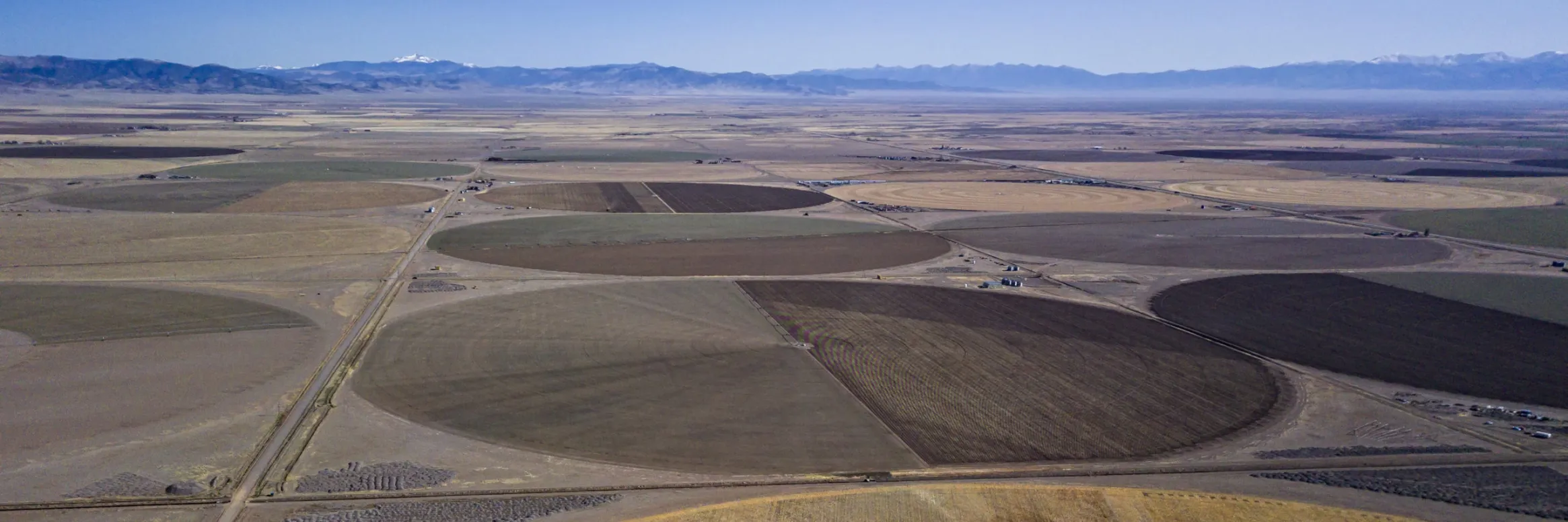
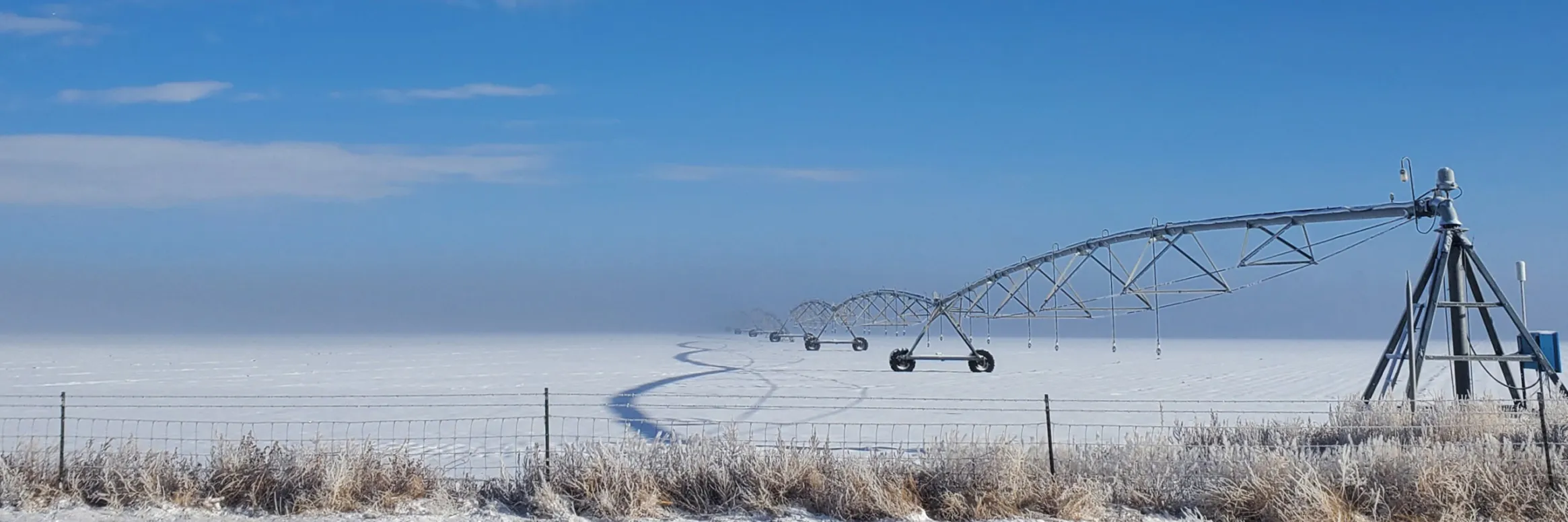
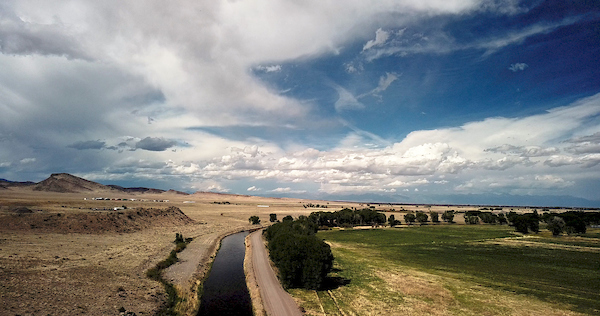
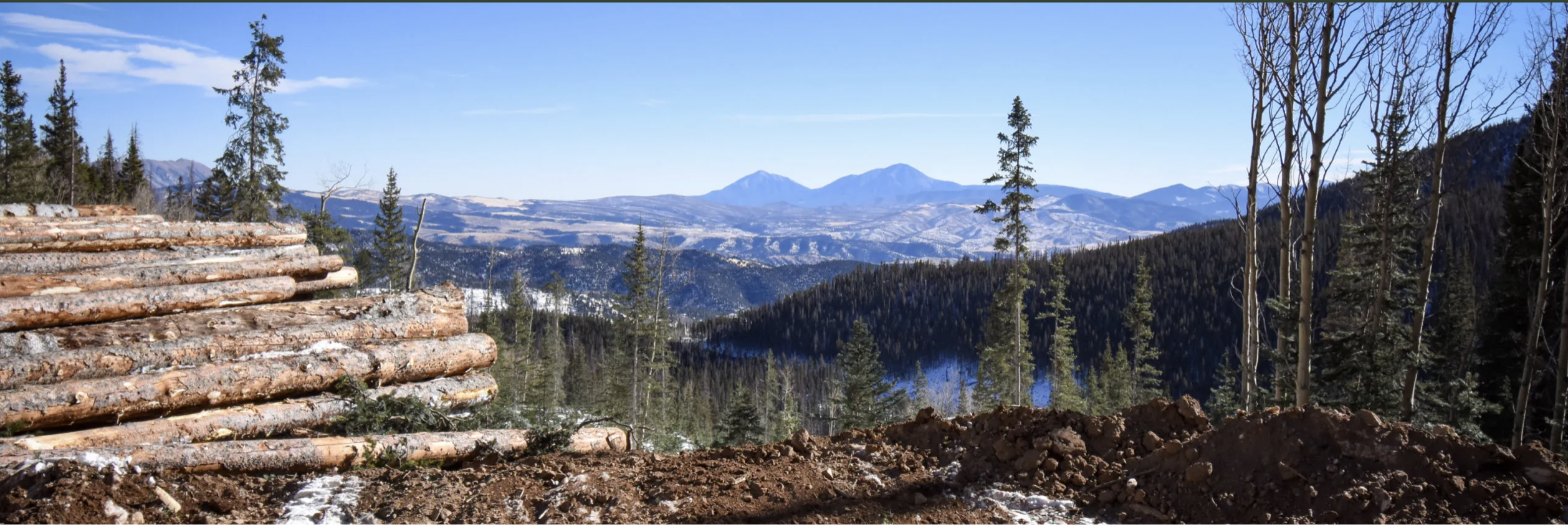
Irrigation equipment on a farm in Montrose County, Colorado on May 29, 2021 with Lone Cone in the background. (Chase Woodruff/Colorado Newsline)

Gov. Jared Polis on Monday signed two bills into law that are aimed at conserving a precious and dwindling resource in the state: water. For the bill signings, the governor traveled to the San Luis Valley, an important agricultural region where farmers face mounting challenges from extreme drought driven by climate change.

Republican Sens. Cleave Simpson of Alamosa and Jerry Sonnenberg of Sterling, plus Reps. Dylan Roberts, an Avon Democrat, and Marc Catlin, a Montrose Republican, sponsored the first bill, Senate Bill 22-28. It puts $60 million of federal COVID-19 relief money into a new “groundwater compact compliance and sustainability” fund to help finance projects that reduce groundwater use in the Rio Grande and Republican river basins.

GET THE MORNING HEADLINES DELIVERED TO YOUR INBOX

Such projects might include efforts to “buy and retire” wells used for irrigation as well as portions of irrigated farmland, with the goal of restoring water to underground aquifers and helping the communities meet deadlines to reduce their water use. The Colorado Water Conservation Board can allocate money from the groundwater fund based on recommendations from the boards of directors for the Rio Grande Water Conservation District and the Republican River Water Conservation District.

“The timing of the availability of federal dollars and the growing sense of urgency in both basins created a unique opportunity that will serve both of these communities well,” Simpson told the Alamosa Citizen in April.

The other bill Polis signed, House Bill 22-1316, provides millions of dollars for construction projects approved by the Colorado Water Conservation Board. The bill’s legislative sponsors included Reps. Karen McCormick, D-Longmont, and Catlin, along with Sens. Kerry Donovan, D-Vail, and Simpson. Among the local and regional projects funded are:

  • $3.8 million for the Platte River Recovery Implementation Program. By increasing water flows through the central Platte River habitat area — which stretches across northern Colorado, Wyoming and Nebraska — the project is aimed at improving conditions for the interior least tern, pallid sturgeon, piping plover and whooping crane.
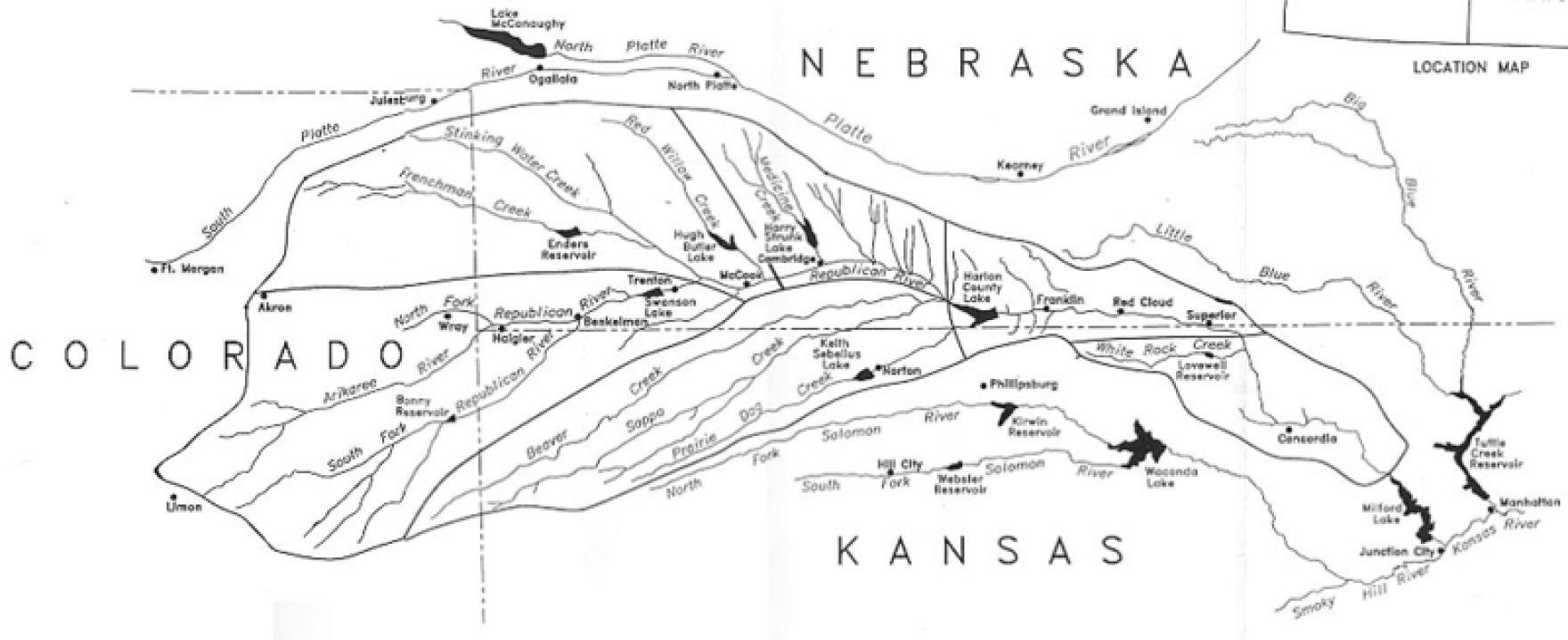
  • $2 million to support the state’s efforts to comply with the Republican River compact, which was first negotiated between Colorado, Kansas and Nebraska in the early 1940s. The compact governs the three states’ use of the water resources in the Republican River basin, which begins on the plains of eastern Colorado and flows through northwest Kansas and eastern Nebraska.
  • $500,000 for the Arkansas River Decision Support System. The Arkansas River DSS project involves collecting data on characteristics like climate and groundwater in the Arkansas River basin, which covers the southeast quadrant of the state, and analyzing the data to help inform future decisions about water use.

Polis, a Democrat, signed both bills into law at the Rio Grande Water Conservation District offices in Alamosa. According to a statement from Polis’ office, the governor then joined state and national officials in the nearby town of Center to champion a major development for the San Luis Valley’s potato industry.

The U.S. recently began exporting potatoes — including those grown in the Valley — to new regions in Mexico under an agreement reached late last year between the two countries. Previously, potato exports were limited to a 16-mile border zone.

“This agreement, paired with the critical work the Valley is doing to protect and conserve our water, will make a major positive difference for our farmers, meaning more money in the pockets of hardworking Coloradans,” Polis said in a statement. “Colorado is strategically positioned to lead the nation in potato exports to Mexico.”

Colorado sent its first shipment of potatoes to Mexico under the new agreement last week, according to the statement.

SUPPORT NEWS YOU TRUST.

Colorado Newsline is part of States Newsroom, a network of news bureaus supported by grants and a coalition of donors as a 501c(3) public charity. Colorado Newsline maintains editorial independence. Contact Editor Quentin Young for questions: info@coloradonewsline.com. Follow Colorado Newsline on Facebook and Twitter.

San Luis Valley shows off diversity of farm operations to #Colorado Ag Commissioner Kate Greenberg — The #Alamosa Citizen #RioGrande

Click the link to read the article on the Alamosa Citizen website (Chris Lopez):

KATE Greenberg, agriculture commissioner for Colorado, is leaving Cactus Hill Farm in Conejos County when she reflects on the farm operations she’s visited so far on her weekend tour of the San Luis Valley.

Greenberg had made stops at the non-profit Rio Grande Farm Park in Alamosa, the large-scale Esperanza Farms managed by Virgil Valdez, and then the niche Cactus Farm where Elana Miller-ter Kuile spoke about the unsustainable nature of fast fashion that the wool farmer sees in an era of water scarcity and climate change.

It was during her time as western program director for the National Young Farmers Coalition that Greenberg would begin to acquaint herself with the area, particularly neighboring New Mexico where she was schooled on the practice of acequia farming and the generational ties to agricultural lands in the high-desert terrain of the region.

It’s been pointed out that she is the first female ag commissioner for Colorado, and maybe the youngest ever after she was appointed to the position in 2018 by Gov. Polis. What’s less described is her ease of command on the issues facing farmers at different scales of operation, and her willingness to engage in the divide between Front Range and rural Colorado as it wrestles with issues like the affluent bedroom community of Douglas County looking to raid the aquifers of the San Luis Valley to quelch its population thirst.

On her visit to the Valley, she sat in the living room of Virgil and Sherry Valdez at Esperanza Farms and heard about fears of getting crops out of the ground and to market this summer due to the lack of farm labor. Earlier she spent time with Jesus Flores and conversed entirely in Spanish with the Rio Grande Farm Park manager, and helped bottle-feed newborn sheep at Miller-ter Kuile’s Cactus Hill Farm.

Across America agricultural leaders like Greenberg wrestle with how to balance the rise of corporate farms that have sliced away at mid-level farming and ranching operations but left a bit of space for the family farmer, community organic operations, and enterprising people like Elana Miller-ter Kuile who clearly has found a niche in the wool-making world.

“Here in the Valley I feel like the different scale, whether it’s very small, or very large, or somewhere in between, it’s all about how do you support your family, support your business, take care of the land and find a market,” Greenberg said.

“I think all of the different operations we’ve seen, whether it’s Rio Grande Farm Park helping families provide food for themselves or for farmer’s markets, Elana selling wool all across the country, or Virgil and Sherry (Valdez) growing for potato sheds for exports, all of that has a place in our ag economy and you could see that just within a few miles of each other here.”

She grasps the very real burnout of farmers and the disappearance of the next generation of ag producers, but even there she found new hope in what’s happening across the San Luis Valley to maintain an agricultural sector.

Her trip into San Luis and Costilla County to attend Saturday’s Congresso de Aquequias 2022 and to learn about the Move Mountains Youth apprenticeship in acequia farming gave her more thought and more ways to move forward in her job handling Colorado’s $7 billion ag economy.

“I think from my experience throughout the years in New Mexico in particular, I come here humbly,” Greenberg said. “Even though I was invited to speak (at the Congresso), I intend to listen a lot more than I speak. I have a farmer friend whose dad always said, ‘We were born with two ears and one mouth for a reason.’ So I hope that’s what I can do, is listen and learn from the folks in San Luis.”

In this video interview with Colorado Agriculture Commissioner Greenberg, she reflects more on the job of ag commissioner, her visit to the San Luis Valley, and why the Renewable Water Resources exportation plan is the wrong approach for managing water in Colorado. Watch our car-ride interview with Commissioner Greenberg:

Pueblos again seek inclusion in #RioGrande decision-making: Experts say 2022 looks grim for the river, and irrigation season is likely to be brief and dry — Source #NM

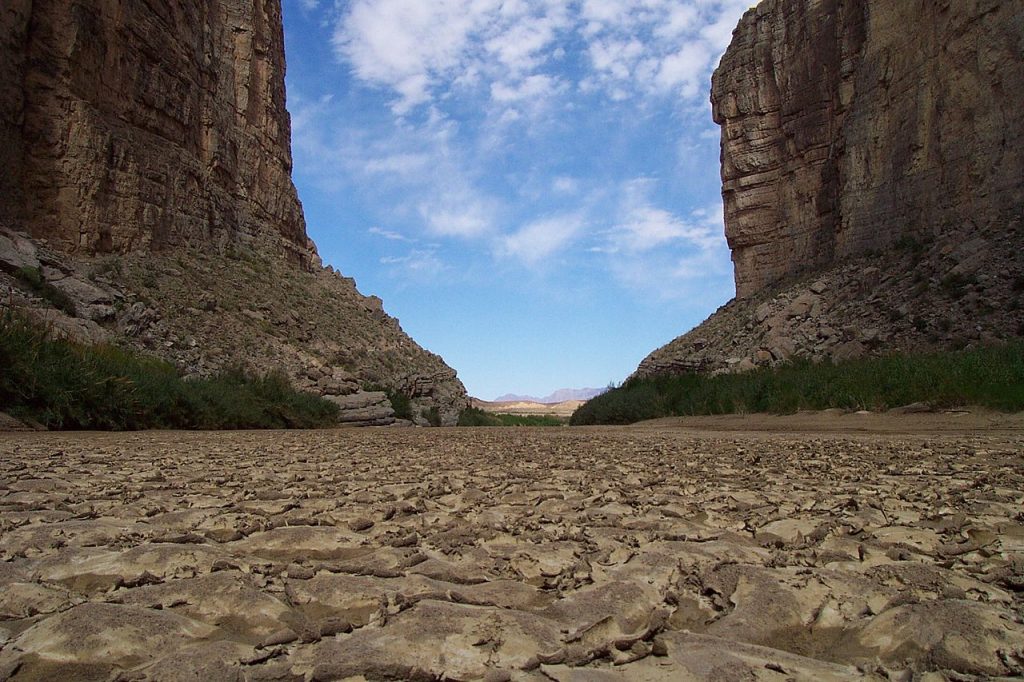
Some parts of the Rio Grande already experience a dry river most of the year. Photo by WildEarth Guardians.

Click the link to read the article on the Source NM website (Danielle Prokop). Here’s an excerpt:

Members of six New Mexico Pueblos are calling for a seat at the table from the body that oversees how the Rio Grande’s water is split, managed and used between states. A coalition representing Cochiti, Santo Domingo, San Felipe, Santa Ana, Sandia and Isleta attended the annual Rio Grande Compact Commission meeting on May 6. Gov. Vernon Abeita (Isleta) spoke on behalf of the coalition, saying the Pueblos should be included in all correspondence and meetings that may impact access to Rio Grande water. They should also be invited to future commission meetings, he said.

The headwaters of the Rio Grande River in Colorado. Photo: Brent Gardner-Smith/Aspen Journalism

“In the past, Bureau of Indian Affairs represented Pueblos at commission meetings,” Albeita said. “It is now time the coalition interacts with the commission directly, and for the commission to engage the coalition Pueblos, so that our voices can be heard.”

Cochiti Pueblo between c. 1871-c. 1907. By John K. Hillers, 1843-1925, Photographer (NARA record: 3028457) – U.S. National Archives and Records Administration, Public Domain, https://commons.wikimedia.org/w/index.php?curid=17208641

He said the Pueblos have cultivated and lived on their land “for time immemorial” and want a formal relationship to manage the water they depend on. This also the first time the Pueblos have sought “a seat at the table,” a direct quote from a 1999 request to join discussions on the operating contract between the Middle Rio Grande Conservancy District and the Bureau of Reclamation. The U.S. Department of the Interior relaxed rules last month to allow tribes more control over their water rights. The department also established a federal assessment team to help the six Pueblos resolve water claim issues between the state of New Mexico and the Middle Rio Grande Conservancy District, Abeita said.

Native land loss 1776 to 1930. Credit: Alvin Chang/Ranjani Chakraborty

2022 #COleg: Turf replacement, wildfire, #groundwater sustainability funding among #water wins as #Colorado legislative session ends — @WaterEdCO

Colorado State Capitol. Photo credit: Allen Best/Big Pivots

Click the link to read the article on the Water Education Colorado website (Larry Moriandi):

The Colorado General Assembly adjourned its 2022 session on May 11. Among the water bills that passed, four share a common theme—funding. A rare confluence of new revenue sources led to strong bipartisan support of bills dealing with groundwater compact compliance and sustainability, state water plan projects, wildfire mitigation and watershed restoration, and urban turf replacement. A bill designed to strengthen Colorado’s water speculation laws failed.

An orangethroat darter, one of the nine remaining native fish species in the Arikaree River. Photo: Jeremy Monroe, Freshwaters Illustrated.

Groundwater compact compliance and sustainability

Senate Bill 28 creates a Groundwater Compact Compliance and Sustainability Fund to help pay for the purchase and retirement of wells and irrigated acreage in the Republican and Rio Grande basins in northeast and south-central Colorado. It appropriates into the fund $60 million in federal American Rescue Plan Act (ARPA) revenue that had been transferred into the state’s Economic Recovery and Relief Cash Fund. The Colorado Water Conservation Board (CWCB) will distribute the money based on recommendations from the Republican River Water Conservation District and the Rio Grande Water Conservation District, with approval by the state engineer. These are one-time dollars that must be obligated by the end of 2024; if not spent by then, they will be used to support the state water plan.

The bill seeks to reduce groundwater pumping connected to surface water flows in the Republican River to comply with a compact among Colorado, Kansas and Nebraska. It will also help meet aquifer sustainability standards required by state statute and rules in the Rio Grande Basin, home to the San Luis Valley. To achieve those goals, 25,000 acres of irrigated land must be retired in the Republican Basin, and 40,000 acres in the Rio Grande, by 2029. If the targets are not met, the state engineer may have no choice but to shut down wells without compensation.

Water sustains the San Luis Valley’s working farms and ranches and is vital to the environment, economy and livelihoods, but we face many critical issues and uncertainties for our future water supply. (Photo by Rio de la Vista.)

Sen. Cleave Simpson, R-Alamosa, general manager of the Rio Grande Water Conservation District, noted that agricultural production coming out of the two basins benefits the overall state economy, not just the local communities. “The state has some skin in the game,” he said, and the availability of ARPA revenue “presented a once-in-a-lifetime opportunity” to support the districts.

Simpson emphasized that neither district is looking for a handout. The Republican has already assessed its water users over $140 million since 2004 to retire irrigated land and purchase or lease surface and groundwater to meet Colorado’s water delivery obligations. The Rio Grande district has taxed its farmers nearly $70 million since 2006 to take irrigated land out of production and has cut groundwater pumping by a third. Simpson requested $80 million from the Economic Recovery Task Force and, by demonstrating the interconnectivity between the state and local economies and the commitment already shown by the districts—along with strong bipartisan support from legislators—was able to secure the $60 million appropriation.

State water plan projects

Each year the Colorado General Assembly considers the CWCB’s “projects bill,” which, among other things, has included appropriations from CWCB’s Construction Fund to support grants for projects that help implement the state water plan in recent years. The funding source for those grants is different this year, with gambling revenue from Proposition DD, which the electorate passed in 2019, becoming available for the first time. Proposition DD legalized sports betting and levied a 10% tax on sports betting proceeds, with the majority of that revenue going into the Water Plan Implementation Cash Fund.

House Bill 1316 appropriates $8.2 million from the fund for grants to help implement the state water plan; $7.2 million of that amount is from sports betting revenue. Rep. Marc Catlin, R-Montrose, said, “This is the first appropriation of funds from Proposition DD … and it looks like it’s starting to grow into what we had hoped.”

The bill also appropriates $2 million to CWCB from its Construction Fund to help the Republican River Water Conservation District retire irrigated acreage. Rod Lenz, district president, said the district has doubled its water use fee on irrigators but that “we’re in need of short-term funding while we wait for that rate increase.” The $2 million in state revenue will help the district meet its 2024 interim target of retiring 10,000 acres of the 25,000 acres necessary to comply with the Republican River Compact by 2029. This is on top of the funds the district will receive from Senate Bill 28.

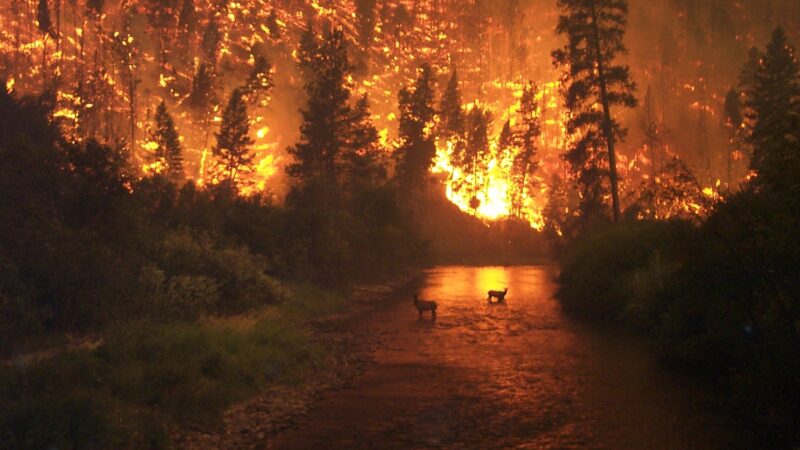
A forest fire next to the Bitterroot River in Montana. UCLA-led research revealed that larger fires tend to be followed by larger increases in streamflow. | Photo by John MacColgan/Creative Commons

Wildfire mitigation and watershed restoration

Like Senate Bill 28, House Bill 1379 takes advantage of ARPA revenue by appropriating $20 million from the Economic Recovery and Relief Cash Fund for projects to restore, mitigate and protect watersheds from damage caused by wildfire-induced erosion and flooding. Testimony on the bill in the House Agriculture, Livestock & Water Committee emphasized how investing mitigation dollars now helps avoid spending even more on very expensive recovery efforts later.

The bill allocates $3 million to the Healthy Forests and Vibrant Communities Fund to help communities reduce wildfire risks by promoting watershed resilience. It moves $2 million into the Wildfire Mitigation Capacity Development Fund for wildfire mitigation and fuel reduction projects. And $15 million goes to CWCB to fund watershed restoration and flood mitigation projects, and to help local governments and other entities apply for federal grants under the Infrastructure Investment and Jobs Act related to water and natural resources management.

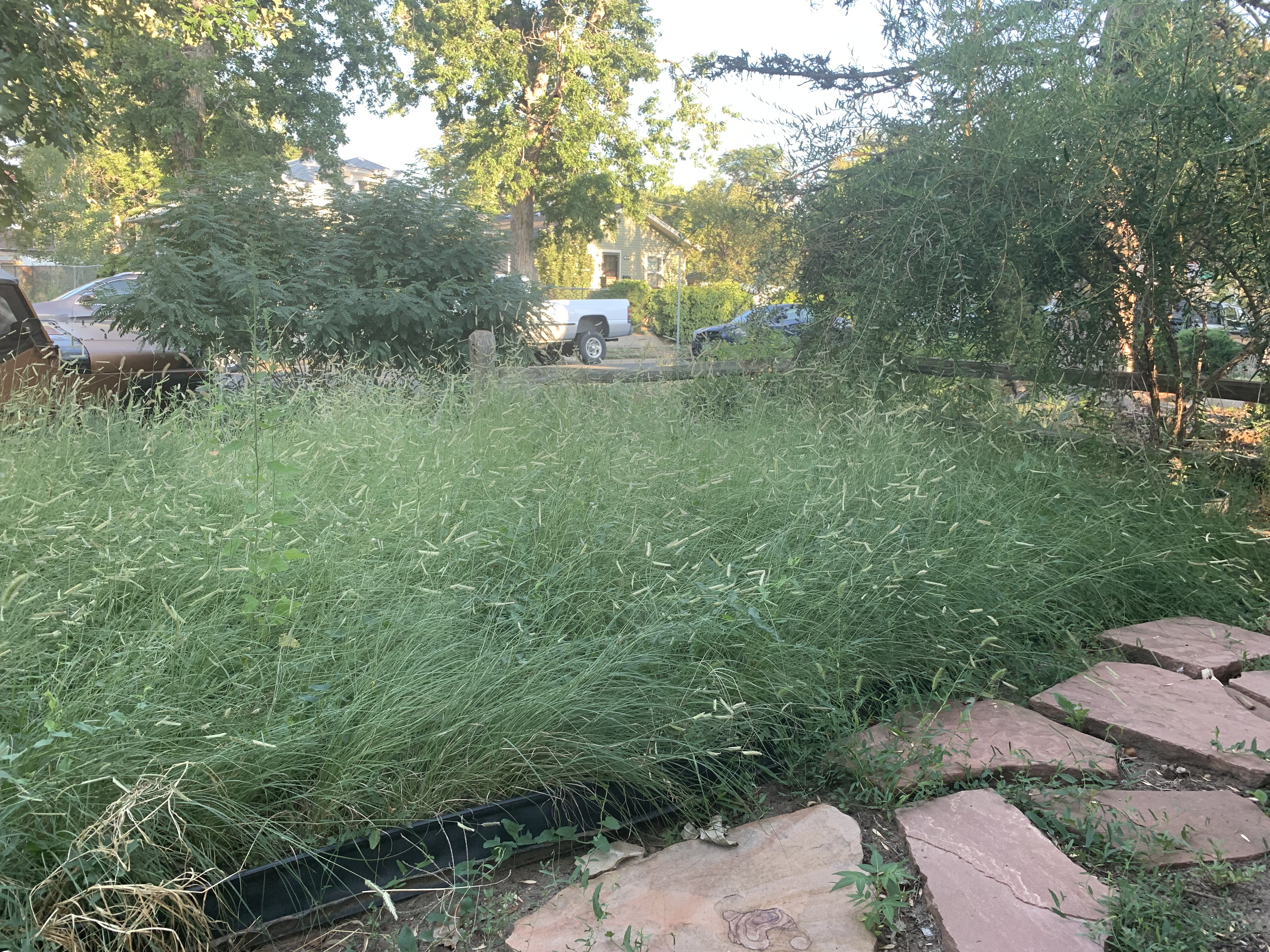
Mrs. Gulch’s Blue gramma “Eyelash” patch August 28, 2021.

Turf replacement

While most of the focus at the Capitol in reducing water use has been on agriculture through retiring irrigated farmland, House Bill 1151 elevates urban turf replacement in importance. The bill requires CWCB to develop a statewide program to provide financial incentives for residential, commercial, institutional and industrial property owners to voluntarily replace non-native grasses with water-wise landscaping. It appropriates $2 million in general funds to a newly created Turf Replacement Fund and authorizes local governments, nonprofits and other entities to apply to CWCB for grants to help finance their programs. Landscape contractors, to whom individuals can apply for money to replace their lawns, are also eligible.

Rep. Catlin pointed out that “50% of the water that comes from the tap and goes through the meter and into the house is used outside.”

“We’re building ourselves a shortage,” he warned, “by continuing to use treated water for irrigation.” Rep. Dylan Roberts, D-Avon, added, “For too long the Western Slope and the Eastern Plains have borne the brunt of water conservation … but this is a bill that will give the tools to metro areas for them to play their fair part in this problem that is our drought.”

WAM bought this 57-acre parcel as part of a $6 million deal in January 2020, leading some to suspect the company was engaging in investment water speculation. WAM’s activity in the Grand Valley helped prompt state legislators to propose a bill aimed at curbing speculation.
CREDIT: BETHANY BLITZ/ASPEN JOURNALISM

Investment water speculation

Senate Bill 29 was an attempt to strengthen protections against investment water speculation, defined as the purchase of agricultural water rights “with the intent, at the time of purchase, to profit from an increase in the water’s value in a subsequent transaction, such as the sale or lease of the water, or by receiving payment from another person for nonuse of all or a portion of the water.” It was aimed at curbing outside investors who may have little or no interest in agriculture from using the water right to maximize its value as the price of water increases during drought. It authorized the state engineer to investigate complaints of investment water speculation and, if found, to levy fines and prohibit the buyer from purchasing additional water rights for two years without the state engineer’s approval.

The 2021 interim Water Resources Review Committee recommended the bill, but it was never viewed as more than a “placeholder.” Sen. Kerry Donovan, D-Vail, a co-sponsor of the bill, expressed her disappointment that the bill did not generate more engagement between the water community and policymakers. “I was certainly hopeful that by having a bill we would force conversation,” she said, “but it did not result in having some forthright ‘let’s get around a table and hammer this out.’” Members struggled with trying to balance concerns over speculation with protecting property rights. Sen. Don Coram, R-Montrose, the other co-sponsor of the bill, emphasized, “We are certainly not trying to take a farmer’s or rancher’s ability away from selling that water. In many cases that is their 401K, their retirement.”

Opposition from water user groups in the Senate Agriculture & Natural Resources Committee sent a clear message: Existing legal requirements provide the necessary safeguards to address water speculation. Travis Smith, representing the Colorado Water Congress, said what’s needed is “having more voices, taking more time.”

Senate Bill 29 was amended to strike the language in the bill and refer the issue to interim study. Sen. Jerry Sonnenberg, R-Sterling, who was chairing the committee, expressed his frustration: “We have an ineffective water group that won’t have a conversation with lawmakers anymore. When they have a bill they just take a position and quit working with people.”

With that said he carried the bill over for further consideration, effectively killing it since this was the last committee meeting of the year. It’s unclear whether the issue will be studied this interim since it’s an election year and fewer committee meetings will be held.

Larry Morandi was formerly director of State Policy Research with the National Conference of State Legislatures in Denver, and is a frequent contributor to Fresh Water News. He can be reached at larrymorandi@comcast.net.

The #DoloresRiver and the #RioGrande are melting-out quickly (May 17, 2022) — @Land_Desk

2022 #COleg: To help refill two struggling underground aquifers, #Colorado lawmakers set aside $60 million to retire irrigation wells and acres of farmland — #Colorado Public Radio

Subdistrict 1 Program Manager Marisa Fricke clears paths for water to flow onto land the subdistrict owns. The property is one of the subdistrict’s investments in recharging the aquifer. Photo credit: The Alamosa Citizen

Click the link to read the article on the Colorado Public Radio website (Michael Elizabeth Sakas). Here’s an excerpt:

Colorado lawmakers unanimously voted to set aside $60 million of federal COVID relief money to create a fund to help water users in two river basins meet groundwater sustainability targets. If signed by Gov. Jared Polis, the legislation would create a groundwater compact compliance and sustainability fund administered by the Colorado Water Conservation Board. The money would be used to buy and retire groundwater wells used to irrigate farmland in the Rio Grande River basin in the south and the Republican River basin in the east to keep the water in underground aquifers that are struggling to keep up with drought and overuse…

Farmers and ranchers in both river basins face rapidly approaching deadlines to reduce their water use, which are necessary to maintain interstate river agreements and preserve underground water supplies. If these goals aren’t met, state water officials say there could be alarming consequences — and thousands of well users could face water cuts.

In the San Luis Valley, the state water engineer is requiring some groundwater well users to limit pumping because too many wells are all pulling from the same groundwater source. Chris Ivers, the program manager for two subdistricts in the Rio Grande Water Conservation District, said farmers and ranchers have levied property taxes on themselves to fund similar local efforts to meet groundwater sustainability goals.

Douglas County to release redacted Renewable #Water Resources memo with their decision — The #Alamosa Citizen #RioGrande

San Luis Valley irrigation crop circles. Photo credit: The Alamosa Citizen

Click the link to read the article on the Alamosa Citizen website:

DOUGLAS County will release a redacted version of an attorney memorandum at the same time it gives its decision on whether to move ahead with a proposal by Renewable Water Resources to transport water from San Luis Valley aquifers to the affluent metro-Denver suburb.

The three county commissioners met for over an hour in a closed-to-the-public executive session Thursday to discuss which portions of water attorney Steve Leonhardt’s analysis and recommendations on the RWR plan would be redacted.

“We will release our decision alongside this redacted memorandum,” said Commissioner Abe Laydon, chair of the board. A disappointed Commissioner Lora Thomas said she was under the impression a redacted version would be released as early as Thursday but now the release will occur at a future board work session.

SLV WATER: Find more coverage of the RWR plan and other Valley water issues HERE

Laydon said a “large majority” of the information contained in Leonhardt’s memorandum to the commissioners would be made public. Redacted would be any information privileged to Renewable Water Resources or any information that would harm Douglas County in any future water discussions. Personal information of individuals Laydon and Leonhardt said they met privately with in the San Luis Valley would also be redacted.

Meanwhile, the SLV Ecosystem Council submitted 255 signatures to the Douglas County commissioners in opposition to the water exportation plan. In the letter, SLV Ecosystem Council Director Chris Canaly slammed the commissioners for canceling a public meeting in the San Luis Valley and for their treatment of water and environmental experts who took time to educate the commissioners on the Valley’s dire water situation.

“… SLV representatives compiled critical research and presented significant facts and valuable findings that embody generations of historical water knowledge of the Rio Grande basin. Your reaction to this good faith effort has been complete dismissal, even disdain.”

#Aridification Watch: May edition As the snow season wraps up, how are things looking? — @Land_Desk #snowpack #runoff

Click the link to read the article on The Land Desk website (Jonathan Thompson) and to drop some dough in the tip jar:

It’s that time of the year, again, folks. Yep, you guessed it, it’s … Yukigata Time! Okay, maybe you didn’t guess it. Maybe you have no idea what the word even means. But I’m willing to bet you are familiar with the concept and, if you are a farmer or a gardener, you probably use a yukigata.

A yukigata is a pattern formed by melting snow on a mountain slope or hillside in the spring. They often serve as agricultural calendars, letting farmers know when to plant certain crops, or when the danger of a tomato-killing freeze has passed. The calendars can be simple: over in the Montezuma Valley gardeners wait until Ute Mountain is free of snow to plant. Or more elaborate: In the Grand Valley of Colorado, it would be foolish to plant before the Swan’s Neck has melted. And in the North Fork Valley of Western Colorado, gardeners wait for the Devil’s Neck on Mt. Lamborn to “break.”

But the yukigatas have been doing their thing, or disappearing, sooner than in the past, tricking people into planting too early and making their crops vulnerable to the inevitable spring freeze. In Durango, Colorado, for example, gardeners once planted according to when the snow melted off the north face of Smelter Mountain. Now that can happen as soon as March—if there’s snow on the mountain at all—which is just too early.

This also messes with plants’ internal calendars, tricking fruit trees into blossoming too early. A study published this spring found wildflowers in the sagebrush ecosystem now bloom weeks earlier than they did in the 1970s. And here’s a cool map from the National Phenology Network showing where trees leafed out earlier (or later) than usual this year.

Clearly the premature melting of the yukigata is caused by less snow to begin with combined with warming temperatures. Dust on the snow causes it to melt faster, too. As does, wait for it, atmospheric thirst! That’s right, the increasing temperatures are making the atmosphere thirstier, and it’s guzzling up snow, drying out plants, sucking up reservoirs, and so on. Last month, scientists from the Desert Research Institute published a study tracking changes in evaporative demand and found it is increasing everywhere, especially in the Southwest.

As evaporative demand increases, it pulls more water from the land into the air via evaporation and transpiration from plants (and snow and reservoirs), leaving less in the streams and soil. In the Rio Grande Basin, the authors say, that means crops need 8% to 15% more irrigation now than they did in 1980. They go on to note, “These increases in crop water requirements are coincident with declining runoff ratios on the Rio Grande due to warming temperatures and increased evaporative losses, representing a compounding stress on water supplies.”

The authors conclude:

“These higher evaporative demands mean that, for every drop of precipitation that falls, less water is likely to drain into streams, wetlands, and aquifers across the region. Soils and vegetation spend more time in drier conditions, increasing potential for forest fire, tree mortality, and tree regeneration failure.”

So the thirsty atmosphere is likely a factor in the catastrophic fires currently burning in New Mexico. The Hermits Peak Fire—in the Pecos River watershed, east of the Rio Grande—has grown to a monstrous 166,000 acres and is threatening Las Vegas, Mora, and Montezuma.

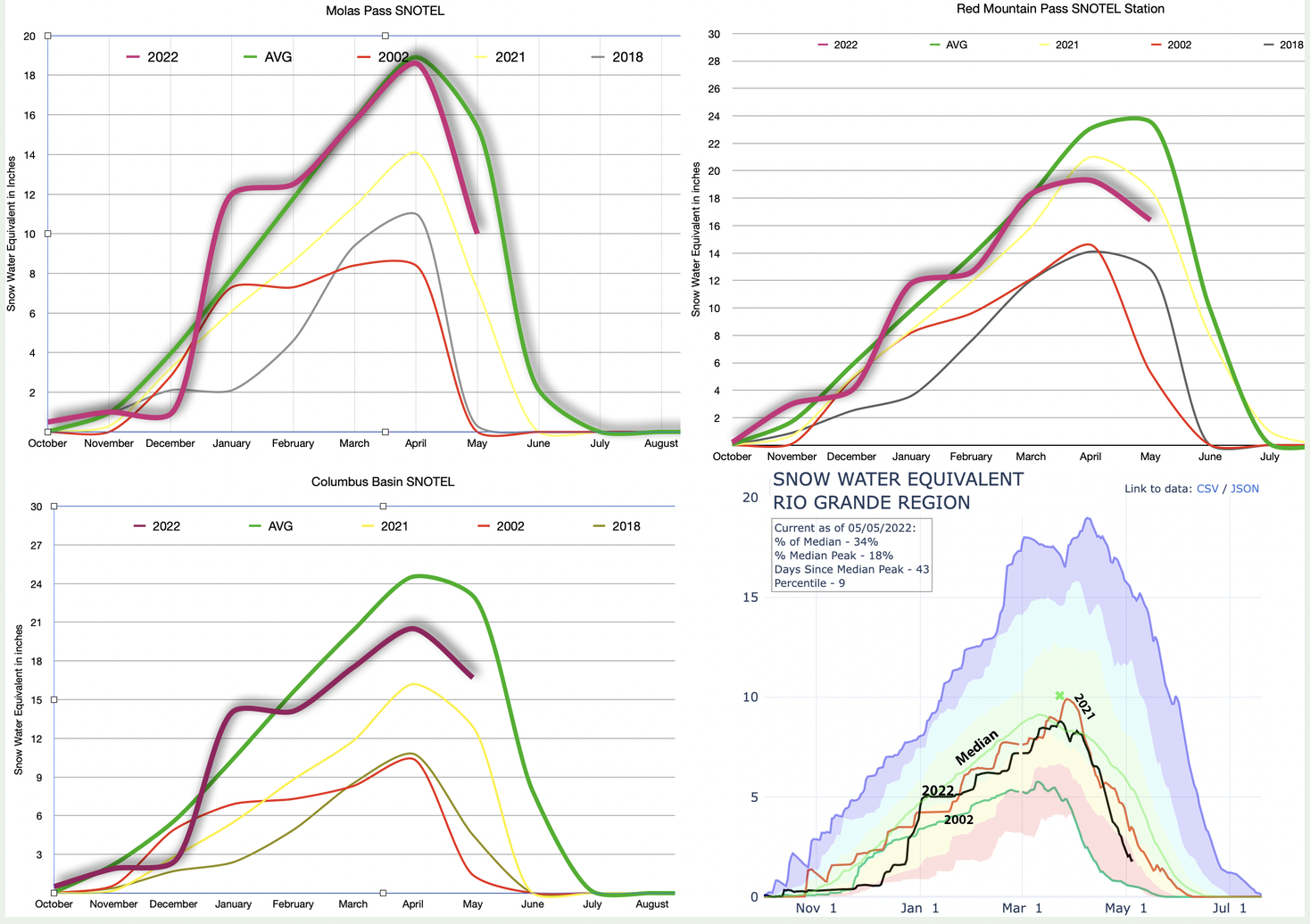
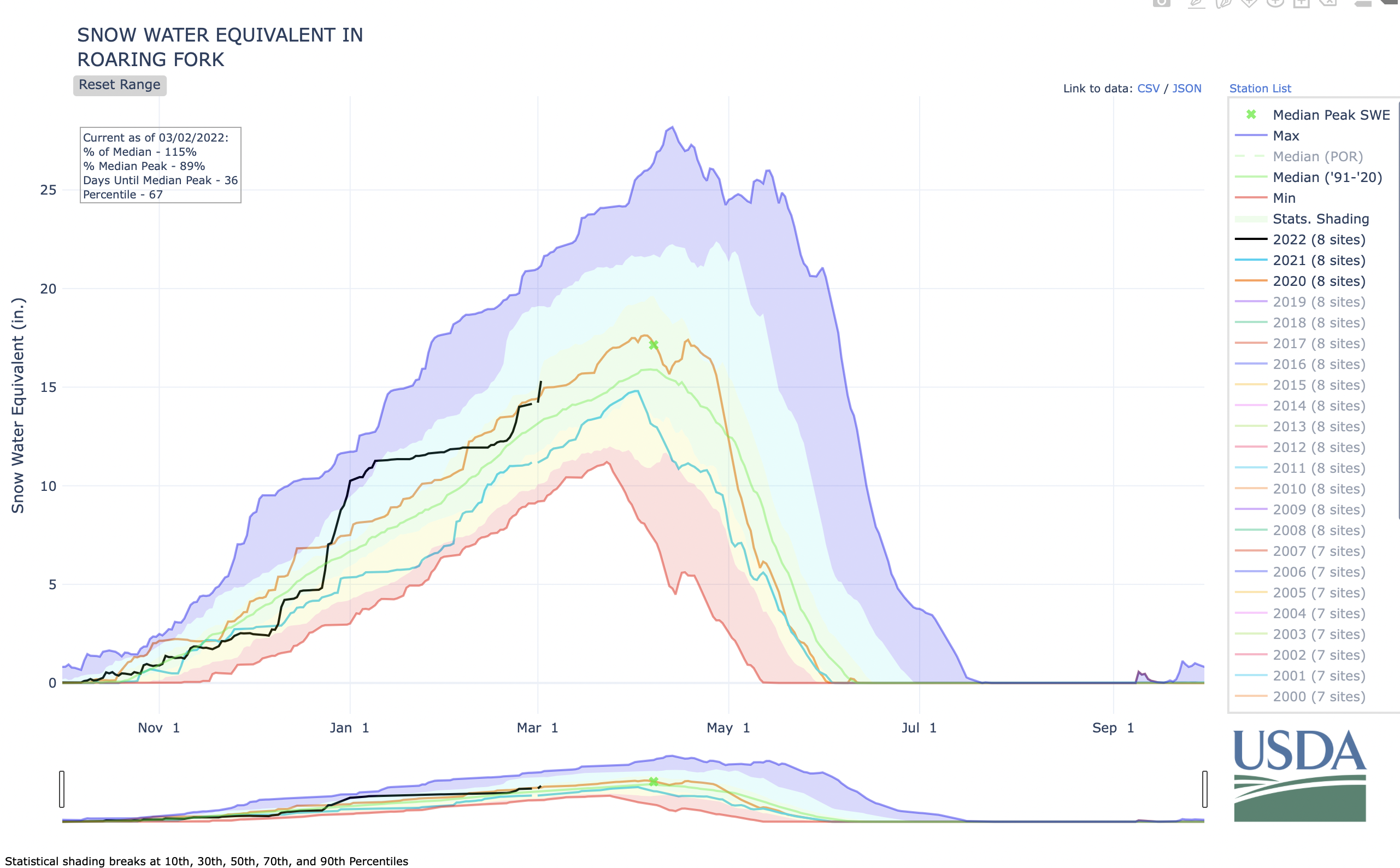
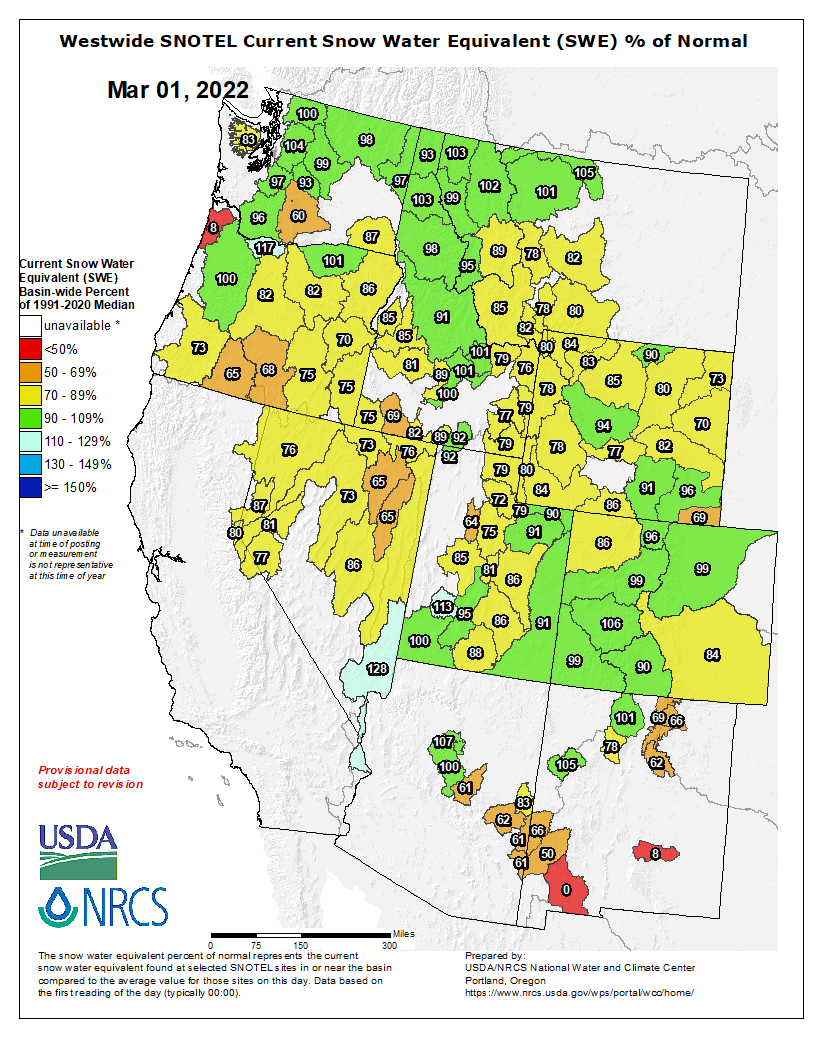
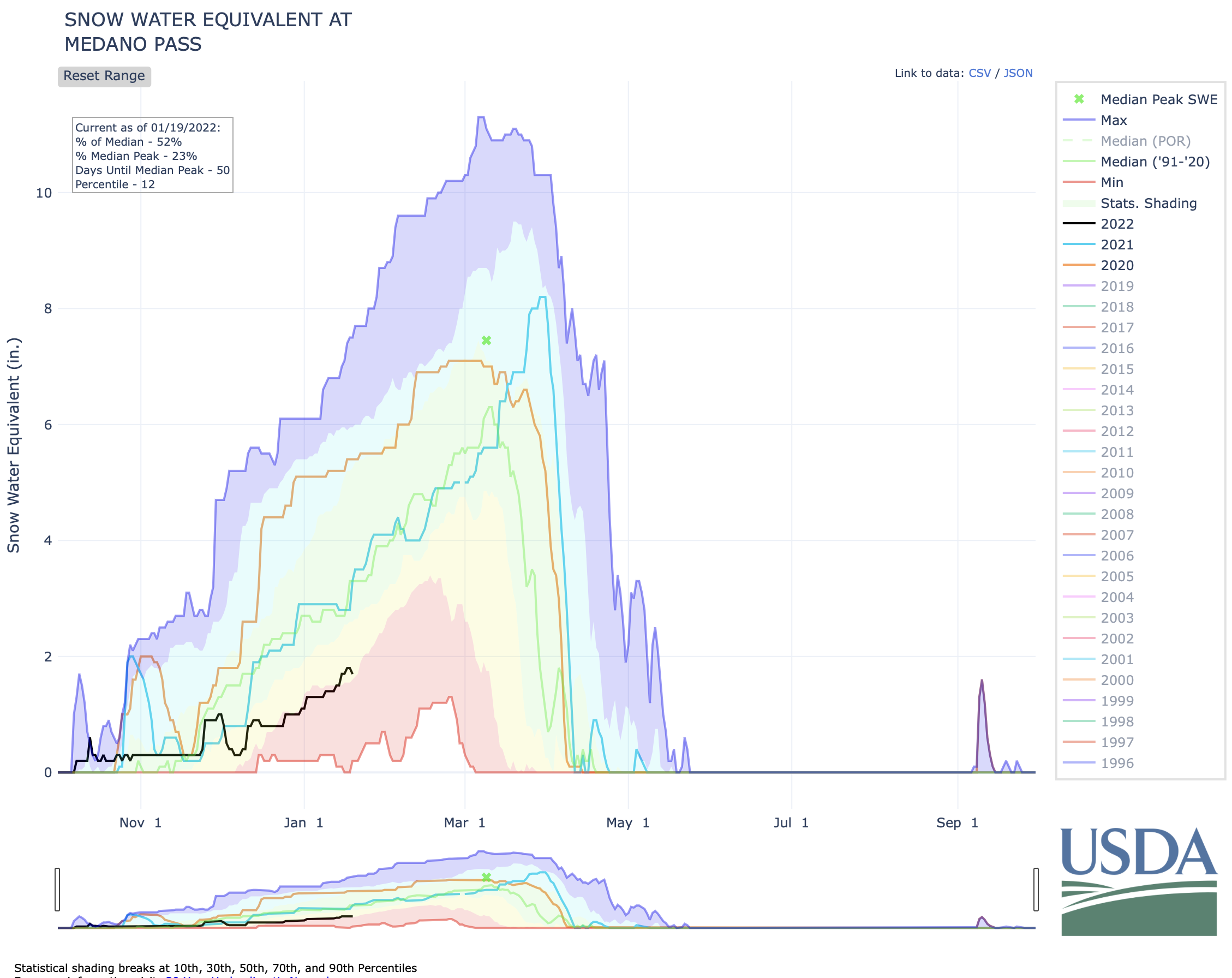
This year neither the Rio Grande nor the Pecos watershed has done all that well, snowpack-wise. Not many watersheds have, although Southwest Colorado is in better shape than it was last year. Snow season is pretty much over. That doesn’t mean it won’t snow any more in the high country. It’s just that the snowpack peak has almost certainly passed, runoff is underway, and many lower elevation SNOTEL stations are registering zero, which can throw off basin-wide graphs. So, below we offer the snowpack season finale with May 1 readings at our three go-to high country SNOTEL , plus the current graph for the Rio Grande Basin.

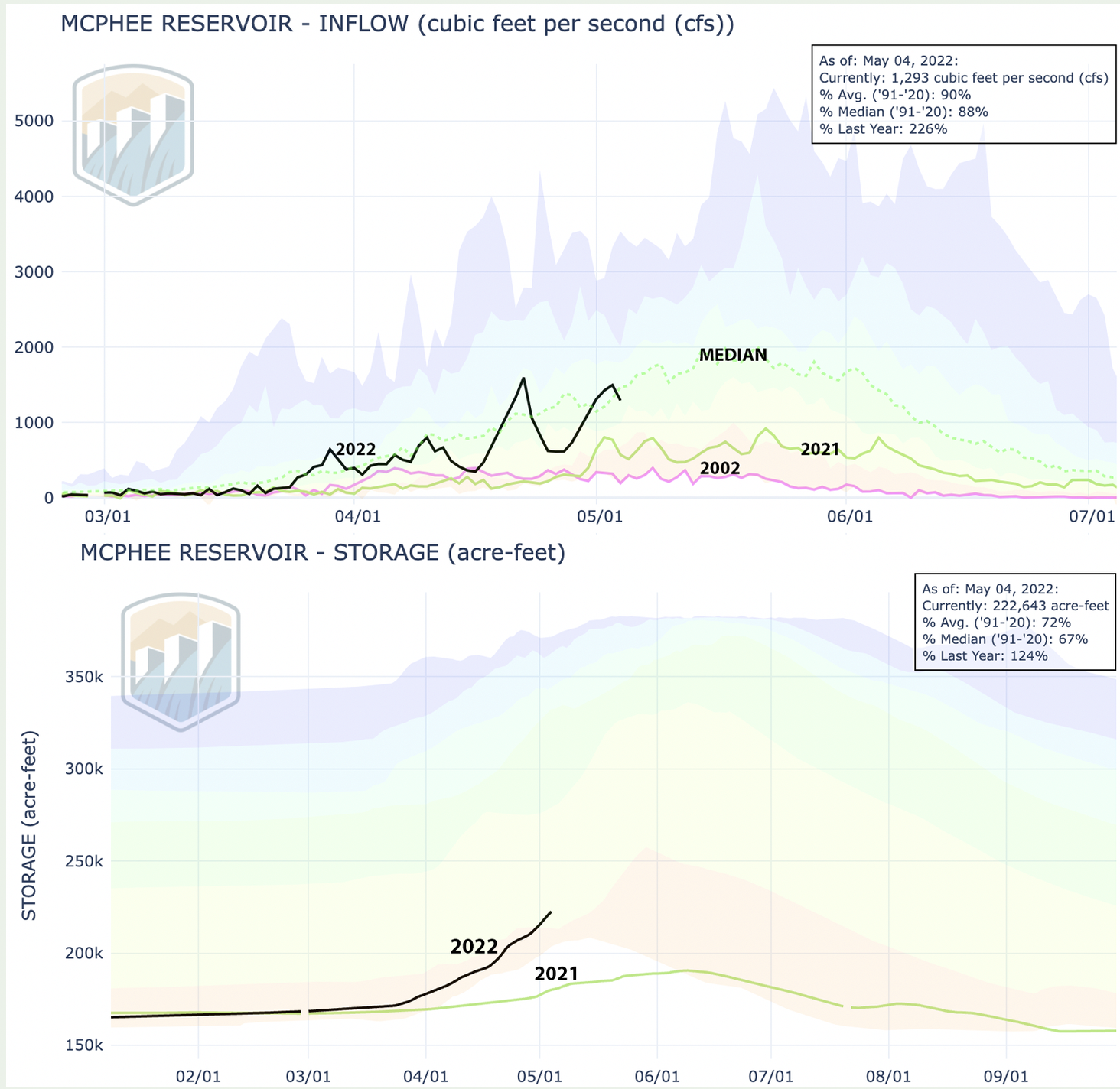
The bright spot is definitely Columbus Basin, high in the La Plata Mountains. It’s below the average level for the period of record, but still doing far better than 2021. The La Platas feed the Animas, La Plata, Mancos, and Dolores Rivers. Last year the Dolores had an awful year. Things are looking up this time around—relatively speaking. The Dolores River through its namesake town shot up to 1,800 cfs at one point, dropped, then shot back up again, pushing up levels at McPhee significantly. Still, don’t goo excited. McPhee’s only at 59% of capacity and water managers are releasing virtually nothing from the dam.

River runners better get out on the water now, while they still can.

[San Luis] Valley farmers tie their fate to Mother Nature — The #Alamosa Citizen #RioGrande

Subdistrict 1 Program Manager Marisa Fricke clears paths for water to flow onto land the subdistrict owns. The property is one of the subdistrict’s investments in recharging the aquifer. Photo credit: The Alamosa Citizen

Click the link to read the article on the Alamosa Citizen website (Chris Lopez):

MOTHER Nature will determine how much groundwater pumping occurs in ag-rich Subdistrict 1 of the Rio Grande Water Conservation District under a new plan of water management making its way to the state for approval.

The subdistrict and its parent Rio Grande Water Conservation District have been under pressure to bring the unconfined aquifer of the Upper Rio Grande Basin to a sustainable level or face curtailment of wells. The San Luis Valley has two aquifers – one unconfined and one confined.

In the draft of its new plan, which is the fourth amendment to the subdistrict’s Plan of Water Management, Subdistrict 1 members spell out the situation with the unconfined aquifer:

“Although the Subdistrict successfully remedied injurious depletions to senior surface water rights caused by groundwater withdrawals from Subdistrict Wells, it has not been successful in achieving and maintaining a Sustainable Unconfined Aquifer. This Plan is intended to address the now-apparent deficiencies of the previous Amended Plans of Water Management and adopts new means needed to achieve a Sustainable Unconfined Aquifer.

“The Subdistrict realizes that if more restrictive steps are not taken to achieve a Sustainable Unconfined Aquifer, the State Engineer will, at some point, be unable to approve a future Annual Replacement Plan, resulting in the curtailment of Subdistrict Wells. State Engineer denial of an Annual Replacement Plan could result in the curtailment of all Subdistrict Wells, causing severe negative impact on the agricultural economy of the Subdistrict and the San Luis Valley as a whole.”

The board of managers for Subdistrict 1 gave final approval to the plan on Tuesday. It now goes to the Rio Grande Water Conservation District Board for consideration. If approved there, it would be submitted to the Colorado Department of Water Resources and State Engineer Kevin Rein for review and approval.

“A lot of hard work has gone into this from everyone involved,” said Subdistrict 1 Board President Brian Brownell. “It’s been a struggle. Overall this is the best plan we could come up with.”

The amended plan relies on covering any groundwater withdrawals with natural surface water or the purchase of surface water credits.

The subdistrict is asking the state for 20 years to make the plan successful in recovering the aquifer, with a goal to restore 40,000 to 50,000 acre-feet a year over that 20-year period to bring the unconfined aquifer to a sustainable level.

TO get there the plan calls for a 1-to-1 augmentation, meaning for every acre-foot of water used, an acre-foot has to be returned to the unconfined aquifer through recharging ponds.

“Our pumping will be adjusted to whatever climate brings us,” said ex-officio board member Mike Kruse.

If the Valley experiences wet periods, groundwater pumping in Subdistrict 1 can match it. If the Valley continues with the persistent drought it has experienced over the past 20 years, groundwater pumping in the subdistrict will reflect the dryness.

“This plan takes into account the climate. That’s the beauty of it,” Kruse said

The predicament of the depleted unconfined aquifer is the result of the state granting too many well permits for groundwater pumping decades ago, now coupled with decades of drought going back to 2002.

“The state has to bear some responsibility,” said Subdistrict 1 board member James Cooley. “It isn’t all our fault.”

Subdistrict 1 Program Manager Marisa Fricke said the subdistrict had been making progress toward meeting the state’s goals with the unconfined aquifer up until 2018, when a particularly dry year hit the Valley. A wet 2019 brought some relief to the aquifer, but the subdistrict lost the progress it made after back-to-back dry years in 2020 and 2021, and now so far 2022.

The change in climate, said Brownell, has been the biggest factor in working to restore the unconfined aquifer. “It’s nothing anybody could have foreseen and that is why we’re addressing it.”

“This concept we have is probably the only way we can address climate,” said Subdistrict 1 Board Member Jake Burris. “With this plan we’re living within our means.”

Based on modeling conducted by Willem Schreuder, president of Principia Mathematica in Denver, there is a high level of confidence among farm operators that the new plan will succeed in meeting the state’s requirement of a sustainable unconfined aquifer. The earliest the amended plan would take effect is for the 2023 irrigation season.

Some farm operators in Subdistrict 1 are filing their own augmentation plans with the state Division 3 Water Court in lieu of joining a new amended plan by the conservation district.

Renewable Water Resources, in its discussions with Douglas County, has tried to use the unconfined aquifer condition in Subdistrict 1 to further its case by approaching farmers with buyouts for their water rights. The RWR water exportation proposal is not in Subdistrict 1, but that hasn’t stopped RWR from trying to leverage the situation to their advantage, telling Douglas County that farmers in the Valley are facing imminent widespread water well curtailments, which isn’t the case.

Douglas County Commissioner Abe Laydon made it a point in his recent visit to the San Luis Valley to bring up well shut downs as a reason why Douglas County could help the Valley by investing in Renewable Water Resources and buying out farmers and establishing a Valley-wide community fund.

A state Senate bill offered by Sen. Cleave Simpson, who also works as general manager of the Rio Grande Water Conservation District, would help address the strategy of retiring groundwater pumping wells in all the Valley’s subdistricts. If adopted – the proposed legislation has cleared major committee hurdles – the Compact Compliance Fund would make available at least $30 million to the Rio Grande Basin to help with groundwater sustainability measurements and would offer the Rio Grande Water Conservation District another pot of money to execute its strategies.

2022 #COleg: Bill would set $60 million fund for #groundwater sustainability — The Alamosa Citizen

The Rio Grande Canal is the largest water right in Colorado.

Click the link to read the article on the Alamosa Citizen website (Chris Lopez):

Rio Grande and Republican River would use funds to meet state groundwater sustainability, interstate compact compliance targets

COLORADO is moving toward putting $60 million into a new groundwater compact compliance fund for the Rio Grande and Republican River basins created and funded through a state senate bill drafted and championed by state Sen. Cleave Simpson of Alamosa.

The bill, Senate Bill 22-028, creates the Compact Compliance Fund that would be administered by the Colorado Division of Water Resources and would receive an appropriation of $60 million from Colorado’s share of federal COVID relief money from American Rescue Plan funding.

The bill, co-sponsored by Sen. Jerry Sonnenberg of Sterling, originally only established the fund, and then an amendment unanimously adopted Thursday by the Colorado House Agriculture, Livestock, and Water Committee added $60 million into it. The bill next will be heard by the House Appropriations Committee.

“Given the unanimous votes every step of the way, so far, I am hopeful the bill with the appropriation will become law in the next week or two,” Simpson told Alamosa Citizen. “The timing of the availability of federal dollars and the growing sense of urgency in both basins created a unique opportunity that will serve both of these communities well. Still some work to do, but things look very promising for both of these Colorado communities.

Rio Grande and Pecos River basins. Map credit: By Kmusser – Own work, Elevation data from SRTM, drainage basin from GTOPO [1], U.S. stream from the National Atlas [2], all other features from Vector Map., CC BY-SA 3.0, https://commons.wikimedia.org/w/index.php?curid=11218868

If the Compact Compliance Fund is adopted by the Colorado Legislature it would pay for efforts to meet groundwater sustainability targets in the Rio Grande Basin and interstate compact requirements for the Republican River Basin. Each basin would get an earmark of $30 million to pay for efforts like retiring groundwater wells and other conservation and water sustainability measures. The goal would be to spend all $60 million within the time constraints put on federal COVID dollars, whether it’s a 50-50 split or not.

The Republican River basin. The North Fork, South Fork and Arikaree all flow through Yuma County before crossing state lines. Credit: USBR/DOI

The threat to livelihood for farmers and ranchers and economic disaster for the regions tied to irrigated agriculture in the Rio Grande and Republican River basins was made loud and clear in the House Agriculture, Livestock, and Water Committee.

“These farmers and ranchers have done everything they possibly can,” said Marisa Fricke, one of the Rio Grande Water Conservation District’s program managers. “They grow produce for us and hay for our cattle.”

Farmers and ranchers in both basins have levied property taxes on themselves through the water conservation districts to pay for their efforts to help the Rio Grande and Republican River meet groundwater sustainability and interstate compact compliance goals set by the state. It has meant fallowing of crop fields, permanently retiring irrigated acreage, taking groundwater wells off line either temporarily or permanently, and compensating farmers and ranchers for their efforts to help offset loss from less irrigated acres.

State Reps. Marc Catlin and Dylan Roberts made impassioned pleas for including $60 million of the ARPA money into the compact compliance fund during their presentation of the bill in the House Ag committee. Both are House sponsors of the bill.

“This is an opportunity with these funds to say, ‘We’re with you,’” said Catlin of the risk farmers and ranchers take their sacrifices to address compact and sustainability issues on the Republican River.

“This is a great bill for the San Luis Valley and Republican River Basin,” said Heather Dutton, district manager of the San Luis Valley Water Conservancy District. “Colorado through COVID relief bills provide a once in a lifetime opportunity to invest in our communities. The imbalance between water use and supply is a critical issue facing Colorado and especially the basins highlighted in this legislation.”

Farmers in the San Luis Valley are looking to take even more drastic steps in their efforts to meet state targets on groundwater pumping and recharging of the Upper Rio Grande Basin’s unconfined aquifer. In Subdistrict 1 of the Rio Grande Water Conservation District, farmers are facing a new proposed amendment to the subdistrict’s Plan of Water Management that would tie the level of groundwater pumping allowed to the natural surface water of the property. Some farms in the subdistrict do not have natural surface water, in which case they would have to purchase water credits from a neighboring farm or pay an overpumping fee of $500 per acre-foot.

This concept keeps the system in balance by replenishing what has been withdrawn from the aquifer with surface water and allows the community within Subdistrict No.1 to work together through the exchange and sale of credits. In the event that more groundwater is withdrawn from the aquifer and not replenished an overpumping fee of $500 per acre-foot would be assessed, according to the proposed amendment to the subdistrict’s water management plan. Money collected by the conservation district from an over pumping charge would come back to the Subdistrict 1 community in the form of payments towards enrolling in water conservation programs, according to Fricke.

“For over a decade farmers and ranchers have worked to meet sustainability levels and have taxed themselves assessments for waters taken out of the aquifer,” Fricke told House ag committee members.

Eventually the water conservation districts would establish guidelines and the state Division of Water Resources would administer drawdowns of the fund. In the unlikely chance Rio Grande and Republican River water managers didn’t spend all $60 million, the money would revert to the division of water resources.

Future state appropriations to Compact Compliance Fund would hinge on executive and legislative budget priorities.

‘Morally wrong’ for Douglas County to be coveting water from the San Luis Valley — @AlamosaCitizen #RioGrande

Douglas County Commissioner Abe Laydon, right, with attorney Steve Leonhardt, who Douglas County has hired to help it work through RWR’s water exportation proposal. Photo credit: Alamosa Citizen

Click the link to read the article on the Alamosa Citizen website (Chris Lopez):

RIO Grande County Commissioner John Noffsker made Douglas County Commissioner Abe Laydon a counter-offer to the Renewable Water Resources exportation proposal: Douglas County gives the San Luis Valley its annual sales tax collections from Park Meadows Mall in exchange for some water.

Noffsker’s point? That the Valley has no more right to sales tax dollars collected by Douglas County than Douglas County has to water in the San Luis Valley aquifers.

Pleasantries were exchanged Saturday [April 23, 2022] between Laydon and a few mostly elected officials during a two-hour exchange at Nino’s Restaurant in Monte Vista. The conversation didn’t reveal anything new or anything Laydon and Douglas County haven’t heard over the past four months as Douglas County weighs whether to invest in the Renewable Water Resources water exportation plan.

“You’re the tip of the spear on this one,” Noffsker said in making Laydon aware that people watching Douglas County’s deliberations know Laydon holds the deciding vote on the three-member commission, with Commissioner Lora Thomas dead set against RWR and Commissioner George Teal in support.

“Once you start putting a straw in this body of water, there’s no end game,” Noffsker said.

“You’re basically saying to us, much as what happened to the Native Americans, that you have something we want and we can do more with it than you can, and that is wrong,” said Noffsker. “It’s morally wrong. When we have to sit here and defend how we use our water, we shouldn’t have to do that. This water belongs to the Valley. It should not be taken out of here to benefit somebody else.”

The meeting at Nino’s with Noffsker and other local elected officials was Laydon’s second of the day. Earlier Laydon and Special Counsel Steve Leonhardt met privately with farmers who Laydon said expressed a variety of concerns, from lack of knowing what’s going on in the subdistrict formations of the Rio Grande Water Conservation District to concerns about their small operations and whether small farms would survive the period of persistent drought and climate change.

With the local elected officials, which included Monte Vista Mayor Dale Becker and Alamosa Mayor Ty Coleman and Commissioner Lori Laske, Laydon raised the idea of a community fund that Renewable Water Resources has touted as part of its proposal. The Douglas County commissioner was told the community fund was a slap in the face to residents of the San Luis Valley.

“It’s not about money, it’s about keeping the (water) resource here,” said Alamosa City Councilman Mike Carson. Carson works at the Rio Grande Water Conservation District and is coordinating the Protect San Luis Valley campaign fighting the RWR exportation proposal.

Karla Shriver, president of the Rio Grande Water Conservation Subdistrict 2 board, said additional financial relief for Valley farmers is on the way through legislation currently moving through the state legislature. A bill sponsored by state Sen. Cleave Simpson would create a new compact compliance fund and would have around $30 million of American Rescue Plan Act money awarded to Colorado in it to help farmers in the San Luis Valley meet groundwater compliance targets set by the state. Read more about the legislation HERE.

Renewable Water Resources has voiced opposition to the legislation. It sees the bill as a government bailout for San Luis Valley farmers at a time when RWR is asking for money from Douglas County and dangling those tax dollars in front of Valley farmers to buy them out.

San Luis garden. Photo credit: The Alamosa Citizen

Noffsker said the RWR proposal is only about making a return on investment, while the Valley fights for its economic livelihood.

“I don’t mean any urban/rural fights,” said Noffsker. “But what’s happening is an urban area that apparently wants to grow more, wants to take from us to do it. If we do something like this, we are being dictated to by the Front Range on what our lives are going to be. That is not correct.”

Laydon, as he’s said in other meetings, told the group that Douglas County only wants to partner with communities that welcome Douglas County and that want to partner with it. He didn’t find that broad support on his weekend trip to the San Luis Valley, and he hasn’t heard any outpouring of support in the months he and his colleagues have been studying the Renewable Water Resources exportation plan.

Unless, of course, Douglas County wants to give up its retail sales tax revenues. Sacrificing a golf course or two might help as well.

Denver Basin Aquifer System graphic credit USGS.

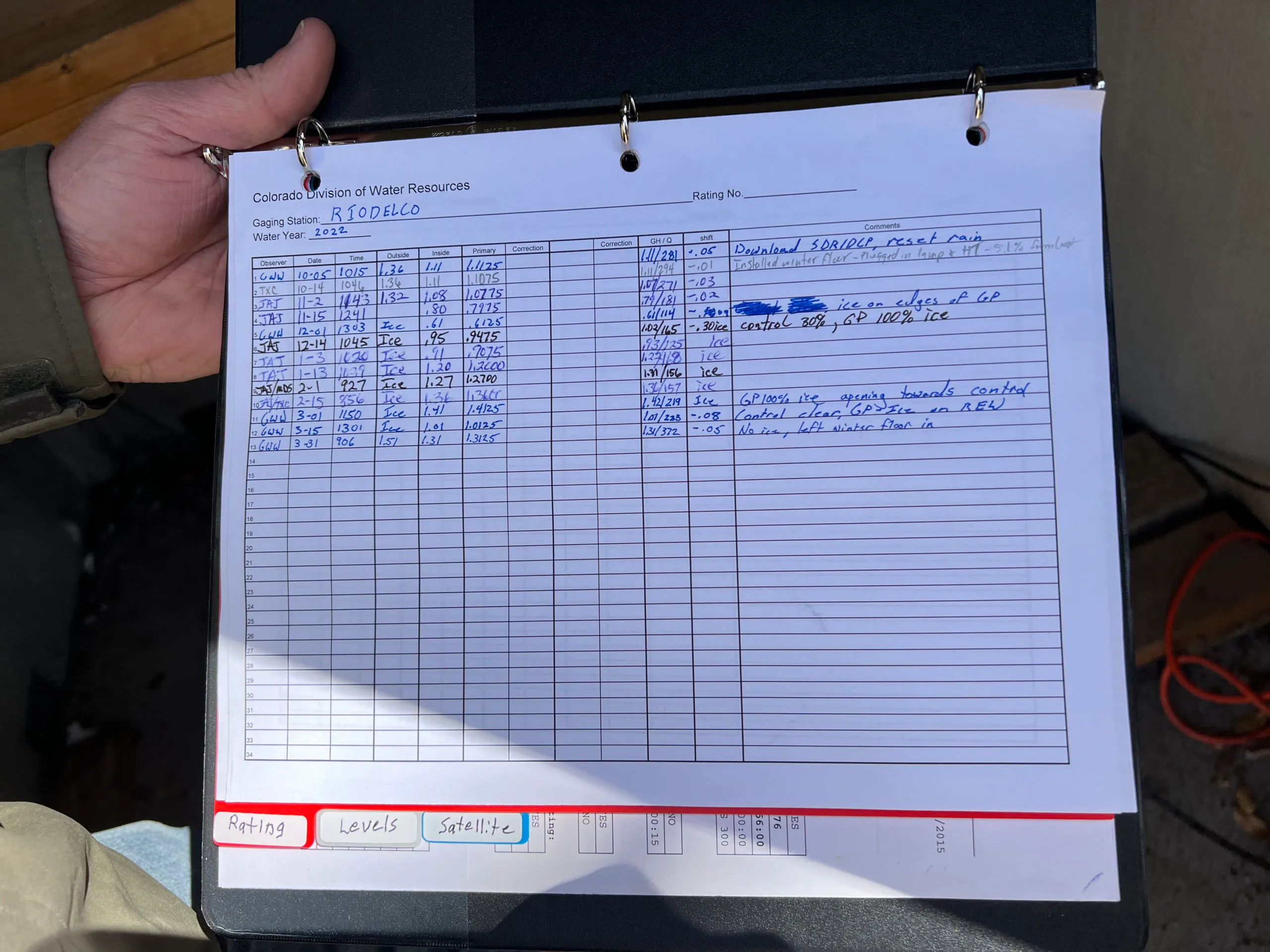
Reading the Rio: The #RioGrande gaging station near #DelNorte has told the story of the river’s flow since 1889 — #Alamosa Citizen

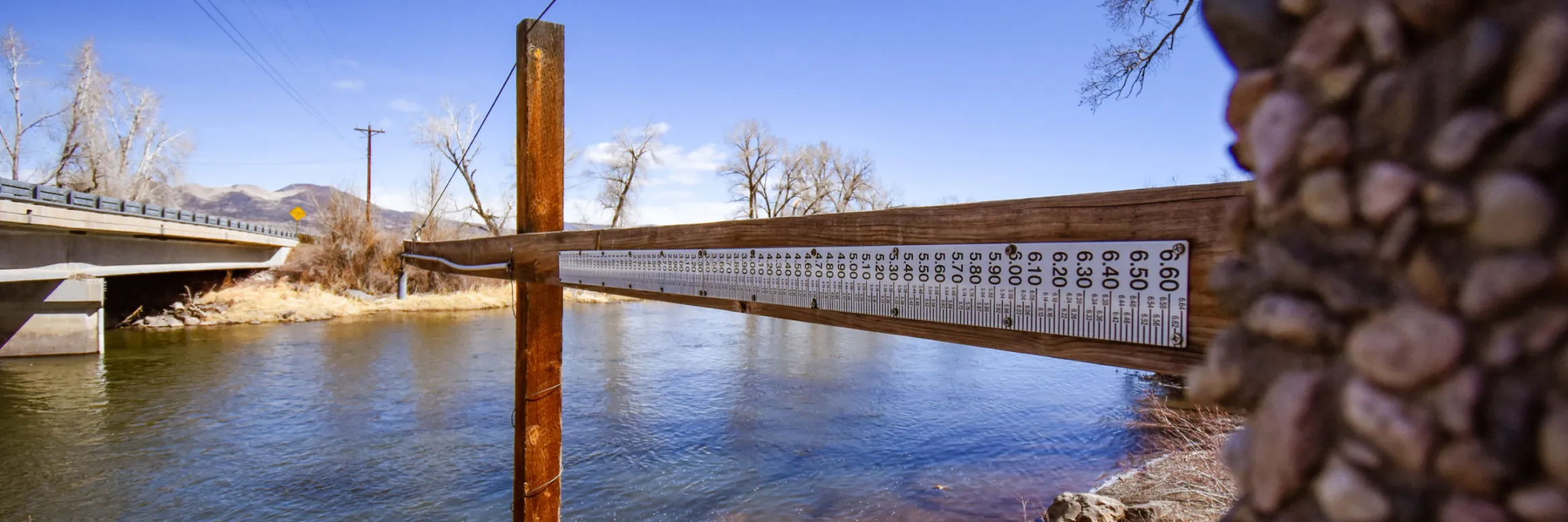
The Rio Grande gaging station near Del Norte has told the story of the river’s flow since 1889. Photo credit: Chris Lopez/Alamosa Citizen

Click the link to read the article on the Alamosa Citizen website (Chris Lopez):

It’s a commonly known spot off County Road 17 between Del Norte and South Fork. Driving in you might see a blue heron standing off in the marsh and river rafters looking to get onto the Rio Grande at the very spot Colorado has been measuring the river since the summer of 1889 – June 1, 1889, to be precise.

This time of year, with any ice on the river gone and the weather warming, Jessie Jaminet comes every two weeks to the stream gaging station operated by Colorado Division of Water Resources to make sure everything is functioning for measurements that are closely watched by water managers up and down the Rio Grande. He was there this past week to get an early spring reading and when prompted for a prediction on this year’s flows said, “I think we’re probably going to be slightly below average from what I’ve seen.”

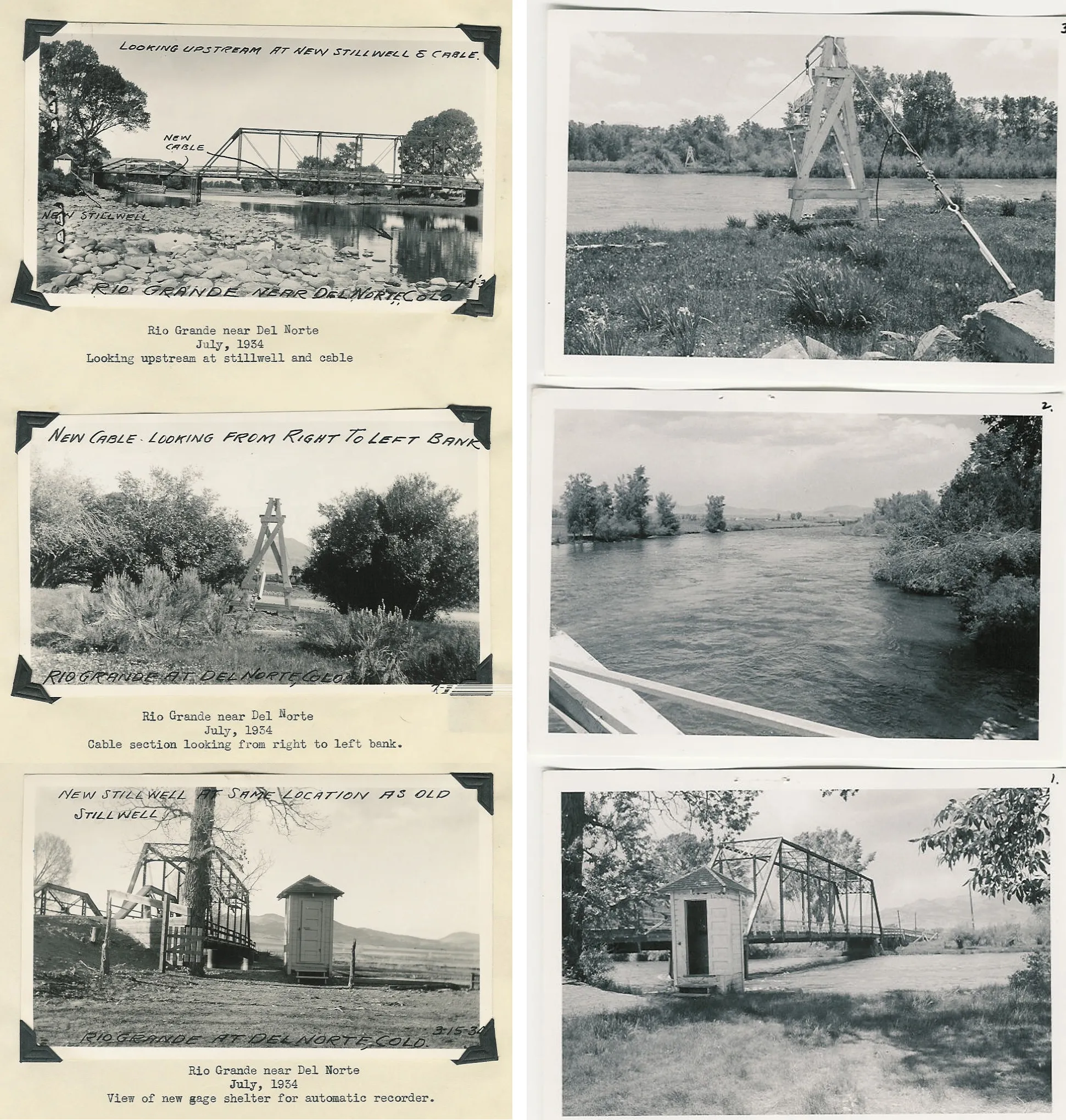
1934 and 1960. Credit: Alamosa Citizen

Average over the past decade has been 491,000 acre-feet of water; historically going back to 1889 the Rio Grande has an average measurement of 639,000 acre-feet, according to figures maintained by the state.

Jaminet, lead hydrographer for state water resources division 3, cautions that the river “changes daily right now.”

“Any storm that hits right now is a huge benefit for the whole system. People watch the snowpack numbers, but it really depends on what happens this time of year. Wet spring storms really benefit the system,” he said.

The Rio Grande gaging station near Del Norte is the highest profile gage station in the Upper Rio Grande Basin. That’s because it’s the gaging station the state uses to help determine how much water from the Rio Grande is available and will be delivered downstream into New Mexico and Texas as part of the three-state Rio Grande Compact.

Besides measuring lower-average acre-feet the past decade, another phenomenon has been occurring: an earlier peak to the river flow and then a quick dropoff, which means less water and shorter irrigation seasons downstream for New Mexico and Texas.

The stream gaging station operated by Colorado Division of Water Resources highway 17 between Del Norte and South Fork. Photo credit: Alamosa Citizen

“Historically the river would peak and we would maintain those flows for a while before we would fall into base flow conditions,” Jaminet said. Peak flow used to hit mid- to late-June and the Rio Grande would maintain itself through the summer. Now the state is seeing peak Rio Grande flows as early as late May and then drastic drop offs to the height of the river. It’s attributable to the aridification of the Valley floor from persistent drought and climate change.

Colorado’s obligations under the Rio Grande Compact is another aspect to the management of the upper basin of the river that water managers, irrigators, and outdoor recreationalists have to factor in when planning their own water usage.

“This is what we base pretty much all of our numbers on, this upper index here. Anything that passes this gage here we have to deliver a percentage of it downstream. This is why this is an important gage here,” said Jaminet.

He’s been working the measurements the past 15 years as part of his job with Colorado Division of Water Resources to operate and maintain the gaging stations along the Upper Rio Grande Basin. It’s not what he planned on doing for a career when he graduated from Mountain Valley High School in Saguache in 2001 and then the University of Wyoming, where he majored in rangeland geology and watershed management. But he’s learned and come to understand the importance of taking the river’s measurement, and the fact he grew up in the San Luis Valley makes him appreciate the work he does even more.

“This is a continuous record that we produce here,” he said of the Del Norte gaging station, pointing to the readings from 1890 through 2021. One of the most eye-popping historical figures is Oct. 5, 1911, when the Rio Grande was flowing at 18,000 cubic feet per second. The day Jaminet was at the gage station the river was moving at 519 cfs.

Most of the big diversions to the Rio Grande happen a bit farther downstream in Rio Grande and Alamosa counties, making the gaging station near Del Norte a natural location to determine the depth and velocity of the river.

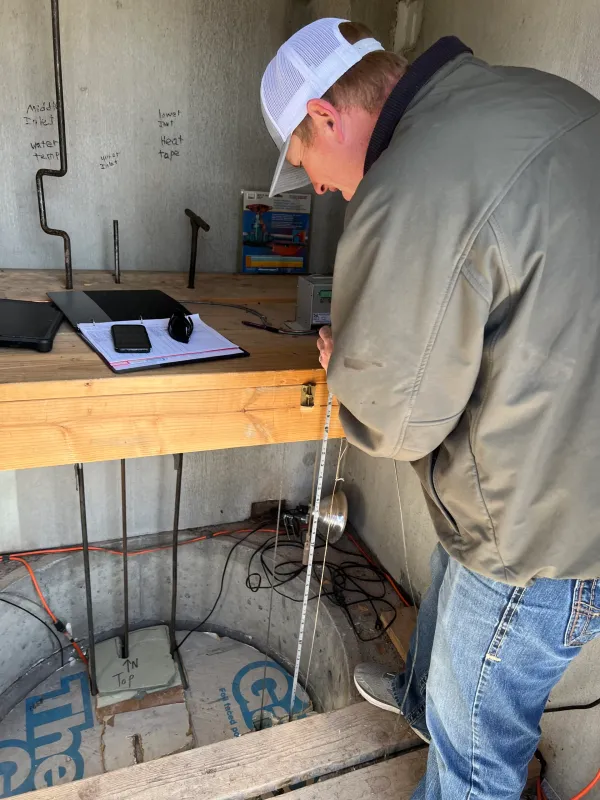
A float sitting in a stilling well reads the height of the river. Photo credit: Alamosa Citizen

In the 1890s and early decades of the 1900s the state division of water resources would take a measurement of the Rio Grande twice a day and then daily as it kept improving the system. It eventually installed a continuous reader in 1983, and then in the summer of 1984 a satellite monitoring system was installed.

Now the gaging station takes a reading every 15 minutes and logs and transmits the data every hour to the Colorado Division of Water Resources website, where it’s tracked and followed by the three states party of the Rio Grande Compact. Fishermen and rafters will also monitor the web site to help them determine the best times to fish and float the river.

One of Jaminet’s responsibilities is to make sure the gaging station is calibrated and reading accurately. A float sitting in a stilling well reads the height of the river and then a rating table unique to the gaging station is applied to give an accurate measurement. In the winter months, with ice on the river, the measurements are more estimates.

Coming off a dry 2021, in January the Rio Grande was at its lowest point to start a year since Colorado began taking measurements 132 years ago. A cooler March and April have helped, but without significant summer rain, the Rio Grande will run dry again early in the summer irrigation season.

“If you go into the fall really dry, even if you get these big spring storms it seems like it just goes into the ground,” Jaminet said. “A lot of it is not making it to the river anymore.”

The measurements at the Rio Grande gaging station near Del Norte tell the story.

Jaminet makes regular checks on calibration. Photo credit: Alamosa Citizen

The El Paso region braces for deeper #drought, less #RioGrande #water for farming — El Paso Matters

Click the link to read the article on the El Paso Matters website (Danielle Prokop). Here’s an excerpt:

In previous years, water would begin to flow in the Rio Grande in springtime, released from storage from Elephant Butte Reservoir in New Mexico, and pour into fields and ditches for cotton, pecans, chiles and other crops. Instead, once again, the riverbed remains sandy and bare, and Elephant Butte is at just 12% of its capacity, awaiting snowmelt from the mountains in Colorado and Northern New Mexico.

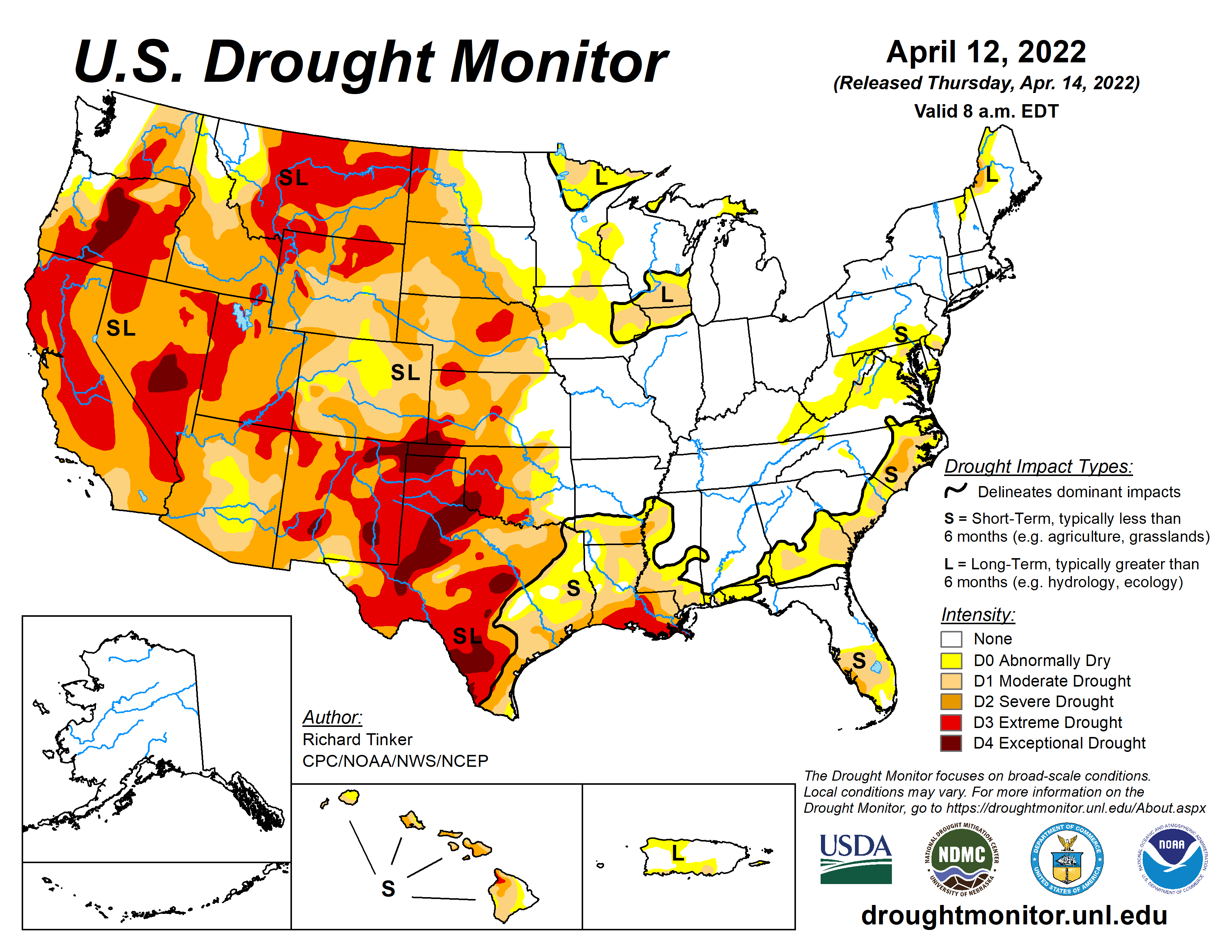
US Drought Monitor map April 12, 2022.

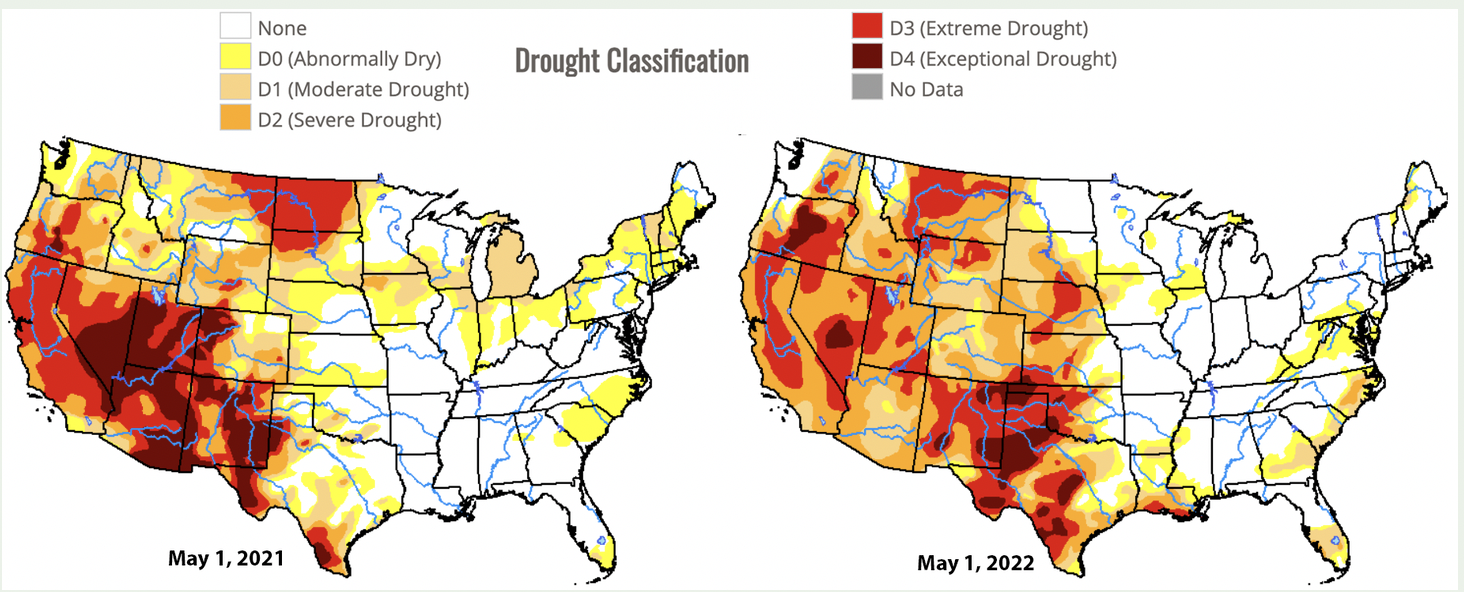
The U.S. Drought Monitor map currently shows about half of El Paso county remains “abnormally dry,” but experts said Tuesday they expect hotter temperatures and little rain to desiccate the Western United States — 90% of which is already in a drought.

Local irrigation managers for New Mexico, Far West Texas and Mexico anticipate a short, small season starting in June, despite the predicted hotter temperatures. A formal announcement with the exact numbers for irrigation will be released from the U.S. Bureau of Reclamation later this month, Mary Carlson, a spokeswoman for the agency said.

Westwide SNOTEL basin-filled map April 13, 2022 via the NRCS.

Snowpacks in New Mexico were boosted by winter storms, and a late March snow, as records showed snowpacks at 100% of median, or higher, in New Mexico. But even good years are not replenishing the river as well as before. That threatens the Rio Grande, which relies on snowmelt for three-fourths of its water…

Hotter temperatures dry out soils, and that can absorb as much as 20% of water before it hits the riverbed, meaning less water to flow downstream…

Projections show El Paso farmers are expecting only 18 inches of water per acre, rather than the full 48 inches, said Jesús Reyes, the manager for El Paso County Water Improvement District No. 1.

Wild Earth Guardians letter to Douglas County April 12, 2022

Sunrise March 16, 2022 San Luis Valley with Mount Blanca in the distance. Photo credit: Chris Lopez/Alamosa Citizen

Click the link to read the letter on the Wild Earth Guardians website (Jen Pelz):

Dear Commissioners Laydon, Teal, and Thomas,

We write to you today, on behalf of our organizations and tens of thousands of supporters across the American West, to express extreme concern over Renewable Water Resources’ proposal to develop a groundwater pumping project in the San Luis Valley that would then export water to the Colorado Front Range. This project represents a serious threat to the water security of the San Luis Valley and to the plant, wildlife, and human communities that depend on this water source. As downstream neighbors we have grave concerns over the cascading effects of this project throughout the entire Rio Grande Basin, and we urge the Commission to reject this proposal.

The Rio Grande Basin cannot afford for any water to be exported out of the Valley.

This project would be the first pipeline built in the San Luis Valley with the intent to export water. But the idea of taking water out of the San Luis Valley for use in other basins is not new. Renewable Water Resources’ proposal is the most recent in a string of such schemes that began in the 1980s. Similar proposals have been decidedly shut down by Colorado courts, which have noted the adverse effects these proposals would have on the aquifer and to surface water rights. In fact, surface waters in the Valley have been recognized as over appropriated since the early 20th century, meaning every drop that flows through the Valley and more is promised to someone. It is incredibly clear that the San Luis Valley has no water to spare.

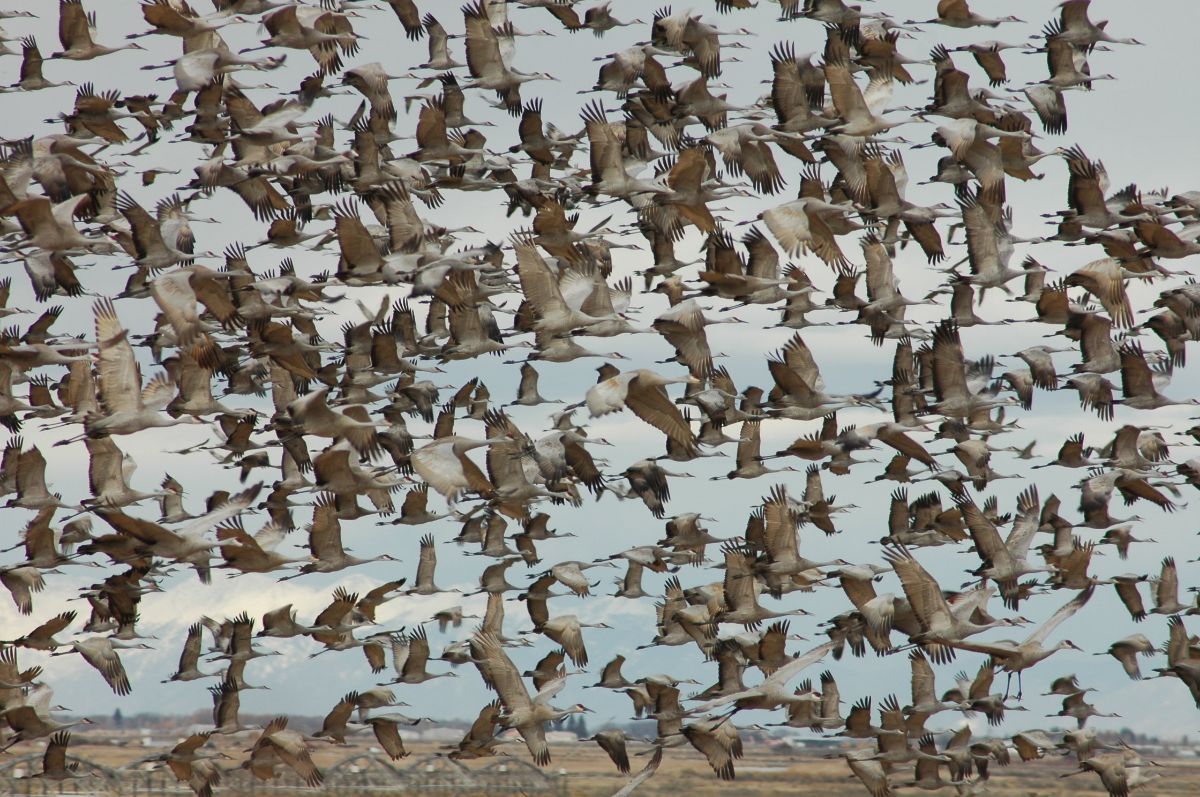
Sandhill Cranes West of Dunes by NPS/Patrick Myers

Exporting water from the San Luis Valley will threaten hope for a sustainable aquifer.

In addition to surface waters, groundwater is also over appropriated in the Valley. We have serious concerns over the effects of the proposed pumping on overall groundwater levels and their impacts to surrounding wetlands and streams. Of particular concern are potential effects to the Great Sand Dunes National Park and Preserve and the Baca National Wildlife Refuge. Farmers in the Valley are already working together and making sacrifices to reduce water demand through the sub-district project, which was created following decades of drought conditions. This voluntary project facilitates farmers within the Valley combining efforts to ensure groundwater levels are maintained. Renewable Water Resources’ proposal undermines years of this difficult work. The demands for water and challenges associated with allocating it equitably will only increase as the impacts of climate change continue to intensify, this proposal will make an already challenging situation worse and undo years of community-driven efforts to find solutions.

Rio Grande and Pecos River basins. Map credit: By Kmusser – Own work, Elevation data from SRTM, drainage basin from GTOPO [1], U.S. stream from the National Atlas [2], all other features from Vector Map., CC BY-SA 3.0, https://commons.wikimedia.org/w/index.php?curid=11218868

Exporting water from the San Luis Valley will have consequences for the entire Rio Grande Basin.

The concerns over this project expand beyond the San Luis Valley. The project also has the potential to threaten the downstream communities and the environment in the Rio Grande Basin for thousands of miles. The Rio Grande Compact and the 1944 treaty with Mexico define how much water must flow from the Rio Grande’s headwaters in Colorado to New Mexico, Texas and Mexico. As a headwaters state, Colorado has a significant responsibility to its neighbors and it is keenly felt downstream when those responsibilities are ignored. For example, during the twentieth century, Colorado consumed more water than it was allotted under the Compact and subsequently accrued a nearly one-million-acre-foot debt to downstream states. This overuse had consequences to downstream communities, agricultural production, and ecosystems. It resulted in lawsuits that ultimately ended with the U.S. Supreme Court requiring Colorado to repay this debt over time. Luckily for Colorado, a wet period of hydrology that filled downstream reservoirs triggered a provision of the Compact that forgave the prior debt and wiped the slate clean for better management going forward. With projected precipitation regime shifts under climate change, we are unlikely to see such a wet period again.

The water challenges we are facing within the Rio Grande Basin make it painfully obvious that a repeat of this situation would be catastrophic for water users across all three states and Mexico. We must think more holistically about the river systems on which we all depend. The San Luis Valley is an integral part of the Rio Grande Basin, a river that runs nearly 1,900 miles and sustains municipal and irrigation uses for more than six million people and two million acres of land across three states and two countries. We urge the Commission to not further complicate this situation by taking vital water from the San Luis Valley and threatening it and others’ water futures.

The communities of the San Luis Valley are working to address their water scarcity challenges in collaborative and inclusive ways. Although there is still much work to do to create a sustainable aquifer and healthy Rio Grande for people and the environment, Renewable Water Resources’ proposal flies in the face of these efforts. Please do the right thing for the communities within the San Luis Valley and those that depend on the water, also vital downstream, by rejecting this ill-advised project.

Fast-growing Douglas County communities need more #water. Is a controversial San Luis Valley export plan the answer? — @WaterEdCO #Water22 #RioGrande

Construction workers build a single family home in Castle Rock. The community needs new surface water supplies to reduce its reliance on non-renewable groundwater. Credit: Jerd Smith

Click the link to read the article on the Water Education Colorado website (Jerd Smith:

Castle Rock’s building boom has barely slowed over the past 20 years and its appetite for growth and need for water hasn’t slowed much either.

The city, which ranks No. 1 in the state for water conservation, will still need to at least double its water supplies in the next 40 years to cope with that growth. It uses roughly 9,800 acre-feet of water now and may need as much as 24,000 acre-feet when it reaches buildout.

With an eye on that growth and the ongoing need for more water, Douglas County commissioners are debating whether to spend $10 million in federal American Rescue Plan Act funding to help finance a controversial San Luis Valley farm water export proposal.

Thirteen Douglas County and South Metro regional water suppliers say they have no need or desire for that farm water, according to Lisa Darling, executive director of the South Metro Water Supply Authority. [Editor’s note: Lisa Darling is president of the board of Water Education Colorado, which is a sponsor of Fresh Water News]

“It is not part of our plan and it is not something we are interested in,” said Mark Marlowe, director of Castle Rock Water. “We have invested hundreds of millions of dollars in our long-term plan and we are pursuing the projects that are in that plan. The San Luis Valley is not in the plan.”

Renewable Water Resources, a development firm backed by former Colorado Gov. Bill Owens and Sean Tonner, has spent years acquiring agricultural water rights in the San Luis Valley. It hopes to sell that water to users in the south metro area, delivering it via a new pipeline. In December, RWR asked the Douglas County commissioners for $10 million to help finance the $400 million plus project.

Tonner did not respond to a request for comment for this article, but he has said previously that the water demands in south metro Denver will be so intense in the coming decades, that the San Luis Valley export proposal makes sense.

Opposition to the export plan stems in part from concern in the drought-strapped San Luis Valley about losing even a small amount of its water to the Front Range. But RWR has said the impact to local water supplies could be mitigated, and that the proposed pipeline could help fund new economic development initiatives in the valley.

Stakes for new water in Douglas County and the south metro area are high. In addition to demand fueled by growth, the region’s reliance on shrinking, non-renewable aquifers is putting additional pressure on the drive to develop new water sources.

Denver Basin Aquifer System graphic credit USGS.

Marlowe and other water utility directors in the region have been working for 20 years to wean themselves from the deep aquifers that once provided clean water, cheaply, to any developer who could drill a well. But once growth took off, and Douglas County communities super-charged their pumping, the aquifers began declining. Because these underground reservoirs are so deep, and because of the rock formations that lie over them, they don’t recharge from rain and snowfall, as some aquifers do.

At one point in the early 2000s the aquifers were declining at roughly 30 feet a year. Cities responded by drilling more, deeper wells and using costly electricity to pull water up from the deep rock formations.

Since then, thanks to a comprehensive effort to build recycled water plants and develop renewable supplies in nearby creeks and rivers, they’ve been able to take pressure off the aquifers, which are now declining at roughly 5 feet per year, according to the South Metro Water Supply Authority.

The goal among Douglas County communities is to wean themselves from the aquifers, using them only in times of severe drought.

Ron Redd is director of Parker Water and Sanitation District, which serves Parker and several other communities as well as some unincorporated parts of Douglas County.

Like Castle Rock, Parker needs to nearly double its water supplies in the coming decades. It now uses about 10,000 acre-feet annually and will likely need 20,000 acre-feet at buildout to keep up with growth.

Parker is developing a large-scale pipeline project that will bring renewable South Platte River water from the northeastern corner of the state and pipe it down to the south metro area. Castle Rock is also a partner in that project along with the Lower South Platte Water Conservancy District in Sterling.

Redd said the San Luis Valley export plan isn’t needed because of water projects, such as the South Platte Water Partnership, that are already in the works.

“For me to walk away from a project in which we already have water, and hope a third party can deliver the water, just doesn’t make sense,” Redd said.

The costs of building two major pipelines would also likely be prohibitive for Douglas County residents, Redd said.

“We would have to choose one. We could not do both.”

Steve Koster is Douglas County’s assistant planning director and oversees new developments, which must demonstrate an adequate supply of water to enter the county’s planning approval process.

Koster said small communities in unincorporated parts of the county reach out to his department routinely, looking for help in establishing sustainable water supplies.

He said the county provides grants for engineering and cost studies to small developments hoping to partner with an established water provider.

“All of them are working to diversify and strengthen their water systems so they are sustainable. Having a system that encourages those partnerships is what we’re looking at,” Koster said.

Potential Water Delivery Routes. Since this water will be exported from the San Luis Valley, the water will be fully reusable. In addition to being a renewable water supply, this is an important component of the RWR water supply and delivery plan. Reuse allows first-use water to be used to extinction, which means that this water, after first use, can be reused multiple times. Graphic credit: Renewable Water Resources

Whether an RWR pipeline will play a role in the water future of Douglas County and the south metro area isn’t clear yet.

Douglas County spokeswoman Wendy Holmes said commissioners are evaluating more than a dozen proposals from water districts, including RWR, and that the commission has not set a deadline for when it will decide who to fund.

Jerd Smith is editor of Fresh Water News. She can be reached at 720-398-6474, via email at jerd@wateredco.org or @jerd_smith.

Restoration of Home Lake is underway — The #Alamosa News

Sediment removal is underway at Home Lake. Photo credit: city-data.com

Click the link to read the article on the Alamosa News website:

Colorado Parks and Wildlife began restoration efforts this week to remove sediment from high spots in Home Lake just east of Monte Vista. Tyler Cerny, CPW District Wildlife Manager for the Monte Vista District, said sediment has accumulated in the lake for years primarily from the water inlet from the Lariat Ditch on the south side of the lake. With irrigation season slated to start in early April, plans are to remove as much sediment as possible before the water allotment is available. Fish restocking will begin as early as May or June with plans to include trout, bluegill, large mouth bass, catfish, grass carp and possibly crappie.

#NewMexico seeks approval to store #RioGrande water at Abiquiú — The Albuquerque Journal

El Vado Dam and Reservoir. Photo credit: USBR

Click the link to read the article on the Albuquerque Journal website (Theresa Davis). Here’s an excerpt:

New Mexico water agencies are slowly piecing together a regulatory puzzle in order to store Rio Grande water in Abiquiú Reservoir for middle valley irrigation this summer as El Vado Dam is repaired. But an objection from Texas water managers could interfere with the reservoir’s use for non-pueblo irrigators. The U.S. Army Corps of Engineers operates the northern New Mexico reservoir on the Rio Chama. Nabil Shafike, the Army Corps Albuquerque District’s water management chief, said Abiquiu was once authorized only to store Colorado River Basin water that is diverted into the Rio Grande Basin with a series of tunnels and dams for the San Juan-Chama Project.

“All the Corps reservoirs – Abiquiú, Cochiti, Galisteo and Jemez Canyon – work as one unit to protect the middle valley from flood,” Shafike said. “Any storing of native (Rio Grande) water would require a deviation from the current operation.”

The agency is weighing two potential changes at Abiquiu:

• A request from the New Mexico Interstate Stream Commission to store up to 45,000 acre-feet, or 14.6 billion gallons, of Rio Grande water in Abiquiú each year for release later in the season to meet middle Rio Grande irrigation demand.

• A request from the U.S. Bureau of Reclamation to store up to 20,000 acre-feet, or 6.5 billion gallons, of Rio Grande water in Abiquiú each year to meet direct flow right for the six middle Rio Grande pueblos of Isleta, Sandia, Santa Ana, San Felipe, Santo Domingo and Cochiti.

The Army Corps could approve both storage plans or may choose only one.

It’s sit and wait while Douglas County figures out move on Renewable Water Resources — The #Alamosa Citizen #RioGrande

San Luis Valley. Photo credit: The Alamosa Citizen

Click the link to read the article on the Alamosa Citizen website (Chris Lopez):

THIS was supposed to be the week that the three Douglas County Commissioners, Lora Thomas, Abe Laydon and George Teal, visited the San Luis Valley to host a community meeting on Douglas County’s consideration of the Renewable Water Resources proposal to export water out of the Valley north.

There’s still an expectation that Laydon and Teal will find their way down, on their own, away from the public spotlight in their own pursuit of reasons to support or not the Renewable Water Resources plan.

For her part, Thomas has been opposed from the outset and prefers that Douglas County focus on a water project in its own backyard – the Platte Valley Water Project with Parker Water & Sanitation and Castle Rock Water.

She’s also been troubled by what she sees as conflicts of interest among her fellow commissioners for their public positioning of RWR and their perceived coziness with Republican moneyman Bill Owens, a former governor of Colorado, and his entourage at Renewable Water Resources.

It would have been those dynamics, a split and at times feuding Douglas County commission, that would have arrived at the Ski Hi Regional Events Complex in Monte Vista to hear from Valley residents. But after Teal made comments that there was nothing to gain from such a meeting since Valley residents didn’t seem interested in finding a deal with Douglas County and supporters of RWR felt threatened and silenced, the commissioners punted.

That doesn’t mean Douglas County – and Laydon and Teal, specifically – has lost interest in RWR. Quite the contrary. What’s puzzling is nobody outside RWR understands why, particularly since Douglas County is not a provider of water services and would find itself entangled in years of litigation at a minimum.

“I have zero ulterior motives, other than wanting to secure proactive win/win water solutions for both communities,” Laydon said to Alamosa Citizen. “I’m persuaded by facts, not noise or propaganda. We have engaged in a deep-dive water series and study with a hydrologist and water attorney who have yet to compile their findings into final recommendations.”

The three commissioners huddled in executive session for two hours Monday to hear from Stephen H. Leonhardt with the law firm Burns Figa & Will, and Tom Hatton from Applegate Group, Inc. Leonhardt and Burns Figa & Will have been retained as special counsel to help Douglas County understand the legal issues surrounding the Renewable Water Resources proposal, while Applegate Group, Inc., has been retained to consult on engineering and hydraulic aspects of the RWR plan, according to public files.

Both the special legal counsel and Applegate consultants had their contracts recently amended to include more money and more time on the RWR plan. Douglas County also this month issued a request for qualifications (RFQ) for additional water consultant services. The RFQ has an April 8 deadline.

Following Monday’s lengthy executive session, the commissioners will receive a confidential memo summarizing what they heard. Where they are with a decision on RWR is harder to determine. Since Thomas is opposed and Teal is in support of RWR, the past weeks have become the Abe Laydon show to see where he lands.

“I don’t know where we’re headed,” said State Sen. Cleave Simpson, who is also general manager of the Rio Grande Water Conservation District and is a farmer and rancher in the San Luis Valley.

San Luis Valley Groundwater

Like others who have made presentations to help Douglas County commissioners understand the ever-declining water conditions of the San Luis Valley aquifers – the unconfined and confined – and threats to the Valley’s ecosystem from 20 years of drought and loss of wetlands, Simpson is frustrated at the spectacle Douglas County has created.

“To make this thing work they have to change the rules and regulations that we all have lived under and crafted over the last 20 years,” he said of the Renewable Water Resources proposal.

It’s not simply Laydon casting the deciding vote to move the RWR proposal forward. If he were to take that gamble for Douglas County, RWR then would have to ask State Engineer Kevin Rein to change the rules governing water to meet the intent of their proposal, said Simpson.

“If I was Douglas County I’d say ‘I’m not going to give you a dime until you get the rules changed’ and the likelihood of them changing the rules here is nearly zero percent from my perspective,” Simpson said.

Coming out of Monday’s executive session with their special counsel and hydrologist consultant, Laydon said he was happy to hear the expertise and “objective facts” that were discussed. He and Teal have made it a point to say Valley representatives and residents they’ve heard from are not objective and instead overfilled with emotion.

“I very intentionally have taken the emotion out of my presentations and conversations with them,” said Simpson. “And honestly, even the folks at RWR from the very beginning, I said ‘I appreciate this is a business proposition from your perspective, I’m happy to sit down with you and let’s debate the pros and cons, but you can’t put out false information.’

“They claim we’re putting out false information and I can say with absolute certainty none of the stuff that I’ve presented or the meetings I’ve been in with them is false information. It’s all 100 percent accurate and quite the contrary from the other perspective. I can demonstrate without doubt that the information they’re getting is false.”

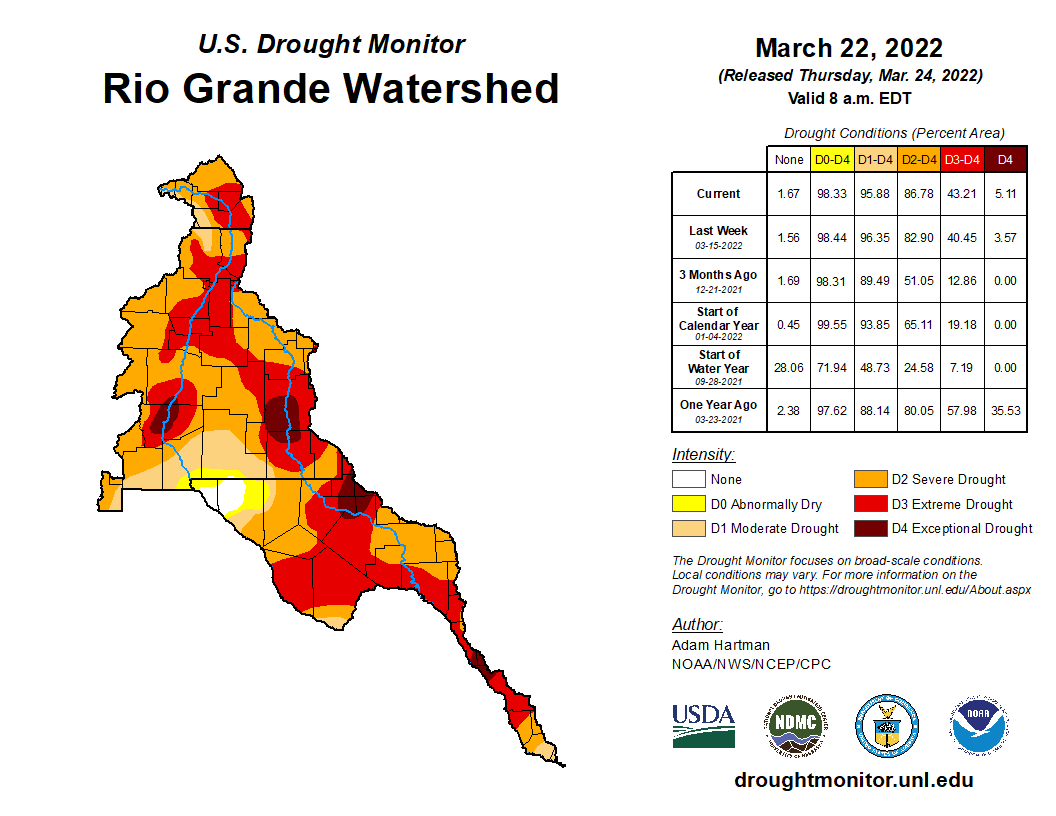
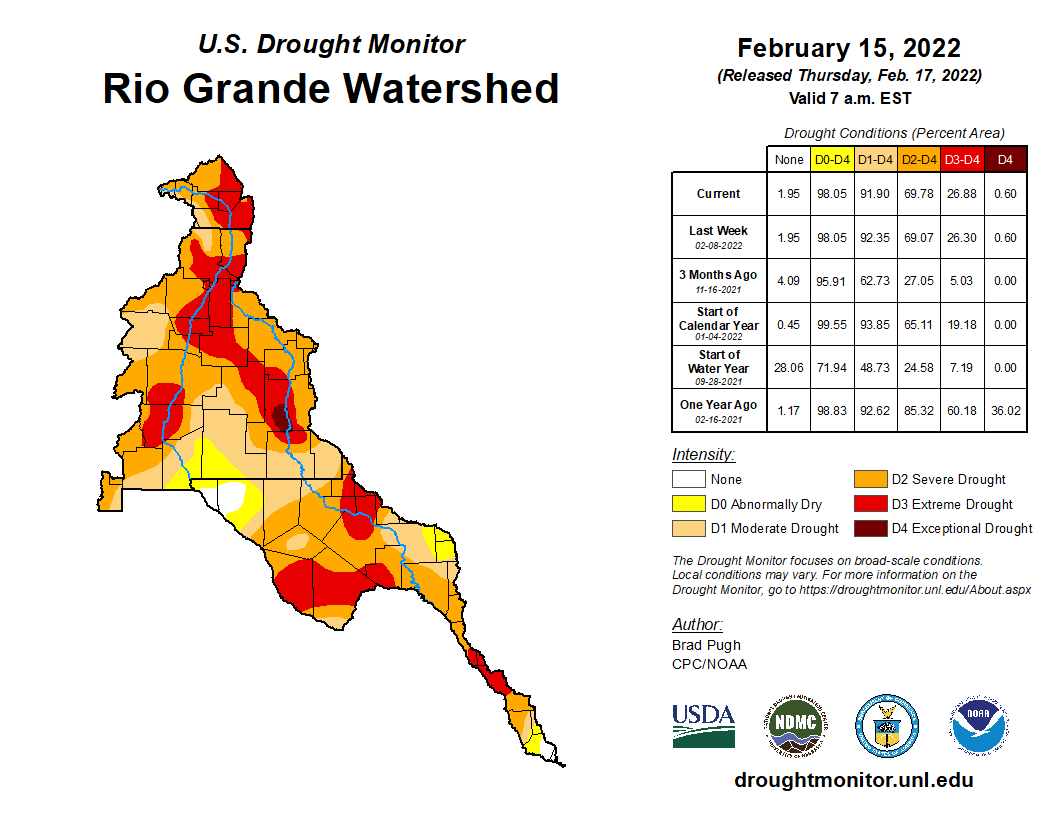
Rio Grande River basin drought monitor map March 22, 2022.

Simpson has sat with Laydon and extended invitations to bring in others like Ken Salazar, the U.S. ambassador to Mexico and one of Colorado’s foremost experts in water law, to help Laydon better grasp the drought conditions and over pumping situation in the Valley. Former Alamosa County Commissioner Darius Allen is another person Laydon has been invited to hear from.

For Laydon, he’s focused on the consultants that Douglas County has hired to help him make a decision. Presumably he heard some of what he’s looking for in Monday’s closed meeting. Following it he, Thomas and Teal sat through their first presentation on the Platte Valley Water Project.

San Luis Valley farmers form Sustainable Water Augmentation Group — The #Center Post Dispatch #RioGrande

San Luis Valley Groundwater

Click the link to read the article on the Center Post Dispatch website (Mechel Meek). Here’s an excerpt:

A group of Valley farmers announced in a press release that they have come together to create the Sustainable Water Augmentation Group (SWAG), an alternative to Rio Grande Water Conservation District, Subdistrict 1.

“It is no secret that we are at a critical moment for the future of the San Luis Valley, as drought deepens, climate change intensifies, and the unconfined aquifer’s water level continues to drop at a dangerous rate. Decisive action is required now before the aquifer runs dry and the way of life for the 46,000 residents of the San Luis Valley, where agriculture is the driving economic force is threatened,” the release stated.

The San Luis Valley has a mostly unconfined aquifer and is subject to many variables including drought. A confined aquifer is surrounded by rock and clay pieces which confine it to an area and make it less at risk for loss, but an unconfined aquifer is exposed and can be impacted more severely by outside factors. A confined aquifer is found deep beneath the ground, while an unconfined aquifer is just below the ground level…

The Rio Grande Water Conservation District, Subdistrict 1 covers much of the San Luis Valley area. According to the Subdistrict 1 Plan of Water Management, “The goals of the Subdistrict are to cause groundwater levels in the Unconfined Aquifer of the Closed Basin to recover, and then to maintain a sustainable irrigation water supply in the Unconfined Aquifer with due regard for the daily, seasonal and longer-term demands on the aquifer and to protect senior surface water rights and avoid interference with Colorado’s obligations under the Rio Grande Compact. To achieve these goals, reducing and managing overall groundwater consumption is essential.” The group of farmers behind SWAG disputes the effectiveness of the plans in place and proposed by Subdistrict 1.

“Despite making little progress towards sustainability with the fee-based model, Subdistrict No. 1’s Board of Managers is now poised to vote on raising the over-pumping fee from $150 to $500 per acre-foot. That’s a 233% increase on top of a 386% increase over the past decade. While this plan may work for some producers, it is not a viable option for the members of SWAG who have paid these ever-increasing fees only to see reduced yields and declining water levels in the aquifer. It is clear the status quo is unsustainable for the farmers of the Valley, nor the aquifer that we rely on for our water. We simply do not have the time to double down on a one-size-fits-all fee-based approach,” SWAG stated in the release.

The SWAG press release included an answer to the ongoing water crisis in the Valley.

“SWAG has entered into an agreement to purchase and retire approximately 4,500 acres, irrigated by wells, that have historically consumed an average of 5,678 acre-feet per year from the unconfined aquifer at a cost of over $35 million. If real progress towards sustainability is not made, the sad truth is that SWAG members’ wells are subject to the very real threat of forced curtailment; whether by the State of Colorado if the subdistrict cannot prove its plan for sustainability will work; or by the Subdistrict itself through ever-increasing fees for pumping which would punish those water users who rely on their decreed water rights for their wells, or the absence of water at their wellheads due to the overuse of the unconfined aquifer. The only way to solve this threat and ensure the future vitality of the Valley is to work together to find solutions which work for everyone. We need more options to promote conservation, not less. SWAG’s augmentation plan is one of those options, and we hope that other members of the community make your voices heard before it is too late,” SWAG concluded.

Hydrogeologist: Please reject Renewable #Water Resources’ proposal — The #Alamosa Citizen

San Luis Valley irrigation crop circles. Photo credit: The Alamosa Citizen

Click the link to read the article on the Alamosa Citizen website (Chris Lopez):

ERIC Harmon is the type of person Douglas County says it wants to listen to.

He’s a hydrogeologist with expertise on the San Luis Valley aquifers of the Upper Rio Grande Basin. In fact, his team completed the groundwater component of the Rio Grande Decision Support System, which is generally described in state water court documents as “an interactive computer-based system that utilizes data and computer models to help decision makers solve unstructured problems.” The RGDSS is what the state relies on to determine the impact of groundwater pumping.

Harmon is also retired and hasn’t been part of any of the presentations that the three Douglas County commissioners have heard on Renewable Water Resources and its pitch to Douglas County to partner on exporting from the San Luis Valley.

What does Harmon’s experience and expertise say about the RWR proposal? He wrote a letter to the Douglas County commissioners outlining his concerns and recommendation that Douglas County reject the RWR proposal. He has yet to hear back from the commissioners. Alamosa Citizen also asked Douglas County for a response to Harmon’s letter.
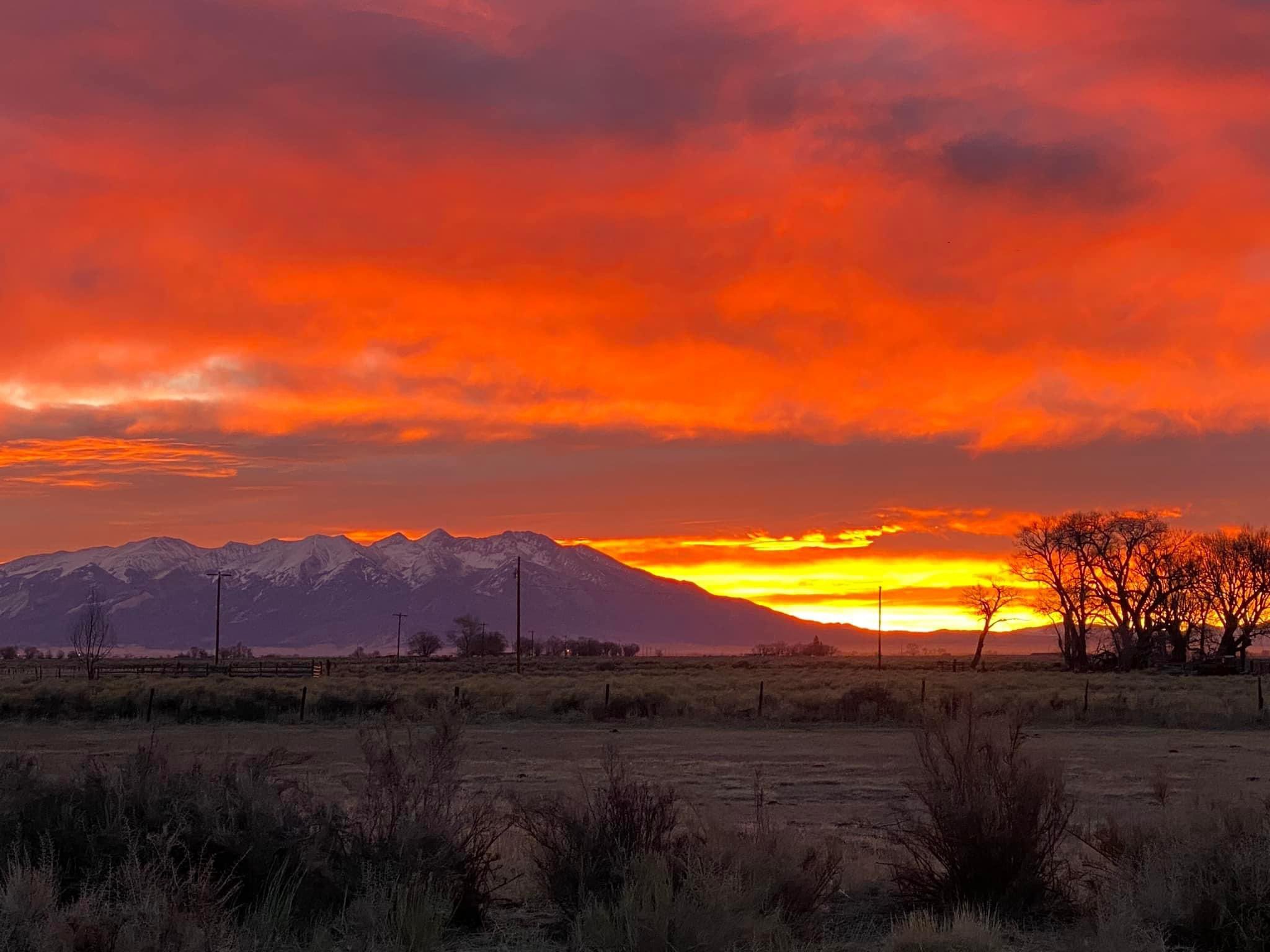
Hydrogeologist Eric J. Harmon

“The Renewable Water Resources (RWR) proposal to Douglas County to use ARPA funds should be rejected in favor of less risky projects,” Harmon told the commissioners. “RWR’s project would place undue risks on San Luis Valley (SLV) water users and ratepayers (water customers) in Douglas County. Why? For that, we need to get down into the weeds on the SLV aquifers.”

You can read the letter HERE.

Harmon said he has given expert testimony in the Division 3 Water Court (San Luis Valley) in the AWDI case (1991), the Confined Aquifer New Use Rules case (2006), the Great Sand Dunes In-Place Groundwater Right case (2008) and the Groundwater Rules case (2018).

“Confined aquifer tests in the SLV by my testing team were done as part of Colorado’s Rio Grande Decision Support System (RGDSS) in the early 2000s,” he said to the commissioners. “Our tests showed repeatedly that pumping impacts move outward from a confined aquifer well very rapidly, often causing drawdown (water level decline) up to ½ mile away within one day of pump startup. At several locations, pumping a deep well caused measurable drawdown in layers much shallower than the pumping zone. This is how confined aquifers work: drawdown spreads out very far, very fast. The SLV confined aquifer is ‘leaky.’”

After he sent along his letter to AlamosaCitizen.com for publishing, we asked him a few additional questions. The exchange is below:

AC: What concerns or thoughts, if any, can you share on the drought the San Luis Valley has been experiencing going back to 2002?

EH: Conditions are never static in hydrology. The dynamic nature of water, weather patterns, and the hydrologic cycle means that conditions are always changing. But where there is a long-term drought, the job of scientists and engineers becomes harder. It means that any predictions we are asked to make may be less reliable than we would like, because we don’t always have similar historic conditions we can look back on to compare to.

AC: The streamflow measurements documented by Davis Engineering for the Rio Grande Water Conservation District demonstrate troubling patterns. Have you recently looked at those streamflow measurements? In your view what type of impact is drought, climate change having on the basin and should that be a concern with the RWR proposal?

EH: I have tried to keep up with the general hydrologic trends in the Valley, including snowpack and streamflow. I have also kept up with the trends of Unconfined Aquifer storage change that Davis Engineering has done for RGWCD for many years. It is clear that even after a number of years of self-imposed pumping reductions in the Subdistricts, there is still too little water available to meet the irrigation demand, and to replenish the groundwater storage deficit in the Unconfined Aquifer in the Closed Basin. If drought or climate change persist in the future, as appears likely, then these impacts should be of concern in any new appropriation of water, whether by RWR or anyone else.

AC: Would the change in conditions, drought persistence, declining snow melt, particularly along the Sangre de Cristo range factor into a water court proceeding?

EH: Declining snowpack, earlier and faster runoff, and drought persistence certainly are of concern in the Sangre de Cristos, as they are in the San Juans. Valley-wide, the water supply from the Sangres is considerably less than it is from the San Juans. Smaller drainage areas, the “rain shadow” effect of the San Juans before the snowstorms get to the Sangres, and differences in topography and geology between the two ranges all are factors. If asked, I would advise the water court to look very hard at all of these factors. If groundwater recharge is less in the future than is predicted, it would almost certainly have an impact on the question of injury.

AC: Commissioner Teal said at the last meeting (March 8) that Douglas County has heard repeatedly that there is a “million acre feet” of water in the SLV aquifer. How does one address that notion?

EH: I can’t find any reference to a “million acre feet” in RWR’s proposal or in the presentations to Douglas County. RWR has stated that 22,000 acre-feet per year, the amount they intend to pump, is 2.5% of the aquifer’s annual recharge. So RWR’s number for annual recharge is 880,000 acre-feet. I do not know if this is what Commissioner Teal is referring to. The important thing, however, is not the annual groundwater recharge or the volume of groundwater in storage in the aquifer. The important thing is that the Valley’s water resources are over-appropriated. As Colorado Division of Water Resources officials have pointed out, this means there is no water available for appropriation and full (“1 for 1”) replacement is required under the Rules.

Douglas County cancels San Luis Valley live town hall after protest warning: Two commissioners say they still want to visit valley regarding water proposal — The Douglas County News Press #RioGrande

Potential Water Delivery Routes. Since this water will be exported from the San Luis Valley, the water will be fully reusable. In addition to being a renewable water supply, this is an important component of the RWR water supply and delivery plan. Reuse allows first-use water to be used to extinction, which means that this water, after first use, can be reused multiple times. Graphic credit: Renewable Water Resources

Click the link to read the article on the Douglas County News Press website (Elliott Wenzler). Here’s an excerpt:

The decision to cancel the event came during a March 9 work session in which county staff told the commissioners they were expecting 300 to 400 people to attend and that it appeared a protest was planned to take place…

Commissioner George Teal, who has voiced his support for the project, said was in favor of canceling the meeting, adding that he had initially hoped to have “actual conversations” with residents and “get past the visceral, emotional aspects of this project.”

He said he’s heard from people in the valley who support the RWR project but feel they are being intimidated to remain quiet….Commissioner Abe Laydon, who has said he hasn’t yet decided if he supports the project, said he still wants to go to the valley but said the event had been “hijacked by a group of folks” and said he didn’t want to be part of it…Commissioner Lora Thomas, who has vocally opposed the plan, said she’s not interested in going to the valley…

When asked where the county learned of reports of intimidation, a county spokesperson referenced comments from a speaker during one of the commissioners work sessions on the topic — Jerry Berry, who is a farmer in the San Luis Valley and a representative for RWR…

In a Feb. 28 meeting, executive director of the South Metro Water Supply Authority Lisa Darling told the commissioners that none of the major water districts in Douglas County are interested in the water from RWR.

Governor Polis opposes Renewable Water Resources #water export plan, US Senators Bennet & Hickenlooper concur, invoking Wirth Amendment — The #Crestone Eagle #RioGrande

A view of public lands around the Sangre de Cristo Mountains and just south from the area Renewable Water Resources has proposed a wellfield for water exportation. Photo credit: Alamosa Citizen

Click the link to read the article on the Crestone Eagle website (Lisa Cyriacks). Here’s an excerpt:

Polis has issued a statement that he is: “against any inter-basin transfer without local support of impacted communities. This is a proposed inter-basin transfer with deep concerns and opposition in the San Luis Valley and the governor is opposed.”

Polis joins Colorado Attorney General, Phil Weiser, who has already expressed strong opposition to the trans-basin export.

Last week, US Senators Michael Bennet and John Hickenlooper issued a statement opposing the RWR proposal and invoking Public Law 102-575, also known as the Wirth Amendment. The Amendment, named for former Colorado Senator Tim Wirth, provides for review by the Department of the Interior prior to approval of any export of water from the San Luis Valley.

Two big snowstorms have made a world of difference for #Aspen’s slopes: The two storms accounted for about one-third of all snowfall this season — The Aspen Times #snowpack

Click the link to read the article on The Aspen Times website (Scott Condon). Here’s an excerpt:

Two prolific storm cycles this ski season have produced more than one-third of the total snowfall on the ski slopes so far this season, according to Aspen Skiing Co.’s snow reports. A four-day storm during Christmas week and the three-day powder wave last week produced a cumulative 50 inches of snow at Aspen Mountain and 62 inches of snow at Snowmass, the snow reports show.

Since opening day of ski season, Aspen Mountain has received 150 inches of snow, so the two big storms combined for 33% of the total. Snowmass has received 180 inches of snow since opening day, so the one-two punch of the storms accounted for 35% of the total.

In other words, only seven days of the 96 days of the ski season thus far have produced one-third of the snow…

Even with last week’s big storm, the snowpack in the Roaring Fork watershed is still a mixed bag. The snowpack at the headwaters of the Roaring Fork River east of Aspen was only 86% of median as of Monday, according to the U.S. Natural Resources Conservation Service. The Ivanhoe site near the headwaters of the Fryingpan River was at 107% of median. Three sites in the Crystal River basin varied widely, according to NRCS data. McClure Pass was only 91% of median on Monday while North Lost Trail outside of Marble was at 127% and Schofield Pass measured at 128%.

Westwide SNOTEL basin-filled map March 1, 2022 via the NRCS.

Click the link to read “Drought threatens Rio Grande levels, again” from the El Paso Matters website (Danielle Prokop). Here’s an excerpt:

Climate experts and irrigation districts are warning that 2022 is looking dry for the Paso del Norte region. New forecasts released Monday from the National Oceanic and Atmospheric Administration predict hotter temperatures and low chances for moisture in the Southwest, stemming from the cooling of Pacific waters known as the La Niña weather pattern. That pattern usually prevents a wet winter in the Western United States, exacerbating the region’s 20-year megadrought…

While the Colorado snowpack improved with snowstorms in January and February, the Rio Grande basin has only seen about 64% of average precipitation. Climate change has already shrunk what is now considered a “normal” annual snowpack. Decades of rising temperatures and fluctuating precipitation have dried out soils, which both prevents waters from flowing into streams and causes more dust, melting snowpacks at faster rates. Snowpack across most of northern New Mexico is between half to 75% of normal right now — with about two months before April’s expected peak levels for snowmelt.

San Luis Valley-to-Douglas County #water pipeline proposed. Critics call it a “buy and dry” scheme. The company, Renewable Water Resources, isn’t the first or even the second or third to eye the valley’s water — The #Denver Post #RioGrande

Third hay cutting 2021 in Subdistrict 1 area of San Luis Valley. Photo credit: Chris Lopez

Click the link to read the article on The Denver Post website (Conrad Swanson). Here’s an excerpt:

Trouble swirls above the aquifers of Colorado’s San Luis Valley, where farmers and ranchers raise and grow much of the region’s cattle, potatoes, alfalfa and barley. Those aquifers are losing water as the American West dries out and whatever remains is spoken for. Farmers and ranchers have labored for decades to use less of the valley’s most precious resource. Today, the farmers say, a new but familiar threat approaches.

Denver Basin Aquifer System graphic credit USGS.

A Front Range company called Renewable Water Resources, backed by a cadre of builders, developers and former Colorado Gov. Bill Owens, wants to drill into the aquifers storing the valley’s declining water supply and pipe it to the ever-growing Douglas County.

The Front Range has money, Renewable Water Resources’ Managing Partner Sean Tonner often says. And the San Luis Valley has water. Tonner is quick to cite poverty statistics for valley residents and says his company can pay those willing to sell their water rights and bring millions more to stimulate the local economy. It’s a win-win deal, he said.
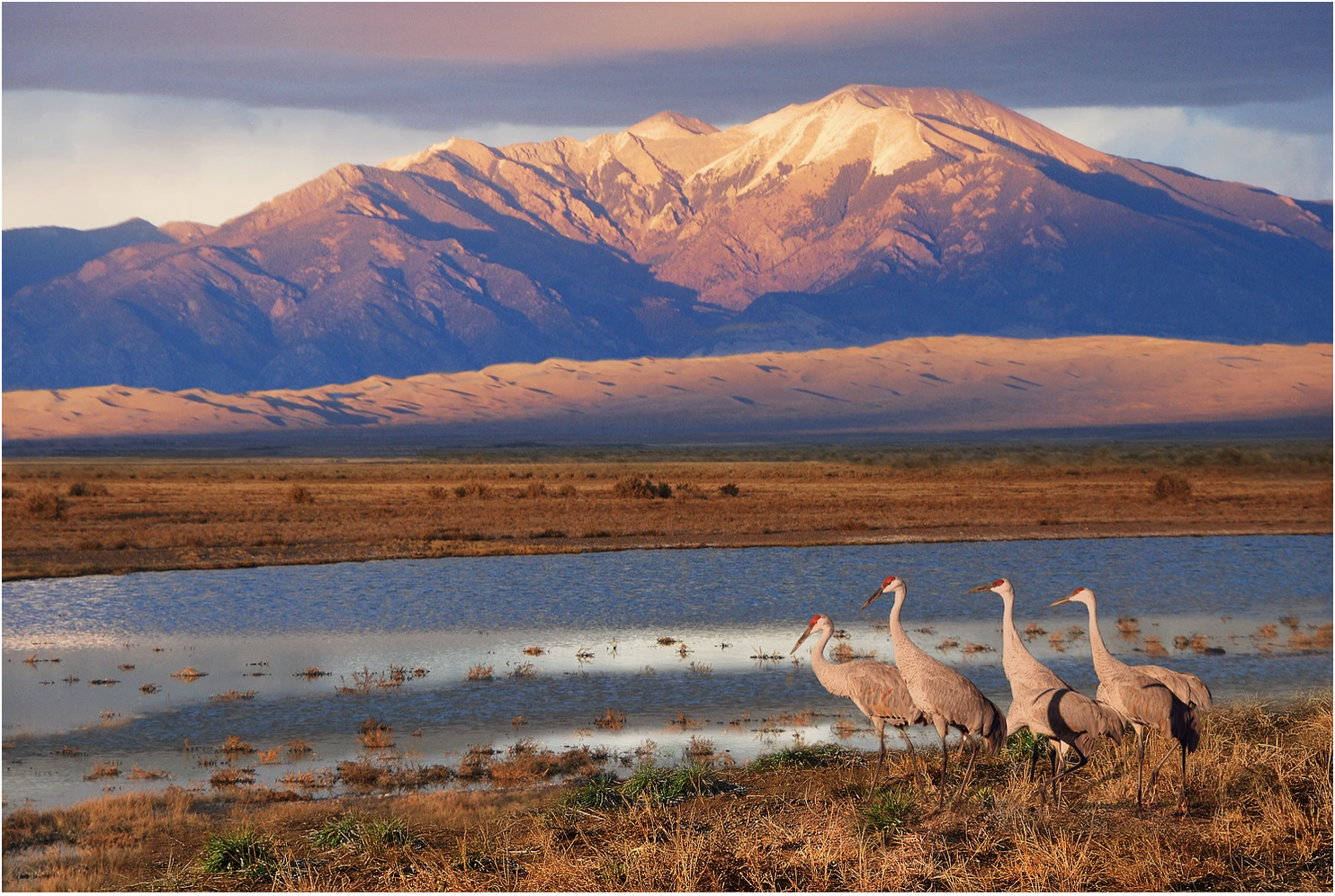
Opposition is widespread among the valley’s farmers, ranchers, water managers, environmentalists, bankers and politicians. Alamosa, Rio Grande and Mineral counties, alongside the cities of Alamosa, Monte Vista, La Jara, Manassa and Crestone passed resolutions opposing the project. So have Conejos Clean Water, the Rio Grande Water Conservation District and the San Luis Valley Ecosystem Council. People in the valley describe the plan as an old-fashioned “buy and dry” scheme…

Not only would Tonner’s plan further dry life in the mountain valley but, residents warn, it would also set a dangerous precedent that other fast-growing Front Range communities could quench their thirst by taking the one thing the San Luis Valley needs most. Money the project would bring into the valley – including a $50 million community fund – isn’t the “magic bullet” for the area’s economic woes, but Tonner argues it’s the best plan proposed yet. And in return, if Douglas County moves now, he said its commissioners can lock-in a renewable source of high-quality water at rates far below market prices.

The deal hinges on Douglas County’s split, three-person Board of County Commissioners.

Potential Water Delivery Routes. Since this water will be exported from the San Luis Valley, the water will be fully reusable. In addition to being a renewable water supply, this is an important component of the RWR water supply and delivery plan. Reuse allows first-use water to be used to extinction, which means that this water, after first use, can be reused multiple times. Graphic credit: Renewable Water Resources

Letter: San Luis Valley #water export proposal will harm wildlife and land — Theodore Roosevelt Conservation Partnership

Photo credit: The Alamosa Citizen

Click the link to read the letter on the Water Education Colorado website (Alexander Funk):

Douglas County Commissioners should not move forward with Renewable Water Resources’ (RWR) request to utilize American Rescue Plan Act (ARPA) stimulus funds to export water from the northern San Luis Valley (SLV). The RWR proposal would significantly impact the economy, environment, and culture of the San Luis Valley, a unique region home to Great Sand Dunes National Park and Preserve and three national wildlife refuges, which collectively attract more than 600,000 visitors annually to the SLV. The SLV cities, farmers, and residents universally oppose the RWR proposal. The project would result in the “buy and dry” of agriculture, which has led to the devastation of other rural communities in Colorado.

Wet hay meadow on the Baca National Wildlife Refuge in July 2008. By Fred Bauder – Own work, CC BY-SA 3.0, https://commons.wikimedia.org/w/index.php?curid=11556466

As conservation organizations, we represent thousands of hunters and anglers in Colorado. Healthy wildlife habitats are necessary to sustain wildlife populations, and wetlands, riparian corridors, and mesic areas are critical in our arid state. The proposed RWR project would impact fish and wildlife habitats on multiple fronts. Groundwater and surface water resources in the SLV are connected, with aquifers sustaining streamflow, which supports habitat for cold-water fisheries. Therefore, removing water from the aquifers could negatively affect aquatic ecosystems important to the region. For example, the proposed wellfields of 22 to 25 groundwater pumping wells for the RWR project would neighbor the Baca National Wildlife Refuge, potentially impacting the wetland and aquatic ecosystems that support breeding and feeding grounds of migratory birds and waterfowl. Baca is also home to the state’s most viable population of Rio Grande Chub, a state species of concern. Other potentially affected species include the Rio Grande Cutthroat Trout and Gunnison Sage Grouse. The RWR proposal would also require the dry-up of 20,000 irrigated acres in the valley. Impacts to irrigated agriculture in the SLV resulting from the RWR project would also negatively affect fish and wildlife since most of the SLV’s wetlands occur on private property and are sustained through irrigation and water delivery.

Potential Water Delivery Routes. Since this water will be exported from the San Luis Valley, the water will be fully reusable. In addition to being a renewable water supply, this is an important component of the RWR water supply and delivery plan. Reuse allows first-use water to be used to extinction, which means that this water, after first use, can be reused multiple times. Graphic credit: Renewable Water Resources

The RWR plan runs contrary to the Colorado Water Plan. The plan, which guides state water planning and policy, establishes a conceptual framework for guiding negotiations around new transbasin diversion projects, including developing adequate measures to reduce socio-economic and environmental impacts on the basin of origin, which the RWR fails to accomplish meaningfully. The Colorado Water Plan also strongly condemns the practice of “buy and dry,” which has led to significant socio-economic and environmental impacts in rural communities and instead supports alternative approaches such as investments in conservation and smart land-use planning.

More cost-effective strategies exist, including investments in water conservation and water recycling/reuse. And there is no surplus water in the SLV to export. The SLV aquifers are over-appropriated and climatic trends point to less available water. Therefore, the RWR proposal presents a likely expensive, unpopular, and risky approach to meeting the growing water needs of Douglas County.

Denver Basin Aquifer System graphic credit USGS.

Our organizations recognize that Douglas County is growing and reliant on an unsustainable groundwater resource. We encourage Douglas County to use the federal funds to make needed investments to address water supply needs in a way that prioritizes local water supplies, promotes conservation, and creates jobs for the community rather than siphoning these funds to a speculative and costly water export proposal that will have significant impacts on rural Coloradans and the unique environment of the San Luis Valley.

Theodore Roosevelt Conservation Partnership

Trout Unlimited

National Wild Turkey Federation

Colorado Backcountry Hunters and Anglers

Colorado Wildlife Federation

Alexander Funk is the director of water resources and senior counsel at the Theodore Roosevelt Conservation Partnership.

RE: Potential environmental impacts of #groundwater export proposal to #GreatSandDunes National Park — @SenatorHick and @SenatorBennet

Sandhill Cranes West of Dunes by NPS/Patrick Myers

Click the link to read the letter to Interior from senators Hickenlooper and Bennet (February 19, 2022):

Dear Secretaries Haaland and Vilsack:

We write today to bring to your attention a matter in Colorado’s San Luis Valley where your agencies play an important and unique oversight role under Public Law 102-575. Through the attached letter from the Rio Grande Water Conservation District (the District), we have been alerted to a proposal called Renewable Water Resources which would transfer groundwater out of the basin from the confined aquifer beneath the Great Sand Dunes National Park, Baca National Wildlife Refuge, and Closed Basin Project. After hearing concerns from our San Luis Valley constituents about this proposal for months, the District’s letter from yesterday, and considering Colorado’s current exceptional drought, we both oppose this proposal. Further, we ask for your attention under the Wirth Amendment, if an opportunity for review comes before your agencies.

The San Luis Valley is experiencing unprecedented drought that has placed a severe demand on local water resources. Valley residents, including farmers, ranchers, and business owners, rely heavily on groundwater aquifers to support their economy and way of life. Since 2005, in response to this drought, local farmers have undertaken an ambitious, collaborative effort to reduce their own pumping with the goal of achieving sustainability. This export proposal continues to seek funding to move forward despite the fact it would exacerbate local water challenges, even with conservation efforts. In addition to concerns from the District, five San Luis Valley counties are opposed to this proposal.

Public Law 102-575, also called the “Wirth Amendment”, was passed in 1992 and provides a legal framework and elevated standard of environmental review for any transfer of groundwater out of the basin that may adversely affect these public resources. We highlight this law because of its relevance to the San Luis Valley and an elevated standard of review for any project that might adversely affect Great Sand Dunes National Park, Closed Basin Project, Baca National Wildlife Refuge. For your convenience, we have pulled out the relevant language on page 64 of P.L. 102-575 (Title XV, Section 1501-1504):

SEC 1501: PERMIT ISSUANCE PROHIBITED
(a) No agency or instrument of the United States shall issue any permit, license, right-of way, grant, loan or other authorization or assistance for any project or feature of any project to withdraw water from the San Luis Valley, Colorado, for export to another basin in Colorado or export to any portion of another State, unless the Secretary of the Interior determines, after due consideration of all findings provided by the Colorado Water Conservation Board, that the project will not:
(1) increase the costs or negatively affect operation of the Closed Basin Project;
(2) adversely affect the purposes of any national wildlife refuge or Federal wildlife habitat area withdrawal located in the San Luis Valley, Colorado; or
(3) adversely affect the purposes of the Great Sand Dunes National Monument, Colorado.
(b) Nothing in this title shall be construed to alter, amend, or limit any provision of Federal or State law that applies to any project or feature of a project to withdraw water from the San Luis Valley, Colorado, for export to another basin in Colorado or another State. Nothing in this title shall be construed to limit any agency’s authority or responsibility to reject, limit, or condition any such project on any basis independent of the requirements of this title.

The Colorado delegation previously raised similar concerns with your agencies. In 2014, Senator Bennet led a letter with Senator Udall, Congressmen Tipton and Gardner elevating these same responsibilities to your attention in the face of a similar groundwater export proposal.

On behalf of our San Luis Valley constituents and the water resources so critical to their economic future, we must oppose the Renewable Water Resources proposal. We thank you for your assistance when your agencies are presented with the opportunity to review this matter.
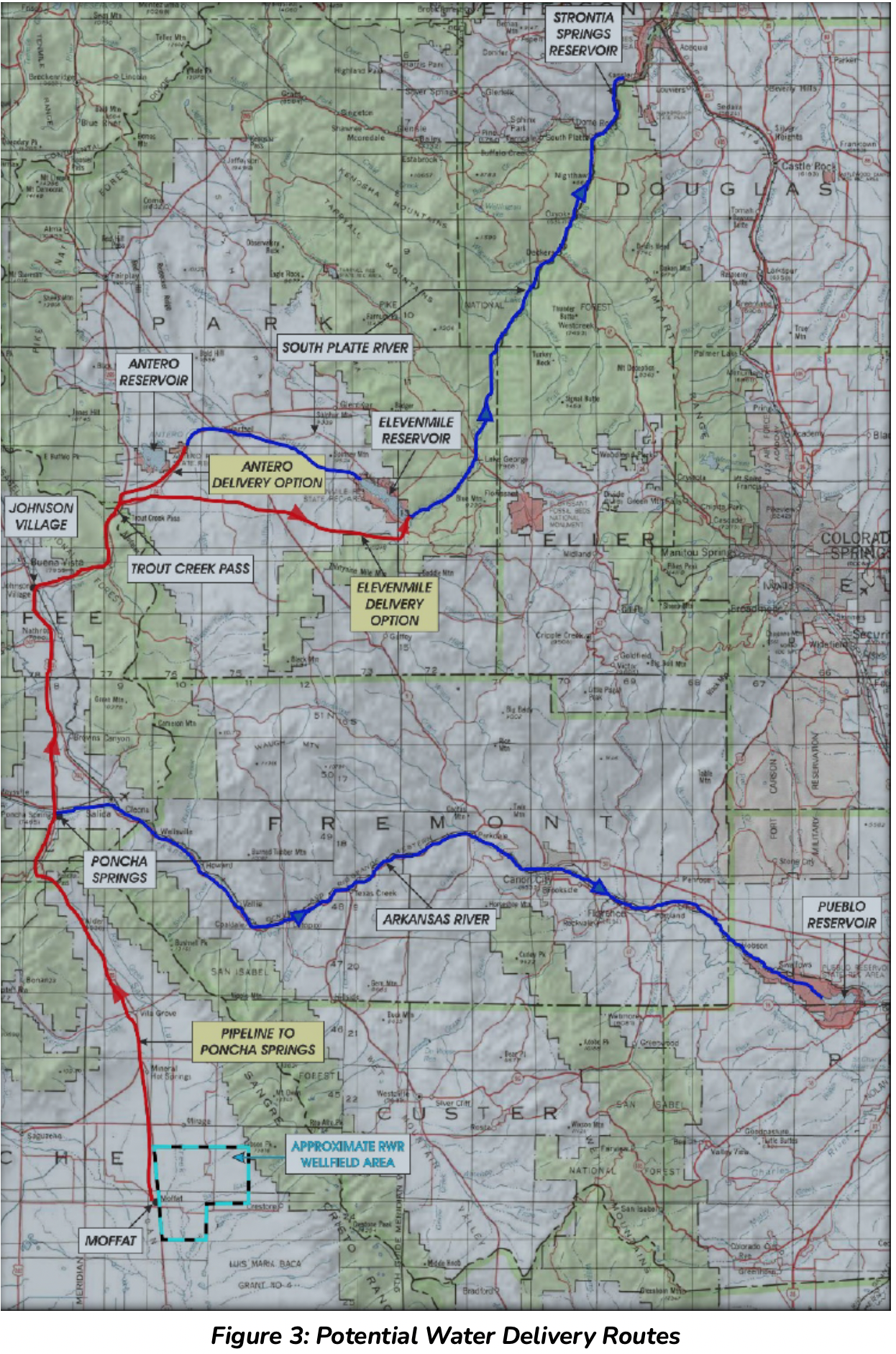
Rio Grande River Basin Drought Monitor map February 15, 2022.
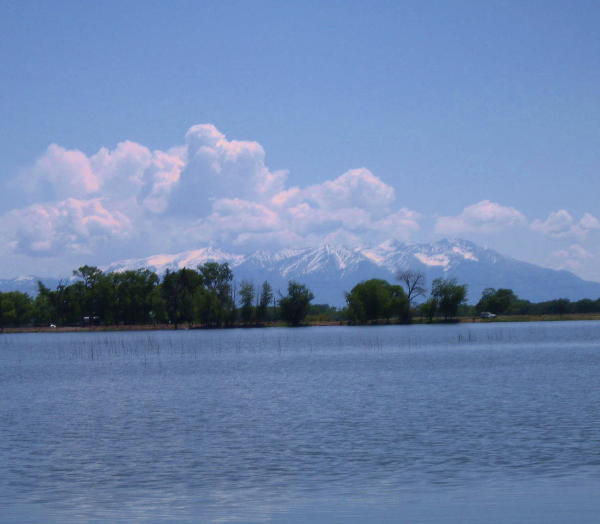
Water for #Colorado Coalition Opposes Damaging Proposal to Export San Luis Valley #Water — @Water4Colorado #RioGrande

Photo credit: The Alamosa Citizen

Click the link to read the release from Water for Colorado:

A recent proposal by Renewable Water Resources (RWR) plans to divert 22,000 acre feet of water annually from the San Luis Valley to Douglas County through a transbasin diversion over Poncha Pass. Douglas County would utilize federal American Rescue Plan Act (ARPA) stimulus funds to partially pay for the acquisition and development of water rights in the San Luis Valley. In response, Water for Colorado has issued the following statement:

“This controversial proposal threatens the economy and way of life for those who live in the San Luis Valley, and demonstrates a harmful use of federal funds. Water for Colorado and its nine partner organizations representing diverse interests across the state stand with the residents of the San Luis Valley and Protect our Water Coalition and join state leaders, including Governor Jared Polis, in strong opposition to the proposal and encourage the Douglas County Commissioners to reject it. Our coalition urges collaborative solutions to Colorado’s water supply concerns that do not irrevocably harm one community in favor of another.

Water is the lifeblood of the San Luis Valley — from supporting the potato crops and grains that have grown on family farms for generations, to providing essential refuge for wildlife, to bolstering recreation at the Great Sand Dunes National Park and across the Valley. Water is everything to the Valley and its people.

With an average of only 7 inches of rain a year, there is no renewable water in the Valley to export. The proposed diversion hurts both the communities from which the water is taken and the sources from where the water comes. There are also no requirements for the cities that receive the water to apply more stringent water conservation standards in recognition of the valuable water resources being taken from the Valley.

Using ARPA funding to sap water from a region that plays home to countless species of wildlife including pronghorn, mountain lion, black bear, beavers and pika; supports over 300 bird species and 119,330 acres of wildlife habitat; and provides critical runs for Rio Grande cutthroat trout, is deeply harmful.

Additionally, the price tag could well exceed $2 billion, which would be borne primarily through water ratepayers. We know that we’re facing extreme water challenges now and in the future, but we must prioritize more cost-effective and immediately available conservation and sustainable water use over diversions. Proposals like this mark an irresponsible use of federal funding, and set a dangerous precedent. The recently-released State of the Rockies poll shows 81% of Westerners oppose these kinds of water diversions preferring, instead, projects that utilize water conservation, reduction in use, and increased water recycling.

It’s incumbent upon us all to use every drop wisely, and for every community in Colorado to achieve the highest conservation and water reuse standards possible. Colorado’s locally-based, collaborative approach to water management relies on us all working together rather than pitting basins against one another. When we start approving dangerous water proposals and short term investments like the ones discussed above, we’ve already lost the battle against drought and climate change.”

Douglas County officials will visit the San Luis Valley on March 26, 2022 — The #Alamosa Citizen

Photo credit: The Alamosa Citizen

Click the link to read the article on The Alamosa Citizen (Chris Lopez):

A morning tour of property owned by Renewable Water Resources, a tour of an irrigated farm, a meeting with elected officials and a community meeting at the Ski-Hi Regional Events Center in Monte Vista is how Douglas County commissioners plan to spend March 26 in the San Luis Valley.

The three Douglas County commissioners – Abe Laydon, George Teal and Lora Thomas – have scheduled the visit to help them decide if they should invest in Bill Owens’ Renewable Water Resources plan and pump groundwater from the Valley to the Denver suburb.

Laydon called it an opportunity to “listen and learn” when the commissioners discussed the visit and tentative agenda on Monday.

Thomas, who has been outspoken in her opposition to the RWR plan because of its impact on the Rio Grande Basin and the Valley communities, said it was important to show respect when Douglas County officials arrive at the end of March.

As for Teal, who supports the RWR plan, he is hoping to find compromise among the Valley’s elected officials to what otherwise has been what he called a lot of unfactual rhetoric coming from Valley residents toward the Renewable Water Resources plan, he said.

“Nine out 10 words we’ve heard is ‘You’re going to dry us to the bone,’” Teal said of the four meetings Douglas County has held so far to study the RWR plan, “while 10 percent has been ‘We’re only taking a little bit and we’re giving something back.’”

By meeting with local elected officials, “hopefully we can get to a workable deal that reasonable people can come to,” Teal said.

He said presentations and comments made to the Douglas County commissioners have been “very contrary to the facts of this case.” He thinks elected officials in the Valley will be more sensible in the conversations.

“What I was hoping for with the elected official lunch is being able to have elected officials talk beyond the simple rhetoric and maybe, yeah, come up with a compromise that could be an element in the town hall,” Teal said to his fellow commissioners as they discussed their visit.

Renewable Water Resources has approached Douglas County about partnering in its water exportation proposal as a way to bring water to the Front Range bedroom community noted for its golf courses and sprawling housing developments. Owens, the former governor of Colorado, is pushing the water exportation plan. Teal was heavily backed by RWR-affiliated money in his 2020 run for Douglas County commissioner.

The RWR plan continues to be met by opposition among Colorado elected officials. Colorado Attorney General Phil Weisner has voiced concerns and opposition to the plan, and so now has Colorado Gov. Jared Polis.

Polis, through a spokesperson, told Colorado Politics that he is opposed to the Renewable Water Resources plan. In a statement to Colorado Politics, the spokesman said Polis is “against any inter-basin transfer without local support of impacted communities. This is a proposed inter-basin transfer with deep concerns and opposition in the San Luis Valley and the governor is opposed.”

Visit our water archives to read more on the Rio Grande and Renewable Water Resources: ​​https://www.alamosacitizen.com/slv-water-archives/.

Potential Water Delivery Routes. Since this water will be exported from the San Luis Valley, the water will be fully reusable. In addition to being a renewable water supply, this is an important component of the RWR water supply and delivery plan. Reuse allows first-use water to be used to extinction, which means that this water, after first use, can be reused multiple times. Graphic credit: Renewable Water Resources

2022 #COleg: Bill providing millions in relief to #RepublicanRiver, #RioGrande basins clears first hurdle — @WaterEdCO

A powerful sprinkler capable of pumping more than 2,500 gallons of water per minute irrigates a farm field in the San Luis Valley June 6, 2019. Credit: Jerd Smith via Water Education Colorado

Click the link to read the article on Water Education Colorado (Larry Morandi):

Colorado lawmakers have given initial approval to a bill that would provide millions of dollars to help two major water-short farm regions reduce water use and comply with legal obligations to deliver water to Kansas, Nebraska, Texas and New Mexico.

On Feb. 10 the Colorado Senate Agriculture & Natural Resources Committee unanimously approved [SB22-028 Groundwater Compact Compliance Fund: Concerning the creation of the groundwater compact compliance and sustainability fund] that creates a Groundwater Compact Compliance and Sustainability Fund to help pay to buy and retire farm wells and irrigated acreage in the Republican and Rio Grande basins in northeast and south-central Colorado. Colorado and federal tax revenue would bankroll the fund, and the Colorado Water Conservation Board would distribute the money based on recommendations from the Republican River Water Conservation District and the Rio Grande Water Conservation District, with approval by the state engineer.

The need

The fund is needed, according to proponents, to help reduce groundwater use that is depleting surface water flows in the Republican River and threatening Colorado’s ability to comply with a compact among Colorado, Kansas and Nebraska. It is also intended to help drought-stressed aquifers in the San Luis Valley recover and to meet aquifer sustainability standards required by the state in the Rio Grande Basin.

To achieve those goals, 25,000 acres of irrigated land must be taken out of production in the Republican basin, and 40,000 acres in the Rio Grande, by 2029. David Robbins, general counsel for both districts, noted that, “Both districts have received letters from the state engineer indicating that if they fail in the task they will receive orders shutting down the wells in each basin, which will have dramatic and very difficult consequences for everyone in both basins.”

The bill’s proponents hope to take advantage of a one-time funding opportunity—federal Covid-19 stimulus dollars under the American Rescue Plan Act of 2021 (ARPA). The General Assembly created the Economic Relief and Recovery Cash Fund last year to receive ARPA dollars and transferred nearly $850 million into it; investment in water infrastructure is among the eligible uses. It also established an Economic Recovery Task Force to recommend how to spend those funds. Sen. Cleave Simpson, R-Alamosa, who is also General Manager of the Rio Grande district and a co-sponsor of the bill, has requested $80 million from the task force to support the bill. The governor’s budget includes $15 million as a starting point.

Neither district is looking for a handout. The Republican has already assessed its water users $148.5 million to retire irrigated land, purchase or lease surface and groundwater, and pipe groundwater to the river near the Nebraska border to meet Colorado’s water delivery obligations. Aaron Sprague, a member of its board of directors, said the district had retired 42,000 acres of irrigated land since 2006 and thought they were in compliance, but then a court stipulation signed in 2016 by the three states, requiring 25,000 acres additional acres be retired, “effectively moved the goal posts on us.” The district has retired 3,000 acres of that additional land so far. Sprague figures the economic impact of well shutdowns to be $2.2 billion annually on local, regional and state economies.

Although the Rio Grande is also part of an interstate compact among Colorado, New Mexico and Texas, the issue there is reducing groundwater pumping to sustainable levels pursuant to state law. What constitutes sustainability is different in the shallow and deep aquifers that underlie the Rio Grande’s San Luis Valley, but it basically boils down to balancing inflows and outflows—precipitation, which averages less than 7” per year in that region, and return flows equaling groundwater withdrawals. As in the Republican basin, the Rio Grande district has taxed its farmers $69 million since 2006 to take irrigated land out of production and cut groundwater pumping, with 13,000 acres retired and well pumping reduced by a third in that period.

But 3,000 wells and 170,000 irrigated acres are at risk if the Rio Grande doesn’t meet the 2029 deadline. How would that affect the valley? Simpson emphasized that, “Irrigated agriculture in the San Luis Valley has about a $1 billion annual impact on our community…the culture, the economy were all built around it.”

The cost

So how much would it cost and where would the money come from? David Robbins suggests that each district would need at least $50 million “over and above” what they already have spent to achieve compliance. Sen. Jerry Sonnenberg, R-Sterling, another co-sponsor whose district includes the Republican River Basin, said he wasn’t sure $150 million total would be enough. “When commodity prices are where they are,” he noted, “it’s much more difficult to retire acres.” Corn now is selling at over $6/bushel, its highest level in years, making irrigated acreage more valuable.

The bill will go next to the Senate floor for debate. It has strong bipartisan support and is identical to a bill recommended by the interim Water Resources Review Committee last fall. But as Sen. Kerry Donovan, D-Vail, committee chair, pointed out, there is no appropriation attached. “This bill just creates an entity,” she cautioned, “and then we’ve got the real hard work to do of making sure we find money to put into it.”

Larry Morandi was formerly director of State Policy Research with the National Conference of State Legislatures in Denver, and is a frequent contributor to Fresh Water News. He can be reached at larrymorandi@comcast.net.

Groundswell on the #RioGrande: How People of the San Luis Valley are Coming Together Around #Water: Across the southwest, water is an essential, often scarce resource that communities rely on for their ways of life — @AmericanRivers

Rio Grande Canal | Photo by Sinjin Eberle

Click the link to read the article on American Rivers (Fay Hartman):

Across the southwest, water is an essential, often scarce resource that communities rely on for their ways of life. In south-central Colorado, the Rio Grande, its tributaries and the water flowing underground supports communities across the San Luis Valley, an 8,000 square-mile high elevation desert that sees less than seven inches of precipitation per year. Water ties generations of people and communities together across the Valley. Married by shared ethics of caring for land and water, everyone across the San Luis Valley depends deeply on the Rio Grande – for their livelihoods, the rich diversity of wildlife and outdoor activities, and a deep connection to the rich history of people who have come before them.

Rio Grande River, CO | Photo By Sinjin Eberle

To help tell the story of the San Luis Valley, the interdependent nature of the people, the river and water flowing below their feet and the threats facing the Valley’s way of life, American Rivers developed Groundswell on the Rio Grande, an interactive ESRI Story Map that illustrates the connection between people, communities and water.

Learn more about the San Luis Valley, visit Groundswell on the Rio Grande

In developing the Story Map, we had the pleasure of engaging with a wide cross-section of people that rely on and appreciate the Valley’s waters for different reasons. Whether we talked to a rancher, small business owner, recreation advocate, retired bus driver, brewer or water manager, it was clear how important the Valley, and the Valley’s water is to them. Water undeniably touches everyone in the Valley, but it is the threats to the rivers and aquifers that bring communities together to fight for their water.

San Luis People’s Ditch March 17, 2018. Photo credit: Greg Hobbs

2022 #COleg: SB22-028, “Groundwater Compact Compliance Fund” passes out of committee with unanimous vote — The #Alamosa News #groundwater #RioGrande #RepublicanRiver

A farmer uses a center pivot to battle drought on a field in Center, Colo., in the San Luis Valley on Aug. 24, 2020. Credit: Allen Best

Click the link to read the article on The Alamosa News (Priscilla Waggoner). Here’s an excerpt:

In a unanimous, bi-partisan vote, Senator Simpson’s bill [SB22-028 Groundwater Compact Compliance Fund: Concerning the creation of the groundwater compact compliance and sustainability fund] passed, unamended, out of the Colorado Senate Agriculture and Natural Resources Committee Thursday. Next step is the floor of the Senate where the bill will be voted on by the body at large.

The bill creates the groundwater compact compliance and sustainability fund to help finance groundwater use reduction efforts in the Rio Grande River Basin and the Republican River Basin, including buying and retiring irrigation wells and irrigated acreage.

The Colorado Water Conservation Board administers the fund and can make expenditures based on recommendations from the board of directors of the Rio Grande Water Conservation District or the Republican River Water Conservation District. A conservation district’s recommendations must first be approved by the state engineer…

Clearly referencing the water development investment group Renewable Water Resources (RWR), Donovan wanted to know how to explain a group of people wanting to export water from the valley when it is clear water scarcity is already an issue. Robbins, who was testifying at the time, responded that it was something they “were trying to understand themselves” but said that the Rio Grande Water Conservation District is united in their resolve to fight the efforts with all they have.

Referencing the RWR proposal, Donovan then commented that being given money to build a senior citizen center or for law enforcement won’t help much if there are no senior citizens or communities left. She then commented that the General Assembly is receiving the message that the group “needs to look for water somewhere else.”

#Nebraska Governor announces $500 million plan to claim #water in #SouthPlatteRiver: Why this concerns the San Luis Valley — The #Crestone Eagle #RioGrande

Wet hay meadow on the Baca National Wildlife Refuge in July 2008. By Fred Bauder – Own work, CC BY-SA 3.0, https://commons.wikimedia.org/w/index.php?curid=11556466

Click the link to read the article on The Crestone Eagle (Lisa Cyriacks). Here’s an excerpt:

Colorado released a report in January that identified 282 new projects within the South Platte River Basin on their side of the border, at a total cost of $9.87 billion…

Nebraska Attorney General Doug Peterson, a Republican, said Colorado has been issuing water usage permits that would cut into Nebraska’s rightful share…

Douglas County Commissioners are currently considering a plan to supplement their water supply by bringing water from the San Luis Valley (SLV) to their county. Douglas County relies primarily on water from the Denver Basin. The South Platte serves as a principal source of water for the Colorado Front Range and the Eastern Plains.

Renewable Water Resources (RWR) is proposing to move 20,000 acre-feet of water annually from the San Luis Valley’s aquifer to Douglas County…

The unconfined aquifer, which provides irrigation water, has not recharged this winter as it typically does during the off-irrigation season.

Producers in Subdistrict 5 of the conservation district (western Saguache County) will likely face another irrigation season where groundwater wells are shut down…

Potential Water Delivery Routes. Since this water will be exported from the San Luis Valley, the water will be fully reusable. In addition to being a renewable water supply, this is an important component of the RWR water supply and delivery plan. Reuse allows first-use water to be used to extinction, which means that this water, after first use, can be reused multiple times. Graphic credit: Renewable Water Resources

The San Luis Creek runs through the middle of the wellfield and Rio Alto Creek through the southwestern side. Both these creeks supply the wetlands on the Baca National Wildlife Refuge created under the Great Sand Dunes National Park Act.

RGWCD plans to challenge RWR’s proposal in the Water Court. “We can’t see a path forward without injury or that would comply with rules and regulations as they exist today,” [Cleave] Simpson said.

Denver Basin Aquifer System graphic credit USGS.

2022 #COleg: SB22-028 #Groundwater Compact Compliance Fund: Concerning the creation of the groundwater compact compliance and sustainability fund #RioGrande

Third hay cutting 2021 in Subdistrict 1 area of San Luis Valley. Photo credit: Chris Lopez

Click the link to read the bill on the Colorado Legislature website.

Click the link to read an article on The Alamosa News (Priscilla Waggoner). Here’s an excerpt:

Senator Cleave Simpson’s bill “Groundwater Compliance Compact Fund” passed the Senate Agriculture and Natural Resources Committee by unanimous vote on [January 25, 2022].

If the bi-partisan, bi-cameral bill ultimately passes both the Senate and the House, SB22-028 will create a groundwater compliance and sustainability fund eligible to receive allocated funding to help both the San Luis Valley and the Republican River Basin in crucial efforts to achieve sustainability in valley aquifers and compact compliance, respectively…

Long before any other basins were addressing sustainability in managing groundwater, growers in the San Luis Valley were looking ahead and taking steps to reduce groundwater usage. In Subdistrict No. 1 alone, more than $70 million has been collected from growers and redistributed to growers in a myriad of ways including, but not limited to, the purchase of water rights and well permits. But the challenge remains.

The language in Simpson’s bill describes the current situation best. “Despite the conservation districts’ and the state’s diligent efforts to implement strategies to reduce groundwater use, including the creation of six groundwater management subdistricts in the Rio Grande River Basin and the use of various federal, state and local funding sources to incentivize the purchase and retirement of irrigated acreage, extensive groundwater use in the Rio Grande and Republican River Basins continues to threaten aquifer sustainability, senior water rights and compact compliance.”

[…]

The Treasury Department has ruled that projects related to water conservation qualify for expenditure of American Rescue Plan Act (ARPA) funding. In collaboration with the Colorado Water Conservation Board and the State Engineer, Senator Simpson developed a plan that would request allocation of $50 to $80 million for the purpose of supporting both the Republican River Basin and the Rio Grande River Basin in purchasing acreage to put out of production – all toward the end of reducing groundwater usage through, among other things, retiring irrigation wells and irrigated aces and ultimate compliance of requirements established either through compacts or state statutes that carry heavy consequences should groundwater usage not be reduced.

However, SB-028 is just the first step in this process. In order for $80 million to be allocated to the Groundwater Compact Compliance Fund, the fund itself must first be created by the legislature. And that is what Senator Simpson’s bill would accomplish.

Assuming SB22-038 passes and the fund is created, the next step will be to write the bill requesting the $80 million dollar allocation to the fund.

Growing hostilities greet Douglas County meetings on Renewable #Water Resources proposal — The #Alamosa Citizen #RioGrande

Denver Basin Aquifer System graphic credit USGS.

From The Alamosa Citizen (Chris Lopez):

RENEWABLE Water Resources promoter Sean Tonner touted a $50 million community fund in his pitch to Douglas County commissioners Monday to support a plan to move water from the San Luis Valley to Douglas County.

San Luis Valley farmers countered with figures that showed an annual loss of $53 million, or 5 percent, to the Valley’s economy from dried-up irrigated land resulting from the acre-feet of water that RWR wants to pump out of the San Luis Valley on an in-perpetuity basis.

In their fourth work session studying a possible investment in the RWR plan, Douglas County commissioners heard differing views on the economic impact of pumping water from the San Luis Valley to Douglas County. At this point Douglas County isn’t sure how much of its federal COVID relief money it can invest in the RWR plan, or what it actually gets for the money.

The work session also raised questions around Douglas County’s motivation, since it is not a water utility and doesn’t have water customers, and why Douglas County is intently focused on the RWR plan rather than other water projects closer to Douglas County that also have been submitted.

“Why are you doing this and not talking about the Platte Valley Water Partnership with as much gusto?” said Heather Dutton, manager of the San Luis Valley Water Conservation District. She was referencing a proposal to Douglas County from neighboring Parker Water and Castle Rock Water on a renewable water supply through the Platte Valley Water Partnership.

“We are actively looking at all of the proposals,” said Douglas County Commissioner Abe Laydon.

Douglas County also received a letter from the San Luis Valley Board of County Commissioners voicing their opposition: “The proposal from RWR is a threat to the life we are already struggling to maintain. Frankly, we think the use of Federal funds to take the livelihood from an area whose median income is $37,663 to increase the population of Douglas County, median income $119,730, is insulting.”

The work session on the economic impact from the RWR proposal was similar to the previous work sessions covering other topics: Little agreement on the impact 70 years of groundwater pumping and 20 years of drought have had on the Upper Rio Grande Basin, and growing hostilities between RWR pitchmen and San Luis Valley farmers and water managers.

At one point, Douglas County Commissioner George Teal, who during his run for county commissioner benefited from RWR-related campaign donations and now supports the RWR plan, grew testy with Conejos County farmer James Henderson. Teal said he took offense at statements last week by Nathan Coombs, also from Conejos County, when Coombs said ag operations in the San Luis Valley were taking a back seat to unchecked growth in Douglas County.

“It’s almost like, ‘What makes the San Luis Valley more valuable than the agricultural interests in Douglas County?’” said Teal.

Tonner said the proposed community fund would bring a needed infusion of money to help address a myriad of problems he sees in the San Luis Valley, from the lack of restaurants and hotels to the distance he has to travel to find a gas station.

“I have to drive almost 40 minutes to get gas,” Tonner said. Finding a restaurant to eat at is another challenge of his, he said. “It gives you some context of what a community fund like this can do for everyone,” he said.

Henderson and Chad Cochran provided the commissioners with figures on the market value of the crops grown in the San Luis Valley to highlight the damage to the Valley’s ag economy that would come with exporting water from the drying Rio Grande.

“How does the value of land go up when there’s not water,” said Cochran, challenging RWR’s assumption that its plan won’t harm the Rio Grande. “It’s a dust bowl.”

He wasn’t at the meeting with Douglas County commissioners, but retiring 12th Judicial District Court Judge Martín Gonzales perfectly framed what’s at stake in the San Luis Valley’s latest battle to stop a water exportation plan when he talked earlier to AlamosaCitizen.com.

“In my mind the seminal struggle for the Valley is water,” Gonzales said. “I think it’s important to keep agriculture alive. I think it’s important to have the water to keep it alive, kept in the Valley. That’s in my mind the seminal struggle by which I define as ‘If you don’t win that, you may not win anything else.’”

Douglas County.

From The Highlands Ranch Herald (Elliott Wenzler):

As a part of their process to evaluate a multimillion-dollar proposal to pump water into Douglas County, the Douglas County commissioners on Jan. 31 heard presentations from advocates and farmers from the place the water would come from: the San Luis Valley in south central Colorado.

Speakers from the San Luis Valley Conservancy District, the Conejos Water Conservancy District and the Rio Grande Water Conservation District spoke to the commissioners with one main message: this plan would damage their community.

“We are struggling to keep our ship correct and to try to recover our aquifer and then here comes this seemingly predatory-natured entity to exacerbate our problem when we’re in the middle of a hardship,” said Nathan Coombs, the district manager for the Conejos Water Conservancy District.

Representatives from Renewable Water Resources, a water developer, also sat in the room, defending the proposal at times. One of the representatives, Jerry Berry, is a farmer from the San Luis Valley and spoke in support of the proposal, which would ask some valley residents to sell their water rights and promises to contribute $50 million to the community to use as they see fit.

The two-hour meeting was one of seven that the board plans to hold to evaluate the controversial proposal, which would use a portion of the $68 million in federal money given to the county from the American Rescue Plan Act. In March, commissioners plan to travel to the San Luis Valley to hear from locals about the plan.

While RWR originally proposed that the county pay an initial fee of $20 million for the project followed by a cost of $18,500 per acre-foot for water, they recently revised that request.

In a letter to commissioners dated Jan. 27, RWR said that their attoreys recently informed them that “the rules and regulations governing the use of ARPA funds may not allow the county to spend $20 million on projects that are not completed by 2026,” according to the document provided to Colorado Community Media by the county.

If those restrictions remain, RWR suggests that the county instead pay an initial amount of $10 million from the general fund for the project with a cost of $19,500 per acre-foot. They say they believe the county could then use $10 million from ARPA to backfill the general fund.

During the meetings evaluating the project, proponents and opponents have sparred over whether or not the plan would be harmful to the San Luis Valley, a huge area that relies on agriculture as a primary source for its local economy.

So far, the commissioners have also heard presentations from RWR, the Colorado Division of Water Resources and from various water lawyers.

The northern end of Colorado’s San Luis Valley has a raw, lonely beauty that rivals almost any place in the North American West. Photo/Allen Best

Adams State University’s Salazar Center to host 2022 #RioGrande State of the Basin Symposium: In Scarcity, Opportunity for Community

Water sustains the San Luis Valley’s working farms and ranches and is vital to the environment, economy and livelihoods, but we face many critical issues and uncertainties for our future water supply. (Photo by Rio de la Vista.)

Here’s release from Adams State University (Linda Relyea, Rio de la Vista):

“In Scarcity, Opportunity for Community” is the theme for the Salazar Rio Grande del Norte Center hosted Rio Grande State of the Basin Symposium this year. These words, from the pen of the late Justice Greg Hobbs, are as timely as ever, as the San Luis Valley faces water scarcity from several directions. In the past, whenever we’ve faced risks, this community comes together to protect our water future. This is the opportunity ahead, if we are able to rise to it.

What is the status of our water supply, current threats and opportunities? We’ll provide updates, information and future forecasts for 2022 at the fourth annual “Rio Grande State of the Basin Symposium.” It will be held virtually, Saturday, February 26th, from 9 am to 1 pm. Co-hosted by the Salazar Rio Grande del Norte Center at Adams State University and the Rio Grande Water Conservation District, the event is free and open to the public. The Symposium is also a featured program of the Adams100 series, celebrating the first 100 years of Adams State University. Register on-line here to receive a Zoom link to the event.

Keynote Speaker for the 2022 Rio Grande State of the Basin Symposium:
Dr. Maria E. Montoya. Photo credit: Adams State University

Dr. Maria E. Montoya to be Keynote Speaker
“We’re looking forward to hearing a new voice and a global perspective on water scarcity and communities from our keynote speaker this year, historian Dr. Maria E. Montoya in her presentation, ‘A Look at Water Scarcity Globally: From the American West to China’,” said Salazar Center Director Rio de la Vista. With family roots in the San Luis Valley and the southwest, Maria E. Montoya is a Global Network Associate Professor of History at New York University and the Dean of Arts and Sciences at NYU Shanghai. She earned her BA, MA and PhD degrees at Yale University. Her research explores how workers and families in the nineteenth and early twentieth centuries have used natural resources to make a living and make their homes in particular places in the American West, with numerous books and articles published on these topics. Dr. Montoya is currently working on another book project about the scarcity of water in the American Southwest and the Rio Grande.

Symposium Agenda Overview
“We’re very pleased to have long time Adams State business professor and newly appointed State Director for the USDA’s Colorado Office of Rural Affairs, Armando Valdez as our Master of Ceremonies,” said de la Vista, “As a multigenerational farmer/rancher from the Capulin area, a water leader, educator and now statewide leader, he brings his valuable perspective to the whole event.”

The morning will begin with a report on the current “State of the Basin,” including the latest data on snowpack measurements and flow forecasts by Division Engineer, Craig Cotten with the Colorado Division of Water Resources. He will also provide information about the state of our groundwater and related challenges. Given the various aspects of community and water scarcity facing our community now and in the time ahead, the Symposium agenda will address three key causes of water scarcity and the community’s response to them: the state of the Valley’s aquifers and subdistricts, the current threat of water exportation, and the changes being experienced due to climate change.

The session on “What’s up with the aquifers?” will include a panel addressing the status of the aquifers and the work of the Groundwater Management Subdistricts to achieve ground water sustainability. Amber Pacheco from the Rio Grande Water Conservation District, George Whitten, rancher and water leader in Saguache County, and Charlie Goodson of Colorado Open Lands will answer questions on these issues.

For the session on “What’s up with the water exportation threat?”, Heather Dutton, Manager of the San Luis Valley Water Conservancy District will give an update on the latest developments with the proposal to move SLV water to Douglas County. Michael Carson of the Rio Grande Water Conservation District will let participants know how they can learn and engage in the collective effort to prevent exportation and the collaborative protectsanluisvalley.com information source.

“What’s happening with climate change?” will be addressed by well known journalist and author Laura Paskus, drawing from here recent book, “At the Precipice: New Mexico’s Changing Climate,” which was published in September 2020 by the University of New Mexico Press. Based in Albuquerque, New Mexico, Paskus is the environment reporter for New Mexico PBS, and produces the monthly series, “Our Land: New Mexico’s Environmental Past, Present and Future.”

The program will also include information about the Rio Grande Basin Roundtable’s newly completed Rio Grande Basin Implementation Plan from Emma Reesor of the Rio Grande Headwaters Restoration Project. Becky Mitchell, Director of the Colorado Water Conservation Board will update on the new version overall Colorado Water Plan. State Senator Cleave Simpson will share the latest on water bills at the Colorado State Legislature. The program will also provide information about the Salazar Rio Grande del Norte Center’s upcoming water education programs for Adams State and the community.

Hosts and Sponsors
The Salazar Center and the Rio Grande Water Conservation District are co-hosts of the annual Rio Grande State of the Basin Symposium, with generous support from the Colorado Water Conservation Board. Symposium sponsorships from the SLV Chapter of Trout Unlimited, the Conejos Water Conservancy District, the SLV Irrigation District, the SLV Water Conservancy District, Colorado Open Lands, Headwaters Alliance and generous individual donors all help make this event possible and free to the community.

To register and for more information about the 2022 Rio Grande State of the Basin Symposium, click here. Interested citizens can also follow the Salazar Rio Grande del Norte Center on Facebook for regular updates on water issues and get information about Water Education program at Adams State University at http://www.adams.edu/about/salazar-center/ or contact them directly at salazarriograndecenter@adams.edu.

To learn even more about water issues in the Rio Grande, videos of previous year’s presentations from the 2019, 2020, and 2021 Rio Grande State of the Basin Symposiums and other past water talks are all available online at: https://www.youtube.com/playlist?list=PLM1XIDdQr4T5uncIUerKvQUhESIzAcfoO. The 2022 Symposium recordings will be posted there as well, as part of the Salazar Center’s on-going work to develop a Rio Grande Library of water information and resources.

San Luis People’s Ditch March 17, 2018. Photo credit: Greg Hobbs

Former Governor Bill Owens defends Renewable Water Resources proposal; Valley #water managers brief Douglas County — The #Alamosa Citizen #RioGrande

A view of public lands around the Sangre de Cristo Mountains and just south from the area Renewable Water Resources has proposed a wellfield for water exportation. Photo credit: Alamosa Citizen

From The Alamosa Citizen (Chris Lopez):

CALLING it a “carefully crafted plan,” former Colorado Gov. Bill Owens defended efforts by Renewable Water Resources to export water from the San Luis Valley in a pointed opinion published Sunday.

Owens is leading the RWR plan and called out “status-quo politicians who are stoking fear doubling down on one valid reality: the San Luis Valley is one of the most economically challenged areas of our state.”

“When the attorney general and state Sen. Cleave Simpson claim they will do all they can to stop the voluntary selling of water rights, they are saying to Coloradans that they know better than you do what to do with your private property,” Owens penned in the op/ed published in ColoradoPolitics.com.

Simpson responded during Monday’s Douglas County commissioners work session on the RWR plan. Douglas County is vetting the proposal for a $20 million investment, using its federal COVID relief money to potentially buy into the RWR plan and pump groundwater in perpetuity to Douglas County from the Valley.

“Myself and the Rio Grande Water Conservation District very intentionally have not tried to implement any type of rule or legislation that would interfere with private property rights,” Simpson said. “If folks are interested in selling water rights to Renewable Water Resources we’ve not stood in the way. We certainly would challenge that a change in the water right and the proposal as crafted isn’t good for the community, and likely our position would be ‘I’m not sure you can do it without injuring other water rights.’”

Simpson was joined by other Valley water managers who briefed Douglas County commissioners on the most current groundwater withdrawals and condition of the unconfined and confined aquifers in the Upper Rio Grande Basin. The RWR groundwater pumping and exportation plan draws from the confined aquifer in Saguache County and is in a part of the Rio Grande Basin considered not sustainable due to current withdrawals.

Owens, making a point in his opinion piece that there is water in the San Luis Valley available for exportation, said “the San Luis Valley pumps over 600,000 acre-feet of water from the aquifers every year.” Actual water flow meter readings show Valley farmers pumped 458,000 acre-feet in 2020, according to data presented to Douglas County commissioners.

The commissioners also saw figures that show the Rio Grande with an average flow of 550,000 acre-feet over the past 20 years, down 15 percent from the Rio Grande’s historical average going back to 1890 when water flows on the Rio Grande started to be measured.

“We’re not guessing at the numbers that we pump. We’re not guessing at the amount of water we’re withdrawing, and we’re not guessing at what it takes to farm in the San Luis Valley,” said Conejos County farmer Nathan Coombs. He is on the board of the Rio Grande Water Conservation District’s Subdistrict 3.

San Luis garden. Photo credit: The Alamosa Citizen

“We don’t have different points of view on the same subject, we have different interests on the same subject,” Coombs said. “The San Luis Valley, we’re needing just to survive in our agriculture economy and with our neighbors. The Renewable Water proposal is just about money. It’s about an exportation of a cash commodity.

“We are struggling to keep our ship correct and to try to recover our aquifer, and then here comes this seemingly predatory-natured entity to exacerbate our problem when we’re in the middle of a hardship.”

Coombs showed Douglas County commissioners where he farms in Conejos County and how it’s 53 miles away from Renewable Water Resources’ proposed wellfield. He said it’s incomprehensible to think the RWR groundwater pumping and exportation of water to Douglas County wouldn’t impact his operations and farming operations in the Valley as a whole.

Denver Basin Aquifer System graphic credit USGS.

“Those of us who have voluntarily worked our tails off to become sustainable, it’s a slap in the face. Who am I? I’m expendable? Denver Basin aquifer should be sustained, San Luis Valley should not? We should import water so unsustained growth on the Front Range continues to expand, where I have to limit the size of my operation because I have to live within my means?

“Why are we trading one aquifer for the other? I think we all matter don’t we? Why can’t agriculture interests in the San Luis Valley matter as much as the Denver aquifer?”

For Owens, the former governor of Colorado, it’s a “false assertion that there is ‘no water’ available in the SLV.”

For farmers like Coombs, it’s more the reality.

Plan to send San Luis Valley water to Douglas County hits opposition — The #ColoradoSprings Gazette #RioGrande

Potential Water Delivery Routes. Since this water will be exported from the San Luis Valley, the water will be fully reusable. In addition to being a renewable water supply, this is an important component of the RWR water supply and delivery plan. Reuse allows first-use water to be used to extinction, which means that this water, after first use, can be reused multiple times. Graphic credit: Renewable Water Resources

From Colorado Politics (Marianne Goodland) via The Colorado Springs Gazette:

The project by Renewable Water Resources, a water developer, proposes to tap 25 new groundwater wells in a “confined” aquifer in the valley. That would bring 22,000 acre feet of water to the South Platte River and eventually to a yet-to-be unidentified water provider in Douglas County.

The Renewable Water Resources proposal, which has been underway since 2017, claims a billion acre-feet of water exists in the larger of two San Luis Valley aquifers, a figure disputed by San Luis Valley water experts…

San Luis Valley Groundwater

Renewable Water Resources’ project wants to tap the confined aquifer, which is larger both by geographic footprint and by water volume. The company argued the project is needed to ensure water reliability for Douglas County, and maintained that the plan is sustainable — both for residents of the county and the valley.

Under the proposal, the wells would be situated on land either owned or controlled by RWR, which currently owns approximately 9,800 acres and has options to acquire approximately 8,000 additional acres.

The 22,000 acre-feet of water represents 2.5% of the aquifer’s annual recharge, defined as water pumped back into the aquifer through precipitation, and a volume that RWR claims would not affect diminish the base.

The proposal noted that Colorado’s water law mandates that, in order to develop water, it must be “retired at the same rate,” a doctrine informally known as the “one-for-one” law in the water community. That means every drop of water removed must be replaced by the same amount.

As it turns out, Division 3 Water Court in in Alamosa, where RWR plans to submit its proposal, is the only water court that uses that law…

Under the plan, Douglas County would kick in $20 million from American Rescue Plan federal money, which is already raising questions about whether that’s a legitimate use of the federal relief funds, and whether years of legal battles would run out the clock for using those dollars, which, under federal guidelines, must be spent by December 2024…

Bruce Lytle of Lytle Water Resources, who is working with RWR, told commissioners the aquifer has the water needed for the project. That’s in stark contrast to what they heard from State Deputy Engineer Mike Sullivan, who told the commissioners the aquifer’s water is over-appropriated, meaning there’s nothing left for Douglas County…

Colorado Politics asked most of the 47 water districts, including the dozen largest ones, whether they intend to participate in the project, either as the end user, or, in the case of Denver, allow the reservoirs the county manages to hold that water.

The answer was “no” from all but one potential end-user. Denver Water, which manages the reservoirs, also shot down the idea…

Greg Baker, a spokesman for Aurora water, answered similarly: RWR has not engaged in discussions with Aurora Water regarding storage or conveyance and does not plan to participate in the RWR acquisition…

That Dominion and Sterling Ranch could be the end users — both entities vigorously deny any interest in San Luis Valley water and maintain their supply is sufficient to meet needs — is bolstered by RWR’s proposal, which says the project “will maximize use of existing infrastructures, ultimately supporting the county’s goals of enhancing solutions along the I-85 corridor.”

[…]

Teal said it could be Sterling Ranch, Castle Rock or Parker Water. Regarding Castle Rock, Teal explained that the town provides water to customers outside of its boundaries, part of an I-85 partnership between Castle Rock and Dominion.

The Smethills, in a Jan. 24 letter to Colorado Politics, disputed the story, saying any depiction of Sterling Ranch as a recipient of water from the RWR project or that it is short on water is factually inaccurate…

Castle Rock Water spokeswoman Mary Jo Woodrick said in an email that “at this time, we do not intend to acquire water from RWR’s San Luis Valley project.”

[…]

The state engineer

Among RWR’s claims in its proposal is that State Engineer Kevin Rein “recently urged Denver Metro water providers, including those located in Douglas County, to seek renewable sources of water other than the Denver Aquifer.”

That comes as news to Rein. He told Colorado Politics there have been no new rulings that apply to what RWR describes.

“We are a regulatory agency but we have made no ruling relevant to what the report describes,” Rein said in an email.

The advice to limit the use of the Denver aquifer, he pointed out, came out in 1996, although a memo in 2020 provided guidance to the staff of the engineer’s office that is “a recitation” of the 1996 memo…

RWR has promised valley residents $50 million for economic development, which the company claims is far more than farmers and ranchers would ever get from agriculture. That “community fund” would assist local communities with schools, broadband or food banks, senior services or job training, the company said, adding a separate pool of money, about $68 million, would pay farmers and ranchers who agree to sell their water rights, known in agriculture circles as “buy and dry.”

[…]

In addition, Weiser and Simpson wrote, the proposal will not comply with rules from the State Engineer or the state Supreme Court. The RWR proposal seeks to change the rules, which would undermine Colorado’s compliance with the Rio Grande compact, they said.

The San Luis Valley gears up for another #water fight — The #Alamosa Citizen #RioGrande

Photo credit: The Alamosa Citizen

From The Alamosa Citizen (Chris Lopez):

ON Instagram Karen Lundquist asks, “Other than locally voting, what else can be done to oppose this horrible proposal?”

“What a crock,” writes Don Richmond on Facebook.

You can say the Valley is gearing up for another fight over its water.

“This fight has now come to the forefront in what would seem to be a David vs. Goliath scenario,” said Alamosa City Councilman Mike Carson, who used last week’s meeting to rally his fellow city council members to the urgent matter of the day – beating back the latest effort to move water out of the Upper Rio Grande Basin and the San Luis Valley. (Read his full statement HERE.)

“The current proposal ‘threat’ to the water security challenges in the San Luis Valley presented by Renewable Water Resources is once again a demonstration of self-serving financial speculation at the expense of others,” said Cleave Simpson, general manager of the Rio Grande Water Conservation District and state senator representing the San Luis Valley and counties east of the Valley.

The conservation district has launched ProtectSanLuisValleyWater.com as its public-facing strategy to address the RWR plan. You can go back through the decades to find other water exportation efforts, including American Water Development Inc.’s (AWDI) application to the Colorado Division 3 Water Court in the 1990s to pump groundwater from the Valley.

This past week Renewable Water Resources engineer Bruce Lytle presented the RWR plan to Douglas County commissioners. They’re weighing whether to use $20 million of Douglas County’s federal COVID relief funding to invest in the RWR plan as a way to bring additional water to the growing Denver-metro county.

Douglas County Commissioner Abe Laydon, who holds what appears to be the deciding vote on the three-member county commission, emphasized Douglas County’s growth and the importance of positioning Douglas County for the future as a basis for any decision he makes on whether to support the RWR plan.

“I have not made any decision whatsoever, nor will I without the input of the community and water experts,” Laydon told AlamosaCitizen.com. “We still have a lot to learn but I hope everyone that is interested will join us in these public meetings and provide their input along the way.

“What I can assure you of is that I will not do anything that is not a clear win/win for both our citizens and the people of the San Luis Valley. That is my commitment, on the record, and I will not deviate from that.”

Laydon is in a position to decide whether the RWR plan moves forward to a formal state review after one his colleagues, Douglas County Commissioner Lora Thomas, voiced opposition to taking water from the San Luis Valley and another, Commissioner George Teal, leaned to supporting it.

On Monday [January 24, 2022], the Douglas County commissioners are scheduled to meet with three attorneys who will talk to them about Colorado water law as it relates to the RWR plan. The attorneys are James Eklund of Eklund Hanlon LLC; John Lubitz, partner with Lewis Brisbois Bisgaard & Smith LLP; and Glen Porzak, managing partner with Porzak, Browning & Bushong LLP.

The backdrop for the RWR push to transfer 20,000 acre-feet of water per year from the confined aquifer of the Upper Rio Grande Basin is an over-appropriated, drought-stricken San Luis Valley that has fewer wetlands, lower stream flows, diminishing natural spring flows, and fewer irrigated acres as the result.

The San Luis Valley Ecosystem Council is raising concerns about damage to the Blanca Wildlife Habitat, among other environmental concerns. RWR’s proposal neighbors the Great Sand Dunes National Park on the northeastern end of the Valley, and RWR’s engineer Bruce Lytle emphasized in his presentation to Douglas County that the plan is “designed to take advantage of the rim recharge coming off the Sangre de Cristos.”

“It’s difficult to get your mind wrapped around the potential environmental impacts of the Renewable Water Resources proposal because effects are so numerous and far-reaching that to quantify on any practical level, we’d have to also keep in mind the exponential affects, because this RWR proposal is asking for perpetuity of ground water withdrawal, so the aquifers potentially won’t ever be able to recharge once the pumps are turned on,” said Chris Canaly, director of the SLV Ecosystem Council.

The San Luis Creek and Rio Alto Creek move through the preliminary wellfield of 22 to 25 groundwater wells that RWR showed to Douglas County.

“The environment in this area has already been changing over time,” said Canaly. “This area is now struggling, in terms of desertification, so RWR’s proposal is just adding fuel to an already burning fire.”

Baca National Wildlife Refuge

Just southwest of the RWR proposed wellfield is the Baca National Wildlife Refuge, where biologists for Colorado Parks and Wildlife and the US Fish and Wildlife Service (USFWS) have been working to conserve two native Rio Grande fish, according to Canaly. The Baca refuge is also home to one of only two aboriginal populations of Rio Grande sucker and Rio Grande chub in the state. Important fish habitat also resides in Crestone Creek, which runs through the refuge, and work in 2017 replaced old culverts to restore fish passage and enhance connectivity in the stream.

“This is the type of restoration work that the RWR project would likely undermine and dismantle,” Canaly said. She said, “if you look at the ‘impact maps’ that RWR Engineer Bruce Lytle displayed, that entire area of the Sangre de Cristo foothills watershed/alluvial fan will be impacted.”

Denver Basin Aquifer System graphic credit USGS.

Whether or not RWR makes it to the phase of well drilling and exportation, what remains is the growth of Colorado’s Front Range from Colorado Springs north and concerns with the Denver Basin.

“Many conversations have and are taking place as to why Front Range cities and towns are going to need to depend less on the Denver Aquifer,” said Monica McCafferty with Renewable Water Resources. “And, why water providers in the Front Range are scrambling to find non-Denver aquifer sources.”

In a world where water is becoming an even more scarce and sought-after natural resource, water exportation proposals like RWR’s only need to win one time in court to sink wells in the ground and pump water north. The San Luis Valley, on the other hand, has to win each and every time to protect one of the most unique ecosystems in North America.

The sandhill cranes are back in the San Luis Valley (2020) on their spring migration. Photo credit: Colorado Parks & Wildlife

#NewMexico #Snowpack improving, but study projects ‘low-to-no’ snow future — The #Taos News

New Mexico snowpack basin-filled map January 21, 2022 via the NRCS.

From The Taos News:

The first major snowstorm of the 2021-22 winter season came late this year, but when it finally rolled into Northern New Mexico on New Year’s Eve, dropping several inches to a couple of feet, depending on elevation, it dramatically changed the picture of what snowpack levels could look like this year.

According to data recorded by the Natural Resources Conservation Service National Water and Climate Center, precipitation levels in Taos County more than doubled from mid-December through Tuesday (Jan. 18), rising from approximately 5.1 inches on Dec. 19 to 11.6 inches as of Jan. 18.

Data from the United States Department of Agriculture shows that the Sangre de Cristos currently have between 65-82 percent of expected snowpack for a typical winter season. That varies depending on location, of course, with the lower spine of the mountain range near Santa Fe seeing about 69 percent, the area near Cimarron at 65 percent and Taos with the highest at 82 percent.

On Jan. 18, Taos Ski Valley reported 38 inches of snow at its base and 54 inches of “packed powder.” Nearly all of its lifts are open, except for two and 76 of its 110 runs are open.

Despite the sudden shift from unusually dry to snowy, historical studies of snowpack levels don’t bode well for the future of snow in the Western United States or for the ski resorts that rely on it to keep their businesses thriving.

A November 2021 study, “A low-to-no snow future and its impacts on water resources in the western United States,” estimated that snow water equivalents are expected to decline by 25 percent by 2050, largely due to persistent greenhouse gas emissions. The study drew its conclusions from what is already known: since the 1950s, snowpack in the Western U.S. has fallen by 20 percent.

The implications of this decline, and the continued reduction in snowpack for the future, predict more serious consequences than resorts suffering or recreationalists missing out on their favorite winter activities.

“Diminished and more ephemeral snowpacks that melt earlier will alter groundwater and streamflow dynamics,” the study reads. “The direction of these changes are difficult to constrain given competing factors such as higher evapotranspiration, altered vegetation composition and changes in wildfire behavior in a warmer world.”

New Mexico has been under varying levels of drought for roughly 20 years, which was part of the motivation behind a cloud seeding operation that was introduced last year by the Roosevelt Soil and Water Conservation District in Southeast New Mexico. Despite evidence that shows cloud seeding can enhance precipitation levels significantly, the application, submitted by Western Weather Consultants of Durango, Colorado, was retracted in November following strong public pushback from opponents who believe cloud seeding can be harmful to the environment and public health.

Renewable Water Resources paints rosy picture of San Luis Valley’s #water situation — The #Alamosa Citizen #RioGrande

The northern end of Colorado’s San Luis Valley has a raw, lonely beauty that rivals almost any place in the North American West. Photo/Allen Best

From The Alamosa Citizen (Chris Lopez):

Douglas County Commissioners hold work session as they decide on $20 million investment

DOUGLAS County Commissioners were told [January 18, 2022] that there is ample water in the San Luis Valley that can be exported to the Front Range and were shown a preliminary wellfield design for the northern end of the Valley.

Bruce Lytle, engineer for Renewable Water Resources’s proposal to move 20,000-acre feet of water a year to Douglas County, walked the three Douglas County commissioners through the Valley’s complex two-aquifer system and left them with the idea that there is water available for exportation.

“It doesn’t sound like there’s any controversy about the water being there. The water is there,” said Commissioner George Teal.

“I would agree with that,” said Lytle.

While Teal demonstrated interest in Douglas County partnering with Renewable Water Resources, Commissioner Lora Thomas voiced opposition to exporting water from the San Luis Valley. (You can read her letter to The Citizen explaining her position HERE.) That would leave Commissioner Abe Laydon as the deciding vote on whether Douglas County spends $20 million of its federal American Rescue Plan Act money, or COVID relief funds, to push the project forward into state water court.

Laydon said he’s planning to visit the San Luis Valley, including possibly having a community forum in mid-March at Adams State, to hear from Valley residents. RWR is dangling a $50 million community fund as part of its plan, and said it would also make a “$68 million investment to pay local San Luis Valley farmers and ranchers who voluntarily wish to retire their water rights above the market rate,” said spokesperson Monica McCafferty.

Colorado State Deputy Engineer Mike Sullivan offered the Douglas County Commissioners a starkly different picture of the Valley’s water situation.

“There’s no extra water,” Sullivan said, explaining that the groundwater supply is over-appropriated and actual Upper Rio Grande Basin streamflows in decline.

State Engineer Kevin Rein told AlamosaCitizen.com in an earlier story that RWR has misrepresented Douglas County’s reliance on the “Denver Aquifer” and a “proposed rule change” from the state engineer that RWR said would drastically affect Douglas County’s reliance on the Denver Basin.

“The cumulative effect of RWR’s statements is an inaccurate portrayal of the State Engineer’s actions and the facts,” said Rein.

San Luis Valley Groundwater

While Douglas County Commissioners were going through the RWR proposal in Castle Rock, the Rio Grande Water Conservation District Board of Directors was also in session. Board members heard little encouraging news about the Valley’s aquifers heading into the 2022 irrigation season:

  • The unconfined aquifer is at its lowest point since January 2013, with concerns that it hasn’t recharged as it typically does when there is little irrigation happening in the Valley.
  • Producers in Subdistrict 5 of the conservation district will likely face another irrigation season where groundwater wells are shut down.
  • The Great Sand Dunes National Park experienced its fourth hottest year on record and the SNOTEL station that measures the runoff expected from Medano Creek is at 50 percent of normal for the season.
  • RWR’s proposal neighbors the Great Sand Dunes on the northeastern end of the Valley. Lytle, the engineer for RWR, said they expect to have 22 to 25 groundwater wells pumping, with the well depth at 2,000 feet and wells spaced a mile apart.

    The San Luis Creek runs through the middle of the wellfield and Rio Alto Creek through the southwestern side. “The orientation of the project is designed to take advantage of the rim recharge coming off Sangre de Cristos,” said Lytle.

    Convinced that there is water available for Douglas County, commissioners Teal and Lytle played out the scenario.

    “And so it would be the water court process that determines ‘Is that water available for us?’” said Teal.

    “You have to follow the rules. To me, if we follow the rules, then you can get a decree augmentation plan,” said Lytle. “Now, there’s always issues. I’ve been in water court enough to know that nothing is a slam dunk in water court.

    “But obviously your best chance of success is if there’s a set of rules, and you follow those rules, then it makes it more difficult for issues to be raised relative to injury.”

    State Engineer: Renewable #Water Resources made “inaccurate portrayal” in its proposal — The #Alamosa Citizen #RioGrande

    Third hay cutting 2021 in Subdistrict 1 area of San Luis Valley. Photo credit: Chris Lopez

    From The Alamosa Citizen (Chris Lopez):

    RENEWABLE Water Resources has made an “inaccurate portrayal of the State Engineer’s actions and the facts” in its pitch to Douglas County to partner in exporting water from the San Luis Valley, State Engineer Kevin Rein said.

    Rein, in an email response to a series of questions from AlamosaCitizen.com, said RWR misrepresents Douglas County’s reliance on the “Denver Aquifer” and how a “proposed rule change” from the state engineer would drastically affect Douglas County’s relationship with the aquifer.

    “The cumulative effect of RWR’s statements is an inaccurate portrayal of the State Engineer’s actions and the facts,” Rein said.

    Kevin Rein, Colorado state water engineer, explains why Colorado needs stepped-up measuring of water diversions in the North Park and other rivers in Northwest Colorado while Erin Light, Division 6 engineer, looks on during a meeting in Walden on Oct. 22. Credit: Allen Best

    Rein said his office has not taken a position on the RWR proposal because the project, led by former Colorado Gov. Bill Owens, has not been formally submitted for regulatory review to the State Engineer’s Office. RWR is courting Douglas County as an investor in its efforts to export water from the San Luis Valley to Colorado’s Front Range. To move the project to formal review both by Rein’s office and state Division 3 Water Court, RWR needs to identify an end user for its effort to export water from the Valley.

    The project has created an uproar, with city officials from Monte Vista the latest to blast it as a “scheme to transport our valuable water resources out of the San Luis Valley.”

    “The idea that there is an abundance of water for Douglas County suburbia to continue to sprawl at the San Luis Valley’s expense is shameless,” Monte Vista officials said in a letter to AlamosaCitizen.com. The full letter is here.

    Denver Basin Aquifer System graphic credit USGS.

    In its pitch, Renewable Water Resources said Douglas County is overly dependent on the Denver Aquifer as its main water supply, and remaining dependent on it threatens the Denver suburb’s property values, economic growth and quality of life.

    “Additionally, a proposed rule change could drastically impact Douglas County’s relationship with the Denver Aquifer,” RWR states in its pitch to Douglas County for money. “Colorado’s State Water Engineer recently urged Denver Metro water providers, including those located in Douglas County, to seek renewable sources of water other than the Denver Aquifer. This new guidance will limit the use of the Denver Aquifer and essentially maintain the Aquifer as a ‘preserve.’”

    Rein, when asked about the accuracy of RWR’s statements, said, “First, as a matter of hydrogeology, there is one hydrogeologic feature known by scientists and water users as the ‘Denver Basin.’ It stretches from approximately Greeley to Colorado Springs and from the foothills to Limon. Within the Denver Basin is a layering of discrete aquifers that for administration purposes are treated as separate sources. Those aquifers, from the top layer to the bottom layer are: the Dawson Aquifer, the Upper Dawson Aquifer, the Lower Dawson Aquifer, the Denver Aquifer, the Arapahoe Aquifer, the Upper Arapahoe Aquifer, the Lower Arapahoe Aquifer, and the Laramie-Fox Hills Aquifer.

    “This information is relevant because the (RWR) report states that ‘Douglas County is currently overly dependent on the Denver Aquifer as its principal water supply…’ However, I know that Douglas County municipal water suppliers and private well owners rely on nearly all of the aquifers I’ve listed, from the Dawson to the Laramie-Fox Hills. Their reliance is not on only the Denver Aquifer.

    “Second, the (RWR) Report states, ‘Additionally, a proposed rule change could drastically impact Douglas County’s relationship with the Denver Aquifer.’

    “The Report does not cite the claimed ‘rule change.’ For your information, the Division of Water Resources recently proposed amended Statewide Nontributary Ground Water Rules, which rules we regard as consistent with the General Assembly’s statutorily-described allocation of nontributary ground water (see SB73-213; section 37-90-137(4), C.R.S.). To my knowledge, neither RWR nor those Douglas County entities have shown evidence that the State Engineer has ever shown a different application of the General Assembly’s intended allocation. Therefore, I find no support for RWR’s claim that ‘a proposed rule change could drastically impact Douglas County’s relationship with the Denver Aquifer.’ As the State Engineer I believe that RWR should account for this claim since it appears to have no basis.

    “In summary, there has been no rule change. If RWR believes the State Engineer’s long-standing application of state statute ‘drastically impacts’ Douglas County, they should also be aware that the State Engineer has not changed its application of the statute in the last 48 years. I am not aware of any evidence to the contrary.”

    Renewable Water Resources said it relied on information from a January 2021 environmental law and policy alert on a call for public comment around the proposed amended statewide nontributary groundwater rules.

    “Many conversations have and are taking place as to why Front Range cities and towns are going to need to depend less on the Denver Aquifer. And, why water providers in the Front Range are scrambling to find non-Denver aquifer sources,” said spokesperson Monica McCafferty. “This is a known fact in the Front Range and likely to be discussed more in the Douglas County public hearings.”

    Rein had a third rebuttal to RWR when the group said in the proposal to Douglas County that Rein had recently urged Denver Metro water providers “to seek renewable sources of water other than the Denver Aquifer,” and called it “new guidance” from the State Engineer.

    “I see no basis for this claim,” Rein told Alamosa Citizen. “Since 1996, the State Engineer’s Office has included notes on our correspondence to Douglas County regarding subdivision water supplies that remind the county of the non-renewable nature of the Denver Basin as a water supply. We include the same information on Denver Basin well permits that we issue. We provide this information as a courtesy since we are an agency that knows the science and administrative aspects of the Denver Basin.

    “The next statement in the report states that ‘(f)or Douglas County, this ruling is an imminent and practical challenge and catalyst for necessary change.’ The basis of this statement is confusing since there has been no ‘ruling.’ The non-renewable nature of the Denver Basin is the result of hydrogeologic events that occurred millions of years ago. Allocation directives that were put in statute in 1973 reflect that nature of the Denver Basin. Nothing that the State Engineer has done has made the challenge any more ‘imminent.’

    “Each of these items may seem small,” Rein said, “but the cumulative effect of RWR’s statements is an inaccurate portrayal of the State Engineer’s actions and the facts.

    “I have only commented on the aspects of the letter that portray the State Engineer and our actions in a way that I believe is inaccurate. I will not comment on RWR’s opinions or judgments of Douglas County’s ongoing efforts.”

    RWR also misrepresents a Dec. 2018 letter from Rein to the Rio Grande Water Conservation District, Rein said. At that time, Rein had sent correspondence to General Manager Cleave Simpson on the amended Plan of Water Management for Subdistrict 1, and the legal authority he has to curtail groundwater diversions from Subdistrict 1 wells if the conservation district isn’t making progress toward restoring the unconfined aquifer to a sustainable level as ordered by the state water court.

    RWR said in its proposal to Douglas County that Rein would shut down wells in the subdistrict for a minimum of three years, boosting its project since its efforts do not rely on the unconfined aquifer.

    “Regarding RWR’s reference to my December 2018 letter, if the State Engineer is put in a position of curtailing wells, it would not be ‘…so the objective of the Subdistrict 1 groundwater management plan can be achieved…’ as I read in the proposal. Rather, it would be the result of a regulatory decision that would be necessary due to the fact that the Subdistrict’s Annual Replacement Plan does not meet the objectives of the Rules and the Groundwater Management Plan. This is stated in the December 2018 letter. My letter did not address the amount of time the wells would be curtailed and I don’t know the basis of RWR’s claim that the wells would be curtailed for a minimum of three years.
    “As I noted earlier, for RWR’s concept to operate, among other things, they would need to demonstrate through a detailed court approved plan that they would have no impact on the basin as a whole. That is yet to be seen.”

    Indigenous feminism flows through the fight for #water rights on the #RioGrande: An intergenerational group of Pueblo women lead the way on water policy along the Middle Rio Grande Valley — @HighCountryNews

    From The High Country News [January 1, 2022] (Christine Trudeau and Kalen Goodluck):

    On a late November morning, Julia Bernal walked a stretch of riverbank along the Rio Grande in Sandoval County, New Mexico, between Santa Ana and Sandia Pueblo. Bernal pointed out the area between the cottonwood trees and the edge of the Rio Grande, a 30-foot stretch of dry earth covered in an ocean of tiny pebbles intermixed with periodic sandbars, tamarisk and willow shrubs.

    “It never used to look like this,” Bernal said. “The reason the cottonwoods look the way that they do is because of the Cochiti Dam — that hyper-channelization of the river did cause this riparian forest to just kind of (disappear) along with it.”

    Bernal grew up in the 1990s watching the river shrink every year, even as Sandia Pueblo, where she is enrolled, and other Rio Grande pueblos were left out of the state’s surface-water management process. Knowing that her community’s water, central to its culture, was in danger, Bernal resolved to work in the water sector after she graduated college in 2016, perhaps in the Bureau of Indian Affairs or the U.S. Fish and Wildlife Service. But everything changed later that year.

    Bernal, along with the rest of the world, watched as tribal communities came together at Standing Rock to fight the Dakota Access Pipeline. The event galvanized her, forcing her to confront the fact that it was impossible to work on behalf of the Rio and the pueblos without centering the Indigenous environmental justice perspective. The time had come — for Standing Rock, for the pueblos, for all Indigenous communities — to enforce their sovereign right to lead on water policy.

    Julia Bernal (Sandia, Taos and Yuchi-Creek Nations of Oklahoma) in Sandoval County in the Middle Rio Grande Valley. “It’s like this concept of landback. Once you get the land back, what are you going to do with it after? It’s the same thing. If we get the water back, what are we gonna do with it after? How are we going to maintain water?” Bernal, the director of the Pueblo Action Alliance, believes that “landback” can’t happen without “water back.”
    Kalen Goodluck/High Country News

    “It was a fight to protect water, but also protect culture, respect treaties,” Bernal said. “It taught me a lot about how any sort of planning initiative is going to include some sort of justice component if you’re dealing with Indigenous peoples.”

    Later that year, Bernal helped found the Pueblo Action Alliance, which she directs. The organization, which prioritizes youth involvement, aims to advocate for the pueblos’ water rights and explain their complex history. Bernal is determined, she said, to “ensure that not just tribal nations but communities also have participation in decision-making processes.”

    Bernal is not alone — far from it. She is part of an intergenerational group of Pueblo women working, advocating and organizing on behalf of the 19 pueblo nations and their right to be policy leaders when it comes to the future of the Rio Grande. Bernal and her contemporaries fight on several fronts at once: Convincing state and local governments to recognize their legal water rights; getting those rights quantified by the courts; and navigating the reality that pueblo nations have to depend on federal officials to actually enforce the existing water-quality regulations. The state has put the pueblos in a tenuous position regarding water rights, particularly given the two-decade-long drought, and these community leaders are done waiting for the state and federal governments to act.

    The Southside Water Reclamation Plant, which treats wastewater sewage from Albuquerque homes before releasing it into the river, sits on the southern edge of the city, just five miles from the boundary of the Pueblo of Isleta.
    Kalen Goodluck/High Country News

    Indigenous water rights are intensely, often frustratingly, shaped by centuries-old colonial law. The disbursement of water within the United States is determined by a process that prioritizes what are known as senior water rights. According to Indian law and civil litigation attorney Richard Hughes, most federally recognized tribes generally have the most senior water rights across the country, secured by a 1908 Supreme Court Decision known as Winters v. United States. The legal precedent for pueblo water rights, however, can also stem from the Mechem Doctrine, from New Mexico v. Aamodt, which holds that the pueblos’ aboriginal water rights were solidified by the Treaty of Guadalupe Hidalgo, signed by the U.S. and Mexico in 1848. Despite their senior status, tribes often wait decades — some for over a century — to have their rights quantified through litigation or settlement with New Mexico and subsequent congressional approval. Whether through Winters or the Mechem Doctrine, this process is particularly cumbersome for the pueblo nations, Hughes says, which are often required to have a documented “precedent for what the tribe would be entitled to were the case to be fully litigated.”

    Judge Verna Teller (Isleta Pueblo) in the Middle Rio Grande Valley at the Isleta Lakes, just south of ​​Albuquerque, New Mexico. “Every day, I thank the Creator that our standards haven’t been challenged, and they’re still active and alive today,” said Teller. “They put the onus on the tribe because we have permitting authority, so we have to monitor the river. We have to monitor that they’re maintaining as much as possible.”
    Kalen Goodluck/High Country News

    Thanks to New Mexico’s attitude, the opportunity for such litigation abounds. In 2020, the pueblos of Santa Ana, Jemez and Zia withstood an attempt by the state to diminish their aboriginal water rights along the Jemez River. The case was the latest entry in a decades-long campaign of antagonism by New Mexico — the very environment that taught Judge Verna Teller how to leverage her people’s sovereignty.

    Teller, chief justice of Isleta Pueblo, grew up just south of Bernal. And like Bernal, Teller witnessed disconcerting changes in the river. Like other Isleta community members, she was unnerved by the discolored foam in the Rio. After traditional elders had to stop using water in ceremonies in the mid-1980s, they asked Teller to find out what was wrong.

    “I just felt obligated to help, because I knew it wasn’t just for them,” said Teller. “It was for the whole community, and for everybody in the future — our children, our babies that weren’t born yet.”

    Treated wastewater flows into the Rio Grande from Albuquerque’s Southside Water Reclamation Plant, which treats wastewater sewage, just five miles north of the Pueblo of Isleta’s boundary.
    Kalen Goodluck/High Country News

    Before long, elders realized Teller needed to be in a position of authority to hold local and state agencies accountable. Teller was only 35 when traditional elders asked her to run for governor of Isleta Pueblo, and she faced an uphill battle, given the existing council’s gender-based discrimination. But once in office, she was able to work with various agencies, legal experts and hydrologists to establish a water-quality standard for Isleta. It took a decade of legal tussling with the city of Albuquerque, but under Teller’s guidance, in 1998, Isleta became the first tribal nation to establish water-quality standards under the Clean Water Act.

    “It was all spirit,” she said. “I still really get emotional when I think about it, because it was so important to us. As mortals, as humans, we don’t realize sometimes how powerful spirit is. They come to your aid when you need it.”

    The Rio Grande flowing underneath a bridge on U.S. 550 in Bernalillo, New Mexico, in late November 2021.
    Kalen Goodluck/High Country News

    Over the years, however, alleged violations by the city have rarely been punished by federal agencies. And as Teller pushes for Isleta’s government to use its regulations to hold New Mexico accountable, others, like Phoebe Suina, also work to ensure that the pueblos keep fighting for their rights to the river and for the Rio’s water quality.

    Suina, who hails from the Pueblos of San Felipe and Cochiti, is a hydrologist by training and the owner of High Water Mark, an Indigenous-women-led environmental consulting company that focuses on water-resources engineering. “We really need to address the water quality along with the water quantity in this very rigid, restricted framework,” Suina said. Like Teller and Bernal, Suina is still grappling with the overarching question that has defined every facet of this struggle: Is adjudication — going to court to obtain a more permanent answer on water rights and quantification — the best way to strengthen Indigenous water rights? And if not, what long-term strategy should the Pueblo nations pursue to achieve justice, given the flexibility that climate change is going to demand?

    Phoebe Suina (Pueblos of San Felipe and Cochiti) at Alameda Open Space, on the Rio Grande. “Science has said, ‘A majority of what you are made of, a majority of what I am made of, is water.’ So what we’re talking about in terms of water rights, it is you, it is me.”
    Kalen Goodluck/High Country News
    The Rio Grande as seen from Albuquerque, New Mexico, in the Middle Rio Grande region. Quantifying water rights through litigation or settlement is a lengthy process, one that could easily outlast our lifetime, according to Richard Hughes, an Indian law and civil litigation attorney. What it could mean, if adjudicated, is that the rights of the Middle Rio Grande pueblos would finally be defined — inarguably — as superior to non-Native entities and governments. “It would completely turn the whole water-rights situation in the basin on its head,” Hughes said.
    Kalen Goodluck/High Country New

    Christine Trudeau, Prairie Band Potawatomi, is a contributing editor for the Indigenous Affairs desk at High Country News, and the Indigenous Investigative Collective’s COVID-19 project managing editor. Follow her on Twitter @trudeaukwe or email her at christine.trudeau@hcn.org.

    Renewable Water Resources proposes selling San Luis Valley #water to Douglas County—SLV opposition organizes — The #Crestone Eagle #RioGrande

    The country’s second largest potato producing region, is in its 18th year of drought in 2020. The San Luis Valley in Colorado is known for its agriculture yet only has 6-7 inches of rainfall per year. San Luis Valley via National Geographic

    From The Crestone Eagle (Lisa Cyriacks):

    RWR’s proposal to Douglas County is, for an initial payment of $20 million, to build a pipeline that would bring 22,000 acre-feet of water from the San Luis Valley aquifer to the Front Range. If Douglas County agrees, the $20 million would come from ARPS stimulus money.

    Struggling with water scarcity, changing climate, and aquifer depletion, San Luis Valley residents object to the proposal. A formidable group has organized around the belief that there is no water available to move outside the San Luis Valley.

    Protect Our Water–San Luis Valley lists as members: 15 local water districts and entities; 22 cities and towns; 22 conservation and environmental groups; and two farm groups. On its website local governments in opposition to RWR’s proposal include the Rio Grande Water Conservation District and the Towns of Crestone and Saguache.

    Despite their marketing assertions, RWR’s plan to export water from the San Luis Valley was not devised by locals nor will it benefit the entire valley.

    RWR needs to find a customer like Douglas County to move its proposal forward. The plan relies on drawing water from the Upper Rio Grande Basin and exporting it to the Front Range. Without an identified end user for the exportation and sale of the water, RWR can’t file its plan in Colorado Water Court.

    While the project has been in the works for some time, many questions remain unanswered.

    RWR does not own municipal water rights, and RWR would need to buy wells and well rights before filing in court to convert irrigation water rights to municipal water rights.

    Until recently, RWR executives asserted specifics about project locations, timetables, or costs were uncertain because they are focused on winning valley support and filing a legal case in Colorado’s water court, which could take three to five years to process. That case would help determine whether the San Luis Valley has enough water for RWR to legally export without hurting existing users.

    In general, the proposal before Douglas County Commissioners reveals that RWR would build a wellfield northeast of Moffat. A pipeline would carry water north along state Highway 17, more than 1,000 feet up and over Poncha Pass to two access points along the South Platte River Basin, one at Antero Reservoir and another Elevenmile Reservoir, both in Park County.

    In addition, a $50 million “community fund” would be developed under the RWR proposal to assist local communities with schools, broadband or food banks, senior services or job training. A separate pool of money, about $68 million, would pay farmers and ranchers who agree to sell their water rights, known in agriculture circles as “buy and dry.”

    Those dollars will come from long-time private investors, according to Sean Duffy, a spokesman for RWR.

    An agreement using stimulus money would give Douglas County access to needed water at less than half the typical rate of $40,000 to $50,000 per acre-foot, said RWR spokesman Sean Duffy…

    Duffy also pointed out that both the water and economic status quo in the valley are not currently sustainable. Critics say the RWR project will only make the situation worse, while supporters argue it offers a more sustainable solution to the state’s water woes.

    The San Luis Valley is described as one of the most arid regions in Colorado, receiving less than 9 inches of precipitation annually. In recent years snowfall on the Sangre de Cristos has been perceptibly less, resulting in reduced stream flows and reduced recharge of the two aquifers below the valley floor.

    The shallow unconfined aquifer has been tapped with wells for crop irrigation for several generations and is over-appropriated. Below lies the confined aquifer which Renewable Water Resources believes holds a billion-acre foot of water.
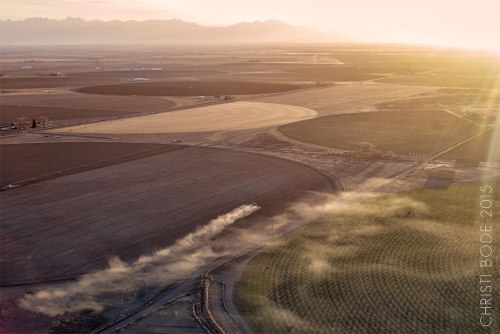
    That one-billion-acre foot estimate is highly disputed by local water managers, farmers and ranchers.

    San Luis Valley Groundwater

    Since 2012 many farms and ranches in the valley have already made self-imposed cuts in irrigation to try and prevent further depletion of the shallow aquifer. A number of subdistricts have been formed as local farmers’ only way of buying more time to solve depletions to the aquifer in their own way. Each subdistrict has until 2031 to replenish water to a predetermined level. Failure to meet those targets could result in the State Engineer’s office shutting down wells until the aquifer reaches that target through unimpeded recharge with no groundwater pumping.
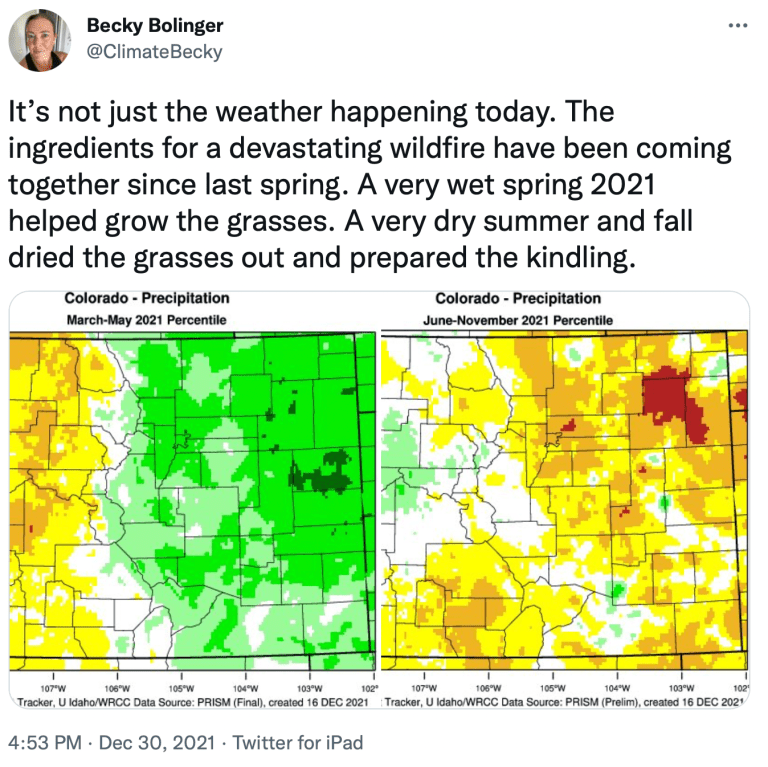
    RWR’s proposal is offering very similar benefits to those proposed by Stockman’s Water in 1998, a project that ultimately failed.

    Stockman’s Water proposed to export at least 100,000 acrefeet annually, mitigating any water losses by offering, in exchange, 25,000 to 50,000 acre-feet of senior water rights.

    Gary Boyce, the manager/ owner of Stockman’s Water, also promised a $3 million trust fund to be administered by Saguache County, and environmental benefits—more riparian and wetland habitat. Renewable Water Resources offers the potential opportunity to add over 3,000 acres to the Baca Wildlife Refuge located off of County Road T.

    Cleave Simpson has met with the Douglas County Commissioners. Using federal American Rescue Plan Act funds for the RWR proposal is a twist he didn’t see coming.

    “I think it’s unconscionable to use those federal dollars to diminish one community in support of another community,” he said. In addition to representing the San Luis Valley in the Colorado Senate, Simpson is the general manager of the Rio Grande Water Conservation District, which is leading the opposition to the RWR plan.

    Simpson reminds us that there is a long history of legal fights over water export claims in the San Luis Valley. The Rio Grande Water Conservancy District already had money set aside to challenge the RWR proposal after the court awarded valley residents legal fees from a previous failed export case involving a developer in the 1970s, called American Water Development Incorporated.

    Trinchera Ranch: Managing lands through a changing environment — The #Alamosa Citizen #RioGrande

    From The Alamosa Citizen (Chris Lopez):

    ‘How are we helping the landscape, how are we helping the community and what’s our long-term vision?’

    The mid-December day was balmy, normal for these times. James Fischer, forestry manager for the 172,000-acre Trinchera Ranch, was explaining and pointing out aspects of the Trinchera’s adaptive management forest plan as he gained elevation in the SUV, barely a trace of snow even in the higher reaches.

    James Fischer. Photo credit: Ryan Michelle Scavo
    “We’re trying to adapt and go ‘OK, what is it going to look like in the future?’ That’s hard,” he said, explaining how one of the largest conservation easements and pieces of property in Colorado is learning to adapt to the changing climate conditions.

    “I mean, we’re basing it on models so you’re going ‘OK, it’s going to warm up. It’s going to dry out.’ How do we manage for that? I don’t know. As a profession, we’re trying different things right now, hoping they’re going to work. I mean, this is a long-term process. We’re only here for just a short period of time.”

    Spruces and mixed conifers 120 to 150 years old are thinned from the forest and hauled to the Blanca Forestry Products sawmill maybe 15 miles away – down the mountain to the Valley floor and on the outskirts of the town of Blanca.

    Of Trinchera’s total acreage, 90,000 are timbered, said Fischer. “Then out of that, there’s 30,000 of spruce, 30,000 of mixed conifer and about 30,000, roughly, of aspen in there.” He can recite those numbers because the saw mill’s business model pushed him to update the Trinchera’s forest management plan and conduct a new inventory to give him precise numbers of what exists.

    Of Trinchera’s total acreage, 90,000 are timbered: 30,000 of spruce, 30,000 of mixed conifer and about 30,000, roughly, of aspen. Photo credit: Ryan Michelle Scavo

    The saw mill itself was a stroke of genius. Like the Trinchera Ranch, it is owned by conservation philanthropist Louis Bacon. Operated by Blanca Forestry Products, it came online in 2017 and produces 8.5 million to 9 million board feet of timber a year out of the Trinchera.

    Judy Lopez. Photo credit: Ryan Michelle Scavo

    “I think that evolution to get to the sawmill was really important because it helped not only the ranch understand, but it was an opportunity to work with the community and understand what fits those needs,” said Judy Lopez, conservation and sustainability manager for the Trinchera Ranch. “When we think about the sawmill, it’s just not a place for timber but it also created this pool of jobs for all local folks.”

    “The same thing up here. As James continues to expand the logging operation, we’re seeing more and more folks in the area getting higher quality jobs and being able to do work here at home that’s meaningful. I think that is one of the key pieces of everything that goes on here and looking at it through that big, broad lens: how are we helping the landscape, how are we helping the community and what’s our long-term vision? Those are two really key pieces of that vision.”

    Since July, crews have focused on an 8-mile stretch of the Trinchera Ranch. Operations are a mosaic across the different landscapes to help reduce fuels. Using some of the cleanest and most technologically-advanced equipment, logs are cut to the precise size for the saw mill.

    “The big change is how we get this material out, the equipment that’s being used,” said Fischer. “There’s only two pieces of equipment doing all of this. One cuts and manufactures the logs out in the woods, the other piece goes behind, picks it up, brings it up here, puts it by the road or decks it.”

    Decks of logs, guessing 25 feet high or higher, line the mountain roads over those eight miles. The cut timber is evidence of how the forest is actively managed. During the day, four semi-trucks will go back and forth to the saw mill, each hauling eight loads a day, 12 at best.

    Trucks are loaded up. During the day, four semi-trucks will make the trips to the saw mill on the Valley floor, each hauling eight loads a day. Photo credit: Ryan Michelle Scavo
    Loaded truck heads down to the saw mill on the Valley floor. Photo credit: Ryan Michelle Scavo

    It’s not only the proactive and adaptive nature of the forest management plan, but the importance of it. Protecting the Trinchera Watershed which feeds into the Rio Grande Basin is critical to the Valley’s ecosystem.

    Aaron Swallow. Photo credit: Ryan Michelle Scavo

    “Everything is tied holistically because we all realize in the West, water is our limited resource,” said Aaron Swallow, environmental manager for the Trinchera and Tercio Ranches. “What James is trying to do here is protect this watershed, again, from that high-severity fire that’ll just essentially nuke it out. Then we don’t have water, and we don’t have fisheries for a couple of years. That’s very scary.”

    The dryness of the Valley and the scenario of a forest fire hit close to home for the Trinchera most recently in 2018, during the Spring Creek fire. Since then, the severe drought over the past two years causes a variety of concerns for Fischer as he surveys the forest around him.

    “The problem is, come summer, if we don’t get moisture, then these trees . . . they’re stressed going into the winter, then spring comes and we get little moisture, they’re just going to get more stressed so then they’re more susceptible for those beetles to bore in and kill those trees,” said Fischer.

    “What happens when these beetles fly, they’ll start boring into the closest tree they can get to and, if one of them is, say, stressed and can’t produce enough sap to pitch that beetle out, it gets in and then they send a pheromone out or release a pheromone for all of their buddies to go “Hey, I got in, come join the party,” and they go attack that tree.”

    An overstocked forest means the trees are competing for limited nutrients, water and sunlight. “Throw drought in there, and that’s kind of the final nail in the coffin,” Fischer said.

    Severe drought over the past two years is causing a variety of concerns, including wildfires and beetle infestation. Photo credit: Ryan Michelle Scavo

    The Trinchera Ranch is part of a Sustainable Forestry Initiative, which is a certification program that examines the ranch’s harvesting practices. As the only certified forest in Colorado, Fischer’s forest management plan is scrutinized through on-site visits and data he provides on the inventory of the forest to road layouts.

    “Our planning, our whole implementation, everything from start to finish, is gone over with a fine-tooth comb,” said Fischer. “They look at our forest management planner, our inventory, that all needs a check. Then, how are we doing with road layout? They look at that and ‘OK, you’re meeting it. Are you exceeding it? OK, you’re doing that.’”

    The benefits are to the land itself and the protection of the natural environment of the San Luis Valley.

    “I think it’s critical for the Sangre de Cristos and the wildlife corridors that are moving around here,” said Lopez. “Especially as we see dryings happening, we’re going to need places for animals to move, we need places for species to move. We need to have a place where there’s a protected area where all of these things can begin to happen. I think, in that way, what we’re doing is super important.”

    Agile equipment gathers processed logs in the forest and takes them to the road and stacks them. Photo credit: Ryan Michelle Scavo
    Trucks are loaded up. During the day, four semi-trucks will make the trips to the saw mill on the Valley floor, each hauling eight loads a day. Photo credit: Ryan Michelle Scavo

    Rio Grande Basin Roundtable: Five amazing projects completed in 2021 — The #Alamosa Citizen #RioGrande

    Del Norte Riverfront Project. Photo credit: Rio Grande Basin Roundtable

    From The Rio Grande Basin Roundtable via The Alamosa Citizen:

    THE Rio Grande Basin Roundtable (RGBRT) began its water advocacy efforts in 2005 as a result of the Colorado Water for the 21st Century Act. This act created nine Roundtables across the state to represent the eight major river basins and the Denver metro area.

    Rio Grande Basin Reservoir release. Photo credit: Rio Grande Basin Roundtable

    Like all the state’s roundtables, the RGBRT is run by local stakeholders and is focused on local community values and water issues. Funding for roundtable project implementation comes from through the Colorado Water Conservation Board. With these state funds, each Roundtable can financially support local projects that further the goals laid out in the Colorado Water Plan and the respective Basin Implementation Plan.

    Since its inception in 2005, the RGBRT has helped fund more than 50 projects, including Irrigation Infrastructure, Reservoir Improvements, River and Watershed Restoration, Conservation Easements, Water Education, Water Management and Water Research Projects. These projects addressed a variety of uses in every corner of the San Luis Valley.

    This didn’t stop in 2021. Despite the pandemic, work continued – allowing five amazing projects to be completed. These projects demonstrate the power that can be garnered when groups come together and create projects that benefit many users, including irrigation, water administration, recreation, the environment, municipal needs and education. The projects and their purposes are listed below.

    Del Norte Riverfront Project

    The Del Norte Riverfront Project was a community-led effort to improve public access, create recreation infrastructure, and enhance aquatic and riparian habitat along the Rio Grande in Del Norte. The overall purpose of the project was to create connectivity between the communities and visitors of the SLV and the river that sustains it. The new Riverfront Park includes a whitewater playwave, boat ramp, fish habitat structures, pedestrian river access, parking area, an ADA accessible picnic shelter, and interpretive signage. The project has provided a significant positive benefit to the community of Del Norte and the San Luis Valley by creating a welcoming, safe space for community members, boaters, and anglers, while also improving river health. The Del Norte Riverfront Project was made possible through collaboration between the Rio Grande Headwaters Restoration Project (RGHRP), Town of Del Norte, Del Norte Trails Organization, Riverbend Engineering, Trout Unlimited, San Luis Valley Water Conservancy District, Colorado Parks and Wildlife (CPW), local businesses, and countless community members.

    Rio Grande Cooperative Project

    The Rio Grande Cooperative Project improved infrastructure and optimized management on the Rio Grande. Both Rio Grande and Beaver Creek Reservoirs were repaired to address seepage issues and improve outlet works. With upgraded infrastructure for the storage and release of water, stakeholders on these reservoirs came together to develop a management strategy that maximizes the benefits of timed reservoir releases, resulting in optimized flows that benefit aquatic habitat, irrigation supplies, augmentation demands, and Rio Grande Compact compliance. The project was a partnership between the San Luis Valley Irrigation District, CPW, and the Colorado Water Conservation Board.

    Conejos Meadows Resilient Habitat Project

    The Conejos Meadows Resilient Habitat project, which was identified in the Conejos River Stream Management Plan (SMP), enhanced habitat on 9,200 linear feet of the Conejos River below Platoro Reservoir, greatly improving connectivity and habitat complexity. During low flow time periods such as winter months and during droughts, the improved instream habitat provides a low flow channel to maximize available habitat and water delivery conveyance. Additionally, the project added rocks and large wood to existing deep pool habitat features in the area, providing increased winter and refuge habitat for the high value recreational fishery. The project is a partnership between Trout Unlimited, the Conejos Water Conservancy District (CWCD), CPW, the Rio Grande National Forest, and Riverbend Engineering. The project complements the Winter Flow Program led by Trout Unlimited and the CWCD, which is an effort to increase stream flows on this section of the Conejos River during the non-irrigation season.

    Conejos River Partnership Project

    The Conejos River Partnership Project (CRPP) was born out of the Conejos River Stream Management Plan (SMP) and has brought together the CWCD, RGHRP, CPW, Division of Water Resources, Bureau of Land Management, private landowners, and water users to address irrigation infrastructure and riparian and aquatic habitat degradation on the Conejos River. This multi-phased project helps meet aquatic habitat needs on the Conejos River through the rehabilitation of irrigation infrastructure, enhancement of aquatic habitat, and restoration of riparian and wetland habitats. The CRPP includes six sites along the Conejos River between Mogote and the confluence with the Rio Grande. In 2021, construction was completed at the Sabine Ditch to replace the diversion structure and headgate, revegetate and stabilize upstream streambanks, and reconnect the river with its floodplain. Construction will continue in 2022 at additional project sites.

    Rio Grande Basin Conejos River Partnership Project Construction. Photo credit: Rio Grande Basin Roundtable

    Alamosa River Water Delivery Improvement Project

    The Alamosa River Water Delivery Improvement Project was a collaborative effort between the Terrace Irrigation Company and the Alamosa-La Jara Water Conservancy District. Many diversions along the Alamosa River are manually diverted with headgates that are out-of-date and deteriorated. This project resulted in the replacement of the headgate on the Main Canal, installation of automatic controllers on the Main and Creek Canal, and installation of satellite recording devices on 5 of the larger upstream diversion structures. As a result of this project, the Alamosa River will be administered more accurately for the benefit of all stakeholders involved, including the Alamosa River Keepers, Colorado Parks and Wildlife, Division of Water Resources, the Town of Jasper, Expo Inc., and other water users along the river.

    The Rio Grande Basin Roundtable continues to work on collaborative and innovative solutions that will keep the Rio Grande Basin water here and working for our communities. We want to thank the Colorado Water Conservation Board and their incredibly dedicated staff, along with other project funders that include Foundations, Agencies, Organizations and contractors who all work passionately to help us create a sustainable water future. We wish you all a Happy New Year and invite you to join us at our monthly RGBRT meetings.

    Ski-Hi Regional Complex readies for first event: Three-day ag conference set for February

    Ski-Hi Regional Complex. Photo credit: Alamosa Citizen

    From The Alamosa Citizen:

    When the 40th annual Southern Rocky Mountain Ag Conference kicks off in 29 days, attendees will christen the new Ski-Hi Regional Complex east wing complete with its spacious conference rooms – and avoid having to shuttle around to other venues in Monte Vista to catch the full flavor of the three-day event.

    It’s a dream come true for event organizers Kyler Browner and Marisa Fricke, who now can envision a growing regional conference with daily guest speakers, concurrent breakout sessions, a trade show, and cattle ranchers and crop producers together in one space networking, sharing best practices, and swapping stories.

    “Having everyone in one campus, one spot, just makes the logistics so much better,” said Browner.

    What attendees won’t see is the rush to finish. On Monday, Alcon Construction crews were busy building handrails, installing countertops, and pushing forward to complete the work before the conference’s opening day on Feb. 1 rolls around.

    Inside Ski-Hi Regional Complex. Photo credit: Alamosa Citizen

    With the COVID pandemic at play, it’s been that way throughout for Alcon on this project, first racing to get the main entrance on the west end completed in time for last July’s 99th Annual Ski-Hi Stampede and now racing to finish the east end of the 54,473-square-foot building to welcome farmers and ranchers back to the all-important ag conference.

    Alcon has done yeoman’s work, understanding the importance of the Ski-Hi Regional Complex as a Valley-wide events center and the critical task of completing it in time, first for the Ski-Hi Stampede, and now the second half of the building for the regional ag conference.

    The regional ag conference, established initially by CSU-Extension in the San Luis Valley to help share its research and embed itself among the Valley ag and farming communities, is the first big business and social event of the year in the Valley. The Monte Vista Chamber of Commerce brings the trade show together, with the goal this year of 30 additional vendor booths from years past.

    Browner has a schedule in mind on the sessions he’d like to catch: A panel with some of the top producers of meat goat; a grazing seminar with Jim Gerrish, author of “Management-Intensive Grazing: The Grassroots of Grass Farming;” a discussion with the Rocky Mountain Farmers Union on federal and state legislation affecting farmers and ranchers; and then on Feb. 3, the final day of the conference, a heavy discussion on a topic that is on the minds of everyone – water and the road forward.

    “Whenever I talk to producers, I feel a lot of uncertainty,” said Browner on the mood of today’s Valley farmer. The rising cost of fertilizer and fuel, concerns about water and drought conditions, the difficulty in finding labor, all weigh heavily on the Valley’s ranchers and producers.

    “We just think we need to solve our own problems ourselves, but this kind of conference gets you out of your little bubble and helps you reconnect with people and with a set of resources we have in the Valley.”

    Alcon Construction will do its part and have the hall ready in time. When they step inside, attendees and participants to the 40th annual Southern Rocky Mountain Ag Conference will have a home that can serve their needs and bring them together like never before.

    Ski-Hi Regional Complex. Photo credit: Alamosa Citizen

    Why three San Luis Valley counties had power outages on Thursday (December 30, 2021): Boulder County fire threatened Xcel Energy’s integrated pipeline system and resulted in controlled outages — The #Alamosa Citizen #ActOnClimate

    Sunrise over the Sangre de Cristos, overlooking the San Luis Valley, April 11, 2015

    From The Alamosa Citizen:

    WHEN fire broke out in Boulder County late Thursday morning and quickly grew into a devastating climate event that triggered the evacuation of the communities of Superior, Louisville, and parts of Broomfield, the inter-connectivity of Xcel Energy’s mountain natural gas system became evident 225 miles away in the San Luis Valley.

    With fire flashing through the area Thursday morning – initial local media reports monitoring emergency scanners began reporting fire around 10:24 a.m. – Xcel Energy soon realized its natural gas infrastructure that supports the neighboring mountain communities of Summit and Grand counties was being impacted, said spokesperson Michelle Aguayo.

    That threat pushed Xcel to shut down the impacted natural gas infrastructure around the fires, which resulted in a loss of pressure on Xcel’s mountain natural gas system, she said.

    “This part of the system helps provide pressure and gas supply to the natural gas system leading into the mountain communities,” she said.

    Xcel’s next move was to institute controlled power outages, which included Alamosa, Rio Grande and Saguache counties, to help manage the residential and commercial use on its natural gas system and prevent the potential of a larger natural gas outage in its mountain system.

    Alamosa Citizen reached out to Xcel through Aguayo to understand why those three San Luis Valley counties were included in the controlled outage, particularly given the distance from the fires.

    Integrated pipeline system

    “It has less to do with Alamosa, Rio Grande, Saguache being part of the ‘mountain communities’ and more with how the natural gas system is set up,” Aguayo said. “We operate a continuous, integrated pipeline system which runs throughout the mountains from approximately Boulder, southwest to Bayfield. The critical infrastructure which was impacted by the wildfire inhibited our ability to serve those mountain communities throughout the system, which include the San Luis Valley.”

    Xcel issued public notice at 6:03 p.m. on Thursday that it was going to implement controlled outages in five counties – Summit, Grand, Lake, Eagle, Saguache, Rio Grande and Alamosa – that would continue over the next six to eight hours. By 10:13 p.m. Xcel sent a second public notice that it expected to end the controlled outages overnight into Friday, which it did.

    “Not having these critical facilities available put customers and communities at risk of losing natural gas service, especially as more customers used their furnaces to heat their homes as the temperatures dropped after the sunset,” Aguayo said.

    The controlled outages extending into the three San Luis Valley counties helped Xcel manage natural gas usage as furnaces in homes and businesses kicked on Thursday, drawing on Xcel’s natural gas system.

    “The reason electric service had to be controlled is that within those furnaces is an electric fan. Without the fan operating the furnace does not begin to heat. Thus, using controlled electric outages helped us manage the use on the natural gas system and prevent the potential of a larger natural gas outage in the mountain system,” Aguayo said.

    Historically dry conditions across Colorado’s Front Range set the stage for fire to grow quickly and intensely across Boulder County. The Front Range experienced its warmest, and among its driest, period on record from June 1 to Dec. 29, according to Russ Schumacher, director of the Colorado Climate Center and associate professor with the Department of Atmospheric Science at CSU.

    ‘Our pharmacy is in the garden’: Acequia Institute in San Luis aims to make “food the medicine” of Costilla County — The #Alamosa Citizen #acequias #RioGrande

    Photo credit: The Acequia Institute

    From The Alamosa Citizen (Chris Lopez):

    DEVON Peña and The Acequia Institute in San Luis just landed a $1.5 million grant from the Colorado Health Foundation that promises to restore the Culebra River Acequia Communities of Costilla County to its healthy foods heritage.

    The initiative “Growing a Healthy Community Foodscape, Food System & Food Economy for the Culebra River Acequia Communities” was awarded the funding over a two-year period. The most immediate work and initially most visible part of the effort is to finalize purchase of the R&R Market in San Luis and continue with its restoration and upgrade which has started through other grants.

    Devon Peña. Photo credit: The Alamosa Citizen

    The bold and comprehensive strategy includes:

  • Establishing a Food & Community Revolving Credit Association (RCA) that provides zero percent interest credit to local agriculture and food producers.
  • Creating a Milpa/Molino/Masa harina Marketing Collaborative that assists acequia farmers in transitioning from cow and alfalfa reliance to an “agroecosystem that includes growing traditional non-GMO corn and associated companion crops.” The farming effort involves producing companion plants like beans (bolita, fava), squash, cauliflower, broccoli, kale, chard, spinach, beets, and other crops that are part of the region’s traditional and healthier adopted diets, according the prospectus for the grant.
  • Integrating youth and young adults into all of the stages of the collaborative through the Move Mountains Youth Leaders Partnership which supports young people (teenagers and young adults through their 30s) in growing food for elders and families; participating in the design and operation of the grocery and community food center; and developing their own food production and value-added food enterprises, among other youth-led efforts.
  • “The underlying objective of this project,” said Peña, “is to improve long-term community health through a resurgence of food sovereignty by reviving and strengthening the local agri-food system, rebuilding our polyculture agroecosystem traditions, unleashing the creativity and commitment among our youth and younger adults by participating in and establishing a set of local institutions to generate and keep our agriculture-generated wealth in the community.

    “What concerns us is that our county also has some of the highest rates of obesity and diabetes in Colorado. According to one recent report, 25.4 percent of the population in Costilla County is obese while 41 percent is overweight (Costilla County Public Health Agency 2018), more than twice the statewide rates. The same report indicates that 13.3 percent of the Costilla County population is currently diagnosed with diabetes compared to the Colorado rate of 5.6 percent. Among epigenetic factors, diet is strongly associated with emergent conditions like diabetes and cardiovascular illnesses. The evidence suggests community health and well-being in the acequia villages are casualties of the enclosure of the common lands and the dramatic long duration effects including the diminishment of our food sovereignty and healthier heritage foodways.”

    It’s a heady effort that now has major investment from the state’s largest health foundation. The Colorado Health Foundation grant to The Acequia Institute announced Tuesday is among the single largest grants awarded to a San Luis Valley non-profit organization and community.

    San Luis garden. Photo credit: The Alamosa Citizen

    Other notable recent awards include a 2020 Great Outdoors Colorado $1.9 million grant to SLV Generation Wild through the city of Alamosa, and a $2.3 million RISE grant from the state of Colorado to a group of nonprofits working with Adams State on youth development. Antonito, also this week, received a $1 million grant from the Colorado Office of Economic Development & International Trade to restore the S.P.M.D.T.U., Sociedad Protección Mutua de Trabajadores Unidos building, on its main drag.

    “Support for this initiative will increase food sovereignty and security while strengthening the local agriculture-food system in Costilla County,” the Colorado Health Foundation said in its award letter. “Local agriculture traditions will be rekindled, the San Luis grocery store will be renovated and expanded, a new commercial kitchen will increase production of local value added foods, and youth will reconnect to the land, acequias, and healthy food while developing skills that will support them to remain in their villages and secure employment.”

    The youth component may be the most challenging of The Acequia Institute’s strategy. Like other communities in the San Luis Valley, San Luis struggles to keep its youth in the community and to find a next generation to maintain and sustain operations.

    This past summer teen farmers, as part of a trial run for the grant, were paid $15 per hour to grow and maintain a one-acre garden. For the summer of 2022 the program will pay $17 per hour. Scholarships, training and internships in trade specialties needed in the agricultural community, an emergency fund for youth and young adults, and a paid staff member for counseling services are all part of the youth efforts under the grant.

    “We still face the challenge of the next generation,” Peña said. “So we’re already working on youth leader development.”

    Originally from Laredo, Texas, Peña first came to San Luis in 1984 as an assistant professor for Colorado College in Colorado Springs. A few years later, while on a field trip with Colorado College, he met the late Costilla County Commissioner Joe Gallegos who invited him to get involved with San Luis.

    It was with Gallegos’ nudge that Peña started to more intently learn about the acequia farming system, the issues of Costilla County, and the plight of the land. In 2005 Peña established The Acequia Institute, and by 2007 he continued his transition by spending at least half his time living in San Luis while also teaching at the University of Washington in Seattle, a position he still holds. Only now he resides full-time in the outlying area of San Francisco, a few miles east of the town, where he’s neighbors as the country roads go with Costilla County’s two world-renowned artists, sculptor Huberto Maestas and muralist Carlos Sandoval.

    “My proudest accomplishment is helping the land heal,” he said. “That’s what I’m most proud of is repairing the damage to the land.”

    Cottonwoods and willows have come back along the river corridor through a conservation easement that was put in place. The feeling of neighbors looking after each other, whether it’s through growing and sharing food, or learning new ways to do business in a technology-driven society, has San Luis and Costilla County looking ahead.

    While the state of Colorado commonly refers to San Luis as the oldest town in the state, Peña has flipped it by saying San Luis is the “last town in Mexico, not the oldest in Colorado.” It’s his way of recognizing the land history of Costilla County and forcing a different interpretation of San Luis as he and The Acequia Institute work to re-establish its cultural heritage to the land and farming system.

    He promises accountability and transparency to the San Luis community with the health foundation grant, and said he won’t draw a salary for the work because he’s already paid well through his professor work at the University of Washington.

    His persistent rap about San Luis, work of The Acequia Institute and efforts to highlight the plight of local farmers, and his willingness to challenge traditional power structures of the San Luis Valley which he says have worked against San Luis and its interests, has won him audiences and influence.

    National Geographic recently featured the community, and a grocery chain is expressing interest in carrying food grown through the program as part of its store offerings.

    “The goal is to address community health through making good, fresh healthy food,” said Peña, and then making it available beyond San Luis and the R&R Market. He’s purchased two corn mills so that corn grown by the farmers can be turned into tortillas which can then be offered with other fresh food efforts locally.

    The Revolving Credit Association (RCA) is the key to the plan, “the operational heart and soul of the entire project as it revives the soft infrastructure of our cultural heritage including the solidarity norms expressed in our acequia associations, land grant councils, and mutual aid and cooperative labor traditions and institutions,” according to the project prospectus.

    Peña has patterned the RCA after the S.P.M.D.T.U., a Society for the Mutual Protection of Workers popular in the early 1900s to protect Hispanic property rights and fight discrimination. He sees the model as fitting for the type of rebirth of the community farmer that the project envisions.

    The plan relies on local farmers committing one acre of their land for community growing, with a goal of 20 farmers participating in the effort. Over time the project is shooting for 1,000 acres set aside for community purposes out of the 23,000 acres of acequia irrigated farm land in the southern half of Costilla County.

    It gets back to the community eating healthy with the assistance of local growers. “We are just as responsible as anyone for the failing health of our communities,” Peña said.

    Of the request for farmers to set aside an acre for community purposes, Peña said, “We’re very happy with the response of the farmers around here.”

    His role, he said, is to bring resources into the community and then to let community leaders like Shirley Romero-Otero and others take over.

    “Colorado Health Foundation thinks we’re on the right track,” said Peña.

    Indeed it does.

    Selection of the 2015 native heirloom maize harvest of the seed library of The Acequia Institute in Viejo San Acacio, CO
    Photo by Devon G. Peña

    Traveling #Colorado’s oldest #water system: The history of #acequias and water rights — Rocky Mountain PBS

    San Luis People’s Ditch March 17, 2018. Photo credit: Greg Hobbs

    In the Río Culebra Villages of arid, desert southern Colorado, el agua es vida: Water is life.

    The crux of ranching and farming is snowmelt and any supplemental rain. Natural waterways wind from the canyons through the desert terrain. The acequia system taps into these creeks and streams with a series of earthen and concrete-lined ditches that bring water to fields. Dug by settlers in the mid-1800s, acequias are physically cleaned, repaired and maintained by water rights holders. Today, many of those people are descendants of area settlers.

    Read the full story: https://www.rmpbs.org/blogs/rocky-mountain-pbs/rio-culebra-watershed-part-2/

    USDA rule to allow payments for cattle contaminated by harmful chemical — KRQE #PFAS

    Clovis, New Mexico. Photo credit: Clovis and Curry County Chamber of Commerce

    From KQRE (Allison Keys):

    The federal government will allow a Clovis dairy to be reimbursed after its groundwater was contaminated by the Cannon Air Force base. The government announced it will finalize a rule change allowing compensation for cows that are not likely to be sold.

    Art and Renee Schaap own Highland Dairy. They say a firefighting foam contaminated their water supply which reduced milk production in their cows.

    The milk that was produced had to be thrown out for fear it was contaminated too. They filed a lawsuit against the federal government in 2019 saying the military knew about the contamination but didn’t tell them.