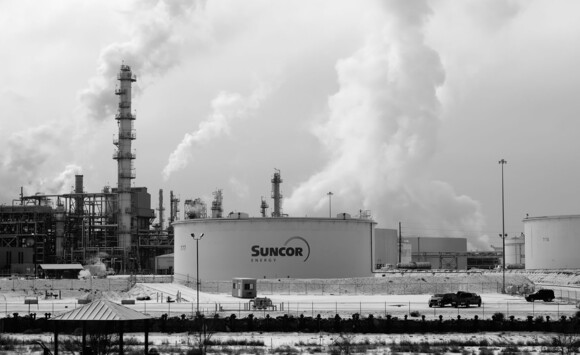
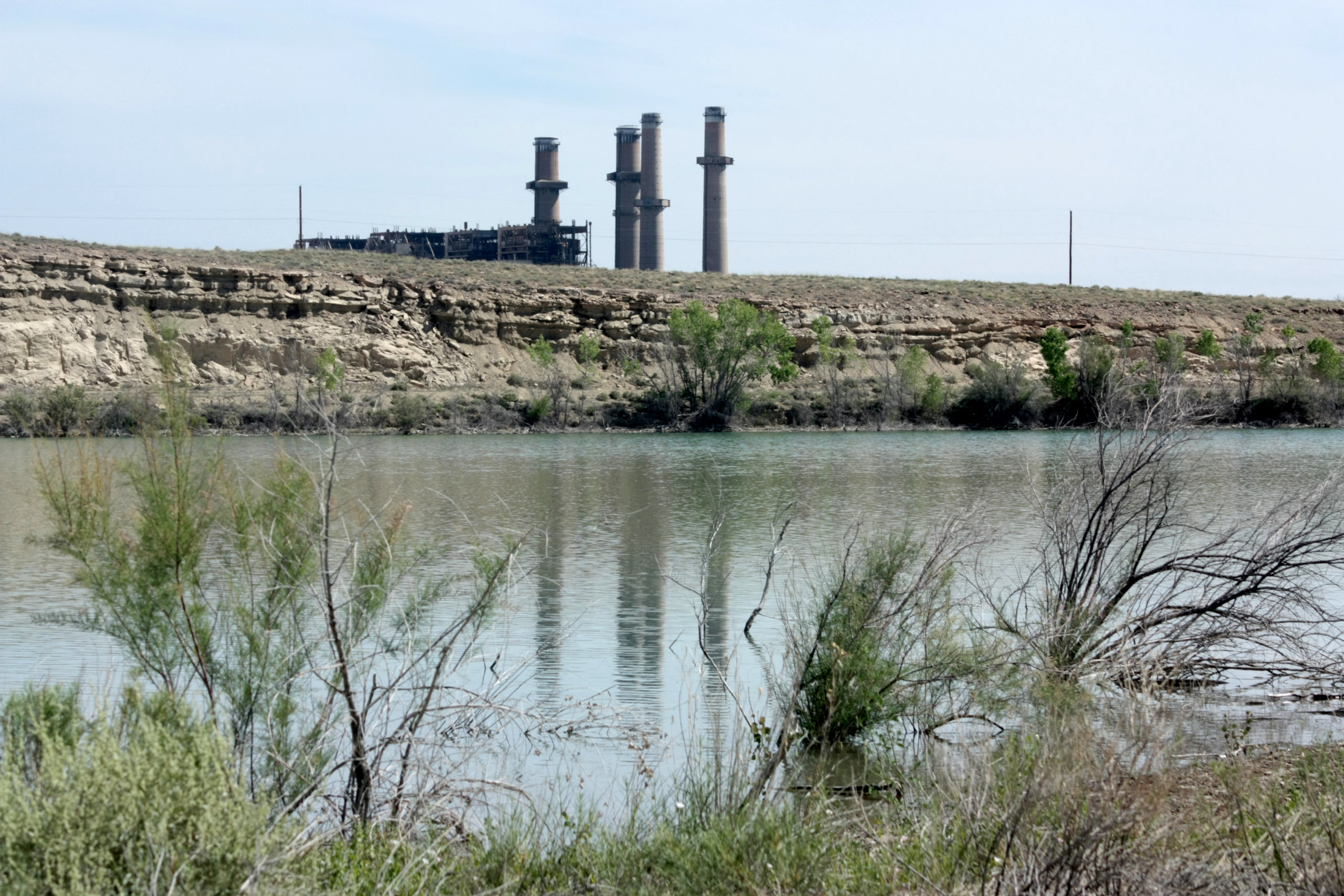
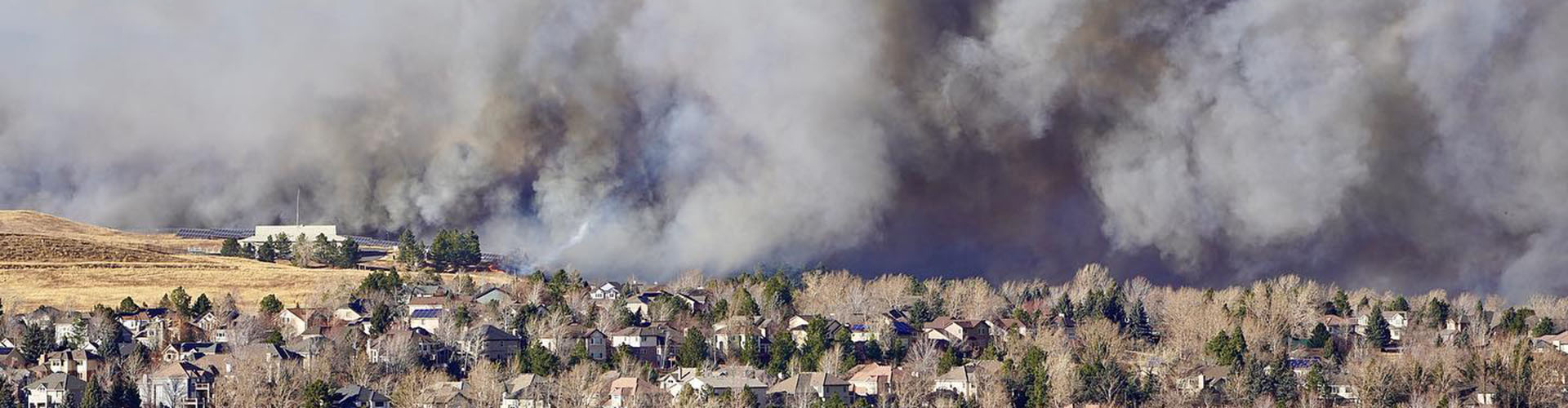
Denver, Colorado, USA – January 12, 2013: The Suncor Energy refinery in Denver, Colorado. Based in Calgary, Alberta, Suncor Energy is a Canadian oil and gas company with revenues of over 35 Billion Canadian Dollars. Photo credit: City of Boulder
Click the link to read the article on the 9News.com website (Cole Sullivan). Here’s an excerpt:
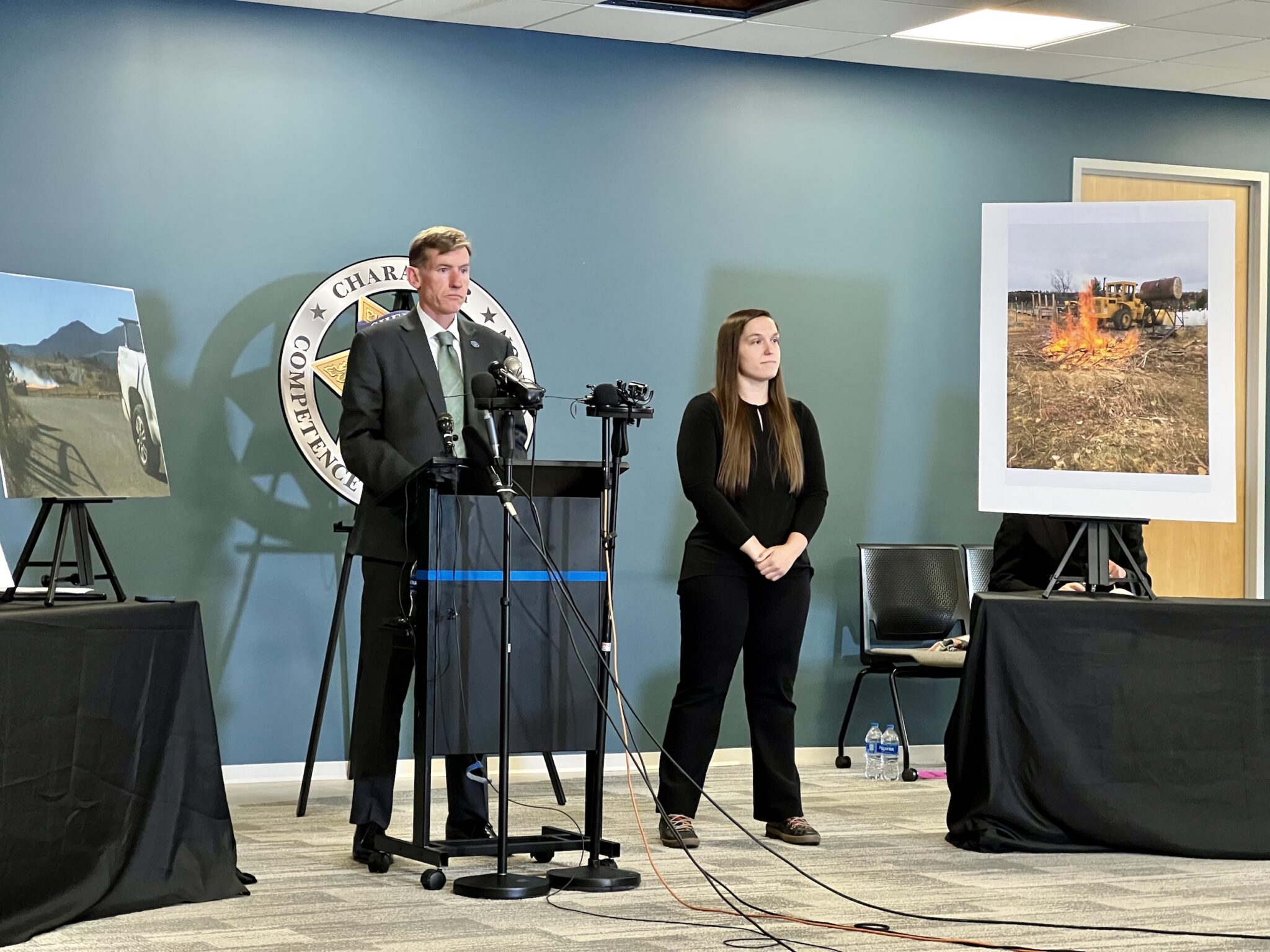
The Colorado Department of Public Health and Environment called the June 1 “compliance advisory” the first step in its enforcement process to hold the company accountable. It details more than 100 alleged violations that occurred at the state’s only oil refinery from July 2021 to June 2022. State regulators will meet with Suncor to discuss the issues and require fixes before determining if penalties should be levied against the company. A Suncor spokesperson said the company self-reported the violations and is working with CDPHE to resolve the compliance advisory.
“The enforcement process can create meaningful, positive changes and outcomes,” a CDPHE spokesperson told 9NEWS. “For example, the division’s historic $9 million settlement announced in March 2020 resolved an enforcement action with Suncor.”
[…]
The compliance actions have become an annual routine for the company, with records from the state indicating orders and advisories every year since 2013.
“It hasn’t proven to help,” said Ean Thomas Tafoya, who directs the Colorado chapter of environmental justice group GreenLatinos. “They’ve had one of the largest [fines] in the state’s history and yet they continue to have violations and more issues at this facility.”
Click the link to read the article on the Circle of Blue website (Zara Gounden & Fraser Byers):
June 7, 2023
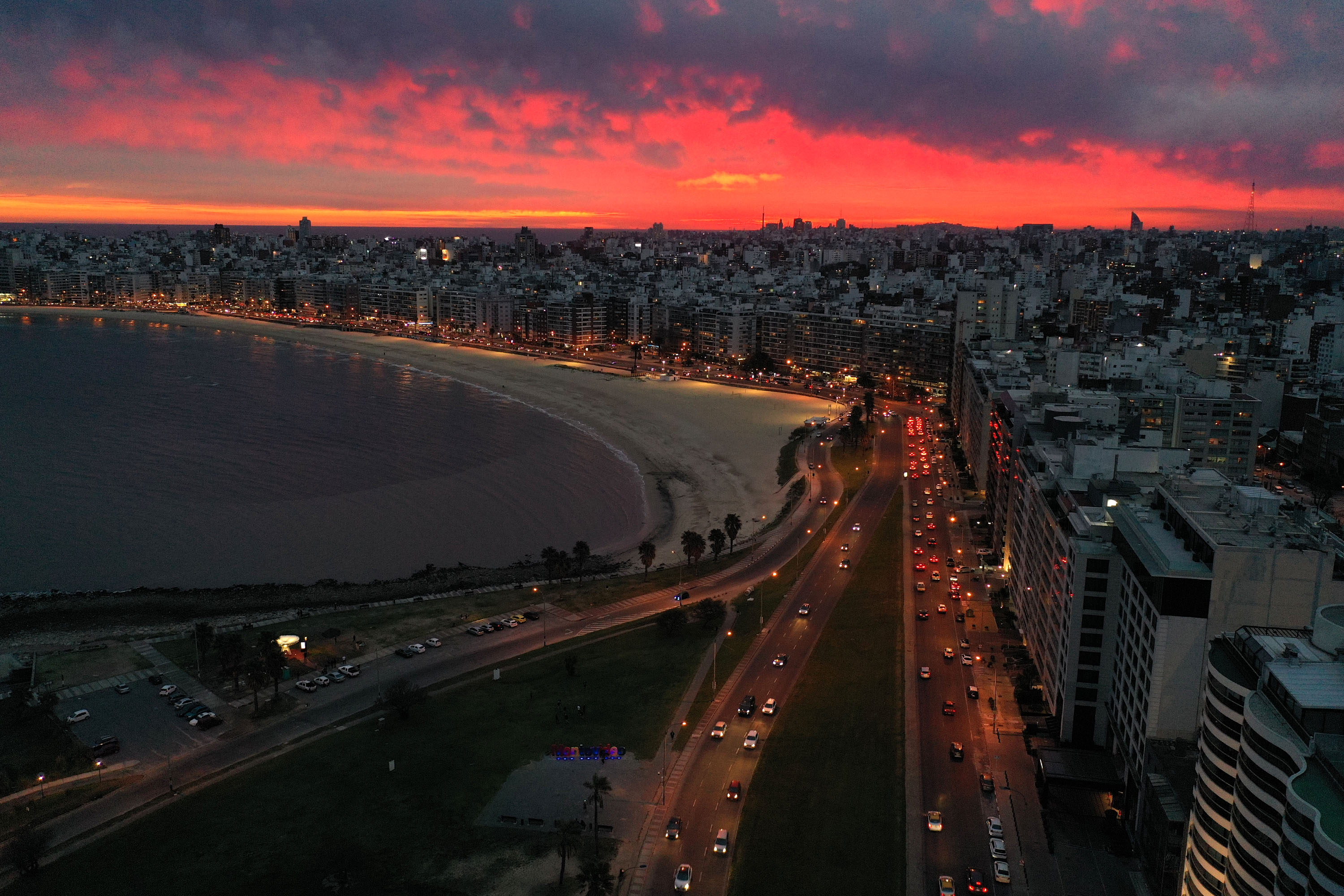
In Uruguay, a mounting crisis is unfolding as ‘Day Zero’ – when the public water supply is depleted – draws closer in Montevideo.
On May 31 the National Administration of State Sanitary Works (OSE) announced that, without significant rainfall, the city of Montevideo would run out of water by June 22. The capital city of 1.4 million residents has plunged into uncertainty, triggering demonstrations.
Desperate officials are taking extraordinary measures in response. The OSE is alleviating dependence on the country’s largest freshwater reserve, the Paso Severino, by adding salt water from the River Plate estuary into the public water supply.
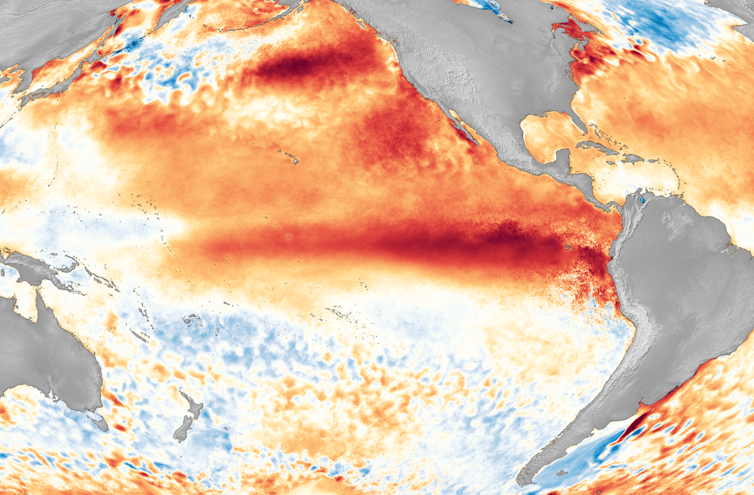
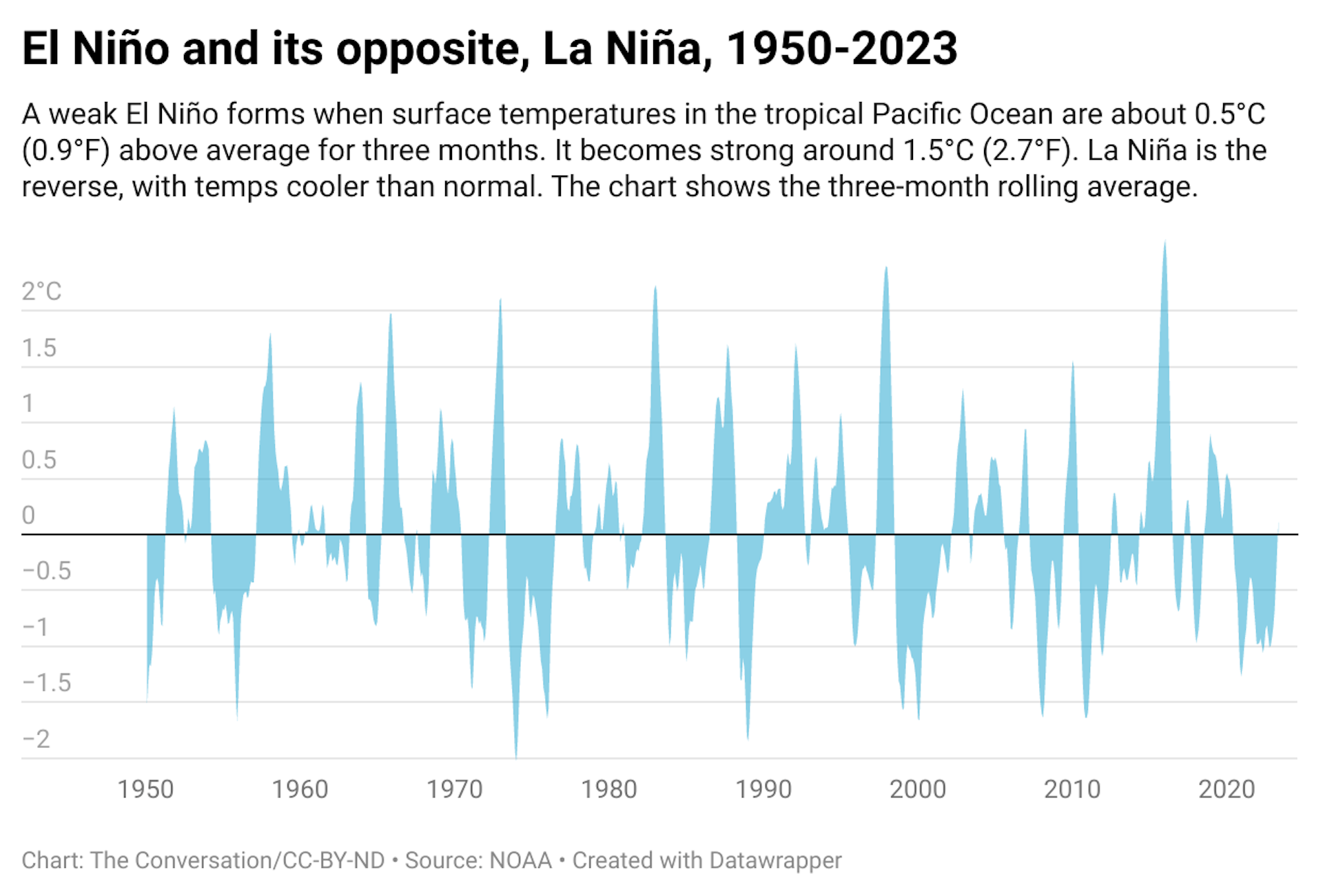
Montevideo’s water emergency joins a growing list of major metropolitan areas affected by extreme weather events that lead to dire water shortages. The El Nino Southern oscillation in the Pacific, in combination with the effects of climate change, have led to a global surge in such Day Zero events.
In Cape Town, South Africa. Day Zero scarcity hounded the city in recent years. Public protests demanded more responsible water resource management and a shift in water allocation from agriculture, which was initially granted 40% of the total water reserves during the drought.
Last year, Day Zero occurred in Monterrey, Mexico. Taps in the city went dry. Tanker trucks became the primary means to provide water to communities. Public demonstrations over water shortages also occurred in major cities in Brazil, Iran, and India.
Montevideo’s strategy to add salt water to supplement and extend its fresh water supply may be globally unique. But – the high levels of sodium and chloride in the region’s tap water are more than double the limits suggested by the World Health Organization (WHO). Uruguay has waived taxes on imported bottled water, and doctors have been empowered to provide prescriptions for free bottled water to pregnant women and individuals with chronic illnesses. OSE has even begun drilling for groundwater inside city parks to provide nearby hospitals with reliable supplies.
Despite such urgent actions, organizers such as Federico Kreimerman, president of the workers union at OSE, called for a greater response to limit the effects of the drought. Speaking to Reuters, Kreimerman blamed the current circumstances on a confluence of factors – low rainfall, industrial overuse, and weak public investment. On Twitter he wrote: “The government cannot make it rain, but it can take measures so that workers are not the losers. Waive fees, regulate bottled water. Otherwise, the water crisis will increase social inequalities.”
Join us next Wednesday, June 28 at 3 p.m. for a webinar on putting the Colorado Water Plan into action!
The update to the Colorado Water Plan, published earlier this year, relies on people across the state to get things done and implement it. What sort of work fits in with the plan? What support is there to get this work done? And what projects have already been successful in advancing the goals of the plan?
During the webinar, we’ll hear about action areas in the plan and how those overlap with funding opportunities. Plus we’ll hear from representatives from different parts of the state and take a look at a variety of projects — including a focus on collaborative water sharing in the Arkansas River Basin, forest health work in the Yampa River Basin, stream management planning and agricultural infrastructure improvements in the Rio Grande Basin, and water reuse, conservation and storage in the Metro area — that have already been implemented before diving into a discussion about moving forward.
With speakers: Russ Sands, Colorado Water Conservation Board Julie Baxter, City of Steamboat Springs Daniel Boyes, Rio Grande Headwaters Restoration Projects Lisa Darling, South Metro Water Supply Authority Scott Lorenz, Colorado Springs Utilities
This webinar is FREE for WEco members! Not a member? Join to support our mission and to take advantage of this and many other benefits.
PFAS contamination in the U.S. October 18, 2021 via ewg.org.
Click the link to access the report on the EPA website:
Objective:
This project aims to develop a new functionalized sawdust anion exchange resin for PFAS removal and to develop new cost-effective treatment processes using functionalized sawdust (FS). The hypothesis of this research is that cellulose-based sawdust can be functionalized into anion exchange resin, which can remove negatively charged PFAS in drinking water. This research will improve water management practices, and technical methods to minimize the PFAS risks to human, ecosystem and the environment. The specific research objectives of the proposed work are to: 1) Functionalize sawdust into biomass-based anion exchange resin; 2) Determine PFOA and PFOS removal from drinking water using functionalized sawdust column tests. The first objective helps students to understand the natural biomass (sawdust) from planet can be used for cleaning drinking water, which is related to people’s health. The second objective helps student to understand how much of PFAS existing in tap water, which is related to the polymer production from industries. This will help students to recognize the critical balance between prosperity of industry and protection of human health and the ecosystem. This project enables the student team to identify the community issues in our drinking water system. Undergraduate students will be trained in the area of sustainability, analytical chemistry, process design and environmental protection.
Summary/Accomplishments (Outputs/Outcomes):
In this Phase I project, functionalized sawdust has been chemically synthesized with epichlorohydrin and dimethylamine and characterized by Fourier transform infrared spectroscopy. The kinetic and isothermal adsorption experiments with FS have been performed and samples have been collected for liquid chromatography coupled to quadrupole time-of-flight mass spectrometry (LC-QToF) analysis. It has been observed that the functionalized sawdust can remove 93% of PFOA and 84% of PFOS in batch process. For the adsorption kinetics, the adsorption sorption rate constant of PFOA and PFOS is 0.1739 g/mg/h and 0.1022 g/mg/h respectively. The initial adsorption rate of PFOA and PFOS is 15.12 mg/g/h and 7.25 mg/g/h, respectively. The results suggested that the adsorption of PFOA and PFOS on FS was very fast and majority of adsorption can be completed within 2 h. The results have been summarized in the 2020 Progress Report.
Adsorption isotherm is critical to evaluate the sorption capacity of adsorbents as well as understand the PFAS and FS interactions. For the adsorption isotherm, series concentrations (ranging from 5-250 mg/L) of PFOA and PFOS solutions were absorbed with 0.2 g FS, respectively. The bottles were maintained on the shaker (200 rpm) for 120 h. The residual concentration of PFAS compounds have been quantified by LC-QToF analysis. As showed in Fig. 1, two commonly used models, the Langmuir and Freundlich were adopted to describe the experimental data and assess the adsorption behavior of the PFAS on each media. The adsorption isotherms show that the FS possesses high adsorption capacity 209.26 mg/g for PFOA and 161.80 mg/g for PFOS according to the Langmuir fitting (Table 1). The Langmuir adsorption model is based on the assumption of a structurally homogeneous adsorbent, monolayer adsorption and equivalent adsorption sites. The Freundlich model assumes adsorption on a heterogeneous surface. A good fit with the Langmuir model indicated monolayer adsorption of PFAS on the FS. The adsorption isotherm results in this study suggested that the synthesized FS showed high adsorption capacity for PFOA and PFOS removal…
Conclusions:
Our goal for the Phase I project is to develop a new functionalized sawdust anion exchange resin for PFAS (especially PFOA and PFOS) removal and to develop new cost-effective treatment processes using FS. To achieve this goal, the commercial sawdust has been functionalized by reaction with epichlorohydrin and dimethylamine. FTIR was used to characterize the functional groups changes along with the functionalization reactions. It can be observed that functional groups (such as hydroxyl group) have been significantly changed after functionalization, which indicated the occurrence of functionalization reactions. To assess the efficiency of FS in PFAS removal, we also adsorption kinetic and adsorption isotherm of PFOA and PFOS in batch process. Based on the adsorption kinetics, we found that adsorption of PFOA and PFOS on FS was very fast and majority of adsorption can be completed within 2 h in batch condition. Based on Langmuir and Freundlich model, we also determine adsorption isotherms to assess the adsorption behavior of the PFAS on each media. The result suggested that the synthesized FS showed high removal efficiency and high adsorption capacity for PFOA and PFOS removal according to the Langmuir fitting. Through this study, we believe that we have successfully synthesized sawdust-based anion exchange resin, which possessed high adsorption capacity of PFOA and PFOS removal from water system. We recommend that more PFAS compounds should be tested with this new developed technology and a techno-economic analysis is needed to assess the cost of advantages of FS for PFAS removal.
Leaders of several tribes say they continue to be left out of key talks between state and federal officials, and they are demanding inclusion as the Biden administration begins the process of developing new rules for dealing with shortages after 2026, when the current rules are set to expire.
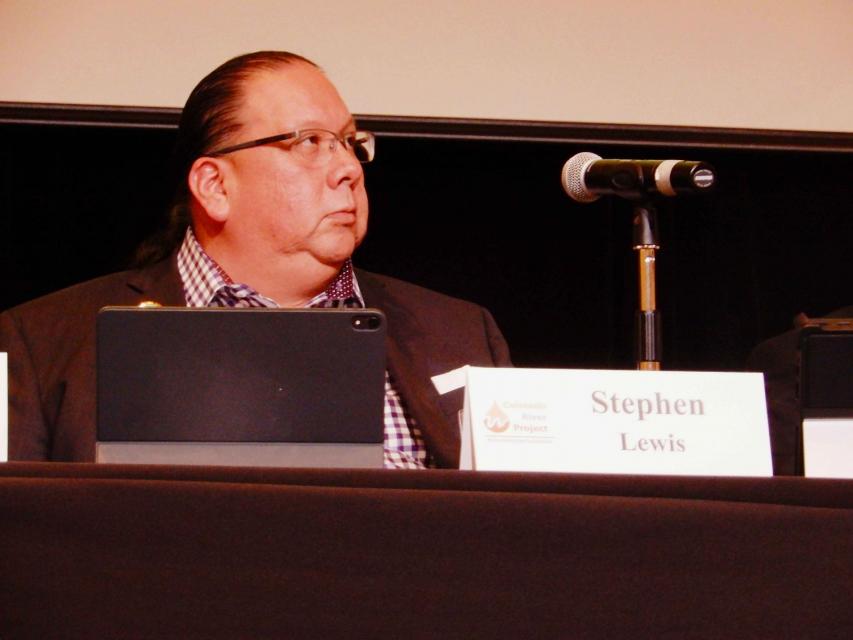
Gila River Indian Community (GRIC) Gov. Stephen Roe Lewis advocates early engagement of tribes in the decision-making process. (Source: Water Education Foundation)
“They’ve met, they’ve discussed, they’ve made decisions that we only find out afterwards,” said Gov. Stephen Roe Lewis, leader of the Gila River Indian Community in Arizona. “And the 30 tribes — and I’ve heard this from my fellow tribal leaders — they are very frustrated by that, especially as we look at a post-2026 process moving forward.”
During the upcoming talks, Lewis said he and other Native leaders want to see the federal government include representatives of the 30 tribes whenever they convene a meeting with all seven states. He said this approach wouldn’t stop state representatives from meeting among themselves. Lewis raised the concern at a conference in Boulder, Colo., last week, saying that as work begins on a post-2026 plan, “it’s no longer acceptable for the U.S. to meet with seven basin states separately, and then come to basin tribes, after the fact.” He said when leaders of the tribes met with Interior Secretary Deb Haaland last year, she made a commitment “that we would be at the table when these highest-level decisions were being made.”
[…’
The Interior Department said the process of developing new rules to replace the 2007 guidelines will involve “robust collaboration” between the seven states, tribes, other stakeholders and Mexico…For the next two months, until Aug. 15, the Interior Department and the U.S. Bureau of Reclamation will accept comments from the public on how the existing rules should be changed to “provide greater stability to water users and the public throughout the Colorado River Basin.”
Click the link to read the article on the Montrose Daily Press website (Kylea Henseler). Here’s an excerpt:
Agricultural users, who grow our very food, depend on the health of the river, soil and habitat around it, while recreational users take advantage of opportunities for activities like fishing and surfing. In this sense, the river boosts the economy and literally helps put food on the table…Multiple local and nearby groups have organized around this river and other Western Slope water resources, and yesterday, June 15, 2023, four met up at the Montrose Library to introduce themselves and explain their mission and current efforts. Most have educational opportunities available and are seeking volunteers, and all are focused on protecting watershed health for all kinds of users for years to come…
Friends of the River Uncompahgre
The mission of this Montrose-based group is “restoring, enhancing and protecting the Uncompahgre River through stewardship efficacy, partnerships and education,” according to Board President Melanie Rees. Its biggest immediate focus is on restoration, as the group is working with Grand Junction-based RiversEdge West on a project to remove invasive species from areas of the river in the city of Montrose and revegetate them with native plants…
Shavano Conservation District
This special government district covers parts of Montrose, Delta, Gunnison, Ouray and San Miguel counties and has been around since the Dust Bowl era focusing on providing conservation resources for agricultural producers. ..
Uncompahgre Watershed Partnership
The Ouray County-based Uncompahgre Watershed Partnership focuses on protecting the upper Uncompahgre River Watershed, but since the water flows toward Montrose, their work impacts us all. According to Executive Director Tanya Ishikawa, the group was founded in 2007, when local residents were concerned that state officials couldn’t monitor the water quality within the watershed closely enough…
Gunnison Gorge Anglers
A chapter of the national organization Trout Unlimited, Gunnison Gorge Anglers serves parts of Montrose, Delta, Hotchkiss, Paonia, and Telluride. While “Anglers” is right in the name, President Joel Evans said: “We’re talking about a lot more than fishing. We’re talking about the river and how to take care of things.”
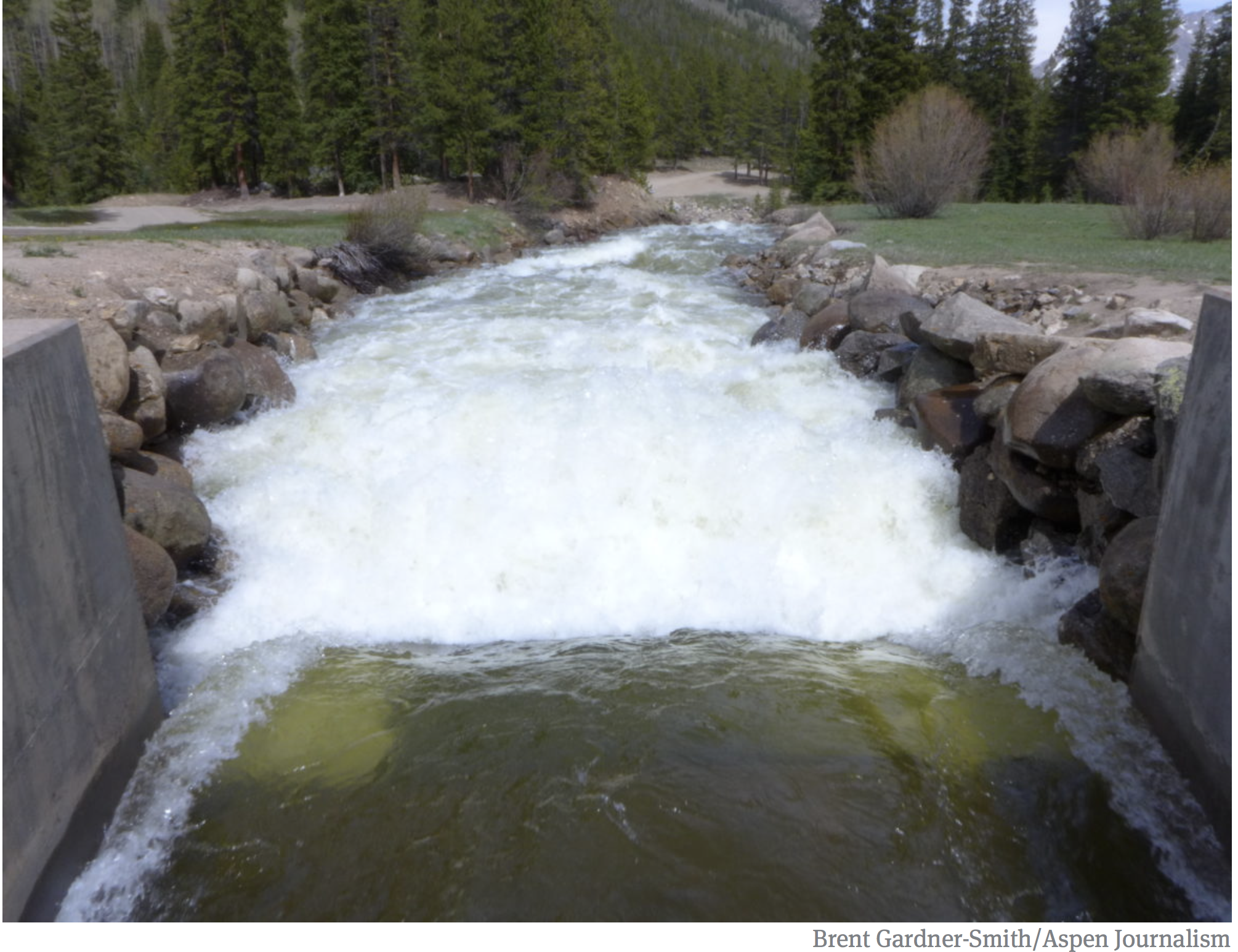
About 600 cfs of water from the Roaring Fork River basin flowing out of the east end of the Twin Lakes Independence Pass Tunnel on June 7, 2017. Photo credit: Aspen Journalism/Brent Gardner-Smith
The upper Roaring Fork River will likely see its highest flows of the season beginning early next week as the transbasin diversion from its headwaters to the other side of the Continental Divide is shut off.
Twin Lakes Reservoir and Canal Co. is expecting to stop diverting from the headwaters of the Roaring Fork, which will result in an additional 350 to 450 cubic feet per second flow downstream through Aspen. Local officials say that amount of water is welcome, doesn’t pose flooding concerns and is a chance to see what natural spring runoff would look like without a transmountain diversion.
“The river is flowing really low right now, particularly for this time of year,” said April Long, an engineer and stormwater manager at the city of Aspen. “We welcome the additional flow and do not believe we have any concern for flooding at this point.”
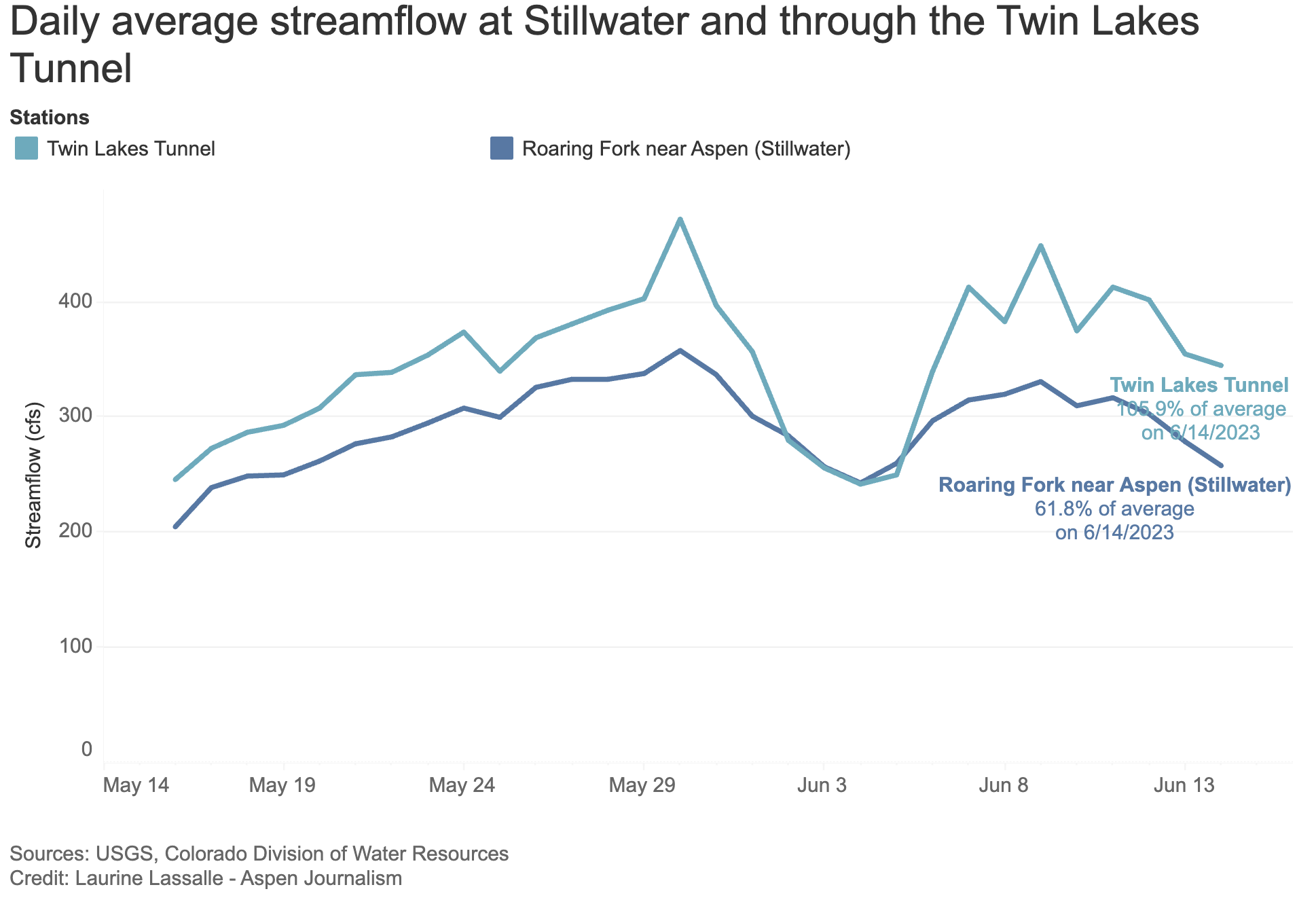
According to the stream gauge just above Aspen at Stillwater, the Roaring Fork was flowing at 257 cfs on Wednesday — about 62% of average — and the Twin Lakes diversion was taking 344 cfs through the tunnel on Wednesday and up to 437 cfs on Thursday. That means the river could be flowing as high as nearly 700 cfs at Stillwater by early next week. That’s still well below the “action stage” for flooding of 1,048 cfs, as defined by the Colorado Basin River Forecast Center.
Interim General Manager of the Twin Lakes Reservoir and Canal Co. Matt Heimerich said the company’s space in Twin Lakes Reservoir is nearing capacity and the Colorado Canal that brings water to farmers in Crowley County is also full. When those two things happen, Twin Lakes is required to shut off the Independence Pass diversion.
“It’s a little bit of a moving target,” Heimerich said. “It’s dependent on the two conditions and they have to happen in a simultaneous fashion.”
Heimerich said they are projecting to reach the storage condition on Monday, June 19, which means they will start to ramp down diversions on Sunday, June 18. Diversions will resume once water levels drop in the Arkansas River basin and the Colorado Canal can no longer be filled with water on the east side of the divide.
Transmountain Diversion system
The Independence Pass Transmountain Diversion System, operated by Twin Lakes Reservoir and Canal Co., collects runoff from 45 square miles of high alpine terrain, including the New York, Brooklyn, Tabor, Lincoln, Grizzly and Lost Man creek drainages, dumping those flows into Grizzly Reservoir, which can hold 570 acre-feet of water.
From there the water runs through the 4-mile-long Twin Lakes Tunnel under the Continental Divide and into Lake Creek, a tributary of the Arkansas River. Twelve miles later the water arrives at the Twin Lakes Reservoir where it is stored before being sent down the Arkansas River, eventually reaching Front Range cities and Eastern Plains farms with the help of a network of pipelines, pumps and canals.
Four municipalities own 95% of the shares of Twin Lakes water: Colorado Springs Utilities owns 55%; the Board of Water Works of Pueblo has 23%; Pueblo West Metropolitan District owns 12% and the City of Aurora has 5%. It’s Colorado Springs’ largest source of Western Slope water and represents about 21% of the utility’s total water supply.
Twin Lakes collection system
Because of cool temperatures and cloudy skies, this year’s runoff has been slow and steady so far.
“That’s definitely what we’ve been seeing: a fairly long, extended period of high flows versus a single, well-defined peak,” said Cody Moser, a senior hydrologist with CBRFC.
Prior to the added flows, the Fork near Aspen peaked on May 30 at 417 cfs.
Christina Medved, director of community outreach at the Basalt-based Roaring Fork Conservancy, said the additional flow is great news for the river ecosystem. The group has a planned educational float next week through the North Star Nature Preserve upstream of Aspen, which will look more like the true wetland that it is because of the extra water. Water managers and river lovers in the Roaring Fork Valley like when the Twin Lakes diversion pauses — which often happens in late summer when senior water users in the Grand Valley place the Cameo call, shutting off upstream junior users — because it means more water flowing through local communities.
“What could be exciting is for people to go look at the river,” Medved said. “This is as close as we get to seeing it as if there wasn’t a transbasin diversion.”
Even though officials don’t expect flooding in the Aspen area, they are still urging caution, especially for kids and pets, around high-flowing rivers.
LOVELAND, Colorado – The Bureau of Reclamation expects to fill Green Mountain Reservoir in late June, leading to increased flows on the Blue River below Green Mountain Dam and in the Colorado River below the Blue River confluence near Kremmling.
Reclamation will increase Blue River flow below Green Mountain Dam by mid-June. Green Mountain Dam release will increase to approximately 750 cubic feet per second. In addition, Reclamation will discontinue Elliot Creek diversion to reduce spillway releases. Overall, Reclamation anticipates flows in the Blue River below Green Mountain Dam could range from 500 to 1,500 cubic feet per second from mid-June through mid-July.
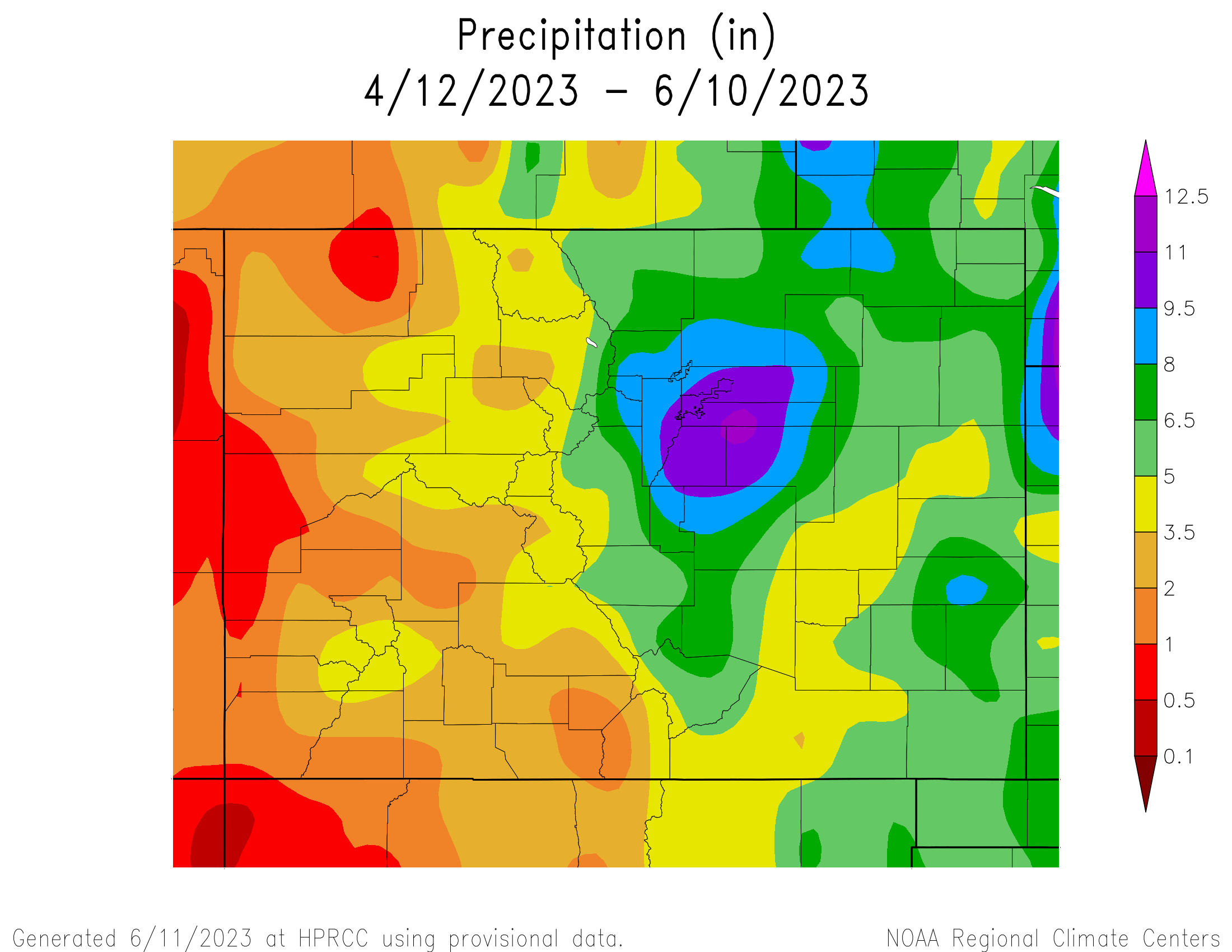
“Thanks to an abundance of precipitation on the Front Range this spring, cities and irrigators are using less water from transbasin diversions and water managers have prioritized filling east slope reservoirs with water available from rivers on the Front Range,” said Reclamation’s Eastern Colorado Area Manager, Jeffery Rieker. “As a result, many east slope reservoirs have filled, and additional water will remain in the Colorado River.”
Green Mountain Reservoir, a feature of the Colorado-Big Thompson Project, provides stored water for beneficial use within the Colorado River basin upstream of the Gunnison River confluence in Grand Junction, Colorado. Green Mountain Reservoir stores more than 100,000 acre-feet for use by West Slope project beneficiaries. This allocation is commonly referred to as the “Power Pool” and includes the 66,000 acre-foot Historic Users Pool.
Media inquiries or general questions about Reclamation should be directed to Anna Perea, Public Affairs Specialist, at 970-290-1185 or aperea@usbr.gov. If you are deaf, hard of hearing or have a speech disability, please dial 7-1-1 to access telecommunications relay services.
Colorado transmountain diversions via the State Engineer’s office
Lorelei Cloud. Photo credit: Allen Best/Big Pivots
Click the link to read the article on the Big Pivots website (Allen Best):
Native Americans were not invited to craft the Colorado River Compact in 1922. Now they are at the table — and insist they must be part of solutions. Big Pivots
Voices of Native Americans, long shunted to the side room, if acknowledged at all, are being heard more clearly in Colorado River discussions, as reflected in two recent water conferences in Colorado.
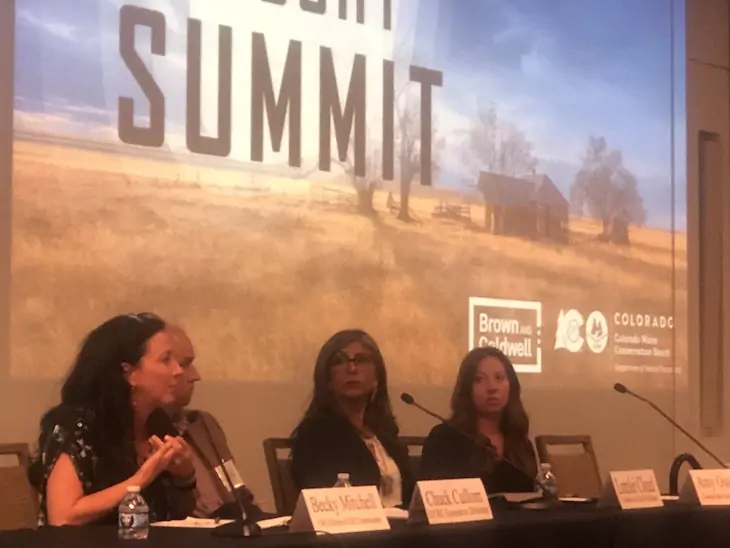
At the first, a drought summit held in Denver, a panel that was devoted to the worsening imbalance between water supplies and demands included Lorelei Cloud, the vice chairman of the Southern Ute Indian Tribe. Her presence was an overt acknowledgement by conference organizers that the Ute tribe, if a part of Colorado, is also a sovereign. That’s something new.
The conference was sponsored by the Colorado Water Conservation Board, the state’s preeminent water policy agency. Cloud recently became a board member, representing southwestern Colorado. She’s the first Ute ever on the board.
Cloud lauded Colorado for being ahead of many other states in including native voices. “We’re making strides,” she said but added that work remains.
The next week, she was on a stage in Boulder, at the Getches-Wilkinson Center’s annual conference about the Colorado River. Thirteen of the 30 federally recognized tribes that hold water rights in the Colorado River Basin were present.
Their rights stem from a 1908 Supreme Court decision involving tribal lands in Montana. The high court agreed that when the U.S. government created reservations and expected tribes to live there, water sufficient to the presumed agrarian ways was part of the deal.
This decision, called the Winters Doctrine, has enormous implications for the shrinking Colorado River. Tribes collectively hold 25% to even 30% of the water rights in basin. Not all claims have been adjudicated. Most tribal rights predate others. The Southern Ute rights, for example, date to 1868.
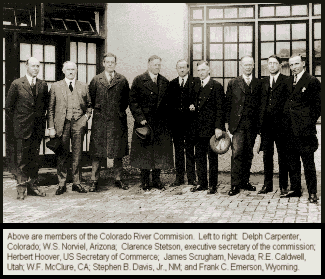
The Compact’s Signers. Photo via InkStain
All predate the Colorado River Compact. Tribes were not invited to Santa Fe in 1922 to apportion the river’s waters among the seven basin states, though the compact does acknowledge federal obligations.
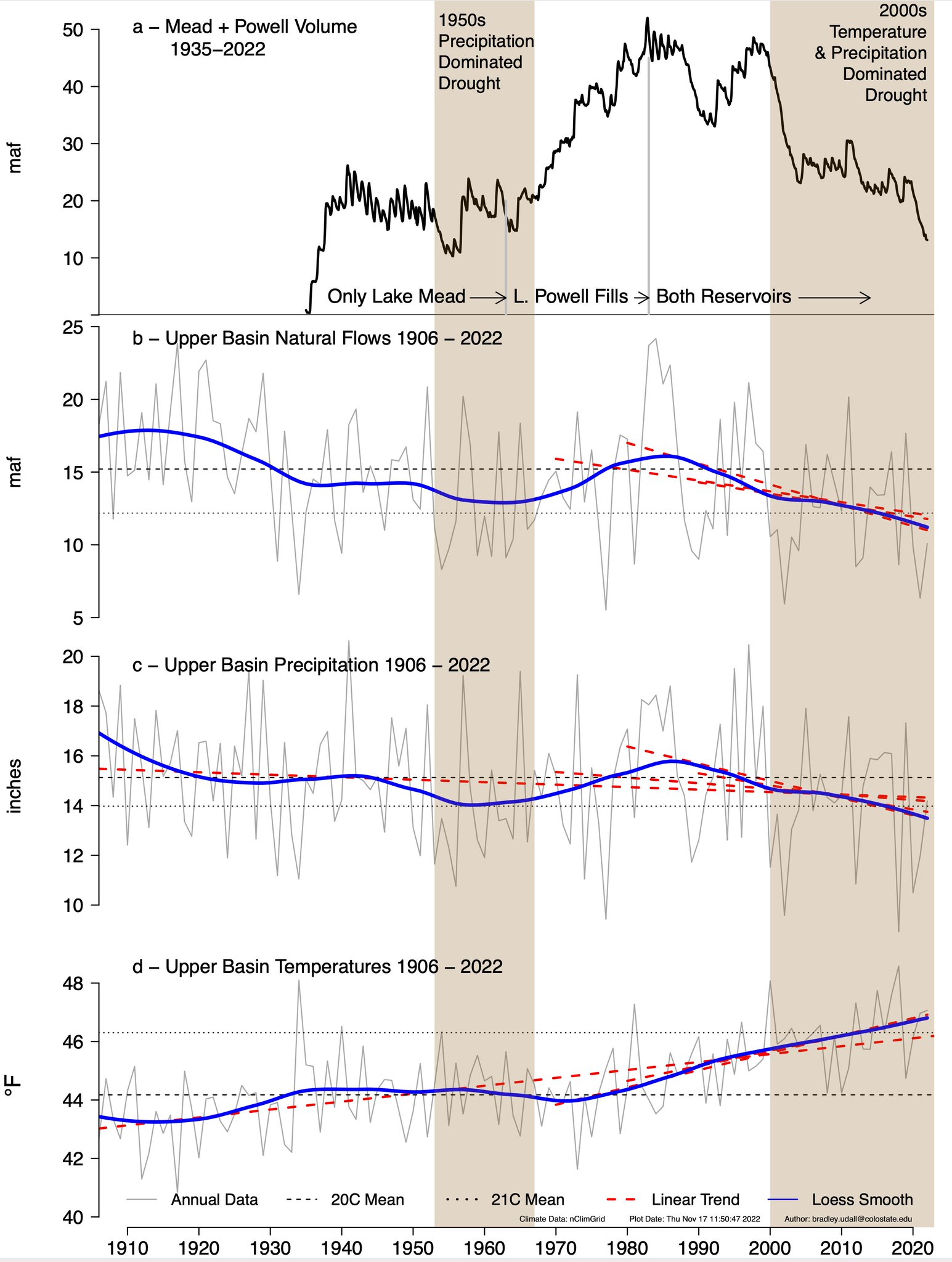
Now, with the Colorado River delivering an average 12.5 million acre-feet, far less than the 20-plus assumed by those who crafted the compact, with flows expected to decline further, we have hard decisions to make. Tribal voices are being integrated into the discussions. Not fast enough for some, but very different than just a few years ago, when the federal government merely “consulted” tribes in the 2019 drought plan. The states were fully engaged.
“We need to be at the table, not just at a side table,” said one tribal representative at the Boulder conference.
Some tribes have been amenable to leasing their rights to cities and others. But will tribes with a few thousand members exert as much influence as California with its giant farms and its huge cities? California maintains that its senior rights be respected in any agreements. Still unclear is what hewing to that principle means when it comes to tribes with their even more senior rights.
From the 2018 Tribal Water Study, this graphic shows the location of the 29 federally-recognized tribes in the Colorado River Basin. Map credit: USBR
Also unclear is the practicality of fully integrating the 30 tribes, each with unique circumstances and perspectives, in discussions with the seven basin states and federal government about how to address the sharp limitations imposed by the river. What has changed is broad recognition that tribal voices must better be included. Through the Water and Tribes Initiative, the tribes themselves have insisted upon being heard.
Residual anger at being shunted aside remains. Also ample is a spirit of cooperation. Many representatives suggested their tribes offer creativity and innovations in the community of 40 million Colorado River water users that extends from the farms of northeastern Colorado to the metropolises of Southern California.
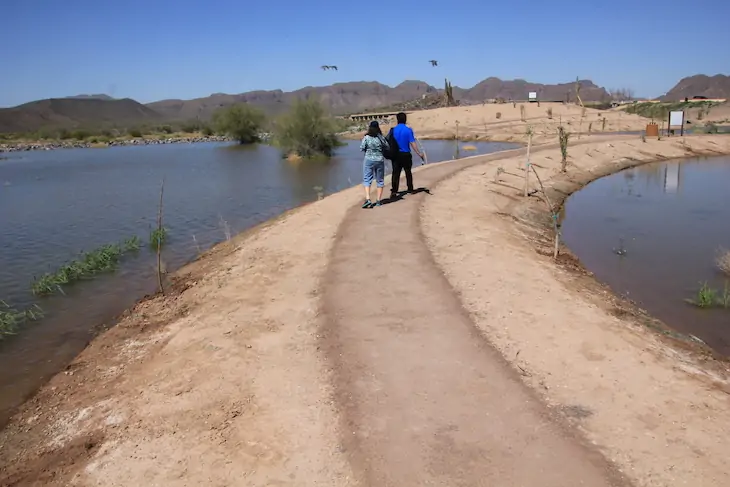
Stephen Roe Lewis, the governor of the Gila River Indian Community south of Phoenix, pointed out that his tribe has undertaken the largest integration of solar panels over water canals in North American, a practice called aquavoltaics.
The Gila River Indian Community, located south of Phoenix, has worked with Arizona collaboratively on projects. Top: Lorelei Cloud, vice chairman of the Ute Mountain Indian Tribe and a director of the Colorado Water Conservation Board, at the entrance to the Ute exhibit at History Colordo in downtown Denver. Photos/Allen Best
Others suggested they offered perspective. The Hopi have been in Arizona for more than 2,000 years. They’ve experienced drought before, said tribal member Dale Sinquah. “Our ceremonies and prayers revolve around water,” he said. “That is what Hopi can contribute, along with dialogue.”
Native Americans often talk of water as being sacred, but that does not mean roped-off, kept in closets. The Native understanding is different than the legalistic framework most of us use. They see water as something to be used, yes, but not in the same lens as most of us, who view it more narrowly as a commodity. What that means in practice is hard to tease out.
Peter Ortego, a non-native attorney representing the Ute Mountain Ute Tribe of Colorado, said he found it odd the session had not started with a prayer. “Maybe we should ask, ‘What should we do day to day to respect the spirituality of water?’”
He’s got a point. I’ve never asked that question, but I am very curious about the answer.
A once in 500-year flood event devastated Yellowstone National Park one year ago this month. A lot of infrastructure was destroyed – roads, bridges and buildings literally were swept into rivers. Researchers have since studied the damage, hoping to learn lessons. This includes a specialized group of scientists who study civil infrastructure immediately in the wake of a disaster. Bret Lingwall, an associate professor at the South Dakota School of Mines and Calvin Tohm, who is a graduate student at the school, were at Yellowstone last year collecting data…
What we’re essentially getting is the topography, the shape, the morphology, of the damage. So be that a washed out bridge, or a landslide or a rock fall, or whatever the damage is. We’re collecting what the surface looks like, then later researchers can come back and look at subsurface information. We also collect samples, we collect soil and rock samples to take back to the lab for laboratory testing and further analysis… — Bret Lingwall
On the physical infrastructure side, we’ve got conclusions about the physical construction of bridges, and things like the wing walls, which protect abutments from erosion. Also, placement of bridges – giving plenty of room for the rivers to do what the river wants to do and move within its floodplain. On the policy side, these events were yet another critical data point in the growing database of our knowledge. As a science and engineering community, we’re learning that the famous 100-year flood exceedance probability criteria for design is probably insufficient for the way our communities are constructed, and how they actually operate. Higher standards are likely required due to the increasing what we call ‘fragility of our communities.’ So the 100-year standard was selected many, many, many years ago. And we’ve learned a lot since then, and these floods were important data to contribute to the efforts that are underway in the various code and organizational committees across the country to raise the flood standards for infrastructure, instead of from 100-year to maybe 250, 500 or 700-year flood events. Because these are the events that are more damaging. There’s just more losses than we probably want to tolerate as a community… — Bret Lingwall
But really, when it comes to any community that is in a mountainous riverine environment where you have rivers, creeks and streams that seem small and tame on a year-to-year basis, but what a fury that can be unleashed in these extreme flood events.
Click the link to read Nolan Doesken’s message on the CoCoRAHS website:
Fort Collins, Colorado — June 17, 2023
Greetings to all CoCoRaHS Volunteers,
Today marks a significant milestone in the history of our network. On this very day in 1998 our website began accepting data from a few dozen volunteers in and around Fort Collins, Colorado. The internet was still young, and “logging in” to enter data was something brand new to many of us. Back then, little did we know how CoCoRaHS would grow and flourish over the years.
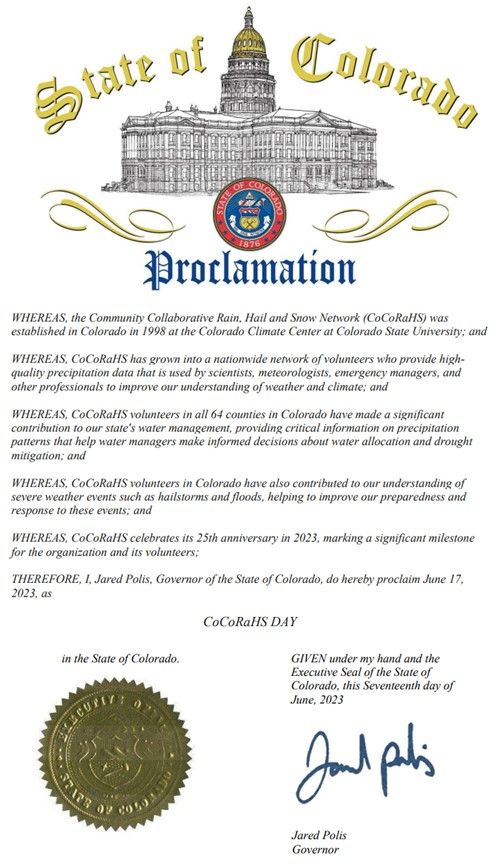
So, “Hear Ye, Hear Ye”, today, the governor of Colorado is declaring June 17, 2023 as “CoCoRaHS Day”! On our 25th anniversary we’ve watched 95,000 stations come and go, with about 26,000 active stations currently submitting data. Each day our database grows into something larger than we’ve ever handled before, and we are currently sitting on a precipitation database with around 70 million records.
Rain or shine, you have ventured outside to measure all types of precipitation, faithfully recording the data that forms the backbone of our network. Your commitment has made CoCoRaHS what it is today, and I am immensely grateful for your contributions.
Russ Schumacher, the new state climatologist that replaced me when I retired, wrote a nice article about our anniversary with some neat maps showing the growth over the years, and a link to view the Governor’s Proclamation.
Please follow our Message of the Day, as we celebrate our 25th anniversary by reviewing some of the benchmarks throughout our history.
Or sing along in this quick video with myself and a couple of staff members to celebrate with my favorite cake – a boston creme pie!
All American Canal Construction circa. 1938 via the Imperial Irrigation District. The 80-mile long canal carries water from the Colorado River to supply nine Southern California cities and 500,000 acres of farmland in the Imperial Valley where a few hundred farms draw more water from the Colorado River than the states of Arizona and Nevada combined
Click the link to read the article on the Inside Climate News website (Wyatt Myskow and Emma Peterson, June 17, 2023):
The price of water is rising across the Southwest as utilities look to cover the cost of the increasingly scarce resource, the infrastructure to treat and distribute it and the search for new supplies.
PHOENIX—Across the Southwest, water users are preparing for a future with a lot less water as the region looks to confront steep cuts from the Colorado River and states are forced to limit use to save the river. Farms are being paid to not farm. Cities are looking to be more efficient and find new water supplies. And prices are starting to go up.
In Phoenix, the city’s Water Services Department is preparing to increase residents’ monthly water bills starting this October if the hike is approved by the city council. The city isn’t alone. Water providers throughout the entire Colorado River Basin have raised water rates, or are preparing to, to compensate for increasing costs of infrastructure repairs and water shortages along the river. Inflation is driving up the costs of resources to treat and deliver water to customers, and other additional fees are planned to incentivize conservation.
The issue is economics 101, said Casey Wichman, an assistant economics professor at Georgia Institute of Technology and a university fellow with Resources for the Future who studies water pricing. Providers along the basin are coming to terms with the diminishing supply in the river and the infrastructure that needs to be repaired or replaced, largely driven by the rapid growth in population. All of those drive up costs, he said.
“The cheapest way to build new supply is just to get your customers to use less.” To do that, he said, water utilities often turn to raising rates, making the need to incentivize conservation another driver of the increasing price of water.
Finding new water sources and getting people to conserve more is becoming increasingly important as the Southwest grapples with climate change and looks to shore up its supply.
“We have a lot of people living in areas where the water supplies just aren’t there,” Wichman said.
Arizona released a report this month showing the Phoenix metropolitan area was over-drafting the region’s groundwater and announced that moving forward, no new development would be allowed if it relied on groundwater. Throughout the Valley, cities like Phoenix and Tempe are introducing drought contingency plans. Further cutbacks of Colorado River water, particularly in the Lower Basin, which consists of Arizona, California and Nevada, are unavoidable.
The region has experienced more than 20 years of drought and decades of overallocation. Arizona’s supply from the Colorado River has already been extensively cut back, and under a proposal from the river’s Lower Basin states introduced last month and supported by the Biden Administration, the states would agree to cut an additional 3 million acre feet of water over the next three years to prevent Lake Mead and Lake Powell, the nation’s two largest reservoirs, from falling to levels that wouldn’t allow electricity generation at the Hoover and Glen Canyon dams, or the river stops flowing past the dams altogether.
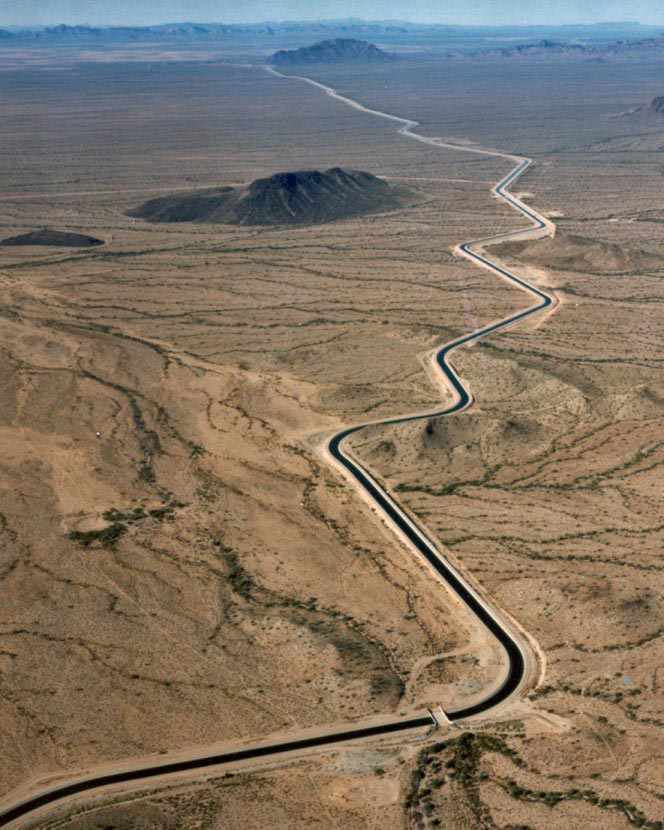
Aerial photo – Central Arizona Project. The Central Arizona Project is a massive infrastructural project that conveys water from the Colorado River to central and southern Arizona, and is central to many of the innovative partnerships and exchanges that the Gila River Indian Community has set up. Public Domain, https://commons.wikimedia.org/w/index.php?curid=326265
In recent years the Central Arizona Project, a 336-mile-long system that delivers Arizona’s allocation of Colorado River water to around 80 percent of the state’s population, has seen a nearly 25 percent cut in the amount of water that flows through its canal.
The price CAP charges is derived from how much it costs to deliver the water to where it needs to go, said Chris Hall, CAP’s assistant general manager for administration and finance. If less water is being delivered to the state, the price of each gallon will go up.
“We’re spreading that cost over fewer acre feet. It’s really just that simple,” he said. “It doesn’t have anything to do with us having to do any major retrofits to accommodate less deliveries or change our business operations in a meaningful way. It’s just less water.”
This year, the cost of an acre foot of water, enough for about three homes for a year, is $217. Next year it will be $270. By 2028, CAP is expecting the price to rise to $323.
“Water in the Southwest is still, especially in Arizona, relatively affordable,” Hall said. CAP’s goal, he said, is ensuring rates go up in a way that is stable.
Rates Have Long Been Too Low, Experts Say
Among the biggest expenditures in water utility infrastructure are pipelines. In order to fund their repairs and replacements, utilities will have to raise the price of water. Many experts believe that is long overdue, and that water rates haven’t been high enough to keep up with the large investments required to keep infrastructure in acceptable condition.
The City of Phoenix has over 7,000 miles of utility pipelines that deliver water to companies and households. The average water pipe will last 70 to 75 years in Arizona, but a large portion of them are reaching that age where they need to be replaced. While these pipes are built to last using what, at the time of any given pipeline’s construction, are enormously expensive and durable components, corrosion takes place over time and the pipe can crack, introducing contaminants into the drinking water system.
“It is a matter of water quality and water reliability,” said Kathryn Sorenson of Arizona State University’s Kyl Center for Water Policy.
Utility companies and elected officials are reluctant to raise prices, she said, which underfunds these vital investments. Other experts believe water prices across the country are historically low, and increases are inevitable.
“Water is remarkably cheap for the value it provides to individuals and how we can’t sustain life without it,” said Wichman, the assistant economics professor.
But raising rates isn’t a simple task, he said. Cities like Phoenix have a much larger customer base to spread the increased costs over, he said, but rural communities tend to just eat the costs or not increase rates at the pace needed.
Wichman said residents feel the same way about higher water rates as they do higher taxes: They’re not big fans.
At a May public meeting regarding the proposed increase in Phoenix’s water rates, residents were skeptical of the proposal. “I want the city to be a lot more creative in how they search for funds to help cover some of these costs other than just putting it on the backs of the ratepayers,” said Jeff Spellman, a West Phoenix resident, who also questioned how the city would make sure the parts of the city most affected by climate change—like his—get the help they need to confront it.
Residents on fixed incomes, like Spellman, have expressed concern over water increases and how they will affect their lives, as well. “My pension isn’t going up by almost 40 percent like these rates are,” he said.
Higher water rates tend to have a greater impact on people in low-income communities, who generally have less efficient appliances and households with more members, resulting in more use, Wichman said.
He said that utilities often adopt complicated rate structures designed to recover costs, promote conservation and keep fees affordable, but those are all very different, and often contradictory, goals. “Those tend to not work that well,” Wichman said.
There are no laws capping how much municipal utilities can charge per month for water, just some that require it be reasonably priced. The Arizona Corporation Commission, however, has a strict rate-making process, Sorenson said, that is taken very seriously.
Cutbacks, Inflation and Conservation Spike Rates
For providers in Arizona that get water from the Colorado River, the costs are beginning to add up.
Starting this October, Phoenix customers could see a 6.5 percent increase—roughly $2 for the average user per month—with another 6.5 percent increase next March and a final 13 percent increase in 2025. Phoenix Water Services will also impose a water allowance on customers to promote conservation, resulting in a $4 increase each month should customers use more than what is allotted to them.
For Phoenix, the rate increases were born out of trying to find a way to signal to residents how much water they were using, said Water Services director Troy Hayes. The city currently has a flat rate for water until a customer uses a certain number of gallons.
“If you use water below that, your bill doesn’t change,” Hayes said. “So they can go up and go down as long as they stay below that amount. They just don’t have really a concept of the amount of water they’re using.”
Many believe raising water rates is the best, and perhaps the only way to disincentivize citizens from overusing their allotments.
“Back in the 1970s, something like 75 to 80 percent of single-family homes in Phoenix had majority turf or lush landscaping, that number today is down to nine percent,” Sorenson said.
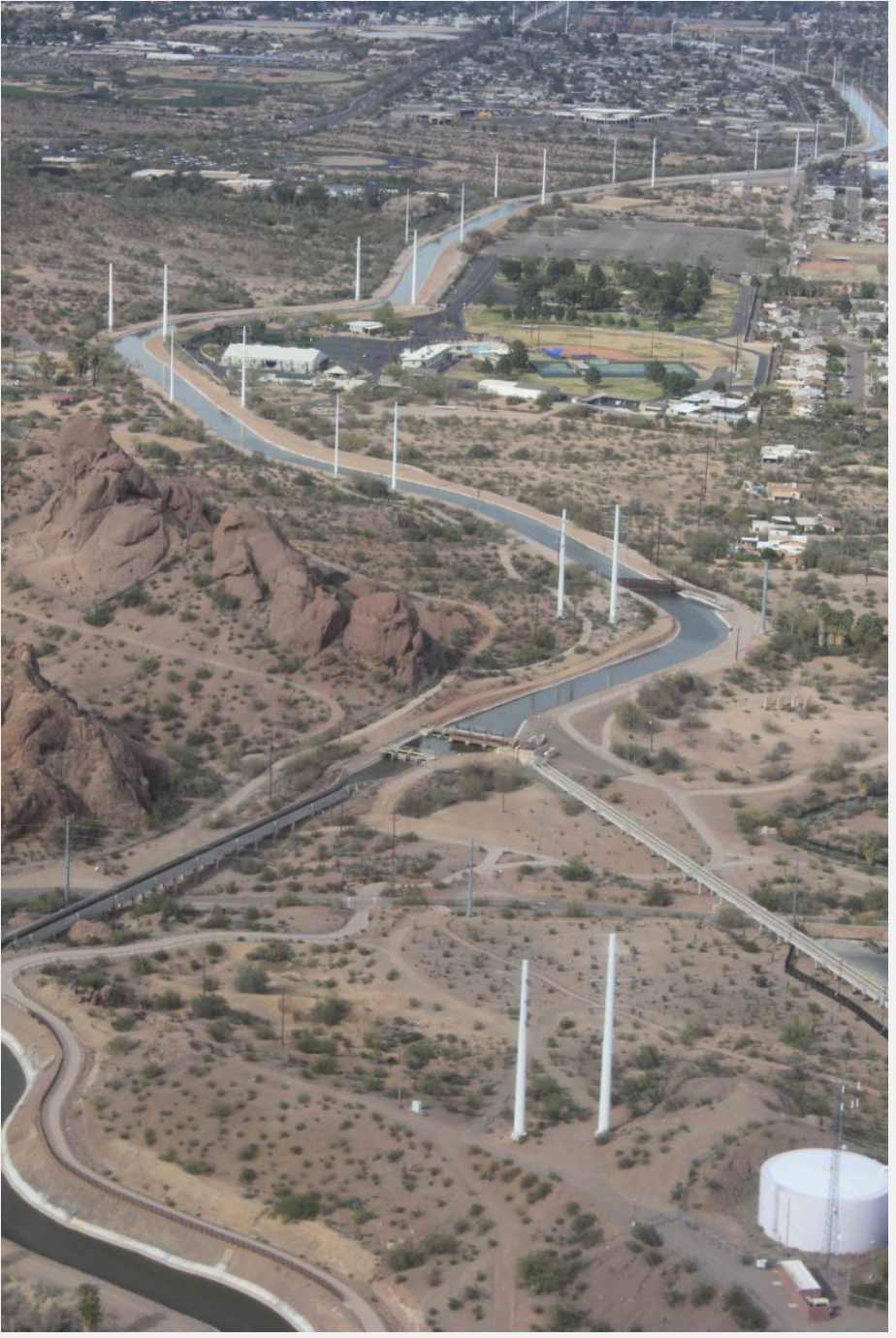
A canal delivers water to Phoenix. Photo credit: Allen Best
She believes a huge amount of that change is directly related to Phoenix charging more in the summer months for water than winter months, giving a direct price signal that people will pay attention to.
The cost of raw water has gone up 35 percent in recent years, according to the city, but it’s not just the price of water itself driving the change. Inflationary pressures are having big impacts, too, with the chemicals to treat the water to drinkable standards rising by 136 percent.
Measures to reduce the demand on the river and overtaxed aquifers are forcing cities to invest hundreds of millions of dollars to find new sources of water, whether from desalination, agreements with tribal governments, recycling more wastewater or finding new untapped groundwater resources. Those costs, water utility directors and city staff have said, will force utilities to raise rates in the future to pay for the new sources of water.
The pressures from inflation are not isolated to Arizona, though.
Colorado Springs Utilities raised rates by 5 percent at the beginning of the year to address inflation and infrastructure projects. The utility created a separate fund supported by a new fee to purchase other water rights and infrastructure, according to Jennifer Jordan, a spokesperson for the utility. Denver also raised its rates this year.
California has also implemented fees for years to discourage overuse, which is expected to increase.
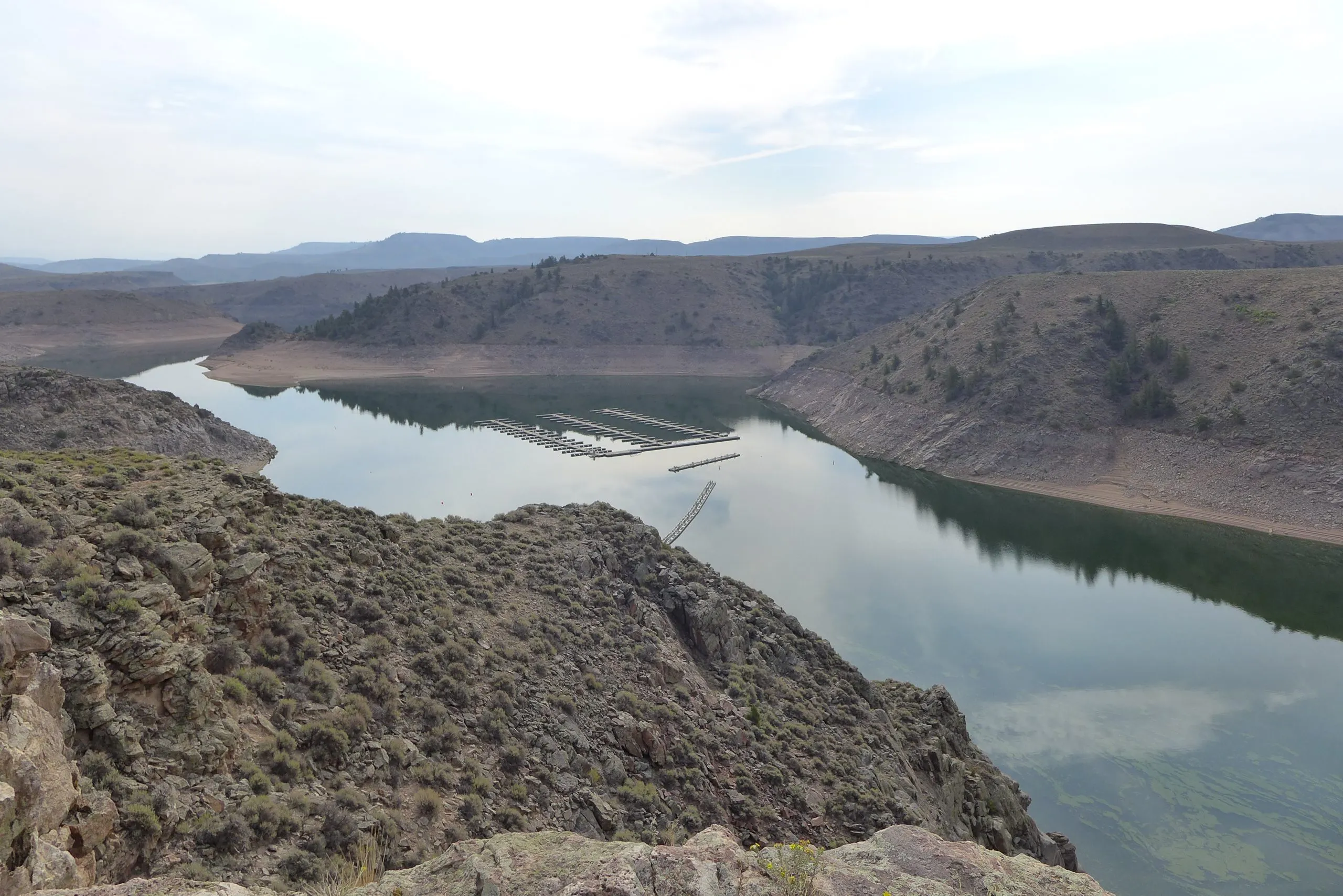
The boat ramp at Elk Creek Marina had to be temporarily closed so the docks could be moved out into deeper water. Colorado water managers are not happy that emergency releases from Blue Mesa Reservoir are impacting late summer lake recreation.
CREDIT: HEATHER SACKETT/ASPEN JOURNALISM
As of Monday [June 12, 2023], the state’s largest body of water was 16 feet from being full to the brim. That means 685,000 acre-feet sitting in the reservoir right now, with spring runoff from a snowy winter not quite finished.
“That’s way better than anybody thought it would be this year,” Bureau of Reclamation hydrologist Erik Knight said Monday. “It’s going to get close (to filling). If it doesn’t, it will probably be within 5 feet.”
[…]
The Gunnison Tunnel, which brings vital irrigation water to the Uncompahgre Valley, has taken its full amount at about 1,000 cubic feet per second. The power plant at Crystal Dam is at full capacity and the river downstream from the tunnel is flowing at about 1,000 cfs.
West Drought Monitor map June 22, 2021.
In 2021, drought was so dire in the West that provisions of the Colorado River Drought Contingency Plan kicked in, and BuRec was obliged to release water from the already hurting Blue Mesa to Lake Powell, to keep that reservoir from dropping below the levels necessary for power plant turbines at the Glen Canyon Dam. Knight said no releases from Blue Mesa to prop up Powell are expected this year. The larger reservoir, though, is not in perfect shape and the water crisis on the Colorado River remains…
Ridgway Reservoir, fed by the Uncompahgre River and Dallas Creek, is also in good shape, said Steve Pope, manager of the Uncompahgre Valley Water Users Association…Pope noted there is still snow sitting in the high country above the reservoir that is to come down. He said excess would be bypassed through the headgates.
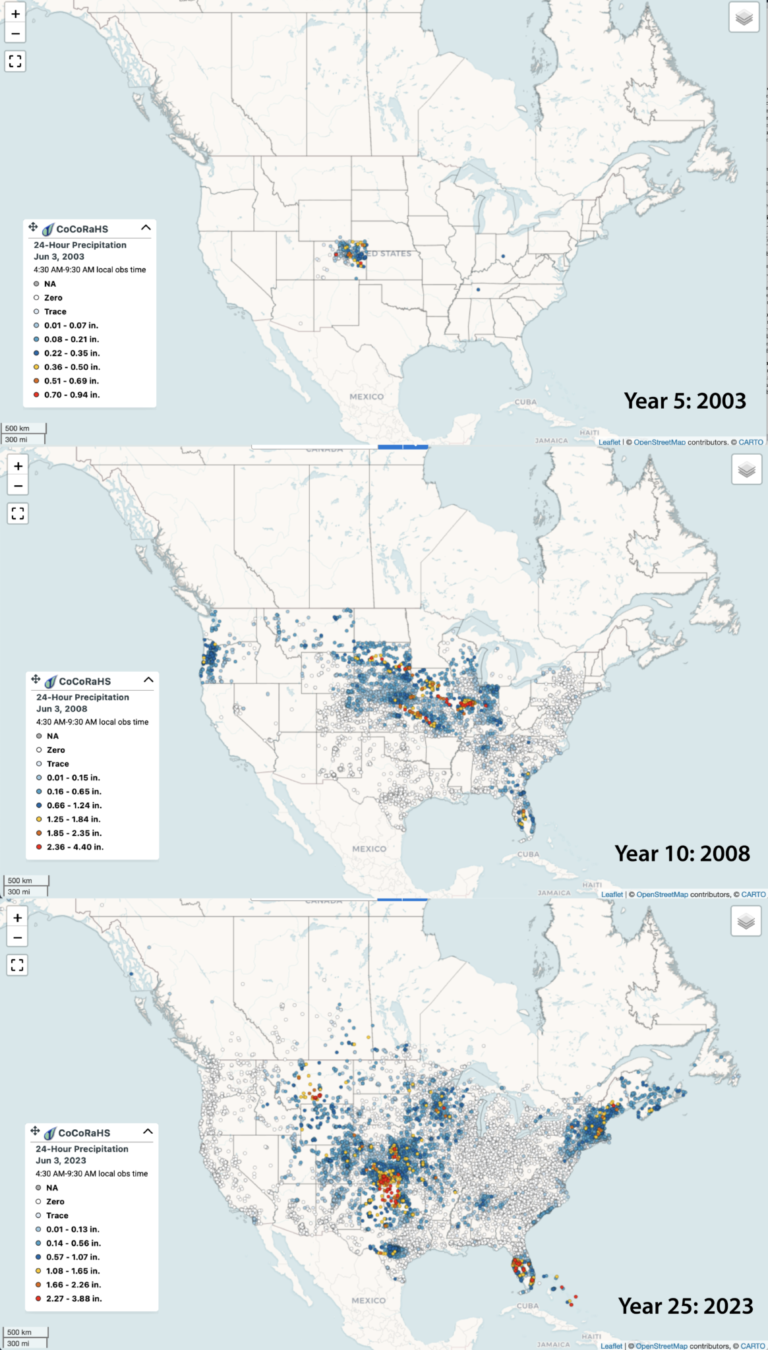
The growth of CoCoRaHS: observations from June of year 5 (2003), year 10 (2008), and year 25 (2023).
After the 1997 rainstorm, former state climatologist Nolan Doesken set out to determine how much rain had fallen in Fort Collins. Using water collected in buckets or whatever else may have offered a reasonable estimate, he and colleagues discovered that the rain was extremely localized, with over 12” on the west side of town, but only 1” on the east side. The official rain gauge on campus recorded 6.17” of rain over two days. But Nolan realized that if local residents had relatively low-cost rain gauges outside their homes, and if there were a way to systematically collect the daily rainfall totals from these “citizen scientists”, that it would be possible to paint much more detailed pictures of future rainstorms.
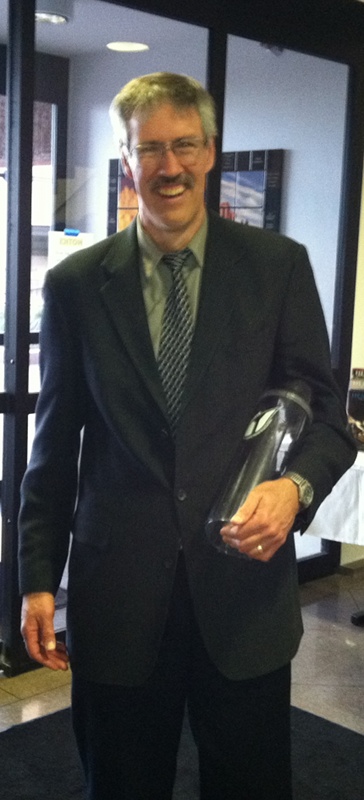
Nolan Doesken — Colorado Water Foundation for Water Education President’s Award Presentation 2011
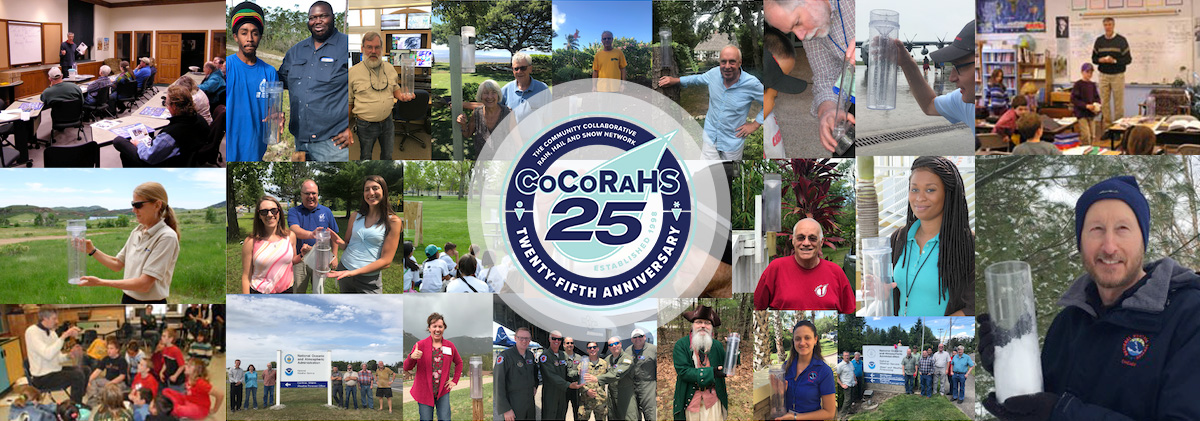
CoCoRaHS began as a local effort in Fort Collins, with the first observations entered on June 17, 1998. The network expanded to the rest of Colorado, then nationwide, then internationally. CoCoRaHS now has over 26,000 volunteer observers across the United States (including all 50 states, Puerto Rico, Guam, and the US Virgin Islands), Canada, and the Bahamas, and it is the single largest source of daily precipitation measurements in the US. In 2022, over 5 million observations were collected, and there are no signs of slowing down.
CoCoRaHS volunteers are dedicated—because the official gauge holds about 11 inches of rain, stories have been shared from observers in tropical areas diligently dumping out their gauge once or twice per day during major storms to ensure accurate measurements. The data collected by CoCoRaHS observers are trusted for a wide array of applications: they are vital to National Weather Service operations in monitoring droughts and floods, by meteorologists studying rainfall and hailstorms, and as “ground truth” for researchers when calibrating advanced radar systems. Farmers and ranchers contribute measurements to the network, and also rely on the data to inform their operations.
The CoCoRaHS network is managed by a small, dedicated group of staff at the Colorado Climate Center at CSU, but the “Community” part of CoCoRaHS is truly vital to its success. In addition to sharing and comparing their rainfall measurements, CoCoRaHS volunteers connect with one another online for “WxTalk Webinars”, and even at in-person gatherings. Volunteer coordinators recruit new observers and ensure the data meet the highest quality standards. CoCoRaHS has also advanced a wide range of educational activities, encouraging schools to participate and contributing to climate and water literacy activities across the country.
And even after 25 years, the network continues to grow. If you, or someone you know, are always watching the weather, then you are a perfect candidate to become a CoCoRaHS observer. The only requirements are an official rain gauge, enthusiasm to carefully measure precipitation each day, and the excitement to be a citizen scientist.
CPW cautions public to avoid Arkansas River below Lake Pueblo due to high, cold, surging water flows
PUEBLO, Colo. – Colorado Parks and Wildlife and its partner agencies are urging the public to avoid the Arkansas River below the Lake Pueblo State Park dam as flows have exceeded 3,000 cubic feet per second (CFS) due to recent normal runoff from spring snow melt in the mountains and locally heavy rains.
CPW, the Pueblo County Sheriff’s office and the City of Pueblo Fire Department are warning that the currents in the river below the dam are fluctuating dramatically, causing surges in the water levels. And the water is extremely cold below the dam – just 58 degrees – because of the spring runoff from the high mountains around the Upper Arkansas River Valley.
“We urge everyone to stay out of the river until the flows calm down,” said Joe Stadterman, CPW’s park manager at Lake Pueblo. “And anyone fishing along the banks should wear life jackets. This is an especially important time to be safe around the river.”
Spring runoff from snowmelt typically causes water levels in Lake Pueblo, in the Arkansas River below the dam and through the city of Pueblo to jump dramatically. Recent heavy rains have compounded the surge of water into the lake forcing heavier than normal releases from the dam.
This week, water is being released at a rate of about 3,365 cfs. That translates to a discharge rate equal to one cubic foot of water per second or about 7.5 gallons per second. Prior to this surge, water was being discharged at just about 200 cfs or less.
“The tailwaters below the dam are a popular place to fish and tube,” Stadterman said. “But this is not a safe time for any activities in the water. Everyone should wait until this river advisory is lifted and the flows are back to normal.”
The partner agencies expect the river advisory to remain in place for at least a week. Please await further information as to when flows are reduced and the river is back to normal levels.
CPW manages recreation at Lake Pueblo in partnership with its owner, the U.S. Bureau of Reclamation. The bureau built Lake Pueblo in 1970-75 as part of the Fryingpan-Arkansas water diversion, storage and delivery project. It provides West Slope water to upwards of 1 million Front Range residents, primarily in southeastern Colorado, as well as agricultural irrigation.
WASHINGTON — The Department of the Interior today [June 15, 2023] announced that it is initiating the formal process to develop future operating guidelines and strategies to protect the stability and sustainability of the Colorado River. The new guidelines will replace the 2007 Colorado River Interim Guidelines for Lower Basin Shortages and the Coordinated Operations for Lake Powell and Lake Mead, which are set to expire at the end of 2026.
The robust and transparent public process will gather feedback for the next set of operating guidelines, including new strategies that take into account the current and projected hydrology of the Colorado River Basin. The Basin is currently facing an historic drought, driven by climate change, that is increasing the likelihood of warming temperatures and continued low-runoff conditions, and therefore reduced water availability, across the region.
“The Biden-Harris administration has held strong to its commitment to work with states, Tribes and communities throughout the West to find consensus solutions in the face of climate change and sustained drought. Those same partnerships are fundamental to our ongoing work to ensure the stability and sustainability of the Colorado River Basin into the future,” said Deputy Secretary Tommy Beaudreau. “As we look toward the next several years across the Basin, the new set of operating guidelines for Lake Powell and Lake Mead will be developed collaboratively based on the best-available science.”
“Developing new operating guidelines for Lake Powell and Lake Mead is a monumentally important task and must begin now to allow for a thorough, inclusive and science-based decision-making process to be completed before the current agreements expire in 2026,” said Reclamation Commissioner Camille Calimlim Touton. “The Bureau of Reclamation is committed to ensuring we have the tools and strategies in place to help guide the next era of the Colorado River Basin, especially in the face of continued drought conditions.”
The process announced today is separate from the recently announced efforts to protect the Colorado River Basin through the end of 2026. The Supplemental Environmental Impact Statement to revise the December 2007 Record of Decision will set interim guidelines through the end of 2026; the process announced today will develop guidelines for when the current interim guidelines expire.
The Notice of Intent to prepare an Environmental Impact Statement asks the public to consider the past 15 years of operating experience since adoption of the 2007 Interim Guidelines, as well as how the best-available science should inform future operational guidelines and strategies that can be sufficiently robust and adaptive to withstand a broad range of hydrological conditions. The NOI also asks the public to consider how and whether the purpose and elements of the 2007 Interim Guidelines should be retained, modified, or eliminated to provide greater stability to water users and the public throughout the Colorado River Basin. The NOI will be available for public comment until August 15, 2023.
While the post-2026 process would only determine domestic operations, the Biden-Harris administration is committed to continued collaboration with the Republic of Mexico. It is anticipated that the International Boundary and Water Commission will facilitate consultations between the United States and Mexico, with the goal of continuing the Binational Cooperative Process under the 1944 Water Treaty.
President Biden’s Investing in America agenda represents the largest investment in climate resilience in the nation’s history and is providing pivotal resources to enhance the resilience of the West to drought and climate change, including to protect the short- and long-term sustainability of the Colorado River System. Through the Bipartisan Infrastructure Law, Reclamation is investing $8.3 billion over five years for water infrastructure projects, including water purification and reuse, water storage and conveyance, desalination and dam safety. The Inflation Reduction Act is investing an additional $4.6 billion to address the historic drought.
To date, the Interior Department has announced the following investments for Colorado River Basin states, which will yield hundreds of thousands of acre-feet of water savings each year once these projects are complete:
$281 million for 21 water recycling projects that are expected to increase annual water capacity by 127,000 acre-feet annually
Over $73 million for infrastructure repairs on water delivery systems, $19.3 million in fiscal year 2022 and another $54 million announced last month
$71 million for 32 drought resiliency projects to expand access to water through groundwater storage, rainwater harvesting, aquifer recharge and water treatment
Eight new System Conservation Implementation Agreements in Arizona that will commit water entities in the Tucson and Phoenix metro areas to conserve up to 140,000-acre feet of water in Lake Mead in 2023, and up to 393,000-acre feet through 2025
Representatives from more than a dozen Indigenous tribes spoke at a CU Boulder law conference last week about their interests in the Colorado River from each of their perspectives. Many of the prominent state and federal officials who manage the water attended the conference. But as they and other water authorities prepare to negotiate the river’s future, it’s unclear how tribes will participate, to what degree tribes will be treated as equal sovereigns, and how their desire to use all the water they legally have rights to will be considered. It’s also unclear whether negotiators will aim for a way to make the long-term reductions in water usage that a decades-long megadrought has made necessary or whether they will propose more short-term changes.
The gathering happened at a critical time: Collectively, Colorado River users have to figure out how to live with significantly less water going forward, and the federal government is forcing states to come to an agreement…
The group of tribal representatives and state water officials, along with academics who study the river, used the two-day conference for discussions about how to make their collective use of the river more sustainable over the long term…The tribes have a shared history of using the river and its tributaries over thousands of years and migrating based on water availability. In the century since the river has been dammed and diverted across seven states, each tribe has a different story about how their water rights have been denied and what they seek to change in the river’s management going forward…
Some river scholars and even people with roles in the negotiations are unclear about what’s possible as they determine longer-term allocations of the water…A lot is at stake for tribes, and each circumstance is unique…For example, Hopi Tribe council member Dale Sinquah said his people still need to have their water rights settled. Southern Ute Tribal Council Vice Chair Lorelei Cloud said the tribe wants to use water they have legal rights to in southwestern Colorado, but they don’t have the infrastructure. She said about 1,000 tribal members still have to manually haul water to their homes, and the tribe hasn’t been able to develop farmland…Crystal Tulley-Cordova from the Navajo Nation said her tribe couldn’t rely on groundwater because of abandoned uranium mines on their land. Dwight Lomayesva, vice chairman of the Colorado River Indian Tribes on the border of California and Arizona, said his people would like to upgrade their farming and water infrastructure to make it more efficient, but the federal government still owns it. “The last major change in our irrigation infrastructure was made in 1942, when the United States government built some canals for the Japanese who were interned on our reservation,” he said. Each needs to negotiate for themselves individually.
“To think that there’s an ‘Indian solution,’ really dishonors that individuality and the uniqueness of each one of those tribes,” said Daryl Vigil, a Jicarilla Apache water leader who used to direct a tribal partnership in the Colorado River basin.
From the 2018 Tribal Water Study, this graphic shows the location of the 29 federally-recognized tribes in the Colorado River Basin. Map credit: USBR
The Colorado River in McInnis Canyons National Conservation Area, near Grand Junction, Colorado, on April 26, 2019. Photo by Mitch Tobin/The Water Desk
To save the Colorado River, its water users must look at radical new options, including a hard stop on new diversions, dams and reservoirs across the seven-state river basin, managing lakes Powell and Mead as one entity, and paying millions to farmers who agree to permanently switch to water saving crops and to change irrigation practices.
Those were among suggestions experts offered at a University of Colorado conference focused on the river June 8 and June 9 presented by the Getches-Wilkinson Center for Natural Resources, Energy and the Environment and the Colorado River Basin’s Water & Tribes Initiative.
Mark Squillace, a University of Colorado law professor who specializes in water law acknowledged that the ideas, such as banning nearly all new development of water on the river, weren’t likely to be popular among established water users.
“But we can’t just keep appropriating water,” he said. Already heavily overused, the river’s dwindling supplies must still be reallocated to set aside water for the 30 Native American tribes whose reservations are located within the basin. Several of them have been waiting more than a century to win legal access to water promised to them by the federal government.
Pushed to the brink by a 22-plus year drought, overuse and shrinking flows caused by climate change, the river’s dwindling supplies prompted the federal government last summer to order the seven states to permanently reduce water use by 2 million to 4 million acre-feet annually.
The call to stop water development on the Colorado River is being heard more often due to the crisis, but it is a tough sell, especially in states, such as Colorado, that have not developed all the water to which they are legally entitled.
The basin is divided into two segments, with Colorado, New Mexico, Utah and Wyoming comprising the Upper Basin, and Arizona, California and Nevada making up the Lower Basin.
The river’s two largest reservoirs, Lake Powell in the Upper Basin and Lake Mead in the Lower Basin, have long been managed separately with different rules, including the time periods in which water is measured, a critical component of forecasting supplies. But experts say that approach isn’t working and is making it more difficult to rebalance the system.
Map credit: AGU
“Why not do things far more simply,” said Brad Udall, a senior scientist and climate expert at Colorado State University. “Let’s give up the game on Upper Basin and Lower Basin. It just seems stupid. The old system is overly complex. It allows people to game the system.”
Udall was referring, in part, to a set of operating rules adopted in 2007, known as the Interim Operating Guidelines, that were intended to better coordinate operations between the two reservoirs, but which some now believe exacerbated the river’s problems.
This year, thanks to abundant mountain snows and a cool, rainy spring, the river is enjoying a bit of a reprieve. But critical negotiations on how to manage it in the future are set to begin this year, with painful decisions facing the seven states, the tribes and Mexico.
Lessening some of that pain is hundreds of millions of dollars in new federal funding dedicated to helping the basin reduce water use and find more sustainable ways to support critical industries, including agriculture, which uses roughly 80% of the river’s supplies.
But agricultural water use is critical to feeding the nation, and finding ways to reduce it without crippling rural farm economies and threatening the food supply is a major challenge.
To that end, Squillace and others say simple steps will deliver big results. Take alfalfa hay production. Most alfalfa growers irrigate their fields all summer, harvesting the crop multiple times over the course of a growing season. Eliminating one of those harvests late in the growing season could save as much as 845,000 acre-feet of water in the Lower Basin states each year. That alone would cover nearly one-quarter of the water use experts say is needed to help the river recover and sustain itself in an era of dwindling flows.
Also high on the list of important steps to better balance the river is to use most of the tens of million in federal funding to pay for permanent reductions water use.
“I would hate to see us waste our money on temporary things when we know we have a permanent problem,” Squillace said.
Colorado’s U.S. Senator John Hickenlooper, who made a brief video appearance at the conference, said he and other senate colleagues did not want to interfere in state-level talks.
“None of the senators want to meddle in state efforts to come to an agreement,” Hickenlooper said, “But we have to make sure that money is spent wisely, and we also have to look at lasting solutions … we recognize that a lot of traditional landscapes and lifestyles are dependent on us finding the right solutions.”
Jerd Smith is editor of Fresh Water News. She can be reached at 720-398-6474, via email at jerd@wateredco.org or @jerd_smith.
Colorado River “Beginnings”. Photo: Brent Gardner-Smith/Aspen Journalism
After graduating from Stanford Law School and practicing with prestigious firms in Phoenix and San Francisco, Wilkinson embarked on a remarkable career that encompassed teaching, writing, and advocating for the rights of Indigenous Peoples and the environment. In 1971, he joined the newly formed Native American Rights Fund in Boulder, Colorado as a staff attorney, helping to shape the organization’s pathbreaking advocacy for Tribes. Together with the late Dean David Getches, Professor Richard Collins, and NARF Executive Director John Echohawk, Wilkinson helped to secure landmark victories in tribal treaty rights litigation and establish a relationship between Colorado Law and NARF that endures to this day.
Wilkinson was a passionate and inventive teacher and mentor, educating and inspiring thousands of students and scores of colleagues at law schools throughout the country. As his colleagues and students would attest, Wilkinson left an indelible mark, not just on legal education and scholarship, but on those attributes that are the very essence of the American West.
“Charles’s enormous legacy touches every aspect of public lands, natural resources, and American Indian law,” reflected Professor Sarah Krakoff. “He blended fierce advocacy with deep scholarship. He wrote in ways that were accessible to the general public while also influencing policy makers at the highest levels of government. And he was a ceaselessly generous, optimistic, kind, and huge-hearted friend and mentor to generations of students and colleagues. To put it in a way Charles himself might have—Dammit we will miss him, but how very lucky we were to know him.”
Most of Wilkinson’s teaching career was spent at the Oregon and Colorado law schools, where his influence and impact were deeply felt. In 1997, the regents of the University of Colorado recognized Wilkinson as a Distinguished Professor, one of only twenty-five at the University. His gift for teaching and deep commitment to research were repeatedly acknowledged through numerous teaching and research awards throughout his illustrious career. Wilkinson was famous for hiring law students as research assistants and sending them out in the world to learn about legal problems. These opportunities were often life-changing, with dozens of his students going on to practice Indian Law and Public Land Law over the decades.
As a prolific writer, Wilkinson authored fourteen books, which stand as seminal works that shaped the fields of Indian Law and Federal Public Land Law. These include highly regarded casebooks and general audience books, including Crossing the Next Meridian, that tackled pressing issues related to land, water, the West, Indigenous rights, and the complex histories that shape our nation. His writings, marked by their clarity and profound insights, resonated with scholars, practitioners, and the general public, making him an influential voice in legal and environmental discourse. He was an early thought leader in the field of environmental justice, seeing early on that the rights of Native Americans had to be considered at the heart of public lands and conservation policy.
“Charles was a beloved person in Indian country,” said Professor Kristen Carpenter who directs the American Indian Law Program. “From the Navajo and Hopi people in the southwest deserts and canyons to the Yurok, Nisqually, and Siletz people along the rivers and coasts of the northwest, Charles spent much of his life working with tribes and they came to trust him. Charles Wilkinson’s deep, respectful engagement with Indigenous Peoples is a model that the AILP will always share with our students.”
Beyond the classroom, the written word, his work with tribes, and support for students, Wilkinson devoted himself to numerous special assignments for the U.S. Departments of Interior, Agriculture, and Justice. His expertise was sought after, and he played instrumental roles in critical negotiations and policy development. From facilitating agreements between the Timbisha Shoshone Tribe and the National Park Service to serving as a special advisor for the creation of Grand Staircase-Escalante National Monument and Bears Ears National Monument, Wilkinson’s successes extended far beyond the confines of academia.
Charles Wilkinson’s exceptional achievements were recognized through a multitude of prestigious awards and honors. These accolades include the National Wildlife Federation’s National Conservation Award, which acknowledged his unwavering commitment to the preservation of our natural heritage. The Earle A. Chiles Award from the Oregon High Desert Museum celebrated his career-long dedication to the High Desert region, while the Twanat Award from the Warm Springs Museum recognized his tireless work in support of Indian people.
Wilkinson’s visionary leadership and dedication to the Colorado Plateau were honored with the John Wesley Powell Award from the Grand Canyon Trust. Additionally, the Federal Bar Association bestowed upon him the Lawrence R. Baca Award for Lifetime Achievement in Indian Law, recognizing his profound contributions to the field. In 2021, the Colorado Center for the Book and Colorado Humanities honored Charles Wilkinson with the Colorado Book Awards Lifetime Achievement Award for his contributions to the Colorado and national literary, history, and legal communities.
“Charles Wilkinson’s passing brings into sharp focus his extraordinary legacy—a legacy that embodies the very best of what our law school stands for. He was a brilliant advocate, and his life’s work will continue to guide and inspire us,” remarked Dean Lolita Buckner Inniss. “His memory will remain a source of comfort and strength for so many as they carry forward his remarkable dedication and honor the profound difference he made.”
Charles Wilkinson’s legacy will indeed continue to inspire generations to come, as those who knew him directly and those who were touched through his work strive to emulate his vision, passion, and commitment to creating a more just and sustainable world.
To Charles Wilkinson’s family and loved ones, the University of Colorado Law School offers our deepest condolences during this difficult time.
Details regarding a celebration of life will be shared as soon as possible.
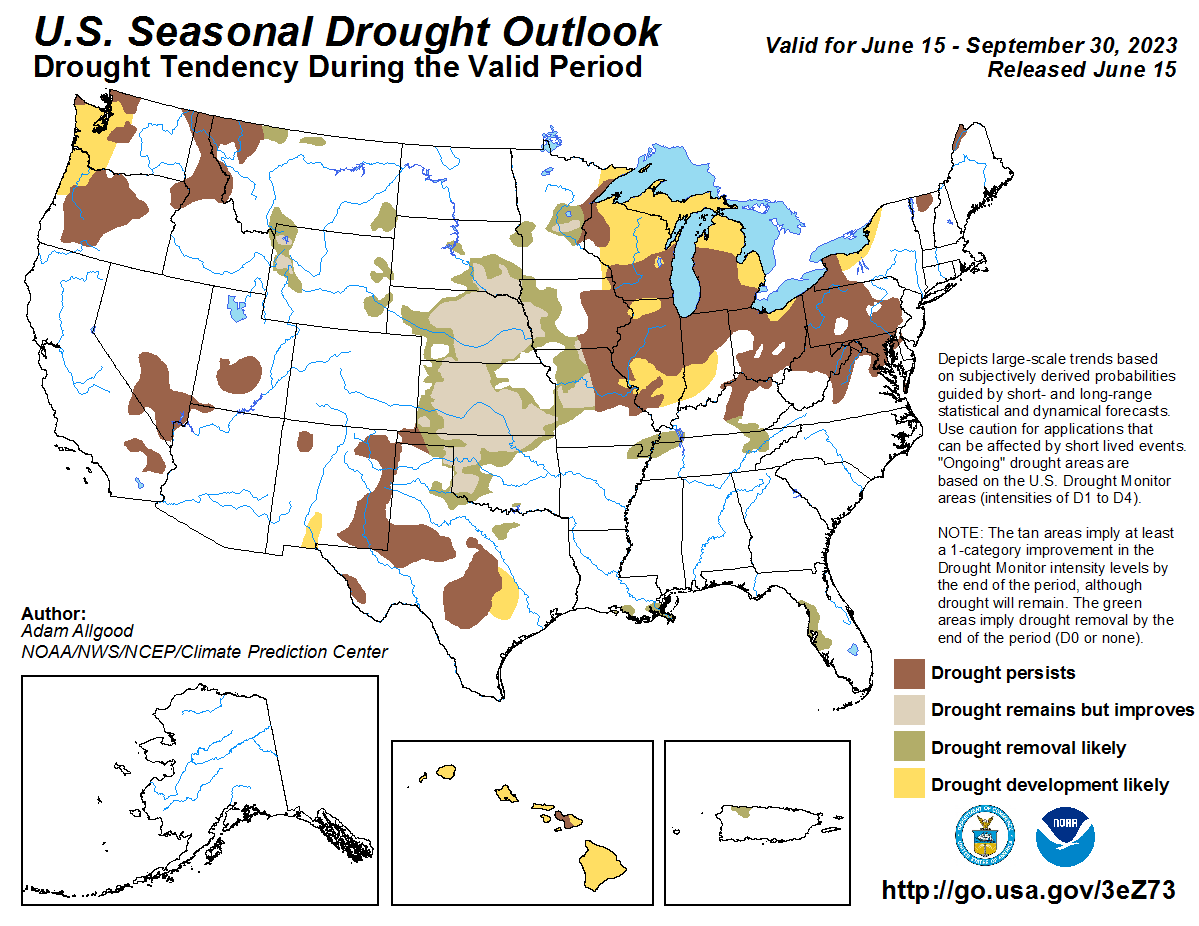
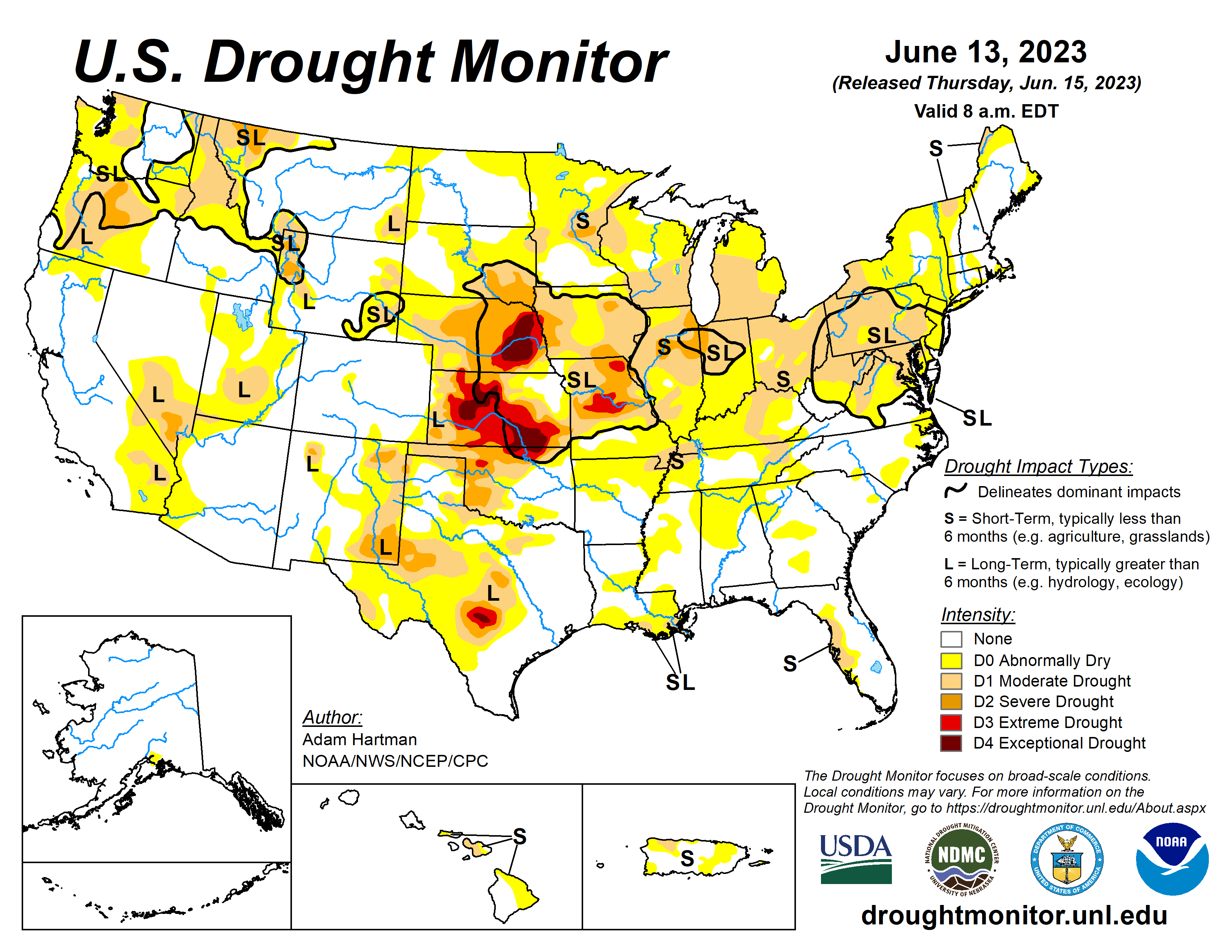
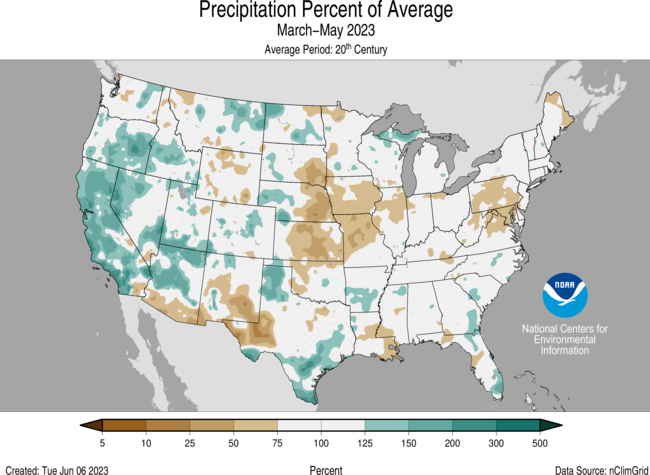
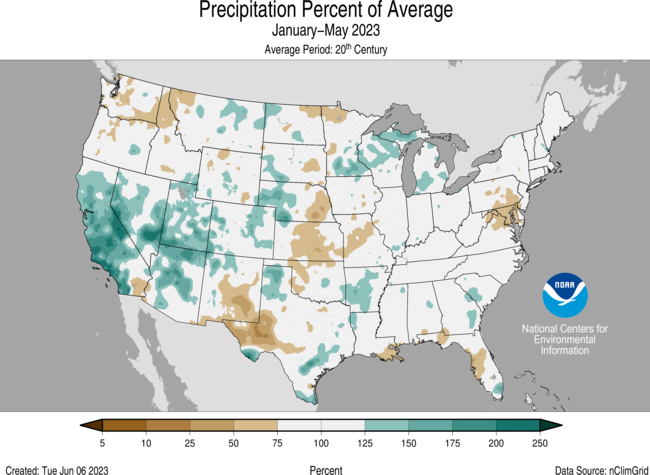
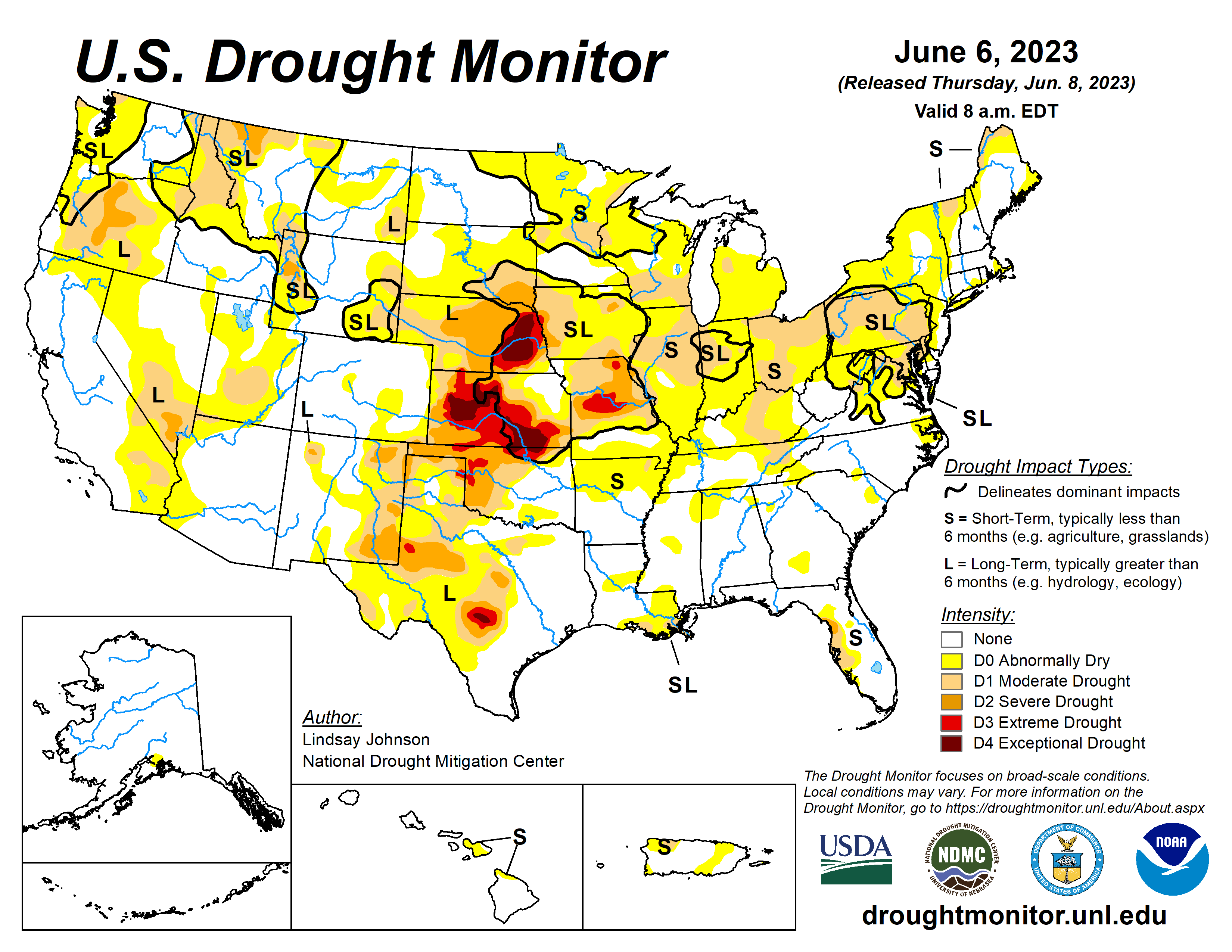
Above normal precipitation and below normal temperatures resulted in another week of targeted improvements across portions of the Intermountain West, adding to recent precipitation totals that have continued to improve long-term drought conditions. The exception is the Pacific Northwest, where below normal precipitation and above normal temperatures resulted in worsening drought conditions along the northern Cascades. There is a mix of improving and worsening drought conditions across the Great Plains. Improvements are mainly confined to the western Great Plains, where widespread 7-day rainfall totals exceeded 200 percent of average for the week, further adding to short-term precipitation surpluses. From the eastern Great Plains to the Eastern Seaboard, 7-day rainfall surpluses are more scattered in nature, leading to only modest improvements in areas seeing the heaviest amounts. In areas that received below normal rainfall this week, drought worsened, as rainfall deficits continue to increase…
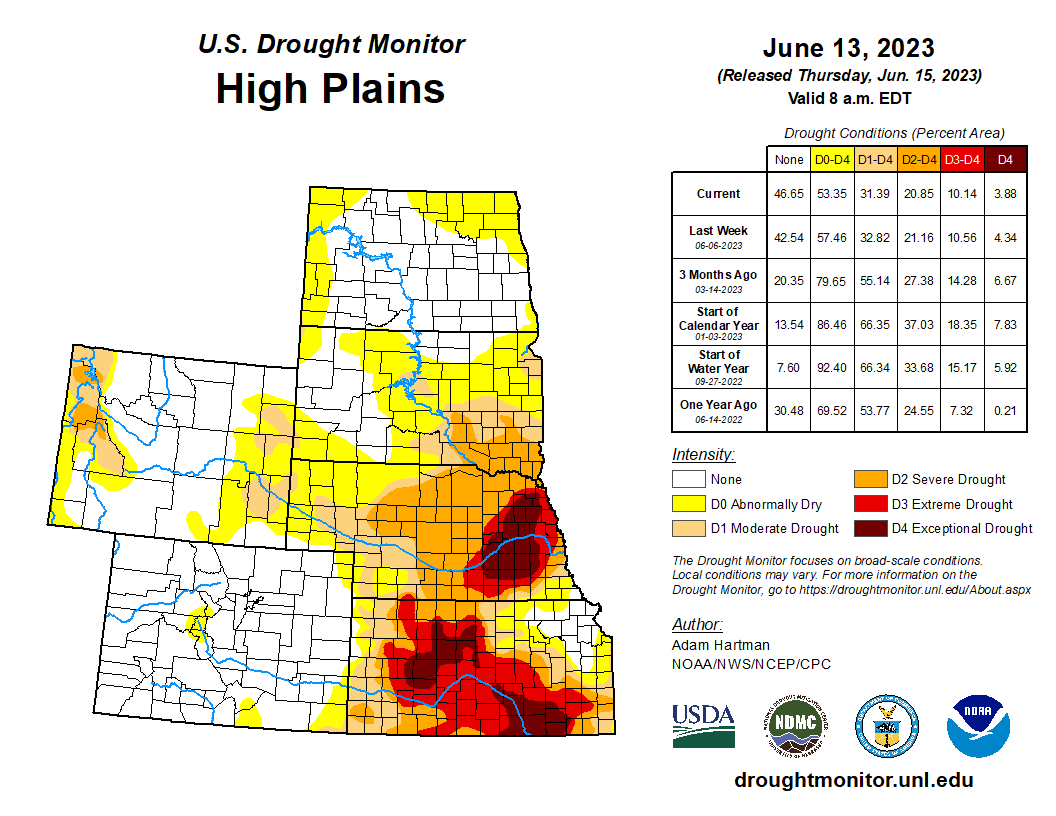
Although much of the High Plains region received above-normal precipitation this week, the region as a whole is a tale of 2 halves. Improvement to the drought depiction is warranted across western portions of the Central and Northern Plains, where 7-day precipitation totals exceeded 200 percent of average across most areas, adding to precipitation surpluses in recent weeks and improving long-term drought indicators. Conversely, deteriorating conditions are warranted across eastern parts of the High Plains region where heavy, convective rainfall was not enough to overcome predominantly near and above normal temperatures and high rates of evaporation from the soils and vegetation (known as evapotranspiration). For example, parts of South Dakota reported evapotranspiration rates from crops averaging around 0.25 inches per day, which varied slightly depending on the type of crop, essentially eliminating the effects of beneficial rainfall for several locations…
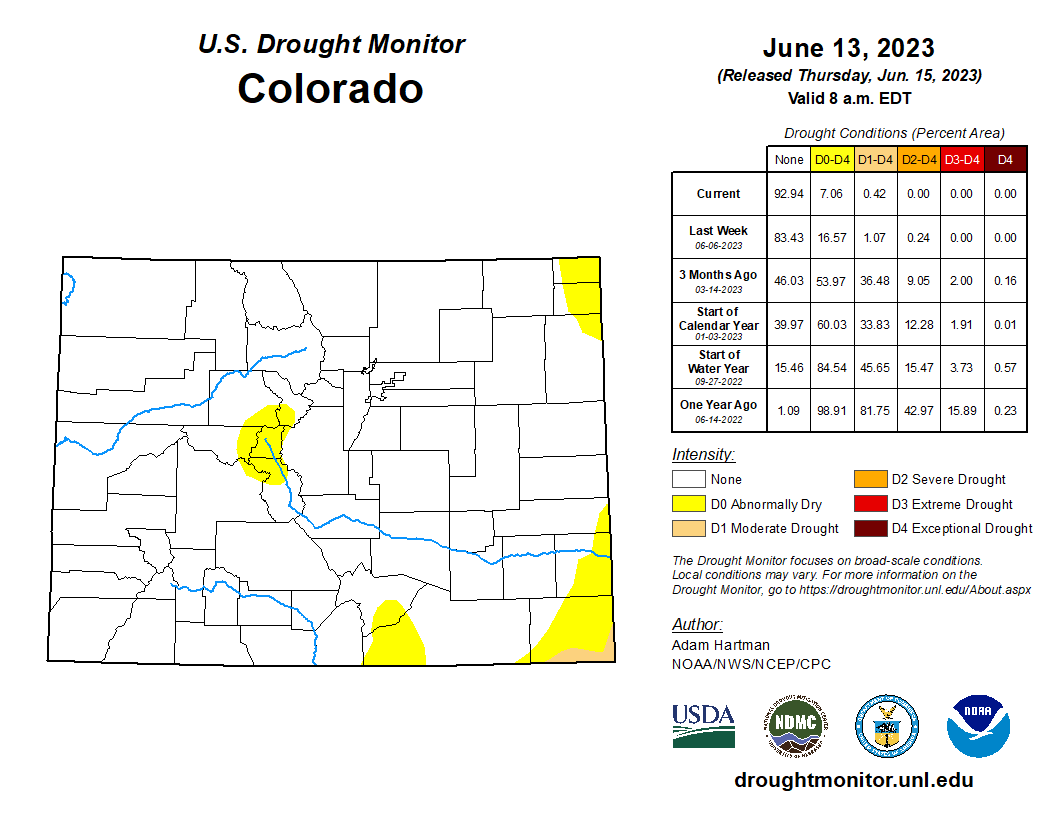
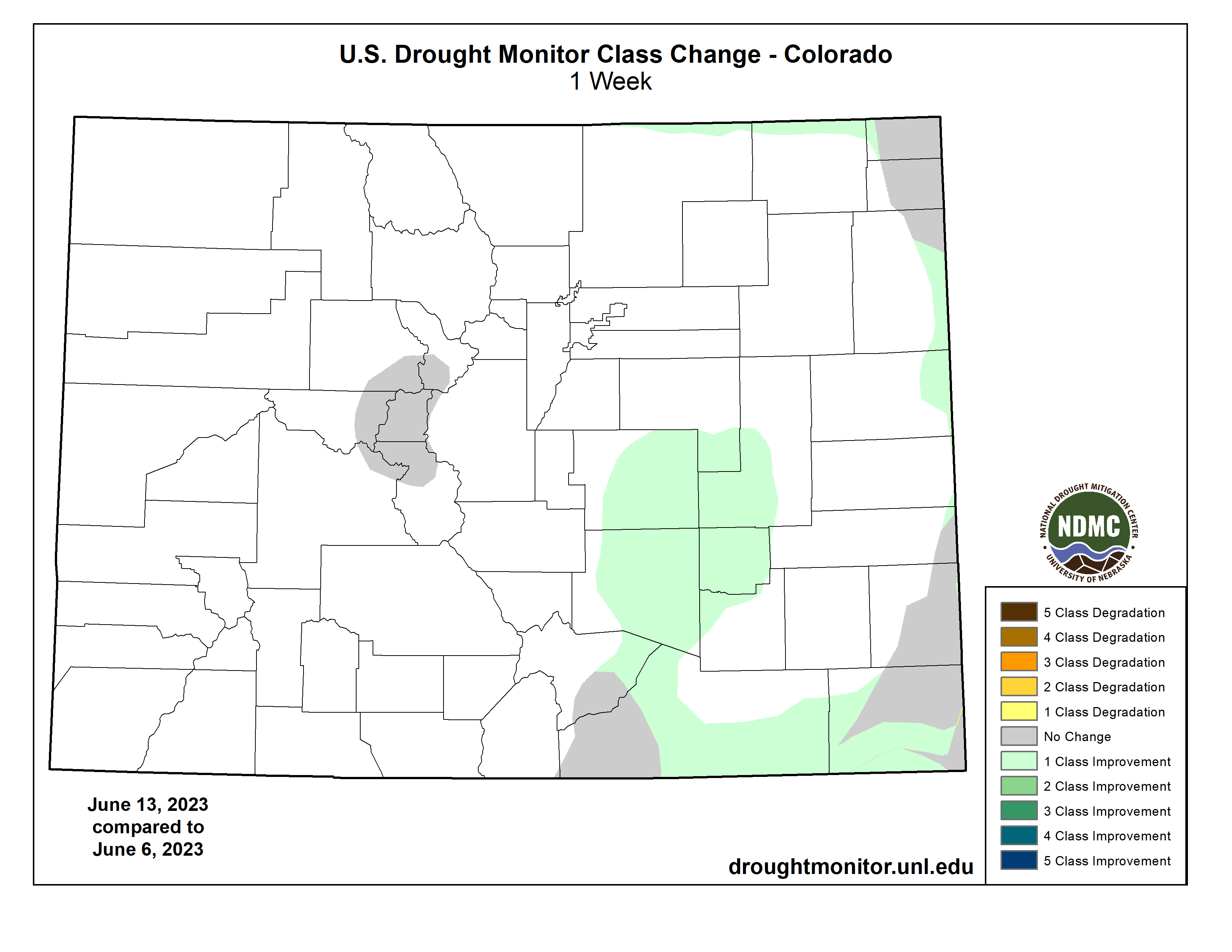
Colorado Drought Monitor one week change map ending June 13, 2023.
The Intermountain West is the beneficiary of another week of widespread above normal precipitation for many locations, with large portions of the Four Corners region, the Great Basin, and the southern and central Rockies also experiencing below normal temperatures. Improvements are warranted in locations where long-term drought indicators, such as groundwater, continue to improve. In addition, the above-normal snowpack from the active winter rainy season across much of the West continues to keep stream flows near and above average. Unfortunately, degradations are warranted across parts of the Cascades in the Pacific Northwest, which experienced a near- to below-average winter rainy season, which has been exacerbated by below average precipitation since that time. Soil moisture and groundwater continue to decline and 7 to 14 day average stream flows have fallen into the bottom 30 percent (and in many cases, the bottom 10 percent) of their historical distributions. In addition, above average temperatures this week (4 to 10°F above normal) have acted to accelerate this deterioration…
Several locations across Louisiana, Mississippi, and Tennessee experienced degradation this week, as the frontal boundary draped across the southern tier states did not result in enough precipitation to stave off degradation for those experiencing antecedent dryness. This is also the case in portions of central Texas and parts of the middle Red River basin, where targeted degradations are also warranted. However, farther westward across western portions of the Southern Plains, pockets of heavy rainfall continued to add to 60-day precipitation surpluses, particularly for parts of the Texas and Oklahoma Panhandles. Rainfall has been plentiful in these areas in recent weeks and months. For example, Amarillo Texas recently set a new record of 20 days with measurable precipitation during May; the previous record being 15 days. In addition, Lake Meredith, located north of Amarillo has reached 45.8 percent of its capacity, its highest since 2001, according to Texas Water Development Board data…
Looking Ahead
According to the Weather Prediction Center, over the next 6 days (June 15 – 20) warm temperatures are forecast to build across central portions of the lower 48 states, with cooler temperatures forecast across much of the Intermountain West and the West Coast leading up to June 20. Generally seasonal temperatures are likely east of the Mississippi River. Rainfall is forecast across a large swath of the lower 48 states from the Pacific Northwest to the Southeast, and northward along the East Coast. In the Southeast, heavy precipitation (in excess of 5 inches) is forecast for parts of the Deep South and the central and eastern Gulf Coast region.
During the next 6 to 10 days (June 20 – 24), the Climate Prediction Center favors below normal temperatures across the western third of the lower 48 states, and across parts of the Mid-Atlantic coast and Appalachians. Above normal temperatures are favored for the Great Plains, Mississippi River Valley, Great Lakes, interior Northeast, and southern Florida. Above normal precipitation is indicated across northwestern and north-central portions of the lower 48 states, and across the Southeast and Mid-Atlantic states. Below normal precipitation is weakly favored across parts of southern Texas and extending into the Four Corners region, parts of the Midwest, and northern New England.
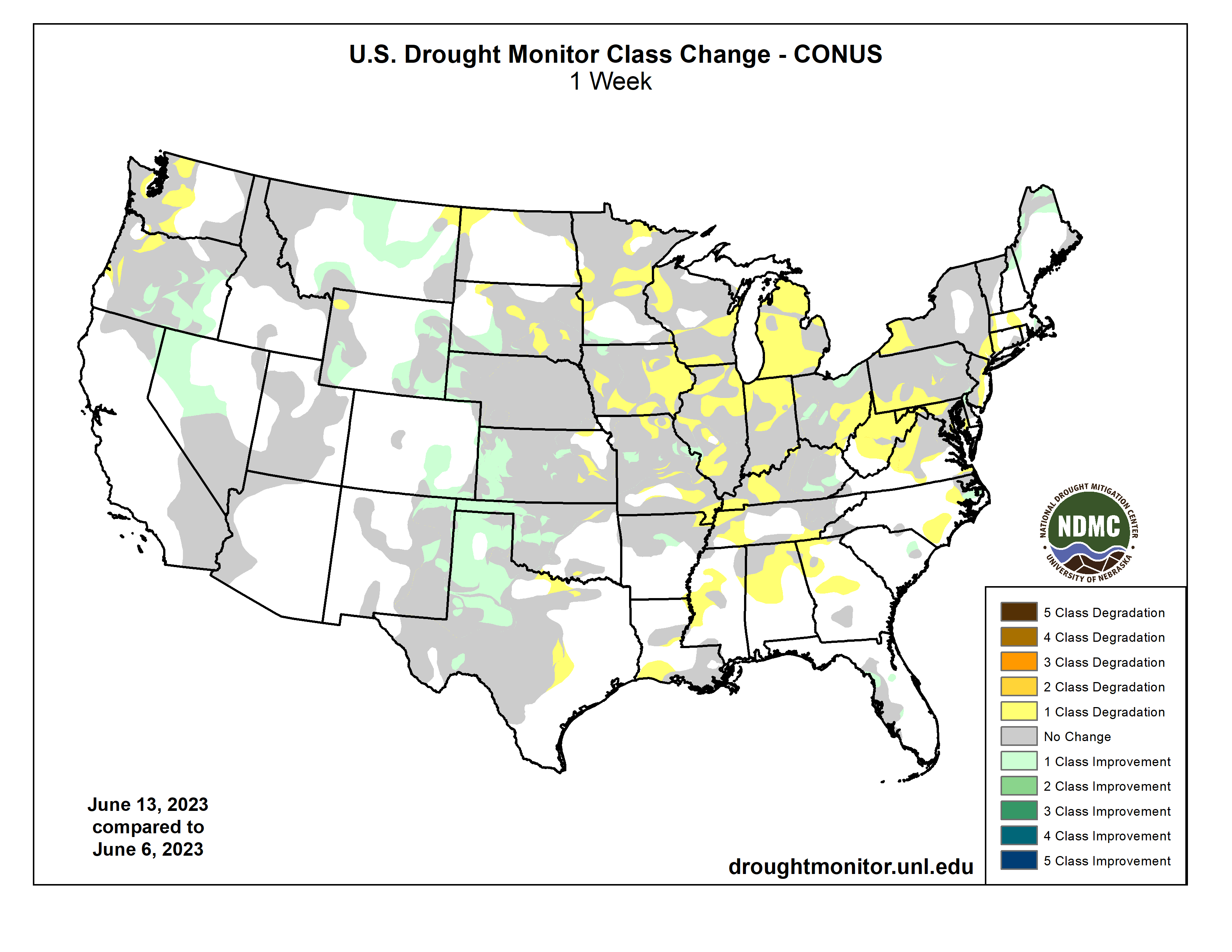
US Drought Monitor one week change map ending June 13, 2023.
A tower, pictured June 23, 2022 supports high-voltage transmission lines as part of PacifiCorp’s new Gateway West transmission project in Carbon County. Construction will soon begin on the TransWest Express transmission project nearby to carry Wyoming wind energy to the Southwest. (Dustin Bleizeffer/WyoFile)
After 15 years of planning and permitting, construction will begin this year on the TransWest Express high-voltage transmission line — a milestone expansion of Wyoming’s electric power export industry to markets in the American Southwest and one of the largest transmission upgrades to the western grid in decades.
The Bureau of Land Management granted TransWest Express LLC a “notice to proceed” in April, culminating years of work and millions of dollars invested in a “vision” to bring Wyoming’s renewable energy potential to the rest of the West, according to company officials.
“It’s a day that’s been long coming,” TransWest Express Executive Vice President and COO Roxane Perruso said. A groundbreaking event will take place Tuesday, she said, with a special appreciation for the Carbon County community’s integral support. That support represented a leap-of-faith for a region with its cultural and economic roots in coal.
Power project
While TransWest Express LLC was mired in planning and a painstaking bureaucratic permitting process that included obtaining rights-of-way from hundreds of entities across the 732-mile route, its affiliate Power Company of Wyoming was already doing preliminary construction work on the wind farm that will energize the line. The Anschutz Corporation owns both companies.
The Chokecherry and Sierra Madre wind energy project will span some 320,000 acres in Carbon County and generate 3,000 megawatts of electricity — representing about 28% of Wyoming’s current electrical generation capacity today, according to U.S. Energy Information data. It will be the largest onshore wind energy facility in North America, according to Power Company of Wyoming.
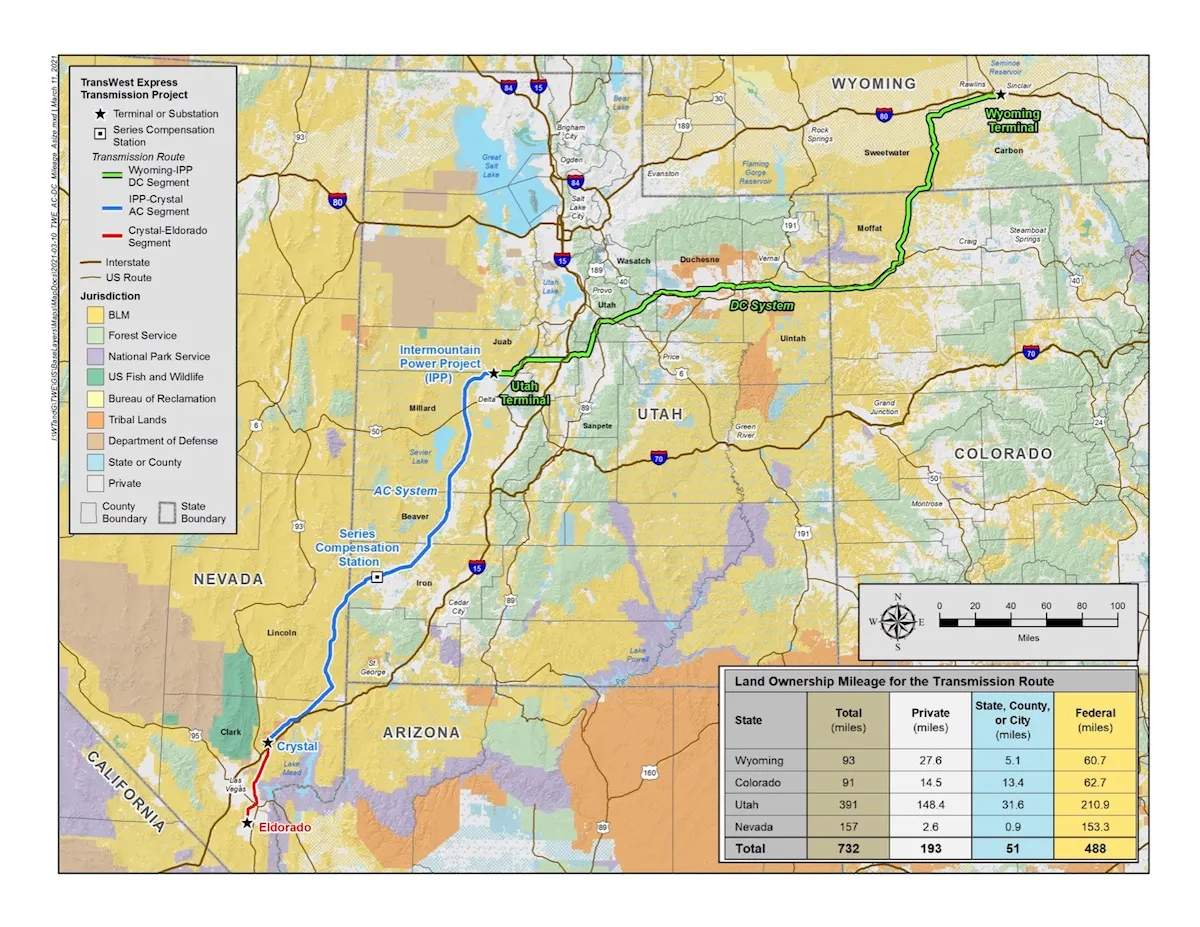
This map depicts the route of the TransWest Express transmission line connecting Wyoming wind energy to the Southwest. (TransWest Express)
Phased construction of the 732-mile TransWest Express high voltage transmission system will begin later this year, according to company officials. The first phase includes a new substation in Carbon County. From there, crews will erect towers and string high-voltage lines to a station in Delta, Utah. That portion of the project will initially begin moving up to 1,500 megawatts of wind-generated electricity via direct current by December 2027.
The second phase includes an alternate current line to connect with other powerline systems in southern Nevada. By the end of 2028, the final phases of the system will ramp up to 3,000 megawatts and four system interconnections in the Southwest, according to TransWest Express officials.
“These components will provide important new bulk transmission capacity and connectivity with the PacifiCorp system in Wyoming, with the Los Angeles Department of Water & Power and Intermountain Power systems in Utah, with the NV Energy system in Nevada and with the California Independent System Operator,” Perruso said.
New dynamic
Aside from transporting power from Wyoming’s Chokecherry and Sierra Madre wind facility, TransWest may also serve as an onramp for other energy projects, such as the hydrogen energy proposal at the Intermountain Power Project in Utah, and potentially new nuclear power facilities, according to TransWest officials.
“As Wyoming looks at more carbon-free [energy] resources, we are going to be that pathway that allows those resources to get to the market,” Perruso said. “We’re opening up the new market for renewables and also creating a pathway for future carbon-free resources.”
Crews work on road and wind turbine pad construction June 23, 2022 at the future site of the Chokecherry and Sierra Madre wind energy project in Carbon County. (Dustin Bleizeffer/WyoFile)
Some clean energy and climate advocates hail the TransWest Express project as a vital step forward in “decarbonizing” the western grid. Once completed, the transmission line will serve as a “backbone,” increasing connectivity between large demand centers — southern Nevada, Utah and southern California — and rural areas that can generate commercial-scale renewable energy, such as Wyoming’s abundant capacity for wind power generation.
“This is an example of infrastructure that is needed and should be built,” Western Resource Advocates Deputy Director of Regional Markets Vijay Satyal said. “It is definitely very important for the West.”
Together, the TransWest line and CCSM wind facility represent a new dynamic — as well as a gamble that too few entities have been willing or able to take on, according to Satyal and other utility market watchers. It’s a rare move that requires a lot of patience with the permitting process, according to one TransWest Express official, as well as deep pockets, according to others.
Going independent
Most consumers don’t get to choose their electricity provider, whether they’re powering a home in Casper or a chain restaurant in Evanston, but the TransWest project diverges from that paradigm. For example, PacifiCorp, which also operates as Rocky Mountain Power, is one of several electric utility monopolies in Wyoming. It serves captive customers in certain areas because, generally speaking, it owns the power infrastructure exclusively.
As a monopoly, PacifiCorp is regulated by the Wyoming Public Service Commission, as well as service commissions in the five other states it operates. It is required to justify and win approval for its electricity rates. In return, it has a guaranteed, captive ratepayer base to finance system operations and necessary upgrades.
Just southeast of the Jim Bridger Plant in August 2019, PacifiCorp workers erect towers that will carry new transmission lines, predominantly for wind energy, to tie into the regional electrical grid where it leaves the plant. (Andrew Graham/WyoFile)
There are variations, such as rural electric co-ops that work under different sets of rules and authorities. But the same geographically limited market for grid infrastructure plays out all over Wyoming, the West and the nation. Although utilities like PacifiCorp are shifting from burning coal to cleaner forms of electric generation within their own service territories, Satyal said, it isn’t enough to achieve the level of connectivity between hundreds of individual service systems to allow for new sources of renewable and low-carbon energy.
The strategy behind Power Company of Wyoming and TransWest Express is to operate as independent merchants, selling and delivering renewable and low-carbon energy to any utility it can reach via the three major operating regions that TransWest will connect to on the western grid.
“We’re broadening the [Wyoming and western] market to include these new interconnections and new customers,” Perruso said. “We’re not constrained by a service territory.
“That also means it’s risky,” Perruso continued. “This is why you don’t see [a lot of] developers doing this, because it’s a risky and an entrepreneurial proposition.”
Big gamble, deep pockets
Unlike a regulated utility, neither TransWest Express LLC nor Power Company of Wyoming have a captive ratepayer base to leverage upfront financing or a guaranteed paying customer base for ongoing operations. That’s where both the gamble and the deep pockets come in.
Both companies are affiliates of the Denver-based Anschutz Corporation. The worldwide oil, investment, sports, real estate, entertainment and publishing company headed by Philip Anschutz is worth some $10.8 billion, according to Forbes.
“Thanks to the deep pockets or the financial muscle the owners had, they survived a long [permitting] process to comply with all the environmental requirements,” Satyal said. “This is a good example of a company seeing the value proposition and the economic benefits of exporting Wyoming-rich wind and moving into the decarbonization of the future.”
A truck hauls a wind turbine blade through Medicine Bow in July 2020. (Dustin Bleizeffer/WyoFile)
TransWest Express doesn’t yet have customers contracted to take the power it plans to deliver from Wyoming. But, Satyal said, the rush to renewables to meet self-imposed carbon emission standards — particularly in the Southwest — is a good bet with a potentially lucrative payoff.
“God forbid California has a reliability crisis. This line will be a very important lifeline in providing energy — and at high [profit],” he said. “That’s competition at work, which I think is what Wyoming wants to support — a competitive market.”
Wyoming Energy Authority Executive Director Rob Creager agrees.
“Our state is in the business of producing and selling world-class energy,” Creager said. “So projects like TransWest Express opening up entirely new consumer markets for our energy products have tremendous potential for Wyoming.”
Dustin Bleizeffer is a Report for America Corps member covering energy and climate at WyoFile. He has worked as a coal miner, an oilfield mechanic, and for 25 years as a statewide reporter and editor primarily… More by Dustin Bleizeffer
The bodacious snowpack means the chance of Lake Mead dropping below elevation 1,000 is zero.
We still need to cut 1.5 million acre feet of Colorado River water use, at least. We still have no plan to do that.
We remain at risk of river flows past Lee’s Ferry dropping low enough by 2026 to trigger a legal argument about what the Upper Basin really owes the Lower Basin.
We have what was called a “historic accord” to reduce Lower Basin use in the short run, which muchly revolves around paying people to not use water.
The “historic accord” does not take any steps toward resolving longstanding tribal and environmental inequities.
The problem of what economist Gordon Tullock called “the transitional gains trap” is a very real obstacle to moving forward on the Colorado River.
WHATEVER, LET’S JUST PAY ’EM: THE “TRANSITIONAL GAINS TRAP”
In a seminal 1975 paper, economist Gordon Tullock nailed the problem at the heart of the current Colorado River policy dilemmas:
Thus farmers in places like Palo Verde, Yuma, and Imperial umpty generations ago benefited from the significant subsidies from the rest of us (federal taxpayers) that enabled Lower Colorado River agriculture to flourish. The benefit of that subsidy has now been fully capitalized in the land and the structures of the communities.
As Tullock’s work so clearly notes, termination of this “scheme” (I love his word) would “lead to large losses for the entrenched interests.”
While there’s a lot of “property rights” framing around our 21st century arguments about this, it’s important to remember that the perfection and continued use of those water rights was enabled by massive collective action on the part of others in establishing the needed institutions, and funding and building infrastructure.
But whatever, right? That’s where we are now, and a fatalistic attitude of “let’s just pay ’em” seems to have settled over basin problem solving, at least in the short term.
IS THERE A “TRANSITIONAL LOSSES TRAP” TOO?
I’m definitely out over the tips of my conceptual skis here, but one of the things that was made clear at the Boulder meeting was something I’ll glibly dub “the transitional losses trap”: the same decisions over the last century that locked in “transitional gains” for Lower Basin farmers also locked in “transitional losses” for Native American communities dispossessed of their land and water.
In a powerful panel last Thursday afternoon, a stage full of tribal leaders one at a time talked about that dispossession. The sheer weight of their words, and the range of their concerns, was breathtaking.
Some progress has been made on this issue, especially in Arizona. But there is no escaping the reality that all that water providing “transitional gains” to Lower Basin farmers is, acre foot for acre foot, a “transitional loss” for Native American communities. And now we’re paying those Lower Basin farmers to not use this very same water.
I get that some of the money we’re paying to reduce water use will go to Arizona and California tribes with settled water rights. But there are many tribes without settled water rights, or with rights that are settled but not yet put to use. They’re getting nothing out of any deal to pay water rights holders not to use their water. We need to remember this fact every time we pay a non-Indian farmer not to farm.
It’s a Lower Basin agreement, among Arizona, California, and Nevada. One of the things that was abundantly clear at the Boulder meeting was that Upper Basin states are withholding judgment until the details are fleshed out.
But it’s already clear that those who negotiated the deal want our money – federal tax dollars – to solve the transitional gains trap, but not to solve any of the other problems worth talking about:
the Colorado River Basin’s tattered environment
unresolved Native American water rights and other needs
As I’ve pointed out previously, with other people’s money should come other people’s values.
THE LEE’S FERRY CONUNDRUM
My buddy/collaborator/coauthor/mentor Eric Kuhn threw up a scary slide during his talk:
The crucially nerdy backstory is in Article III(c) and (d) of the Colorado River Compact, which seem to say the Upper Basin is required to send 82.5 million acre feet every ten years. As Hamby noted, one of the premises of “we need to cut 1.5maf in the Lower Basin” is that the Upper Basin continues to hit that target. Lawyers will argue forever about Article III interpretation, but I’d prefer not to hand over our management of the Colorado River to a judge’s ruling on who’s right.
But the deep entanglement between this question and the transitional gains trap stuff I mentioned before isn’t going away. California farmers have benefited from a “property right” essentially created in 1968 through the use of power politics, but that property right, as Tullock would say, is now priced into the value of their assets. And we’ve now set a “whatever, let’s just pay ’em” precedent (at an unprecedented scale), which does seem historic, but maybe not in a good way.
West snowpack basin-filled map April 16, 2023 via the NRCS.
Denver Water is helping ensure its future water security with the Gross Reservoir Expansion Project. When the project is complete, it will nearly triple the Boulder County reservoir’s capacity to 119,000 acre-feet. CREDIT: HEATHER SACKETT/ASPEN JOURNALISM
Climate change is robbing the Colorado River of water and threatening water security for 40 million people living in the Southwest. But prominent Colorado water managers, citing political concerns, are shying away from action on climate, favoring instead adaptation to rising temperatures and sustainability in their own operations.
The climate news surrounding the river is often grim. Scientists have shown that flows have declined nearly 20% from the 20th century average and that human-caused higher temperatures are responsible for about one-third of that. They have also shown that every 1 degree Celsius of warming results in a 9% reduction in flows. A record-setting snowpack this past winter led to above-average runoff conditions, but that good news follows the fact that water levels in the nation’s two largest reservoirs, Lake Powell and Lake Mead, dropped to historic lows early this year.
And it is predicted to get worse. Scientists at the World Meteorological Organization said last month that we are more than likely headed for a period of warming in the next four years, driven by El Nino, that will see record-breaking heat. This will push the Earth 1.5 degrees Celsius (2.7 degrees Fahrenheit) above pre-industrial levels for at least one year between now and 2027. The 1.5-degree Celsius mark is a major threshold; experts have warned that this amount of warming will result in far more impacts such as droughts and heatwaves.
Yet, despite a cleareyed recognition of the scale of the climate problem, Colorado water managers have done remarkably little when it comes to pushing for climate action on a main cause of water shortages: rising temperatures caused by humans burning fossil fuels such as coal, oil and natural gas. Experts agree the world needs to quickly transition away from fossil fuels to renewable sources of energy such as solar and wind power.
Managers instead have focused almost entirely on climate resilience and adaptation by funding programs that help water users adjust to the impacts of shortages and, in some cases, have worked to reduce their own carbon footprint and increase sustainability in their operations. “Climate resilience” and “drought resilience” have become popular buzz phrases in the Colorado water world.
But experts say these approaches don’t address the root cause of the problem and that water managers have a responsibility to pivot from climate adaptation to mitigation. According to the Intergovernmental Panel on Climate Change (IPCC) — an arm of the United Nations representing 195 countries and considered an international authority on climate change — adaptation and mitigation are necessary to avoid the worst losses and damages.
“This is their resource,” said John Berggren, a water policy analyst with Western Resource Advocates, referring to Colorado River water managers. “It’s not disconnected, it’s not tangential. Climate change is impacting their ability to provide water, and therefore I think they have a responsibility to be advocating for policy change at every level of government.”
Climate scientist Brad Udall has been beating the drum on this issue for years. Udall’s 2017 paper with researcher Jonathan Overpeck was one of the first to illustrate just how much of an effect rising temperatures were having on the Colorado River. A hotter atmosphere can hold more water through evaporation, and plants suck up more water as heat increases. Udall and Overpeck’s research found that an average of one-third of the declines in flows can be attributed to human-caused higher temperatures.
September 21, 1923, 9:00 a.m. — Colorado River at Lees Ferry. From right bank on line with Klohr’s house and gage house. Old “Dugway” or inclined gage shows to left of gage house. Gage height 11.05′, discharge 27,000 cfs. Lens 16, time =1/25, camera supported. Photo by G.C. Stevens of the USGS.
Source: 1921-1937 Surface Water Records File, Colorado R. @ Lees Ferry, Laguna Niguel Federal Records Center, Accession No. 57-78-0006, Box 2 of 2 , Location No. MB053635.
Udall’s family is steeped in the history of the Colorado River. As he writes in the forward to the book “Cornerstone at the Confluence: Navigating the Colorado River Compact’s Next Century” (2022),his father, Morris, was a U.S. congressman from Arizona who shepherded the Colorado River Basin Project Act through the House of Representatives in 1968 and his uncle Stewart was secretary of the interior during the 1960s, who promoted the U.S. Bureau of Reclamation’s vision for the river. His great-great-grandfather John D. Lee founded the famous Lee’s Ferry, now the dividing point between the upper and lower Colorado River basins.
Udall, a senior water and climate research scientist at Colorado State University, has been one of the loudest voices in recent years calling for audacious leadership on issues of climate change and the river. He often says that climate change means water change. He said water managers have a responsibility to address climate change and that it’s frustrating to watch people retreat to their silos.
“It’s disheartening to me, the idea that it’s somebody else’s problem and the potential for disaster that exists because people are just focused on their little areas of expertise and what they think is their responsibility as defined by their job title versus what I would argue is their responsibility to humanity as a whole, which might not be in their job title but should be,” Udall said.
During his presentation at the 2019 Upper Colorado River Commission meeting in Las Vegas, Udall told water managers that adapting to impacts doesn’t go far enough, and he suggested tools for mitigation such as carbon pricing and tax credits for renewable energy. He said not nearly enough is being done.
“How many times can we say this is a full-on, five-alarm fire that we’ve got to address immediately and yet nothing happens?,” Udall said. “It’s kind of as if people don’t understand the historic times in which we are operating right now. This is a once-in-human-history pivot point.” [ed. emphasis mine]
Water and climate scientist Brad Udall speaks at the annual Colorado Law Conference on Natural Resources at the University of Colorado Boulder last week. Udall has been one of the loudest voices calling for audacious leadership on issues of climate and the Colorado River. Photo credit: Heather Sackett/Aspen Journalism
Hot-spot mission scope
When General Manager Andy Mueller was hired at the Colorado River Water Conservation District in 2017, he told his new board the two biggest challenges facing the district were its anemic bank account and climate change. The money problem was largely remedied in 2020 when voters throughout the 15-county district overwhelmingly approved ballot measure 7A, raising an additional $5 million a year for the River District. The majority of that new taxpayer money now goes to fund water projects, many of which are aimed at helping water users across the Western Slope adapt to the impacts of climate change.
The River District has funded projects that create a redundant water supply so that cities aren’t at risk if a wildfire affects one water source; projects that help farmers and ranchers figure out how to still grow crops with a smaller supply of water; and projects that try to predict water availability such as soil moisture monitoring and remote-sensing snowpack monitoring. Mueller said adapting to climate change underlies everything they do at the River District.
Andy Mueller, the general manager of the Colorado River District, speaking at the district’s annual seminar on the Colorado RIver, on Sept. 14, 2018 in Grand Junction. Muller expressed concerns about how the state of Colorado might deal with falling water levels in Lake Powell and Lake Mead. Photo credit: Brent Gardner-Smith/Aspen Journalism
“Conversations today are largely driven by the fact that climate change has impacted the availability of water,” Mueller said. “Everything we think about at the River District is how do we prepare our water users and how do we help protect our water users in our communities from that hotter and drier future from the water-security perspective.”
The area covered by the River District is feeling climate change impacts more acutely than other areas in the West. According to a 2020 analysis by The Washington Post, a cluster of counties on the Western Slope has warmed more than 2 degrees Celsius (3.6 degrees F), which is double the global average. The hot spot spans more than 30,000 square miles; is the largest hot spot in the contiguous United States; and includes some of western Colorado’s largest irrigation districts in the Grand Valley and Uncompahgre River Valley.
It’s likely that the River District’s mission — to lead in the protection, conservation, use and development of Colorado River water for the welfare of the district — will be made all the more challenging in years to come as rising temperatures cause flows to decrease even more. But Mueller said he sees addressing the causes of climate change — humans burning fossil fuels — as outside the scope of that mission. The River District hires lobbyists and has staff focused on government relations, but it does not push for climate policies that aim to curb carbon emissions.
Turning from adaptation to prevention is a massive lift and one that would change the focus of the organization, Mueller said. Add to that the fact that some of the counties represented on the district board have economies still partly dependent on extracting oil, gas and coal and it becomes even harder to take action.
“I think we have a responsibility to give voice to what climate change is doing to our communities and our water supply, and I do think the River District does a good job with that,” he said. “Do we have an obligation to lead in the prevention of climate change? I would say no, we don’t … . We have identified climate change as a threat, but the idea that we have the ability to meaningfully prevent the root cause of climate change isn’t within our traditional abilities and our mission.”
The trust of the customer
Denver Water is Colorado’s oldest and largest public water utility, supplying water to 1.5 million people. The water provider gets about half of its supply from the Colorado River through transmountain diversions that take from the headwaters to the Front Range via a system of pumps, pipes, tunnels and reservoirs. Its operations and water quality have been impacted by climate-change-fueled wildfires in the watersheds where it draws this water, with post-fire debris and ash being washed into reservoirs and clogging infrastructure.
Denver Water’s departing CEO, Jim Lochhead, who has led the utility since 2010, is an attorney and the former head of Colorado’s Department of Natural Resources. He has received a Water Leader of the Year award from the Colorado Water Congress.
Lochhead and Denver Water are powerful political players in Colorado. For example, after he and heads of other water utilities that pull some of their supply from the Colorado River testified at a state Senate hearing this year, lawmakers added more seats for Front Range water providers to a drought task force.
Lochhead said that every aspect of Denver Water’s operation is impacted by climate change and that climate change, population growth and the resulting impact on the Colorado River are the utility’s greatest challenges. He said Denver Water walks the talk by doing stream-restoration projects in the headwaters to mitigate the impacts of its diversions and forest health initiatives that mitigate impacts of wildfires. The utility is preparing for a future with a less consistent water supply through increased efficiency, water recycling and projects such as the expansion of Gross Reservoir in Boulder County. That project is raising the height of a dam in the foothills west of Boulder by 131 feet, nearly tripling the reservoir’s capacity from 42,000 to 119,000 acre-feet.
Denver Water CEO/Manager Jim Lochhead accepts the 2021 AMWA Sustainable Water Utility Management Award from AMWA President Angela Licata and AMWA Vice President John Entsminger, at the group’s annual meeting in early October, 2021 in Denver. Photo credit: Denver Water.
Lochhead said Denver Water is addressing climate change in a major way: through sustainability, water conservation and energy efficiency efforts at its new campus, which has solar panels, blackwater reuse and rainwater capture for irrigation, LED lighting and has been awarded multiple LEED Green Building certifications.
“We wanted it to be a vision of the future and a vision of sustainability,” Lochhead said. “This is the most sustainable campus that has been developed in Colorado.”
Denver Water’s goal is to reduce by 2025 overall energy use and greenhouse gas emissions by 50% from a 2015 baseline, and Lochhead said they are on track to meet that goal.
But addressing the root cause of warming is a bridge too far for Lochhead, as it is for Mueller and the River District. Lochhead called climate change “a hot-button political issue.”
“We are created to be nonpolitical, and part of the trust our customers have for us is that we are nonpolitical,” he said. “To the extent that we are operating politically or we have stepped out of that role, we actually risk losing some of the trust of our customers.”
Last year, Denver Water joined a memorandum of understanding with other large municipal water providers to commit to reducing nonfunctional turf grass — a major water hog — by 30% and other efficiency upgrades. This type of collective action, along with promoting an ethic of sustainability, is how Lochhead sees Denver Water’s role in the climate crisis.
“There hasn’t been, to my knowledge, a collective discussion around reducing carbon emissions,” he said.
A POW delegation in front of the U.S. Capitol in this 2013 photo includes Roaring Fork Valley leaders including Gretchen Bleiler, far left, Penn Newhard, fourth from left, Chris Davenport, far right, and Auden Schendler, fifth from right.
Making the shift to activists
Auden Schendler, vice president of sustainability at Aspen Skiing Co. and a thought leader on climate issues in the ski industry, said water managers need to engage in solving climate change not just in their own operations but at the policy level.
A water utility getting its own sustainability house in order doesn’t do enough to make a difference and takes the blame off of where it belongs: the fossil fuel industry, which has long misled the public about the impacts of burning its products, Schendler said.
“By definition, it doesn’t do the things that fossil-fuel-industry people fear,” Schendler said. “What do they fear? Active voters, movements, legislation, public shaming, public exposure — that kind of thing. The fact that very powerful entities, businesses, water districts and trade groups won’t speak up is an astounding win for the fossil fuel status quo power structure … . I would argue that it’s negligent for a water district to not engage in those things.”
In recent years, SkiCo has become a leader on climate, aligning itself with Protect Our Winters, a group that harnesses the power of outdoor athletes and recreationists to solve the climate crisis. POW focuses on large collective action and political action for systemic change, an approach that the IPCC says can work.
“Effective climate action is enabled by political commitment, well-aligned multilevel governance, institutional frameworks, laws, policies and strategies and enhanced access to finance and technology,” reads the latest IPCC assessment report.
SkiCo has made the shift from a business that merely worked to make its operations “green” to climate activists promoting policies that combat climate change. Schendler said SkiCo’s role is to wield power, model solutions, lobby, help build movements, get involved in politics and basically engage in civics. So far, water managers have not made a similar shift, even though rising temperatures represent as much of a threat to their mission as they do to the snowy winter slopes relied upon by ski resorts.
Although things can often look grim, one of the points stressed in the latest report from the IPCC is that there is still time to avoid the worst impacts if people act now to limit warming. The window to secure a livable and sustainable future is rapidly closing, but there is a window nevertheless. Seeing climate change only as an inevitability that is global in nature can contribute to inaction, said Berggren, of Western Resource Advocates.
“Sure, maybe you as a water provider aren’t going to be writing or developing international climate policy, but as a water provider whose entire mission is dependent on a resource that is being negatively impacted by this issue, … you do have maybe even a moral obligation to be advocating for our national elected leaders to do something.”
During Aspen Journalism’s interviews with a wide swath of Colorado River experts, politics emerged again and again as the main barrier for the water community taking action on climate change. Most experts echoed the conclusions reached by Mueller and Lochhead: Climate action is perceived as a liberal issue, and taking more aggressive action is seen as an overreach.
The future of water in the West may depend on shifting those perceptions. With the Colorado River crisis making international headlines, many are looking to see what water leaders will do during this pivotal time.
“It’s a moral obligation on the part of leaders in our community to depoliticize climate,” Schendler said. “If water districts can’t think 100 years in the future, who can?”
The Bureau of Reclamation will reduce the release from 4,300 cfs to 4,000 cfs today at 12:00 PM. The release will be further ramped down beginning Thursday, June 15th, at 12:00 PM. The updated schedule is in the following table and posted to the website at the link below.
Areas in the immediate vicinity of the river channel may continue to be unstable and dangerous. Please use extra caution near the river channel and protect or remove any valuable property in these areas.
For more information, please see the following resources below:
Bureau of Reclamation:
• Susan Behery, Hydrologic Engineer, Reclamation WCAO (sbehery@usbr.gov or 970-385-6560).
Gallup Mayor Louis Bonaguidi was serving on city council in 1988 when a geologist the city hired to evaluate its water supplies informed Gallup that it would run out of water within a matter of decades.
It didn’t take long for the city to discover that its neighbor, the Navajo Nation, was also looking for ways to increase access to water.
On Friday, the city and Nation got one step closer to achieving a reliable water supply that will serve more than 250,000 people on Navajo Nation, the Jicarilla Apache Nation and in the Gallup area.
The Public Service Company of New Mexico handed over the virtual keys–as company president and Chief Operating Officer Don Tarry called it–to the reservoir that once provided water from the San Juan River for San Juan Generating Station operations to the U.S. Bureau of Reclamation for use in the Navajo-Gallup Water Supply Project.
“There is a significant connection between energy and water,” Tarry said, explaining that the coal-fired power plant that ceased operations last fall required a large amount of water.
Bart Deming is the construction engineer and manager for the BOR’s Four Corners Construction Office. He said when the supply project began, the plan was that there would be a direct intake off of the San Juan River. But turbidity concerns led to the planned intake being relocated to an area near Hogback where there could be turbidity control.
Turbidity is the measurement of how cloudy the water is, or how much sediment it is carrying.
Preliminary designs had been completed when PNM approached the bureau in November 2018 with a proposal to repurpose the reservoir at the power plant.
Deming said a lot of studies followed over the next four years to ensure the reservoir could meet that need, including making sure it was not contaminated by nearby power plant operations.
Using the reservoir and associated infrastructure reduced project costs by about $70 million compared to the Hogback plans.
The reservoir also comes with other advantages, including increased storage that will allow for better water resilience in the face of drought and climate change. Deming said that the intake can also be shut off when there is a lot of turbidity in the water, such as during monsoon season, or if another incident like the Gold King Mine spill was to occur.
The bureau purchased the reservoir and associated infrastructure for $8 million using funding available through the Infrastructure Investment and Jobs Act, or bipartisan infrastructure bill.
The use of the reservoir meant delaying completion of the project until 2028 or 2029.
The Navajo water rights settlement of 2005 that led to the Navajo-Gallup Water Supply Project required the project to be completed by the end of 2024.
U.S. Rep. Teresa Leger Fernandez introduced legislation on Friday that will amend the 2009 project authorization in light of increased costs and the delay. She said the bill will also expand the number of Navajo communities that will benefit from it.
“It is a beautiful day, not just because we get to see this beautiful water that reflects the wonderful blue sky above it, but (because of) what we are celebrating,” she said. “Today’s transfer is more than just a transaction…it is the symbol of water itself.”
She said it represents both life and a future for the communities.
Frank G. Willetto, a Navajo Code Talker, renders honors during the playing of the national anthem at a ceremony commemorating the 65th anniversary of the Battle of Iwo Jima at the National Museum of the Marine Corps in Triangle, Va., Feb. 19, 2010. In February 1945 the United States launched its first assault against the Japanese at Iwo Jima, resulting in some of the fiercest fighting of the war. By Cpl. Scott Schmidt – This image was released by the United States Marine Corps with the ID 100219-M-1318S-092 (next).
The reservoir has been named Frank Chee Willeto Reservoir after a late code talker who was influential in getting the Navajo water rights settlement and also served as vice president of Navajo Nation.
His family was there for the ceremony and members of his family helped unveil the new sign that will be displayed there.
Arvin Trujillo, who was involved in the project during his time as director of the Navajo Nation Department of Natural Resources, spoke on behalf of President Buu Nygren.
He said over the years, those pushing for the project kept having people tell them, “you can’t do this. It’s not possible.”
But now sections of the pipeline are already supplying water to communities that have had to haul water in the past.
At the same time, Trujillo urged people not to lose sight of the end goal and to continue working together to complete the pipeline.
Once finished, the project will feature approximately 300 miles of pipeline, two pumping plants and two water treatment plants.
It will supply about 250,000 people with water over the next 40 years.
Today [June 12, 2023] marks the beginning of an unprecedented two-week climate trial in Montana. In the first youth-led climate case to go to trial in the United States, 16 young people are accusing the government of Montana of violating their right to a “clean and healthful environment,” which is enshrined in the state constitution, by promoting fossil fuel development…
“A strong decision could have ripple effects and inspire more climate litigation around the world,” Michael Gerrard, faculty director of Columbia Law School’s Sabin Center for Climate Change Law, said in an email.
The Details
The 16 young people — represented by Oregon-based nonprofit law firm Our Children’s Trust — filed their lawsuit in March 2020. At the time, their ages ranged from 2 to 18. The case, Held v. Montana, is named for Rikki Held, the only plaintiff who was 18 at the time. Held grew up on a 7,000-acre cattle ranch and saw how the effects of climate change — including raging wildfires and relentless droughts — threatened her family’s business. The lawsuit lists many other ways that climate change has harmed the young challengers. For example, it says dangerous air quality from wildfire smoke has made it difficult for another plaintiff to breathe.
The youths are seeking a verdict that Montana — the country’s fifth-largest coal producer and 12th-largest oil producer — has unlawfully approved fossil fuel projects without considering their climate impact. Such a ruling could require state agencies to weigh these effects before permitting any more oil, gas and coal development. It could also give more teeth to the state constitution and others like it. Two other states — New York and Pennsylvania — have established constitutional rights to a healthy environment by adopting “green amendments.” More states could follow.
“To have a court say that these plaintiffs are having their constitutional rights violated would be a bellwether for the rest of the country,” said Mat dos Santos, general counsel and managing attorney with Our Children’s Trust.
On the last day of Colorado’s 2023 legislative session, Senate Bill 23-266 was signed by leaders of the state Senate and House. The bill limits the sale of a class of pesticides, neonicotinoids, or “neonics,” which are known for killing bees and other pollinators. The governor signed the bill a little over one week later, making Colorado the ninth state in the country to take steps against neonics.
Specifically, SB-266 requires the Colorado commissioner of agriculture to designate neonics as a “limited use pesticide.” Only licensed dealers will be authorized to sell neonics, which excludes the average home and garden store, significantly reducing the use of neonics in residential areas.
Neonics are the most common class of pesticide in the world, even though several studies suggest neonics provide negligible economic benefits to corn and soy crops. Neonics are often applied via seed treatments, which distributes the chemical throughout the entire plant as it grows. As a result, neonics cannot be washed off the surface of plants prior to eating. This quality, combined with their ubiquity, is perhaps the reason that neonics are the most prevalent pesticide in infant and baby food. While there are documented cases of neonics’ toxicity to humans, there is no scientific consensus regarding the chemicals’ threat to human health.
However, neonics’ toxicity to bees, our food supply, and the country’s economy is very well understood.
Native solitary bee. Photo: The Xerces Society / Rich Hatfield
Bees pollinate 75% of the fruits, nuts and vegetables in the United States, and contribute $24 billion to the U.S. economy. Bees are often exposed to neonics while gathering pollen or drinking nectar from crops in agricultural fields, clover on golf courses, and even ornamental flowers in residential neighborhoods. If the bees don’t consume a fatal dose, the poison interferes with key grooming and sleep behaviors, leading to a slow death or lack of reproduction.
The number of bees in Colorado has declined by more than 70% in the past 20 years. Bee populations have been decimated by pesticides, habitat fragmentation and competition with invasive species, such as the European honey bee.
A bumble bee does its thing with a flower on Pennsylvania Mountain. Photo/Christine Carlson
Although it’s an important agricultural pollinator, the familiar European honey bee is not representative of our country’s incredible bee diversity. And the notoriety of honey bees obscures the real bee-pocalypse occurring in the U.S. and Colorado: native bees’ slow descent into extinction. Colorado alone has 950 native bee species, placing the state in the top five for most biodiverse bee habitats in the country. Because Colorado’s native bees, including bumblebees, sweat bees and leaf-cutting bees, do the yeoman’s share of pollinating native plants, their fate will affect all of Colorado’s ecosystems. That’s why Colorado’s induction into the club of states working to restrict neonics is vital.
Eight states besides Colorado restrict the use of neonics, either by legislative or administrative action. The restrictions vary in scope — some apply only to residential areas and others, such as in New Jersey, prohibit the use of neonics on lawns, golf courses, and more. There have been no successful bans on the use of neonics in agriculture.
If history is any indication, there’s little chance that the agriculture industry will ever be subjected to neonic restrictions. The powerful agriculture lobby has doggedly avoided environmental regulations for decades, paying for exemptions from the Clean Water Act, and securing reporting exemptions from the Emergency Planning and Community Right to Know Act. That nearly half of Colorado’s land is devoted to agriculture underscores the importance of SB-266 — if state leaders can’t make Colorado’s farms safe for bees, it’s imperative that they target low-hanging fruit by discouraging the use of neonics in residential areas.
SB-266 isn’t a complete reprieve for our state’s bees, but it is a start. What’s the next step? Hopefully, a ban on all uses of neonics, except for the stubborn agriculture industry.
Click the link to read the article on the Ark Valley Voice website (Daniel Smith). Here’s an excerpt:
Salida’s signature summertime event, the nationally-recognized FIBArk Whitewater Festival, takes place in and around Salida June 15 through 18, 2023 heralding fine whitewater event competition. There are other athletic and fun events like the Raft Rodeo and foolish Hooligan Race downtown as well as musical events throughout. This, the 75th Diamond Anniversary promises to be one for the record books.
The crowd-favorite event, the Hooligan Race, runs from just north of the Whitewater Park, finishing at the park. Crowds line the riverbanks cheering and jeering as they witness competitors literally try to keep it all together in the homemade craft. Anything that floats (and is not a boat) qualifies.
Cleverly-designed (if not well-constructed) “craft” careen downriver, often leading to self-destruction as the occupants try to snag cash envelopes hung from lines across the river. While always a spectacle, safety is key and emergency crews are on hand to snag the unfortunate before they end up down in Cañon City.
A standup surfer in the Arkansas River at Salida during Fibark, the river celebration held in late June. Photo/Allen Best
"Anything else you’re interested in is not going to happen if you can’t breathe the air and drink the water. Don’t sit this one out. Do something. You are by accident of fate alive at an absolutely critical moment in the history of our planet." — Carl Sagan pic.twitter.com/tOteEvNaRR
North Lake Powell October 2022. With the Colorado River’s woes, Boulder County towns are looking to diversify their water sources Photo credit: Alexander Heilner via The Water Desk
This winter dropped a lot of snow on the mountains above Boulder. Our reservoirs are in good shape for now as Boulder Creek babbles. But that’s not our only water source.
Boulder and many other cities along the Front Range rely, at least in part, on water from the strained Colorado River. Younger cities with fewer senior rights for local water sources — like Superior and Erie — rely on it almost entirely.
Because every city is responsible for its own water portfolio, as the Colorado River becomes a potentially unreliable source, wholly dependent cities could be far worse off than others. This isn’t a far-fetched idea. A Colorado State University study shows that for every degree Fahrenheit of global warming, flows of the Colorado River decrease by 4%. And already, the Windy Gap Project — responsible for supplying a portion of Colorado River water to Front Range cities — sometimes doesn’t provide any water at all.
Yet for now, many municipalities in the Boulder County area seem reluctant to even discuss sharing water.
“Right now, we’re all trying to do the best job for our [own] residents and our customers,” said Melanie Asquith, the water resources manager for the City of Lafayette. “Everybody’s situation is different. Everybody’s storage is different. Everybody’s rights are different.”
Interviews with water managers across the county revealed potential stage-setting for a “Mad Max” situation. Each municipality is concerned only with securing water rights for its own residents. This means that unless the mindset in Colorado changes to one of greater collaboration, it’s safe to assume future droughts will hit some communities harder than others. And those hard-hit communities may be on their own.
“The citizens and businesses of Louisville are paying their water bills to ensure their supplies are covered — not necessarily Lafayette’s or Broomfield’s or anybody else in the region,” said Cory Peterson, the City of Louisville’s deputy director of utilities. “There’s not a regional or state presence that would do those types of activities. That’s just the way the system is set up.”
Where do Boulder County communities get their water from?
Peterson of Louisville said a foreshadowing of droughts’ impacts in Boulder County happened in 2001.
“You had some communities that were doing very aggressive water restrictions, had very low water supplies, and were really struggling to make it through,” Peterson said. “And you had other communities that had very light restrictions and had, I don’t want to say an easy time, but they were able to manage through those impacts.” (We saw a lesser instance of this last summer when Lafayette imposed year-round water restrictions while Boulder didn’t.)
This has led to water resource managers up and down the Front Range to chase water diversity to ensure they’re not the worst off. If one water source fails, it’s good to have another to lean on.
“Our biggest gift is our diversity, that we are not wholly dependent on the [Colorado River], that if we had to rely only on eastern water, we could do it,” Asquith of Lafayette said.
Age matters for water rights
Because of the way Colorado water rights work, it pays to be old. The “prior appropriation doctrine” — summed up as “first in time, first in right” — heavily favors cities that started getting water for their residents earlier. Being first has landed them “senior” water rights from local sources like Boulder Creek or St. Vrain Creek.
“Longmont is fortunate that a majority of the water rights in our water rights portfolio are very senior water rights,” said Wes Lowrie, a water resources analyst for the City of Longmont. “We feel very strong in our ability to meet our future demands for Longmont.”
Boulder, Louisville and Longmont have senior rights to local creeks, requiring them to get only a third of their water from the Colorado River. That insulates them from future uncertainty on the Colorado River and provides some resilience against climate change through diversification. Lafayette gets less than a quarter of its water from the Colorado River.
Pretty much all of Erie’s water, on the other hand, comes from the Colorado River. All of Superior’s does as well.
California, Nevada and Arizona recently reached an agreement to temper their use of water from the Colorado River. With federal assistance, the worst repercussions of overuse from the river will hopefully be avoided, for now. But Colorado wasn’t a part of the recent Colorado River agreement, because Colorado is part of the Upper Basin states: those using water above parched Lake Powell. Unlike the Lower Basin, Upper Basin states have thus far used less water than is available to them. But that could change as the river reduces more.
Looking west across the 445 acre-foot Windy Gap Reservoir, which straddles the Colorado River (Summer 2011). Photo By: Jeff Dahlstrom, NCWCD via Water Education Colorado
When a water source is diminishing, you want a senior right on that source to make sure you get your water before it runs out. Yet some of the water coming from the shrinking Colorado River to the Front Range isn’t even close to a senior right. The Windy Gap project, a water right that provides some cities with a considerable chunk of their water, only dates back to 1968 — very young by Colorado River standards.
“The Windy Gap water right is a very junior water right on the Colorado River,” said Jeff Stahla, a public information officer at Northern Water, which manages Windy Gap. “The Windy Gap Project in some years yields zero water.”
The project — which includes a diversion dam and reservoir on the Colorado River — is just one of the water rights allotting Colorado River water to eastern cities. Originally funded by Boulder, Estes Park, Fort Collins, Greeley, Longmont and Loveland to cope with booming populations, the project started delivering water across the Continental Divide in the 1980s.
Today, some Front Range municipalities are investing further in Windy Gap water. By building a new reservoir in southern Larimer County, the cities hope to store Windy Gap water from wet years to get them through the dry ones when Windy Gap may provide no water.
Site of Chimney Hollow Reservoir via Northern Water.
Called the Chimney Hollow Reservoir, the project broke ground in 2021 and is on track to cost upwards of $700 million. A dozen different water districts are funding the reservoir to add an additional fail-safe to their water supply. Involved cities include Louisville, Lafayette, Longmont, Erie and Superior. Broomfield is leaning especially heavily on the new reservoir, voting in 2021 to foot $176.4 million of the bill. (Boulder is not involved in the Chimney Hollow project.)
According to City of Broomfield staff, this investment will increase Broomfield’s reliance on Colorado River water from 60% of their source water to 70%. Broomfield’s water not delivered by Northern Water comes from Denver Water, which also gets a portion of its water from a tributary of the Colorado River. Piped through the Moffat Tunnel, water previously destined for the Colorado River is stored in Gross Reservoir that recently began a controversial expansion project.
Yet Windy Gap water isn’t the only water coming from the Colorado River. The Colorado-Big Thompson Project, or C-BT, has been pumping water east since 1947. With its right dating to the 1930s, that water “is much more guaranteed,” according to Stahla.
Almost all cities who get Windy Gap water also get a portion of C-BT water.
Pete Johnson, a water attorney for the town of Erie, said the town’s water comes from a mix of C-BT water and Windy Gap water with an investment in the Chimney Hollow project — all Colorado River water.
“The long term goal is to diversify the town’s portfolio,” Johnson said.
But C-BT water isn’t infallible either. “The CB-T water right, I don’t want to say it’s junior, junior,” Stahla said. “But certainly a 1930s water right is not senior in the state of Colorado.”
Water stored in Colorado’s Denver Basin aquifers, which extend from Greeley to Colorado Springs, and from Golden to the Eastern Plains near Limon, does not naturally recharge from rain and snow and is therefore carefully regulated. Courtesy U.S. Geological Survey.
Setting up a Mad Max future
Robert Crifasi, a former City of Denver hydrologist and Boulder Open Space and Mountain Parks water resources administrator, and author of a new book “Western Water A to Z: the History, Nature and Culture of a Vanishing Resource,” said one of the most important steps to avoiding a Mad Max future is ensuring water availability before building new developments. Because of overzealous development companies, Crifasi said, some Denver suburbs are now reliant on nonrenewable Denver Basin groundwater. What will those communities do when the aquifer runs dry? Rely on the Colorado River?
“There is no magic bullet in any of this,” Crifasi said. “But I do think the most important action is to legislatively require vigorously integrated water and land-use planning.”
Kim Hutton, the City of Boulder’s water resources manager, said in addition to conservation and planning, there’s a need for collaboration and coordination among municipalities around water. As it currently stands, it’s every city for itself.
“Right now, with the water rights system, individual water users really are responsible for developing a supply to meet their needs,” she said.
Lowrie of Longmont, for instance, said that Longmont has always required that developers prove a reliable water source before moving forward into construction. “And that planning has served us well,” he said.
When asked if Longmont had talked about possibly sharing with other municipalities that might, in the future, not have enough water for their residents, he suggested that long-term aid would be viewed very differently than short-term aid.
“The decision to share water on an ongoing basis might be a different conversation than if there was an emergency situation, like if somebody’s water treatment plant went out,” he said. “That’s a different scenario than saying, ‘Hey, we didn’t plan as well as Longmont, and now we don’t have enough supply.’”
Boulder Reporting Lab is a nonprofit newsroom serving Boulder County. Sign up for their newsletter here.
Updated Colorado River 4-Panel plot thru Water Year 2022 showing reservoirs, flows, temperatures and precipitation. All trends are in the wrong direction. Since original 2017 plot, conditions have deteriorated significantly. Brad Udall via Twitter: https://twitter.com/bradudall/status/1593316262041436160
Click the link to read the article on the Big Pivots website (Allen Best):
What can Colorado expect of its changing climate going forward?
The Colorado Water Conservation Board has commissioned a study overseen by Becky Bolinger, the assistant state climatologist, and Jeff Lukas, whose business is called Lukas Climate Research and Consulting, to update projections from two previous studies, in 2008 and again in 2014.
Newer climate models have been issued, they explained in a presentation at the Colorado Drought Summit on May 31, and more weather data has been accumulated to compare against what had previously had been projected.
Rising temperatures in the last 20 years roughly align with what climate models had suggested would happen. That falls short of verification of the models, said Lukas, but it does suggest stronger confidence in what the models today say about the future.
The base period is 1970 to 2000. Against the historical record, temperatures have been 1.5 degrees F higher in the 21st century. The best estimate is for another 2.5 degrees of warming by mid-century, but warming of 5 to 6 degrees is possible. “That is an uncomfortable future,” said Lukas.
“Climate models were very clearly telling us to expect more heat proportionate to the amount of emissions,” said Bolinger. If 2012—a year of wildfires—remains the warmest year in records, it likely won’t stand.
“By 2050 and beyond, things really be different,” she said, depending upon continued emissions. Earlier in the month, gauges on volcanoes in Hawaii recorded at 424 parts per million, the fourth highest rise since measurements began in 1958.
Another way of understanding this warming is to look at the warmest four-day periods of a year above a certain threshold. That threshold was achieved maybe once a year before the turn of this century. It has now accelerated and will increase to about five times a year by mid-century.
As for precipitation, that’s still unclear. It might produce more. The models have no consensus. Even if winters do produce more precipitation, though, that gain will be offset by impacts during other seasons beginning with earlier runoff. Warming alone also increases the thirst of the atmosphere, which dries out plants and soils and causes water to evaporate.
“It’s very certain that we are going to get a couple of degrees more warming over the next several decades, and that will continue to dry our watersheds, our water cycles, our crops,” said Lukas.
Impacts to river flows in summer and fall could be particularly severe. And droughts will be intensified.
“The worst droughts of the next several decades will likely exceed those of the past 100-plus years,” he said.
Jeff Lukas explains what can be said with high confidence about the evolving climate in Colorado and what can be said with only low confidence.
Lukas and Bolinger emphasized that their conclusions, a synthesis of other work, remained preliminary. Just prior to their presentation at the drought conference, they had sent their report for review by 50 others. The final report is to be issued this summer.
A few of the projections as defined by confidence levels: low, medium, high, and very high:
In runoff, the recent trend has been toward earlier in spring, and there’s high confidence that runoff will occur even earlier.
Evaporative demand similarly has been trending higher, robbing the soil and plants of moisture, and all the available literature points in the same direction with a very high confidence level.
Snowpack has been trending lower (this year being a notable exception), and that’s the projected future trend, too, but this projection has only a medium confidence level.
Heat waves? They’ve become more frequent and intense, and that is the projected change for the future — this coming with a very high confidence.
Cold waves. Fewer of them as compared to a half-century ago, and even fewer in the future. That comes with a high confidence.
Wildfire threat? The risk has grown, and it will continue to grow even more. This comes with a high confidence level.
Windstorms. The recent trend is uncertain, and the future change is uncertain. That comes with a low confidence level.
Allen Best is a Colorado-based journalist who publishes an e-magazine called Big Pivots. Reach him at allen.best@comcast.net or 720.415.9308.
Colorado statewide annual temperature anomaly (F) with respect to the 1901-2000 average. Graphic credit: Becky Bolinger/Colorado Climate Center
Real estate developers interested in exporting water they own from the San Luis Valley to fast-growing, water-short Douglas County have contributed thousands of dollars to candidates for the Parker Water & Sanitation District Board, one of the largest water providers in the county.
Last month, Robert Kennah won a seat on the Parker water board and had received two donations from partners in Renewable Water Resources, a real estate development group whose principals include former Colorado Governor Bill Owens. The contributions were made by RWR principals John Kim and Hugh Bernardi, according to filings at the Colorado Secretary of State’s office.
A second RWR-backed candidate, Kory Nelson, also received $10,000 in donations from RWR, but did not win a seat on the Parker water board. Nelson is contesting the results of the election. If Nelson had won, RWR would have ties to three members of the five-member board, according to Parker Water and Sanitation District Manager Ron Redd.
Parker board member Brooke Booth is related by marriage to RWR principal Sean Tonner, Redd said.
Big money
Neither Booth, Kennah nor RWR responded to a request for comment. Nelson could not be reached for comment.
Such large contributions are unusual in low-profile water district board elections, where candidates often provide their own funding for their campaigns of a few hundred dollars, rather than thousands, according to Redd.
“That’s a lot of money for a water board race,” Redd said.
The donations come after Douglas County Commissioners last year declined to invest in RWR’s controversial $400 million San Luis Valley pipeline proposal using COVID-19 relief funding. Douglas County Commissioners Lora Thomas and Abe Laydon voted against the funding, while Commissioner George Teal supported the proposal.
San Luis Valley Groundwater
Among other objections, the county said that RWR’s claim that there was enough water in the San Luis Valley’s aquifers to support the export plan, was incorrect, based on hydrologic models presented over the course of several public work sessions.
The county’s attorneys also said the proposal did not comply with the Colorado Water Plan, which favors projects that don’t dry up productive farmland and which have local support.
Opposition to the proposal in the San Luis Valley is widespread. The Rio Grande Water Conservation District in Alamosa argues that no water should be taken from the San Luis Valley because it is already facing major water shortages due to the ongoing drought and over-pumping of its aquifers by growers. The valley faces a looming well shutdown if it can’t reduce its water use enough to bring its fragile water system back into balance.
Out of compliance
That lack of compliance means that Douglas County would likely not win any potential state funding for the export proposal.
Last year, after the county rejected the San Luis Valley proposal, RWR said it would continue to work with Douglas County to see if its objections could be overcome. It has also maintained that the agricultural water it owns in the San Luis Valley would be pulled from a portion of the valley’s aquifer system that is renewable, minimizing any damage that might occur from the project, and that even though farmlands would be dried up when the water is exported, the valley’s water situation would benefit from a reduction in agricultural water use.
RWR’s water rights, however, have not yet been converted to municipal use, as is required under Colorado law. That process could take years to complete and would likely be fiercely contested by farm interests in the San Luis Valley, as well as other opponents.
Still RWR continues to deepen its ties to Douglas County water districts. RWR principal John Kim, one of the contributors to the Parker water board elections, won a seat last year on the Roxborough Water and Sanitation District Board, according to the district’s website. Kim lives in that district. He declined a request for comment.
Douglas County government does not deliver water to its residents, but relies on more than a dozen individual communities and water districts to provide that service. Fast-growing towns and water districts early on simply drilled wells into aquifers, but the aquifers have been declining and water districts have been forced to implement aggressive water conservation programs, water reuse programs, and use of local surface supplies to meet their needs.
Lawn sizes in Castle Rock are sharply limited to save water, with some homeowners opting to use artificial turf for convenience and to help keep water bills low. Oct. 21, 2020. Credit: Jerd Smith, Fresh Water News
No support
Two of the largest water providers in Douglas County, Parker Water and Sanitation District and Castle Rock Water, have said they would not support the RWR proposal because they had already spent millions of dollars developing new, more sustainable, politically acceptable projects. Those projects include a South Platte River pipeline that is being developed in partnership with farmers in the northeastern corner of the state.
A host of politicians across the political spectrum came out against the RWR proposal as well, including Gov. Jared Polis and Rep. Lauren Boebert, who represents the San Luis Valley.
Still, Douglas County’s Teal, who has also received funding from RWR principals, said he believes the RWR water could have a role to play in helping ensure the county has enough water to grow over the next 50 years.
“I don’t know [if we have enough water,]” Teal said. “That is part of what makes me wonder if we do have enough. Water projects take time. There is no snapping your fingers and then delivering 10,000 acre-feet of water.”
But Douglas County Commissioner Lora Thomas says the county’s water providers are well prepared for the future and there is no need to spend money on a project that has little public support and which may never come to fruition.
“We are secure without it,” Thomas said. “But I think that RWR is doing everything it can to get Douglas County to buy into their scheme.”
Long shot?
Floyd Ciruli, a pollster and veteran observer of Colorado politics who has done extensive work in the past for Douglas County water providers, said the RWR initiative faces an uphill battle.
“They have resistance at both ends,” Ciruli said, referring to opposition in the San Luis Valley and in the metro area. “It’s interesting that [RWR] is contributing to these boards. It’s is a real long shot.”
Parker Water and Sanitation District says it plans to continue its development of the South Platte pipeline project in northeastern Colorado and to craft deals with farmers so that agricultural water won’t be removed from farmlands, helping preserve the rural economy there. Most of Parker’s water rights have already been approved for municipal use, according to Redd.
“We’re concerned because Parker water has no interest in the RWR project and we basically stated that a year ago when Douglas County was looking at their project. It has no clear path to being done. It’s years if not decades before they could even get started,” Redd said.
“We have a clear path. We already have the water. I am not sure what the intent was to try and get people on our board. It is just concerning.”
Jerd Smith is editor of Fresh Water News. She can be reached at 720-398-6474, via email at jerd@wateredco.org or @jerd_smith.
Potential Water Delivery Routes. Since this water will be exported from the San Luis Valley, the water will be fully reusable. In addition to being a renewable water supply, this is an important component of the RWR water supply and delivery plan. Reuse allows first-use water to be used to extinction, which means that this water, after first use, can be reused multiple times. Graphic credit: Renewable Water Resources
El Niño is officially here, and while it’s still weak right now, federal forecasters expect this global disrupter of worldwide weather patterns to gradually strengthen.
That may sound ominous, but El Niño – Spanish for “the little boy” – is not malevolent, or even automatically bad.
Here’s what forecasters expect, and what it means for the U.S.
What is El Niño?
El Niño is a climate pattern that starts with warm water building up in the tropical Pacific west of South America. This happens every three to seven years or so. It might last a few months or a couple of years.
Normally, the trade winds push warm water away from the coast there, allowing cooler water to surface. But when the trade winds weaken, water near the equator can heat up, and that can have all kinds of effects through what are known as teleconnections. The ocean is so vast – covering approximately one-third of the planet, or about 15 times the size of the U.S. – that those sloshings of warm water have knock-on effects around the globe. https://www.youtube.com/embed/_Tuou_QcgxI?wmode=transparent&start=0 The National Oceanic and Atmospheric Administration explains teleconnections and the impact of El Niño.
That warming at the equator during El Niño leads to the warming of the stratosphere, starting about 6.2 miles (10 kilometers) above the surface. Scientists are still studying how exactly this teleconnection occurs.
At the same time, the lower tropical stratosphere cools.
That combination can shift the upper-level winds known as the jet stream, which blow from west to east. Altering the jet stream can affect all kinds of weather variables, from temperatures to storms and winds that can tear hurricanes apart.
Basically, what happens in the Pacific doesn’t stay in the Pacific.
Leyden street and turf. Photo credit: Allen Best/Big Pivots
Click the link to read the article on the Big Pivots website (Allen Best):
Like hard rains amid the Dust Bowl, Colorado has lots of water almost everywhere now amid long-term drought. That’s exactly the time to talk about what do as hotter and drier inevitably return.
The Colorado Water Conservation Board chose an awkward time to conduct a drought summit, launching the two-day event on the last day of May at History Colorado in downtown Denver.
It was the fourth wettest month in Denver since 1876, before Colorado was a state, and June got off to a soggy start, too. This followed one of the snowiest winters in decades in some parts of Colorado. The only part of Colorado still in drought is in the state’s southeastern corner.
The somewhat awkward timing was noted by Anne Castle, of the Getches-Wilkinson Center for Natural Resources, Energy and Environment at the University of Colorado Law School. “It’s perfect time to hold a drought summit,” she said with intended irony.
Like others, though, she doesn’t expect this wetness to last. Most of Colorado, including cities and farms east of the Continental Divide, depends upon water from the Colorado River and its tributaries, and it should be news to exactly no one that those who depend upon the largesse of that river have a serious re-reckoning underway. Too slow in some places, according to at several speakers at the conference.
Unlike last year, though, the heat is off. That is good, said Castle. “We can make better decisions when we’re not right in the midst of a crisis, as long as we recognize that one winter does not solve our long-term problems.”
That problem is not necessarily drought, although Colorado and Southwestern states clearly have seen less precipitation in the last 20-plus years. Droughts come and go, and this one in the Colorado River Basin is the worst in at least 1,200 years. Something more is happening here, what scientists call aridification. In aridification, it can snow just as much, but warmer temperatures draw more of the precipitation into the atmosphere. At least one study found that up to 50% of the declined flows in the Colorado River could be attributed to the warming now underway.
Aridification doesn’t roll off the tongue quite so easily as drought, noted Russ Sands, section chief for water supply planning at the CWCB.
Make no mistake, though. Climate change, a subject approached gingerly 20 years ago by state water officials, has become part of the conversation. Consider Greeley.
The once-smallish city located at the confluence of the Poudre and South Platte Rivers has grown to a population of more than 110,000 residents. That is almost certainly just the beginning.
Sean Chambers, director of water and utility services for Greeley, said the city expects to need to expand its water portfolio, currently at 35,000 acre-feet, to 80,000 acre-feet by 2080. “That does not get Greeley to build-out; it’s only half-way there,” he said.
The city gets about 40% of its water from the Colorado River Basin.
Chambers said Greeley is starting to integrate the impacts of climate change into its planning, among them pressures on reservoirs, different times of runoff, and more watershed disruptions.
“All of these risks and challenges on the water system driven by climate change come on top of managing for growth and uncertainties around supply,” he said.
As for its planning, Greeley hopes to keep ahead of hard pressures. Last year, the city gained access to an aquifer to the north of the city that it plans to manage in conjunctive fashion. It can be drawn upon when needed but also used as a storage vessel.
“It’s really difficult to innovate when your back is against the wall,” he said during a panel discussion under a heading of “storage, conservation and innovations.”
Peter Mayer, a Boulder-based consultant who has worked for 30-plus years in water demand management, said conservation has worked very well in Colorado, especially in urban sectors. “That is my specialty. We started in the late 1980s and 1990s and have seen a gradual decline in per-capita use across the state.”
Mayer argued that this has allowed Colorado’s population to grow in a way that has been much less expensive “Because conserved water is much, much cheaper generally than (developing) new supply.”
Greg Fisher, who supervises conservation efforts for Denver Water, talked about the major water reductions in its service territory since 2000, which has allowed Denver to better keep water in its reservoirs. “Conservation really works,” he said.
But there can be tensions within water agencies between programs to reduce water use and the revenue needed to pay for the infrastructure that has been installed, as described by representatives for both Colorado Springs and Durango.
“Your leaders say (conservation) is first, but in the process of setting rates, you tend to find out it’s second or third,” said Jarrod Biggs, from the City of Durango.
“Every councilor wants to make sure that they are saving the last drop and doing what is right for the community and regional partners. When talk gets to dollars and cents, conservation ends up being somewhat important, but it does kind of fall down that list, particularly if you have a very noisy political constituency.”
Castle, from the University of Colorado, who had a law practice for much of her career, pointed out the need for getting land use right, to produce urban landscapes that are less water-intensive. “It’s really the initial configuration of development that is the primary factor that influences future water demand,” she said. We have land-use plans, master plans, comprehensive plans, subdivision improvement agreements. That is where you can deal with and incentivize water conservation and incorporate that into any new development plans.”
Municipal use represents only 7% of total water consumption in Colorado, said Mayer, compared to 91% for agriculture. “What is the agriculture sector doing?” he asked. He suggested the answers can be found with better measuring.
Taylor Hawes, who directs the Colorado River program for The Nature Conservancy with 26 years of experience, talked about the need to pick up the pace.
“We have lost 20% of the Colorado River supply since 2002,” she said. The pace of change must accelerate to correspond with the need. “The longer we wait, the harder it gets.”
Allen Best is a Colorado-based journalist who publishes an e-magazine called Big Pivots. Reach him at allen.best@comcast.net or 720.415.9308.
Updated Colorado River 4-Panel plot thru Water Year 2022 showing reservoirs, flows, temperatures and precipitation. All trends are in the wrong direction. Since original 2017 plot, conditions have deteriorated significantly. Brad Udall via Twitter: https://twitter.com/bradudall/status/1593316262041436160
This image, acquired on 7 June 2023 by a Copernicus Sentinel-3 satellite, shows plumes from the Canadian fires reaching the American East Coast. In a region-spanning event, New York City found itself shrouded in thick smoke while Philadelphia and Washington DC declared a ‘code red’ emergency. By Contains modified Copernicus Sentinel data, Attribution, https://commons.wikimedia.org/w/index.php?curid=132854025
Hundreds of wildfires have been burning across Canada in what has been called an “unprecedented” start to the nation’s fire season.
Huge clouds of smoke from the blaze have blown thousands of kilometres down to the eastern US, shrouding cities such as New York and Washington DC in an orange haze and causing levels of toxic air pollution to reach record levels.
Scientists have been quick to make the link with climate change. The hot and dry conditions resulting from rising global temperatures are known to make wildfires more extreme.
Many US commentators said the fires should act as a “wake-up call” for climate action.
Meanwhile, the nation’s influential right-leaning media channels were quick to downplay the severity of the toxic smoke filling US streets.
In this article, Carbon Brief examines the role of climate change in the Canadian wildfires and how the media has responded.
What is happening with the wildfires in Canada?
In late April, forest fires began in British Columbia and Alberta, expanding to cover nine of Canada’s 13 provinces and territories. While wildfires are fairly common in the country’s western provinces, fires have opened new fronts, spreading to the eastern provinces of Nova Scotia, Quebec and Ontario, according to ABC News.
Quebec has been particularly affected, with multiple being started by lightning strikes, ABC continues. As of Tuesday 6 June, there were around 160 forest fires, which displaced some 10,000 people in the province alone, it added.
“The distribution of fires from coast to coast this year is unusual. At this time of the year, fires usually occur only on one side of the country at a time, most often that being in the west,” Michael Norton, an official with Canada’s Natural Resources ministry told Reuters.
The fires are taking place after the provinces of Alberta, Nova Scotia and Quebec experienced record heat this year, according to the Washington Post. Edmonton in Alberta, for example, saw average temperatures 6C above normal in May, hitting 17.2C, according to CBC.
Canada’s Atlantic region has also been experiencing droughts since February, with, for example, the town of Sydney, Nova Scotia, receiving only 15% of normal moisture in April, the paper says. Parts of the Atlantic region, including Nova Scotia, New Brunswick, Prince Edward Island and Newfoundland, recorded their driest April on record, it adds.
As such, by the end of April, 49% of the Atlantic Region was classified as “abnormally dry or in moderate drought”, including 77% of the region’s agricultural landscape, according to the Canadian government.
Such conditions made wildfires more likely, according to the Washington Post, although it also noted that a long-running forest management practice of fire suppression in many provinces has caused combustible vegetation that fuels fires to build up and dry out on the forest floor, playing a role in the severity.
55 million+ people across the US under air quality alerts. 9 million acres charred by wildfires in Canada this year — 15x normal. 400+ fires still burning across Canada.
Forests cover about a third of the total land area or 3.62m km2 of Canada. As of Thursday, around 2,300 wildfires had burned roughly 42,897 km2, according to Reuters. The newswire says this is more than 15 times the 10-year average for this time of year.
More than half of the 437 active fires across Canada – some 248 – were out of control as of Thursday morning, according to the Canadian Interagency Forest Fire Center (CIFFC). With the hottest and driest period of the year still to come, the country is on track for its “worst ever” wildfire season, according to Reuters.
Across Canada, more than 20,000 people have been evacuated as firefighters continue to tackle the blazes, according to the Associated Press. To support this, firefighters from the US, South African, Australia, New Zealand, France, Portugal and Spain have been deployed in the country, Reuters reports.
200+ South African firefighters landed in Edmonton, Canada to assist in the fight against the raging wildfire. 🇿🇦🇨🇦pic.twitter.com/flXKqlvYxG
A day after he spoke to Canadian prime minister Justin Trudeau, US president Joe Biden said in a statement on Thursday:
“Since May, more than 600 US firefighters, support personnel and firefighting assets have been deployed, working alongside Canadian firefighters to tackle what is likely to be the worst fire season in Canadian history and one that has huge impacts here in the US.”
Earlier this week, the Canadian government outlined a number of measures it was taking in response to the wildfires, including approving requests for federal assistance from the provinces of Alberta and Nova Scotia, partnering with provincial and territorial governments, and launching a “Wildfire Resilient Futures Initiative” with a proposed investment of $284m.
In a statement released alongside the announcements, Steven Guilbeault, minister of environment and climate change, made a clear link between the threat of wildfires and global warming. He said:
“We are already seeing one of the worst wildfire seasons on record and we must prepare for a long summer. The government of Canada is stepping up to the request for assistance from Quebec and will immediately begin mobilising Canadian Armed Forces, firefighting resources and assistance with planning to support the wildfire response in the province.
“The threat of increased fires due to climate change is one of the many reasons our government is developing a robust national adaptation strategy with all levels of government and Indigenous groups, so we can be sure our communities are well prepared for the impacts of climate change.”
What are the wider effects across North America?
Haze blanketed much of the eastern US this week as prevailing winds carried the smoke southwards from Canada.
At least 100 million Americans – nearly one-third of the US population – were under air-quality alerts on Wednesday, with the smoke spreading as far west as Chicago and as far south as Atlanta, according to USA Today.
The north-east, including major population centres such as New York City, Philadelphia and Washington DC, bore the brunt of the haze. Reuters reported that New York City temporarily had the world’s worst air quality of any major city on Wednesday afternoon. On Thursday, CBS News Philadelphia noted that that city now had the world’s worst air quality.
The Toronto Star wrote on Thursday that the city was “brac[ing] for what might be the worst air quality levels it has ever seen”, warning readers that Toronto’s air quality index might approach the levels seen in New York the previous day.
Check out this almost unbelievable time-lapse of wildfire smoke consuming the World Trade Center and the New York City skyline.
Those vulnerable to poor air quality, including seniors and young children, should limit time outdoors if possible.
Heatmap News wrote that air quality in the eastern US “has reached the worst level since 2005, when modern records began”. The piece noted that the air quality on the east coast “was comparable” to that regularly seen on the west coast during fire season, but added that “it is unheard of for such toxic air to afflict such a densely populated part of the country”.
The Atlantic advised: “It is, to put it lightly, an absolutely terrible time to go outside.” The piece noted that “masks are being urged as a precaution against the thick, choking plumes of smoke from Canada”.
The Federal Aviation Administration temporarily grounded or otherwise restricted flights into several east coast airports on Wednesday and Thursday, according to CNN.
Taking a look west from the top of the Washington Monument. You can make out the Lincoln Memorial and Potomac River some. But Virginia is not visible. The other picture shows what it looked like 3 days ago. #dcwx#vawxpic.twitter.com/p5rRFowDRZ
All along the east coast, sporting events – including baseball games, indoor basketball games and horse racing – were cancelled or postponed due to unsafe air quality on Wednesday and Thursday, the AssociatedPress reported.
The Washington Post reported that several New York City theatres had also cancelled performances on Wednesday. The White House postponed its pride month event, originally scheduled for Friday, to Saturday, according to Bloomberg.
Reuters wrote that “schools up and down the east coast called off outdoor activities, including sports, field trips and recesses”; New York City public schools announced on Thursday that Friday would be a remote-instruction day. Washington, DC suspended some non-essential city services, such as roadwork and rubbish collection, according to the local outlet DCist.
Axios reported that the US had dispatched more than 600 “firefighting personnel”, as well as firefighting equipment, to help battle the blazes in Canada.
US senator Bernie Sanders and New York representative Alexandria Ocasio-Cortez, both Democrats, took to Twitter to “issue stark warning[s]” about the connection between the wildfires and climate change, the Independent wrote.
Right now, 98 MILLION people on the East Coast are under air quality alerts from Canadian fires and, last night, NYC had the worst air quality in the world. Climate change makes wildfires more frequent and widespread. If we do nothing, this is our new reality. It's time to act.
Meanwhile, the New Republic criticised US representative Marc Molinaro, a Republican, for saying “this isn’t the moment to start lecturing people about the science of climate change”. The New Republic wrote:
“It’s almost comical the extent Republican politicians will go to deny reality…While nearly a third of the country is at risk of breathing in a dark haze straight out of dystopia, Republicans are still lecturing us for having the nerve to say enough is enough.”
Does climate change have a role in driving the fires?
There is a wide body of evidence to show that climate change is making wildfire conditions more likely in many parts of the world.
For example, dry conditions intensified by climate change can cause fires to spread more quickly over large areas.
Heat, malnutrition and harm from wildfire are some of the adverse impacts on health and well-being from human-caused #climatechange that will continue to intensify, according to #IPCC’s Synthesis Report.
The IPCC said with high confidence that “compound hot and dry conditions become more probable in nearly all land regions as global mean temperature increases”.
There is an increasing risk of forest fires in North America, the IPCC said, and the fire season across this region “expands dramatically”, if global warming exceeds 2C.
In the western US, climate change has made – and will continue to make – fires larger and more destructive, Carbon Brief reported in 2018.
No attribution studies have so far made a climate connection with the ongoing wildfires in Canada.
But previous studies have looked at the link between climate change and other extreme weather events. One study found that climate change made a 2020 Siberian heatwave at least 600 times more likely. This heat broke temperature records and led to wildfires.
Additionally, the IPCC said that wildland fire has been “identified as a top climate-change risk facing Canada”.
[…]
News outlets and experts have also been making the climate connection in recent days.
Mohammadreza Alizadeh, a researcher at McGill University in Montreal, told the Guardian that the Canadian fires are a “really clear sign of climate change”.
“The climate signal is very strong” given the size and severity of the fires, according to Robert Scheller, a professor of forestry at North Carolina State University, quoted by BBC News.
Here at #CCNow, we help journalists produce more informed and urgent climate stories. This week's wildfire smoke & very unhealthy air in the Northeastern US presents an opportunity for journalists to make the connection with climate change. Here are a few examples we applaud…🧵 pic.twitter.com/6PUXV1PbJr
— Covering Climate Now (@CoveringClimate) June 8, 2023
Experts have “pointed to a warmer and drier spring than normal” as the reason for heightened wildfire conditions in Canada, another BBC News piece said, adding:
“Fires across Canada have already burned more than 3.8m hectares (9.4m acres) of land – an area 12 times the 10-year average for this time of year.”
According to Al Jazeera, New York City mayor Eric Adams told a press briefing:
“While this may be the first time we’ve experienced something like this on this magnitude, let’s be clear: it is not the last. Climate change [has] accelerated these conditions.”
More extreme wildfires are clearly linked to climate change, and the relationship is strongest at high latitudes, like in Siberia, Canada, Alaska, and Northern Europe. Remember the wildfires in London last summer? Heatwave + dry veg. That’s all it takes.
— Dr. Crystal A. Kolden 🔥 (@pyrogeog) June 8, 2023
It is “unusual” for fires to occur “from coast to coast” at this time of the year, according to Michael Norton, an official with Canada’s Natural Resources ministry. He told Reuters:
“The rate of increase of area burned is also high…if this rate continues, we could hit record levels for area burned this year.”
The newswire further quoted Yan Boulanger, a researcher with Natural Resources Canada, who said that “partially because of climate change, we’re seeing trends toward increasing burned area throughout Canada”.
“Higher-than-normal” fire activity is possible across most of Canada during this year’s wildfire season due to ongoing drought and expected high temperatures, the country’s government said.
The fires “remind us that carbon pollution carries a cost on our society, as it accelerates climate change”, Steven Guilbeault, Canada’s environment and climate change minister, said on Twitter.
Extreme and prolonged hot and dry conditions in Canada are setting records and making it effortless for wildfires to rage.
Canada was at the epicenter of the most significant heat anomaly on the planet in May. pic.twitter.com/YlvtOvihwP
Elsewhere, however, a Yahoo News article said that, “while it may seem obvious to blame climate change for these extreme conditions, one expert clarifies that there’s more factors at play”.
Carbon Brief’s climate science contributor Dr Zeke Hausfather took a closer look at studies on Canada’s wildfires and climate change.
He wrote on his Substack that, while climate attribution studies are needed to assess the current fires, “it is clear that these sort of events are likely to become more common as the world warms”.
(For more details on how climate change affects wildfires, read Carbon Brief’s in-depth explainer from 2020.)
How has the media responded to the wildfires?
Media in Canada, the US and around the world covered the fires, the smoke and the eerie orange tint that settled on swathes of the eastern seaboard.
However, much of the ensuing commentary on the wildfires came from the US east coast. The location of some of the world’s most influential news organisations was blanketed in smoke, giving many journalists and news anchors first-hand experience of the event.
An editorial in the Washington Post said the fires were a sign that the US had to ramp up its preparations for climate change – for example, by assessing wildfire risks in areas previously considered too wet. It concluded:
“In some ways, the haze could be making everyone see more clearly what lies ahead.”
The idea that the wildfires should galvanise climate action was a common one. “Will nature’s smoke alarm serve as an American wakeup call?” asked Will Bunch, a columnist for the Philadelphia Inquirer. In his Washington Post column, Eugene Robinson wrote that, “once again, nature is sending us an unambiguous message”.
Concluding her account of a day spent in a smoke-choked New York, Carolyn Kormann wrote in the New Yorker: “We know the story of the climate crisis…Yet we live as though we do not, and we breathe the consequences.”
In his newsletter for the New York Times, David Wallace-Wells wrote that the fires could mark a shift in perceptions “away from the American West as the fountainhead of wildfire”.
From his home in Vermont, veteran climate activist and author Bill McKibben wrote in The Crucial Years, his Substack, that the fires brought people in the US closer to how “a huge percentage of the world’s people breathe every single day of their lives”. (He was referencing cities such as New Delhi and Beijing that have high rates of air pollution.)
Everyone who has lived in a big Chinese / Indian city during the past couple of decades, or in Pacific NW / SF Bay area / SoCal during US/Canadian wildfires is thinking:
Yes, we feel for everyone in smoke-ridden NYC!
And, we can't help but notice the diff in press attention.
Some, such as former Atlantic national correspondent James Fallows, pointed out what they viewed as a media bias towards the events on the east coast of the US.
Responding to this in his New York Times column, Paul Krugman wrote:
“That’s a minor issue compared with the importance of learning from these crises, now that enough influential people have seen with their own eyes what’s happening.”
I've met many people who say that California's 2020 orange sky day was the moment they understood what a warming world really looks like.
It was a wake up call. Some changed careers. Others got politically involved.
Meanwhile, as clouds of smoke billowed through some of the nation’s largest cities, many right-leaning US news outlets responded with a shrug. Their attitude was summarised by a Rolling Stone article titled: “Right-wing media is saying the wildfire smoke is good, actually.”
The article quoted lobbyist Steve Milloy, a “big oil mouthpiece who has long denied climate change”, who appeared on Fox News host Laura Ingraham’s show and said:
“This doesn’t kill anybody, it doesn’t make anybody cough, this is not a health event…This has got nothing to do with climate. This is wildfire smoke. This is natural.”
Fox guest: There's just no health risk…We have this kind of air in India and China all the time, no public health emergency… this doesn't kill anybody, this doesn't make anybody cough, this is not a health event… particulate matter is just very fine soot, they're innocuous. pic.twitter.com/DB0hDmqRwC
Another Fox News host, Jeanine Pirro said it was “insanity” for people to wear masks to protect themselves from wildfire smoke. She also referenced a Fox News line that left-leaning politicians, such as Democrat congresswoman Alexandria Ocasio-Cortez, were “seiz[ing] on” the fires to push for a Green New Deal.
According to the Daily Beast, Sean Hannity, another popular Fox News host, asked a guest on the show if people complaining about breathing difficulties due to the smoke were merely “snowflakes”.
The NGO Media Matters for America summarised the coverage in a piece titled “with Canadian wildfires, Fox News follows its Covid playbook” – referencing the channel’s tendency to downplay the risks of the pandemic.
Greg Kelly, a host on another right-leaning news channel, Newsmax, attributed the smoke in New York to “our woke friends to the north in Canada” and also played down the risks, describing the smoke as “not an unpleasant odour, to be honest”.
An editorial in the climate-sceptic comment pages of the Wall Street Journal also took the opportunity of the fires to take aim at US climate policy, stating:
“Progressives are proclaiming that the smoky skies engulfing the eastern US from Canadian wildfires are another sign that the climate apocalypse is nigh. Instead, they’re a reminder that government policies to mitigate the impact of natural disasters matter more than those to reduce CO2 emissions.”
The newspaper said land management policies ”such as prescribed burns” to prevent wildfires spreading “would reduce CO2 emissions more than offshore wind or electric-vehicle mandates”. Australian columnist Miranda Devine wrote a piece in the New York Post echoing this sentiment, calling links to climate change “propaganda”.
Click the link to read the article on the Pagosa Springs Sun website (Josh Pike). Here’s an excerpt:
River levels across the region remain above average while the snowpack on Wolf Creek Pass was 79 percent of median as of June 7, according to the U.S. Department of Agriculture (USDA) National Water and Climate Center’s snowpack report. The USDA report indicates that the pass had 10.9 inches of snow water equivalent on Wednesday, June 7, below the median of 13.8 inches.
Area rivers also remain high, with the San Juan River in Pagosa Springs running at 2,470 cubic feet per second (cfs) at 9 a.m. on June 7, down from a nighttime peak of 2,930 cfs at 2 a.m., according to data from the U.S. Geological Survey (USGS). The mean flow for June 7 is 1,550 cfs, while last year’s flow on the date was 1,100 cfs, according to the USGS. The San Juan River has remained consistently above the median flow for the last 30 days, only briefly dipping below the median on June 4.
Other regional rivers are also high, with the Animas River in Durango flowing at 4,410 cfs at 9 a.m. on June 7, well above the mean flow of 3,100 cfs for that date based on USGS data. The Piedra River near Arboles was flowing at 1,980 cfs at 9 a.m. on June 7, according to the USGS, compared to a mean flow of 1,170. The Los Pinos River above Vallecito Reservoir near Bayfield was flowing at 1,090 cfs at 9 a.m. on June 7, according to the USGS, above the mean flow of 670 cfs. The Animas, San Juan, Los Pinos and Piedra rivers all saw sharp increases in flow levels on Wednes- day morning due to recent pre- cipitation, but, even before that, remained at or near median flows.
The Rio Grande River near Cerro, N.M., was flowing at 2,150 cfs at 9 a.m. on June 7, according to the USGS. This is considerably above the mean flow of 1,050 for the date. Cerro is the closest USGS monitoring station to the Rio Grande headwaters that provides cfs data. It is located to the north of Taos, N.M.
Colorado Drought Monitor map June 6, 2023.
The National Oceanic and Atmospheric Administration (NOAA) National Integrated Drought Information System (NIDIS) pro- vides another view on current climate conditions, indicating that Archuleta County is not currently experiencing drought. The NIDIS indicates that April was the eighth driest in 129 years, with 1.3 less inches of precipitation than normal, but that January to April of 2023 has been the 26th wettest in the past 129 years with 2.25 more inches of precipitation than normal…
Pagosa Area Water and Sanitation District (PAWSD) District Engineer/Manager Justin Ramsey also noted the wet conditions and stated that all PAWSD reservoirs are full. He added that there has not yet been a call on water in the Fourmile Creek drainage, meaning that water is continuing to flow into Lake Hatcher. Ramsey stated he does not expect a call before early July given current conditions, which he noted would be significantly later than the median call date of approximately June 4. He added that last year the call of Fourmile was made in the middle of May.
L to R: Becky Mitchell, Chuck Cullom, Lorelei Cloud and Amy Ostdiek. Photo credit: Allen Best/Big Pivots
Click the link to read the article on the Big Pivots website (Allen Best):
Chuck Cullom was speaking before a friendly audience on June 1 when he shared his perspective on the messy story in the Colorado River Basin.
“Is the press here?” he asked early in his remarks, surely knowing that the event, the Colorado Drought Summit, was being taped for later posting on the website of the Colorado Water Conservation Board, the sponsor of the two-day meeting. “Is anybody here from a ski town?”
Since 2021, Cullom has directed the Upper Colorado River Commission, which represents Colorado and three other upper-basin states of Utah, Wyoming, and New Mexico. This is distinct from the lower basin, which consists of Arizona, California and Nevada.
The bifurcation, primarily a legal one but a hydrologic one, too, was created by the Colorado River Compact in 1922. The division is marked by Lee Ferry, just below what is now Glen Canyon Dam and the launch point for boaters rafting the Grand Canyon. Most of the water in the Colorado River Basin comes from upstream, especially from snow and especially in Colorado.
For the 25 years prior to his current position, Cullom was in the lower basin, most immediately before at the Central Arizona Project. That giant straw, the last major one stuck into the Colorado River, delivers water to Phoenix, Tucson, and other cities as well as some agriculture users in Arizona. It’s also worth noting that there has always been friction between Arizona and California.
Now, from his base in the greater Salt Lake City area, he’s just across the hill from Park City, one of the top mountain resorts.
“So we have what are referred to as the trustafarians, which is a tribe of people who live off their trust funds,” he said. “Trustafarians tend to drive something between a new Subaru and a Range Rover, but with the latest kit bolted atop. I don’t know if they ever take it off, but they do have skis and mountains bikes and stuff—and they expect their paycheck every month from daddy or whomever. And they are insufferable.”
“You better be going someplace with this,” quipped another panelist, Becky Mitchell, the director of the Colorado Water Conservation Board, known in water circles by CWCB. She is also Colorado’s voice on Colorado River affairs.
Mitchell had just wrapped up a critique of the recently announced agreement in which the federal government is to give lower-basin states $1.2 billion to curtail about 10% of their withdrawals from the Colorado River during the next three years. During that time, at least in theory, the basin states will have figured out how to solve their bad-math problem. During the 21st century, they’ve been withdrawing more water than the river has delivered. The two basins – upper and lower – do not share equal responsibility. The lower-basin has been drafting on the water banked during wetter times.
Like ski town trustafarians, Cullom explained, the lower-basin has a sense of entitlement. Trustafarians don’t have to get a job when the money runs out, and the lower-basin states for most of the last century have never had to live within the limitations of natural runoff.
Upstream of the desert empires lies Hoover Dam and, above that, Glen Canyon Dam – plus a lot of other much smaller dams and reservoirs, about 50 million acre-feet in total capacity, which provide assurances that the water will be available, no matter what is happening in the headwaters. But what has been happening most years in the 21st century has been drought and its longer-term and less reversible component, aridification.
On May 17, Rabbit Ears Pass still had plentiful snow for Muddy Creek, a tributary to the Colorado, and for the Yampa River tributaries. Photo/Allen Best
Mitchell, who was first in the batting order in the program, has never been one to mince words. She seemed particularly animated as she described being in Phoenix the previous day to present the upper-basin’s perspective. The majority of the day was devoted to sharing “their concerns over security and certainty that they felt they were entitled to,” she said.
One can wonder how her message may have been delivered on the road as opposed to a home-court crowd.
“When we talk about security and certainty, the way that water is being used in the lower basin is damaging all of our security and certainty, not just their own.”
As did Cullom, Mitchell described a system that has shielded the lower-basin states from the hydrologic realities.
Colorado and other upper-basin states must largely live within the natural water budget, what falls from the sky. There are many dams and reservoirs, but even the largest are almost tiny in their capacities compared to the behemoths of Powell and Mead. Having those giant reservoirs above them allows California and Arizona to be certain that the water will be there for their cities and crops, be it lettuce in winter, or alfalfa and almond groves in summer. Agriculture, particularly in the Imperial Valley of California and the Yuma area of Arizona, has the most secure water systems.
In a sense, Mead and Powell represent savings accounts. Now, as all of the nation understands, the result of new and devoted national media interest, those bank accounts have verged on functional depletion. Going into this winter, the two reservoirs were 26% and 23% full. There was legitimate worry that, given just another dry winter, hydroelectric production at Glen Canyon would cease and, with another dry winter or two, Powell might drop to levels such that it could not allow water to go downstream, a level called dead pool.
Graphic credit: Becky Mitchell/CWCB
The marvel in all this is that California, especially, and to a lesser extent Arizona, have not fundamentally changed anything in the last 20 years. According to Cullom, the lower basin states have been consuming about 10 million acre-feet. This compares to about 3.5 to 3.75 million acre-feet by the upper-basin states.
The Colorado River Compact stipulates equal apportionment between the two basins of 7.5 million acre-feet on a rolling 10-year average.
Almost everybody has heard talk about whether the Colorado River Compact needs to be renegotiated, said Mitchell. It does not, she declared. Instead, it needs to be honored.
“The foundational principle of that compact is equity. Sit with that for a little bit,” she said.
“While these quantities are distracting and we know that the river is suppling less than it did a 100 years ago, that doesn’t take away from the foundation principles of this compact. With that being said, I believe that the compact is flexible enough to adapt to these conditions. We, as humans, are flexible enough to include other voices in these conversations,” added Mitchell, a reference to Lorelei Cloud, a representative of the Southern Utes who was also on the Colorado River panel at the conference.
Native Americas, if almost completely ignored when the waters of the Colorado River were being apportioned, in fact have the most senior of rights as determined by the U.S. Supreme Court in a 1908 case that yielded the Winters Doctrine. Those rights in the Colorado River Basin are estimated to be 20% to 25% of the river’s total flows. Tribes in Colorado and other upper-basin states have had their allocations determined, but the work remains incomplete in the lower basin.
Mitchell and Cullom also described efforts by upper basin states, if not always successful, to begin pruning water use in anticipation of possibly hotter, drier times ahead. Lower basin states have made some adjustments, but the question is whether they are remotely close to what is needed.
“When we saw the flags of a crisis coming, there was a choice by some to not make changes that are going to be painful,” said Mitchell, alluding to the lower basin.
Upper-basin states, she went on to explain, did make choices. In her description, users in upper-basin states did suffer, pointing to the divergent numbers of the upper-basin and the lower basin. in a chart on the screen behind her. (See above).
“These numbers tell the story of how change has to happen. And so when people get tired of us sharing the numbers, we’re going to share them some more.”
Cullom made a similar point. “It’s a threshold difference when you live downstream of 50-plus million acre-feet of storage. Your concerns about your year-over-year precipitation and runoff in operations are pretty marginal. It’s very, very different up here. Last summer, fully one-third of Wyoming’s users on the Green (a tributary to the Colorado) were shut off, regulated off.”
That, he added, is not something understood in the lower basin. “It means you are out of priority.”
It means that you are out of priority that day, that week, that month. And the state engineer, who in Wyoming is a law-enforcement official, comes and shuts you off. That is not a thing in the lower basin. But in August and September (of 2022, fully one-third of growers in the Green were curtailed. Ninety percent of the Ute Mountain Ute water was curtailed, their agricultural productivity was reduced because of hydrology.”
There’s another difference, he went on to say: the upper basin has tens of thousands of individual water users and “turnouts,” places where water is diverted. In the lower basin, there are probably 30 main-stem turnouts of which fewer than 10 really matter.
The upper basin, he said, is “small, messy and complicated. The lower basin is just a corporate machine of giant turnouts.”
Water levels in Lake Powell have been rising rapidly this year, but in May 2022 there was a very real risk that levels would drop too low for hydroelectric generation. Photo/Allen Best
A bit of history: The reservoirs entered the 20th century close to full. The 1990s had been good snow years and the upper basin states had not developed their full allocation of 7.5 million acre-feet. California famously had been allocated 4.4 but was using about 5.5
Then came the lean years, worst of all 2002. The river carried only 4.5 million acre-feet of water. Attorneys who framed the Colorado River Compact had assumed 20 million acre-feet of water on average. The thin “bathtub rings” on the sides of the reservoirs representing high marks widened considerably—and then widened more in subsequent years.
The first response was the Interim Guidelines of 2007. Then came other very small belt-tightening measures. California, for example, cut back to its legal entitlement.
By 2015, though, it had become clear that more would be needed. A modestly good water year allowed the lower-basin states to postpone any serious talk. Then came a bad year—and finally there was action. The result was the 2019 drought contingency plan.
Updated Colorado River 4-Panel plot thru Water Year 2022 showing reservoirs, flows, temperatures and precipitation. All trends are in the wrong direction. Since original 2017 plot, conditions have deteriorated significantly. Brad Udall via Twitter: https://twitter.com/bradudall/status/1593316262041436160
At the time, Brad Udall, who has family roots in Arizona but a lifetime mostly in Colorado, told me that he believed that 2019 agreement that was broadly heralded was not close to being enough. “I hope I’m wrong,” he said.
He wasn’t.
More lean years followed, the reservoirs shrank, and the small measures weren’t near enough.
In their remarks at the Drought Summit in Denver on June 1, Mitchell and Cullom mentioned several of those efforts in the upper basin, with Mitchell describing one as “clumsy.” Cullom said something similar, noting the call for accelerated action as not without risk. “Part of the challenge with picking up the pace is you stub your toe,” he said, alluding to mistakes made in the system conservation pilot program.
The Yampa River emerging from Cross Mountain Canyon in northwest Colorado had water in October 2020, but only the second “call” ever was issued on the river that year. Photo/Allen Best
Finally, in August 2021, the Colorado River story became national in a way that it had not been before. “In a First, U.S. Declares Shortage on Colorado River, Forcing Water Cuts,” announced the New York Times.
That cut off some farmers in Arizona. More reduction was needed, though.
On June 14, 2022, Camille Calimlim Touton, the commissioner of the Bureau of Reclamation, which is sort of the task-master on the Colorado River because of its role in regulating the dams, told the Senate Committee on Energy and Natural Resources that between 2 and 4 million acre-feet of additional conservation was needed just to protect reservoir levels. She gave the basin states 60 days to come up with a plan.
To compare, the entire state of Colorado uses about 2.2 million acre-feet from the river each year.
“I wasn’t surprised by the two-million acre-feet,” recounted Mitchell last week. “It wasn’t rocket science. It was addition and subtraction. It’s not even multiplication and division. It didn’t work. There was an overuse that was not sustainable.”
That deadline from the Bureau of Reclamation was missed, as was an extension.
Finally, in late January, something came out, if it also fell short. California wasn’t on board.
“Cut the crap,” Udall was quoted as saying in a Denver Post story in January.
Finally in late May, a new agreement was announced, getting front page attention from New York and Washington DC to Los Angeles (and, of course, in Denver).
Center-pivot sprinklers on the Ute Mountain Ute Reservation in southwestern Colorado were mostly sitting idle in May 2022 after another low-snow and warm year in the San Juan Mountains. Photo/Allen Best
“We’ve received a page and a half of bullet points saying what the lower-basin intends to do. We don’t know how they’ll do it. We don’t know where the water will come from (among existing uses). We don’t know if it will be binding and enforceable,” said Mitchell.
She said Colorado and other upper basin states are waiting to see a revised draft supplement environmental impact statement.
Mitchell was unsparing. “I think it’s also important to recognize that we don’t get paid for the conservation that happens in the upper-basin states, because it’s in response to hydrology,” she said.
There is yet another bone of contention, one that all but Colorado River wonks will have a hard time understanding. That is who takes responsibility for evaporation from the reservoirs as well as transmission loss.
Hydrologists estimate a million acre-feet of evaporation occurs on Lake Mead – but in the accounting of the lower-basin states, he said, it doesn’t exist.
“In the lower basin,” said Cullom, “they, uh, somehow , uh, there’s an atmospheric thing that prevents evaporation from being considered. Apparently physics doesn’t work (the same) everywhere.”
By that point, Cullom had left his metaphor for ski town trustafarians alone. Do you think he uses that when he speaks in Las Vegas, Phoenix or Needles?
Allen Best is a Colorado-based journalist who publishes an e-magazine called Big Pivots. Reach him at allen.best@comcast.net or 720.415.9308.
The Remaining Carbon Budget for 1.5°C has gone from 500 GtCO₂ to 250 GtCO₂ in three years: we emitted an extra 3*40=120 GtCO₂ & the science was updated… Oops… pic.twitter.com/Q2EYkJAkyq
Matthew Anderson, left, a water quality technician with Roaring Fork Conservancy, takes water samples while Chad Rudow, the water quality program manager, records the numbers on Avalanche Creek during the late-May runoff season. RFC is trying to get an Outstanding Waters designation on several local tributaries, which would protect water quality at the time of designation. CREDIT: HEATHER SACKETT/ASPEN JOURNALISM
Environmental groups in western Colorado are working to designate more reaches of high-elevation tributaries as Outstanding Waters, the state health department’s highest water-quality rating.
The Outstanding Waters designation can be awarded to streams with high water quality and exceptional recreational or ecological attributes, and the intent is to protect the water quality from future degradation. The program, established as part of the federal Clean Water Act, is administered through the state’s water quality control commission.
To get the OW designation, a steam’s water quality must meet 12 different standards for pH, dissolved oxygen, nitrate, E. coli and ammonia, and be under a threshold for seven dissolved metals: cadmium, copper, lead, manganese, selenium, silver and zinc. The designation is the highest level of three anti-degradation classifications awarded by the state. The OW designation does not affect current uses on streams; it only protects against activities with new or increased water quality impacts.
The Roaring Fork Conservancy is working to get an OW designation on potential candidate stream reaches in the watershed, including on tributaries and segments of Woody Creek and Hunter Creek, both tributaries of the Roaring Fork River; and on Bulldog Creek, a tributary of Avalanche Creek, and tributaries of Middle Thompson Creek, which all flow into the Crystal River. Chad Rudow, the conservancy’s water quality program manager, is leading the effort to collect baseline water samples on the streams in all four seasons and submit them for testing. Sometimes that requires skiing or snowmobiling into remote areas to access the streams in winter.
“As part of the water quality requirements for an Outstanding Waters designation, you want to establish that the stream has healthy characteristics and healthy water quality throughout all the major flow seasons,” Rudow said. “So we are trying to establish the water quality is consistently high across all the seasonal variation.”
After taking samples last month, staff whisked them to the lab at the Snowmass Water and Sanitation District, which tests for E. coli, and packed in ice other samples bound for a lab in Durango.
“So far, our results that have been coming back are high quality, and pollutants are coming back in really low quantities, which is what we are looking for,” Rudow said.
Roaring Fork Conservancy staff will do seven rounds of sampling over two years. So far, they have done four rounds in all four seasons, with three rounds to go. In addition to the water sampling, the potential candidate stream reaches go through a rule-making process with three public hearings — the first of which occurred in November — before CDPHE makes a final decision about whether to add them to the Outstanding Waters list.
The effort at designating more streams as Outstanding Waters is happening across the state. In the southwest corner, environmental group American Rivers and others worked to get more than 20 segments of streams designated. The Eagle River Watershed Coalition is working to get Big Alkali Creek, East Brush Creek and West Brush Creek on the list. And in the northwest part of the state, the nonprofit group Friends of the Yampa is working on getting 14 tributaries designated.
“It is a really fulfilling and rewarding thing I feel proud we are a part of,” said Lindsey Marlow, executive director of Friends of the Yampa. “When we were asked to identify which would be great, we shot for the sky and we did 14.”
According to Aimee Konowal, watershed section manager for CDPHE’s water quality control division, there are 88 stream segments and water bodies with an OW designation in Colorado; 57 are streams, which represent 7,600 miles of waterways.
Spring runoff boosted flows on a segment of Avalanche Creek during May 2023 where the Roaring Fork Conservancy is working to get an Outstanding Waters designation. The upper reaches of the creek already have the designation, which is awarded by the Colorado Department of Public Health and Environment.
How does OW protect water quality?
There are two main ways an OW designation can keep streams pristine, according to Konowal.
The first is through CDPHE-issued permits for point-source dischargers such as a wastewater treatment plant. If a future-project proponent proposed discharging to a stream with an Outstanding Waters designation, they would have to ensure — by adding conditions to the permit — that the project wouldn’t degrade the water quality. The second is through projects that need a permit from the U.S. Army Corps of Engineers, which also require a water quality certification from CDPHE (excluding smaller projects applying under a general or nationwide Army Corps of Engineers permit).
But it’s unclear what practical effect that the designation has had on streams, because these mechanisms remain untested.
“In my time here, we have not seen one of these larger federal permits impact Outstanding Waters,” Konowal said. “We have not been in that scenario where that has happened.”
There are also no instances of a wastewater treatment plant requiring a state permit discharging into Outstanding Waters, she said.
That is probably because most of the streams both seeking designation and those previously designated are in high-alpine wilderness areas, national parks or national forest land, which means there are already limits on some development that could affect water quality.
“Streams that are generally looked at as potential candidate reaches for Outstanding Waters, they are traditionally in areas that are pretty high up in the watershed,” said Fay Hartman, southwest region conservation director for American Rivers. “I think there usually is not as much development that would go on there.”
American Rivers is helping to lead the effort and outreach for OW designations throughout the state and Hartman said it’s an excellent way to help preserve high-water-quality streams in the future.
Existing activities such as grazing are compatible with the OW designation, since the high level of water quality required would be attained with these uses in place. Grazing is also a nonpoint source of water contamination, which is not subject to any Water Quality Control Commission regulations, Hartman said.
There is an open question of how or if the federal agencies would consider OW when managing their lands, but according to David Boyd, public affairs specialist with the White River National Forest, a state designation would not directly affect the Forest Service’s management of these areas.
One of the major issues affecting streams in western Colorado is the dwindling quantity of water, a problem not addressed by an OW designation. Transmountain diversions that take flows from some Western Slope headwaters to the Front Range, as well as diversions for agriculture and cities, leave less water in rivers for ecosystems and recreation. Drought and increased temperatures from climate change decrease flows even more, driving shortages. An Outstanding Waters designation does nothing to ensure there is enough water in rivers.
“It’s not intended to protect flows, which is what the majority of people in the Western U.S. are most concerned about, especially in the headwaters tributaries,” said Matt Rice, southwest regional director with American Rivers.
Still, Rudow and others say the Outstanding Waters designation on local streams is worthwhile, especially in light of the uncertainties that come with a hotter, drier future. Pitkin County Healthy Rivers board agreed last month to write a letter of support for the effort.
“If we can get these protections applied to these streams, it covers things we don’t even know are on our radar,” he said. “We are looking at the unknown and trying to provide a level of protection for the future and for things we might not even be able to anticipate.”
In North America and Europe, cropland that had a 32% annual chance of a flash drought a few years ago could have as much as a 53% annual chance of a flash drought by the final decades of this century. The result would put food production, energy and water supplies under increasing pressure. The cost of damage will also rise. A flash drought in the Dakotas and Montana in 2017 caused US$2.6 billion in agricultural damage in the U.S. alone.
Stunted corn in Nebraska struggles to grow during the 2012 flash drought that covered much of the central U.S. AP Photo/Nati Harnik
How flash droughts develop
All droughts begin when precipitation stops. What’s interesting about flash droughts is how fast they reinforce themselves, with some help from the warming climate.
When the weather is hot and dry, soil loses moisture rapidly. Dry air extracts moisture from the land, and rising temperatures can increase this “evaporative demand.” The lack of rain during a flash drought can further contribute to the feedback processes.
Under these conditions, crops and vegetation begin to die much more quickly than they do during typical long-term droughts.
Global warming and flash droughts
In our new study, we used climate models and data from the past 170 years to gauge the drought risks ahead under three scenarios for how quickly the world takes action to slow global warming.
If greenhouse gas emissions from vehicles, power plants and other human sources continue at a high rate, we found that cropland in much of North America and Europe would have a 49% and 53% annual chance of flash droughts, respectively, by the final decades of this century. Globally, the largest projected increases would be in Europe and the Amazon.
Slowing emissions can reduce the risk significantly, but we found flash droughts would still increase by about 6% worldwide under a low-emissions scenario.
Climate models indicate that more land will be in flash drought in every region in the coming decades. Three scenarios show how low (SSP126), medium (SSP245) and high (SSP585) emissions are likely to affect the amount of land in flash drought. In some regions, rising global emissions will bring more extreme rainfall, offsetting drought. Jordan Christian
Timing is everything for agriculture
We’ve lived through a number of flash drought events, and they’re not pleasant. People suffer. Farmers lose crops. Ranchers may have to sell off cattle. In 2022, a flash drought slowed barge traffic on the Mississippi River, which carries more than 90% of U.S. agriculture exports.
If a flash drought occurs at a critical point in the growing season, it could devastate an entire crop.
Corn, for example, is most vulnerable during its flowering phase, called silking. That typically happens in the heat of summer. If a flash drought occurs then, it’s likely to have extreme consequences. However, a flash drought closer to harvest can actually help farmers, as they can get their equipment into the fields more easily.
During Europe’s flash drought in 2022, floating houses were left sitting on a dry riverbed in the Netherlands. Thierry Monasse/Getty Images
In the southern Great Plains, winter wheat is at its highest risk during seeding, in September to October the year before the crop’s spring harvest. When we looked at flash droughts in that region during that fall seeding period, we found greatly reduced yields the following year.
Looking globally, paddy rice, a staple for more than half the global population, is at risk in northeast China and other parts of Asia. Other crops are at risk in Europe.
Ranches can also be hit hard by flash droughts. During the huge flash drought in 2012 in the central U.S., cattle ran out of forage and water became scarcer. If rain doesn’t fall during the growing season for natural grasses, cattle don’t have food, and ranchers may have little choice but to sell off part of their herds. Again, timing is everything.
It’s not just agriculture. Energy and water supplies can be at risk, too. Europe’s intense summer drought in 2022 started as a flash drought that became a larger event as a heat wave settled in. Water levels fell so low in some rivers that power plants shut down because they couldn’t get water for cooling, compounding the region’s problems. Events like those are a window into what countries are already facing and could see more of in the future.
One way to help agriculture adapt to the rising risk is to improve forecasts for rainfall and temperature, which can help farmers as they make crucial decisions, such as whether they’ll plant or not.
When we talk with farmers and ranchers, they want to know what the weather will look like over the next one to six months. Meteorology is pretty adept at short-term forecasts that look out a couple of weeks, and at longer-term climate forecasts using computer models. But flash droughts evolve in a midrange window of time that is difficult to forecast.
We’re tackling the challenge of monitoring and improving the lead time and accuracy of forecasts for flash droughts, as are other scientists. For example, the United States Drought Monitor has developed an experimental short-term map that can display developing flash droughts. As scientists learn more about the conditions that cause flash droughts and about their frequency and intensity, forecasts and monitoring tools will improve.
Increasing awareness can also help. If short-term forecasts show that an area is not likely to get its usual precipitation, that should immediately set off alarm bells. If forecasters are also seeing the potential for increased temperatures, that heightens the risk for a flash drought’s developing.
Nothing is getting easier for farmers and ranchers as global temperatures rise. Understanding the risk from flash droughts will help them, and anyone concerned with water resources, manage yet another challenge of the future.
Monarch butterfly on milkweed in Mrs. Gulch’s landscape July 17, 2021.
Click the link to read the article on the NOAA website:
Key Points:
Millions of people were placed under heat advisories as a heat wave brought record-breaking temperatures to parts of the Northwest during mid May. Temperatures reached 89°F in Seattle and 92°F in Portland, setting daily records in both cities.
Over the spring season, less than two inches of rain fell over parts of eastern Nebraska, resulting in the driest conditions for the region since 1934 during the Dust Bowl.
Nine billion-dollar weather and climate disasters have been confirmed this year. These disasters consisted of seven severe storm events, one winter storm and one flooding event.
Drought coverage in the contiguous U.S. has dropped nearly 44% over the last seven months, from 63% on November 1, 2022 to 19% on May 30, 2023—the fastest reduction in drought coverage since the start of the U.S. Drought Monitor (since 2000), and the smallest drought footprint since May 26, 2020.
Much of the eastern U.S. had a warm start to 2023. For the January–May period, 28 states experienced a top-10 warmest event and Florida was record warm.
In May, the average temperature was 11th warmest and precipitation ranked in the driest third of the historical record.
Other Highlights:
Temperature
The average temperature of the contiguous U.S. in May was 62.4°F, 2.2°F above average, ranking 11th warmest in the 129-year record. Generally, May temperatures were below average along the East Coast, from Vermont to northern Florida. Temperatures were above average across much of the West to the Mississippi River Valley and in the Florida Peninsula. Washington ranked warmest on record for May while Oregon, Idaho and Montana each ranked fifth warmest on record. Four additional states ranked among their top-10 warmest May on record. Conversely, South Carolina ranked 10th coldest on record for the month.
The Alaska statewide May temperature was 39.8°F, 2.0°F above the long-term average, ranking in the middle third of the 99-year period of record for the state. Temperatures were above average across much of the north, east and Panhandle, with near-normal temperatures observed across much of the western and southern portions of the state, including the Aleutians, during the month.
The meteorological spring (March–May) average temperature for the contiguous U.S. was 51.5°F, 0.6°F above average, ranking in the middle third of the record. Temperatures were above average from the southern Plains and Great Lakes to the East Coast and in parts of the Northwest. Temperatures were below average from parts of the West Coast to the northern Plains. Florida ranked fourth warmest while Massachusetts ranked 10th warmest on record for this spring season.
The Alaska spring temperature was 23.3°F, 0.7°F below the long-term average, ranking in the coldest third of the record for the state. Temperatures were below average across much of interior Alaska and in parts of the west, southwest and Panhandle, while parts of the North Slope and Aleutians saw above average spring temperatures.
For the January–May period, the average contiguous U.S. temperature was 45.2°F, 1.9°F above average, ranking 18th warmest on record for this period. Temperatures were above average across much of the eastern U.S. and parts of the Northwest, with near- to below-average temperatures from the northern Plains to the West Coast. Florida ranked warmest on record while Massachusetts, Rhode Island, Connecticut, New Jersey, Delaware and Maryland each had their second warmest January–May period. An additional 22 states had a top-10 warmest year-to-date period. No state experienced a top-10 coldest event for this five-month period.
The Alaska January–May temperature was 17.4°F, 1.6°F above the long-term average, ranking in the middle third of the historical record for the state. Much of the state was near-normal for the five-month period while temperatures were above average across much of the North Slope and in parts of the southeast, Kodiak Island and the Aleutians.
Precipitation
May precipitation for the contiguous U.S. was 2.56 inches, 0.35 inch below average, ranking in the driest third of the historical record. Precipitation was above average across much of the western Plains and West and in parts of the Southeast and New England. Precipitation was below average from the Mississippi River Valley to the Mid-Atlantic and southern New England, and in parts of the Northwest and central Rockies. Wisconsin ranked fourth driest while Pennsylvania ranked fifth, Maryland eighth and Michigan ninth driest on record.No state experienced a top-10 wettest event for this month.
Across the state of Alaska, the average monthly precipitation was 2.98 inches, making last month the fourth-wettest May in the 99-year record. Conditions were wetter than average across most of the state while parts of the Southeast were record wettest. Near-average precipitation was observed in parts of the Aleutians and the Panhandle during the month.
The U.S. spring precipitation total was 7.86 inches, 0.08 inch below average, ranking in the middle third of the March–May record. Precipitation was above average from the West Coast to the Rocky Mountains, and in parts of the western Plains, northern Great Lakes and Southeast. Spring precipitation was below average from the central Plains to the Mid-Atlantic and in parts of the central and northern Rockies, as well as Maine. Pennsylvania and Maryland each ranked ninth driest while Kansas ranked 13th driest on record for the spring season.
For spring season precipitation, Alaska ranked in the middle third of the record with wetter-than-average conditions observed across most of the state. Precipitation was near average in parts of south-central Alaska and along the Gulf of Alaska coast.
The January–May precipitation total for the contiguous U.S. was 12.82 inches, 0.43 inch above average, ranking in the middle third of the 129-year record. Precipitation was above average across much of California and the Southwest, and in parts of the southern Mississippi Valley, Southeast, northern Plains and Great Lakes. Utah and Nevada ranked 11th and 13th wettest on record, respectively. Conversely, precipitation was below average across much of the Mid-Atlantic and in parts of the Northwest and central Plains during the January–May period. Maryland ranked fifth driest while Pennsylvania ranked 12th driest on record.
The January–May precipitation ranked in the wettest third of the 99-year record for Alaska, with above-average precipitation observed across much of the eastern Interior, North Slope, West Coast and in parts of the Panhandle. The central Interior and parts of the Southwest and Southeast were near average while south central Alaska and parts of the Aleutians experienced below-average precipitation during this period.
Billion-Dollar Disasters
There have been nine confirmed weather and climate disaster events, each with losses exceeding $1 billion this year. These disasters consisted of seven severe storm events, one winter storm and one flooding event. The total cost of these events exceeds $23 billion, and they have resulted in 99 direct and indirect fatalities.
The U.S. has sustained 357 separate weather and climate disasters since 1980 where overall damages/costs reached or exceeded $1 billion (including CPI adjustment to 2023). The total cost of these 357 events exceeds $2.540 trillion.
Other Notable Events
Several notable weather systems produced severe thunderstorms and tornadoes that impacted portions of the U.S. in May.
On May 7, a line of severe thunderstorms moved into southern Indiana and northern Kentucky. A total of six tornadoes was confirmed by the National Weather Service, five of which occurred within a 15-minute span.
A tornado outbreak occurred across areas of central Oklahoma on May 11. The National Weather Service confirmed a total of nine tornadoes, which snapped utility poles and damaged homes.
On May 12, severe thunderstorms produced several tornadoes, up to grapefruit-sized hail and flooding in parts of Nebraska. A total of 19 tornadoes, including three rated as EF-2, was confirmed by the National Weather Service.
During late April and early May, spring melting of record winter snowfall caused the Mississippi River to crest, resulting in near-record flooding in cities along the Mississippi River in Minnesota, Wisconsin and Iowa.
A coastal low brought rainfall of up to five inches and over 50 mph wind gusts to the Carolina coast over the Memorial Day weekend. The low also brought rainfall and thunderstorms to much of the Southeast.
US Drought Monitor map June 6, 2023.
Drought
According to the May 30 U.S. Drought Monitor report, about 19.0% of the contiguous U.S. was in drought, down about 5.4% from the beginning of May. Moderate to exceptional drought was widespread across much of the Great Plains, with moderate to extreme drought in parts of central to west Texas. Moderate to severe drought was present in parts of the Northwest, northern Rockies, Southwest and Florida as well as moderate drought in parts of the Mid-Atlantic and Puerto Rico.
Drought or abnormally dry conditions expanded or intensified in parts of the Midwest, Mid-Atlantic and central Plains this month. Drought contracted or was reduced in intensity across western parts of the Great Plains, the Florida peninsula, parts of the West and in western Puerto Rico.
Monthly Outlook
According to the May 31 One-Month Outlook from the Climate Prediction Center, areas from the Northwest to the Ohio River Valley and into the Northeast, along the Gulf Coast and from northern Alaska to the Panhandle favor above-normal monthly average temperatures in June, with the greatest odds in Washington and parts of the northern Plains. The best chances for below-normal temperatures are forecast from southern California to the central Rockies and in parts of southwest Alaska. Much of the Northwest to southern Plains, as well as parts of Florida and southwest Alaska, are favored to see above-normal monthly total precipitation.Below-normal precipitation is most likely to occur from the northern Plains to the Great Lakes and in the interior parts of central and eastern Alaska. Drought improvement or removal is forecast across much of the Plains and portions of the northern Rockies and Florida, while persistence is more likely in portions of the Northwest, Southwest and parts of the central Plains and northwest Puerto Rico. Drought development is likely from the middle Mississippi Valley to parts of the Northeast and in parts of Hawaii.
According to the One-Month Outlook issued on June 1 from the National Interagency Fire Center, portions of the Northwest, northern Great Lakes and eastern Alaska have above-normal significant wildland fire potential during June, while portions of California and the Southwest are expected to have below-normal potential for the month.
Boulder District Attorney Michael Dougherty shares results from the investigation into the cause of the Marshall Fire, June 8, 2023, in Boulder. (Sara Wilson/Colorado Newsline)
Click the link to read the article on the Colorado Newline website (Sara Wilson):
The Marshall Fire in Boulder County was caused by two distinct ignitions, one sparked by an unmoored Xcel Energy power line and another from embers of a week-old trash fire at the nearby Twelve Tribes property, that eventually merged into the larger fire, investigators announced Thursday.
The Marshall Fire began on Dec. 30, 2021, amid intense high winds and quickly became the most destructive fire in Colorado history, burning over 6,000 acres, damaging more than 1,000 homes in Boulder County, Louisville and Superior, and killing two people.
The Boulder County Sheriff’s Office, in conjunction with the Boulder district attorney and other agencies, concluded its investigation nearly 18 months later.
“I recognize that the investigation into the cause of origin of the Marshall Fire has taken a significant amount of time to complete,” Boulder County Sheriff Curtis Johnson said at a Thursday press conference. “While it took time, I can confidently say that we know what happened and why.”
District Attorney Michael Dougherty said that no criminal charges will be filed against Xcel or Twelve Tribes residents.
One of the fires responsible started at the Marshall Mesa Trailhead, likely due to sparks from a sagging Xcel power line that cast hot particles onto surrounding dry vegetation. The investigation found that the high winds caused the power line to disconnect from its pole and contact other lines.
Johnson said underground coal fires can’t be ruled out as a cause, but the “unmoored” power line is likely to blame.
In the days after the Marshall Fire, Xcel reattached the line to its crossarm despite an Xcel-issued “do not repair order,” to restore power during a freeze. Investigators didn’t find evidence that Xcel repaired the line in order to hide evidence or wrongdoing.
Dougherty said investigators found no evidence of criminal recklessness or negligence by Xcel.
“This is a different discussion and a different decision, if that wire was worn or shoddy or they had maintenance issues in the past. There was no such record of that, no indication of that,” he said.
Xcel disputes the claim that its power line caused the ignition.
“We strongly disagree with any suggestion that Xcel Energy’s power lines caused the second ignition, which according to the report started 80 to 110 feet away from Xcel Energy’s power lines in an area with underground coal fire activity. Xcel Energy did not have the opportunity to review and comment on the analyses relied on by the Sheriff’s Office and believes those analyses are flawed and their conclusions are incorrect,” an Xcel spokesman said in a statement Thursday. They said that after reviewing maintenance records, they believe everything was properly maintained.
There is still the possibility of civil charges against Xcel.
“The information we’ve shared today and conclusions we’ve reached could certainly play a role in civil litigation,” Doughery said.
Marshall Fire December 30, 2021. Photo credit: Boulder County
Twelve Tribes
The other ignition point was at 5325 Eldorado Springs Drive, the site of the property owned by the Twelve Tribes religious group.
Investigators say residents at the property started a fire there on Dec. 24, 2021, to burn old fencing material, tree branches and other junk. Firefighters responded to the property that day, but they were unconcerned with the legal, intentional fire and were satisfied with the residents’ plan to let the fire burn out and extinguish it by burying it. The conditions on Dec. 24 were rainy, damp and cool. The winds were calm and there wasn’t a “red flag” warning in effect.
Less than a week later, however, winds picked up drastically and uncovered smoldering material from the old fire. That ignited a new fire, about an hour before the fire at the trailhead began 2,000 feet away, investigators say. Winds were blowing east on the day of the Marshall Fire. Though the trailhead fire began after the Twelve Tribes fire, it is located south and west of the property. Eventually, the two fires merged, though investigators can’t pinpoint when or where.
Investigators did not find evidence that residents at the property were criminally reckless or had knowledge that their legal, controlled burn on Dec. 24 would reignite and cause the Marshall Fire.
“This fire was terribly destructive and traumatic for so many people. We make our decisions on criminal charges based on evidence, not based on emotion,” Dougherty said. “If we were to tell you that we were filing charges, it would be wrong and it would be unethical.”
Since the Marshall Fire, Boulder County has changed its fire burning ordinance to say that fires should be extinguished with both water and dirt, not just dirt, as the Twelve Tribes residents did.
“I know personally the last 18 months have been hard and not having answers creates stress and challenges that we don’t need,” Johnson, who lost his own home in the fire, said. “And I hope that now we can focus on rebuilding our lives and getting back to our homes and our community.”
THE cooler, cloudy days in May and early June have helped maintain the snowpack in the high country and extended the spring runoff on the Upper Rio Grande and Conejos River systems.
“It is difficult to tell if we are going to see a higher peak in the near future than what we have seen so far this spring, but it is definitely possible on some of the river systems,” Craig Cotten, Division 3 engineer for the Colorado Division of Water Resources told Alamosa Citizen this week.
“I am fairly certain that we will see a higher combined flow (Conejos plus Platoro storage) in the near future on the Conejos River than what we have seen before,” Cotten said.
Terrace Reservoir
Terrace Reservoir in Conejos County is close to being full now, and Platoro Reservoir will get close to full from runoff, Cotten said.
Platoro Reservoir. Photo credit: Rio de la Vista
Neither reservoir has filled in the last 20 years, Cotten said. But this year is different, giving indication to the amount of water in the 2023 spring runoff.
The National Weather Service is forecasting a warmer trend ahead. There’s an expectation of an El Niño summer materializing, which would bring a warmer and dry July and August.