South Platte River Basin: Redhill Forest to drill new supply wells

A picture named uppersouthplattebasin.jpg

From The Fairplay Flume (Mike Potter):

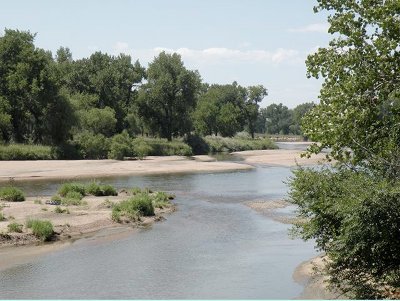
The subdivision has looked at buying water from the town of Fairplay. Now it is looking at drilling permanent wells away from the subdivision that would provide clean water, and a site has been found. Curt Sayer, president of the Redhill Forest Property Owners Mutual Water and Cattle Association, said that two test wells were drilled near the Middle Fork of the South Platte River near Colorado Highway 9 that could provide water free of radium. “The new water plant is going to be a sweetheart plant,” he said. “We’re not going to have to remove any radioactive materials, making it far less expensive to operate than our old water plant.” The current plant costs around $180,000 per year to operate. The new facility would cost an estimated $50,000 per year to operate. In August 2008, The Flume reported that there were 580 lots in the subdivision and 150 of them were getting water. At that time there were 80 homes built in the subdivision, half of which were occupied full-time.

More South Platte River Basin coverage here.

SB 10-078: Facilitate reuse of municipal effluent

A picture named wastewatertreatmentwtext.jpg

From The Pueblo Chieftain (Chris Woodka):

“There’s no way to know what this might do and what mischief it could cause,” attorney Peter Nichols told the Lower Arkansas Valley Water Conservancy District. “It looks like they could avoid court. This has the potential to change the place of use or the timing of use.”

The bill [SB78: Concerning the Use of Reusable Effluent That Has Been
Discharged Bact to a Water Body From a Domestic Wastewater Facility After Being Put To Beneficial Use] is sponsored by Sen. Mary Hodge, D-Brighton, and would allow cities that can measure the return flows from transmountain or fully consumable native water to reuse them — either by exchange or other means — without a trip to water court. Cities already have the right to reuse water “to extinction” when it is brought into the basin or when the consumptive use of crops on agricultural land is removed for municipal use. The cities, however, have to gain water court approval for how that water is used. This gives other water right owners the opportunity to assess whether the plan to reuse the return flows would injure their own ability to take water. The bill, as it is now written, places the responsibility of monitoring the measurement of return flows on the state engineer and does not mention water quality.

More 2010 Colorado legislation coverage here.

Cracks in the Pikes Peak Regional Water Authority?

A picture named pikespeak.jpg

From The Tri-Lakes Tribune (Nicole Chillino):

At the group’s Jan. 20 meeting, Cherokee Metropolitan District general manager Kip Petersen said Woodmoor Water and Sanitation District’s filing for an exchange plan for water in the Lower Arkansas Valley and a letter sent to Aaron Million expressing interest in his project came as surprises to him. Million, a Colorado entrepreneur, is working on a privately studied, built and funded project to pipe water from the Flaming Gorge Reservoir in Utah and Wyoming to areas along the Front Range. The exchange plan filing came as a surprise to several members of the authority and some thought it could hurt the group’s negotiations with projects it is looking at to potentially provide the area with renewable water. “I’m pretty sure that’s hurt our credibility with the Super Ditch people,” Petersen said.

More Pikes Peak Regional Water Authority coverage here.

Grand Junction: NWF climate change forum recap

A picture named coalfiredpowerplant.jpg

From the Grand Junction Daily Sentinel (Dennis Webb):

“In the longer term, would I want my kids to get into the river outfitting business? No, because eventually we’re not going to have the water, we’re not going to have the experience to give our guests,” said Murphy, manager of Rock Gardens Rafting. From rafting, to skiing, to hunting, fishing and wildlife-watching, Colorado’s recreation industries face a changing future because of a changing climate, speakers said Thursday night at a Glenwood Springs forum presented by the National Wildlife Federation and other conservation groups.

More climate change coverage here and here.

State Senator Bruce Whitehead plans to introduce legislation to increase reporting requirements for conservation measures

A picture named dripirrigation.jpg

From the Telluride Daily Planet (Ben Fornell):

As a man whose resume over the past 25 years is almost exclusively focused on water issues, the state senator from Southwest Colorado has several conservation measures on his mind. One bill he has agreed to sponsor will increase reporting requirements for water conservation measures, creating a system that will make the data more accessible to the public. “Conservation is important to Colorado and the use of its water,” Whitehead said.

More conservation coverage here.

R.I.P. Charlie Meyers

A picture named charliemeyers.jpg

I missed this remembrance of Charlie Meyers from Charles Gauvin: President and CEO, Trout Unlimited. Click through and read the whole thing. Here’s an excerpt:

One of Charlie’s last wishes was unexpected gift – he asked that donations in his name be given to Colorado Trout Unlimited. Even in death, Charlie Meyers still put conservation first.

Snowpack news: Nearly 3 feet of new snow sitting on the San Juans

A picture named plowingsnowsanjuans.jpg

From The Pueblo Chieftain (Matt Hildner):

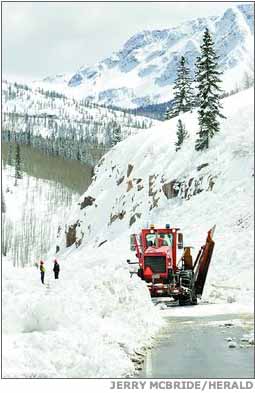
Both U.S. 160 on the west side of Wolf Creek Pass and Colorado 17 over Cumbres and La Manga were closed all day. U.S. 285 south of Antonito at the New Mexico state line was also closed at the start of the day, although it would later reopen…

By Friday morning, 31 inches of snow had fallen at Creede. “Mama said there’d be days like this,” Town Manager Clyde Dooley said. Work crews were plowing there by 3:30 a.m., attacking drifts that had piled as high as 39 inches in spots. By 2 p.m. the town of South Fork had roughly 20 inches of snow on the ground…

While tough on drivers, the snowfall boosted the mountains’ snowpack. The Natural Resource Conservation Service’s gauges in the upper Rio Grande basin reported snow-water equivalent at 103 percent of average, up by 20 points from just a week ago. Gauges in the Sangre de Cristos reported the snow-water equivalent at 92 percent of average, up from 78 percent last week.

More coverage from the Cortez Journal (Kimberly Benedict). From the article:

“We’ve received 11.2 inches (of snow) for all the storms that have happened in the whole week,” said local weather observer Jim Andrus. “It has been pretty impressive.” The winter weather has given the area a head start on moisture for the year, providing 1.31 inches of liquid precipitation, 130 percent of normal for the month, according to Andrus.

I can’t help posting this line from the Cortez Journal: “If you have deer near your home, chances are you also have mountain lions.” You see, it’s winter down there and the deer have been in the old orchards lazing around eating well and now the lions are eating well.

More coverage from The Durango Herald (Shane Benjamin):

The snow began flying Monday evening and continued for four consecutive days with periodic interruptions. A total of three storms passed through the region with 12- to 18-hour breaks between each one. As of Friday morning, Durango had received 35 inches over the preceding four days. As of Friday afternoon, Pagosa Springs reported 31.3 inches, Durango West II subdivision 39.7 inches, and Wolf Creek Pass 48 inches. The 35 inches is also Durango’s total for January, which is more than twice the average January snowfall of 16.9 inches…

Four of the five major mountain passes in Southwest Colorado – Coal Bank, Molas, Red Mountain and Wolf Creek – closed Thursday night and remained closed Friday evening. Lizard Head pass closed Thursday night and reopened Friday night. Cumbres and La Manga passes also were closed, preventing drivers from taking an alternate route through New Mexico.

Southern Delivery System: Fountain Creek Watershed Flood Control and Greenway District green lights project

A picture named sdspreferredalternative.jpg

From The Pueblo Chieftain (Chris Woodka):

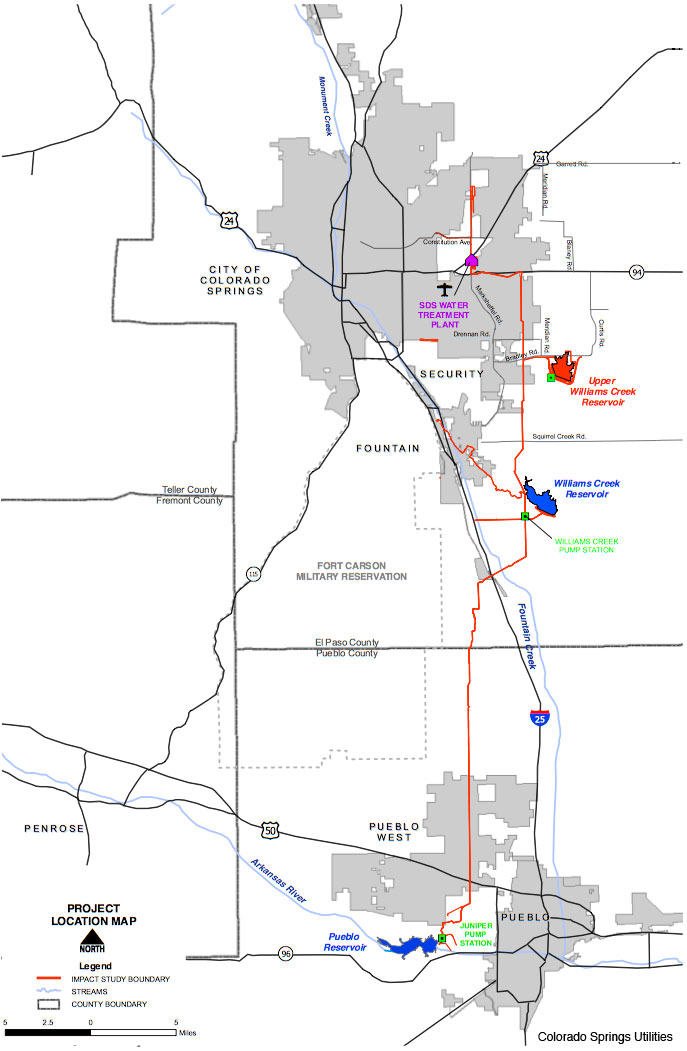
The approval by the Fountain Creek Watershed Flood Control and Greenway District came after two hours of discussion by the board on the adequacy of stormwater controls in Colorado Springs after a city council decision last month to disband the stormwater enterprise. “I would be embarrassed to be in a city of your size to let a politician or two misinform the public,” said Pueblo County Commissioner Jeff Chostner, who was elected chairman of the district board Friday. “You’re letting a few people in the community drive you in the wrong direction.” Chostner was referring to Doug Bruce, sponsor of Issue 300 — a November ballot proposal that led to the demise of the stormwater enterprise…

Richard Skorman, a former Colorado Springs City Councilman and an aide to former Sen. Ken Salazar when the Fountain Creek Crown Jewel project was launched, was even more blunt. “I want to apologize to Pueblo and our neighbors in Southern Colorado. I’m ashamed of what we’ve done,” Skorman said. “If it was June of 1999 (immediately after a large flood), the vote would have been 2-1 in favor of the stormwater enterprise.”

The Fountain Creek board voted unanimously to approve five separate requests from Colorado Springs Utilities, attaching conditions from its advisory committees. The technical advisory committee asked for detailed site development plans for the parts of the project that will be built in the Fountain Creek flood plain. The committee also wants the district to monitor the adaptive management plan required for the project by the Bureau of Reclamation. Colorado Springs plans to tunnel up to 30 feet deep under Interstate 25, railroad tracks and Fountain Creek when it crosses the creek with its pipeline just south of Pikes Peak International Raceway, said Keith Riley, permits manager for SDS. The citizens advisory committee also asked the board to include Condition 23 of the Pueblo County 1041 permit, which requires stormwater management in Colorado Springs. Utilities officials pledged to abide by the condition, but questioned why the district wants to duplicate Pueblo County’s effort. “Serving two masters is problematic,” said John Fredell, SDS project director.

More Southern Delivery System coverage here and here.

HB 10-1159: Mitigation for water exports

A picture named waterdivisionscolorado.jpg

From The Pueblo Chieftain (Chris Woodka):

In [HB 10-1159 Concerning the Water Court’s Authority to Consider Conditions in Decrees to Address the Effects of a Water Export Across Water Division Boundaries], Pace seeks to require mitigation agreements between communities giving up water (often rural) and those that are taking it through transport (generally urban). The agreements proposed by Pace would address both economic and ecological factors. If the water districts involved in a transfer could not reach an agreement, a judge in water court would set the terms. “It’s a carrot-and-stick approach that I’m proposing,” Pace said. “The carrot is the ability for urban and rural areas to work together collectively on mitigation agreements. The stick would be the provision for judges to apply mitigation when a compromise can’t be reached.”

Pace’s bill also calls for community meetings where citizens could express their positions on transfer agreements, something that doesn’t happen now. “The only individuals who have any standing in water court now are those with senior water rights who can show (economic) injury,” Pace said. “This bill would for the first time give communities a voice.”

More 2010 Colorado Legislation coverage here.

State Senate Agriculture and Natural Resources Committee votes unanimously to move Jim Martin’s appointment to DNR forward

A picture named roadteasttolaplatas032004

From the Grand Junction Free Press:

Gov. Bill Ritter’s pick to head the Colorado Department of Natural Resources has cleared the first hurdle to confirmation at the state Capitol. The Senate Agriculture and Natural Resources Committee voted unanimously Wednesday to back Jim Martin’s appointment. The full Senate will vote next.

Arkansas Valley Conduit: $14 million for project to be included in next year’s federal budget

A picture named pipeline.jpg

From The Pueblo Chieftain (Chris Woodka):

“What we hope for is that it will be part of the president’s budget on February 1,” lobbyist Christine Arbogast told the Southeastern Colorado Water Conservancy District on Thursday. “If it’s not all there, we’ll work with the congressional delegation (to get the full amount). . . . The deadline for that process is February 26.”[…]

This year could be the first time funds for the project are included in a presidential budget request, and hopes have been bolstered after Interior Secretary Ken Salazar’s visit to Pueblo last August. At a public meeting, Salazar made Arkansas Valley issues, including the conduit, a high priority. Meanwhile, the Southeastern district is moving ahead on pre-project activities on an accelerated schedule using an Environmental Protection Agency grant, said project manager Phil Reynolds…

Consultants also have begun discussing issues with the Colorado Department of Public Health and Environment, Bessemer Ditch and the Pueblo Board of Water Works. The initial path of the pipeline would cross Pueblo and could follow the ditch route toward the first customer, the St. Charles Mesa Water District…

The largest users are St. Charles, 17.47 percent; Lamar, 16.66 percent; La Junta, 14.22 percent; Rocky Ford, 8.05 percent; Las Animas, 6.7 percent; and Crowley County Water Association, 6.68 percent. Another 3 percent was set aside for contingencies. Communities east of Pueblo are entitled to 12 percent of the total yield of the Fryingpan-Arkansas Project under past allocation principles. That averages 9,643 acre-feet per year, but can vary widely from one year to the next. The communities are entitled to more than 37,000 acre-feet of Fryingpan-Arkansas Project storage in Lake Pueblo, however.

More Arkansas Valley Conduit coverage here and here.

Snowpack news

A picture named coloradosnowpack01202010

From the Fort Collins Coloradoan (Bobby Magill):

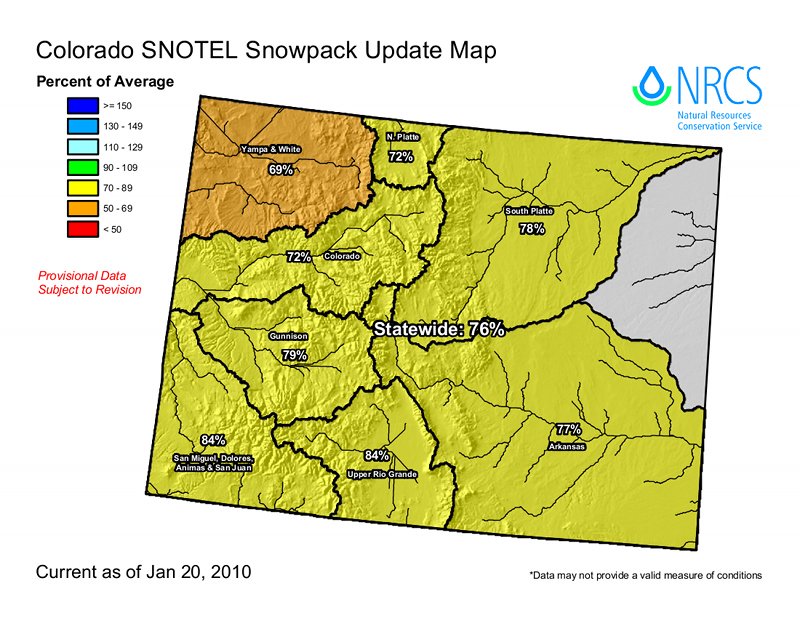
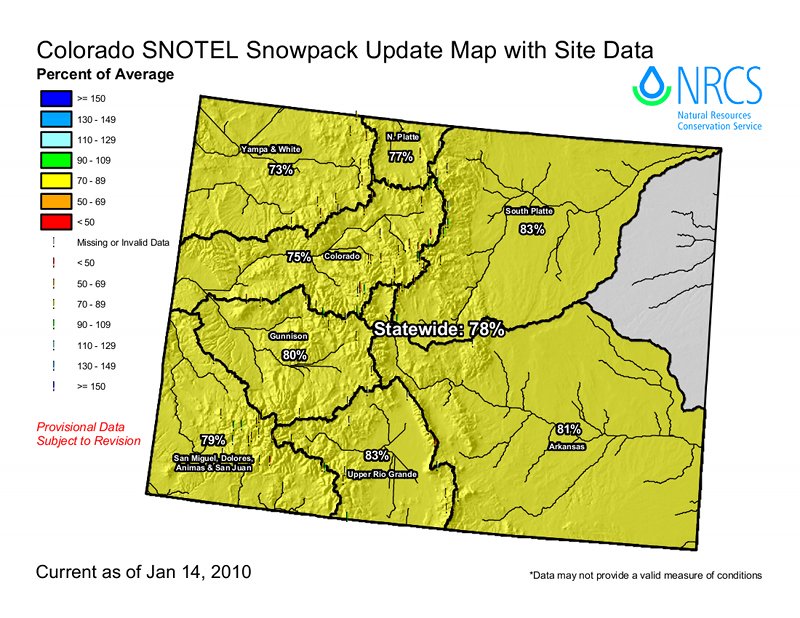
As of Thursday morning, the snowpack in the South Platte River Basin, which includes the Poudre River watershed, is 23 percent below normal, according to snowpack data compiled by the Natural Resources Conservation Service’s National Water and Climate Center. A year ago, the basin’s overall snowpack was only 6 percent below average. The snowpack below Cameron Pass at Joe Wright Reservoir is 79 percent of average, down from 105 percent of average a year ago.

Statewide, the snowpack is well below normal as well. The Yampa River Basin is down to 69 percent of normal. The Upper Colorado River Basin and the Laramie and North Platte river basins are both 72 percent of normal, while the Gunnison River Basin today sits at 80 percent of normal. The Gunnison’s snowpack a year ago was 110 percent of normal.

More coverage from the Fort Collins Coloradoan (Bobby Magill):

“What it means is, we’re probably a little better than halfway to building up our total peak (in snowpack),” said Chris Pacheco, assistant snow survey supervisor at the NRCS in Lakewood. “Between now and April, we’d have to get 130 percent of average snowfall to reach the average peak.”[…]

The snow is dry, too, with its water content nearly 3 inches below average at Cameron Pass and 76 percent of average statewide. “Seventy-six percent of average is pretty low,” Pacheco said, adding that the NRCS forecasts that there is a 10 percent probability the snowpack will return to average levels by the end of the snow season.

More coverage from the Grand Junction Daily Sentinel (Dennis Webb):

“We’re right about halfway through the winter accumulation season right now,” [Mike Gillespie, snow survey supervisor in Colorado for the Natural Resources Conservation Service] said. “It’s not really too early, I don’t think, to be a little concerned. We’re starting off on a deficit right now.” One question is whether this year’s El Niño weather pattern will bring much relief to the state. Usually, that weather pattern benefits the southwest corner the most, he said. This week, a storm has been hitting that region hard, with the Silverton Mountain ski area reporting 17 inches of snowfall in a 24-hour period, and Wolf Creek Ski Area saying Thursday the storm had brought 29 inches, with a lot more snow still in the forecast. But Dave Merritt, a board member of the Colorado River Water Conservation District in Glenwood Springs, said he saw no new snow while driving Interstate 70 east to Denver on Thursday.

More coverage from The Aspen Times (Scott Condon):

Data collected at the Skico’s snow station near Cloud 9 Restaurant at Aspen Highlands showed there were 185 millimeters of water content in the snowpack, Burkley said Thursday morning. The median for this time of winter is 258 millimeters. The lowest season-to-date was 111 millimeters back in 2000. As of Thursday morning, this season ranked in the 20th percentile for snowfall over the past 30 years, according to Burkley. In other words, only six seasons have been drier since 1980. Three of them came between 1999 and 2001, he said.

More coverage from The Pueblo Chieftain (Matt Hildner):

A storm system that could dump up to 4 feet of snow in the eastern San Juan Mountains hit Thursday afternoon and was expected to sit over the area through late Friday…

Foothills communities such as Creede and South Fork are forecasted to get between 8 and 17 inches of snow. Between 6 inches to a foot of snow are expected to fall on the Sangre de Cristo Mountains, including Poncha and La Veta passes…

Thursday’s storm had dropped 5 inches of snow at Wolf Creek Ski Area by 2 p.m. The snowfall also led to the implementation of chain laws on Colorado 17 over Cumbres and La Managa passes. By 6 p.m., 4 inches of snow had fallen at Antonito, while an inch had fallen in Monte Vista, according to weather service spotters.

Coyote Gulch archives in danger of going missing

A picture named coyotenaturalbridge0507

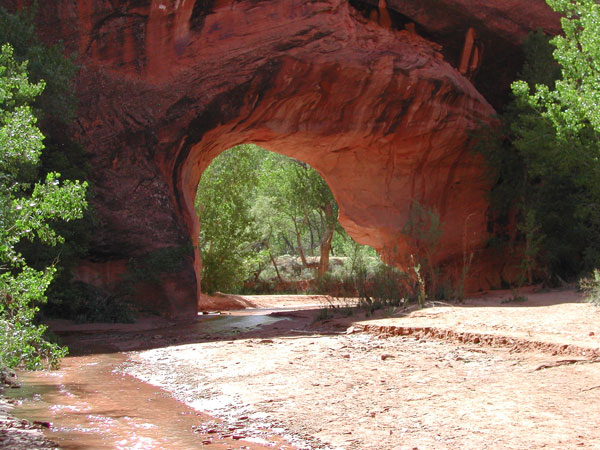
I was having some trouble this morning with images that I had uploaded to the the servers at Radio Userland my old hosting service for Coyote Gulch. After checking in the the folks at Userland I found this announcement.

UserLand has decided to close the Radio UserLand and Salon Radio services as of December 31, 2009.

Update: Due to server outages in late November and early December, the Radio UserLand and Salon Radio services will remain available until January 31, 2010.

You can continue to use your Radio weblog hosted with UserLand until the end of the year.

If you plan on continuing to use Radio to publish your blog, we would recommend that you look for an alternative web host if your weblog is being published to a UserLand server. You can use the FTP option [1] in Radio to publish to your own server.

The closure of Radio will also mean that the UserLand-hosted comments, trackbacks and stats tracking will be unavailable after the shutdown date.

If you have any questions, please send them to customerservice@userland.com

UserLand Software

All of Coyote Gulch’s content up until February 2009 is hosted there. Links to old articles and graphics will now be broken. ARGHHHH! (It makes me scream). There is a chance that I will be able to re-publish all the articles to another server but I have low confidence in Userland’s software. I apologize to all of you readers that still navigated to the old blog from time to time. I planned to pay my fees each year and hoped that Userland Software would at least keep everything on line in perpetuity even if they didn’t allow new posting. That doesn’t seem to be the case.

Colorado Springs: Colorado Rural Water Association’s 29th Annual Training Conference and Exhibition February 15-18

A picture named irrigation.jpg

Here’s the lowdown from the Colorado Rural Water Association.

Tamarisk control: 15 camels working the tamarisk clusters near Loma

A picture named camel.jpg

From Discovery News (Alyssa Danigelis):

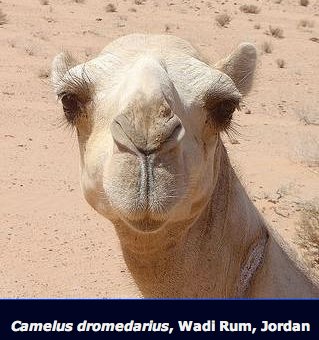
Rancher Maggie Repp has unleashed her 15 camels in Loma, Colorado, on tamarisk clusters and noticed that they managed to obliterate every one of the hardy shrubs, Lisa Song reports in the High Country News.

More tamarisk control coverage here and here.

Grand Junction: Pit-liner bill upheld

A picture named derrick.jpg

From the Grand Junction Daily Sentinel (Dennis Wwebb):

Judge William W. Hood III issued the ruling Tuesday in the case brought by Fourmile Recycling Facility Inc. of Moffat County, and a second operation there.

The operators challenged rules adopted by the Colorado Solid and Hazardous Waste Commission, which was implementing a new state law. The Legislature passed the bill in 2008 out of concern about the potential health effects of the facilities in places such as the De Beque area in Mesa County. Its principal sponsors included state Sen. Josh Penry, R-Grand Junction, and Bernie Buescher, a former state representative from Grand Junction now serving as secretary of state. The law requires new facilities to be located at least a half mile from homes, other occupied structures and parks. Companies also must now use synthetic rather than more permeable clay liners for disposal pits unless they qualify for waivers.

Brine waste from oil and gas exploration and production consists of salt water mixed with small amounts of chemicals used in hydraulic fracturing of wells, along with crude oil and other hydrocarbons.

The new rules don’t apply to brine waste disposal by oil and gas well owners, who instead are subject to similar regulation by the Colorado Oil and Gas Conservation Commission.

Hood disagreed with plaintiffs’ contentions that the new rules were contrary to the 2008 law, unreasonable and unconstitutional, and that they usurped local regulatory authority over such disposal sites.

More groundwater coverage here and here.

Flaming Gorge pipeline: Million Resources Group has seventeen entities in Colorado and Wyoming interested in the water

A picture named flaminggorgepipelinemillion.jpg

Update: Here’s the list from the Associated Press via CBS4Denver.com:

Central Colorado Water Conservancy District and its subdistricts, headquartered in Greeley, Colo., up to 150,000 acre feet; Cheyenne Board of Public Utilities: from 3,500 to 5,500 acre feet by the year 2040; City of Brighton, Colo.: up to 12,000 acre feet; Douglas County, Colo.,: up to 40,000 acre feet; East Larimer County Water District, Up to 5,000 acre feet; Fort Collins-Loveland Water District; up to 5,000 acre feet; Larimer and Weld Irrigation Co.: up to 20,000 acre feet; Lower South Platte Water Conservancy District, up to 35,000 acre feet; Norris Ranches (T-Cross Ranches, Norris Cattle Inc. in Colorado Springs); up to 20,000 acre feet; North Sterling Irrigation District; up to 25,000 acre feet; Penley Water Company in Douglas County, Colo.,; Up to 10,000 acre feet; Pioneer Canal and Lake Hattie Irrigation District in Wyoming, 8,000 acre feet; Prewitt Operating Committee, headquartered in Sterling, Colo., (Logan Irrigation Co., Illiff Irrigation District, Morgan Prewitt Reservoir Co.), up to 10,000 acre feet; Windsor Reservoir and Canal Co., up to 10,000 acre feet; Woodmoor Water and Sanitation District, up to 3,000 acre feet.

More coverage from the Associated Press (Ben Neary) via CBS4Denver.com. From the article:

Mike DiTullio, general manager Fort Collins-Loveland Water District, said Thursday his district serves 15,000 customers and ultimately could use another 10,000 acre feet of water. The district’s letter submitted to the Corps of Engineers expresses interest in securing an additional 5,000 acre feet per year. “We’re interested in any water project that could bring water into northern Colorado,” DiTullio said. “It doesn’t have to be (Million’s); we’re into any of them. We think that water is just an essential ingredient for the health and welfare of northern Colorado and Wyoming.”

Tim Murrell, Douglas County water resources planner in Castle Rock, Colo., said Thursday that the county’s letter expressing the need for up to 40,000 acre feet of water doesn’t indicate support or opposition to the pipeline project. “It wasn’t interest in this water,” Murrell said of the county’s letter. “It was a statement that we would need a certain amount of water from some source.”

From the Associated Press via KJCT8.com:

Some of the potential customers say they don’t necessarily endorse the pipeline project, which faces opposition in Wyoming…Million this week gave the U.S. Army Corps of Engineers a list of 17 local water entities in Colorado and Wyoming interested in getting water. He says their needs exceed the pipeline’s capacity and prove that it’s necessary.

More Flaming Gorge pipeline coverage here and here.

Republican River Water Conservation District board meeting recap

A picture named republicanriverbasin.jpg

From the Yuma Pioneer (Tony Rayl):

Legal counsel David Robbins told the board that the three states — Colorado, Kansas and Nebraska — have reached a contract agreement with arbitrator Martha Pagel of Oregon. Colorado invoked the non-binding fasttrack arbitration last August after Kansas and Nebraska voted down the pipeline plan as presented. The initial timeline called for the arbitrator being chosen by September 16, the trial to be held February 1-5, with the arbitrator’s decision due by March 1. Robbins said there was no news yet on a revamped timeline. “We are more in a mode of a tugboat on an oceanliner, trying to nudge the three states along,” he said, noting the district itself had very little power in terms of forcing the states into action…

Robbins told the board that Colorado officials were meeting with their Nebraska counterparts this week in an effort to find out how to reach an agreement on the pipeline. Robbins and Dennis Montgomery, another member of the RRWCD’s legal team, were going to be involved with the meetings…

Later in last Thursday’s meeting, district engineer Jim Slattery reported that pipeline consultant GEI strongly recommends not do the prequalifying of potential contractors until ready to actually do the project. He added that GEI is receiving phone calls daily from contractors eager to get started, and the process is receiving interest from all over the country. That was when Robbins spoke up again, asking if the district should build before it is clear how much credit toward compact compliance Colorado will receive for the water it sends down the North Fork from the pipeline. (As it stands now, only 22 percent of the water that crossed the gage at the Nebraska state line would go toward compact compliance. However, when all is said and done, it is expected Colorado will receive 80 to 100 percent credit.) He noted that if the arbitration goes well, then Colorado will be in a stronger position to go forward with the pipeline…

Board President Dennis Coryell said last Thursday the district is just beginning to receiving the feedback, and hopes all ground water management districts and commissioners provide their opinion within the coming weeks.
(The district already has spent more than $40 million on purchasing the wells for the pipeline, from the Cure family. The wells are located approximately 10 miles or more north of Laird in extreme eastern Yuma County. However, there is another $15 million of the Colorado Water Conservation Board’s $60 million loan left to spend on construction of the pipeline.) Board members did relay some feedback they have received. Greg Larson said Byron Weathers of Colorado Corn, indicated the organization would prefer to wait for arbitration to run its course. Several others said their ground water districts are leaning toward waiting for the arbitrator’s decision, as well as other issues to be settled, such as the amount of credit Colorado will receive, the sub-basin test on the South Fork being pushed by Kansas. (The state is fighting the idea of water being sent down the North Fork counting for the water the compact states Colorado should be sending down the South Fork.)

More Republican River Basin coverage here and here.

Arkansas Valley: Woodmoor Water and Sanitation District offers $40,000 per share for rights on the High Line Canal

A picture named arkbasinditchsystem.jpg

From The Pueblo Chieftain (Chris Woodka):

A copy of a contract being offered by the Woodmoor Water and Sanitation District revealed the offer. Woodmoor is seeking to buy shares of the High Line and Holbrook canals, which primarily serve farmers in Otero County. The Woodmoor district is on the northern El Paso County line, east of Interstate 25. It serves 8,400 customers and some of the homes in the district drain into the South Platte basin.

It’s not known how many contract offers have been made, who has accepted or what prices are being offered on the Holbrook Canal. The contract provides a diligence period of four months with the possibility of extension. The price reflects the potential difficulty of moving water from the Arkansas Valley. Bessemer Ditch shares last year sold to the Pueblo Board of Water Works for $10,150 each. A share on the Bessemer historically irrigated 1 acre. Further down the river, on the Fort Lyon and Amity canals, shares have sold to municipal or industrial interests for a less than $2,500 per acre in recent years. High Line sold water to Aurora and Colorado Springs on a temporary lease agreement for $500 per acre in 2004-05.

The district filed for an exchange decree on potential Lower Arkansas Valley water rights on Dec. 30 in Division 2 Water Court. The move would allow Woodmoor to take water by exchange up reservoirs, both existing and planned, on the Arkansas River and Fountain Creek. On Wednesday, the Lower Arkansas Valley Water Conservancy District board voted unanimously to oppose the water court application.

More Arkansas Basin coverage here.

Colorado State University: Water Tables 2010 February 20

A picture named coloradohistoricaverageannualstreamflows.jpg

Here’s the link to the website. They write:

Join us for the fifth year of Water Tables, the annual fundraiser supporting the Water Resources Archive on Saturday, February 20.

You won’t want to miss this evening of dinner and conversation with experts on Western water. This year’s theme, “Across State Lines: Sharing the Resource,” promises to be livelier than ever. The event starts at 5 p.m. with a reception and tour of the Archive at Morgan Library before moving to the Lory Student Center main ballroom for dinner.

You can choose to sit with one of 20 table hosts who will hold discussions during dinner on various aspects of how states and countries share water. Archival materials on display during the reception will illuminate some of the history behind the topic.

With one international and five out-of-state water experts hosting tables this year, the Water Resources Archive is giving greater attention to western water issues, as well as Colorado’s precarious position of being the Headwaters State.

Water Tables 2010 provides a unique opportunity to mingle with this special group representing diverse perspectives. Join us!

Here’s the list of table hosts and topics from the CSU Water Resources Archives Newsletter:

Colorado State University Libraries will host Water Tables 2010, its fifth annual fundraiser for the Water Resources Archive, at 5 p.m. Saturday, February 20th. The event starts with a reception and tour of the Archive at Morgan Library before moving to the Lory Student Center main ballroom for dinner.

The theme this year is “Across State Lines: Sharing the Resource.” Twenty table hosts will hold discussions during dinner focused on various aspects of how states and countries share water. Archival materials on display during the reception will illuminate some of the history behind the topic.

With one international and five out-of-state water experts hosting tables this year, the Water Resources Archive is giving greater attention to western water issues, broadly, as well as Colorado’s precarious position of being the Headwaters State. Water Tables 2010 provides a unique opportunity to interact with this special assemblage representing diverse perspectives.

This year’s table hosts and topics are:

Don Ament, Former Colorado Commissioner of Agriculture
Topic: Is ag dry-up inevitable?

Alan Berryman, Assistant General Manager, Engineering Division, Northern Colorado Water Conservancy District
Topic: Interstate comity is for the birds

John D’Antonio, New Mexico State Engineer
Topic: The Rio Grande Compact — sharing the resource

Derek Everett, Visiting assistant professor, History Department, Metropolitan State College of Denver
Topic: Fluid boundaries: water and western state lines

Jennifer Gimbel, Director, Colorado Water Conservation Board
Topic: The state of Colorado’s role in balancing non-consumptive needs and meeting the state’s future consumptive use demands

Neil Grigg, Professor of Civil and Environmental Engineering, Colorado State University
Topic: Water for a sustainable future: challenges to the political system

Taylor Hawes, Colorado River Program Director, The Nature Conservancy
Topic: The Colorado River Compact: is it up to the task?

Tom Iseman, Program Director for Water Policy and Implementation, Western Governors Association
Topic: How far has multi-state water management gotten us? Where will it lead us?

Frank Jaeger, District Manager, Parker Water and Sanitation District
Topic: Colorado-Wyoming Coalition: developing Colorado River water across state lines

Eric Kuhn, General Manager, Colorado River Water Conservation District
Topic: How can we keep from losing the resource? How would we deal with a compact call on the Colorado River?

Harry LaBonde, Jr., Wyoming Deputy State Engineer
Topic: The Green River Pipeline Regional Watershed Supply Project — perspectives from Wyoming

Mario Lopez Perez, Engineering and Technical Standards Manager, National Water Commission of Mexico
Topic: The Colorado River as an international river: Mexico’s perspective

Jon Monson, Director of Water and Sewer, City of Greeley
Topic: The Laramie-Poudre Tunnel and the Colorado-Wyoming Compact of 1957: a tale of transfer ag to urban

Patrick O’Toole, President of the Family Farm Alliance, and former member of President Clinton’s Western Water Policy Review Advisory Commission
Topic: A historical look at western water policy development

Jennifer Pitt, Senior Resource Analyst, Environmental Defense Fund
Topic: Si se puede? U.S.-Mexico cooperation on the Colorado River

Rock Ringling, Managing Director, Montana Land Trust
Topic: Private land conservation’s role in the preservation of wetlands and water resources

Bill Rinne, Director, Surface Water Resources Dept., Southern Nevada Water Authority
Topic: Augmenting the Colorado River — sharing the resource

David Robbins, President and Co-founder, Hill & Robbins, P.C.
Topic: Why we have to share — limits on our right to consume

Randy Seaholm, Former Chief, Water Supply Protection, Colorado Water Conservation Board
Topic: Environmental flows, Colorado’s compact entitlement and compact administration

Steve Vandiver, General Manager, Rio Grande Water Conservation District
Topic: Riding herd on the Rio Grande Compact in the San Luis Valley

More Colorado Water coverage here.

Flaming Gorge pipeline: No list of customers yet but Aaron Million names three interested parties

A picture named flaminggorgepipelinemillion.jpg

From the Associated Press via LocalNews8.com:

The U.S. Army Corps of Engineers last year directed Million to name potential customers to prove the project’s need. Million issued a statement Wednesday afternoon saying Douglas County and the Fort Collins-Loveland Water District in Colorado and Lake Hattie Irrigation District in Wyoming are interested. Million didn’t have a full customer list available. The list was not available Wednesday afternoon from the Corps of Engineers.

More Flaming Gorge pipeline (Regional Watershed Supply Project) coverage here and here.

Snowpack news

A picture named coloradosnowpack01202010

From The Aspen Times:

Snowfall in Aspen and Snowmass has been scant since late December and locals have been crossing their fingers this week. The Aspen Skiing Co. reported 3 inches of new snow at Snowmass early Wednesday, while Aspen Highlands picked up 2 inches over the past 24 hours, according to the morning report. Aspen Mountain and Buttermilk both picked up an inch. Sunlight Mountain Resort near Glenwood Springs had 2.5 inches. Snowfall reports around the state varied widely, with resorts in the southwest enjoying the biggest dumps. Wolf Creek reported 10 inches over the past 24 hours on Wednesday morning, and Durango Mountain Resort had 13 inches. Silverton boasted 8 inches. Telluride reported 4 inches of new snow. Powderhorn in far western Colorado picked up 8.5 inches, but most resorts elsewhere around the state were reporting 1 to 3 inches, though Vail and Beaver Creek both reported 5 inches of new snow early Wednesday morning.

From the Cortez Journal:

“The storm has definitely favored southern Colorado and southeastern Utah,” said Norv Larson, meteorologist with the National Weather Service in Grand Junction, said Tuesday. Snowfall accumulated to 10.1 inches through Wednesday morning, according to Jim Andrus, local weather observer. The snow has brought much-needed moisture to the region. “Right now for the month of January we have .95 inches of water and normal is 1.01 inches,” Andrus said. “We are already sitting at 94 percent of normal.”[…]

Thus far, Cortez has seen 31.6 inches of winter snow with measurable snow on the ground for 45 straight days. “That’s the longest stretch of measurable snow I’ve ever had here,” Andrus said.

First decade of 21st century was the warmest on record

A picture named meltwaterlake.jpg

From the Associated Press (Randolph E. Schmid) via The Denver Post:

In 2009, global surface temperatures were 1.01 degree above average, which tied the year for the fifth warmest year on record, the National Climatic Data Center said. And that helped push the 2000-2009 decade to 0.96 degree above normal, which the agency said “shattered” the 1990s record value of 0.65 degree above normal. The warmest year on record was 2005 at 1.11 degrees above normal…

In the United States last year the average temperature was 0.3 degrees above normal. And on average it was moist, with average annual precipitation in 2009 for the 48 contiguous states some 2.33 inches above the long-term average at 31.47 inches. It was the 18th wettest in 115 years of record keeping. However, dry conditions occurred during much of the year across parts of the Southwest, Upper Mississippi Valley and southern Texas, the agency said. And there was periodic low rain and snowfall in parts of a ring around the country from the northern Rockies, Far West and Southwest to the southern Plains and Southeast, then up along the East Coast and back across the Great Lakes.

More climate change coverage here and here.

Helen Hankins appointed to lead Bureau of Land Management in Colorado

A picture named anvilpoints.jpg

From the Associated Press via Grand Junction Free Press:

Helen Hankins, a 58-year-old native of Council, Idaho, is currently associate state director for the BLM in Arizona. Hankins replaces Sally Wisely, who retired last year. Hankins has worked for the BLM for about 40 years, including an assignment in Durango. As Colorado state BLM dikerctor, Hankins will oversee 815 employees with a budget of approximately $75 million. Colorado has 8.3 million acres of BLM public lands and 27 million acres of mineral estate.

Here’s the release from the Bureau of Land Management (Celia Boddinton):

Bureau of Land Management Director Bob Abbey today announced the appointment of career employee Helen Hankins as the new state director for the agency’s Colorado State Office. Hankins is currently the associate state director for the BLM in Arizona.

“Helen has worked at all levels and across the nation for the BLM,” Abbey said. “The depth and breadth of her experience and her dedication to our country’s public lands is exceptional. I’m very pleased she has accepted this crucial position.”

Hankins, 58, is a native of Council, Idaho. She joined the BLM in Albuquerque, N.M., serving as a clerk-typist in the agency’s student work study program in 1970. She went on to serve in increasingly responsible positions in Durango, Colo., Anchorage and Fairbanks, Alaska, Washington, D.C., Elko, Nev., and Phoenix, Ariz.

She earned her bachelor’s degree in geology from the University of New Mexico and was one of the first two women to complete the BLM’s 5-month-long minerals law school program.

In Colorado, Hankins will oversee 815 employees with a budget of approximately $75 million and administer 8.3 million acres of BLM public lands and 27 million acres of mineral estate, which are concentrated primarily in the western portion of the state.

Hankins, an active member of both Rotary International and Toastmasters International, is married to Michael Mauser, with whom she has hosted eleven exchange students. Helen and Michael look forward to continuing their shared passion for hiking and backpacking in Colorado. She plans to assume her duties on February 1.

Craig: Yampa/White River Roundtable recap

A picture named yampariverbasin.jpg

From the Craig Daily Press (Andy Bockelman):

At its Wednesday night meeting at the Holiday Inn of Craig, the group of regional water experts unanimously tabled discussion for at least two future meetings after hearing a presentation from Steamboat Springs water attorney Tom Sharp.

In [his proposed Yampa Doctrine], Sharp wrote that Article XIII of the 1948 Upper Colorado River Compact — which requires that the state of Colorado not cause the flow of the Yampa’s Maybell gauging station to drop below 5 million acre-feet during the course of 10 years — among other things, needed closer, more specific regulation to ensure that Colorado is responsible for the curtailment of its own water should the Lower Basin states require it.

Sharp said the Yampa’s flow is 1.2 million acre-feet and users only require about a tenth of it. But he said modern users could be vulnerable since its water is now needed for regional power plants, reservoirs and other such uses, as opposed to the pre-1950s period when it was primarily used for irrigation and other agricultural purposes.

Attendee Eric Kuhn, of the Colorado River District — who said he wasn’t officially representing the group — spoke against the Yampa Doctrine, saying he didn’t think passing it would better the issue of water rights and regulations. “I’m not sure I agree that the state will be jumping quickly into rule-making,” Kuhn said.

I missed this story Tuesday. It’s a preview of yesterday’s Yampa/White River roundtable meeting where local water attorney was Tom Sharp to present his “Yampa Doctrine” methodology to protect Yampa irrigators if there is a call on the Colorado River from downstream Colorado River Compact states. Here’s the report from Mike Lawrence writing for Steamboat Today. From the article:

The Yampa Doctrine is an effort to protect local water users in the event of a worst-case scenario for the Colorado River system: a so-called “compact call,” a case of extreme water shortage in which the 1922 Colorado River Compact is enacted and Lower Basin states — Nevada, part of Arizona and California — call for their allocated water from Upper Basin states including Colorado, Utah, Wyoming, part of Arizona and New Mexico. Sharp said Monday that there is not yet a specific plan for how state water officials would acquire the allocated water — in other words, who gets shut off — if such a call occurs. “What (the Yampa Doctrine) would do would be to protect the Yampa Basin users from being forced to curtail their use, to stop their use, when there is a Lower Basin call and the Upper Basin has to deliver up water at Lee’s Ferry (in Arizona),” Sharp said.

Sharp said Yampa River users could be vulnerable to state action because regional reservoirs and power plants have “very junior water rights.” “We need to be prepared to make the Yampa Doctrine argument as a defense to being the youngest guy on the block,” he said.

State water officials have not agreed with his interpretation of water policy language, Sharp said. “Nobody else particularly thinks that’s appropriate,” he said of the Yampa Doctrine.

More Yampa River Basin coverage here.

Eagle: Conservation program successes

A picture named toiletlidsink.jpg

From the Eagle Valley Enterprise:

The town of Eagle reduced its annual potable water consumption by 10 percent in 2009. This equates to a savings of more than 40 million gallons of water, with the largest reductions noted in the residential sector. Government operations, including park maintenance, reduced its consumption by more than 14 percent.

More conservation coverage here.

Energy policy — nuclear: Conservation groups suing the U.S. Department of Energy for its decision to expand uranium mining on BLM parcels near the Dolores River Canyon

A picture named doloresrivercanyon.jpg

From The Telluride Watch (Karen James):

“I find that some limited discovery is appropriate but reject the full range of discovery sought by Plaintiffs,” wrote U.S. District Court Chief Judge Wiley Y. Daniel, who both affirmed and rejected parts of a previous finding issued by U.S. Magistrate Judge Michael J. Watanabe that denied discovery.

While Daniel agreed that limited discovery was appropriate for the purpose of identifying site-specific actions taken by the DOE concerning leases, mining approvals or other activity to implement the program, he rejected a request for discovery concerning unspecified, non site-specific actions. “This discovery request is too broad and would essentially constitute a fishing expedition on the part of Plaintiffs,” he wrote.

More nuclear coverage here and here.

Vail: Next ‘Waterwise Wednesday’ meeting January 27

A picture named eagleriver.jpg

From the Vail Daily:

The impact of growth on Vail Valley water supplies will be discussed at the next Waterwise Wednesday session at 5:30 p.m. on Jan. 27 in the Board of County Commissioner’s hearing room in the Eagle County Building. Clark Anderson, an Eagle County native and director of the Sonoran Institute’s Colorado Rockies program, will discuss ways water supplies can be protected when new development is approved. He will focus on design and planning strategies that minimize the impact on water supplies and how government agencies can developer more water-friendly policies.

More Eagle River watershed coverage here.

Flaming Gorge Pipeline: The view from Green River, Wyoming

A picture named flaminggorgepipelinemillion.jpg

Here’s a long article about Aaron Million’s pipeline dream to move water from the Green River (and Flaming Gorge Reservoir) to Colorado’s Front Range, from Brandon Loomis writing for The Salt Lake Tribune. From the article:

In an audacious test of the Western axiom that water flows toward money, Fort Collins, Colo., entrepreneur Aaron Million wants to tap this Colorado River tributary just downstream from here and send it to faucets in neighborhoods that don’t yet exist. “We certainly don’t want to impact the Green River,” says Million, who spent his youthful summers shoveling mud to open and close flood-irrigation canals to his grandfather’s melon farm in Green River, Utah.

His plan worries Utah and Wyoming officials, who don’t dispute that Colorado has a legal right to the water under the Colorado River Compact. They never expected their neighbor to take its share from a river that they consider money in their water banks, but rather thought the diversion would come from the Colorado River to the south…

“That river is so quickly impacted by [changing] water conditions,” says Mark Forslund, a Heber City fly-fishing guide who has floated the Green here for a dozen years. Unlike lower stretches, he says, the upper Green is shallow, with no holes to hide fish. When flows shrink in winter, fish die. In summer, the water gets hot. These are conditions that steel the monstrous brown trout and make valiant fighters of the rainbows and native cutthroats, he says. Tinkering with flows from the Fontenelle Dam, above the [Seedskadee National Wildlife Refuge], could doom them. The Corps of Engineers is reviewing Million’s proposal to take water from just 200 yards downstream of the refuge boundary. Million now says he’ll consider a diversion downstream in siltier waters below the city of Green River, Wyo. Moving it lower is better, Seedskadee Refuge Manager Carl Millegan says, but won’t fully protect the refuge. Draining the river — perhaps taking as much as half of its lowest winter flows — will hinder fish migrations from Flaming Gorge. Kokanee salmon, a major source of nutrients for the refuge’s other fish and birds, might not swim up to Fontenelle to spawn and die as they do now, he says. “I can’t see how they’d make it,” he says while standing on a cutbank and watching one of the refuge’s seven eagle nests on a tree across the ice. Wherever the pipeline starts, Millegan fears, it could require adjusting Fontenelle Dam’s releases and stemming spring floods that scour the riverbanks and help new cottonwoods sprout.

Millegan’s view north across the sagebrush finds the ice-capped granite of the Wind River Range, source for both the river and uneasiness about its future. The glaciers there, including seven of the 10 largest in the American Rockies, are shrinking. It’s just one reason scientists throughout the Colorado River Basin worry that climate changes will drop water levels well below what the states divvied up on paper with the 1922 compact. “Whether you believe in climate change or not, every year around here is a struggle” for adequate flows, Millegan says. So far this winter’s snowpack in the Winds is about half the historic average.

The glaciers have shrunk by a third or more since 1970, according to Craig Thompson, an associate professor of earth sciences and engineering at Western Wyoming Community College. He and faculty colleague Charlie Love, a geologist, have studied the glaciers since 1985. The glaciers help maintain year-round flows, Thompson says, because they release meltwater late in the summer and fall, when winter snows are gone. When they disappear, he expects, the year-round supply for Denver or any other big pipe evaporates. Corralling the river also could degrade municipal supplies here, Thompson says, because lower flows mean higher salinity in this mineral-rich valley…

All this for private gain? At current Colorado water prices, Thompson figures the Million Conservation Resource group could make $250 million a year on the water.
“It looks like a project where Million gets to turn millions into billions,” he says, “and Wyoming gets to bear the impacts.”

Million views his plan more like his great-grandfather might have, back when he built one of the river’s earlier irrigation ditches. “Water in the Western United States was developed privately, initially, by the farm and ranch and mining communities,” he says. It wasn’t until later that the federal government stepped in, he says. His pipeline is a return to the principle of private capital serving public demand. “That’s how America was built,” Million says…

Million is unfazed. He can build the pipeline with up to $3 billion in private financing, he says, if he gets 140,000 acre-feet or more. Despite the loud and broad criticism — including condemnation by the Green River and Laramie city councils in Wyoming — Million believes the project is on course. After all, he notes, Colorado has an absolute right to the water…

Million must show who will buy his water before the environmental review continues. His deadline to produce a list of users to the Corps of Engineers is today. He says he has that list ready, but critics wonder why anyone would sign on without a firm supply and rates in place. To get a permit to alter wetlands, Million also will have to prove his plan jibes with the Clean Water Act. That means the corps must determine it’s the least damaging plan that can reasonably meet the need. The corps is investigating that question, project manager Rena Brand says, and whether in fact Front Range growth is likely to require so much water.

University of Arizona law professor Robert Glennon sees many obstacles in Million’s way, “not the least of which is the Rocky Mountains.” Farmers and small towns in western Colorado won’t want the Front Range to soak up all of Colorado’s rights. Further political complications come from Front Range citizens and water districts who “won’t want Aaron Million to hold all of the cards.”[…]

Glennon’s 2008 book, Unquenchable: America’s Water Crisis and What To Do About It , groups Million with a host of grand-scheming “water alchemists” who, he writes, “gaze at the Mississippi River, the Columbia River, icebergs in Alaska, and rivers in British Columbia and wistfully imagine the problem is solved.” Still, he says, if Million secures real municipal and agricultural customers, the interstate compact’s so-called “law of the river” is with him. “Sometimes,” Glennon says, “dreamers pull off their dreams.”

More Flaming Gorge Pipeline coverage here and here.

Rocky Ford: Sixth Annual Arkansas Valley Farm/Ranch/Water Symposium and Trade Show Feb. 4

A picture named rockyfordditch.jpg

From the Ag Journal:

The sixth annual Arkansas Valley Farm/Ranch/Water Symposium and Trade Show is scheduled Feb. 4 in Rocky Ford…

The water topics will include operation of the Pueblo Reservoir and an update on the irrigation efficiency rules…

The symposium will be conducted at the Gobin Community Building in Rocky Ford with registration beginning at 8 a.m. The program will begin at 8:30 a.m. Early registration is $20 per person or $30 per couple before Jan. 29 ($25 and $35, respectfully, after January 29). Student registration is $5. For information call Janet Golden or Natalie Edmundson, CSU Extension office in Rocky Ford at (719) 254-7608, or visit the Web site http://www.farmranchwater.org.

More Arkansas Basin coverage here.

Snowpack news

A picture named coloradosnowpack01202010

From The Pueblo Chieftain (Matt Hildner):

Just under a foot of snow fell on the eastern San Juan Mountains Tuesday and more is expected in the region today. The snowstorm, which dropped 10 inches of snow on Wolf Creek Ski Area, made for treacherous driving in the high country…The snowstorm glanced off much of the San Luis Valley, leaving only a dusting in Alamosa and 2 inches in the foothills southeast of Crestone, according to a National Weather Service spotter.

More coverage from the Cortez Journal (Kimberly Benedict/Steve Grazier):

County officials placed the snow total at 7 inches at 6:45 a.m. [Tuesday], [Norv Larson, meteorologist with the National Weather Service in Grand Junction] said. Another 1 to 3 inches of accumulations are expected through the morning…

Snow falling from power lines has resulted in “blinks,” according to Jones. “Blinks” occur when accumulating snow falls off a power line, and the line moves, connecting with the neutral, or lowest line, Jones explained. When a phase touches the neutral it can trip a breaker or blow a fuse, which could affect an entire section of line…

Despite a lack of hard evidence, many in the weather community believe El Nino has impacted weather systems across the nation, according to Larson. “Although there isn’t a lot of climatological evidence, you could argue that El Nino is really impacting California and that seems to be where most of the precipitation is coming from,” Larson said.

Pueblo Board of Water Works ponies up $12,226 for the Upper Colorado River Endangered Fish Program

A picture named coloradopikeminnow.jpg

From The Pueblo Chieftain (Chris Woodka):

…the water board has contributed to the Colorado River endangered fish program for many years, joining other Front Range water users who import water across the Continental Divide through a program sponsored by the Colorado Water Congress. The program, started in 1988, assures compliance with the federal Endangered Species Act. Last year, it received authorization for $15 million in federal funding through 2023. This year, the Pueblo water board’s share of the budget was $12,226.

The U.S. Fish and Wildlife Service determined in 1983 that Colorado River flows needed to be restored to 1960 levels in order to save four vanishing species: the humpback chub, bonytail, razorback sucker and Colorado pikeminnow (formerly Colorado squawfish). The fish were a substantial source of food for early Coloradans, as described in a Fish and Wildlife report of historical accounts, and once called “white salmon” by the locals, said Bud O’Hara, division manager of water resources for the water board. The fish were the catch of choice until the 1940s, when trout and catfish became preferable species, and people referred to the endangered species as “trash fish,” according to the report. Efforts to restore the fish are paying off, O’Hara told the board. One tagged fish swam more than 480 miles thanks to fish ladders that have been added at some points on the Colorado River…

The money supplied to the Colorado Water Congress efforts funds programs such as providing 10,825 acre-feet of water to a critical reach above Grand Junction and to pay for a technical coordinator to monitor compliance with the National Environmental Policy Act for water providers.

More Upper Colorado River Endangered Fish Recovery Program coverage here and here.

Confirmation hearing for DNR nominee today

A picture named coloradohistoricaverageannualstreamflows.jpg

From the Associated Press via CB4Denver.com:

The Senate Agriculture and Natural Resources Committee is scheduled to question Jim Martin during a hearing Wednesday morning. Ritter appointed Martin to lead the department in October but the Senate must approve his appointments…Martin previously headed the state Department of Public Health and Environment. Before that, he was executive director of Colorado-based Western Resource Advocates, an environmental law and policy organization.

More about the Martin nomination here.

Will the landmark agreement to manage the Colorado River in times of drought survive?

A picture named coriverwatershed.jpg

Back in December 2007 federal officials, the seven Colorado River Compact states, several Indian Tribes and who knows who else were all smiles as then Secretary of Interior signed an agreement to manage the Colorado River in times of drought. Well a California judge has put a wrench in the works by overturning an in state agreement to share water between the northern and southern parts of California which has cast a cloud of doubt over the larger agreement. Here’s a report about Colorado State Engineer Dick Wolfe’s reaction to the ruling, from the Associated Press (Dan Elliot) via the Merced Sun-Star. From the article:

Dick Wolfe, director of the Colorado Division of Water Resources, said Tuesday that water officials have shown a new collective will to overcome obstacles to cooperation on the river.

A California state judge invalidated a conservation plan intended to curtail Southern California’s overuse of the river. Among other things, the plan called for an effort to restore California’s Salton Sea, an enormous desert lake. The judge said California lawmakers hadn’t approved the state’s share of the Salton Sea project cost. An appeal is planned, and the judge left the deal in place for now. The California conservation plan also called for transferring trillions of gallons of water from agricultural to municipal use. By expanding its municipal water supply through those transfers rather than taking more water from the Colorado River, California was set to become part of a landmark 2007 agreement on managing the Colorado River during droughts. Arizona, Colorado, Nevada, New Mexico, Utah and Wyoming are also party to the deal…

…Wolfe believes water officials will find a fix because of a new willingness to cooperate after decades of legal disputes. “I think that somehow the parties that are involved will try to find a solution to address that part ruling,” he said. Wolfe said it’s too early to predict with any certainly how the California court ruling might affect Colorado and the other states…

The plan committed California state government and a collection of water suppliers to pay up to $133 million toward restoring the Salton Sea, which is fed by the Colorado River irrigation channels that were being diverted. The state’s share was estimated at about $60 million.

More Colorado River Basin coverage here.

Lower South Platte Water Conservancy District fills two board seats

A picture named lowersouthplatteriver.jpg

From the Sterling Journal Advocate (Judy Debus):

Two new members joined the Lower South Platte Water Conservancy District Board last week, bringing a full board for the first time in several years. Filling the two empty positions are Pete Kohn and Bill Lauck, both of the Brush/Fort Morgan area.

Kohn farms near Brush on a third-generation farm and raises hay, corn and sugar beets. He is married and has two grown daughters and has served on a number of water related boards and committees. He has served on the Fort Morgan Ditch Board since 1997; the Jackson Lake Board since 2003/04; and has served on The Fort Morgan Water Company, which handles the purchase of water by the Pawnee Power Plant. Kohn also has a residential and commercial contracting business…

Bill Lauck also farms with his son in the Fort Morgan/Brush area. He is a member of the Fort Morgan Ditch Board; is president of the Fort Morgan Water Company and serves on the SS Lateral Ditch Board. Lauck has four children and eight grandchildren.

More Lower South Platte Water Conservancy District coverage here.

Conflict in the San Luis Valley over groundwater pumping

A picture named slvdischargerecharge.jpg

Here’s a recap of a recent meeting of the Rio Grande Water Conservation District board, from Ruth Heide writing for the Valley Courier. From the article:

In response to several letters to the editor from Perry Alspaugh, the water district board asked Alspaugh and other members of the senior surface water group Save Our Senior Water Rights (SOS) to meet with the board during its quarterly meeting in Alamosa.

More San Luis Valley groundwater coverage here and here.
Colorado Springs stormwater strategy update

A picture named stormwateroutlet.jpg

Even with the demise of the Colorado Springs stormwater enterprise the city is still planning to implement promises they made regarding the Fountain Creek watershed. Here’s a report from Chris Woodka writing for The Pueblo Chieftain. From the article:

A project started in 2009 is looking at revising policies for construction within the watershed to develop methods that will reduce erosion and sedimentation, the risk of flooding and improve water quality and aesthetics on Fountain Creek. It would build on previous efforts by the Army Corps of Engineers and the Vision Task Force, and the results could be applied to other communities throughout the watershed. “Other communities are looking at it, and we’ve invited them into the discussion,” said Dan Bare, a senior civil engineer assigned to the task. “The goal is to establish a standard we can all live with.”

Former Pueblo Stormwater Director Dennis Maroney, now a Pueblo consultant, called the development of the standards the most important step Colorado Springs could take toward improving Fountain Creek. The first phase of the effort, gathering information, has been completed. The political turmoil has stalled the next two phases, analyzing data and writing new policies, Bare said. “The plan has remained the same, but the schedule has been delayed due to the budget uncertainties the city has been experiencing,” Bare said…

Bare is in the process of setting up work groups that will begin looking at different sets of issues in order to determine the best policies or practices for minimizing damage to Fountain Creek. Writing and implementing the manual could take up to two years, Bare said. Documents posted on the Web site identify population growth, increased impervious surfaces, more water use, more runoff, floodplain encroachment and increased pollutant loading in Colorado Springs as the main contributors to problems on Fountain Creek. The effects include damage to property and infrastructure like highway bridges or pipelines. Public health, safety and welfare issues, loss of habitat and water quality issues also are listed as effects.

More stormwater coverage here.

CWCB: Agenda for the January 22 Water Availability Task Force meeting

A picture named barkermeadowdam.jpg

Here’s the agenda for Friday’s shindig.

More CWCB coverage here.

Great Outdoors Colorado’s latest ‘GOCO Update’

A picture named saguachecreek.jpg

Here’s the link to the January 2010 GOCO Update (pdf).

Emily Davies writes in an email, “GOCO played a critical role in helping the Colorado Division of Wildlife purchase the 710-acre Andrick Ponds State Wildlife Area in Morgan County.”

From the Colorado Division of Wildlife website:

[The Andrick Ponds State Wildlife Area]: 711 acre fee title; critical fall and spring migration stopover for waterfowl and other migratory birds; supports breeding and wintering mallards and geese; includes open water, wetland vegetation, grassland, sand sage and open woodland.

More conservation coverage here.

Water drops at 2000 frames per second

A picture named waterdrop.jpg

This YouTube video has been making the rounds on the Internet recently. It’s completely safe to view at work. The physical characteristics of water combined with gravity and a air make for a fascinating film clip. Be sure to click through.

Evans: ‘Water 101’ talk Thursday

A picture named irrigationditchgreeleyhistoricalresources.jpg

From The Greeley Tribune:
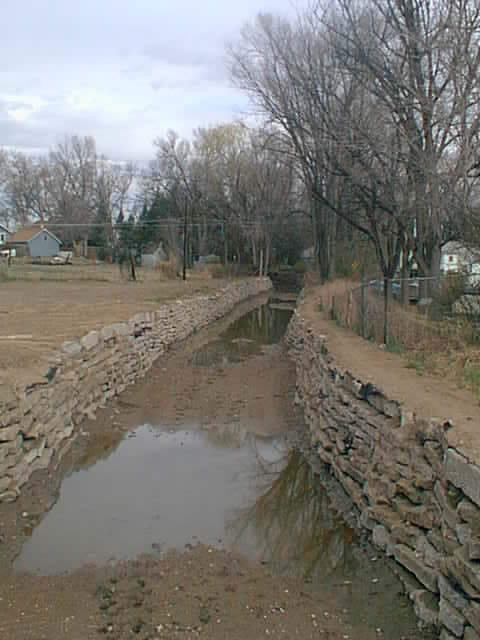
Lori Ozzello, a staff member for Rep. Betsy Markey, D-Colo., will present “Water 101” at a Thursday meeting. Sponsored by the Women’s International League for Peace and Freedom, Ozzello will talk at noon, at the Palomino Restaurant, 3390 23rd Ave., in Evans. Reservations are required and may be made at (970) 352-7765 or by e-mail to elaine567@hotmail.com.

More education coverage here.

Snowpack news: Some water providers are getting nervous

A picture named snowpackmap01142010

From The Aspen Times (John Colson):

At a meeting of the Garfield County commissioners on Monday, [Dave Merritt, a board member of the Colorado River Water Conservation District] said that the snow depths in the Colorado River basin is “a little bit better than 2002 right now.” He later described 2002 as “essentially the worst year we’ve had on record” for snow depths, when the statewide snowpack was essentially gone by June…

Merritt told the commissioners that the state’s water officials, worried about the prospect of another record drought year, already are discussing whether there will be sufficient water to raise Lake Powell above its present level of 60 percent full…

Merritt said the current regulations call for an annual release of 8.23 million acre feet of water from Lake Powell to satisfy the compact’s allotments, and 1.5 million acre feet for Mexico. Another large reservoir on the Colorado River, Lake Mead (Hoover Dam), “has been dropping pretty precipitously,” Merritt continued, and is counting on an “equalization” release from Lake Powell to boost the water level. But, if the spring runoff is insufficient to bring Lake Powell’s levels up by much, Merritt said, “there’s less than a 50 percent chance of equalization” in 2010. The “equalization” is determined by a complex series of calculations related to how the Colorado’s waters are managed, Merritt explained…

The CRWCD board will hold its first regular quarterly meeting of the year on Jan. 19-20 at the Hotel Colorado. For information about the meeting’s agenda and other Colorado River issues, go to the district’s website at www.crwcd.org.

Grand Junction: Colorado Environmental Coalition open house January 20

A picture named wheelergeologicarea.jpg

From the Grand Junction Free Press (Sharon Sullivan):

The Colorado Environmental Coalition is holding an open house at its downtown Grand Junction office Wednesday, Jan. 20, from 6-7 p.m. to kick off its second season of CapWatch — a program for people to learn about western Colorado conservation issues. At the CEC open house staff will talk about its goals for a number of bills regarding issues such as conservation tax credits, renewable energy, and water conservation. CapWatch meetings are held monthly…

The group’s legislative agenda for 2010 includes increasing Colorado’s renewable energy standard from 20 to 30 percent by 2020. Environmental groups say the renewable energy standard has helped drive investment in renewable energy in the state. More than $150 million was invested in 2008, said Pam Kiely of Environment Colorado…

Other issues on the 2010 legislative agenda include water efficiency, and cleaning up toxic uranium processing sites. Colorado taxpayers are stuck with $1 billion in clean-up costs from past uranium activity. Environmental groups want to see uranium operators responsible for their own remediation…

The CEC Grand Junction office is located upstairs at 546 Main St., unit 404. Refreshments will be provided at the open house Wednesday. RSVP is requested at 243-0002 or jason@cecenviro.org.

More 2010 Colorado legislation coverage here.

Manassa plans to add chlorine dosing to municipal supply

A picture named watertreatment.jpg

From the Conejos County Citizen (Stan Moyer):

It hasn’t been established how much this solution will cost the community, varying from very little to as much as $250,000. Manassa has lost a waiver from a legal requirement for a sanitation method for water drawn from two deep wells supplying the town. Test samples drawn in the past three years had revealed bacteria in four instances, and e-coli, or fecal matter in two samples taken in 2008. Summarizing the Department of Public Health position, Safe Drinking Water Program Unit Manager Rick Koplitz declared, “We feel the present situation of no disinfectant system is too risky.”

More water treatment coverage here.

Buena Vista hopes to piggyback onto Nestlé pipeline easement

A picture named nestlehaffeepipelinec.jpg

From The Mountain Mail (Sue Price):

Chaffee County commissioners learned during their meeting Tuesday that Buena Vista wants to share the Nestlé water line easement across the Arkansas River near Johnson Village. Sue Boyd, representing the town, attended the meeting to answer questions regarding the official letter sent to Nestlé Waters Jan. 11 by mayor Cara Russell. The letter states in part, “the Town of Buena Vista operates a municipal water system that would be able to utilize the easement at some time in the future to provide water to and/or receive water from the east side of the Arkansas River.” Before Nestlé begins construction, Buena Vista trustees requested one or two conduit lines be laid in and under the river to accommodate a water line enabling the town to supply water, depending upon future needs.

More coverage from Kathy Davis writing for The Chaffee County Times. From the article:

The sharing of the Nestlé water-line easement is a pro-active measure in case the town would someday need to have a water line on the Arkansas River. The river would not have to be disturbed two times, once for Nestlé and then another time for the town, she said.

Buena Vista trustee Brett Mitchell said the town wanted to share the easement and to share the conduit at no cost to the town. “The letter to Nestlé says we have this interest and asks if the town could piggyback with Nestlé on the easement,” he said. According to the agenda for the executive session, the special meeting followed a request from Paul Moltz. Mitchell said Moltz, who owns ACA Products, is working on a bid to build the water line for Nestlé.

More Arkansas Basin coverage here.

Arkansas Basin: Where is the economic tipping point for regional economies and ag dry-ups?

A picture named arkansasriverbasin.jpg

From The Pueblo Chieftain (Chris Woodka):

A study by Paul Flack, former water resources manager for Colorado State Parks, will look at how water used in flow management programs from Lake County to John Martin Reservoir could be more effectively managed. A second study by anthropologist Ken Weber will look at the “tipping point” of regional economies from dry-ups associated with water transfers…

Under the proposal, Flack would look at how the Upper Ark flow management program, started in 1990 to provide year-round flows for fish and seasonal flows for rafters, has worked. He would study how releases and exchanges for consumptive purposes – municipal or agricultural – fit in with nonconsumptive needs – environment and recreation. Representatives from Colorado Springs and Aurora, which move much of the water along the river, pledged cooperation with the study at Wednesday’s roundtable meeting. Flack’s study would also look at flow management on the river below Pueblo Dam and the reach from Pueblo to John Martin Reservoir under the study’s concept, according to Tom Simpson, Aurora’s water resource manager.

Weber’s study will build on work he has already done in Crowley County to look at the historic impacts of water transfers between Boone and La Junta. Colorado Springs, Aurora, Pueblo and Pueblo West now control water rights that once benefitted farmers on the Colorado Canal, including Twin Lakes purchases in the 1970s. Aurora owns the vast majority of shares in the Rocky Ford Ditch.
More Arkansas Basin coverage here.

Pueblo West is ponying up $205,000 for geological assessment at the proposed Red Creek Reservoir site

A picture named glencanyonconst.jpg

From The Pueblo Chieftain (James Amos):

The site of the proposed Red Creek Reservoir is a mile from the Arkansas River near the borderline of Pueblo and Fremont counties. District Manager Larry Howe-Kerr said this part of the reservoir study will include drilling to study the rock under the reservoir site. That and other studies will determine if the reservoir could hold water and if it would be strong enough. The drilling could begin as soon as next week.

More Pueblo West coverage here.

There’s a bad moon rising for some small well owners

A picture named groundwater.jpg

From The Pueblo Chieftain (Chris Woodka):

From the state’s point of view, if wells are out of compliance, they are subject to being shut down. It’s a serious matter determined after 24 years of litigation before the U.S. Supreme Court against Kansas over the issue of violation of the Arkansas River Compact. The Supreme Court found a proliferation of well-pumping in Colorado had diminished the supply to Kansas under terms of the compact negotiated in 1948. Colorado did not begin to connect groundwater and surface water until 1969. That led to Arkansas River well rules in 1996 that required replacement of well water to the river and measurement of depletions.

“The existence of wells in these subdivisions depend on augmentation plans,” Witte said. “If those plans are not complied with, we have no recourse but to order the wells shut down.” The problem is not isolated, nor ignored by the state, Witte said.

There are 445 augmentation plans covering 9,195 small wells – typically 15 gallons per minute or so – in the Arkansas River Basin. Most of those are in areas where mountain lots have been carved out in subdivisions. “Everyone thinks they’re the first and are being picked on,” Witte said. “A lot of folks are completely unaware of the legal foundation that justifies the existence of the subdivision.” In fact, the state began looking at compliance with the court decrees that created the augmentation plans about five years ago, dedicating a full-time staffer to the task in the Arkansas Valley. Witte said at least five more years of work lie ahead…

So what should anyone buying mountain property do? “They should ask for the basis of the water right, and then check with the Division of Water Resources to see if the plan is in compliance,” Witte said.

More Arkansas Basin coverage here.

University of Colorado law school: Searching for a sustainable Colorado River management plan

A picture named grandcanyontoroweap.jpg

From the Boulder Daily Camera (Laura Snider):

A complex web of treaties, compacts, laws and court decisions govern who can use the once-mighty river’s water and when. But over the last several decades, those rules have not kept the yearly demand for water from exceeding the average flow. “People have known since the 1940s, if not earlier, that this river was over-allocated and that, at some point, it’s going to be a major problem,” said Douglas Kenney, senior research associate at the University of Colorado’s Natural Resources Law Center…

Kenney and two of his colleagues have now begun an ambitious, yearlong project called the Colorado River Governance Initiative to evaluate options for reforming the laws of the river. “The initiative is designed to develop a blueprint for future management that will allow for managing the river basin’s resources more holistically and in a manner that preserves wildlife resources and habitats while ensuring the availability of water supplies for humans,” said Mark Squillace, director of the Natural Resources Law Center…

So part of the project’s goal is to do the background policy work, and ask the questions, that public officials are often afraid to, eventually creating a ready-made list of possible changes that may be easier for government leaders to handle. “If you’re an elected official and you talk about changing the management of the Colorado River, you have to tread very carefully,” Kenney said. “We’re going to study the options that they cannot safely talk about publicly. If we come up with some really good solutions, then they can think about supporting them.”

More Colorado River Basin coverage here.

Gunnison Basin Roundtable responds critically to letter from the Arkansas Basin Roundtable and Front Range Water Council

A picture named coloradotransmountaindiversions.jpg

From The Pueblo Chieftain (Chris Woodka):

The Front Range Water Providers group – which includes the state’s major importers of water – suggested that urban water conservation is not a practical way to deal with water shortages. The Front Range letter says, in part: “20 to 40 percent demand reductions may necessitate major changes in land use, or significant alteration of most of the urban landscape.”

“We submit that it may be time for Colorado to balance the search for new urban water supply with serious research on such ‘major changes,’” [Roundtable Chairwoman Michelle Pierce] argued. “We recognize that such strategies are complicated, may be intrusive upon property rights and will involve the effective collaboration among many governments and water providers throughout the state. “The significance of such changes, however, may be no less than that of continued dry-up of our agricultural lands or additional transmountain diversions.”

The Gunnison roundtable also took umbrage with the idea that its agricultural lands are not threatened, as the Arkansas roundtable’s resolution implied. “Many agricultural landowners within basins on both sides of the (Continental) Divide have opted to engage in profitable transactions that are not tied to water supply strategies. The loss of agricultural land is not unique to the Arkansas Basin,” Pierce wrote…

According to the Statewide Water Supply Initiative by the Colorado Water Conservation Board, 2,500-10,000 acres of farmland in the Gunnison River Basin could be dried up to meet future needs by 2030. In the Arkansas River Basin, 23,000-72,000 acres could be dried up.

More IBCC — basin roundtables coverage here.