Pueblo: Meeting January 23 to discuss Fountain Creek through the East Side

A picture named fountaincreek.jpg

From The Pueblo Chieftain (Peter Roper):

Great Outdoors Colorado has awarded a planning grant [for turning Fountain Creek into a community asset that could help revitalize the East Side] to a partnership between Pueblo city government, Colorado Springs Utilities, Fountain Creek Foundation and the Lower Arkansas Valley Water Conservation District. The resulting design – called the Fountain Greenway Master Plan – will focus on Fountain Creek between Eighth Street and the confluence with the Arkansas River, but it can include parks, recreation programs, trails or whatever residents envision for Fountain Creek and the adjoining neighborhoods. “This meeting will be about what the community wants,” said Kevin Shanks, the project manager for THK and Associates, the planning firm that will develop the master plan. “The whole idea behind this partnership is to look at what can be done to make Fountain Creek into a true amenity.” The plan, of course, is the just beginning. Shanks said the partnership is also committed to making sure there is a strategy for getting the pieces of the plan built in the future. For example, the steering committee for the master plan includes city planners, officials from the Historic Arkansas Riverwalk of Pueblo and others.

More Fountain Creek coverage here and here.

Energy policy — geothermal: Standing room only at Buena Vista geothermal lease sale meeting

A picture named geothermalplant.jpg

From The Mountain Mail (Joe Stone):

Greg Shoupe, U.S. Bureau of Land Management Front Range district manager, opened the meeting by explaining the meeting was to provide information, not accept public comment. He said this is the first time the process has occurred in Colorado because of changes initiated by the 2005 Energy Policy Act. He said, “We want you to understand what it’s all about. We’re here as long as you guys want us to be here.” Shoupe encouraged anyone with comments, especially negative comments, to include specific facts or data the bureau can consider because new information from public comments can give the bureau reasons to change leasing decisions. “This process is a long way from over,” Shoupe said.

More coverage from The Mountain Mail (Joe Stone):

[Kevin Rein, assistant state engineer with Colorado Division of Water Resources] said Colorado water law recognizes geothermal resources and drilling a geothermal well requires a permit from the state engineer, who is also director of the Division of Water Resources. When considering a permit application, the state engineer must consider potential for “material injury” to other water rights or geothermal rights, Rein said. A separate permit to “appropriate” the “geothermal fluid” is required for geothermal wells, but it can be waived if no hot water is consumed by the proposed use.

Regarding geothermal rights, Rein stressed owning land above a geothermal resource does not include rights to the resource. “A geothermal right is not established through use from an unregistered well or an exempt well. A well must be specifically permitted for geothermal use, or it must have a court decree for it to have a geothermal right.” Rein said a geothermal right is not needed to make use of heat as a by-product of the permitted well use if that use is incidental and doesn’t increase diversion or consumption of geothermal water. Rein said the state engineer must consider how a proposed well might affect surface water. Any impact in the Arkansas River basin requires a plan to replace surface water depletions and the plan must be approved by the water court.

Rein said geothermal developers will favor non-consumptive uses for two main reasons: to avoid water court issues and to preserve the geothermal resource.

More geothermal coverage here and here.

EPA proposes new federal standards for farm and urban runoff in Florida

A picture named effluent.jpg

From the Associated Press (Brian Skoloff) via The Denver Post:

Friday’s proposed rules mark the first time the EPA plans to force numeric limits of so-called nutrient runoff on any state. A handful of other states, at the urging of the agency, have already acted to set their own standards. The remainder have vague limits on waste and fertilizer pollution, while some are in the process of developing their own numeric limits. “It’s actually pretty good,” said David Guest, an attorney for Earthjustice, which represented environmental groups in the lawsuit, including the Sierra Club, Florida Wildlife Federation and others. While noting the standards “aren’t as stringent as we’d like,” Guest called it “a huge leap forward in getting effective controls on sewage, fertilizer and animal manure.” “This is the beginning of a very serious effort nationwide, and Florida is going to be a model,” he said.

More stormwater coverage here.

Energy policy — nuclear: 680,000 tons of uranium mill tailings shipped so far in Moab cleanup

A picture named moabtailingscleanupsite.jpg

From the Deseret News:

The U.S. Department of Energy Moab Uranium Mill Tailings Remedial Action Project last week shipped 136 containers of mill tailings, the maximum number that can be transported in a single train. The load was sent from Moab to a disposal cell 30 miles north near Crescent Junction. The shipment held about 4,700 tons of tailings, bringing the total quantity shipped to more than 680,000 tons. More than 40 percent, or 278,000 tons using federal stimulus funding.

Thanks to the Colorado Independent (David O. Williams) for the link.

More nuclear coverage here and here.

Wiggins: Town council approves waterline bid

A picture named fountainpavementdrawing.jpg

From The Fort Morgan Times (Dan Barker):

Wiggins must run a pipeline from a well near Empire Reservoir to the west side of town to start using a new water source. So far, the town has bought about half of the water it needs, and there is a prospect for buying more. The water project is needed because the water levels and water quality in existing wells have fallen steadily over the past few years, as have other wells in the same basin.

More Wiggins coverage here and here.

Grand County: What are the tradeoffs with respect to the Moffat Collection System Project and the Windy Gap Firming Project?

A picture named coloradorivergranby.jpg

Folks in Grand County know their water law pretty well. 150 or so showed up to a briefing on the Moffat Collection System Project last Tuesday at Silver Creek. Here’s a report from Tonya Bina writing for the Sky-Hi Daily News. It’s a long article so click through and read the whole thing. Here are a few exerpts:

“What the EIS is proposing to do is take the flows off of the rising level of the hydrograph, and in our wettest times of the year, what our enhancements are proposing to do is to give us water back when our flows are the lowest. Is that an acceptable trade?” she asked.

“There’s skepticism out there, there’s a feeling out there that Grand County has this back-room deal going on,” said Grand County Commissioner James Newberry at the start of the meeting. “And the more I thought about this, yeah. We do. We really do. It’s a separate negotiating process.”

On its team, the county has assembled water attorneys, engineers, NEPA and Clean Water Act specialists and a professional negotiator to aid in deals and to advise on what to ask for. The county has spent some $2.8 million on water protection since 2003.

In the past year alone, county representatives have attended 65 meetings with the Northern Water Conservancy District, Denver Water and West Slope partners regarding water issues, according to county officials. “We’re going to be much better off than before the project happened,” Newberrry said, optimistically. But success is not guaranteed, at which point the county is prepared to litigate. “And even that is not a guarantee,” he said.

The county has stated it has better legal footing against the Northern Colorado Municipal Subdistrict’s Windy Gap Firming Project — concurrently being proposed — than it does Denver’s…

“We already have a river that is on the brink,” said Mely Whiting, senior attorney for Trout Unlimited. “Is this incremental 20 percent going to push us over the brink?” It’s a question that has been subjected to modeling, charting and graphing in countless studies.

But Jon Ewert, Division of Wildlife area biologist, said even with the most esteemed modeling, biology is really unpredictable. “There are cascading effects that can take years, if not decades to unfold,” he said. Both Denver Water and Northern have endorsed the science behind the [Grand County] Stream Management Plan (pdf), county officials say, although those water users may not agree on the implementation of it…

Attorney Mely Whiting of Trout Unlimited stressed along with county officials that any allowance for Denver to take more water from the river should be tied to a “reopener clause,” in which stakeholders would revisit the project if degradation of the river reached beyond what was predicted in the NEPA process.

More Moffat Collection System Project coverage here.

Arkansas Basin Roundtable unveils report detailing their accomplishments over the first four years

A picture named arkansasriverbasin.jpg

From The Pueblo Chieftain (Chris Woodka):

On one hand, most all are pleased with the work so far. At least one other roundtable, the South Platte, acknowledged the thoroughness of the report, called “Projects and Methods to Meet the Needs of the Arkansas Basin.” But some needs are more pressing than others in the minds of roundtable members. Around the table Wednesday, those who attended shared their views on everything from municipal conservation to agricultural leasing programs to tamarisk removal…

More emphasis should be put on developing alteratives for ag water rights owners to realize the value of their water, said Beulah rancher Reeves Brown, who also is a member of the Lower Arkansas Valley Water Conservancy District board. He represents ag interests on the roundtable. “Presently, a willing seller results in moving water permanently out-of-basin, resulting in increasing the gap,” Brown wrote. “Surely with earnest effort, more options can be developed that would both meet the needs of the seller and keep the water in the basin, if not all in ag.”

There is strong environmental opposition to transmountain projects that is not adequately reflected in the report, said SeEtta Moss, of the Arkansas Valley Audubon Society and the sole environmental representative on the roundtable. “We oppose ‘Big Straw’ projects that wreak environmental damage by removing large amounts from Western Slope streams for transmountain diversions to the Front Range,” Moss wrote.

There is still too much influence on water-project identification from municipalities and their legal teams, said Jane Rawlings, assistant publisher of The Pueblo Chieftain, and the industrial representative on the roundtable.

“Granted (municipal and industrial) is important, but recreation, tourism, agriculture, wildlife, environment and rural communities are also vitally important constituencies,” Rawlings wrote. “These values and the people who are affected by them must have a method by which they can be part of the larger process. As we all know, water still flows uphill to money. Continued efforts at meaningful mitigation to these values and uses must be supported and moved forward.”

More IBCC — basin roundtables coverage here.

Gary Barber: ‘[SDS] infrastructure to deliver water needs to support a regional solution’

A picture named sdspreferredalternative.jpg

From The Pueblo Chieftain (Chris Woodka):

“The infrastructure to deliver water needs to support a regional solution and the funding must be equitable,” Gary Barber, chairman of the roundtable, said in comments accompanying an official report to the state. “Otherwise, the Arkansas Basin may not be able to meet the gap, and the consequences will be felt beyond the borders of El Paso County.”

The largest portion of a statewide gap in future water supply is 22,600 acre-feet needed to supply communities outside Colorado Springs in El Paso County, according to the needs assessment included in the report. About 40 percent of that will be new demand, while 60 percent is loss of existing water supplies as pumping increases in the Denver Basin aquifers. As roundtable president, Barber pushed for completion of the reports, “Projects and Methods to Meet the Needs of the Arkansas Basin.” The document includes consumptive and nonconsumptive needs studies and represents the consensus of the roundtable’s first four years of meetings. It also begins to rate the relative importance of projects in meeting the state “gap” in water supply identified in 2004 by the Colorado Water Conservation board. It places the highest priority on sustainable projects. The ideas included in the report are rated on three questions: Is it viable? Is it equitable? Is is bearable?…

Every member of the roundtable represents a constituency – special interests – and Barber’s are his clients in El Paso County, which include two water authorities whose members are hunting for future water supplies. Three of them have purchased ranches for water rights in the past three years, one is trying to buy rights on two valley canals and collectively, they unsuccessfully tried to buy control of the Bessemer Ditch in 2008…

Barber’s comments about SDS reflect years of frustration over including other areas of El Paso County besides Colorado Springs, Security and Fountain in the $1 billion-plus project. He has frequently been outspoken on the need for regionalism…

A study by the Pikes Peak Regional Water Authority concluded it would cost at least $1 billion to build its own pipeline from the lower Arkansas Valley…

Colorado Springs City Council, sitting as the utilities board, has discussed including other El Paso County users as customers of SDS and the possibility of using it as a regional delivery system. No formal decisions on that concept have been made, however.

More Southern Delivery System coverage here and here.

Energy policy — nuclear: Colorado Citizens Against Toxic Waste and other state conservation groups hope for 2010 legislation to clean up the Lincoln Park/Cotter Mill superfund site

A picture named lincolnparksuperfund.jpg

From The Pueblo Chieftain (Tracy Harmon):

Jeff Parsons of the Western Mining Action Project said he believes Colorado taxpayers should not foot the bill for cleanup of “bad uranium operations.” “It is common sense to require all uranium operations to clean up their toxic messes. Period,” Parsons said…

Cotter Mill Manager John Hamrick said the company spends a lot of money on cleanup projects. On tap this year are plans to place a dirt cover over the secondary impoundment, tearing out of old tanks and cleanup of sites where the company used to store ore at the mill.

Also on tap in the Legislature this year is the state health department’s plan to ask for a new penalty section on the state’s radiation-control regulation. Under that proposal, any violator (be it Cotter, an X-ray company or other radiation users) of the radiation-control act could be subject to up to $15,000 daily fines.

In an effort to raise funds for their 2010 legislative effort, Colorado Citizens Against Toxic Waste and Environment Colorado has scheduled a banquet from 6:30 to 8:30 p.m. Jan. 30 at the Abbey Event Center, 2951 E. U.S. 50. The event will feature dinner, guest speakers, door prizes, plus a live auction and silent auction. Cost is $50 to $100 per person depending on the level of support desired. Reservations are required by Monday. Call Pam Kiely of Environment Colorado at 1-303-929-8702 or visit online.

More nuclear coverage here and here.

The City of Pueblo hopes to persuade the Federal Emergency Management Agency to revise flood plain maps

A picture named southplatteflood.jpg

From The Pueblo Chieftain (Chris Woodka):

The maps are crucial to some businesses or for future construction loans. If the maps are drawn according to FEMA’s initial figures, much of Downtown would be in a floodplain and property owners required to buy flood insurance. At issue is FEMA’s contention that a maximum flow of 21,000 cubic feet per second would come rushing down Wild Horse Dry Creek in a flood. The city’s hydrology shows the rate would be only about half of that and that levees built after the 1921 flood still protect Downtown. “We think we’re in a good position to challenge,” City Manager Jerry Pacheco said Thursday. “We’re concerned about what the maps will show.” City Stormwater Director Dennis Maroney, who led the city’s efforts to refine the hydrology, is retiring today, but will be hired as a consultant…

If FEMA rejects the city figures, the city could issue a technical challenge. The Colorado Water Conservation Board is scheduled to complete maps that analyze the hydraulics – structures within the floodplain – by June, setting up at least four months of technical and public comments.

More infrastructure coverage here.

CWCB to revise Pitkin County numbers in final report on consumption

A picture named roaringfork.jpg

From The Denver Post (Bruce Finley):

A report expected in June likely will present water use in Pitkin County, home of Aspen, more in line with consumption in other counties — about 270 gallons per person a day, said Jacob Bornstein, water-supply planning program manager for the Colorado Water Conservation Board, an arm of state government.
State officials have agreed not to include water from Aspen’s municipal system that is used for ski resort snow-making, Bornstein said. An updated “Colorado’s Water Supply Future” report also will factor in residents who live outside the cities of Aspen and Basalt — not included in a published draft report — as well as the water billing data received Tuesday, he said. “Unknowingly, we just used their data (in the published report). And their data . . . had this error in it that we didn’t understand,” he said…

Aspen public works director Phil Overeynder said “bad data” is to blame and that the revisions will increase accuracy, reflecting efforts over the past 15 years to conserve water.

More CWCB coverage here.

Northern Integrated Supply Project: Fort Morgan Water Advisory Board still on board

A picture named nisp2

From The Fort Morgan Times (John Brennan):

“The more we sit and discuss these things, the more NISP sounds like the best option,” said Fort Morgan City Council member James Powers, who represents the council as an ex officio member of the water advisory board.

At Wednesday’s session the water board heard a presentation from Tom Ullman of The Engineering Company, who is also in the process of performing a water and sewer rate study for the city. Ullman’s presentation Wednesday, however, was an analysis of the impact on city water rates of NISP as compared to what he called “the C-BT alternative.” That alternative would have the city purchasing an equivalent amount of Colorado-Big Thompson water — the city’s primary supply now — to equal the amount of water NISP is expected to yield to the city when it is built and operational. Based on what Ullman presented, though, the C-BT proposal hardly seemed to be an alternative at all — and several in the room said so. “Maybe we should take the C-BT option off the table, because it’s not viable,” Powers said…

In addition to costing the city millions of dollars more than NISP, according to the latest and best estimates Ullman had, the C-BT alternative assumes that the city would be able to purchase the additional C-BT water it needs. That assumption is by no means a safe one. The amount of C-BT water is finite, and shrinking all the time, water board members have said. And while prices for C-BT shares are attractive now, because of a slowdown in development due to the recession, nobody knows whether sufficient C-BT water to supply the city’s needs will be available at any price in the future…

Another variable is that the Northern Colorado Water Conservancy District — which supplies the city with its C-BT water and is also spearheading NISP — has announced plans to cap the ownership level of C-BT shares for any one owner, but the city does not yet know what its cap will be. Even if enough C-BT water were available, the price fluctuates greatly with demand and it’s impossible to predict what prices may do. C-BT water has been selling in the range of about $8,000 to $9,000 a share in the past year, and Dreessen suggested that any C-BT water to be had at less than $10,000 a share was “just gravy.”[…]

The average city residential customer who uses 10,000 gallons of water a month pays a monthly bill of $56.30 now, Ullman said. Under the NISP scenario, that bill would increase by about 30 percent — or about $16.95 a month — between now and 2024. Those increases would come in 10 percent increments, in 2015, 2016 and 2023. Under the C-BT alternative — if it were even feasible — the cost for the average homeowner would go up by an additional $9.35 more than the NISP increase, or closer to 50 percent higher than today, by 2027…

The water advisory board also welcomed a new member at Wednesday’s meeting. Heath Kuntz has taken the place of former member Brent Nation, who assumed his position on the Fort Morgan City Council on Tuesday. Nation, a water engineer who owns Nation Engineering, had resigned at last month’s water board meeting because of his election to the city council. Kuntz is a city resident who has extensive experience in water issues. He has worked for water advisory board Chairman Jack Odor at General Appropriators of the South Platte as well as for Nation in the past, and now works for Leonard Rice Water Consulting Engineers on the Front Range. The board also re-elected Odor as its chairman, Jim Green as vice chairman and Bill Baker as secretary, and reviewed revisions to its bylaws. The bylaws will be forwarded to the city council for approval.

More Morgan County coverage here. More Northern Integrated Supply Project coverage here and here.

Flaming Gorge pipeline: Users are lining up if project gets built

A picture named flaminggorgepipelinemillion.jpg

From The Pueblo Chieftain (Chris Woodka):

“I have letters from municipalities, special districts and agricultural districts in Wyoming and Colorado,” Million said. “We’re close to full subscription.” Million said some discussions are continuing, but he will make the list of potential end users for his project available next week and meet a Jan. 20 deadline imposed on an environmental evaluation by the Army Corps of Engineers. Letters of interest, not formal contracts, will be submitted to the Corps, Million said. Million’s plan calls for bringing 225,000 acre-feet of water to Colorado and 25,000 acre-feet to Wyoming in a 6- to 10-foot-diameter pipeline. It has met local opposition in the Green River, Wyo., area near Flaming Gorge and from some Colorado environmental groups.

“I don’t think they understand the impact,” Million said. “At the end of the day, this is an environmental project. What we’ve been told by the people who manage the asset (Bureau of Reclamation) is that there is enough water to meet the Green River’s environmental issues.” He said water from Flaming Gorge would address other environmental issues in Colorado, on both sides of the Continental Divide. For instance, Western Slope interests could use the pipeline to deliver water to Denver, reducing the need for diversions from Dillon Reservoir, Million said. Water from the pipeline could also reduce the need for cities to buy and dry more farmland, he added. “There are huge opportunities to help meet deficits,” Million said. “If you can assist, why not do it.”

The El Paso County Water Authority suggested Million look at using a proposed underground storage basin in the Upper Black Squirrel designated groundwater basin for terminal storage, and wants a Flaming Gorge task force to discuss how the pipeline would fit into area water plans. “None of the providers was willing to solely commit to the Flaming Gorge project,” explained Gary Barber, manager of the authority. In a letter to Million, El Paso Water Authority President Kip Peterson, who is manager of the Cherokee Water District, said additional time is needed to consider public interest in Million’s proposal…

A task force effort as proposed by El Paso County users could unnecessarily delay the project, although he is still interested in bringing the water into the Arkansas Valley, Million said. “I’m continuing to negotiate individually and collectively with El Paso County,” Million said.

More Flaming Gorge pipeline coverage here and here.

Aspinall Operations Meeting January 21

A picture named bluemesa.jpg

From email from Reclamation (Dan Crabtree):

Reclamation will be hosting the January Aspinall Operations Meeting on Thursday, January 21, 2010 at the Holiday Inn Express, 1391 Townsend, Montrose, Colorado. The meeting will start at 1:00 p.m. We will be discussing recent operations, maintenance activities, and even though it’s early in the snowfall season, possible spring and summer operations. Dan Kowalski, Colorado Division of Wildlife, will be presenting the results of the 2009 Gunnison Gorge trout inventory. Other topics related to Gunnison Basin water issues may be discussed as appropriate. Reclamation welcomes input and public comment regarding Aspinall Unit Operations, so we’d love to hear from you.

More Aspinall Unit coverage here.

CWCB: Next water availability task force meeting January 22

A picture named vallecitolake.jpg

From email from the Colorado Water Conservation Board (Ben Wade):

The next meeting of the Water Availability Task Force (WATF) is scheduled for Friday, January 22, 2010 from 9:30a-12p at the Colorado Division of Wildlife Headquarters, 6060 Broadway, Denver, CO, in the Bighorn Room. A meeting agenda will be sent shortly and will also be posted on the CWCB website.

More CWCB coverage here.

Sterling: Local Colorado Division of Water Resources open house recap

A picture named lowersouthplatte.jpg

From the Sterling Journal Advocate (Judy Debus):

The Sterling office of the Colorado Division of Water Resources hosted farmers, ditch riders and other guests at an open house and lunch last week. Also attending from the state office were Dick Wolfe, state engineer; Jim Hall, division engineer; Scott Cuthbertson, assistant state engineer; Kevin Rein, assistant state engineer; Jeff Deatherage and Sara Reinsel. This is the third year the office has hosted the event, according to Brent Schantz, District 1 and 64 water commissioner. The area represented stretches from the Wyoming border to Elbert County and Kersey to Julesburg, he said.

More South Platte River Basin coverage here.

Snowpack news

A picture named snowpackmap01142010

From the Telluride Daily Planet (Ben Fornell):

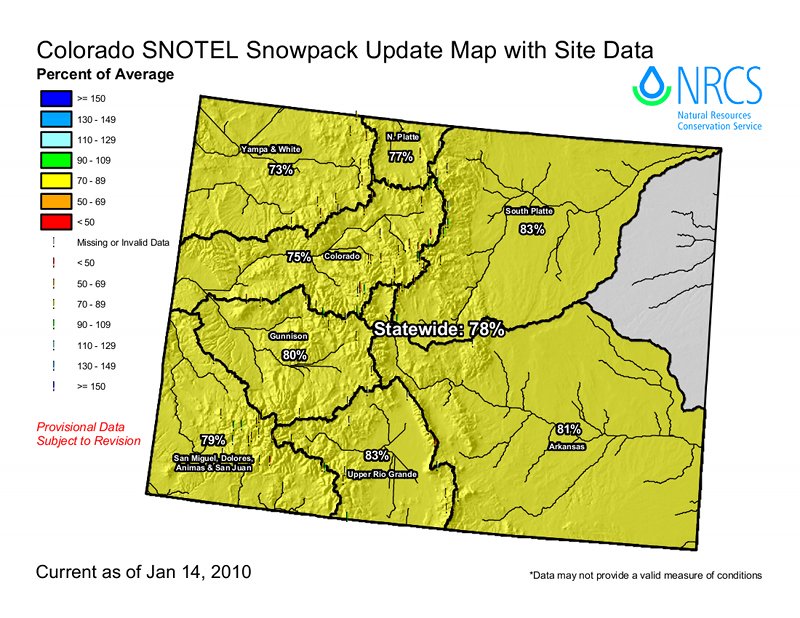
Taking a look at sites near Telluride, the snowpack is a little off average. At Red Mountain Pass, the base is about 84 percent of the average. At Lizard Head Pass, the snow is at 90 percent. And at Lone Cone, the gauge reads 87.4 percent. At the Telluride Ski Resort, all lifts are open but 13 (Race Hill), and of the 112 inches of snow that have fallen this season, the base has accumulated to about 36 inches, according to the resort’s Web site. While that certainly does not keep pace with the epic snows of two seasons ago at this time, it’s not off par for where the mountain historically is this time of year.

State Representative Kathleen Curry plans to introduce bill to allow boaters access to streams running through private property

A picture named taylorriver.jpg

From the Gunnison Country Times:

The debate over whether there’s actually a “right to float” in Colorado played out locally before. In a high-profile case a few years ago, an outfitter who had historically boated the Lake Fork of the Gunnison River was sued for civil trespass, for floating through private land. The company, Cannibal Outdoors, ultimately went out of business amidst the litigation.

The case was settled out of court, so the matter never became part of case law. The question of whether landowners have grounds for such civil suits has lingered in the minds of proponents of the state’s $142 million river running industry ever since. It’s widely recognized that current law protects boaters from a criminal charge if they don’t touch bottom while floating through private property. Likewise, it’s long been held that property owners of parcels through which rivers and streams flow own the underlying stream bed. “Both sides definitely have enough information to create their own philosophies about what these laws say,” said Bob Hamel, chairman of the Colorado River Outfitters Association and owner of Arkansas River Tours in Cotopaxi.

Local water attorney John Hill represented the landowners in the case on the Lake Fork, and has staunchly argued that there is no right to float in Colorado. He believes that landowners have the legal right to control access to waterways because they own the underlying streambed.

“We don’t think that’s the way it is or should be,” countered Hamel. “We’re trying to protect an industry. We’re being pushed.”

Hill, whose firm is currently representing the landowner on the Taylor River who is attempting to bar access by commercial outfitters, said that Curry’s bill is unconstitutional. Allowing commercial boaters to portage, he argued, is a “taking” with no prospect for just compensation. “This is a physical invasion taking,” he explained. “It’s authorizing people to go on private property.”[…]

Jackson Shaw, a Texas-based real estate development company, purchased what has historically been called the Wapiti Ranch, six miles up the Taylor Canyon from Almont, for $20.5 million in late summer 2007. The approximately 2,000-acre hay meadow down-river of Harmel’s Resort is now the site of a subdivision development called Wilder on the Taylor. Company CEO Lewis Shaw II is a part-time resident of the nearby Crystal Creek community along the Taylor River. Historically, Scenic River Tours and Three Rivers Outfitting have guided float trips through the section of river that flows through the new development, without cause for alarm from the previous owner. That’s changed since Jackson Shaw became the new owners. Lewis Shaw has informed the two local outfitters that they won’t be allowed to continue floating the section of river that flows through the development, threatening legal action if they don’t abide. Wilder on the Taylor is what Hill’s partner and longtime local water attorney Dick Bratton called a “recreational fishing subdivision.” Jackson Shaw has conducted improvements on the property, and in the river, to improve the fishing, he said. Similarly, the Cannibal case was over the same competing interests. The landowners maintained a fishing lease on the section of water in question, with which they believed the frequent commercial raft trips interfered. “If this guy had owned this river in his family for the last hundred years I would feel somewhat differently,” Mark Schumacher, owner of Three Rivers, said of Lewis Shaw. “But he bought the property to make it a fishing (subdivision) and he knew that people floated through it. We just don’t want anything taken away that we’ve been doing for 20 years.”[…]

Curry plans to introduce the bill — which, she said, she agreed to carry for the two local outfitters — in coming weeks. She expects a constitutional challenge of the bill, should it be written into law, but views it as necessary for protecting commercial rafting in Colorado. Bratton, on the other hand, calls the proposal a “special interest” bill, because it would only protect two companies on a two-mile stretch of one river…

“In Colorado, it’s almost impossible to float a river without touching something,” said Curry. “The statute does not realistically address normal boating conditions in this state.”

More coverage from the Fort Collins Coloradoan (Bobby Magill):

Though the controversies sparking the bill originate along the Taylor River in Gunnison County, the bill could impact all commercially navigable rivers statewide, including the Poudre. “The need is, somebody who owns property could stop you from floating,” said one of the bill’s chief proponents, David Costlow of Rocky Mountain Adventures in Fort Collins. “There are a number of businesses that could be shut down.”

The bill, the River Rafting Jobs Protection Act, would allow commercial river outfitters to float on waterways that have historically been used for float trips. The bill would prevent the outfitters from being liable for criminal or civil trespass as long as they access the waterway via a public right of way.

Rafters would also be given the right to make “incidental” contact with the riverbank or the riverbed and a similar right to portaging, all of which today may lead to a trespassing charge. “The gist of the bill is that they cannot block the river and cannot deny the right of commercial outfitters to pass through,” Curry said Monday.

More 2010 Colorado legislation coverage here.

R.I.P. Paul Grundemann

A picture named highlandsranch.jpg

From the Highlands Ranch Herald (Chris Michlewicz):

Paul Grundemann was the first employee to be hired by Centennial Water, and was instrumental in the development and delivery of water and wastewater services for Highlands Ranch. For 26 years, he served as the director of operations for the burgeoning district and dedicated his entire career to the water industry. “Paul led a number of innovative projects throughout the development of the Highlands Ranch community,” said Centennial Water & Sanitation District General Manager John Hendrick. Grundemann used pioneering approaches to serve water and wastewater customers and even implemented the use of aquifer storage and recovery, which has been a successful water storage strategy for Centennial Water for many years. He also was involved with the Pankake Ranch project, an efficient permanent site for the disposal of wastewater solids…

Grundemann, who served as a leader on a number of statewide commissions, councils and committees, developed the application of GIS for water and wastewater infrastructure, and managed a sophisticated energy conservation program that significantly reduced energy consumption from the water and wastewater plants in Highlands Ranch. He also oversaw the design and construction of several in-house projects that protected water quality and saved Centennial Water hundreds of thousands of dollars.

Rio Grande Basin Roundtable recap

A picture named acequiadelcerro.jpg

From The Pueblo Chieftain (Matt Hildner):

Shareholders for the San Luis Peoples Ditch unveiled their plans to reduce flooding and secured $40,000 from the Rio Grande Basin Roundtable Tuesday. The ditch, which, with an 1852 water right, is the oldest in the state, has been overwhelmed with floodwaters in recent years because of faulty infrastructure that keeps it from shedding the excess flows. “This is becoming a bigger and bigger problem to us,” said Conrad Trujillo, the ditch company’s president. The 7-mile long ditch diverts water from Culebra Creek southeast of San Luis and waters 2,100 acres stretching west of town. There are 23 shareholders in the company. When functioning properly, the ditch’s crossover structure and headgates on the southern edge of town can divert the excess flows into the Rito Seco stream bed and on to the Culebra. But that was not the case as recently as last summer when a cloud burst sent water from the Rito Seco into the ditch at a rate of 100 cubic feet per second…

Craig Cotton, the division water engineer, said he would support the revamping of the Peoples Ditch because the ditch is also taking on water from the Rito Seco, which needs to go back into the Culebra to fill downstream water rights. The project would replace a headgate and culvert that could send floodwaters back down the Rito Seco. In addition to the $40,000 from the roundtable, the Costilla Conservancy District has pledged $20,000. “We’re just asking to do a state-of-the-art job so that this doesn’t have to be done for another 100 years,” Cortez said. “We’re reaching out for resources wherever we can to get the job done right.” Down the road, the ditch company also hopes to pipe roughly 1,600 feet of the ditch through a section that now includes a crumbling, cement-lined ditch that loses up to 30 percent of its capacity. The crumbling ditch has forced shareholders to divert the water into lateral ditches that have more trouble carrying the water to the right places. The last phase of the ditch’s overhaul would include a new diversion structure at the Culebra.

More coverage from the Valley Courier (Ruth Heide):

In a rare split decision of the diverse water group on Tuesday, the roundtable board voted to spend $50,000 out of its local basin account for further river restoration efforts on the Rio Grande. The vote was not unanimous, with Cindy Medina voting against the funding. Medina said although this project was worthwhile, the roundtable had already provided funding for it in the past and she believed with the financial resources dwindling the group should consider spending its remaining funds on projects that have not yet received any money from the group…

At the beginning of Tuesday’s water meeting, the Rio Grande Roundtable had about $202,000 in its local basin account. At the end of the day, the group had $87,000 left in the basin account. On Tuesday the group voted to provide $40,000 to the San Luis Peoples Ditch for an upgrade and rehabilitation project near San Luis, $25,000 to assist Judy Lopez’s educational efforts and $50,000 to continue Rio Grande stabilization…

Projects receiving basin support on Tuesday (still to go to the state for final approval) were:

>[?• San Luis Peoples Ditch. The roundtable approved $40,000 out of basin funds for Phase I of this project that will reconstruct the main headgate for the ditch, as it has deteriorated over time, and rebuild banks that have eroded. “We are jeopardizing a couple of houses that are right next to it where the bank has washed out,” explained Ditch President Conrad Trujillo. He said San Luis experienced a flash flood last year that caused problems for area residents. Colorado Division of Water Resources Division III Division Engineer Craig Cotten said in addition to flooding problems, the ditch has contributed to water right issues.

• Education. The roundtable approved $25,000 over two years to assist Judy Lopez’s educational work. Lopez, a former classroom teacher, has served as a conservation education specialist for five years. Her work is varied and includes educational activities with K-12 students, teacher workshops, conservation curriculum activities, project learning oversight, water festival management, Beaver Creek junior conservation camp coordination, land owner workshops and representation at conferences and community events.

• Rio Grande stabilization. The roundtable approved $50,000 from basin account funds for continued river restoration/stabilization efforts. The group is also requesting $98,0000 from the state funds but that money may not be available. The $148,000 total project is Phase 4 of riparian stabilization to include such tasks as stream bank and stream channel modification and sediment reduction.

More IBCC — basin roundtables coverage here.

Arkansas Basin Roundtable meeting recap

A picture named arkansasriverbasin.jpg

From The Pueblo Chieftain (Chris Woodka):

The Joint Budget Committee has asked Jennifer Gimbel, director of the Colorado Water Conservation Board, to assess the impact of transferring $106.5 million from water project funds to the state general fund, said Reed Dils, the basin’s representative on the CWCB. Gimbel is scheduled to speak to the JBC today. The move would come on top of a $107 million transfer last year from the CWCB’s construction funds. That would leave only about $70,000 in the funds. “The combination of taking over $213 million could reduce the value of the funds by $287 million over the next 20 years,” Gimbel said in written comments shared with the roundtable by Dils. The construction fund and perpetual base account of the mineral severance trust fund are used to fund water projects of all sizes in Colorado through low-interest loans.

The $300 million Arkansas Valley Conduit, which is in line for a federal allocation of $5 million, received CWCB approval for a $60 million loan from the CWCB. At the same time, there are $105 million worth of projects under $10 million each lined up in the next decade, Gimbel said. “These projects allow water users to put their rights to the maximum beneficial use and increase their economic viability,” Gimbel said. “On the larger scale, the state will not be able to meet its water needs in the near future without water projects moving forward.” Smaller communities, in particular, are hard-pressed to fund those projects and have relied on state funds…

There have been no formal suggestions to use the water funds to balance the state budget, and the CWCB might have a better idea of legislative intent by its meeting later this month, Dils said. “It’s unknown what will happen,” Dils said. “Last year was rough, and if you don’t already know it, the next year looks like it will be worse.”

Roundtable members agreed with Dils that lawmakers need to fully understand the impact of raiding the water funds. “The giant majority of legislators don’t understand water,” said Bud Elliott, mayor of Leadville. “What the letter doesn’t say is that water is more valuable than money when it comes to our future.”

More IBCC — Basin roundtables coverage here.

Snowpack news

A picture named coloradorivergranby.jpg

From the Sky-Hi Daily News:

…as of January 1, snowpack conditions are below normal at 81 percent of average and only 64 percent of the measurements taken last year at this time…

Snowpacks in the sub-basins are below to well below normal ranging from 63 percent of average in the Willow Creek Drainage to 91 percent of average in the Roaring Fork Watershed. After a spectacular 130 percent of average showing in October, mountain precipitation during November was a pitiful 40 percent of average. December provided a modest 92 percent of average precipitation figure. Total precipitation for the water year is currently at 84 percent of average and 72 percent of last year. Reservoir storage is 104 percent of average and 74 percent of capacity. This year’s storage figures are 8 percent higher than those reported a year ago. Forecasts call for below average runoff across the basin. April-July forecasts are expected to range from 75 percent of average for Muddy Creek below Wolford Mountain Reservoir to 85 percent of average for the Inflow to Ruedi Reservoir and the Roaring Fork at Glenwood Springs.

Arkansas River Basin Water Forum April 6-7 in Cañon City

A picture named arkansasriverbasin.jpg

From The Pueblo Chieftain:

Nominations for the sixth annual Bob Appel Friend of the Arkansas award are now being accepted. The award is given in memory of the late Bob Appel each year at the Arkansas River Basin Water Forum. Appel was instrumental in developing the annual water conferences until his death in 2003. This year’s forum will be April 6-7 in Canon City…

Nominations should be sent to Phil Reynolds at the Southeastern Colorado Water Conservancy District office by Feb. 26. Registration for the forum will open in February. Contact Reynolds at 948-0069 or phil@secwcd.com.

Lake Nighthorse: Talks over recreation at the lake heating up

A picture named ridgesbasindam.jpg

From The Durango Herald (Dale Rodebaugh):

A committee that took on the job of developing recreation at Lake Nighthorse is negotiating with a consultant to produce a skeletal plan that would lead to a fleshed-out version focusing on a timetable, cost and public benefit. Two hours of talks Friday between members of an Animas La Plata Water Conservancy District subcommittee and Ann Christensen, the principal in Durango-based DHM Design, left many issues up in the air. The water district in March decided to develop recreation at Lake Nighthorse after Colorado State Parks, La Plata County and the city of Durango wished them well but said they had no money for the project. The cost of a blueprint for recreation – including camping, boating, angling and trail systems for hikers, bikers and equestrians – ranges from $150,000 to $200,000. In 2000, State Parks estimated recreational amenities could cost about $25 million. Ongoing operations and maintenance would be additional.

More Animas River watershed coverage here and here.

Pueblo West: Southern Delivery System route to cost the Springs’ $740,000 for six properties

A picture named sdspreferredalternative.jpg

From The Pueblo Chieftain (Chris Woodka):

An agenda item at today’s Colorado Springs City Council meeting would authorize Colorado Springs Utilities to close contracts on the six properties. Four homes and two vacant lots in Pueblo County are included in a list of 14 properties in a resolution to be presented to council today. The other eight properties are in El Paso County…

Colorado Springs indicated during the county hearings that it would work to obtain easements on most of the Pueblo West properties it crosses, but was forced to purchase some outright because of their location. The city also must reach agreement with rancher Gary Walker on the part of the 14-mile route that crosses his family’s land. The agreements reached represent a small part of the impact of SDS on Pueblo West. There are 26 homes touched by the route, and more than 500 properties within 500 feet of the construction, according to Pueblo County documents.

More Southern Delivery System coverage here and here.

Arkansas Valley: Woodmoor Water and Sanitation shopping for water rights

A picture named arkbasinditchsystem.jpg

From The Pueblo Chieftain (Chris Woodka):

“We’re talking to a number of potential sellers in the Rocky Ford High Line and Holbrook systems,” said Jessie Shaffer, manager of the Woodmoor Water and Sanitation District. On Dec. 30, the district filed in Division 2 Water Court for an exchange decree to use water from the Lower Arkansas Valley to supplement its inventory now fed by wells. “We thought it was prudent to file this year. It’s just the first step in a long round to go,” Shaffer said.

The filing surprised backers of the Arkansas Valley Super Ditch, which has reached agreement with Woodmoor and other El Paso County water users to supply water through a long-term lease. “I thought we were looking at doing everything with regional cooperation,” said Jay Winner, general manager of the Lower Arkansas Valley Water Conservancy District, which formed Super Ditch in 2008.

The Woodmoor district is looking for its own sources of water, but would consider buying water through a lease like Super Ditch, Shaffer said. “We want to buy water rights, but we’re not opposed to leasing,” he said. The Woodmoor district formed in 1964 and serves about 8,400 people north of Colorado Springs near the Douglas County line The district will be looking for reliable sources of water at an affordable rate it can solely control, according to its Web site. Woodmoor now gets nearly all of its water through 14 wells in the Denver Basin aquifers. It also has surface water rights in the Lake Woodmoor area, used for irrigation or replacement. It has worked with other El Paso water users through the Pikes Peak and El Paso County water authorities. Last year, the district approved a long-term plan that includes using water from the Lower Arkansas Valley to supplement the Denver Basin wells with renewable sources…

In its court filing, Woodmoor identifies water rights on the Holbrook, High Line, Excelsior and other unnamed ditches as potential sources for the exchange. The district does not, however, seek to change or claim any of the water rights at this time…

The district also lists reservoirs on the Holbrook and High Line canals and reservoirs that have not been built on the Excelsior Ditch as potential exchange points. There are also a series of reservoirs along Fountain Creek, some of which have not been built, listed in the court case.

More Arkansas River Basin coverage here.

Arkansas Valley: Conservation easements not the panacea for agriculture in all cases

A picture named purgatoireriver.jpg

From the La Junta Tribune Democrat (Elaine White):

On Jan. 4 the administrative board of Landowners United met with a team of consultants at the courthouse in La Junta where the topic of discussion was the ongoing threat looming over landowners who have participated in the State of Colorado’s tax credit incentive program. By donating development rights on agriculture land and/or water, farmers and ranchers were able to take advantage of state and federal tax credits, which in many cases eased a financial burden suffered after years of drought and failing commodity prices. However, many landowners are now being subjected to audits by the IRS and the state, placing them in serious danger of losing their farms or ranches. “General consensus at the meeting is that the state has changed the rules of the game and now there is a very definite economic effect to this small part of Colorado, not only from the State of Colorado, but also from the IRS,” said Ed Hiza, local landowner.

Some landowners are facing a demand from the Colorado Department of Revenue to return all tax credits, plus penalties and interest, generated from placing a conservation easement on their property. This action appears to be based on the department’s disqualification of certain professionals associated with the easement process…

J.D. Wright, LOU president and landowner said, “LOU is pursuing every option available for a resolution to this very serious problem including meetings with legislators and the governor, and requesting legislative hearings in order to determine the perceived bias against the Lower Arkansas Valley.” Many landowners speculate the Lower Arkansas Valley has been targeted because the northern part of the state needs water from the valley to continue growth and development.

More conservation easements coverage here and here.

Denver Water: Chips Barry to retire this spring

A picture named cityparksunrise.jpg

Here’s the release from Denver Water:

Denver Water Manager Hamlet “Chips” Barry today announced his plans to retire later this spring.

“Making the decision to retire sounds easy from a distance, but it is more difficult than you might expect, especially from a great job, at a very highly respected place like Denver Water,” said Barry. “After nearly 20 years as general manager of Denver Water, I have decided to retire.”

“Chips has been discussing this with the Board for some months now,” said Penfield Tate, president of the Denver Board of Water Commissioners. “We are beginning a search process for his successor.”

“Chips’ contributions to Denver Water and our broader community are too numerous to list,” said Tate. “All of us have learned and benefited from his leadership, his integrity, his humor and his focused dedication to the mission of Denver Water. It is an honor to have worked with him and to now undertake the important effort to find an equally talented and capable successor.”

Barry is a Denver native who attended Denver Public Schools, graduating from George Washington High School in 1962. He graduated cum laude from Yale College in 1966 and earned a law degree from Columbia University Law School in 1969. Prior to his current position, he was the executive director of the Colorado Department of Natural Resources for Gov. Roy Romer from 1987 to 1990. He was named manager of Denver Water in January 1991.

During his tenure at Denver Water, the utility implemented a conservation program that is nationally and internationally recognized as a model of success, built a recycled water distribution system, invested millions of dollars in improvements at its treatment facilities, monitored recovery from several devastating wildfires in Denver Water’s watershed and led the work to recover from one of the worst droughts in the city’s history. The 1997 Integrated Resource Plan, which details Denver Water’s long-term water supply plan, was adopted under Barry. He also has been very active in regional cooperative efforts to open up new relations and continual dialogues among water providers throughout Colorado, and in national efforts dealing with global climate change, water infrastructure funding and regulations concerning transfer of water from one basin to another.

Denver Water’s Board has hired Carolyn McCormick of Peak HR Consulting, LLC to help conduct a national search for the next leader of Denver Water. The Board’s goal is to identify highly talented leaders who are interested in the position. A selection is expected later this spring.

Update: More coverage from The Denver Post (Bruce Finley):

Since 1991, Barry, 65, has led Denver Water through dealings with other water suppliers, efforts to improve delivery systems, a major drought and negotiations to divert water from the Western Slope. During his tenure, the utility implemented a conservation program, built a recycled-water distribution system and invested millions of dollars in treatment facilities for its 1.3 million customers. “Part of his legacy is his wit, sense of humor,” said Penfield Tate, president of the Denver Board of Water Commissioners. “His style and his easygoing manner really helped set the groundwork for a number of cooperative ventures between Denver and its suburban neighbors and Denver and the Western Slope.”

More Denver Water coverage here.

State Representative Sal Pace plans to introduce legislation requiring mitigation for transbasin diversions

A picture named coloradocapitolfront.jpg

Here’s an editorial from the Grand Junction Daily Sentinel that downplays the chances of Pace’s bill getting to Govenor Ritter’s desk during the next legislative session. From the article:

…the sort of law being pushed by Pace has historically faced fierce opposition from Front Range water organizations.

It doesn’t help that Kathleen Curry, the Gunnison lawmaker who recently dropped her Democratic Party affiliation, lost her chairmanship of the House Agriculture Committee in the process. Curry, an outspoken advocate of protecting Western Slope water from Front Range attacks, will no longer have the power she once did to shepherd such a bill through that important committee.

Pace’s bill, as important as it is, will likely be swimming upstream at the state Capitol.

More 2010 Colorado Legislation coverage here.

CSU to present free seminars at the National Western Stock Show

A picture named uncompahgresheepherders.jpg

Here’s the release from Colorado State University (Jim Beers):

Colorado State University faculty members will host a series of educational seminars during the National Western Stock Show in Denver. The inaugural CSU Seminars, which are part of the university’s increased presence during this year’s Stock Show, are free and open to the public. Each seminar will be approximately one hour with an opportunity for audience questions at the end of the presentation. The seminars will be held in the Beef Palace Auction Arena, located on the lower level of the Hall of Education at the National Western Stock Show complex, 4655 Humboldt St., Denver, Colo.

The schedule includes:

Tuesday, Jan. 12 at 3 p.m. – Nolan Doesken, State Climatologist – “Weather Trends and Stock Show Weather.” [ed. emphasis mine]

Saturday, Jan. 16:

o 9:30 a.m. – Rusty Collins, Jefferson County Extension director, hosting a program titled, “Energy Efficiency and Renewable Energy” presented by CSU Extension, and featuring keynote speaker Colorado Commissioner of Agriculture, John Stulp. There will also be two speakers discussing energy efficiency and solar power.
o 1 p.m. – Dean Hendrickson, director of the Veterinary Teaching Hospital – “Equine Wound Care”
o 2 p.m. – Sherry Stewart, assistant to the dean for Admissions and Student Affairs in the College of Veterinary Medicine and Biomedical Sciences – “So You Want to be a Veterinarian…”
o 3 p.m. – Laurie Goodrich, assistant professor in the College of Veterinary Medicine and Biomedical Sciences, specializing in equine lameness and surgery – “Successfully Treating Equine Orthopedic Injuries with Stem Cells”

Monday, Jan. 18:
o 10 a.m. – Neil Grigg, professor of civil engineering – “Colorado Water – Cities and Farms Can Live Together” [ed. emphasis mine]
o 3 p.m. – Laura Bauer, assistant director of the Nutrition Center – “The Wild West Diet for Today, While Eating What you Like”
Tuesday, Jan. 19 at 3 p.m. – Jessica Davis, director of the Institute for Livestock and the Environment – “ILE’s Current Research Efforts”

For more information, contact Jim Beers at (970) 491-6401 or Jim.Beers@colostate.edu.

Fort Morgan: New city council to get chance to voice support for the Northern Integrated Supply Project

A picture named fortmorganrainbowbridge.jpg

From The Fort Morgan Times (John Brennan):

The one item of business on the organizational meeting agenda that is not tied to city organizing matters is a resolution that will test the new council’s commitment to the NISP water project. The resolution would authorize the mayor to “execute the fifth interim agreement with the Northern Colorado Water Conservancy District, Northern Integrated Supply Project (NISP) Water Activity Enterprise,” for continued participation in NISP.

The city’s share of NISP expenses in 2010 is projected at $135,000, according to the agreement. Each of the 15 participants in the project contributes money based on its percentage share of the water from the project, to fund the work necessary to design and obtain permits for the water project. The total expenditure on these efforts for 2010 is expected to be $1.5 million, the agreement says.

The NISP project is now in its third phase, years 7 through 9, according to the agreement. The project has been delayed by a drawn-out permitting process through the U.S. Army Corps of Engineers as well as opposition to the project from some environmental groups. Northern Water officials have said they expect NISP to receive a permit this year. The Fort Morgan City Council, as well as the city’s water advisory board, have been solidly behind NISP as the best answer to the city’s long-range water supply needs. The city’s participation in the project is expected to cost in the neighborhood of $40 million over about 12 to 15 years, with the highest payments coming due when actual construction of the water storage project starts.

More Morgan County coverage here.

CWCB: Instream flow recommendations being accepted until February 10

A picture named doloresrivercanyon.jpg

From email from the Colorado Water Conservation Board (Rob Viehl):

Staff is now accepting new instream flow recommendations through February 28, 2010 for potential incorporation into Colorado’s Instream Flow and Natural Lake Level Program.

Pursuant to section 37-92-102(3), C.R.S. (2009), staff is formally requesting recommendations from the Colorado Division of Wildlife and the Division of Parks and Outdoor Recreation, as well as the United States Department of Agriculture and Department of Interior. In addition, any other person or entity may submit a recommendation at this time. All recommendations must be in writing with specificity and must describe the natural environment to be preserved as well as quantify the amount of water necessary to preserve said natural environment to a reasonable degree.

The earliest these recommendations could be brought to the Board for appropriation is January 2011. A preliminary notice of all recommendations that are received by the February 28, 2010 deadline will be provided to this subscription mailing list in March 2010 and to the CWCB at its March meeting. A final notice will be provided in November 2010. All recommendations will be posted on the CWCB’s website.

Note that previously submitted recommendations that have been postponed for various reasons do not need to be resubmitted. Staff will continue to process these recommendations and address issues with the recommending entities and stakeholders…

For more information on the new appropriation process, please visit:

http://cwcb.state.co.us/StreamAndLake/NewAppropriations/

If you are interested in more information regarding new instream flow and natural lake level recommendations, please contact Jeff Baessler at 303-866-3441 x3202 or Robert Viehl at x3237.

More CWCB coverage here.

Snowpack news: January 1 forecast — average runoff in the South Platte Basin

A picture named streamflowforecast0110

The January snowpack forecasts from the Natural Resources Conservation Service hit the streets on Friday.

The Colorado Basin Outlook Reports predict below average runoff in the Gunnison, Colorado, Yampa, White, North Platte and Laramie basins while, “All in all, the water situation on the South Platte is setting up well, being near average on all fronts on the first of January,” according to the report.

“Streamflow forecasts on the Arkansas are near average at this point falling in between 90 – 107% of average for the 50% exceedance level. The Grape Creek near Westcliffe, CO forecast point is tied for the best outlook in the state, so far. It is still early in the forecast season, and from this point, on average, there is still 60% of this year’s snowpack left to accumulate,” the report says.

Rio Grande Basin irrigators can expect, “slightly below average with most forecasts falling near 90% of average.”

For the San Miguel, Dolores, Animas and San Juan River Basins the report says, “The basin should see below average runoff during the spring and summer throughout the basin. April-July forecasts range from 80 percent of average for the La Plata River at Hesperus to 99 percent of average for the Navajo River at the Oso Diversion.”

We still have a lot of winter to go. April 1 is the big day to look at snowpack and streamflow forecasts.

Donala Water and Sanitation District meetings to discuss ‘water for the future’ January 13 and 14

A picture named denveraquifer.jpg

From The Tri-Lakes Tribune:

The Donala Water & Sanitation District, which serves the community of Gleneagle and surrounding developments, is holding two “town meetings” at 7 p.m. Jan. 13 and 14 at the Gleneagle Golf Club, 345 Mission Hill Way. The meetings will be the same both nights, allowing for as many constituents as possible to attend. The topic will be “water for the future,” and the plans that Donala has for bringing renewable water into the district. “We have been working on finding a renewable source of water to replace our depleting Denver Basin of aquifer supply for several years,” said Dana Duthie, Donala’s general manager. “We have kept our customers informed through newsletters, past town meetings and phone surveys. Now we have settled on what we believe is the solution — a connection to the distribution system of Colorado Springs Utilities.

More Denver Basin Aquifer System coverage here and here.

Energy policy — coalbed methane: State Engineer Dick Wolfe uses industry maps to develop rules governing produced water augmentation

A picture named groundwater.jpg

From The Durango Herald (Joe Hanel):

State Engineer Dick Wolfe finished new rules for area coalbed methane wells Dec. 30. They allow most of the wells in San Juan Basin to be treated as nontributary, meaning the water in the coal seams does not connect with surface streams. “There’s a lot at stake. If they can turn Colorado water law on its head like this and get away with it, I don’t know how anybody can feel like their water rights are safe,” said Jim Fitzgerald, who successfully sued the state in 2005 for not protecting his water rights from coalbed methane drilling. Fitzgerald’s wife, Mary, and Bill and Elizabeth Vance of Archuleta County also were plaintiffs.

Their case went to the state Supreme Court, which said coalbed methane wells need to get a water permit from the state engineer. What’s more, gas companies might be required to create augmentation plans to replace the water they use…

The Supreme Court case scared water regulators – who feared a blizzard of paperwork – and gas companies – who did not want large new costs for drilling wells. Shortly after the Supreme Court ruling last April, the Legislature directed Wolfe’s office to set rules about which wells don’t need augmentation plans. The rulemaking is ongoing, but the portion that covers coalbed methane wells in Southwest Colorado was finalized in December…

During the rulemaking, area gas companies collaborated to create a map of nontributary water. Wolfe adopted that map as official state policy. The change takes effect at the end of January, but Fitzgerald and other land-owners plan to appeal to water courts. Wolfe defended his decision to use the gas companies’ model of underground water. It used good science based on “complete and robust data,” Wolfe wrote in his justification for the rules. Zeller, too, defended the way companies drew the map. “If we were in doubt, we erred in the interest of the other water rights holders,” she said…

Durango City Manager Ron LeBlanc sent Wolfe a letter last month to say he thought the rules could hurt the city’s water rights on the Animas and Florida rivers. “We believe the results of such rulemaking may not be manifested for decades to come, and that the effect of the dewatering of aquifers in the area of our water rights will have a detrimental and irreversible effect on the city’s pubic water supply,” LeBlanc wrote…

San Juan National Forest Supervisor Mark Stiles sent Wolfe a letter asking for a delay until federal land officials could do detailed studies on springs in the land they manage. Wolfe didn’t grant the delay, but the Forest Service does not plan to appeal, Stiles said…

Wolfe said he took seriously the concerns from foresters, city officials and others. “I don’t want people to think that we were totally dismissive of these individuals’ concerns,” he said. In general, Wolfe’s map puts wells in the southern parts of La Plata and Archuleta counties into the nontributary zone, exempting them from strict regulations. Most of the Southern Ute Indian Reservation is in the nontributary zone.

Even with the nontributary exemption, gas companies still will have to file well permits for more than 4,000 Southwest Colorado wells. And the tributary wells will need court-approved plans to replace the water they use. Those plans will go back to Judge Gregory Lyman, the Durango water judge whose ruling started the whole affair, Zeller said. “He’s going to get a whole bunch of paperwork,” she said.

More coalbed methane coverage here and here.

Ouray: 2010 Ice Festival recap

A picture named thefang.jpg

From The Durango Herald (Chuck Slothower):

[Dawn] Glanc was one of 24 competitors at the 15th annual Ouray Ice Festival. Climbers descend into deep ravines and slowly climb up, using ice axes and crampons. Every competitor climbs the same route, about 100 feet up a wall of ice. Climbers have 20 minutes to advance as far as they can. “The goal is to get to the top,” Glanc said. “Not everybody does.”

As the climbers methodically worked their way up masses of icicles in Ouray’s Box Canyon, fans watching from bridges cheered them on. Besides the competitions, the ice festival hosted children’s and adult ice-climbing clinics, 50 vendors’ tents and an estimated 5,000 spectators. Live music, a film and a superhero party were scheduled for Saturday night…

“This is the biggest and best ice festival that’s held in the United States,” said Glanc. “All the other ice festivals try to be like this one.” The crowds of novices far outnumbered the competitors…

Josh Wharton of Rifle repeated Saturday as men’s champion. Ines Papert of Germany won the women’s division. As for Glanc, she did not repeat as champion but finished in third place in the women’s competition. “That’s pretty darn good,” she said. “I’m pretty happy with that.”

Energy policy — geothermal: DNR/BLM geothermal open house January 14 in Buena Vista

A picture named geothermalenergy.jpg

From The Pueblo Chieftain (Tracy Harmon):

The Bureau of Land Management and the Colorado Department of Natural Resources have scheduled a public information meeting from 7:30 to 10 p.m. Thursday at the Buena Vista Community Center, 715 E. Main St. The meeting will focus on a federal geothermal lease parcel in Chaffee County near Mount Princeton Hot Springs. The format of the meeting will include presentations by the BLM and the state, followed by informal discussion and information sessions between federal and state officials and the public. “This meeting will be an opportunity for the Colorado BLM and the state to share information and answer questions from the local community on geothermal leasing,” said Lynn Rust, BLM Colorado deputy state director for minerals and lands.

More geothermal coverage here and here.

State Representative Sal Pace plans to introduce legislation requiring mitigation for transbasin diversions

A picture named coloradotransmountaindiversions.jpg

From The Pueblo Chieftain (Patrick Malone):

Pace said Friday he plans to introduce a bill during the upcoming Legislative session that would require advanced mitigation of economic and ecological effects on originating communities when water is transferred. On the other side of the fight are the communities that would be the water’s destination. And they’ve prevailed in the past.

Presently, a water judge can only consider senior water rights in determining whether to allow transfers. Pace said it’s archaic that ecological damage is not a consideration in the process. He pointed to Crowley County’s meager average annual household income for a family of four – $18,000 – as an example of the aftermath of water transfers conducted without regard to economic or ecological impact on a region. Generally, he said, urban centers are sated at the expense of rural areas by benefiting from the transfers. Consequently, Pace’s proposed legislation would require water divisions seeking to receive transfers to reach economic and ecological mitigation agreements with the originating communities before the transfers could be approved in Water Court. If a mitigation agreement could not be reached, a judge would have to rule on one.

The existing law governing mitigation of water transfers – the Conservancy District Act – was adopted in 1937 and only requires mitigation when water transfers come from the Western Slope across the Continental Divide. Pace’s bill would extend that mitigation requirement to all transfers between two water districts. State Sen. Dan Gibbs, a Western Slope Democrat, is the bill’s Senate sponsor. A similar bill was proposed in 2004, but it died in the House.

Here’s a roundup of planned legislation from Arkansas Valley legislators, from Patrick Malone writing for The Pueblo Chieftain.

Here’s a look at some of the movers and shakers in the state legislature, from Joe Hanel writing for The Durango Herald.

Here’s a look at Northern Colorado legislators’ plans, from Bobby Magill writing for the Fort Collins Coloradoan.

More 2010 Colorado legislation coverage here.

Trappers Lake: Cull the brookies — supply a Meeker food bank

A picture named trapperslake.jpg

From the Boulder Daily Camera (Jeff Milton):

To avoid the extirpation of Colorado River cutthroat from Trappers Lake, CDOW biologists decided to manage the trout by selectively trapping fish and removing brookies. The Fyke nets used resemble a gigantic minnow trap with a net curtain extending 50 feet from the mouth of the trap to shore. When a fish encounters the curtain it turns toward deeper water to get around the obstruction. Swimming along the wall of netting, the fish passes through a series of funnels culminating in a confined space with netting on all sides. Biologists empty the trap nets and remove brookies while returning cutthroat to the lake. Culled adult brook trout are cleaned, packed in ice, and taken to the food bank in Meeker.

By setting traps and leaving them overnight for a half dozen nights each fall, biologists have cut the percentage of brook trout in the population in half. The cutthroat are safe as long as the management program continues. Regrettably, there is no realistic prospect of eradicating the brookies.

More White River Basin coverage here here.

Fountain Creek: Colorado Springs’ stormwater efforts are under the magnifying glass

A picture named arkansasfountainconverge.jpg

From The Pueblo Chieftain (Chris Woodka):

In addition to paying the district $50 million and spending $75 million to fortify wastewater structures if SDS is built – conditions imposed by Pueblo County in its 1041 permit – Colorado Springs would be required to use an adaptive management program to monitor and evaluate changes on Fountain Creek over time. The program would be part of its federal contract with the Bureau of Reclamation. Colorado Springs has requested contract negotiations on behalf of its partners in Security, Fountain and Pueblo West, but no timetable has been set. No one can be certain of exactly what the program would require until SDS is built, however. “The (program) will allow changes to be tracked over time, judging whether these changes are likely caused by operation of the SDS project and addressing actual effects in a systematic manner,” the application states. “The combination of these two projectwide commitments ensures that there are data available to make informed decisions on the impacts of the SDS project, and that there is money available to address impacts to Fountain Creek different than those anticipated.”

In an interview this week, the district’s interim Director Gary Barber called the federal requirement a more powerful motivator to improve Fountain Creek than the defunct stormwater district…

The city has committed to dredging the channel of Fountain Creek through Pueblo to restore levees to 100-year flood capacity. It will also restore 4 miles of creek and wetlands at its Clear Springs Ranch south of Fountain and 3 miles near the Sand Creek confluence.

More Fountain Creek coverage here and here.

State Representative Sal Pace plans to introduce legislation requiring mitigation for transbasin diversions

A picture named cotransmountaindiversions.jpg

From the Grand Junction Daily Sentinel (Charles Ashby):

A measure is to be introduced that would require water transfers from one river basin to another, such as the Western Slope to the Front Range, to include mitigation agreements, an issue that always creates turbulence between water users on both sides of the Continental Divide. Like a similar measure that nearly cleared the Colorado House in 2004, this bill would require anyone trying to divert river water to provide some sort of mitigation, which could come in the form of cash for a specific purpose or the promise to build a storage project in the basin where the water is taken.

Rep. Sal Pace, D-Pueblo, said he plans to introduce the controversial idea because he’s concerned rural areas of Colorado ultimately will be dried up as growing metropolitan areas on the northern Front Range continue to take water from the state’s farms and ranches. “It’s estimated that about 700,000 additional acre-feet of water will be diverted from farmland to feed population growth in Denver by 2050,” Pace said. “If that’s anywhere close to being accurate, it will turn many rural communities into ghost towns because they won’t have any water left.”[…]

Doug Kemper, executive director of the Colorado Water Congress, said his group is working with Pace, even though it vehemently opposed similar proposals in the past. While a handful of his group’s members, which consist of nearly 400 water buffaloes from around the state, have supported similar ideas, historically they’ve never come close to getting the required two-thirds majority of the Legislature to agree. “I remember the last time it was a very tight vote (in the House), but will some of the same people vote the same way? I don’t know,” Kemper said. “I would expect if it got to a (House) floor discussion that it would be similar, somewhere plus or minus six or seven votes. “The first thing we’re trying to do is better understand what the problem is that’s trying to be solved, and better define that problem. Representative Pace talks about the bill being on transmountain diversions, but I would read it to apply to all applications. That needs to be defined better.”

Pace and Kemper do agree on one thing: A new law approved by the Legislature during the 2007 session has opened the door for a full-fledged mitigation bill. For the first time in the history of the state’s complex water laws, that bill allowed water court judges to consider environmental impacts of withdrawing large amounts of water from a river. “That was groundbreaking, which helps me,” Pace said. “That was the first time that the judge could consider issues beyond just senior water users. That really opened the door.”[…]

[State Representative Kathleen] Curry said the mitigation issue needs to be placed before the Legislature, if nothing else, to have a discussion about the expected Front Range water shortage and what the state should do about it, particularly with the spectre of a multistate lawsuit. “This is a statewide problem whether we want it to be or not,” she said. “It doesn’t hurt to point out the pitfalls associated with transfers. (Pace’s) bill is an incremental approach that I think is defensible, though it doesn’t go as far as some people would like.”

More 2010 Colorado legislation coverage here.

Moffat Collection System Project: Breckenridge Corps of Engineers hearing recap

A picture named grossdam.jpg

From the Summit Daily News (Julie Sutor):

The Army Corps of Engineers held a hearing Thursday night on Denver Water’s proposal to divert more Colorado River Basin water through the Moffat Tunnel in Grand County and then store it in an expanded Gross Reservoir, just southwest of Boulder…

Summit County Commissioner Karn Stiegelmeier said the Army Corps analysis of the project and its various alternatives contains “serious flaws.” “A number of reasonable and obvious alternatives that do not have impacts on the Blue River and the West Slope were not considered,” Stiegelmeier said. “Conservation, re-use and other storage can meet the need for 18,000 acre-feet.”[…]

The additional water in the Moffat Project would be come from the Fraser River and Williams Fork River basins in Grand County, as well as water from the South Boulder Creek basin. Streamflow in the Fraser and Williams Fork rivers and the South Boulder Creek would be decreased by the Moffat Project only during wet and average years during the runoff months, primarily May, June and July…

The project would impact water bodies in Summit County, including Dillon Reservoir and the Blue River. Summit County Board of County Commissioners expressed concern over a decreased number of days that flows would be optimal for boating and impacts to fish and wildlife. “There is no discussion of tourism, or businesses that rely on tourism and no socioeconomic impact implications,” Frisco town manager Michael Penny said about the Army Corps analyses. Penny also faulted the agency for not considering the project’s impacts as they relate to the pine beetle epidemic, climate change, waste-water treatment plants and air quality. “With reservoir levels being drawn down during summer months, the (analyses) should have better evaluated air quality implications,” Penny said. “As we saw in 2002, a newly exposed shoreline produces a considerable amount of dust. This dust not only has air-quality implications, but also threatens water-quality in Dillon Reservoir.”

More Moffat Collection System Project coverage here.

Fryingpan River: Ditch project to deliver water from Ruedi?

A picture named ruedidam.jpg

Folks over in the Fryingpan Valley are debating the merits of building a ditch (or pipeline) from Ruedi Reservoir to the confluence of the Fryingpan River with the Roaring Fork River. The ditch would allow for the management of the fishery in the 12 mile reach below the dam. High flows from releases for the Upper Colorado Endangered Fish Recovery Program, hydroelectric generation and delivery of contract sales impacted the valley’s fishing industry last summer. Contract sales are likely to rise in the future. Here’s a report from Scott Condon writing for the Glenwood Springs Post Independent. From the article:

A ditch covering the 12 miles from the Ruedi dam to the Fryingpan’s confluence with the Roaring Fork River could deliver most of the water demanded by purchasers. In theory, the presence of a ditch would allow flows on the Fryingpan to be maintained at a level favorable to the fishery and for fishing. Most anglers won’t wade the river when flows top 350 cubic feet per second. That threshold was topped 23 times between June 1 and Sept. 1 last summer. Another long-term concern is maintaining a high enough water level throughout the summer at Ruedi Reservoir for boating. The Basalt and midvalley economy depends in large part on fishing, boating and other water-related activities in the Fryingpan Valley during summers. Basalt Town Manager Bill Kane said the issue of Ruedi releases and Fryingpan flows is vital to the town. “Not to be combative, but this is an issue that’s not going to go away,” he said at the Jan. 5 gathering.

More Fryingpan River watershed coverage here.

Aurora: City files for change of use for Busk-Ivanhoe rights, teams with Climax Molybdenum to change Columbine Ditch rights

A picture named turquoiselake.jpg

From The Pueblo Chieftain (Chris Woodka):

Aurora bought half of the Busk-Ivanhoe water system from the High Line Canal Co. in 1987, following the purchase of the other half from the ditch company by the Pueblo Board of Water Works in 1971. Aurora filed for a change of use decree in Division 2 Water Court in December. Identical applications have been filed in Division 1 (South Platte) and Division 5 (Colorado River) water courts. The project brings water from Ivanhoe Lake, located at 11,500 feet elevation on a tributary of the Fryingpan River west of Hagerman Pass, through a former railroad and highway tunnel to Busk Creek, which empties into Turquoise Lake near Leadville…

{Aurora] has imported more than 3,000 acre-feet per year from Busk-Ivanhoe for the past few years. The Pueblo water board manages the system, which includes two live-in caretakers at Ivanhoe Lake, but Pueblo and Aurora share the water equally. In its application, Aurora states it intends to use the water for all purposes in two basins, rather than its existing decree for agriculture in the Arkansas River basin. Aurora would continue some of those uses, but would also apply water to its delivery and reuse systems in the South Platte basin. Aurora takes the water through the Homestake Project, which it shares with Colorado Springs. In the application, Aurora lists its Box Creek Reservoir, located between Turquoise and Twin Lakes, as a potential storage place, even though it has not been built. It also lists several recharge pits or reservoirs in the South Platte River basin that have not been built.

Meanwhile here’s the lowdown on the Columbine Ditch, from Chris Woodka writing for The Pueblo Chieftain. From the article:

The Fremont Pass Ditch Co., owned by Aurora and Climax, filed an application for change of water rights in Division 2 Water Court in Pueblo last month. Identical applications were filed in Division 5 (Colorado River) and Division 1 (South Platte) water courts. The Pueblo water board sold the Columbine Ditch to the Fremont Pass Co. last year for $30.48 million, as part of its financing for the purchase of about 27 percent of the water rights on the Bessemer Ditch in Pueblo County.

The Columbine Ditch, located at 11,500-foot-elevation Fremont Pass 13 miles north of Leadville, is about two miles long and was built to serve irrigators in 1931. It diverts water from three small streams in the Eagle River watershed over the pass near Climax mining operations. The water board purchased the ditch in 1953 to meet long-term needs and changed the decree to municipal and other uses appropriate to its needs in 1993. The average yield of the ditch was about 1,700 acre-feet annually, but because of long-term limits that was expected to drop to 1,300 acre-feet per year. Aurora and Climax are seeking further uses, including snowmaking, wetlands creation and direct reuse among others. They also are asking the court to approve new places of use, including at the Climax Mine, a gravel pit reservoir near Leadville and in the Arkansas or South Platte basins as part of Aurora’s extensive water system.

More transmountain/transbasin diversion coverage here.

State Representative Kathleen Curry plans to introduce bill to allow boaters access to streams running through private property

A picture named taylorriver.jpg

From the Colorado Independent (David O. Williams):

State Rep. Kathleen Curry of Gunnison wants to remove the ambiguity this coming legislative session with a bill that would allow licensed outfitters to not only raft, kayak or fish on rivers and streams crossing private property, but also make contact with the riverbank without trespassing. “The bill defines incidental contact and portaging and limits [thos activities] to just when necessary for safety reasons,” Curry said. “[The definition] doesn’t include stops to eat or go to the bathroom or anything like that– that would still be trespassing– but what would not be trespassing is if there’s a low bridge and it’s too dangerous to go under it and you have to portage [carry a raft on shore] around it.”

Curry said there’s also something in the bill for landowners. It would for the first time clarify that landowners are not liable if a boater or angler is injured portaging or during incidental contact on their property.

What prompted the bill, which is backed by the Colorado River Outfitters Association (CROA), was a case last summer in Curry’s district in which an out-of-state landowner bought a parcel for development and informed two permitted rafting companies they could no longer navigate that section of the Taylor River.

More whitewater coverage here.

San Luis Valley: Pre-hazard mitigation plan hatched

A picture named tornado.jpg

From The Mineral County Miner (Toni Steffens):

The counties of Alamosa, Conejos, Mineral, Rio Grande and Saguache have been working together to develop a multi-hazard mitigation plan, as a way for the region to plan for natural hazards and reduce the risk to life and property. They will be having a strategy workshop to decide what the teams should do next. The tentative agenda for the meeting, according to Tareq Wafaie of URS, includes introductions, county mitigation actions, a regional mitigation action exercise and a breakout for subcommittees/ regional efforts. The public is welcome to attend to listen and will be able to participate during the regional mitigation strategy exercise and the breakout sessions…

The counties have already conducted risk assessments to identify hazards and see how they are being dealt with. Natural hazards identified for the San Luis Valley are flood, winter storm, drought, earthquake, hail, lightening, wind storms, tornado, landslide, dam and levee failure, avalanche and bark beetle infestation.

More Rio Grande Basin coverage here.

Cripple Creek: Residential tap fees on the chopping block?

A picture named waterfromtap.jpg

From the Pikes Peak Courier (Norma Engelberg):

Councilmember Gary Ledford said the city has only a finite water capacity and that millions have been spent upgrading its water and sewer plants. “We’re going to run out of capacity and we won’t have any money,” he said, suggesting that council continue to allow waivers for “meritorious concepts” such as affordable housing and other projects that fit the city’s goals. City attorney Lee Phillips said he could easily draft that into an ordinance. Mayor Dan Baader suggested instead that the ordinance be repealed and Phillips answered that would be even easier to draft.

Cripple Creek charges $3,000 each for water and sewer taps. In comparison, Woodland Park charges $10,871 and $5,412 for residential water and sewer taps respectively.

More infrastructure coverage here.

Energy policy — nuclear: Timeline for H.B. 08-1161 rulemaking process coming soon

A picture named uraniuminsituleaching.jpg

From the Fort Collins Coloradoan (Bobby Magill):

The Colorado Mined Land Reclamation Board decided Wednesday to move ahead with a formal rulemaking process that will implement a 2008 law, House Bill 1161, which regulates in situ, or “in place,” leach uranium mines in the state…

Sometime in the “next several days,” the state Mined Land Reclamation Office will post a timeline for the rulemaking process and the final proposed rule, office director David Berry said Thursday. The formal rulemaking process, he said, is expected to begin in April and last for “several months.”

The rulemaking is separate from any federal permitting process Powertech must go through to begin mining. The company needs a permit from the U.S. Environmental Protection Agency that would regulate how the Centennial Project can impact underlying groundwater.

More nuclear coverage here and here.

Wiggins: Boring project under Bijou Irrigation District canal on fast track

A picture named smalldirectionalboringunit.jpg

From The Fort Morgan Times (Dan Barker):

Work on this part of the project needed to be pursued quickly, because Bijou needs it done before water may possibly be moving in the ditch, and the irrigation district gave a deadline of Jan. 31, said Wiggins Town Administrator Bill Rogers. This was brought up at the last regular meeting of the council, and was an obstacle because the town was not certain if the USDA would pay for doing this so soon, since the agency had not yet approved the project for loans or grants. However, town officials met with USDA officials and a letter from the agriculture department has given the go-ahead for this portion of the project, Rogers said. In fact, the town already had a bidders’ meeting with six contractors and expects to open bids on Jan. 12, he said…

The $10,000 fee for a right of way is high, considering these usually come for about $1,000, Rogers said. But it would probably cost that much to condemn the land for a right of way. Given the time constraints, this is the best deal the town can make, said Wiggins Mayor Mike Bates. In fact, it will cost a little more than $10,000, because part of the agreement adds Bijou engineering and legal costs, too, said Town Clerk Craig Trautwein.

Rogers also told the council that Wiggins was offered a chance to buy nine more shares of Weldon Valley Ditch Co. water for the project. The project already has 10 shares and could use 10 or so more…

The Weldon Valley Ditch Co. still has not made a decision about converting the shares Wiggins owns from agricultural water to municipal water, Trautwein said.

More Wiggins coverage here and here.

Mesa County Water Association to offer ‘The Water Course’ January 19, 27 and February 2

A picture named orchardmesa1911

From the Grand Junction Free Press (Sharon Sullivan):

What: “The Water Course” covering water law, water quality and balancing competing demands, sponsored by the Mesa County Water Association
When: Jan. 19 and 27, Feb. 2, 6-9 p.m. Registration due Monday, Jan. 11.
Where: GG City Hall Auditorium, 250 N. Fifth St.
Cost for entire series: $35 MCWA members; $45 nonmembers; Single session: $15 MCWA members; $20 nonmembers. Some scholarships..
Info: hannah@mesacountywater.org, or 683-1133, or http://www.mesacountywater.org

More from the article:

Studies estimate a 600,000 million-acre-feet shortage [ed. in the Grand Valley] by 2050, said Grand Junction Utility and Street System Director Greg Trainor, and a board member of the Mesa County Water Association.

The MCWA was first formed 25 years ago by the late Ruth Hutchins, a Fruita farmer concerned about a proposal that would pump water from the Western Slope to the Front Range. Citizens, irrigators and government leaders held “Water 101” courses on controversial water topics for many years. After several years of inactivity, the MCWA was resurrected a year ago by Trainor and Hannah Holm to resume educating people on water issues affecting the Western Slope. The association is governed by a seven-member board of directors. “Current water laws serve the valley well, but it really behooves people to appreciate the resource and protect it as the water situation gets tighter,” said Holm, MCWA coordinator. “We can’t stay in our bubble forever.”[…]

A three-part water course series starts Tuesday, Jan. 19, at Grand Junction City Hall Auditorium. The first course will address water law; how the valley’s water rights relate to the water rights of California and Denver; and who is responsible for irrigation water once it leaves a canal…

The Jan. 27 course will cover laws and programs that seek to protect and clean up Colorado waterways, the condition of Grand Valley rivers and streams, and how drinking water is protected and treated. The February course will explore threats to irrigated agriculture as cities grow; environment and recreation water needs; and how the Grand Valley could change with drought and increasing competition for water.

More Colorado River Basin coverage here.