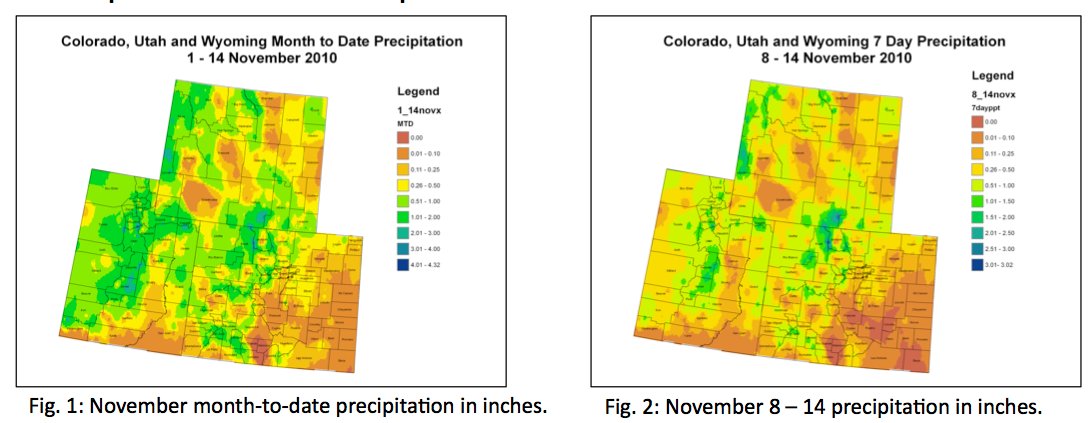
Here are the notes from Tuesday via Henry Reges.

Here are the notes from Tuesday via Henry Reges.
From email from the Water Research Foundation via a colleague at work:
On December 7, 2010, at 3:30 pm ET (2:30pm CT, 1:30pm MT, 12:30pm PT) the Water Research Foundation will present a one-hour Webcast titled “North American Residential Water Usage Trends and Applications for Utilities.”
Register for this Webcast by clicking on the link below:
http://video.webcasts.com/events/h2oo001/36778
Synopsis
Many water utilities are experiencing declining water sales among residential households, even though the total number of residents and households continues to grow and as household incomes continue to rise. A variety of theories have been advanced to explain the declining usage, however, to date, no definitive statement has been made as to the validity of these theories or the amount each variable contributes to residential water-usage decline.
While “water conservation” is normally viewed as protecting a scarce resource, this can cause revenue erosion and uncertainty in terms of meeting revenue requirements for water utilities. Without a clear understanding of the changing water-use patterns, it is difficult to develop appropriate pricing structures that will both recoup costs and provide resources for the future. Thus, for utilities to both encourage conservation and have sufficient financial reserves for maintenance and growth, it is necessary to better understand how water-use patterns have changed over the last 30 years, what factors are driving usage, and how these factors might impact utilities in the future.
This Webcast, based on the published report North American Residential Water Usage Trends and Applications for Utilities (Order #4031), will focus on (1) understanding residential water-usage behavior patterns and trends, (2) assessing the impact of those patterns on water utility operations, and (3) providing data that can be correlated with future trends for planning purposes.
Presenters:
Greg C. Heitzman, President/CEO, Louisville Water Company and Thomas D. Rockaway, Director of the University of Louisville’s Center for Infrastructure Research
If you have any questions about registration, please contact Terry Freeman at tfreeman@WaterRF.org, or 303-347-6248. Registration to the Webcast is free to Foundation subscribers and is one of the many benefits of being a Foundation subscriber. Foundation subscribers will also be able to download the Webcast from the Water Research Foundation Website a few days after the event.
More education coverage here.
From email from Gigi Richard:
Our next presentation in the Fall 2010 Natural Resources of the West: Water seminar series a project of the Water Center at Mesa State College will be…
Mon 22 November, 4:00 pm
Saccomanno Lecture Hall, Wubben Science Building , Room 141 (WS 141)
Mesa State CollegeWill Wood Chips and Hay Keep Selenium Away? A Passive Bioreactor for Removing Selenium from Water
Dr. Russ Walker, Professor of Environmental Science, Mesa State CollegeSeminars are free and open to the public, no registration necessary.
For the entire seminar series schedule, please see: http://home.mesastate.edu/~grichard/WSS/Seminar2010.html
For more information please contact:
Prof. Gigi Richard, 970.248.1689, grichard@mesastate.edu
Prof. Tamera Minnick, 970.248.1663, tminnick@mesastate.edu
More education coverage here.

Here’s the release from the Environmental Protection Agency (Latisha Petteway):
The U.S. Environmental Protection Agency (EPA) has identified a list of 134 chemicals that will be screened for their potential to disrupt the endocrine system. Endocrine disruptors are chemicals that interact with and possibly disrupt the hormones produced or secreted by the human or animal endocrine system, which regulates growth, metabolism and reproduction. Administrator Lisa P. Jackson has made it a top priority to ensure the safety of chemicals, and this is another step in this process.
“Endocrine disruptors represent a serious health concern for the American people, especially children. Americans today are exposed to more chemicals in our products, our environment and our bodies than ever before, and it is essential that EPA takes every step to gather information and prevent risks,” said EPA Administrator Lisa P. Jackson. “We are using the best available science to examine a larger list of chemicals and ensure that they are not contaminating the water we drink and exposing adults and children to potential harm.”
The list includes chemicals that have been identified as priorities under the Safe Drinking Water Act (SDWA) and may be found in sources of drinking water where a substantial number of people may be exposed. The list also includes pesticide active ingredients that are being evaluated under EPA’s registration review program to ensure they meet current scientific and regulatory standards. The data generated from the screens will provide robust and systematic scientific information to help EPA identify whether additional testing is necessary, or whether other steps are necessary to address potential endocrine disrupting chemicals.
The chemicals listed include those used in products such as solvents, gasoline, plastics, personal care products, pesticides, and pharmaceuticals, including benzene, perchlorate, urethane, ethylene glycol, and erythromycin.
Also being announced today are draft policies and procedures that EPA will follow to order testing, minimize duplicative testing, promote equitable cost-sharing, and to address issues that are unique to chemicals regulated under the SDWA.
After public comment and review, EPA will issue test orders to pesticide registrants and the manufacturers of these chemicals to compel them to generate data to determine whether their chemicals may disrupt the estrogen, androgen and thyroid pathways of the endocrine system.
EPA is already screening an initial group of 67 pesticide chemicals. In October 2009, the agency issued orders to companies requiring endocrine disruptor screening program data for these chemicals. EPA will begin issuing orders for this second group of 134 chemicals beginning in 2011.
EPA has the most comprehensive mandated testing program for hormone effects in the world. The program is the result of a multi-year effort that includes validation of the science through a transparent scientific review process.
More information: http://www.epa.gov/endo.
More water pollution coverage here.

From DMNNewsWire.com:
Two Rivers Water Company, a company focused on acquiring and developing water, farming and alternative energy in southern Colorado, announced today they have received a $9,900,000 loan approval from the Colorado Water Conservation Board. This loan will be in two phases. The first phase will be to fund the repairs of the Cucharas Reservoir to comply with the Colorado Division of Water Resources, Dam Safety Program requirements. Once the repairs are completed, Two Rivers will begin the permitting process to either completely rehabilitate the existing dam or construct a new roller-compacted concrete dam. The expected storage of the rehabilitated or new dam is in excess of 41,000 acre feet.
More Arkansas River basin coverage here.

From The Pueblo Chieftain (Chris Woodka):
More than 400 water rights owners have returned cards the Super Ditch board sent out earlier this month to shareholders on seven ditches in an attempt to measure interest in the fledgling water leasing program. And more than 120 attended a meeting Thursday at the Gobin Community Center. About 30 people turned out for an evening meeting at Lamar.
They peppered the Super Ditch board with questions for two hours about how the program would work: how much water would be available, where it would be stored and when water contracts would be expected. Many wanted to know why they had to sign up by the end of November, before many of the ditches had annual meetings to discuss the proposal among themselves. “The reason we need a commitment now is that we have to identify a source of water for the court case, an environmental impact statement and 1041 permits,” explained John Schweizer, president of the Super Ditch. “By returning the cards, you keep your options open.”
The Super Ditch board decided to send out the cards and host the meetings after a meeting last month. The board has lease agreements with the Pikes Peak Regional Water Authority and Aurora and now needs to show it has ditch shareholders interested in filling the supply. “Otherwise, you are speculating,” Schweizer said…
“The best thing about leasing is that you can control your vote,” [Dale] Mauch said. “The cities are going to keep coming. We came up with a way to to deal with it so we can take advantage of it in the future. If Super Ditch can supply the water, 50 years from now, it’s the Walmart of water.”