Colorado Water Institute: Region 8 Collaborative Workshop February 15-17

A picture named bluegreenalgaebloom.jpg

Here’s the announcement from the Colorado Water Institute:

Agencies and universities in the six states of EPA Region 8 (Colorado, Montana, North Dakota, South Dakota, Utah and Wyoming) are hosting a three-day workshop in February 2011 to explore the science and institutional context regarding nutrients and water quality.

Why this Workshop?
Nutrients are a nationwide and regional concern due to degradation of important water resources and the associated health and environmental risks. The science and policy context surrounding nutrients is complex, affecting the management of wastewater, stormwater, drinking water and agriculture. This workshop will provide an opportunity for stakeholders and agencies to work together to develop a shared understanding of the science and to better understand the challenges associated with developing and implementing nutrient controls while preserving other important stakeholder values.

Anticipated Outcomes
The goal of the workshop is to build a better informed and more tightly linked community of nutrient researchers, regulators, managers, policy makers and stakeholders leading to collaborative approaches for developing and achieving nutrient controls.

Sponsors/More Information
This workshop is sponsored by the USDA-NIFA Northern Plains and Mountains Regional Water Program, Colorado Water Institute, Utah Water Research Laboratory, and EPA Region 8.

More water pollution coverage here.

Snowpack news

A picture named snowflakesbentley.jpg

From the Glenwood Springs Post Independent via The Aspen Times:

Snowpacks are averaging 106 percent through the Roaring Fork Basin. On Independence Pass, the snowpack is at 128 percent of average, and several other stations along the Fryingpan and Crystal rivers report a snowpack of between of 122 and 130 percent of average.

Cherry Creek Reservoir winter boating closure starts December 1

A picture named cherrycreekreservoir.jpg

From the World Fishing Network:

Cherry Creek State Park will close to boating on Wednesday, Dec. 1 due to the onset of winter and the seasonal closure of the aquatic nuisance species vessel inspection stations. All waters in the park will be closed to both motorized and non-motorized watercraft. Cherry Creek Reservoir will reopen to boating on March 1, as weather allows.

More Cherry Creek watershed coverage here.

More South Platte River basin coverage here.

Southern Delivery System update

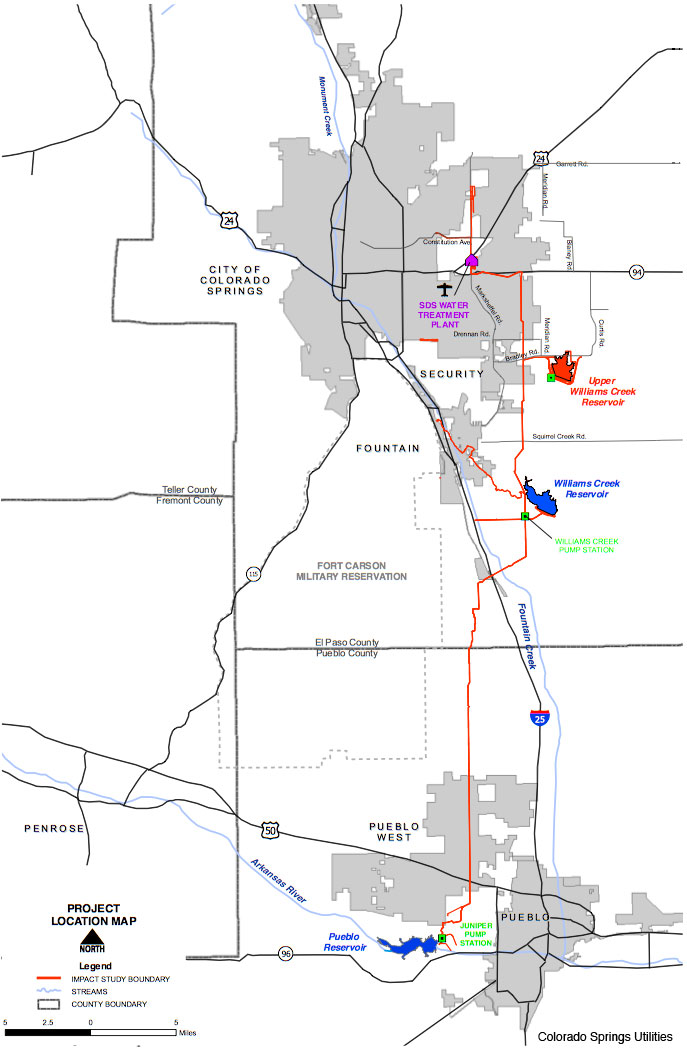
A picture named sdspreferredalternative.jpg

From the Colorado Springs Independent (Pam Zubeck):

Within a month or so, a segment of pipeline installation south of Colorado Springs will be awarded to one of seven prime contractors who have been pre-qualified for the work. Most are based in the Front Range area. The pipeline will bring water from Lake Pueblo to Colorado Springs by 2016, Utilities officials say.

More Southern Delivery System coverage here and here.

High Speed Water Sterilization Using One-Dimensional Nanostructures

A picture named highspeednanostructuresdisinfection.jpg

From the Nano Letters (David T. Schoen/Alia P. Schoen/Liangbing Hu/Han Sun Kim/Sarah C. Heilshorn/Yi Cui):

The removal of bacteria and other organisms from water is an extremely important process, not only for drinking and sanitation but also industrially as biofouling is a commonplace and serious problem. We here present a textile based multiscale device for the high speed electrical sterilization of water using silver nanowires, carbon nanotubes, and cotton. This approach, which combines several materials spanning three very different length scales with simple dying based fabrication, makes a gravity fed device operating at 100000 L/(h m2) which can inactivate >98% of bacteria with only several seconds of total incubation time. This excellent performance is enabled by the use of an electrical mechanism rather than size exclusion, while the very high surface area of the device coupled with large electric field concentrations near the silver nanowire tips allows for effective bacterial inactivation.

More water treatment coverage here.

Pueblo County and Pueblo West settle lawsuit over Arkansas River winter flow program

A picture named puebloleveearkansasriver.jpg

From The Pueblo Chieftain (Chris Woodka):

Lawyers for both sides have reached agreement on language in the settlement, which will allow Pueblo West to receive more credit for return flows of treated wastewater down Wild Horse Dry Creek under the flow program. Pueblo County commissioners will consider the agreement this morning, while the Pueblo West metro district board will take it up at its meeting tonight. The details of the agreement have been hammered out for months and discussed in executive session by both boards. Other parties in the agreement are the Pueblo Board of Water Works, which will consider the agreement at its December meeting, and Colorado Springs Utilities.

The agreement would end a lawsuit filed by Pueblo West in 2009 over conditions imposed by Pueblo County commissioners in approving a 1041 permit for the Southern Delivery System…

Pueblo West would be allowed to exchange water into Lake Pueblo under certain conditions even though its flows enter the Arkansas River about four miles downstream of Pueblo Dam, according to a draft of the agreement. Those flows are upstream of the Pueblo Whitewater Park, so may be counted toward meeting the city of Pueblo’s recreational in-channel diversion decree measurements, the document states. Colorado Springs Utilities agreed to provide up to 900 acre-feet annually in Lake Pueblo to Pueblo West through a contract exchange, or paper trade, of Pueblo West Water in Twin Lakes. Colorado Springs may deliver water directly from Twin Lakes through its Homestake Pipeline. If Pueblo West’s water is delivered to Lake Pueblo via the Arkansas River, it is subject to a 10 percent transit loss. In return, Pueblo West would withdraw a state application to exchange return flows through a pumpback into the golf course wash that flows directly into Lake Pueblo. The plan was discussed in the past two years and met opposition from the Pueblo Area Council of Governments, with the sole exception of Pueblo West. Pueblo West intends to construct a pipeline down Wild Horse Dry Creek that would increase the amount of water it exchanges, and the other parties would support the plan in any PACOG, state health department and water court applications.

More Pueblo West coverage here and here.