El Paso County: A plan is taking shape to improve aesthetics and management of Rainbow Falls

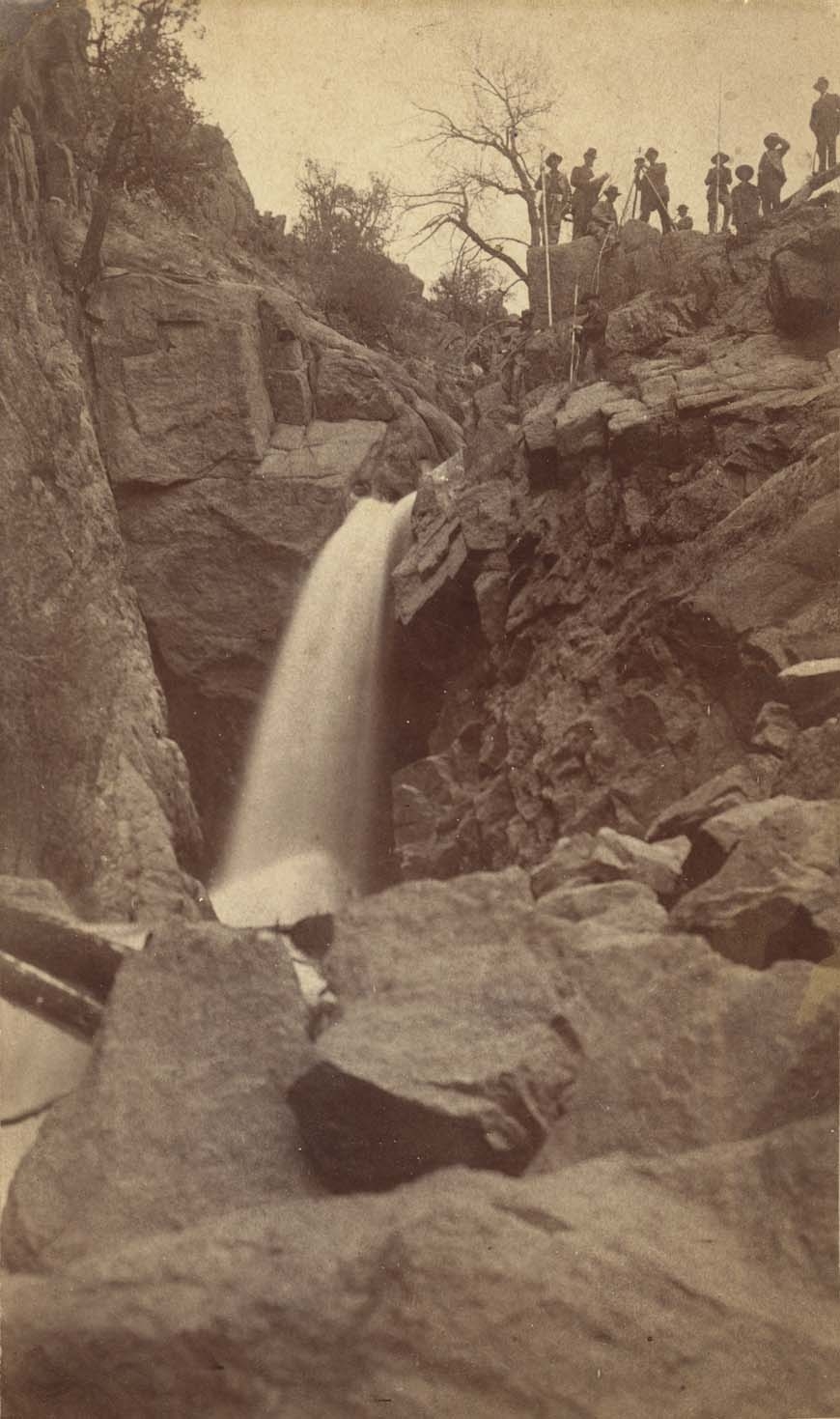
A picture named rainbowfallsmanitousprings1879

From The Colorado Springs Gazette (Jakob Rodgers) via OutThereColorado.com:

The initial plan is short on specifics, offering instead an outline that includes several aesthetic improvements to the oft-vandalized falls that — if approved by the El Paso County Commissioners — would be completed in the next three years…

In about five years, planners hope to enhance the area’s fishing, build a trail along the creek, expand the parking area east of the trailhead along Serpentine Drive, and establish a regular volunteer clean-up schedule…

Tim Wolken, El Paso County’s director of community services, said the county is working to secure about $80,000 for the project’s first year. A grant approved by Great Outdoors Colorado would supply more than $40,000, while the county would offer roughly $25,000. El Paso officials are waiting to hear if a block grant worth more than $15,000 will be approved to round out initial funding.

She looks forward to the day when graffiti is stricken from the rock walls and “graffiti art” is restricted to one area. “Man and nature can work together through art,” Montgomery said. “But what’s up there right now is not art.”

More restoration coverage here.

Population, Immigration, and the Drying of the American Southwest

A picture named coloradoriverbasin.jpg

Here’s the release from the Center for Immigration Studies (Bryan Griffith) via PRNewswire:

The looming water crisis in the American Southwest – and the role of immigration-driven population growth – is the topic of a paper published this month by the Center for Immigration Studies and authored by New Mexico journalist Kathleene Parker.

The paper, “Population, Immigration, and the Drying of the American Southwest,” online at http://cis.org/southwest-water-population-growth, explores the link between the possibility of the potentially catastrophic economic and environmental water crisis and the fact that the Southwest is the fastest-growing region of the world’s fourth-fastest-growing nation – a growth rate earlier cautioned against by various presidential commissions. It also looks at how that growth rate is driven by historically unprecedented immigration – legal and illegal – into the United States, the world’s third-most-populous nation after China and India. Immigration is responsible for more than half of the population growth in the Southwest this past decade, and nearly all of the growth in the largest southwest state, California.

Such high immigration has happened absent discussion or acknowledgement of its impacts on population or limited resources, such as water. Parker presents evidence that indicates there is insufficient water for the region’s current population, much less the larger future populations that will result if immigration continues at its present high rate.

The paper focuses on the drought- and growth-depleted Colorado River, including the high probability that the first-ever drought emergency could be declared on the river by early 2011 and the possibility that Lake Mead, the nation’s largest reservoir and a depression-era wonder of engineering, could run dry in the not too distant future, with hydroelectric production threatened even sooner.

This would imperil all of the Southwest, Nevada and Las Vegas – which depends on Lake Mead for 90 percent of its water – in particular, but also cities like Albuquerque, which uses Colorado River water via the San Juan-Chama diversion project. Such relatively junior water rights could be at risk in the midst of a profound or long-term water shortage on the Colorado River.

The legal allocation of the Colorado in the 1920s was based on a combination of flawed river-flow data and a failure to understand that the Southwest, historically, is a far more arid region – based on recent scientific research – than first believed. That concern is based on normal weather patterns, with the possibility of even further depletion of the river, the Southwest’s main source of water, should global warming happen.

Yet the water crisis unfolds in an atmosphere where, as pointed out by prestigious scientific groups like the National Academy of Sciences and the Scripps Institute of Oceanography, the extent of the crisis is not being sufficiently acknowledged or the advisability of the region’s high growth rate considered by leaders. That high growth rate, in turn, is driven by U.S. immigration policies that do not consider the implications of a growth rate that, if trends hold, could mean one billion Americans by late this century.

Six states are dependent upon Colorado River to provide water to roughly 60 million people, and that number could double over the next four decades if immigration is not returned to far lower levels in the near future.
Parker, now of Rio Rancho, N.M., earlier worked as a correspondent for the Santa Fe New Mexican in the 1990s, covering Los Alamos, Los Alamos National Laboratory, and the Jemez Mountain region. She also freelanced for the Albuquerque Journal, covering the aftermath of the Cerro Grande fire and other topics, and she recently authored an article, for a major forestry magazine, on the Cerro Grande fire. She often teaches adult-education courses on population and environmental topics, has worked widely on water issues in Colorado and New Mexico, and frequently writes commentaries.

The Center for Immigration Studies is an independent non-partisan research institution that examines the impact of immigration on the United States.

Contact: Bryan Griffith
(202) 466-8185, press@cis.org

More Colorado River basin coverage here.

Energy policy — oil shale: The Government Accountability Office warns that oil shale development may impact Colorado water quantity and quality

A picture named oilshaledepositsutwyco.jpg

Here’s the summary for the report from the GAO:

Oil shale deposits in Colorado, Utah, and Wyoming are estimated to contain up to 3 trillion barrels of oil–or an amount equal to the world’s proven oil reserves. About 72 percent of this oil shale is located beneath federal lands, making the federal government a key player in its potential development. Extracting this oil is expected to require substantial amounts of water and could impact groundwater and surface water. GAO was asked to report on (1) what is known about the potential impacts of oil shale development on surface water and groundwater, (2) what is known about the amount of water that may be needed for commercial oil shale development, (3) the extent to which water will likely be available for commercial oil shale development and its source, and (4) federal research efforts to address impacts to water resources from commercial oil shale development. GAO examined environmental impacts and water needs studies and talked to Department of Energy (DOE), Department of the Interior (Interior), and industry officials.

Oil shale development could have significant impacts on the quality and quantity of water resources, but the magnitude of these impacts is unknown because technologies are years from being commercially proven, the size of a future oil shale industry is uncertain, and knowledge of current water conditions and groundwater flow is limited. In the absence of effective mitigation measures, water resources could be impacted from ground disturbances caused by the construction of roads and production facilities; withdrawing water from streams and aquifers for oil shale operations, underground mining and extraction; and discharging waters produced from or used in operations. Estimates vary widely for the amount of water needed to commercially produce oil shale primarily because of the unproven nature of some technologies and because the various ways of generating power for operations use differing quantities of water. GAO’s review of available studies indicated that the expected total water needs for the entire life cycle of oil shale production ranges from about 1 barrel (or 42 gallons) to 12 barrels of water per barrel of oil produced from in-situ (underground heating) operations, with an average of about 5 barrels, and from about 2 to 4 barrels of water per barrel of oil produced from mining operations with surface heating. Water is likely to be available for the initial development of an oil shale industry, but the size of an industry in Colorado or Utah may eventually be limited by water availability. Water limitations may arise from increases in water demand from municipal and industrial users, the potential of reduced water supplies from a warming climate, fulfilling obligations under interstate water compacts, and the need to provide additional water to protect threatened and endangered fishes. The federal government sponsors research on the impacts of oil shale on water resources through DOE and Interior. DOE manages 13 projects whose water-related costs total about $4.3 million, and Interior sponsored two water-related projects, totaling about $500,000. Despite this research, nearly all of the officials and experts that GAO contacted said that there are insufficient data to understand baseline conditions of water resources in the oil shale regions of Colorado and Utah and that additional research is needed to understand the movement of groundwater and its interaction with surface water. Federal agency officials also said they seldom coordinate water-related oil shale research among themselves or with state agencies that regulate water. Most officials noted that agencies could benefit from such coordination. GAO recommends that Interior establish comprehensive baseline conditions for water resources in oil shale regions of Colorado and Utah, model regional groundwater movement, and coordinate on water-related research with DOE and state agencies involved in water regulation. Interior generally concurred with GAO’s recommendations.

More coverage from the Associated Press via The Salt Lake Tribune:

The Government Accountability Office says in a report released Monday that oil shale development could have “significant” impacts on water quality and quantity, but more research is needed to determine the effects. The GAO says up to 12 barrels of water, or about 500 gallons, may be needed to produce a barrel of oil. It urges the Interior Department to coordinate more research.

Here’s a look back at the oil shale bust in the early 1980s from Jim Spehar writing in The Denver Post. From the article:

Tim Schultz, now president of the Denver-based Boettcher Foundation, was a 31-year-old Rio Blanco County commissioner during the Exxon days. Lamm recalls Schultz as one of the local leaders who was not “willing to sell out their heritage for a promise.” Schultz and others backed an industry-funded Oil Shale Trust Fund, which assisted with up-front impact costs and helped soften the bust. “It’s kind of hard to plan for the peaks,” Schultz warns, “but you always want to remember that those valleys are just around the corner.”

More oil shale coverage here and here.

Southern Delivery System: Colorado Springs Utilities is taking a wait and see stance with respect to Pueblo County’s legal fee bill

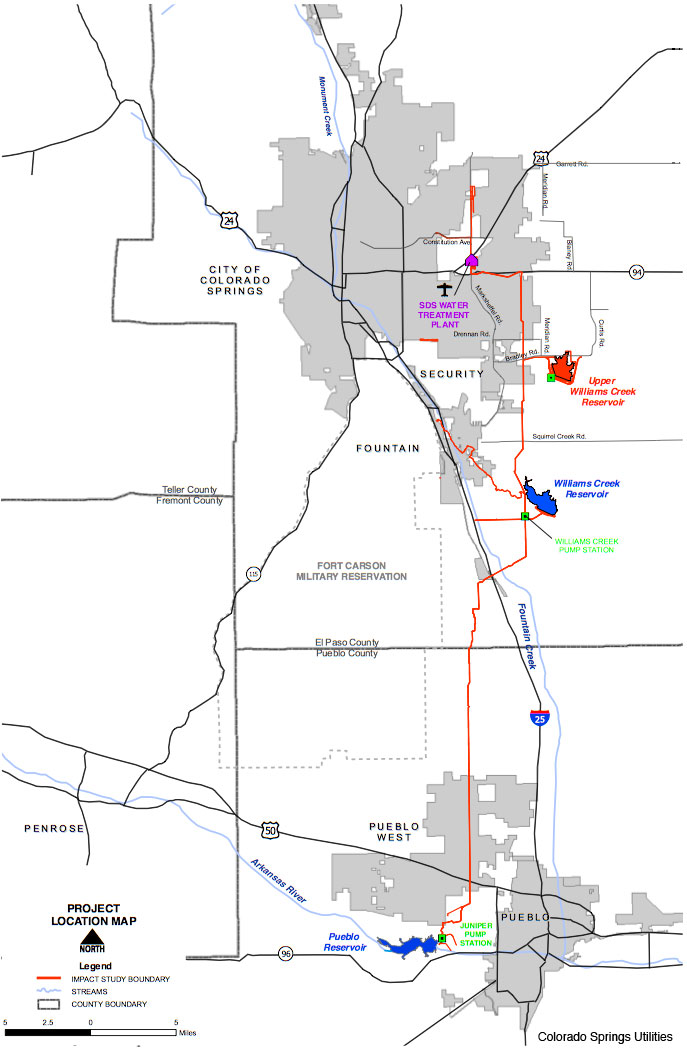
A picture named sdspreferredalternative.jpg

From The Pueblo Chieftain (Chris Woodka):

“We haven’t received any formal notification, so I’m not sure how to respond,” John Fredell, project director for the Southern Delivery System, said Monday. “This wasn’t an action between us and the county commissioners, since we’re not involved in the litigation, and we were peripheral to the lawsuit between Pueblo County and Pueblo West. We did participate in the negotiations that led to the agreement.”

Pueblo County commissioners last week decided to send Colorado Springs a bill for nearly $150,000 to pay for its legal costs in defending the county against a lawsuit by Pueblo West…

Under an agreement approved by commissioners and the metro district last week, Pueblo West will participate in the flow program, but can count return flows in Wild Horse Dry Creek as part of the program. The agreement also clears the way for Pueblo West to apply for a return-flow pipeline to the confluence of Wild Horse and the Arkansas River, and abandon its alternative plan to pump back return flows into the golf course wash, which empties directly into Lake Pueblo. Colorado Springs agreed to a paper trade of up to 900 acre-feet annually with Pueblo West to exchange its water in Lake Pueblo for Pueblo West water in Twin Lakes. By doing that, Pueblo West avoids transit loss when the water moves down the Upper Arkansas River…

Last week, County Commission Chairman Jeff Chostner said Colorado Springs should simply pay the bill, adding that it was for professional services and not intended as an antagonistic gesture. “Colorado Springs Utilities had a responsibility for the other participants to be informed. Colorado Springs should have resolved the problem without Pueblo West suing Pueblo County,” Chostner said. “So far, there has been professional cooperation on both sides. I think they realize that Pueblo County has taken a role Colorado Springs should have taken.”

More Southern Delivery System coverage here and here.