A beautiful snow

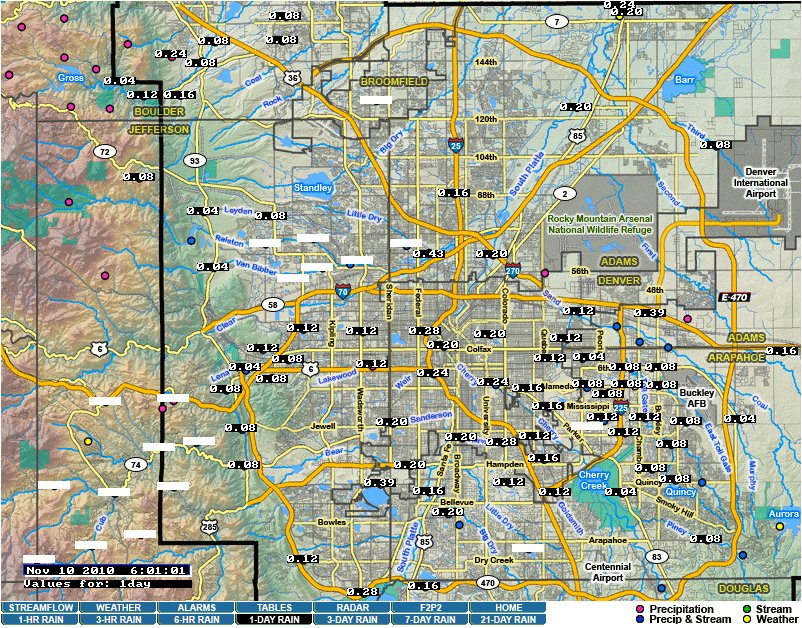
A picture named urbandrainage1dayrain11102010

After such a hot and dry fall it was a treat to watch the hail, rain and snow storm yesterday. Click on the thumbnail graphic to the right to see the one day precipitation map for the Denver area from the Urban Drainage and Flood Control District.

43 hundredths was recorded a couple of miles from Gulch Manor at the Little Dry station near 64th and Pecos.

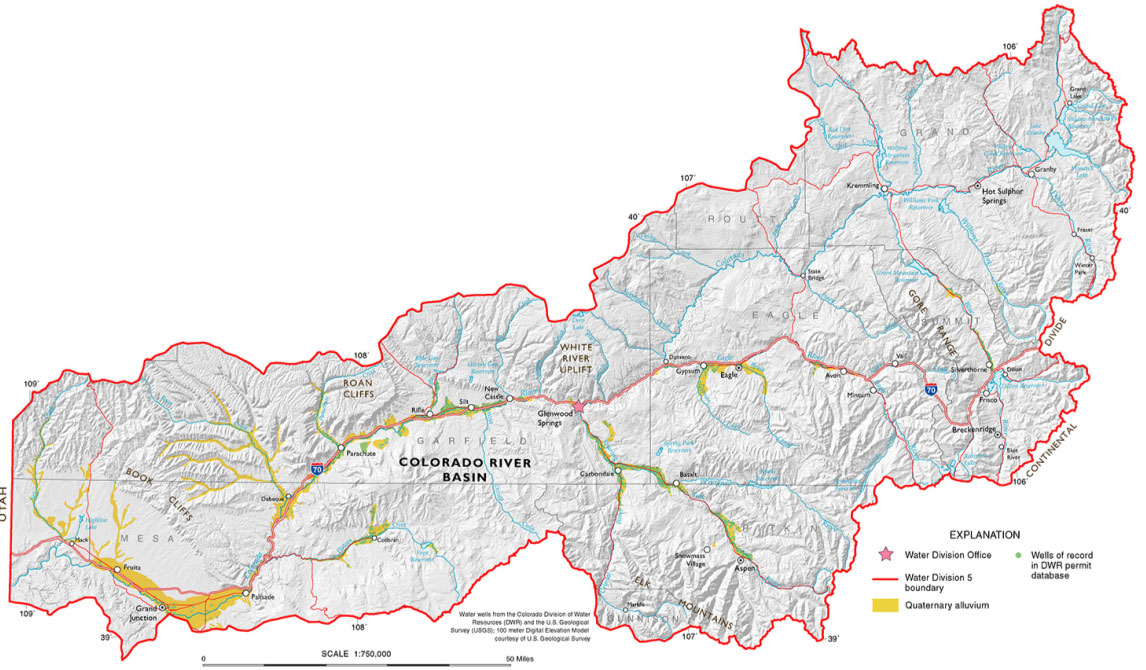
Upper Colorado River Basin: Water Year 2010 streamflow recap

A picture named coloradoriverbasincgs.jpg

From the Glenwood Springs Post Independent (John Stroud):

“It was a roller coaster year,” said Don Meyer, senior water resources engineer for the River District. “We had a pretty dry late winter and early spring, which led to a low snowpack.” What snowpack there was also melted in a quick runoff, due in part to a heavy layer of dirt in the higher elevations from a series of spring dust storms and hotter-than-normal temperatures in late May and early June.

“Then we had a big monsoonal season, especially in the upper Colorado basin where we got quite a bit of rain,” Meyer said. “It was a real mixed bag, but in general it was a much better water year than we anticipated back in the spring.”

Currently, most rivers in the Colorado Basin are running at or near average for this time of year, despite a dry fall. The Colorado River below Glenwood Springs was running at 1,770 cubic feet per second (cfs) on Tuesday, slightly below the 43-year average for that date of 1,920 cfs. Since mid-August, the Colorado below Glenwood was running at or above average, before dropping off in late October as dry weather persisted.

Two major tributaries of the Colorado have been running below average for the past 60 to 90 days, however. The Roaring Fork River at Glenwood Springs was running at 593 cfs on Tuesday, compared to the 39-year average of 678 cfs. The Roaring Fork has been flowing at below-average levels since early September. Likewise, the Eagle River at Gypsum has been running below average since about that same time period. On Tuesday, it was running at 244 cfs compared to the 64-year average of 252 cfs…

River flows in the Colorado below the Shoshone hydroelectric plant in Glenwood Canyon for the past two years have also been impacted by the fact that the power plant has been out of commission. As a result, Denver and other Front Range water users placed a call on the Shoshone allotment. Still, downstream water interests have been able to work out an agreement that has kept near-historical flows in the Colorado River, intended for protection of endangered fish species as well as recreation interests.

More Colorado River basin coverage here.

Pueblo: Fountain Creek community meeting recap

A picture named fountaincreek.jpg

Update: From The Pueblo Chieftain (Chris Woodka):

Flood control money through a district formed to fix Fountain Creek won’t necessarily tie into Pueblo’s master plan for the Historic East Side and Fountain Creek, County Commissioner Jeff Chostner said Wednesday. City officials mentioned the funds Tuesday as one source of money while discussing an ambitious master plan for urban renewal and recreation that could cost $60 million and take 50 years to complete. “My concern is that we’re leading people on about things that the money is not intended for,” Chostner said. “The money will not come out of Southern Delivery System funds, because these projects don’t meet the terms of the 1041 permit.”

From The Pueblo Chieftain (Chris Woodka):

A crowd of about 30 people attended a community meeting at Risley Middle School to review a master plan that has been in the making for nearly a year. Many of those who attended were at the previous three public meetings or a dozen steering committee meetings earlier this year, and there were a few curious newcomers. The goal is to tie together a plan to improve flood protection and access along Fountain Creek from its confluence with the Arkansas River to Eighth Street with an urban redevelopment plan in the adjacent area south of Eighth and west of Hudson Avenue. Features in the plan include a pedestrian bridge over Fountain Creek at First Street, expanded parks at El Centro del Quinto Sol and Plaza Verde, a trail that connects to the Front Range Trail System to the north, a skate park, water fountains and a community-built playground. There are also gateway approaches planned on Fourth and Eighth streets. It also would tie in to flood control projects elsewhere on Fountain Creek, and use some of the sediment dredged from Fountain Creek to create more user-friendly approaches to the earthen levees south of Fourth Street. The total cost of the projects outlined Tuesday would be in the neighborhood of $60 million and take 40-50 years to complete, [Scott Hobson, assistant city manager for community development] explained…

…there are bite-sized pieces and the opportunity for more funding partners. Hobson said the master plan actually includes 20 separate projects that range in price from $500,000 for some of the less-developed park areas to $6 million-$7 million for the more urban neighborhoods. For the parks, which could be tackled soonest, the city would look to Great Outdoors Colorado. “The city applies to GOCo for one or two projects each year,” Hobson said.

The approaches on Fourth and Eighth streets would tie into improvements now being planned on Interstate 25 by the Colorado Department of Transportation. Flood control projects and work on the levees could be funded by the Corps of Engineers, Natural Resource Conservation Service or the Fountain Creek Watershed Flood Control and Greenway District — once it has a funding source in place, Hobson said.

More Fountain Creek coverage here and here.

The Pueblo Board of Water Works is looking at a five percent increase in water rates

A picture named waterfromtap.jpg

From The Pueblo Chieftain (Chris Woodka):

The board sat down with staff Tuesday to look at specifics in the proposed budget, and will consider approval of the budget following a public hearing at 2 p.m. Tuesday. The water board is looking at a $30.2 million budget in 2001 that is actually less than the previous two years. However, there were extraordinary expenses and revenues in 2009 and 2010…

A 5 percent increase means the average residential water bill will increase $1.45-$1.58 per month, based on 11,000 gallons used per month, depending on tap size. In summer, it would be less than $5 per month, based on higher usage for lawn watering of about 30,000 gallons in a month. Since the drought of 2002, residential use has decreased, and the budget is built on projections of 123,000 gallons annually per residential account, said Seth Clayton, manager of the financial division. In 2009, one of the wettest years on record, single-family households averaged 118,000 gallons. In 2010, use is projected to be 128,000 gallons per household. Similar patterns have been seen in multifamily and commercial accounts. “October and November have been drier and warmer than usual, and that’s really boosted revenues,” Clayton said, in estimating revenues from metered water sales that will come close to projected $20 million this year, about 70 percent of total revenues…

Pueblo water rates increased dramatically during the early 1980s, then hardly at all until the mid-1990s. Since then, they have increased by 1.5 to 5 percent annually.

More Pueblo Board of Water Works coverage here.