Leadville: Arkansas River Basin Water Forum, April 25-26, 2012

arkansasriverbasin.jpg

From email from the Interbasin Compact Committee:

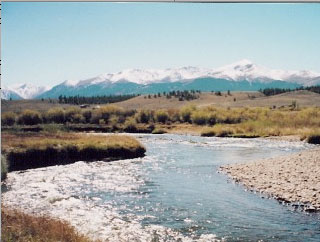
Save the date for the 2012 Arkansas River Basin Water Forum taking place at the Climax-Molybdenum Leadership Center at Colorado Mountain College in Leadville, CO! See the attached reminder and check out the website (www.arbwf.org) for details on lodging and registration.

Registration ($45) may done online at our website or by mail-in. Exhibitors are also welcome at the same registration rate.

Our Keynote Speaker this year will be Mr. Richard Bratton – a Salida native with state wide experience in water law, agriculture, higher education, and public service. A member of Bratton-Hill LLC, he has practiced law in Gunnison since 1958 after discharge from the Army and a stint in Denver. He was counsel to the Upper Gunnison River Water Conservancy District (1961-2006). Mr. Bratton is a former Chairman of Colorado Water Resources and Power Development Authority and founder of the Western State Water Workshop, recipient of the Colorado Water Congress Aspinall Leadership award and outstanding alumnus from CU (Law) and Western State College.

We also have interesting panels planned on the Effects of River Compact Calls, Restoration Innovations to Improve Water Quality, Source Water Planning, Advancements in the Mining Industry to Protect the River, and Trends in Agriculture.

Finally, join us for an evening on April 25 with Gillian Klucas, author of Leadville: The Struggle to Revive an American Town.

Questions may be directed to Chairperson Melissa Wolfe (Colorado Mountain College) at (719) 486-4239 or the Southern Region Extension Office at (719) 545-2045.

More Arkansas River basin coverage here.

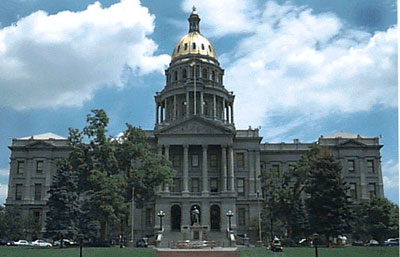
2012 Colorado legislation: SB12-132 would set limit of one year for yea or nay on business water and air quality permits

coloradocapitolfront.jpg

From The Pueblo Chieftain (Patrick Malone):

Sen. Kevin Grantham…sponsored [Senate Bill 12-132: Issue Air & Water Quality Permits Within 12 Months]. It aims to set a one-year deadline for the issuance or denial of permit applications. Grantham said during a tour of the state over the summer, many businesses complained to him that the slow permitting process has interfered with expansion, hindering job creation. “A company in this situation obviously faces many difficult personnel decisions over this period as they await the final determination, which in many cases takes a little over a year,” Grantham said…

The Colorado Department of Public Health and Environment, which is responsible for air and water permitting, opposes the bill. Will Allison, director of the health department’s air-quality division, said the department is understaffed and overburdened by permit applications. That has hampered the department’s ability to meet the 18-month deadline on some permit decisions, much less the 12-month timeline that Grantham seeks to impose. “Frankly, we are currently experiencing delays meeting the existing statutory deadlines,” he said. The current backlog of pending air permits at the department is about 140, according to Allison.

The Senate Agriculture and Natural Resources Committee passed the bill 4-3, with Republicans voting in favor of it and most Democrats, including Sen. Angela Giron, D-Pueblo, opposing it.

More 2012 Colorado legislation coverage here.

Pueblo: The city is starting to plan for Arkansas River stream improvements through town to accommodate greater numbers of fisherman

puebloleveearkansasriver.jpg

From The Pueblo Chieftain (Chris Woodka):

Pueblo and Trout Unlimited are preparing an application to Colorado Parks and Wildlife for a Fishing is Fun grant to do further work on the Arkansas River through Pueblo. “What’s driving it is the higher quality fishing on that reach of river,” said Scott Hobson, assistant city manager for community investment. “We are seeing more fly fishermen in the winter months when streams in other parts of the state are inaccessible.”

The city wants to add boulder clusters in the Arkansas River from the Juniper Bridge just below Pueblo Dam to Dutch Clark stadium. Agreements reached among water users in 2004 provided greater assurance of flows in winter months by curtailing exchanges when river levels are low. A new project, which could cost up to $300,000, would make improvements to the banks, add J-hook jetties and revegetate some areas. Improvements on the previous work and other features would be added. The features allow fish to survive and feed during a variety of conditions along the river.

More restoration/reclamation coverage here.

Snowpack news: Dust off your drought plan in northwest Colorado, La Niña is weakening

usdroughtmonitor02072012

From the Associated Press via USAToday.com:

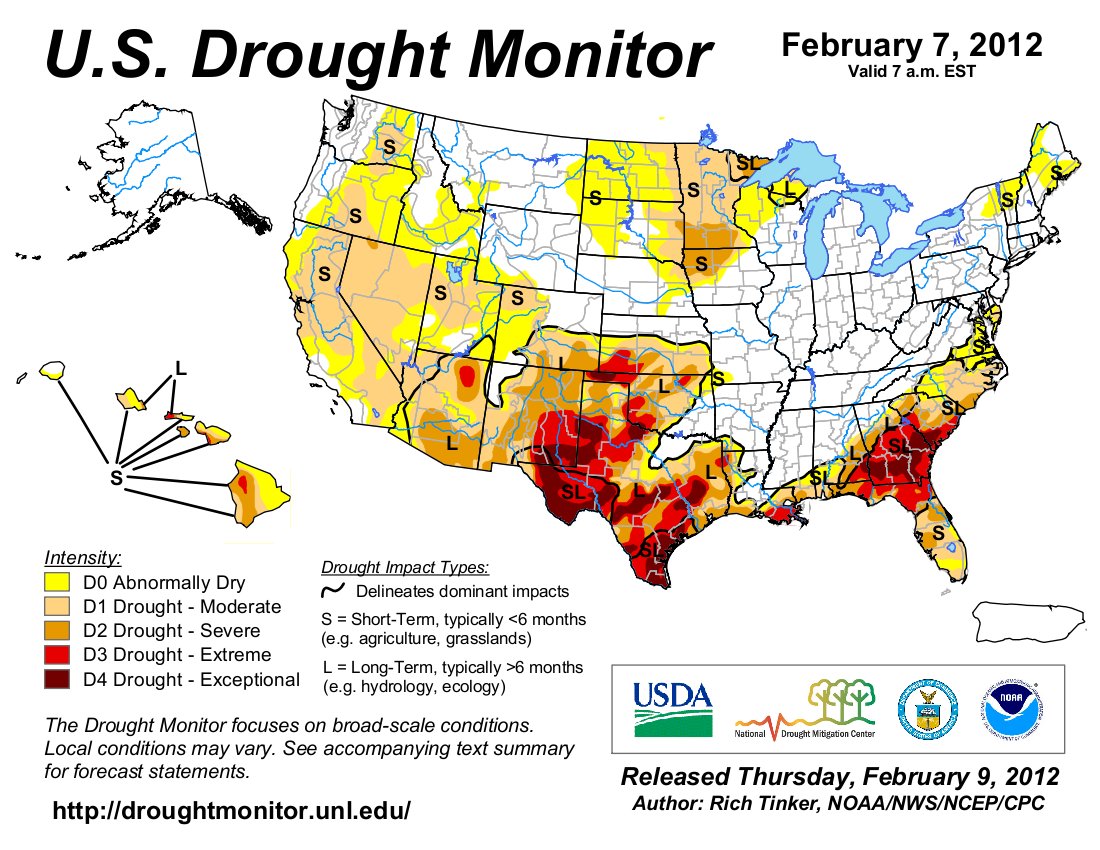
The National Weather Service’s Climate Prediction Center says La Niña is showing signs that it will be over by summer. Center deputy director Mike Halpert said that’s too late for the U.S. Southwest because the rainy season will be over by that time. The effects of La Niña, a cooling of the central Pacific Ocean water, are generally weaker in summer. But it is good news for the Atlantic hurricane belt. More tropical storms and hurricanes form there during La Niñas.

Forecasters don’t know what conditions will follow this La Niña. Usually a multi-year La Niña is not followed by a neutral event, Halpert said. It either goes to El Niño or comes back as another La Niña, he said.

La Niña winters can lead to great snowpack. It hasn’t panned out this year but last year was one for the record books.

From Steamboat Today (Lori Jazwick):

So how bad is the snow situation for Northwest Colorado? Unfortunately, we can’t compare this year’s totals to last year’s. Last year was an above-normal snowpack year, so comparing 2012 to 2011 indicates our water drainage basin is only at 38 percent of last year’s total. But to compare it to the norm, let’s consider a block of 30 years of data to get a more realistic picture.

Snowfall in the Yampa River basin currently is 61 percent of that 30-year average, which means we are just a little bit above half of where we should be at this time of year. So are you a glass half-full or glass half-empty person? To err on the side of caution, I am going to go with half-empty. According to all of the data collected by the Natural Resources Conservation Service during the past 30-plus years, we have only a 10 percent chance of reaching the average peak for this season. It looks like the odds are against us.

The good news is that because of our epic snowfall last year, our reservoirs are in good shape. Stagecoach Reservoir is at 118 percent of average, and at 93 percent of total capacity. Almost all other reservoirs are in a similar situation within the state, so that hopefully will help us in the dry months to come this summer.

From The Greeley Tribune (Eric Brown):

It didn’t take long to set historic Greeley weather marks in 2012. Last month, Greeley experienced its driest and second-hottest January on record.

Municipal and county officials above the Niobrara shale play are examining their roles in regulating oil and gas exploration and production

niobrarashale.jpg

From The Denver Post (Bruce Finley):

…elected officials are responding by considering drilling moratoriums and new local rules. Residents want good air, water and safety, Commerce City Councilman Rene Bullock said. “What are we going to do to start providing that?” Colorado’s State Land Board hit the brakes on a controversial metro-Denver drilling project after learning that ConocoPhillips is embroiled in a lawsuit for failing to pay the state $152 million for cleanup of leaky underground gas tanks.

As energy companies prepare to tap the vast Niobrara shale formation, this reticence reflects widening anxiety and an uneasy standoff with state regulators as residents question Colorado’s ability to combine environment stewardship with large-scale industrial development.

State regulators, who simultaneously are charged with encouraging oil and gas development, oppose local rules for protecting air, water and serenity. “The state has the experience and the infrastructure to effectively and responsibly regulate oil and gas development,” Colorado Department of Natural Resources spokesman Todd Hartman said. “A healthy industry is important to our state’s economy, and a mosaic of regulatory approaches across cities and counties is not conducive to clear and predictable rules that mark efficient and effective government.”

Air pollution is a major concern. Here’s a report about past air pollution from Mark Jaffe writing for The Denver Post. From the article:

The study based on air sampling from a tower north of Denver estimated wells in the Denver-Julesberg Basin were losing about 4 percent of their methane emissions — twice as high as earlier estimates. The findings raise questions about emissions industrywide, said Greg Frost, a co-author of the study and a scientist at the National Oceanic and Atmospheric Administration and the University of Colorado-Boulder…

But since the sampling for the study was done in 2008, a number of steps have been taken to address emissions, state air officials and industry executives said. A mixture of venting emissions, leaks and flashing — fumes that escape as the pressure on the liquid portion of the gas drops — contributed to the problem, the researchers said. “The methane was detected in the atmosphere. The challenge was to understand what happens at each well site,” Frost said. In the last four years Colorado has adopted new drilling rules and air-emission restrictions that deal with many pollution issues, said Will Allison, director of the state Air Pollution Control Division.

More coverage from Scott Rochat writing for the Longmont Times-Call. From the article:

The public and three of the city’s advisory boards strongly urged tougher regulation — and a longer moratorium — of oil and gas drilling in Longmont. The support came during Tuesday night’s open house and joint board meeting at the civic center. More than 90 people showed up to have their say, either at the microphone or by showing with stickers which subjects they most strongly backed. Huge collections of stickers on poster boards told the tale: Keep drilling operations a half mile from homes? Yes. Require closed-loop systems? Yes. Toughen regulations even if they may be challenged or pre-empted by the state? Yes, yes, yes.

“I’m really concerned abut the long-term effects on the water supply,” said resident Edna Loehman. “I don’t think they should be doing it in urban areas.”[…]

The 14 members of the city’s water board, parks board, and environmental affairs board didn’t always go as far as the audience, but still wanted more than the city had.

In electronic voting, 86 percent of the advisory board members said they’d support tighter requirements even in areas the state had declared pre-empted; about three-quarters said they’d support either a 500 foot or a 1,000 foot setback. The current setback is 350 feet.

“It seems we have more control over where a gas station goes in town than things like this,” said Douglas Ward of the Board of Environmental Affairs.

More oil and gas coverage here and here.

2012 Colorado November election: Ballot initiatives 3 and 45 would challenge prior appropriation and beneficial use

clearcreekfalls.jpg

Here’s an opinion piece about ballot initiatives 3 and 45 from Nancy Agro running in The Durango Herald. From the article:

Article XVI of the Colorado Constitution, enacted in 1876, provides that the waters of the natural streams of the state belong to the people of the state, subject to appropriation for use, and that the right to divert unappropriated water for beneficial use shall never be denied. Priority of appropriation gives the better right as between those using the water with domestic use and irrigation having priority over other uses in times of shortage. These constitutional provisions codify the foundation of Colorado water law that a water right is the private property right of the appropriator, and first in time, is first in right.

The Colorado Supreme Court, acknowledging that the doctrine of prior appropriation existed from the earliest appropriations of water, said, “The climate is dry, the soil, when moistened only by the usual rainfall, is arid and unproductive … artificial irrigation for agriculture is an absolute necessity. Water in the various streams thus acquires a value unknown in moister climates. Instead of being a mere incident to the soil, it rises, when appropriated, to the dignity of a distinct usufructuary estate, or right of property.”

Proposed ballot initiatives 3 and 45 propose to turn these principles upside down by reversing the dominant and servient water estates. These amendments propose, among other things, that the public’s ownership of the waters of the natural streams supersedes property law, that the right of appropriation is servient to the public’s dominant water estate, including the protection of the public’s enjoyment of use of water, and that no water right has priority over the natural stream. If passed, these constitutional amendments will call into question, and potentially undo, long-established decreed appropriative water rights by subordinating those rights in favor of leaving the water in the stream. Vested water-rights diversions could be curtailed by holding unlawful any use of water causing irreparable harm to the public’s water estate, including the public’s enjoyment of water.

The well-settled principles of water appropriation have shaped the social and economic development of the arid West. It has always been the policy of government to encourage the diversion and use of water for agriculture and other beneficial uses. Significant expenditures of time and money have been made to put portions of Colorado’s unproductive land to beneficial use through irrigation. Construction of houses and other improvements and the cultivation of soil which made Colorado’s land more valuable, were undertaken because water-rights appropriations were constitutionally protected. In the words of the Colorado Supreme Court, “Deny the doctrine of priority or superiority of right by priority of appropriation, and a great part of the value of all this property is at once destroyed.”

More 2012 Colorado November election coverage here.

Flaming Gorge pipeline opposition talking point: Outdoor recreation supports 52,000 jobs in Wyoming

flaminggorgepipelineearthjustice.jpg

From the Wyoming Business Report (Wyoma Groenenberg):

The group said it has gathered resolutions from West Slope governments opposing the pipeline, which is proposed to transport 80 billion gallons of water annually, which could negatively impact the region’s recreation industry. The coalition plans to lobby Colorado Gov. John Hickenlooper to drop the project…

Protect the Flows plans to spend the year reminding Hickenlooper and state officials that public resources would be better spent on more affordable solutions that support recreation industry jobs, such as improving water conservation efforts, water reuse and recycling, and better land-use planning and growth management.

Outdoor recreation supports 52,000 jobs in Wyoming, according to the January edition of the Wyoming Business Report. That means that about 1 in 11 Wyoming residents works in that industry. In Colorado, about 107,000 jobs are in outdoor recreation, according to a 2006 economic impact report from the Outdoor Industry Association.

More Flaming Gorge pipeline coverage here and here.

Exploring the myth and lore around hydraulic fracturing — ‘…tests are showing that the fractures usually go only 200 or 300 feet’

marcellushydraulicfracturing.jpg

From The Fort Morgan Times (Dan Barker):

Hydraulic fracturing — sometimes called “fracking” — is a process of pumping a water, sand and chemical mixture into shale formations under high pressure to break up rock and get oil and natural gas flowing more readily, said Dale Larsen, a sales representative for CALFRAC, who spent most of his career since 1978 as a petroleum engineer in fracking…

Some people believe hydraulic fracturing is a new and untested process, but it goes back to 1948, when it was first used in southwest Kansas, Larsen said. People used to think that fracking produced fractures that went for thousands of feet, but tests are showing that the fractures usually go only 200 or 300 feet, he said, and the process does not create earthquakes…

Wells have pipes put in them, and those have a cement casing around them to keep oil or gas from escaping. When the pipes have reached the desired areas, they are perforated with charges and then water, sand and chemicals are pushed into the sandstone to force oil and gas out. However, the part of the pipe which passes through water table is not perforated, and the area where the fractures occur are thousands of feet lower than the water table, Larsen said. Groundwater rarely gets as far down as 1,000 feet…

There is federal regulation of at least one aspect of hydraulic fracturing. When water comes back up the pipe, it must be contained and either purified or disposed of safely, Larsen said. Sometimes that water is filtered and reused, depending on what kinds of minerals may have mixed with it, he said. Other times, it is disposed of in deep wells below the water table, Larsen said.

Meanwhile, Longmont gave folk a look at their proposed oil and gas regulations on Friday. Here’s a report from Scott Rochat writing for the Longmont Times-Call. From the article:

If approved, the rules would be the first update of Longmont’s drilling regulations since 2000. Pressure to upgrade the rules began last fall when TOP Operating announced plans for a multi-well site near Union Reservoir.

The updated rules will be reviewed by the city’s planning commission Wednesday. The commission then will decide whether to send them to the City Council for approval.

Longmont has a moratorium on new oil and gas permits through April 17 to allow time for new rules to be adopted.

Drafting the rules has meant walking a fine line for the city. On the one hand, many residents have told city officials they want the toughest regulations possible. On the other hand, state rules and court decisions put certain areas off-limits. Longmont can’t completely ban drilling within city limits, for example, nor can it mandate tougher setback distances — such as the space between a well and an occupied building — than the state allows.

That left the “carrot” approach, according to city planner Brien Schumacher: Put in a recommended set of guidelines that are tougher than the state’s, to be voluntarily agreed to. If a company agrees to all of them, they can have their permit approved by city staff; if they don’t, it has to go through a full planning commission review and possibly an appeal to the City Council.

More oil and gas coverage here and here.

Colorado Water 2012: Carl Musso — ‘…almost all of us know that our food has to be grown, produced, or farmed somewhere before it ever hits the shelves of the supermarket’

coloradowater2012

Here’s the latest installment of their Colorado Water 2012 series from The Pueblo Chieftain (Carl Musso):

Every farm needs sunlight, soil and nutrients, seeds and of course water. Without water, there is no agriculture…

Here in Colorado, we can’t rely on it raining to help us grow food, so the irrigation decisions we make are even more important. Irrigation on a farm is a lot more complicated than just running water down a field or turning on a sprinkler. It all starts with that snowpack up in the mountains. After it thaws and the water comes down the river, it gets used by upstream cities. By the time it gets down here, that same water has probably been used for fishing, rafting and boating in the reservoir too. By then, we get our shares and push water out each one of our plants.

Trust me, some of that old equipment along our ditches might look like antiques, but we measure our water down to the thickness of an eyelash.

More Colorado Water 2012 coverage here.

Arkansas River basin Water Forum: Nominees sought for the Bob Appel Friend of the Arkansas River award

arkansasriverleadville.jpg

From The Pueblo Chieftain:

Nominations are open for the 8th annual Bob Appel — Friend of the Arkansas award, presented each year at the Arkansas River basin Water Forum. The forum will be April 25-26 at Colorado Mountain College in Leadville.

The Appel award is designed to honor an individual who has over the years demonstrated commitment to improving the condition of the Arkansas River as it flows from its headwaters near Leadville to the Kansas state line. The award is meant to recognize someone who has helped to promote the best management practices in the usage of water in the Arkansas River basin. Their efforts may include contributions in the general areas of development, preservation, conservation or leadership…

Nominations may be sent to Jean Van Pelt at the Southeastern Colorado Water Conservancy District office, 31717 United Ave., Pueblo, CO 81001 or by email to jean@secwcd.com or fax 719-948-0036.
Nominations need to be received by March 9.

More Arkansas River basin coverage here.

Blue Mesa Reservoir may be home to a pre-1922 water bank for Front Range suppliers in case of a Colorado River Compact call

uppercoloradoriverbasinstatesultimatum09011925denverpost.jpg

From The Pueblo Chieftain (Chris Woodka):

The Arkansas Basin and Gunnison Basin roundtables are collaborating on a project to see whether water from pre-1922 water rights in the Gunnison River basin could be banked in Blue Mesa Reservoir as a hedge against a Colorado River Compact call…

A call could affect transmountain diversions like the Colorado-Big Thompson project, Denver Water’s diversions, Twin Lakes and the Fryingpan-Arkansas Project because they rely on post-1922 water rights. There also could be an impact on Western Slope water rights claimed after 1922…

The joint roundtable group plans to meet again on March 19 and report on the progress of the water bank plan at the meeting of the Colorado Water Conservation Board the following day, [Jim Broderick, executive director of the Southeastern Colorado Water Conservancy District] said. There also are questions about whether Blue Mesa Reservoir can be operated for water bank storage, but the state should develop a specific proposal before that can be explored, Broderick said.

More IBCC — basin roundtables coverage here.

The Arkansas Basin Roundtable is beating the drum for additional storage and water for agriculture

ibccroundtable.jpg

From The Pueblo Chieftain (Chris Woodka):

The Arkansas Basin Roundtable decided Wednesday to look at several scenarios for meeting the state’s water needs, balancing the needs of agriculture against projected increases in demand from cities. Ot ther roundtables in the state are going through a similar exercise and will compare notes at a statewide roundtable summit March 1 in Broomfield.

A model developed by the Colorado Water Conservation Board and CDM engineering plugs in the proportion of existing projects, urban conservation, water development and agricultural dry-up to a gap in water supplies identified in the Statewide Water Supply Initiative. The Interbasin Compact Committee hopes to combine the reports into a framework that looks at how to fill the gap.

The Arkansas Basin Roundtable has had two major differences with the IBCC process, taking the position that storage has to be a part of any process and that maintaining water for agriculture is as important as finding water for cities. The roundtable also chose to account for how much water could come from rotational fallowing, rather than permanent dry-up of farmland…

At a workshop in December, a few roundtable members came up with three scenarios involving low, middle and high estimates for water supply and demand. Most agreed the middle approach was reasonable. During the discussion, the roundtable also added a model for high demand and low supply, and another for low demand and high supply that most thought was far-fetched. In the low-demand, high-supply scenario, the Arkansas Basin would not suffer as much as the Western Slope and the South Platte basins. “I think the Western Slope uses the tool to reduce to the lowest level the amount of water available from the Colorado River,” said Jeris Danielson. “How many more high-mountain hay meadows can they irrigate?”

More IBCC — basin roundtables coverage here.

The Arkansas Valley Super Ditch engineering report forecasts the need for an additional 50,000 acre-feet in the valley by 2050

arkansasvalleywateruse2011

From The Pueblo Chieftain (Chris Woodka):

The conclusion is reached in an engineering report by Heath Kuntz prepared as part of the Super Ditch exchange case filed by the Lower Arkansas Valley Water Conservancy District in 2010.

The exchanges involve up to 58,000 acre-feet of water, 30,000 acres of ground, 82 exchange sites and seven ditch companies. So far, there has been no filing for a change of use of the water. Without a water leasing program like Super Ditch in place, there is the potential to permanently sell more farm water and take away flexibility to use the best farmland to grow crops, said Jay Winner, general manager of the Lower Ark district.

“Without the Super Ditch, I can see the day when the Ark Valley turns the clock back to the 1950s and we’re reduced to furrow irrigation,” Winner said. “In fact, I think the demand for water might be even higher than this report indicates.”

With the advent of surface-irrigation improvement rules in 2009, more replacement water will be needed as more systems in the valley are converted…

Well plans administered by three major groups now use about 24,500 acre-feet of leased water, and the engineering report projects that would increase to 30,500 acre-feet of water by 2050. In addition, the Arkansas Valley Conduit is expected to be constructed in the next decade, and its water demands will include 3,100 acre-feet from new sources to serve about 40 communities east of Pueblo. “The total projected demands associated with these operations are approximately 53,300 acre-feet per year in 2050,” Kuntz said in the report…

At its January meeting, the Lower Ark board heard from well associations that its lease of water from the Pueblo Board of Water Works, to help surface irrigators fill replacement needs, is raising the price others have to pay for augmentation water. The Pueblo water board typically sells water to bidders each year when the water is available. The price has been creeping up, as witnessed by the Fort Lyon Canal’s bid of $40 per acre-foot — twice its typical offer — in 2011. But the well groups argue that the $200 per acre-foot in the Lower Ark’s five-year contract takes water out of the pool available to them.

More Arkansas River basin coverage here.

Coyote Gulch has been running on WordPress for three years today — 6,187 posts so far

stevensarchfromcoyotegulch19951

Today is the third anniversary of Coyote Gulch on WordPress. 6,187 posts seems like a lot — 5.65 posts a day on average. Thanks to all the readers and to those of you that recommend Coyote Gulch to friends and acquaintances.

Here’s a shout out to all the great journalists that take the time to get water stuff right. It’s not an easy beat to cover. And thanks to all the editors that allow content to be published freely to the Internet. I hope you’ve all figured out a way to make things work financially.

For you readers: If you don’t subscribe to your local daily consider doing so. It’s hard for the papers to make ends meet and they can use the dough. Subscribers also help them attract advertisers.

WordPress is great software so if you’ve been tempted to join the blogosphere go out to wordpress.com and get started. You’ll be posting in a few minutes time.

2012 Colorado Legislation: SB12-017 (prevent the new CWQCC nutrient standards) gets the boot from the Senate Agriculture Committee

cowboyboots.jpg

From Colorado News Agency (Debi Brazzale) via the La Junta Tribune-Democrat:

Senate Bill 17, sponsored by Sen. Steve King, R-Grand Junction, would have prohibited the Colorado Water Quality Control Commission from establishing numeric standards for nitrogen and phosphorus levels that would then drive costly mitigation measures for wastewater treatment plants…

King told the panel that establishing numeric standards is paramount to “wasteful and arbitrary” regulation resulting from “speculative” decision making in anticipation of possible EPA mandates.
“The cost of implementation of such regulation on small and medium-sized communities will be staggering,” said King. “This is the ultimate in unfunded mandates.”

Sen. Gail Schwartz, D-Snowmass Village, said thwarting the state’s rule-making process on nutrient standards would stall efforts to address a growing concern. “This is such an important conversation—a timely conversation,” said Schwartz. “It would be a mistake if we didn’t move forward with a Colorado plan.”

More 2012 Colorado legislation coverage here.

Next Water Availability Task Force meeting February 16

olympusdamrelease062011

From email from the Colorado Water Conservation Board (Ben Wade):

The next Water Availability Task Force meeting is on Thursday, February 16 from 9:30a-11:00a at the Colorado Parks & Wildlife Headquarters, 6060 Broadway Denver, CO, in the Bighorn Room.

The agenda has been attached and will be posted at the CWCB website.

In the event you are unable to attend in person, but still wish to participate, please email Ben Wade to get call in and web conference information. This will allow you to hear as well as see the presentations live. An email will be sent 10-15 minutes prior to the meeting that will have the link to the online meeting and the number to call.

More CWCB coverage here.

Northern Water nixes use of Colorado-Big Thompson Project water for hydraulic fracturing outside of project boundaries

coloradobigthompsonin2007

From KUNC (Nathan Heffel):

Northern Water is cracking down on oil and gas companies using its water for hydraulic fracturing. The agency says its water cannot be used for fracking operations outside of the district boundaries. Brian Werner, with Northern Water says they have no knowledge of this happening but, “With all the trucks out there hauling water in Weld County and elsewhere that it is apt to.”

More oil and gas coverage here and here.

John Hamrick (Cotter Corp): ‘We see things are getting a lot better — The amount of uranium out there is a lot less’

cottermillcontaminationconcerndenverpost10232011

From The Pueblo Chieftain (Tracy Harmon):

“We are committed to cleaning up our mill,” mill manager John Hamrick said during a public meeting Thursday in Canon City. “We do take this obligation very seriously and we want to be able to demonstrate the remedial action is compliant with the health and safety standards,” Hamrick said.

About 50 people attended the latest in a series of public meetings planned to provide the public updates on the clean-up plan…

Some members of the public charged that contaminated water is leaking from the site to adjacent neighborhoods. State regulators rejected the charge. “A leak has not been demonstrated,” [Department of Public Health Hazardous Materials Division Chief Steve Tarlton] said. “It is possible, so more study is being done. But we are convinced it is not conclusive that there is a leak.”[…]

Hamrick showed a 1975 map of groundwater contamination spread and compared it to a 2010 map. “We see things are getting a lot better. The amount of uranium out there is a lot less and it is not like things are spread out, things are getting better,” Hamrick said.

More coverage from Rachel Alexander writing for The Cañon City Daily Record. From the article:

The documents under review by CDPHE, the Environmental Protection agency and the public are the New Evaporation Pond Conceptual Design; the Onsite Soil Excavation and Groundwater Characterization Process Plan; and the Soil Remediation Criteria Selection.

This is the first round of documents that are being developed by Cotter as part of the process to terminate its radioactive materials license and the deletion of the site from the Superfund list. About 50 people attended the meeting.

“This is a process as we get down the road and try to figure out how to clean up this site,” said CDPHE public information officer Jeannine Natterman. “We’re going forward together with this.”

“We’re reviewing these documents at the same time you are,” said Steve Tarlton, radiation program manager of the hazardous materials and waste management division of CDPHE.

Tarlton and Cotter’s Vice President of Milling John Hamrick made brief presentations about the three documents and the decisions that the department will be making before a question and answer period was conducted.

“It is our understanding that the public wants to be more involved in the document reviews,” Tarlton said.

“We have been producing documents and will be producing documents for review by CDPHE,” Hamrick said. “I’m here to tell you tonight that we’re committed to cleaning up our mill. We do take this obligation very seriously and intend to be able to close this mill in compliance with all standards.”

More nuclear coverage here and here.

IBCC: Statewide Roundtable Summit March 1

ibccroundtable.jpg

From email from the Interbasin Compact Committee (Jacob Bornstein):

Register for the Statewide Roundtable Summit, scheduled for March 1st, 2012 from 8 am to 5 pm at the Omni Interlocken Resort, 500 Interlocken Boulevard, Broomfield, CO.

In addition, the IBCC is meeting during the afternoon of February 29th and a welcome reception will follow. Conference attendees are encouraged to attend both events.

Sign up HERE to attend and to get more information!

Registration Closes February 23.

Hotel room block closes on Thursday, February 9.

You can check out the draft agenda here.

More IBCC — basin roundtables coverage here.

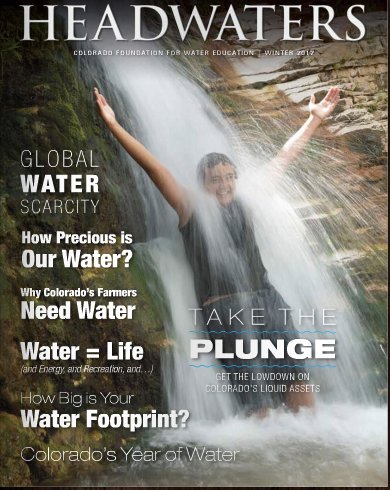
Colorado Foundation for Water Education: Winter 2012 issue of Headwaters magazine is hot off the press

headwatersmagazinewinter2012

Click here to read the issue online. Click here to find out how to order your own copy.

More Colorado Foundation for Water Education coverage here.

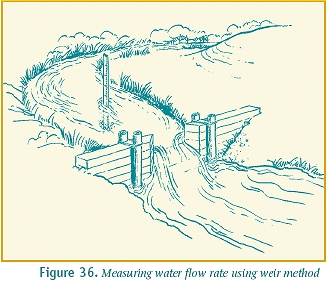
DARCA Tenth Annual Convention – Are Your Water Rights in Jeopardy?

measuringwithweir.jpg

From email from the Ditch and Reservoir Company Association (John McKenzie):

We are only two weeks away from the start of our Tenth Annual Convention – Are Your Water Rights in Jeopardy? – It will take place from February 23-24, 2012, at the DoubleTree Hotel in Colorado Springs. We have compiled our largest list of speakers yet. Thirty-three speakers will discuss their views on timely subjects facing ditch and reservoir companies. The presentations will include topics on the recent United/FRICO change case, administrative issues, and keeping the next generation on the farm. Colorado Supreme Court Justice Gregory J. Hobbs will address the ditch and reservoir group on “Prior Appropriation: Does it Still Meet Changing Needs?” We are trying a new format this year and will be having three concurrent workshops on the morning of Friday, the 24th. The workshops are: What Directors and Officers Need to Know; Water Quality and Stormwater Issues; and Managing the Ditch Company. A complete agenda is available on the front page of the DARCA website.

You may be interested in attending the pre-convention workshop, Is Your Great-Grandpa’s Dam Ready for the 21st Century, on Wednesday, February 22, from 9:00 a.m. to 4:00 p.m. Please check out the great list of speakers at the DARCA website…

If you need to register you may visit www.darca.org to download a registration form or you may register on-line. You can always call, fax, or email me to register.

It will be good for us ditch people to get together and see what we have all been up to. Look forward to seeing all of you.

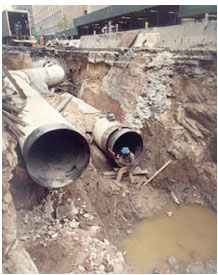
EPA: Water and sewer infrastructure needs tally at $300 billion

supplyconstruction.jpg

From the Associated Press via The Washington Post:

“EPA found that the nation’s 53,000 community water systems and 21,400 not-for-profit, non-community water systems will need to invest an estimated $334.8 billion between 2007 and 2027,” stated the federal Drinking Water Infrastructure Needs Survey and Assessment, which is updated every four years…

“This is a very serious concern,” said Carolyn Berndt of the National League of Cities. “Many communities have a long-term plan to replace all their underground water infrastructure, but even if they do a couple percentages of pipes a year, it’s still going to take over 100 years for some of them to replace it all.”

Snowpack news: It’s probably too late in the season for the snowpack to recover

snowpackcolorado02092012

From Steamboat Today (Tom Ross):

The latest basin outlook report from the Natural Resources Conservation Service in Lakewood relies on its surveys of the amount of water stored in the snowpack in the combined Yampa, White, North Platte and Laramie river basins, combined with historical data and current weather trends, to conclude there’s only a small chance that the water carried in those river systems this summer will reach average.

“Based on historical data there is a less than 10 percent chance that the snowpacks in these basins will recover to average conditions by the end of the season,” the report issued by state conservationist Phyllis Ann Phillips concluded. “April to July runoff is expected to be well below average at all forecast points except for the Laramie River near Woods Landing, which is expected to be 85 percent of average.”

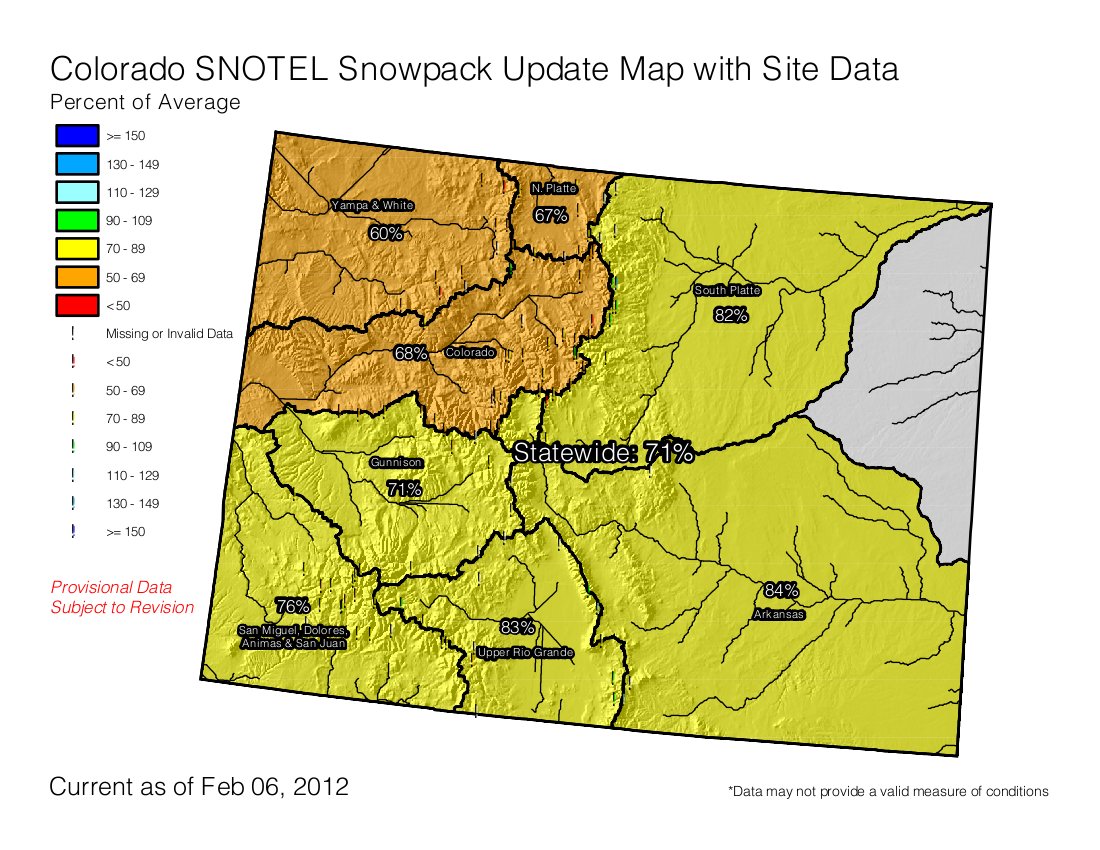
It went on to say, “A closer look reveals that the Yampa and White river basins are faring a bit worse than the combined basins. These basins measure just 60 percent of average (snowpack) on Feb. 1 while the North Platte and Little Snake basins reported 69 and 67 percent, respectively.”[…]

If there is a bright spot in the snowpack outlook, it’s that area reservoirs contain 120 percent of average water storage. The Web page of the Upper Yampa Water Conservancy District shows the water level elevation at Stagecoach Reservoir is currently 7,197 feet, compared to 7,204 feet when the reservoir is full. District Manager Kevin McBride said the positive condition of water storage at Stagecoach is attributable to the strong water year of 2011 that still was adding to the reservoir in autumn. The reservoir’s recently expanded storage capacity also is helping. The district added to the height of the dam and filled the expanded reservoir for the first time last year. This week’s level is 7 feet below full but only 3 feet below the old capacity. “It’s still an open question whether we’ll fill, but we could easily fill with 50 percent” of average snowpack, McBride said. “And we’re very close right now to having the water needed to meet our contract obligations. That’s because of the raise” in capacity.

Crawford: Public Works requests water and sewer rate increases

fountainpavementdrawing.jpg

From the Delta County Independent (Kathy Browning):

The Crawford public works department announced at the Feb. 1 council meeting the town needs a utilities increase totaling $6 a month. If approved, the rate increase would begin in April. The total breaks down to a $2.50 rate increase on the monthly water bill and a $3.50 increase on the monthly sewer bill…

Of the $2.50 water increase, $2 would be reserved for capital improvement and infrastructure needs. That would mean $6,400 would be set aside per year for long term needs and $1,600 a year to counter inflation. The current inflation rate is 3.87 percent.

On the sewer side, $1.50 of the increase would be for future capital improvement and infrastructure needs. That will total $4,824 per year for long term needs and nearly $6,700 a year for current fund shortfalls and inflation…

The Town of Crawford will have a public hearing on the proposed water and sewer monthly rate increases on Wednesday, March 7, at 7 p.m. Public comment is welcome.

More infrastructure coverage here.

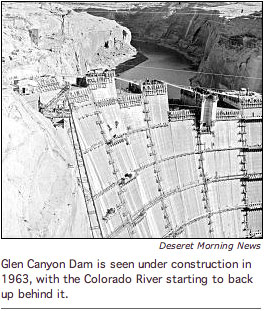
U.S. House of Representatives Water and Power Subcommittee: Water Storage Vital to Rural Communities, Job Creation, Economic Growth

glencanyondamconst.jpg

From The Durango Herald (Kelcie Pegher):

The Water and Power Subcommittee spoke Tuesday with constituents from the West to decide whether removing government regulations on water-storage infrastructure would be helpful.

U.S. Rep. Scott Tipton…used the example of the Grand Mesa Water Conservancy District, which serves Delta County. The board of directors from the district made plans to rehabilitate breached reservoirs in the fall of 2008. They found various regulations stopped their construction, and it has still not been completed. Tipton also made the point that water is being directed in urban districts. He says it leaves rural areas of the West “dried up in terms of farms to feed the people that choose to live in those cities.”[…]

Dan Crabtree from the Durango office of the Bureau of Reclamation said the Animas-La Plata Project’s dam will likely be the last it builds. They are in the business of mostly municipal water, as well as rehabilitating existing dams…

Bill Midcap, the director of the Renewable Energy Center at the Rock Mountain Farmers Union, said his concern is in repairing existing infrastructure as opposed to building new dams and reservoirs.

More infrastructure coverage here.

Jennifer Pitt (Environmental Defense Fund): ‘That a study of the future of the Colorado should include the health of the river itself might seem obvious’

coloradoriverbasin.jpg

From National Geographic Water Currents (Jennifer Pitt):

The federal Bureau of Reclamation has started working with the seven states in the basin (AZ, CA, CO, NM, NV, UT and WY) to study the future of supply and demand on the Colorado, and to search for solutions that fill the ‘gap’ between them, as illustrated in the right hand side of the graph above. Stay tuned for great debates about the merits of cloud seeding versus conservation, and desalinization versus re-use.

But what strikes me as most promising is the commitment from Reclamation and the states to consider the health of the basin’s rivers. Their latest report discusses how they will assess the future status of ecosystem health, by looking at projected conditions for endangered species, river-based wildlife refuges, and even for a host of freshwater and riparian habitats on the mainstem and major tributaries…

That a study of the future of the Colorado should include the health of the river itself might seem obvious. Yet the vast system of pipes and canals we’ve built from the top to the bottom of this basin point to the Colorado’s central importance as a water supply to the arid Southwest, and too often we overlook the river itself.

More Colorado River basin coverage here.

COGCC: Water use for hydraulic fracturing expected to increase from 4.5 billion gallons now to 6 billion gallons in 2015

hydraulicfracturingrulisonhaliburtonap04152009

From E&E Publishing (Tasha Eichenseher):

In what many are calling the first attempt to document how much water is required for hydraulic fracturing in the Centennial State, the Colorado Oil and Gas Conservation Commission (COGCC) released a fact sheet late last month that projected a 35 percent increase from 2010 to 2015 in water use for oil and gas exploration and production. Water demand for hydraulic fracturing in the state is expected to increase from roughly 4.5 billion gallons in 2010 to more than 6 billion gallons in 2015, a jump that could supply more than 160,000 people with domestic water for a year…

The amount of water used depends on the geology of the region and whether wells are drilled horizontally or vertically, according to the COGCC. Horizontal wells require more, as do shale formations located deep underground. COGCC estimates that between 2010 and 2015, barring any major economic, environmental or technological changes, the number of active oil and gas wells in Colorado is likely to remain steady, with much of the expected 1.5-billion-gallon increase in water use linked to an expected swing from vertical oil drilling to new horizontal technologies…

Jon Monson, director of the water and sewer department in Greeley — the Weld County seat — said citizens have expressed concern about the tanker truck water withdrawals. But Greeley, like many Colorado cities, has accumulated surplus water rights over time in an effort to meet its long-term needs and stave off the potential impacts of a temporary shortage. Last year was an “epic water year,” he said, leaving the city plenty of extra to sell. “Once you start explaining it is an annual surplus, and we are not committing to these people long-term,” there is a bit of an attitude change, he said. Last year, Greeley leased $1.5 million worth of water, or around 326 million gallons, primarily to oil and gas companies, as well as almost 9.8 billion gallons to neighboring farms. But the city makes more from the oil and gas deals because the water it sells to those operations is treated and therefore more expensive, according to Monson. The water surplus “can make money for the citizens of Greeley,” he pointed out…

According to COGCC numbers, hydraulic fracturing represented just 0.08 percent of all water used in Colorado in 2010. Hydraulic fracturing used less water than agriculture, municipalities, industry, recreation or thermoelectric power generation. The biggest user of water in Colorado, and the United States in general, is agriculture, usually accounting for up to 70 percent of water consumption. According to the COGCC, farming, ranching and other agricultural operations accounted for more than 4.6 trillion gallons, or 85.5 percent, of Colorado water use in 2010. Municipal and industrial uses combined accounted for about 397 billion gallons, or 7.4 percent.

More oil and gas coverage here and here.

2012 Southern Rocky Mountain Agricultural Conference and Trade Fair recap: Groundwater subdistrict one was on everyone’s mind

slvdischargerecharge.jpg

From The Valley Courier (Lauren Krizansky):

The management plan’s purpose is to recharge the Valley’s aquifer, and one way to fill it back up is to stop taking water out. The RGWCD Subdistrict 1 is offering a tiered district fallowing program to persuade water users to do just that.

Water users qualify for the program if they have a three-year average of 50 percent reduced pumped groundwater. Contract prices for the 2012 irrigation begin at $300 an irrigated acre for zero groundwater use, $200 an irrigated acre for up to six inches of groundwater use and $100 an irrigated acre for up to 10 inches. The program is not offering incentives for more than 10 inches.

The deadline for fallow acreage bids is Wed., Feb. 15, but the board could extend the deadline if interest grows.

RGWCD Manager Mike Mitchell said that the program is calling for a significant irrigation reduction.

“Twenty-four inches is what is used on the common crops,” Mitchell said. “The whole focus of this is to see how much we can save.”

More San Luis Valley groundwater coverage here and here.

Snowpack news: Statewide snowpack at 72% of average, Colorado River basin — 68%

snowpackcolorado02092012

From the Summit County Citizens Voice (Bob Berwyn):

Despite above-average January snowfall in a few localized spots in Colorado, the state’s snowpack recovered only slightly from the early winter snow drought, reaching just 72 percent of normal (and 62 percent of last year’s reading) as of Feb. 1.

The low readings were most evident in the Yampa and White river basins, where the combined snowpack was only 60 percent of average. Forecasts for spring and summer water supplies in these basins reflect the below average snowpack. Reservoir storage across the state continues to remain in good condition which should help ease potential shortages this season…

The Arkansas basin was at 81 percent of average on February 1 down from 94 percent at the beginning of January. The greatest decrease was measured in the Upper Rio Grande basin, where the snowpack dropped 15 percent from the Jan. 1 reading.

Union Pacific Railroad Company to pay $1.5 million for Clean Water Act violations in Colorado, Utah and Wyoming

unionpacificunit4065

Here’s the release from the Environmental Protection Agency (Donna Inman/Matthew Allen):

The U.S. Environmental Protection Agency today announced a settlement with Union Pacific Railroad Company regarding alleged violations of the Clean Water Act and the Oil Pollution Act.

This settlement resolves a Clean Water Act enforcement action against Union Pacific that involves continuing operations at 20 rail yards in Colorado, Utah, and Wyoming, as well as spills of oil and coal in 2003 and 2004 along railroad lines in all three states.

For the railyards, EPA alleges Union Pacific violated EPA’s Spill Prevention, Control, and Countermeasure (SPCC) and Facility Response Plan (FRP) regulations. These regulations are the first line of defense for preventing oil spills and providing immediate containment measures when an oil spill does occur.

“Today we have secured a settlement that will help prevent spills, protect water quality, and improve the safety of Union Pacific’s operations in 20 communities across Colorado, Utah, and Wyoming,” said Jim Martin, EPA regional administrator. “Union Pacific has already begun putting necessary measures in place and we will ensure they continue to do so.”

As part of the settlement, Union Pacific will pay a civil penalty of $1.5 million of which approximately $1.4 million will be deposited into the Oil Spill Liability Trust Fund, a fund used by federal agencies to respond to oil spills. The remaining $100,000 will be deposited in the U.S. Treasury for the coal spills and stormwater violations. In addition, the settlement requires the company to develop a management and reporting system to ensure compliance with SPCC regulations, FRP regulations, and storm water requirements at 20 rail yards in Colorado, Utah and Wyoming. Union Pacific must take further actions to control stormwater runoff at the Burnham Rail Yard in Denver, which are anticipated to prevent the discharge of approximately 2,500 pounds of chemical oxygen demand, 50 pounds of nitrate, 11,000 pounds of total suspended solids, and 30 pounds of zinc annually to waters in the Denver area.

This settlement will benefit many communities in Colorado, Utah, and Wyoming, many of which are disadvantaged, by requiring Union Pacific to install secondary containment to safely store oil and prevent oil spills from leaving its properties. Further, it will require the company to designate an environmental vice-president responsible for complying with oil spill prevention and stormwater control requirements at the 20 railyards. The majority of the 20 locations cited in the settlement are in disadvantaged areas with significant low-income and/ or minority populations.

The complaint alleges the following violations:

· Six oil spills in Colorado, Utah, and Wyoming
· Three coal spills in Colorado
· Inadequate SPCC plans and/or inadequate SPCC plan implementation (e.g., inadequate secondary containment) at the following 20 rail yards:

o Denver 36th Street, Burnham, Denver North, East Portal Moffatt Tunnel, Grand Junction, Kremmling, Pueblo, and Rifle, all in Colorado
o Helper, Ogden, Provo, Roper, Salt Lake City North, and Summit, all in Utah

§ Also for six rail yards in Utah, failure to provide certifications and reports for storm water pollution prevention plans (SWPPPs) as required by the Utah Multi-Sector General Permit.

o Bill, Buford, Cheyenne, Green River, Laramie, and Rawlins, all in Wyoming

§ Also for the Rawlins, Wyoming rail yard, an inadequate FRP and a failed Government Initiated Unannounced Exercise

More Environmental Protection Agency coverage here and here.

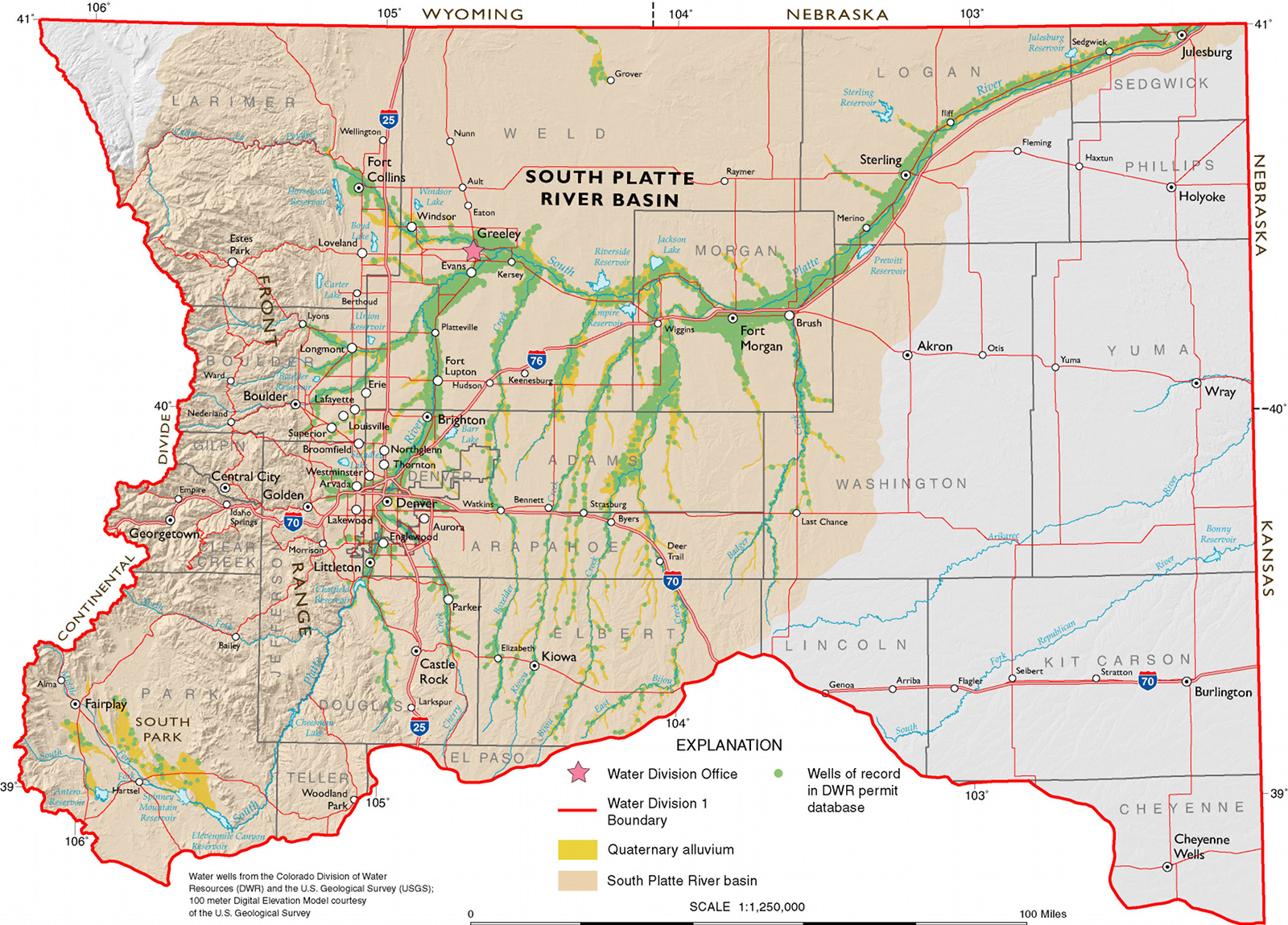
Water 2012: Logan County Historical Society presentation about the history of water in Colorado February 13

southplatteriverbasincgs.jpg

From the Sterling Journal-Advocate:

At its regular meeting on Feb. 13, the Logan County Historical Society will have a presentation on the history of water in Colorado. Jim Yahn, PE, manager of the North Sterling and Prewitt reservoirs, will present information on this important issue of water in Colorado, especially the South Platte Basin…

Municipal water use in the South Platte Basin in now about 25 percent of the total available and rising. Chief Colorado Supreme Court Justice Gregory Hobbs believes Colorado has done a remarkable job of setting water priorities and allocating the finite resource. He sees the current laws as being the best way to appropriate water to its different uses.

University of Wyoming legal scholar Larry MacDonnell disagrees. He believes the resources of the Colorado River are being squandered and advocates moving more agriculture water to urban areas.

Yahn says the large metropolitan areas of the South Platte are working very hard and expending a lot of money to conserve and otherwise make good use of the water they get. But the reality, according to Jim and other water experts, is that the population of the South Platte Basin is going to increase dramatically in the next 25 years and they will have to get more water. Conservation and high prices alone won’t do the job…

The LCHS meeting will be at 7 p.m., Monday, Feb. 13, at the Church of the Nazarene, 1600 Sidney Ave., Sterling Colorado. The meeting is open to the public.

More Colorado Water 2012 coverage here. More South Platte River basin coverage here.

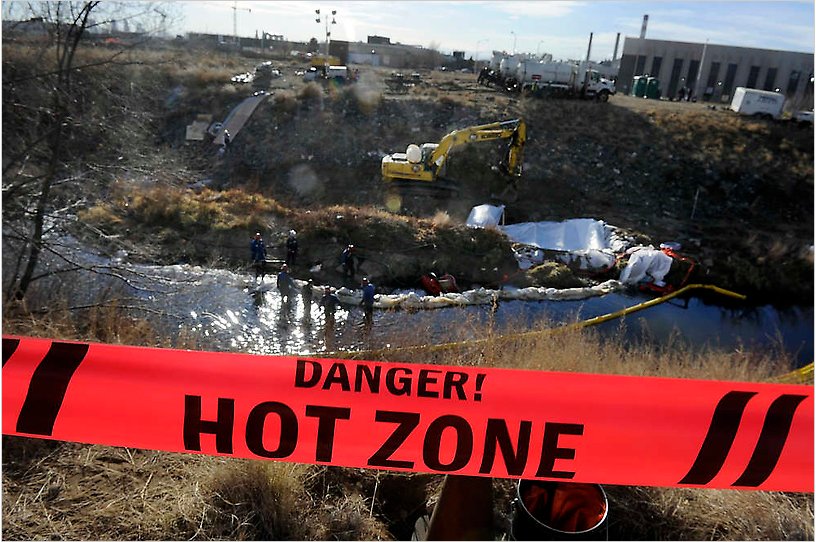
Sand Creek: Suncor spill may have started a year ago

suncorcleanupsandcreek.jpg

From CBSDenver.com:

“Our focus right now is to try to contain it onto Suncor’s property,” [Robert Beierle with the Colorado Department of Health and Environment] said. The health department says they were notified of the problem’s start last February. “Of the pipeline that failed pressure testing, which was thought to be probably the source or one of the sources of this material we’re migrating off site right now,” Beierle said. “It’s the only source were aware of and it’s certainly in their best interest to stop it on their property.”

Suncor hasn’t confirmed where the gasoline-like leak began but is cooperating with all aspects of the clean-up, according the health department. Once the trench is complete the Canadian-based energy company will then move back onto their property to install a second trench.

Suncor says they do not believe there is any leak at this time.

More coverage from Carlos Illescas writing for The Denver Post. From the article:

Suncor Energy crews are working on a collector trench on property owned by Metro Wastewater, trying to stop the black gunk flowing from under its refinery north of Denver from reaching Burlington Ditch, Sand Creek and the South Platte River. An access agreement was reached last week, and Suncor started work on the trench Monday, said Suncor’s vice president for refining, John Gallagher. The goal, Gallagher said, is to prevent more petroleum-based contaminants from reaching the Metro Wastewater Reclamation District’s property, which is adjacent to the refinery and the waterways…

Gallagher said the trench should be completed by the end of the month. The company also is working to complete an underground clay wall at the refinery to block toxic material from leaving the Suncor property, which has been home to oil-refining activities since the 1930s. “We’ll do everything we can to make this situation right,” Gallagher said Tuesday.

More oil and gas coverage here and here.

Aspinall Unit operations update: Flows in the Black Canyon around 600 cfs, forecasted inflows to Blue Mesa — 450,000 acre-feet

aspinallunitdescription.jpg

From email from Reclamation (Erik Knight):

The February 1st forecast is out and the prediction is still for 450,000 acre-feet of inflow to Blue Mesa Reservoir during the April-July runoff period. This represents 67% of the current 30 year average. In response to the continuing dry conditions, releases at Crystal Dam will be reduced by 200 cfs on Wednesday, February 8th. This will bring releases down to 600 cfs and with no Gunnison Tunnel diversions, flows in the Gunnison River through the Black Canyon should also be around 600 cfs.

More Aspinall Unit coverage here.

Colorado Water 2012: Check out Your Colorado Water Blog for a primer explaining what a water footprint is and how to calculate yours

waterfootprint.jpg

Here’s the link to their post, What’s Your Water Footprint?. Click through and read the whole post and then take part in the conversation in the comments. Here’s an excerpt:

Calculate your water footprint using National Geographic’s personal water footprint calculator and let us know– how big is your water footprint? Are you doing anything to cut back on personal water use? Do you think about the water used to create the products you purchase? Is there anything that the state of Colorado or your utility should be doing to make people more aware of the water we’re using?

More Colorado Water 2012 coverage here. More conservation coverage here.

CU-Boulder study shows global glaciers, ice caps shedding billions of tons of mass annually

inylchekglacierkyrgyzstancawa.jpg

Here’s the release from the University of Colorado (John Wahr/Tad Pfeffer/Jim Scott):

Earth’s glaciers and ice caps outside of the regions of Greenland and Antarctica are shedding roughly 150 billion tons of ice annually, according to a new study led by the University of Colorado Boulder.

The research effort is the first comprehensive satellite study of the contribution of the world’s melting glaciers and ice caps to global sea level rise and indicates they are adding roughly 0.4 millimeters annually, said CU-Boulder physics Professor John Wahr, who helped lead the study. The measurements are important because the melting of the world’s glaciers and ice caps, along with Greenland and Antarctica, pose the greatest threat to sea level increases in the future, Wahr said.

The researchers used satellite measurements taken with the Gravity Recovery and Climate Experiment, or GRACE, a joint effort of NASA and Germany, to calculate that the world’s glaciers and ice caps had lost about 148 billion tons, or about 39 cubic miles of ice annually from 2003 to 2010. The total does not count the mass from individual glacier and ice caps on the fringes of the Greenland and Antarctic ice sheets — roughly an additional 80 billion tons.

“This is the first time anyone has looked at all of the mass loss from all of Earth’s glaciers and ice caps with GRACE,” said Wahr. “The Earth is losing an incredible amount of ice to the oceans annually, and these new results will help us answer important questions in terms of both sea rise and how the planet’s cold regions are responding to global change.”

A paper on the subject is being published in the Feb. 9 online edition of the journal Nature. The first author, Thomas Jacob, did his research at CU-Boulder and is now at the Bureau de Recherches Géologiques et Minières, in Orléans, France. Other paper co-authors include Professor Tad Pfeffer of CU-Boulder’s Institute of Arctic and Alpine Research and Sean Swenson, a former CU-Boulder physics doctoral student who is now a researcher at the National Center for Atmospheric Research in Boulder.

“The strength of GRACE is that it sees everything in the system,” said Wahr. “Even though we don’t have the resolution to look at individual glaciers, GRACE has proven to be an exceptional tool.” Traditional estimates of Earth’s ice caps and glaciers have been made using ground-based measurements from relatively few glaciers to infer what all of the unmonitored glaciers around the world were doing, he said. Only a few hundred of the roughly 200,000 glaciers worldwide have been monitored for a decade or more.

Launched in 2002, two GRACE satellites whip around Earth in tandem 16 times a day at an altitude of about 300 miles, sensing subtle variations in Earth’s mass and gravitational pull. Separated by roughly 135 miles, the satellites measure changes in Earth’s gravity field caused by regional changes in the planet’s mass, including ice sheets, oceans and water stored in the soil and in underground aquifers.

A positive change in gravity during a satellite approach over Greenland, for example, tugs the lead GRACE satellite away from the trailing satellite, speeding it up and increasing the distance between the two. As the satellites straddle Greenland, the front satellite slows down and the trailing satellite speeds up. A sensitive ranging system allows researchers to measure the distance of the two satellites down to as small as 1 micron — about 1/100 the width of a human hair — and to calculate ice and water amounts from particular regions of interest around the globe using their gravity fields.

For the global glaciers and ice cap measurements, the study authors created separate “mascons,” large, ice-covered regions of Earth of various ovate-type shapes. Jacob and Wahr blanketed 20 regions of Earth with 175 mascons and calculated the estimated mass balance for each mascon.

The CU-led team also used GRACE data to calculate that the ice loss from both Greenland and Antarctica, including their peripheral ice caps and glaciers, was roughly 385 billion tons of ice annually. The total mass ice loss from Greenland, Antarctica and all Earth’s glaciers and ice caps from 2003 to 2010 was about 1,000 cubic miles, about eight times the water volume of Lake Erie, said Wahr.

“The total amount of ice lost to Earth’s oceans from 2003 to 2010 would cover the entire United States in about 1 and one-half feet of water,” said Wahr, also a fellow at the CU-headquartered Cooperative Institute for Research in Environmental Sciences.

The vast majority of climate scientists agree that human activities like pumping huge amounts of greenhouse gases in the atmosphere is warming the planet, an effect that is most pronounced in the polar regions.

One unexpected study result from GRACE was that the estimated ice loss from high Asia mountains — including ranges like the Himalaya, the Pamir and the Tien Shan — was only about 4 billion tons of ice annually. Some previous ground-based estimates of ice loss in the high Asia mountains have ranged up to 50 billion tons annually, Wahr said.

“The GRACE results in this region really were a surprise,” said Wahr. “One possible explanation is that previous estimates were based on measurements taken primarily from some of the lower, more accessible glaciers in Asia and were extrapolated to infer the behavior of higher glaciers. But unlike the lower glaciers, many of the high glaciers would still be too cold to lose mass even in the presence of atmospheric warming.”

“What is still not clear is how these rates of melt may increase and how rapidly glaciers may shrink in the coming decades,” said Pfeffer, also a professor in CU-Boulder’s civil, environmental and architectural engineering department. “That makes it hard to project into the future.”

According to the GRACE data, total sea level rise from all land-based ice on Earth including Greenland and Antarctica was roughly 1.5 millimeters per year annually or about 12 millimeters, or one-half inch, from 2003 to 2010, said Wahr. The sea rise amount does not include the expansion of water due to warming, which is the second key sea-rise component and is roughly equal to melt totals, he said.

“One big question is how sea level rise is going to change in this century,” said Pfeffer. “If we could understand the physics more completely and perfect numerical models to simulate all of the processes controlling sea level — especially glacier and ice sheet changes — we would have a much better means to make predictions. But we are not quite there yet.”

Water Court Division Two judge, Dennis Maes, to retire at the end of May

judgedennismaes1

From The Pueblo Chieftain (Peter Roper):

Maes sent a letter Wednesday to Colorado Supreme Court Chief Justice Michael Bender announcing his intention to retire May 31. The governor will appoint a replacement to the bench and the state’s high court will decide who will be the next chief. Maes, 66, has been a district court judge since April 1988 and the district’s chief since September 1995.

NIDIS Weekly Climate, Water and Drought Assessment Summary of the Upper Colorado River Basin

utwycoprecipitationjanuarynidis.jpg

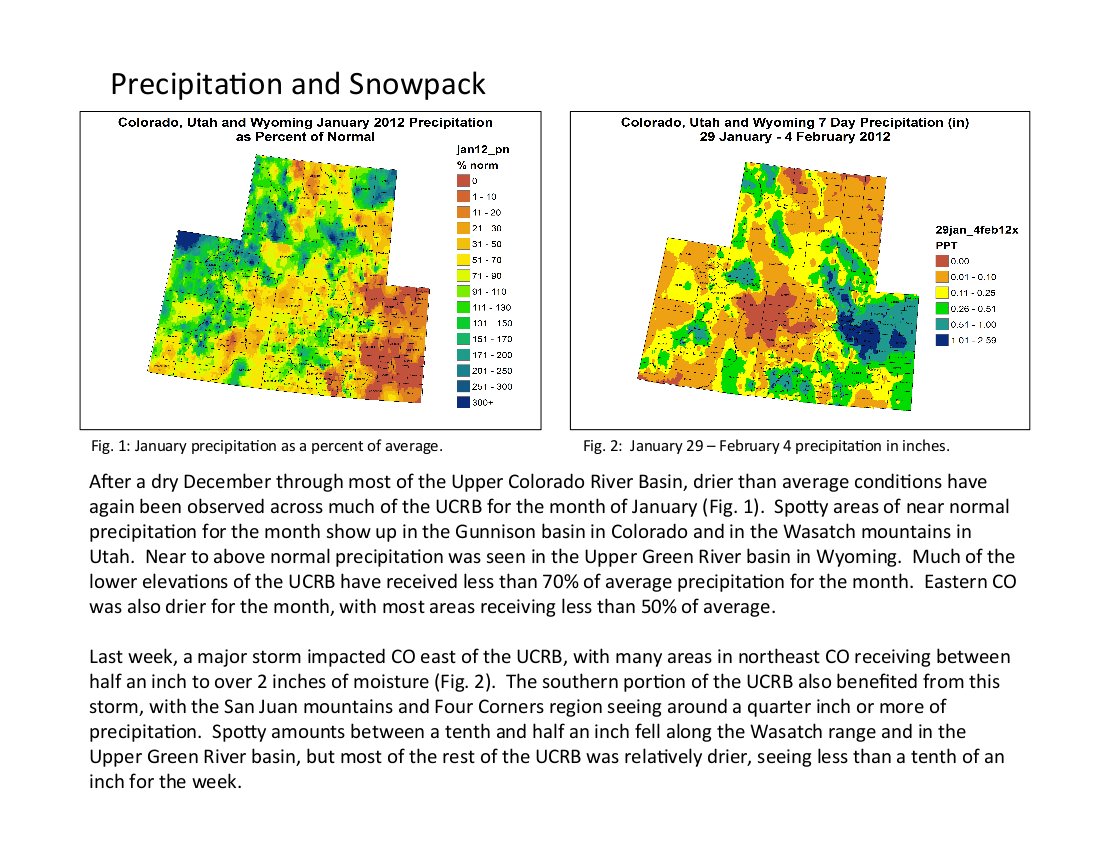
Here’s the link to yesterday’s summaries from the Colorado Climate Center. Click on the thumbnail graphic to the right for the precipitation summary.

More Colorado River basin coverage here.

Snowmass: The new Ziegler Reservoir should meet the town’s supply needs at buildout

shellfreezewalloilshale.jpg

From the Snowmass Sun (Jeanne McGovern):

“It is an expensive process to build a reservoir, but we felt it was necessary to be prepared for a full build-out of the town,” said Rhonda Bazil, vice president of the Snowmass Water & Sanitation District board of directors, during a presentation before the Snowmass Village Town Council on Feb. 6.

According to Bazil’s report, the district created three scenarios for municipal demand based on levels of development: existing municipal demand with Base Village and redevelopment, district build-out, and build-out with reserves.

With Ziegler online, the district is able to meet the third standard, which assumes as much as a 110 percent build-out that “may result from additional redevelopment and infill” within the district.

More Roaring Fork River watershed coverage here.

Former Gov. Ritter, Environmental Scientists to Participate in CSU Water Cafe on Thursday, Feb. 9

shellfreezewalloilshale.jpg

Here’s the release from Colorado State University (Emily Narvaes Wilmsen):

Water is one natural resource that will be at the forefront of defining a healthy future. Recognizing the importance of dialog and planning on this topic, the Colorado State University Water Center and the School of Global Environmental Sustainability will host the CSU Water Café, starting with a panel on Thursday, Feb. 9, featuring former Gov. Bill Ritter and a host of environmental experts at CSU.

Water Café is an interdisciplinary, interactive series designed to examine critical water issues and the University’s roles in their solutions. The first event on Thursday will feature an interdisciplinary panel discussing water and energy from 1-3:30 p.m. in the Lory Student Center Senate Chambers.

Members of the panel include:

• Former Gov. Ritter, now director of the Center for the New Energy Economy
• Ken Carlson, co-coordinator, Colorado Water Energy Consortium, Department of Civil and Environmental Engineering
• John Labadie, professor, Department of Civil and Environmental Engineering
• Sally Sutton, department head, Department of Geosciences.
• James Pritchett, department of Agricultural and Resource Economics.
• Mark Paschke, Shell Endowed Chair in Restoration Ecology, Department of Forest and Rangeland Stewardship

The panel will be moderated by Neil Grigg, a professor in the Department of Civil and Environmental Engineering. Water Café sessions will create synergy among the greater CSU community with faculty groups working on topics related to water and sustainability issues to identify opportunities for university advancement in research, student activities, and outreach.

“People who follow the news know that energy is a critical issue, but they might not connect the dots on the importance of water in generating energy or how energy use can impact water resources,” Grigg said. “Water and energy are bound together, and we will be developing a research strategy to help the nation solve the puzzle.”

The next Water Café is planned for Feb. 29 from 1-5 p.m. in the Lory Student Center Senate Chambers. The session, titled “Exploring Sustainability in Our Own Backyard: The Cache la Poudre Watershed,” will feature two panel discussions, one focused on community stakeholders and another on CSU’s role in advancing water research and conservation in Northern Colorado.

Two additional Water Café sessions are planned for Spring 2012 in March and April and will focus on water issues surrounding sustainability and food. For complete details on upcoming Water Cafés, go to http://sustainability.colostate.edu.

More energy policy coverage here and here.

Colorado Water 2012: Craig Cotten — ‘The Rio Grande Compact is the agreement, signed in 1939, that provides for the equitable apportionment of the waters of the Rio Grande between Colorado, New Mexico, and Texas’

riograndebasin100thmeridianorg.jpg

Here’s this week’s installment of the Colorado Water 2012 series from the Valley Courier. Craig Cotten (Division Engineer and Colorado’s Engineer Adviser to the Rio Grande Compact Commission) explains the Rio Grande River Compact:

The Rio Grande Compact is the agreement, signed in 1939, that provides for the equitable apportionment of the waters of the Rio Grande between Colorado, New Mexico, and Texas. During the late 1800’s and early 1900’s, much of the flow of the Rio Grande began to be diverted for irrigation in the upper part of the Rio Grande Basin, which caused concern to the downstream states. The Compact was necessary to fairly allocate the flows of the Rio Grande between the three states. It provides the framework for a fair allocation and use of water in the Rio Grande and its tributaries from year to year.

The delivery obligations set forth in the Compact were based upon a study of the Rio Grande during 1927 through 1936. Engineers studied the amount of water used by each state and developed a schedule of required delivery for Colorado and for New Mexico dependent on the total yearly flow in the river. The engineers also developed a limit on the yearly amount of water that Texas could use from the upper Rio Grande. These limitations allow each state to develop its water resources at will, subject only to its obligations as set forth in the Compact. In essence, the compact limits all three states’ use of water from the Rio Grande to approximately what they were using in the 1920’s.

The Compact requires Colorado to annually deliver a certain amount of water to the state line according to its delivery schedules. Colorado has a separate delivery schedule for the Rio Grande and for the Conejos River. Snowpack, rainfall, and the delivery schedules control the annual amount of water available to Colorado diverters. In any given year, from 20 to 60 percent of the water generated in the Rio Grande and Conejos River basins needs to flow to the downstream states. In a low water year, Colorado can use a higher percentage of the water, but in a high water year, Colorado must send a larger percentage to the downstream states.

It is important to note that Colorado does not have to strictly adhere to the Compact’s delivery schedules each year. The Compact allows for a system of credits and debits. This credit and debit accounting provision of the compact provides Colorado with some flexibility in managing water use from year to year.

Since 1939, the administration of the Rio Grande Compact in Colorado has been an evolutionary process marked by three distinct periods. The first period from 1939-1967 was a time when water rights were administered as they had been during the study period of 1927 to 1936. This administration worked well until 1952 when Colorado began to under-deliver on its obligations. By the mid 1960’s, Colorado’s debt to the downstream states exceeded 900,000 acre-feet. In 1966, the states of Texas and New Mexico sued Colorado in the U.S. Supreme Court to force Colorado to comply with the provisions of the Compact and to pay back the debt. In May of 1968, the Court granted a continuance of the case as long as Colorado met its Compact delivery obligation each and every year.

During the second period, from 1968 to 1985, Colorado administered the compact pursuant to that stipulation and was forced to begin curtailing water rights, i.e. shutting off ditches, specifically to meet the compact obligations. From approximately 1968 to the present, the Colorado State Engineer has directed that the Compact be administered as a two-river system (Rio Grande and Conejos) with each river responsible for its own delivery obligation. The State Engineer also directed that any curtailment of diversions would come from the junior water rights which would have otherwise been in priority on any given day of administration. Colorado met or exceeded its obligation each year from 1968 through 1984 because of the directive of the U.S. Supreme Court.

The third and current period began in June of 1985, when Elephant Butte Reservoir in Southern New Mexico spilled and eliminated Colorado’s remaining debt. The lawsuit against Colorado was dismissed, and since that time Colorado has operated in accordance with the Compact and has met or exceeded its obligation.

Although some believe that the compact causes too big of a burden to Colorado water users, it actually protects us and our water. Large cities downstream of us such as Albuquerque, El Paso, and Juarez are actively searching for more water. The downstream states also are always looking for more water to ease their endangered species, Indian water rights, and environmental issues. The compact offers a legal defense to these demands that Colorado send more water to quench the ever-growing thirst of the downstream states.

More Colorado Water 2012 coverage here.

The January 2012 Colorado River District news summary is hot off the press

coloradoriverbasinusgs.jpg

You can download the document here. Thanks to Jim Pokrandt for sending it along in email. Here’s an excerpt:

General Manger Eric Kuhn has authored a paper that outlines risk-management issues associated with the growing use of water in the Colorado River Basin.

It is called “Risk Management Strategies for the Upper Colorado River Basin.”

It can be downloaded from the CRD website or obtained by calling (970) 945-8522 or e-mailing edinfo@crwcd.org.

Kuhn lays out the risks lurking in the shadows as demands on the river exceed supply. He explores strategies to minimize the risk of a Colorado River Compact curtailment of the states of the Upper Basin, which are Colorado, Wyoming, Utah and New Mexico.

Also in the paper, Kuhn addresses new storage projects, re-operation of current projects and litigation as strategies to manage risk. He also advocates for a water bank and conservation as hedging tools.

Looking ahead, Kuhn says new agreements could reduce risk, and that the most effective ones would be the most controversial.

At the top of that list is the idea of interstate water marketing, allowing market mechanisms to address regional shortages and the movement of water.

Kuhn also suggests that the Upper Basin states be allowed to store conserved water in Lake Powell as a water bank.

He advocates that dust control, phreatophyte eradication and cloud seeding should be maintained and better financed.

Additionally, he discounts the value of the desalina- tion of ocean water as a big water-supply generator and says it is unlikely that a big project will be built that would move water from another part of the country, like the Mississippi River, to the southwestern U.S.

More Colorado River basin coverage here.

Snowpack news: Yampa & White basins are at 59% of average, Arkansas basin still on top — 85%

snowpackcolorado02072012

From The Denver Post:

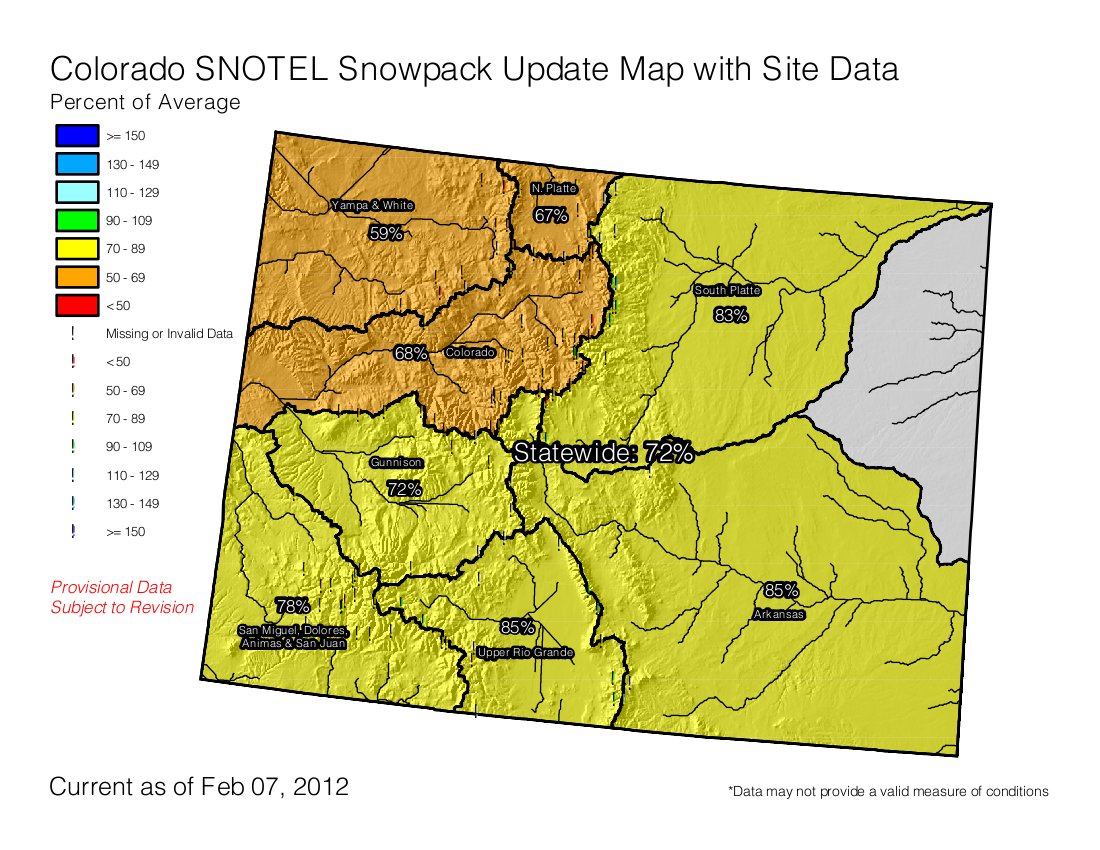
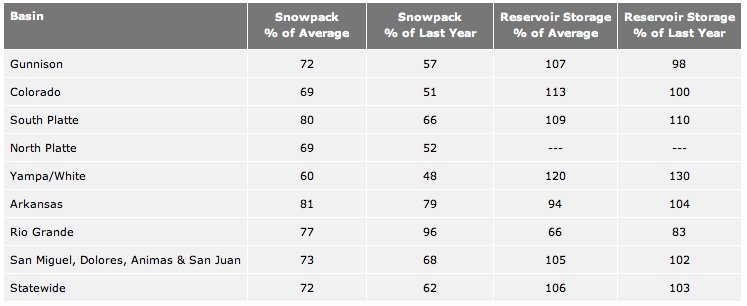
According to the National Resources Conservation Service Feb. 1 report, snowpack statewide was 72 percent of average and 62 percent of the reading taken Feb. 1, 2011. State conservationist Phyllis Phillips said the Pacific jet stream has shifted south and by the middle of January was delivering much needed precipitation to southern Wyoming and northern and central Colorado…

The Arkansas basin was at 81 percent of average on Feb. 1, down from 94 percent at the beginning of January. The greatest decrease was measured in the Upper Rio Grande basin where snowpack was down 15 percentage points from Jan. 1 to 77 percent of average.

January storms boosted the snowpack in west central Colorado. As of Feb. 1, both the Gunnison and Colorado basins snowpack percentages increased by 9 percentage points from where they were on Jan. 1. The Yampa, White, and North Platte basins did not gain much during these storms. The basins are reporting nearly the same snowpack percentage as last month: 65 percent of average as of Feb. 1…

The South Platte basin, which provides much of the water to the Front Range and eastern plains, was at 80 percent of average and 66 percent of last year. The Colorado was at 69 percent of average and 51 percent of the snowpack logged this time last year.

From the Summit County Citizens Voice (Bob Berwyn):

The low readings were most evident in the Yampa and White river basins, where the combined snowpack was only 60 percent of average. Forecasts for spring and summer water supplies in these basins reflect the below average snowpack. Reservoir storage across the state continues to remain in good condition which should help ease potential shortages this season.

The Pacific jet stream did start to shift southward in January,passing over southern Wyoming and northern and central Colorado by mid-month and bringing much needed precipitation to basins west of the Continental Divide.

The pattern reversed from earlier in the season, with basins east of the Divide reporting little snowfall during this period. The most recent storm in early February did help boost snowpack in the Arkansas and South Platte basins to more than 80 percent of average,.

With typical La Nina precipitation and snowfall patterns returning to Colorado in January, the southern and southeastern basins saw significant decreases in their snowpack’s after a stellar start to the season.

The Arkansas basin was at 81 percent of average on February 1 down from 94 percent at the beginning of January. The greatest decrease was measured in the Upper Rio Grande basin, where the snowpack dropped 15 percent from the Jan. 1 reading.

Water Storage Vital to Rural Communities, Job Creation, Economic Growth

mcpheereservoiroverlook.jpg

Here’s the release from the U.S. House of Representatives Natural Resources Committee:

The House Natural Resources Subcommittee on Water and Power held an oversight hearing today on “Water for Our Future and Job Creation: Examining Regulatory and Bureaucratic Barriers to New Surface Storage Infrastructure.” The hearing highlighted the regulatory burdens that hinder vital water storage improvement projects that help create jobs, increase agriculture production, generate hydropower and grow the economy and common sense ways to overcome those hurdles.
Cumbersome environmental regulations have delayed critical water storage projects for years while urban growth, environmental litigation and age strain current water storage infrastructure. Rural communities, ranches and family farms across the country are dependent on a dependable water supply, which is directly linked to storage capacity. Current and new dams and reservoirs provides affordable emission-free electricity to millions of Americans, supports the livelihoods of hundreds of thousands hard-working families and protects America’s food security.

The Bureau of Reclamation (BOR) has built more than 600 dams over the last century, however over 66% of their facilities were constructed over 50 years ago. A recent BOR study found nearly one hundred potential sites for new surface storage, yet due to environmental regulations and other factors it has been over a generation since BOR built multiple large scale water storage facilities.

“Regulations and associated litigation have hijacked these projects, to the point where their very purposes have been compromised and the construction of new water storage to continue to meet the needs of these regions is nearly impossible to achieve,” said Natural Resources Committee Chairman Doc Hastings. “Water users throughout the West have been forced to stand by and watch powerlessly as increasingly burdensome federal rules based on questionable science and never-ending litigation makes it more and more difficult to continue to receive the water they need.”

“The legendary multi-purpose dams and reservoirs of the last generation turned deserts into farmlands, created vast new recreational areas, tamed the environmentally devastating cycle of floods and droughts, and produced clean and abundant hydropower that provided a foundation for unprecedented prosperity throughout the western United States,” said Subcommittee Chairman Tom McClintock (CA-04). “This hearing will explore the bureaucratic obstacles that federal agencies have placed in the way of water development. Congress must make a concerted effort to identify and remove these obstacles that lead to increasingly expensive water and power and affect our prosperity as a nation.”

“Prudent water storage can help aid agriculture, residential use, recreation, hydropower production and environmental protection. Water storage is a precursor for multiple use water management in arid regions such as Colorado’s third Congressional district,” said Rep. Scott Tipton (CO-03). “I am hopeful that this hearing will be a productive step in highlighting some of the shortcomings of the existing water storage regulatory framework, and how it can be streamlined to better support jobs and communities that depend on the availability of water.”

“I commend the Subcommittee for holding this hearing to address water storage concerns. In my district water is a vital resource to our livelihoods, and we must ensure we have a reliable storage and conveyance system in place in order to spur job growth. I introduced bi-partisan legislation, H.R. 1604, to eliminate duplicative environmental regulations in California and alleviate burdensome policies restricting job creation,” said Rep. Jeff Denham (CA-19).

“Reducing the burdensome regulations that the federal government has imposed is critical to the vitality of our nation. The American people continue to be strapped by the bureaucratic layers of protocols and hindrances that continue to skyrocket our federal deficit,” Congressman Raúl Labrador (ID-01) said.

Mr. Pat O’Toole, President of Family Farm Alliance, who represents family farmers, ranchers, irrigation districts, and allied industries in seventeen Western states, testified about the importance of increased storage to agriculture and food security. “There must be more water stored and available to farms and cities. Maintaining the status quo simply isn’t sustainable in the face of unstoppable population growth, diminishing snow pack, increased water consumption to support domestic energy, and increased environmental demands,” said O’Toole. “If we don’t find a way to restore water supply reliability for irrigated agriculture…our country’s ability to feed and clothe itself and the world will be jeopardized.”

The Committee also heard testimony from Mr. Thad Bettner, Clenn-Coulsa Irrigation District; Mr. Norm Semanko, Idaho Water Users Association.

More infrastructure coverage here.

2012 Colorado legislation: SB12-107 would regulate hydraulic fracturing near superfund sites and formations containing radioactive materials

coloradocapitolfront.jpg

From the Fort Collins Coloradoan (Bobby Magill):

State Sen. Morgan Carroll, D-Aurora, is sponsoring the “Water Rights Protection Act,” which, if passed, could affect future oil and gas drilling and hydraulic fracturing in eastern Larimer County where there are underground uranium deposits…

Carroll’s bill, sponsored in the House by Rep. Roger Wilson, D-Glenwood Springs, seeks to require the state to write new rules that would regulate fracking near federal Superfund sites and sites containing radioactive materials.

Energy companies would be required to report to the state how much water they plan to use to frack a specific well and submit water quality reports for all water wells within a half mile of a fracked oil well.

The bill would prohibit fracking within a half mile of any surface water unless the driller keeps all the fracking fluid contained within a “closed-loop” system, which would prevent the fluid from escaping into the environment.

Energy companies would also be held responsible for any water pollution that occurs within a half mile of a well and its bottom-hole if that pollution occurred within six months of drilling…

She said the bill, primarily written to address issues with fracking near unexploded munitions and places where depleted uranium was stored at the former Lowry Bombing and Gunnery Range in Aurora, would apply to areas with uranium deposits, possibly including Powertech’s Centennial Project site between Wellington and Nunn.

More oil and gas coverage here and here.

Laramie: State legislator wants the state to buy 11,000 acres over the aquifer that waters the city

laramiewyomingforeignpolicyblog.jpg

From the Associated Press (Ben Neary) via the Wisconsin Rapids Tribune:

Nonetheless, Wyoming Water Development Commission Director Michael K. Purcell told Gov. Matt Mead in December that development of other land outside the proposed acquisition area could still affect the quality of the city’s well water.

“Basically, the acquisition would only provide a portion of the insurance policy,” Purcell wrote.

In a recent interview, Purcell said residential development itself may not be a concern.

“You wouldn’t want a power plant or a mine, or a refinery up there, but typically just the normal rural development shouldn’t be a problem,” Purcell said. “A lot of water comes through that recharge area.”

Sen. Phil Nicholas, R-Laramie, has pushed state acquisition of the property. He is co-chairman of the Legislature’s Joint Appropriations Committee, which last month voted in favor of his recommendation to spend up to $15 million to acquire the land if it becomes available.

Nicholas said opinion among hydrologists and other experts in the Laramie area is split on whether development of the land would likely pollute the aquifer.

More North Platte River basin coverage here.

Drought news: Lincoln County designated as the primary disaster area in Colorado by the USDA

usdroughtmonitor01312012

From The Fort Morgan Times (Dan Barker):

Lincoln County in particular had little precipitation since last summer, and farmers there can now apply for emergency loans and other aid due to drought conditions.

On Monday, the USDA said Lincoln County was designated as the primary disaster area, but qualifying growers in adjacent counties can apply, too. That includes Washington, Arapahoe, Cheyenne, Crowley, Elbert, El Paso, Kiowa, Kit Carson and Pueblo counties.

American Strategic Minerals Corp. hopes to get the stateside uranium industry moving

olduraniumsitesincolorado.jpg

From the Montrose Daily Press (Katharhynn Heidelberg):

Nucla-based American Strategic Minerals Corp. hopes to soon operate eight mines in the Uravan Mineral Belt and eastern Utah. Two of the mines are located in western Montrose County, where Energy Fuels has been fighting to build a uranium and vanadium mill.

AMICOR generated more than $5.3 million in startup costs from gross proceeds of its common stock by selling more than 10.6 million shares at 50 cents per share. The company also has an option agreement with Sagebrush Gold Ltd. for more uranium-producing assets. Sagebrush has properties in California, Wyoming, Arizona and North Dakota and received AMICOR shares in exchange for the uranium assets.

Historic drilling data from the eight mine sites here and in Utah leave Glasier hopeful he can help rebuild the uranium industry in the U.S.

More nuclear coverage here and here.

NRCS Colorado Snow Survey and Water Supply News Release

nrcssnowpackstorageprecipfebruary2012

Click on the thumbnail graphic to the right for the snowpack and reservoir storage picture for February 1.

Here’s the release from the Natural Resources Conservation Service (Mage Skordahl):

January saw the Pacific jet stream finally begin to shift southward; by mid January it had positioned itself over southern Wyoming and northern and central Colorado bringing much needed precipitation to basins west of the Continental Divide. In a reversal of conditions earlier this season, basins east of the Divide saw very little snowfall during this period. Unfortunately these storms were not enough to boost the statewide snowpack significantly. Recent snow surveys conducted by the Natural Resources Conservation Service (NRCS) show that Colorado’s snowpack continues to track below the long-term average according to Phyllis Philipps, State Conservationist, with the NRCS.

Colorado’s statewide snowpack was 72 percent of average as of February 1 and 62 percent of last year’s readings at this same time. The increased snowpack totals across western Colorado were somewhat offset by decreased snowpack’s across the southern and eastern basins. This has resulted in nearly the same statewide snowpack percentage for two consecutive months.

With typical La Nina precipitation and snowfall patterns returning to Colorado in January, the southern and southeastern basins saw significant decreases in their snowpack’s after a stellar start to the season. The Arkansas basin was at 81 percent of average on February 1 down from 94 percent at the beginning of January. The greatest decrease was measured in the Upper Rio Grande basin whose snowpack percentage was down 15 percentage points from January 1. January storms boosted the snowpack in west central Colorado. As of February 1, both the Gunnison and Colorado basins snowpack percentages increased by 9 percentage points from where they were on January 1. The Yampa, White, and North Platte basins did not gain much during these storms. The basins are reporting nearly the same snowpack percentage as last month; 65 percent of average as of February 1.

Statewide the snowpack remains well below what was measured last year on February 1. This is most apparent in the Yampa and White river basins which boasted well above average snowpack’s this time last year. The combined basins snowpack was measured at 60 percent of average on February 1, just 48 percent of what was measured at this same time last year. Forecasts for spring and summer water supplies in these basins reflect the below average snowpack. Reservoir storage across the state continues to remain in good condition which should help ease potential shortages this season.

Colorado State Forest Service: Funding Available for Forest Restoration Projects

trailcreekrestorationworkoctober2011

Here’s the release from Colorado State University (Kimberly Sorenson):

Colorado landowners and communities wanting to protect forested areas from severe wildfire or other forest health concerns that ultimately impact water supplies may be eligible for grant funding from the Colorado State Forest Service.

Through March 8, the CSFS is accepting proposals for the Colorado Forest Restoration Pilot Grant Program, which helps fund projects that demonstrate a community-based approach to forest restoration. Proposals must address the protection of water supplies or related infrastructure, as well as the restoration of forested watersheds.

Projects are encouraged to utilize forest products, and where feasible, involve the Colorado Youth Corps Association or an accredited Colorado Youth Corps to provide labor. Projects also should mitigate threats that affect watershed health, such as the build-up of wildland fuels that increase the risk for a severe wildfire. Large, intense wildfires negatively impact watersheds through increases in runoff and erosion, diminished water quality and accelerated loss of snowpack.

“This program encourages local stakeholders to work together to develop forest restoration proposals that address diverse forest health challenges, including community and water-supply protection, ecological restoration, forest product utilization and wildfire risk reduction,” said Jeff Jahnke, state forester and director of the CSFS.

Colorado landowners and anyone with legal authority to contract for work on relevant properties are eligible to compete for grant funding. The state can fund up to 60 percent of each awarded project; grant recipients are required to match at least 40 percent of the total project cost through cash or in-kind contributions, including federal funds. Proposed projects must be located in communities with a CSFS-approved Community Wildfire Protection Plan.

An interdisciplinary technical advisory panel, convened by the CSFS in partnership with the Colorado Department of Natural Resources, will review project applications. The CSFS will notify successful applicants by this summer.

Applications and additional information about the Colorado Forest Restoration Pilot Grant Program are available at local CSFS district offices or www.csfs.colostate.edu.

The CSFS is a service and outreach agency of the Warner College of Natural Resources at Colorado State University.

More restoration coverage here.

Snowpack news: Big storm hits the San Juan and Sangre de Cristo mountains, the South Platte basin is up to 82% of average

snopackcolorado02062012

It looks like there is about three inches of new snow here at Gulch Manor. Eldora ski area is reporting five inches of new snow this morning and Telluride is reporting eleven inches in the past 24 hours.

Here’s a report from Matt Hildner writing for The Pueblo Chieftain. From the article:

A storm that moved into the San Juan Mountains on Sunday had dropped 1.5 feet of snow by midday Monday. Wolf Creek Ski Area reported 18 inches of snow from the storm by 2 p.m… Snow falling on the valley floor Monday was much lighter with an inch reported near Crestone and less than half an inch near Del Norte and Alamosa.

From the Glenwood Springs Post Independent (Janet Urquhart):

The snowpack in the Roaring Fork River basin stood at 56 percent of average at the close of December, based on data dating back to 1971. As of Monday, the average for the basin was a far more respectable 72 percent, though it will take considerably more snow for the remainder of the winter and spring to bring conditions back to normal, according to Mage Skordahl, assistant snow survey supervisor for the Natural Resources Conservation Service in Denver. “The thing is, when you start out that low, you have to have above-average conditions for a long period of time to catch back up,” she said. “Historically, it has happened before. I wouldn’t discount spring storms.”[…]

January brought improvement with a change in the weather pattern and the first real powder days of the season. Snowmass picked up 50 inches of snow up top during the month, which is 11 percent above average, according to Aspen Skiing Co. spokesman Jeff Hanle. Snowfall at Buttermilk was 9 percent above average for the month, while Aspen Mountain and Aspen Highlands saw about 90 percent of their average snowfall for January, he said…

According to the service’s SNOTEL data at sites around the Roaring Fork basin, the snowpack — actually a measurement of the water equivalent of the snow — was at 64 percent of average on Independence Pass, east of Aspen, on Monday. It was at 72 percent on McClure Pass, south of Carbondale, and at 73 percent at Nast Lake in the upper Fryingpan Valley. The depth of the snow at the Independence Pass site stood at 34 inches on Jan. 26, according to the NRCS.