
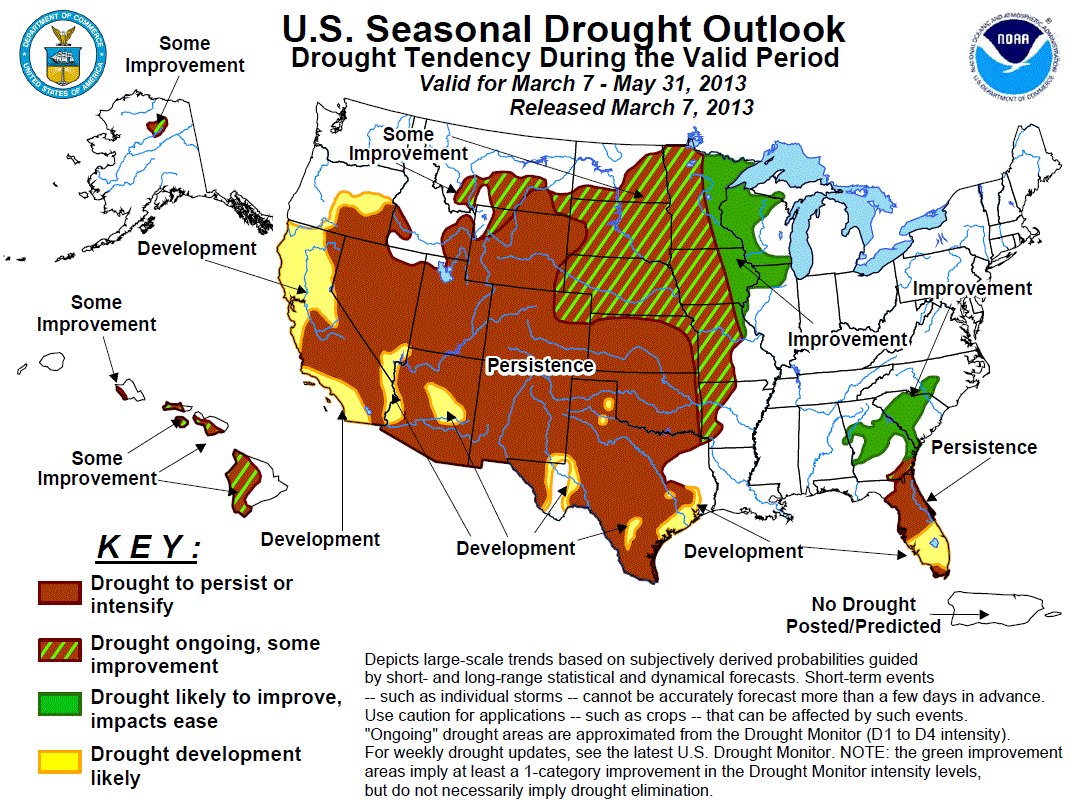

From 9News.com (Dave Delozier):
The Northern Colorado Water Conservancy District board of directors is a few weeks away from deciding how much water farmers will receive for their crops. That decision will impact what farmers will plant or even if they will plant. “The next couple of weeks before our board of directors sets quota on April 12, is going to be critical for what happens in the mountains,” Brian Werner, spokesperson for Northern Water, said.
While March has increased the snowpack in the area almost 10 percent, the reservoirs are still below average. “Our reservoirs are almost 25 percent below average for this time of year and almost 50 percent below where they were a year ago,” Werner said.
With water storage so far below average farmers in northern Colorado are making plans for dealing with a limited amount of water. “Whatever we plant, we need to make sure we have enough water to take care of,” Larimer County farmer Bill Markham said.
From The Trinidad Times (Steve Block):
Colorado is entering its third year of drought, with the southeast part of the state rated in the most dangerous level of D-4, or extreme drought conditions. Taryn Finnesey, an official of the Colorado Office of Water Conservation & Drought Planning of the Colorado Water Conservation Board (CWCB) talked about climate conditions and possible changes at a Thursday meeting of the board of the Purgatoire Watershed Partnership, part of the Spanish Peaks/Purgatoire River Conservation District.
Finnessey told the board that climate models from the 2008 report titled “Climate Change in Colorado” show Colorado’s Front Range could expect average annual temperatures to rise by 2.5 degrees by the year 2025, and by 4.0 degrees by 2050, relative to a temperature baseline for the years 1950-1999.
Finnessey said carbon dioxide gas ascends into the atmosphere, trapping the heat below. She said levels of carbon dioxide gas have increased dramatically since the pre-industrial age, when they were about 270 parts per million cubic feet (cf). She said a study of the atmosphere for the years 2006-2009 showed an increase to 386 parts per million cf. That has been a primary cause for the rise in temperatures in recent years, and has produced many side effects.
“Any increase in the Earth’s temperature impacts health, agriculture, sea levels, wildlife habitats and many other things,” Finnessey said. “What I focus on are the impacts to water resources, because that affects so many other things.”
Reblogged this on Friend Nature and commented:
Water! Our precious resource, and now the USA is on the list for water shortages. Please rethink your daily use of water. Change starts with you!
Friend Nature