
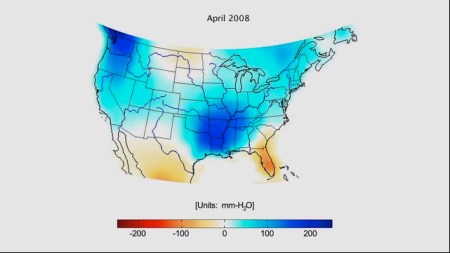
From the animation:
This animation illustrates the highs and lows of combined land water storage (Snow, soil moisture and surface water) over the continental U.S. from 2003 to early 2013 as measured by NASA’s Gravity Recovery and Climate Experiment (GRACE) satellites. The changes are depicted in millimeters of equivalent water height, with increased land water storage shown in blues and decreased storage in reds. Annual seasonal variations are prominent, as are periods of flooding and drought.
Here’s a report from Brett Walton writing for Circle of Blue. Click through and read the whole article. Here’s an excerpt:
Stephanie Castle…presented [UCI’s Center for Hydrologic Modeling] most recent findings on Wednesday, December 11, in San Francisco at the annual fall meeting of the American Geophysical Union, the world’s largest Earth sciences conference. Like earlier studies of California’s Central Valley and the Tigris-Euphrates Basin in the Middle East, the UCI research team assessed fluctuations in water storage using data from NASA’s GRACE mission, a pair of satellites that translate changes in gravity into changes in water volume…
From March 2005 to June 2013, the Colorado River Basin lost 5.7 cubic kilometers (4.6 million acre-feet) of water per year, or more than 47 cubic kilometers (38 million acre-feet) over the 100-month study period. The cumulative losses are equal to 1.3 times the storage capacity of Lake Mead, the nation’s largest reservoir. Most of the water losses are attributed to groundwater pumping, mainly for irrigated agriculture.
The GRACE satellites measure total water storage – the water in mountain snowpack, reservoirs and rivers, soils, and aquifers. By subtracting the known quantities from other data sets, the value for each component can be reckoned. The research team is still analyzing those data, but preliminary results strongly suggest that groundwater is the prime culprit for the losses.
Castle told Circle of Blue that she compared the GRACE data to groundwater monitoring wells that are operated by state and federal agencies in the Upper and Lower Colorado River Basins. The water levels in the monitoring wells were consistent with what the satellites were detecting.
Though Castle acknowledged that water agencies in Arizona and Nevada – which, along with California, make up the three Lower Basin states – are storing water underground in a process called “water banking,” those savings accounts are relatively small when compared with the broader picture of water use in the region.