
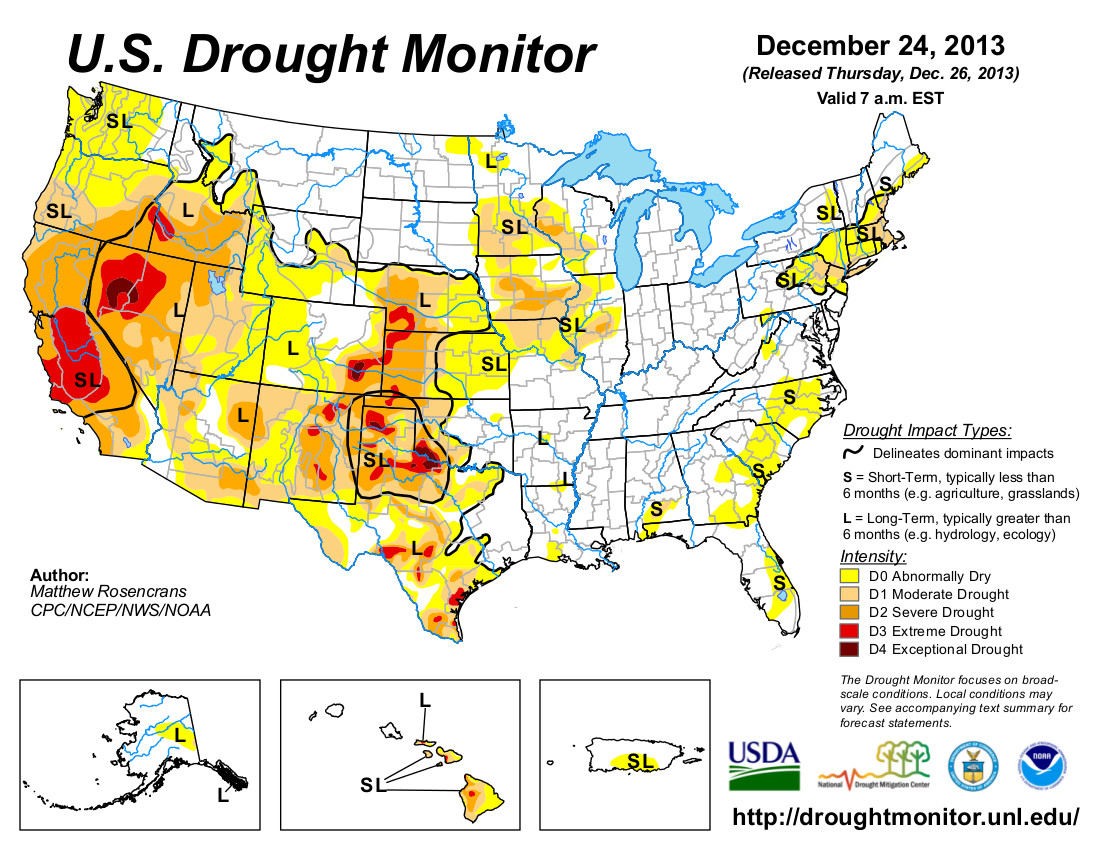
Click here to go to the US Drought Monitor Website. Here’s an excerpt:
The Lower Mississippi Valley and Southern Plains
The axis of heaviest rains extended into Arkansas, so some D0 was removed from central Arkansas and along the Mississippi River. The heaviest of rains (0.5 – 2.5 inches) extended southward to eastern Texas, leading to a slight trimming of the D0 across northeastern Texas and southeastern Oklahoma. Many of the remaining sections of Texas saw drought intensify slightly due to continued dry conditions. SPI values remain well below 0 across the Texas Panhandle and southern Texas. Recent deficits out to the 90 day time period (10 – 25 percent of normal) are especially strong across northeastern New Mexico and Texas, so some adjustments to the drought depiction were made in those regions.The Northern and Central Plains and The Midwest
Pockets of abnormal dryness were removed from Indiana, Michigan, Illinois, and Missouri due to recent rainfall. The streamflows have not responded as much as necessary to remove the D1 (moderate drought) designation for most of this area.The Rockies Westward to The Pacific Coast
Some light to moderate precipitation fell across the northern and central Rockies, although it was frozen so had little impact on the drought conditions and water supply. Surface Water Supply Index values across much of Idaho are in the lowest 30 percentile with many in the lowest 25%. Combined with longer-term rainfall deficits (2.0 – 8.0 inches below normal) during the past 180 days and 10-20 percent of normal during the past 90 days, the drought depiction including extreme drought was not modified. Dry conditions continued east of the cascades in Washington, so D0 was expanded there. Despite some significant rains during the past 7 days, 30 day totals are near normal across much of Washington and Oregon, so no change was made to the depiction there. Severe drought was expanded slightly across northern California as SPI values out through 24 months indicated more intensely dry conditions than what was indicated on prior Drought Monitor maps.
One thought on “Drought news: Parts of southeastern Colorado still deep in #COdrought”