
Here’s the first of a two-part series about the bill from Michael Schrantz writing for Steamboat Today. Here’s an excerpt:
Senate Bill 23 is on its way to Gov. John Hickenlooper’s desk thanks to some legislative maneuvering, but the bill dealing with changes to water law on the Western Slope has divided interested organizations and prompted warnings that its consequences could be much broader than intended.
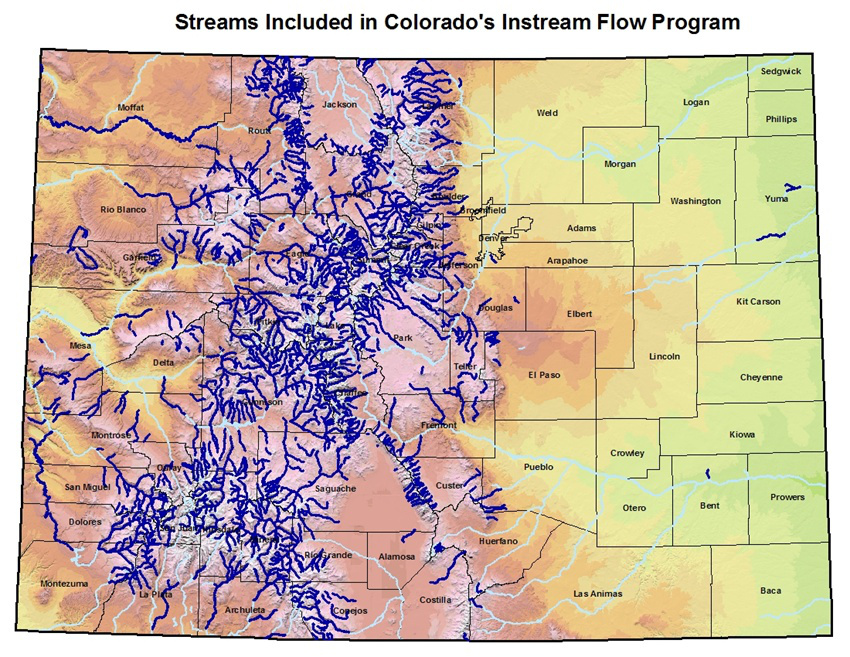
The bill aims to provide incentives for Western Slope agricultural water users and irrigators to make their operations more efficient while also increasing instream flows.
Organizations opposed to Senate Bill 23 warn that while its intent is laudable, the bill also has the potential to harm existing water rights.
Under current water law, not using a water right in its full, decreed amount for the intended beneficial use can put the right in jeopardy. The Division Engineer’s office tracks historic consumptive use, and whatever water has not been used in a 10-year period (either the full right or a partial amount) gets put on the decennial abandonment list. Water that’s considered abandoned flows through the stream or creek like it had been during the previous 10 years or longer that it wasn’t being used or it’s put to use by other rights holders.
Senate Bill 23 would allow those who have rights for agricultural, irrigation or stock watering uses in water divisions 4, 5, 6 (that’s us) or 7 to implement efficiency measures, such as a sprinkler system, and transfer that savings as an instream right to the Colorado Water Conservation Board.
The water rights holders could structure the agreement so that they could get the transferred amount back from the CWCB in the future, allowing them to implement more efficient irrigation measures without risking the loss of part of their decreed water.
The CWCB would get an instream flow between the point the rights holder diverts water and the point of the historical return flows.
Critics of Senate Bill 23 generally have two major issues with the legislation: that a transfer for instream use has the potential to harm intervening water rights and that it also could injure upstream junior rights holders…
“The intent of bill is providing incentives for ag water to use efficiencies without harm to others,” Colorado River Water Conservation District spokesman Chris Treese said.
That’s a goal the district supports and has funded itself in the past, Treese said, but there are a number of concerns with Senate Bill 23.
The Colorado River Water Conservation District, which represents Western Slope counties including Routt, opposes Senate Bill 23.
The principal concern, Treese said, is that the process could represent a cost to surrounding water users who take it upon themselves to investigate whether the change would harm their rights.
“There’s definitely a potential for injury for those rights in between,” Colorado Farm Bureau President Don Shawcroft said about the intervening rights between the point of diversion and point of historical return flows.
The Colorado Farm Bureau also opposed Senate Bill 23.
“It’s an interesting dilemma,” Shawcroft said. “Colorado water law says the state and anyone changing a water right has to prove they’re not injuring anyone else.
“Anyone who believes they’re injured has to lawyer up and engineer up and has to prove their point.”[…]
The Colorado Water Congress worked on the bill with legislators and other interested parties for eight to 10 months, Executive Director Doug Kemper said, and it is satisfied that the processes included in the bill will protect surrounding water rights holders.
“We finally got to the point where we felt like major concerns were addressed,” Kemper said. “We ultimately ended up taking the position to support” the bill.
Requiring a water court process to ensure that other water rights are not injured was a big part of that, he said.
“It’s not creating water right out of thin air or, of more concern, creating water right out of someone else’s water,” Kemper said…
More 2014 Colorado legislation coverage here.