
Parched: A New Dust Bowl Forms in the Heartland http://t.co/qFkL7ATlAi via @NatGeo #drought
— Drought Center (@DroughtCenter) May 19, 2014
Day: May 19, 2014
Snowpack news
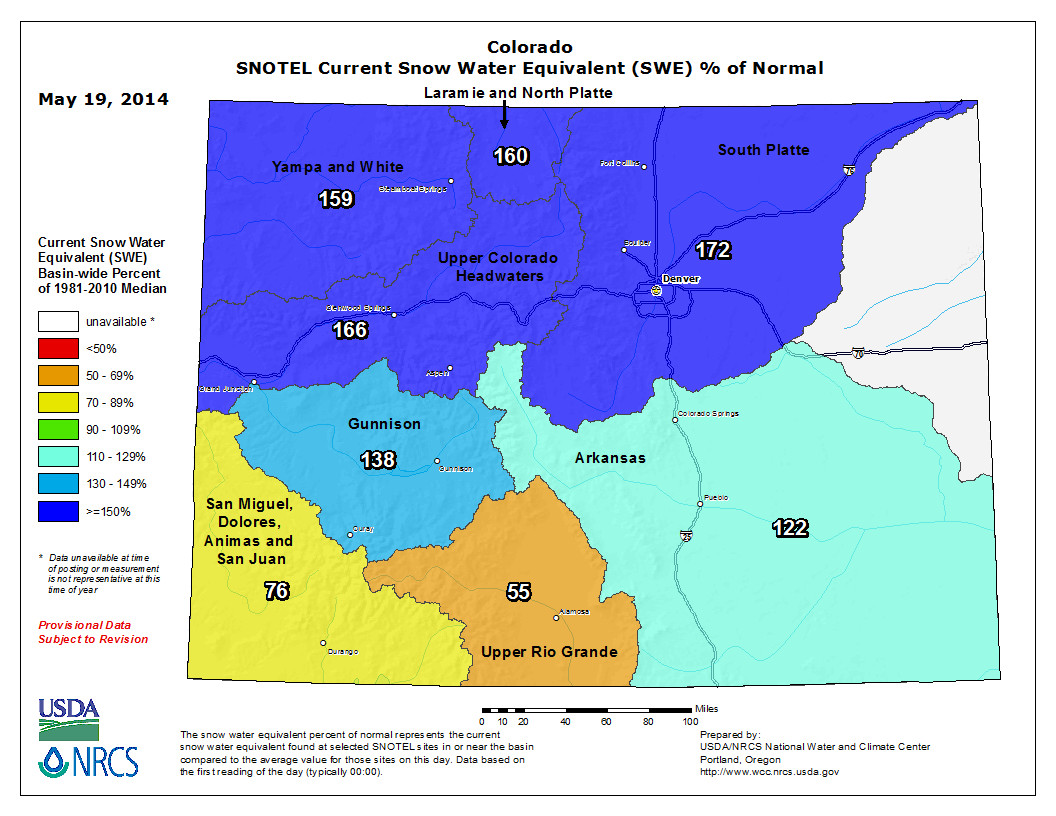
Don’t get too giddy looking at the map. The runoff has started and those percentages are of a historically steep drop in snowpack that starts in earnest right about now.
Paying for stormwater drainage is a conundrum in the Grand Valley
From The Grand Junction Daily Sentinel (Gary Harmon):
The Grand Valley Drainage District will send out the first of regular monthly invoices to Mesa County and the three Grand Valley municipalities for its services in collecting water off untaxed government facilities. District officials say they’re concerned that they face liability for the water that runs off streets, government buildings and parking lots and other impervious surfaces that collect in the drainage system they operate. The district has taken several steps to reduce financial woes that officials detailed to Mesa County and municipal officials last year. District Chairman Mark Harris said it’s clear that the district is short of the revenue needed to deal with day-to-day activities and insulate itself from liability for the kinds of waters that end up in the ditches and pipelines the district operates.
Waters such as those that flow off the impervious surfaces of government facilities fit into a category different from that of the agricultural runoff the district was designed to collect nearly a century ago. What are now called “regulated,” as opposed to agricultural, waters flow into the district’s system, which covers lands from Palisade to Loma north of the Colorado River. The pressure to treat regulated waters differently than agricultural runoff is growing, Harris said.
“People who tell us not to worry about water quality are just not paying attention,” Harris said.
The district collects a mill levy of 1.245, but government entities don’t pay property taxes.
So, the district will send invoices next month to Mesa County, $13,250.40; Grand Junction, $11,910.80; Fruita, $4,277.60; and Palisade, $354.29.
“It’s not in the budget,” Mesa County Commission Chairman John Justman said.
“I don’t know if we can pay it.”
Fruita City Manager Clint Kinney said Fruita disagrees with the assessment.
“Their approach doesn’t make any sense,” Kinney said, noting in a memo to the City Council that, “The district must be crazy.”
By the same logic, Kinney noted in the memo, Fruita could charge the district for the use of those same impervious surfaces, such as roads.
The Grand Junction City Council is to discuss the district at a future meeting, the city said.
In no small part, the invoices are intended to get the attention of the local governments and bring them to the bargaining table, Harris said.
The county and cities should “pay their fair share of the cost of conveying and managing the regulated urban storm waters they produce.”
More stormwater coverage here.
Montezuma County: Non-hazardous waste from the Red Arrow Mill to local landfill?

From the Cortez Journal (Mary Shinn):
The Montezuma County landfill has taken a proactive measure to help save taxpayers any unnecessary expense when disposing of nonhazardous waste from the Red Arrow mill in Mancos.
Landfill manager Deb Barton recently requested clarification from the U.S. Environmental Protection Agency about accepting any non-hazardous waste from the federal Superfund site. Acting as a concerned citizen, Barton said she sought the clarification in order to help lower waste disposal transportation costs associated with the cleanup effort.
“Why pay an extra 50, 60 or 70 miles of transportation when we’re basically 20 miles from Mancos?” she asked. “If this will reduce the cost to taxpayers, isn’t that my responsibility as a citizen?”
“The EPA is going to tear down everything at the mill, and they would like to keep any non-hazardous material as close as possible,” she said.
After an environmental investigation by state authorities, the EPA issued a temporary 60-day permit for the landfill on Feb. 28. Barton said state and federal laws prohibit the landfill from accepting anything but non-hazardous and non-liquid waste only.
“We’ve been certified to meet EPA standards,” said Barton. “Does that mean they can bring the material to me willy-nilly? No. They have to prove that it is non-hazardous.”
Barton said a certified EPA lab report stating the waste was not hazardous would have to be produced before receiving any non-hazardous waste from Red Arrow. Any mercury tainted waste from the milling site must be less than 0.2 parts per million, and any lead or arsenic polluted material must be less than 5 parts per million, she said.
“The EPA will test everything that comes out of the milling site, because they don’t want another Superfund site along the way,” Barton said. “The EPA would not allow any waste to come that doesn’t meet their standards, so I’m not going to screw the pooch either.”
Because of the EPA lab results, Barton said she remained confident that no hazardous material would ever enter the local landfill. She added that nearby archeological sites, ranchers and ordinary citizens also have nothing to fear.
“If the waste doesn’t have that EPA lab report, then it will be going someplace else,” Barton said. “I’m not going to take any hazardous material.”
More Montezuma County coverage here.