
From the Vail Daily (Randy Wyrick):
Wendy Ryan stood in front of a room packed with water professionals and offered this historical perspective. In the last 1,400 years, the last 14 years were not the driest. But it’s as dry as it has ever been. Ryan is with the Colorado Climate Center at Colorado State University. She and her peers were curious about drought and wanted data, not anecdotes.
So Ryan and the Climate Center crew collected data from the years 762 through 2005, poring over records and studying tree rings, to calculate precipitation during those vast expanses of time before computers measured this sort of thing. They found that we’ve had 14 similar dry stretches during that millennia and a half. But this 14-year stretch is as dry as any of them.
“It was among the driest,” Ryan said.
Temperatures have been above average since the 1980s, Ryan said.
“The last 14 years have been a drought,” said John McClow, General Counsel of the Upper Gunnison River Water Conservancy District and one of the West’s foremost water experts…
The rivers flowing into Lake Powell are running 105 percent of normal, Ryan said, so it’ll fill a little bit. It’ll need to, [John McClow] said. Lake Powell is 45 percent full right now, McClow said. This year, for the first time in several years, it should receive more water than it releases — if it keeps raining. The years 2012-13 were the two driest years since they started keeping records 140 years ago, McClow said. Two more consecutive years like that would leave Lake Powell so low it would be unable to generate electrical power.
“People in seven states would see their power cut. They’d be forced to pay double to quadruple for power for at least eight years,” McClow said.
If that happens, it would take 12 years for Lake Powell to refill, assuming those are normal water years…
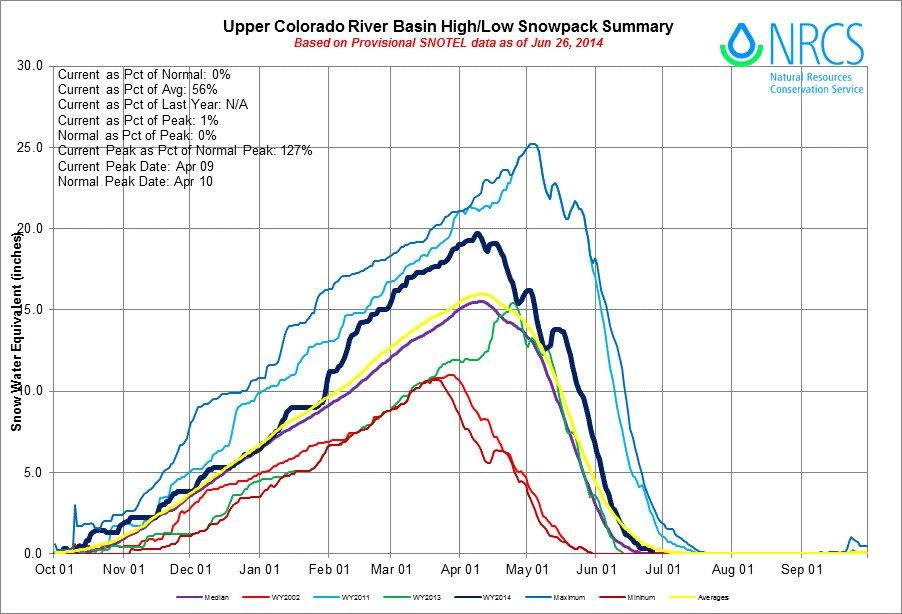
Snowpack is a fickle thing. In the Colorado River basin — that’s Eagle County and the Central Rockies resort region — it was 19 percent of normal in the drought year of 2012, and 83 percent last year. It was 121 percent this year.
On the other hand, the last four years were slightly wetter than normal, based on the average of the last 30 years, Ryan said. But it also depends on where you’re measuring. The Colorado River Basin was hammered with 223 percent of the median snowpack and 180 percent of last year’s. At the other end of the state, the drought continues. The Rio Grande basin saw just 39 percent of the median snowpack.
More Colorado River Basin coverage here.