
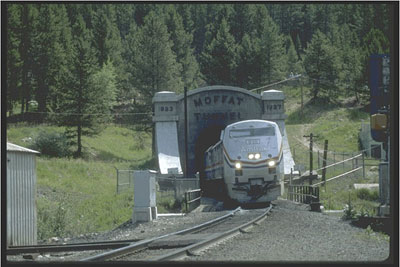
From the Sky-Hi Daily News (Hank Shell):
The Union Pacific Railroad announced on June 19 that it plans to construct a water treatment facility that will remove fine particulates and metals discharged in flows from the west portal.
As part of its discharge permit, Union Pacific must meet preset effluent limitations by April 30, 2017. The new treatment plant will help Union Pacific reach compliance with those limitations.
“It’s a victory,” said Mike Wageck, president of the East Grand Water Quality Board. “It’s definitely a victory for the river, if they’re going to be removing that coal dust that’s getting in there and removing those metals.”
The way the tunnel is bored, ground water flows from seepages inside the tunnel, picking up coal dust left by passing trains and heavy metals leached from the railroad ballast and exposed rock.
“This isn’t much different than a mineral mine,” said Kirk Klancke, East Grand Water Quality Board member. “If you just put a hole in the ground and have water leeching out, it’s going to carry the heavy metals you’ve exposed that have been buried for millennia.”
The way the Moffat Tunnel is pitched, water flows from both portals of the tunnel. To the east, water flows through a sedimentation pond before it’s discharged into South Boulder Creek. But to the west, water flows untreated into the Fraser. In 2013, average daily flows from the west portal were 171 gallons per minute, according to an implementation schedule sent from Union Pacific to the Colorado Department of Public Health and Environment.
The sediment in this discharge increases turbidity, or cloudiness, in the Fraser River…
Slag, a by-product of metal processing found in railroad ballast, leeches copper, lead, mercury and arsenic, among other elements, into the discharge and ultimately the river, according to the implementation schedule.
“Basically, from 2007 to today, we’ve been reviewing various ways we could treat the water coming out, primarily the water when it comes out of the tunnel,” said Mark Davis, a spokesman for Union Pacific.
Union Pacific examined a number of options for reaching compliance with effluent levels in the discharge, including diverting the water to publicly-owned treatment works in Winter Park, though the town ultimately decided that it would not benefit from receiving the water, pretreated or not…
Davis said he wasn’t sure when construction on the facility would begin or how much it would cost, though the state requires that Union Pacific have something in place by its compliance date of April 30, 2017.
More Fraser River watershed coverage here.