Glenwood Springs: #COWaterPlan update planned for afternoon session at today’s CWCB board meeting

From the Glenwood Springs Post Independent (John Stroud):

River recreation business owners and enthusiasts are expected to be out in force today as the Colorado Water Conservation Board meets in Glenwood Springs at the Hotel Colorado.

The afternoon session will include conversation about the upcoming draft statewide water plan, which is due out later this year at the direction of Gov. John Hickenlooper.

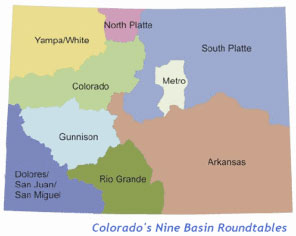
The water plan is the main agenda item from 1-5 p.m. Starting at 3:45 p.m., the board will hear an update on public input received to date from the state’s nine river basins, including from the Colorado River Basin Roundtable. The meeting is open to the public and will include a time for comments.

Meanwhile, boaters, rafters, anglers and other outdoor enthusiasts are gathering in conjunction with the meeting to highlight the economic value of Colorado’s rivers, and to try to ensure river flows are protected from new large trans-mountain water diversions.

The Colorado and other western basin roundtables are urging against including any new Front Range diversion projects in the water plan.

A coalition of business and conservation groups said in a Wednesday press release that they will emphasize the economic importance of Colorado’s river-based economy, which they say is greater than $9 billion annually and supports more than 80,000 jobs in the state…

Geoff Olson, co-owner and operator of Blue Sky Adventures in Glenwood Springs, said in the release that commercial river rafting alone in Colorado last year was worth about $150 million.

“We want the governor and the state water board to make smart, long-term decisions to protect our rivers and our livelihoods, and this huge part of Colorado’s economy,” said Olson, who employs 35 people during the height of the summer whitewater season…

“Colorado’s cities can easily conserve more water, and that will preserve flows for the river-based recreation that is so important to so many Coloradans,” said Annie Henderson, co-founder of the Upper Colorado Private Boaters Association, an American Whitewater affiliate.

Whitewater businesses have also emphasized the need to secure recreational in-stream flows, which is also included in the draft Colorado River Basin Implementation Plan.

The CWCB will continue its meetings Friday, and this morning is scheduled to meet with the Colorado Parks and Wildlife Commission, also at the Hotel Colorado.

Hayfield message to President Obama 2011 via Protect the Flows

Here’s the release from Protect the flows (Belinda Griswold):

Businesses in Colorado, including boaters, rafters, anglers and other outdoor enthusiasts, will be in Glenwood Springs tomorrow to highlight the economic value of Colorado’s rivers and to ensure river flows are protected from new large trans-mountain water diversions. The river supporters will share their experiences with the Colorado Water Conservation Board (CWCB), which is holding a public board meeting Thursday and Friday at The Hotel Colorado.

At the executive order of Gov. John Hickenlooper, the CWCB is currently preparing the first-ever statewide water plan, which will determine how water is managed across Colorado now and for decades to come. Western Slope businesses – retailers, recreational outfitters and other outdoor-related companies – will emphasize the vast economic importance of Colorado’s river-based economy, which is greater than $9 billion annually and supports more than 80,000 jobs in the state. Water diversions, which are being debated during the CWCB board meeting, would significantly jeopardize this river economy.

“The economic impact of commercial river rafting in Colorado last year was about $150 million, and the Colorado River-based recreation industry as a whole added $9 billion to our state’s economy. For Blue Sky Adventures, we employ 35 people, all of whom depend on healthy rivers,” said Geoff Olson, co-owner and operator of Blue Sky Adventures in Glenwood Springs. “We want the governor and the state water board to make smart, long term decisions to protect our rivers and our livelihoods, and this huge part of Colorado’s economy.”

To protect Colorado’s $9 billion river economy, Colorado’s recreation-based leaders are encouraging the CWCB to ensure smart water management is included in the plan. In lieu of large, new trans-mountain diversions, these business want the CWCB to keep river flows at healthy levels by setting a statewide water conservation goal for the state’s cities and towns, something most other Western states have but Colorado is lacking.

“Colorado’s cities can easily conserve more water, and that will preserve flows for the river-based recreation that is so important to so many Coloradans,” said Annie Henderson, co-founder of the Upper Colorado Private Boaters Association, an American Whitewater affiliate. “If it’s going to be a Colorado water plan, it has to reflect Colorado values.”

Another way the CWCB can ensure ample water and support Colorado’s $9 billion river economy supply is by integrating the best recommendations for recreational flow, such as that proposed by the Colorado River Basin Implementation Plan, which called for a goal to protect water for recreational boating purposes.

“Our state’s recreation economy depends on healthy stream flows today,” said Nathan Fey, director of Colorado River Stewardship Program for American Whitewater. “These flows support existing businesses, jobs and local economies that rely on active outdoor recreation and tourism. Trans-mountain diversions are being proposed as a way to meet a future need – an unknown and speculative demand. The conversation about water supply at the state and local levels must be about the trade-offs between our needs today, and what our needs might be in the future.”

Adding to the direct economic boost rivers provide, Coloradans cherish their natural landscape including the rivers that provide opportunities for boating, rafting and fishing. Surveys of Colorado voters show that outdoor recreation is among the top values for residents. In addition, Front Range businesses report that outdoor recreation opportunities are key for attracting and retaining talented employees.

The supporters of healthy rivers plan to hold a press conference at Blue Sky Adventures’ offices (319 6th St, Glenwood Springs, CO 81601, at the Hotel Colorado) starting at approximately 12:00 p.m. on Thursday, Sept. 11. In addition, several supporters are scheduled to speak later in the day at the CWCB board meeting including:

Speakers at the event will include representatives from outdoor recreation businesses, Protect the Flows, American Whitewater, and many more.

To learn more about Colorado’s statewide water plan, please visit http://wwww.waterforcolorado.org.

doloresriveraspens

From the Northwest Council of Governments:

Leaves are starting to change and work on the Water Plan is gearing up around the State. The Colorado Water Conservation Board (CWCB) will be visiting the Colorado Basin this week, holding their board meeting in Glenwood Springs on Sept. 11-12. Part of their discussion will be a review of many draft sections of the Water Plan, released to the public by way of their board meeting agenda. We are anxious to jump into a review of those draft sections—we are encouraged and impressed with the amount of data the CWCB staff have already sifted through to complete these draft sections! We will keep you posted as well learn more.

Meanwhile, QQ has been reviewing the Basin Implementation Plans submitting from Basins around the State over the past month. As one might expect, many Basins agree with some foundational QQ Principles for the Water Plan, while others conflict with some of our primary points. We’ll keep working on a summary document that can help guide those who don’t have time to read the 1000s of pages of information!

Over the next several months, the CWCB will wrap up the first complete draft of Colorado’s Water Plan! This fall marks a crucial time for public input on the draft sections released already, as once this draft is completed the Plan will move to revisions in the Governor’s office and away from the hands of the CWCB. As always, you can provide comment at http://www.coloradowaterplan.org.

More CWCB coverage here.
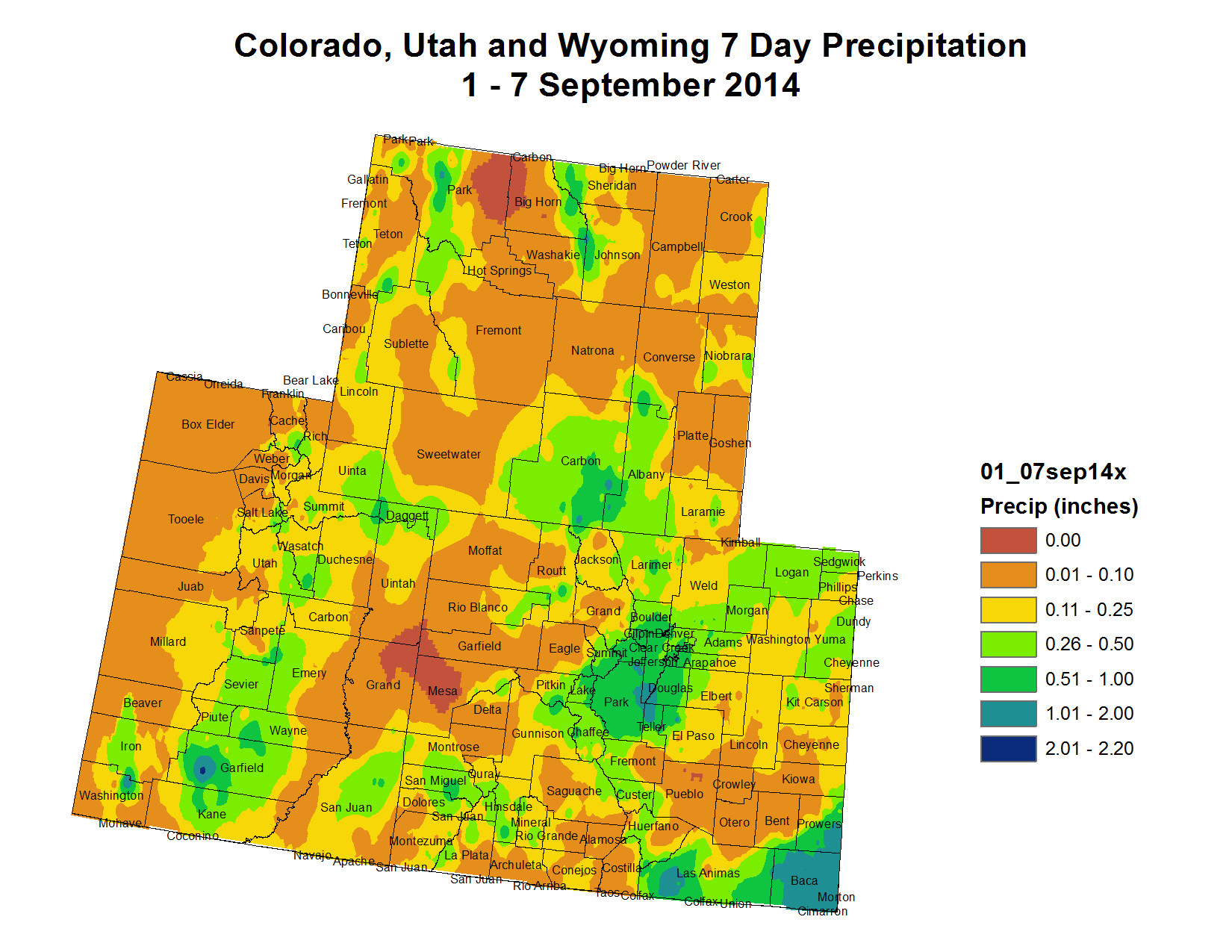
NIDIS: Weekly Climate, Water and Drought Assessment of the Upper #ColoradoRiver Basin

Upper Colorado River Basin 7-day precipitation August 1 -7, 2014

Click here to read the current assessment. Click here to go to the NIDIS website hosted by the Colorado Climate Center.

The Grand Canyon & Hydropower — a complicated relationship — Grand Junction Free Press #ColoradoRiver


From the Grand Junction Free Press (Hannah Holm):

The Grand Canyon is one of America’s most famous wild places, but the river that runs through it is one of the most managed in the world.

On Monday afternoon (Sept. 8), Lucas Bair, an economist with the Grand Canyon Monitoring and Research Center, told an audience at Colorado Mesa University’s Saccamano Lecture Hall how the price of electricity factors into river flows through the Grand Canyon. His lecture was part of CMU’s “Natural Resources of the West” weekly fall seminar series (schedule available at http://www.coloradomesa.edu/watercenter ).

The demand for air conditioning in Phoenix and the performance of power plants across the vast western grid both affect when electricity demand and prices peak, which in turn determines the most profitable time to maximize power production with high releases through Glen Canyon Dam. Hydropower plants can respond quickly to changes in demand, as can natural gas power plants; coal plants respond more slowly, and wind and solar plants’ power production is dependent on natural conditions and is thus intermittent.

Hydropower production is only one of the purposes for which the dam was constructed, however, and only one of many factors driving the quantity and timing of releases (along with the experiences of rafters in the Grand Canyon).

The “Law of the River” — a complex set of laws, plus interstate and international agreements on how to allocate Colorado River water — sets the broad framework for how much water is released in each year. Seasonal and daily release fluctuations are influenced by attempts to maximize benefits and minimize harm to native fish and riparian habitat, as well as recreational boating.

Prior to a 1995 Environmental Impact Statement for the operation of Glen Canyon Dam, which raised the priority of environmental and recreational considerations in dam management decision-making, daily flow fluctuations were much more extreme than they are now. The 1995 EIS also introduced the concept of periodic high releases to rebuild beaches and otherwise benefit riparian habitat by mimicking pre-dam floods.

Knowledge about how releases at Glen Canyon Dam and other management measures affect the environmental, recreational and cultural resources downstream are still imperfect, and any potential change in dam operations to benefit those resources must also be assessed for its impact on water users and hydroelectric power generation. An adaptive management advisory group was set up to respond to new information and integrate all of these considerations into decision-making about how the dam is operated. Bair’s task is to provide information on the economic efficiency of different management options.

The impacts of Glen Canyon dam’s operation extend upstream as well as downstream. This is in part because Lake Powell serves as the Upper Colorado River Basin States’ primary “bank account” for meeting downstream obligations, and partly because revenues from power generation at the dam help fund salinity control and endangered fish recover programs. These programs have funded many irrigation infrastructure upgrades in the Grand and Uncompahgre valleys.

Likewise, water use and hydrology in the Upper Basin impact the operations of the dam. When lake levels drop, whether due to drought or increased water use or a combination of the two, power generation through the dam becomes less efficient. And if levels drop far enough, the dam won’t be able to generate power at all.

The already complex challenge of optimizing management of Glen Canyon Dam gets more complex the farther you broaden the scope. If measures that decrease hydropower production in order to benefit riparian habitat lead to increases in power generation from natural gas or coal-fired plants (and decreases in funding for other management measures), then what is the net environmental benefit? How should economic values be weighed against environmental and cultural values in decision-making?

These are questions that require a combination of sophisticated scientific and economic analysis and informed public deliberation, and will probably never be settled for good. To learn more about the Grand Canyon Monitoring and Research Center’s work to do their part in informing the process, go to http://www.gcmrc.gov.

This is part of a series of articles coordinated by the Water Center at Colorado Mesa University in cooperation with the Colorado and Gunnison Basin Roundtables to raise awareness about water needs, uses and policies in our region. To learn more about the basin roundtables and statewide water planning, and to let the roundtables know what you think, go to http://www.coloradomesa.edu/WaterCenter. You can also find the Water Center on Facebook at http://Facebook.com/WaterCenter.CMU or Twitter at http://Twitter.com/WaterCenterCMU.

More hydroelectric/hydropower coverage here.

Brighton works with oil and gas drillers to protect water — The Greeley Tribune

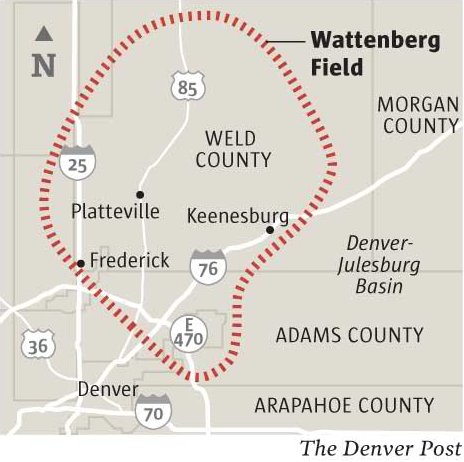
Wattenburg Field
Wattenburg Field

From The Greeley Tribune (Sharon Dunn):

For almost a month last spring, Brighton business owners found out just how important the oil and gas industry was to their town. In March, shortly after the Brighton City Council put a four-month moratorium on oil and gas development — to some residents and business owners, seemingly out of the blue, with no pending applications for development — the oil and gas industry reacted, showing the tiny town what that could mean economically.

“You have people like us, the motels, the restaurants, all these people who were doing a lot of business with oil and gas here, going ‘Wait a minute, what are you doing poking a stick in the eye of the major industry here?’” said Steve Whiteside, owner of Whiteside’s Clothing and Boots, 855 E. Bridge St., Brighton, who supplies energy employees with their industry-required flame-resistant clothing in town. “Yeah, we felt the effects.”

The ill-timed ban seemed to punctuate the moratoriums and bans that were ongoing throughout the Front Range, with five votes in the previous election in November 2013. But Brighton was the first such city to induce the rancor of oil and gas-related businesses that helped fuel the local economy.

The move prompted a bit of an uprising, and some local oil and gas-related businesses opted to do business elsewhere. Weeks later, the council rescinded the order under assurances from the industry that they would not submit any applications for development, so the city could buy time to study the effects it could have on its unique municipal water system that is almost entirely reliant on a series of shallow groundwater wells, ditches and streams in and around Barr Lake.

In that time, the city worked out a deal with the Colorado Oil and Gas Conservation Commission, creating an order that creates larger setbacks surrounding those wells and natural waterways that supply Brighton’s water. The new boundaries extend setbacks beyond state rules because of the unique circumstances.

“We met with operators, outlined the desire to protect the water System … then fleshed out details,” COGCC director Matt Lepore told the commission in late July. “It’s taken the better part of two months. It’s been a collaborative process, again with various stakeholders engaged in the process all the way.”

TIMEOUT

For many who hadn’t been completely advised on the city’s happenings, a four-month ban on oil and gas drilling seemed almost ridiculous given where they were — almost in the heart of the Wattenberg Field, where oil and gas drilling had been a mainstay since the field was discovered in 1970.

Kristen Chernosky, spokeswoman for the city, said it wasn’t really a ban. Chernosky wouldn’t answer questions other than through email and city officials deferred comment on the situation to her. It turns out the apparent knee-jerk reaction wasn’t so much about fear-mongering as it was a legitimate concern for the city’s water supply. The council opted for the “timeout” after hearing the industry’s intention in town, Chernosky wrote.

“Residents within the city of Brighton have been receiving leasing offers from the oil and gas industry,” Chernosky wrote. “The city also receives frequent notices from the COGCC about drilling applications in our area. … As a result of the dramatic increase in oil and gas activity in our area, the city of Brighton put forward a four-month “timeout” to allow us to revise our oil and gas regulations.

“Our oil and gas regulations had not been revised for eight years. The city council believed the timeout was unnecessary after the industry agreed to give the city time to update our regulations by voluntarily refraining from proposing oil and gas development within the city limits.”

THE BAN

Reaction to the event, however, was pronounced and potentially fueled by a growing resentment of an anti-industry sentiment across the Front Range. For those working in the oil and gas industry, as a matter of fact, it was time to do business someplace else.

“Some of the oil related businesses took offense in a big way and said to the city of Brighton, ‘If that’s your attitude about our industry, then we won’t do business in your town anymore,’” Whiteside said. “The whole kerfuffle got squared away, but it came to blows a bit.”

But in the two weeks it took to lift that temporary timeout, local businesses felt the pain.

Holly Hansen, president/CEO of the Greater Brighton Chamber of Commerce, noticed the effects almost immediately. Soon, her members were calling.

“I eat out in Brighton probably every day. And if you go on a normal lunch hour almost anywhere, you’ll see a long line of oil and gas employees,” Hansen said.

Hansen said officials at Halliburton and Conoco-Phillips tried to get the city to back off its moratorium to no avail. Word came down to employees. Brighton was suddenly off limits.

“There was just nothing,” Hansen said. “It was dead. … Something didn’t feel quite right. I had downtown merchants who weren’t really following what was going on (at city hall), in the first couple of days, saying, ‘I’m $1,000 down from last year at this time. What’s going on?’”

The oil and gas industry in that area of southern Weld County is huge. Halliburton, which is an oil and gas service company working with the likes of Anadarko Petroleum, has a massive facility just a couple of miles north in Fort Lupton, and had recently invested more than $40 million to stay in the area, after initially seeking to move further north in the county.

Several oil and gas employees had called Brighton home, and the time they spent away from Brighton business had an impact. The town also was reliant on other industry-related businesses.

“There was a gas station in town that had a sign saying, “We love Halliburton,” said Jared Whipple, an area resource coordinator for Halliburton, on a recent lunch at the Philly Cheese Steak at the Pavillions in downtown Brighton.

Shortly after the industry showed its collective might, the council agreed to rescind the ban. Meanwhile, the city would get to work with the COGCC on the concerns of its water system.

“Actually, as soon as the (measure) was revoked, business did come back to Brighton, and that made companies really happy,” Hansen said. “But also, and I talked at length with folks from Halliburton, they made it clear they appreciated Brighton and the support the town gives to families of employees. The overall kind of lesson was that oil and gas has to work in tangent with the city because it’s such an important industry.”

Business owners, while lauding any agreement the city could make, feel that cloud has lifted.

“From a business point of view, it was a bit shortsighted,” Whiteside said of the council’s ban. “It was presumptive, and I’m sure all with good intentions. But you know, people that aren’t really involved in (oil and gas) business maybe don’t realize how business works. It’s just such a key part of the economy in the area.

“It was a little frustrating, but government oftentimes proves they’re really disconnected from what’s reality. I’d think in this particular issue, they might have stopped and talked to a few people first.”

Small business owner Gary Mikes, who was opposed to any ban, spoke out against it to the council.

“It just sends a message that, ‘We don’t want your business, go away,’” said Mikes, who said his refrigeration business wasn’t directly affected by the temporary ban. “I look at it as a microcosm of what will happen statewide if we vote for no oil and gas exploration. These people will pack up and go to other places like Texas and Oklahoma, and we’ll be left holding our hands with nothing.”

The event laid the groundwork the city council was looking for in protecting the city’s unique water resources.

A NEW DAY

Brighton’s water system includes about 11 shallow groundwater wells near ponds and Barr Lake, both of which serve as water storage for the town, as well as some streams and ditches that are integral parts of the city’s water supply, COGCC Director Matt Lepore told the state Oil and Gas Conservation Commission at its monthly meeting held July 28 in Greeley.

“The circumstances in Brighton are unique,” Lepore said. “The regulatory agencies have crafted a unique response and solution that is appropriate we believe in these circumstances. The intent is this is a site-specific response to these set of circumstances.”

The agreement — which is not intended in any way to set a precedent for other municipalities throughout the state — will prohibit drilling around several natural water sources and shallow groundwater wells that make up a majority of the city’s municipal water system.

The commission unanimously approved the order preventing drilling from 500 feet around water wells and 300 feet from the city’s many streams, ponds and ditches, all of which make up about 70 percent of the city’s water.

Lepore explained that the agreement also called for groundwater sampling — once before and twice after drilling — for all drilling locations within a half-mile of water wells or from 301 to 500 feet of a river or a stream, or a ditch.

“All the parties with a stake in this have been engaged and crafted this order together and presented it as a joint presentation for approval,” Lepore told the commission. “This represents a great partnership between the state, municipality and operators. We all came together, worked hard and identified the issue, and we’re pleased to put this order in front of you and ask you to adopt it.”

COGCC member Tommy Holton, who also is mayor of neighboring Fort Lupton, said he could understand the council’s concerns about drilling, especially being new and having so much mis-information out there.

He said the agreement that came out of the mess, while not at all to be used as a template for other cities, showed that all entities could work together to come up with an amicable agreement.

Mikes said he was pleased to hear that the parties could come together on a plan.

“I’m encouraged they came to compromise. It’s shows the stakeholders they can come together,” Mikes said. “It’s 100 times better than an outright ban, not even considering the economic impacts to what happens when you totally ban something.”

More oil and gas coverage here.
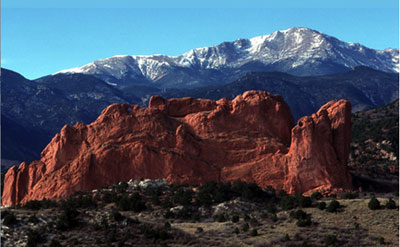
Photo gallery: #ColoradoRiver pulse flow — Peter McBride

Peter McBride and Coyote Gulch

Click through to view the photo gallery from the Daily Mail (James Nye). Here’s an excerpt:

For the first time in half a century the Colorado River kissed the Sea of Cortez in Mexico this May, providing photographer Pete McBridge a glimpse into the past of an American continent untouched by man’s meddling.

The river, which flows high up in the Rocky Mountains of the United States, winds its way 1,400 miles south. Over the past hundred or so years its journey has been dammed and changed more than a dozen times to feed and irrigate cities across the West.

Only 10 percent of the mighty river even reaches Mexico, but this March, the US and Mexican governments made the decision to unleash the Morelos Dam across the border and release billions of gallons into now dry riverbeds – restoring the Colorado River Delta to life.

More Colorado River Basin coverage here.
9News series about #COwater and the #COWaterPlan — Maya Rodriguez


9News.com reporter Maya Rodriguez has embarked on a series about the Colorado Water Plan and water issues in Colorado. The first installment deals with Cheesman Dam and Reservoir.

Correction: The original post attributed the article to *Mary* Rodriguez. Coyote Gulch blames autocorrect rather than the author and his propensity to post at the wee hours of the morning.

Here’s an excerpt from Ms. Rodriguez’s article:

It is something most of us take for granted: running water. Colorado is now beginning to grapple with how to keep the tap flowing, both now and in the future. As the state develops a water plan, set to be released in December, we are beginning a series of stories revolving around that precious resource…

Cheesman Reservoir and Dam

Nearly 7,000 feet above sea level, it’s a place of stillness and a quiet refuge. Yet, it’s also a place capable of wielding immense power.

Cheesman Reservoir is a major source of water for communities up and down the Front Range. It holds 25 billion gallons of water. That’s enough water to cover Sports Authority Field with a foot of water more than 79,000 times. All of it is held in place by the Cheesman Dam, which was built nearly 110 years ago.

“It was tremendous foresight that this reservoir has been pretty much unchanged in all that time,” documentary filmmaker Jim Havey of Havey Productions said.

The reservoir is just one of the places Havey is beginning to capture as part of an upcoming documentary called “The Great Divide.” The subject? Water.

“We looked at water, initially, as a great way to tell the story of Colorado,” he said.

Colorado’s water system is a complex combination of reservoirs, rivers and dams. As the state’s population has grown, though, there has been a greater need to come up with a water plan that can evolve with time.

“Really, it is all connected,” said Travis Thompson, spokesperson for Denver Water, which bought the Cheesman Reservoir nearly 100 years ago.

Denver Water– along with water municipalities and agencies across Colorado– is now working on a long-term plan for Colorado’s water. It includes, among other things, figuring out the best way to manage the state’s water as it flows between different river basins and whether or not to create more reservoirs.

“We’re not planning just for today, we’re planning for tomorrow– 25 years, 50 years down the road,” Thompson said. “And we have many challenges that we’re looking into, just like our forefathers had.”

Those challenges include how to provide enough water for people and industries in Colorado, as well as people in 18 other states– and even two states in Mexico– which also get their water from rivers that begin in Colorado.

“What the water plan is going to mean, I don’t think anybody knows yet,” Havey said.

Yet, it’s a plan that has a lot riding on it below the surface. The first draft of the state’s water plan is due in December and is expected to be presented to the state legislature next year. For more information about the water documentary, “The Great Divide,” go to http://bit.ly/1qDftUO.

More Denver Water coverage here. More South Platte River Basin coverage here. More Colorado Water Plan coverage here.

“There’s no debate”: 97 experts explain the scientific consensus on climate change — Salon

Screen Shot 2014-09-09 at 12.04.01 PM

From Salon (Lindsey Abrams):

While the vast majority of the scientific community agrees that man-made climate change is happening, the public is still working to catch up: Even among those who accept that it’s probably a thing, not nearly enough appear to understand just how certain most scientists are about the basic relationship between human activity and Earth’s warming.

Not that we aren’t making progress. Politicians are listing humanity’s continued contribution of greenhouse gases to the atmosphere among their top concerns and risking attack should they continue to deny the scientific facts. On my subway ride to work, colorful advertisements are urging me to show up in Columbus Circle two weeks from now to participate in what organizers are promising to be the biggest climate march in history. And on social media, the climate science website Skeptical Science has launched a 97-hour campaign — begun, naturally, on 9/7 — highlighting the 97 percent scientific consensus, and featuring 97 forceful, tweetable quotes from 97 experts.

As their statements attest, anyone who tries to argue that climate change is some fringe theory, or not nearly as settled as “environmentalists and the liberal media” make it seem, is picking a fight with not just some scientists, but nearly all the scientists. Fortunately for us, some of the top climate experts also happen to be excellent science communicators. There’s still a lot to come, but some highlights from the campaign so far prove they’re up to the task of explaining both why we should believe climate change is happening, and — crucially — why we should care.

Denver: @ColoradoWaterWise 6th Annual #WaterConservation Summit, October 24

CWCB: The next Water Availability Task Force Meeting is September 17

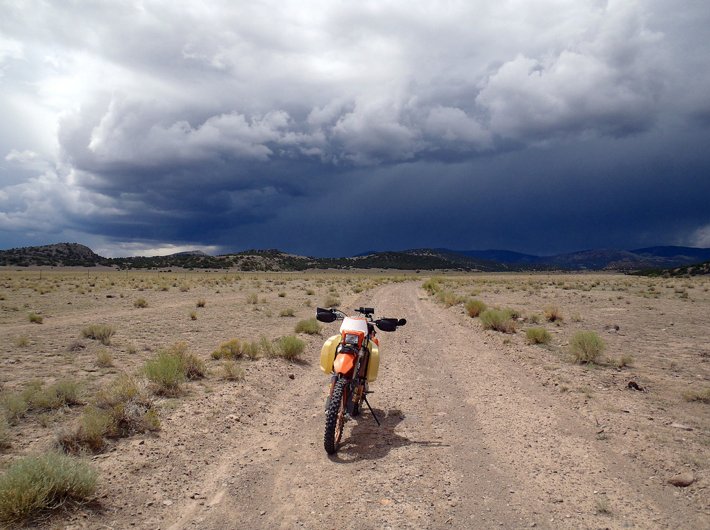
Storm over the La Garita Hills

From email from the Colorado Water Conservation Board (Ben Wade):

The next Water Availability Task Force meeting will be held on Wednesday, September 17, 2014 from 9:30a-11:30p at the Colorado Parks & Wildlife Headquarters, 6060 Broadway, Denver in the Bighorn Room.

The agenda is posted at the CWCB website.

CWCB: New draft chapters of #COWaterPlan now available for review

The latest climate briefing is hot off the presses from Western Water Assessment

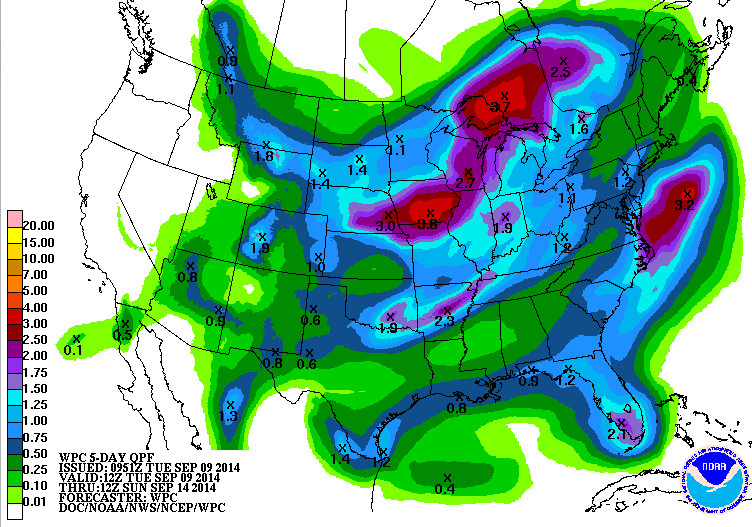
Five-day QPF September 9, 2014 via NOAA

Click here to go to the Western Water Assessment climate dashboard to view the current briefing (scroll down). Here’s an excerpt:

Highlights

  • After mixed outcomes for precipitation in July, the summer ended on a wet note in August, with much of the region receiving over 200% of average precipitation for the month.
  • The vast majority of reservoirs across the region now have more storage than at the end of August last year. Reservoirs in Colorado and Wyoming are also ahead of the long-term average, while most reservoirs in Utah are below the long-term average.
  • The NOAA CPC monthly and seasonal outlooks are tilted towards wetter-than-average conditions for our region for the fall months.
  • While official ENSO indicators remain in neutral territory, an El Niño event is still expected to emerge this fall or winter.
  • Study: Climate Change Will Disrupt Half of North America’s Bird Species

    USGS: Tuesday is Protect Your Groundwater Day

    “The goal is to work together to find methods for conserving the precious lifeblood of our basin” — Deb Daniel

    From Circle of Blue (Brett Walton):

    Following a regional trend, Colorado’s water board is likely to approve a $US 160,000 grant on Friday that will help farmers in the state’s northeastern plains reckon with a water-scarce future.

    Researchers at Colorado State University will use the state funds to answer a simple but profound question that is blowing across the American Great Plains like a stiff wind: What does water conservation mean for farming families, their towns, and their livelihoods?

    Requested by the Water Preservation Partnership, a coalition of a farm group and all of the region’s water management districts, the two-year academic study reflects an important development in the nation’s grain belt…

    “There is concern now over the rate of pumping,” Chris Goemans, an agricultural economist at Colorado State and one of the study leaders, told Circle of Blue. “The question is, what do we do and what happens if we do that?”

    If current practices continue, wells in some counties will be dry within a decade, with disastrous economic and social consequences for rural communities. Faced with this prospect, the people of the plains, from Nebraska to Texas and now Colorado, are beginning to tighten the spigot and embrace, sometimes grudgingly, water conservation…

    The Water Preservation Partnership, which recently marked its first anniversary, was created to find a local solution to the problem of groundwater depletion. It takes as a model a similar grassroots success story in northwest Kansas.

    “The goal is to work together to find methods for conserving the precious lifeblood of our basin,” Deb Daniel told Circle of Blue. Daniel is general manager of the Republican River Water Conservation District, one of 10 members of the partnership.

    Eight of the partners are groundwater management districts. Farmers in these districts account for 80 percent of the water used in northeastern Colorado and half of regional economic output. Altogether, the nine-county region withdraws nearly twice as much water each year as filters back into the aquifer, according to recent research. The annual deficit is 488 million cubic meters (396,000 acre-feet), roughly twice what Denver uses in a year.

    The members see the writing on the wall for the aquifer if current behaviors continue, and they support a reduction in water use. Doing so will keep water in the ground longer, but not forever. The demands of irrigation are far too great. Still, the farmers want a clearer idea of the changes that conservation might bring.

    “The WPP believes we must follow the lead of groups in Kansas, Texas and elsewhere who have developed grassroots, self-governing policies, by imposing pumping policies upon ourselves,” the members wrote in their application for state funding. “The challenge is determining what the policies should be, taking into consideration their economic feasibility for our agricultural producers and rural communities as well as their regional support.”[…]

    Researchers at Colorado State University, which will contribute $US 48,000 to the project, will develop four products. First, they will use computer models to analyze the relationship between water use and agricultural production over the next 100 years. Several levels of conservation will be assessed, showing a range of possible outcomes.

    Farmers in northwest Kansas, for example, are in the second year of a five-year plan to reduce water use by 20 percent. Their economic performance under the restrictions is being assessed by Kansas State University in a separate, ongoing study.

    Next, the Colorado State University researchers will fan out into the community to educate farmers about the results of the modeling.

    Then farmers will take a survey that asks what types of policies they prefer for achieving the reductions in water use. Goemans, the economist, said that policies will fall into one of two categories: those that put a price on water and those that put a cap on how much farmers use.

    Lastly, the researchers will combine the modeling results and the survey preferences in a set of recommended policies…

    The Colorado State University study has the conditional support of the state water board, said Rebecca Mitchell, head of the water supply planning section.

    Mitchell told Circle of Blue that approval of the grant on Friday is “likely” though the state wants to see a few more letters of support to ensure the project has wide appeal. The board itself is interested, viewing the study as a template for analyzing water conservation policies in other areas of the state.

    More Ogallala aquifer coverage here and here.

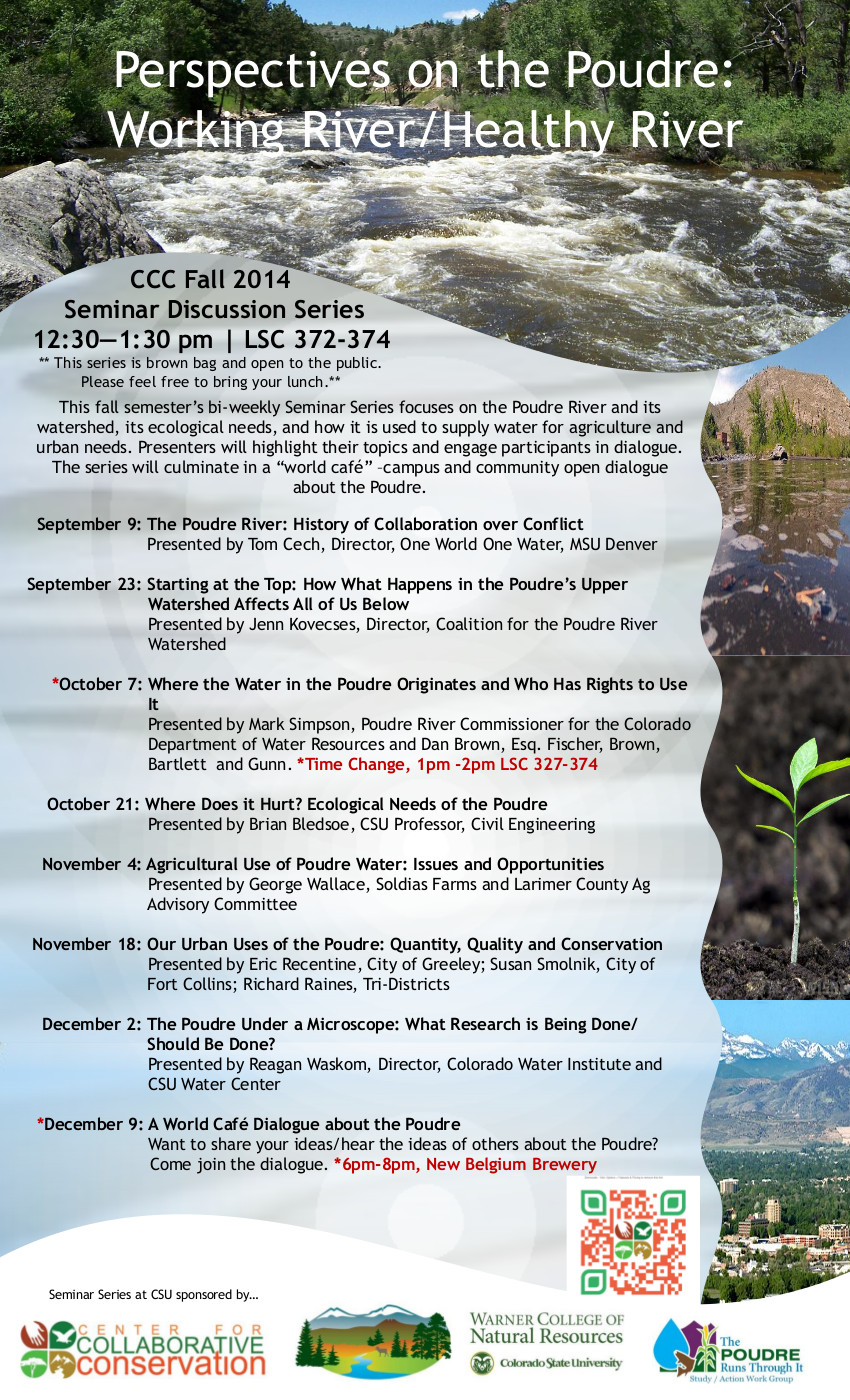
    Perspectives on the Poudre: Working River / Healthy River

    CCC2014seminarscheduleflyer

    More Cache la Poudre River watershed coverage here.

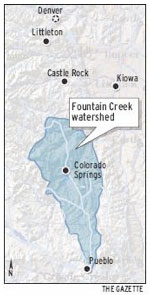
    Fountain Creek “Creek Week” September 27 thru October 5

    From The Pueblo Chieftain (Chris Woodka):

    Plans are being made to clean up litter throughout the Fountain Creek watershed during Creek Week, Sept. 27-Oct. 5 in Pueblo and El Paso counties.

    The event is sponsored by the Fountain Creek Watershed Flood Control and Greenway District, which was formed five years ago to improve the drainage.

    At its last meeting, the Fountain Creek board learned more than 20 groups already have committed time, materials or money to the effort.

    Trash that makes its way into Fountain Creek can degrade water quality, harm wildlife, create safety hazards and clog irrigation or drainage structures.

    Businesses, churches, schools, nonprofits, neighborhood associations, youth groups, service clubs and individuals are encouraged to form work groups, pick a work date within the time frame, pick a location and pick it up.

    Information about Creek Week and how to register a crew is available at http://fountain-crk.org.

    More Fountain Creek coverage here.

    Colorado Springs: Reduced water rates for Parks?

    Pikes Peak with Garden of the Gods in the foreground
    Pikes Peak with Garden of the Gods in the foreground

    From The Colorado Springs Gazette (Monica Mendoza):

    Mayor Steve Bach said he needs to slash about $6 million from the 2015 budget, and hinted that the nearly $4 million parks watering bill from Colorado Springs Utilities is among the reasons.

    Bach said he is not ready to release all of the 2015 budget details, but he did say that part of the budget problem is the high cost of water. There is no discount for the city’s parks, something he said is typical in many cities. Bach did not say if the parks budget would be cut or if he would trim from other areas.

    Last year’s general fund budget was $245 million, with $14 million spent on parks, recreation and cultural services. Bach will present his proposed budget to the City Council in October. City Council will host a series of budget hearings in November and is expected to vote on the budget in December.

    The price of the city’s parks watering bill has been an issue for more than a decade – long before the current council and mayor began their water wars. For years, the city administration has asked for a discounted water rate from Utilities. For years, Utilities had said no.

    Chuck Fowler, a member of the City Committee, which has offered input to the mayor on the budget, said there should be a benefit to having a city-owned utility, and it should be a discount on water for city parks.

    “If you owned your own carwash, you would think you could bypass the meter to get your car washed,” he said…

    Water bills have doubled for Utilities customers in the past five years, said councilman Merv Bennett. The money has been used to pay for the Southern Delivery System project, a 53-mile pipeline that will pump water from Pueblo Reservoir to Colorado Springs. That project is scheduled to be completed in 2016.

    Bennett said the Utilities board could consider reducing water rates for the city’s parks after the SDS project is completed, but not likely before then.

    “It comes down to is (park watering) the responsibility of the taxpayer or the ratepayer,” Bennett said. “This council is of the mindset that it is the cost of running the city.”

    Bennett and other council members wanted to strike a compromise between Utilities and the city during the last budget session. But once the budget was approved in December, talks broke down…

    “I’m disappointed that we couldn’t come up with a solution,” Bennett said…

    Council president Keith King said Utilities cannot afford to offer a discounted rate to the city because of the major capital projects in the works. “If you make one group a better deal, who picks up the price of that better deal?” he asked. “We base the (water rates) on the true cost of service. Those are legitimate numbers.”

    More Colorado Springs Utilities coverage here.

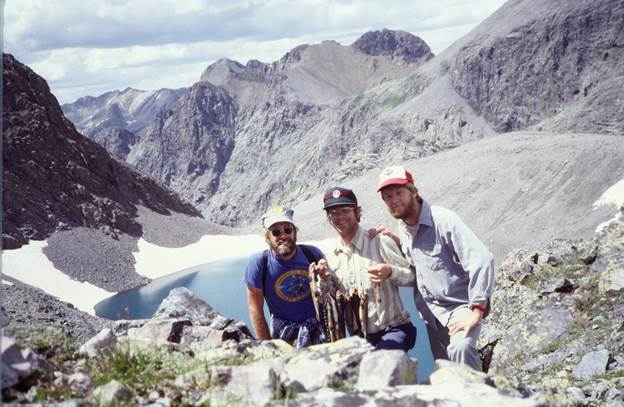
    Poem: Think ahead whereat you go! — Greg Hobbs #wilderness

    Will Hobbs, Greg Hobbs, Dan Hobbs, and a string of fish for dinner, Mary Alice Lake, Weminuche Wilderness, 1986 via Greg Hobbs
    Will Hobbs, Greg Hobbs, Dan Hobbs, and a string of fish for dinner, Mary Alice Lake, Weminuche Wilderness, 1986 via Greg Hobbs

    Think ahead whereat you go!

    Pack your pack, your saddle bags,
    your camera, craft, your fishing pole,
    your sleeping bag, your pocket knife,
    flashlight, poncho, wooly cap

    Whichever map will get you back!

    To canyon, forest, peak, and stream,
    quiet eye of deep down things,
    juice and joy of streaming light
    within, along, above, below

    What’s very good that needs you not!

    Paws and claws, gills and wings,
    trunk and branch, flower stems,
    mother dew and father cool,
    beauty’s changing discipline

    In the rhythm you’re returning to!

    Ever fresh and ever new,
    re-creation’s symmetries,
    pour off tarns and pocket cirques,
    travois tracks and medicine wheels

    The smallest thing the hardest to do!

    Leave ‘em alone, just let it be
    a column of moonlight,
    marmot snouts,
    wetland seeps.

    Greg Hobbs 9/5/2014
    (In celebration of the 50th Anniversary of the Wilderness Act)

    Here’s part of the note that Justice Hobbs sent along with the poem:

    50thanniversarywildernessactdoi

    John, a poem I wrote for the 50th Anniversary of the Wilderness Act at the CU Law School this past Thursday and Friday…[The] photo [is] from a family backpacking trip into the Weminuche Wilderness in 1986. Brother Will Hobbs, then a teacher at Miller Junior High School in Durango and now a renowned young adult author http://www.willhobbsauthor.com, centered his first couple of books Bearstone and Beardance on this area of the Weminuche Wilderness where the Divide bends back to Wolf Creek Pass above Silverton, Durango, and Pagosa Springs.

    National Wildlife Federation: A new map that shows every tree in the US

    “…all measures, including…storage…must also be part of the conversation” — Charlie Bartlett #COWaterPlan


    From ColoradoCorn.com (Charlie Bartlett):

    Colorado Corn board member and Colorado Agricultural Water Alliance (CAWA) president Charlie Bartlett recently voiced concerns about the Colorado Water Plan draft, stressing to officials that it focuses too much on alternative water transfer methods as the way to protect agriculture, and not enough on other avenues, like new water-storage projects.

    “We disagree with the premise that ATMs will sustain a viable agriculture,” Bartlett, a Merino-area farmer, wrote in a letter to the Colorado Water Conservation Board. “CAWA believes that the Colorado Water Plan needs a much more significant analysis and treatment of how we can sustain our vibrant and critical industry though keeping water in agriculture.”

    Colorado cities have long bought water rights from farmers and ranchers to help meet the needs of their growing populations, and, because of that and other factors, Colorado is on pace to see 500,000 to 700,000 acres of irrigated farm ground dry up by 2050, according to the Statewide Water Supply Initiative report.

    To help with the problem, many in Colorado are exploring alternative transfer methods (ATMs), agreements that more easily allow the ag community and cities to use the same water supplies without the farmers and ranchers selling off their water rights altogether. The Colorado Water Plan draft includes language about further exploring ATMs to protect the state’s agriculture – an industry, that, in addition to supplying food, feed, fuel and fiber, has a $40 billion economic impact on Colorado.

    However, all measures, including more water-storage projects, must also be part of the conversation in developing a Colorado Water Plan that will help ensure there’s enough to go around for agricultural, municipal and industrial needs down the road, Bartlett stressed in a letter to the Colorado Water Conservation Board.

    “Certainly, ATMs are a part of that approach, but only one aspect,” Bartlett continued.

    About the Colorado Water Plan

    Gov. John Hickenlooper has put in charge the Colorado Water Conservation Board (CWCB) of developing a comprehensive, statewide water plan, in conjunction with other state water agencies. Roundtables of water experts from each of the eight major river basins in Colorado have already submitted drafted plans to the CWCB. The CWCB is now combining those eight draft plans, along with other input, into one that covers all of Colorado, which is due to the governor’s office in December. The final version Colorado Water Plan is to be completed by the end of 2015.

    Draft chapters of the Colorado Water Plan and each of the eight basin’s draft plans are available online at http://www.coloradowaterplan.com/.

    Those wanting to provide comments can do so at the same website.

    Thanks to the La Junta Tribune-Democrat for the heads up.

    More Colorado Water Plan coverage here.

    #nmdrought relief

    Photo: Snow on Grays and Torreys

    Pulse flow feeds more than the dry #ColoradoRiver delta — the Boulder Weekly

    Young girl enjoying the river restored temporarily by the pulse flow March 2014 via National Geographic
    Young girl enjoying the river restored temporarily by the pulse flow March 2014 via National Geographic

    From the Boulder Weekly (Elizabeth Miller):

    The people threw a party.

    “People really turned out for it, I think because they knew it was being sent there deliberately to see the good that it could do, and also because it hadn’t flowed like that for a long time,” says Jennifer Pitt, with the Environmental Defense Fund, one of the parties instrumental in orchestrating the bi-national agreement between Mexico and the U.S. to allow for this flow of water.

    “We’re talking about a bed of the river about 200 feet from bank to bank, the bed of the river is virtually just sand, and it has been like that since 1960, with some exceptions of water coming down maybe four times. But from 1960 to now … the Colorado river has been 16 inches wide and 6 inches deep, and you have three generations of people, that’s what they’ve had since 1960, a river that’s 16 inches wide and 6 inches deep, then suddenly you have a river that’s 200 feet wide and 16 feet deep,” says Jorge Figueroa of Western Resource Advocates, who went down to document the pulse flow. Before the water came, people went to the riverbed to use drugs and drink alcohol, run motorcross bikes and jeeps.

    “The river literally flushed that out, and brought this wholesome, healthy experience,” Figueroa says.

    Pitt was there for two weeks to watch as children who had never seen the Colorado River running through their town were brought out to see it, and elders who remembered the river before it began to shrivel up and dry out in the 1960s were brought to see it and remember that past. A month later, photos showed that there were taco stands, live music and a ferris wheel alongside the river, and boats floating in it. They were still celebrating its return.

    “When I was down there for that pulse flow, the song that kept going through my head was, ‘You don’t know what you got ’til it’s gone,’ but in some ways, when something’s gone for a really long time, and you get decades into it, people kind of get used to the absence. Like, the kids had no memory of a river,” Pitt says. “But then, if it reappears for a moment, you get this glimpse of what could be. I think a lot of people got a little glimmer of what a restored river could look like, and so I think it’s in that that we have a real hope for long-term progress in this area.”

    Western Resource Advocates has worked on Colorado River issues for the last 15 years, beginning with dam operations and endangered species, but also now working on the water use programs designed to help cities live within their means when it comes to water. They’re often looking at the issue from the “30,000-foot level,” talking in acre feet and wrangling with policy. For this trip to Mexico, Figueroa wanted to focus on a different story — the people.

    He also wanted to bring this story home to the upper Colorado River, and helped to convene a panel at the Americas Latino Eco-Festival to discuss the pulse flow and what it meant for the ecosystems and the people far down river. Speakers include himself, Pitt, the Sonoran Institute’s Colorado River Delta Program Project Manager Karen Schlatter and San Luis Rio Colorado resident Nancy Saldaña, who led a campaign to clean up the river bed before the water arrived, clearing four tons of garbage that included needles, glass and cars.

    “Most people, at least in the United States, don’t see it as a river that actually goes to Mexico and reaches the Sea of Cortez, or that should reach the Sea of Cortez, so this experience for me really crystallized the fact that all Colorado River water users are an integral part of the Colorado River — from the headwaters to the Sea of Cortez, it’s our river. Our river does not stop at Morelos Dam,” Figueroa says. “This issue of grandmothers and their granddaughters enjoying their majestic river, or being deprived of such a majestic river for three generations, should resonate with all Colorado River water users, whether you’re a farmer or somebody who lives in Denver, or in Phoenix, or a federal policymaker. I think this resonates more than acre feet of water. … I would hope that the cat is out of the bag, that after this event, hopefully it’s going to be very, very hard to deprive these people of their majestic river.”[…]

    From the city of San Luis Rio Colorado, the pulse flow of water continued on down toward the delta at the Sea of Cortez, once 2 million acres of wetlands and riparian habitat. The delta has since gone so dry and dead that it’s threatening to the endangered species, including the Yuma clapper rails, Virginia rails and California black rails, and migratory birds such as warblers and flycatchers, that rely on that vanishing thread of green.

    “There were still some flows going down there, but really, over the drought over the last 10, 15 years, it got extremely dry and even the remnant habitat that was down there was beginning to disappear,” Pitt says.

    This spring, for less than 24 hours, while the tide was up and that pulse of river water was reaching for its ancient home, the Colorado River touched the sea…

    The water for the pulse itself came from a project the U.S. funded with $22 million to line an irrigation ditch in Mexico, decreasing water loss there.

    Essentially, Pitt says, the science team was “handed a bucket of water” and told to pour it out how they thought best. The team included scientists from both countries, and one who had worked on the experimental flow program in the Grand Canyon. The advice from that scientist was clear: Whatever you design, it isn’t going to be right. His suggestion was to deliver the water in a way that the signal of what the water was doing would be clear.

    “Ecosystems, rivers, are a real landscape, it’s not like a lab experiment where you can tightly control all the variables,” Pitt says. “We believe this pulse flow will have done some good at the end of the day and we also believe we’re going to learn a ton from it and the conservation community is definitely going to be working hard to make sure we get an opportunity to do another pulse flow in the future, to make sure there is more water committed to the area and hopefully we’ll do it next time with the hindsight of this pulse flow and do it better.”

    There’s precedent to suggest that the results will be positive. In the 1980s and ’90s, flood events brought water to areas of the delta that had been dry for decades.

    “Everyone had kind of given up the delta for dead, like a dead ecosystem that had been desecrated and degraded, but after these flows, a lot of the vegetation was able to come back, so that demonstrated to the conservation community and scientists that this is a pretty resilient ecosystem that can withstand long periods of no flows, little flows, and then boom, you have water and the vegetation can make a comeback,” Schlatter says. “That’s what sparked the idea to dedicate environmental flows to the region with the notion that even a little bit of water in this area can really make a difference and bring back a lot of habitat.”[…]

    In the Sonoran Institute’s restoration efforts in riparian habitat, removing nonnative species like salt cedar and replanting native ones, the saplings are irrigated for two or three years, and then have root systems deep enough to tap into the groundwater. The area has a level of groundwater favorable to restoration efforts that’s fed by agricultural return flows, and Minute 319 also allows for base flows into the Colorado River in Mexico to support those efforts.

    “It is resilient, but it does need water, so without any intervention at all, there’s resilience up to a certain point, and if we keep taking water from the system, the river system never sees water again, it will eventually collapse and the invasive species that have already established there will become too dominant for native species to reestablish if there were ever flows in the future,” Schlatter says. “So I think the pulse flow came at a really critical time in this ecosystem’s trajectory where going too much longer with these flood flows is kind of a dangerous thing because you’re never sure how long is too long and when having a flood flow actually won’t be enough to restore the system because it’s lost its resiliency, so it does require intervention at some point.”

    The pulse this year was intended to stimulate the germination of native vegetation — cottonwoods and willows require flood conditions to germinate, and the pulse, on a very small scale, simulated the kind of floods that used to hit that region each year.

    “When some of the scientists who really brought up the idea that a pulse flow could do some real good for the delta’s ecosystem, the original speculation was that having that kind of a pulse flow every few years would probably be enough, because it’s the creation of cottonwood and willow habitat that’s critical, when you get the water up over the river’s banks, you create that disturbance that can cause those seedlings to grow. You don’t need to have that happen every year, but you do need a little bit of water provided year round, all the time, so that seedlings can continue to grow,” Pitt says. “Historically certainly it happened every year, but given that we’re fighting the uphill battle for getting just a little bit of water into this ecosystem, the thought is that every few years would work, every four or so, on average. So there is a need for some year round water to keep the roots wet, and in some places there’s adequate groundwater to do that already.”

    Work to secure that year-round water has been done by the Colorado River Delta Trust, a private trust established by the Mexico-based conservation group Pronatura Noroeste, which, in addition to the Environmental Defense Fund and the Sonoran Institute, has been buying up water rights to make sure there’s a little bit of water in the river to sustain what the intermittent pulse flows, assuming they’re approved again, create.

    The delta now has just a small remnant of a river left, but the big drink of water it just had is producing green up and down the river. An intensive monitoring effort undertaken by federal agencies from both countries as well as academics and nonprofits is scrutinizing details down to counting seedlings and wildlife, and should start producing numbers to quantify the effort in the coming years. It’s tough to know now, Pitt says, where things like the groundwater saw a recharge while the effects of this one-time pulse flow are still being studied.

    When the five-year agreement that Mexico and the U.S. have settled on runs out at the end of 2017, they’ll be back to the drawing board and making a decision on whether to allocate water for this kind of water event again.

    Signs point toward a momentum and support building for it, Pitt says, and the agreement has drawn some attention from the international community as an example of the kind of collaborative work countries can undertake to help preserve endangered transboundary rivers around the world.

    “It gives me hope that we can manage our way through this and end up with the West that we want with limited water resources,” Pitt says. “That idea that the community responded and that there’s a path forward for them to take a role in stewardship of the Colorado River is a really exciting premise, and really shows a lot of promise, but clearly is dependent on this whole broader suite of governance issues. … I’d say the other community response has come from water managers, I mean, they kind of created the story, they created the pulse flow, but that sense that while the Colorado River basin in many ways is in a pretty urgent situation right now in terms of extended drought and allocation and use that exceeds our long-term supply, a sense that with our sleeves rolled up and good collaborative effort and instinct, that we can see our way to careful management that supports all the values that we want from the river, including the environment, and I’ll project a lot of stuff onto this, but including viable rural economies and thriving cities, all of which use water from the Colorado.”

    The Raise the River campaign is organizing an ongoing effort to help ensure a future for the river. That campaign needs to raise $10 million by 2017 to fulfill their portion of the commitment for Minute 319 and pur chase water rights to support river restoration through the Colorado River Delta Trust. The still-in-development Colorado Water Plan also has fingers that reach to that delta, and adopting a plan that advocates for conservation is going to be key to keeping water in that delta despite a growing gap between supply and demand on the Front Range of Colorado.

    “I don’t think it’s ever going to be that the full flow of the Colorado River is down there, which is what it was in the early 20th century. There’s 40 million people depending on that river, 4 million acres of farm land, 15 percent of U.S. ag produce — it’s just too big,” Pitt says. “But I do think there’s hope that the basic connectivity could be reestablished between the river that flows in the U.S. and the upper gulf, at least on a periodic basis. Not necessarily on a regular basis. But connectivity, a corridor, a ribbon of green that’s so important for the birds and for the people to see that there’s a natural area in their midst, not just a sandy desert.”

    More Minute 319 coverage here. More Colorado River Basin coverage here.
    State Water Plan draws crowd — Pine River Times #COWaterPlan

    Colorado Water Plan website screen shot November 1, 2013
    Colorado Water Plan website screen shot November 1, 2013

    From the Pine River Times (Carole McWilliams):

    A group of legislators from around the state were in Durango on Aug. 27 to take comments on the Colorado Water Plan now being drafted, and the regional plan that will be part of it.

    The legislators are members of an Interim Water Resources Review Committee who are following a bill passed in the spring requiring them to hold such meetings in each of nine major drainage basins around the state…

    Many of the attendees said they didn’t know enough about what’s actually in the state plan or the Southwest Basin Roundtable Implementation Plan to ask questions or comment.

    Several people worried that the federal government is trying to take control of all the water in the U.S. and take people’s property rights via recent updates to the Clean Water Act rules on what constitutes “waters of the U.S.” Speakers urged people to submit opposition comments before the comment deadline in October.

    Another concern is federal agencies trying claim bypass flows and to require private water rights holders to turn over those rights as a condition to get or renew a use permit on federal land.

    Southwest Water Conservation District Director Bruce Whitehead cited area Forest Service and BLM land management plans. “This isn’t a new issue,” he said. “These plans come up with things about bypass flows.” The state has opposed that, and memorandums of understanding “have encouraged federal agencies to use state (in-stream flow) programs instead of imposing bypass flow requirements.”

    It’s also one of the concerns with federal special use permits, he said. State agencies have protested that. “These aren’t guidelines. They are standards in the Forest Plan. We see it as double dipping, using the state in-stream flow program but also wanting bypass flows… The feds say this will be a template throughout the state and maybe the West.”

    Whitehead continued, “Few of our concerns have been addressed. That’s why we’re bringing it to this panel. So far, we’ve been unsuccessful in working with these federal agencies in a cooperative collaborative manner.”

    Participants grouped around tables discussed water issues and picked one of their members to summarize their comments to the larger group.

    There was strong support for water conservation as part of the plan, such as the large percentage of municipal use that goes for lawns; for more water storage, and for Colorado’s prior appropriation system of “first in time, first in right.”

    Tom Morris, staff attorney for the legislature, commented, “To many people, that is the Colorado water plan.”

    Several people supported elimination of the “use it or lose it” part of the prior appropriations system, because it discourages more efficient water use.
    There was support for new water storage in Southwest Colorado to keep water the area is entitled to from flowing out of state. Another big point was that water users in each basin should fully develop their own water, including storage, before they seek diversions from other basins or buy up ag water for municipal use.

    Summarizing comments from his table, La Plata/ Archuleta Water District board member Dan Lynn said, “One point we wanted to make is that every drop of water in the state starts on federal land, but every drop of water doesn’t belong to the federal government.” He noted he worked for 36 years for the Natural Resources Conservation Service and said, “Don’t let those people get your rights.”[…]

    Ignacio area rancher and president of the American National Cattle Women Patti Buck urged people to send formal comments on the EPA rule change on what constitutes waters of the U.S. subject to regulation.

    “When we bought our ranch, we paid extra for our water shares” compared to land with no water rights, she said. No water means no grass, which means no cattle, which means no food, she said.

    One participant, Margaret Cozine, had a different concern. She wants the state to not only allow, but encourage, rain water harvesting from rooftops, and re-use of gray water, as several other states do. She wants it for her garden and argued it does not damage downstream water rights.

    Water committee chair Randy Fischer urged people to send comments on the water plan. There will be another series of meetings around the state once the draft plan is released. “Please stay tuned,” he said.

    More Colorado Water Plan coverage here.

    The latest Eagle River Watershed Council newsletter “The Current” is hot off The presses

    Eagle River Basin
    Eagle River Basin

    Click here to read the newsletter. Here’s an excerpt:

    In 2014, the Watershed Council has had the opportunity to work with various summer camps throughout the valley. We joined the Sonnenalp, Vail Mountain Club and Vail Mountain School’s Summer Quest program for watershed-themed days. We learned about watershed health & pollutants to our waterways; we removed invasive weeds like Canada thistle from our river banks; we found hundreds of bugs in Gore Creek; and we spent hours outside enjoying all that is summertime in Colorado![…]

    The Eagle River Cleanup is Saturday the 13th!

    We all love to play on our rivers and streams during the warm months but all that love can take its toll. That’s why each September, we get down and dirty for a day of cleaning along the waterways that we all cherish.

    More Eagle River watershed coverage here.

    Reclamation Releases the Final Environmental Assessment for Developing Hydropower at Drop 4 of the South Canal

    Uncompahgre River watershed
    Uncompahgre River watershed

    Here’s the release from the US Bureau of Reclamation (Terry Stroh/Justyn Hock):

    Reclamation announced today that it has released a final environmental assessment and Finding of No Significant Impact for a hydropower project at Drop 4 of the South Canal, part of the Uncompahgre Project in Montrose, Colorado.

    The project, proposed by the Uncompahgre Valley Water Users Association, will be located at existing Reclamation facilities on the South Canal. A Lease of Power Privilege will authorize the use of federal facilities and Uncompahgre Project water to construct, operate, and maintain a 4.8 megawatt hydropower facility and 1.27 miles of associated interconnect power lines.

    The hydropower plant will operate on irrigation water conveyed in the South Canal, and no new diversions will occur as a result of the hydropower project. Construction activities and operation of the hydropower plant will not affect the delivery of irrigation water.

    The final environmental assessment and Finding of No Significant Impact is available on our web site or a copy can be received by contacting Reclamation.

    More hydroelectric/hydropower coverage here.

    Denver Water — installing wood stave pipe -May 1910

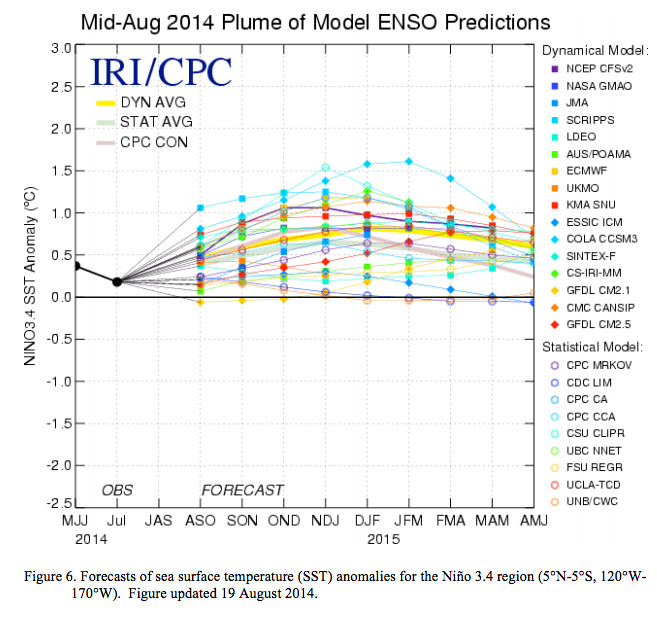
    The latest ENSO discussion is hot off the presses

    midagust2014plumeofensopredictions

    Click here to read the latest discussion. Here’s an excerpt:

    Synopsis: The chance of El Niño is at 60-65% during the Northern Hemisphere fall and winter.

    During August 2014, above-average sea surface temperatures (SST) continued across much of the equatorial Pacific. Most of the Niño indices warmed during the month with values of +0.5°C in Niño-4, +0.4°C in Niño-3.4, +0.4°C in Niño-3, and +0.8°C in Niño-1+2. Subsurface heat content anomalies (averaged between 180o-100oW) also increased during the month as above-average subsurface temperatures developed across the central and east-central equatorial Pacific. This warming is associated with the downwelling phase of an equatorial oceanic Kelvin wave triggered in July by low-level westerly wind anomalies. Westerly wind anomalies continued in the central and eastern part of the basin early in August, but weakened by the end of the month. Enhanced easterly upper-level wind anomalies have prevailed during much of the month, and the Southern Oscillation Index has been negative. However, convective cloudiness remained generally near average over most of the region, except for below average cloudiness observed across the central and western Pacific. The lack of a coherent atmospheric El Niño pattern and near-average SSTs in the central Pacific indicate a continuation of ENSO-neutral.

    Most of the models continue to predict El Niño to develop during September-November and to continue into early 2015. A majority of models and the multi-model averages favor a weak El Niño. At this time, the consensus of forecasters expects El Niño to emerge during September-October and to peak at weak strength during the late fall and early winter (3-month values of the Niño-3.4 index between 0.5°C and 0.9°C). The chance of El Niño is at 60-65% during the Northern Hemisphere fall and winter (click CPC/IRI consensus forecast for the chance of each outcome).

    NASA: The world now has a new view of snow and rain

    Water, sewer rate hikes before Glenwood Springs Council — Glenwood Springs Post-Independent

    Glenwood Springs via Wikipedia
    Glenwood Springs via Wikipedia

    From the Glenwood Springs Post-Independent (John Stroud):

    Based on a recent cost recovery analysis, the city will need to increase water rates by 10 percent and sewer rates by 7 percent, according to recommendation from Glenwood Public Works Director Robin Millyard.

    Under the rate proposal, the base rate for water service would increase from $11.97 to $13.17 per month, while the base sewer rate for in-city customers would increase from $58.36 to $62.45. Additional costs apply for using more than 2,000 gallons per month.

    The rate adjustments are necessary to meet revenue requirements for the remainder of the year, Millyard indicated in a memo to City Council members. The analysis also suggests more increases will be needed in future years to keep up with the costs of providing water and wastewater services, he said.

    City sewer rates were increased anywhere from 20 to 30 percent per year from 2006 through 2011 in an effort to pay for the city’s new wastewater treatment plant. Customers were given a break for two straight years in 2012 and 2013 when no rate adjustments were made.

    During the same period, water rates rose anywhere from 4 to 10 percent. There was no water rate increase in 2013, however.

    A comparison with other area municipalities provided by Millyard shows that Glenwood Springs’ new water rates would remain the lowest in Garfield County. Sewer rates, on the other hand, are somewhat higher by comparison, due to the ongoing cost recovery for the new sewer plant.

    The rate proposals will be discussed during a 5 p.m. council work session Thursday, Sept. 4, and will be considered for formal adoption during the regular 7 p.m. meeting at City Hall, 101 W. Eighth St.

    More infrastructure coverage here.

    September 4, 1964 — the first generator went online at Glen Canyon Dam #ColoradoRiver

    More Colorado River Basin coverage here.

    Clear Creek: A river runs though it — The Clear Creek Courant

    Clear Creek watershed map via the Clear Creek Watershed Foundation
    Clear Creek watershed map via the Clear Creek Watershed Foundation

    Here’s part II of the series on Clear Creek from the Clear Creek Courant (Ian Neligh). Here’s an excerpt:

    Editor’s note: This is the second installment of a three-part series examining the past, present and future of Clear Creek.

    Through the mountains and down to the plains, Clear Creek has rushed along its jagged banks long before civilization ever found it and the gold hidden within. Its discovery led to industry, economy and community. The tie binding the stream to the people living along its banks will not be broken easily.

    A commitment

    Several thousand mines are estimated to crisscross the county. Lasting repercussions of the mining industry led to more than 100 efforts to clean up the stream and mitigate the mining pollution in the last decade.

    According to David Holm, the Clear Creek Watershed Foundation’s executive director, stream mitigation is a “forever commitment.”

    “Once you’re going down that road, you’ve really made a forever commitment for maintenance,” Holm said. “So mine drainage is like that. It is a forever problem.”

    Mine waste removal and restoration of stream banks are projects that, once completed, are ultimately removed from the Clear Creek remediation radar screen, Holm said.

    Clear Creek always had a “metal footprint” because of the natural mineralization in the mineral belt, which the stream cuts across, Holm said.

    “So there’s no question that there would have been iron, manganese, aluminum in elevated levels, and probably a little bit of a diminished pH,” Holm said. “The tremendous increase in exposure to the weather and elements of the mineral zone, brought about by mining, definitely has increased that footprint, and we will never eliminate that additional increased footprint.”

    However, the stream is cleaner today than in recent memory, thanks to efforts by the Watershed Foundation, the U.S. Forest Service, and the Division of Reclamation, Mining and Safety.

    A new industry

    The mining industry, once so reliant on the stream, has dwindled to nearly nothing. In its place, a recreational industry has grown by leaps and bounds.

    Since 1991, rafting companies using Clear Creek have experienced more than a 7,000 percent increase in customers. This increase comes at an ideal time, when the county is looking to transition to a recreation-based economy, with Clear Creek considered the area’s crown jewel.
    The increase in visitors to the county had nearly a $19 million economic impact in 2013, according to the Colorado River Outfitters Association.

    Association executive director David Costlow said the meteoric rise in recreation over the years is in large part due to the stream’s close proximity to Denver and to the relatively relaxed regulations for outfitters launching in Clear Creek.

    Costlow said a lot of companies based on other rivers, such as the Arkansas, now bring customers to Clear Creek.

    Last year, 61,000 “user days” were reported on the stream. A user day is how the rafting industry tracks customers and equates to one customer spending time on the river during one day. In 1991, the Colorado River Outfitters Association noted, Clear Creek had just 800 user days. Today the area has 15 rafting outfitters, with several owning locations in the area and putting in additional features such as zip-lines.

    “You can see the growth on Clear Creek pretty rapidly. It was just 30,000 (user days) not too long ago, and now it is around 60,000,” Costlow said. “It’s a fun river, a lot of rapids per mile.”

    ‘Mining recreation opportunities’

    County officials see the stream as a large piece in the area’s economic puzzle. In 2010, Clear Creek Open Space, with the help of funding from a Federal Highway Administration grant, created the Lawson Whitewater Park. The park includes boulders that create specialty chutes and waves for kayakers and other boaters along the 450-foot stretch of Clear Creek just upstream from Mile Hi Rafting. The park also has parking and a changing station with environmentally friendly toilets.

    County Commissioner Tim Mauck said Clear Creek saw little to no rafting 15 years ago, and now it is the second busiest river in Colorado. The county is working on a Greenway Project, which it hopes one day will create an uninterrupted recreational space following the stream from one end of the county to the other.

    Earlier this year, officials met for a groundbreaking ceremony for a $13.9 million project that will link Clear Creek and Jefferson counties with a 10-foot-wide concrete trail for 6 miles, improve stream access, and link the Oxbow parcel with Mayhem Gulch.

    “Looking for recreational opportunities is really something we need to position ourselves to take advantage of,” Mauck said. “The stream is the lifeblood in so many ways, not just physically to the necessities of life, but we’re drawn to it in ways that just make obvious sense.”

    Mauck said Clear Creek offers a diversity of recreational opportunities such as rafting, kayaking, angling and gold panning, and the county needs to continue to transform itself and take advantage of the creek, but now in a different way.

    “It’s (now about) mining the recreation opportunities,” Mauck said.

    More Clear Creek watershed coverage here.

    NOAA: Western drought brings Lake Mead to lowest level since it was built #ColoradoRiver

    Lake Mead water levels via NOAA
    Lake Mead water levels via NOAA

    From Climate.gov:

    On July 11, the day these photos were taken, the Lake Mead reservoir reached its lowest water level since the lake was first filled during the construction of the Hoover Dam in the 1930s, according to the Bureau of Reclamation. The lake’s elevation was 1,081.77 feet—147.23 feet below capacity and 133.99 feet below its last peak in 1998. Similar to how the rings in the cross-section of a tree trunk can tell a story about that tree’s past, the high points and low points of Lake Mead’s water history can be glimpsed from observing recent photos taken at the Hoover Dam.

    The highest rust-colored ring on the concrete dam structure shown in the top photo marks the height of the water when the lake is near capacity (it’s never allowed to literally fill to the tip-top). The top of the dark ring around the water intake towers at image left in the foreground indicates the height of the water level on December 21, 2012—the highest the lake has been this decade. At the time, water levels were down 95.4 feet from 1998 levels. The white “bathtub ring” seen on the rocky sides of the reservoir in the bottom photo shows the historical high water level in the reservoir. The ring is a coating of minerals, deposited on the rocks while they were covered by water.

    The Lake Mead reservoir—the largest in the United States—stores Colorado River water for delivery to farms, homes, and businesses in southern Nevada, Arizona, southern California, and northern Mexico. According to the National Park Service website, about 96 percent of the water in Lake Mead is from melted snow that fell in Colorado, Utah, New Mexico, and Wyoming. Each year, these “Upper Basin” states are required to allow a minimum flow of Colorado River water to reach Lake Mead.

    This year’s new low was hardly unexpected. Runoff in the Upper Colorado River Basin was 94 percent of average in 2014, but that flow wasn’t enough to make up for the previous two years’ shortfalls: runoff was only 47 percent of normal in 2013 and 45 percent in 2012, according to the Bureau of Reclamation.

    The past two years are a continuation of a15-year dry spell in the U.S. Southwest that has led to more water going out of Lake Mead than coming in. The lake reached an all-time high of 1,215.76 feet in November 1998, but it has not approached that level since. The Bureau’s Boulder Canyon Operations Office projects the lake’s elevation to continue to drop through the fall, falling to approximately 1,080 feet in November of this year.

    Fluctuations in regional climate and the resulting water level in Lake Mead are an expected part of its operation, but many scientists are concerned that the recent prolonged drought could be a sign that the region will confront significant water supply challenges as greenhouse gas concentrations continue to rise.

    Projections of precipitation changes in the Colorado watershed are less certain than those for temperature changes in the Southwest, but rising temperature along with declining snowpack and streamflows may threaten the reliability of surface water supply across the Southwest, according to the 2014 National Climate Assessment.

    The report also warns that the current drought could be just beginning. Southwest paleoclimate records show that severe mega-droughts at least 50 years long have occurred in the past several thousand years. Unlike those ancient droughts, however, similarly dry periods in the future are projected to be substantially hotter, and for major river basins such as the Colorado River Basin, drought is projected to become more frequent, intense, and longer lasting than in the historical record.

    More Colorado River Basin coverage here.

    Drought News: South Platte River basin drought-free from stem to stern #COdrought

    Click here to go to the US Drought Monitor website. Here’s an excerpt:

    Summary
    This U.S. Drought Monitor week saw heavy showers and thunderstorms across the Central Plains and portions of the Upper Midwest as well as along the central and western Gulf Coast. Rainfall accumulations in the Central Plains and Upper Midwest were heaviest across Iowa, Kansas, and Nebraska with some areas receiving in excess of six inches. The combination of above-average summer rainfall accumulations in many areas and short-term gains (seven-day accumulations) led to improvements in drought-affected areas of Kansas and Nebraska. Along the central and western Gulf Coast, locally heavy rainfall fell across coastal areas of Louisiana and Texas with some areas receiving five-to-ten inches helping to improve drought conditions in southeastern Texas. Meanwhile, much of the Northeast, Mid-Atlantic, and Southeast remained relatively dry with the exception of some isolated showers and thunderstorms across portions of Florida and Georgia. Temperatures were well above average for the week across Texas, the Southern Plains, Midwest, and portions of the Mid-Atlantic and New England. Out West, light rainfall accumulations were observed in the Central Rockies, New Mexico, and Wyoming. In the Southwest, monsoonal rains began to taper off across the region. West of the Continental Divide, dry conditions dominated…

    The Plains
    Drought conditions continued to improve across portions of Kansas and Nebraska this week as heavy rains increased soil moisture conditions and streamflows. Rainfall amounts were highest across eastern Kansas and southeastern Nebraska where accumulations ranged from three-to-six inches leading to one-category improvements in areas of Severe Drought (D2) and Moderate Drought (D1). In southwestern Nebraska and southeastern South Dakota, summer rains have brought conditions back to normal. In west-central Oklahoma, above-average temperatures and short-term precipitation deficits led to expansion in areas of Extreme Drought (D3) and Severe Drought (D2) while rainfall this week helped to slightly improve areas of Extreme Drought (D3) and Severe Drought (D2) in the Panhandle. During the past week, temperatures were above normal in the Southern Plains while Northern Plains temperatures were below normal…

    The West
    During the past week, conditions were generally dry across most of the West with the exception of some light, isolated shower activity (<2 inches) in portions of Arizona, New Mexico, Colorado, Wyoming, and Montana. The Far West, Great Basin, and Intermountain West were dry, however. Improvements were made on the map in parts of the eastern Great Basin including one-category improvements in areas of Severe Drought (D2) in northwestern and west-central Utah, as well as northeastern Nevada where springtime and monsoon-season rains helped improve rangeland conditions, soil moisture, and streamflows. In the mountains of northeastern Nevada and south-central Idaho, snowpacks were below normal for the Water Year (since October 1st); but total precipitation amounts at Natural Resource Conservation Service (NRCS) SNOTEL sites (observational stations that measure snow water content, snow depth, accumulated precipitation, soil moisture, and air temperature) in these areas show that Water-Year-To-Date accumulated precipitation is near normal or normal. In this region, lingering hydrologic impacts persist as reservoirs remain well below normal. In northwestern, west central, and southwestern Utah, monsoon rains improved soil moisture and rangeland conditions according to the August 25, 2014, U.S. Department of Agriculture (USDA) Utah Crop Progress and Conditions Report. In northeastern Utah, northwestern Colorado, and southwestern Wyoming, summer rains helped to improve conditions leading to one-category improvements in areas of Extreme Drought (D2) and Severe Drought (D1). During the past week, temperatures were above normal in the Far West and below normal across the eastern half of the West…

    Looking Ahead
    The NWS WPC 7-Day Quantitative Precipitation Forecast (QPF) calls for moderate-to-heavy rainfall accumulations (two-to-five inches) across the Desert Southwest, Southern Rockies, Central Plains, Upper Midwest, Southeast, and lower Mid-Atlantic regions. Late in the period, a plume of subtropical moisture is forecasted to move into the Southwest bringing potentially heavy rains. In the Far West, dry conditions are forecasted to persist across California, the Great Basin, and most of the Pacific Northwest. The 6–10 day outlooks call for a high probability of above-normal temperatures across the Far West, Southern Plains, South, Southeast, and Mid-Atlantic while below-normal temperatures are forecasted across the Central Rockies, Northern Plains, Upper Midwest, and New England. Temperatures across much of Alaska, including western, south-central, and southeastern regions are forecasted to be above normal. Regarding precipitation across the conterminous U.S., a high probability of above-normal precipitation is expect across the Southwest and the eastern half of the U.S. Below-normal precipitation is expected across the Pacific Northwest and western Alaska while precipitation in southeastern Alaska and the eastern half of Interior Alaska is forecasted to be above normal for the period.

    Aspinall Unit operations update: Summer rains bolstering flows in Black Canyon

    From email from Reclamation (Erik Knight):

    Releases from Crystal Dam will be reduced from 1600 cfs to 1450 cfs on Wednesday, September 3rd at 1:00 PM. Flows in the lower Gunnison River are currently above the baseflow target of 1050 cfs. River flows have remained relatively high due to the August rains and flows are expected to stay above the September baseflow target at the new rate of release.

    Pursuant to the Aspinall Unit Operations Record of Decision (ROD), the baseflow target in the lower Gunnison River, as measured at the Whitewater gage, is 1050 cfs for September.

    Currently, diversions into the Gunnison Tunnel are around 1050 cfs and flows in the Gunnison River through the Black Canyon are around 600 cfs. After this release change Gunnison Tunnel diversions will still be around 1050 cfs and flows in the Gunnison River through the Black Canyon should be around 450 cfs. Current flow information is obtained from provisional data that may undergo revision subsequent to review.

    Drought news

    Jacob Bornstein speaks about the Role of Groundwater in the State Water Plan, 9/17/14 @AWRACO #COWaterPlan

    More Colorado Water Plan coverage here.

    Denver District Court Throws Out License to Build Piñon Ridge Uranium Mill—Again — @sheepmtn

    Here’s the release from the Sheep Mountain Alliance (Hillary Cooper):

    A Denver district judge has ruled against the license issued by the state of Colorado to Energy Fuels to construct and operate a uranium mill in Paradox Valley in western Montrose County for the second time.

    In a court ruling issued Wednesday, September 3, 2014, District Judge Robert McGahey found that the hearing process for the mill, ordered by a previous judge who invalidated the license in June of 2012, did not comply with the 2012 order. In today’s order, Judge McGahey ruled that a hearing officer must review the record established at the November 2012 hearing and make an “initial decision as to whether Energy Fuels application has met all criteria under state law.” Sheep Mountain Alliance and Rocky Mountain Wild retained technical experts who presented solid evidence at the hearing to prove that Energy Fuels’ application was based on false information and that the environmental review was incomplete.

    “This process has been mishandled by the state agency from the start and the district court has agreed again,” stated Hilary Cooper, executive eirector of Sheep Mountain Alliance. “If the state chooses to continue this process, it will be taking action on a 2009 application for a project that will most likely never be built.”

    Sheep Mountain Alliance, a grassroots conservation group based in Telluride, Colorado, has led the effort with Rocky Mountain Wild to stop the Piñon Ridge uranium mill based on significant environmental impacts to the surrounding region. SMA filed a lawsuit against the state of Colorado in February 2011 after the first radioactive materials license was issued to Energy Fuels. The Piñon Ridge mill would have been the first conventional uranium processing mill approved in the U.S. since 1980. The judge agreed with SMA’s challenge and ordered an independent hearing officer to conduct a hearing in November 2012. The hearing officer did not take action on issues raised during the hearing. Instead, the hearing officer sent the file to the state with simple direction to proceed with the license consideration. The state then issued a second license to Energy Fuels in April 2013. SMA and RMW again challenged the decision, and today’s ruling found that the hearing officer “failed to make a conclusion as to whether Energy Fuels application met all criteria for issuance of a license pursuant”.

    In the meantime, Energy Fuels acquired the existing White Mesa uranium mill in Blanding, Utah, and admitted that they did not intend to build the Piñon Ridge mill because of unfavorable economic conditions and the redundancy of two mills in close proximity. In addition, Energy Fuels has entered into a contract to sell the Piñon Ridge mill property and other assets to George Glasier, the original founder of Energy Fuels, who is backed by Baobab Asset Management, Inc.

    “The application lacks sufficient analysis of impacts to wildlife and the environment,” states Matt Sandler, staff attorney with Rocky Mountain Wild. “This decision is a win for the wildlife and the natural resources of this region. Our hope is that this remand will finally highlight the deficient environmental analysis included in the application.”

    “The state has a clear choice to deny the Energy Fuels application and require a future developer to reapply with an updated application, which must address the conditions on the ground at that time,” states Cooper. “It’s time to release the communities of southwest Colorado from the false hope embellished by this industry for too long.”

    More nuclear coverage here.

    Fountain Creek flood mitigation dam(s) and the issue of prior appropriation

    Flood irrigation in the Arkansas Valley via Greg Hobbs
    Flood irrigation in the Arkansas Valley via Greg Hobbs

    From The Pueblo Chieftain (Chris Woodka):

    A discussion about water rights, the first step to looking at building dams or detention ponds on Fountain Creek, is moving ahead. The project is being coordinated by the Fountain Creek Watershed Flood Control and Greenway District, and would fit in with a larger study looking at flood control on Fountain Creek.

    It’s a hot-button issue with farmers in the Lower Arkansas Valley, who see the capture of flood flows on Fountain Creek as a threat to junior water rights. At an Arkansas Basin Roundtable meeting last month, the need for a water rights study killed a proposal to look at the feasibility of building dams.

    A $58,000 program by the Fountain Creek district will look at just the water rights issue. It will be funded by Colorado Springs Utilities, Pueblo West, Security, Fountain, the Pueblo Board of Water Works and the Southeastern Colorado Water Conservancy District, with in-kind support from Utilities and the Fountain Creek district. The process will bring together downstream water rights holders and state officials in a series of meetings to identify how water rights could be harmed by projects meant to provide public safety and what action could be taken to mitigate the damage.

    All of the questions about how water moves throughout the Arkansas River basin would not be answered, but some ways to provide water through releases from Lake Pueblo or by timing releases from Fountain Creek structures would be explored, said Mark Shea, Fountain Creek point man for Utilities.

    “There could be other beneficial uses, providing waterfowl or fish habitat, and allowing flood flows to be exchanged up Fountain Creek,” Shea said.

    Melissa Esquibel, Pueblo board member of the Lower Arkansas Valley Water Conservancy District, said the Lower Ark also should be involved in the project.

    “There is a lot mistrust and misinformation, so we need to take the right path,” she said. “There are legitimate concerns that arise from past issues.”

    Pueblo County Commissioner Terry Hart agreed.

    “If we are perceived as an 800-pound gorilla, we’ll get nowhere,” Hart said. “We’re talking about people and their livelihoods.”

    Pueblo City Councilwoman Eva Montoya, who chairs the Fountain Creek board, said the dialogue is an opportunity to balance public safety and the need to protect water rights.

    “We need to rebuild trust,” she said.

    More prior appropriation coverage here.

    Water Lines: Learn H20 facts from experts this fall in western Colorado — Grand Junction Free Press

    itscalledsciencesenator
    From the Grand Junction Free Press (Hannah Holm):

    Fall is full of water events in western Colorado, from opportunities for “experts” to trade ideas and information to seminars primarily intended for the general public. Here’s a sampling of what’s coming up.

    Colorado Mesa University’s fall “Natural Resources of the West” Monday evening seminar series is focusing on the role of natural and social sciences in natural resource management. Upcoming seminars on water-related topics include a Sept. 8 presentation on resource economics and the Grand Canyon; a Sept. 15 presentation on agricultural research stations; an Oct. 6 presentation on climate change and agricultural economics; an Oct. 13 presentation on riparian restoration and the tamarisk beetle; and an Oct. 20 presentation on the uranium mill tailings clean-up along the Colorado River near Moab. All seminars are free, open to the public and are held in Room 141 of the Wubben Science Building from 4-5:15 p.m. Live web-streaming will also be available at http://www.ustream.tv/channel/coloradomesalive. Additional details will soon be available at http://www.coloradomesa.edu/WaterCenter.

    The Colorado River District’s annual seminar will take place on Friday, Sept. 19, from 9 a.m. to 3:30 p.m. in the Two Rivers Convention Center in Grand Junction. This seminar is always a big draw for water managers and elected officials, as well as interested members of the public. This year’s theme is “Growing the River: Is it All About Ag?” The featured speaker will be author Kevin Fedarko, whose book titled “The Emerald Mile” tells the story of the 1984 flood on the Colorado River from the perspectives of both dam operators and river runners, three of whom use the high water for a record-setting speed run through the Grand Canyon. Other topics will include how the Colorado River became over-allocated; the pluses and minuses of irrigation efficiency; how to sustain agriculture; and what kind of future agriculture wants (commentary — there are likely multiple answers to this); and the “pulse flow” release that sent water back to the Colorado River Delta last spring. For more details or to register, go to http://www.crwcd.org or call 970-945-8522.

    Southwest Colorado’s annual “Water 101” seminar will be held Monday, Sept. 22, in Telluride Town Council Chambers from 8 a.m. to 5 p.m. As in the past, the keynote speaker will be Colorado Supreme Court Justice Gregory Hobbs, always a crowd pleaser. Federal, state and local agency representatives will also provide information on water law and administration, local water sources and environmental concerns. For more details or to register, go to http://www.waterinfo.org or call 970-247-1302.

    The annual “Sustaining Colorado Watersheds” conference will take place in Avon from Oct. 7-9. This year’s conference, themed “Come Hell or High Water!” will explore community resiliency in the wake of the 2013 floods, wildfires, and other risks to Colorado watersheds. This conference tends to focus less on issues of water supply than other water meetings in the state, and more on stream and riparian health. Many participants are energetic, young staffers of watershed protection and restoration organizations. For more information, go to http://www.coloradowater.org/conferences.

    The Water Center at Colorado Mesa University’s 4th annual Upper Colorado River Basin Water Forum will be held Nov. 5-6 on CMU’s campus, with pre-conference workshops on Nov. 4. This year’s theme is “Seeking a Resilient Future.” The conference keynote speakers will be Pat Mulroy, former head of the water authority serving Las Vegas, and William Hasencamp, manager of Colorado River Water Resources for the Metropolitan Water District of Southern California. Conference sessions will include scientific and policy perspectives on topics such as the management of Lakes Powell and Mead, the “pulse flow” release to the Colorado River delta, Grand County water challenges related to transmountain diversions, and climate change. Additional sessions will focus on state water plans, tribal water rights claims and settlements, innovations in agricultural irrigation, and water history. For more information, go to http://www.coloradomesa.edu/WaterCenter or call 970-248-1968.

    In my experience, all of these events are great opportunities to both learn and make connections with the movers and shakers in Colorado’s dynamic water community.

    This is part of a series of articles coordinated by the Water Center at Colorado Mesa University in cooperation with the Colorado and Gunnison Basin Roundtables to raise awareness about water needs, uses and policies in our region. To learn more about the basin roundtables and statewide water planning, and to let the roundtables know what you think, go to http://www.coloradomesa.edu/WaterCenter. You can also find the Water Center on Facebook at http://Facebook.com/WaterCenter.CMU or Twitter at http://Twitter.com/WaterCenterCMU.

    More education coverage here.

    Basin, state plan for future water needs — the Valley Courier #COWaterPlan

    Colorado Water Plan website screen shot November 1, 2013
    Colorado Water Plan website screen shot November 1, 2013

    From the Valley Courier (Ruth Heide):

    As more people move to Colorado, the state is trying to make sure there will be enough water for them once they get here. Recognizing Colorado’s population will only continue to grow in future years, the state is developing a water plan encompassing all nine river basins including the Rio Grande Basin in the San Luis Valley. Last year the governor issued an executive order requiring the Colorado Water Conservation Board (CWCB) to complete a statewide water plan by December 2015.

    About halfway through a statewide tour of the river basins, the state legislative committee heading up the water basin plan effort held a public meeting in Alamosa last week to see what local residents thought of the plan so far. There will be further public meetings in the future and the public may submit comments electronically at the web site: http://www.colorado.gov/lcs/WRRC

    State Representative Randy Fischer, who is chairman of the legislative water resources review committee, encouraged comments to be made by October 1. He said the legislature does not have a role in formally adopting the water plan. The Colorado Water Conservation Board will adopt the plan in draft form by December of this year followed by the final water plan next year after additional public meetings.

    CWCB Member Travis Smith said the drought of 2002 prompted the state legislature to really look at water supplies and future water needs.

    “We have a water shortage issue and we have more people coming to Colorado,” he said. “We would like to preserve agriculture and Colorado’s values.”

    One consensus developing from the basins around the state is that each basin wants to keep the water it has, and each basin has future needs of its own on top of the statewide needs to serve a growing populace.

    “Export is a big deal here,” Water Educator Judy Lopez told the legislators as a mes- sage from the group for which she served as spokesperson . “We will rise and fight it.”

    The Rio Grande Basin water plan is being developed under the jurisdiction of the Rio Grande Roundtable, which hired DiNatale Water Consultants to develop the basin plan. Members of the roundtable and other local residents have spent numerous hours compiling a draft plan that sets out specific goals for the basin and how they could be accomplished in the future.

    Of the 14 specific goals of the plan, highlights include: protecting and restoring sustainability , watershed health and water quality; abiding by existing water rules such as the doctrine of prior appropriation , state water regulations and the interstate compacts; creating infrastructure such as storage for long-term water needs; sustaining the basin’s agricultural economy; developing projects with multiple benefits ; preserving wildlife habitats and wetlands; providing water-related recreational activities; and continuing to educate the public about water.

    The proposed plan also provides a template for those wishing to submit water projects for funding in the future. The template sets up a matrix of basin plan goals so the applicant can see how the potential project meets and measures up to those goals.

    See the local plan at http://www.riograndewaterplan.com and read more about the statewide plan at http://www.coloradowaterplan.com

    During last week’s public meeting regarding the plan, participants shared their ideas of how they believed the plan could be improved and what they believed was important to consider in future water planning.

    Rancher and Colorado Parks/Wildlife Commissioner Dale Pizel urged the group to use the plan once it is formulated and not leave it on a shelf. He said he hoped this would be a plan that would be dog-eared with use and marked up for future changes to make it better.

    “I want the plan to be used, and I want it to change, and I want it to go on because it is necessary if we are going to deal with problems of Colorado population and loss of agriculture,” he said.

    Rio Grande Roundtable Chairman Mike Gibson urged the legislative committee to be involved after the state plan is completed.

    “Let this process continue. Present it to the governor. Then the legislature should step in. For the statewide plan to work we will need to be considering changing some of the constraints that are out there today that would prohibit it from being implemented ” like regulations about new infrastructure.”

    Comments coming out of the group discussion process included:

    • Be sure the plan recognizes and upholds the doctrine of prior appropriation.
    • The plan calls for sustaining the confined and unconfined aquifers, but it should also call for restoring the aquifers.
    • Using water for multiple benefits and diversified ways is critical and requires cooperation among water users and agencies.
    • The plan should not only address future human needs but also the needs of wildlife and riparian habitat.
    • Consider recreational and environmental water uses/ needs.
    • Soil health is also connected to watershed health and should be considered.
    • Perhaps the basin plans should address trans-mountain diversions, some of which are occurring already. However , there is concern about new diversions from this basin to the Front Range or elsewhere, and attempts to do so would meet with resistance. Perhaps the state should keep the status quo regarding current trans-mountain diversions.
    • The Valley has many outdated water infrastructures requiring repair or replacement , and the basin water users hope the state plan and the Colorado Water Conservation Board will continue to financially support those needs.
    • New and repaired reservoirs are crucial to meeting future water needs, and the state should be more flexible with its regulations to allow such facilities to be improved, expanded, replaced or newly constructed.
    • There must be more storage in this basin. A reservoir at the state line would be beneficial , for example.
    • It is important to find ways of making existing storage facilities more effective both in this basin and statewide.
    • Give the water planning process sufficient time to develop sound, well-reasoned workable plans.
    • Streamline the permitting process for water projects going before the state for funding.
    • Accurate forecasts are crucial to this basin and the irrigators who are under constant call to meet Rio Grande Compact obligations, so it is vital to maintain technology and resources such as SNOTEL sites to provide as accurate forecasts as possible. Use technology to better measure water uses as well.
    • If this basin uses its water more effectively and carefully it could help meet water needs in other parts of the state where the population is expected to increase in future years. However, if water is transferred from this basin to supply urban development, the water should be used effectively and not excessively in those developments.
    • Consider the economic impact locally and statewide of increasingly more agricultural acreage being fallowed and take into account that some of that fallowing in this basin is an intentional means to restore the aquifer per state mandates.
    • It is important to find ways to decrease water usage and conserve water, not just locally but throughout the state, so the existing supplies can be better utilized.
    • Land use planning should be integrated into the water plan.
    • Address climate change in the water plan.
    • Maybe the state should look to outside water sources, such as the Mississippi River, for new water to meet increasing population demands.
    • Consider the relationship of solar energy development to water, or the lack of it.
    • Consider oil/gas development in the state water plan.
    • It is important for this basin and its agricultural economy to prevent a “buy and dry” acquisition of farmland.
    • The state water plan should acknowledge the unique characteristics of each basin and that each basin is different.

    More Colorado Water Plan coverage here.

    #ColoradoRiver Basin states release triennial water quality review — Casper Star-Tribune

    Colorado River Basin
    Colorado River Basin

    From the Casper Star-Tribune (Trevor Graff):

    The Colorado River Basin states are completing a required triennial review of water quality standards in that river. The forum of basin states released its report earlier in the month. As an upper basin state, Wyoming plays a large role in helping to prevent the rise of salinity in Colorado River waters.

    The state’s agricultural producers can often decrease the amount of salt in the river by choosing more efficient irrigation practices that don’t use as much water.

    “By reducing the salt, it reduces the damages to water users and the cost of treatments associated with salinity,” said David Waterstreet, program manager for the water quality division of the Wyoming Department of Environmental Quality. “This allows us to develop water in the upper basin states and meet our requirements with moving water to Mexico.”

    Wyoming officials said the new report wouldn’t change the state’s implementation of measures aimed to curb salinity.

    “The meat of it hasn’t changed in a number of years, but to fulfill the requirement of the Clean Water Act, we undergo a triennial review,” said Lindsay Patterson, natural resources program supervisor at the DEQ.

    More Colorado River Basin coverage here.

    Weekly Climate, Water and Drought Assessment of the Upper #ColoradoRiver Basin #COwx #COdrought


    Click here to read the current assessment. Click here to go to the NIDIS website hosted by the Colorado Climate Center.

    From The Denver Post (Jesse Paul):

    The grass is green in Denver, the foothills are lush and Colorado’s rivers are running high. This is the summer of rain.

    Above-average rainfall statewide has let those who work in utilities, parks and recreation and agriculture soak up the relief falling from the sky. Feet of rain have dropped in parts of the state this year, filling reservoirs, lessening wildfire risks and quashing fear of droughts like the one that has left California thirsty.

    Rain has helped Rocco Snart reclaim the sleep he’s lost over the past few years as wildfires swept through the state. Snart, the acting section chief overseeing wildfire management for the Colorado Division of Fire Prevention and Control, has been able to recover from years of “chronic fatigue” as he rests easy knowing that monsoon weather has kept the land he oversees saturated.

    “It certainly modified the landscape for fire in 2014,” Snart said. “Frankly, it’s been a welcomed relief.”

    Rainfall totals recorded at Denver International Airport were 4 inches above normal between May and August, representing a roughly 51 percent increase over the average. Nearly a foot of rain fell at the airport over 48 rainy days during that time, according to the National Weather Service in Boulder.

    “Overall, the state has had above-average precipitation,” said Kyle Fredin, a weather service meteorologist.

    “This was just kind of a nice summer.”

    Fredin says the increased precipitation and cooler temperatures can be attributed to sub-tropical moisture that drifted into Colorado leading up to what forecasters are expecting to be an El Niño year.

    The Denver area saw below-average rainfall in the summers of 2012 and 2013, years that included devastating wildfires and last fall’s floods. Devoid of any major natural disasters thus far — thanks in great part to plentiful rainfall — 2014 has been a gift-wrapped present for Coloradans.

    “I’ve definitely surfed a lot more waves on the South Platte River than ever before,” said Alex Mauer, a sponsored stand-up paddle surfer who works at Confluence Kayaks in Denver. ” I’ve seen a crazy number of tubers.”

    Mauer thinks the rains have encouraged people to head out on the river.

    “We haven’t seen flows like this for a few years,” he said. “Me and all my friends have been waiting for it.”

    Denver Water reservoirs are at 95 percent normal capacity overall, and the city has diverted up to 91 percent less water from the Western Slope than average, said Stacy Chesney, a spokeswoman for the utility. Customers also have saved about 5 billion gallons of water — using 10 percent less than usual — this year.

    Chesney called those statistics “historic.”

    In Colorado Springs, where residents last year were held to strict water restrictions, utilities officials say they have extra storage and that water consumption to date has ballooned.

    “We’re in a much better place than we were in last year,” said Patrice Lehermeier, a spokeswoman for the utilities provider.

    The Colorado wheat crop is averaging about 60 bushels per acre, an increase from the 25 to 30 bushels farmers have been able to yield in years past, according to Meagan Schipanski, an assistant professor at the Colorado State University’s agriculture school in Fort Collins.

    “It’s been great for agriculture in Colorado,” said Ron Carleton, deputy commissioner of the Department of Agriculture. “The moisture that we’ve gotten throughout the summer and late spring, combined with the above-average snowpack this winter, has given our producers the resources that they need.”

    Experts say monsoonal weather hasn’t ended water-use issues or the extended drought. In southeast and southwest Colorado, for instance, drought conditions remain.

    And the high water has come at a cost for some.

    “It’s going to take several years of above-average precipitation to make a difference,” said Doug Kemper, executive director of the Colorado Water Congress.

    Heavy rainfall — paired with this year’s snowmelt — has been blamed for contributing to the 14 deaths on Colorado’s rivers and creeks this summer, including a robber in Pueblo who drowned after he tried to evade police by jumping into an Arkansas River spillway.

    “This is the worst year on record that I’m aware of,” said Matt Robbins, statewide spokesman for Colorado Parks and Wildlife.

    Rainfall recorded at Denver International Airport

    May – 3.51 inches, 1.39 inches above normal

    June – 1.82 inches, .16 inches below normal

    June – 3.85 inches, 1.69 inches above normal

    August – 2.73 inches, 1.08 inches above normal

    Normal rainfall from May-August is 7.91. We had 11.91 inches of rainfall at DIA between May and August.

    Source: The National Weather Service in Boulder

    “It’s a well thought out proposal that we’ve been working on for two years” — Dennis Hisey #COpolitics

    Fountain Creek Watershed
    Fountain Creek Watershed

    From The Pueblo Chieftain (Chris Woodka):

    El Paso County voters will decide in November whether to implement a fee to provide $39 million annually for stormwater protection by creating the Pikes Peaks Regional Drainage Authority. Commissioners Tuesday finalized an intergovernmental agreement and placed the issue on the ballot on a 5-0 vote.

    “It’s a well thought out proposal that we’ve been working on for two years,” said Dennis Hisey, chairman of the commissioners. “It’s a vehicle that will put our stormwater protection on track with other communities throughout the state.”

    The 11-member authority would include the mayor of Colorado Springs, five members appointed by Colorado Springs City Council, two members appointed by commissioners and one each from Fountain, Manitou Springs and Green Mountain Falls.

    The authority would collect up to $39 million in 2016 through fees collected on property within the Fountain Creek watershed. The fee would be determined based on impervious surface area, density, land use and ownership, according to the IGA. Over the next 20 years, the money would go toward a $700 million list of projects, and after that, a smaller fee would pay for maintenance. The average homeowner would pay about $7.70 per month.

    Mayor Steve Bach opposes the fee, which he calls a tax, and has suggested alternative ways to finance improvements Colorado Spring needs and is obligated to make under its permits for the Southern Delivery System. Colorado Springs City Council supported the IGA by a 7-2 vote.

    “We’re expecting a robust campaign,” Hisey said. “Any time you ask for money, there’s a need to educate the voters and make your case.”

    More stormwater coverage here.

    Shoshone: “It’s an important plant for us [@XcelEnergyCO]” — Jerome Davis #ColoradoRiver

    From The Grand Junction Daily Sentinel (Dennis Webb):

    A Glenwood Canyon hydroelectric power plant with a controlling historic water right on the Colorado River is not for sale, a top executive with the Colorado subsidiary of Xcel Energy said Monday. Speaking at a meeting of the Colorado Basin Roundtable water-planning group, Jerome Davis, regional vice president of Xcel’s Public Service Company of Colorado, called the plant “extremely important” to Public Service.

    The roundtable group is providing input on the state water plan and is hoping that plan takes note of the plant’s importance to western Colorado because of its 1905 water right. The right requires delivery of 1,250 cubic feet per second to the plant and is senior to rights including those of Front Range municipal transmountain diverters. The water continues downstream of the plant because of its nonconsumptive nature.

    Western Slope entities have feared that Xcel might sell the small, 15-megawatt plant to a Front Range entity interested in abandoning the water right, which would significantly decrease Colorado River flows certain times of year. There also is Western Slope interest in having an opportunity to buy the plant should it be available for sale, to protect those historic flows.

    But Davis on Monday said Xcel isn’t interested in selling the plant. He noted that the company has invested about $21 million there since 2007 repairing a ruptured penstock, doing dam work and a spillway replacement, and undertaking other projects.

    “It’s an important plant for us when you talk about system reliability and system stability,” Davis said.

    “… It also plays an important role in our renewable portfolio. … Those reasons really drive that in terms of where we view that long-term necessity of that plant.”

    He said system reliability and rate competitiveness are Xcel’s top priorities as a utility, and while small, Shoshone adds to that reliability.

    The plant doesn’t count as renewable energy in terms of Xcel meeting what’s required of it in that regard in Colorado, but Xcel officials said Monday it’s still viewed as an important renewable source within the company.

    Asked whether Xcel would be willing to grant the Western Slope the right of first refusal should it ever decide to sell the plant, Davis declined to make any such commitment. But he did say the company took away that right from Denver in a franchise agreement between the city and Xcel for providing power there.

    “We really see no change in terms of our operations” going forward with the plant, Davis reiterated, but he said the company makes a point to listen to all stakeholders and “ensure that all vested interests are listened to and addressed” in whatever it does.

    “You’re hearing me say Shoshone is not for sale. I do have a pretty good feel in terms of the importance of it to the entire state,” Davis said.

    As part of a 2007 franchise agreement with Denver, Xcel agreed to relax Shoshone’s water call under certain conditions, beginning with a projection that Denver water storage wouldn’t reach 80 percent during spring runoff. He said Xcel worked to involve others in the discussions to reach a balanced agreement that worked for the Western Slope and the river, and Denver proved to be “tremendous partner.”

    “There’s this understanding that we work these things out with all stakeholders, as one unit,” Davis said.

    A subsequent, far-reaching agreement between the utility Denver Water and dozens of Western Slope entities includes a protocol for generally continuing flows during plant outages, and even if the plant is no longer operational. Under it, the utility also would support possible purchase of a plant by a Western Slope entity. Under that agreement, the Colorado River Water Conservation District has initiated a process to study how best to preserve Shoshone flows, whether through a plant purchase or other means.

    Among the concerns for some Western Slope interests is whether Xcel might someday change its mind about selling Shoshone, and the fact that the Denver Water deal doesn’t extend to other Front Range utilities.

    Grand County Manager Lurline Underbrink-Curran told Davis Monday that should a time come when the plant is put up for sale, it’s the water right the Western Slope cares about, not Shoshone’s power capability.

    “To remove that water right from the West Slope will upset the balance of the state more than you can ever realize,” she said.

    Said basin roundtable member Chuck Ogilby, “I just think the Western Slope wants to know that that water right’s going to be there and protect our minimum-flow regime that we have as an assurance today.”

    Officials with the river district have indicated they would be a likely interested party should the opportunity to acquire the plant ever arise. But Eric Kuhn, the district’s general manager, said Xcel is the most qualified entity to operate and maintain the aging facility, and that the district’s interest in the plant stems from river flows, not power generation.

    “If it were for sale we would have to have somebody who knew the power business as our major partner because we couldn’t do that. We’re not in that business,” he said.

    More Colorado River Basin coverage here.

    “It’s a way for us to cross boundaries and work together” — Alan Hamel #COWaterPlan

    Basin roundtable boundaries
    Basin roundtable boundaries

    From The Pueblo Chieftain (Chris Woodka):

    A state water plan probably won’t make anyone’s wildest dreams come true, but it could provide a framework to get things done.

    “It’s a way for us to cross boundaries and work together,” said Alan Hamel, who represents the Arkansas River basin on the Colorado Water Conservation board. “We have worked with the Rio Grande and South Platte basins. We need to reach across the Continental Divide as well.”

    Hamel’s comments were among many heard by the state Legislature’s interim water resources committee as part of a statewide listening tour on the water plan. The panel spent three hours at the Robert Hoag Rawlings Public Library, hearing strong messages about regulation, conservation and storage.

    “We represent an extremely wide variety of water users and water issues,” said Betty Konarski, chairwoman of the Arkansas Basin Roundtable. The roundtable has met since 2005 to sort out water issues in the basin. “We are both a (water) importing and exporting basin, and we have the second-highest gap in the state. But it’s not uniform.”

    Hamel and Konarski highlighted the need for the roundtables. There have been 22 public outreach meetings on the state water plan alone, generating hundreds of comments. Hamel lauded the $56 million in state Water Supply Reserve Account grants that, coupled with CWCB loans, have already gone a long way toward completing projects that will reduce the looming water gap.

    The legislators participated in small-group discussions and heard testimony that generated a flood of water-related suggestions.

    Some of the key points included:

  • Gary Bostrom, chief of water services for Colorado Springs Utilities, talked about a 50-year water plan now under development by Utilities that mirrors the state water plan. Future water projects must look at regional cooperation rather than just filling urban needs, he said.

    “We need to support alternative water transfer methods,” Bostrom said. “They won’t be successful if the regulations are as difficult as permanent transfers.”

  • Marge Vorndam, of Trout Unlimited, said water for farms needs to be preserved because it supports flows in the upper reaches of the Arkansas River system.

    “The state water plan should be addressing the limits of growth,” she added. “What is the maximum population that can be served?”

  • Kiera Hatton of Pueblo suggested that the state needs to be more proactive in supporting urban conservation measures such as graywater reuse and rainwater collection that could reduce the amount of water usage.
  • Bob Leach, a Pueblo developer, told the committee that local regulations should not be one-size-fits-all, and emphasized the need for local control of projects.
  • Sean Chambers, manager of the Cherokee Metro District near Colorado Springs, said the state should remove barriers to groundwater storage.
  • A draft state plan is scheduled to be completed in December, with adoption of a final plan scheduled one year later.

    More Colorado Water Plan coverage here.

    Aspinall Unit operations meeting Thursday, Septmember 4

    From email from Reclamation (Erik Knight):

    The next Aspinall Unit Operations Meeting will be held at the Elk Creek Visitor Center at Blue Mesa Reservoir this Thursday, September 4th at 1 PM. Handouts will be available on the website prior to the meeting.

    Water Values podcast: Insights to Effective Communication in the Water Industry

    August was wet but… #COwx #COdrought