El Niño update

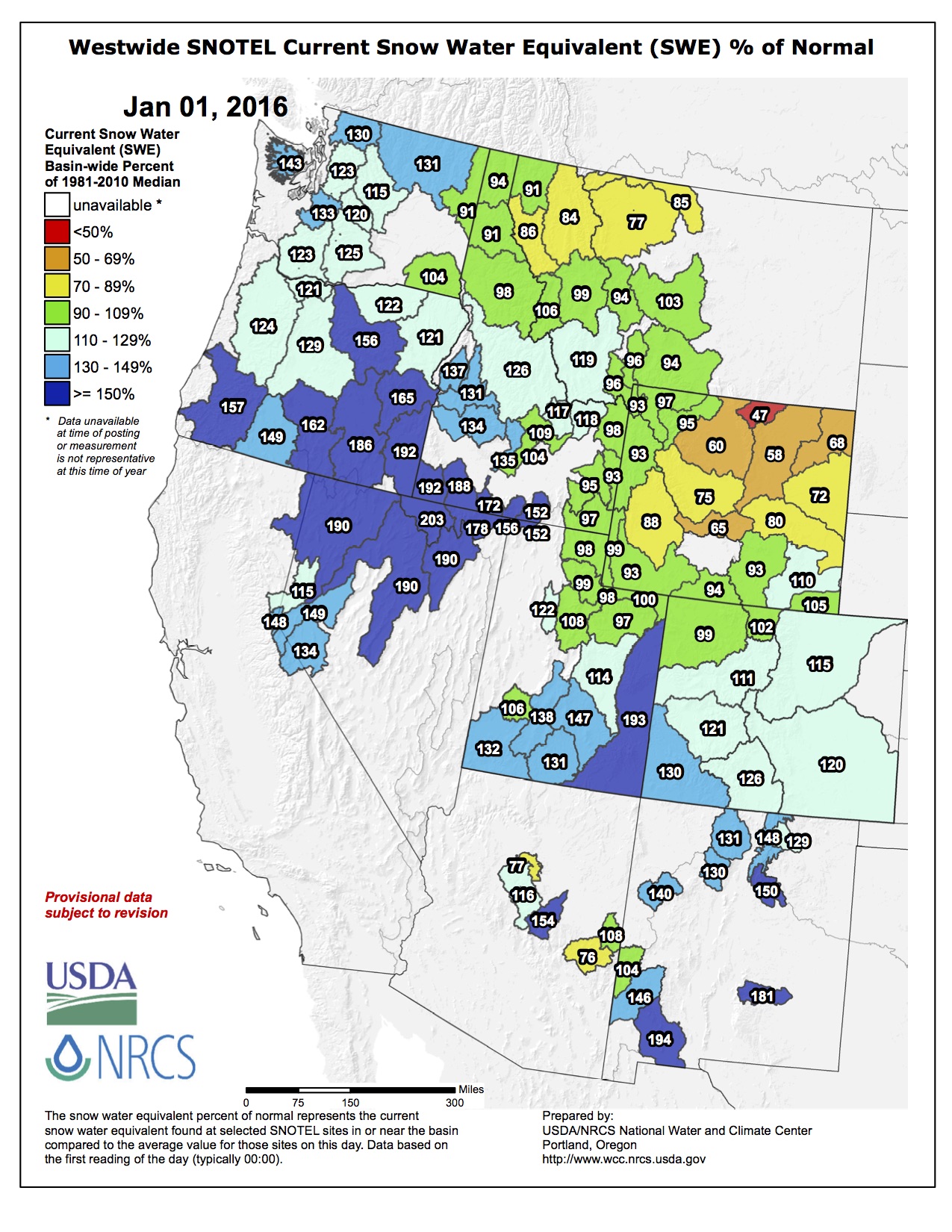
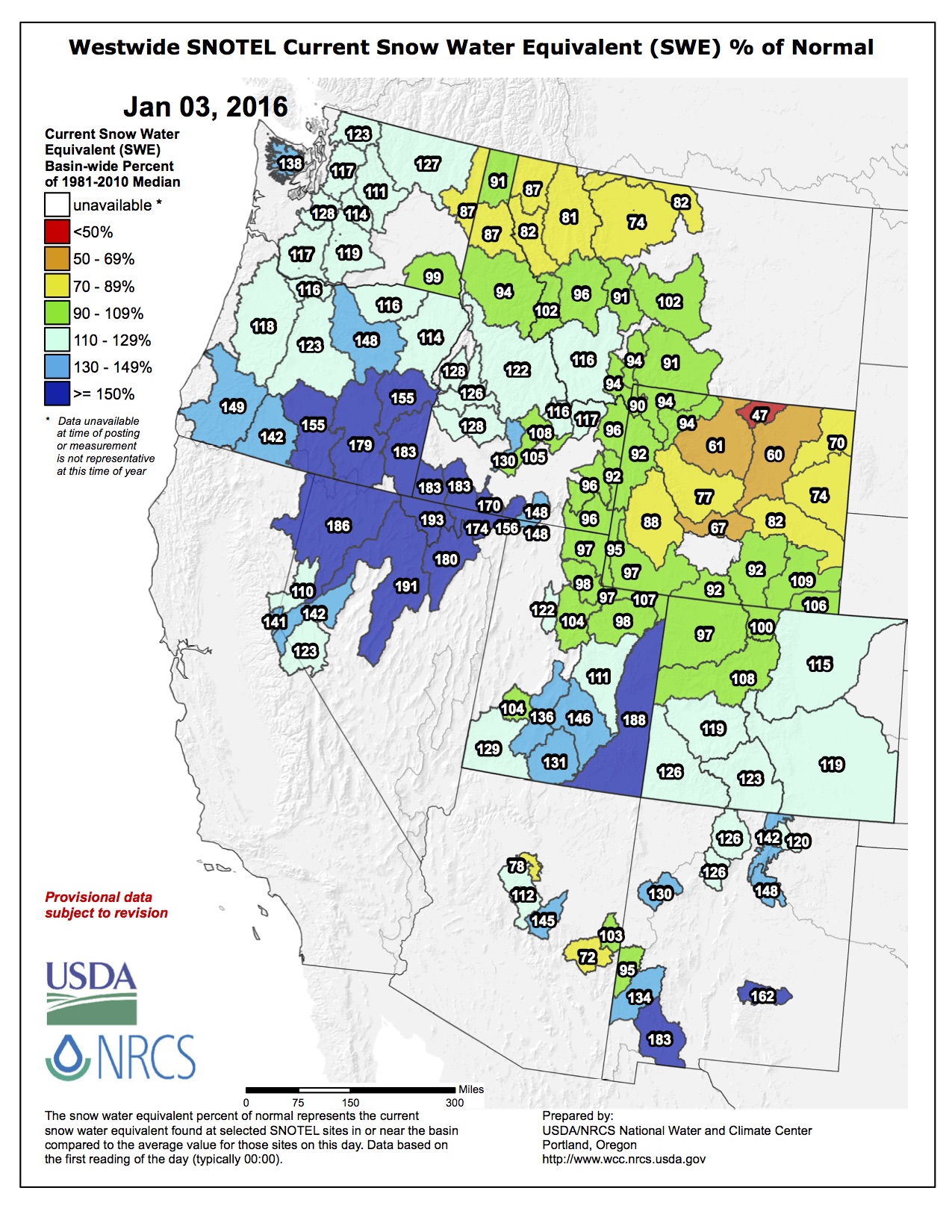
Westwide SNOTEl January 3, 2016 via the NRCS

From The Mountain Mail (Samantha Gillespie):

Salidans experienced a year of above-average precipitation in 2015, reaching 15.86 inches at year-end, and, because of continuing El Niño conditions, investing in snow tires was a good idea.

Weather experts predict “a strong likelihood” of another 3 to 4 months of above-normal precipitation, Tony Anderson with the National Weather Service in Pueblo said Wednesday.

But 2015 weather was good for Chaffee County, bringing excellent skiing conditions in time for the holidays, and Jim Aragon, Colorado Parks and Wildlife area wildlife manager, said despite making hunting more challenging, those weather conditions have been good for wildlife.

“We are currently in a very strong El Niño that should be reaching maximum intensity right about now,” Anderson said. He added conditions are expected to weaken to neutral by late spring or early summer.

Despite variations in precipitation across the state, overall Colorado saw considerably more precipitation in 2015 than in 2014…

The Natural Resource Conservation Service estimates that current snowpack is above historical averages throughout the south central and southeastern regions of Colorado.

“The current snowpack and weather patterns look promising, but we are still a long way from spring,” Anderson said.

“It is snowing in all the right places,” Aragon said, which is good for wildlife but was difficult for hunters.

From the Glenwood Springs Post Independent (Ryan Summerlin):

While El Niño has lived up to its reputation and brought plenty of storms leading into winter, meteorologists expect January and February to be drier for the Western Slope…

So far this El Niño hasn’t behaved exactly as expected, he said. Whereas El Niño storms typically blow straight west to east, coming off the deserts of the American West, the storm systems this year have come more from the northwest, blowing in from the Alaskan gulf.

Normally the storms coming from the northwest would create some good precipitation for northwestern Colorado, but they’ve largely split into two portions: one tracking into the northeastern plains and the other into southwestern Colorado.

Coming into January, Ramey said the systems seem to be straightening out into the more typical west-to-east pattern.

From the fall and into this winter, the El Niño season has been one of the strongest on record, said Ramey. And now it’s reaching its peak.

In western Colorado, El Niño seasons tend to bring a wet fall and drier winter starting in January. Heavier precipitation tends to come back around in spring.

Forecasting models are showing that weather systems are following that trend, said Ramey.

Also, El Niño seasons bring more precipitation for the southern parts of western Colorado, leaving the northwest part of the state drier.
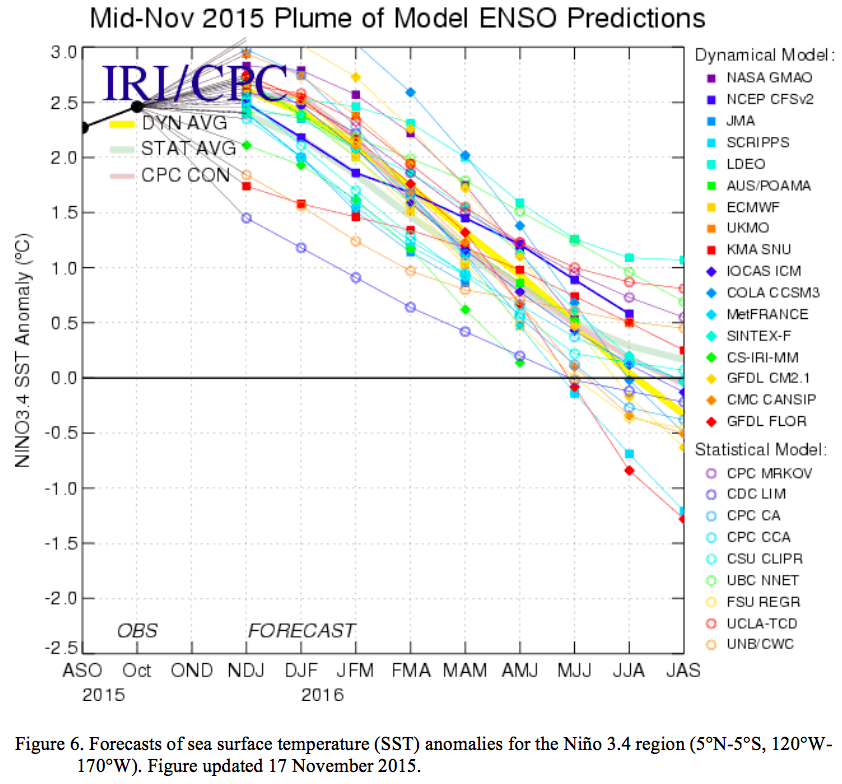
Mid-November 2015 plume of ENSO predictions from the Climate Prediction Center

From Steamboat Today (Christine Shook):

With as much as 75 percent of the water supply being derived from snowmelt, successful water planning and management of the state’s water resources begins with a comprehensive knowledge of current snowpack conditions and the ability to make informed decisions for the upcoming water year.

Since the 1930s, the Natural Resource Conservation Service has been using scientific measurements of mountain snowpack to quantify and forecast annual water supply in 12 western states. Snow surveyors from NRCS and other cooperating agencies manually collect data, such as the snow water equivalent (SWE) and snow depth, from over 1,600 snow courses several times each winter.

The SWE is the amount of water within the snowpack and can be thought of as the depth of water that would theoretically result if the snowpack melted instantaneously.

The NRCS also operates and maintains an extensive automated system that collects snowpack and climate data in real-time, called SNOTEL (SNOpack TELemetry). A variety of information collected from the two methods are available online to the public in several user-friendly interfaces, including interactive maps and report generators. The data is also translated into water supply forecasts that the NRCS State Office issues monthly from January to June in cooperation with the National Weather Service.

So, if you are wondering exactly how this year’s snowpack is measuring up, there are nine SNOTEL sites and two manual snow courses located at high elevations within the Yampa River Basin that conveniently provide us with this valuable data.

As of Dec. 29, the Yampa and White River Basins were reporting that the snowpack is 111 percent of median conditions for SWE and 93 percent of average precipitation for water year to date. The water year-to-date precipitation represents the total precipitation since Oct. 1, usually expressed in inches.

When running a comparison report, data reveals conditions are slightly behind 2014 statistics to this day. This local data can forecast annual streamflow of the Yampa River at specific points, help us operate our local reservoirs, provide input to fisheries management, manage domestic water use and flood control and much more.

Thanks to the United States Department of Agriculture NRCS systematic snowpack inventory and monitoring program, water supplies in the high country are quantifiable, and managers are able to be alerted early in the water year on whether to expect normal flows, water shortages or floods and can make plans while there is still time to take effective action.

So, whether you are planning your irrigation schedule for the upcoming season or monitoring current powder conditions on Buff Pass, real time situational data is available at your fingertips. For more information, contact your local Conservation District or NRCS field office at 970-879-3225×3 or visit http://www.wcc.nrcs.usda.gov/.

Christine Shook is a soil conservationist with the Natural Resources Conservation Service field office in Steamboat Springs.

2016 #Colorado #election: Adiós TABOR?

votingboothFrom The Denver Post (John Frank):

An organization backed by prominent Colorado leaders is moving toward ballot initiatives in 2016 to roll back the state’s TABOR spending caps and make it harder to amend the constitution…

The bipartisan organization tested support for the issues in a December statewide poll and recently began drafting ballot language for the potential initiatives as it prepares to conclude a five-month listening tour in January.

“I think people recognize that there’s a problem that needs to be dealt with … and therefore, there is more enthusiasm for a solution,” said Reeves Brown, the project’s director.

The move to eliminate the inflation-plus-population revenue limit in the Taxpayer’s Bill of Rights likely would include a provision to direct surplus money that would have gone to taxpayer refunds to certain priority areas, rather than give state lawmakers free reign to spend it…

And the desire to revamp the initiative process to amend the state constitution likely would involve two elements: a super-majority to win approval and a requirement that petition signatures come from different areas of Colorado.

The tentative proposals, organizers say, represent the areas with the strongest support among the 1,500 civic and business leaders who participated in roughly two-dozen meetings across the state and the 3,500 surveys submitted online.

Brown emphasized that the final outcome remains uncertain, but it’s clear the organization is making a push to tackle some of the most contentious political issues in Colorado, despite initially suggesting it would focus on subtle, nuanced changes…

Colorado’s top elected leaders are largely reserving judgment on the issue. In a statement, Gov. John Hickenlooper said he is looking forward to seeing the end result but “it’s too early to weigh in on potential ballot issues.”

House Speaker Dickey Lee Hullinghorst said she is waiting to see the final ballot language, but said she supports the TABOR overhaul and initiative process changes. “Only by investing in our priorities can we build for our future prosperity,” the Boulder Democrat said in a statement…

Moving forward

The one idea the group did not entertain from the start is the complete repeal of TABOR, in particular the constitutional requirement that voters approve all tax hikes. However, the project’s leader said he was surprised at the level of support for removing the revenue caps, which restrict state budget spending and provide taxpayer refunds in boom years.

“There’s an increasing percentage of the electorate (for which) TABOR is not as sacrosanct as it was to some,” Brown said.

Brown said the idea has more support among likely voters when coupled with “a prescription on how it would be spent.”

The state’s current budget situation, in which it is issuing taxpayer refunds but facing spending cuts, is a motivating factor, he said.

Chris Watney, the president at the nonprofit Colorado Children’s Campaign, applauded the move. “Having more ability to invest and more flexibility in how we do so, I do think would have a positive impact on things like education and health care,” she said.

Still, the potential ballot initiative would prove hugely controversial, particularly given the emphasis from Republicans and conservatives on protecting the TABOR limits…

The effort to change the state’s initiative process may prove just as contentious. The current system allows residents to put a constitutional amendment on the ballot with signatures from roughly 100,000 registered voters and win approval with a simple majority vote.

Building a Better Colorado is considering a requirement for a super-majority vote for new initiatives — but maintaining a simple majority to change amendments that received prior voter approval. The organization is discussing a two-thirds threshold but may put the bar as low as 55 percent.

An idea to require more signatures for constitutional initiatives is another possibility, although the poll found it didn’t get much traction among likely voters, Brown said.

2015 #COleg: State Rep. Brown to focus on South Platte storage again

continentalcongress
George Washington addresses the Continental Congress via Son of the South

From The Durango Herald (Peter Marcus):

On water, Brown is again focused on studying water storage along the South Platte River. He tried legislation last session, but it failed amid spending concerns.

“I’m going to keep pushing on that because the low hanging fruit for the Front Range is Western Slope water,” he said. “It’s easy to just send it over the hill, and we just don’t have that water to send.”

[…]

[State Senator Ellen Roberts] is also working on bills in the wake of the inactive Gold King Mine spill, in which an error by the Environmental Protection Agency caused an estimated 3 million gallons of mining sludge to pour into the Animas River on Aug. 5.

One proposal comes out of an interim water resources committee that has suggested a resolution that would encourage Congress to pass “good samaritan” legislation, which would reduce the liability associated with private entities conducting mine reclamation work.

Roberts would also like to address jurisdictional issues between states in the wake of Gold King. The incident impacted several states, including neighboring New Mexico. State agencies found it difficult to work with one another because of legal roadblocks. Roberts has proposed legislation that would eliminate some of those barriers through intergovernmental agreements.

“When minutes matter, you need a clearer pathway,” she said.

In terms of wildfires, Roberts is supporting a resolution that would ask Congress to change how it funds fire services so that it can spend more money on forest management.

The problem is that over the last several years, there has been a sharp increase in the Forest Service’s budget for fire suppression, jumping to 50 percent from as little as 15 percent 25 years ago. The agency is forced to borrow from programs that would reduce fire risk and aid prevention in order to fund suppression efforts.

“The Forest Service’s budget gets depleted with these god-awful wildfires, and so then they don’t have the money they need to actually manage the forests,” Roberts said. “It becomes a vicious cycle.”

South Platte River Basin via Wikipedia

Colorado Open Lands and Acequia Institute Complete Major Conservation Easement Project

From TaosAcequias.org (Devon G. Peña):

Colorado Open Lands and The Acequia Institute are pleased to announce the completion of a project establishing a conservation easement on the Institute’s 181-acre acequia farm in Viejo San Acacio, Colorado.

The easement will also protect water rights on the oldest ditch in Colorado. The San Luis People’s Ditch (La Acequia De La Gente) is a gravity-fed irrigation system which was dug by hand and draught horses in 1851 and later widened and extended by plow. It was eventually awarded the first adjudicated water rights in Colorado, nearly a quarter of a century before Colorado became a state.

The Acequia Institute, a nonprofit dedicated to supporting acequia research and community knowledge, purchased one of the varas, which was originally owned by Dario Gallegos, a founding member of the town of San Luis. The Institute worked to convert the property from a center pivot back to the historic flood irrigation methods practiced by acequias.

Devon G. Peña, founder of the Acequia Institute, is a leading scholar on acequia history and culture, and is a passionate practitioner of acequia irrigation. Alfalfa is grown on the property and the Acequia Institute has been working on a seed saving and exchange that focuses on re-establishing the integrity of local heirloom varieties of corn and beans.

Not only does the property support agricultural production, but it has incredible wildlife habitat as well. The Rio Culebra runs through the property and supports a blue ribbon fishery. The farm contains 77 acres of wetlands and serves as a winter concentration area for bald eagles. Located just west of the town of San Luis, near the community of San Acacio, the farm is visible to travelers on the Los Caminos Antiguos National Scenic Byway.

This project was made possible by funding from The Gates Family Foundation, Great Outdoors Colorado, and the Sangre de Cristo National Heritage Area. The Acequia Institute matched the grant with an investment of $18,000.

No End in Sight for Toxic Legacy of Abandoned Mines — FairWarning.org

Colorado abandoned mines

From FairWarning.org (Bridget Huber):

The U.S is pockmarked by thousands of abandoned mines, particularly in the Western states. Abandoned mines are the sites of tragedies every year, often from people drowning in flooded pits or shafts. Hardrock mines in the West—sources of gold, silver, uranium and other metals—also contaminate waterways with arsenic and other heavy metals. The point was dramatized in August by an accidental spill at the Gold King Mine in Colorado that sent millions of gallons of tainted water into the Animas River.

Many of these abandoned mines are on land owned by the U.S. government. But federal agencies have struggled with the problem for years, in part because some of the sites were abandoned as long as a century ago by companies that no longer exist. There isn’t even a reliable count of the number of abandoned U.S. mines, according to the Government Accountability Office, though the agency has estimated that there are at least 161,000 such sites in the 12 Western states and Alaska.

Over the last 20 years, the Environmental Protection Agency, which cleans up some large mines through its Superfund program, has completed work on 18 of the 137 abandoned hardrock mines and mineral processing sites on its list of the nation’s most contaminated sites. The Bureau of Land Management, which is responsible for a portion of the abandoned mines, says more than 80 percent of the known sites on its land require more cleanup or evaluation.

Cleanup funds are scarce because mining companies, unlike gas and oil concerns, do not pay royalties to the federal government for what they extract from public lands. In a limited move, the U.S. Bureau of Land Management in 2001 began requiring mining operators working on lands under its jurisdiction to set aside funds, called financial assurances, that could be used for cleanups, though U.S. investigators have questioned whether the assurances are adequate. A group of environmental organizations is seeking a court order that would force the Environmental Protection Agency to issue long-delayed rules requiring financial assurances from other mining companies, too.

Meanwhile, lawmakers have repeatedly tried in recent years to overhaul what they have called “antiquated” rules for hardrock mining. Current bills such as the Hardrock Mining Reform and Reclamation Act in the House and the Hardrock Mining and Reclamation Act in the Senate would allow the U.S. to begin charging royalties and other fees to help fund cleanups on federal lands.

Happy New Year from Coyote Gulch

Photo via http://mashable.com

I hope your 2016 is creative, happy, and full of love. I hope you win the Lotto (after me).

#Snowpack news: Gallery of early January snowpack maps since 2011

#Snowpack news: 2015 puts Sierra Nevada-#ColoradoRiver Basin linkage in stark relief — John Fleck

If you care about Colorado River Basin water, it behooves you to pay attention to the snowpack in California’s Sierra Nevada. It’s an entirely different watershed, but 2015 demonstrated how the interconnections in California’s plumbing have left the two inextricably linked.

The tl;dr version of two interrelated points below:

  • California’s drought has put pressure on the Colorado River, as Southern California turns east for more water to make up for shortfalls from the north.
  • Despite California’s problems, the overall Colorado River Basin is holding up – able in a subpar year on the Colorado to deliver the extra water to L.A. and San Diego while ending the year with total reservoir storage unchanged from last year at this time. The system is in a tenuous but encouraging balance.
  • Westwide snowpack map January 1, 2015 via the NRCS
    Westwide snowpack map January 1, 2015 via the NRCS

    2015: The Year We Found Out #ExxonKnew — InsideClimate News

    From InsideClimate News (David Hasemyer):

    The lengthening list of Americans calling for more investigations of ExxonMobil Corp.’s behavior on climate change includes members of Congress, three presidential candidates, dozens of climate scientists and Glenda Poliner, a San Diego grandmother.

    She was one of almost 9,000 people who signed a petition calling on California Attorney General Kamala Harris to investigate whether Exxon misled the public on global warming. Poliner, a schoolteacher who says she has a second grandchild on the way, included a note to Harris, a Democrat.

    “I almost told my daughter to not have children because they would be facing a steadily deteriorating world because of the actions of companies such as ExxonMobil,” she said in the note. “These companies must be held accountable for their misdeeds. Please continue to do everything in your power to reverse this devastation.”

    From the halls of Congress to the campaign trail to households across the nation, there is a roiling call for federal and state prosecutors to probe what Exxon knew about climate change and whether it broke consumer and shareholder protection laws in what it communicated to the public. Petitions and other public demands for investigations follow the publication of investigative stories by InsideClimate News and other news organizations that showed Exxon was at the forefront of global warming research decades ago until it launched campaigns to cast doubt on climate science and delay action.

    Exxon is already the target of a probe by the state attorney general in New York, though the inquiry was opened months before the nationwide clamor for action began. Investigators for Democratic Attorney General Eric Schneiderman subpoenaed Exxon records last month spanning four decades of research findings and communications about climate change.

    “We’re not just shouting this into the wind,” said R.L. Miller, president of the political advocacy group Climate Hawks Vote. Her organization called on U.S. Attorney General Loretta Lynch and California’s Harris to open probes into Exxon.

    Doonesbury November 8, 2015
    Doonesbury November 8, 2015