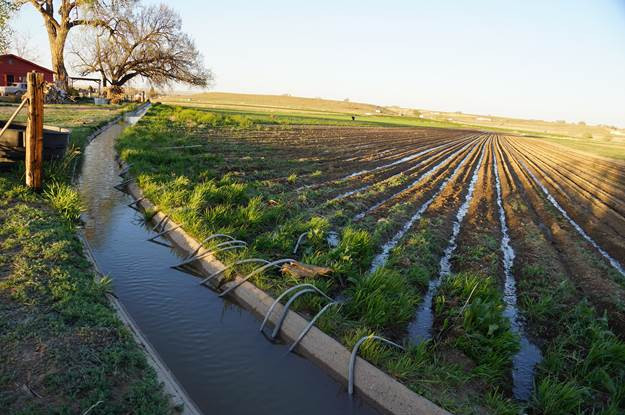
Farm operations can’t work alone. It takes collaboration to make them successful.
That was the main theme of Wednesday’s 26th annual Governor’s Forum on Colorado Agriculture, driven home by many of those who spoke at the forum, including Democrat Gov. John Hickenlooper and Republican Sen. Cory Gardner. Hickenlooper, Gardner and more than a dozen others spoke to a group of 425 farmers and ranchers from across the state at the Renaissance Denver Stapleton Hotel.
The speakers said with growth and the changing desires among consumers, the industry’s economic outlook and the unpredictable nature of agriculture, collaboration is key.
That rings true for all of agriculture, but especially in Colorado, where the industry is one of the largest in the state, said Colorado Commissioner of Agriculture Don Brown…
According to Hickenlooper, about 50 percent of Colorado’s agriculture exports are to Mexico, so collaboration through open communication with elected leaders is important when it comes to trade.
Click here to go to the US Drought Monitor Website. Here’s an excerpt:
Summary
Several weather systems moved across the contiguous U.S. (CONUS) during this U.S. Drought Monitor (USDM) week. Upper-level troughs, surface fronts, and surface low pressure systems slammed into the Pacific Coast, drenching California, Oregon, and Washington with several inches of precipitation, especially in the favored upslope areas. As they crossed the coastal ranges, the weather systems dropped above-normal precipitation across parts of the Southwest and Pacific Northwest. Tapping Gulf of Mexico moisture, a couple systems drenched parts of the Southern Plains to Lower Mississippi Valley, while another brought above-normal precipitation to parts of the Upper Mississippi Valley, but most of the Northern to Central Plains was drier than normal. Upper-level ridging in the central part of the CONUS contributed to above-normal temperatures across most of the country and drier-than-normal weather for most areas east of the Mississippi River. With persistent unusually warm temperatures across much of the CONUS, plants are responding prematurely, especially in the Southeast to Midwest. For example, as noted by the Alabama State Climatologist, plant phenology indicates that Alabama is around 20 days ahead of normal with warm soil temps (and dry soils) so that plants think it is March 12th instead of February 20th. The precipitation that fell this week continued to reduce long-term drought in California and contracted drought in the Southern Plains, but dry conditions in the Mid-Mississippi Valley, Southeast, and Mid-Atlantic expanded drought…
Central to Northern Plains
Parts of eastern Kansas measured an inch or more of precipitation this week, but only a couple tenths of an inch fell across the rest of the Central to Northern Plains with many areas reporting no precipitation. In the High Plains of Colorado, D2 expanded in Lincoln County to better reflect dryness over the last 7 days to 12 months. As noted by the Colorado Climate Center, soil moisture remains a concern for eastern Colorado as spring rains will be needed to make up for deficits during the second half of last growing season…
California
Days of heavy precipitation continued to improve mountain snowpack, but created areas of flooding, especially downstream from the favored upslope areas. As of February 21, the daily Sierra Nevada snowpack was 186% of average for the date and 151% of the April 1 climatological peak. The North Sierra 8-Station Index for February 21 showed 230% of average precipitation for this date, and the Central Sierra San Joaquin 5-Station Index for February 21 showed 230% of average precipitation for this date, both of which are above the 1982-1983 record for the date; the Southern Sierra Tulare Basin 6-Station Index for February 21 showed 223% of average precipitation for this date, which is very near the 1968-1969 record for the date. Over a foot of precipitation was reported for the week at several CoCoRaHS stations, including 16.60 inches at Honeydew in Humboldt County, 15.36 inches at Alta Sierra in Nevada County, 14.54 inches at Big Sur in Monterey County, and 13.80 inches at Monte Sereno in Santa Clara County. Santa Barbara and Ventura Counties, which have been the epicenter of drought in California in recent weeks, received much-needed rainfall. Over 8 inches of rain was reported at two stations near Santa Barbara and over 6 inches at Ojai (6.97 inches) and Thousand Oaks (6.59 inches) in Ventura County. Streams were running full which helped refill depleted reservoirs in the area. Lake Cachuma rose 24 feet in just one day, which is remarkable and most welcomed. Even though the reservoirs were responding quite favorably, they still have a long way to go before we can classify this area as drought-free. As of February 22, Lake Cachuma was at 82,011 acre-feet, or 42.4% of capacity, Jameson Reservoir was at 52.5% capacity, Lake Casitas at 42.3%, and Lake Piru at 31.7%. These values still represent a significant hydrological drought. Generally a one-category improvement to drought conditions was made from central California to the Los Angeles basin. Areas of D0-L were left in the San Joaquin Valley where wells were still in jeopardy and groundwater aquifers will take many more weeks or months to recharge. D3 was eliminated but D0-D2 were left in place along the Central Coast where the reservoirs were still below average and groundwater has yet to be recharged. D0-D2 were left in place in southern California where the precipitation was not as heavy and longer-term precipitation deficits remained. With the removal of this D3, D2 is now the worst drought condition in the state; August 6, 2013 was the last time California had no D3…
Rest of the West
Six to 10 inches of precipitation fell in the coastal areas of Oregon and Washington, with less than 2 inches in the leeward areas. Two to 5 inches were common in the mountains of Idaho, but less than 2 inches to just a few tenths occurred in the Great Basin and Four Corners states. The snow water content (SWE) at high elevation stations from California to the Central Rockies was well above average for the date; the SWE was below average at some Northern Rockies stations and stations in Arizona and New Mexico. Snowpack in the eastern Sierra slopes of southern Nevada and adjacent California continues to increase. The SWE, averaged across all snow courses in the eastern Sierra, was more than twice the normal (217%) for this time of year, and even 143% of the April 1 peak. D1 was eliminated and D0 contracted from Death Valley to Nye County in Nevada. The remaining D0 reflected long-term dryness at the 12-24 month time scales. In Colorado, D0 was pulled back from the Sangre De Cristo Range, where mountain snowpack SWE and precipitation showed generally wet conditions. A shallow snowpack with low SWE along the eastern portion on the Mogollon Rim in eastern Arizona prompted the introduction of a spot of D1…
Looking Ahead
In the day since the Tuesday morning cutoff time of this week’s USDM, a low pressure system dropped half an inch or more of precipitation across parts of California, Oregon, and the Northern Rockies, while another surface low gave half an inch to 2 inches of rain to parts of Florida, Alabama, and Georgia. For February 22-28, the western low will track across the central CONUS to Northeast, followed by a second low taking a similar track, and a third low will bring more precipitation to the West. A tenth of an inch or more of precipitation is forecast for much of the West, the Lower Mississippi Valley, and parts of Florida, with 1 inch or more along the west coast, Central Rockies, and in a band from the Central Plains and Ohio Valley to the Northeast. Up to 3 inches of new precipitation may fall in the D1-D2 area of southern coastal California and the Sierra Nevada, with up to 2 inches in parts of the Midwest to Northeast. Little to no precipitation is forecast for the Northern and Southern Great Plains and parts of the coastal Southeast. A trough west/ridge east pattern should keep temperatures cooler than normal in the western CONUS and warmer than normal in the east. For March 1-8, the odds favor drier-than-normal conditions from the Southwest to Central Plains, most of Alaska, and parts of Florida, and wetter-than-normal conditions along the northern Alaska coast, the northern tier states in the CONUS, and most of the country along and east of the Mississippi River. Odds favor cooler-than-normal weather across Alaska and the western CONUS, and warmer-than-normal weather across the eastern half of the CONUS as well as the Southern Plains.
Storm drain and open channel improvements between the East Rail Line (38th & Blake Station) and the South Platte River (Globeville Landing Outfall), Stormwater detention/conveyance between the East Rail Line (38th & Blake Station) and Colorado Blvd, (Montclair Basin) Stormwater detention/ conveyance immediately east of Colorado Blvd. (Park Hill Basin).
Rafael Espinoza opposed a series of big flood-control projects planned by Denver city officials as a city councilman — by voting last June against steep increases to storm drainage and sewer fees that are helping to pay for the work.
Now Espinoza has found a new way to voice his misgivings about one of the controversial projects. He was one of several residents who asked a judge’s permission late Tuesday to be added as plaintiffs to an ongoing lawsuit challenging the city’s plan to reshape much of City Park Golf Course. The city wants to create a storm water detention area on the course’s western portion that would fill up during heavy storms but remain part of the course.
Essentially, the councilman wants to sue his own city over the project — if a judge lets him.
“I voted against this (fee) increase because it missed the opportunity to not only address the stormwater drainage problems of District 1, but of the entire city,” Espinoza said in a statement Tuesday. “Instead, this project misappropriates the use of the public good to focus on a flood plain that directly eases the development of the I-70 Ditch at the expense of a more comprehensive citywide solution.”
A motion filed late Tuesday by attorney Aaron Goldhamer, who has pressed the lawsuit since last year, says a city attorney has indicated to him that the city plans to oppose only the addition of Espinoza as a plaintiff. The two sides disagree on whether a legal concept called “government deliberative privilege” prevents a sitting councilman from joining such a lawsuit, the filing indicates.
Espinoza and many critics of the city’s Platte to Park Hill storm water projects — estimated to cost $267 million to $298 million — have based their opposition in part on the link to the state’s $1.2 billion Interstate 70 plan.
After hearing dozens of public comments, and having their email inboxes flooded with input, the council voted 6-1 late Tuesday night to take a place at the table with the Northern Water Conservancy District, the lead proponent of NISP and representative of 15 backers of the project. NISP would include two reservoirs fueled by the Poudre River, including one near the mouth of the Poudre Canyon.
Council members were also clear that they didn’t view opening discussions as giving in to the project. Councilman Bob Overbeck — the only vote against it — added to the Tuesday resolution that the council outright opposed the project in 2008 and voted in 2015 not to support the project in its current form. The word “negotiate” and phrase “mutual interests,” referring to the city and Northern Water, were also struck from the resolution.
Nonetheless, Gary Wockner, of Save the Poudre, said his group is looking at putting the question of whether the city should support NISP before city voters…
Advocacy group Save the Poudre conducted an opinion poll, via 556 automated phone calls, which results found an overwhelming amount of opposition to the project among city voters.
About 50 of the 60 or so people who made public comment Tuesday opposed the resolution or NISP outright…
John Stokes, head of the city’s natural areas department, said Wednesday staff was happy to get more direction from council, in terms of having discussions with Northern Water regarding city concerns and mitigation proposals. He was also clear that staff didn’t view it as authority to make any decisions regarding the city’s support or efforts of NISP.
“Council makes the decisions about all of this, and, clearly, if we’re going to make any progress on this, it needs to be with council on board,” he said…
Brian Werner, spokesperson for Northern Water, said his group was grateful to be able to have more robust conversations about NISP with the city. There have been some talks with the city about its concerns, but it always felt “sort of like walking on egg shells,” without formal backing, Werner said.
He noted Northern Water and its constituents have already shifted plans to address concerns about low-flow periods of when the Poudre River might dry up by including promises of base flows. Werner cited the city’s softening positions between 2008 and 2015 as proof of Northern Water’s efforts.
“They’ve gone from an almost hell no, to a we’re not happy right now, but maybe make some changes and come back with another proposal,” Werner said. “… I would argue that shows we’ve been listening to Fort Collins as we’ve been trying to craft and draft this plan.”
Update: The council adopted an amended version of the resolution with a 6-1 vote. Bob Overbeck was the only dissenting vote.
The Fort Collins City Council discussed Resolution 5217, which would begin discussions with the Northern Colorado Water Conservancy District, a public agency which provides water to northeastern Colorado, on Tuesday. The discussion revolved around a controversial proposal known as the Northern Integrated Supply Project.
The NISP is a proposed project meant to deliver 40,000 acres of water a year to 15 Northern Colorado communities. While the city itself would not a participate in the NISP, a portion of southeastern Fort Collins would partake in the project.
The NISP would consist of three reservoirs along the Cache La Poudre River, including a large reservoir to the north of the city known as Glade Reservoir which would divert over 1,200 cubic feet per second of the river’s peak flows. This would reduce annual river flows by 20 percent and by 30 percent during the peak flow months of May, June and July, a staff report said.
However, the project is not without opposition. According to non-profit organization Save the Poudre, the NISP/Glade Reservoir project would cause immense ecological damage to the Poudre River.
According to the organization’s website, the project’s aim of reducing peak flows would prevent the river from cleaning itself of algae, endangering the Poudre’s water quality as well as the habitat of a number of aquatic plants and animals.
The staff report also acknowledges that “it is likely the health of the river will be negatively impacted by NISP, especially without well-planned and extensive mitigation actions.” The report states that although the river is able to support a number of ecological systems, the Poudre is approaching “critical thresholds below which the river’s health and resilience will suffer.”
The city’s Natural Resources Director John Stokes recommended the City Council to begin discussions with the Northern Colorado Water Conservancy District. In particular, he recommended to negotiate with the public agency, saying it would be the best alternative outcome.
If the city were to forego consulting with Northern Water the project would be left to federal and state agencies who would not consider the NISP’s impacts on Fort Collins.
Close to 40 Fort Collins citizens approached the council for public comment, some urging the council to negotiate with Northern Water and some voicing their reservations.
“I’ve noticed a marked decline in the river corridor already… I see virtually nothing anymore,” said one Fort Collins citizen about the current state of the Poudre.
The city owns around 60 percent of the river’s corridor and the city has already engaged in a number of projects with regards to the Poudre, such as clean-ups and the creation of trails.
Negotiations with Northern Water does not mean that the city has already agreed to the NISP’s construction. In order to construct the reservoirs a permit must be obtained from the U.S. Army Corps of Engineers who must assess the environmental impacts of the project.
The NISP has been in the federal permitting process for 12 years and thus requires many state and federal permits in order for the project to push forward. In 2015 the council passed a resolution which stated “the City Council cannot support NISP as it is currently described and proposed (as of 2015).”
In January the Colorado Water Conservation Board granted the Upper Gunnison River Water Conservancy District (UGRWCD) and partners $175,000 to begin local watershed management planning efforts. The funding will support the gathering of baseline information, initial stakeholder outreach, and future needs assessments in three Upper Gunnison tributary basins from 2017 to 2020.
The goals of the Upper Gunnison Basin Watershed Management Plan are to protect existing water uses and water quality, and improve relationships between different water users. The plan also seeks to understand whether there are gaps between available water and future uses, and how to best manage that water moving forward. Water experts predict that the Colorado population will rise exponentially, putting more stress on the Front Range’s limited water supply and thus the Western Slope, and changing temperatures will reduce water availability.
The planning framework developed by the UGRWCD includes needs identified in the Colorado Water Plan, but also focuses on agricultural and municipal uses. Irrigated hay and pasture meadows have rights to approximately 95 percent of the basin’s water resources. “Our planning process distinguishes between ‘watershed management’ and ‘stream management,’” explained UGRWCD board member and outreach coordinator George Sibley.
“’Stream management’ in the Colorado Water Plan focuses almost entirely on environmental and recreational needs. Watershed management covers our interactions with all of the water resources in the entire watershed, including groundwater, and water removed from streams for human purposes,” said Sibley…
Gunnison River watersheds encompass over 8,000 square miles of western Colorado and are critical headwaters of the Colorado River. “The Upper Gunnison River Basin is a headwaters basin, which means it is not yet really a river, but many flows of water becoming a river. Most of those streams organize themselves into seven main watersheds, each unique in its natural and human cultural geography,” said Sibley…
Locally, the assessments will begin with the Ohio Creek, East River and Lake Fork watersheds, providing a framework for the other four watersheds over the next four years.
Each watershed study begins with a needs assessment inventory of known and anticipated needs stretching out to mid-century from industry, recreation, agriculture, and human settlements in general—while subsequently identifying areas with significant environmental concerns.
The studies will seek to understand ecosystem function needs, river flows, infrastructure in need of improvement, water quality impairment issues, and ensuing legal frameworks. This first phase will also address information gaps and develop pilot projects to demonstrate best management practices. Pilot studies and demonstration projects in each watershed will look at options to reconcile instream and diversion needs. Potential demonstration projects include ditch repair, stream channel reconfiguration, wetland enhancements, coordination irrigation or other conservation practices.
The UGRWCD will be the coordinating agency for the watershed management planning processes, working with other water-related agencies and organizations within the Upper Gunnison Basin, including but not limited to the Gunnison County Stockgrowers Association, the seven municipal/domestic water suppliers in the Upper Gunnison Basin, Trout Unlimited, High Country Conservation Advocates, the Coal Creek Watershed Coalition, the Lake Fork Conservancy, recreational organizations, and federal and state land management agencies.