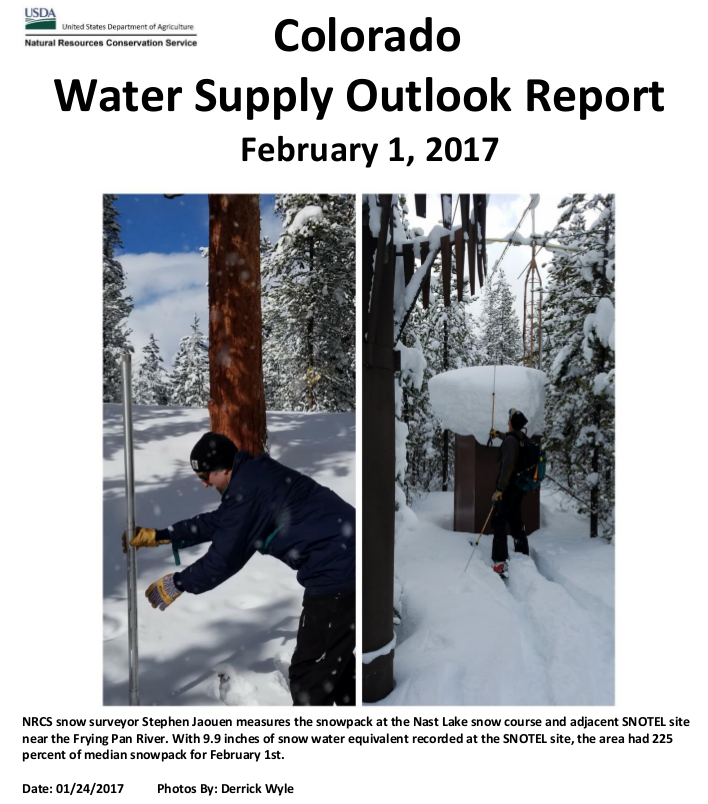
Click here to read the report.
Here’s the February 1, 2017 basin-filled snowpack map.
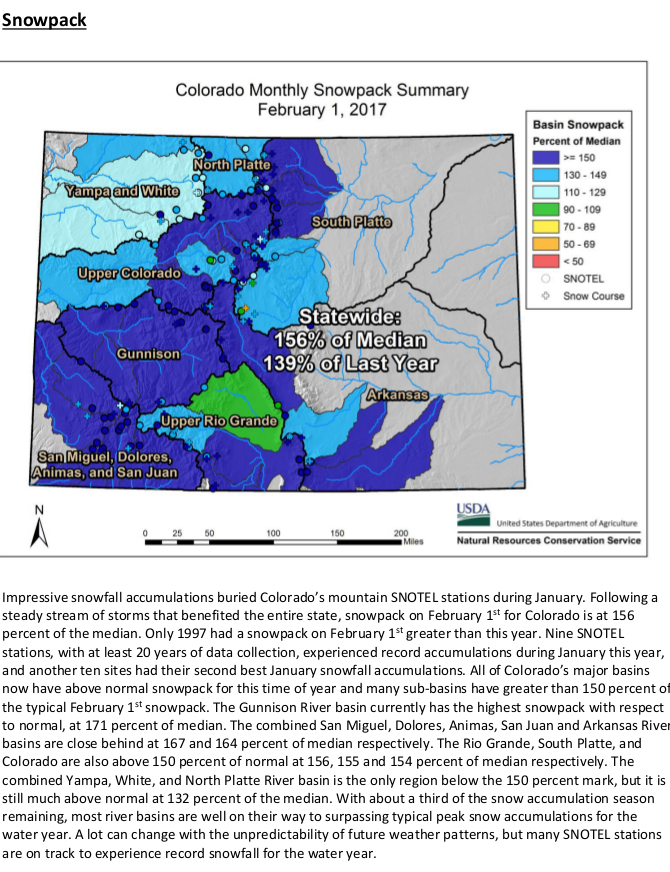
Here’s the February 1, 2017 basin-filled streamflow forecast.
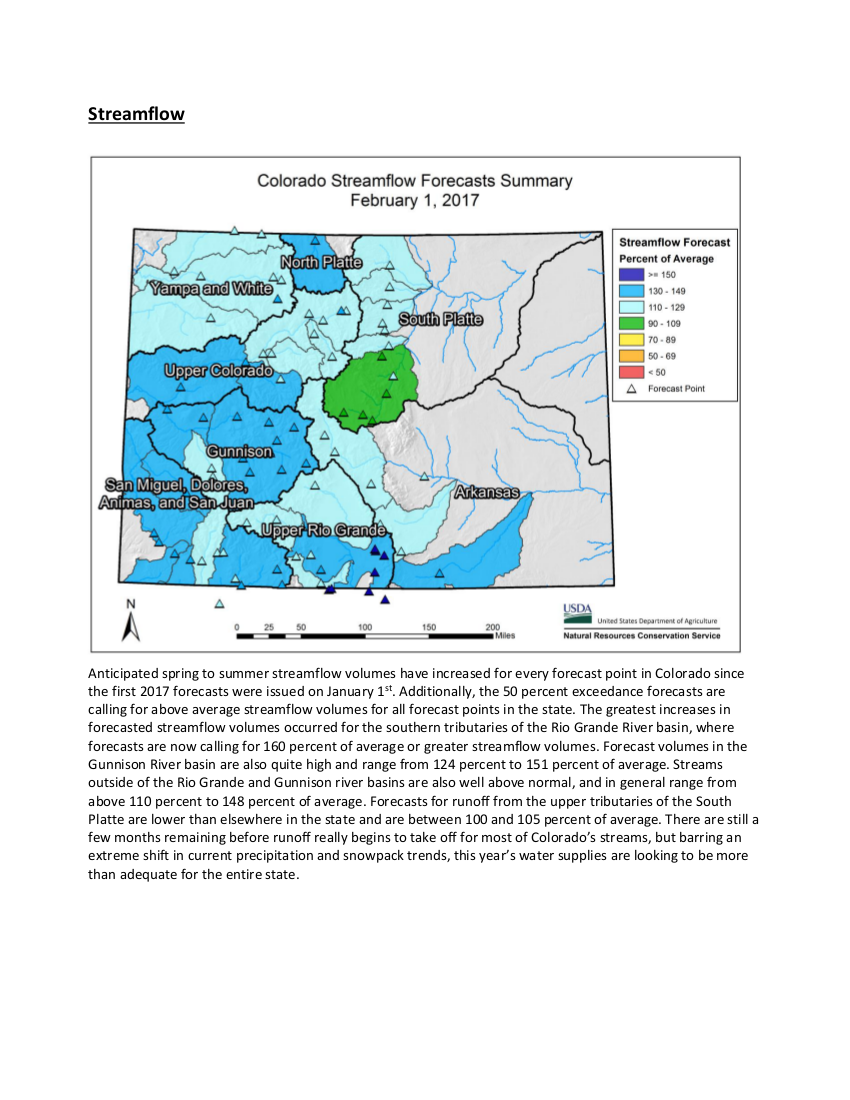

Click here to read the report.
Here’s the February 1, 2017 basin-filled snowpack map.
Here’s the February 1, 2017 basin-filled streamflow forecast.
Click here to read the newsletter. Here’s an excerpt:
Justin Ramsey Takes Over as PAWSD Manager
In January 2017 the PAWSD Board of Directors promoted Justin Ramsey to District Manager, replacing Renee Lewis. Mr. Ramsey had served as the District Engineer since May 2015. He has over twenty years of water and wastewater design and construction administration experience. Mr. Ramsey has a Bachelor’s of Science degree in Environmental Engineering and a Masters of Engineering in Civil Engineering both from Northern Arizona University. He is a registered professional engineer in four states and has designed and overseen the construction of water and wastewater treatment, conveyance and disposal facilities throughout the southwest.
Prior to coming to PAWSD, Mr. Ramsey lived and worked in Arizona and sat on the City of Flagstaff’s Water Commission where he reviewed and provided recommendations on a variety of utility assessments including capital improvement project budgets, inflow and infiltration studies, water leakage studies, rate studies and energy audits. Mr. Ramsey has also consulted with multiple regulatory agencies to provide training, develop regulations and represent agencies in a variety of venues. Congratulations, and welcome!

From the E&E News (Jeremy P. Jacobs):
[The new President’s] rocky relations with Mexico could have major consequences for the Colorado River and the 35 million Americans who rely on it for water…
A bilateral agreement specifies exactly how much water Mexico receives, as well as other important factors like how those deliveries are reduced in years of exceptional drought.
It is set to expire this year.
The seven Colorado River Basin states — and particularly Lower Basin states Nevada, Arizona and California — say it’s pivotal that the new administration finalize a new agreement.
But many are now worried that U.S.-Mexico relations have already deteriorated to the point where that may be impossible.
“The events of this week make me more apprehensive about the prospects” of reaching a new agreement, said Anne Castle, a former assistant secretary of the Interior for water and science during the Obama administration.
She said a challenge for the new administration is separating the Colorado River issues between the United States and Mexico, which Castle described as a “win-win,” from other binational issues.
“There seems to be a demonizing of Mexico in general that is becoming more difficult to overcome,” she said.
A 1944 treaty between the two countries requires the United States to deliver 1.5 million acre-feet of Colorado River water to Mexico annually. It said that amount can be reduced during times of exceptional drought, but it did not define what an exceptional drought is, or how much those deliveries could be curtailed during one.
Amendments to the treaty have since clarified. The current one, 2012’s Minute 319, laid out those terms. It tied the deliveries to the volume of water in Lake Mead behind the Hoover Dam, America’s largest reservoir and the primary storage facility for the Lower Basin states. It also allowed Mexico to store water in Lake Mead.
Minute 319 expires at the end of 2017, which has led to negotiations over a new amendment commonly referred to as Minute 32x.
All parties in the Colorado River Basin say it is critical that Minute 32x be finalized. It would again set the terms of water delivery and define exceptional drought.
That’s particularly important now because the basin is in the midst of a 17-year drought. Further, scientists estimate there is a 50-50 chance that Lake Mead will drop below an elevation this year that would trigger drought contingency conditions along the river, including reduced deliveries.
Defining those terms with Mexico and allowing it to store water in Lake Mead — which would help keep the lake above the 1,075-feet elevation trigger point — are critical. The Obama administration worked hard to finish the negotiations but ran out of time, Castle said.
Then, last week, [the new President’s] relationship with Mexico got off to a shaky start. Mexican President Enrique Peña Nieto canceled a planned meeting over [the new President’s] plan to build a wall between the two countries amid suggestions that Mexico would pay for it through a 20 percent import tax on Mexican goods.
Since [the new President’s] election, Mexico has also replaced its foreign minister and U.S. ambassador, both of whom had been intimately involved in the Minute 32x negotiations.
Those developments have alarmed key Colorado River players.
“Reports the last couple days are not the kind of footing that you would expect to provide a really good foundation for these talks,” said James Eklund, director of the Colorado Water Conservation Board.
Failure to finalize Minute 32x would have important consequences.
Tom Buschatzke, director of the Arizona Department of Water Resources, said the current minute proposal would define Mexico’s shortages in a drought and make them proportional to how much Arizona must curtail its use. Arizona relies on the Colorado River for about 40 percent of its water.
“There are many, many terms of Minute 32x that are hugely beneficial to the state of Arizona,” he said. “This is a very positive thing.”
If there is no new agreement, several problems could occur. For example, if Lake Mead hits the 1,075-feet trigger, the United States could decide unilaterally to begin reducing the amount of water that reaches Mexico. Such a decision could have “broad geopolitical implications,” according to a white paper from the Colorado River Future Project based on interviews with 65 key players that was released shortly before the election.
Salton Sea a sticking point
There are other Colorado River issues on which the Trump administration needs to play a leading role, observers say.
Before Minute 32x can be finalized, the seven basin states — and particularly the Lower Basin states — need to finalize a drought contingency plan, or DCP, for what happens if and when Lake Mead drops below 1,075 feet.
The Obama administration worked toward finalizing that document but similarly came up short. If an agreement isn’t finished, the stage could be set for litigation and conflicts between the states if Lake Mead drops.
Recently, California’s largest lake, the Salton Sea, has become a sticking point in the DCP negotiations.
The Salton Sea lies in the Imperial and Coachella valleys in the southeast corner of the state. The lake was once a tourist hot spot, but a complicated 2003 water transfer from the agricultural area surrounding the lake to San Diego has significantly reduced inflows to the lake, causing it to dry up.
As the lake has receded, it has exposed a massive lake bed that emits toxic dust during windstorms, creating a major public health risk. And under the terms of that agreement, water flowing into the lake will again be reduced by the end of 2017.
At the time of the agreement, California vowed to take action to address those public health concerns. In nearly 15 years, however, it has done very little (Greenwire, June 13, 2016).
Agricultural water that eventually flows into the Salton Sea comes from the Colorado River. And the Imperial Irrigation District, or IID, which represents those users, is a major player in the DCP negotiations because its users have water rights to 3.1 million acre-feet of the river’s water. That’s more than all of Arizona…
IID says it won’t sign onto a DCP until it sees a plan from the state to address air pollution at the Salton Sea.
“For IID to take part in a DCP for the Lower Basin,” said IID General Manager Kevin Kelley, “we’re going to have to know that we’ve got a coherent going-forward plan for at least the next 10 years.”
California is working to come up with such a plan, according to state officials. But a big problem is cost. California has set aside about $80 million for mitigation efforts in its most recent budget, and the Obama administration pledged another $30 million before leaving office.
But most expect mitigating the likely 38,000 acres of exposed lake bed to cost at least $1 billion.
That has put IID and the Salton Sea in a critical position for progress on the Colorado River.
“The Salton Sea went from being an issue that was on the back burner for a lot of people to the front of the line,” said Douglas Kenney, director of the Western water program at the University of Colorado’s Getches-Wilkinson Natural Resources Law Center.
“It went from this quirky, very isolated issue to being front and center.”
Despite Trump’s rough start with Mexico, some still see causes for optimism. They note that water should be a nonpartisan issue, and that even the Israelis and Palestinians cooperate when it comes to managing water in the Middle East.
“The shift in politics doesn’t change the fact that the reservoir system in the Colorado system is half-empty,” said Jennifer Pitt of the National Audubon Society, who has been a key player in Colorado River negotiations for years.
“What gives me confidence that there will be a path forward is there are seven states that really would like to see this sort of continued collaboration with Mexico in increasing the reliability of Colorado River water supply.”
For many key players, though, there have been few hints from the new administration about what role it will play.
“The bigger question in the Colorado Basin for a lot of people is not a concern that a [new] administration would come in and try to push some strong agenda, but that the administration might just disappear on Western water issues,” said Kenney.
He noted that the Obama administration was very active in trying to broker these agreements.
“What if that just goes away?” he asked.
Here’s the release from ConjoStudios, LLC:
We are well into the new year, and I wanted to give you a quick update on screening events for Thirsty Land. I will be attending the following events this week. Please let me know if you’re interested in scheduling a media interview.
Feb. 7, 7:00PM – Monte Vista, CO – Vali 3 Theater – Sponsored by Colorado Potatoes, the Rio Grande Water Conservation District and the Monte Vista Co-op. All ticket and concession proceeds for the night will go directly to supporting the Vali 3 Theater. Feb. 8, 2017, 5:30PM – Ft. Collins, CO – Colorado State University – Lory Student Center Theatre, Central Avenue Mall, Fort Collins, CO. Sponsored by the Colorado State University Water Center. Join me for a Reception and Meet & Greet at 5:30; we’re also expecting Pat & Sharon O’Toole from the Ladder Ranch to attend. Film screening at 6:30PM This is a FREE EVENT! Feb. 9, 2017, 6:00PM – Laramie, WY – University of Wyoming – Berry Center Auditorium 1000 East University Ave. Laramie, WY Film screening & Q&A sponsored by the Graduate & Undergraduate Students in Hydrology. The O’Tooles have also planned on attending this event. Future events coming up:
Feb. 24, 2017 – Las Vegas, NV – Family Farm Alliance Conference
Screening sponsored by the Family Farm AllianceApril 6, 2017 – Manhattan, KS – Kansas State University June, 2017 – Fresno, CA – AgChat Western Regional Agvocacy Conference

From the Fairplay Flume (Lynda James):
The Colorado Department of Public Health and the Environment required additional monitoring activities after 1,4 dioxane was found in a monitoring well…
According to County Administration Officer Tom Eisenman, CDPHE is requiring one more groundwater monitoring well in addition to the four currently on site.
A revised monitoring plan is due to CDPHE by the end of March.
Neighboring residents were notified last December by BLM that dioxane was found in one monitoring well.
The BLM stated in a memo to the county that CDPHE said the level found at the landfill was too low to cause health problems.
Eisenman said the surrounding groundwater wells on 12 private properties were tested.
One tested positive for dioxane, so a second sample was pulled as well as on an adjacent property’s well. Those results haven’t been received.
Eisenman said the county is providing water to the residents whose well was positive and currently working on a cost analysis of various options to provide a permanent solution for these residents’ well, at the county’s cost.
Landfill historyAccording to BLM, the landfill was operated from 1967 to Oct. 1993.
According to CDPHE, the closure plan met state requirements at the time it was approved. Since then state regulations have changed.
Waste was deposited into unlined trenches that were about 20 feet deep and regularly burned, according to Doty and Associates, the county’s consultant for the landfill post-closure requirements.
Located in Golden, Doty is an environmental, groundwater and waste management engineering firm.
Eisenman told The Flume that two groundwater monitoring wells were installed in 1991, both several hundred feet from the landfill trenches. They are LF-1 and LF-2 on the adjacent map.
The following history was taken from a 2014 Doty report.
A compliance advisory from CDPHE in 2004, stated the county needed to report groundwater monitoring. In 2006, one sample was tested and contained several volatile organic compounds.
Another advisory sent in 2007, stating groundwater monitoring needed to be implemented and based on the 2006 sampling, explosive gases needed to be identified.
When the state didn’t receive a response from the county, CDPHE conducted a site visit in 2013 and sent a third memo in 2014.
That led to digging excavation test pits both in the landfill and adjacent to it in 2015.
Because gas measurements at the pits showed the landfill is still generating gases, the state is now requiring the installation of gas probes.
The state also required more groundwater monitoring wells in the 2014 memo and implementation of a groundwater monitoring plan.
Doty developed a monitoring plan and two additional wells, LF-3 and LF-4R, were installed by BLM in early 2016.
All four wells were sampled three times in 2016, starting with the second quarter of the year and dioxane was detected in LF-2 and LF-3 in the fourth quarter, according to documentation from CDPHE.
The Flume’s request for copies of the landfill laboratory results was denied by the county.
Eisenman said the county is financially responsible for installing the gas probes and another groundwater monitoring well plus any remediation that is necessary.
According to an online article by Geosyntec Consultants, a world-wide company with two Colorado offices, dioxane removal is very complex and most treatments don’t remove it.
The article stated the process used at one site in Colorado is an advanced oxidation process.
“It has the capability to reduce the dioxane concentration to non-detect levels under the right conditions, but this is likely not achievable for many groundwater matrices,” the article stated.
Advanced oxidation process can include processes using ozone, hydrogen peroxide and/or ultraviolet light to break dioxin into other benign substances.
Research is ongoing regarding the best way to remove dioxane.
The good news
According to the Doty report, the geology in the area indicates that the groundwater found in the monitoring wells are in moraine deposits that were left after glaciers retreated.
These deposits have varying sizes of boulders, cobbles, gravel, sand and silt, usually without any cementing as found in other formations such as sandstone, shale or limestone.
Water can travel through moraine deposits easily.
The report states that the groundwater appears to be a perched aquifer underlain with a reddish clay, probably from a weathered Minturn formation which is a red siltstone.
The clay keeps the groundwater from moving downward, confining it to the depths of the moraine deposits. In the area, the moraine deposits range from 80 to 134 feet.
Aquifers below that may not be contaminated.
Eisenman said the monitoring wells are about 150 feet deep and most private wells in the area use an aquifer at around 250 feet.
The following two sections were obtained the Environmental Protection Agency and National Library of Medicine websites.
What is dioxane?
Dioxane is a synthetic heterocyclic organic compound. This means it is a manmade chemical that contains carbon, hydrogen and oxygen molecules that are connected in a circular pattern.
Dioxane is classified as an ether. It is a colorless liquid with a faint sweet odor. It is flammable; it mixes with and migrates quickly through groundwater.
Dioxane can degrade in the atmosphere into other harmless substances through photosynthesis. But that takes several days.
Health effects of a short term, high dose exposure include nausea, drowsiness, headache, and irritation of the eyes, nose and throat.
Chronic exposure can cause dermatitis and damage to the liver and kidneys. It is considered a possible carcinogen.
The BLM press release stated that according to CDPHE, the amount found in the Park County landfill monitoring well was not high enough to cause health hazards.
Currently, there is no EPA drinking water standard for dioxane. In 2012, EPA established a lifetime health advisory of 0.2 milligrams per liter in drinking water.
Colorado has adopted an interim groundwater quality cleanup standard of .35 micrograms per liter…
Dioxane uses
Dioxane is used as a solvent in paint and varnish removers, a corrosion inhibitor in chlorinated solvents, a purifying agent in the manufacture of pharmaceuticals and is a by-product in the manufacture of polyethylene terephthalate plastic.
It is used as a wetting and dispersing agent in the textile industry.
Traces may exist in food supplements and food containing residues from packaging adhesives or on food crops treated with certain pesticides.
Dioxane can be an impurity in antifreeze and aircraft deicing fluids and in some consumer products, such as deodorants, shampoos and cosmetics.
Although now a relic of the past, wood-stave piping remains an admired piece of water history in Denver.

From The Durango Herald (Jessica Pace):
Board President John Porter and Vice President Steve Fearn, representatives of Montezuma and San Juan counties, respectively, were voted off the board by commissioners in their respective counties.
Fearn, a prominent longtime coordinator of the Animas River Stakeholders Group, has represented San Juan County on the water conservation board since 1990 and served as vice president since 2007.
But San Juan County commissioners said Fearn’s representation no longer reflects county values, which have changed significantly since Silverton’s mining days to include more recreational interests with respect to water, county attorney Paul Sunderland said…
Commissioners voted to appoint Charlie Smith, part-time Silverton resident and eight-year general manager of the Lake Durango Water Authority, as Fearn’s replacement.
“Commissioners thought Charlie Smith would better represent San Juan County,” Sunderland said. “He has a lot of water expertise, and he’s probably more in tune with the wants of the current board. Historically, San Juan County has been largely dominated by mining interests, and Steve Fearn is very much associated with those interests, but the board’s interests have shifted more toward recreation.”
The fact that the state of New Mexico named Fearn in a lawsuit as a “potentially responsible party” for mine pollution in the Gladstone area was noted in the county’s decision, Sunderland said.
“It’s definitely something we’re aware of, given his ownership interests around Gladstone,” he said…
The board consists of nine members representing Archuleta, Dolores, Hinsdale, La Plata, Mineral, Montezuma, Montrose, San Juan and San Miguel counties. Board directors can serve an unlimited number of three-year terms.
“I want to make sure the county’s views are represented,” Smith told The Durango Herald. “I have an understanding of their water rights, and a lot of work needs to be done to secure those rights and make sure the uses align with what the county envisions.”
Montezuma County commissioners selected Don Schwindt to replace Porter, who was general manager of the Dolores Water Conservancy District for 22 years and a Southwestern board director for 26.
Schwindt is a director on the Dolores Water Conservancy District board and a critic of the Dolores National Conservation Area, a controversial proposal in Montezuma County to congressionally protect land and water along the lower Dolores…
Porter thinks the proposal, criticized by Montezuma County commissioners, influenced his removal. Under Porter’s leadership, Southwestern Water Conservation District contributed funds to hire a water attorney to rewrite draft National Conservation Area legislation, which Porter thinks was perceived as support for the bill.
“I perceived the funding as an effort so everyone involved knew all the problems, the facts on both sides and could intelligently make a decision,” Porter said. “I think Southwestern’s involvement was perceived by others that we were very much in favor of the NCA legislation. That had something to do with it, and the fact that I’m 80-plus, and my 26 years on the board.”
Montezuma County Commissioner Larry Suckla said the commission chose Schwindt because of his water knowledge, and the conservation area proposal did not play a part in the decision.
“Don has shown ways that he would save water and retain water for farmers and ranchers,” Suckla said. “John Porter is an icon for Montezuma County. He was involved in the management of the lake (McPhee Reservoir), and all the benefits the county has received from that is because of the work he did, but it felt like it was time for new eyes.”
When Porter joined the board in 1990, he said water storage and dam construction were the district’s primary focus, including such projects as Lake Nighthorse. But gradually, the focus broadened to consider recreational water use and water quality.
Porter refers to his tenure as a career highlight, and said the importance of inter-basin relations and dialogue will only increase as time goes on, water supply dwindles and population grows.
“You’re asking someone who’s biased, but I’ve always felt that the Southwestern board tried its very best to represent all interests,” Porter said. “True, the majority of the members, including myself, were and still are agriculture-oriented. Yet to me, as Colorado’s population grows, it’s inevitable that our water supply will be drying up agriculture. And that’s not in our best interest, but I don’t see a way of satisfying municipal needs that we’re going to have without drying up some ag use. Irrigation takes a lot of water, and just that amount converted to municipal use will take care of a lot of families in an urban situation.”

Here’s a guest column from Paul Bruchez that is running in Steamboat Today:
A few years ago, I saw an opportunity to fix the irrigation problems while also improving river and wildlife habitat. My family’s ranch is in one of the most intact traditional agricultural communities remaining in Colorado. Like most ranchers, we’re independent folks — but in a pinch, we know we can count on each other.
Our neighbors came together and agreed on the need for action. Our group of 11 private ranches and the Bureau of Land Management, the irrigators of lands in the vicinity of Kremmling, received a couple of grants for a pilot project to restore a riffle/pool structure on a stretch of the river. It was an exciting start.
But I quickly realized that, given the scale of the problems, we needed to think bigger.
We worked with a variety of partners — Trout Unlimited, American Rivers, the Colorado Basin Roundtable, the Colorado Water Conservation Board, Grand County government, Northern Water, Denver Water, Colorado Parks and Wildlife, the Upper Colorado River Alliance, the Colorado River District and other river stakeholders — to put together an ambitious proposal for restoring a significant stretch of the Upper Colorado River.
In December, the U.S. Department of Agriculture’s Natural Resources Conservation Service recognized that big vision, awarding ILVK and our partners $7.75 million under the Regional Conservation Partnership Program to improve irrigation systems and reverse the decline in water quality and fish habitat in the headwaters of the Colorado River.
This funding is an amazing win for all Coloradans, because a healthy Colorado River sustains all our lives.
The Colorado River Headwaters Project will install several innovative instream structures designed to improve water levels for irrigation, while enhancing critical river habitat by rebuilding riffles and pool structure. A crucial piece will be restoring approximately one mile of the Colorado River’s former channel, currently inundated by Windy Gap Reservoir. This ambitious bypass project will reconnect the river — for the first time in decades — and improve river habitat in the headwaters area.
When fully implemented, the Headwaters Project will directly benefit more than 30 miles of the Colorado River and 4,500 acres of irrigated lands and make available up to 11,000 acre-feet of water to improve the river during low-flow conditions.
What have I learned from this project? That the interests of agriculture producers can align with the interests of conservation groups, state agencies, water providers and other river users. It’s not just the waters of the Colorado River that are connected — so are the people who depend on it.
The Colorado River flows through all of our lives. By working together, we can find smart, creative solutions that keep the Colorado healthy and working for all of us.
Paul Bruchez is a rancher who lives near Kremling.