Grant money has been received to complete the North La Junta Project started last year. The levee, destined to complete the originally planned project by the Corps of Engineers connecting from the bridge to Al Rite Concrete’s dike will be completed, raised five feet and strengthened. The grant was for $80,000; with the same chip-ins as last year, La Junta would pay $10,000, Otero County $10,000 and the LAVWCD $10,000, making a budget of $110,000. Kenneth Muth, the contractor from last year’s project, estimates $62,000 to complete the levee, leaving about $50,000 for further treatment of the sedimentation problem on the west side of the bridge.
The water quality problem is being investigated with the lining of ponds and lateral ditches to improve the water quality of the water returning to the river. Irrigation by sprinklers and other modern innovations will be tested in farms on three different segments of land illustrating different configurations of farms in the valley: Pueblo County, upper end of Arkansas; Otero County, middle part of Arkansas; Bent County, lower part of the Arkansas. The Pond Lining 319 Grant theorizes that, by reducing the amount of groundwater seepage the water quality at the river will increase. The grant total is $654,550, project length: four years. It has been accepted by the Colorado Department of Health and Environment in the contracting phase. The soil health phase will consider one water long ditch, one water short ditch and one average water supply ditch.
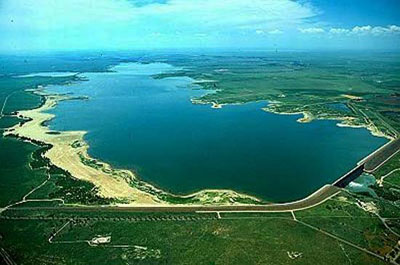
Goble’s report studies John Martin Reservoir and the idea of extra storage in the lower part of the valley. John Martin is a key component of the 1948 Compact between Colorado and Kansas, administered by The Arkansas River Compact Administration, which has three representatives from each state, governor appointed. The reservoir serves 11 Colorado ditches and five Kansas ditches. In addition, it is used to augment groundwater pumping from Colorado Irrigation, municipal and recreational wells. Colorado Parks and Wildlife manages a permanent pool. Active storage at this time is 330,700 acre-feet.
From going almost dry in 2011, it has gone to almost full in 2016. The permanent pool since 1976 could only be helped by Colorado River water. In May of 2017, ARCA passed a resolution allowing water from the Highland Ditch to be stored in the permanent pool (one year agreement, potential for renewal). Colorado Parks and Wildlife needs approximately 2,000 AF to cover evaporation.
The new source is expected to yield around 2,800 AF. A proposal will be made to the State of Kansas for a new 40,000 AF storage account in JMR. Nine Colorado water users have expressed an interest in obtaining additional storage in JMR. They are four augmentation groups (Arkansas Groundwater Users Association, Catlin Augmentation Association, Colorado Water Protective & Development Association, Lower Arkansas Water Management Association), two municipalities (cities of La Junta and Lamar), two conservancy districts (LAVWCD and Southeastern Colorado Water Conservancy District), one electric company (Tri-State Generation & Transmission Company). The increase would also benefit Kansas, in reducing the chance of un-replaced return flows, less evaporation charged to Kansas accounts, possible modification to the operating plan to allow Kansas to use certain water to recharge the Ogallala Aquifer, and better water quality.
Here’s a interview with Al Gore from Mark Maslin that’s running The Conversation. Here’s an excerpt:
[TC]: I was struck in the middle of your film by a profound statement: “To fix the climate crisis we need to fix democracy”. And then the film moved on to another topic. How do you think we can fix our democracies now in the 21st century?
[Gore]: Well, big money has hacked our democracy even before Putin did. And it accompanied the transition from the printing press to television, when all of a sudden candidates – especially in the US – were made to feel they have to spend all their time begging rich people and special interests for money so they can buy more TV ads and their opponents.
And that’s really given an enormous unhealthy and toxic degree of influence to lobbyists and special interests. Now just as television replaced the printing press, internet-based media are beginning to displace television and once again open up the doorways to the public forum for individuals who can use knowledge and the best available evidence.
If you believe in democracy as I do and if you believe in harvesting the wisdom of crowds, then the interaction of free people exchanging the best available evidence of what’s more likely to be true than not will once again push us toward a government of by and for the people. One quick example. Last year the Bernie Sanders campaign – regardless of what you might think about his agenda – proved that it is now possible on the internet to run a very credible nationwide campaign without taking any money from lobbyists and special interests or billionaires. Instead, you can raise money in small amounts from individuals on the internet and then be accountable to them and not have to worry about being accountable to the big donors.
The Albuquerque Bernalillo County Water Utility Authority recently began drilling a pair of injection wells that will allow it to build up a water “account” that it can draw from when the Rio Grande is running at a low ebb.
“This project is designed to address those times when we don’t have that flow in the river,” said Katherine Yuhas, the utility’s water resources manager.
When the utility begins banking water in October 2018, the $6 million demonstration project will allow the utility each year to store up to 5,000 acre-feet, or about 1.6 billion gallons. Over a period of 20 years, that will amount to enough water to meet the demand of customers for about a year, Yuhas said.
Here’s a report from Josh Zaffos writing in the The High Country News. Click through and read the whole thing. Here’s an excerpt:
The bill, H.R. 23, would basically block or override several state water laws — contrary to conservatives’ often-stated goal of reducing the federal government’s role and giving states greater power to manage resources. “They are trying to pre-empt the state from managing its rivers to balance the benefits to the economy with the need to protect the environment,” says Doug Obegi, attorney for the Natural Resources Defense Council.
The bill would override environmental rules set by California’s laboriously negotiated San Francisco Bay Delta Accord, an agreement meant to protect water quality in the Delta while guaranteeing reliable supplies for farms and cities. Instead, managers delivering water to the Central Valley would follow a less restrictive, temporary order from 1994 and do so “without regard to the Endangered Species Act.” That would prohibit the state from keeping water in the Sacramento or San Joaquin rivers solely to benefit chinook salmon, green sturgeon and delta smelt, all protected under the Endangered Species Act.
It would also repeal and replace the San Joaquin River Restoration Settlement — a state-federal partnership to recover salmon — with a new farmer-friendly arrangement that allows irrigators to dry up a 60-mile stretch of the river, harming fish habitat. Overall, such measures to pre-empt state water laws are “huge and unprecedented,” says Brian Gray, an emeritus law professor now with the Public Policy Institute of California.
Outside California, the GROW Act would also fast-track permitting for new dams across the West. It would make the Bureau of Reclamation the lead agency for permitting all new water-storage projects on federal lands, and accelerate environmental review, even for complex projects with expansive effects on rivers, fish and wildlife. Environmental impact statements, which agencies complete to weigh project costs and impacts, often take years to finish, particularly if conservation groups or local governments file appeals or lawsuits. The act would require the review process to be completed within 13 months, effectively limiting critics’ ability to raise concerns.
Such expedited permitting would help water agencies like the Northern Colorado Water Conservancy District, whose plans for two large new reservoir projects have been under review since 2004. Chimney Hollow Reservoir, to be built on the eastern side of the Rockies, will store water diverted from the Colorado River to supply booming northern Colorado. It received federal approval this May — after 13 years of federal review that required numerous plan revisions to address potential environmental impacts. The district’s Northern Integrated Supply Project still awaits a final decision.
Northern Water hasn’t endorsed the GROW Act, but spokesman Brian Werner says that better agency coordination — between federal authorities and state fish and wildlife managers, for instance — and swifter decisions would help water suppliers address criticism in a more timely, less piecemeal way. Delays are also costly, particularly if construction costs rise, and leave water-needy towns in limbo.
Map from Northern Water via the Fort Collins Coloradan.
Windy Gap and C-BT Granby area facilities
Colorado-Big Thompson Project east slope facilities
Last week, county commissioners approved a roughly $272,000 contract with Englewood-based engineering firm Forsgren Associates, Inc., to develop a water master plan. The document, expected to be finished by the end of 2018, will map providers’ water sources and infrastructure, clear the way for water to be considered earlier in the county’s development review process and make forward-thinking recommendations, Dossey said.
As the region’s population increases, so does the demand for water, a dwindling resource in the arid high desert of Colorado’s Front Range and plains. Small, rural districts can’t rely indefinitely on overdrawn aquifers. Nor can they afford massively expensive pipeline projects, such as Utilities’ $825 million Southern Delivery System, or to buy rights to water west of the Continental Divide, where most of the state’s supply is found.
“We’re talking 50 to 100 years out that we’re going to see issues, potentially, with water supply,” Dossey said. “It’s important that the county take the lead and work with each of the providers to work on a plan for the future.”
If water providers in the Colorado Springs vicinity don’t replace existing groundwater sources with more reliable water supplies by 2030, it could result in an annual regional shortfall of up to 25,000 acre-feet, or more than 8 billion gallons, according to Utilities’ Integrated Water Resource Plan, which was approved in February.
“There’s a huge gap to fill if we’re going to continue to grow,” said Dave Doran, a director for the Upper Black Squirrel Creek Ground Water Management District in eastern El Paso County. “There’s just so many more straws in the ground. Inevitably, these aquifers are dropping rapidly.”
Tens of thousands of residents rely on groundwater drawn from the depleting aquifers of the Denver Basin, according to local water officials.
How fast water levels within the Denver Basin aquifers are falling is up for debate. Kip Petersen, general manager for the Donala Water and Sanitation District, believes the aquifers could dwindle to a point where it would no longer be cost-effective for providers to pump water from them within the next 50 years.
“The water that we’re pulling out has been there for millions and millions of years. Once that water’s out, it’s out,” said Petersen, whose district services about 2,800 homes in the Gleneagle area. “That’s the big search right now – how do we offset a declining aquifer like the Denver basin with a renewable source?”
Petersen’s district is one of the few in the county that’s secured renewable water sources, including water rights to a Leadville ranch and Fountain Creek, to serve about a third of its customers, he said.
Utilities’ water resource plan, a roughly $2 million project, explores options for how the agency might help smaller providers fill a supply gap. One possibility would allow the providers to use Utilities’ delivery infrastructure during wetter years when demand falls in Colorado Springs. Another potential solution would involve Utilities selling other entities water to supplement existing resources. But with so-called “regionalization” comes a host of technical and legal challenges. The Utilities Policy Advisory Committee is researching the risks and benefits of working with smaller providers in the Pikes Peak region, said Steve Berry, a Utilities spokesman.
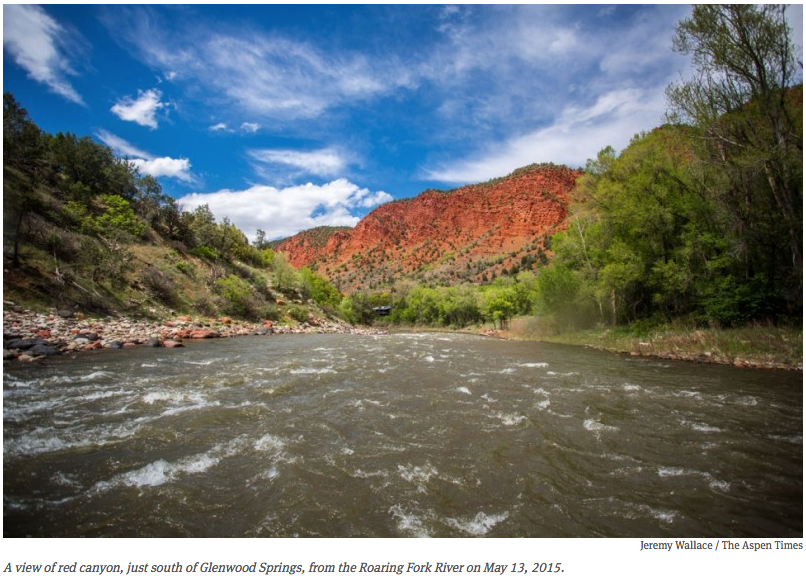
Red Canyon from Roaring Fork River. Photo credit: Brent Gardner-Smith.
From American Rivers (Sinjin Eberle, Kristin Green, Rob Harris, Brian Jackson)
A recent article suggested that the Colorado Water Plan could cost much more than anticipated – but estimates of higher cost are misguided, as all the proposals for proposed projects, and smart prioritization, is not yet final. Low-cost conservation measures will bring down the cost of the plan, and protect Colorado’s rivers for drinking water stability and healthy rivers.
SMART PRIORITIZATION AND COLLABORATION CRITICAL
Most everyone in Colorado knows that we can’t take a reliable water future for granted. Having clean, secure water for our communities, businesses, and agriculture, along with healthy rivers for respite, recreation, and to fuel our economy is not a given. In 2015, Colorado adopted a water plan, setting a course to achieve a reliable water future. Many applauded the balance of solutions and goals, including bolstering water conservation and reuse, looking for favorable ways to share water between cities and agriculture, and ensuring we had plans, and ideally actions, to keep our streams healthy.
Recently, the cost of the plan has come up in discussion.
There is no firmly identified cost to implement the water plan. We only have estimates at this time for what it will take to secure reliable water for our communities, agriculture, and environment. Those costs will become clearer as the state and water providers prioritize what water conservation, new supplies, water reuse, and stream restoration we want to do.
What we do know is that it will take resources to preserve the Colorado we love, and keep our farms productive and taps flowing. We also know that the money we need to restore and protect our rivers and streams, and find innovative ways to conserve water, are currently underfunded.
The initial estimate for the plan put the cost of implementation around $20 billion. That estimate includes the cost of the projects proposed from each basin around the state, but given the state’s limited resources that number could change as stakeholders further prioritize those projects.
We recently heard a much higher estimate cited that is simply wrong. When a Colorado family needs a new car, most are not going to go out and buy a Ferrari when a Ford affordably meets their needs – and that’s what we have here. We can achieve all of what’s needed to secure Colorado’s water needs into the future while investing only in those ideas that provide the best return to ratepayers and taxpayers. That’s what Coloradoans expect and it can be done. We need to identify what projects are a priority and which are financially feasible. We need to make sure we don’t double count projects that overlap with each other.
We encourage the state to prioritize funding the most cost-effective and feasible projects to secure a reliable water supply and protect our rivers and streams. Water conservation is one of the most cost effective ways to get where we need to go. Other innovations like water reuse and agricultural-urban sharing can provide multiple benefits and help us achieve a reliable water future.
Do we need more money? Yes. There are water funding needs identified in the plan and we will likely need to find new sources of dedicated funding. New funding sources should be used to support stabilizing a clean water supply for people, river health, agricultural conservation and efficiency, municipal conservation for smaller and medium-sized communities, and environmental water transactions. These projects are modest in costs, like adding air conditioning to a Ford, not a splurging on a lavish luxury car.
Collaboration will be critically important to shaping our water budget. We look forward to working with water providers, businesses, consumers, the state, local leaders, and other stakeholders in exploring the best way to meet the goals of the Colorado Water Plan.
FromThe Grand Junction Daily Sentinel (Gary Harmon):
Blue Mesa this week was brimming at 99 percent full and it was far from alone among Colorado River Basin reservoirs.
Morrow Point and Crystal reservoirs below Blue Mesa on the Gunnison River were 96 percent and 90 percent full, respectively.
“It’s going to take a lot of work” to reduce Blue Mesa’s level to 70 percent of full, or 580,000 acre-feet of water, U.S. Bureau of Reclamation hydrologist Eric Knight said Thursday.
Typically, all three reservoirs are well depleted by this time of year to meet irrigation demand, as well as feeding more water into Lake Powell, the largest storage unit in the Upper Colorado River Basin.
This year, however, river managers learned late that there was more snow in the high Colorado mountains than they had believed when deciding how much water to release early on this spring, officials said during a regular update on management of the Aspinall unit.
Several factors contributed to the underestimation of snowpack, not least of them the warm March in the Colorado Rockies and the fact that some snow-monitoring gauges were covered with snow, incapable of providing accurate information, officials said.
Recent storms in the high country also have pumped more water into the reservoirs.
River managers have to balance the need to release more water out of the Aspinall unit with making sure that the Gunnison doesn’t overflow its banks in Delta.
At the same time, managers also have to get as much water as possible into Lake Powell, which can hold some 24 million acre-feet of water but which now holds about 15.2 million acre-feet.
The Bureau of Reclamation this year is to release 9 million acre-feet of water into Lake Mead.
Public health experts in Colorado are narrowing in on the effects of climate change on human health. And they’re warning that people who work outdoors, low-income families, seniors and children are among those who will bear the brunt of rising temperatures.
Rosemary Rochford, a CU Denver professor, directs the new Colorado Consortium on Climate and Health. She says climate change may not create new diseases, but it’s likely to amplify conditions that already exist.
“So, imagine if you have a child going back to school in a hot classroom, what is that going to do if they’ve got asthma?” she asks. “It’s really going to amplify the problems for our kids, and especially those children that don’t have access to good schools with air-conditioning units.”
More than half of Denver public schools – mostly in low-income areas – are not fully air conditioned. Research has also found higher rates of kidney disease in men who work outdoors due to heat stress and dehydration.
Colorado’s average temperature is expected to increase by as much as five degrees Fahrenheit by 2050, according to Colorado Water Conservation Board scientists.
Policy analyst Chrissy Esposito, a co-author of a new Colorado Health Institute report on climate, says airborne pollutants tend to “cook” during hotter days, creating ground-level ozone that can cause problems for people with asthma and heart conditions. Esposito says her research confirms that warmer conditions are also causing bigger and more frequent wildfires.
“Wildfires release a lot of particulate matter, and this particulate matter embeds into our lungs and causes lung irritation, lung diseases, and can also restrict our lung function,” she explains.
She adds a majority of Coloradans recognize that climate change is happening, but a smaller portion understands how a warming planet puts them at risk.
Rochford says the new CU research group is aimed at bringing insights together from medicine, public health and climate science to help provide a more thorough picture of what the state faces going forward.
“We do want to be cognizant of what we know and what we don’t know, and that we need to understand more of the impacts – so that we can help the population here respond to this problem, and adapt to it, so we improve the health of everybody,” Rochford adds.
This story was produced with original reporting from Jaclyn Zubrzycki for The Colorado Trust.
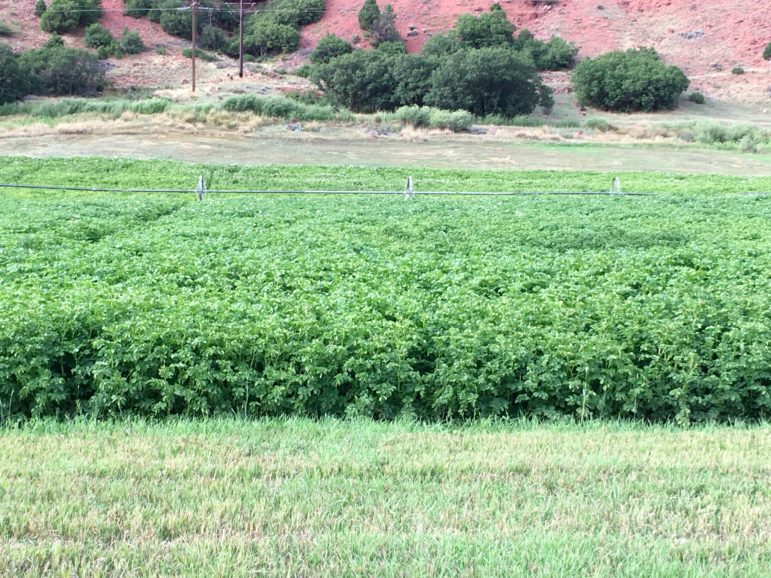
A crop of potatoes growing on an irrigated field in lower Woody Creek. The potatoes are being irrigated on land owned by Pitkin County as part of it's open space program.
Western Resource Advocates and Wilderness Workshop are opposing the city of Aspen’s efforts in water court to maintain conditional water storage rights tied to two potential dams on Castle and Maroon creeks. But the environmental organizations are formally collaborating with the city on finding water-supply alternatives to the two potential dams.
In late July, Western Resource Advocates and Wilderness Workshop joined the city in filing a preliminary application with the Colorado Water Conservation Board seeking state funds for a local study of potential “agricultural transfer mechanisms,” or ATMs.
Such programs provide alternatives to the “buy and dry” approach often used by cities to obtain water from ranchers and farmers.
“We all recognize that the issues that face our region will only be solved through the creative interaction of the entire community, and we hope that this effort will lead to more productive and collaborative projects,” Margaret Medellin, a utilities portfolio manager with the city, wrote in an email about the joint application.
CWCB officials recently asked water managers in the state to file either grant applications or notices of intent to apply so they could gauge interest for a new $10 million grant program designed to spur projects and programs spelled out in the 2015 Colorado Water Plan.
By the Aug. 1 deadline the state received 28 such notices for future grant cycles, including the one from the city and the environmental groups. In total, the “intent” notices identified more than $7.6 million in spending on various projects, according to a CWCB newsletter sent out Aug. 3. The CWCB also received 32 regular grant applications, requesting a total of $8.9 million for projects worth $60 million.
Recommended Stories For You
The scope and details of the emerging collaborative effort among the city, Western Resource Advocates and Wilderness Workshop were not included in their preliminary application to the CWCB, including how much money the groups might seek.
“At this point, there isn’t much information to share as project details still need to be developed,” Medellin said. “Once we jointly identify a pilot project, we will submit an application to the CWCB for funds.”
The application says a statement of work, a budget and a list of other funding sources will be forthcoming.
The CWCB’s board of directors will review and approve the new water plan grants in a two-step, two-meeting, process. The next grant application deadline is Oct. 1.
A field in the Roaring Fork River valley below Aspen. The city of Aspen hopes to work with irrigators to develop a source of water to meet its needs.
Work with irrigators
The three entities told the state they “seek to work with one or more irrigators in the Roaring Fork Valley to develop an alternative transfer mechanism that will help meet local water needs and demonstrate an alternative to buy-and-dry.”
According to the state water plan, ATMs can include techniques such as “rotational fallowing,” where irrigators voluntarily enter into a lease to stop watering parts of their fields during drought conditions. Or they can take the form of “interruptible supply agreements,” where irrigators agree to lease a certain percentage of their water to a city.
The joint application to the state says “the exact type of ATM would be determined in collaboration between Aspen, irrigators, Wilderness Workshop and Western Resource Advocates, and be in accordance with ATM types described” in the water plan.
On Aug. 3, the city put forth a settlement agreement to the two environmental organizations it is now collaborating with and to eight other opposing parties in the water court cases regarding the potential dams.
The city said it was willing to move its conditional right to store 4,567 acre-feet of water on Maroon Creek to other locations in the Roaring Fork River valley, including land in Woody Creek next to the Elam gravel pit, and the gravel pit itself.
However, the city did not commit to moving its 9,062-acre-foot right in Castle Creek, apart from a small portion that might flood a sliver of the wilderness.
While Wilderness Workshop and Western Resource Advocates are collaborating with the city on alternatives to storage, they are firmly opposed to the city maintaining storage rights in either Castle or Maroon creek valley.
“Moving the dams out of these two iconic valleys is dead center with our mission,” said Sloan Shoemaker, executive director of Wilderness Workshop. “Working collaboratively with partners in exploring alternative approaches to water supply will help achieve that mission-centric goal.”
A status conference was held about the cases with the water court referee Aug. 10. The parties agreed to another 90-day period to continue settlement efforts, with the next status conference in the case set for Nov. 9.
Aspen Journalism is an independent nonprofit news organization collaborating with The Aspen Times on the coverage of rivers and water. The Times published this story on Thursday, Aug. 17, 2017.
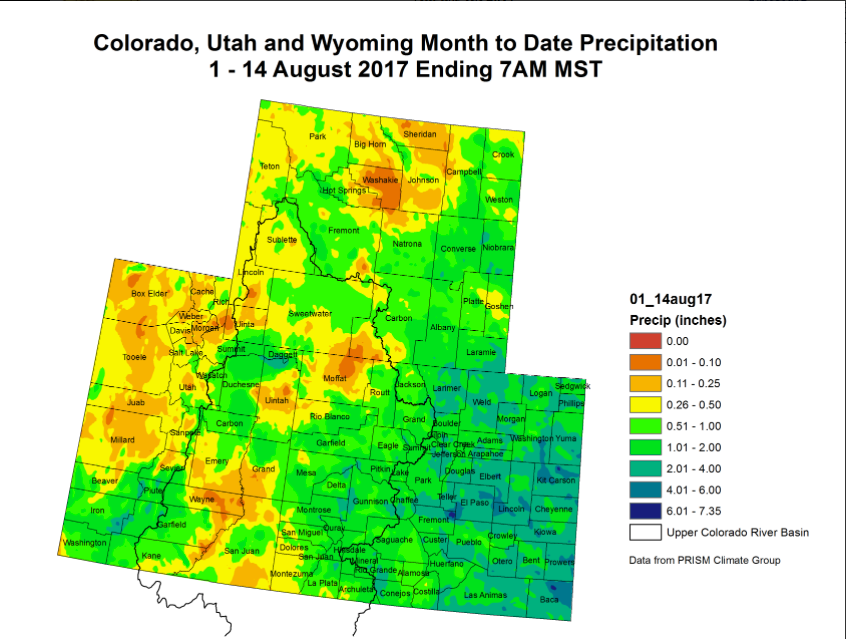
Click here to go to the US Drought Monitor Website. Here’s an excerpt:
Summary
Temperatures were cooler than average for much of the contiguous U.S. this week, including 4-8 degrees F below average across a large part of the Plains and Midwest this past week. Only Washington and Oregon saw temperatures more than 4 degrees above average for the period. With the below-average temperatures came a lot of rain in some regions, notably across northern Texas and much of Oklahoma, where rainfall was more than 600% of normal for this time of year. There were also substantial rains in parts of Wyoming, Nebraska, parts of the Dakotas, and in many places across the southeast. Rainfall was below average in southern Texas, parts of the midwest, northeast, and northwest, particularly notable in Montana where wildfires are prevalent…
High Plains
With the recent rainfalls, conditions returned to normal in northwestern Kansas along the Nebraska border and across extreme southern Kansas. In southwestern Nebraska, moderate drought shrank (D1) in Perkins, Chase, Hayes, and Lincoln Counties, following precipitation totals of up to nearly 4 inches. Likewise in the Nebraska panhandle, normal conditions prevail once again across eastern Box Butte, northeastern Morrill county, and northern Garden Counties, thanks to precipitation totals of 1.5-2.5 inches over the past week. Heavy rain also erased remaining dryness in Laramie County, Wyoming. Conditions improved to abnormally dry (D0) in parts of Custer, Blaine, and Loup counties in central Nebraska after two consecutive nights of heavy rainfall. Moderate drought also shrank slightly in north central Holt and south central Boyd counties, where up to 3.5 inches of rain fell. And normal conditions returned to a swath from Ewing to Atkinson in Holt County. Some areas in South Dakota received 3-7 inches of rain over the past week, contributing to improving conditions in some northeastern, north central, and south central pockets. However, the west was not as fortunate. Extreme drought (D3) creeped farther west in Meade County while severe drought (D2) expanded in Jackson. In southwestern North Dakota, rainfall helped alleviate exceptional drought (D4, the worst category), although due to the extremely poor growing conditions, it remained around the Hettinger County area. Conditions also improved in Colorado. Normal conditions returned around the Denver metro area and in Phillips County in the northeastern corner of the state…
West
In far southern California, drought conditions in Imperial County have now improved to moderate (D1) as long-term drought continues to plague this area and nearby regions. Conditions also improved around eastern Nevada into western Utah as abnormally dry (D0) conditions returned to normal in most of region, save for a region encompassing part of southwestern White Pine and northeastern Nye Counties. Conditions also returned to normal in the Unita Mounains at the Utah / Wyoming border. In Montana, abnormally dry conditions extended southward to the Wyoming border, encompassing more of northern Beaverhead and most of Madison Counties. There have been recent reports of water shortages in Beaverhead, Madison, Gallatin, Jefferson, Park Counties. Ninety-eight percent of the topsoil rated short to very short in Montana and fire danger is high…
Looking Ahead
For the week of August 16-23, rain is forecast across most of the contiguous United States, save most of the western quarter and part of eastern to southern Texas. Rainfall may be in excess of two inches or more in some areas that will significantly benefit, including much of the Plains from North Dakota south through Oklahoma, parts of the midwest where dry conditions have recently creeped in, and across much of the East Coast states. Over the next few days, temperatures are broadly forecast to be in the 70s to 80s across much of the northern tier and 80s to 90s across much of South. Temperatures in the 90s and higher are likely limited mostly to Texas, southwestern Arizona, and southern California.
Looking further ahead into the second week period, above-average temperatures are favored across most of the contiguous U.S., particularly in southern Texas, Florida, and part of the upper midwest to the mid- and North Atlantic states, while below-average conditions are favored in Alaska. Wetter-than-average are favored across much of the eastern two-thirds of the contiguous U.S., part of the west, most notably western New Mexico, ad eastern Alaska. Drier-than-average conditions are favored across most of Texas and Oklahoma, along with the northwestern tier of the Contiguous U.S. and western Alaska.
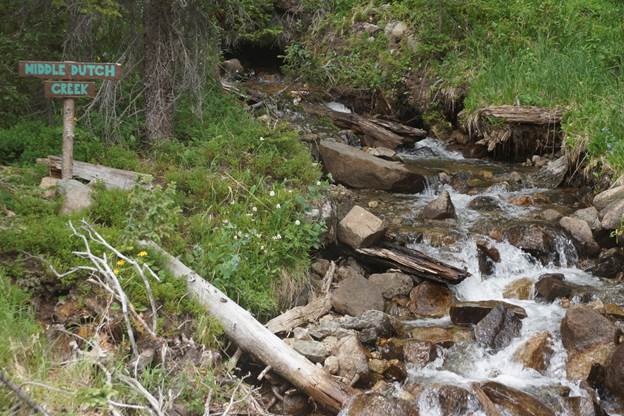
Middle Dutch Creek near the Grand River Ditch. Photo credit Greg Hobbs.
Here’s the release from the Environmental Protection Agency:
DESK STATEMENT
Extension of the Comment Period for Proposed Rule “Definition of ‘Waters of the United States’ – Recodification of Pre-existing Rules”
August 16, 2017
EPA and the Army are extending the comment period by 30 days for the proposed first step of the review of the definition of ‘Waters of the U.S.’ to provide additional time for stakeholders to weigh in.
Background
The comment period, as now extended, will close on September 27, 2017. The proposed rule was signed by the Administrator and posted to EPA’s website on June 27th and published in the Federal Register on July 27th. With this extension, the public will have more than 90 days to review the proposal. When finalized, the proposed rule would replace the 2015 Clean Water Rule with the regulations that were in effect immediately preceding the 2015 rule. For more information on the proposed rule: http://www.epa.gov/wotus-rule
Pre-Publication Version
The EPA Acting Assistant Administrator for Water, Michael Shapiro, along with Mr. Douglas Lamont, senior official performing the duties of the Assistant Secretary of the Army for Civil Works, signed the following document on 08/16/2017, and EPA is submitting it for publication in the Federal Register (FR). While we have taken steps to ensure the accuracy of this Internet version of the rule, it is not the official version. Please refer to the official version in a forthcoming FR publication, which will appear on the Government Printing Office’s FDsys website (http://fdsys.gpo.gov/fdsys/search/home.action) and on Regulations.gov (http://www.regulations.gov) in Docket No. EPA-HQ-OW-2017-0203. Once the official version of this document is published in the FR, this version will be removed from the Internet and replaced with a link to the official version.
Storm drain and open channel improvements between the East Rail Line (38th & Blake Station) and the South Platte River (Globeville Landing Outfall), Stormwater detention/conveyance between the East Rail Line (38th & Blake Station) and Colorado Blvd, (Montclair Basin) Stormwater detention/ conveyance immediately east of Colorado Blvd. (Park Hill Basin).
The vote [August 14, 2017 was 10-3, with councilmembers Rafael Espinoza, Paul Kashmann and Debbie Ortega the three “no” votes.
The project aims to reduce the potential for flooding in Denver’s northern neighborhoods, from Globeville, Elyria and Swansea to northwestern Park Hill. The projects are designed to capture and funnel the water from the neighborhoods to the South Platte River.
But critics of the interconnected projects say their sole purpose is to aid the Colorado Department of Transportation’s (CDOT) $1.2 billion initiative to expand I-70 on Denver’s northern flank.
CDOT officials have said the I-70 project, which includes ripping out a 50-year-old viaduct and adding a tolled express lane to each direction of the highway between I-25 and Chambers Road, has its own set of flood-mitigation elements. Those elements will be built, but might be reduced in size due to Denver’s projects, according to the agency.
Critics of the I-70 project, including those who have filed lawsuits, say halting the project may force the state to shift the highway’s route further to the north. CDOT said it looked at what’s called the “reroute option” and found it would cost more than $3 billion, farm more than the Central 70 project, and clog the surface streets of north Denver with traffic.
Kashmann, one of the no votes, said he believes Denver’s drainage project and CDOT’s I-70 project “are tightly interwoven, and the city is far more than an interested party.”
Kashman said he believes CDOT is saving money on the Central 70 project by having the city do the Platte to Park Hill project.
Espinoza said the project helps CDOT while harming City Park Golf Course, which will be redesigned with a larger detention pond on the west side as part of the Platte to Park Hill effort.
“If you vote for this, you’re saying to vote for the priorities of CDOT over this asset [City Park Golf Course],” he said.
But halting the Platte to Park Hill project won’t halt the Central 70 project, Councilman Paul López said.
Nor would a “no” vote lead CDOT to decide to reroute I-70 traffic onto other highways further north, he said.
“If you vote no on this, it won’t bring back the reroute [option],” López said.
Nor would a no vote eliminate the risk of flooding in the neighborhoods, Councilwoman Mary Beth Susman noted.
Councilwoman Stacie Gilmore said the project’s planned redesign of the City Parks Golf Course will bring native landscaping to the course. The councilwoman is the target of an ethics complaint, over her vote on Aug. 7 in favor of the contracts, due to her marriage to a city parks official…
City Park Golf Course, as it exists today, is “a human-created, overwatered ecosystem” devoted to non-native turf grass, Gilmore said.
After the project “the landscape will be more sustainable, with wetland areas to help filter stormwater runoff and contaminants in the water. We’ll improve on the non-native environment,” Gilmore said.
Councilman Wayne New said he appreciated the project’s flood mitigation efforts — but, “putting on his golfer’s hat” — said the improvements to the golf course also are important.
“City Park Golf Course needs to be improved,” New said. “It has beautiful views of our city, but it can be something that is notable. It’s a good public golf course, but it can be more.”
The city contracts approved Monday were:
A three-year, $6 million, on-call program management contract between the city and Parsons Transportation Group to design and build drainage improvements at the City Park Golf Course and in Park Hill at 39th Avenue.
A $7.6 million, one-year contract with Flatiron Constructors Inc to install a 84-inch storm drainage pipe and 24-inch sanitary pipe from 48th Avenue and Dahlia Street to approximately 360 feet north of Smith Road and Dahlia Street.
A $44.99 million, three-year contract with Saunders Construction LLC to design and build improvements to the City Park Golf Course.
Now, after 18 years on the city’s Board of Water Works, Jim Gardner, 85, won’t be seeking reelection…
“I’m old,” Gardner said with a laugh. “But I can shoot my age in golf and I want to spend more time going that.”
When a vacancy on the water board opened up in 1999, Gardner was appointed by City Council to fill the slot.
He said frequent conversations with a friend — well-known civic activist and longtime water board member Bud Whitlock — helped spur his interest in water and related issues.
“Mr. Whitlock would talk about it all the time as being very important,” Gardner said. “And water is an engineering type thing and I’m interested in that kind of stuff.”
After his appointed term ended in 2000, Gardner chose to run for the seat and was successful in obtaining it — a pattern he repeated for three terms.
Along the way, Gardner said he “really got to know Alan Hamel,” the longtime executive director at Board of Water Works of Pueblo. “And he was a good guy to work with.
“One of the first things I remember is working with Alan to reduce the cost of operation in the water department. I thought we were spending too much money on the buildings and so forth. And we got that done.”
Another cause Gardner championed was the filling of key department positions with local, rather than out-of-the-area, talent.
“People were retiring, especially from important sections,” Gardner explained. “And Alan came to a meeting one day and said, ‘We will have do a big search for a financial director,’ and so forth.
“And I said, ‘You know Alan, I think we can find them all right here in town.’ And Alan did just that — he never went outside out of town again.
“It’s important that they use local people who are qualified,” he said.
Now that he is stepping down, Gardner has offered his endorsement to Sandy Gutierrez, who just announced her intention to run for the open board seat.
“I’ve known her over the years to be a level-headed person,” he said. “And she will learn a lot working with the board.”
A board, by the way, that Gardner praised as being top shelf.
“I’m proud to say that we worked to get a good board and today we have a first-class board. It’s very cohesive,” Gardner said. “They all have good heads. No one carries an agenda to the board. They listen to the staff, which I also will say is first-class.
“It’s amazing how well we work together.”
One of the major acquisitions Gardner played an instrumental role in is the purchase of the Bessemer Ditch.
“That goes back years ago, during the drought of 2001, 2002,” Gardner said. “And I was worried about the Western Slope curtailing our water through the mountains.
“And I said, ‘We’ve got to buy more native water.'”
And the city did just that, securing 32 percent of the Bessemer Ditch.
“It’s going to cost a lot of money but it’s native water, and the federal government can’t mess with us. Now, we’ve got a lot of water but we need security.”
On all levels, Gardner’s tireless efforts on behalf of the board are appreciated and will long be remembered.
“Jim got on the board shortly after I started working,” said Alan Ward, Pueblo Water’s water resources division manager. “So pretty much my whole career he’s been on the board.
“And he’s led us through some big capital projects like the purchase of the Bessemer Ditch. He’s dedicated a lot of years to us and he will be missed, I can tell you that.”
As an architect and principal in HGF Architects, Inc., Gardner’s elaborate handiwork can be seen throughout the region — from Buell Children’s Museum/Sangre de Cristo Arts and Conference Center to Pueblo Community College’s Academic Center and Learning Facility to the Pueblo City-County Health Department building.
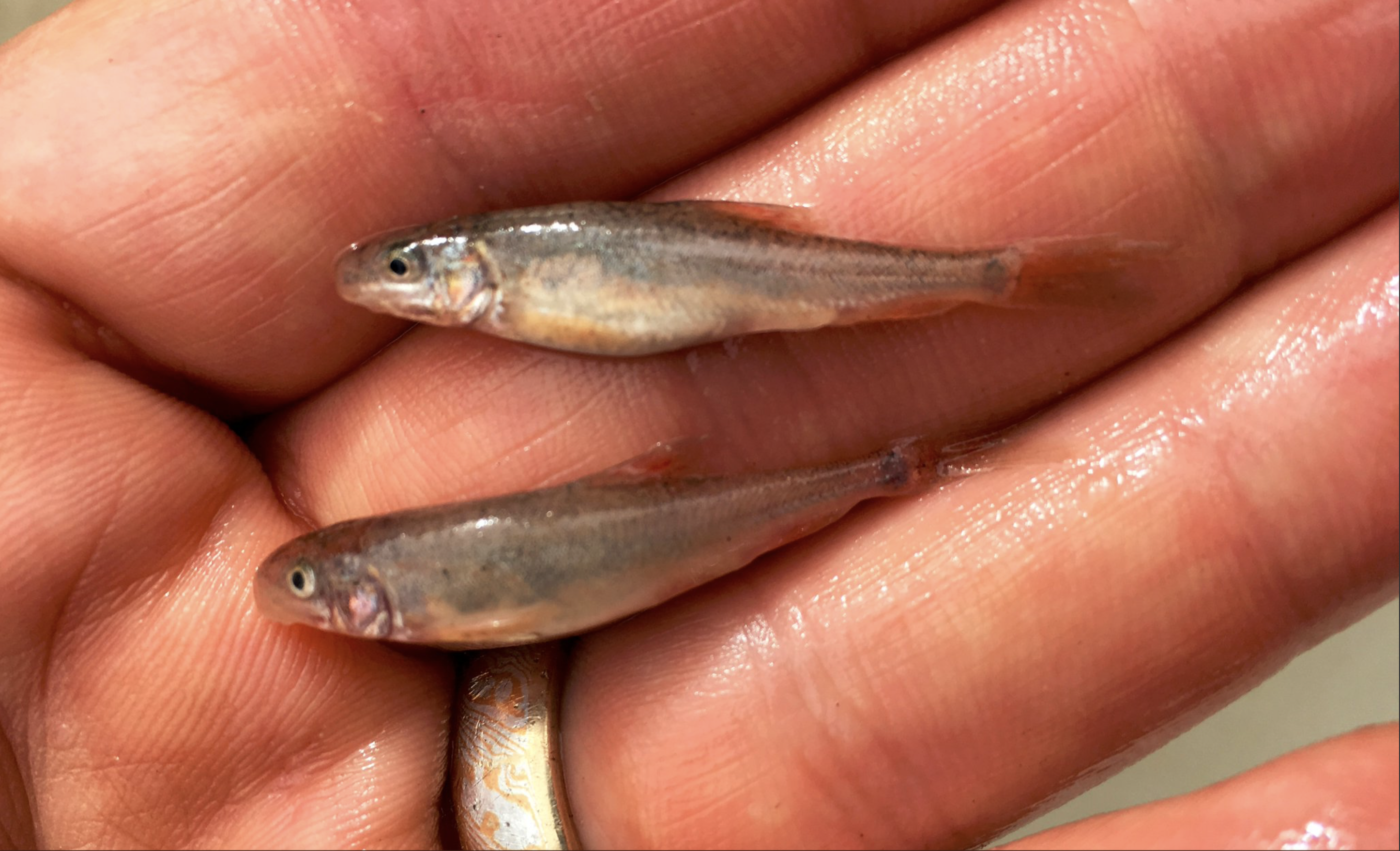
August 16, 2017: Colorado ParksWildlife and John Sanderson found imperiled bluehead sucker fry on Dolores River — a hopeful sign.Blue head suckerDolores River watershed
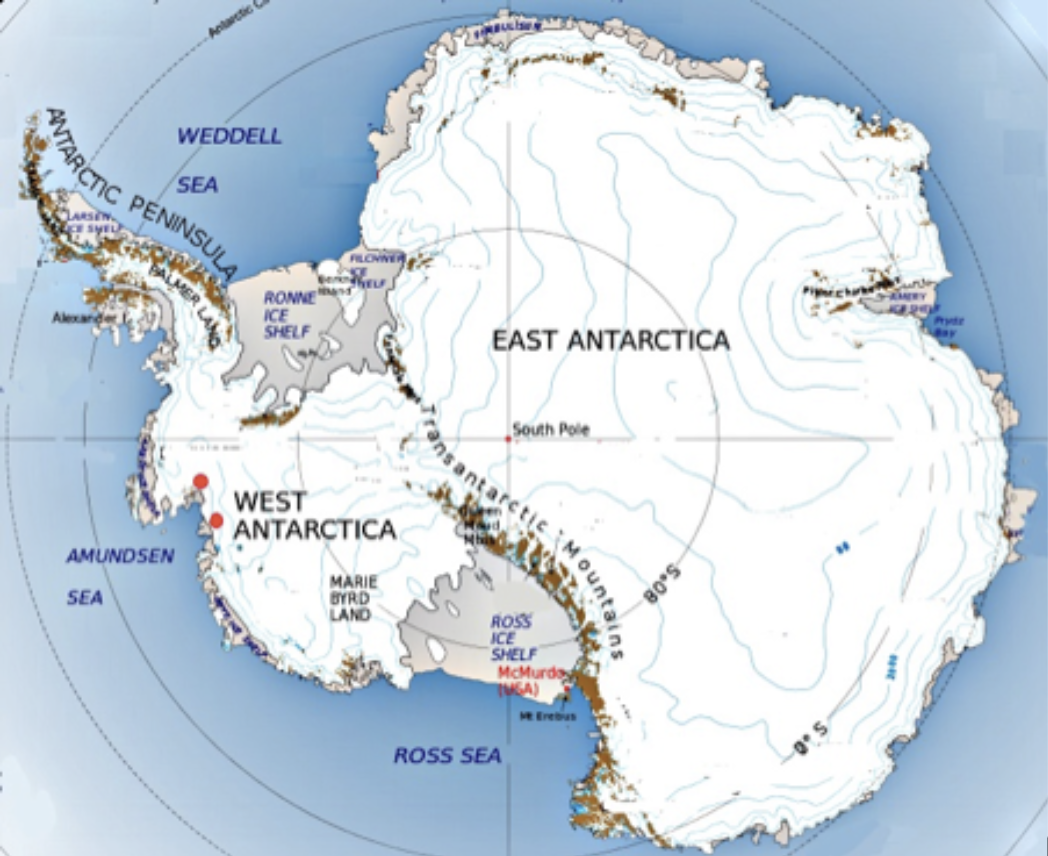
Scientists announced [August 15, 2017] that a core drilled in Antarctica has yielded 2.7-million-year-old ice, an astonishing find 1.7 million years older than the previous record-holder. Bubbles in the ice contain greenhouse gases from Earth’s atmosphere at a time when the planet’s cycles of glacial advance and retreat were just beginning, potentially offering clues to what triggered the ice ages. That information alone makes the value of the sample “incredible,” says David Shuster, a geochemist at the University of California, Berkeley, who is unaffiliated with the research. “This is the only sample of ancient Earth’s atmosphere that we have access to.”
Described at the Goldschmidt Conference in Paris by Yuzhen Yan, a graduate student at Princeton University, the ice revealed atmospheric carbon dioxide (CO2) levels that did not exceed 300 parts per million, well below today’s levels. Some models of ancient climate predict that such relatively low levels would be needed to tip Earth into a series of ice ages. But some proxies gleaned from the fossils of animals that lived in shallow oceans had indicated higher CO2 levels. If the new result holds up, says Yige Zhang, a paleoclimatologist at Texas A&M University in College Station, the proxies will need to be recalibrated. “We have some work to do.”
The discovery also points the way to finding even older ice, because it comes from a largely ignored “blue ice” area, where peculiar dynamics can preserve old layers. Although blue ice areas offer only a fragmentary view of the past, they may turn into prime hunting grounds for ancient ice, says Ed Brook, a geochemist on the discovery team at Oregon State University in Corvallis. “Ice that’s this old really makes people stand up and notice,” he says. “We’re just scratching the surface.”
Water leaving a section of the Meeker Ditch, which was curtailed in 2014 by the state division engineer based in Steamboat Springs. The division engineer had found that the ditch operator was diverting more water from the White River than necessary to irrigate hay fields under the ditch.
CRESTED BUTTE — If there was a commemorative coin minted in honor of Colorado water law, the shiny side could be inscribed with the phrase “use it or lose it.”
But the flip side of the coin might read “don’t divert more than you need.”
The second phrase may yet gain currency in Colorado as a new set of internal guidelines about over-diverting, or wasting, water were recently approved and made public by the Colorado Division of Water Resources.
The guidelines, signed by outgoing state engineer Dick Wolfe on June 30 and embraced by the new state engineer Kevin Rein, say “the people of the state have a right to divert water and apply it to beneficial use but do not have a right to divert water and waste it.”
The 11-page guiding document also says, “the goal in any diversion of water should be to divert and convey that amount of water, and only that amount of water, needed to accomplish the intended beneficial use.”
There are many “beneficial uses” of water under state law, but the one most relevant to the waste discussion is using it to irrigate a crop, such as alfalfa.
And the guidelines say “water that is diverted in excess of what is required to accomplish the intended beneficial use is considered wasted and may be curtailed by Division of Water Resources.”
Rein has been with Division of Water Resources for 19 years and was promoted from his position as deputy state engineer to state engineer by Gov. John Hickenlooper in July. Rein said the guidelines have been in the works for some time, were written in a collaborative manner by staff and were in response to a growing number of questions about the issue.
The new guidelines give water commissioners and division engineers direction on what to do when encountering waste.
Asked, during a break in a Colorado Water Conservation Board meeting in Crested Butte in July, if he was comfortable with the phrase “don’t take more than you need” as shorthand to describe the concept of “waste” in Colorado, Rein said he preferred “don’t divert more than you need.”
“‘Divert,’ that’s clear to me,” he said. “That means taking water out of the river, or taking water off the main ditch. And what we mean by ‘what you need’ is to satisfy that beneficial use that your water right is based on.”
A division engineer in the Yampa River basin, pointing to a headgate on the Meeker Ditch, which had been determined to be over-diverting in 2014.
‘Waste’
The new internal guidelines are officially titled “Internal guide to understanding ‘waste’ and the determination of ‘waste’ associated with irrigation, as that term is used in the definition of beneficial use.”
There are some stern statements in the new internal guidelines, including that it is against Colorado law to divert more water from a river into an irrigation system than is “absolutely necessary.”
“Statutes provide that a person shall not run through his or her ditch any greater quantity of water than is absolutely necessary for irrigation, domestic, and stock purposes to prevent the wasting and useless discharge and running away of water,” the guidelines say.
Rein said the internal guidelines should provide statewide enforcement consistency and serve as a public clarification of the agency’s policy on identifying and enforcing waste.
“It really helps us to have that go-to document to explain it,” he said. “This gives us the best way to communicate to water users, ‘Here are the important considerations when it comes to waste.'”
The guidelines define waste as “diverting water when not needed for beneficial use, or running more water than is reasonably needed for application to beneficial use.” And the guidelines seek to distinguish between “efficiency” and “waste,” Rein said.
“Efficiency is an objective measure,” he said. “It’s an equation. It’s the amount of water consumed divided by the amount of water diverted for that purpose.”
However, he said a higher-efficiency irrigation system can still waste water by over-diverting, while a lower-efficiency system might be diverting and irrigating in a manner that is not wasting water.
And when it comes to determining if someone is wasting water, there is no equation, no formula.
“There is no number,” he said. “There is no amount of tail water. There is no amount of runoff or ponding or deep percolation that you can identity. It is a subjective call.
But the water commissioner can look at the irrigation practice and look at the diversion. And if that same … crop can be satisfied with a reduced diversion, then that satisfies the definition, or identification, of waste.”
Well-tended fields along the White River west of Meeker irrigated by the Meeker Ditch. In 2014, the ditch was directed by the division engineer to divert less water at its headgate.
Reasonable?
The guidelines also discuss seepage in irrigation ditches, overtopping of ditches, or tailwater spilling out of an irrigation system, and say there is a point where too much of each is “unreasonable.”
And the guidelines say it does not matter if a call from downstream senior rights is in effect or not; there can still be waste.
And, of importance to water rights owners, that wasted water should not count in a historical use analysis, which ultimately determines how much of a water right can be transferred or sold for another use.
The guidelines cite several reasons why people over-divert water, including trying to protect a water right from a claim of abandonment, trying to maximize the future potential value of a water right in a sale or transfer and failing to apply adequate labor to an irrigation system.
It can even occur “when a water user diverts more water than is needed based on the mere fact that they can.”
Rein acknowledges that when it comes to determining waste, a lot depends on the layout, construction and management of a given irrigation system. The guidelines also recognize that it can take more work to use less water, due to factors such as the need to frequently adjust distant headgates.
“Diverting more water than can be beneficially used because of the labor involved in diverting less water but requiring more time and labor to do so may or may not be considered an acceptable practice,” the guidelines state. “Regardless, an irrigator has the responsibility and duty to divert only that amount needed and is responsible for being a good steward of the resource.”
The guidelines also address the practice of over-diverting in an effort to increase the future potential value of a water right.
“There is a misperception by some that by maximizing the amount of water diverted, regardless of the need, one can enhance or preserve the magnitude and value of a water right in a future transfer or protect it from some other reduction such as through an abandonment proceeding,” the guidelines say. “Diverting more water than can be beneficially used to avoid abandonment is not considered an acceptable practice and will generally be considered a wasteful practice.”
Editor’s note: Aspen Journalism is collaborating with The Aspen Times and the Glenwood Springs Post Independent on coverage of rivers and water. The Times and the Post Independent published this story on Wednesday, Aug. 16, 2017.
“Turning Towards Solutions” builds upon our previous episode, “Law of the River.” Across the Colorado River Basin, collaboration, cooperation, and compromise between towns, districts, states, and basins is a common theme. “Turning Towards Solutions” explores how collaborative actions like the Drought Contingency Plan and Minute 319 (the pulse flow) are creating promise and opportunity for sustaining the Colorado River and the people and communities that depend on it. Tune in to hear about efforts to create a new pathway to preserve both this crucial resource, and the legacy of the entire southwest.
WISE System Map via the South Metro Water Supply Authority
Here’s the release from the WISE Project:
Denver, Aurora and South Metro region connect water systems to maximize efficiencies
DENVER, Aug. 16, 2017 – One of the most exciting water projects in Colorado’s history is now live. After years of planning and development of critical infrastructure, water deliveries have begun for the Water Infrastructure and Supply Efficiency Partnership, known as WISE.
“This is a significant new chapter in Colorado’s water history,” said John Stulp, special policy advisor to Gov. John Hickenlooper on water and chairman of the state’s Interbasin Compact Committee. “With the start of WISE deliveries, we are ushering in a new era of regional collaboration and partnership for the benefit of current and future generations in the Denver metropolitan area.”
WISE is a regional water supply project that combines available water supplies and system capacities among Denver Water, Aurora Water and the South Metro WISE Authority, which consists of 10 water providers serving Douglas and Arapahoe counties. Participating South Metro communities include Highlands Ranch, Parker and Castle Rock, among others.
“The state water plan identified regional collaboration and partnerships as key to a secure water future for Colorado,” said Lisa Darling, executive director of the South Metro WISE Authority. “WISE is a perfect example of the benefits that can come from such an approach.”
The innovative regional partnership is one of the first of its kind in the West and a major component to the region’s cooperative efforts to address long-term water supply needs. The WISE project has garnered unprecedented statewide support for its collaborative approach, which draws a stark contrast to water feuds of the past.
WISE allows the participating water entities to share existing water supplies, infrastructure and other assets in the South Platte River basin in ways that are mutually beneficial.
For communities in the South Metro region, WISE provides an additional source of renewable and reliable water supply and helps to reduce historical reliance on nonrenewable groundwater. Since the early 2000s, the region has made tremendous progress transitioning to a renewable water supply while ramping up conservation efforts.
For Denver, WISE adds a new emergency supply and creates more system flexibility, while allowing Denver Water to use water imported from the Colorado River multiple times for multiple purposes. For Aurora, WISE creates revenue that helps stabilize rates for municipal customers while creating added value from existing water and infrastructure.
“WISE promotes the efficient use of water through full utilization of existing resources,” said Denver Water CEO Jim Lochhead. “Through this project, we’ve created a sustainable water supply without having to divert additional water out of mountain streams.”
“This is a positive development for Colorado’s water community,” Aurora Mayor Steve Hogan said. “It is critically important that water utilities and providers are working together to meet Colorado’s water needs, and I commend this partnership.”
By reusing water imported from the Colorado River through Denver Water’s water rights, the project provides a new sustainable supply without additional Colorado River diversions. A portion of the WISE water rate also goes to the Colorado River District to support river enhancements within the Colorado River basin.
In 2015 WISE became the first water infrastructure project ever to receive funding from Basin Roundtables — groups of regional water leaders who help shape statewide water policy — across the state because of the example it set of regional cooperation. It also received financial support from the Colorado Water Conservation Board.
“The WISE Partnership is a great example of communities working together to creatively address the water demands of Colorado’s growing Front Range,” said Laura Belanger, water resources engineer with Western Resource Advocates. “We commend the project partners for successfully implementing this innovative and flexible project that utilizes existing infrastructure to share water supplies between communities, increasing reuse, and helping keep Colorado rivers healthy and flowing.”
Others expressing public support of the project include Gov. Hickenlooper; U.S. Sen. Cory Gardner; U.S. Reps. Ed Perlmutter and Mike Coffman; and David Nickum, executive director of Colorado Trout Unlimited.
Since finalizing the WISE delivery agreement in 2013, WISE members have been hard at work putting in place the infrastructure and processes that will allow the parties across the Denver metro area to combine water supplies and system capacities.
Work included:
· Purchasing a 20-mile pipeline to carry water from Aurora to Denver and South Metro;
· Building a new water tank near E-470 and Smoky Hill Road;
· Connecting an array of existing underground pipelines; and
· Developing a new computer system that enables up-to-the-minute coordination between all entities.
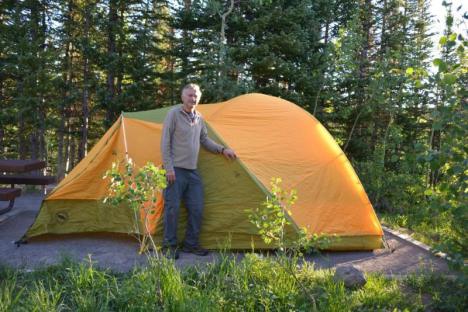
Water legend Ken Wright joins The Water Values Podcast for a discussion about paleohydrology. Ken’s studies of how ancient cultures used water over the last quarter century have shed tremendous light on how those cultures engineered their water infrastructure and planned for their water resources. This is a fascinating episode for anyone who is interested in history and how ancient cultures like the Inka (read Charles C. Mann’s 1491 to understand why I’m not spelling it “Inca”), Anasazi, Roman, ancient Thai, and Middle Eastern cultures, among others, related to their most important resource.
In this session, you’ll learn about:
Ken’s background and how his diverse experiences helped shape his career
How the Inka used water at Machu Picchu and other sites in their civilization
How the Inka and other cultures engineered their infrastructure
How the Anasazi built and maintained their water infrastructure in the arid Southwest
How ancient civilizations used simple design and sustainable practices
How Ken and his team made population estimates based on water infrastructure
A snowy winter in the Rocky Mountains helped Colorado River water users escape a shortage for the next year and likely for at least two more, federal water managers project, though a hot spring made the escape a narrow one.
The river’s reservoirs combined have gained 5 percent of their capacity in the last year, and now sit at 57 percent full. It means customers using Central Arizona Project water in the Phoenix and Tucson areas won’t lose deliveries next year and have just a 31 percent chance of losing some water in 2019 — a marked improvement from roughly even odds projected in recent years.
“We had a fairly decent runoff this year, which certainly helped us trend in the right direction,” U.S. Bureau of Reclamation spokesman Doug Hendrix said Tuesday.
Conservationists say the projections provide a nice reprieve but that the seven states on the river must use the time to plan and save more water and prevent future pain.
“I don’t think we really have time to wait for an official shortage declaration,” said Jeff Odefey, drinking-water-supply program director for the group American Rivers…
A 2007 agreement between Reclamation and the seven states said CAP customers, starting with farmers, would lose some of their river water in any year when the August projections show Lake Mead’s elevation dropping below 1,075 feet elevation on Jan. 1.
The lake would already be well below that level if not for conservation measures by the states and Mexico, Arizona Department of Water Resources Director Tom Buschatzke said in a statement Tuesday…
The government currently projects Lake Mead will end this year well above shortage level, at 1,083.46 feet. It was about 1,080 feet throughout on Tuesday, and should gain elevation as fall temperatures cool and reduce the demand for irrigation water, allowing more of the inflow to pool behind the dam…
The Green River, the biggest tributary to the Colorado, had a record snowpack in Wyoming last winter, Odefey said, while western Colorado was also above normal.
Warm weather then melted, evaporated and increased demand for water, reducing earlier predictions that Lake Mead would get a bigger boost…
The states and the federal government have already propped up the reservoir by paying for conservation and efficiency improvements with a goal of leaving water behind the dam instead of earmarking it for a particular use.
From 2012 through 2016, the states collectively saved 1.2 million acre-feet of water in the reservoir, said Jennifer Pitt, the National Audubon Society’s Colorado River program director.
That’s enough water to support a few million households, and it approaches the Central Arizona Project canal’s share of the river.
“It’s a great demonstration of the fact that water conservation can be done,” she said. “It makes me optimistic about the future.”
According to projections released Tuesday by the U.S. Bureau of Reclamation, the reservoir east of Las Vegas will have enough water in it on Jan. 1 to stave off a first-ever federal shortage declaration — and the mandatory water cuts for Nevada and Arizona that would come with it.
The lake is also on track to avoid a shortage in 2019, thanks to decreased demand downstream on the Colorado River and a larger-than-usual influx of water from Lake Powell upstream.
The extra water from Lake Powell is expected to raise Lake Mead’s surface by more than five feet by the end of the year.
The new federal projections come as officials in the United States and Mexico finish work on a new binational agreement aimed at stretching limited resources on the Colorado and keeping more water in Lake Mead.
Negotiators from the two countries, including representatives of the Southern Nevada Water Authority, have agreed on a range of water-sharing and water-saving initiatives, including voluntary cuts that Mexico could begin taking as soon as next year to prop up the overdrawn, drought-stricken river system.
The agreement also spells out how much Mexico would have to reduce its river use during a declared shortage and how much extra water the nation would get in the event of a surplus on the Colorado.
The new pact, known as Minute 323 to the Mexican Water Treaty of 1944, extends many of the provisions of an earlier treaty amendment approved in 2012 and set to expire at the end of this year. For example, Mexico will be able to keep storing some of its river allotment in Lake Mead, and U.S. water agencies will be able to continue to invest in infrastructure improvements south of the border in exchange for a portion of the saved water.
The water authority board is expected to vote Thursday to sign on to Minute 323 when the agreement is finalized next month.
“It’s a good deal for both countries,” Authority General Manager John Entsminger said.
The most important thing about the deal is the certainty it provides, Entsminger said. Water managers in both countries will now know what to expect should the river continue to shrink.
“It’s a big deal because the last thing you want is uncertainty when you get into a shortage condition,” he said.
The voluntary water cuts Mexico would take under the treaty deal hinge on a separate but related pact being negotiated by water officials in Nevada, Arizona and California.
The three states have agreed in principle on the so-called Lower Basin Drought Contingency Plan, under which Nevada, Arizona and, eventually, California would voluntarily leave some of their river water in Lake Mead when the surface of the reservoir falls to certain trigger points.
Entsminger said the multistate deal is on track for completion next year despite some public spats and lingering disagreements among water agencies in Arizona and California over how the voluntary cuts should be made in each state.
“I do believe it will happen,” he said…
The Las Vegas Valley relies on Lake Mead for 90 percent of its drinking water supply. The surface of the reservoir now sits at about 1,080 feet above sea level, roughly 130 feet lower than it was before the current drought began on the Colorado River in 2000…
Above-average flows in the Colorado River helped keep Lake Mead out of shortage for another year, but the real news is on the demand side.
Over the past year, Nevada, Arizona and California combined to use less than 7 million acre-feet of river water for the first time in 25 years.
Colby Pellegrino, Colorado River programs manager for the Southern Nevada Water Authority, said the decline in demand is proof that conservation efforts on the Colorado are making an impact.
The last time the three lower basin states combined to use less than 7 million acre-feet of river water was in 1992, when the region was home to roughly 7 million fewer people than it is now.
“We’ve successfully decoupled our economic prosperity from our water use,” Pellegrino said.
Work has started on the new Chimney Hollow Reservoir in Larimer County. Final approval was granted for a 90,000 acre foot reservoir in May, and crews are now surveying and drilling at the site, to determine the extent of building materials.
Chimney Hollow will be operated by Northern Water. It is located just west of Carter Lake Reservoir, and is going to be close to the same size of twin to the east. This location was chosen for it’s proximity to existing Colorado Big Thompson facilities, and because there were no threatened or endangered species, no existing residences to relocate, and they were able to acquire the property from a single owner, Hewlett Packard.
Nearly 400,000 northern Colorado residents will benefit from this new water supply. Those areas are Broomfield, Longmont, Loveland, Greeley, Erie, Superior, Louisville, Fort Lupton, Lafayette, and the towns in the Central Weld County Water District.
“This project specifically is to make some supplies reliable year in, and year out, for those communities. They will be able to have more of a guarantee that they will be able to pull water from the Windy Gap Project, which today, is not possible. There are some years where there is either no water available, or nowhere to store it,” said Brian Werner, spokesperson for Northern Water…
Contracts will start to get awarded in 2018, and Northern Water says that construction will likely start later next year, or early in 2019. It will be a three to four year build. The next step, which could happen this fall, is to relocate power lines that run through the middle of the property, and to also start clearing the vegetation.
Once construction is complete, they can start filling the reservoir with water. According to Northern Water, that could take several years to fill up.
“There are state regulations on dam safety, on how fast we can bring the water elevation up, so it’s sort of fill and seal, before we can go to that next incremental level. It could take 3, or 5, or even 10 years to fill it. A lot is dependent of mother nature as well, with how much water is available,” Werner said.
The water will come from the headwaters of the Colorado River, channeled back to the east from Windy Gap Reservoir.
The Chimney Hollow project has already been 14 years in the making. The permitting process began in 2003, and there have been $15 million spent in studies. The total estimated cost is $400 million.
The dam is estimated to be about 340 feet tall, which makes it the tallest dam to be built in Colorado since the Morrow Point Dam in Gunnison County back in 1968. Morrow Point is still the largest dam in Colorado at 468 feet. Denver Water has recently received approval to increase the size of Gross Dam, in Boulder County, to 471, which will make that the largest dam once it is finished.
Chimney Hollow Dam could be the first in the United States with an asphalt core. This type has been used in Europe and Canada for many years. The available land material in the area, made asphalt the more cost effective choice. The asphalt will be the inner seal of the dam, but the outside appearance will be more earthy, made of land and boulders. Arizona has also received approval to build an asphalt core dam, and could be completed about the same time as Colorado’s.
Larimer County will be handling the recreation on this new reservoir, and already has some initial plans for hiking, fishing, and boating. It will be a non-motorized boating lake and a day-use area. So far, there are no plans to allow overnight camping.
There had been some opposition to this project, and other proposals to build new reservoirs in Colorado. River conservation groups are concerned about the impacts of further taxing a the Colorado River system. Werner says they are addressing the future of the river, and the future of Colorado’s population at the same time.
“We are all for using water more efficiently, and water managers in this state are doing a darn good job of that, but the bottom line is that you have to provide some additional buckets, some additional water storage to meet our future demand, without drying up our agricultural lands,” he said.
Two reports out this week found that the outdoor-recreation and tourism industries, which often lend each other a hand, accounted for $28 billion and $19.7 billion, respectively, in consumer spending last year.
And experts in both industries don’t expect growth to taper off soon.
Neither the Outdoor Industry Association nor the Colorado Tourism Office could say exactly how often tourism and outdoor recreation intersect. But evidence suggests that the two industries are mutually beneficial.
Of the travelers who visit Colorado in the summer, 52 percent take scenic drives, 46 percent visit a state or national park, and 32 percent hike or backpack, said Cathy Ritter, Colorado’s tourism boss.
Similarly, Vail’s GoPro Mountain Games brings in 3,300 athletes and 67,000 spectators annually, generating $7.2 million in economic impact, according to the Outdoor Industry Association’s report, out Tuesday.
That’s not to say the tourism and outdoor-recreation industries rely on each other exclusively. The OIA report found that 71 percent of Colorado’s 5.7 million residents participate in outdoor recreation…
Outdoor recreation and tourism last year brought in $2 billion and $1.2 billion in state and local taxes, respectively. The state tourism report found that each Colorado resident would have to pay an additional $216 to replace the taxes that visitors kick in each year.
Outdoor recreation, such as camping, motorcycling and trail sports, directly creates 229,000 jobs and nearly $10 billion in wages and salaries, OIA executive director Amy Roberts said.
Tourism directly created 165,000 jobs that supply $5.8 billion in wages, according to the tourism office. In comparison, oil, gas and mining accounts for 58,000 Colorado jobs, the OIA report pointed out without citing total wages.
Since the recession, Colorado has logged a 37 percent increase in total visitation, compared with a 17 percent increase across the U.S. The $19.7 billion in tourism consumer spending is a new high for the state.
And both Ritter and Roberts expect their industries to grow — outdoor recreation aided by friendly policies, businesses relocating to the state and a strong independent retail sector, and tourism buoyed by the national “Come to Life” marketing campaign that helped grow Colorado’s share of the U.S. tourism market to 3.1 percent from 2.8 percent in a year.
Credit: Cattleman’s Ditches Pipeline Project II Montrose County, Colorado EIS via USBR.
Here’s the release from the US Bureau of Reclamation (Justyn Liff, Jenny Ward):
The Bureau of Reclamation has released a draft environmental assessment on Phase II of the Cattleman’s Ditches Piping Project located in Montrose County, Colorado. The project would replace approximately 6.1 miles of open irrigation ditch with 5.1 miles of buried water pipeline. The purpose of the project is to reduce salinity loading in the Colorado River Basin.
Reclamation will consider all comments received by September 15, 2017. Submit comments by email to jward@usbr.gov or to: Ed Warner, Area Manager, Bureau of Reclamation, 445 West Gunnison Ave, Suite 221, Grand Junction, CO 81501.
Longmont’s city staff is recommending raising the city’s sewer rate charges by 3 percent next year, followed by 2 percent increases in both 2019 and 2020.
The City Council is to discuss the possible rate hikes during a Tuesday night study-session review of Longmont’s wastewater utility and that utility’s financial projections and needs.
The Department of Public Works and Natural Resources staff said in a memo to the council that the proposed rate hikes “will allow the utility to maintain its target debt service coverage and appropriately fund operational costs” of Longmont’s sewage collection and treatment system.
“The wastewater utility continues to experience cost increases that affect the utility’s financial outlook,” the staff wrote in that memo. “While staffing levels have been significantly decreased in the utility since 2000, resulting in annual cost reductions in excess of $2 million each year, operating costs have still increased by an average of 2.8 percent each year between 2006 and 2016.”
Major drivers of those costs included regulatory requirements that necessitated large capital expenses at Longmont’s wastewater treatment plant, the staff said, as well as flood-recovery and repair costs for the sewage collection system, the city staff said.
The staff also cited a need for “deployment of new metering technologies,” as well as climbing construction costs after the 2008 recession and what it said was an “aging wastewater infrastructure reaching the end of its life cycle.”
In order to pay for capital improvements to the city’s wastewater treatment plant and infrastructure, Longmont sold a total of $52 million in sewer bonds issued in 2010, 2013 and 2015.
Debt repayments from the wastewater utility’s budget fund have increased by $3.1 million a year because of those bond sales, the staff said, and the bond requirements include being able to maintain enough budget money to cover at least 110 percent of that debt.
As part of its adoption of Longmont’s 2017 budget, the City Council approved an average 3 percent increase in customers’ sewer fees that took effect this year…
Staff reductions, achieved after Longmont completed a 2000 water-wastewater strategic plan, “helped stabilize rates and provided more money for capital needs while service levels were maintained or improved,” the staff wrote.
However, “while staff has continued to maintain service levels, major cost drivers in the form of regulatory requirements, natural disasters, new technologies, increasing construction costs and aging infrastructure have impacted the utility.”
The City Council cannot make official rate-increase decisions during a study session but can direct the city staff whether to proceed with preparing a rate hike for formal council votes later this summer or fall.
The city received 14 different proposals for how to best spend a reserve fund of lodging tax money that has been accruing in recent years. They range from a plan to use the money to keep the Yampa River flowing at a healthy pace in the summer to adding several public restrooms around town.
The money, which comes from a 1 percent tax tourists pay on their nightly stays, must be spent on something aimed at drawing more tourists to town. Projects must also enhance the city’s “environmental desirability.”
A committee appointed by the Steamboat Springs City Council will spend this week grading all of the proposals and coming up with a recommendation.
It will then be up to the City Council to decide which project is most worthy, or whether the money should be spent at this time at all…
Yampa River Flow Endowment, Friends of the Yampa, $1 million
Anyone who uses the Yampa River in the summer would benefit from Friends of the Yampa’s idea for how to spend the reserve lodging tax money.
The fish would also thank the group too if they could.
The river advocacy group thinks the money could be well spent on water releases from Stagecoach Reservoir that help keep the Yampa River flowing at a healthy level during the summer.
The Colorado Water Trust has partnered with the Upper Yampa Water Conservancy District in recent years on such water releases.
The releases help maintain a healthy river and ecosystem during low water years and times of drought.
“A healthy Yampa River is paramount to Steamboat Springs’ tourism industry,” Friends of the Yampa wrote in its application.
“Fly fishing shops, tubing outfitters, restaurants, breweries and river property owners depend on healthy river flows.
The application is a collaborative effort that also includes the Water Trust, The Nature Conservancy and some local business owners.
Click here to read the newsletter. Here’s an excerpt:
Progress on the San Juan River Headwaters Project
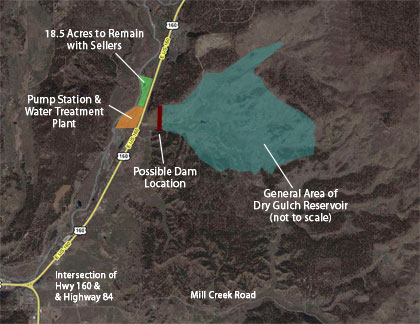
San Juan Water Conservancy District announced it has changed the name of the “Dry Gulch Project” to the “San Juan River Headwaters Project”. The project has changed from a 35,000 AF reservoir to an 11,000 AF reservoir. The original cost estimate for the reservoir was in excess of $400 Million, it has now been reduced to that of a reservoir that will cost less than $100 Million. “The reduced cost is substantially due to changing from filling and re-filling by means of an electric pump station to the use of a syphon, which also has the advantage of having less operation expense and a longer useful life at lower maintenance”, said Rod Proffitt, President of San Juan Water Conservancy District
San Juan Water Conservancy District was awarded a $2 million loan from the Colorado Water Conservation Board at its meeting in Pagosa Springs this past May. *Please note the correction of the previous amount stated. The existing mill levy for San Juan Water Conservancy District (“the District”) is .316 of a mill (not $316.000 at stated in previous newsletter), which raises approximately $67,000 per year on property assessed within the District. If this measure is approved, the mill levy will be exactly what it was when the District was first formed in 1987 – One (1) mill. The issue will be on the ballot this November.
Rod Proffitt also stated that the San Juan Water Conservancy District is working with a number of stakeholders in Archuleta County to apply for funding from the Colorado Water Conservation Board to do a watershed management plan for the Upper San Juan River above Navajo Reservoir.
“The San Juan River is facing continuing demands on its water as the area’s population grows and existing uses adjust to changing conditions. The plan will ensure the river continues to benefit the natural habitat of the watershed, the non-consumptive uses of the river like tubing, fishing, and rafting” noted Proffitt.
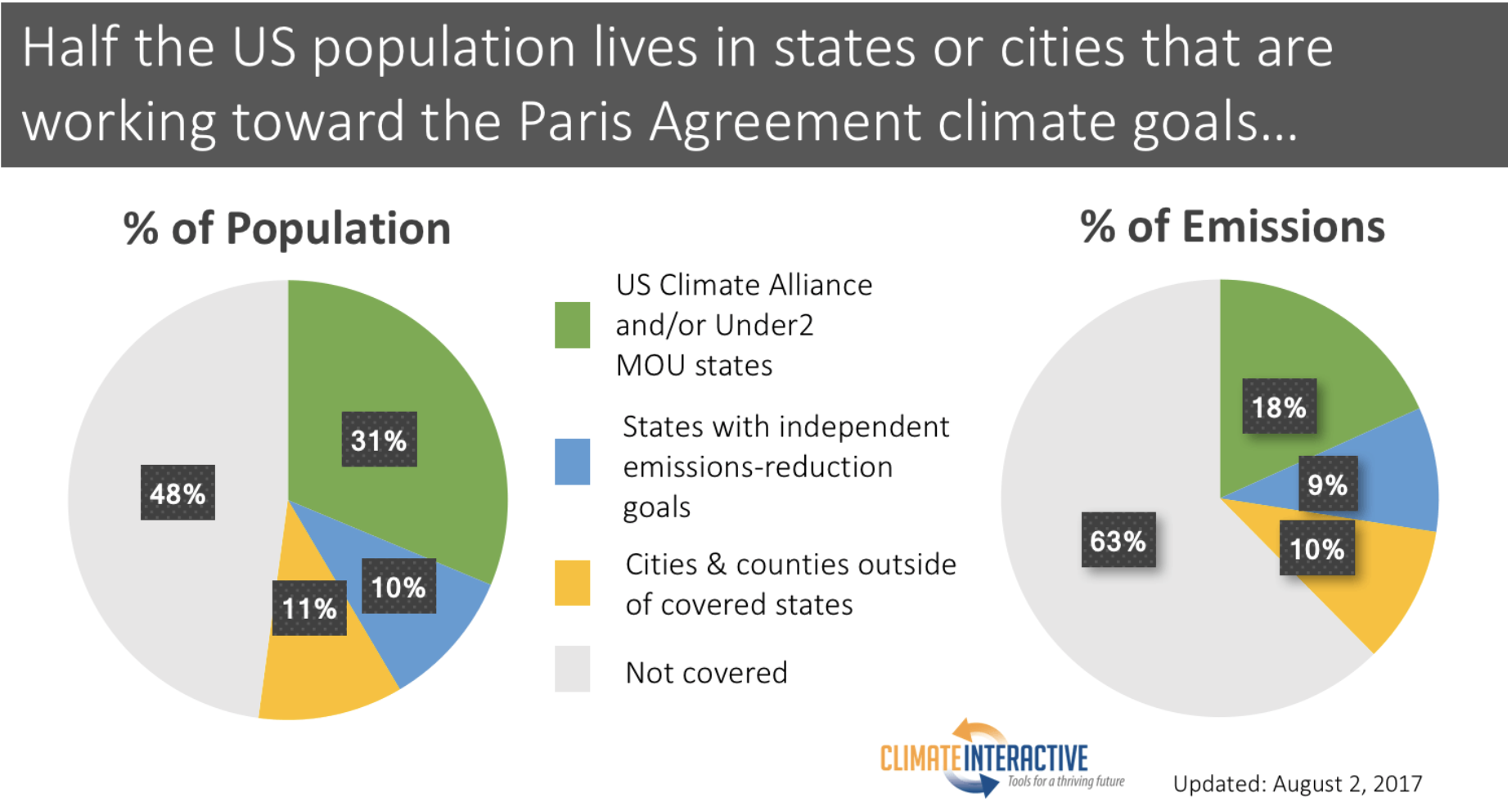
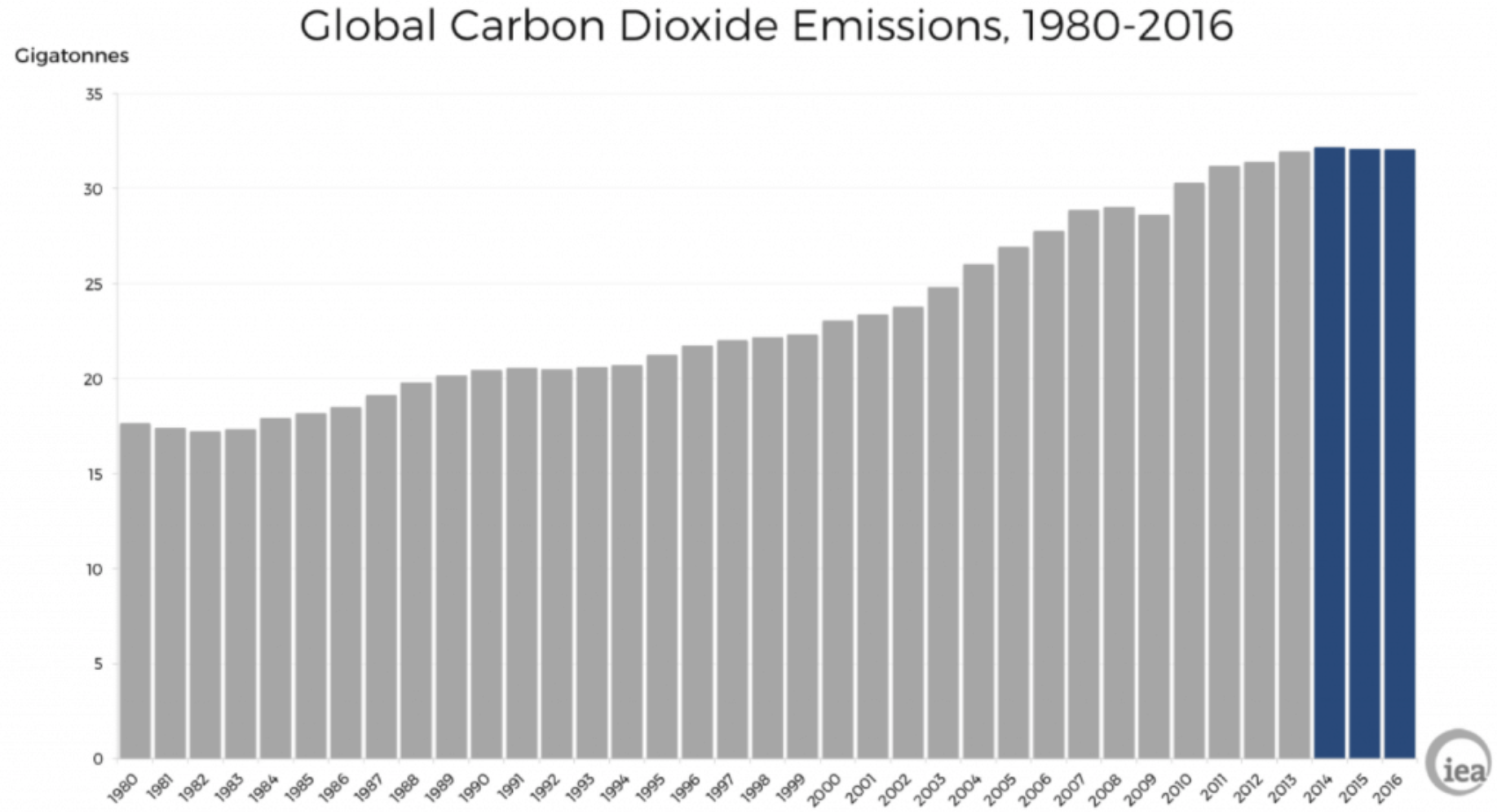
We know there’s been a lot of bad news on climate change lately. But there is plenty of good news too, and we think it’s just as urgent that people hear the good that is happening around the globe. Recognizing the progress the world has made keeps us hopeful and avoids the feeling of helplessness that can stop us from moving forward and taking action. So Climate Interactive has been gathering reasons to be hopeful about the climate.
Our Co-Director Drew Jones has been sharing this list to live audiences recently, including the Sierra Club and the Citizens’ Climate Lobby (click links for video). He found that it resonated with many climate leaders, and we hope it resonates with you, too. So here are our top 11 reasons for climate hope:
11. US Cities and States Are Acting on the Climate
A citizens’ climate movement is awakening in the United States. After President Trump withdrew from the Paris Climate Agreement, dozens of US states and hundreds of cities, counties, tribes, museums, and universities committed themselves to Paris-level emissions reductions. More than half of the US population now lives in an area that is committed to reducing emissions in line with the Paris Agreement goals. Every week the number of commitments grows, and brings the US closer to its Paris Agreement emissions reductions target.
10. There Is Bipartisan Support for Action in the US Congress
There is also support for climate action in the US federal government – and what’s more, it’s bipartisan. The Climate Solutions Caucus of the US House of Representatives was created in 2016. Composed of an equal number of Democrats and Republicans, the caucus crafts bipartisan legislation dealing with the causes and impacts of climate change. The caucus itself was formed after a long lobbying effort from the Citizens’ Climate Lobby, showing the power of citizen efforts to raise political awareness of climate change.
9. Global CO2 Emissions Are Leveling Off
In order to keep global warming below 2°C, carbon emissions need to peak, and peak soon. And there is evidence that this is already happening. According to the International Energy Agency, global carbon dioxide emissions have remained flat for the past three years, even as the global economy grew. This shows that the world economy is beginning to decarbonize. But while this is a good sign, we must ensure that this is a true peak rather than a pause, and start working to decrease those emissions.
8. Countries Are Setting Prices on Carbon
Forty countries and 24 cities, states, and regions are putting a price on carbon, according to the World Bank. And the carbon price movement is growing – the share of global emissions covered by a carbon price has tripled in the past ten years. Seven out of the 10 largest global economies have now put a price on carbon. What’s more, the World Bank reports that a rapidly growing number of companies have begun to use internal carbon pricing in the past year, and more international platforms have been introduced to encourage the uptake of carbon prices around the world.
7. We Are Hitting the Tipping Point on Renewable Energy
There is a feedback loop for renewable energy production: as demand for renewable energy goes up, R&D, economies of scale, and public acceptance of renewable energy technologies all rise. This brings the cost of producing renewable energy down, which in turn reduces the price of renewable energy. This price drop continues the cycle, as demand for renewables rises when the price goes down, and yet more renewable energy is diffused. The good news is that this virtuous cycle is well under way, as seen by the incredible drops in the cost of wind and solar technology in the past several years. In fact, Bloomberg predicts that solar power will become the cheapest energy source almost everywhere in the world within the next ten years. The market is driving these changes, but with the implementation of clean energy subsidies and/or carbon pricing, this cycle will accelerate even further.
6. Chinese Coal Consumption Is Going Down
China is the world’s biggest producer and consumer of coal, but it may be turning a corner. Although Chinese coal production and consumption rose hugely during the 2000s, it appears to have peaked in the 2010s and is now beginning to decline. Along with this change, China’s renewable energy sector is flourishing, growing faster than its fossil fuel and nuclear power capacity.
5. The Paris Climate Agreement Is Coordinating International Action
The Paris Agreement, adopted in December 2015, was an important breakthrough in the international negotiations on climate change. Despite President Trump’s recent high-profile exit from the Agreement, it continues to provide a powerful framework for 194 countries in the world to work together to set and address climate goals. While the current emissions pledges in the Agreement do not limit us to 2°C of warming, with increased action to reduce fossil fuel emissions, the participating countries could set the world on a path to 2°C or lower.
4. We Are Multisolving – Realizing the Multiple Benefits of Climate Action
As if climate change alone wasn’t enough reason to stop burning fossil fuels, we are finding out more about the ways that preventing climate change can also bring about economic, health, and other co-benefits. For example, planting a tree sequesters carbon emissions, which helps reduce climate change. But that tree will also clean the air and soil around it, provide cooling shade in the summer, and reduce the noise of city life. Another example: designing a neighborhood to be walkable will reduce the number of cars on the road, but it will also increase the health of residents and help those who can’t afford a car. We call these intersections of climate, justice, and well-being multisolving, and it is encouraging to see that so many problems can be addressed with the same budget and intervention. Also, when we keep these connections in mind, we can forge alliances with groups fighting for better healthcare, for social justice, and for many other causes.
In short, we are realizing that acting on climate pays dividends.
3. Social Change Looks Impossible, Until It’s Completed
How long does it take to accomplish long-term change? In the US, Bloomberg found there’s a pattern: a few pioneers will get out ahead of the issue, and then years or decades later a key event (such as a landmark court case or the maturation of a grassroots campaign) will take place that ushers in a cascade of new supporters, and finally a federal law on the issue. What’s more, the pace of social change seems to be accelerating: it took centuries for interracial marriage to go from being acceptable in a few US states to becoming federal law, whereas gay marriage took a little more than a decade to make the same transition. These booms that bring about change often seem unpredictable, even on the cusp of such an event.
The world ended the slave trade in the 19th century and apartheid in the 20th. If we keep up the pressure, then climate change could be the next frontier for global change.
2. We Are Divesting from Fossil Fuels
Beginning as a movement in 2011, young people on campuses across the US were determined that their college or university should not be putting money into fossil fuels, and urged their schools to divest their endowments away from fossil fuel companies. Today, 668 institutions around the world have joined the divestment movement, representing governments, NGOs, faith-based organizations, educational institutions, and more. The Guardian reports that this has been the fastest-growing divestment movement in history, and almost $5.5 trillion in global assets has been divested thus far.
1. Standing Rock Shows the Promise of Grassroots Activism
In early 2016 in the midwestern United States, a diverse coalition of Native American tribes began to protest the construction of the Dakota Access underground oil pipeline that was an impending threat to their water supply and sacred sites. The protests escalated over a period of months, and the original protesters were joined in support by 87 Native American governments, Black Lives Matter supporters, indigenous leaders in South America, and other civil rights and environmental groups. After several twists, turns, victories, and setbacks, the pipeline became operational in June 2017. However, a federal judge has ruled that the permit authorizing the pipeline violated the law, and the Standing Rock Sioux tribe has filed a brief to ask for the pipeline to be shut down while a more thorough environmental review is conducted.
This incredible protest showed the power of a grassroots movement led by Native Americans and those most vulnerable to fossil fuel exploitation. It showed that we can pull together and make common cause with diverse coalitions to protect indigenous sovereignty and land rights while working to keep fossil fuels in the ground. To keep the momentum going, we must continue to reach across traditional boundaries and build support to make a better world for all.
Climate Change Is a Fixable Problem
If there’s anything that these signs of hope show, it’s that we can do it. It may take a strong, coordinated, and global effort to keep fossil fuels in the ground and spread renewable energy, but we can do it. We know what it takes to reduce climate change, and we know that we must move forward together.
Think about your role in this effort – seeing all these reasons for hope, all of these effective strategies, what part could you play? Could you ask your organization to divest from fossil fuels, or pressure your elected officials for a carbon price, or add to the demand for renewable energy, or join a coalition like the Standing Rock activists?
Whatever you choose to do, always keep this in mind:
It’s not going to be easy. It’s going to be worth it.
Almost 8 million acre-feet of water has left Colorado in the past 20 years that the state could have kept, according to preliminary data from a legislative-commissioned study expected later this year…
That takes us to what happened to that 8 million acre-feet of water on the South Platte. It went to Nebraska. There’s a compact, like a contract, between Colorado and Nebraska, dating from 1923, that dictates that a certain amount of water from the South Platte goes to Nebraska, which preserves the river’s downstream environment and aquatic wildlife.
The 8 million acre-feet exceeds what Colorado was legally required to send to Nebraska. But the problem for Colorado is that there’s no place to put that water.
Lawmakers and water experts have been jawing about the lost water problem for years. In 2016, Rep. J. Paul Brown of Ignacio sponsored a bill to put some teeth into the conversations, by asking how much water is being lost to Nebraska and where it can be stored.
The final answer won’t be known until the end of this year, but earlier this month, an interim water committee at the state Capitol took a first look at the data and some of the sites where storage might happen.
It’s not an easy conversation. Building new reservoirs takes decades and often has to survive lawsuits and complicated federal and state permitting processes.. Look at the Northern Integrated Supply Project near Fort Collins, which could lead to a new reservoir and expansion of a second. The project is in its 14th year and will likely take another five or six years to get through all the permitting. In the life of a reservoir, that’s short. Compare that to the Animas-La Plata reservoir in southwestern Colorado, where construction was declared finished in 2013. The project began construction in 1968.
While new storage is definitely possible for that South Platte water, other storage ideas are being considered in the study. According to Andy Moore, a senior water resources specialist with the Colorado Water Conservation Board, the state’s primary water agency, 147 sites were identified on first blush for water storage.
Those sites fall into three categories: new reservoirs, rehabilitating and/or expanding existing reservoirs, or refilling underground storage. That’s water that would be pumped into aquifers, which are underground rock formations that hold water. Colorado has four major aquifers, with the three largest all along the Eastern Slope. In 2000, the South Platte aquifer, according to the Colorado Foundation for Water Education, served about 70 percent of the Front Range population.
The site list has been pared down several times, to eliminate sites too far from the main body of the South Platte or for sites that were too small to be useful. That leaves 16 sites, mostly in northeastern Colorado. Over the next several months, those sites will be evaluated for cost, benefits and other factors.
The first look at possible storage along the South Platte was welcomed by Chris Treese, external affairs manager for the Colorado River Water Conservancy District, the water agency in charge of the Colorado. “The Western Slope has long thought that as Coloradans we’re in the water world together, but every basin should look to own resources and capabilities first before looking for outside resources,” he said.
Treese wasn’t surprised by the numbers. “This is what Brown and others in the South Platte have been saying – that it’s a problem with a suitable storage location.” He added that the study will identify whether storage is “one silver bullet or a lot of smaller opportunities.”
Rep. Jeni Arndt of Fort Collins, a Democrat who chairs the House Agriculture, Livestock and Natural Resources Committee, favors refilling aquifers first and looking at other possibilities next. Arndt sponsored a bill, signed into law this year by the governor, that allows the state engineer to set up rules for the use of water that is pumped into nontributary aquifers. Those are aquifers not connected to surface water, like rivers.
Refilling aquifers, Arndt told Colorado Politics, is environmentally friendly, with less evaporation and less permitting. It is also practical from a political standpoint, she said, meaning that there should be less opposition to refilling aquifers than to building new reservoirs.
Refilling is “appealing, makes sense, it’s cost effective and it’s politically doable,” she said.
Brown was pleased with the study’s first data.
“This is the kind of information needed to make good decisions about what to do on the South Platte,” he said this week. He pointed out that the Arkansas, Rio Grande and Colorado rivers all have instream storage, and the only place without it is the South Platte.
For years, “the low-hanging fruit has been West Slope water,” Brown explained. And while Colorado has always delivered its Colorado River water as it should under the compact, the supply is just not there anymore. “It’s not just a West Slope issue – it’s an issue for the entire state. People who know water are very interested in making sure we don’t waste any and don’t send any more water to Nebraska than what they’re entitled to.”
Rep. Daneya Esgar, D-Pueblo, was named…to the legislative Water Resources Review Committee, which convenes when the legislature is not in session to study and recommend policies to promote the conservation and responsible use of Colorado’s water resources.
The WRRC and the Colorado Water Conservation Board play major roles in the implementation of the Colorado Water Plan, the state’s first comprehensive management plan for its most precious natural resource.
Rep. Esgar’s appointment was announced by Speaker Crisanta Duran. Esgar takes the place of Majority Leader KC Becker, who resigned to devote more of her time to her House leadership role.
How much water reaches the Westwater stretch of the Colorado River, and then Lake Powell, is taking on increasing importance to Colorado water officials. A new study is underway to look at much more water is available to develop on the Western Slope, and it’s caught the attention of east slope water officials. Photo: Brent Gardner-Smith/Aspen Journalism
Click here to read the newsletter. Here’s an excerpt:
UPPER COLORADO FORUM PROGRAM
The draft program for the 2017 Upper Colorado River Basin Water Forum, which will be held at CMU Nov 1-2, is now posted here, along with registration, sponsorship and lodging information. The forum will showcase stories that illuminate the challenges and complexities involved in trying to understand Upper Colorado River Basin water issues and manage water in new ways. Speakers will include scholars, water managers and policy leaders from across the Upper Basin.
Officials from the Colorado River District, which owns and operates Wolford Mountain Reservoir, announced in spring 2016 that they were scrapping plans to conduct a multimillion dollar rehabilitation project on Ritschard Dam, which when full holds back Wolford’s 66,000 acre-feet of water. At that time the district announced it would initiate an earthwork project to restore the dam to its original height after several years of settling dropped the dam’s crest by roughly one-and-a-half feet.
District officials, however, announced plans this week to postpone the dam heightening project until 2018.
Jim Pokrandt, spokesperson for the river district, explained the decision was based on several factors including that the project is still working through the permitting process and officials were concerned about a late start for construction and the potential for bumping up against colder weather.
Pokrandt further noted that 2017 has been a very busy construction season and bids on the project would have been high.
“This is still a good project and it needs to be done. It will just take another year,” Pokrandt said.
The River District had previously planned to draw down Wolford to accommodate the earthwork but the recent announcement means accelerated drawdowns will not occur.
According to Ray Tenney, Deputy Chief Engineer for the District, for the remainder of summer and fall, the usual and expected water deliveries for contract and endangered fish habitat purposes will occur, resulting in a typical seasonal drawdown of about 10 feet in water elevation in coming months.
Wolford’s recreational amenities, including camping, boating, fishing, and day-use, will still remain open to he public.
Mexican and American officials are finalizing a water-sharing deal for the Colorado River, and a newly released summary of the accord’s key points shows negotiators have agreed on a cooperative approach geared toward boosting reservoir levels and trying to stave off a severe shortage.
The document, which federal officials have circulated among water agencies, outlines a series of joint measures that build on the current 5-year agreement, which expires at the end of this year.
The new accord – titled Minute No. 323 to the 1944 Mexican Water Treaty – is expected to be signed sometime this fall, perhaps as early as September, and would remain in effect through 2026.
It would extend provisions in the current agreement, known as Minute 319, that specify reductions in water deliveries during a shortage, as well as increases in water deliveries during wet periods. The agreement also provides for Mexico to continue storing water in Lake Mead, near Las Vegas, helping to boost the reservoir’s levels, which in the past few years have dropped to historic lows.
The accord would also establish a “Binational Water Scarcity Contingency Plan,” in which Mexico would join U.S. states in temporarily taking less water out of Lake Mead to reduce the risks of the reservoir reaching critical levels.
Those commitments by Mexico would only take effect if California, Arizona and Nevada finish their own Drought Contingency Plan, under which the states would forgo larger amounts of water than they’ve previously agreed to as the reservoir’s level declines.
“The Mexicans have demonstrated their interest in pursuing this, and it’s a clear benefit to the river to have more storage in Lake Mead,” said Bart Fisher, chairman of the Colorado River Board of California. He said the agreement would benefit water suppliers in California, Arizona and Nevada by giving them “certainty in case of shortage that Mexico will also share in the shortage.”
“All of those things put together, it’s a big win-win for both countries,” Fisher said…
Talks on the U.S.-Mexico agreement began during President Barack Obama’s administration and have continued with negotiating sessions held on both sides of the border by the International Boundary and Water Commission, which includes representatives of both governments. Representatives of U.S. states have also participated in the talks.
Even as political tensions have grown over Trump’s immigration policies and his vows to have Mexico foot the bill for a border wall, the Colorado River negotiations seem to have moved ahead relatively smoothly – pressed on by the approaching expiration of Minute 319.
“We largely concluded the framework for these negotiations a year ago,” Fisher said, “and the only fine-tuning has been the drought contingency portion, and cleaning up a little bit of inconsistent language.”
The agreement itself has not yet been publicly released. The summary provided by the U.S. Bureau of Reclamation was presented Wednesday at a board meeting of the Imperial Irrigation District, which holds the biggest single entitlement to water from the river.
In a memo, IID officials said in order to implement the U.S. commitments under the deal, several agreements must first be completed between the states, water agencies and the Interior Department.
Those agreements include a U.S.-funded program to invest $31.5 million in water conservation projects in Mexico, including infrastructure upgrades such as concrete lining for leaky canals and other improvements to reduce water losses from distribution systems.
The federal government will provide $16.5 million, while the remaining $15 million will come from four water agencies, including IID, the Metropolitan Water District of Southern California, the Southern Nevada Water Authority and the Central Arizona Water Conservation District.
Each of the water agencies will contribute a fourth of the funding. In return, they will receive a portion of the water freed up through conservation in Mexico.
The conservation projects are intended to generate a total of 229,000 acre-feet of water – enough to cover an area two-thirds the size of Los Angeles with a foot of water. Of that, 50,000 acre-feet will be used to give a boost to the Colorado River system and 70,000 acre-feet will be used to “satisfy the U.S. commitment to provide water for the environment.”
The accord lays out a cooperative strategy for Mexico and the U.S. states to jointly put the brakes on water use to reduce the risks of a crash in the system if the drought persists.
As of this week, Lake Mead stands at just 38 percent full, with its level at an elevation of nearly 1,080 feet, not far above the initial shortage threshold of 1,075 feet…
In April, the Bureau of Reclamation estimated the odds of Lake Mead hitting shortage levels in 2019 at 31 percent. A previous projection had put the odds at 50-50 before the winter brought a substantial snowpack, which was measured at 113 percent of average across the Colorado River basin.
The government’s summary of Minute 323 says the United States and Mexico “share a common vision on a clear need for continued and additional actions to reduce the risk of reaching critical reservoir elevations at Lake Mead.”
The document details how continued declines at the reservoir would trigger a rising scale of cutbacks in water deliveries, with Mexico contributing alongside the states – as long as the states have a similar plan in place.
By developing this type of plan to reduce water use effectively, the aim is to reduce risks of severe shortages threatening water deliveries and the generation of hydroelectricity, said Jennifer Pitt, who leads the National Audubon Society’s Colorado River project.
“It’s avoiding the shocks of sudden disruptions in water supply that is most important,” Pitt said. “But with these agreements, where the states and countries … commit together to a planned decrease in water use, I think the prospects for sustainable management increase greatly, and likely without severe economic impacts.”
The U.S.-Mexico deal includes a list of other measures, including establishing several joint working groups to focus on issues such managing the river’s salinity and optimizing flows to benefit the environment.
One of the groups, according to the government’s outline, will focus on studying the potential for desalinating seawater from the Sea of Cortez…
Under Minute 319, which was signed in 2012, the U.S. and Mexico agreed to an experiment: a one-time release of water into the parched delta that would resemble a natural flood.
That “pulse flow,” which gushed into the delta for eight weeks in 2014, temporarily reconnected the river with the Gulf of California, bringing a bloom of cottonwoods and willows along its path and attracting birds.
In Minute 323, there is no mention of plans for another “pulse flow.” This time, the focus is instead on securing a more steady flow of water to sustain wetlands south of the border. Goals include expanding restored habitat areas from about 1,000 acres to 4,300 acres.
Under the agreement, Mexico, the U.S., and nongovernmental organizations will team up to secure water for environmental purposes, plus $18 million for habitat restoration and monitoring.
“It seems like everybody’s in agreement on how to address these challenging issues,” said Tina Shields, IID’s water manager, who presented an overview of Minute 323 to the district’s board.
The Southeastern Colorado Water Conservancy District and the U.S. Bureau of Reclamation, which owns and operates the Pueblo Dam, signed an agreement last week allowing for the soon-to-be-built plant to connect to the dam, Chris Woodka, the district’s issues management program coordinator, said in a release.
The agreement was signed after the Colorado Springs City Council unanimously approved the creation of a military sales tariff on Tuesday. The tariff will cover costs for Colorado Springs Utilities to act as an intermediary, buying power from the district and selling it to Fort Carson.
With all the necessary agreements in place, the district hired Mountain States Hydro, LLC, to build the $19 million plant, Woodka said. Construction will begin in September and the plant should be operational by the spring.
Half of the electricity from the plant, estimated to be up to 7.5 megawatts, will be sold to Fort Carson and the other half will be sold to Fountain Utilities.
The plant is expected to generate about $1.4 million in revenue each year, Woodka said.
“This is a monumental moment in the history of the district,” said Jim Broderick, the district’s executive director. “We have been working to put all of the pieces in place since 2011. Now that this project is coming to fruition, it represents not only a sustainable income stream for our stakeholders, but develops a clean source of power for the future.”
Added Chris Woodka, the district’s issues management program coordinator, “The Lease of Power Privilege clears the way for the hydropower plant to connect to Pueblo Dam, a federally owned structure. Mike Ryan, director of the Great Plains Region for Reclamation, signed the lease Friday.”
In order to satisfy all federal requirements related to the project, members of the district have been working for the past 18 months to put a series of other agreements in place.
“The district has contracted with Mountain States Hydro, LLC, to build the plant,” Woodka said, “with construction to begin in September. It is scheduled to be completed during the fall and winter months when releases from Pueblo Dam generally decrease.”
It’s anticipated that the plant will be online by spring 2018.
The plant will cost about $19 million to build. Last year, the district secured a $17.2 million loan from the Colorado Water Conservation Board, with the district’s business enterprise providing matching funds.
Over time, those funds will be paid off by revenues from the sale of power.
For a decade, power from the plant will be purchased by the city of Fountain and by Colorado Springs Utilities for use at Fort Carson.
“After that, Fountain intends to purchase all of the power for at least 20 more years,” Woodka said.
The plant will generate up to 7.5 megawatts of power by using three turbines capable of producing power from 35 to 800 cubic feet per second of flow in the Arkansas River. Water will pass through a connection that was built into the service line for the Southern Delivery System, then into the Arkansas River.
Projections by district staff show that an average of 28 million kilowatt hours will be produced annually, with about $1.4 million in average revenue per year.
This money will be used to pay off the CWCB loan and to satisfy contractual agreements with the Bureau of Reclamation, as well as a carriage agreement with Black Hills Energy. All remaining funds will go to enterprise activities, including the Arkansas Valley Conduit.
The Colorado Water Conservation Board, after unveiling the Colorado Water Plan in Denver in November 2015. The board includes eight voting members from river basins in Colorado and one voting member from the city and county of Denver.
Here’s a guest column from Bart Miller that’s running in The Durango Herald. Here’s an excerpt:
Here’s why. Water management continues to be one of the trickiest out-of-sight, out-of-mind challenges of our era.
Water resources are stretched thin because the state continues to grow (with about 100,000 new residents added every year) while water sources are shrinking – scientists predict a future with less water on average, with “drought” being more like the new norm. Fast-growing Front Range cities continue to rove in search of water, including from Western Slope streams and Front Range farmers.
The challenges above led to the creation of Colorado’s Water Plan in 2015. The two-year process to develop the plan engaged many around the state. Over 30,000 public comments were submitted. The vast majority of them highlighted the need for more urban water conservation, river protection, and increased flexibility of water policies to allow more voluntary and compensated agreements for water sharing between farms, cities, and rivers.
The plan did a good job of articulating the wide range of values Colorado has around water and set out objectives to meet our future demands. But it noted the vast majority of existing public funding is focused on traditional water infrastructure projects and not the often cheaper and more river-friendly water supply tools of expanding water conservation in cities and on farms, water reuse, and flexible water-sharing agreements. In fact, there is a multibillion dollar “gap” that prevents fully implementing these water security tools and improving river flows to support local river-dependent economies.
Here is where Mitchell comes in. As the new director of the CWCB, she has a huge opportunity to kick the plan into action. She is as well-suited for the job as anyone could be. She has nearly a decade of experience at the Conservation Board, including as a section chief. She’s technically savvy and politically astute.
She has gained trust from all water sectors and has shown a strong willingness to meet with water users and river enthusiasts all across the state, balancing her heavy work schedule with raising five kids at home.
Perhaps most importantly, Mitchell knows Colorado’s Water Plan like the back of her hand. After all, she had a major role in writing it. She seems ready to realign the agency’s priorities to support the full spectrum of water management tools that support our communities, rivers and agriculture.
New price tag reflects costs of water treatment projects, which governor says were “never intended” to be part of the water plan
Implementing Gov. John Hickenlooper’s ambitious water plan likely will cost at least twice what the administration projected.
When releasing the statewide strategy in 2015, James Eklund, then director of the Colorado Water Conservation Board [CWCB], estimated that amassing enough water to avoid a critical shortfall mid-century would cost $20 billion. He didn’t indicate what that amount would pay for, saying the figure was more of a “back-of-the-napkin analysis” than the sum of specific costs for specific projects in a set list of priorities.
Eklund resigned in March, taking his $20 billion napkin with him.
Now, less than a month into the job, his successor Becky Mitchell is setting more realistic cost projections for a plan that seeks to glean massive amounts of water not just to accommodate population growth, but also to keep farms and ranches in business and to protect Colorado’s rivers and the ecosystems that rely on them.
Mitchell is putting the anticipated price tag at $40 billion, and “maybe more.” Some $18 billion is likely to be paid by existing sources such as municipalities, water utilities, and ditch companies that deliver water to farms and ranches, she said. She described the remaining $22 billion as an “unmet funding need.”
“Cost projections have always been just estimates, and part of that is because not all the information is in,” Mitchell said. “What we’re already seeing as folks are solidifying our numbers is that it’s going to be more than earlier predictions.”
It’s not clear what Eklund’s $20 billion estimate included, but it seems to have reflected costs only for brick and mortar projects such as dams, reservoirs, ditches and other infrastructure needed to meet growing demands for municipal and industrial water use. It apparently didn’t include conservation programs, public education and keeping water in rivers for recreational and environmental purposes. It also didn’t factor in ambitious programs to encourage farmers and ranchers to collaborate with environmentalists on conservation, Mitchell said. “Those creative solutions will be high-dollar projects,” she added, and they “are coming in higher than predicted.”
Eklund now works at a prominent law and lobbying firm, but still represents Colorado in interstate water negotiations. Asked this week to explain the disparity between his $20 billion cost projection and Mitchell’s $40 billion, he said, “Boy, that’s a good one. I haven’t heard about the new figure.”
His estimate may have been “conservative” and “low,” he acknowledged.
“Maybe too low,” he said.
Gov. Hickenlooper told The Colorado Independent today that while he expects the estimated cost of the plan to change with inflation and as projects are added or deleted, the additional $20 billion comes largely from the cost of water treatment projects, which help turn wastewater into potable water. Such projects, he said, were not part of the original estimate “and were never intended to be part of the water plan.”
The governor’s water advisor, John Stulp, told The Independent in the spring that water treatment projects likely would add $8 billion to $12 billion to Eklund’s original, $20 billion estimate.
Hickenlooper ordered Colorado’s first statewide water plan in May 2013 as an attempt to thwart a shortfall that state water officials project for 2050. When he and Eklund heralded the release of the final version in November 2015, the governor made it clear that he didn’t want it to sit on a shelf gathering dust.
The plan aims to secure enough water to keep up with rampant growth, which is expected to boost the state population of 5.5 million people last year to as many as 10 million by 2050. It also needs to satisfy farming and ranching water rights, environmental necessities, increasing thirst brought about by climate change, and contractual water obligations to other states. Putting it into place will require enormous financial investments.
Eklund’s $20 billion price tag was daunting enough to politicos and policy advocates in a state that rejected a water bond issue in 2003. Referendum A sought voter approval for $2 billion in revenue bonds for water projects. Coloradans voted 2 to 1 against the measure, which failed in every county in the state.
Coming up with funding for $40 billion in water projects would require unprecedented unity among Colorado’s factioned rural and urban water users, leadership from the governor’s office and the legislature, and buy-in from Coloradans.
“It will be a much harder task to actually implement the water plan than it was to write it,” said Ted Kowalski [ed. emphasis mine], a water lawyer who now leads the Walton Family Foundation’s initiative on the Colorado River, which provides about half of Colorado’s water supply.
The doubling of the estimated cost of that implementation underscores the urgency of having conversations about sustainable funding now, Kowalski added, “so that we don’t have to be having these conversations during a crisis.” The philanthropy of Walmart heirs has taken an increasing role promoting balanced water policies, conservation, and watershed health in the seven states that rely on the river, as well as in other watersheds nationally and internationally.
Basin roundtable boundaries
In setting water priorities, the water board takes its cue from collaborative working groups called “roundtables” in Colorado’s eight river basins, plus another group in the Denver metro area. Those groups are in the process of telling the water board what projects – with price tags – they need to meet the goals set forth in the water plan, such as keeping up with growth, conserving water, and ensuring environmental protections on rivers. Their proposals are “flooding in,” Mitchell said, and have been giving her agency a clearer sense of how much the water plan will cost to implement. The water board will let each working group set its own priorities before deciding which projects should receive state funding.
In the meantime, what, specifically, the $40 billion would pay for still remains unclear. Mitchell said her staff will “gain more clarity” after the nine roundtable groups have come up with lists of proposed projects expected in 2018.
“I’d be very interested in how they got from $20 to $40 billion so fast, and what new projects will be included,” said Gary Wockner, a Colorado-based ecologist and activist for healthy rivers.
Pat Mulroy, a water policy expert for the Brookings Institution and former head of the Southern Nevada Water Authority, said, “I would have had my head handed to me on a platter if I said we’re going to spend $40 billion in the next 30 years and people asked what are you going to spend it on and I said ‘I’ll let you know.’”
Also unclear is where $40 billion would come from.
The state collects severance tax revenues for its water supply reserve fund, which is up to $10 million. But that’s just a drop in the water plan’s symbolic bucket. Mitchell said Colorado’s Department of Transportation, Colorado Parks and Wildlife, and Colorado Department of Public Health and Environment may need to take responsibility for some costs associated with the water plan. And she hopes that the federal government, under the Trump administration’s public works agenda and looser regulatory policies, “might also play a role.”
While running the water board – the agency leading water policy in the state – Eklund focused on promoting public-private partnerships to fund projects. Those are the water equivalent of toll roads. Whether the partnerships ultimately come to fruition and how much they could fund remain to be seen.
In the last several months, the Walton Family Foundation and philanthropies tied to the Rockefeller, Gates (as in Gates Rubber, not Microsoft), and other ultra-wealthy families have been discussing how to be part of the funding solution. Walton recently announced that it’s investing $100 million on the Colorado River from Colorado to Mexico. Kowalski, the foundation’s water man in Colorado, said Walton and other benefactors may be able to fund small pilot projects in hopes that they spur public investment, but can’t be relied on to help bankroll the billions of dollars Colorado needs.
“We’re trying to increase awareness and help generate conversations along the river,” Kowalski said. Those efforts include a recent Walton-funded study trip about the Colorado River for 18 journalists, including this reporter.
Ultimately, implementing the water plan will require public funding. The Nature Conservancy has been studying options such as a bottle tax, a tourism tax, and a surcharge on water rates. A ballot measure or referendum could go to voters as early as 2018, but the 2020 election is more likely given Colorado’s new law making it tougher to put such measures before voters.
Carol Hedges, executive director of the Colorado Fiscal Institute, said the multi-billion-dollar price tag for water projects “is one more instance of how we’ve delayed making the public investments we need in a changing economy. And as a result of that delay, it’ll come at a substantial cost for all Coloradans.”
Mitchell is an engineer by training, accustomed to working with hard facts and figures, and to devising solutions. She knows that coming up with $40 billion to address Colorado’s water woes is a solution that, if achievable, will entail an epic level of political heartburn. Having to double the cost projection in her first month as CWCB director has given her a taste of the challenges before her.
“It’s not productive to get hung up on the cost. That’s divisive,” she said. “What’s more productive is framing this around how much progress we’ve made coming together around this plan. We have to look at the whole picture right now. We just have to.”
Those who watch water policy in Colorado say Hickenlooper won’t be moving the needle on water simply by having ordered the state’s first water plan.
Added Kowalski: “It would be great if (Gov. Hickenlooper) could secure his legacy as a water leader by having sustainable funding.”
Editor’s note: The Colorado Independent’s series PARCHED looks at how Colorado is preparing for a looming water shortage brought on by population growth and climate change.
I haven’t heard anyone talk much about the impending food crisis in N. Korea. So I will.
The New York Times (Choe Sang-Hun) reported on July 21, 2017:
North Korea is suffering its worst drought in 16 years, a United Nations agency reported on Friday, raising fears of worsening food shortages in the country, where children and other vulnerable groups have been malnourished for years.
North Korea’s production of staple crops for this year, including rice, corn, potatoes and soybeans, has been severely damaged by prolonged dry spells “threatening food security for a large part of its population,” the agency, the Food and Agriculture Organization, said in a report prepared in collaboration with the European Commission’s Joint Research Center.
Seasonal rainfall in the main cereal-producing regions is below that of 2001, when grain production fell to a record low of two million tons, Vincent Martin, the agency’s representative in North Korea, said in a news release.
Although some rain has fallen this month, it was likely to be too late to allow the normal planting and development of main crops that would be harvested in October and November, the report said.
Because of the drought, the production of early season crops that are harvested in June, including wheat, barley and potatoes, dropped to 310,000 tons, more than 30 percent below last year’s 450,000 tons, it said. The early season harvest usually accounts for 10 percent of the country’s total annual cereal production…
“Increased food imports, commercial or through food aid, would be required during the next three months at the peak of the lean season, ensuring adequate food supply for the most vulnerable, including children and elders,” the agency said in a statement.
North Korea experienced chronic food shortages in the 1990s, when a famine caused by years of bad weather and economic mismanagement forced the country to issue a rare appeal for international help. By some estimates, more than a million people died in the famine.
The country has since allowed more market-oriented activities and encouraged trade with China to increase access to food. Its own food production has also improved in recent years. But humanitarian relief groups still call for donations, warning that shortages remain widespread.
But international donors have become increasingly reluctant to provide humanitarian aid in recent years, as North Korea has continued to test nuclear weapons and missiles in defiance of United Nations resolutions. In September, after the North’s fifth nuclear test, South Korea did not offer humanitarian aid to tens of thousands of flood victims in North Korea, saying that the country should divert the money spent on weapons to buy food for its people.
President Park Geun-hye took a hard-line stance on the North, but under President Moon Jae-in, a liberal who took office in May, the South Korean government has indicated it will be readier to consider humanitarian aid.
North Korea has not yet reported any damage from the drought. Instead, its main state-run newspaper, Rodong Sinmun, urged the country on Friday to produce more goods locally, especially raw materials and fuel, to overcome what it called “barbaric” international sanctions pushed by the United States.
The question is how the North Korean leader will react if there is unrest. That’s why the U.S. Congress needs to step up and make sure that food can get to N. Korea.
Here’s an analysis of the potential supply disruptions and political effects from climate crises, like drought, and the intersection of limited supply routes, from Elizabeth Winkler writing for The Washington Post. Global food security, she says,
…depends on trade in just four crops: maize, wheat, rice and soybeans. The first three account for 60 percent of the world’s food energy intake. The fourth, soybeans, is the world’s largest source of animal protein feed, making up 65 percent of global protein feed supply. Their production is concentrated in a handful of exporting countries, including the United States, Brazil and the Black Sea region, from which they are flowing at ever-greater volumes. Between 2000 and 2015, global food trade grew by 127 percent to 2.2 billion metric tons — and growth rates are projected to keep increasing.
It’s peak hurricane season, but the nation’s worst weather disaster right now is raging on the High Plains.
An intense drought has quickly gripped much of the Dakotas and parts of Montana this summer, catching farmers and ranchers off-guard. The multi-agency U.S. Drought Monitor recently upgraded the drought to “exceptional,” its highest severity level, matching the intensity of the California drought at its peak.
The Associated Press says the dry conditions are “laying waste to crops and searing pasture and hay land” in America’s new wheat belt, with some longtime farmers and ranchers calling it the worst of their lifetimes. Unfortunately, this kind of came-out-of-nowhere drought could become a lot less rare in the future.
“The damage and the destruction is just unimaginable,” Montana resident Sarah Swanson told Grist. “It’s unlike anything we’ve seen in decades.”
Rainfall across the affected region has been less than half of normal since late April, when this year’s growing season began. In parts of Montana’s Missouri River basin, which is the drought’s epicenter, rainfall has been less than a quarter of normal — which equals the driest growing season in recorded history for some communities.
“It’s devastating,” says Tanja Fransen, a meteorologist at the National Weather Service’s office in Glasgow, Montana. Just six years removed from 2011, one of the region’s wettest years on record, eastern Montana is now enduring one of its driest.
“We’re at the bottom of the barrel,” Fransen says. “For many areas, it’s the worst we’ve seen in 100 years.”
Wheat production worries
The drought already has far-reaching effects. In eastern Montana, America’s current-largest wildfire continues to smolder; the 422-square-mile Lodgepole complex fire is one-third the size of Rhode Island. It’s Montana’s largest fire since 1910.
Across the state, 17 other large fires are also spreading. “We haven’t even hit our normal peak fire season yet,” Fransen says.
Recently, as the climate has warmed and crop suitability has shifted, the Dakotas and Montana have surpassed Kansas as the most important wheat-growing region in the country. The High Plains is now a supplier of staple grain for the entire world. According to recent field surveys, more than half of this year’s harvest may already be lost.
The economic impact of the drought and related fires may exceed $1 billion across the multi-state region by the time the rains return. Donations of hay for beleaguered farmers and ranchers have come in from as far away as West Virginia.
Farmers in the region are also worried because the Trump administration has targeted a key federal crop insurance program for hefty cuts. The governors of North Dakota, South Dakota, and Montana have all declared states of emergency to speed aid and open some normally protected areas for livestock grazing.
It came out of nowhere
Droughts are often thought of as creeping, slow-motion disasters. They usually don’t grab headlines like hurricane landfalls, even though they represent the costliest weather-related catastrophe worldwide.
But this drought is an anomaly, a “flash drought.” It essentially came from nowhere. It didn’t exist just three months ago.
The frequency of these rapid-onset droughts is expected to increase as the planet warms. A recent study focusing on China found that flash droughts more than doubled in frequency there between 1979 and 2010.
Droughts like these are closely linked to climate change. As temperatures rise, abnormally dry conditions across the western United States are already becoming more common and more intense. And as evaporation rates speed up, rainfall becomes more erratic, and spring snowmelt dries up earlier each year.
Future summers in North Dakota are expected to be even hotter and drier, on par with the present-day weather of south Texas.
In their zeal to pile on the madman in N. Korea Congress needs to be careful not to inadvertently join forces with Climate Change and worsen the situation.
Click on a thumbnail graphic to view a gallery of U.S. Drought Monitor maps showing the development of flash drought in the N. High Plains this season.
The Colorado Parks and Wildlife Commission honored three water engineers for their work to secure water for a permanent fish and wildlife conservation pool in John Martin Reservoir. Celebrating, from left, are Dan Prenzlow, CPW Southeast Region manager, Steve Witte, Arkansas River Basin division engineer, CPW Director Bob Broscheid shaking hands with recently retired State Engineer Dick Wolfe, Bill Tyner, deputy Arkansas River Basin engineer, and Brett Ackerman, deputy manager CPW Southeast Region. Photo courtesy Colorado Parks and Wildlife / Bill Vogrin.
Here’s the release from Colorado Parks and Wildlife:
Three state water engineers who were instrumental in breaking a 40-year deadlock between Colorado and Kansas to secure water for a permanent fish and wildlife conservation pool in John Martin Reservoir were honored Thursday by the Colorado Parks and Wildlife Commission at its meeting here.
For their “outstanding support of Colorado’s wildlife,” CPW Director Bob Broscheid praised recently retired State Engineer Dick Wolfe, Steve Witte, Arkansas River Basin division engineer, and Bill Tyner, deputy Arkansas River Basin engineer.
The three, working with CPW Southeast Region Manager Dan Prenzlow and Deputy Region Manager Brett Ackerman, negotiated the breakthrough agreement that resulted in a new source of water flowing into John Martin, beginning in June, to help stabilize the permanent pool.
“This is a very big deal,” Broscheid said as Wolfe, Witte and Tyner were presented with wildlife statues in appreciation of their work.
The water for the permanent pool was approved on a one-year agreement between Colorado and Kansas, the two states whose citizens are the primary recreational users of the reservoir. If extended beyond the first year, it would have a significant beneficial impact on fishing and boating in drought years when the reservoir can run dry, killing fish and destroying habitat and recreational opportunities at John Martin Reservoir State Park and adjacent State Wildlife Area.
The improved maintenance of the permanent pool was made possible in May when the Arkansas River Compact Administration passed a historic resolution allowing CPW to run water in the Highland Ditch on the Purgatoire River in Bent County into John Martin Reservoir. Stipulations in the temporary agreement state that 6,000 acre-feet of water may be delivered during specific time periods, and with consideration of transit losses.
If the water flow goes as planned, CPW hopes to renew the agreement for 2018 and work to make it a permanent agreement.
The water agreement is the culmination of long negotiations between a variety of agencies including CPW, the Colorado Water Conservation Board, the Lower Arkansas Water Management Association and the Attorney General’s office, and brought to fruition through extensive collaboration between the state engineers of Colorado and Kansas.
“CPW has tried unsuccessfully for the past 40 years to get a new source of water approved by the Compact Administration,” Broscheid said. “That multimillion-dollar fishery has constantly been in flux and at risk. This will preserve that valuable fishery and recreational facilities at John Martin Reservoir State Park and State Wildlife Area.”
Broscheid said there are significant benefits to the new agreement, including:
Reducing the hundreds of thousands of dollars CPW has spent leasing Colorado River water.
Lowering the risk of fish loss, saving CPW approximately $165,000 annually in restocking costs when the fishery is damaged.
Improving the economies in surrounding communities by as much as $825,000 a year when the fishery is healthy.
Wolfe retired in June after a 24-year career with the Colorado Division of Water Resources including the last 10 as director and state engineer.
“This was a group effort,” Wolfe said, noting the intense involvement of Prenzlow and Ackerman and the important roles they played in elevating the issue as a priority and seeing it through the recent three-year negotiations.
“It’s been a long time in the making,” Wolfe said. “And it shows the importance of fostering good relationships between state agencies and how cooperation between the various agencies solved a complex water administrative system issue.”
Professor Emeritus and former State Climatologist Tom McKee, left, shared memories dating back to 1977, the year Nolan started working at CSU as Assistant State Climatologist.
Here’s the release from Colorado State University:
Former department members and National Weather Service employees joined the department and Colorado Climate Center today to celebrate Nolan Doesken’s 40 years of service to CSU, 11 of those as Colorado’s State Climatologist. Department Head Jeff Collett recognized Nolan for his dedication and passion for climatology, and guests shared memories of everything from recording the coldest day in Colorado to Nolan’s basketball prowess.
Nolan’s impact as State Climatologist was lauded on local, state and national levels. The American Association of State Climatologists wrote a letter of thanks to Nolan that was read by Becky Bolinger. Taryn Finnessey from the Colorado Water Conservation Board read a letter from Gov. John Hickenlooper, thanking Nolan for his service and expertise in helping to craft a leading drought mitigation plan. Climate Center staff, who applauded Nolan for being a wonderful boss, presented him with a home weather station, and a representative of the National Weather Service gave him a snow measuring stick.
Nolan thanked Professor Emeritus and former State Climatologist Tom McKee and others who were not in attendance for hiring him for the position of Assistant State Climatologist, even though, he claimed, he was “not qualified.” Nolan said the job description called for five years of mountain meteorology experience, and he had about 19 days experience in the Colorado Rocky Mountains. Though his love for weather may have started in his home state of Illinois, Nolan has made a name for himself and deep connections in Colorado, where he has long been known as the state’s top authority on weather and climate.
We thank you for your service and wish you the best in retirement, Nolan!