A low pressure system developed across the southern Great Plains by February 17 and rapidly tracked northeastward to the Ohio Valley and Northeast a day later. To the northwest of the surface low track, snowfall amounts exceeded 6 inches across northeast Kansas, northern Missouri, and north-central Illinois. In the warm sector of this storm system, severe thunderstorms with locally heavy rainfall (more than 1 inch) affected the Tennessee Valley and parts of the Lower Mississippi Valley. Another low pressure system developed by February 21 with a similar northeastward track to the Ohio Valley. 7-day precipitation amounts, from February 15 to 21, exceeded two inches across much of the Ohio and Tennessee Valleys, Ozarks region, southeast Oklahoma, and parts of northern Texas. Farther to the south and west, little to no rainfall occurred closer to the Gulf Coast along with the Rio Grande Valley and central to southern high Plains. This precipitation pattern during mid-February and the primary storm track across the Ohio Valley are typical during La Nina. Although there was accumulating snow across the northern to central Rockies and northern Cascades this past week, the drier-than-normal pattern persisted throughout most of the West. 7-day temperatures, for the week ending on February 22, averaged above normal across the East, lower Mississippi Valley, and western Gulf Coast. Meanwhile, intrusions of Arctic air began to shift south from Canada into the northern Great Plains and upper Mississippi Valley where weekly temperatures averaged as much as 10 degrees F below normal. Periods of rainfall continued to occur along the windward sides of the Hawaiian Islands…
Following two weeks of worsening conditions across the central Great Plains, additional degradations were made to parts of Kansas and southern Nebraska. These degradations were supported by 30 to 120-day SPI and soil moisture indicators. Snowfall of more than 6 inches during mid-February and favorable snow water equivalent values supported a one category improvement over the Bitterroots of western Montana. A small reduction in exceptional drought (D4) and extreme drought (D3) was made to western and south-central Montana, due to this past week’s snowfall (more than 0.5 inch, liquid equivalent) along with consideration of SWE for the season and long-term SPIs…
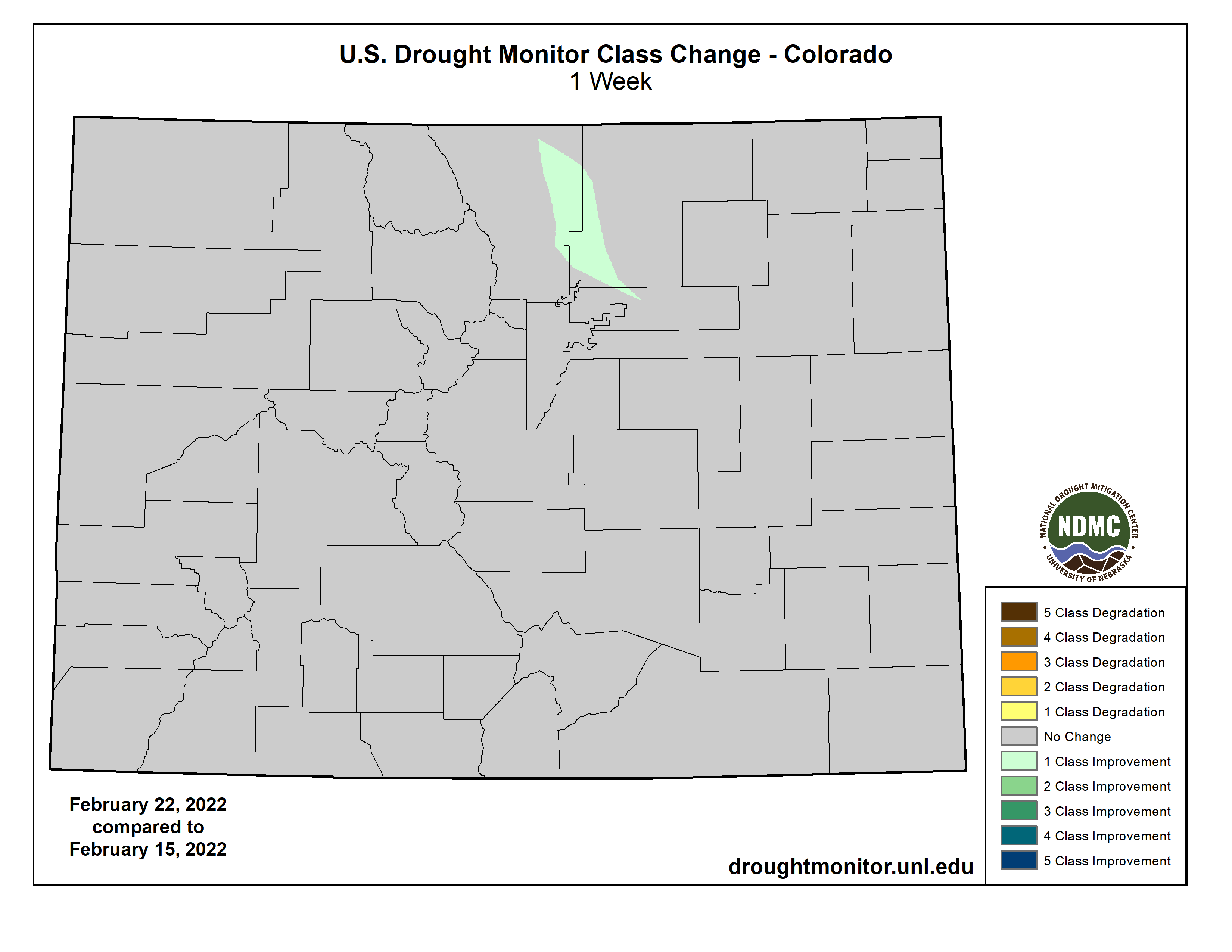
Colorado Drought Monitor one week change map ending February 22, 2022.
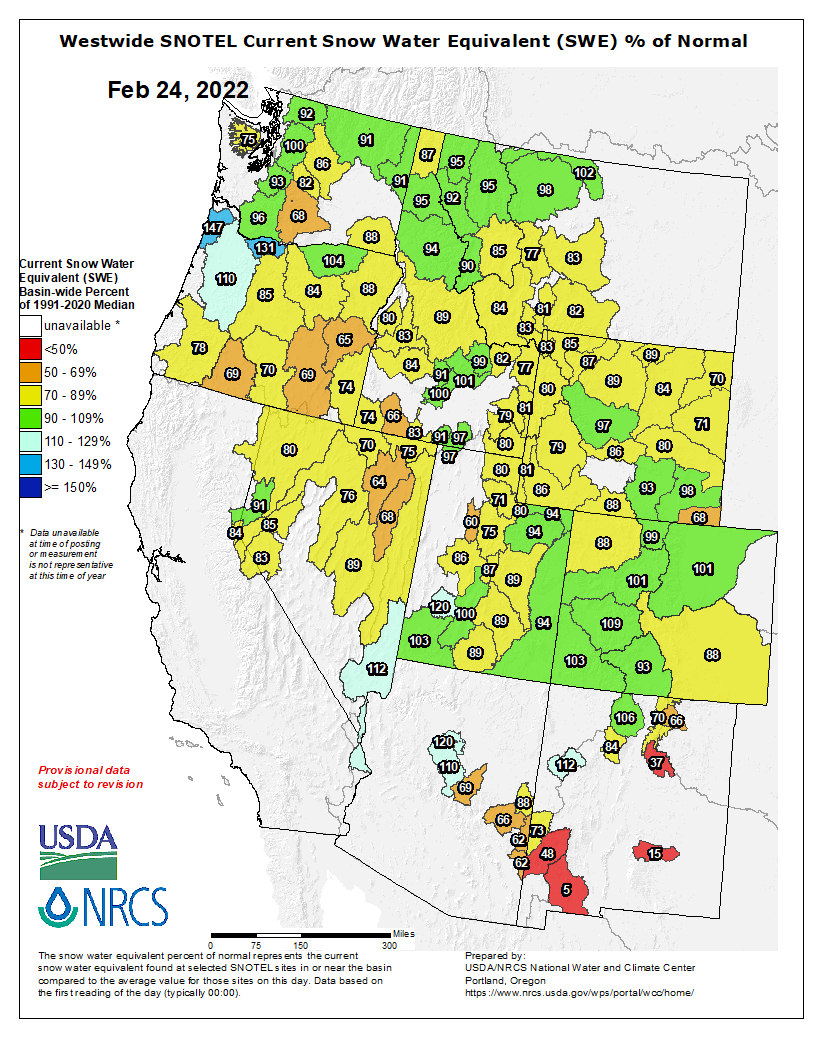
Following the wet December 2021 for much of the West, a dry pattern persisted since early January. 2022 year-to-date precipitation averages less than 25 percent of normal throughout much of California and the Great Basin. Snow water equivalent (SWE) continues to decline due to the dry pattern during January and February with SWE falling below 75 percent of normal for much of the southern Cascades, Sierra Nevada Mountains, and Great Basin. Due to the persistently dry pattern since early January, a 1-category degradation was made to parts of northern California and southwest Oregon which reflects the extreme (D3) levels of drought according to the 24-month and 2022 year-to-date SPI, soil moisture indicators, and 28-day average streamflows. Without a major pattern change during March, additional degradations may be needed for California and the Great Basin in the weeks ahead.
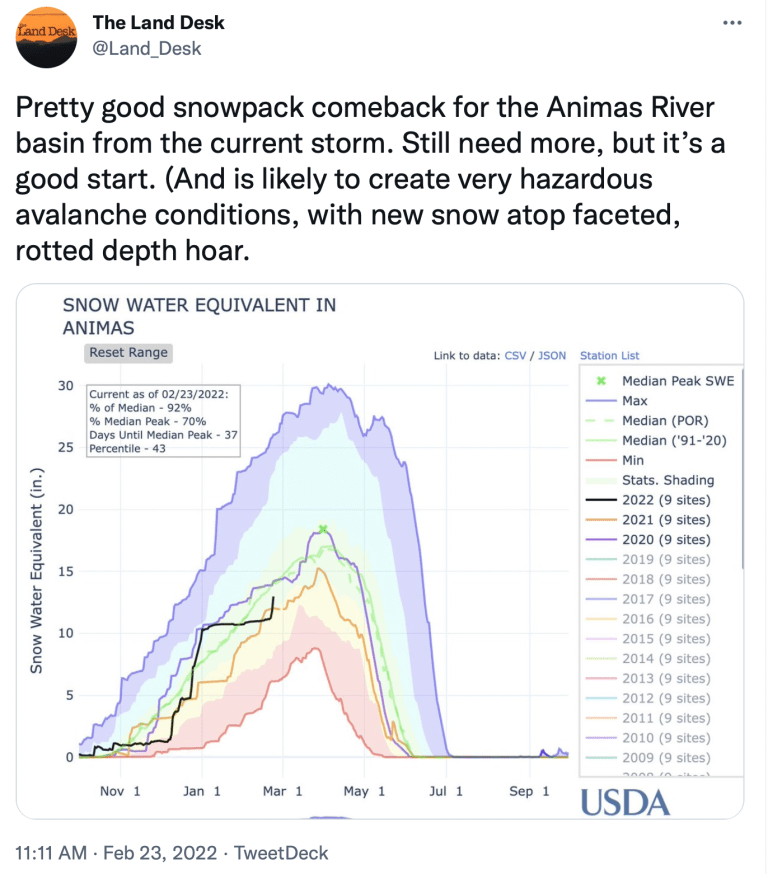
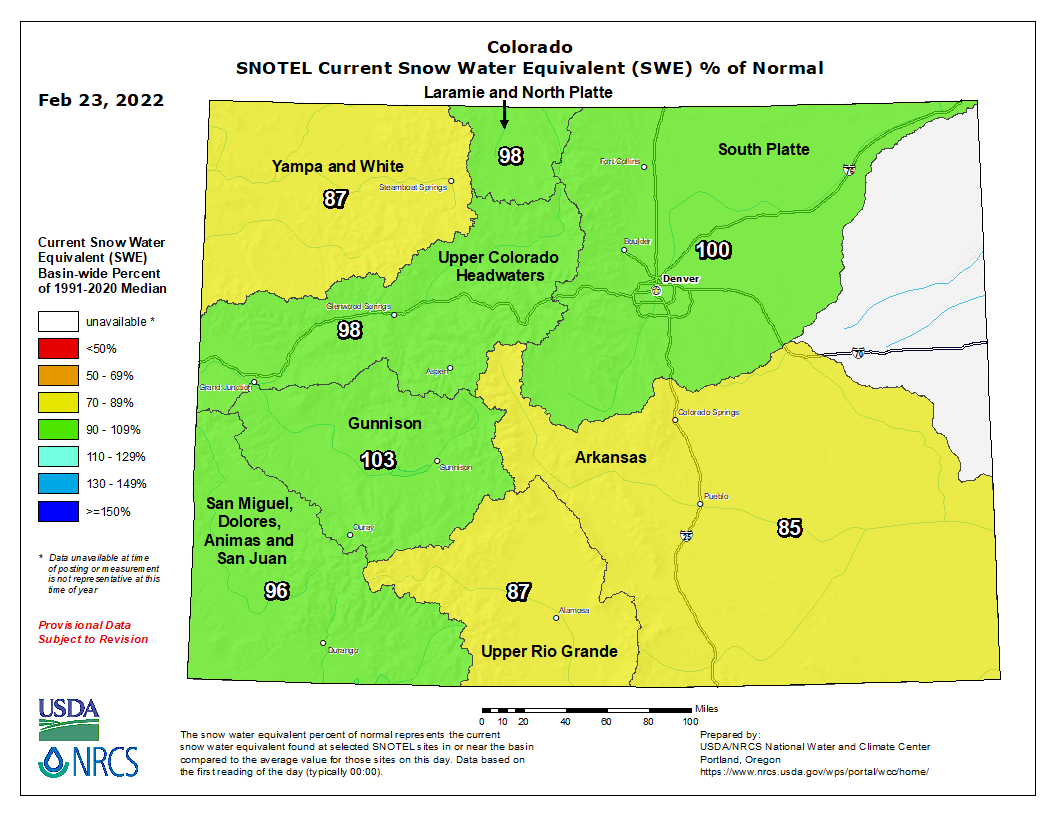
A slight expansion of D3 was made to northern Wyoming to be consistent with 12 to 24-month SPIs. Recent snowfall with SWE currently running near to above average prompted a 1-category improvement to the north of Denver, Colorado. Based on a favorable snowpack across the Clearwater and Salmon basins of central Idaho, severe (D2) was improved to moderate (D1) drought for that part of Idaho. Moderate drought (D1) was degraded to severe drought (D2) across the Upper Snake River basin of Idaho as SWE for the headwaters or this basin are nearing the 10th percentile. 7-day precipitation amounts of more than 1 inch, liquid equivalent, prompted a 1-category improvement from extreme (D3) to severe (D2) drought across parts of south-central Montana. Periods of above-normal temperatures coupled with enhanced surface winds support an expansion of severe (D2) to extreme (D3) drought across southern and eastern New Mexico. These worsening conditions are also consistent with SPEI at various time scales and the depiction for western Texas.
A sharp gradient in precipitation was observed from north to south across this region which is typical for La Nina during mid-February. 7-day precipitation amounts, from Feb 15 to 21, exceeded 2 inches across most of the northern half of Mississippi, northern two-thirds of Arkansas, southeastern Oklahoma, and northwestern Texas. A 1-category improvement was made to these areas that received the heavier rainfall. Conversely, farther to the south, a 1-category degradation was made to parts of the lower Mississippi Valley, western Gulf Coast, and central to southern Texas where little to no rainfall occurred this past week. Extreme drought (D3) was added to parts of southwestern Louisiana based on 30 to 90-day SPIs and soil moisture indicators. As temperatures warm heading into March and water demand increases with vegetative growth, additional degradation may be warranted for the lower Mississippi Valley. Although no changes were made this week to the southern high Plains, soil moisture continues to rank in the lowest 5th percentile consistent with much of this region being designated with D3 levels of drought. The lack of adequate soil moisture remains a major concern for the winter wheat crop across the southern Great Plains, while many counties of Oklahoma and Texas remain under a burn ban…
Looking Ahead
On February 24, a major winter storm will be ongoing across the south-central U.S. with snow and freezing rain. This winter storm is forecast to shift to the Midwest and Northeast where there is the potential for more than 6 inches of snowfall. The heaviest precipitation (more than 1 inch), associated with the low pressure system, is likely to affect the increasingly wet areas of the Ohio and Tennessee Valleys. In the wake of this winter storm, bitterly cold temperatures are forecast to overspread the Great Plains and also expand east across the Corn Belt. Onshore flow is expected to bring rain and high-elevation snow to the Pacific Northwest on February 27 and 28. Little to no precipitation is forecast along the Gulf Coast, Florida, and California through the end of February.
The Climate Prediction Center’s 6-10 day outlook (valid Mar 1-5, 2022) favors near to above normal temperatures across much of the contiguous U.S. However, it should be noted that below normal temperatures are likely to return to the northern Rockies, northern Great Plains, and upper Mississippi Valley by the second week of March. Below normal precipitation is favored for much of the Southeast, southern Great Plains, Southwest, and California, while above normal precipitation is most likely from the northern Rockies east to the northern Great Plains and upper Mississippi Valley.
Douglas County Commissioners should not move forward with Renewable Water Resources’ (RWR) request to utilize American Rescue Plan Act (ARPA) stimulus funds to export water from the northern San Luis Valley (SLV). The RWR proposal would significantly impact the economy, environment, and culture of the San Luis Valley, a unique region home to Great Sand Dunes National Park and Preserve and three national wildlife refuges, which collectively attract more than 600,000 visitors annually to the SLV. The SLV cities, farmers, and residents universally oppose the RWR proposal. The project would result in the “buy and dry” of agriculture, which has led to the devastation of other rural communities in Colorado.
As conservation organizations, we represent thousands of hunters and anglers in Colorado. Healthy wildlife habitats are necessary to sustain wildlife populations, and wetlands, riparian corridors, and mesic areas are critical in our arid state. The proposed RWR project would impact fish and wildlife habitats on multiple fronts. Groundwater and surface water resources in the SLV are connected, with aquifers sustaining streamflow, which supports habitat for cold-water fisheries. Therefore, removing water from the aquifers could negatively affect aquatic ecosystems important to the region. For example, the proposed wellfields of 22 to 25 groundwater pumping wells for the RWR project would neighbor the Baca National Wildlife Refuge, potentially impacting the wetland and aquatic ecosystems that support breeding and feeding grounds of migratory birds and waterfowl. Baca is also home to the state’s most viable population of Rio Grande Chub, a state species of concern. Other potentially affected species include the Rio Grande Cutthroat Trout and Gunnison Sage Grouse. The RWR proposal would also require the dry-up of 20,000 irrigated acres in the valley. Impacts to irrigated agriculture in the SLV resulting from the RWR project would also negatively affect fish and wildlife since most of the SLV’s wetlands occur on private property and are sustained through irrigation and water delivery.
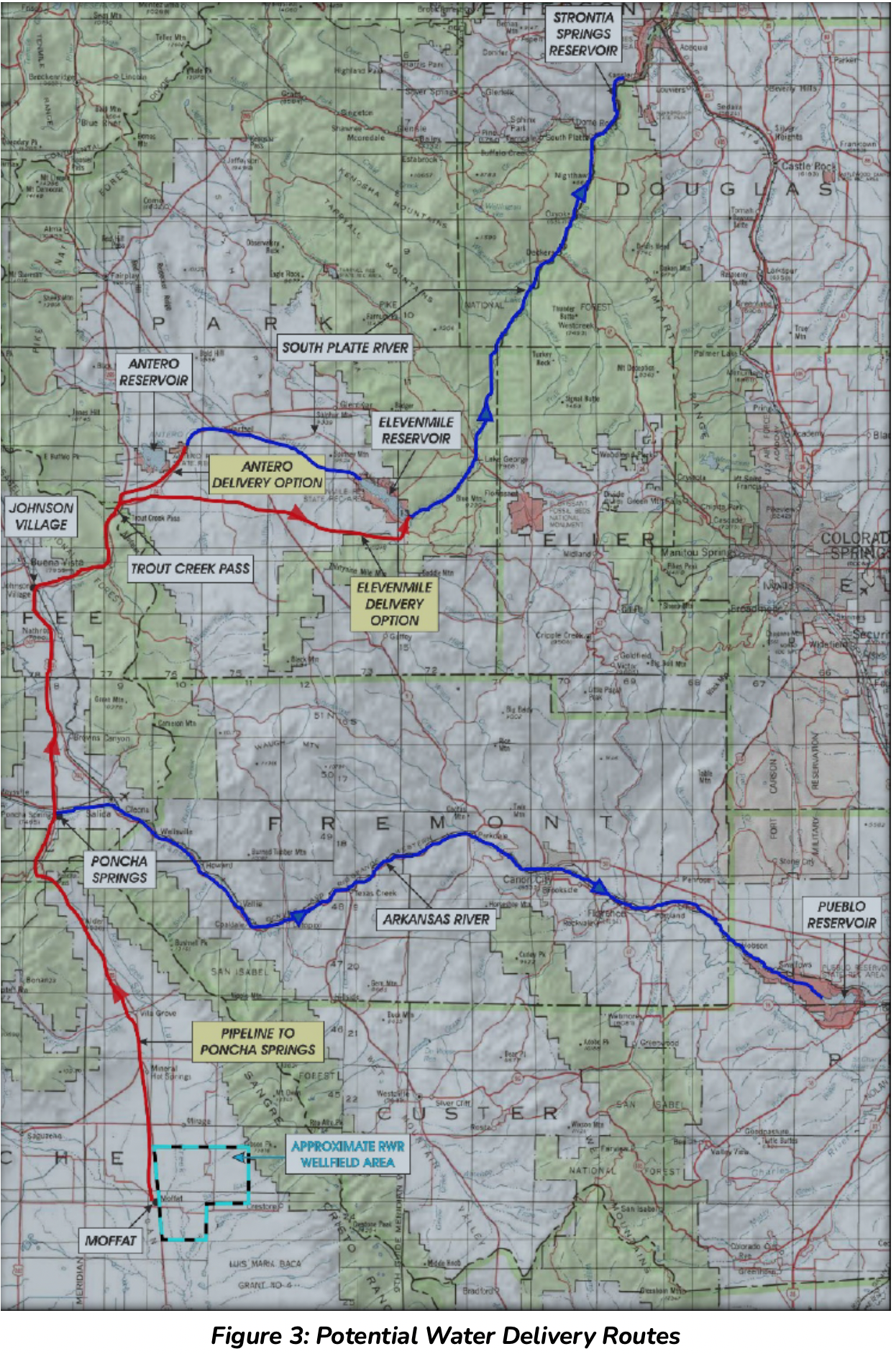
Potential Water Delivery Routes. Since this water will be exported from the San Luis Valley, the water will be fully reusable. In addition to being a renewable water supply, this is an important component of the RWR water supply and delivery plan. Reuse allows first-use water to be used to extinction, which means that this water, after first use, can be reused multiple times. Graphic credit: Renewable Water Resources
The RWR plan runs contrary to the Colorado Water Plan. The plan, which guides state water planning and policy, establishes a conceptual framework for guiding negotiations around new transbasin diversion projects, including developing adequate measures to reduce socio-economic and environmental impacts on the basin of origin, which the RWR fails to accomplish meaningfully. The Colorado Water Plan also strongly condemns the practice of “buy and dry,” which has led to significant socio-economic and environmental impacts in rural communities and instead supports alternative approaches such as investments in conservation and smart land-use planning.
More cost-effective strategies exist, including investments in water conservation and water recycling/reuse. And there is no surplus water in the SLV to export. The SLV aquifers are over-appropriated and climatic trends point to less available water. Therefore, the RWR proposal presents a likely expensive, unpopular, and risky approach to meeting the growing water needs of Douglas County.
Denver Basin Aquifer System graphic credit USGS.
Our organizations recognize that Douglas County is growing and reliant on an unsustainable groundwater resource. We encourage Douglas County to use the federal funds to make needed investments to address water supply needs in a way that prioritizes local water supplies, promotes conservation, and creates jobs for the community rather than siphoning these funds to a speculative and costly water export proposal that will have significant impacts on rural Coloradans and the unique environment of the San Luis Valley.
Theodore Roosevelt Conservation Partnership
Trout Unlimited
National Wild Turkey Federation
Colorado Backcountry Hunters and Anglers
Colorado Wildlife Federation
Alexander Funk is the director of water resources and senior counsel at the Theodore Roosevelt Conservation Partnership.
Click the link to read the article on the NOAA website (Michon Scott and Rebecca Lindsey):
At the dawn of the 21st century, drought descended on southwestern North America. Two decades later, the drought continues. Recent NOAA-funded research found that even small additional increases in greenhouse gas emissions will make such decades-long “megadroughts” more common. But limiting greenhouse gas emissions will reduce the intensity of megadrought by reducing the risk of the most intense single-year droughts that occur within the longer period.
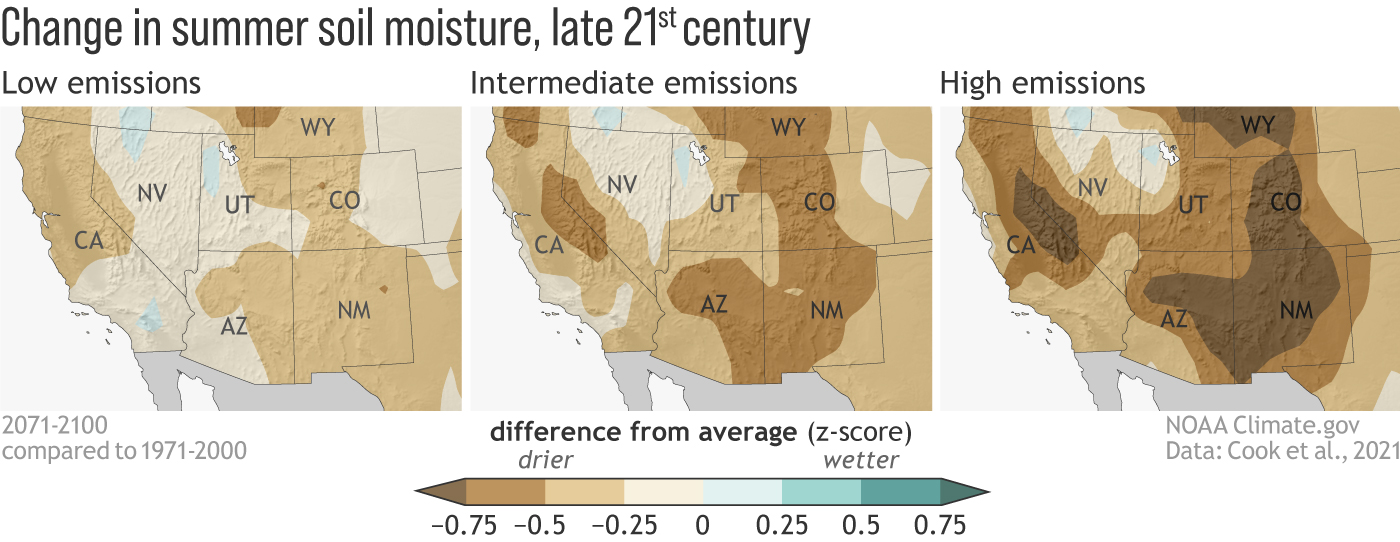
These maps show projected changes soil moisture—one way to measure drought—across the Southwest by the late 21st century (2071–2100) depending on how many greenhouse gases people produce in coming decades. In these maps, wetter conditions are blue-green; drier conditions are brown. Summer soil moisture is likely to decline in the future, even in a world where greenhouse gas emissions are kept fairly low (left). But the drying impact is far less severe than in a future in which greenhouse gas emissions are much higher (right).
To project future conditions, the scientists chose two drought events from the historical record—the megadrought that began in 2000 and the extreme single-year drought of 2002—and used them as test cases for what droughts like those might look like in a future, warmer climate. Even in the model experiments with the lowest future greenhouse gas emissions, the risk of 21-year soil moisture deficits as bad as or worse than the current drought was roughly 50 percent.
But that doesn’t mean there’s no benefit to reducing how many greenhouse gases we emit. The researchers also found that reducing greenhouse gas emissions will significantly lower the risk of extremely dry single-year droughts within a longer megadrought. If we can reduce the occurrence of intense, single-year droughts, it will reduce the overall intensity of megadroughts. That will give us a better chance to adapt to the drier conditions we may not be able to avoid.
References
Cook, B. I., Mankin, J. S., Williams, A. P., Marvel, K. D., Smerdon, J. E., Liu, H. (2021). Uncertainties, Limits, and Benefits of Climate Change Mitigation for Soil Moisture Drought in Southwestern North America. Earth’s Future, 9(9). https://doi.org/10.1029/2021ef002014.
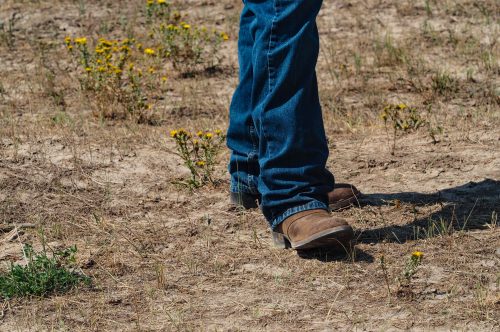
A rancher digs a boot heel into the dry ground of the Little Bear Ranch near Steamboat Springs, Colo., during the Northwest Colorado Drought Tour on August 11, 2021. Credit: Dean Krakel, special to Fresh Water News.
Nebraskans know every drop of water is precious. Agriculture is our top industry. It makes up 20% of our economy, and it generates one in four jobs in our state. Access to water makes this possible. We have the most irrigated acres of cropland in the country. Three of eight acres of farmland in Nebraska are irrigated.
Fifty years ago, far-sighted Nebraskans set up a system of water management, including our Natural Resources Districts (NRDs), that has allowed us to manage our water based on river basin. This has allowed our state to maintain the Ogallala Aquifer within one foot of where it was in the 1950s.
The Ogallala aquifer, also referred to as the High Plains aquifer. Source: National Oceanic and Atmospheric Adminstration
By contrast, Colorado has mined their water. The Ogallala Aquifer under Colorado has dropped nearly 15 feet since the 1950s. Now, Colorado is aggressively planning new developments that threaten Nebraska’s water resources. Last year, Colorado released their South Platte Basin Implementation Plan. It was updated last month and now includes 282 total projects to meet their growing demands. Altogether, these projects cost an estimated $9.8 billion.
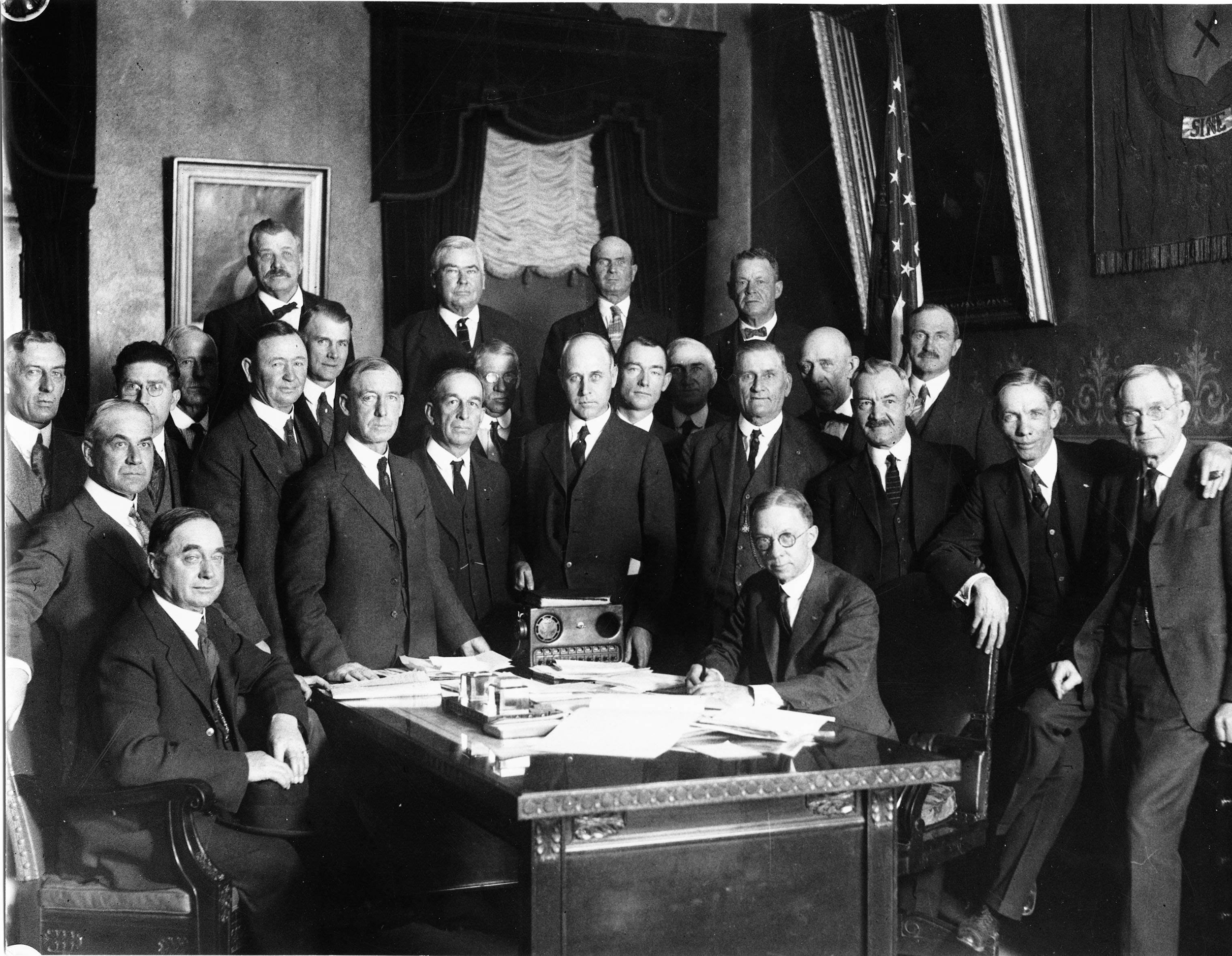
Governor Clarence J. Morley signing Colorado River compact and South Platte River compact bills, Delph Carpenter standing center. Unidentified photographer. Date 1925. Print from Denver Post. From the CSU Water Archives
Thankfully, 100 years ago Nebraskans negotiated an agreement with Colorado over the use of South Platte River water. The South Platte River Compact (Compact) was signed by Nebraska and Colorado in 1923 and ratified by Congress in 1926. It entitles Nebraska to 120 cubic feet per second (cfs) of water from April 1st through October 15th (irrigation season) and 500 cfs of water from October 16th through March 31st (non-irrigation season). Under the Compact, we can only claim our non-irrigation season water entitlement by building a canal and reservoir system—known as the Perkins County Canal—along the South Platte River. Until we build the canal, Colorado has no obligation to deliver the water.
South Platte River Storage Study Area. Illustration shows water availability, in blue circles, compared with demand at various places along the South Platte River. The yellow area is the study area. (Illustration by Stantec).
As Colorado’s desire for water grows, they’re acting as if Nebraska’s non-irrigation season water rights under the Compact don’t exist. In 2016, the Colorado Legislature passed HB16-1256, the South Platte Water Storage Study, into law. Its purpose was to identify water storage options along the lower South Platte River. Colorado wants to make sure no water “in excess of the minimum legally required amounts” gets to Nebraska. In the study’s final report, Colorado clearly assumes that Nebraska’s legal requirement is only the 120 cfs during irrigation season. Since we haven’t built the canal, Colorado is not planning to deliver any water to us during non-irrigation season. Zero.
The good news is that the Compact gives Nebraska undeniable authority to construct a canal to claim our non-irrigation water flow. It even gives us legal entitlement to land in Colorado to build it. Senator Dan Hughes, of District 44, has prioritized LB 1015, authorizing the Department of Natural Resources to design, construct, and operate the Perkins County Canal and reservoir system. My budget recommendation to the Legislature includes $500 million for the project. This is a bargain compared to the nearly $10 billion Colorado is preparing to spend on their water resources.
Our proposed canal has caused a stir in Colorado. In response to our plans, a legislator in Colorado introduced SB22-126 earlier this month to prioritize water storage projects in the South Platte Basin. Colorado’s leaders believe that “possession is nine-tenths of the law.” I am concerned that even though Nebraska has clear entitlements to South Platte River water under the terms of the Compact, it will be difficult for us to claim what we are owed once municipalities in Colorado become reliant on the water.
There’s no doubt that Colorado plans to take the 500 cfs of water guaranteed to Nebraska during non-irrigation season under the Compact. On February 7th, a coalition of water districts gave a presentation to the Colorado Legislature on ways to shore up South Platte River resources. The presentation indicates that Colorado only recognizes its 120 cfs delivery commitment to Nebraska during irrigation season. In other words, the presentation assumes Nebraska is not entitled to receive a single drop of South Platte River water for almost half the year.
We must take action now to protect this water from being taken. Our ag producers rely on it for irrigation. Communities along the Platte River use it for drinking water. The water is critical to power generation in Nebraska, and our natural habitats along the Platte depend on these water flows.
People have asked, “why not slow down and discuss reworking the terms of the compact?” Any renegotiation would take time to hammer out. It would require approval from the Colorado Legislature and Nebraska’s Unicameral. What are the odds of that happening anytime soon? Keep in mind: delays only benefit Colorado. Remember, Colorado is trying to accelerate their work along the South Platte River. Pausing our plans, while they move full steam ahead, would put us at risk. The longer we delay, the more we risk losing access to the water we’re due.
This month, I’ve held town halls across the state to inform Nebraskans about our water rights with Colorado. There has been overwhelming support for moving forward on the canal. People understand that the price of inaction is far higher than the funding needed to secure our water rights. I’ll encourage you to do what I asked of them: contact your state senator to let them know your thoughts on LB 1015. The passage of this bill is a necessary first step.
Fifty years from now, Nebraskans will look back on this generation. Will they say we had the foresight to secure our water resources? Or will they say this generation failed?
If you have questions about the proposed canal, write me at pete.ricketts@nebraska.gov or call 402-471-2244.
Wattenberg Oil and Gas Field via Free Range Longmont
Click the link to read the article on Big Pivots (Allen Best):
A press release distributed by United Power this week describes a new agreement as ground-breaking. That cliché truly applies in this case as the Brighton based electrical cooperative and a company called Transitional Energy have signed a letter of intent to develop geothermal resources among some of the thousands of oil and gas wells in the service territory of United Power north and east of Denver. United says it has 5,300 well-bores in its service territory, which overlaps with the Wattenberg, one of the nation’s most productive oil-producing fields.
Many oil and gas operators use electricity to power drilling rigs and other well-pad equipment. In this pilot project, owners-operators of wells in the Wattenberg field north of Denver—both working and abandoned—will be able to tap the warmth of the wells to generate electricity. In this way, they can offset their electricity purchase from United while reducing their greenhouse gas footprints.
“Reuse of existing wells and infrastructure is a capital-efficient way to use the heat beneath our feet,” the press release said.
The website for Transitional Energy says the technology has a payback period of 5 years. Transitional Energy was launched with a $500,000 grant from the Colorado Office of Economic Development and International Trade in 2020. It has an office on 17th Street in Denver. In January the company also received a $2.4 million grant from the U.S. Department of Energy’s Geothermal Technologies Office, according to the company’s website. That grant is to be used to develop up to one megawatt of electrical generation from the Blackburn Oilfield in Nevada.
United has also distinguished itself as an innovator in other ways. In 2019, it put into operation a 4-megawatt battery storage complex, still the largest in Colorado.
“United Power is excited to work on this innovative pilot project,” stated Dean Hubbuck, United Power’s chief energy resources officer. “Utilizing clean, economical geothermal energy to provide local power that can be dispatched when needed is a critical component of our growing energy portfolio. Geothermal energy represents a huge untapped renewable resource that can reduce our reliance on power from other traditional sources.”
Hubbuck said he believes a pilot will occur by summer. The technology has been deployed in Europe and elsewhere, he said.
Click the link to read an article on The Guardian (Alexis Petridis). Here’s an excerpt:
Gary Brooker, lead singer of English band Procol Harum, dies aged 76
Pop music moved at high speed in the 1960s, but even so the story behind the song for which Gary Brooker was always going to be remembered almost beggars belief. It was taped in April 1967, the same month that the band who recorded it formed: they hadn’t even got around to recruiting a drummer yet and had to use a jazz player moonlighting as a session musician. A couple of weeks later, Paul McCartney was interrupting his first date with his future wife Linda in order to rush to the DJ booth at Soho’s Bag O’Nails club, demanding to know what the hell he was playing (“God, what an incredible record,” he subsequently enthused) and John Lennon was informing a journalist friend that all current pop music was “crap” except for “that dope song, A Whiter Shade of Pale – you hear it when you take some acid and wooooh!”
A few weeks after that, it was No 1, a position it held until the middle of July. You do wonder how incredulous Brooker must have felt. He had only started Procol Harum as a last resort. He had left the minor R&B band the Paramounts with the intention of becoming a full-time songwriter, only to discover that no one wanted to buy the songs he had written with lyricist Keith Reid, so he would have to sing them himself. And now here he was less than two months later, on Top of the Pops and feted by the Beatles as the vanguard of pop. A Whiter Shade of Pale caused so much commotion that the effect was discombobulating: Procol Harum organist Matthew Fisher once recalled being mortified after they were parachuted into a headlining slot over the Jimi Hendrix Experience when “we weren’t one 10th as good as him”. Perhaps it was just as well he didn’t know that on the other side of the Atlantic, Brian Wilson of the Beach Boys – in the throes of mental collapse and on the verge of abandoning his latest opus, Smile – had taken A Whiter Shade of Pale as another signal that he was finished: “I was so sensitive for the dramatic organ sound that I thought it was my funeral tune,” Wilson later recalled.
It was one of rock history’s great lightning-in-a-bottle moments. A Whiter Shade of Pale was completely of the moment – the psychedelic era was all about opening new vistas in pop music, and if there’s one thing everyone agreed on, it was that they had never heard anything like it before – while also harking to pop’s recent past and pointing towards its future. Brooker’s vocal spoke loudly of the hours he had put in touring the R&B clubs, belting out covers of Solomon Burke and the Impressions for the nation’s mods; the tune’s allusions to Bach and its dense, elusive lyrics – open to wild interpretation – presaged the arrival of progressive rock. It spawned hundreds of covers by everyone from Joe Cocker to Jackie Mittoo – soul versions, reggae versions, jazz interpretations, disco versions, mock-Gregorian chant versions – as well as a little subgenre of British psychedelia populated by obscure bands trying to make records that sounded like it: Meditations by Felius Andromeda and Reputation by Shy Limbs are two examples prized by psych collectors.
The chances of a band walking into a studio for the first time and immediately recording one of rock’s impermeable classics – 10m copies sold – are incredibly slim…
Perhaps A Whiter Shade captured its era so perfectly that it succeeded in transcending it. None of 1967’s other big songs, not even All You Need Is Love or Pink Floyd’s See Emily Play, feels quite so evocative of a mythic, idealised version of the British Summer of Love – of what the press took to calling “the beautiful people” drifting through London on a warm evening in a stoned, optimistic haze – which meant that whenever a film director or a radio DJ wanted a surefire burst of beatific nostalgia, they invariably reached for it. It turned up on umpteen soundtracks – everywhere from The Big Chill to Breaking the Waves – and in 2004 was named the most-played song on British radio over the last 70 years.
Or maybe it was just a completely fantastic song, of the kind that takes an inordinate combination of talent and luck to come up with even once in a career. You could argue it’s unfair that Gary Brooker’s musical legacy hinges on one song in the popular imagination. On the other hand, if you’re going to be largely remembered for one song, it might as well be one like that.