September 2022 La Niña update: it’s Q & A time — NOAA

Click the link to read the article on the NOAA website (Emily Becker):

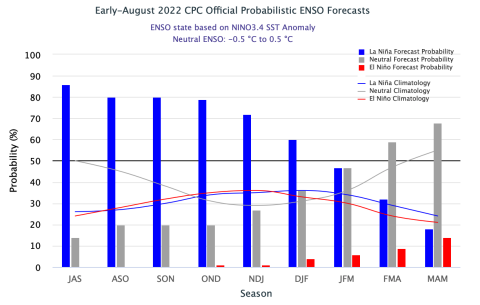
Ocean and atmospheric conditions tell us that La Niña—the cool phase of the El Niño-Southern Oscillation (ENSO) climate pattern—currently reigns in the tropical Pacific. It’s looking very likely that the long-predicted third consecutive La Niña winter will happen, with a 91% chance of La Niña through September–November and an 80% chance through the early winter (November–January).

91%! That’s very high. Why so confident?

The first reason is that La Niña is already clearly in force in the tropical Pacific. The August sea surface temperature in the Niño-3.4 region, our primary location for ENSO monitoring, was about 1.0 °C (1.8 °F) cooler than the long-term average, according to ERSSTv5, our favorite dataset for sea surface temperature. (“Long-term” is currently 1991–2020.) This is substantially cooler than the La Niña threshold of 0.5 °C (0.9 °F) below average.

Sea surface temperatures in the tropical Pacific Ocean from mid-June through early September 2022 compared to the long-term average. East of the International Dateline (180˚), waters remained cooler than average, a sign of La Niña. Graphic by Climate.gov, based on data from NOAA’s Environmental Visualization Lab. Description of historical baseline period here.

La Niña’s characteristic tropical atmospheric response—more rain and clouds over Indonesia, less over the central Pacific, and stronger-than-average winds both aloft and near the surface—was also clearly active in August. Taken together, the oceanic and atmospheric conditions tell us that La Niña is solidly in place. Once active, La Niña conditions are reinforced by feedback processes between the ocean and atmosphere. Read more about those feedbacks here.
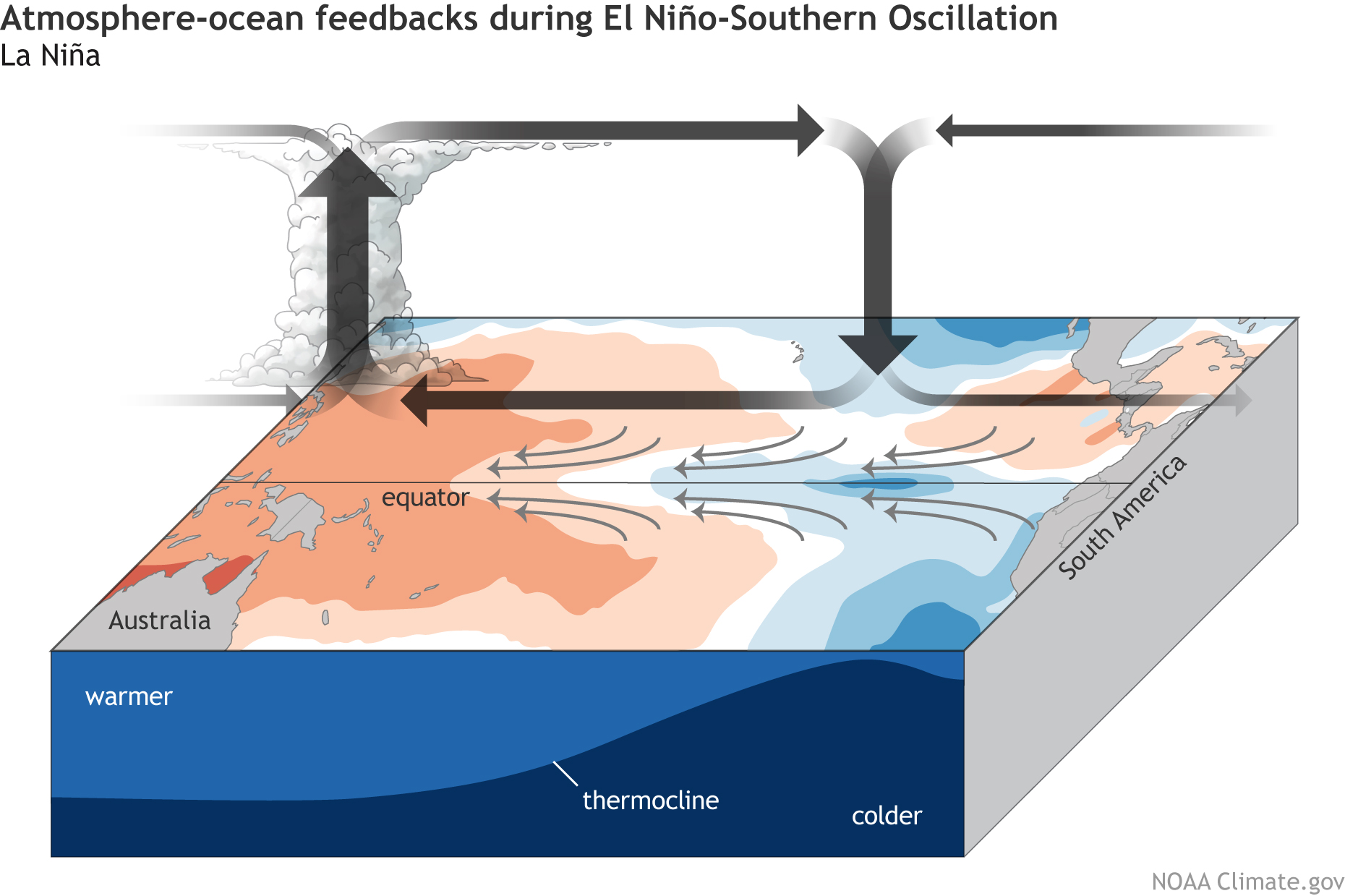
La Niña feedbacks between the ocean and atmosphere.  Climate.gov schematic by Emily Eng and inspired by NOAA PMEL.

What else is providing confidence in the forecast?

There is a substantial amount of cooler-than-average water under the surface of the eastern-central tropical Pacific. This subsurface water will provide a source of cooler water to the surface over the next couple of months. Also, the computer climate model consensus predicts that La Niña will continue into the winter.

How long will La Niña last?

While there’s high agreement through the winter, there is a lot of uncertainty about how long this La Niña will last and when we will see a transition to neutral conditions. Current forecaster consensus gives La Niña the edge through January–March (54%), with a 56% chance of neutral for the February–April period.
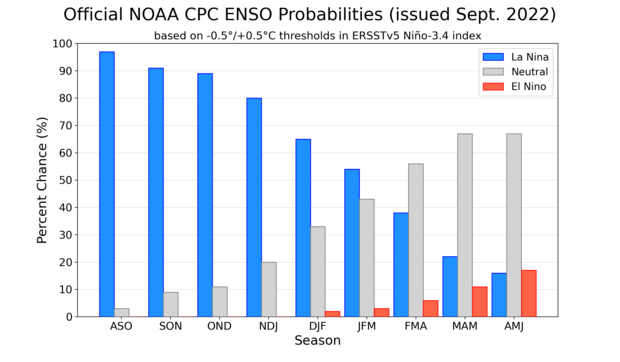
NOAA Climate Prediction Center forecast for each of the three possible ENSO categories for the next 8 overlapping 3-month seasons. Blue bars show the chances of La Niña, gray bars the chances for neutral, and red bars the chances for El Niño. Graph by Michelle L’Heureux.

When have previous La Niñas transitioned to neutral?

There are 24 La Niña winters in our historical record, which dates back to 1950. Of those, only one (2016–17) changed to neutral in December–February. Four transitioned to neutral in January–March, one (2000–01) by February–April, two by March–May, and 16 in April–June or later. Especially when you’re slicing and dicing a relatively short record, it’s tough to find truly analogous events. For example, this will be only the third La Niña three-peat on record, and the first not to follow a strong El Niño event.

Three-year history of sea surface temperatures in the Niño-3.4 region of the tropical Pacific for the 8 existing double-dip La Niña events (gray lines) and the current event (purple line). Of all the previous 7 events, 2 went on to La Niña in their third year (below the blue dashed line), 2 went on to be at or near El Niño levels (above the red dashed line) and three were neutral. Graph is based on monthly Niño-3.4 index data from CPC using ERSSTv5. Created by Michelle L’Heureux.

All this is to say that past La Niñas aren’t providing much guidance on how long we can expect this event to last. The current forecaster estimate, which favors an earlier than typical transition to neutral, is based on computer model guidance.

Remind me why I should care about La Niña…?

I admit, as scientists, we sometimes get wrapped up in how interesting the inner workings of El Niño and La Niña are! But ENSO has some serious practical applications. In a nutshell, La Niña and El Niño affect global atmospheric circulation patterns in (somewhat) predictable patterns, altering jet streams and storm tracks around the world and influencing temperature, rain/snow, and tropical cyclone seasons. Since we can predict ENSO months in advance, we can get an early picture of potential upcoming climate patterns. Of course, nothing is guaranteed with weather and climate—ENSO merely “tilts the odds” toward certain patterns. For more on how ENSO affects climate patterns, as well as why it’s so difficult to make specific predictions, check out Michelle’s post here.

Can I have some examples of how La Niña can affect North American weather?

Yes! Here’s a map, followed by a list of some specifics.

During La Niña, the Pacific jet stream often meanders high into the North Pacific. Southern and interior Alaska and the Pacific Northwest tend to be cooler and wetter than average, and the southern tier of U.S. states—from California to the Carolinas—tends to be warmer and drier than average. Farther north, the Ohio and Upper Mississippi River Valleys may be wetter than usual. Climate.gov image.

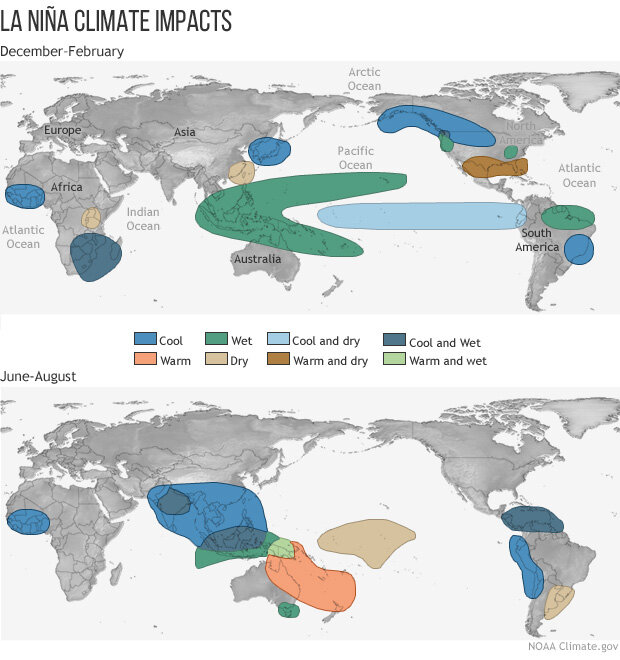
What about global impacts?

Temperature and precipitation patterns that are typical of La Niña during (top) Northern Hemisphere winters and (bottom) summers. Map by NOAA Climate.gov, based on originals from the Climate Prediction Center. Larger images and maps for El Niño are available in this post.

That’s enough for now! Thanks!

Anytime! See you next month.
The summer drought’s hefty toll on American crops — The Washington Post

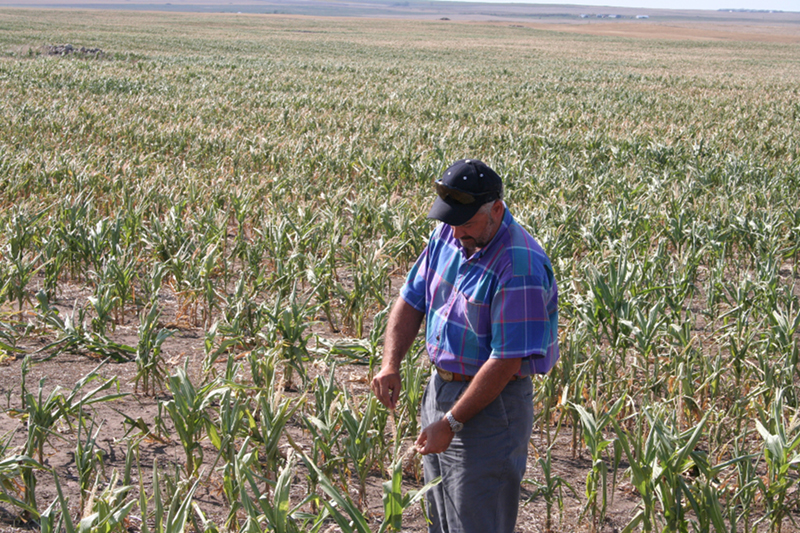
Drought impacted corn. Water stress can lead to insufficient water supply for cities, agriculture, and vegetation. Dry vegetation may facilitate the propagation and increase the risk of wildfires.

Click the link to read the article on The Washington Post website (Laura Reiley). Here’s an excerpt:

Corn, wheat and other agricultural products withered in a year of glaring climate change impacts

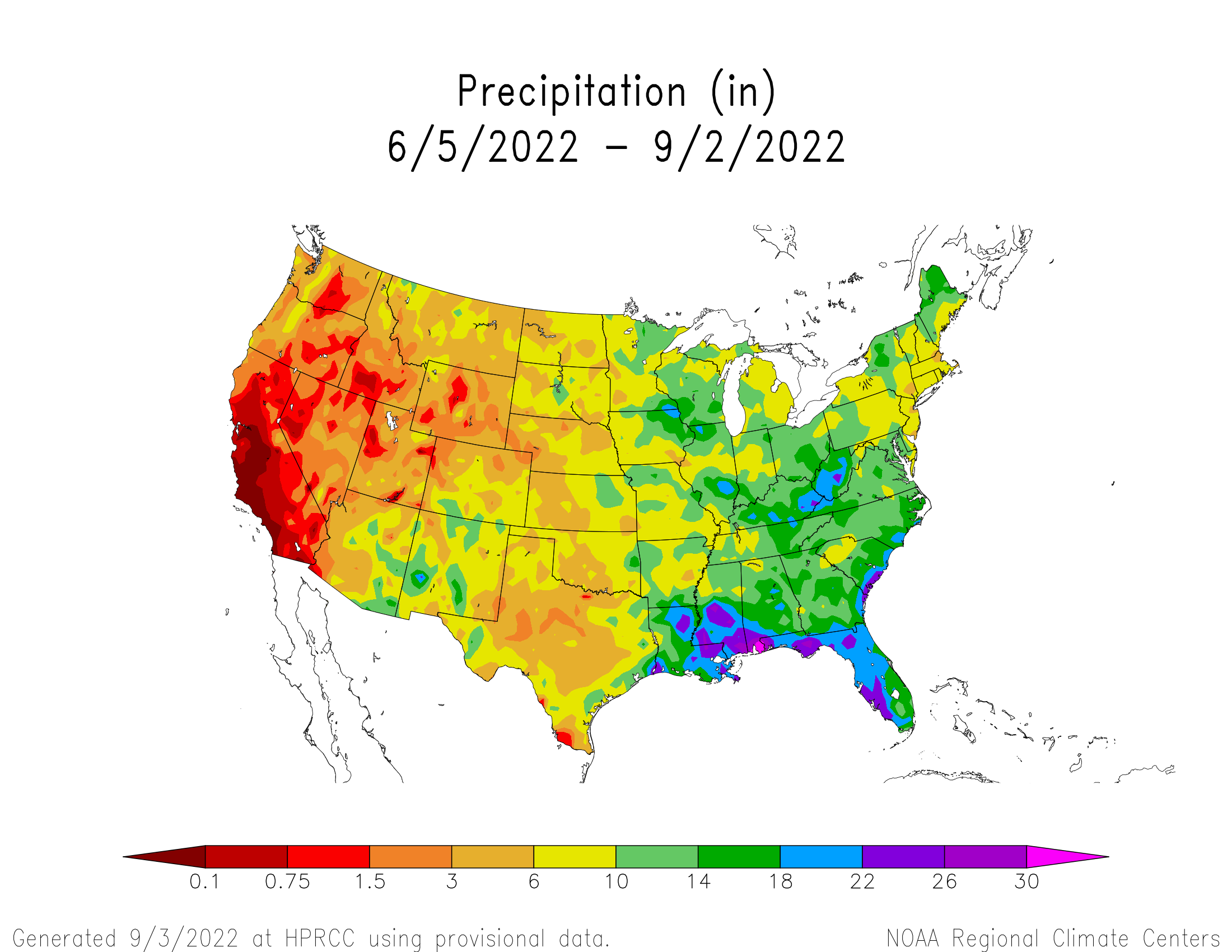
Farmers, agricultural economists and others taking stock of this summer’s growing season say drought conditions and extreme weather have wreaked havoc on many row crops, fruits and vegetables, with the American Farm Bureau Federation suggesting yields could be down by as much as a third compared with last year. American corn is on track to produce its lowest yield since the drought of 2012, according to analysts at Rabobankwhich collects data about commodity markets. This year’s hard red winter wheat crop was the smallest since 1963, the bank’s analysts said. In Texas, cotton farmers have walked away from nearly 70 percent of their crop because the harvest is so paltry, according to the U.S. Department of Agriculture. The California rice harvest is half what it would be in a normal year, an industry group said.

The poor yields are probably more than a one-year blip, as climate change alters weather patterns in agriculturally important parts of the country, contributing to higher food prices that experts don’t see ebbing any time soon. Drought has consumed 40 percent of the country for the past 101 weeks, USDA meteorologistBrad Rippey said. But precisely where that 40 percent is has shifted over time, meaning different swaths of the country’s agricultural land have been affected at different times, spreading pain and difficult choices geographically and by crop.

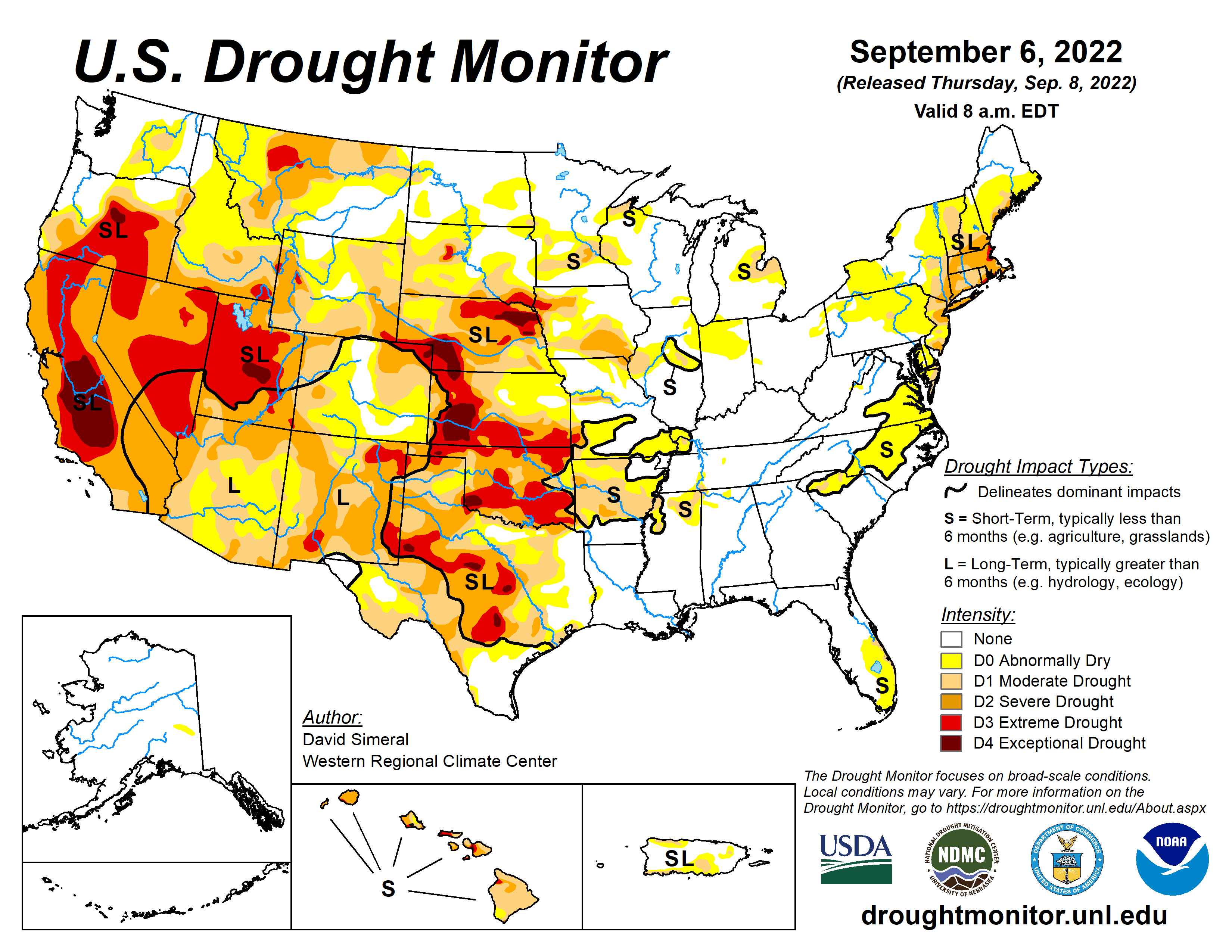
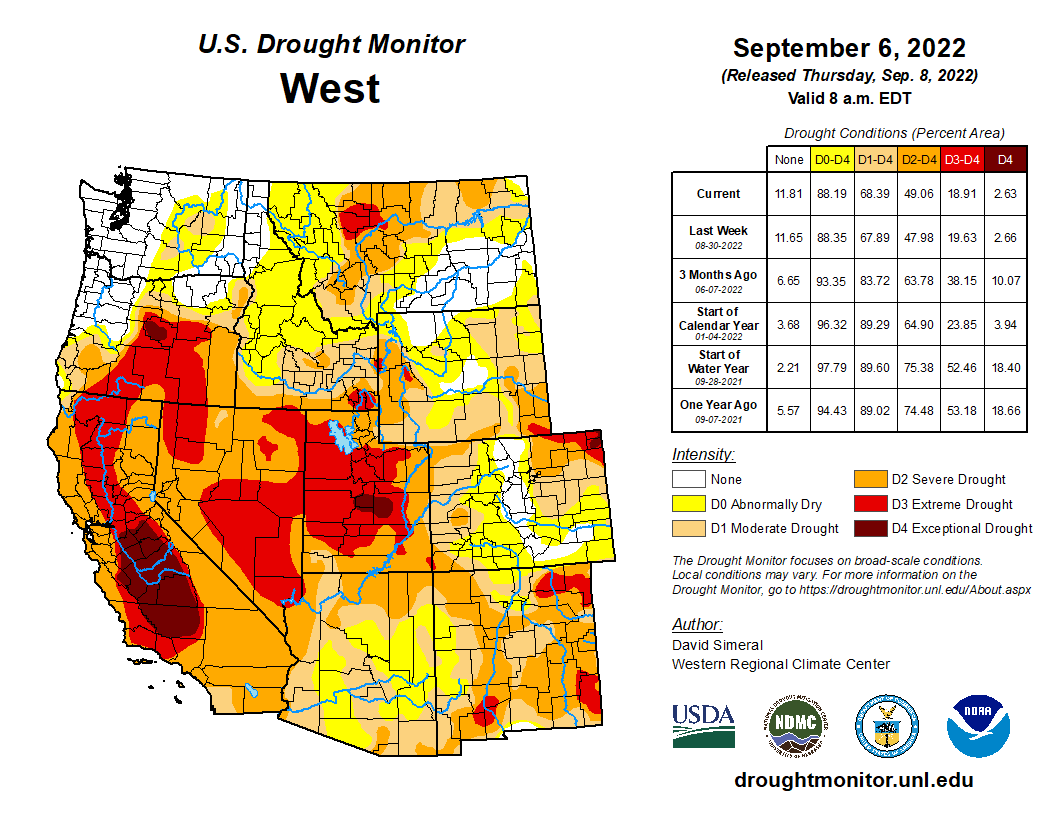
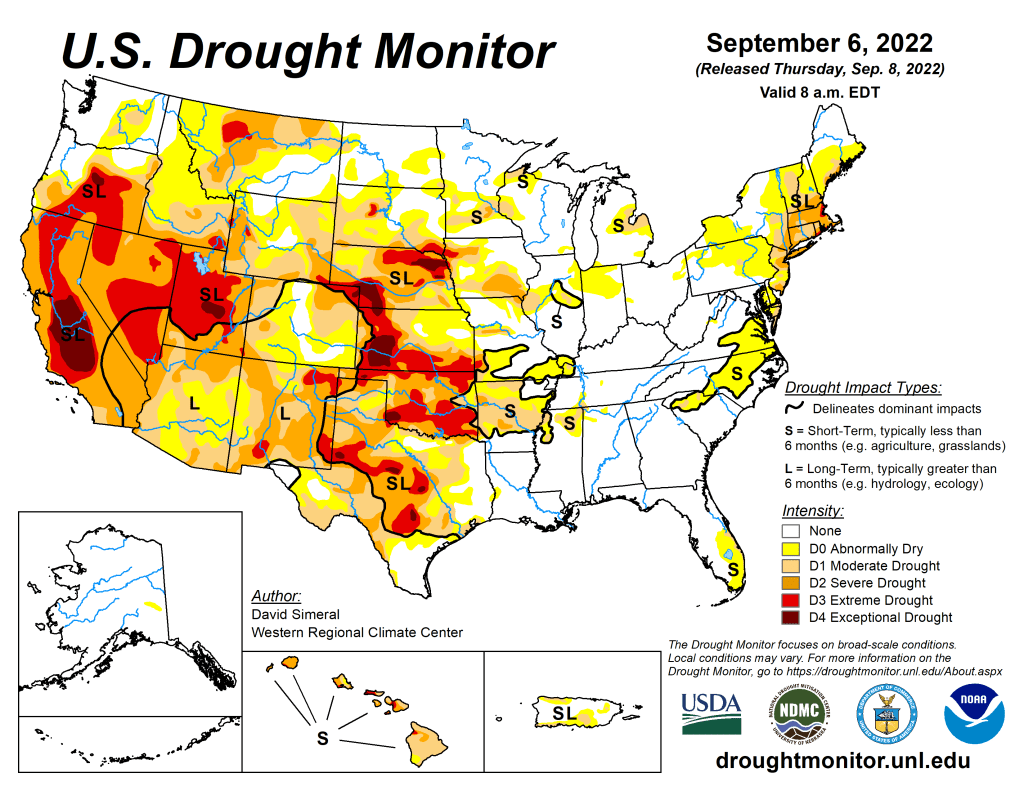
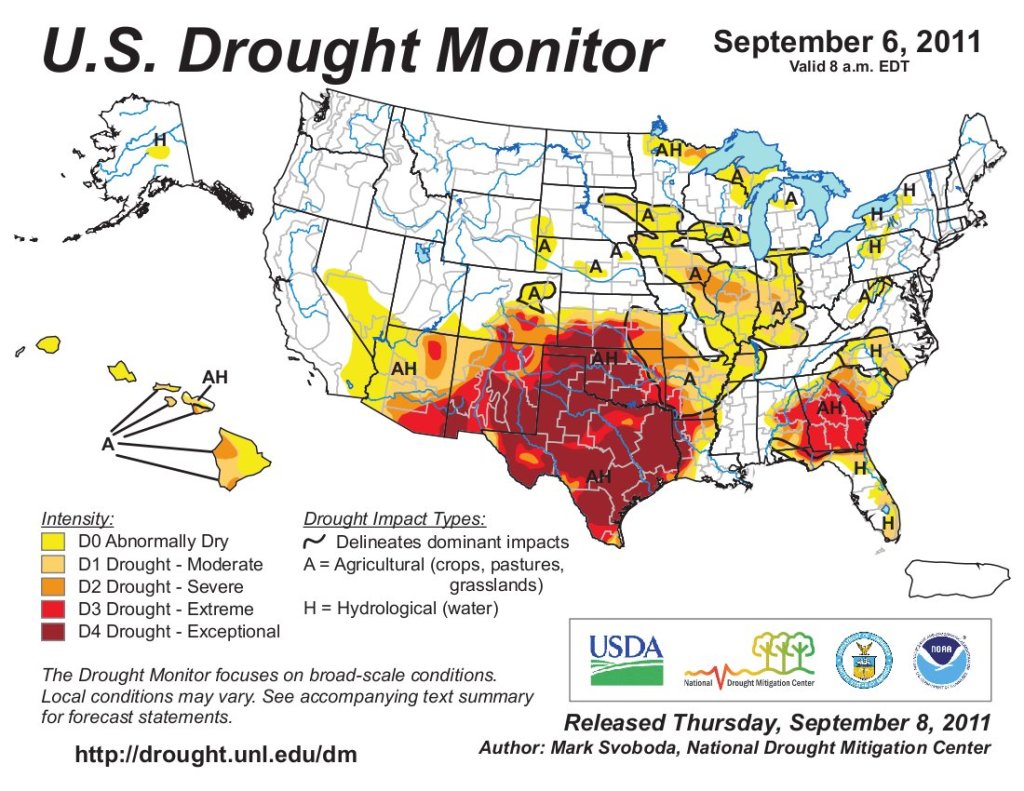
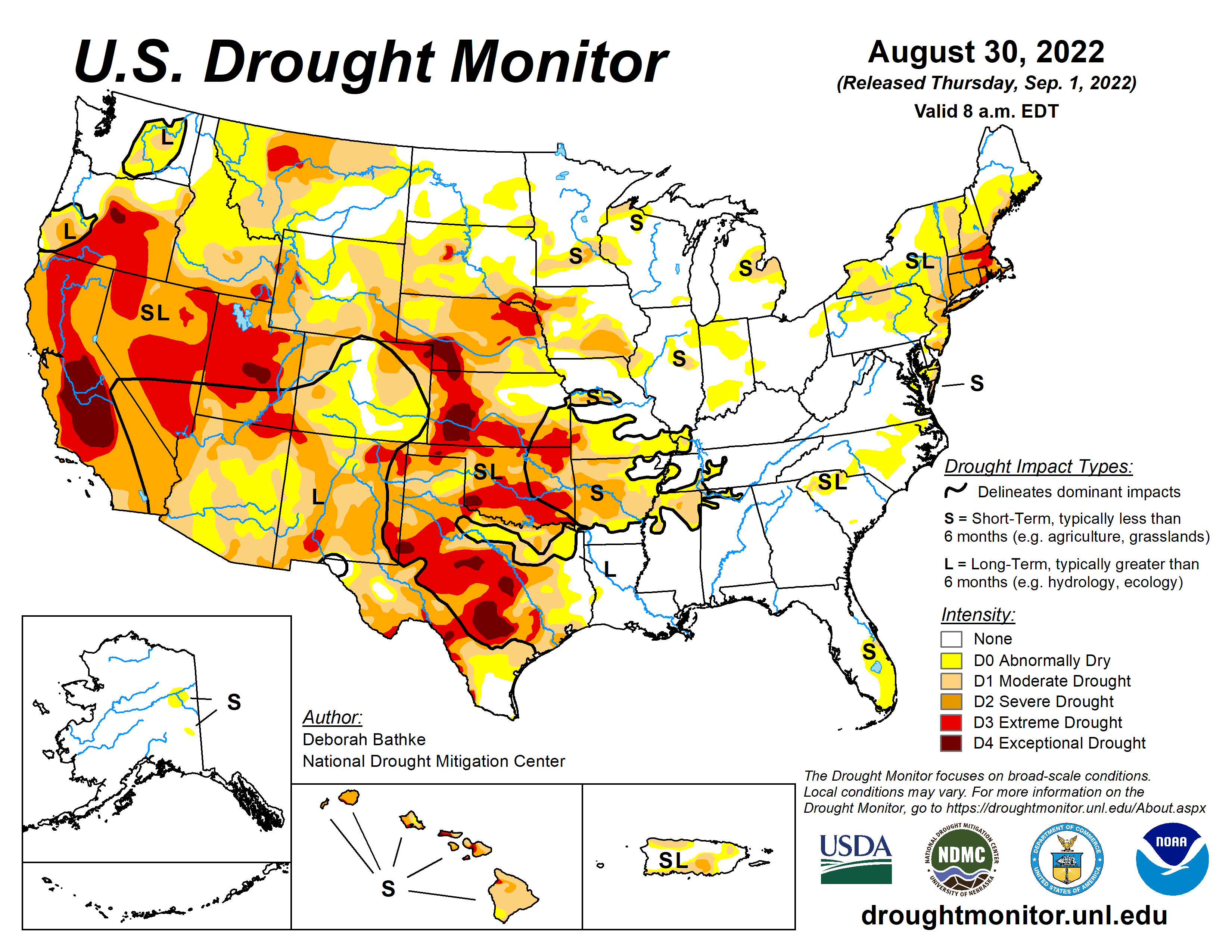
US Drought Monitor map September 6, 2022.

“The biggest impacts this year have been the Central and Southern Great Plains — Nebraska southward through Texas — and the two big crops hit this year are grain sorghum [primarily used for animal feed] and cotton,” Rippey said…

In California, farmers are making tough choices to give up on their strawberries and tomatoes, lettuces and melons, so that whatever water they get goes to crops such as almonds, grapes and olives, into which they’ve sunk multiyear investments and which provide a better payoff, Rippey said…

The USDA had reduced its corn forecast last month because of this summer’s drought. But thePro Farmer Crop Tour, which concluded Aug. 25, found the corn yield was even worse than that lowered expectation. The on-the-ground inspectors also found the corn quality had suffered as a result of heat and dry conditions, with cobs carrying small grains and many suffering from “tipback,” when kernels are missing from the outer edge…Wheat has taken a walloping this year, with rains impeding spring planting after a protracted La Niña weather pattern meant several years of hotter and drier weather over key production areas. Drought is also having a dramatic effect on California rice, which isgrown mostly in the Sacramento Valley. The state, which grows medium-grain rice such as sushi rice, is at about half of a normal year’s production, said Katie Cahill, spokeswoman for the California Rice Commission. Many growers decided to fallow their fields and sell their water to perennialcrops such as almonds to defray their losses…The USDA recently estimated that the tomatoharvest this year will be 10.5 million tons, more than a million tons shy of a normal season, which will be reflected in the next year’s pizza, spaghetti sauce and ketchup prices. Harvest of the new potato crop is underway, and Rabobank analysts say the harvested area is projected to drop 4 percent from last year (and last year’s crop was the lowest in a decade). Its analysts also said year-to-date shipments of carrots are down 45 percent, sweet corn down 20 percent, sweet potatoes down 13 percent, and celery down 11 percent, all an indication of short supply. And according to the USDA, total peach production was down 15 percent from 2021, mostly because of California’s small crop…

But the bad news extends to cattle, portending bad news for next year’s beef prices. When weather is dry and hot, there’s not enough natural feed to go around. To sustain a herd, ranchers must bring in hay, and feed prices soar, prompting ranchers to sell their animals a little early, and often to sell heifers, the young females, rather than keep them as breeding stock, said Sarah Little, spokeswoman for the North American Meat Institute, a trade association. This has resulted in lower beef prices for consumers in the short term but signals that there probably will be a tighter supply next year.

Interior Department Completes Removal of “Sq___” from Federal Use: Decisions of the U.S. Board on Geographic Names are Effective Immediately

Secretary Haaland meets with tribal, local leaders regarding conservation efforts in southern Nevada

Click the link to read the release on the Deparmtment of Interior website :

The Department of the Interior today [September 8, 2022] announced the Board on Geographic Names (BGN) has voted on the final replacement names for nearly 650 geographic features featuring the word sq___. The final vote completes the last step in the historic efforts to remove a term from federal use that has historically been used as an offensive ethnic, racial and sexist slur, particularly for Indigenous women.

“I feel a deep obligation to use my platform to ensure that our public lands and waters are accessible and welcoming. That starts with removing racist and derogatory names that have graced federal locations for far too long,” said Secretary Deb Haaland. “I am grateful to the members of the Derogatory Geographic Names Task Force and the Board on Geographic Names for their efforts to prioritize this important work. Together, we are showing why representation matters and charting a path for an inclusive America.”

The list of new names can be found on the U.S. Geological Survey website with a map of locations.

The final vote reflects a months-long effort by the Derogatory Geographic Names Task Force established by Secretary’s Order 3404, which included representatives from the Department’s Bureau of Indian Affairs, Bureau of Land Management, Bureau of Safety and Environmental Enforcement, National Park Service, Office of Diversity, Inclusion and Civil Rights, Office of Surface Mining Reclamation and Enforcement, and the U.S. Geological Survey and the Department of Agriculture’s U.S. Forest Service.

During the public comment period, the Task Force received more than 1,000 recommendations for name changes. Nearly 70 Tribal governments participated in nation-to-nation consultation, which yielded another several hundred recommendations. While the new names are immediately effective for federal use, the public may continue to propose name changes for any features — including those announced today — through the regular BGN process.

The renaming effort included several complexities: evaluation of multiple public or Tribal recommendations for the same feature; features that cross Tribal, federal and state jurisdictions; inconsistent spelling of certain Native language names; and reconciling diverse opinions from various proponents. In all cases, the Task Force carefully evaluated every comment and proposal.

In July, the Department announced an additional review by the BGN for seven locations that are considered unincorporated populated places. Noting that there are unique concerns with renaming these sites, the BGN will seek out additional review from the local communities and stakeholders before making a final determination.

Secretary’s Order 3404 and the Task Force considered only the sq___ derogatory term in its scope. Secretary’s Order 3405 created a Federal Advisory Committee for the Department to formally receive advice from the public regarding additional derogatory terms, derogatory terms on federal land units, and the process for derogatory name reconciliation. Next steps on the status of that Committee will be announced in the coming weeks.

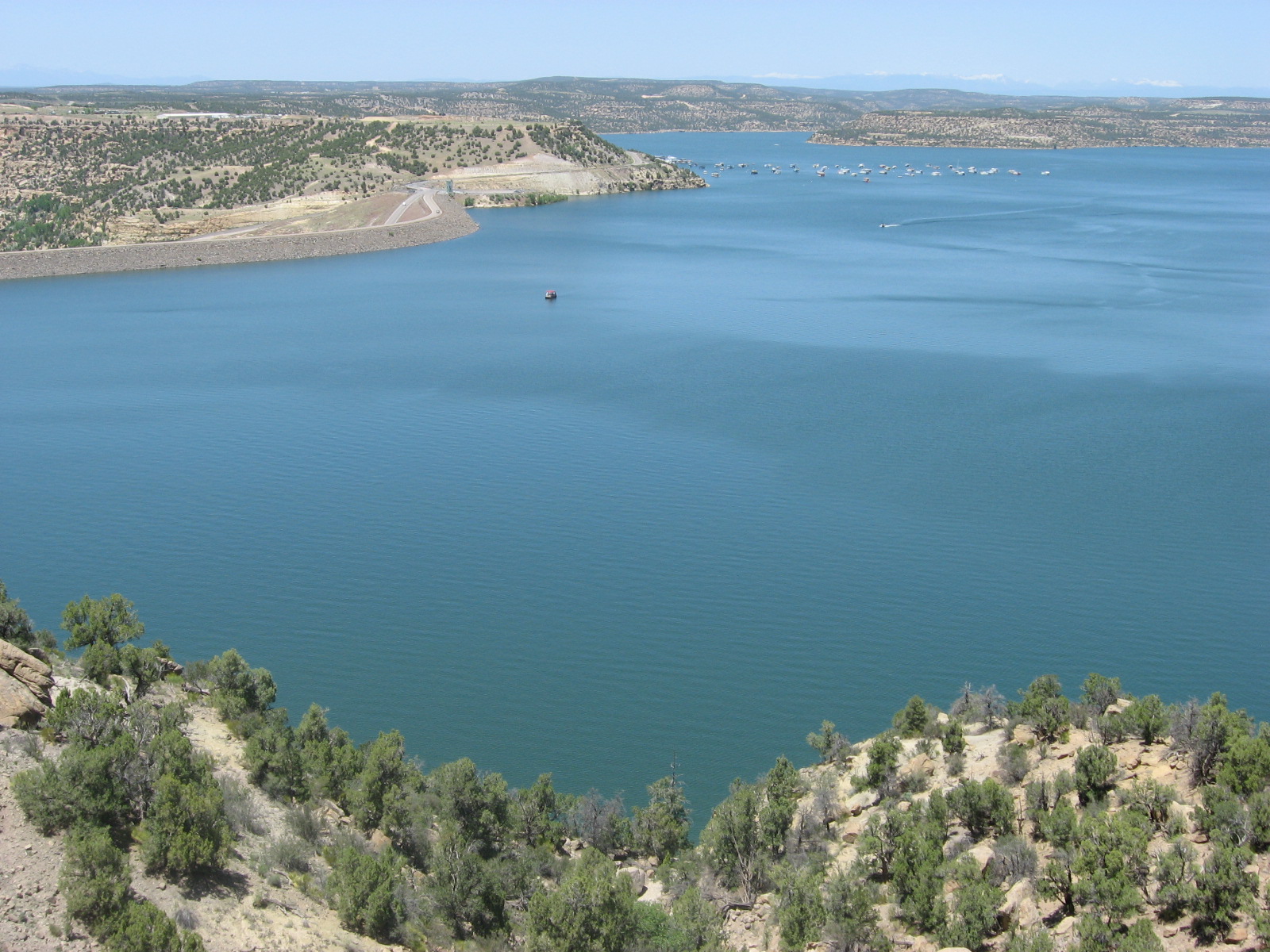
Aspinall Unit operations update September 8, 2022: Bumping up to 1400 cfs #GunnisonRiver #ColoradoRiver #COriver #aridification

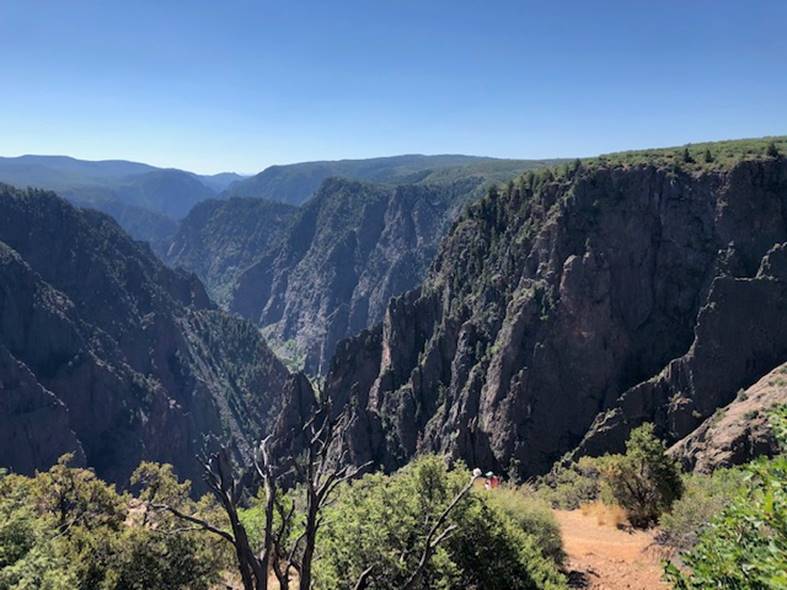
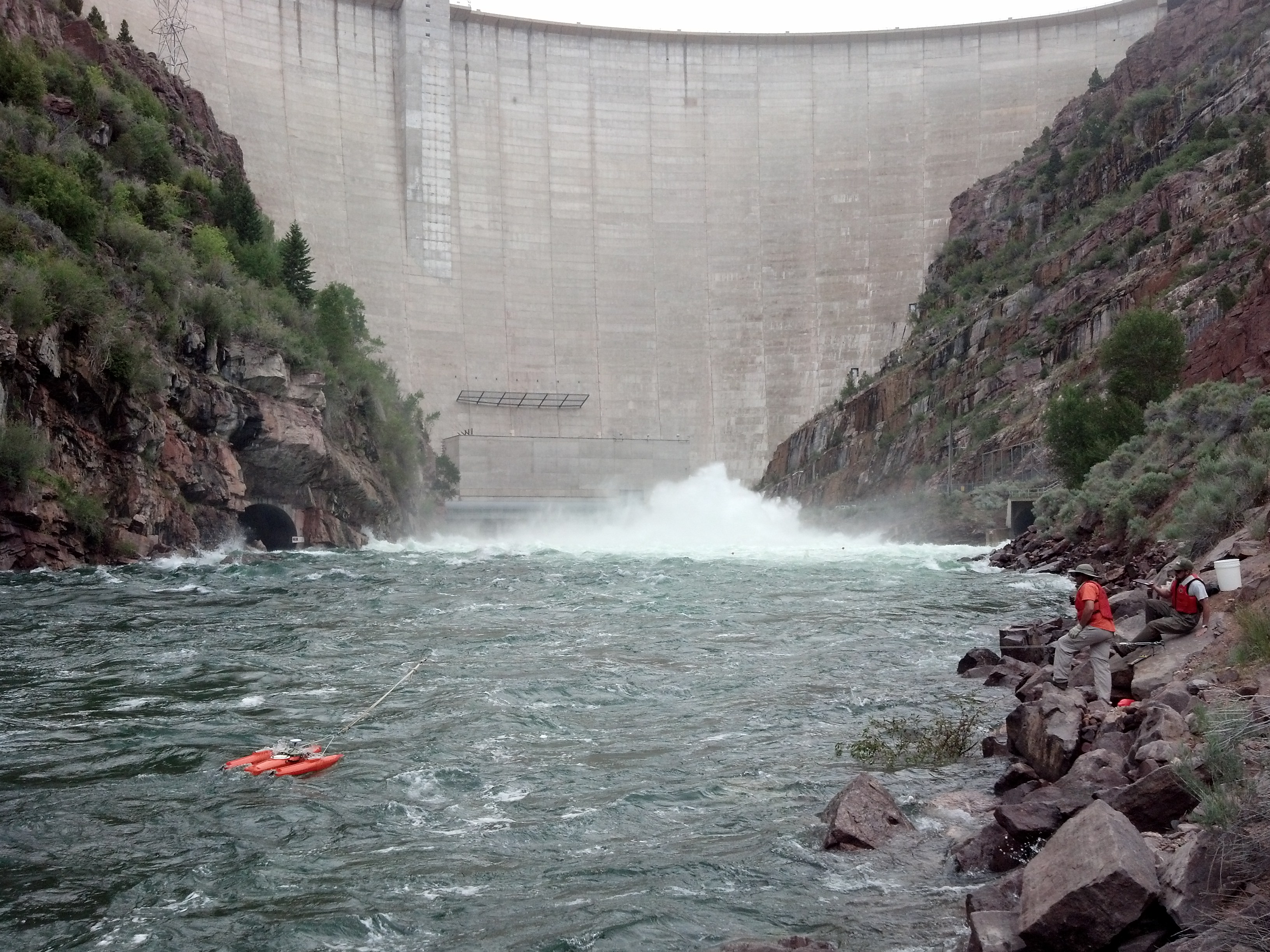
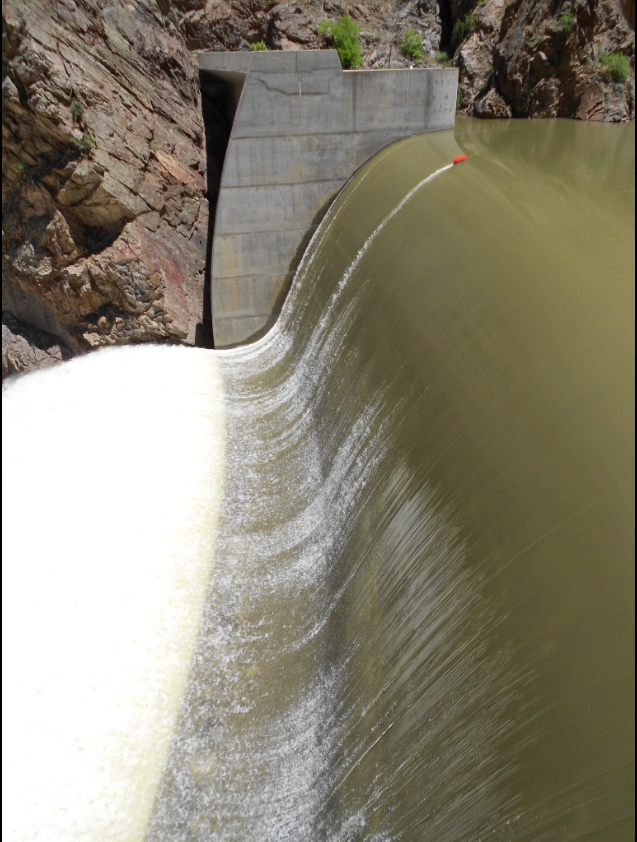
Black Canyon July 2020. Photo credit: Cari Bischoff

From email from Reclamation (Erik Knight):

Releases from the Aspinall Unit will be increased from 1350 cfs to 1400 cfs on Thursday, September 8th. Releases are being increased due to the hot and dry conditions that have caused the river to drop below the baseflow target on the lower Gunnison River. The actual April-July runoff volume for Blue Mesa Reservoir came in at 68% of average. 

Flows in the lower Gunnison River are currently under the baseflow target of 890 cfs. River flows are expected to be under the baseflow target until the additional release from Crystal Dam arrives. 

Pursuant to the Aspinall Unit Operations Record of Decision (ROD), the baseflow target in the lower Gunnison River, as measured at the Whitewater gage, is 890 cfs for September. 

Currently, Gunnison Tunnel diversions are 1050 cfs and flows in the Gunnison River through the Black Canyon are around 345 cfs. After this release change Gunnison Tunnel diversions will still be around 1050 cfs and flows in the Gunnison River through the Black Canyon will be near 400 cfs.  Current flow information is obtained from provisional data that may undergo revision subsequent to review.

#Drought news (September 8, 2022): Most of the [West] region saw no precipitation this week, except for some isolated storm activity in W. #WA, #AZ, E. #Colorado, and E. #NM

Click a thumbnail graphic to view a gallery of drought data from the US Drought Monitor website.

Click the link to go to the US Drought Monitor website. Here’s an excerpt:

This week’s drought summary

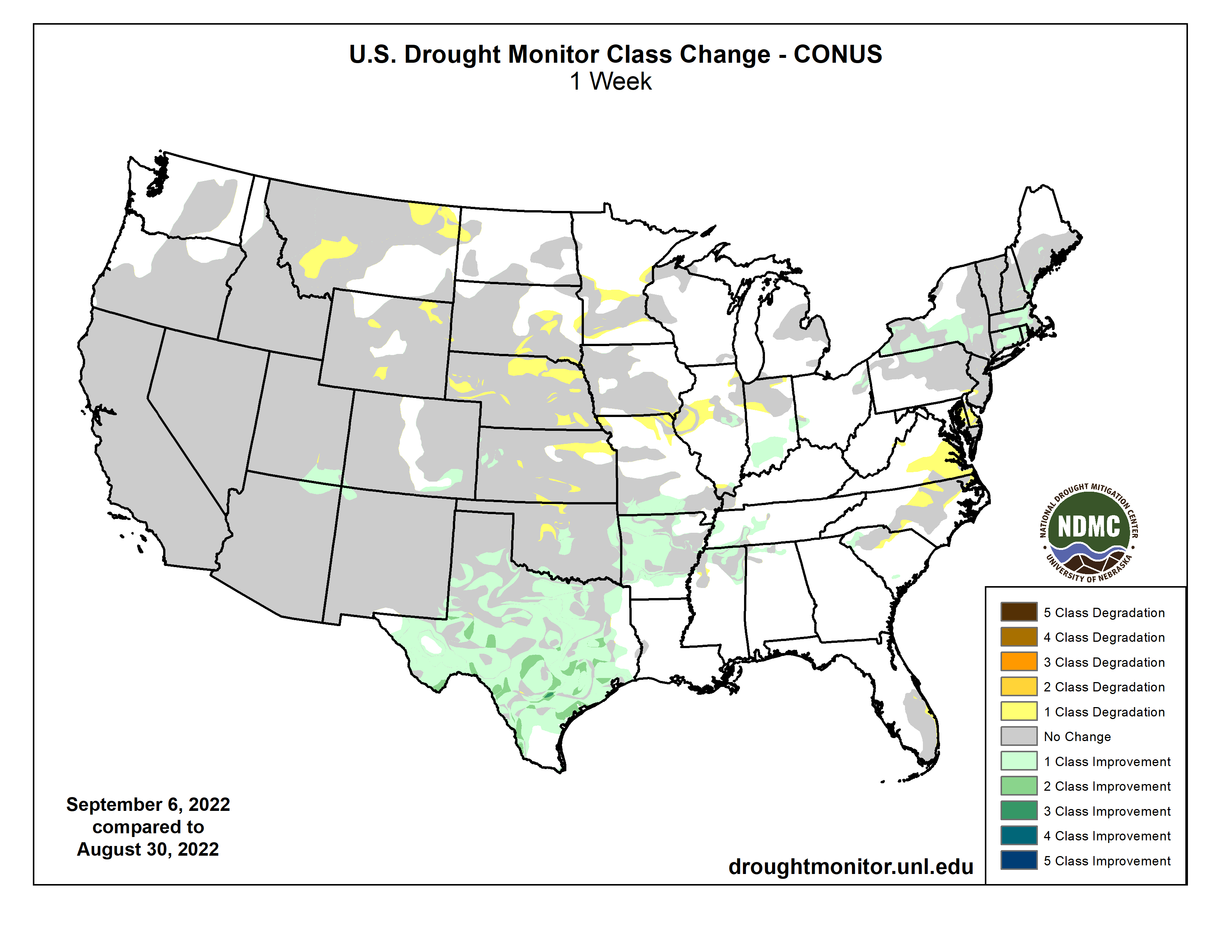
This U.S. Drought Monitor (USDM) week saw continued improvements on the map across areas of the South, including Texas, in response to another round of localized heavy rainfall during the past week. Overall, the recent rainfall in Texas throughout the past month has started to make a significant dent in the state’s drought conditions in some areas. In contrast, drought conditions intensified in areas of the central and northern Plains with additional degradations on this week’s map. In these areas, recent drought impact reports submitted to the National Drought Mitigation Center indicated drought-related impacts within the agricultural sector including reduced crop yields as well as deteriorating pasture and rangeland conditions. Out West, the big story of the past week has been the heat wave that has impacted the region with record-setting temperatures and critical fire-weather conditions. The hot temperatures and strong winds exacerbated conditions on the Mill Fire, which broke out in Northern California on Friday, forcing the evacuation of the town of Weed, California as well as neighboring communities. In Death Valley, California, high temperatures exceeded 125 deg F multiple times during the past week including on September 1st when the high temperature reached 127 deg F―potentially breaking the record for the hottest temperature ever recorded during September, according to preliminary reports. Elsewhere, shower activity in the Northeast led to isolated improvements in drought-affected areas of Massachusetts and Connecticut, while further to the south conditions deteriorated on the map in Delaware. In the Midwest, short-term precipitation deficits and declining soil moisture levels led to the expansion of areas of drought in northern Missouri and central Illinois…

High Plains

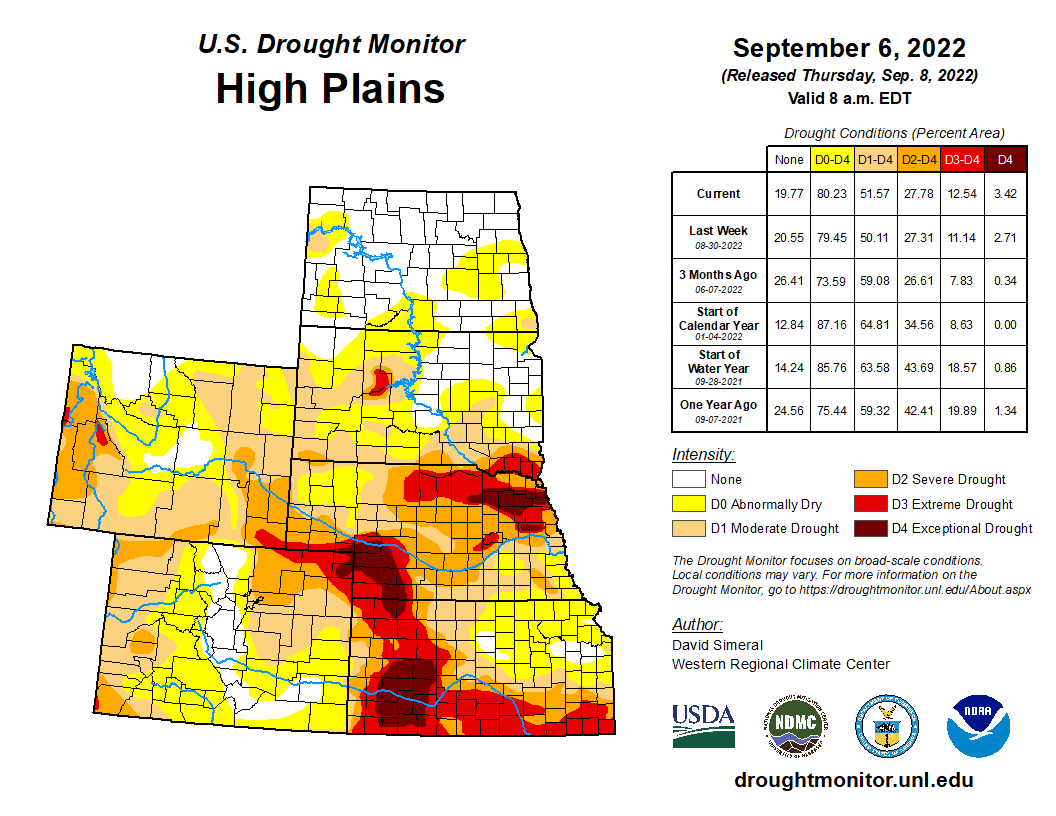
On this week’s map, drought-related conditions continued to intensify across areas of southeastern Wyoming, northeastern Montana, Nebraska, southern South Dakota, and western Kansas, as anomalously hot temperatures impacted western portions of the region. According to the National Drought Mitigation Center’s Condition Monitoring Observer Reports (CMOR), numerous drought impact reports have been submitted during the past 30-day period. Impacts include reduced crop yields, poor pasture conditions, and the need for supplemental feeding of livestock. The current drought situation was exacerbated by this week’s intense heat, with average maximum temperatures ranging from 95 to 100 deg F in areas of eastern Montana, northern and eastern Wyoming, and western portions of South Dakota, Nebraska, and Kansas…

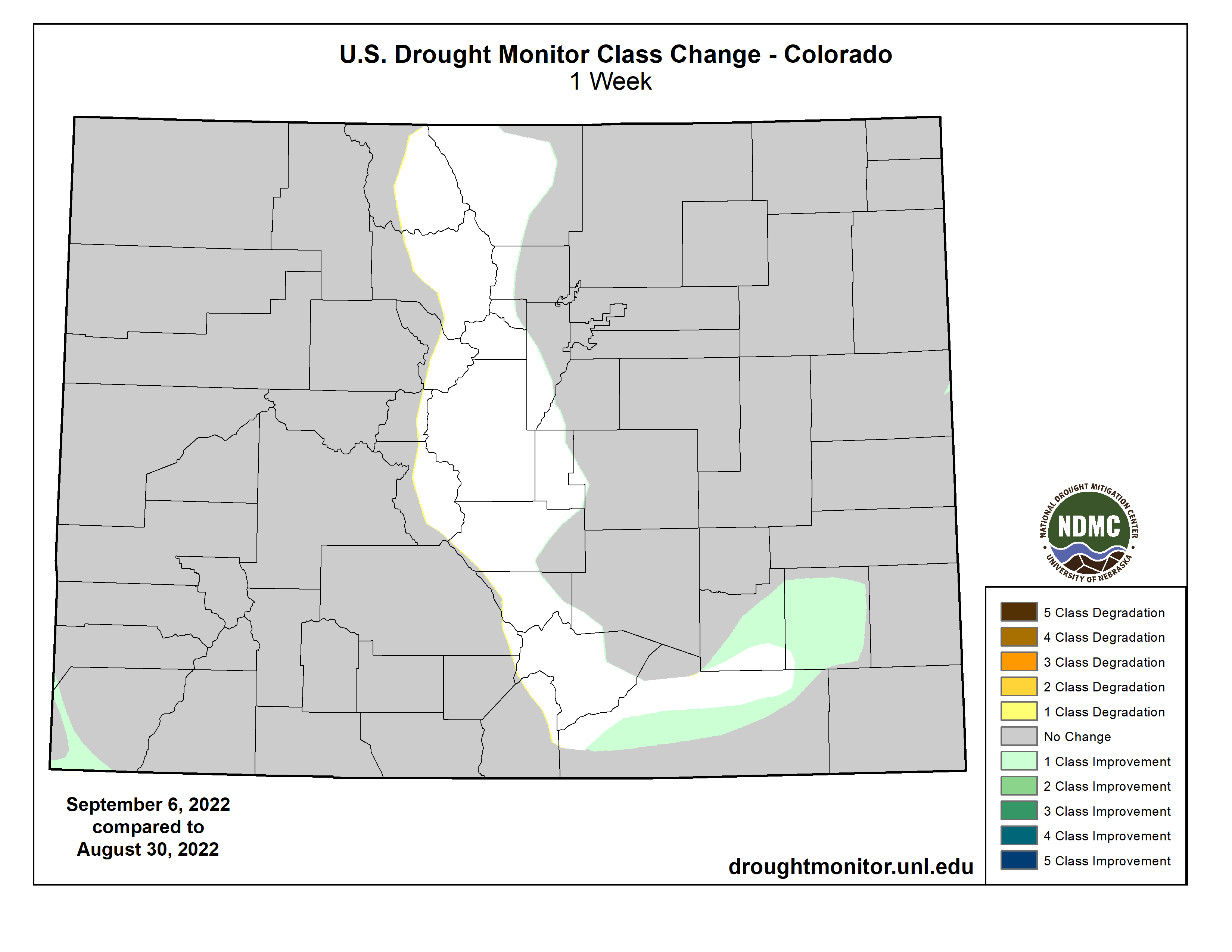
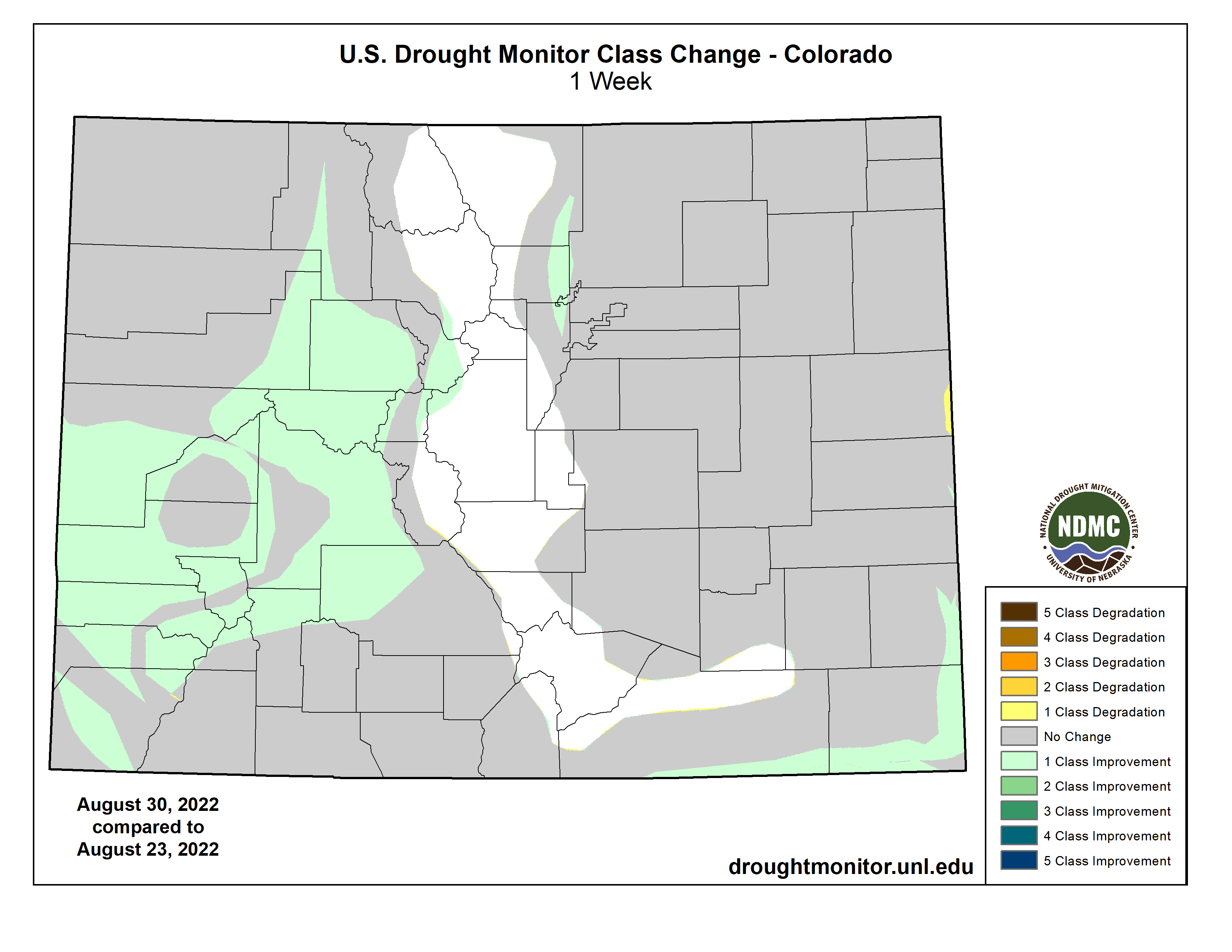
Colorado Drought Monitor one week change map ending September 6, 2022.

West

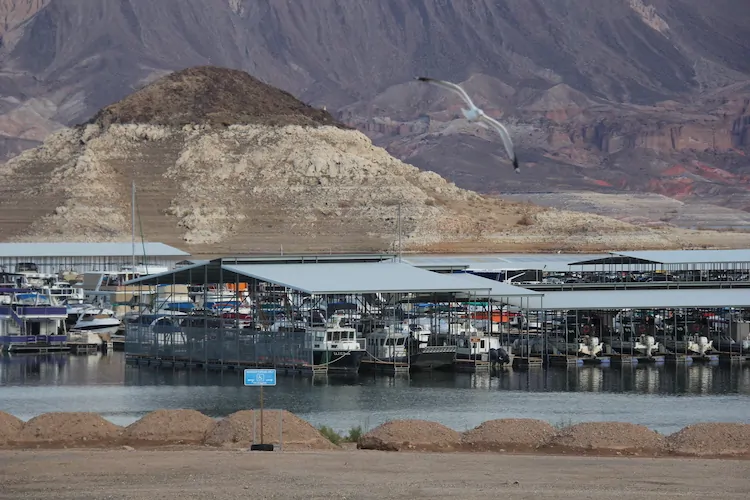
Out West, an anomalous upper-level ridge parked over the central Great Basin during the past week—leading to a dangerous heat wave and record-high temperatures across the region. The record heat exacerbated fire-weather conditions across Northern California, the Pacific Northwest, and the Northern Rockies as well as taxed California’s power grid in response to the record-high demand reported this week. Most of the region saw no precipitation this week, except for some isolated storm activity in western Washington, Arizona, eastern Colorado, and eastern New Mexico. On this week’s map, areas of drought expanded in southwestern and central Montana, and in northern Wyoming. Areas of Extreme Drought (D3) in the Four Corners region were trimmed back as part of a re-assessment of the impact of monsoonal rainfall during the past several months. Looking at reservoir storage conditions, the two largest reservoirs in the Colorado River system, Lake Mead and Lake Powell, are currently 28% and 24% full, respectively.

South

In the South, widespread improvements were made across Texas this week in response to another round of moderate-to-heavy rainfall that impacted isolated areas of the state, with accumulations ranging from 2 to 6+ inches. The recent rains have provided a much-needed boost to soil moisture and streamflow levels. Despite the recent rains, streamflow levels in some areas of the Hill Country have yet to recover, with gaging stations on numerous rivers and creeks reporting below-normal flows (ranging from the 2nd to the 24th percentile), according to the U.S. Geological Survey. Elsewhere in the region, this week’s rainfall led to improvements in eastern Oklahoma, northern Arkansas, northern Mississippi, and western portions of Tennessee. For the past 30-day period, much of the region experienced above-normal precipitation with the greatest positive departures (ranging from 6 to 12+ inches) observed in the Basin and Range and southern portion of the Gulf Coastal Plains of Texas, northern Louisiana, and central Mississippi. Overall, average temperatures for the week were within a few degrees of normal, with larger negative departures (2 to 4 deg F below normal) observed in western Texas.

Looking Ahead

The NWS WPC 7-Day Quantitative Precipitation Forecast (QPF) calls for moderate-to-heavy precipitation accumulations ranging from 2 to 5+ inches across areas of the Southeast including Georgia, Florida, and South Carolina. Likewise, 2 to 4+ inch accumulations are forecasted for areas of the Upper Midwest in Wisconsin and Upper Peninsula Michigan. Conversely, lighter accumulations (<1.5 inches) are expected across eastern portions of the South, Lower Midwest, Mid-Atlantic, and the southern extent of the Northeast. Out West, accumulations of less than an inch are expected in areas of Southern California including the Mojave Desert, Transverse Ranges, and the southern Sierra. Elsewhere, areas of the central Great Basin, Northern Arizona, and Northern Rockies are expected to receive modest rainfall accumulations. The CPC 6-10-day Outlooks calls for a moderate-to-high probability of above-normal temperatures across the West, the Plains states, and along much of the Eastern Seaboard. Below-normal temperatures are expected across the Pacific Northwest and the Upper Midwest while there is a low-to-moderate probability of below-normal temperatures across areas of the South and Lower Midwest. In terms of precipitation, below-normal precipitation is expected across the South, Plains states, and Upper Midwest, whereas above-normal precipitation is expected across much of the West, and East Coast. In Alaska, above-normal precipitation is forecasted across much of the Interior, Southwest, and Southcentral, while areas of the southern Panhandle have a low-probability of below-normal precipitation.

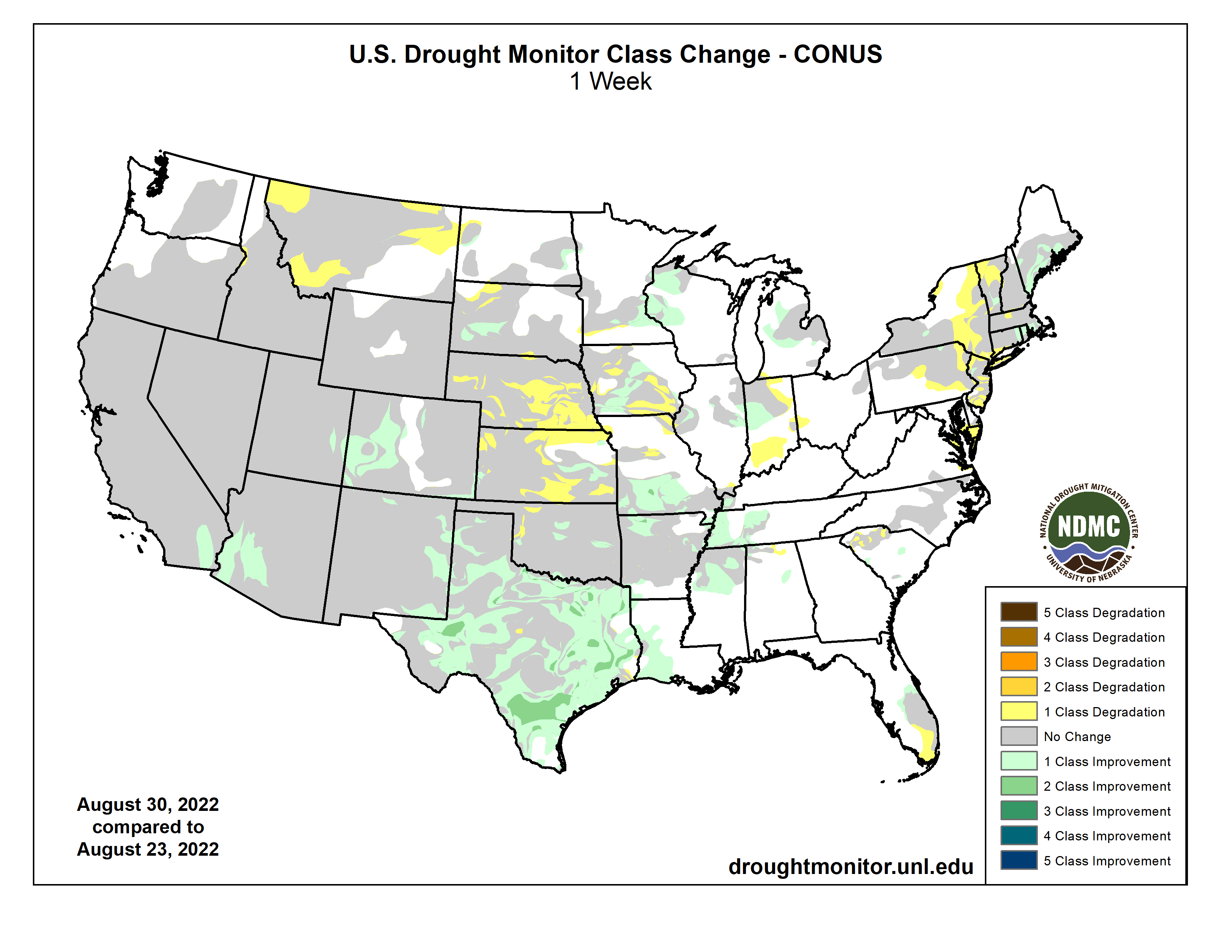
US Drought Monitor one week change map ending September 6, 2022.

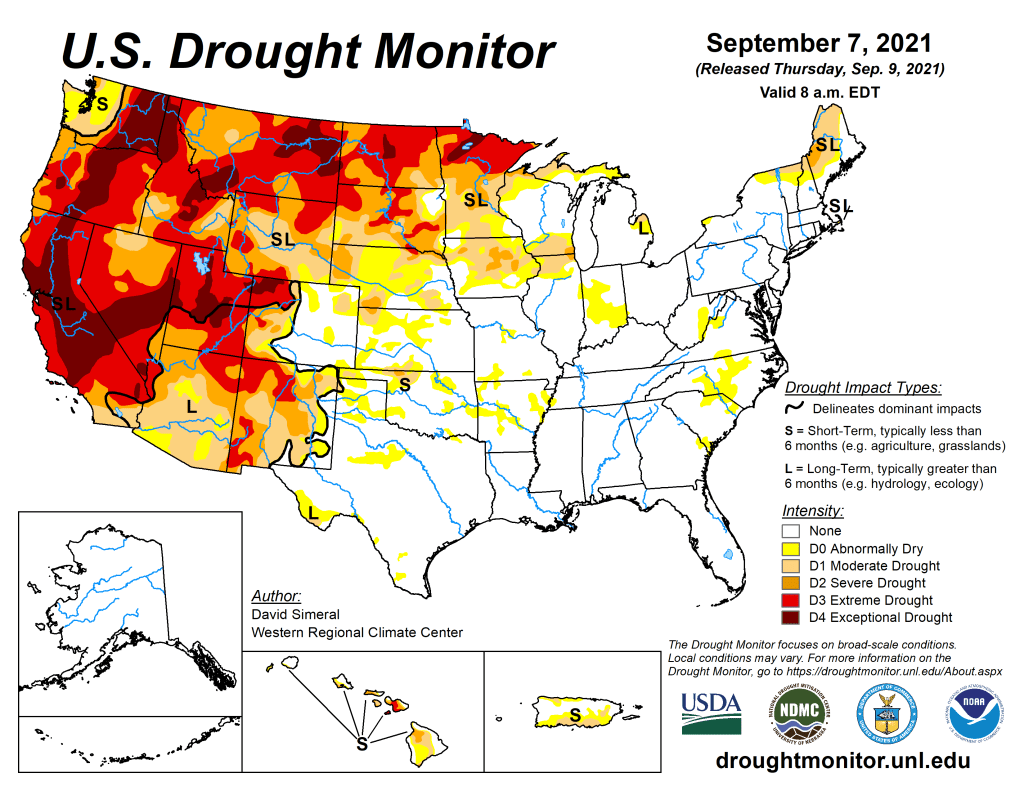
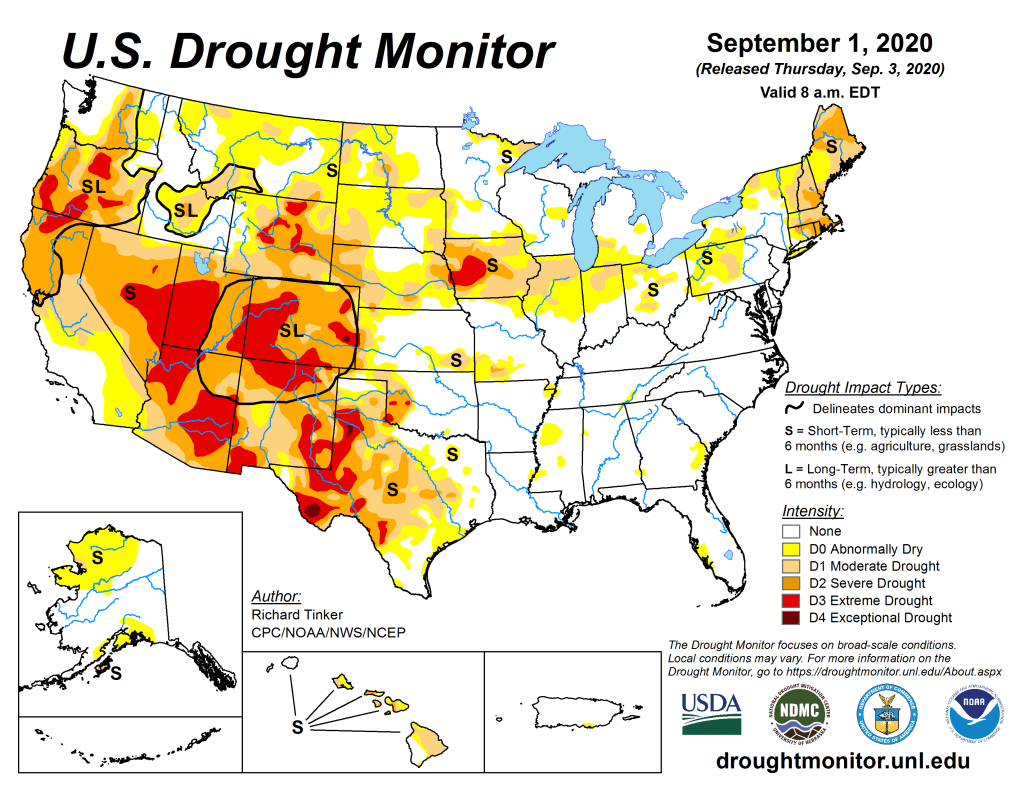
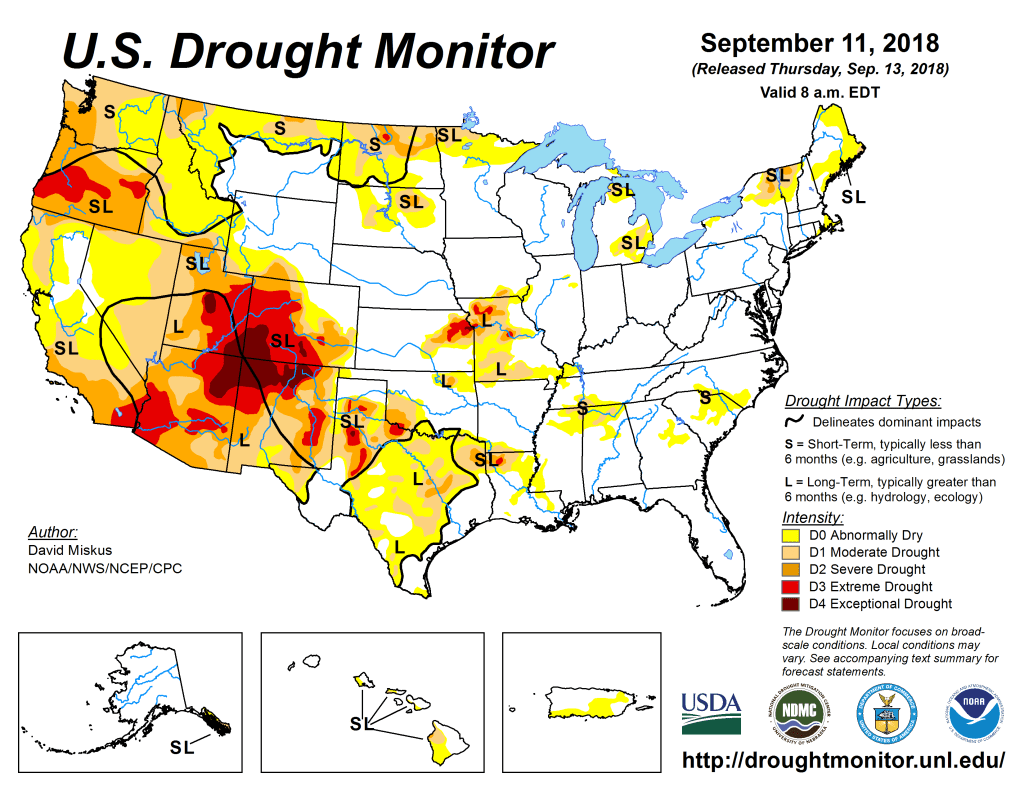
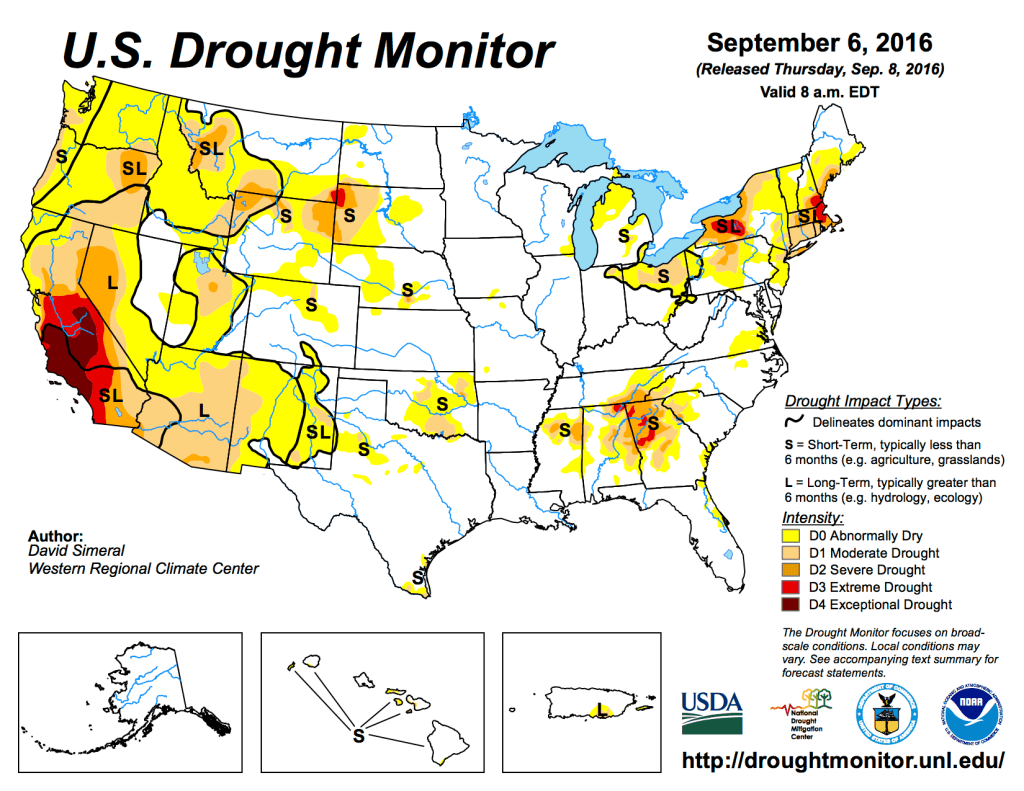
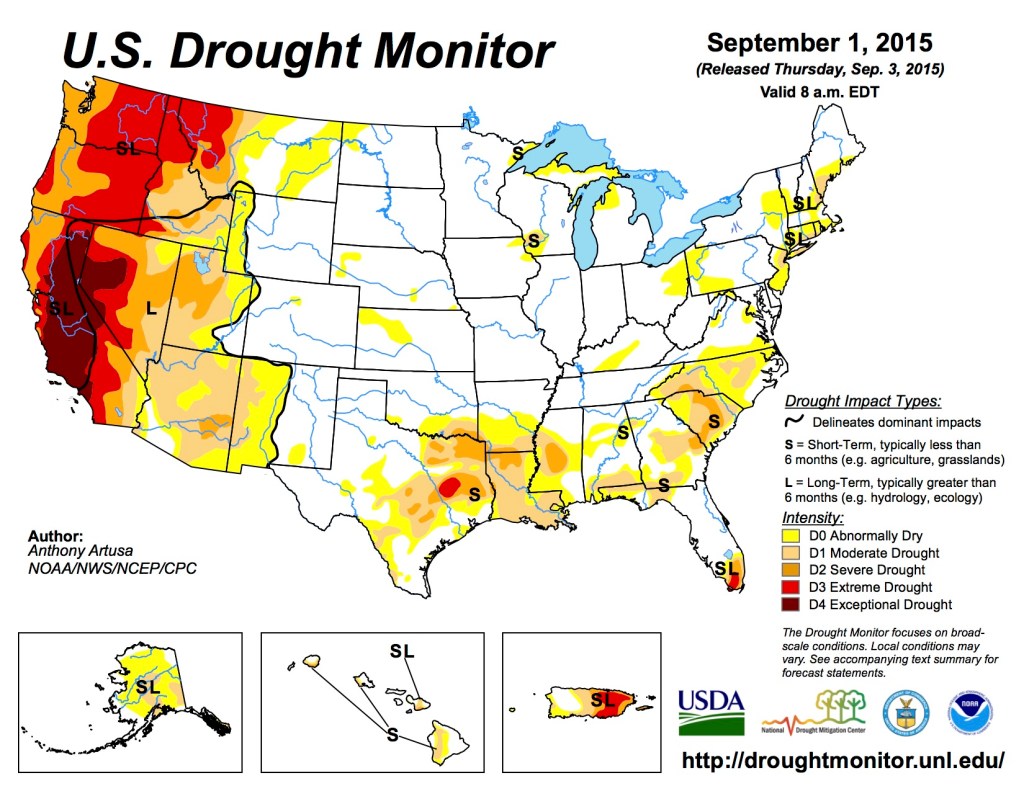
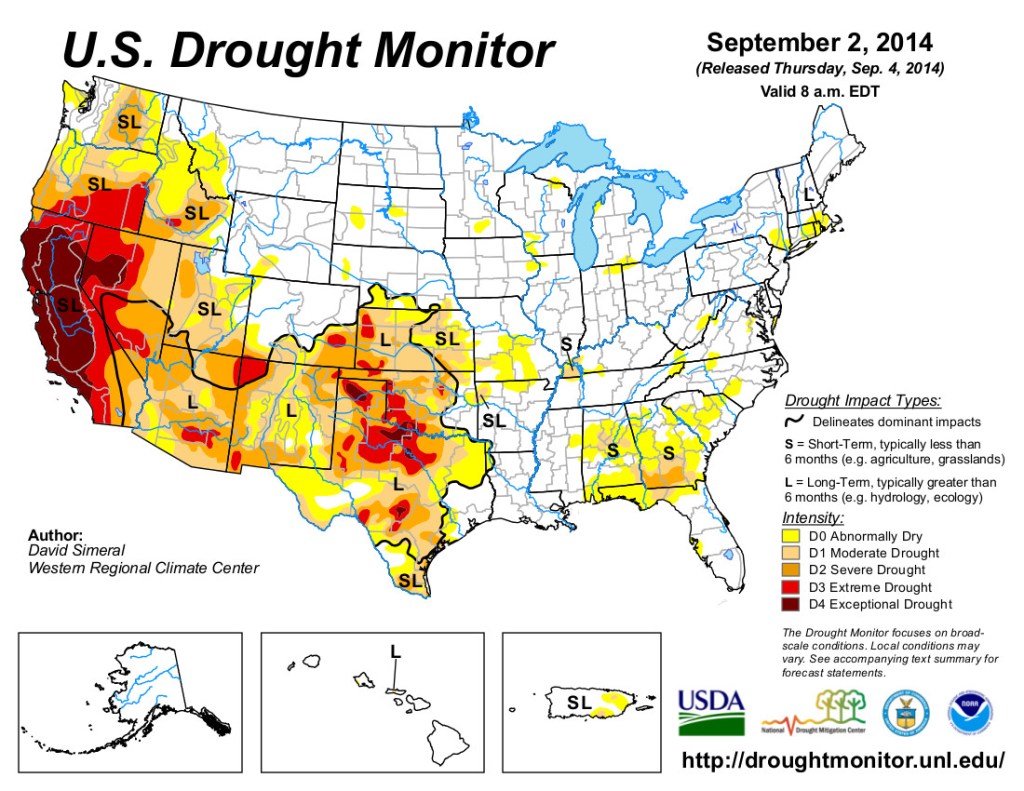
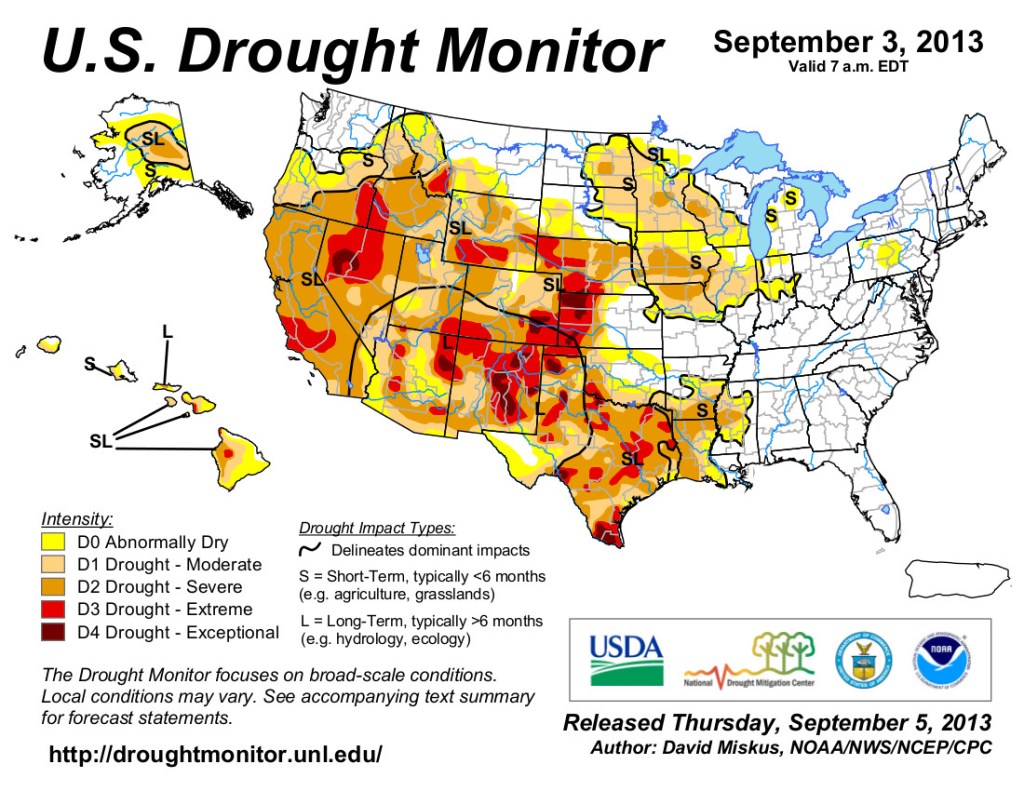
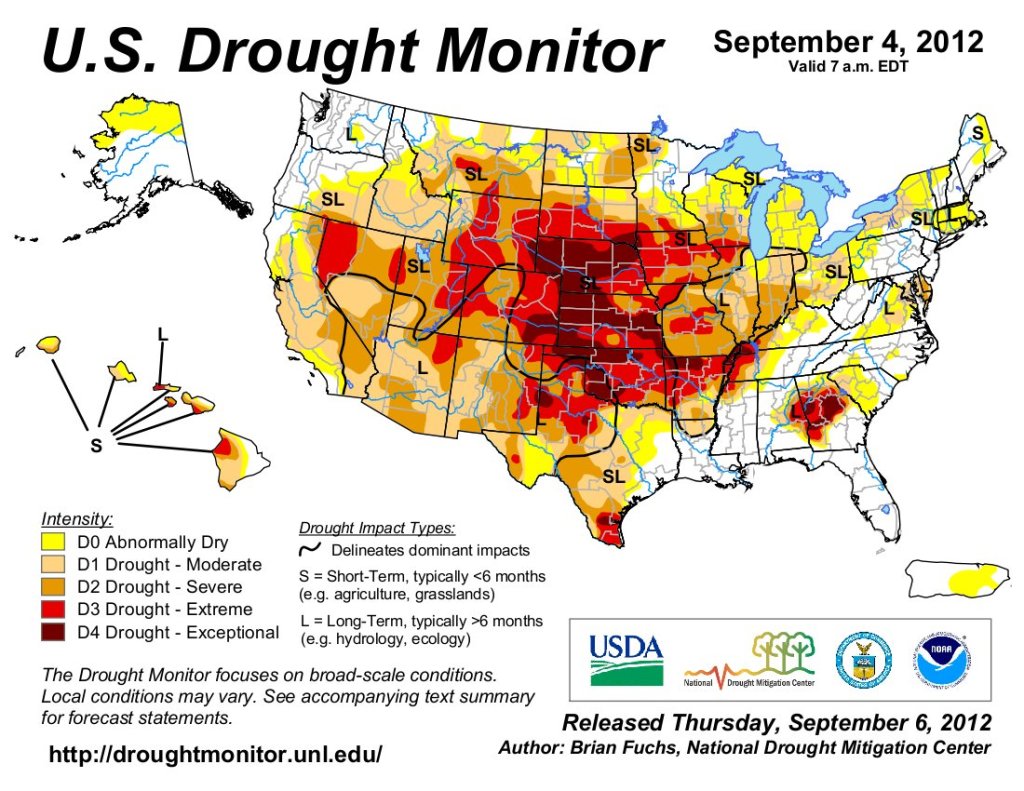
Just for grins here’s a gallery of early September Drought Monitor maps for the past few years.

#Colorado #Water #Conservation Board studying possible expansion of Bear Creek Lake — CBS Colorado

Following heavy rains which fell mid-September 2013 in Colorado, the pool elevation at the Bear Creek reservoir rose several feet. At 4 a.m., Sept. 15, the reservoir pool elevation surpassed its previous record elevation of 5587.1 feet, and peaked at a pool elevation of 5607.9 ft on Sept. 22, shown here. Bear Creek Dam did what it was designed to do by catching the runoff and reducing flooding risks to the hundreds of homes located downstream.

Click the link to read the article on the CBS Colorado website (Ben Warwick). Here’s an excerpt:

The Colorado Water Conservation Board, Army Corps of Engineers and City of Lakewood partnered on a study to examine gaps in water supply and demand, as part of the Colorado Water Plan. The study looked at several different scenarios to forecast and address water supply gaps through the year 2050. The South Platte Basin, which serves the Denver metro area, Northern Colorado, and the northeastern plains, is projected to have a gap anywhere between 509,000 acre-feet and 835,000 acre-feet per year. 

The CWCB and Army Corps of Engineers chose Bear Lake because it has an existing dam and provides an opportunity to store more water at what the group calls a more reasonable cost. The study is examining whether an expansion can decrease the supply/demand gap, possible impacts to flood control, and environmental and recreational impacts. 

If deemed feasible, funding for expansion and enhancement of recreational areas and open space would be a large part of the project. 

There is no set timeline for the project. The feasibility study is ongoing.

#Water #conservation efforts to thwart #drought delusional — The Boulder City Review #ColoradoRiver #COriver #aridification

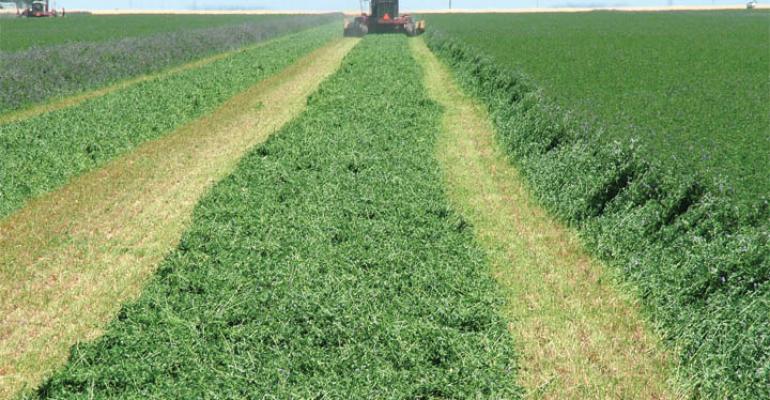
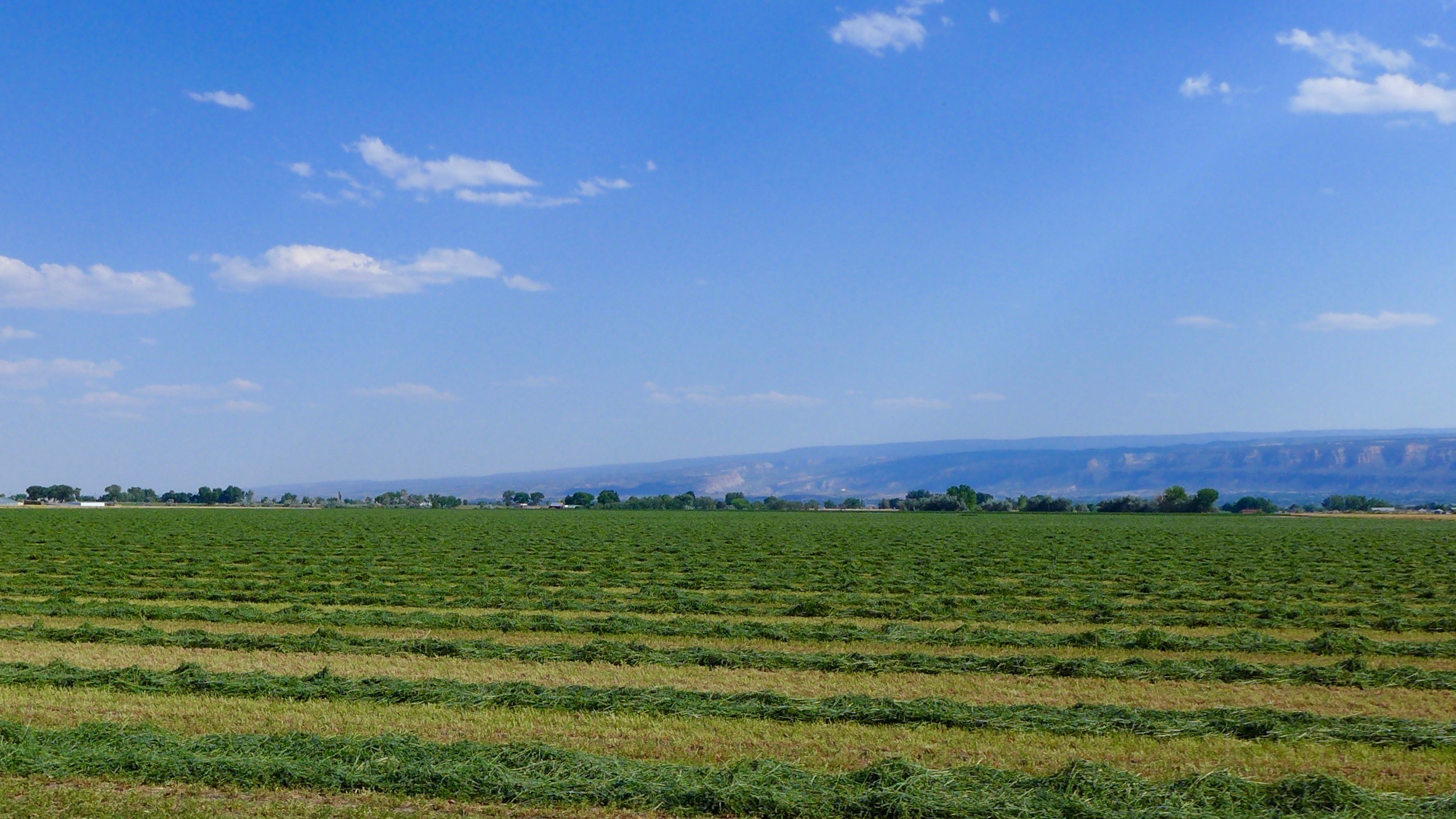
Alfalfa harvest via the Western Farm Press.

Click the link to read the guest column on the Boulder City Review website (Rod Woodbury). Here’s an excerpt:

Over the last two decades, however, the river has generated average flows of only 12.3 million acre-feet annually, a huge shortfall despite serious municipal conservation and reuse efforts. Southern Nevada has led the way in those laudable efforts. Despite adding 750,000 to our population since 2000, we’ve somehow managed to cut consumptive use by 26 percent due to aggressive conservation and recycling programs. Still, it’s not nearly enough. Global warming and the megadrought are projected to continue, which means river flows and lake levels will keep plummeting without drastic policy changes. We’re now only 90 feet above the “dead pool” level at which Hoover Dam will cease generating electricity.

And it’s no longer alarmist to prophesy that it could happen within our lifetime or even the next decade. That’s why the federal government recently issued its first-ever shortage declarations, reducing Nevada, Arizona and Mexico’s collective allocations by over 700,000 acre-feet annually, then tasking the seven river states to create a collaborative plan cutting an additional 2-4 million acre-feet annually next year.

So, here’s where I get brutally honest, which always seems to get me in big trouble. But I’ll say it anyway. Nevada isn’t the problem. If we were feeling generous, Nevadans could permanently donate back our entire annual allocation and it wouldn’t even make a dent. River flows would still be woefully insufficient to supply current uses and Lake Mead would still be rapidly draining. Of course, just because Nevada isn’t the problem doesn’t mean we can’t be part of the solution. Southern Nevadans should continue our conservation and recycling efforts, even if only to set an example and because it’s the right thing to do. But we need to stop pretending that eliminating more Clark County lawns, reducing the size of more (Las) Vegas golf courses and swimming pools, or even recycling all 1 million gallons of Boulder City’s daily wastewater will somehow solve the systemic river and lake problems. It won’t. Nevada amounts to nothing more than a statistical rounding error in the riverwide problem, and absolutely nothing Nevadans do to better conserve or recycle is going to change that…

Domestic water use also isn’t the problem. Nor are golf courses and resorts. If we completely wiped out the residential populations of Nevada, Utah, Wyoming and New Mexico, for instance, drying up millions or acres of turf and water features in the process, the lake would still be dropping.

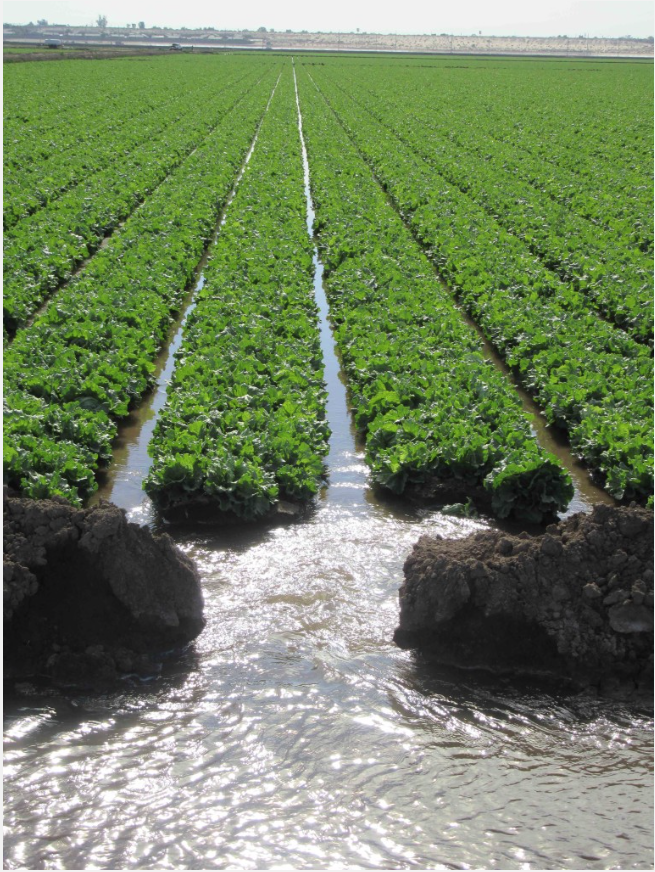
Let’s be honest. Desert agriculture is the real problem source. It uses approximately 80 percent of the Colorado River’s water to irrigate 15 percent of the nation’s farmland, producing a high percentage of winter fruits and vegetables. In fact, 20 percent of the entire Colorado River system’s output is channeled across the desert to a few wealthy landowners in California’s once-arid but now-productive Imperial Valley. And growers of cattle feed like alfalfa are by far the biggest river water consumers. So, if we really want to solve our Colorado River problem, then desert agriculture either needs to evaporate out of existence like the water it uses or become vastly more efficient. The best way to ensure that happens is to let the market dictate price. Make agriculture, commercial and industrial users pay for every drop they use, sending it to the highest bidders. With the market in control, we’ll be shocked how quickly irrigation ditches get lined with concrete, recycling projects ramp up and the lake start rising again.

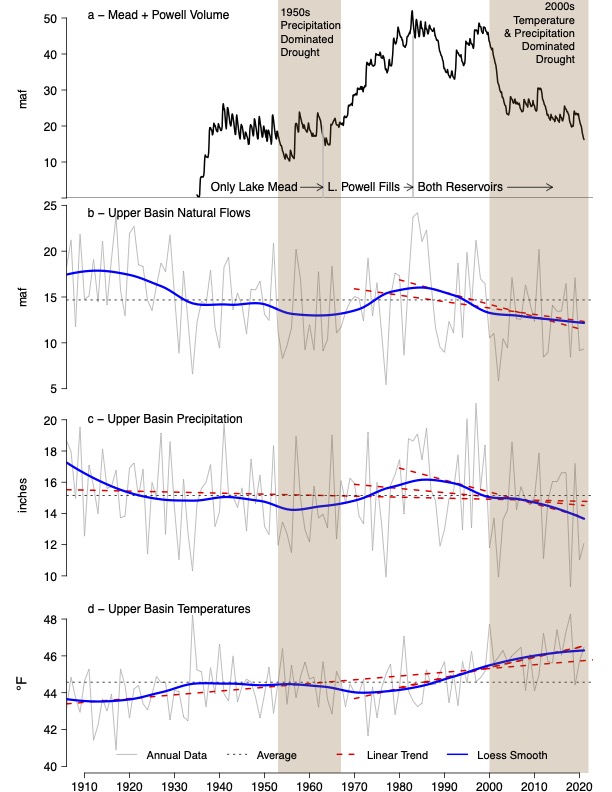
Brad Udall: Here’s the latest version of my 4-Panel plot thru Water Year (Oct-Sep) of 2021 of the Colorado River big reservoirs, natural flows, precipitation, and temperature. Data (PRISM) goes back or 1906 (or 1935 for reservoirs.) This updates previous work with @GreatLakesPeck. Credit: Brad Udall via Twitter

Intense heat waves and flooding are battering electricity and water systems, as America’s aging infrastructure sags under the pressure of climate change

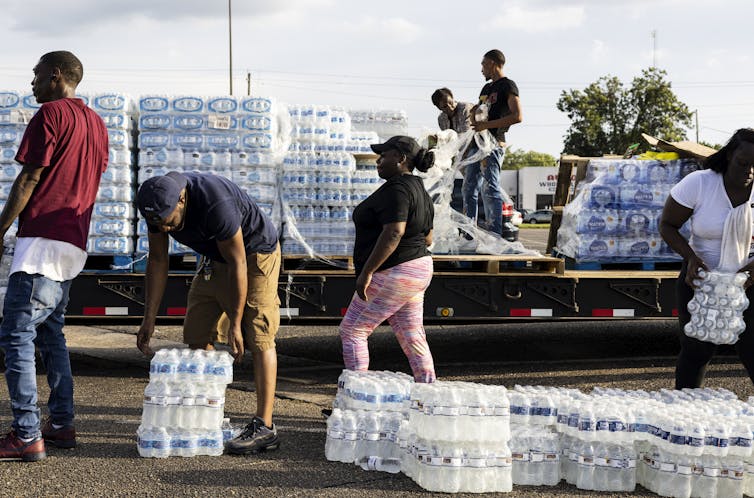
Volunteers distributed bottled water after Jackson, Mississippi’s water treatment plant failed during flooding in August 2022. Brad Vest/Getty Images

Paul Chinowsky, University of Colorado Boulder

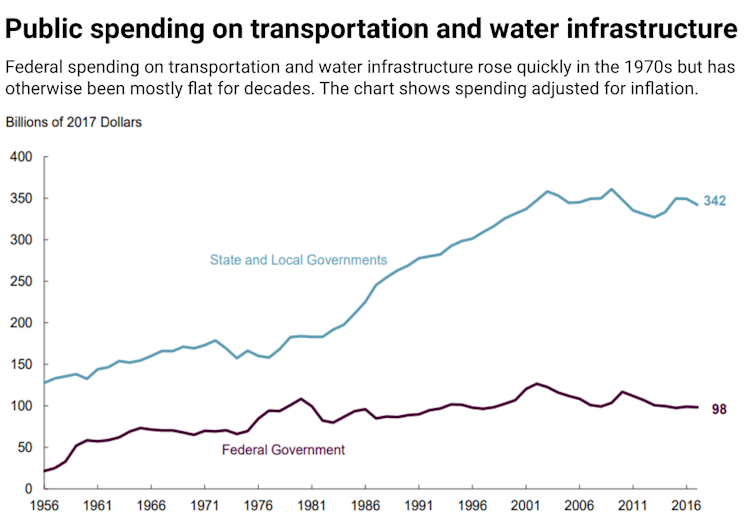
The 1960s and 1970s were a golden age of infrastructure development in the U.S., with the expansion of the interstate system and widespread construction of new water treatment, wastewater and flood control systems reflecting national priorities in public health and national defense. But infrastructure requires maintenance, and, eventually, it has to be replaced.

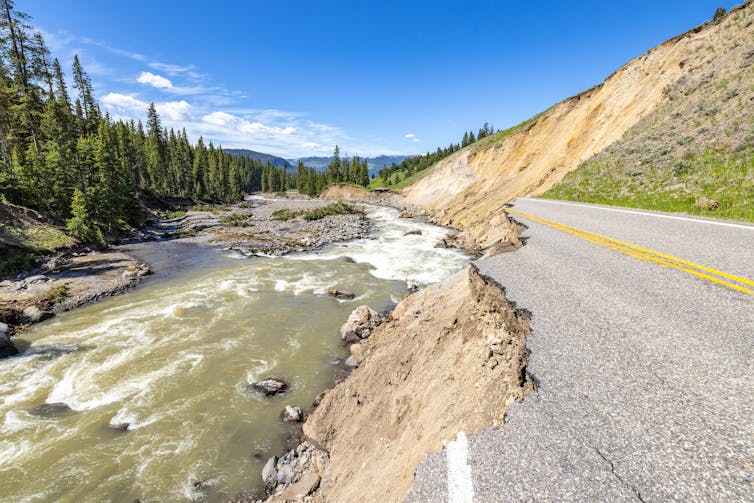
That hasn’t been happening in many parts of the country. Increasingly, extreme heat and storms are putting roads, bridges, water systems and other infrastructure under stress.

Two recent examples – an intense heat wave that pushed California’s power grid to its limits in September 2022, and the failure of the water system in Jackson, Mississippi, amid flooding in August – show how a growing maintenance backlog and increasing climate change are turning the 2020s and 2030s into a golden age of infrastructure failure.

I am a civil engineer whose work focuses on the impacts of climate change on infrastructure. Often, low-income communities and communities of color like Jackson see the least investment in infrastructure replacements and repairs.

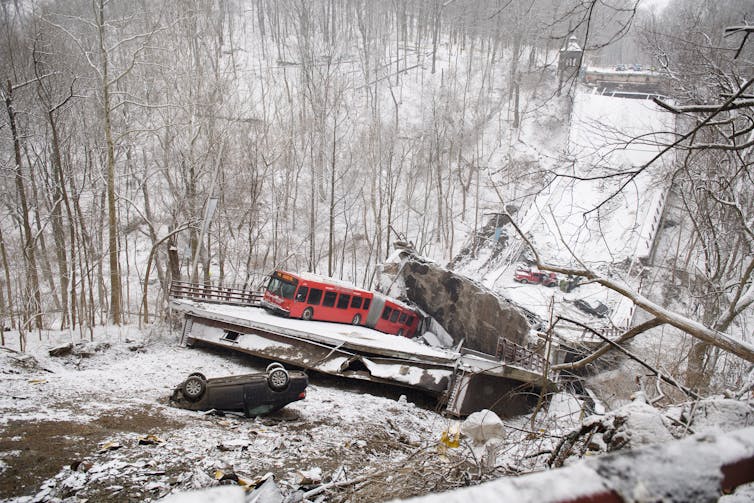
Crumbling bridge and water systems

The United States is consistently falling short on funding infrastructure maintenance. A report by former Federal Reserve Board Chairman Paul Volcker’s Volcker Alliance in 2019 estimated the U.S. has a US$1 trillion backlog of needed repairs.

Over 220,000 bridges across the country – about 33% of the total – require rehabilitation or replacement.

A water main break now occurs somewhere in the U.S. every two minutes, and an estimated 6 million gallons of treated water are lost each day. This is happening at the same time the western United States is implementing water restrictions amid the driest 20-year span in 1,200 years. Similarly, drinking water distribution in the United States relies on over 2 million miles of pipes that have limited life spans.

Concerns about water rise as #ColoradoRiver negotiations continue — The Rocky Mountain Collegian #COriver #aridification

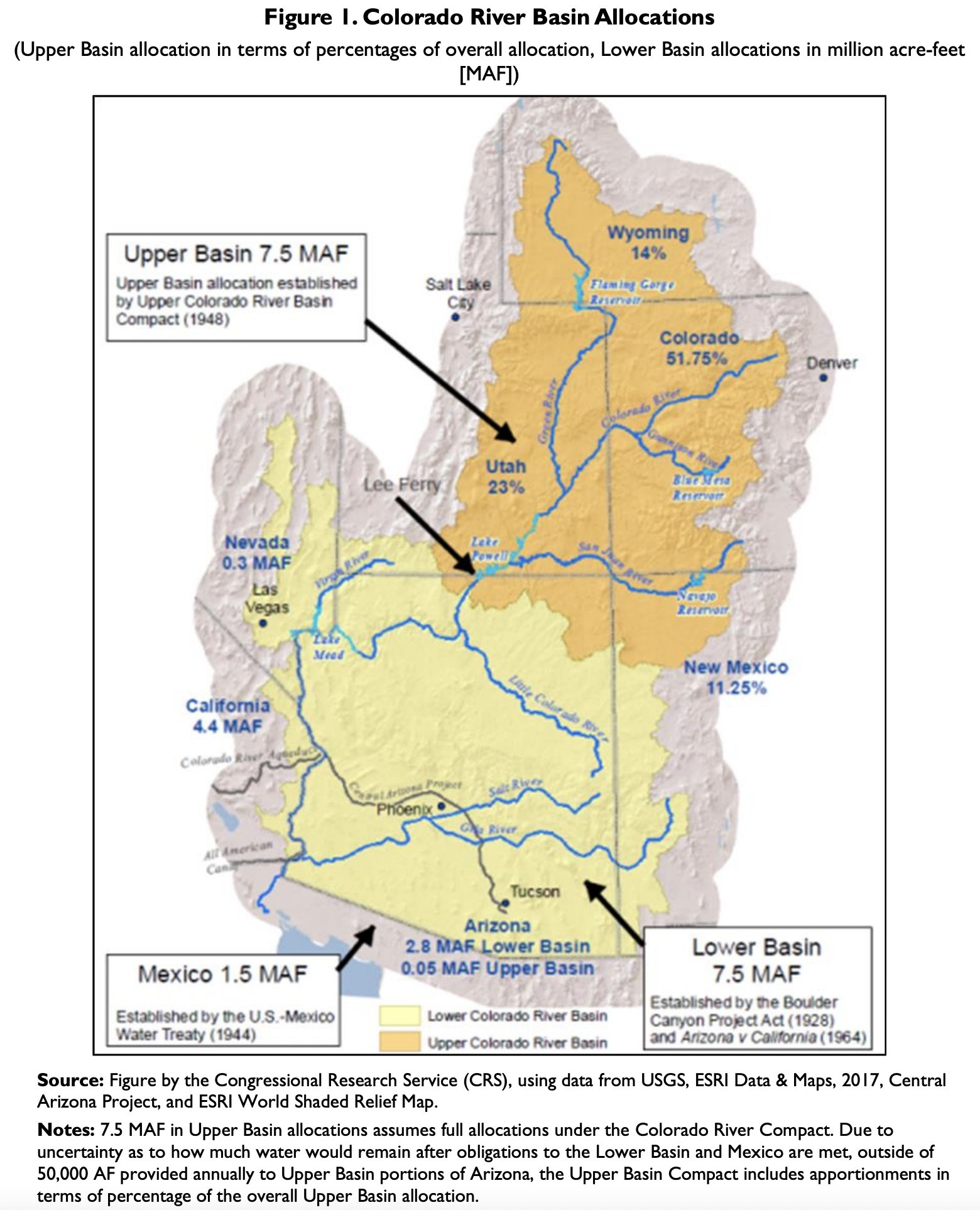
Colorado River Allocations: Credit: The Congressional Research Service

Click the link to read the article on the Rocky Mountain Collegian website (Ivy Secrest):

Dry, hot air settles over a small suburb in Fort Collins. The heat pushes residents indoors to crank the air conditioning, and the constant spurt of sprinklers is the only sound breaking the midday silence. This is a common occurrence of exceptional waste that may need to become a scene that only exists in memory, especially for states like Colorado.

Colorado has been experiencing drought conditions on and off for decades. And combating the issue of water scarcity in the region has been a priority for the states that rely on Colorado’s water resources.

“As a headwater state, we’re a really critical location in terms of the different rivers that originate in Colorado,” said Melinda Laituri, professor emeritus in ecosystem science and sustainability at Colorado State University.

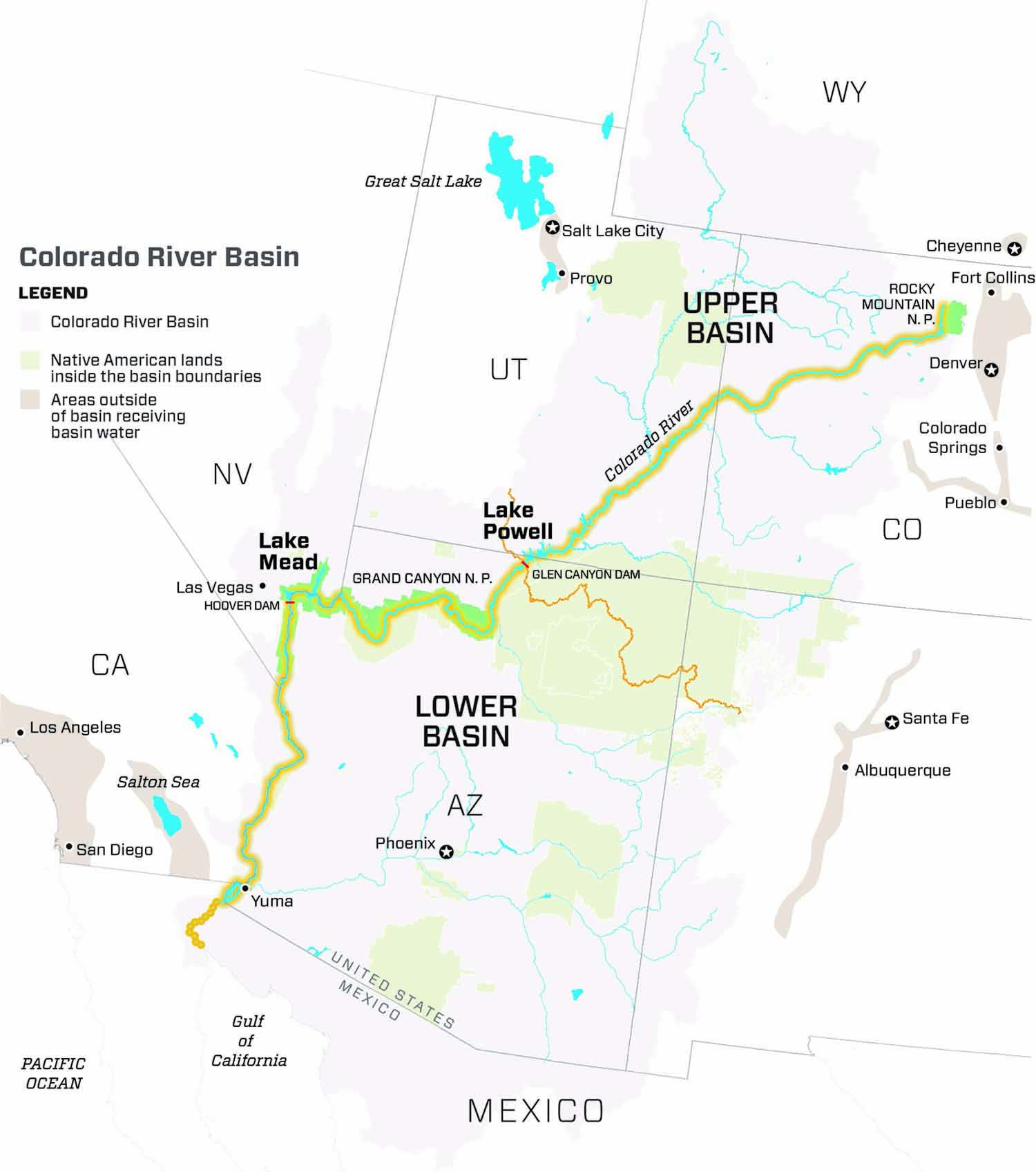
One of these rivers is the Colorado River, the sixth-longest river in the country, which serves nearly 40 million people. It’s a critical resource for the Southwest United States and Mexico.

“The lower basin and the southern half of the upper basin had been in drought for 22 years,” said Steven Fassnacht, a snow hydrologist and professor at CSU. 

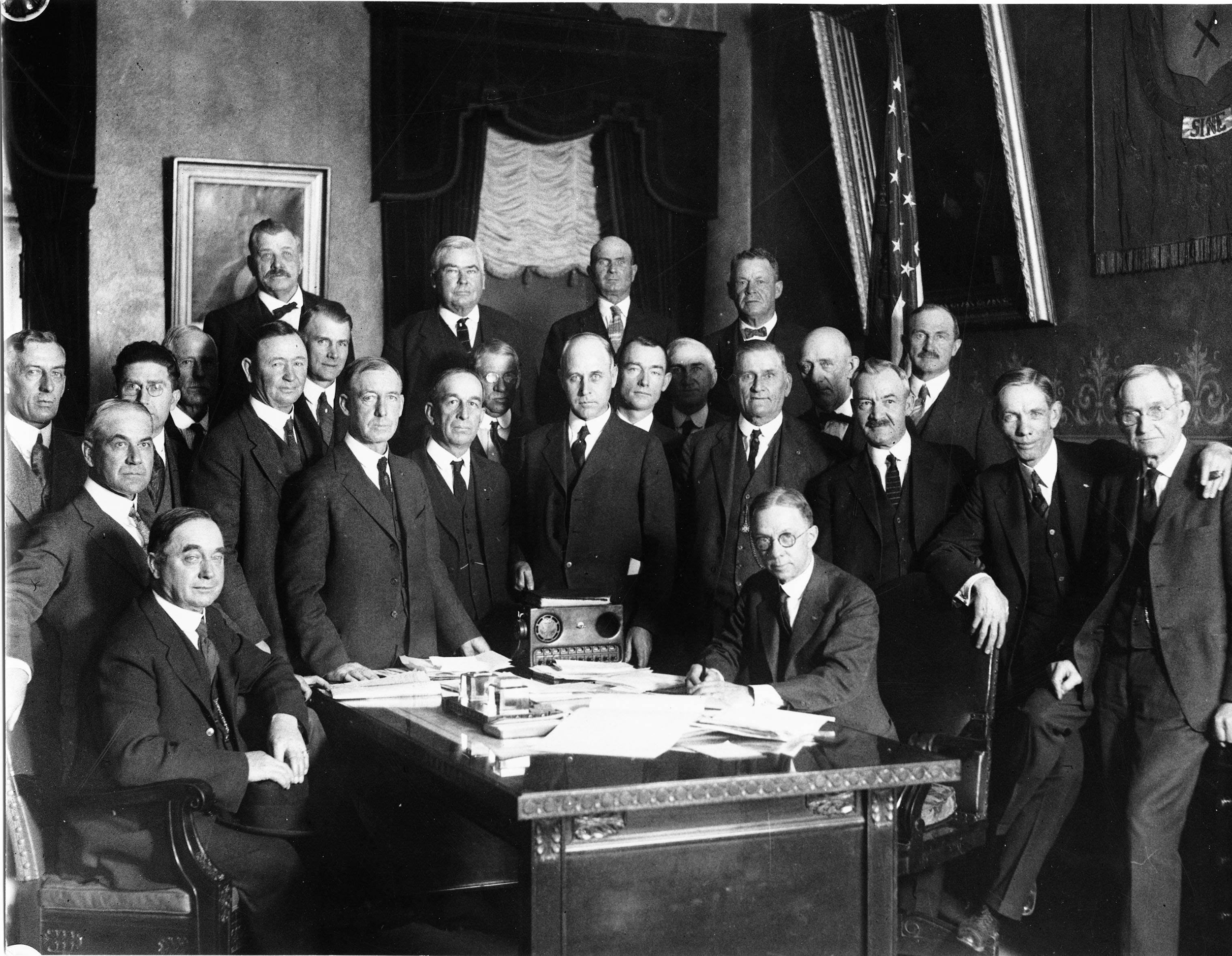
Governor Clarence J. Morley signing Colorado River compact and South Platte River compact bills, Delph Carpenter standing center. Unidentified photographer. Date 1925. Print from Denver Post. From the CSU Water Archives

 The Colorado River Compact of 1922 has been a focus, as the rights established in the compact are being renegotiated to protect the river. [ed. this statement is not correct, no renegotiation of the Compact is in the works.]

A lot of this water access is dependent on snowpack. From the flow of the Colorado River to ground water resources, snow is integral to water access, and Colorado is simply not getting the amount it used to. 

“From the mid ’30s to the mid ’70s, the snowpack was actually increasing,” Fassnacht said. “And since then, the trend has been a decrease in the snowpack.” 

This is particularly concerning when resources are used to manufacture snow for skiing or water lawns that aren’t beneficial to local ecosystems. The larger ecological impacts Colorado has been facing, like fires and excess use of resources, have to be considered. 

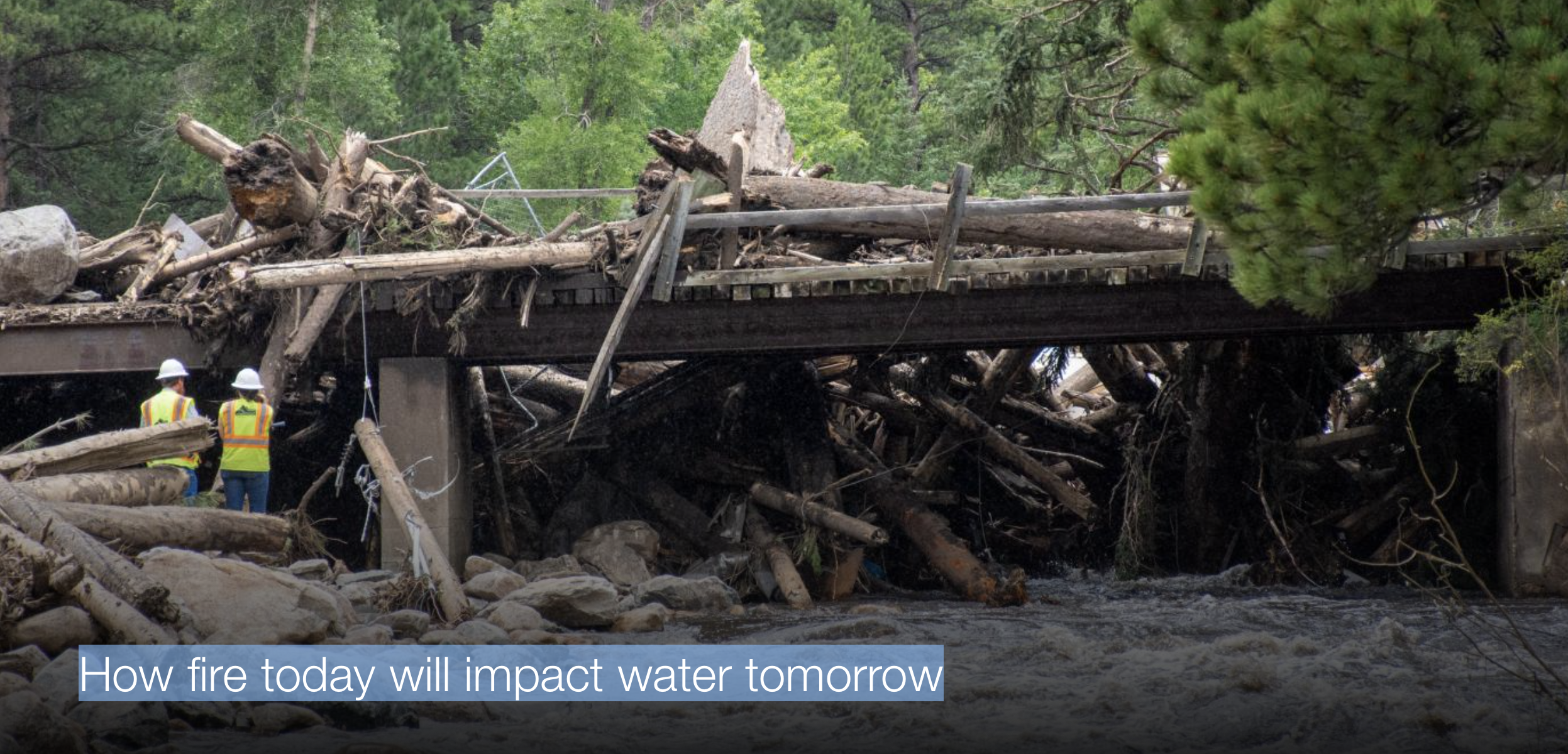
The aftermath of July 2021 floods in Poudre Canyon, west of Fort Collins. (Credit: Colorado Parks and Wildlife)

“If you burn the hillside, then you really increase the likelihood that you’re going to have rainfall causing erosion,” Fassnacht said. “You’ve got a lot of sediment that ends up in the river. Ash is terrible for the water treatment plants.”

Think of what it would mean to have ash in your drinking water or even just damaging water treatment facilities. This reality means the way we interact with water may have to drastically change in order to protect it. 

“We have the expectation that we can go to the tap and turn it on and water will be there,” Laituri said. 

Even using your sprinklers in the middle of the day or overusing natural resources by running your AC all of the time can have serious impacts on water resources and the ecosystems they serve. 

“It comes down to education too because not everyone is a watershed scientist,” said Eric Williams, president of the Watershed Science Club at Colorado State University.

Williams said lawns and developers should concern the public in regard to water use.

“I think if we want to point the finger at something, it should be all of these lawns that we have,” Fassnacht said. “I’m not saying let’s get rid of every last piece of lawn, but let’s be a lot more strategic.” 

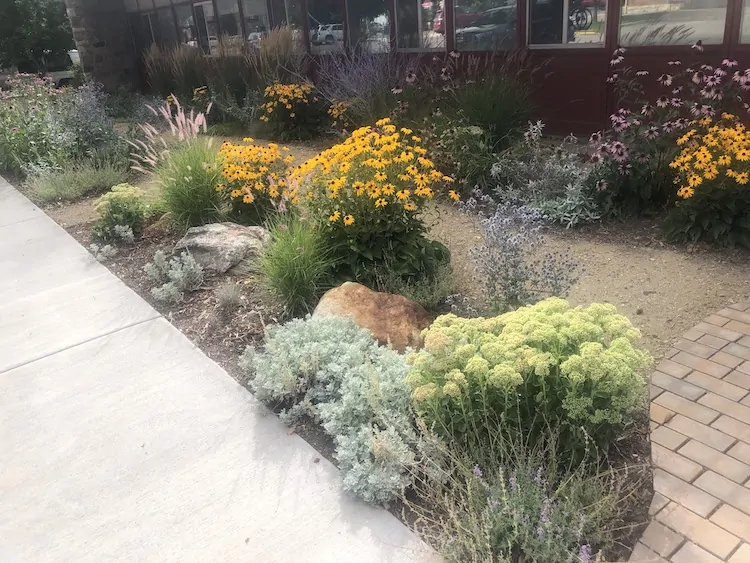
This is not a new idea. Nevada has begun to remove lawns, and the City of Fort Collins has an initiative to encourage xeriscaping, the replacement of lawn with local plants that fare better in drought conditions. Participating in these programs and educating yourself, Williams said, are some of the best ways to get involved. However, the average citizen can’t simply stop watering their lawn and expect the drought to no longer exist. 

“I don’t know if this can be really driven at the individual level,” Laituri said. “Yes, it makes us feel good to do things that we feel are contributing. … Will that be enough? It’s the larger water users that are going to have to really come to the table.”

We cannot continue to live in a world wherein wealthy citizens and major celebrities can abuse their water allocations while others go without access to clean water at all. The issue of water scarcity is an elaborate entanglement of social justice and environmental concern, meaning the resource must first be treated like a necessity before it can be allocated for luxury. 

Native American lands where tribes have water rights or potential water rights to Colorado River water. Graphic via Ten Tribes Partnership via Colorado River Water Users Association website.

“There’s 30 federally recognized (Indigenous) tribes across the lower basin that should have access to water, and many other reservations actually don’t have running water,” Laituri said. “Assuring that they have access to that resource is part of this conversation.”

Indigenous groups were not included in the Colorado River Compact, and as some of the most prominent advocates of water rights, they have a lot to contribute to the conversation.

Indigenous groups are not the only population to be considered as water rights are negotiated. Laituri emphasized new populations coming to Fort Collins should be considered. 

Laituri said if we want to conserve water, we need to consider the state’s capacity when developing. We need to consider if we can house more people and if it’s responsible to continue this growth in population. 

While the concerns around the river are complex and still not fully understood, that doesn’t mean action isn’t being taken. And it doesn’t mean there aren’t any solutions. 

“Please be curious,” Williams said. “No question is (a) dumb question.” 

Reach Ivy Secrest at life@collegian.com or on Twitter @IvySecrest

#SouthPlatteRiver Surfers Want Updated #COWaterPlan to Go With the Flow — Westword

The second wave at River Run Park, Benihanas, is a high-speed, dynamic wave that gives up great rides but can be challenging to surf for beginners. Once you have it dialed, it’s one of the best high-performance waves in the state. It features a wave shaper – a set of three adjustable plates underneath the water that allow the wave to be dialed for particular flows. At higher flows (from 250 cfs to over 750 cfs) the wave creates a large A-Frame wave that can run from waist to chest high. Under 180 cfs, the wave is usually too weak to hold a surfer. Photo credit: EndlessWaves.net

Click the link to read the article on the Westword website (Catie Cheshire). Here’s an excerpt:

People who use the South Platte River for recreation, particularly river surfers, are hoping the next iteration of the Colorado Water Plan will include stronger language about the importance of recreation on the river. An updated version of the plan originally developed in 2015 during the John Hickenlooper administration will take effect in 2023, and the public can currently weigh in on the Colorado Department of Natural Resources draft. David Riordon, an avid river surfer in Denver, says he was pleasantly surprised that the draft indicated a positive approach to recreation, but hopes there will be more specifics regarding the use of the South Platte in the final document. While Riordon recognizes that the plan must tackle big issues across the state, he points out that river surfers keep a close eye on the South Platte’s status in metro Denver when they spend time on the waves at River Run Park in Englewood. “We see what comes by us or what doesn’t come by us,” Riordon says. “That could be water. It could be people. It could be fish, it could be trash. It could be plants. All kinds of stuff comes by us.”

Currently, river surfers gauge several factors, such as the discharge from Chatfield Reservoir and the City of Englewood, to see if the water is running at enough cubic feet per second to surf, generally 180 cfs. Riordon thinks the flow of the South Platte should be controlled the way it is on the Arkansas River, where a voluntary flow management program ensures that the Arkansas will be high enough for recreation during summer months, including rafting and fishing…Although the agreement guiding the Arkansas River program is between the Colorado DNRColorado Parks and Wildlife, Trout Unlimited, the Southeastern Colorado Water Conservancy District and the Arkansas River Outfitters Association, the U.S. Bureau of Reclamation actually operates it, measuring the reservoirs and controlling the outlet gates to ensure a constant flow of at least 700 cfs from July 1 to August 15. It also maintains a 250 cfs level during fall and winter months to improve conditions for trout. To create something similar on the South Platte, Riordon, who’s president of the Colorado River Surfers Association, hopes to connect with other stakeholders to apply for a grant from the Metro Basin Roundtable to determine if the idea would be feasible…

The new iteration [of the Colorado Water Plan] includes goals for protecting and enhancing both environmental and recreational attributes of the South Platte. Compared to the first version, completed before the original 2015 Colorado Water Plan, it takes a stronger stance on social justice and ensuring equitable access to recreation on the river, [Sean Chambers] continues.

The South Platte River Basin is shaded in yellow. Source: Tom Cech, One World One Water Center, Metropolitan State University of Denver.

Navajo Dam operations update (September 8, 2022): Bumping up to 850 cfs #SanJuanRiver #ColoradoRiver #COriver #aridification

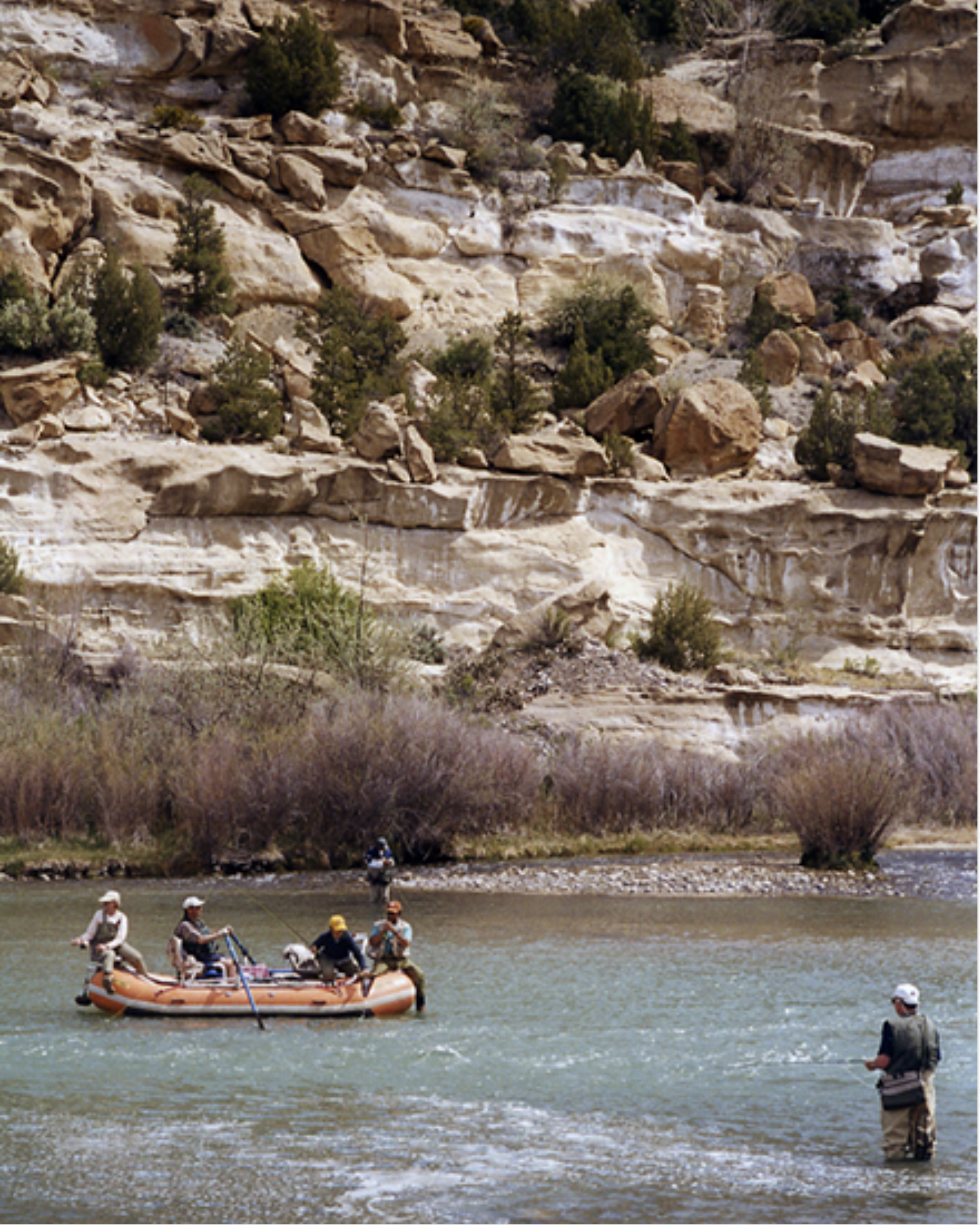
Fly fishers on the San Juan River below the Navajo Dam.U.S. Bureau of Reclamation

From email from Reclamation (Susan Novak Behery):

In response to a hot dry weather pattern and continued decreasing flows in the critical habitat reach, the Bureau of Reclamation has scheduled an increase in the release from Navajo Dam from 750 cubic feet per second (cfs) to 850 cfs for tomorrow, September 8th, at 4:00 AM. 

Releases are made for the authorized purposes of the Navajo Unit, and to attempt to maintain a target base flow through the endangered fish critical habitat reach of the San Juan River (Farmington to Lake Powell).  The San Juan River Basin Recovery Implementation Program recommends a target base flow of between 500 cfs and 1,000 cfs through the critical habitat area.  The target base flow is calculated as the weekly average of gaged flows throughout the critical habitat area from Farmington to Lake Powell.  This scheduled release change is calculated to be the minimum required to meet the minimum target baseflow.

Court rejects #Wyoming, industry challenge to Biden administration postponement of oil, gas lease sales — Western Environmental Law Center #KeepItInTheGround #ActOnClimate

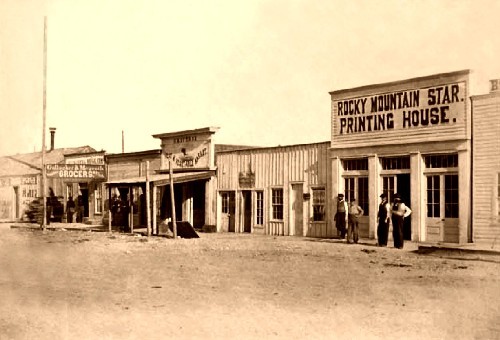
Cheyenne circa 1868 via Legends of America

Click the link to read the release on the Western Environmental Law Center website:

A federal judge in Wyoming affirmed on Friday the Biden administration’s decisions to postpone oil and gas lease sales in early 2021, holding that the federal government has broad authority to postpone sales in order to address environmental concerns.

The Wyoming court rejected across the board the arguments by industry and Wyoming, and found that the Bureau of Land Management (BLM) acted within its legal authority under the Mineral Leasing Act, National Environmental Policy Act (NEPA), and other laws when it postponed lease sales in order to ensure that it fully considered the environmental harms they could cause. The court also held that industry and Wyoming lacked standing to challenge the postponement.

“We find it reassuring that the court affirmed the Bureau of Land Management’s authority to postpone oil and gas lease sales in order to make certain they adhere to the law,” said Melissa Hornbein, senior attorney at the Western Environmental Law Center. “The judge called out as nonsensical the state and industry group’s argument that postponing a lease to ensure compliance with the National Environmental Policy Act (NEPA) requires a NEPA analysis of its own. This suggests any appeal of this decision will have an uphill battle in court.”

“We’re pleased the Judge affirmed the Department of the Interior has significant discretion to decide when to offer public oil and gas resources at lease sales. The law requires Interior to serve the public interest by analyzing and considering the environmental and social costs of leasing before holding lease sales, and that’s what they did,” said Bob LeResche, Powder River Basin Resource Council Board member from Clearmont, Wyoming. “Last year BLM initiated a comprehensive review of the federal oil and gas program, and this is the perfect time for the Department to complete their review and fully reform the federal oil and gas program to better protect taxpayers, communities, and the environment. We call on them to do so.”

In early 2021, the Biden administration issued an executive order aimed at tackling the climate crisis, which directed the Department of the Interior to temporarily pause new oil and gas leasing on federal lands and offshore waters. The pause was meant to provide the federal government an opportunity to undertake a systematic review of its oil and gas program and consider how to address its climate impacts. Before Interior could decide how to implement the executive order, it was targeted in five lawsuits filed by industry trade associations and Republican-led states. Friday’s ruling came in two of those lawsuits, brought by the State of Wyoming, Western Energy Alliance (WEA), and the Petroleum Association of Wyoming. Earthjustice and the Western Environmental Law Center (WELC) intervened on behalf of 21 groups to defend the lease sale postponements and leasing pause.

“This ruling is a victory for people who cherish public lands, and the communities whose livelihoods are intertwined with these special places,” said Ben Tettlebaum, senior staff attorney with The Wilderness Society. “The court rightly affirmed that our public lands are not up for a fire sale to the fossil fuel industry whenever it chooses. The Interior Department has the clear authority to manage these lands for conservation, wildlife, and the health and well-being of communities who rely on them.”

The Wyoming ruling follows an August 18 ruling from the Western District of Louisiana Louisiana that permanently blocked a blanket leasing pause in thirteen states (not including Wyoming) that had sued over the executive order in Louisiana District Court. The Louisiana ruling came one day after the 5th Circuit Court of Appeals overturned a preliminary injunction previously issued by the Louisiana court, finding that it lacked adequate “specificity.” Similar to the Wyoming decision, however, the August 18 Louisiana ruling appears to permit the government to postpone sales based on National Environmental Policy Act (NEPA) and other concerns.

“Given the climate crisis and its superstorms, floods, fires, and droughts, it’s essential that the President have the authority to control oil and gas leasing – or deny leasing – on mineral deposits owned by the American people,” said Erik Molvar, executive director with Western Watersheds Project. “Friday’s ruling puts the federal government back in the driver’s seat for managing federal mineral deposits and paves the way for keeping oil and gas in the ground.”

“BLM has never adequately considered the impacts of its fossil fuel leasing program on climate,” said Peter Hart, attorney at Wilderness Workshop. “Courts across the country have found BLM’s leasing decisions illegal based on this failure. This opinion confirms that BLM doesn’t have to continue selling leases that don’t comply with law. Instead, the agency should STOP and consider the real impacts of more leasing. After that, we may all agree: ‘it isn’t worth it!’”

“The climate induced disasters keep stacking up, from mega droughts and catastrophic floods to wildfires and unhealthy air. Business as usual is not working,” said Anne Hedges, director of policy for the Montana Environmental Information Center. “The President simply must have the ability to take the time necessary to find a better path forward. People’s lives, livelihoods and communities depend on getting this right. This pause is a small step in the right direction.”

“The court reaffirmed the federal government’s long-standing obligation to protect the environment and public interest, not just sell off lands when demanded by oil and gas companies,” said Michael Freeman, senior attorney with Earthjustice’s Rocky Mountain Office. “We hope the Biden administration will exercise that authority to limit new oil and gas leasing and avoid the worst impacts of the climate crisis.”

“This welcome decision affirms that the Biden administration has wide latitude to rein in federal fossil fuels,” said Taylor McKinnon with the Center for Biological Diversity. “Allowing any new fossil fuel projects, including oil and gas leasing, is flatly incompatible with avoiding catastrophic climate change. The administration still has much work to do to bring federal fossil fuel production to a swift and orderly end.”

“The law is clear, the oil and gas industry doesn’t have a right to frack public lands,” said Jeremy Nichols, WildEarth Guardians’ Climate and Energy Program Director. “And given our climate crisis, it’s more critical than ever to ensure the industry is not fracking public lands.”

“This decision shows that the Department of Interior is not beholden to the fossil fuel industry, as many states and industry groups have alleged,” said Adam Carlesco, staff attorney with Food & Water Watch. “Given this understanding of its legal authority, Interior must move towards a future where public lands are protected for a variety of uses – not simply used as sacrifice zones for a polluting industry that is exacerbating our climate crisis.”

“This decision marks a step forward in ensuring our public lands are part of the climate solution, not the problem,” said Dan Ritzman, Director of the Sierra Club’s Lands Water Wildlife Campaign. “At a time when we need to be rapidly transitioning away from dirty oil and gas to meet our climate commitments and avoid the worst of the climate crisis, the last thing we need is to sell off even more of our treasured public lands to the fossil fuel industry.”

Earthjustice and the Western Environmental Law Center represent a coalition of conservation and citizen groups in the Wyoming litigation. Earthjustice represents Conservation Colorado, Friends of the Earth, Great Old Broads for Wilderness, National Parks Conservation Association, Sierra Club, Southern Utah Wilderness Alliance, The Wilderness Society, Valley Organic Growers Association, Western Colorado Alliance, Western Watersheds Project, and Wilderness Workshop. The Western Environmental Law Center represents Center for Biological Diversity, Citizens for a Healthy Community, Diné Citizens Against Ruining Our Environment, Earthworks, Food & Water Watch, Indian People’s Action, Montana Environmental Information Center, Powder River Basin Resource Council, Western Organization of Resource Councils, and WildEarth Guardians.

Contacts:

Melissa Hornbein, Western Environmental Law Center, 406-471-3173, hornbein@westernlaw.org

Perry Wheeler, Earthjustice, 202-792-6211, pwheeler@earthjustice.org

Taylor McKinnon, Center for Biological Diversity, 801-300-2414, tmckinnon@biologicaldiversity.org

Kerry Leslie, The Wilderness Society, 415-398-1484, kerry_leslie@tws.org

Anne Hedges, Montana Environmental Information Center, 406-443-2520, ahedges@meic.org

Shannon Anderson, Powder River Basin Resource Council, 307-763-0995, sanderson@powderriverbasin.org

Jeremy Nichols, WildEarth Guardians, 303-437-7663, jnichols@wildearthguardians.org

Medhini Kumar, Sierra Club, medhini.kumar@sierraclub.org

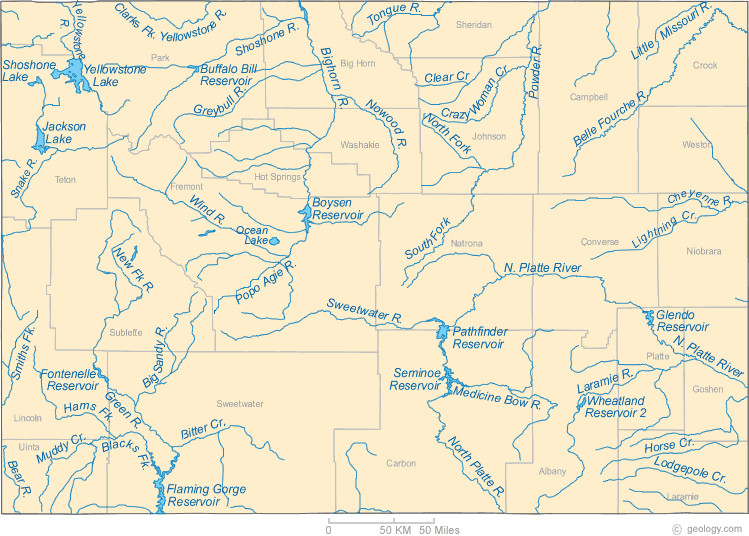
Wyoming rivers map via Geology.com

World Meteorological Organization #AirQuality and #Climate Bulletin highlights impact of #wildfire #ActOnClimate #KeepItInTheGround

Photo credit: World Meteorological Organization

Click the link to read the bulletin on the WMO website:

Increasing risk of “climate penalty” from pollution and climate change

An anticipated rise in the frequency, intensity and duration of heatwaves and an associated increase in wildfires this century is likely to worsen air quality, harming human health and ecosystems. The interaction between pollution and climate change will impose an additional “climate penalty” for hundreds of millions of people, according to a new report from the World Meteorological Organization (WMO).

The annual WMO Air Quality and Climate Bulletin reports on the state of air quality and its close interlinkages with climate change. The bulletin explores a range of possible air quality outcomes under high and low greenhouse gas emission scenarios.

The WMO Air Quality and Climate Bulletin 2022 focuses in particular on the impact of wildfire smoke in 2021. As in 2020, hot and dry conditions exacerbated the spread of wildfires across western North America and Siberia, producing widespread increases in particulate small matter ( PM2.5) levels harmful to health.

“As the globe warms, wildfires and associated air pollution are expected to increase, even under a low emissions scenario. In addition to human health impacts, this will also affect ecosystems as air pollutants settle from the atmosphere to Earth’s surface,” says WMO Secretary-General Prof. Petteri Taalas.

“We have seen this in the heatwaves in Europe and China this year when stable high atmospheric conditions, sunlight and low wind speeds were conducive to high pollution levels,” said Prof. Taalas.

“This is a foretaste of the future because we expect a further increase in the frequency, intensity and duration of heatwaves, which could lead to even worse air quality, a phenomenon known as the “climate penalty,” he said.

The “climate penalty” refers specifically to the climate change amplification effect on ground-level ozone production, which negatively impacts the air people breathe. The regions with the strongest projected climate penalty – mainly in Asia – are home to roughly one quarter of the world’s population. Climate change could exacerbate surface ozone pollution episodes, leading to detrimental health impacts for hundreds of millions of people.

The Air Quality and Climate Bulletin, the second in an annual series, and an accompanying animation on atmospheric deposition was published ahead of International Day of Clean Air for blue skies on 7 September. The theme of this year’s event, spearheaded by the UN Environment Programme, is The Air We Share, focusing on the transboundary nature of air pollution and stressing the need for collective action.

The bulletin is based on input from experts in WMO’s Global Atmosphere Watch network which monitors air quality and greenhouse gas concentrations and so can quantify the efficacy of the policies designed to limit climate change and improve air quality.

Air quality and climate are interconnected because the chemical species that lead to a degradation in air quality are normally co-emitted with greenhouse gases. Thus, changes in one inevitably cause changes in the other. The combustion of fossil fuels (a major source of carbon dioxide (CO2)) also emits nitrogen oxide (NO), which can react with sunlight to lead to the formation of ozone and nitrate aerosols.

Air quality in turn affects ecosystem health via atmospheric deposition (as air pollutants settle from the atmosphere to Earth’s surface).  Deposition of nitrogen, sulfur and ozone can negatively affect the services provided by natural ecosystems such as clean water, biodiversity, and carbon storage, and can impact crop yields in agricultural systems.

Wildfires in 2021

The European Union’s Copernicus Atmosphere Monitoring Service measures global particulate matter. PM2.5 (i.e. particulate matter with a diameter of 2.5 micrometers or smaller) is a severe health hazard if inhaled over long periods of time. Sources include emissions from fossil fuel combustion, wildfires and wind-blown desert dust.

Intense wildfires generated anomalously high PM2.5 concentrations in Siberia and Canada and the western USA in July and August 2021. PM2.5 concentrations in eastern Siberia reached levels not observed before, driven mainly by increasing high temperatures and dry soil conditions.

The annual total estimated emissions in Western North America ranked amongst the top five years of the period 2003 to 2021, with PM2.5 concentrations well above limits recommended by the World Health Organization.

At the global scale, observations of the annual total burned area show a downward trend over the last two decades as a result of decreasing numbers of fires in savannas and grasslands (2021 WMO Aerosol Bulletin ). However, at continental scales, some regions are experiencing increasing trends, including parts of western North America, the Amazon and Australia.

Future scenarios

The Intergovernmental Panel on Climate Change (IPCC) Sixth Assessment Report (AR6) includes scenarios on the evolution of air quality as temperatures increase in the 21st century. It has assessed that the probability of catastrophic wildfire events –like those observed over central Chile in 2017, Australia 2019 or the western United States in 2020 and 2021– is likely to increase by 40-60% by the end of this century under a high emission scenario, and by 30-50% under a low emission scenario.

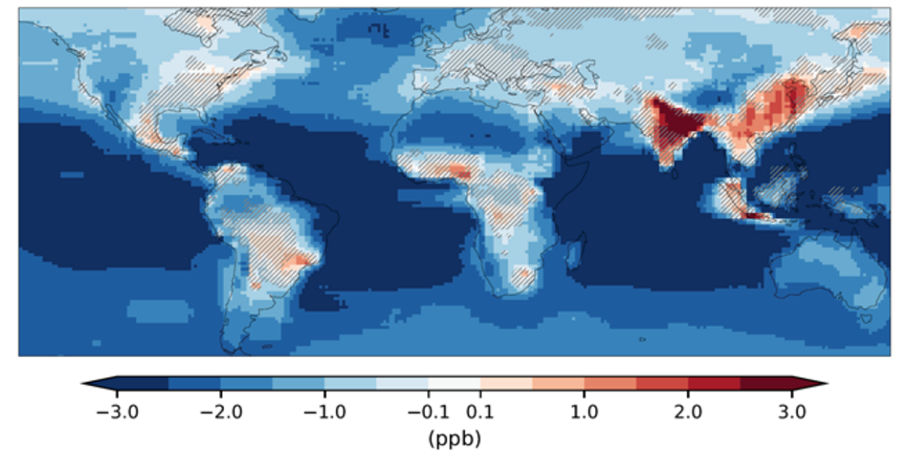
If greenhouse gas emissions remain high, such that global temperatures rise by 3° C from preindustrial levels by the second half of the 21st century, surface ozone levels are expected to increase across heavily polluted areas, particularly in Asia. This includes a 20% increase  across Pakistan, northern India and Bangladesh, and 10% across eastern China.  Most of the ozone increase will be due to an increase in emissions from fossil fuel combustion, but roughly a fifth of this increase will be due to climate change, most likely realized through increased heatwaves, which amplify air pollution episodes. Therefore heatwaves, which are becoming increasingly common due to climate change, are likely to continue leading to a degradation in air quality.

Projected changes in surface ozone levels due to climate change alone in the late part of the 21st Century (2055-2081), if average global surface temperature rises by 3.0 °C above the average temperature of the late 19th Century (1850-1900).  Credit: WMO

A worldwide carbon neutrality emissions scenario would limit the future occurrence of extreme ozone air pollution episodes.  This is because efforts to mitigate climate change by eliminating the burning of fossil fuels (carbon-based) will also eliminate most human-caused emissions of ozone precursor gases (particularly nitrogen oxides (NOx), Volatile Organic Compounds and methane). 

Particulate matter, commonly referred to as aerosols, have complex characteristics which can either cool or warm the atmosphere. High aerosol amounts – and thus poor air quality – can cool the atmosphere by reflecting sunlight back to space, or by absorbing sunlight in the atmosphere so that it never reaches the ground.

The IPCC suggests that the low-carbon scenario will be associated with a small, short-term warming prior to temperature decreases. This is because the effects of reducing aerosol particles, i.e. less sunlight reflected into space, will be felt first, while the temperature stabilization in response to reductions in carbon dioxide emissions will take longer.  However, natural aerosol emissions (e.g., dust, wildfire smoke) are likely to increase in a warmer, drier environment due to desertification and drought conditions, and may cancel out some of the effects of the reductions in aerosols related to human activities.

A future world that follows a low-carbon emissions scenario would also benefit from reduced deposition of nitrogen and sulfur compounds from the atmosphere to the Earth’s surface, where they can damage ecosystems.  The response of air quality and ecosystem health to proposed future emissions reductions will be monitored by WMO stations around the world, which can quantify the efficacy of the policies designed to limit climate change and improve air quality. WMO will therefore continue to work with a wide range of partners including the World Health Organization and the EU’s Copernicus Atmospheric Monitoring Service to monitor and mitigate the impacts.

The World Meteorological Organization is the United Nations System’s authoritative voice on Weather, Climate and Water

For further information contact: Clare Nullis, WMO media officer, cnullis@wmo.int. Tel 41-79-7091397

#ColoradoRiver ‘stalemate’ continues — The #Gunnison Country Times #COriver #aridifcation

Click the link to read the article on the Gunnison Country Times website (Alan Wartes). Here’s an excerpt:

On Aug. 16, the Bureau of Reclamation (BOR) issued a press release restating the urgency of the situation and laying out actions it will take in coming months to protect water levels in Lake Mead and Lake Powell.

“Every sector in every state has a responsibility to ensure that water is used with maximum efficiency. In order to avoid a catastrophic collapse of the Colorado River System and a future of uncertainty and conflict, water use in the Basin must be reduced,” Assistant Secretary for Water and Science Tanya Trujillo said. “The Interior Department is employing prompt and responsive actions and investments to ensure the entire Colorado River Basin can function and support all who rely on it. We are grateful for the hardworking public servants who have dedicated their lives to this work, and who are passionate about the long-term sustainability of Basin states, Tribes, and communities.”

“They said, ‘Well, we appreciate all of the efforts, and here’s what the August 24-month study shows, and here’s what we’re going to do for the next year, which is basically consistent with the 2007 guidelines with a modification,’” Upper Gunnison River Water Conservancy District General Counsel John McClow said.

That modification from the already existing agreement, McClow said, was to hold 480,000 acre feet of water back in Lake Powell to protect the critical elevation of 3,525 feet, but to treat it as if it went to Lake Mead for the purpose of water accounting.

“So, nothing new,” McClow said. “But they said they were still looking to the states to come up with an answer. Basically, I think it was unrealistic to expect the states to deliver a plan to cut the river use by 2 to 4 million acre feet in 60 days. It just wasn’t feasible.”

Brad Udall: Here’s the latest version of my 4-Panel plot thru Water Year (Oct-Sep) of 2021 of the Colorado River big reservoirs, natural flows, precipitation, and temperature. Data (PRISM) goes back or 1906 (or 1935 for reservoirs.) This updates previous work with @GreatLakesPeck. https://twitter.com/bradudall/status/1449828004230664195

The problem remains that aridification in the West has meant significantly less available water in the system over the past 20 years. That is compounded by what some have called a “structural imbalance” in how the water is used between the upper and lower basins. In 2021, for instance, the Lower Basin states consumed over 10 million acre-feet of water from the Colorado River, while the Upper Basin states combined consumed 3.5 million acre-feet.

Pipe dream or possible? Experts weigh in on idea of sending Mississippi River water to West — The Palm Springs Desert Sun #ColoradoRiver #COriver #LakePowell #aridification

Map of the Mississippi River Basin. Made using USGS data. By Shannon1 – Own work, CC BY-SA 4.0, https://commons.wikimedia.org/w/index.php?curid=47308146

Click the link to read the article on the Palm Springs Desert Sun website (Janet Wilson). Here’s an excerpt:

This summer, as seven states and Mexico push to meet a Tuesday [August 16, 2022] deadline to agree on plans to shore up the Colorado River and its shriveling reservoirs, retired engineer Don Siefkes of San Leandro, California, wrote a letter to The Desert Sun with what he said was a solution to the West’s water woes: build an aqueduct from the Old River Control Structure to Lake Powell, 1,489 miles west, to refill the Colorado River system with Mississippi River water. 

“Citizens of Louisiana and Mississippi south of the Old River Control Structure don’t need all that water. All it does is cause flooding and massive tax expenditures to repair and strengthen dikes,” wrote Siefkes.”New Orleans has a problem with that much water anyway, so let’s divert 250,000 gallons/second to Lake Powell, which currently has a shortage of 5.5 trillion gallons. This would take 254 days to fill.”

[…]

Engineers said the pipeline idea is technically feasible. But water expertssaid it would likely take at least 30 years to clear legal hurdles to such a plan. And biologists and environmental attorneys said New Orleans and the Louisiana coast, along with the interior swamplands, need every drop of muddy Mississippi water. The massive river, with tributaries from Montana to Ohio, is a national artery for shipping goods out to sea. And contrary to Siefkes’ claims, experts said, the silty river flows provide sediment critical to shore up the rapidly disappearing Louisiana coast and barrier islands chewed to bits by hurricanes and sea rise. Scientists estimate a football field’s worth of Louisiana coast is lost every 60 to 90 minutes. Major projects to restore the coast and save brown pelicans and other endangered species are now underway, and Mississippi sediment delivery is at the heart of them…

Nonetheless, Siefkes’ trans-basin pipeline proposal went viral, receiving nearly half a million views. It’s one of dozens of letters the paper has received proposing or vehemently opposing schemes to fix the crashing Colorado River system, which provides water to nearly 40 million people and farms in seven western states. Fueled by Google and other search engines, more than 3.2 million people have read the letters, an unprecedented number for the regional publication’s opinion content…

The bigger obstacles are fiscal, legal, environmental and most of all, political.

“The engineering is feasible. Absolutely. You could build a pipeline from the Mississippi or Missouri Rivers. Would it be expensive? Yes. Do we have the political will? Absolutely not,” said Meena Westford, executive director of Colorado River resource policy for the Metropolitan Water District of Southern California. “I think that societally, we want to be more flexible. We want to have more sustainable infrastructure. So moving water that far away to supplement the Colorado River, I don’t think is viable. But it’s doable. You could do it.”

In fact, she and others noted, many such ideas have been studied since the 1940s. Most recently, in 2012, the U.S. Bureau of Reclamation produced a report laying out a potentially grim future for the Colorado River, and had experts evaluate 14 big ideas commonly touted as potential solutions. The concepts fell into a few large categories: pipe Mississippi or Missouri River water to the eastern side of the Rockies or to Lake Powell on the Arizona-Utah border, bring icebergs in bags, on container ships or via trucks to Southern California, pump water from the Columbia River in the Pacific Northwest to California via a subterranean pipeline on the floor of the Pacific Ocean, or replenish the headwaters of the Green River, the main stem of the Colorado River, with water from tributaries.

Missouri River Reuse Project via The New York Times

Dry: A Weekly Western #Drought Digest — August 30, 2022 — Circle of Blue

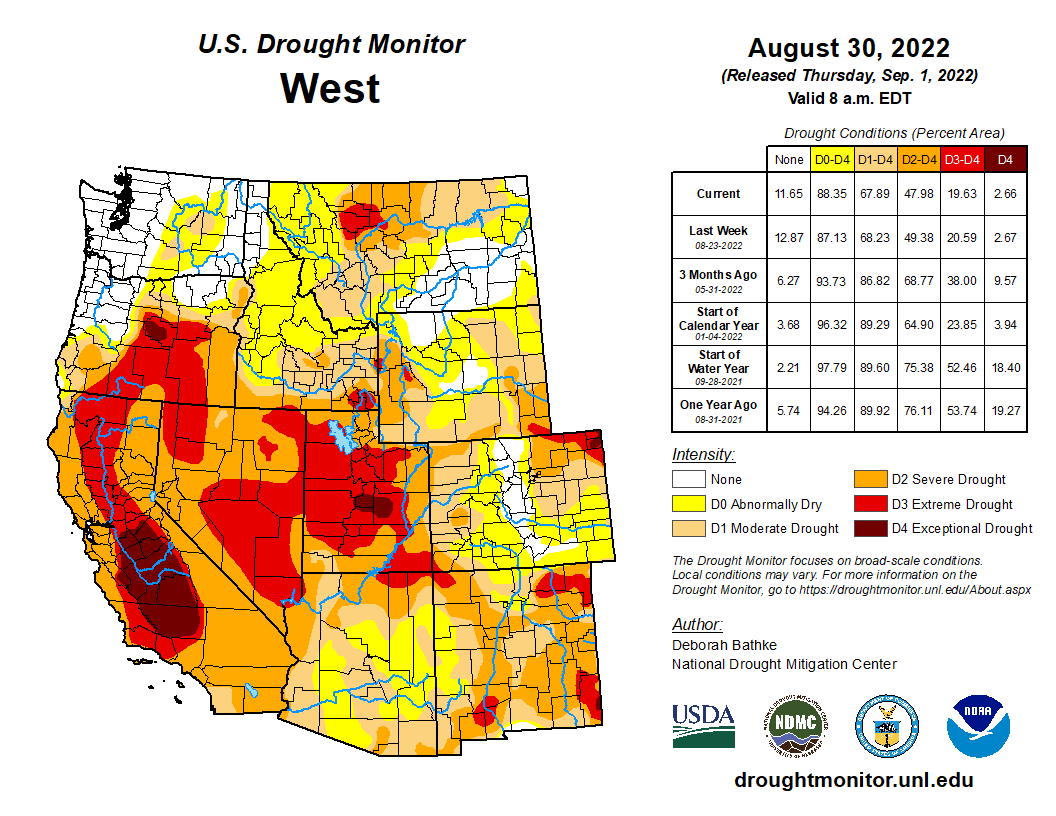
US Drought Monitor map September 1, 2022.

Click the link to read the article on the Circle of Blue website (Delaney Nelson):

The American West is experiencing its most severe drought in 1,200 years. The consequences are far-reaching and long lasting. Forests become tinder boxes. Hydropower is weakened. Human health and wildlife are threatened.  Each week, Circle of Blue breaks down the biggest stories, the latest data, and the most promising solutions to the United States’ most urgent water crisis. Read Dry: A Weekly Western Drought Digest, your go-to news brief on the drying American West.

Top News

– As of August 23, 39 percent of the U.S. and Puerto Rico are in drought, down four  percentage points in the last month. Portions of Texas and the Southwest witnessed extraordinary downpours in recent weeks that relieved some drought stress but also caused severe flooding.
– Utah’s proposed Lake Powell pipeline struggles to make progress amid declining water levels and drought conditions.

– Data centers around the country face scrutiny for their substantial water use.

– California becomes first state to install solar panels over canals in an effort to combat drought.

The Numbers

– A single year of drought can reduce vegetation growth by more than 80 percent, researchers found. To gather their data, ecologists created artificial droughts at 100 research sites globally. While results of the study varied, some plots of land saw “catastrophic loss” in vegetation, according to Science Magazine

– As the fall migration season approaches, birds traveling along the Northern California mountains to Central America will face dried up wetlands and shallow water. Migratory birds will have to travel further to find smaller amounts of water, which will likely increase the spread of diseases among the birds, the Enterprise-Record reports. The Centers for Disease Control reported 230,900 birds are affected by the current avian flu outbreak.

– The Paluxy River in the Texas Dinosaur Valley State Park is almost completely dried up – revealing dinosaur tracks from 113 million years ago. 

Status of Reservoirs/Colorado River

– A group of seven water utilities across the Colorado River basin pledged last week to reduce their water consumption and increase water reuse and recycling programs. In a letter to the Bureau of Reclamation, officials representing utilities in Colorado, California and Nevada committed to implementing indoor and outdoor water-efficient programs, reducing the quantity of non-functional turf grass and installing drought- and climate-resilient landscaping. The utilities vowed to collaborate with other users in the basin, however their conservation efforts are not likely to make a considerable dent in the river’s water scarcity crisis, KUNC Colorado reports.

– The declining water levels of Lake Powell, which Reclamation predicts could fall to the point of dead pool in the coming years, have had major implications for ecosystems, business owners and residents throughout the region. Without action to save the Colorado River and its reservoirs, Lake Powell is “heading toward catastrophe,” Zak Podmore writes for the Salt Lake Tribune.

How recent legislation will help Western Slope farmers — The #Colorado Farm and Food Alliance

U.S. Capitol building. © Devan King/The Nature Conservancy

Click the link to read the guest column running on The Grand Junction Daily Sentinel website (Mark Waltermire):

Colorado’s farms are at peak production, market season is in full-swing and the season’s bounty is being served up on tables across the state. In this hot weather, as we enjoy Colorado’s local food cornucopia, we should think of the farmers and farmworkers up early and in the fields, working to feed the nation. Farming is hard work, which many people appreciate.

The hard work of farming includes much more than just the field work. It includes building and maintaining ditches to get water to our crops and roads to get those crops to market. So when Congress passed and President Biden signed the infrastructure law this year, I saw it as a boost to my ability to turn hard work in my fields into a living that works for me.

The infrastructure act also makes progress in addressing climate change. Everyone knows drought is a real threat to agriculture, but so is heat. Heat hurts our crops, it hurts our animals and it can be deadly for those who have to work outside. Using this investment to help prepare for a climate-smart and adapted future will be good for farming, too.

Climate change is here, and farming, our food systems and the supply chain are all especially vulnerable. Unless we get ready now, the hurt will only be worse down the road, which is why another new law, the recently enacted Inflation Reduction Act (IRA), also makes good sense.

For agriculture, rural communities and conservation, the IRA is a big win for several reasons. It helps make our farms and communities more resilient. It prioritizes funding to restore and protect watershed and public land health, for instance, and to improve soil health.

The IRA also takes huge steps in reducing the nation’s greenhouse gas pollution. While we need to prepare for the heating that is here and to come by adapting our systems to be more resilient (and the new law begins to do that), we really need to stop making the problem worse.

This legislation does that as well, by increasing the uptake of more renewable energy and supporting rural electric co-ops in that transition. And it accomplishes an important third component, too, just as crucial as these first two. By focusing on improving land health and conservation practices, the IRA can help us better manage carbon by encouraging practices that return and store carbon in the ground, in soils and in natural systems.

The potential here cannot be overstated for western Colorado, and rural communities in particular, should seek to actively lead in this effort to center land-use and agriculture as climate action. For example, an analysis by the Colorado Farm and Food Alliance has found that the ability to store carbon in soil on farmland just within five counties on the Western Slope could be increased by more than ten-fold by shifting to incorporate more cover-cropping.

Relatively small investments in these practices will make a real difference. Resources that help farmers strengthen their resiliency and improve techniques — resources that are increased under the IRA — can be a real boost. The future of farming, even our survivability in the American Southwest, means we need to get this right. Let’s make sure the funding available for infrastructure and in bolstering healthy natural systems and the ecological services they provide finds its way to our farms and ranches.

By investing in rural communities through resources dedicated to restoring land, watershed, and soil health — as well as supporting more home-grown renewable power — we can all help in bringing real benefit to our communities as we address the climate crisis. Western Colorado can and should be a global leader in rural climate action. We should welcome and seize the opportunity the new Inflation Reduction Act brings.

Mark Waltermire owns and operates Thistle Whistle Farm outside of Hotchkiss and is active with the Valley Organic Growers Association, Colorado Farm and Food Alliance and other projects that promote secure, equitable and resilient farms and local food systems.

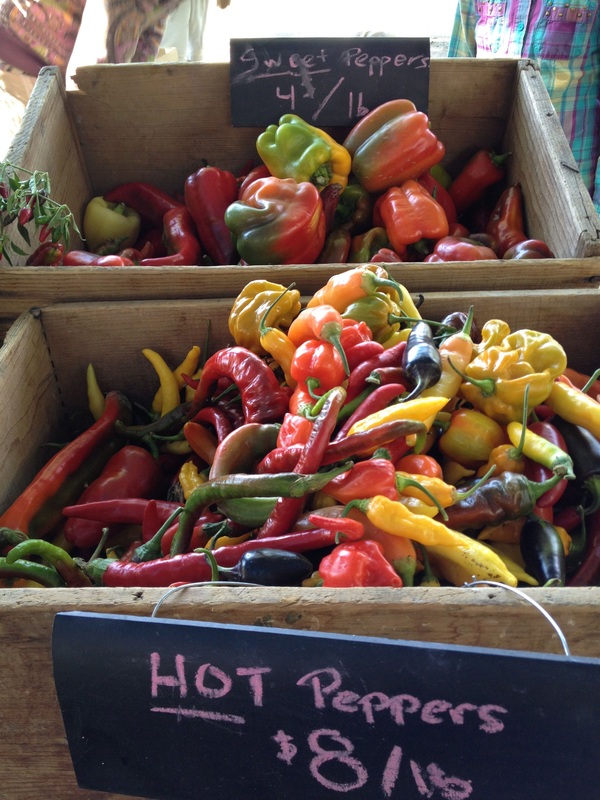
the Food grown, Beautiful, Delicious, Odd. Photo credit: Thistle Whistle Farm

#ClimateChange Is Ravaging the #ColoradoRiver. There’s a Model to Avert the Worst — The New York Times #COriver #aridification #ActOnClimate #KeepItInTheGround

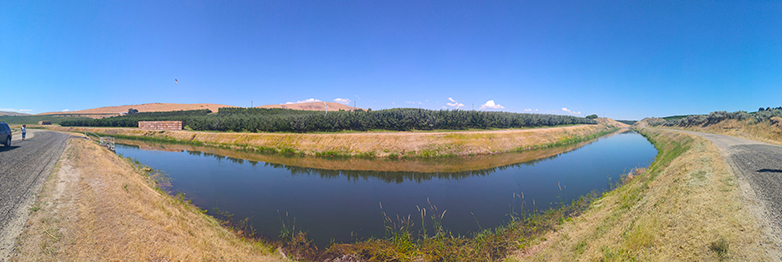
This irrigation canal helps support the Yakima Basin’s $4.5 billion agricultural industry. Photo credit: Washington Department of Ecology

Click the link to read the article on The New York Times website (Henry Fountain). Here’s an excerpt:

…a decade ago, the water managers of the Yakima Basin tried something different. Tired of spending more time in courtrooms than at conference tables, and faced with studies showing the situation would only get worse, they hashed out a plan to manage the Yakima River and its tributaries for the next 30 years to ensure a stable supply of water. The circumstances aren’t completely parallel, but some experts on Western water point to the Yakima plan as a model for the kind of cooperative effort that needs to happen on the Colorado right now…

Representative Melanie Stansbury, a New Mexico Democrat who worked on the Yakima Basin and other water issues for years before being elected to Congress in 2021, said the plan “represents the best of a collaborative, science-based process.”

[…]

Climate change and recurring drought had wreaked havoc with the water supply for irrigation managers and farmers in the Yakima Basin, one of the most productive agricultural regions in the country. Conservationists were concerned that habitats were drying up, threatening species. Old dams built to store water had blocked the passage of fish, all but eliminating the trout and salmon that the Indigenous Yakama Nation had harvested for centuries. In droughts, water allocations to many farms were cut. Years of court fights had left everyone dissatisfied, and a proposal in 2008 for a costly new dam and reservoir that favored some groups over others had not helped. Ron Van Gundy, manager of the Roza Irrigation District at the southern end of the basin, went to see Phil Rigdon, director of the Yakama Nation’s natural resources division. The two had been battling for years, largely through lawyers. They both opposed the dam, but for different reasons…

The two met, and eventually other stakeholders, joined them in developing a plan for better management of the river. After several years of give-and-take, the result was the Yakima Basin Integrated Plan, a blueprint for ensuring a reliable and resilient water supply for farmers, municipalities, natural habitats and fish, even in the face of continued warming and potentially more droughts. A decade into the plan, there are tens of millions of dollars’ worth of projects up and down the river designed to achieve those goals, including canal lining and other improvements in irrigation efficiency, increasing reservoir storage, and removing barriers to fish.

Created by Imgur user Fejetlenfej , a geographer and GIS analyst with a ‘lifelong passion for beautiful maps,’ it highlights the massive expanse of river basins across the country – in particular, those which feed the Mississippi River, in pink.

Hedging our #water bets — @BigPivots

Las Vegas Lake Mead intake schematic, courtesy SNWA.

Click the link to read the article on the Big Pivots website (Allen Best):

Las Vegas in 2007 bet on declining reservoir levels in the Colorado River. The bet is now paying off. Municipal water providers in Colorado have started tightening the spigot for landscaping. That move is also wise — but overdue?

Lake Mead’s receding waters have exposed sunken boats, dead bodies and more. But the wisdom of a bet placed in 2005 by Las Vegas has also been revealed.

The Southern Nevada Water Authority draws 90% of its water for a population of 2.3 million from Lake Mead. It had two intake pipes, one higher and one lower in the reservoir.  Reservoir levels have dropped precipitously since 2002 when the Colorado River delivered just 3.8 million acre-feet of flows. The 1922 compact among Colorado and the seven other basin states assumes more than 20 million in annual flows.

Las Vegas bored a third tunnel, this one coming up from the bottom of the reservoir. The far-sightedness of that and other investments totaling $1.3 billion was revealed in April when reservoir levels dipped below what was needed for the highest intake pipe. Depending upon the Colorado River, Las Vegas had wisely hedged its bet.

The front of the Steamboat Springs municipal building has been xeriscaped to consume less water. Top photo, Lake Mead floats boats below the now-infamous bathtub ring in December 2021. Photos/+Allen Best

Drought combined with the aridification produced by warming temperatures have upset the cart in the Colorado River Basin. Apples are rolling everywhere. The easy, visual way of telling that story is of the widening bathtub rings in the giant reservoirs of the Colorado River. Mead and Powell are respectively 73% and 74% empty.

But the most important story will be in how demand gets cut in Colorado and the six other basin states. The onus is on California, Arizona, and Nevada —particularly California, which for years into the drought to slurp too generously given the emerging climate realities.

Colorado and other upper basin states have lived within their compact-apportioned means. But here, too, changes are underway, because the water just is not there. Farms and ranches, which still consume upward 85% of water in Colorado, will have to be part of the story. So will the still- growing towns and cities.

Changes can be seen most prominently in those places on the edge, including Denver’s fast-growing suburbs of Aurora and Castle Rock. They’re redefining acceptable landscapes in the semi-arid West. Sprawling lawns resembling those of the rain-soaked eastern states are on their way out.

In Aurora, Colorado’s third largest city at nearly 400,000 residents, the city council last week approved regulations sharply limiting turf grasses on golf courses and new homes. Residential lots will be limited to 45% or 500 square feet of the yard, whichever is less, for grass. Within that limit are other limits. No more Kentucky blue-grass. Other varieties use less water

Elected officials in Castle Rock, a city of 80,000 people that expects to fully fill out its britches at 142,000 people, in early September review similar regulations. “Coloradoscape” is what Castle Rock calls its recommended landscapes. For homes, 500 square feet is tiny, smaller than some bedrooms. For new yards, it will be the max. Mark Marlow, director of Castle Rock Water, says city leaders began meeting with stakeholders, including homebuilders, in November.

Marina at Lake Mead. Photo credit: Allen Best/Big Pivots

Facing ‘dead pool’ risk, #California braces for painful #water cuts from #ColoradoRiver — The Los Angeles Times #COriver #aridification #LakeMead #LakePowell

Brad Udall: Here’s the latest version of my 4-Panel plot thru Water Year (Oct-Sep) of 2021 of the Colorado River big reservoirs, natural flows, precipitation, and temperature. Data (PRISM) goes back or 1906 (or 1935 for reservoirs.) This updates previous work with @GreatLakesPeck. https://twitter.com/bradudall/status/1449828004230664195

Click the link to read the article on The Los Angeles Times website (Ian James). Click through for the photo gallery, here’s an excerpt:

Managers of districts that rely on the Colorado River have been talking about how much water they may forgo. So far, they haven’t publicly revealed how much they may commit to shore up the declining levels of Lake Mead, the nation’s largest reservoir.But state and local water officials say there is widespread agreement on the need to reduce water use next year to address the shortfall. Without major reductions, the latest federal projections show growing risks of Lake Mead and Lake Powell approaching “dead pool” levels, where water would no longer pass downstream through the dams. Though the states haven’t agreed on how to meet federal officials’ goal of drastically reducing the annual water take by 2 million to 4 million acre-feet, the looming risks of near-empty reservoirs are prompting more talks among those who lead water agencies…

Though [Tanya] Trujillo and [Camille] Touton have stressed their interest in collaborating on solutions, they have also laid out plans that could bring additional federal leverage to bear. Their plan to reexamine and possibly redefine what constitutes “beneficial use” of water in the three Lower Basin states — California, Arizona and Nevada — could open an avenue to a critical look at how water is used in farming areas and cities. How the government might wield that authority, or tighten requirements on water use, hasn’t been spelled out. The prospect of some type of federal intervention, though, has become one more factor pushing the states to deliver plans to take less from the river…

Because most water rights fall under state law, developing a new definition of “beneficial” would be complicated and could lead to lawsuits, Larson said. What might qualify as “waste” would also be hard to pin down, he said, because “one person’s waste is another person’s job.”

[…]

Arizona and Nevada are calling for a look at “wasteful” water use as a way of prodding large California agencies like the Imperial Irrigation District to agree to substantial cutbacks, [Rhett] Larson said. It’s an indirect way, he said, for the two states to send a message that “California, your agriculture needs to be more efficient.”

The latest briefing (September 2, 2022) is hot off the presses from Western #Water Assessment

Click the link to read the assessment on the Western Water Assessment website:

August brought several waves of monsoonal thunderstorm to Colorado, Utah and western Wyoming and left much of the region with above average August precipitation. Monsoonal thunderstorms triggered high flows and flash floods in many locations. On August 20th, 1-2” of rain in Moab triggered a large flash flood that caused Mill Creek to crest its banks and flow down Main Street. Temperatures were near average for much of Colorado and Utah; temperatures in Wyoming, northern Colorado and northern Utah were 2-4 degrees above normal. Drought conditions improved slightly in Utah and Colorado and Utah remains the hardest hit by drought with 100% of the state in drought and 61% of the state in D3-D4 drought. La Niña conditions are predicted to persist through early winter and temperatures are likely to be above average and precipitation below average for much of the region.

Much of the region received average to above-average precipitation during August. Areas that traditionally receive ample monsoonal moisture like the Colorado Rockies and eastern Utah received average to slightly above average August precipitation. Large swaths of western and northern Utah and western Wyoming received 150-400% of normal August precipitation. August is typically a very dry month in these areas, so it is important to note that much above average precipitation meant total precipitation of 1-3 inches with isolated observations of 4 inches. There were three distinct areas of below average precipitation during August: eastern Colorado and Wyoming, northeastern Utah, northwestern Colorado into central Wyoming and the Lake Powell region.

August temperatures cooled somewhat compared to record and near-record July heat. Temperatures in most of Colorado and Utah were near-normal with areas of relatively cooler temperatures in the southern parts of both states. In parts of northern Colorado and Northern Utah, temperatures were 2-4 degrees above normal. In Wyoming, August temperatures were 2-4 degrees above normal in most locations. 

Several streams and rivers in central Utah continued to report record low monthly streamflows during August. In other locations, monsoonal rains caused many regional rivers to rise to above or much-above normal flows for short periods. Southern Utah rivers where flash floods occurred and flows rose to at least 1,000 cubic feet per second (cfs) included the Dirty Devil, Dolores, Paria, Price, Santa Clara and San Juan Rivers. Flows in the San Juan River were much higher than normal in August, including a peak flow of 6,000 cfs. The San Juan had a paltry peak spring streamflow of around 2,000 cfs, flows followed by a low of 350 cfs in late June.

The impacts of long-term drought are evident in regional reservoir storage, especially in the Colorado River Basin. Of the Upper Colorado River basin reservoirs, Flaming Gorge (75% full) and Fontanelle (92%) have the most stored water and Lake Powell remains extremely low (26% full). Navajo (55%) and Blue Mesa (41%) are also much lower than average for this time of year. Overall reservoir storage in Utah is below average and slightly lower than last year; Utah reservoirs are currently 62% full and 82% of median reservoir levels. Reservoir storage is slightly lower in Colorado where statewide reservoir storage is 56% full and at 75% of median reservoir storage. Colorado reservoir storage is highest in the South Platte River basin and Colorado River headwaters and the lowest levels of Colorado reservoir storage are found in the Gunnison and San Juan River basins.

Overall, regional drought conditions improved somewhat during August. Drought now covers 68% of the region (down from 73% on 8/2) and 21% of the region is in extreme (D3) drought, most of which is in Utah. Drought conditions improved by one category in southern and eastern Utah during August. In Wyoming drought conditions worsened by one category in south central Wyoming and southwestern Wyoming where extreme (D3) drought emerged. While monsoonal rains did improve drought conditions during August, conditions did not improve in as widespread of an area as predicted last month.

West Drought Monitor map September 1, 2022.

La Niña conditions remain in place as eastern Pacific Ocean temperatures remain consistently 0.5º – 1ºC below normal. There is a 60-85% probability of La Niña conditions remaining through mid-winter. By early 2023, there is a higher probability of neutral ENSO conditions and a 20-45% chance of La Niña conditions persisting. NOAA monthly climate outlooks project a 33-60% chance of above average regional temperatures and an increased probability of below average precipitation in Wyoming. The NOAA seasonal climate outlook for October-December indicates the influence of a La Niña weather through early winter with an increased probability of above average temperatures across the region and an increased probability of below average precipitation for Colorado, Utah and southern Wyoming.

Significant August weather event. Strong monsoonal thunderstorms caused flash flooding and extensive damage in Moab, UT and a hiker fatality in Zion National Park. On August 20th, 1 to 1.75 inches of rain fell in the Mill Creek watershed southeast of Moab, UT. The ensuing flash flood tore down Mill Creek, reaching a peak flow of over 1,000 cfs upstream of Moab. Mill Creek overflowed its banks and ran down Main Street in Moab reaching depths of 2-3 feet, carrying several cars, woody debris and mud through downtownUtah Governor Spencer Cox declared a state of emergency in Moab and plans to seek aid from FEMA There was an estimated $10 million in damages from the flood.

Area newspapers widely reported the flood as a 1-in-100-year event based on precipitation recurrence interval frequencies. The flash flood was actually caused by two distinct 1-in-100-year rainfall events in the Mill Creek watershed; one event started at 5:30 pm, the second event started at 6:40 pm and both lasted just over 1 hour. The rainfall event that triggered the initial high flows of 1,000 cfs in Mill Creek was from a small area of intense precipitation that stalled over Mill Creek upstream of Moab beginning at 5:30 pm. This area of rain dumped 1.25-1.75” of rain over 60-90 minutes. As Mill Creek flows were peaking at around 1,000 cfs, a second wave of precipitation arrived and dumped 1-1.5” of rainfall over Mill Creek immediately upstream of Moab. Mill Creek flows in downtown Moab, downstream of the streamflow gauge, were likely much higher than 1,000 cfs; most of the second wave of precipitation fell downstream of the Mill Creek stream gauge. Rainfall from the Moab area sites reported 0.03-0.64” of rain on 8/20. A potential contributor to the severity of the flood was the 2021 Pack Creek Fire which burned 8,000 acres in the upper Mill Creek watershed, however the most intense precipitation from the event did not occur over the Pack Cree Fire burn scar. The second wave of precipitation fell in an area rated as a high to very high flooding hazard according to Utah Geologic Survey maps.

The day prior to the Moab flood, August 19th, a strong thunderstorm triggered a large flash flood in the Narrows of the Virgin River in Zion National Park. The Narrows is a popular hike in the park and particularly dangerous during times of high flash flood risk. Just downstream of the Narrows, on the North Fork of Virgin River, 0.67” of rain fell and the river peaked at a flow of 2,540 cfs. During the flash flood, there were several reports of hikers being swept off their feet or trapped by flood waters in the Narrows. Immediately following the flood, no hikers were unaccounted for, but by the evening of 8/19, a hiker from Tuscon, AZ was reported missing. Search efforts recovered the body of the 20-year-old woman on 8/23, approximately 6 miles downstream of the Narrows.

Aspinall Unit operations update (September 4, 2022) #GunnisonRiver #ColoradoRiver #COriver #aridification

Aspinall Unit
Click the link for a larger view.

#Durango to explore pipeline from Lake Nighthorse to Terminal Reservoir — The Durango Herald #AnimasRiver #SanJuanRiver #ColoradoRiver #COriver #aridification

Lake Nighthorse and Durango March 2016 photo via Greg Hobbs.

Click the link to read the article on the Durango Herald website (Christian Burney). Here’s an excerpt:

The proposed solution is a new water pipeline from Lake Nighthorse to Durango’s Terminal Reservoir, on College Mesa, which stores water short term until it is pumped into the city’s treatment facility and made ready for use. The pipeline would allow the city to access its share of water at Lake Nighthorse in the event its access to the Florida or Animas rivers is compromised or those waters become unavailable or unsafe for use.

City Council approved an allocation of $500,000 to the city’s water fund for a feasibility study and a preliminary design report. Justin Elkins, Durango utilities manager, said on Thursday he hopes the study will be completed by the end of the year. He said the feasibility study is intended to determine if a pipeline from Lake Nighthorse to Terminal Reservoir can be installed and, assuming it can be, what materials would be used and the size of the pipe; where it would be installed; any land-use or zoning obstacles; and how much the project would cost. The study will also examine if Durango is using its water in the most efficient way or if it will need to adapt in the future, he said…

“From the two watersheds that we draw from – the Animas and the Florida watersheds – we do have statistically significant reduction over the past 20 water years in precipitation, in total runoff, in the watershed’s ability to convert runoff,” he said.

[Allison] Baker said at the City Council meeting August 2, 2022 that the downward trend started in 1980. [ed. emphasis mine]

“Personally, what I look at more than the trends … is that there is a lot of extreme years where we are extremely high or extremely low (in precipitation),” she said.

State appeals court upholds Larimer County’s decision to deny permit for #Thornton pipeline — The #FortCollins Coloradoan

Thornton Water Project route map via ThorntonWaterProject.com

Click the link to read the article on the Fort Collins Coloradoan webslite (Bethany Osborn). Here’s an excerpt:

The Thornton pipeline continues to face obstacles after the Colorado Court of Appeals on [September 1, 2022] upheld Larimer County’s denial of a permit that would allow the pipeline to run through private property north of Fort Collins.

The decision against the major water project for the city of Thornton comes after a long journey through Colorado’s judicial system. Larimer County commissioners originally denied Thornton a 1041 permit to construct 12 miles of a pipeline through unincorporated parts of the county in 2018 and again in 2019. Commissioners said both times that Thornton’s proposed project failed to meet several criteria required under 1041 permits…

The next step in the judicial process for Thornton could be an appeal to the Colorado Supreme Court, though project officials have not yet announced if this will be their next move. 

“We will take some time to analyze what the court said in the ruling and consider our next steps,” Todd Barnes, Thornton’s communications director, told the Coloradoan in an email. “Thornton remains committed to bringing the high-quality water we own down to the people in our community.”

Flows in #SanJuanRiver remain above median — The #PagosaSprings Sun #ColoradoRiver #COriver #aridification

Click the link to read the article on the Pagosa Springs Sun website (Josh PIke). Here’s an excerpt:

Stream flow for the San Juan River on Aug. 31 at approximately 9 a.m. was 162 cubic feet per second (cfs), according to the U.S. Geological Service (USGS) National Water Dashboard. This is down from a nighttime peak of 195 cfs at 7:45 p.m. on Aug. 30.

The NIDIS also indicates that the levels of drought in the county have declined significantly from July and early August, with only 36.2 percent of the county being affected by drought, down 64 percent from last month, although there has been no change since last week.

Summer precipitation and percent of normal maps from the High Plains Regional Climate Center (September 3, 2022): Precipitation up and down the spine of the Southern Rockies #COwx

The #ColoradoRiver’s alfalfa problem: Growing less hay is the only way to keep the river’s #water system from collapsing — @HighCountryNews #COriver #aridification

A hayfield near Grand Junction, irrigated with water from the Colorado River. Under demand management pilot programs, the state could pay irrigators to fallow fields in an effort to leave more water in the river. Photo credit: Brent Gardner-Smith/Aspen Journalism

Click the link to read the article on the High Country News website (Jonathan Thompson):

The West has an alfalfa problem.

It’s time for hay farmers to come to the Colorado River water-conservation table  

In June, Bureau of Reclamation Commissioner Camille Calimlim Touton told the Colorado River Basin states that they needed to reduce water consumption by 2-to-4 million acre-feet — or as much as 30% of the seven states’ total use — to save the system from collapsing. It was an enormous ask, unprecedented in scope, and probably the first time a Reclamation official’s words ever went viral.

A few weeks later, I stood on a dusty trail in Page, Arizona, looking out at Glen Canyon Dam and wondering whether such huge cuts were even possible, without, say, shutting off every irrigation canal into California. And how could the states possibly manage such a huge reduction while also fulfilling their legal obligation to deliver an equally large amount of additional water to the 30 tribes in the Colorado River Basin?

Part of the answer lay right in front of me: The trail I was hiking followed the edge of the local golf course, an emerald green carpet on the parched red earth. I wondered how much water you could save by cutting off every golf course in the West. Then I started ticking off other water-saving measures

– Tear up the turf lawns;

– Shut down water-guzzling coal power plants;

– Drain private swimming pools, and ban new ones;

– Shut off those Las Vegas fountains*;

– Halt new housing growth;

– Make water recycling the norm;

– Plug the leaks in water-distribution systems;

– Ban water-guzzling data centers in arid areas;

– Structure water rates in a way that discourages waste;

And put water-flow restrictors on LA-area celebrities’ homes to keep them from wasting water.

Surely that would do it. Especially the last item, given that Kim Kardashian was just busted for using 232,000 gallons more than she was supposed to — and doing so in just one month. (Sylvester Stallone was equally guilty.) But when I sat down to tally up the savings all this added up to, I still came up short. Way short.
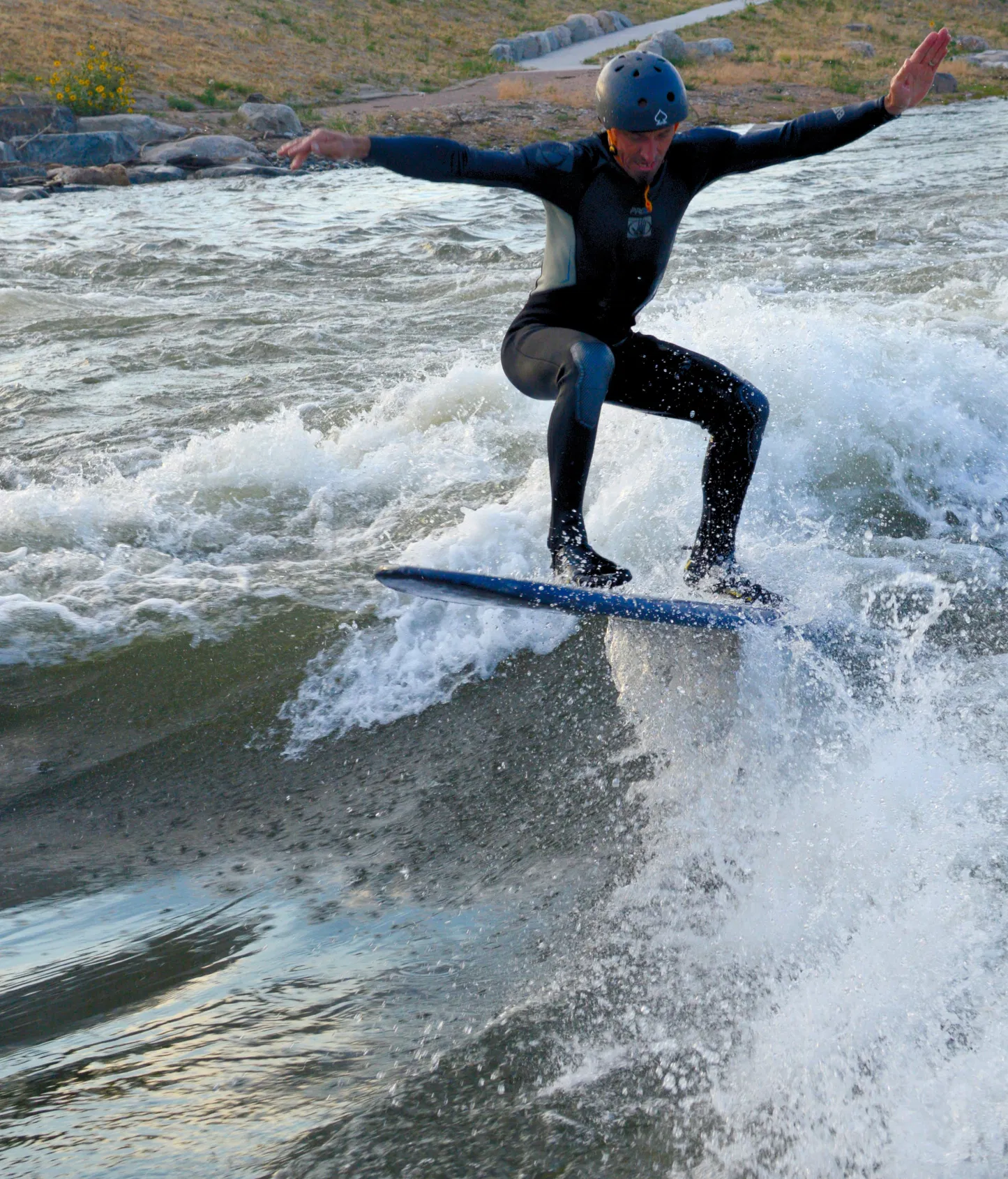
459 acre-feet
Average annual water used to irrigate a golf course in the Southwest, according to the U.S. Golf Association. (1 acre-foot = 325,851 gallons)

300
Number of golf courses in Arizona, according to Golf Arizona

145 million gallons
Daily consumptive water use of power plants in Colorado River Basin states, which amounts to about 162,000 acre-feet per year. 

Now, 2 million acre-feet is a huge amount of water: enough to fill more than 1 million Olympic-size swimming pools. To get to Touton’s upper goal, you’d need to drain 2.2 million monster-sized pools. Hell, you could shut off every water tap in Las Vegas, and you’d still come up 2-million-swimming-pools’-worth short — or about 1 trillion gallons. In fact, you could halt all municipal water consumption in the Colorado River Basin — dry out Phoenix and Tucson lawns, deprive Los Angeles and Denver of showers and toilet flushing — and it still wouldn’t be quite enough.

“There’s not 2 million acre-feet of municipal use within the Lower Basin (Nevada, California and Arizona) and probably just above that if you look basin-wide,” said Colby Pellegrino, a deputy general manager of the Southern Nevada Water Authority in an executive roundtable in August. “To think this problem can just be solved by cities just is wrong,” she continued. “Agriculture has to step up to the table.” 

But I come from a long line of western Colorado farmers, and my instinctive reaction to this kind of talk is: Them’s fighting words! We Upper Basin folks learn early on about “first in time, first in right,” and that if you don’t put all of your allotted water on your fields, it’ll run downstream to overflow Las Vegas’ lavish fountains, the swimming pools of Phoenix and Hollywood celebrities’ private forests. The notion of “buying and drying” farms so the cities can keep growing is anathema. 

2.6 million acre-feet
Amount of Colorado River water California’s Imperial Irrigation District is expected to consume this year, most of which goes to agriculture. 

244,635 acre-feet
Amount of Colorado River water Nevada is expected to consume this year. That’s less than half the amount of water that evaporates off of Lake Mead each year. 

75%
Portion of Utah’s Colorado River use consumed by agriculture in 2018.

But once I calmed down, I realized that Pelligrino has a point. See, if you want to cut water consumption, you have to tackle the biggest water users. And the biggest user of Colorado River water, by far, is not lawns, not Vegas golf courses (mostly irrigated by recycled wastewater), not the Bellagio fountain, not even Kardashian or Stallone. It’s agriculture, which historically has accounted for up to 80% of all consumptive water use in the Colorado River Basin. Not only do crops need more water than houses, but in most cases, farmers have senior rights to the bulk of the water. And of all the crops grown in the region, alfalfa and hay fields collectively are the thirstiest. 

That’s not just because alfalfa uses a lot of water, though it does — about 1.5 million gallons per acre per year, rivaled only for thirstiness by almonds and pistachios. It’s also because so much of the West’s agricultural land is devoted to growing alfalfa. Colorado, Utah and Arizona farmers irrigated about 4.1 million acres of crops in 2017, and nearly half of those acres were in alfalfa. The Colorado River Basin’s largest single water consumer is the Imperial Irrigation District in Southern California, which draws some 2.6 million acre-feet from the river each year, nearly all of which goes to crops. About one-third of the district’s irrigated acreage is devoted to alfalfa, which annually consumes at least 400,000-acre feet of Colorado River water — more than Nevada’s entire allotment. 

3 to 6 acre-feet
Amount of water needed annually to irrigate an acre of alfalfa. The amount is greater in hotter, drier climates. 

3 million
Acres of irrigated agricultural land in Western states (including the Colorado River Basin) planted with alfalfa grown for forage (hay), grazing or seed in 2022. 

$880 million
Value of hay shipped overseas last year from Colorado River Basin states, most of which went to China, Japan and Saudi Arabia.

If the Rocky Mountains’ winter snowpack is like a huge reservoir that feeds the Colorado River system, then the alfalfa fields stretching from western Colorado to Southern California comprise a sort of anti-reservoir, sucking up a good portion of the water in order to feed beef and dairy cattle in the U.S., China, even Saudi Arabia. If you were to stop filling up the alfalfa anti-reservoir, or fallow all of the alfalfa fields in the Colorado River Basin, you’d come up with Touton’s desired cuts and then some fairly quickly. It’s simple math. 

Which is not to say doing so would be pretty, painless, politically palatable or even possible. Buying and drying up small farms en masse would threaten rural economies and cultures. Many farmers grow alfalfa or other hay as a side crop — it’s reliable, relatively easy to care for, provides multiple harvests during the long growing season and gains value during drought. If farmers were forced to get rid of their hay, their operations might no longer be viable, and the cost of beef and dairy products would certainly go up. Gone would be the experience of rolling down the windows on a summer’s eve and inhaling the poignant aroma of a freshly cut field. Gone the bucolic sight of the long sunset shadows cast by the bales — all replaced by patches of dusty, noxious-weed-breeding ground or yet more residential sprawl.

Most of us can probably agree that farms should not be dried to allow cities to grow heedlessly, or to allow urban folks to water big lawns or enable Kim Kardashian to do whatever the heck she does with all that water. In the past, Phoenix’s sprawl has gobbled up citrus groves and cotton fields, and Colorado’s Front Range cities have bought and fallowed distant farms to accommodate houses and lawns. That, too, must stop. The goal here is not to transfer the water from farms to cities, but from farms and cities back to the river itself — or, rather, to the rivers, plural. The Klamath River in southern Oregon and Northern California is in crisis as well, and the Great Salt Lake is rapidly shrinking. Alfalfa fields are a primary culprit in both cases.

So, banning alfalfa is not the answer. But piping Mississippi River water over the Rockies or building billion-dollar, energy-intensive desalination plants to enable farmers to continue dumping water on hundreds of thousands of acres of cattle fodder is simply insane. It’s time for agriculture, and especially Big Alfalfa, to step up and give up a portion of its water either by becoming more efficient, switching to less water-intensive crops or fallowing more fields. The growers will be compensated: Congress just authorized $4 billion in the Inflation Reduction Act for that very purpose.

Industrial-scale farmers are currently growing and irrigating some 85,000 acres of alfalfa in California’s Imperial Valley. Cover all of that land with solar panels instead, and you’d save desert land from industrialization, generate enough power to replace Glen Canyon Dam’s hydroelectricity output several times over — and maybe even stave off the Colorado River’s collapse. 

Additional #water cuts could be coming to Yuma, #AZ farmers, threatening supply of leafy greens — Fresh Plaza #ColoradoRiver #COriver #aridification

A field of produce destined for grocery stores is irrigated near Yuma, Ariz., a few days before Christmas 2015. Photo/Allen Best – See more at: http://mountaintownnews.net/2016/02/09/drying-out-of-the-american-southwest/#sthash.7xXVYcLv.dpuf

Click the link to read the article on the Arizona’s Family website (Briana Whitney). Here’s an excerpt:

The water cuts made by the Bureau of Reclamation to the Colorado River that will affect Pinal County farmers will not affect Yuma farmers. Still, the bureau said there needs to be millions more cuts to the water, and Yuma farmers may take the brunt of it. The big picture problem: Yuma provides 90% of the nation’s leafy greens like lettuce and spinach during the winter months, and now that could be at risk. Anybody who’s driven from the desert of the Valley to the San Diego beaches passes through the stretch of agricultural land along Interstate 8: Yuma, Arizona. “It is a climate that isn’t really replicated anywhere else in the world in terms of how we can grow and how long we can grow and what we can grow,” said Chelsea McGuire, Director of Government Relations with the Arizona Farm Bureau…

This month the Bureau of Reclamation announced Colorado River water cuts to farms in Arizona amid the drought. That didn’t affect Yuma farms, but something else could. “That’s not kind of where the bureau stopped. They said earlier before they announced the Tier 2A that we’re going to need an additional 2-4 million acre feet to stay in the river to avoid a crash, a catastrophic situation,” McGuire said. McGuire said the Yuma farmers came up with a plan for the Bureau of Reclamation — their farmers are willing to take a one-acre foot of water less per acre. That would total about 925,000-acre-feet in water cuts, a significant chunk but well below that 2-4 million number set by the bureau.

“They’ve basically come to the determination that that’s as much as they can take and still stay in business and keep producing,” McGuire said.

So, all these numbers, what does that mean for you at the grocery store? “The most basic consequence is that we’re going to see significant decreases in availability and significant increases in price,” McGuire said. “We can buy romaine lettuce any time of year in the stores, it’s grown in different places, but we can access it. That may not be the case anymore.”

Navajo Dam operations update (September 2, 2022): Bumping up to 750 cfs #SanJuanRiver #ColoradoRiver #COriver #aridification

Navajo Reservoir, New Mexico, back in the day.. View looking north toward marina. The Navajo Dam can be seen on the left of the image. By Timthefinn at English Wikipedia – Transferred from en.wikipedia to Commons., Public Domain, https://commons.wikimedia.org/w/index.php?curid=4040102

From email from Reclamation (Susan Novak Behery):

In response to a warmer drier weather pattern and continued decreasing flows in the critical habitat reach, the Bureau of Reclamation has scheduled an increase in the release from Navajo Dam from 650 cubic feet per second (cfs) to 750 cfs for tomorrow, September 2nd , at 4:00 AM. 

Releases are made for the authorized purposes of the Navajo Unit, and to attempt to maintain a target base flow through the endangered fish critical habitat reach of the San Juan River (Farmington to Lake Powell).  The San Juan River Basin Recovery Implementation Program recommends a target base flow of between 500 cfs and 1,000 cfs through the critical habitat area.  The target base flow is calculated as the weekly average of gaged flows throughout the critical habitat area from Farmington to Lake Powell.  This scheduled release change is calculated to be the minimum required to meet the minimum target baseflow.

#Drought News (September 1, 2022): Large areas of improvement in W. #Colorado #Monsoon2022

Click a thumbnail graphic to view a gallery of drought data from the US Drought Monitor website.

Click the link to go to the US Drought Monitor website. Here’s an excerpt:

High Plains

Warm, dry conditions continued across much of the region with the Dakotas, Nebraska and Kansas seeing some areas of worsening conditions. In Nebraska and Kansas, all levels of drought expanded as short-term precipitation deficits, on top of long-term dryness, continued to deplete soil moisture and stress vegetation. Exceptional (D4) drought expanded in the southwest where rainfall deficits of over 3.5 inches have occurred over the last 90 days. Extreme (D3), severe (D2) and moderate (D1) drought expanded in the eastern half of Nebraska where rainfall deficits of 3 to nearly 7 inches have occurred over the last 90 days. Other areas of Nebraska seeing degradations include north-central Nebraska, where D2 expanded, and the Panhandle, where D1 expanded. Similarly, Kansas also saw large areas of deterioration. In the western half of the state, D1, D2, D3 and D4 expanded where rainfall deficits near 5 inches occurred over the last 90 days. In the east, improvements were made to D1 where the heaviest rain fell over the last 2 weeks. Improvements were also made in eastern South Dakota to D1 along a band of heavy rain last week.

Colorado Drought Monitor one week change map ending August 30, 2022.

West

The North American Monsoon continued to provide excellent rainfall in the Southwest. Many areas in the region only receive about five inches of rain annually, but a few spots have nearly equaled this annual average in the last two weeks alone. Drought conditions improved in areas receiving the heaviest rain. Many drought indicators, including soil moisture, streamflow and well data, are responding to the rainfall. Improvements were made to moderate (D1) and severe (D2) drought in Arizona, extreme (D3) drought in Southern California and eastern Utah, and D2 and D3 conditions in eastern New Mexico. To the north, Montana saw an expansion to abnormally dry (D0) and D1 areas as conditions began to rapidly deteriorate. Low rainfall, combined with high evaporative demand, has lowered streamflow and stressed vegetation there.

South

Rainfall totals over the past two weeks once again led to broad 1- and 2-category improvements across large parts of the South. For the second week in a row, all states in the region showed improvements as the effect of the rainfall became apparent in drought indicators such as soil moisture, streamflow and vegetation. Rainfall records show that the previous two weeks ranked in the top 10 wettest for this time of year in many locations in the region. Some of these records go back over 100 years. Drought remains in areas that missed out on the recent heavy rains and those in which rainfall deficits still exist at 90-plus days so that deeper soil moisture, shallow groundwater and streamflow indicators have yet to recover. Extreme (D3) drought expanded in northern Oklahoma in the areas that missed out on the heavy rain. Rainfall deficits of nearly 6 inches have continued to dry out soils and stress vegetation.

Looking Ahead

The National Weather Service Weather Prediction Center forecast (valid September 1 – September 4) calls for rainfall over parts of the South, the Southeast, the Central Plains and the Upper Midwest. Meanwhile, dry weather is expected to continue across much of the West, the Northern Plains and the Mid-Atlantic. Moving into next week (valid September 5 – September 8), the forecast calls for continued rain across much of the South and Southeast, while the West, High Plains and parts of the Midwest are expected to remain dry. Heavy rain is expected across portions of the Alaska Panhandle and mainland Alaska. At 8 – 14 days, the Climate Prediction Center Outlook (valid September 8 – September 14) calls for above-normal temperatures across most of the continental U.S. Below-normal to normal temperatures are predicted across southern Arizona, southern New Mexico and West Texas. Below-normal precipitation is favored across much of the northern tier of the continental U.S., while normal to above-normal precipitation is favored for the rest of the continental U.S. Below-normal precipitation is expected across parts of the Pacific Northwest, the Intermountain West, and parts of the Midwest and Northeast.

US Drought Monitor one week change map ending August 30, 2022.

Biden-Harris Administration Announces $8.5 Million from Bipartisan Infrastructure Law for #ColoradoRiver #Endangered Species Recovery — USBR #COriver #aridification

RAZORBACK SUCKER The Maybell ditch is home to four endangered fish species [the Humpback chub (Gila cypha), Bonytail (Gila elegans), Colorado pikeminnow (Ptychocheilus lucius), and the Razorback sucker (Xyrauchen texanus)] © Linda Whitham/TNC

Click the link to read the article on the Reclamation website (Rob Manning):

The Bureau of Reclamation today announced a $8.5 million investment from President Biden’s Bipartisan Infrastructure Law for endangered species recovery and conservation in the Colorado River Basin. Funding will modify the current water intake system at the Lake Mead State Fish Hatchery, which supplies razorback sucker and bonytail subadult fish to the Lower Colorado River Multispecies Conservation Program as part of their fish augmentation program.

Given historically low water levels in Lake Mead, the Lake Mead State Fish Hatchery’s current water intake system is unable to deliver water, as it is positioned at a 1050 elevation, above current water levels. As a result, the Hatchery has been forced to cease operations and remove native fish from the hatchery. Grant funding will be provided to the Southern Nevada Water Authority to construct a new water delivery system at the facility that would draw water from a point in Lake Mead below expected lake decline and allow the Lower Colorado Multi-Species Conservation Program to continue operations.

“Investment from President Biden’s Bipartisan Infrastructure Law in this program is a proven, effective way to reduce impacts to the environment and endangered fish species that are caused by operation, maintenance and rehabilitation of water diversion facilities,” said Reclamation Commissioner Camille Calimlim Touton. “With drought putting more pressure than ever on water projects and the environment, the investment announced today will tackle known facility needs and help assure the continued survival of endangered fish species in the Colorado River Basin.”

The Bipartisan Infrastructure Law allocates $8.3 billion for Bureau of Reclamation water infrastructure projects to repair aging water delivery systems, secure dams, complete rural water projects, and protect aquatic ecosystems. This funding includes $300 million specifically set aside for the Colorado River Basin Drought Contingency Plan, which will work to reduce the risk of Lake Mead and Lake Powell reaching critically low elevations.

Detailed information on Reclamation programs and funding provided in the Bipartisan Infrastructure Law is available at https://www.usbr.gov/bil/

Battle for Colorado River finds common ground at Windy Gap: Collaboration instead of competition makes Granby’s #ColoradoRiver Connectivity Channel Project a Reality — The Sky-Hi News #COriver #aridification

Dignitaries from across the region gathered on Aug. 23 to celebrate the start of construction at the Colorado River Connectivity Channel located in Grand County. Led by U.S. Sen. Michael Bennet, leaders of public agencies and private non-governmental organizations extolled the value of the project that will reconnect two segments of the Colorado River above and below Windy Gap Reservoir. Dirt was turned on the existing Windy Gap Dam, which lies on the Colorado River just west of the river’s confluence with the Fraser River. In the project, the existing dam’s length will be reduced by about 800 feet, and a new channel will direct water around the reservoir for most weeks of the year. The project will take about three years to build, at a cost of nearly $30 million. Funding will come from many sources, including the USDA’s Natural Resources Conservation Service, Colorado Water Conservation Board, Northern Water, Municipal Subdistrict, Grand County, Trout Unlimited, Colorado Parks and Wildlife, Colorado River Water Conservation District, Upper Colorado River Association, National Fish and Wildlife Foundation and a number of corporate sponsors. The channel was identified as a recommended improvement during the process of receiving a 1041 Permit from Grand County during consideration of the Windy Gap Firming Project. On the East Slope, the project includes the construction of Chimney Hollow Reservoir west of Berthoud.

Click the link to read the article on the Sky-Hi Daily News website (Meg Soyars). Here’s an excerpt:

The Connectivity Channel Project will move the reservoir’s existing southern embankment 300 yards, reducing the reservoir’s surface area by about 30%, allowing for a new channel and floodplain. This will reconnect the river upstream of the dam and downstream at the confluence of the Colorado and Fraser Rivers. Construction will be completed in the fall of 2024.

During the groundbreaking ceremony, individuals spearheading the project spoke to a crowd gathered beside the reservoir’s soon-to-be-realized channel. The speakers represented an unprecedented collaboration between diverse groups across Colorado, including: Grand County government, state entities, Trout Unlimited, Colorado Parks and Wildlife, Colorado Water Conservation Board, Colorado River District and many more. Northern Water’s Municipal Subdistrict leads the project. Brad Wind, Northern Water’s General Manger, told the crowd the project will improve “all the ecology that make high mountain streams important to the environment and to Colorado.”

[…]

Reconnecting the Colorado will allow for the free passage of fish and sediment, plus create around 50 acres of floodplain and riparian habitat, restoring stream health. The channel will provide over 1 additional mile of public fishing access for the Gold Medal trout fishery, an important benefit for Grand’s recreation industry. Lastly, the project will support additional restoration efforts, such as improving irrigation and aquatic habitat near Kremmling…

An essential facet of the Connectivity Project is its relation to the Windy Gap Firming Project. Shortly after Windy Gap’s construction, Northern Water realized this was an inefficient means for them to draw water from the Colorado River. Their rights are for 30,000 acre-feet annually. But during wet years, Lake Granby was too full to take this water for delivery to the Front Range, so it sat in Windy Gap. Other years, especially during recent drought, Lake Granby was too low for Northern to pump the water they needed. On top of this, the Front Range population was increasing. Northern Water began creating a better storage option…Northern began construction on the Chimney Hollow Reservoir west of Loveland to ensure the reliability of, or make “firm,” its deliveries of Windy Gap water, even during drought. Instead of being stored in Lake Granby, water from Windy Gap will travel through Lake Granby, then over the Continental Divide, to be stored at Chimney Hollow instead. 

A draft plan for the Colorado River Connectivity Channel, also known as the Windy Gap Bypass, is now available. Public comment will be accepted starting February 8, 2022 through March 10. NRCS/Courtesy photo

Feds: #ColoradoRiver’s Flaming Gorge Reservoir able only to deliver two more emergency #water releases — @WaterEdCO #GreenRiver #COriver #aridification

View below Flaming Gorge Dam from the Green River, eastern Utah. Photo credit: USGS

Click the link to read the article on the Water Education Colorado website (Jerd Smith):

Utah’s Flaming Gorge Reservoir, which Colorado River officials have used twice during the past two years to add water to the rapidly deteriorating river system, likely only has enough water left for two more emergency releases, according to the U.S. Bureau of Reclamation.

Last summer, Reclamation ordered the release of 125,000 acre-feet of water from Flaming Gorge to help keep Lake Powell from falling too low to produce power. Then, earlier this summer, Reclamation announced that it would release another 500,000 acre-feet of water from Flaming Gorge and hold back 480,000 acre-feet in Powell instead of releasing it to Lake Mead, as it would normally do.

Another 30,000 acre-feet was released from Colorado’s Blue Mesa Reservoir last summer, which along with Flaming Gorge, New Mexico’s Navajo, and Powell itself, was supposed to act as a critical savings account for the river system.

The Colorado River Basin, which is divided into two regions, includes seven states: Colorado, New Mexico, Utah and Wyoming make up the Upper Basin, while Arizona, California and Nevada comprise the Lower Basin. Lake Powell serves as the largest water bank for the Upper Basin, while Lake Mead holds water for the Lower Basin states.

Colorado River Basin. Credit: Chas Chamberlin/Water Education Colorado

But as drought and climate change continue to sap the Colorado River, even the water in the Upper Basin’s high elevation storage ponds, namely Flaming Gorge, Blue Mesa and Navajo, isn’t enough to protect the larger system, and those kinds of releases can’t go on indefinitely, said Jim Prairie, a hydrologic engineer with Reclamation.

“We could release from Flaming Gorge maybe two more times,” Prairie said at a conference convened by the Colorado Water Congress last week.

And Blue Mesa and Navajo, now at less than 50% of capacity themselves, are considered too low to provide much, if any, additional relief.

It is analyses like these that prompted Reclamation Commissioner Camille Touton in June to order the seven basin states to find ways to come up with 2 million to 4 million acre-feet of water next year, to inject into the reservoirs to keep them full enough to generate hydropower and supply water.

That means determining which water users and states are going to cut back use.

Tensions are rising as the federal government and the states continue to fail in their efforts to develop a concrete plan that will cut water use enough to come up with that 2 million to 4 million acre-feet.

“If we failed at anything in the [drought contingency planning done in 2019] it is that our vision was insufficiently dark,” said Wayne Pullan, director of Reclamation’s Upper Colorado Region.

As the freefall on the river continues, veteran federal hydrologists and engineers at Reclamation are scrambling to come up with new ways to forecast what is going to happen, using, among other tools, a stress test that is based on recent observed inflows, rather than models.

Hydrologists are also using data that excludes measurements from extremely wet years back in the 1980s, and focuses instead on the most recent dry periods.

Reclamation estimates that Powell will receive just 6.2 million acre-feet of water from the mountain snows in Colorado, Utah, Wyoming and New Mexico in 2022, using its new forecasting models. That is far below the 9.6 million acre-foot average, a figure based on a 30-year average that includes extremely wet periods.

Right now, Powell stands at 3,533 feet, just 8 feet above the top of a buffer pool that must be maintained to keep the reservoir’s power turbines operating. Lake Mead is similarly low, with an elevation of 1,043.42.

Reclamation expects the reservoirs’ levels to continue dropping next year as well. “This could be where our hydrologies are going to stay,” Prairie said.

But it isn’t only the one-year outlook that is so troubling, Prairie said. It is the wildly varying temperature scenarios, low soil moisture levels, and shrinking snowpacks that are making it difficult to determine the best methods for keeping the giant river system, and Powell and Mead, from crashing.

Ironically, 2022 is shaping up to be slightly wetter than 2021, when inflow was just 3.5 million acre-feet, well below the 6.2 million acre-feet expected for this year.

Urging water users to move quickly to find ways to deliver and keep more water in the system, Prairie said, “Even if we have a good year next year, it is not going to save us.”

Jerd Smith is editor of Fresh Water News. She can be reached at 720-398-6474, via email at jerd@wateredco.org or @jerd_smith.

#Colorado landowner’s takings claim against EPA advances after judge denies motion to dismiss — The Ark Valley Voice #AnimasRiver #GoldKingMine

This image was taken during the peak outflow from the Gold King Mine spill at 10:57 a.m. Aug. 5, 2015. The waste-rock dump can be seen eroding on the right. Federal investigators placed blame for the blowout squarely on engineering errors made by the Environmental Protection Agency’s-contracted company in a 132-page report released Thursday [October 22, 2015]

Click the link to read the article on the Ark Valley Voice website (Jan Wondra). Here’s an excerpt:

On Tuesday, August 30, Judge Armando Bonilla of the U.S. Court of Federal Claims issued a decision from the bench in favor of New Civil Liberties Alliance’s (NCLA) client and denying a motion to dismiss in Todd Hennis v. The United States of America.

“Today, the Court of Federal Claims recognized what we have long known. EPA must answer for the bad decisions it has made and the unlawful actions it has taken since 2015, said New Civil Liberties Alliance (NCLA) Litigation Counsel Kara Rollins. “We are pleased that Mr. Hennis’s case is moving ahead, and we look forward to presenting the facts about what the EPA did to him—and took from him.”

Hennis filed a lawsuit against the United States for the physical taking of his property without just compensation in violation of the Fifth Amendment to the United States Constitution. He took this step after years of waiting for action. On August 5, 2015, EPA destroyed the portal to the Gold King Mine, located in Silverton, Colorado. Upon doing so, the agency released a toxic sludge of over 3,000,000 gallons of acid mine drainage and 880,000 pounds of heavy metals into the Animas River watershed. According to Hennis, the Environmental Protection Agency (EPA) caused an environmental catastrophe that preceded and culminated in the invasion, occupation, taking, and confiscation of Hennis’s downstream property. Ever since, he has been trying to recover damages.  This ruling means the U.S. Court of Federal Claims is allowing Mr. Hennis’s lawsuit to go forward to discovery, and ultimately to trial…

[The EPA] eventually mobilized supplies and equipment onto Hennis’s downstream property to address the immediate after-effects of its actions, but it apparently ignored Hennis’s explicit instructions on how to protect the land and the scope of the access that he granted. Instead, the EPA constructed a multimillion-dollar water treatment facility on his land, without permission, compensation, or even following a procedure to appropriate his property for public use. After seven years, Hennis says the U.S. Government has been “squatted on his lands”, and he wants financial compensation. Hennis says he didn’t voluntarily give EPA permission to construct and operate a water treatment facility on his property. It was built without his knowledge or consent, and it later coerced him into allowing access to his lands by threatening him with exorbitant fines (over $59,000 per day) should he exercise his property rights. When Hennis  refused to sign an access document, the EPA preceded to occupy his property by operation of the agency’s own administrative order—and threatening him with fines if he challenges it.

Cement Creek aerial photo — Jonathan Thompson via Twitter

Innovative land management benefits Valley bird populations — @AlamosaCitizen #RioGrande

Sandhill cranes in the San Luis Valley. Photo credit: Alamosa Citizen

Click the link to read the article from the Rio Grande Basin Roundtable on the Alamosa Citizen website:

THE waters of the San Luis Valley are a crucial part of life for the people and wildlife that call it home. Particularly tied to these water sources are the multitudes of bird species that reside in the area year-round, seasonally, or even just briefly during migration. As conditions become drier and water scarcer, collaboration and creative solutions on all fronts have grown to make the most of the available water supply. This is particularly relevant for riparian and wetland habitat for bird populations.

The Bureau of Land Management (BLM) plays an important role in this effort by managing a number of riparian and wetland areas, including the Blanca Wetlands, McIntire/Simpson property and the Rio Grande Natural Area (RGNA). The BLM has many ongoing riparian and wetland habitat improvement projects, including riparian exclosures and fencing on the RGNA to protect portions of these delicate riparian habitats for nesting.

Unsurprisingly, water availability is a concern for even healthy habitats, which is why the BLM uses its water rights to irrigate these lands to mimic natural wetting and drying processes and provide habitat when species’ need it the most, whether for nesting or migration or other life cycle needs. In addition to the management of its own lands, collaborations with groups such as the Rio Grande Headwaters Restoration Project and others are improving willow habitat along riverbanks, benefitting bird species such as the endangered Southwestern Willow Flycatcher. Though there are challenges, the future is hopeful. 

Sue Swift-Miller, who has worked as a wildlife biologist in BLM Colorado’s San Luis Valley Field Office for about 20 years, says, “It’s really exciting getting to work with such great partners and to be providing habitat for these species.”

Colorado Parks and Wildlife (CPW), like the BLM, works both independently and with partners to protect and enhance habitat for the benefit of birds. Collaboration with other entities in the Valley has been foundational to CPW’s efforts thus far, most notably with Ducks Unlimited and Wetland Dynamics. 

These two private organizations help CPW acquire funding for projects, research bird populations, and manage water use in riparian and wetland areas. CPW also works with farmers and ranchers on and near riparian and wetland areas, helping educate and inform them about practices that are beneficial to their production as well as wildlife. While this effort has presented a certain level of difficulty, the results work to benefit everyone involved.

Tony Aloia, wildlife technician with CPW, says, “Seeing [private landowners] sometimes progress away from what has always been to what is obviously a better way is pretty rewarding … to hear your message being heard.” 

Rotational grazing, preventing overgrazing, and other such practices have helped these landowners get more production value from their land, while simultaneously contributing to wildlife and species preservation through increased suitable habitat and less disturbed nesting periods. 

Sometimes these collaborations and projects can be challenging as well, but CPW’s staff enjoy the work they do and see the benefits it offers. 

Tyler Cerny, who works as a district wildlife manager for CPW, says, “My favorite part of [the job] is seeing the collaboration and people in the community … come together for one common goal, and that is wildlife.” 

Aloia added that one of his favorite aspects of this work is “seeing the wildlife, and seeing your work actually have some impact.”

While changes in climate and water supply challenges will continue to be pressing issues, the management of riparian and wetland habitat in the Rio Grande Basin is adapting to meet them through collaboration and innovation.

This article was brought to you by the Rio Grande Basin Roundtable. The roundtable meets the second Tuesday of the month. If we are in-person, we are meeting at the Rio Grande Water Conservation District, 8805 Independence Way, Alamosa, CO 81101. Due to Covid restrictions we are also offering a Zoom option. We welcome your attendance but encourage checking the Roundtable website at www.RGBRT.org prior to the meeting to see if an in-person option is available.

More RGBRT Stories >>

Northern Water Board Member Wins State’s Highest #Water Honor

Northern Water Director Jennifer Gimbel appears with her family upon receiving the Aspinall Award from Colorado Water Congress on August 25, 2022.

Click the link to read the release on the Northern Water website:

Northern Water Director Jennifer Gimbel was presented as the 2022 winner of the Aspinall Award by Colorado Water Congress during its summer convention Aug. 25, 2022, in Steamboat Springs. 

Gimbel received the state’s top water advocacy award based on her many accomplishments during a career with service to the Colorado Water Center, Northern Water, Colorado Water Conservation Board, Department of Interior and the Colorado Attorney General’s Office. 

The Aspinall Award is named after former Congressman Wayne Aspinall, who advocated for the state’s water resources during a 24-year career in the U.S. House of Representatives. 

Previous award-winners associated with Northern Water include former general managers Eric Wilkinson (2011), Larry Simpson (2001) and Bob Barkley (1995), Municipal Subdistrict Board President W.D. Farr (1985), legal counsel John M. Sayre (1989) and legislative consultant Fred Anderson (1994). 

Aspinall Unit operations update (September 1, 2022): Bumping down to 1350 cfs #GunnisonRiver #ColoradoRiver #COriver #aridification

From email from Reclamation (Erik Knight):

Releases from the Aspinall Unit will be decreased from 1450 cfs to 1350 cfs on Thursday, September 1st. Releases are being decreased as rainfall has helped put river flows well above the baseflow target on the lower Gunnison River. The actual April-July runoff volume for Blue Mesa Reservoir came in at 68% of average. 

Flows in the lower Gunnison River are currently over the baseflow target of 890 cfs. River flows are expected to continue at or above the baseflow target for the foreseeable future. 

Pursuant to the Aspinall Unit Operations Record of Decision (ROD), the baseflow target in the lower Gunnison River, as measured at the Whitewater gage, is 890 cfs for September. 

Currently, Gunnison Tunnel diversions are 1050 cfs and flows in the Gunnison River through the Black Canyon are around 440 cfs. After this release change Gunnison Tunnel diversions will still be around 1050 cfs and flows in the Gunnison River through the Black Canyon will be near 340 cfs.  Current flow information is obtained from provisional data that may undergo revision subsequent to review. 

Crystal Dam, part of the Colorado River Storage Project, Aspinall Unit. Credit Reclamation.

Navajo Dam operations update (September 1, 2022): Bumping up to 650 cfs #SanJuanRiver #ColoradoRiver #COriver #aridification

From email from Reclamation (Susan Novak Behery):

In response to a warmer drier weather pattern and decreasing flows in the critical habitat reach, the Bureau of Reclamation has scheduled an increase in the release from Navajo Dam from 500 cubic feet per second (cfs) to 650 cfs for tomorrow, September 1st , at 4:00 AM. 

Releases are made for the authorized purposes of the Navajo Unit, and to attempt to maintain a target base flow through the endangered fish critical habitat reach of the San Juan River (Farmington to Lake Powell).  The San Juan River Basin Recovery Implementation Program recommends a target base flow of between 500 cfs and 1,000 cfs through the critical habitat area.  The target base flow is calculated as the weekly average of gaged flows throughout the critical habitat area from Farmington to Lake Powell.  

The San Juan River, below Navajo Reservoir. Photo: Brent Gardner-Smith/Aspen Journalism