Sunrise over Golden, Colorado. Photo credit Terry Smith via The City of Golden.
Click the link to read the article on the Ark Valley Voice website (Jan Wondra). Here’s an excerpt:
The month of July 2023 just ended. It is in the record books as the hottest month in the history of the world while humans have been around; or at least in the past 120,000 years or so. It will obliterate the record for the hottest recorded month, upping the record by a formerly unheard of potential 2.7 degrees Fahrenheit. In fact, according to a report from the United Nations’ World Meteorological Organization and the European Commission’s Copernicus Climate Change Service, it was hotter this past month than anything we’ve seen in the last 80 or so years. But then again, humans only have data for about 100 years or so; an era considered the “sweet spot” in planet livability for humans.
This past month is the latest in a string of records that have made the past nine years the hottest in the history of our planet. Anyone who can read data knows we’re in trouble. On July 27, the United Nations Secretary-General António Guterres made an urgent speech in New York warning that the only surprise is the speed of climate change, saying “Climate change is here, it is terrifying and it is just the beginning.” He declared that “the era of global boiling has arrived.” Add to the extreme heat, the extreme weather that feels as if it is all happening at once, and we could be forgiven for wondering what on earth is going on. The answer is that ‘on earth”, we humans continue to screw it up, pumping billions of particles of CO2 and methane into the atmosphere; fueling an accelerating climate crisis.
In the ultimate irony, as the temperatures have surged across the affluent parts of the world, people there are cranking up their air conditioning — creating an endless cycle of climate disruption.
KARACHI: The month of July has rewritten the record books as it stands out as the hottest month ever on a global scale. Unrelenting heat waves have sizzled large swathes of Europe, the United States, and parts of Asia, leaving countries grappling with severe weather conditions. From Puerto Rico to Pakistan, Iran, India, and all the way to Siberia, climate records have not just been shattered, but smashed.
In June more than 4.7 million hectares of land in Canada were scorched by wildfires, painting skylines an eerie shade of orange over Ottawa, Montreal, and Toronto, where a dense haze obstructed views of the CN Tower, a 553.3-meter-tall iconic landmark that dominates the downtown skyline of one of Canada’s largest cities. However, this was not just Canada’s problem; billowing smoke traveled across continents, reaching as far as Europe, serving as a wake-up call for everyone trying to ignore the climate crisis and its far-reaching consequences.
A month later, all efforts were concentrated on dousing blazes raging on the Greek islands of Evia and Corfu, in addition to Rhodes, where wind-whipped infernos forced the government to evacuate more than 19,000 tourists and residents. The scars left behind by these fires are all too visible. Many towns in Greece were left with a severe shortage of water because of the damage to their resources. According to the country’s weather Institute, Greece faced the longest heatwave in its history, with its hottest July weekend in 50 years, with the mercury rising in some parts up to 45 Celsius (113 Fahrenheit).
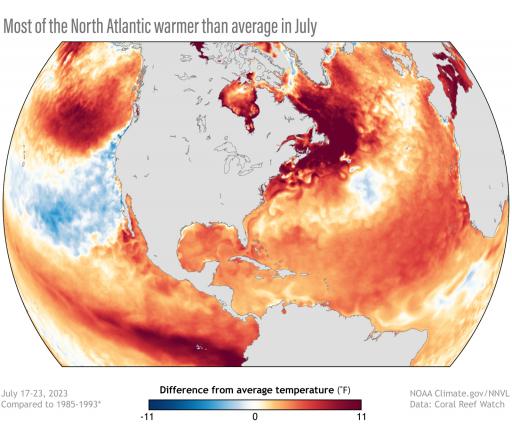
To leading scientists, none of this comes as a surprise. The likely trajectory of climate change, given the current global performance on emissions reduction, has been spelled out repeatedly by climate experts, and their cries have been falling on deaf ears for quite some time. While warming caused by greenhouse gases is not unexpected, seeing some of the climate records being broken was not anticipated. The global average temperature has been rising, and in July this year, it broke through 17 degrees for the first time. Furthermore, the record for the hottest day on earth fell not just once but three times in a week. And it is not just the land that is warmer; the oceans, which take up most of the world’s heat, have also witnessed unprecedented temperatures.
A new state Colorado River Drought Task Force will meet nine times between now and early December, and hold two public hearings to develop recommendations on how the parched river’s supplies will be managed inside state lines as its flows continue to decline.
At its first meeting Monday [July 31, 2023], 100 people joined the virtual session as the 17-member task force began planning the work it must conclude by Dec. 15.
“We are at a truly historic moment in Colorado River history,” said Kathy Chandler-Henry, an Eagle County Commissioner who is non-voting chair of the group.
“We are tasked with providing recommendations for programs addressing drought in the Colorado River Basin. … It’s a tall order but I am confident we can deliver. … My hope is that we can reach a broad consensus. My concern is the time crunch … 4.5 months in water time is a blink of an eye.”
Lawmakers created the Colorado River Drought Task Force in May when they approved Senate Bill 23-295. The 17-member task force includes representatives of environmental groups, urban and agricultural water users, and the Southern Ute and Ute Mountain Ute tribes, among others. Its task: to recommend state legislation that would create new tools and programs to address drought and declining flows on the Colorado River.
The seven-state Colorado River Basin is divided into two regions, with Colorado, New Mexico, Utah and Wyoming comprising the Upper Basin, and Arizona, Nevada and California making up the Lower Basin.
But it is in the Upper Basin and in Colorado, specifically, where roughly two-thirds of its flows originate.
Colorado is home to eight major rivers, four of which are major tributaries to the Colorado River on the West Slope. They are the Yampa/White/Green, the Gunnison, the San Juan/San Miguel/Dolores, and the Colorado River itself.
Four river basins, the Colorado, Yampa/White, Gunnison and Southwest would participate in a demand management program that eventually will include the entire state. Source: Colorado River District
This year, negotiations among the states and the federal government are beginning on how to manage and protect the river now and beyond 2026, when many of the existing Colorado River management agreements expire.
Overuse in the Lower Basin is considered to be the largest issue to resolve, but Upper Basin states may be called on to reduce their agricultural water use as well. One proposal, known as demand management, is to create a new drought pool in Lake Powell by having farmers and ranchers fallow their fields in return for cash payments. And the state’s urban water users may also be called on to cut back.
Colorado water users on the West Slope and Front Range are concerned that changes to the river’s seven-state management system could harm their water rights.
Scott Hummer, water commissioner for District 58 in the Yampa River basin, checks out a recently installed Parshall flume on an irrigation ditch in this August 2020 photo. Compliance with measuring device requirements has been moving more slowly than state engineers would like.
CREDIT: HEATHER SACKETT/ASPEN JOURNALISM
Mike Camblin, a task force member representing agricultural water users, said it would be critical to find ways to ensure farmers’ and ranchers’ lands remain healthy and their operations profitable. Agriculture uses 80% of the Colorado River’s supplies across the basin and the agricultural industry is deeply worried that it will take the hit if and when reductions are required.
“I hope we can come up with a plan. I would hate to see our ancestors cuss us down the road,” Camblin said.
Melissa Youssef, a task force member who is also mayor of Durango, said her city is already seeing its water supplies reduced. She said she was glad to have a seat on the task force and to have a say in how her community should be protected.
“My hope is that we can come together, making our positions abundantly clear. We have senior water rights on two rivers, but we are exposed to a reduction in water supplies through drought,” Youssef said.
Alex Davis, assistant general manager of Aurora Water, is a task force member representing Front Range water users. She said urban reliance on the Colorado River is significant.
Colorado transmountain diversions via the State Engineer’s office
Roughly half of water supplies for Aurora and Denver, among others, come from the Colorado River.
“My concern is that people will bring very specific agendas from different entities that will benefit their constituents but may not be beneficial to the state as a whole,” she said.
The group will meet at sites around the state, with one meeting each month slated to be in-person and the others designed to be virtual. The next meeting is Aug. 10 in Denver. It is in-person. A location has not yet been determined. All meetings are open to the public.
Jerd Smith is editor of Fresh Water News. She can be reached at 720-398-6474, via email at jerd@wateredco.org or @jerd_smith.