Help for tribes to electrify homes available through new grant program — Source NM #ActOnClimate

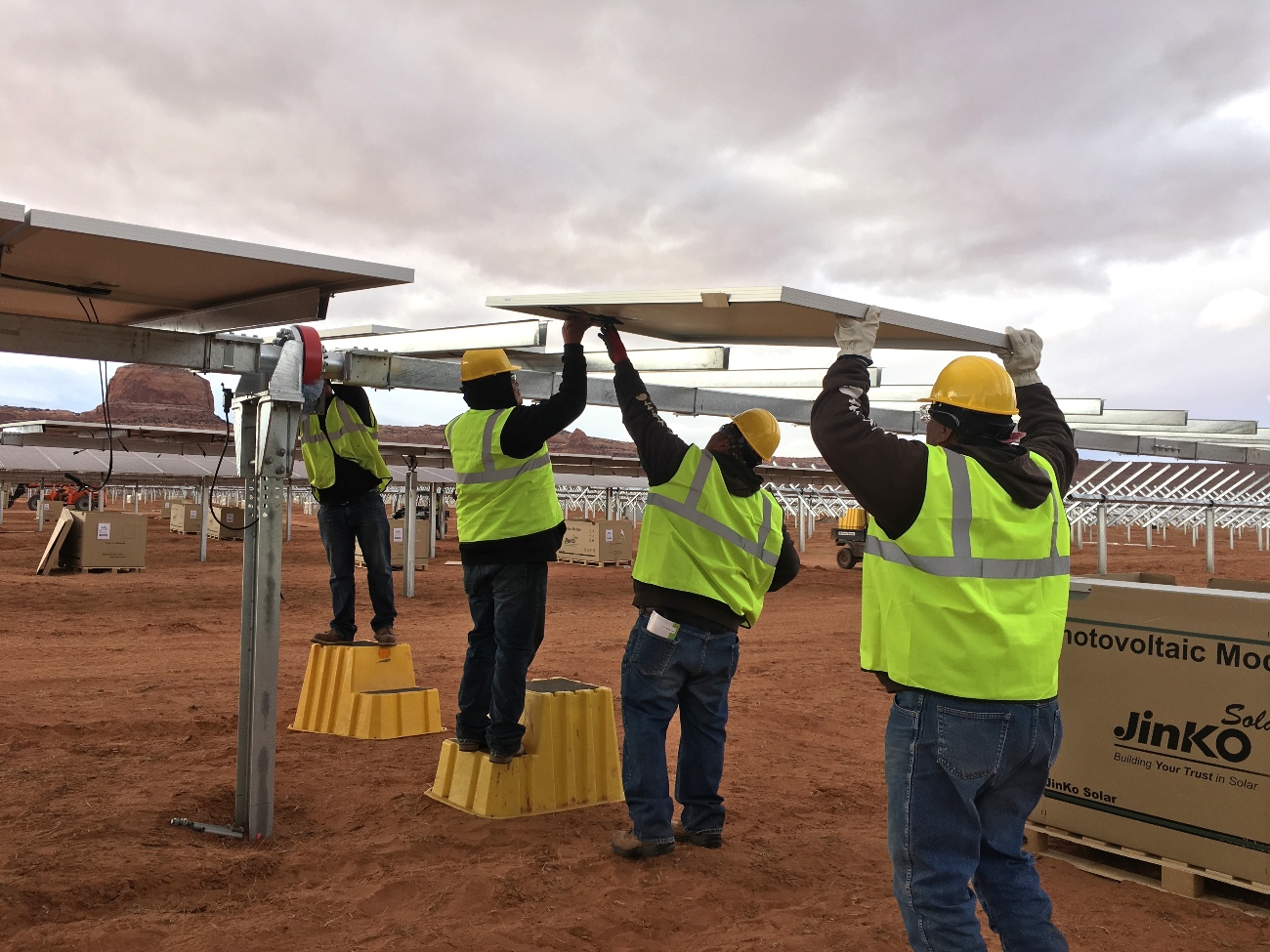
The construction project to build the Kayenta solar farms on the Navajo Nation, shown here in 2018, employed hundreds of people, nearly 90 percent of whom were Navajo citizens. Renewable energy is drawing increasing attention from tribes and others as a way to build jobs for the future. (Photo from the Navajo Tribal Utility Authority / Navajo Nation)

Click the link to read the article on the Source NM website (Shondin Silversmith):

Thousands of homes across Indian Country are still not connected to electricity, including an estimated more than 14,000 on the Navajo Nation alone.

That accounts for more than 80% of the tribal homes in the United States that aren’t electrified.

But it could all change with the launch of the Tribal Electrification Program by the U.S. Department of the Interior, which will provide funding to help tribal nations get connected to electricity.

“The goal of the funding is to get electricity to homes,” Onna Lebeau, director of the Office of Indian Economic Development (OIED), told the Arizona Mirror. “We do see the electrification need in Indian Country is in a critical state.”

The Department of the Interior launched the Tribal Electrification Program on Aug. 15 with $72.5 million that will directly help tribal nations electrify homes and expand the availability of clean energy in Indian Country.

“This funding from the president’s Investing in America agenda will bring electricity to homes in Tribal communities that have never had it,” Assistant Secretary for Indian Affairs Bryan Newland said in a press release. “It will have a fundamental and significant impact on businesses, communities, and families.”

Newland added that this historic investment is one of many the department is making to fund long-overdue infrastructure needs in Indigenous communities.

Regarding connecting homes to electricity within Indigenous communities, Lebeau said the need has long been there, and through the funding available from the new program, they can prioritize this need.

It will help the homes within tribal communities that not only need updating, Lebeau said, but the homes that need to be connected to the grid for the first time.

In 2022, the Department of Energy’s Office of Indian Energy released a report about Tribal Electricity Access and Reliability, where they found 16,805 tribal homes were not connected to electricity, resulting in 54,209 residents living without electricity. The price of electricity on tribal lands, according to the report, is 56% higher than the national average.

The Navajo Nation and Hopi Tribe have some of the highest numbers of homes not connected to electricity, and together account for nearly 90% of all unelectrified tribal homes nationwide.

According to the report, there are 68,101 homes on the Navajo Nation, with an estimated 14,063 without electricity and about 45,001 people living without power. For the Hopi Tribe, there are 2,508 homes located on their tribal land, with an estimated 878 homes without electricity and about 2,810 people living without power.

Between the Navajo Nation and Hopi Tribe, that is roughly 15,000 homes and nearly 48,000 people between just two communities living without power, compared to the approximately 16,800 homes and more than 54,000 people living without electricity in the U.S.

The funding comes via the Inflation Reduction Act (IRA), which was signed into law last summer. It is part of an overall $150 million investment from the IRA to support the electrification of homes in tribal communities.

The new program increases efforts to electrify Indian Country to provide reliable, resilient energy that tribes can rely on, Department of Interior Secretary Deb Haaland said in a press release. The program will also advance the department’s work to tackle the climate crisis and build a clean energy future.”

“Climate change is the crisis of our lifetimes and has left far too many communities managing for worsening water challenges, extreme heat, devastating wildfires, and unprecedented storms,” Haaland added. “Every action we take now to lessen the impacts for future generations is critical.”

The program will work to provide electricity to unelectrified homes located on tribal land through zero-emissions energy systems, and it will transition electrified tribal homes to zero-emission energy systems, including the associated home repairs within homes to install necessary systems for zero-emission energy.

The program will work to meet the unique needs of individual tribal communities, according to the Department of Interior, because the demand for electrification across Indian Country is significant, and each tribe has its own energy and electrification-related needs and implementation capacity.

Lebeau said a unique component of the program is that it will also coordinate financial and technical assistance to tribes to increase the number of tribal homes connected with zero-emission electricity.

“We do understand each of our tribes are at various levels within their development,” she said. “The technical assistants will be able to support those tribes who need additional guidance through the program.”

Lebeau said there are tribal nations that have the infrastructure set in place, such as wind power or solar energy, but then there are others that need help getting their projects off the ground, which is where the technical assistance from the program comes in.

“The technical assistance will be able to support them,” Lebeau said. “We are doing our best to meet the needs of each community.”

Lebeau said that when tribes start applying, they need to state their unique needs to meet their capacity within their community.

“The primary goal is to get electricity into the homes. That’s what’s driving this program,” Lebeau added. “The individuality of each need of each community is so important when it comes down to truly understanding how we’re going to be able to support everyone.”

The Department of the Interior stated that the program expects to obligate roughly half of the funding by the end of the year.

As part of the program, the Office of Indian Economic Development will select a range of tribal communities in stages ranging from early planning to already implementing plans and actions for household electrification.

There are two deadlines tribal nations should be aware of when applying for the program. The first deadline is for the pre-application process, due by Sept. 18, and the second is for the full application, due Dec 22.

Applications will only be accepted by eligible applications, which include federally recognized Native American or Alaska Native tribes or an approved tribal entity. Applicants must demonstrate need, community impact, and capacity.

To learn more about the application process, visit the Tribal Electrification Programs website.

This story was originally published by Arizona Mirror. It is republished here with permission.

Deadpool Diaries: rekindling optimism? — John Fleck (InkStain) #ColoradoRiver #COriver #aridification

Lake Mead used to be here (October 2022). Photo by John Fleck

Click the link to read the article on the InkStain website (John Fleck):

Something remarkable is happening this year in the Lower Colorado River Basin that provides both a glimmer of hope about what durable basin solutions might look like, and also a clear demonstration of the obstacles still standing in their way.

NEVADA’S COLORADO RIVER WATER USE IS ON TRACK TO BE THE LOWEST IT’S BEEN SINCE 1992

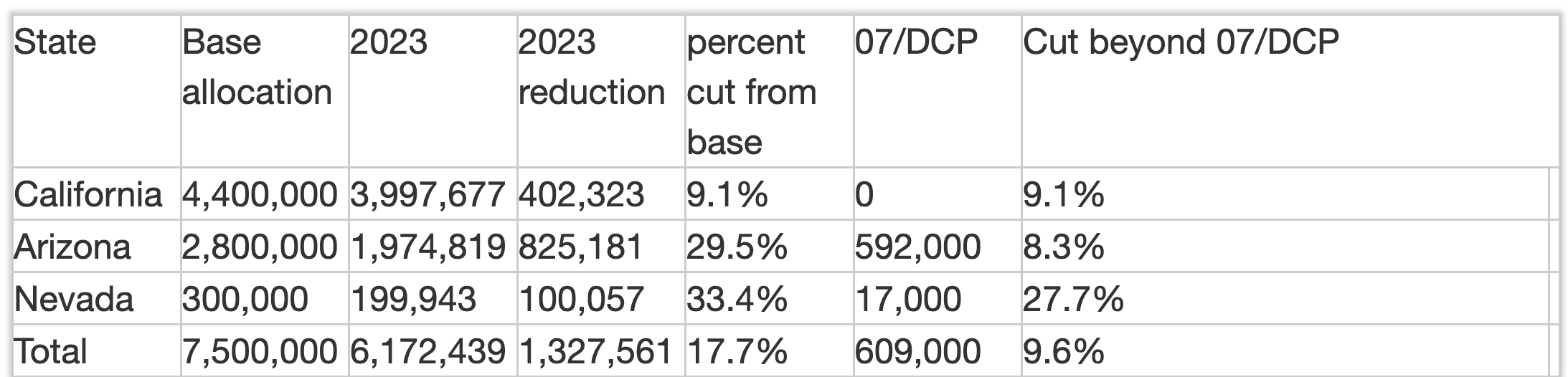
Southern Nevada’s projected 2023 use right now (the following is based on Reclamation’s Aug. 14 water forecast run) has dropped below 200,000 acre feet, sitting today at 199,943 af. That would be Nevada’s lowest take on the Colorado river since 1992. Southern Nevada’s population (Clark County, basically “greater Las Vegas”) has nearly tripled in that time.

Nevada has demonstrated its ability to take deep cuts without jeopardizing the structure and function of the communities that depend on Colorado River water.

ARIZONA’S COLORADO RIVER WATER USE IS ON TRACK TO BE THE LOWEST IT’S BEEN SINCE 1992

Arizona’s projected 2023 use, 1,974,819 acre feet, has dropped below 2 million acre feet, also the lowest since 1992. The Central Arizona Project, which supplies the Phoenix-Tucson area, is projected to take just 605,171 acre feet this year. That is 40 percent of CAP’s 21st-century average.

Arizona has demonstrated its ability to take deep cuts without jeopardizing the structure and function of the communities that depend on Colorado River water.

CALIFORNIA’S COLORADO RIVER WATER USE IS ON TRACK TO BE THE LOWEST IT’S BEEN SINCE 2019

California’s use has dropped below 4 million acre feet, which would be the first time that’s happened since 2019, currently 10 percent below the state’s 21st century average.

Ok, the comparison is striking, right? Some states are doing a lot, other states are doing less. But I’m trying to be optimistic here, California’s water use reductions aren’t nothing! Everyone’s using less water!

But the relative depth of California’s cuts has not yet demonstrated its ability to take deep cuts without jeopardizing the structure and function of the communities that depend on Colorado River water.

THE NUMBERS

THE OBSTACLES

The premise of a piece I wrote earlier this year in the New York Times is that there’s no way we can fix the Colorado River supply/use imbalance if California insists that the burden of overallocation and climate change fall on everyone else.

The new Schmidt/Yackulic/Kuhn paper puts the needed cuts at 20 percent just to stabilize the system – more if we’re going to rebuild a buffer against a repeat of last year’s shit show. Arizona and Nevada have figured out how to cut a lot more than that.

California, not so much.

A CLARIFYING NOTE ON THE PICTURE

The above picture, which I took in October, no longer represents reality. Based on the latest Sentinel satellite imagery, a bit of water has returned to Boulder Harbor on Lake Mead’s western shore.

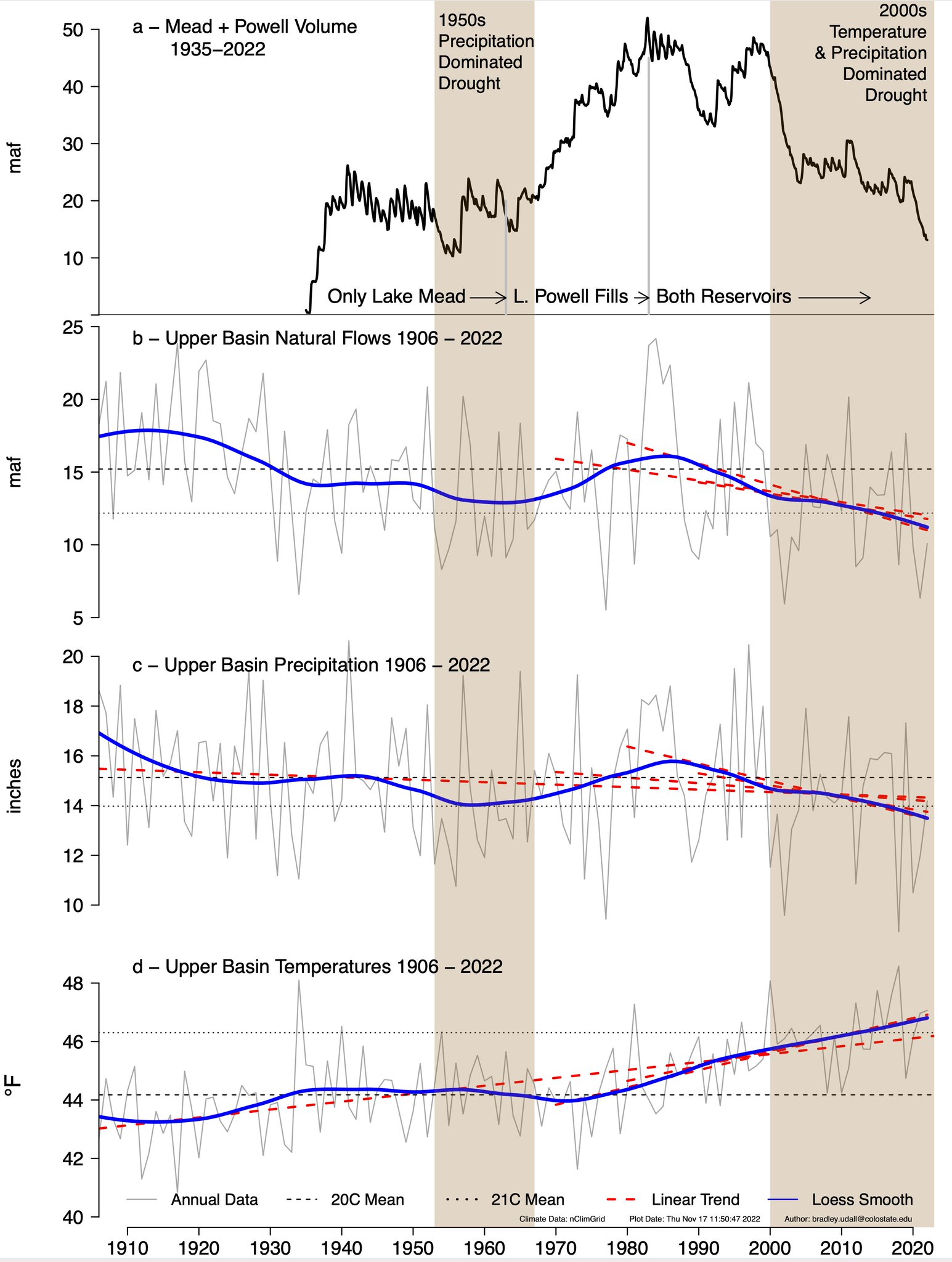
Updated Colorado River 4-Panel plot thru Water Year 2022 showing reservoirs, flows, temperatures and precipitation. All trends are in the wrong direction. Since original 2017 plot, conditions have deteriorated significantly. Brad Udall via Twitter: https://twitter.com/bradudall/status/1593316262041436160

2020 #COleg: #Gunnison ranch to loan #water for the environment — @AspenJournalism #Tomichi #GunnisonRiver

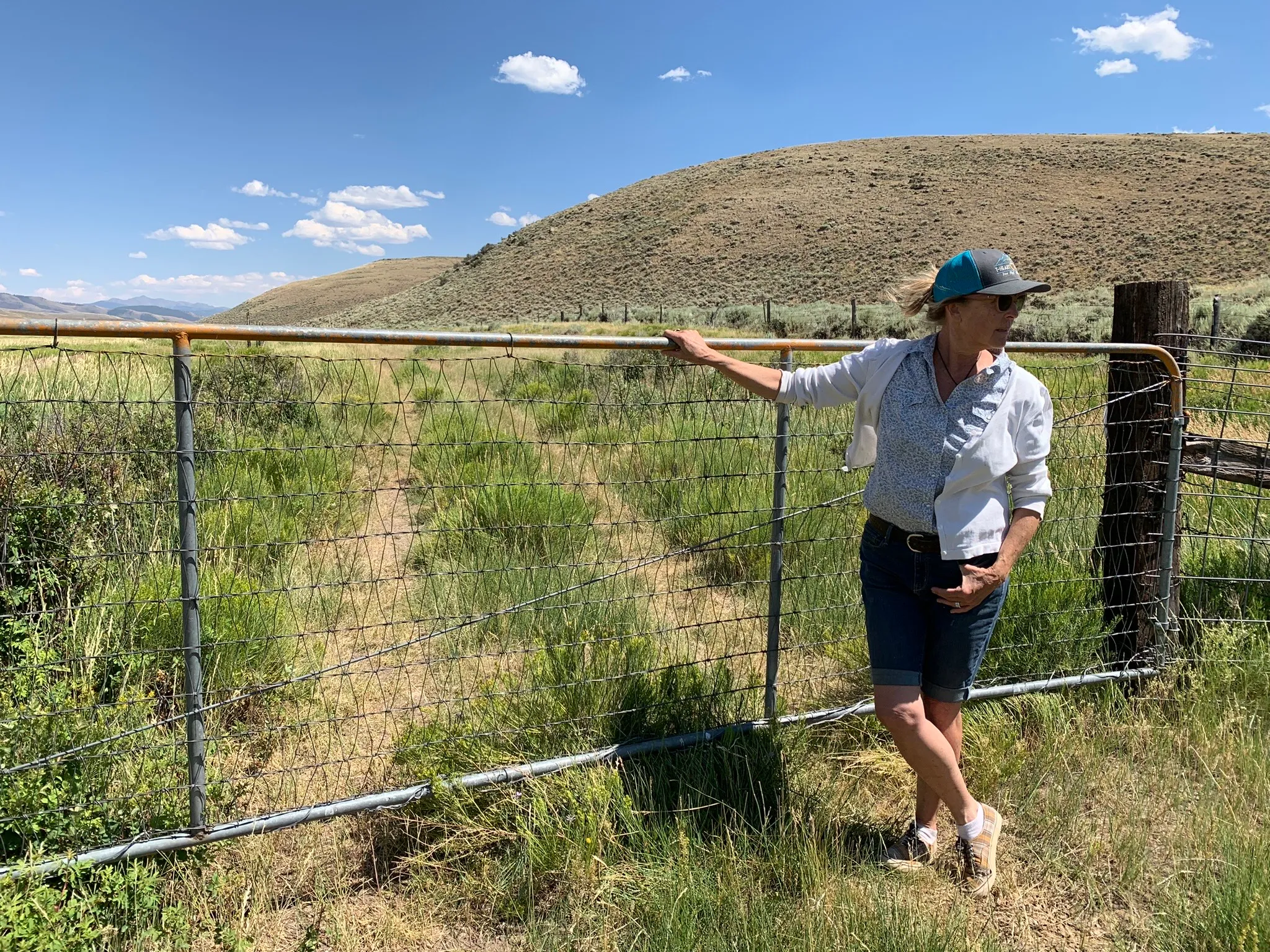
Kathleen Curry, owner of Peterson Ranch in Gunnison County, stands by a fence on her ranch on a breezy summer day. Peterson Ranch has an agreement to temporarily loan its agricultural water to the state’s instream flow program for the benefit of Tomichi Creek. CREDIT: HEATHER SACKETT/ASPEN JOURNALISM

Click the link to read the article on the Aspen Journalism website (Heather Sackett):

A Gunnison County family ranch plans to use a relatively new tool to help keep water flowing in a chronically dry section of creek while still irrigating their hay crop.

In dry years, the Peterson Ranch will temporarily loan some of the water it diverts from Tomichi Creek to the state’s instream flow program, which is aimed at keeping water in rivers for the benefit of the environment. The agreement was approved by the Colorado Water Conservation Board this year under legislation passed in 2020 designed to make the water loans more attractive to water-rights owners and effective as a conservation tool.

“We don’t like to see the fish suffer, so we thought this was one way to allow us to continue with our operation and do something for the creek,” said ranch owner, former legislator and Colorado River Water Conservation District board member Kathleen Curry. “For us, it was a way to make a contribution.” 

Historically, Curry and her husband, Greg Peterson, have flood irrigated their 220 acres of river bottom ranchland, about 15 miles east of Gunnison, beginning in the spring until the end of July. The end of spring runoff, combined with irrigation season, can cause river flows to plummet during the hottest time of year, which is bad news for fish.

“Historically, Tomichi Creek dries up in several locations,” said Tony LaGreca, a project manager for the Colorado Water Trust. “A dry-up is the complete worst thing to happen for an aquatic ecosystem because everything that needs water to live does not live.”

In late July, Curry and Peterson normally stop irrigating to allow their fields to dry out for a few weeks so that they can get their one annual hay cutting in August, during which time — with the help of monsoon rains — creek flows tend to rebound. They resume irrigating in the fall to regrow some pasture grass and to replenish the groundwater for the next season, which leads to another dip in river flows.

But with the lease agreement enacted, Curry and Peterson would turn off their four ditch headgates at the end of June and keep them off for 37 days — usually the hottest, driest time of year and when Tomichi Creek could most use a boost. By turning water off a month early, they expect to lose about 20% to 25% of their yield, for which they will be compensated nearly $25,000 by the nonprofit Colorado Water Trust. 

A second part of the agreement would let them irrigate in August and leave the water in the creek in September, when streamflows are lower. Peterson Ranch could get $2,500 if it enacts the lease in the second operational window. If they do both windows, they could get $30,000.

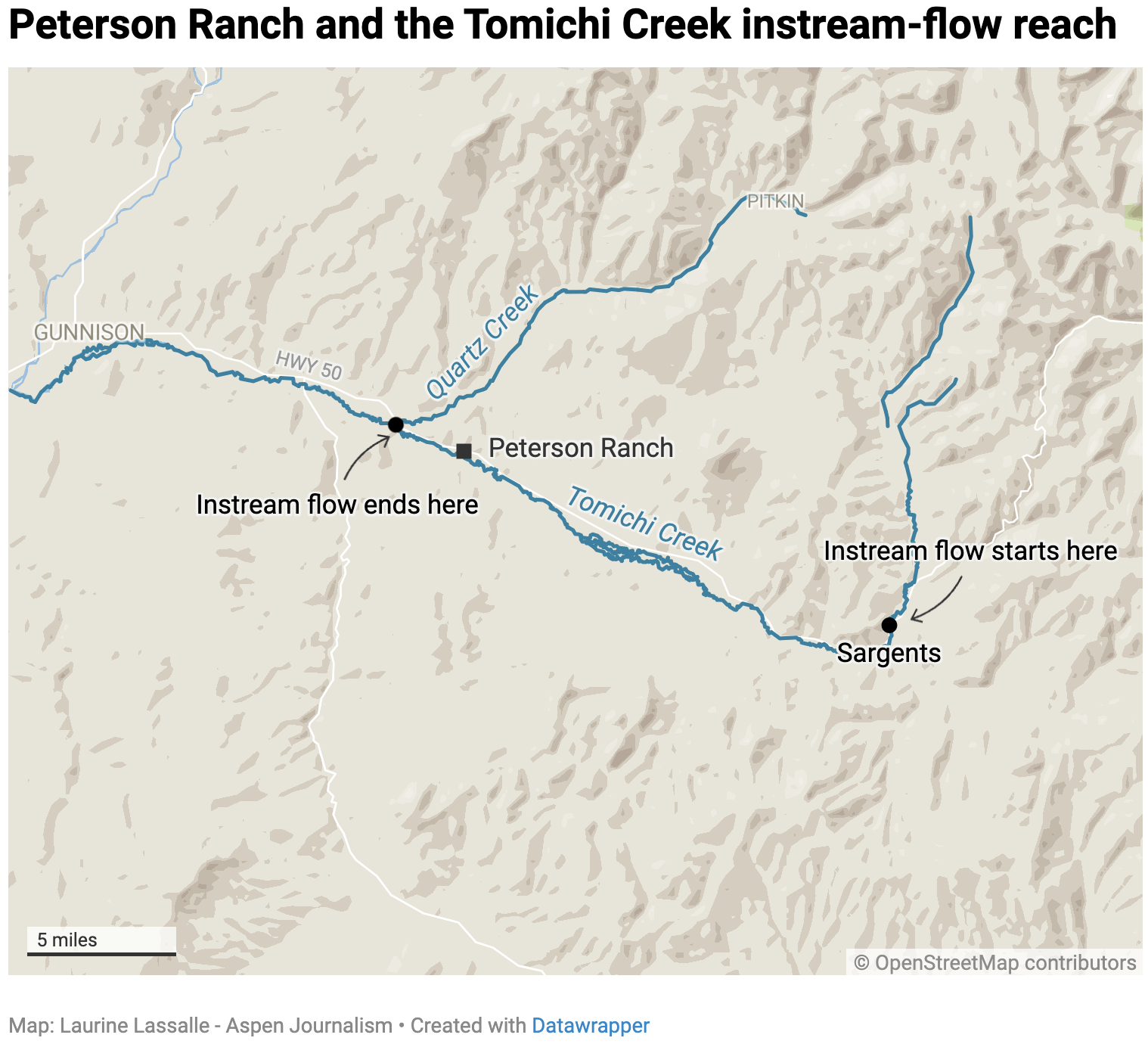
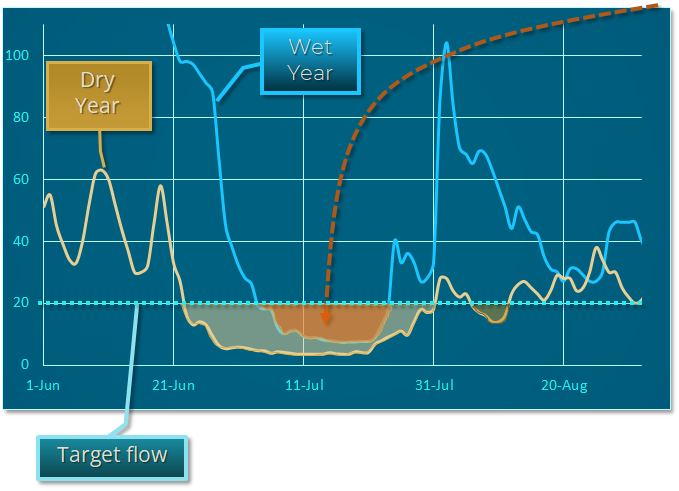
Over seven miles of Tomichi Creek would benefit from the loan of water. Depending on the location in the stream and time of year, the project could add between 2 and 18 cubic feet per second back to the stream for a total of 116 acre-feet of water conserved.

“It’s a win-win,” Curry said. “We can go with a little bit less yield and they are compensating us very fairly.”

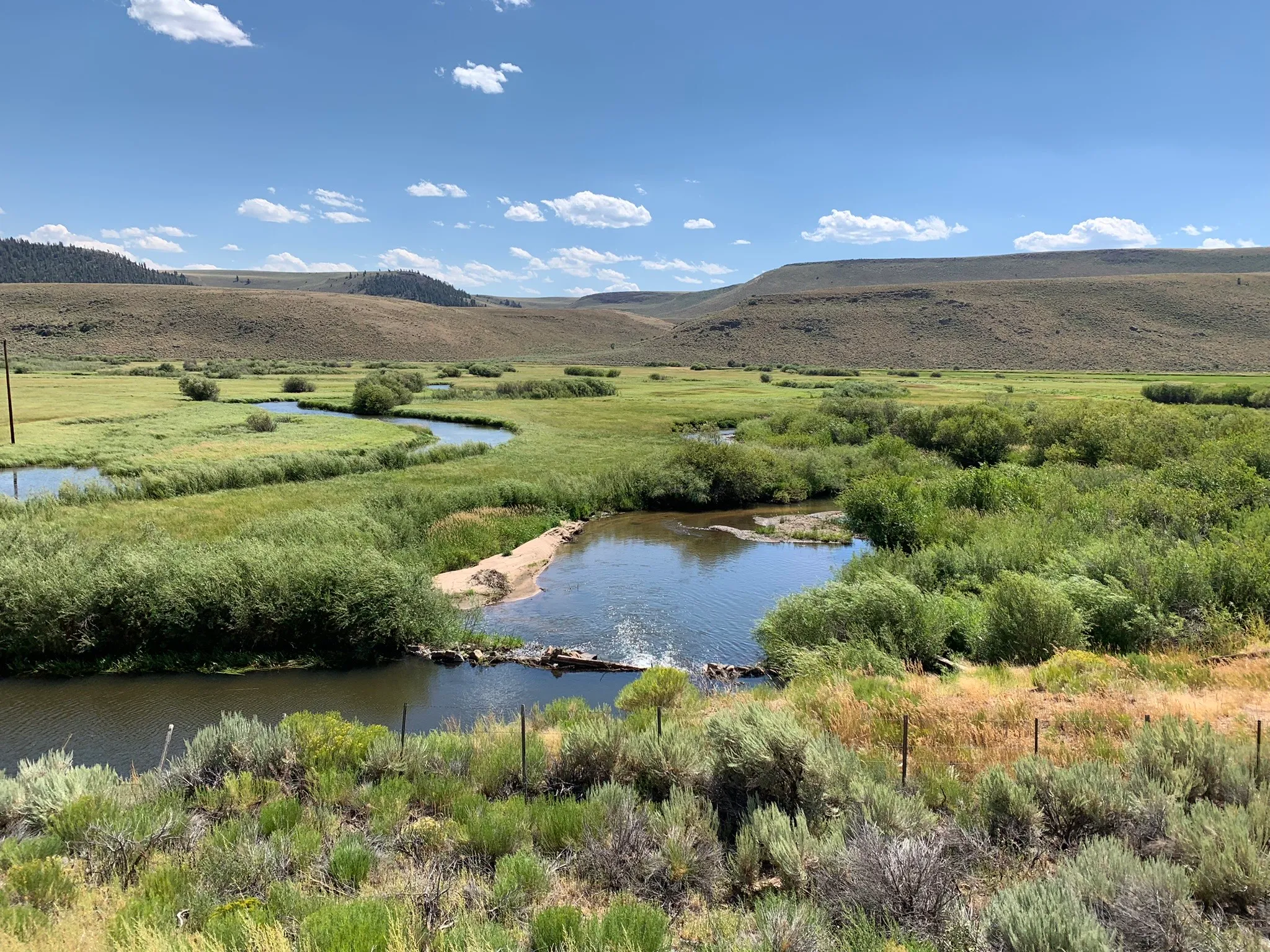
Tomichi Creek, a tributary of the Gunnison River, runs through the Peterson Ranch property. The Colorado Water Conservation Board holds an instream flow water right for 18 cfs on the creek in this stretch. CREDIT: HEATHER SACKETT/ASPEN JOURNALISM

Legal pathway 

The statute that allows irrigators to temporarily loan their water to the state’s instream flow program was originally crafted in 2005 with the help of Curry when she was a state representative. (Curry this week told Colorado Politics that she intends to run in 2024 to represent House District 58.)

The instream flow program allows the Colorado Water Conservation Board to appropriate water rights to “preserve the natural environment to a reasonable degree.” Since it was created in 1973, the CWCB has appropriated water rights on nearly 1,700 stream segments, covering more than 9,700 miles of streams, according to its website. But because these rights are so junior compared with most other water users, their effectiveness as a tool for keeping water in rivers is limited. 

Under the prior appropriation system — the cornerstone of Colorado water law — the holders of the oldest water rights, which usually belong to agriculture, get first use of the river. That means in many locations across the state, the much younger instream flow water rights — 18 cfs in the case of Tomichi Creek, with an adjudication date of 1980 — are not met. Temporary leasing of agricultural water to the instream flow is one way to remedy the problem. 

Still, the tool is not widely used, despite tweaks to the legislation in 2020 with House Bill 1157 that allowed projects to expand to being used five of every 10 years from three of every 10 years. The Peterson Ranch lease is one of just three projects using the five-in-10 lease program, according to CWCB staff. There are six other similar projects across the state that came about under the previous three-in-10 legislation.

“It doesn’t appear at the rate it’s being utilized, it’s going to solve environmental problems all across the state just like that,” said Kate Ryan, executive director of the Colorado Water Trust. “But on the streams and rivers where it’s used, it’s transformative. It makes a huge difference.”

The graph shows how, even in a wet year, a “July hole” sends Tomichi Creek flows below the targeted instream flow of 18 cfs. Credit: Colorado Water Trust

State Sen. Dylan Roberts, D-Avon, who represents District 8, was one of the sponsors of HB 1157. The bill also made it possible to renew loans for two additional 10-year periods, meaning that holders of agricultural water rights can theoretically loan their water for the benefit of the environment for 15 of every 30 years. Roberts said he has heard positive feedback about the expanded loan program.

“We’ve cut down some of the barriers and made it easier to participate but the whole time we’ve kept it voluntary,” Roberts said. “I think the tool is only going to become more important as we head further into drought and dry summers.”

Curry said she got involved with the original bill that created a legal pathway to loan water to ensure that it was workable for livestock producers. 

“The state is changing, and we have to face that there are other values for water,” she said. “We just need to make sure if we go down this path, these types of projects need conditions: They wouldn’t hurt ag, they wouldn’t hurt your neighbor, it’s voluntary — things like that.”

State engineers at the Division of Water Resources still need to give their final sign-off for the Peterson Ranch project to move forward. In the spring, Peterson Ranch will decide whether to enact the lease for 2024’s irrigation season. Ideal conditions for the agreement would be a below-average runoff year but not in the bottom 10%. 

Despite the lease program’s limited use so far, Ryan said she has seen more interest lately in partnerships among water-user groups. 

“We don’t have to choose between ag and the environment,” she said. “I think water users are seeing there is a natural partnership between ag and the environment. But it’s still complicated and takes a lot of work.”

Map of the Gunnison River drainage basin in Colorado, USA. Made using public domain USGS data. By Shannon1 – Own work, CC BY-SA 4.0, https://commons.wikimedia.org/w/index.php?curid=69257550