

From the Colorado Water Conservation Board (Katie Weeman):
Introduction
Good morning. My name is Becky Mitchell and I am proud to be joining you as Colorado’s first, full-time Colorado River Commissioner. This change took effect on July 1st. With thanks to the General Assembly and Governor Polis, I stepped out of the CWCB Director role – which is now in Lauren’s very capable hands – and have dedicated myself full-time to protecting our state’s significant interests in the Colorado River. The Commissioner role is a unique one. I am charged by the Governor to represent the state in interstate Colorado River matters, which includes all of our diverse water users, sectors, and geographies. It is not a role that I take lightly. And I truly appreciate the support that so many of you have lent as we shape the future of the Colorado River. I’d like to take “the last word,” as the agenda says, to update you on interstate Colorado River matters; plus, what I’m doing to push everyone in the basin to live within its means –- something we in Colorado have always done.
The past year has been tumultuous for the Colorado River. Last summer, when we gathered here in Steamboat, the Upper Division States had just completed the Five Point Plan in response to Commissioner Touton’s call for the basin states to conserve 2 to 3 million acre-feet. To put that in perspective: Colorado, New Mexico, Utah, and Wyoming – combined – used three and a half million acre-feet in 2022.
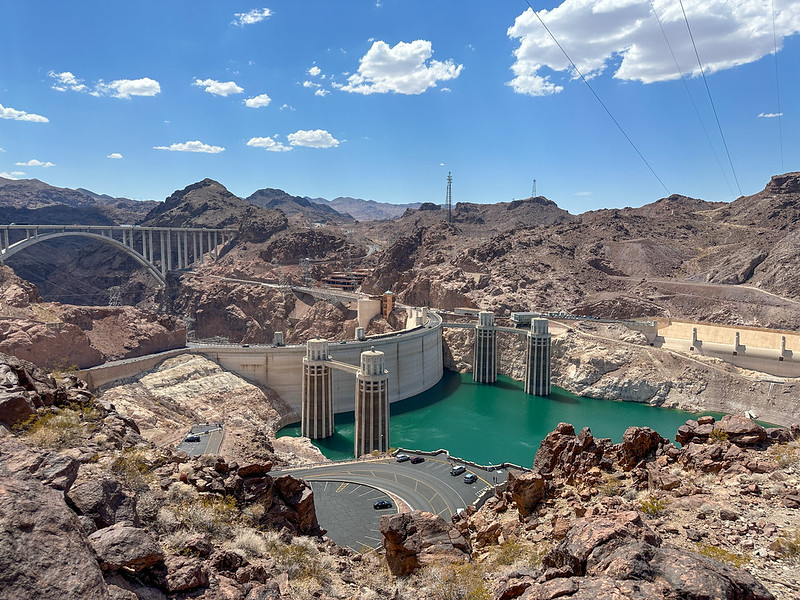
You’ll remember how bad the situation was. The reservoirs were declining quickly, with daily headlines in the papers. The federal government took emergency action to reduce releases from Lake Powell. The Upper Division States provided DROA water from Upper Basin reservoirs to prop up elevations at Lake Powell. You might also remember how the Lower Basin was unable and unwilling to reach agreement to do their part to conserve water.

The Five Point Plan showed the federal government that the Upper Division States are united, committed to being part of the solution, and limited in the scale of what we can do.
One of the five points was a commitment to pursue water conservation on a voluntary, temporary, and compensated basis through the System Conservation Pilot Program (SCPP). After an incredibly fast reauthorization by Congress, the UCRC launched SCPP earlier this year. Contracts were temporary – for just one year; completely voluntary; and fairly compensated – on average, $422 an acre-foot. All conserved water became system water, used to mitigate the impacts of drought in the Upper Basin. In total, the Upper Basin conserved less than 38,000 acre-feet of water in 64 projects; 2,700 acre-feet of which was conserved by 22 projects in Colorado.
A second point in the Five Point Plan was to continue the Demand Management Feasibility Investigation. Like SCPP, Demand Management would be a temporary, voluntary, and compensated program. The difference is that water conserved in a Demand Management program would be stored in a pool to ensure ongoing Compact compliance for the Upper Division States. Each Upper Division State must find that a Demand Management program is feasible for their state, before any such program could be established. We’ve been discussing Demand Management for a few years now. I want to take a quick second to thank you all for your continued engagement on the topic. Regardless of whether Colorado moves forward with any such program, your input – and debates – have shaped our state’s understanding of conservation programs overall.
Then – and now – the Upper Division States recognized that we did not cause and cannot solve the problem. Overuse in the Lower Basin has driven the Colorado River System into crisis. But inaction is not the answer.
COMPACT COMPLIANCE EMPHASIS
I want to pause here to emphasize something that is so, so important to say: even in the driest of years, the Upper Division States have never been out of compliance with the Compact. We are not even close. If flows at Lees Ferry fall below 75 million acre feet over a 10-year period, it would prompt an inquiry into the cause. If the cause is something other than our depletions, we have not violated the Compact. Remember, we are currently using less than half the flows of the River and less than half of what the Compact apportioned to us.
My team takes the importance of protecting Colorado’s legal interests very seriously. The Compact assures us the ability to develop our half of the river into perpetuity – at our own pace, without risk of a Lower Basin giant guzzling up our share.
I can’t say this clearly enough: Colorado is not at risk of Compact curtailment. We do ourselves a disservice by suggesting otherwise and play right into the Lower Basin’s strategies.
COLORADO RIVER UPDATES – SEIS & Post 2026
Now, back to our recap of the last year. Even to those who actively read about the Colorado River, the issues have been complicated by two distinct federal processes
The first process – the Supplemental Environmental Impact Statement to revise the ‘07 Guidelines – started in late 2022 to provide the Bureau of Reclamation with additional tools to protect Glen Canyon and Hoover Dams between now and 2026. Specifically, the SEIS could change operations at Lake Powell and Lake Mead in the near-term to allow for lower releases out of those reservoirs. Last January, I was driving back-and-forth between Water Congress and a Basin States meeting, trying to reach an agreement with our neighbors about what input to provide to the federal government on this process. Ultimately, six states signed a letter urging the Bureau of Reclamation to consider several options for reductions in uses in the Lower Basin, including assessment of evaporation and transit losses. Fast forward to spring, and Reclamation released a draft SEIS with two action alternatives and one no-action alternative. No alternative reached upstream to the Upper Basin – each was focused on reducing uses downstream of the reservoirs. In response, the Lower Basin States negotiated a different proposal, which they say will conserve 3 million acre-feet. The Upper Division States agreed to transmit that plan to Reclamation for analysis. We are expecting their findings in the coming weeks, and a revised Draft EIS should provide this analysis. To be clear: while we applaud our downstream neighbors’ efforts to conserve water, the Upper Division States did not, and cannot, endorse the Lower Basin’s proposal. We have not yet seen enough detail about the conservation efforts.
But please keep in mind: this SEIS would develop a short-term fix for the ‘07 Guidelines, which have proved inefficient to protect the System.
This year’s hydrology has given us a much-needed reprieve, but it has not changed the fundamental challenges we still face. We must re-focus our efforts on developing longer-term solutions for management of Lake Powell and Lake Mead. This is the only way to stop living crisis to crisis on the Colorado River.
That brings me to the second federal process – in June, the federal government announced the Post-2026 Environmental Impact Statement Process, which will develop new operating guidelines for Powell and Mead. To be blunt: this is the process that matters the most for Colorado. The current guidelines, the ‘07 Guidelines, have been gamed by the Lower Basin. They have knowingly maximized releases from Powell for decades, simultaneously draining Mead and ignoring basic physics like evaporation and transit losses. The silver lining is that the ‘07 Guidelines were interim, by design, so that we could learn from their implementation – and we did learn a lot.
IRREFUTABLE TRUTHS
The ‘07 Guidelines have illustrated why Colorado and the Upper Division States must care about sustainable operations at Lake Powell and Lake Mead. We cannot have our fate tied to continued Lower Basin overuse.

I met with many of you, with the Tribal Nations, with entities like the Basin Roundtables, IBCC, and conservancy districts, to develop my guiding principles for the post-2026 negotiation.
First, we must acknowledge that climate change is real. We can’t count on decades like the 80s and 90s; we need to be prepared for years like the early 2000s. Our future is going to be drier and more variable.
Second, water users in the Lower Basin are not more important than water users in the Upper Basin. The Upper and Lower Basins have equal apportionments to the river in perpetuity, established by the 1922 Colorado River Compact. We are not re-negotiating the Compact, and any guidelines for post-2026 operations at Lake Powell and Lake Mead must be rooted in the Compacts and the Treaty with Mexico.
.
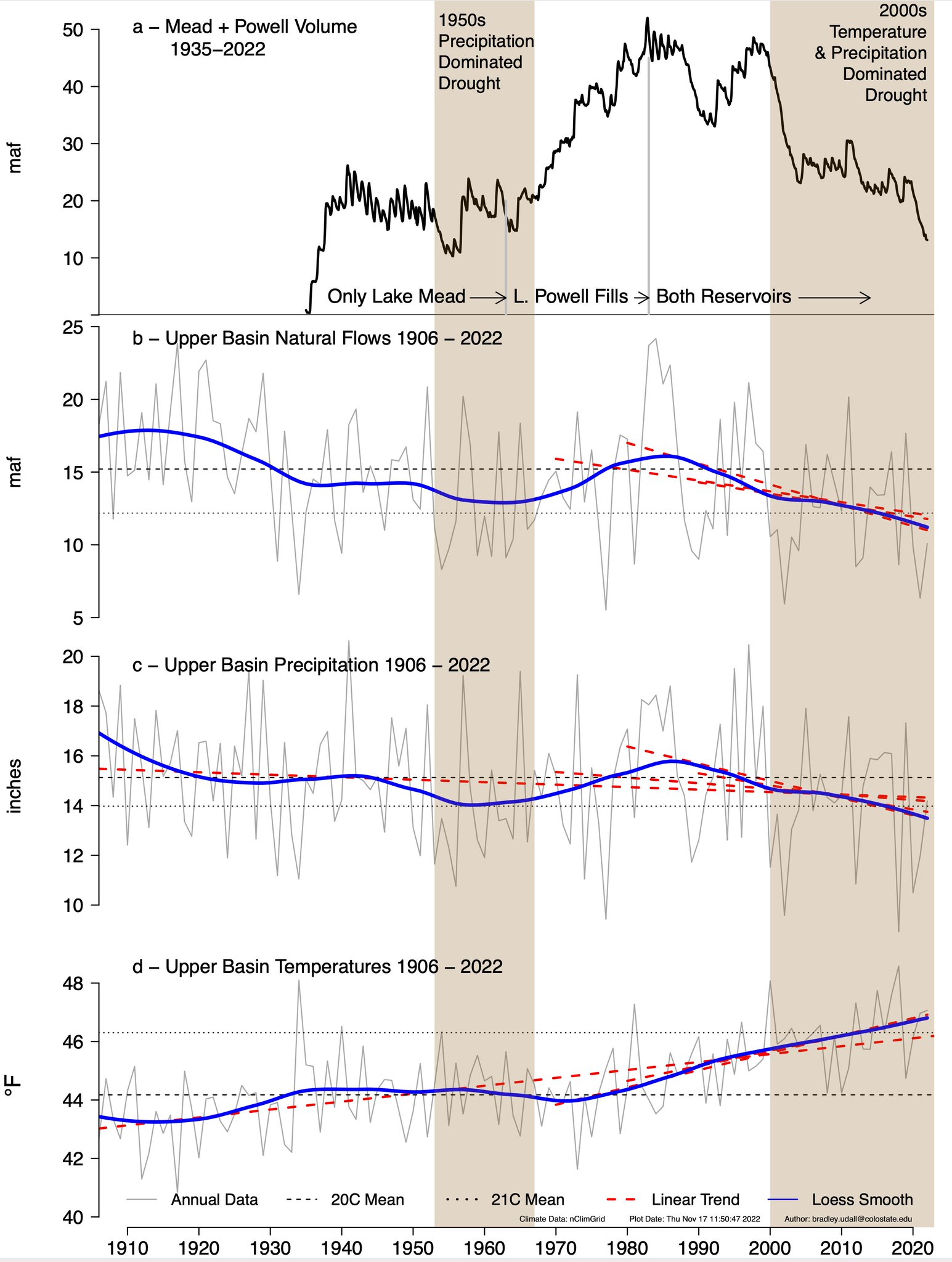
Third, the Colorado River is not providing enough to sustain overuse in the Lower Basin. We’ve seen the reservoirs crash to critically low levels. Water use in the Lower Basin cannot continue to exceed available supplies and operations of Lake Powell and Lake Mead must better respond to actual hydrology. The Lower Basin must account for all depletions, including evaporation and transit losses.
Fourth, Compact curtailment is not an option. The Upper Basin is apportioned half of the river’s flows in perpetuity, and we are using a lot less that.
Fifth, operations at Lake Powell and Lake Mead must respond to actual hydrology and available water supplies. This will be hard for water users in the Lower Basin because it will demand change. Lake Powell releases must be determined by actual hydrology and protecting storage rather than by Lake Mead conditions.

Sixth, the Tribal Nations have federal reserved water rights that must be preserved. The Tribal Nations have water rights that they are entitled to use. Solutions for overuse in the Lower Basin cannot continue to depend on Tribes’ undeveloped federal reserved water righ.
And finally, we need solutions that comply with federal environmental law and advance coordination between the United States and Mexico.
I am honored to be Colorado’s interstate negotiator, and will stand firm by these principles. Future operations must live within the means of the river.
UNITY
We are in difficult negotiations with the Basin States, and I suspect things will get harder before they get easier. From experience, I know we are better when we stand together as seven basin states. But I also know we must be ready to stand alone when necessary to defend our significant interests in the river. The only way that I can stand alone in the basin is if Colorado can stand together as a state.
I have worked hard to facilitate unity across our state – and a huge thank you to you who’ve organized meetings, rearranged agendas, and teed up discussions with me. Unity is a two-way street. While I work to understand the needs and concerns of Colorado’s diverse water users, diverse water users work to understand the needs and concerns of other people in the state. Unity does not necessarily mean agreement. It’s not an echo chamber – Coloradans have never seen eye-to-eye on all of our water issues, and the post-2026 negotiations will be no different. But unity does mean that we’re good-faith actors with one another; that we agree to protect Coloradans’ rights on our namesake river; and that we commit to finding shared values where we can.
As Commissioner, I represent the entire state – all of our diverse interests and needs. It is so important that we put our best foot forward on the matters where we are unified, while leaving room for difficult discussions to continue within our state.
CONCLUSION
The post-2026 negotiations matter to Colorado: we must seek operations that are responsive to climate change and actual hydrology. I hope you’ll stay interested, involved, and committed to a future where all in the basin live within the means of the river. You have heard me say it before, but I am going to say it again: we are at a critical juncture on the Colorado River. We have an opportunity to negotiate a better deal on how Lake Powell and Lake Mead are operated – a better deal for our State and also for the 40 million people who depend on this critical resource. I am bringing all of myself and the State’s resources to this effort, and I will need each of you, too.
Thank you all for your continued support.
