Click the link to read the article on the Aspen Journalism website (Heather Sackett):
A Carbondale ditch company is looking for sources of funding after 30-foot-deep sinkholes caused the ditch to collapse in early September, cutting off water to downstream irrigators.
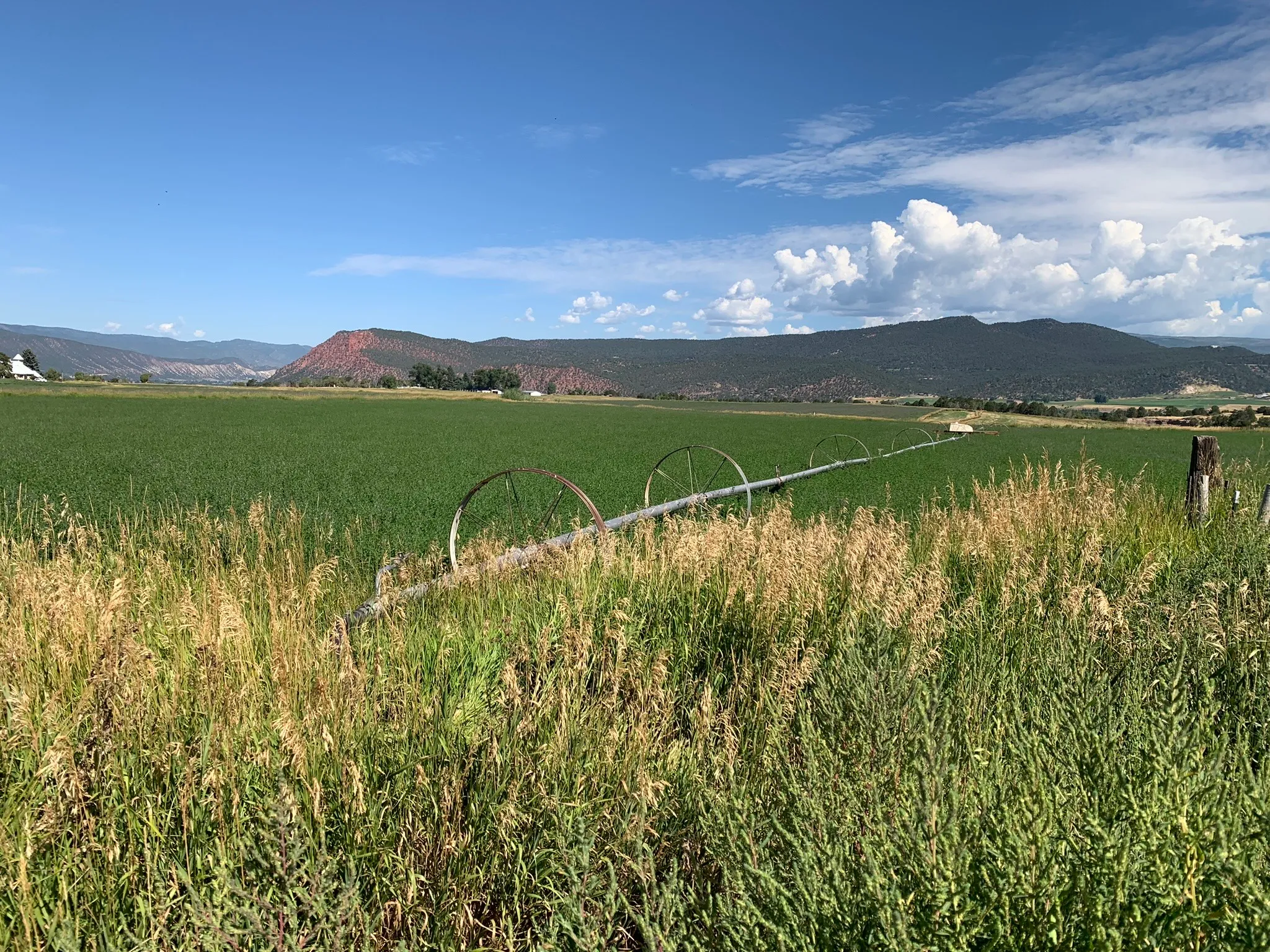
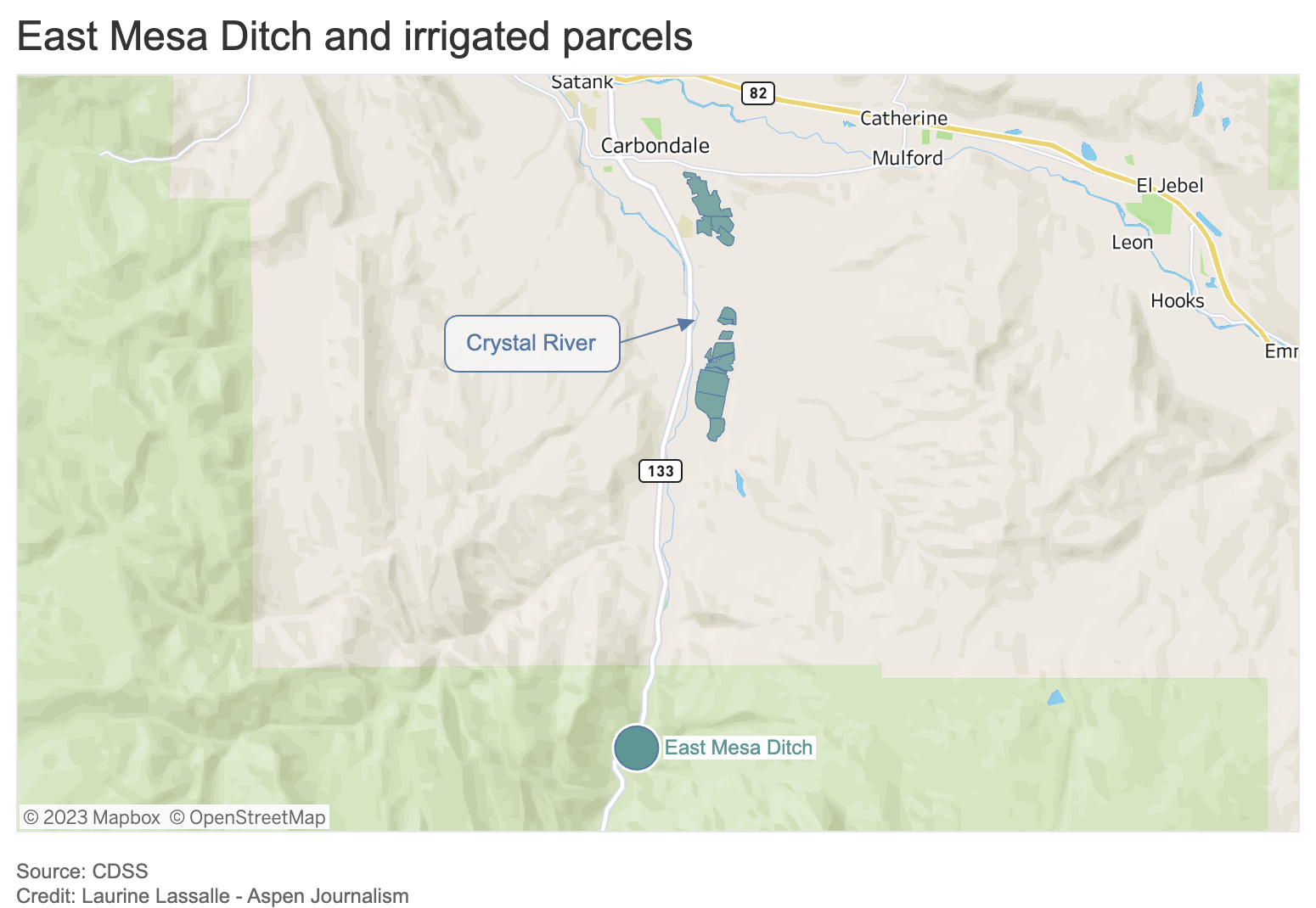
The East Mesa Ditch pulls water from the Crystal River mostly to irrigate about 740 acres of hay and alfalfa south of Carbondale. The ditch operator, East Mesa Water Co., received approval Sept. 20 for an emergency loan up to $418,140 from the Colorado Water Conservation Board to pipe the ditch and relocate it away from the area prone to sinkholes. The piped section will include a siphon and be about 1,500 feet long.
According to the CWCB memo, about 34% of the acres irrigated by the East Mesa Ditch are currently without water. The ditch is able to pull 41.8 cubic feet per second from the Crystal River using two water rights, the oldest of which dates to 1902.
East Mesa Water Co.’s secretary and treasurer, Richard McIntyre, said at the Pitkin County Healthy Rivers board meeting in September that the company would like to repair the ditch as soon as possible — definitely before next irrigation season — but first, they have to do a geophysical investigation so that they can avoid more sinkhole issues in the future. The ditch company, which has 12 shareholders, also plans to ask for grant money from the Colorado River Water Conservation District’s Community Funding Partnership as well as the Healthy Rivers program.
McIntyre and water company president Tim Nieslanik gave a presentation during the Healthy Rivers board meeting, held Sept. 21, but declined to speak further with Aspen Journalism. They have not yet asked Healthy Rivers for a specific amount of money.
“That is really going to depend on what the geophysicist discovers in this mesa and where the stable ground is,” McIntyre said. “You guys know water is kind of the lifeline for the ranchers here. Without it, we’re washed up, so to speak.”

Some Pitkin County Healthy Rivers board members see the East Mesa Ditch repair project as not only an opportunity to help local agricultural producers but a chance to potentially benefit the Crystal River.
“We are excited about opportunities where we can both help out the ranchers and farmers that are being hurt by this damage to the canal but also set ourselves up for a partnership in the future where we can look at opportunities for water savings that can potentially be returned to the environment or ways to manage the ditch in a way that benefits the Crystal River more so than it has in its current state,” Healthy Rivers board vice chair Kirstin Neff said.
On the Western Slope, agriculture efficiency infrastructure projects — such as upgrading headgates and diversion structures, lining and piping ditches, and replacing flood-irrigated meadows with sprinkler systems — are often funded with grants from public entities and environmental organizations. Pitkin County Healthy Rivers also helped to fund repairs to the East Mesa Ditch in 2016.
The idea is that when irrigators have more-efficient systems, they don’t need to take as much water from the river, leaving more for the benefit of the environment and recreation. But whether these agricultural efficiency projects actually result in more water in the river is unclear. Some say it’s likely that if irrigators can more easily access their full water right, they will use more — unless they are paid not to do so.
At the Sept. 21 meeting, Neff asked how the project would support Healthy Rivers’ mission, which is to improve the water quality and quantity in the Roaring Fork River watershed.
Nieslanik responded that the East Mesa Water Company is interested in leasing some of their water for the benefit of the environment. An example of this is a program that allows irrigators to temporarily loan water to the state’s instream flow program. Colorado water law was tweaked in 2020 to make it more attractive to water-rights holders and effective as a conservation tool, and ranchers in the Gunnison River basin are leasing their water through this program.
“We’d actually like to lease water to help pay back these loans,” Nieslanik said. “We have water at certain periods of time in the year after second cutting. … We would like to consider the ways that our additional water could be a monetary source for us, as well as maybe a safety net for municipalities.”
Representatives of the East Mesa Water Co. have said in the past they would be open to leaving water in the river. Also, they have let other water users borrow some of the ditch’s flow in the past. During an August 2018 first-ever call on the Crystal River, the East Mesa Ditch loaned 1 cfs to the town of Carbondale under an emergency substitute water supply plan.
“We bailed them out. They kindly sent us a check six months later for $10,000,” Nieslanik said. “We would love to do something the same way with you guys if you can help us fund this somehow.”
Nieslanik added that the company would like to get more irrigators to use sprinkler systems, which are more efficient than flood irrigation.
Finding creative arrangements with irrigators to boost streamflows on the Crystal during dry periods has long been a desire of some Healthy Rivers board members. So far, there has been just one such nondiversion agreement between rancher Bill Fales and the Colorado Water Trust that aims to leave more water in the Crystal River that he would usually divert using the Helms Ditch late in the irrigation season of dry years.
At the Sept. 21 meeting, Pitkin County Attorney John Ely voiced his approval for the county’s funding the East Mesa Ditch piping project. With agricultural water users laying claim to 86% of the water used in Colorado, many water managers who are focused on the environment agree that working with them instead of against them is the best way forward.
“The question is: How can we stay true to our charter of maintaining streamflow while helping somebody divert water from the river?,” Ely said. “You simply can’t preserve water in the river at all without someone you can work with and someone who holds a relatively senior water right. … You can’t solve the riddle of how to protect streamflow without working with agriculture.”
This story ran in the Oct. 1 edition of The Aspen Times and the Oct. 3 edition of the Grand Junction Sentinel.