Biden-Harris Administration Announces Next Steps to Protect the Stability and Sustainability of #ColoradoRiver Basin — Reclamation #COriver #aridification #LakePowell #LakeMead

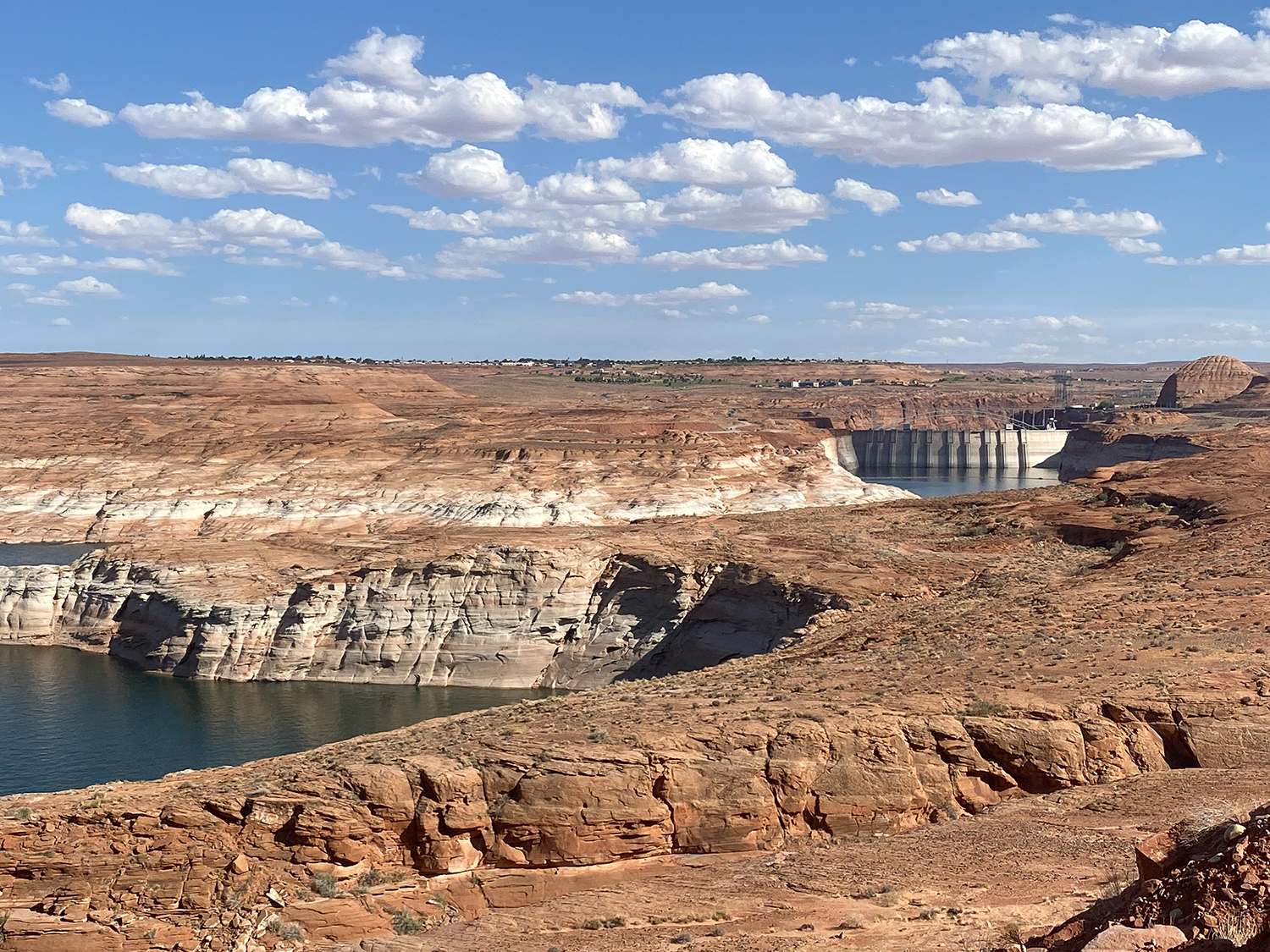
View of Glen Canyon Dam from Lake Powell. Photo credit: USBR

Click the link to read the release on the Reclamation website:

Oct 25, 2023

WASHINGTON – The Biden-Harris administration today announced next steps in the Administration’s efforts to protect the stability and sustainability of the Colorado River System and strengthen water security in the West. The Department of the Interior’s Bureau of Reclamation released a revised draft Supplemental Environmental Impact Statement (SEIS) as part of the ongoing, collaborative effort to update the current interim operating guidelines for the near-term operation of Glen Canyon and Hoover Dams to address the ongoing drought and impacts from the climate crisis.

In order to protect Glen Canyon and Hoover Dam operations, system integrity, and public health and safety through 2026 – at which point the current interim guidelines expire – an initial draft SEIS was released in April 2023. Following a historic consensus-based proposal secured by the Biden-Harris administration in partnership with states – which committed to measures to conserve at least 3 million-acre-feet (maf) of system water through the end of 2026 enabled by funding from President Biden’s Investing in America agenda – Reclamation temporarily withdrew the draft SEIS to allow for consideration of the new proposal.

Today’s revised draft SEIS includes two key updates: the Lower Basin states’ proposal as an action alternative, as well as improved hydrology and more recent hydrologic data. The release of the revised draft SEIS initiates a 45-day public comment period.

“Throughout the past year, our partners in the seven Basin states have demonstrated leadership and unity of purpose in helping achieve the substantial water conservation necessary to sustain the Colorado River System through 2026,” said Deputy Secretary Tommy Beaudreau, who led negotiations on behalf of the Administration. “Thanks to their efforts and historic funding from President Biden’s Investing in America agenda, we have staved off the immediate possibility of the System’s reservoirs from falling to critically low elevations that would threaten water deliveries and power production.”

“The Colorado River Basin’s reservoirs, including its two largest storage reservoirs Lake Powell and Lake Mead, remain at historically low levels. Today’s advancement protects the system in the near-term while we continue to develop long-term, sustainable plans to combat the climate-driven realities facing the Basin,” said Reclamation Commissioner Camille Calimlim Touton. “As we move forward in this process, supported by historic investments from the President’s Investing in America agenda, we are also working to ensure we have long-term tools and strategies in place to help guide the next era of the Colorado River Basin.”

Key Components of Revised Draft SEIS

Reclamation conducted updated modeling analyses using June 2023 hydrology for the No Action Alternative, Action Alternatives 1 and 2 from the initial draft SEIS, and the Lower Division proposal. The results of that modeling indicate that the risk of reaching critical elevations at Lake Powell and Lake Mead has been reduced substantially. As a result of the commitment to record volumes of conservation in the Basin and recent hydrology, the chance of falling below critical elevations was reduced to eight percent at Lake Powell and four percent at Lake Mead through 2026. However, elevations in these reservoirs remain historically low and conservation measures like those outlined by the Lower Division proposal will still be necessary to ensure continued water delivery to communities and to protect the long-term sustainability of the Colorado River System.

Based on these modeling results, Reclamation will continue the SEIS process with detailed consideration of the No Action Alternative and the Lower Division Proposal. The revised SEIS designates the Lower Division Proposal as the Proposed Action. Alternatives 1 and 2 from the initial SEIS were considered but eliminated from detailed analysis.

Historic Funding from Investing in America Agenda     

President Biden’s Investing in America agenda is integral to the efforts to increase near-term water conservation, build long term system efficiency, and prevent the Colorado River System’s reservoirs from falling to critically low elevations that would threaten water deliveries and power production. Because of this funding, conservation efforts have already benefited the system this year.

This includes eight new System Conservation Implementation Agreements in Arizona that will commit water entities in the Tucson and Phoenix metro areas to conserve up to 140,000-acre feet of water in Lake Mead in 2023, and up to 393,000-acre feet through 2025. Reclamation is working with its partners to finalize additional agreements. These agreements are part of the 3 maf of system conservation commitments made by the Lower Basin states, 2.3 maf of which will be compensated through funding from the Inflation Reduction Act, which invests a total of $4.6 billion to address the historic drought across the West.

Through the Bipartisan Infrastructure Law, Reclamation is also investing another $8.3 billion over five years for water infrastructure projects, including water purification and reuse, water storage and conveyance, desalination and dam safety.

To date, the Interior Department has announced the following investments for Colorado River Basin states, which will yield hundreds of thousands of acre-feet of water savings each year once these projects are complete:

The process announced today is separate from the recently announced efforts to protect the Colorado River Basin starting in 2027. The revised draft SEIS released today would inform Reclamation’s ongoing efforts to set interim guidelines through the end of 2026; the post-2026 planning process advanced last week will develop guidelines for when the current interim guidelines expire.
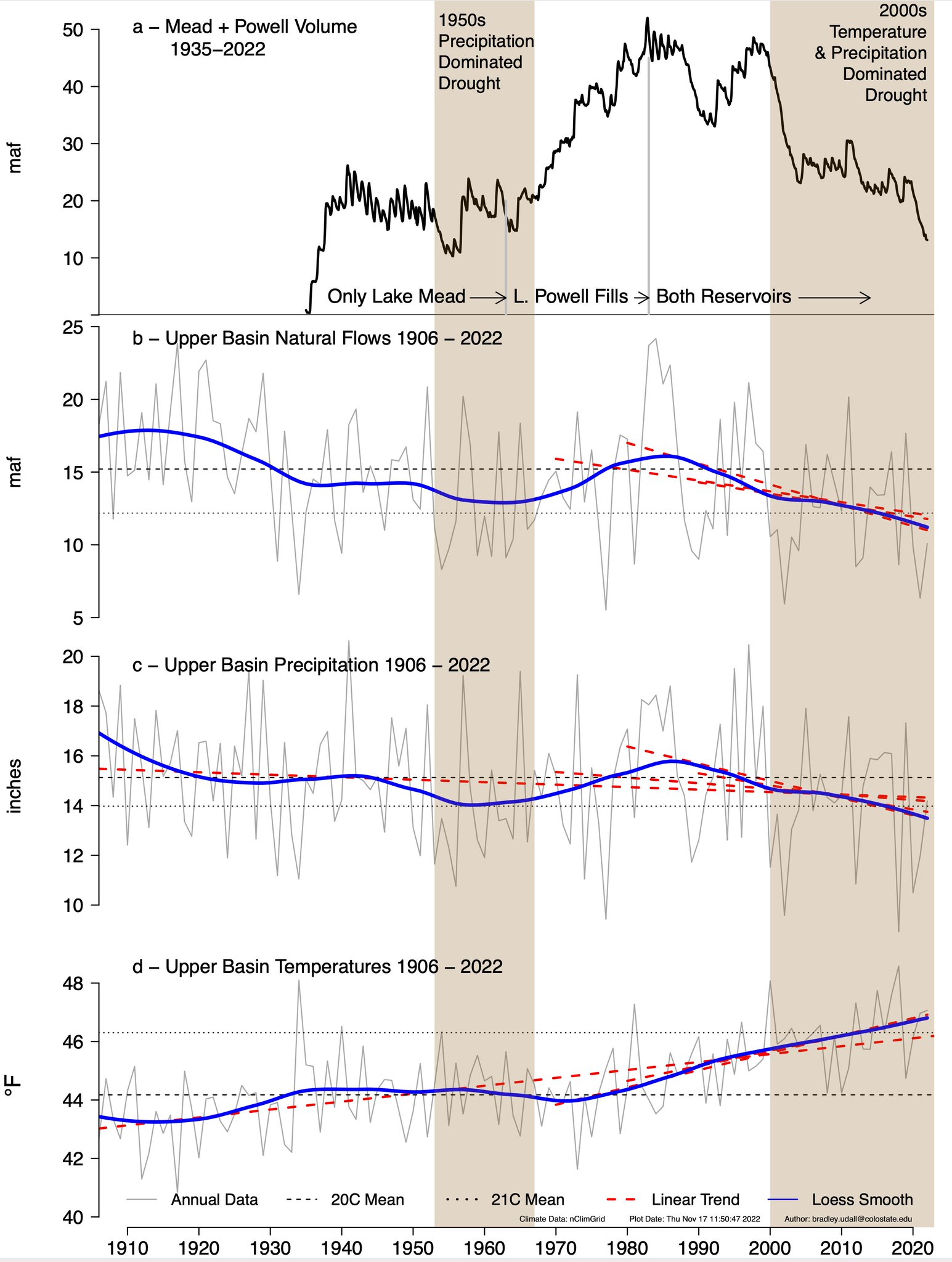
Updated Colorado River 4-Panel plot thru Water Year 2022 showing reservoirs, flows, temperatures and precipitation. All trends are in the wrong direction. Since original 2017 plot, conditions have deteriorated significantly. Brad Udall via Twitter: https://twitter.com/bradudall/status/1593316262041436160

Greeley’s #wastewater treatment plant improves water quality with $35.5M project — The #Greeley Tribune

Wastewater Treatment Process

Click the link to read the article on The Greeley Tribune website (Trevor Reid). Here’s and excerpt:

The city recently completed a $35.5 million project expanding the treatment plant’s capacity and improving the quality of water the city discharges into the river. Though the city plans to rebuild and improve the front end of the process, the city’s Nitrification Project mostly expanded the capacity for biological treatment processes that remove nitrogen and phosphorous to meet state and federal regulations…Nitrogen and phosphorus support the growth of algae and aquatic plants, but too much causes algae to grow faster than ecosystems can handle, according to the Environmental Protection Agency. Algae blooms can severely reduce or eliminate oxygen in the water, harming fish populations and elevating toxins and bacterial growth in the water…

The city contracted with Garney Construction to complete the improvements at the plant, which took about 200,000 hours of work. Cadee Oakleaf, the project manager, said everyone involved had to plan carefully to prevent any interruptions in service to Greeley water customers. This included temporary piping throughout the plant and working overnight as wastewater collected in an empty basin when work required the plant to temporarily stop a step in the process.

“It was very meticulous planning, planning for months ahead of time at times,” Oakleaf said. “To bring on the new basins, we actually started talking about it a year in advance.”

Lab testing and real-time measurements at the plant have indicated the project was successful at further removing nitrogen and phosphorus, [Tyler] Eldridge said.

A final environmental report for FortCollins’ Halligan Reservoir expansion is out — The #FortCollins Coloradoan #PoudreRiver

Halligan Reservoir. Photo credit: The City of Fort Collins

Click the link to read the article on the Fort Collins Coloradoan website (Rebecca Powell). Here’s an excerpt:

A final environmental impact statement for Fort Collins’ proposed Halligan Reservoir expansion is out, and now the public has about a month to weigh in on it. The Halligan Reservoir project north of Fort Collins would expand the reservoir from 6,400 acre-feet to 14,600 acre-feet to help the city meet its projected water demands through 2065. The reservoir stores water from the Poudre River, which makes up half of Fort Collins Utilities’ water supply.

“The project will provide added space to store Utilities’ water rights, enabling a more robust, resilient, and reliable water supply for Utilities’ current and future customers,” according to a news release from Fort Collins Utilities.

The project would require excavation and would discharge dredged or fill material into the North Fork of the Cache la Poudre River and adjacent wetlands, so it requires approval from the U.S. Army Corps of Engineers under the federal Clean Water Act. Since a draft environmental impact study, or EIS, came out in 2019, the city has modified its plans to address some challenges in meeting guidelines for dam safety and construction. Rather than raising the height of the current dam by about 25 feet, it now plans to build a replacement dam that is 26 feet higher than the current dam. It would be located about 200 feet downstream. The existing dam, which is more than 110 years old, would be either partially or fully removed.

Water Year 2023 in Context: A Cautionary Tale — Center for #ColoradoRiver Studies (Jack Schmidt) #COriver #aridification

Photo credit: Center for Colorado River Studies

Click the link to read the article on the Utah State University website (Jack Schmidt):

The end of September marked the end of Water Year 2023 (WY2023). This is a good time to take stock of the year’s runoff and to understand how much reservoir storage improved. What kind of a year was WY2023? How long will any added storage last? Can we ease our collective effort to reduce consumptive uses and losses in the basin?

In Summary

The short answer is that WY2023 was certainly a good year for runoff, reservoir inflow, and increases in reservoir storage—but the same amount of inflow would have to occur for several additional years to fully recover storage to what it was in summer 1999 when the system was last full.  Such a string of high flow years has not occurred in the 21st century and is unlikely in the future.

History also warns that we should work to conserve the gains of WY2023. In notably wet WY2011, WY2017, and WY2019, extra storage that accumulated during each year’s snowmelt runoff was totally consumed in approximately two years. Thus, our past shows that there is potential to quickly consume the benefits of a good water year. We’ve done it before. It is imperative to keep a keen eye toward accomplishing significant reductions in water use throughout the basin to save what we have gained. We should not expect Mother Nature to bail us out again.

The Details

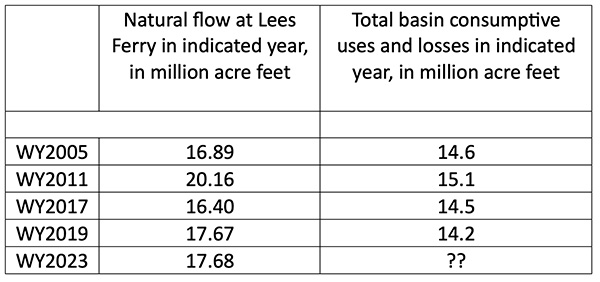
Estimates of WY2023 unregulated inflow and natural flow indicate that the year’s runoff was the second largest in the 21st century, exceeded only by WY2011. The Colorado Basin River Forecast Center estimates that the April to July unregulated snowmelt inflow to Lake Powell was 10.6 million acre feet (maf) and that the total unregulated inflow for the year was 13.4 maf. Reclamation estimates that natural flow at Lees Ferry in WY2023 was 17.7 maf (Table 1). Unregulated inflow is the estimated stream flow if little of this year’s runoff had been stored in reservoirs upstream from Lake Powell, and natural flow is the estimated flow at Lees Ferry if there were no reservoirs in the basin and no upstream consumptive uses.

Table 1. Natural flow and total basin consumptive use in the five largest runoff years of the 21st century. Total basin consumptive use includes reservoir evaporation and use by Mexico but does not include use in Lower Basin tributaries.

Data concerning reservoir storage are made available by Reclamation at their comprehensive basin-wide hydrologic data base. Daily water storage data are available for 46 reservoirs in the basin including all the large reservoirs and many small ones.

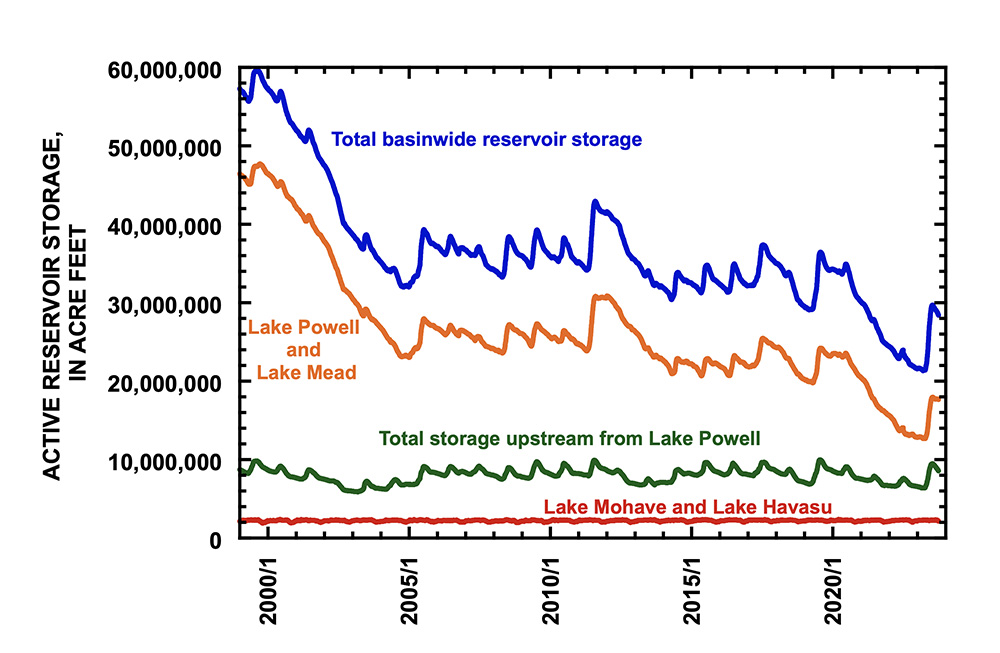
Figure 1 shows how reservoir storage changed during the 21st century. Total storage in all the reservoirs reported in Reclamation’s database is shown in blue, and storage in the three different parts of the watershed are distinguished. Between 60 and 80% of all reservoir storage in the basin occurs in Lake Mead and Lake Powell (orange line). Between 16 and 32% of basin reservoir storage occurs in the many reservoirs upstream from Lake Powell (green line), and between 4 and 8% of basin storage occurs in Lake Mohave and Lake Havasu (red line) that are downstream from Hoover Dam. Graph showing daily storage contents of reservoirs of the Colorado River basin, as reported by Reclamation,
between 1 January 1999 and 30 September 2023. Data do not include reservoirs on Lower Basin tributaries.

The most striking trend in these data is that reservoir storage decreased greatly between August 1999 and October 2004 when total storage decreased by 27.4 maf and storage in Lake Mead and Lake Powell decreased by 24.5 maf. There was a small amount of recovery in storage between October 2004 and August 2019; total basin storage increased by 4.1 maf, and storage in Lake Mead and Lake Powell increased by 0.9 maf. Between August 2019 and March 2023, storage plunged again, decreasing by 14.8 maf in the entire watershed of which 11.4 maf was lost from Lake Mead and Lake Powell. These trends were described in more detail by Schmidt, Yackulic, and Kuhn (2023, The Colorado River water crisis: its origins and the future. WIREs Water).

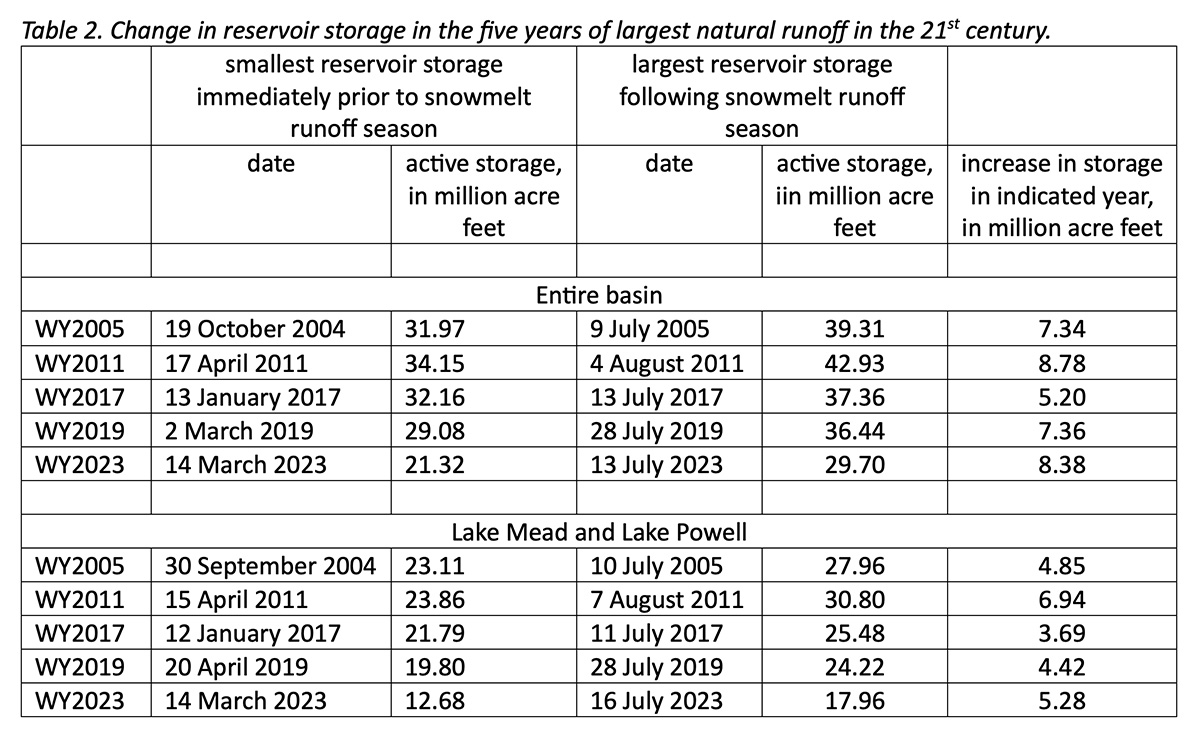
On 30 September 2023, the total storage in the watershed’s reservoirs was 28.4 maf, of which 62% was in Lake Mead and Lake Powell. The storage in all reservoirs upstream from Lake Powell was 8.6 maf and comprised 30% of the total basin storage. Total basin storage in WY2023 peaked on 13 July at 29.7 maf, and the combined storage in Mead and Powell peaked on 16 July at 18.0 maf (Table 2).

How does this year’s increase in storage compare to increases in other years of large inflow? At the beginning of the WY2023 runoff season in mid-March, total reservoir storage in the basin had dwindled to 21.3 maf (Table 2), which is approximately 18 months of supply, based on the average basin-wide water consumption rate for 2016-2020. The combined storage contents of Lake Mead and Lake Powell was 12.7 maf.

Between mid-March and mid-July, total basin-wide storage increased by 8.4 maf, of which 5.3 maf accumulated in Lake Mead and Lake Powell. In comparison, the other four large runoff years of the 21st century — 2005, 2011, 2017, and 2019 – resulted in increases in basin reservoir storage between 5.2 and 8.8 maf and increases in storage in Lake Mead and Lake Powell between 3.7 and 6.9 maf (Table 2). Not only was WY2023 the second largest runoff year of this century, but reservoir storage increase was also the second largest of the century.

Nevertheless, the increase in reservoir storage in WY2023 was small in comparison to the total loss in storage that had occurred since summer 1999. Between August 1999 and March 2023, the reservoir system lost 38.1 maf, and the increase in storage in WY2023 was only 22% of that amount.  It would take another 3 to 6 years of very large runoff to fully recover the basin’s reservoirs to what they had been at the turn of the 21st century.

It is unrealistic to expect that the next several years will be similar to the remarkable winter of 2022-2023. No other high flow year of the 21st century was immediately followed by another high flow year. Our best hope for achieving sustainability in water supply is for the Basin States and the federal government to reach new agreements to greatly reduce basin-wide water use so that the modest recovery in reservoir storage in WY2023 might be preserved. Otherwise, our gains may quickly disappear.

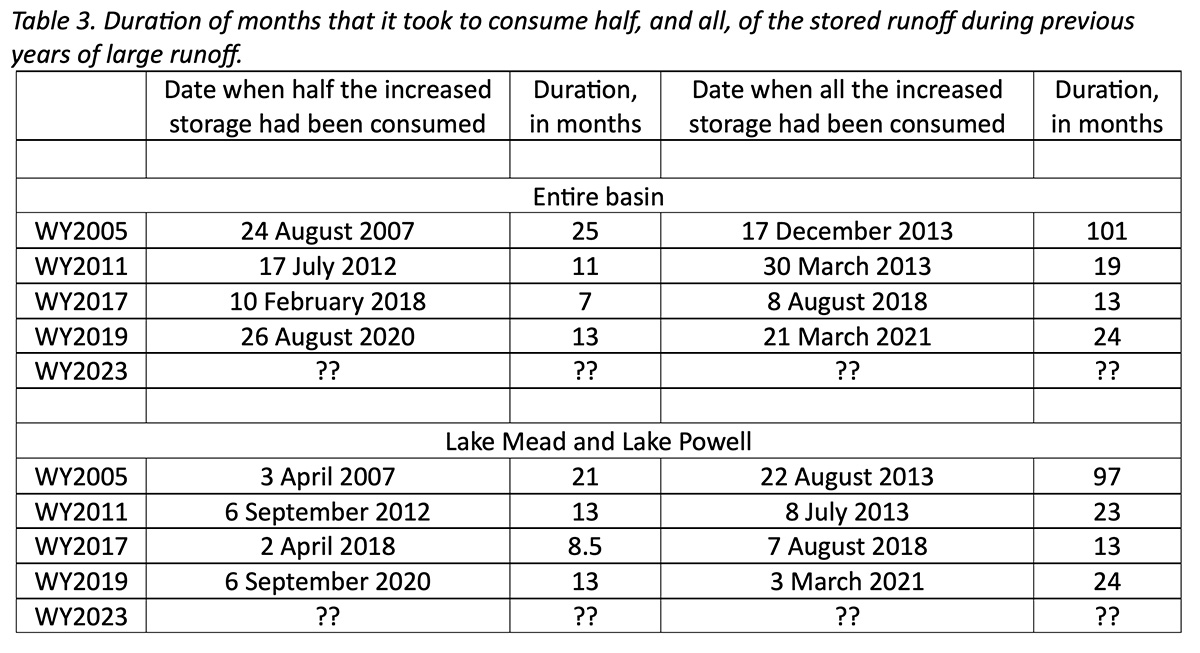
Historical data from the previous wet years of this century provide a cautionary tale about how slowly the political process responds to the opportunity provided by a wet winter. Table 3 summarizes the duration of months it took to consume the increased supply of each of the previous years of large runoff. Half of the supply provided by the largest inflow year of WY2011 was gone 11 to 13 months after peak storage had occurred in early August 2011; 8 to 10 months after that, all of WY2011’s large runoff had been consumed (Table 3). The historical story is the same for WY2017 and WY2019.

Since mid-July when the snowmelt season had ended, reservoir storage has begun to decline. The basin’s reservoirs lost 1.3 maf of storage between mid-July and 30 September of which 0.3 maf was lost from Lake Mead and Lake Powell and 0.9 maf from the reservoirs upstream from Lake Powell. The total consumption in these 2.5 months was 16% of the “benefit” of WY2023. Today, the contents of Lake Mead and Lake Powell are about the same as what they were in mid-June 2021.

A Last Thought

One strategy for maintaining a public focus on water conservation would be to widely report—every month—changes in total reservoir storage. The Basin States, and the basin’s citizens, would benefit from knowing the rate at which we are consuming the bounty of the WY2023 supply. It would be especially useful to know the point in time when we consume half of what we gained this year. If we reach that point in less than a year, we would have fair warning that the political process by which we now seek to reduce water consumption is too slow. Hope for a secure and sustainable water supply must rely on nimble and adaptable strategies for reducing water consumption and saving the gains of each wet year.

Colorado River “Beginnings”. Photo: Brent Gardner-Smith/Aspen Journalism