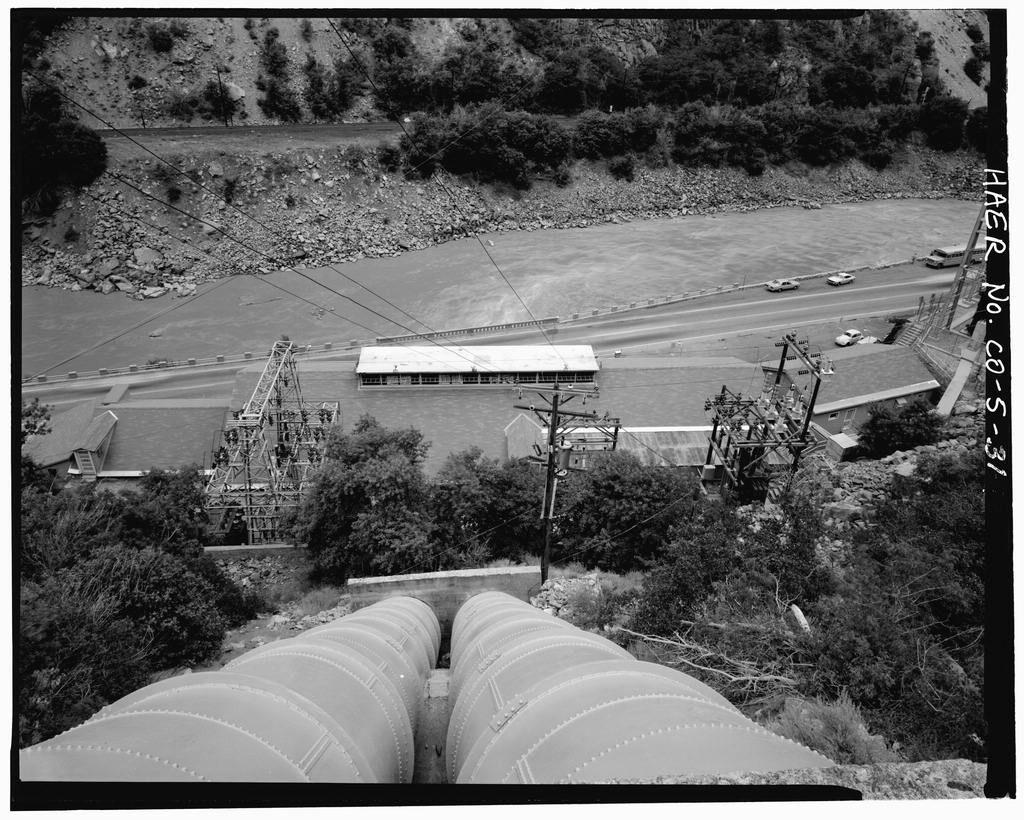
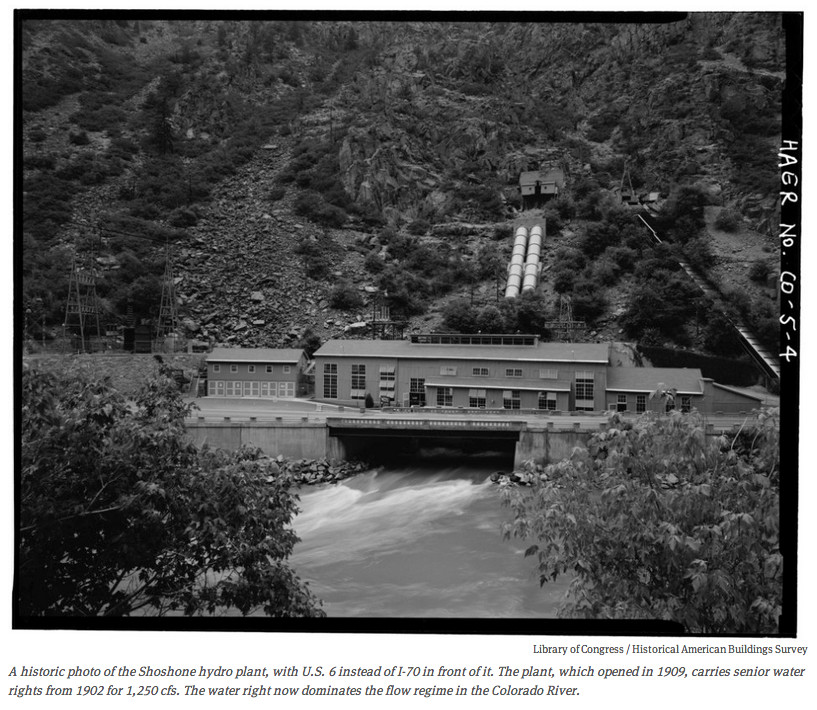
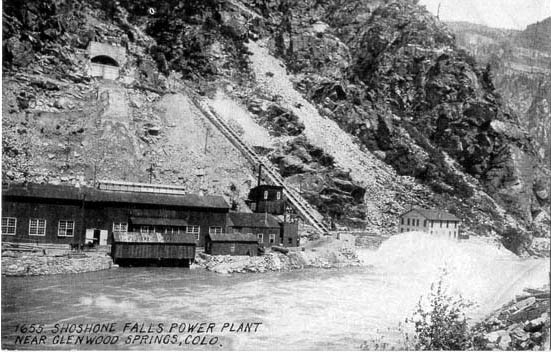
This historical photo shows the penstocks of the Shoshone power plant above the Colorado River. A coalition led by the Colorado River District is seeking to purchase the water rights associated with the plant. Credit: Library of Congress photo
The Colorado River District is leading a coalition in what would be a history-making purchase involving historic water rights that are pivotal to Colorado River flows and water uses in western Colorado. The district and others in the Western Slope coalition are proposing spending potentially $98.5 million to acquire the rights from Xcel Energy for operation of the Shoshone hydroelectric power plant in Glenwood Canyon. According to the river district, Shoshone holds the most senior major water rights on the river, dating back to the early 1900s and totaling 1,408 cubic feet per second…
When river flows drop below 1,408 cfs the plant puts a “call” on the river, preventing access to water by many junior rights holders above the plant to ensure flows to it. That also keeps more water flowing for recreational purposes such as fishing and whitewater boating, and to benefit the environment. Because the flows used by the plant return to the river, they continue downstream, along with the benefits they provide, which also include access to the water by junior water rights holders downstream, and improved water quality for communities and water utilities that rely on the river for their supply. The improved water quality results from higher river flows that dilute pollution. Critically, the water also helps shore up flows in what is called the 15-mile reach of the river starting in the Palisade area, which is important habitat for fish federally listed as endangered or threatened.
”Preserving the Shoshone call permanently secures the flow of the Colorado River and the health of that river for our economies and our environment, literally from the headwaters in Grand County all the way down to the border with Utah,” said river district General Manager Andy Mueller.
Shoshone Hydroelectric plant. Photo credit: The Colorado River District
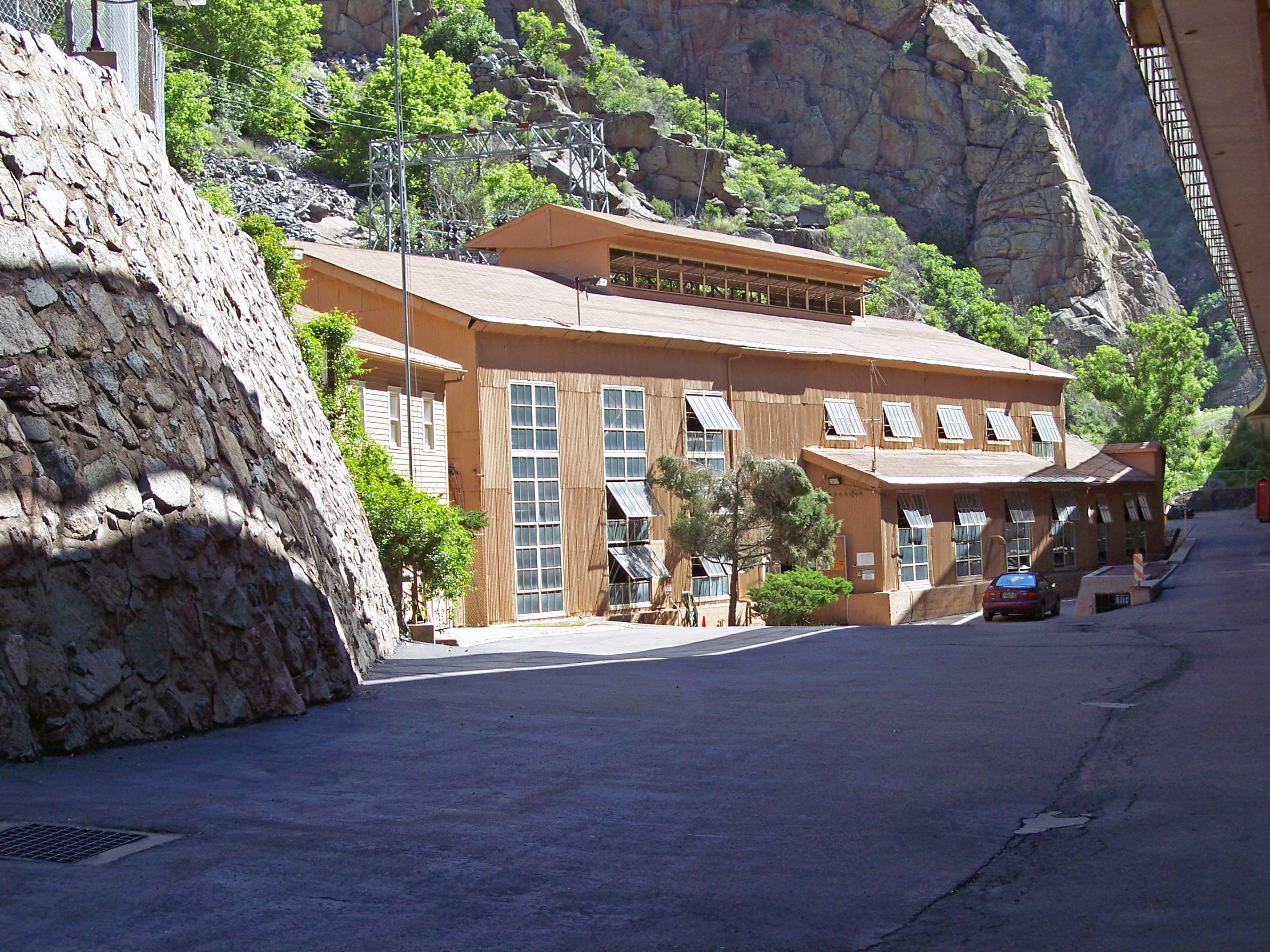
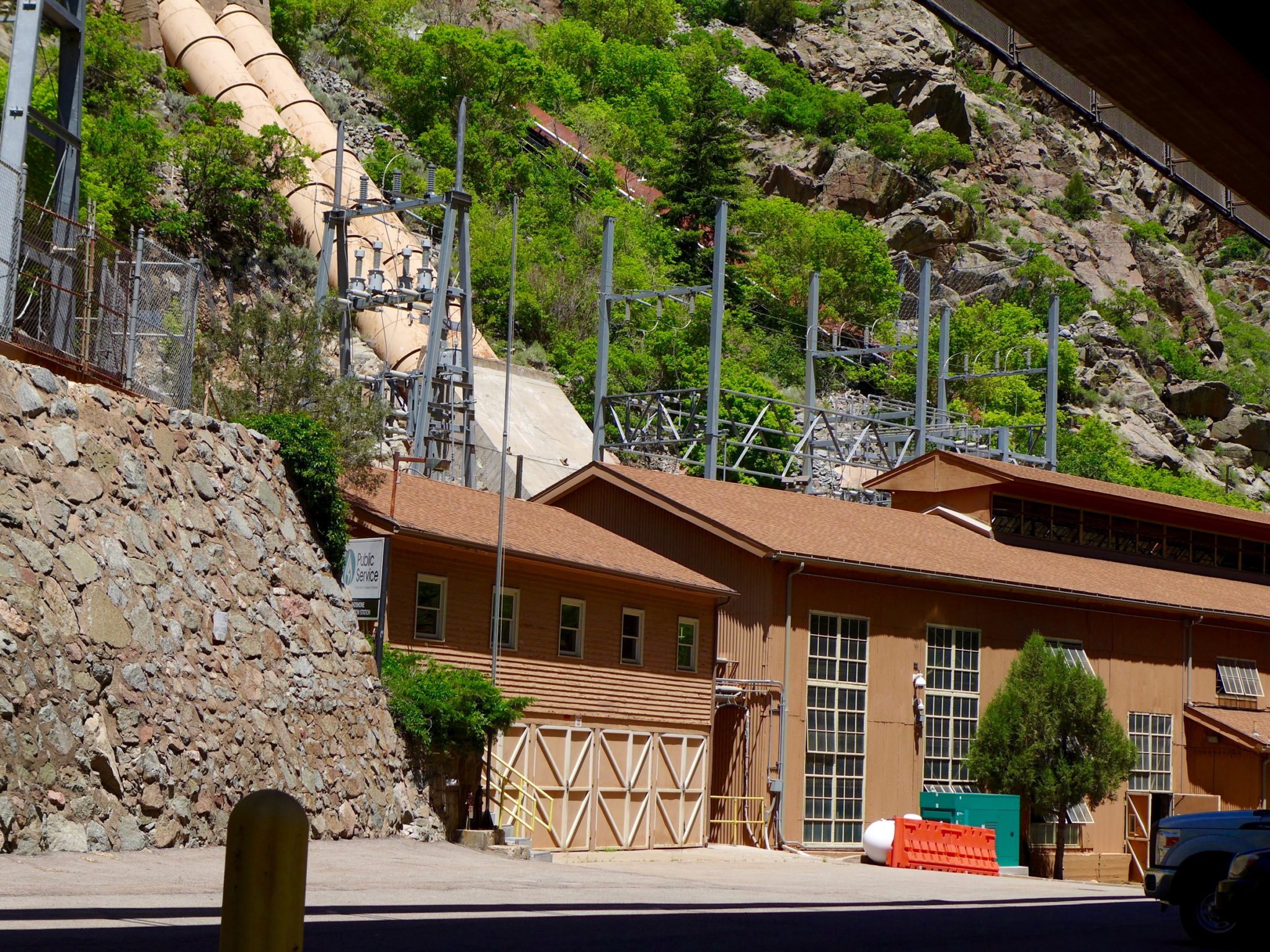
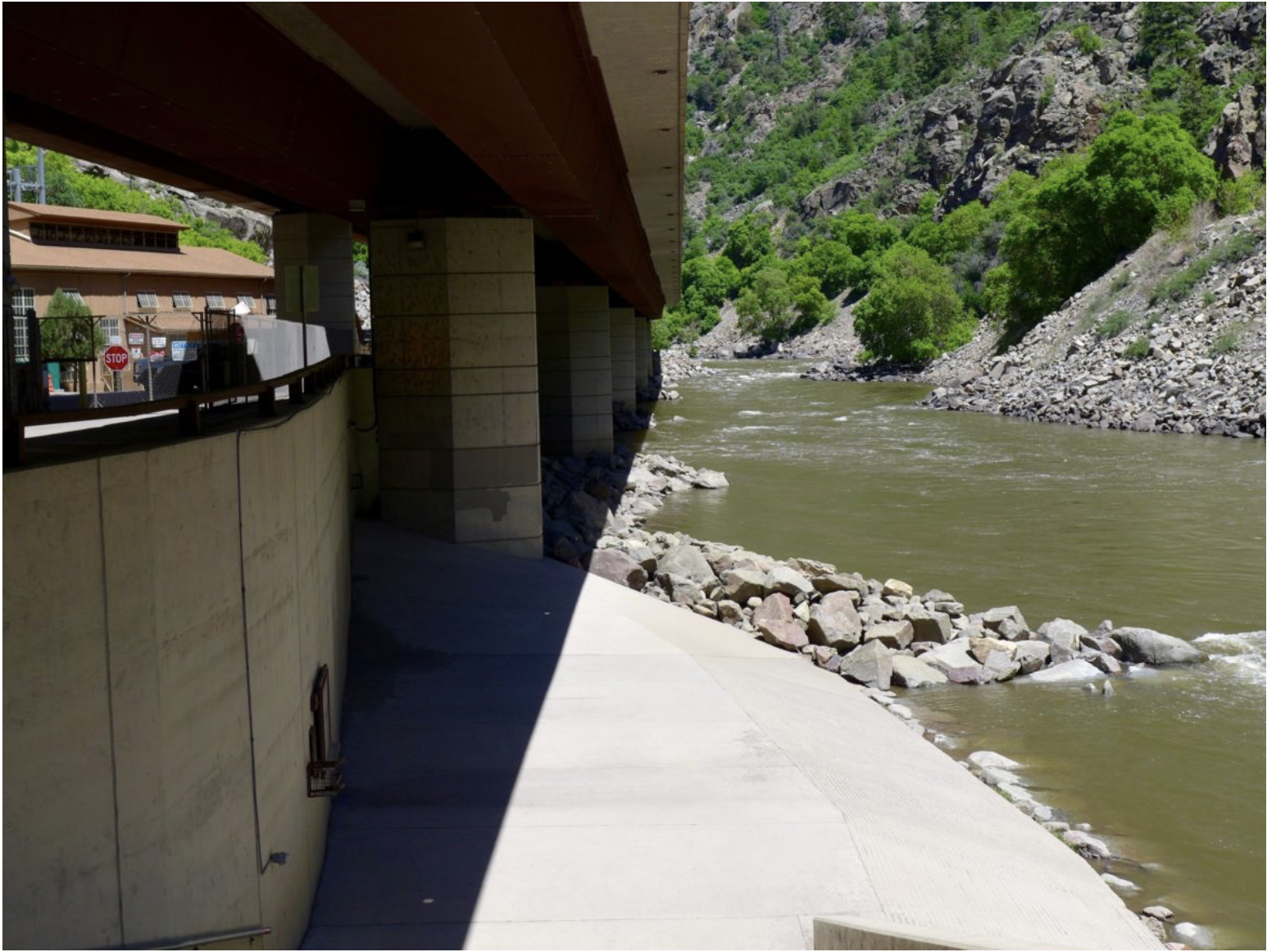
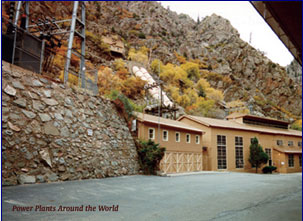
The Shoshone hydro plant in Glenwood Canyon, captured here in June 2018, uses water diverted from the Colorado River to make power, and it controls a key water right on the Western Slope. Photo credit: Brent Gardner-Smith/Aspen JournalismThe Shoshone plant and boat ramp on the Colorado River. Photo credit: Brent Gardner-Smith/Aspen JournalismThe penstocks feeding the Shoshone hydropower plant on the Colorado River in Glenwood Canyon.Xcel truck at Shoshone plant. Photo credit: Brent Gardner-Smith/Aspen JournalismThe blown-out penstock in 2007 at the Shoshone plant. Photo credit: Brent Gardner-Smith/Aspen JournalismShoshone Hydroelectric Plant back in the days before I-70 via Aspen JournalismShoshone Falls hydroelectric generation station via USGenWebShoshone hydroelectric generation plant Glenwood Canyon via the Colorado River District
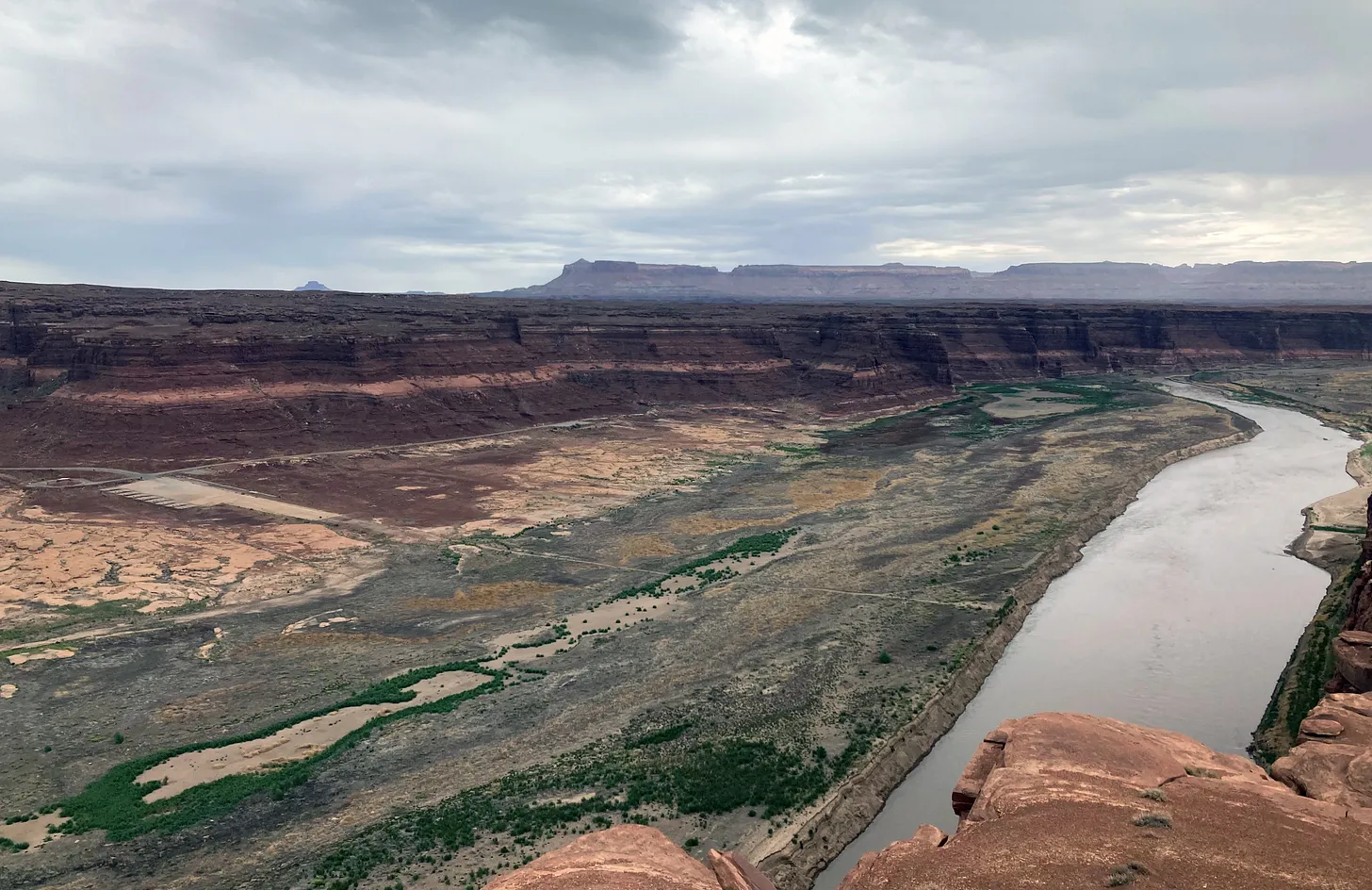
The Colorado River and the silt flats left behind by a receding Lake Powell. Note the old Hite Marina boat ramp on the left side of the image. This was once at water’s edge. Jonathan P. Thompson photo.
Click the link to read the article on the KUNC website (Alex Hager). Here’s an excerpt:
Reclamation Commissioner Camille Calimlim Touton said there were some common threads in the feedback her agency received.
“There’s consensus that there needs to be an ability to operate the system more sustainably for the future, that hydrology may lead to drier conditions, and that there needs to be an understanding between supply and demand,” Touton said.
How exactly to bridge that supply-demand gap, though, is the existential question of ongoing river negotiations. State leaders are reluctant to volunteer major water cutbacks, trying to soften the blow that could be dealt to growing cities and agricultural economies if new reductions are rolled out. That’s left them mired in a standoff about how to proceed. For example, in a letter from the Upper Colorado River Commission – a group representing Colorado, Wyoming, Utah and New Mexico – leaders outlined a list of priorities. The first of those points the finger at other states further downstream, saying that Reclamation’s new rules should address the supply and demand gap and “will require permanent Lower Basin reductions under most if not all operating conditions.”
Other letters, signed by state and agricultural leaders in the Lower Basin, say that post-2026 rules need to comply with the “Law of the River,” a longstanding collection of legal agreements that gives preference to the West’s oldest water users, many of whom operate in the Lower Basin.
Elizabeth Koebele, an associate professor of political science at the University of Nevada, Reno, has been reviewing the comments submitted to Reclamation.
“It’s unsurprising that the vast majority of the calls for action and letters describing potential action are focused on changes in the Lower Basin,” she said. “I think there’s a real strong focus on ‘let’s get the Lower Basin’s house in order, and then we can focus on the rest of the system.’”
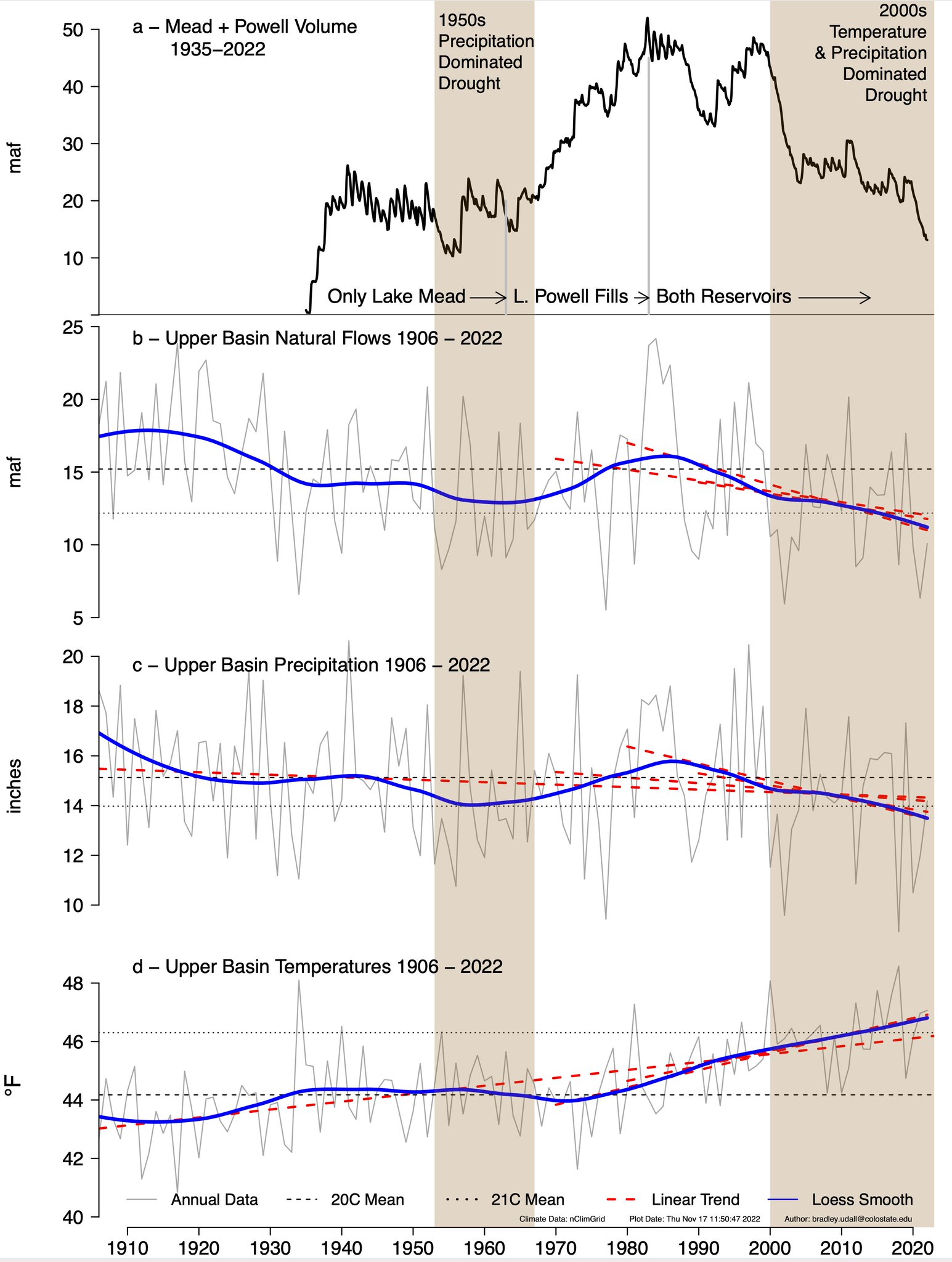
Updated Colorado River 4-Panel plot thru Water Year 2022 showing reservoirs, flows, temperatures and precipitation. All trends are in the wrong direction. Since original 2017 plot, conditions have deteriorated significantly. Brad Udall via Twitter: https://twitter.com/bradudall/status/1593316262041436160
Click the link to read the article on the Big Pivots website (Allen “You got the story right, without going too long” Best):
Colorado’s Just Transition legislation intends to help coal-dependent communities like this one ease into an economy after coal
Yampa, the town of 400 near the headwaters of the river of the same name in northwest Colorado, recently got a small grant from the state’s Just Transition program designed for coal-reliant communities.
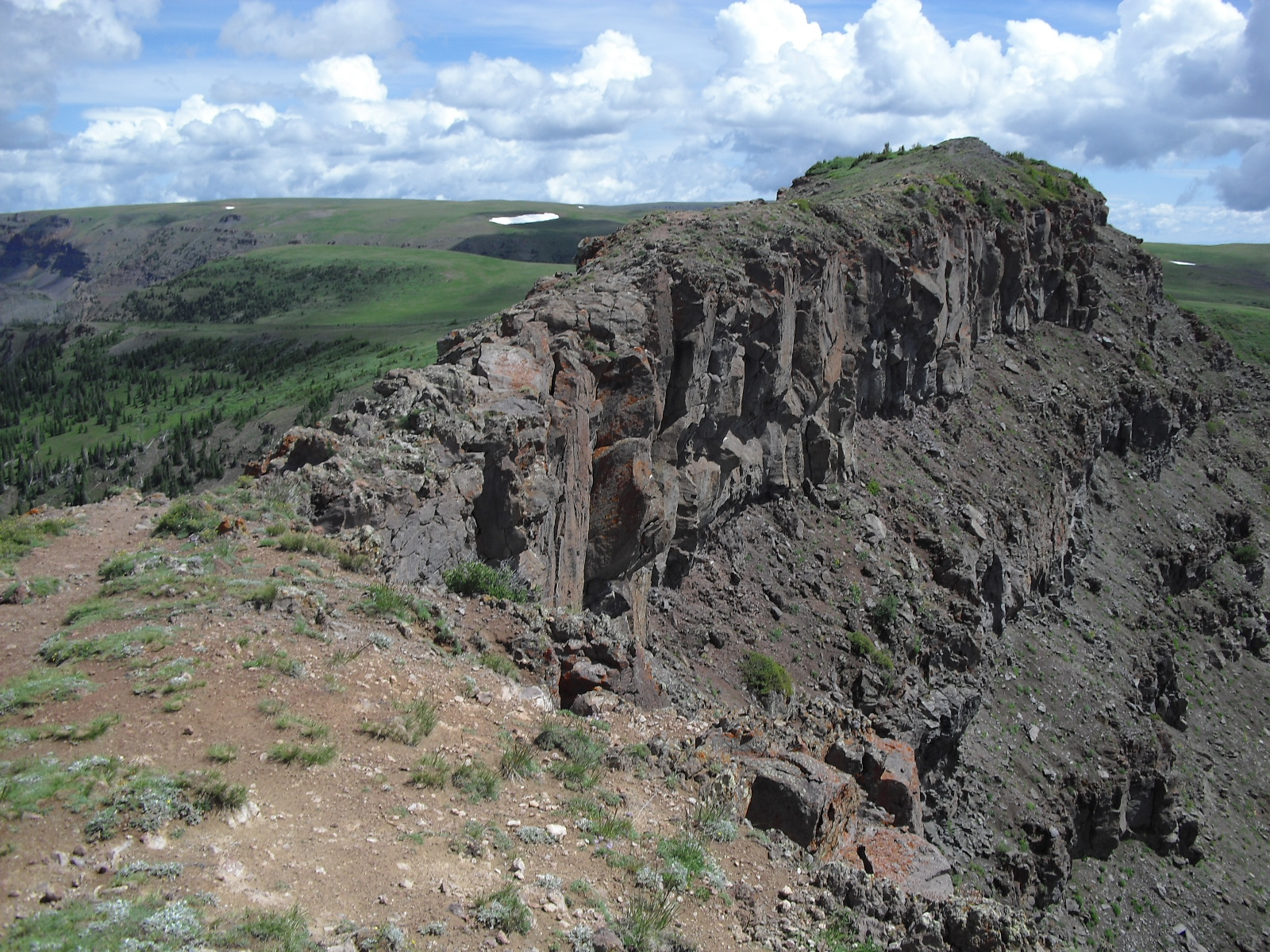
You won’t immediately see the presence of coal in Yampa. You will quickly recognize that for hunters, wilderness hikers, and anglers, it’s a gateway to the Flat Top mountains with all of their wilds and mysteries plus the reservoirs that store their melted snow. At the head of one of the creeks is a narrow bridge of land above timberline called the Devil’s Causeway. Those with acrophobia need not cross.
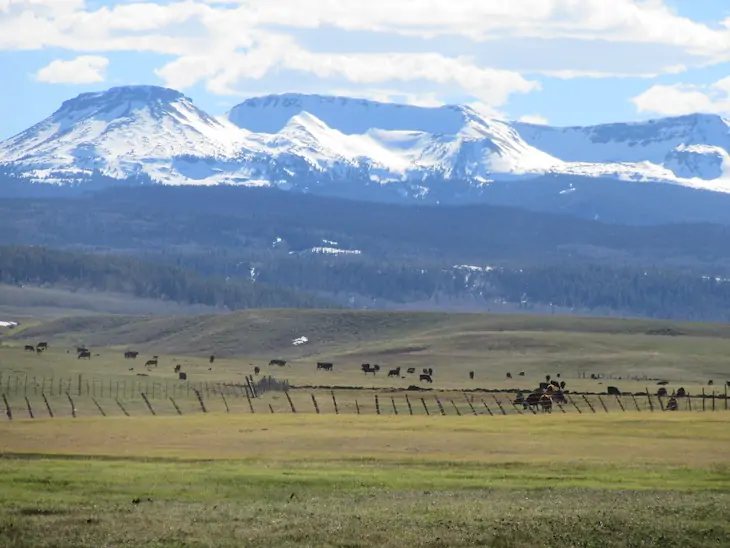
Yampa also lies amid a valley of hay ranches, emerald in some seasons but always comforting in their relative emptiness. This is a valley that to some is best described as “Colorado as it used to be.” It’s not crowded, nor is there a rush. Not surprisingly, Yampa is on a Colorado Scenic and Historic Byway.
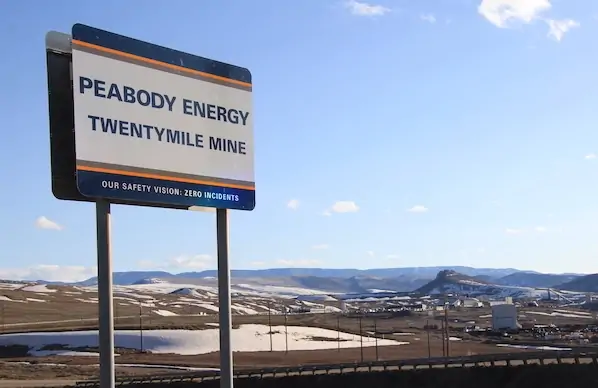
The coal is less obvious. The closest active mine, Twentymile, Colorado’s fourth largest, is actually about 50 minutes to the north along sometimes winding roads choked by oak brush.
Yampa’s economy is intertwined closely with that of coal extraction at Twentymile. Some coal miners and others directly associated with the mine live in Yampa. Others work on the railroad. There’s even a motel for railroaders built in the 1990s and a café, Penny’s Diner, created specifically to ensure that railroaders can get a square meal at all hours of the day.
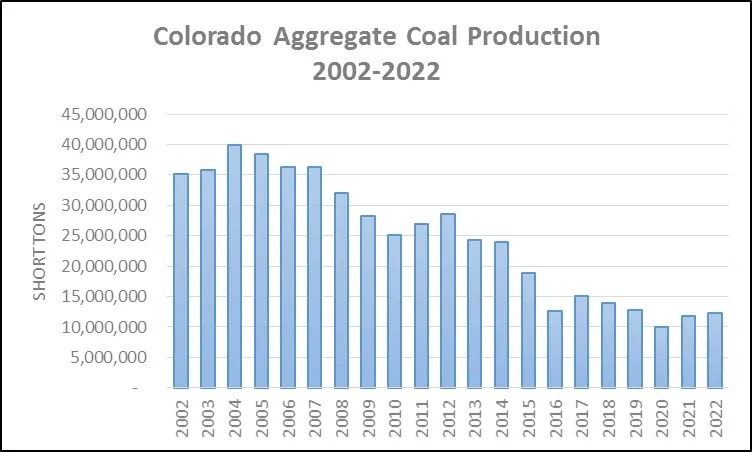
The coal economy of northwest Colorado is on the decline. Most of the coal mined at Twentymile travels only a short distance, to be burned at the two units at Hayden operated by Xcel Energy. The same is true for mines in Moffat and Rio Blanco counties, whose coal mostly if not entirely gets burned at the three units of the Craig Generating Station. That plant is operated by Tri-State Generation and Transmission.
All five coal-burning units are scheduled to cease operations from 2025 to 2030.
Will the coal mines continue operations? That’s unclear. Peabody Energy, the owner of Twentymile, has not said for certain what it plans.
Without reservation it can be said that the shipments of coal from Routt County through Yampa and to markets elsewhere have significantly declined in the last 20 years. The official evidence is scant. Coal companies don’t release such reports. But the anecdotal evidence—what locals can report about the frequency of passing trains —is abundant.
In recognition of this impact, Colorado has awarded Yampa a $105,000 grant for implementation of a business support program. The money is to be used for purchase of new and upgraded equipment for local businesses.
Some of the money will also be used to install signs along Highway 131, which passes on the edge of town. Many travelers use the highway to get between Steamboat Springs and the I-70 corridor.
Colorado also awarded a $600,000 grant to the Pioneers Medical Center in Meeker for implementation of a new electronic medical health record system. That was identified as the first step to expand healthcare services and long-term plans to develop medical tourism. See: “Medical tourism in a land of fishing poles & orange vests”
Both grants come from state funding allocated to smooth the transition of coal-dependent communities during the energy pivot underway in Colorado.
New jobs will be the end result of the grants, according to a press release issued by Gov. Jared Polis’s administration.
“As the economy moves away from the high cost of coal power, Colorado is helping local communities diversify their economies and creating new opportunities for their residents to be successful,” said Polis.
Yampa, the town, lies at the head of the Yampa River drainage on the eastern flanks of the Flat Tops. Top, Twentymile Mine in 2022 was Colorado’s four largest coal producer Photos/Allen Best
Paul Bonnifield, a resident, rejects the characterization of the new grant for Yampa as being a “nod of the hat.” In the context of Yampa’s municipal government, “it’s a pretty danged big chunk of money,” he said when asked for his on-the-ground observations.
As a history professor at a college in Oklahoma, he had several books to his credit, including “Dust Bowl: Men, Dirt and Depression,” which was published in 1979.
While never completely abandoning his interest in history, Bonnifield decided to pursue a life of railroading on Colorado’s Western Slope. He was based in the nearby railroad community of Phippsburg for 25 years while working as a conductor on trains from Grand Junction to Denver before retiring in 2002. This writer became familiar with him when we met during the early 1990s at the Turntable, a railroad restaurant located adjacent to newspaper offices of The Vail Trail in Minturn. Both of us were regulars there for awhile.
At one time, far more trains traveled through Yampa, he said. A train from northwest Colorado, for example, delivered coal to a plant along the South Platte River near downtown Denver. That plant, Arapahoe Station, ceased electrical production in 2014. Trains also delivered coal from northwest Colorado to Texas.
Now, maybe one train a month exports coal out of the Yampa Valley. One train a week may travel through the town ferrying wheat and other goods from northwestern Colorado and delivering pipes and other supplies.
But the valley no longer has a maintenance crew and other railroad employees like it once did. As for the diner for railroad employees, it has had trouble finding enough local help to maintain reliable hours.
At the same time, local governments will enormously suffer from the eroded tax base if the mine closes.
These grants are an expression of Colorado’s commitment to ease coal-dependent communities economically as the era of coal, now more than 125 years old in Colorado, ebbs even more rapidly through the end of this decade. By 2031, the state’s remaining last eight coal-fired electricity-generating plants will be closed, casting doubt on the viability of Colorado’s six remaining coal mines.
The legislative roots were in 2019, when Colorado adopted what was then seen as ambitious—too ambitious, in the minds of at least some Republican legislators—decarbonization goals: 50% economy-wide decarbonization by 2030 and 90% by 2050, both compared to 2005 levels. The law was HB 19-1261.
In HB 19-1314, Colorado legislators declared that they did not want to throw coal workers in the mines, power plants, or on the railroad under the energy transition bus. Colorado had been mindful of impacts, the law said, and state government had a role in helping provide a transition for those people and their communities.
The state, Colorado’s law declared, had a “moral commitment to assist the workers and communities that have powered Colorado for generations” by supporting a “just and inclusive transition” away from coal.
It also noted that resources existed at neither the state nor federal levels sufficient to assist workers and communities impacted by the transition. That included the absence of coordinated leadership within Colorado’s state government.
The law appropriated a thin sum for staffing, not quite $157,000, with the understanding that more would come. Wade Buchanan, a veteran of several state positions, was hired to run the new Office of Just Transition.
Meetings in early March 2020 were held in Craig and Hayden. I attended all three. In Craig that first evening, I heard anguish and dismay about the announcement two months before by Tri-State Generation and Transmission that the three coal units it operated there would all be closed by 2030. Only one had been announced previously.
The third day, the governor arrived in Craig. First he toured a small shop, Good Vibes, that produces gear for river boaters. It was just the governor by himself with the two co-owners and me the observer.
That afternoon, he sat in the Hayden Town Hall listening to testimony when the news arrived. One coal miner from Twentymile pleaded with the governor to see a future that included coal. Polis seemed to be listening, but likely he had been told just a few hours before that Colorado had its first case of covid. Surely, he was thinking many thoughts.
Colorado put together a 20-page action plan by the end of 2020 that outlined 13 strategies for communities, workers, and funding. It also gained state funding.
Between the Office of Just Transition and its parent agency, the Office of Economic Development & International Trade, $9.62 million in funding in the form of coal transition community grants had been issued. They were:
Yampa Valley, $5,152,538
West end of Montrose County (Nucla and Naturita), $3,058,192
Pueblo County, $471,423
Morgan County, $471,423
$471,423 for Delta, El Paso, Gunnison, La Plata and Larimer counties collectively
So, money is getting distributed, lots and lots of meetings are being held now, and the Office of Just Transition is no longer a one-man office, as it was for the first year.
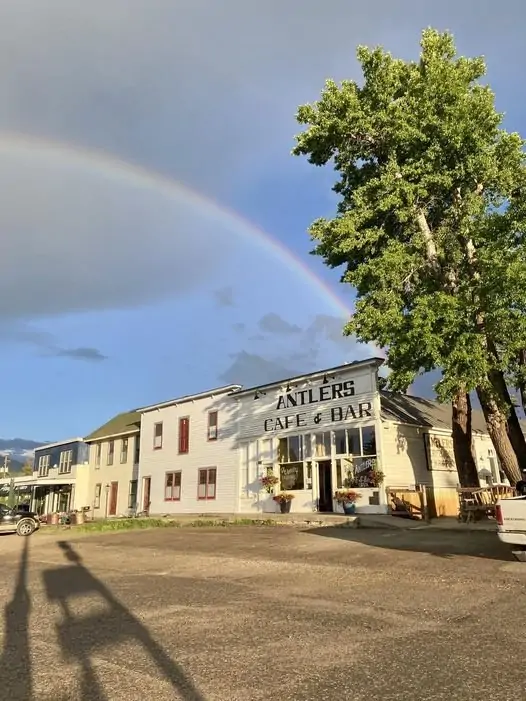
Antlers began operating in 1904, shortly before the rails of what many called the Moffat Road arrived. The principle figure in the railroad was David Moffat, whose name lingers on the tunnel through the Continental Divide, the county in northwest Colorado — and the street on which this business is located. Photo credit: Allen Best/Big Pivots
Yampa’s main street, Moffat Avenue, is wide and still largely without pavement. It has never had a large population, hovering between 300 and 400 in recent decades. None of the busyness of Steamboat Springs 40 miles to the north, or the Vail Valley communities, 40 miles to the south, can be found in Yampa. To most locals, that’s fine.
Still, a little more activity would also suit the locals, and that is how the town intends to use the money, to bolster business activity. Part of that plan is to ensure that the community has a restaurant open to the public on a year-round, not just seasonal basis.
Yampa has had a very fine restaurant called Antlers. The business was established in 1904, just before the rails arrived from Denver through the Moffat Tunnel on their way to Moffat County, and has been in operation continuously since then with the exception of 2005-2009.
The restaurant has now returned to operating hours year-round with some help from the town government.
The opening of Yampa Garage Eatery is another bright spot in the town’s economic story. The money will also help expand the space and variety of goods at the local grocery store and mercantile.
But 90% of the town’s workers leave to work elsewhere, points out Mary Alice Page-Allen, the town planner and treasurer.
The goal of her work, she said, is to “retain what we have, but also to expand and attract.” The town core lies just a block off the highway, but for many travelers, there may be no particular reason to pause on their journeys.
Oak Creek, a one-time coal-mining town 10 miles to the north, which Page-Allen formerly managed, has had some success in creating more buzz in its commercial district. It even has a parking problem a couple days a week.
That’s a hard problem to imagine for Yampa, but a few more cars on that big, broad street would be welcome.
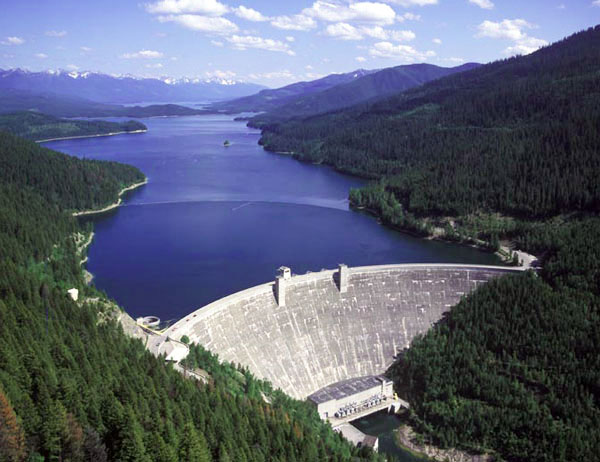
Hungry Horse Dam – one of the potential locations where prize competition solvers will test their contest solutions.. Photo credit: Reclamation
Click the link to read the release on the Reclamation website (Chelsea Kennedy):
WASHINGTON – The Bureau of Reclamation is launching a Water Supply Forecast Rodeo prize competition to spur innovation and advancements in methods for seasonal water supply prediction. Water supply forecasts are crucial for effective water resource management in the Western U.S. Improved forecast accuracy will help water managers mitigate the impacts of drought, improve hydropower generation, and meet environmental targets.
Reclamation is making a $500,000 prize pool available through this competition.
“Seasonal water supply forecasts are critical to informing water management and operations across the Western U.S.,” said Reclamation Chief Engineer David Raff. “Improving seasonal forecasts will allow water managers to better meet all of the needs for water including irrigation, hydropower generation, and the environment.”
In this challenge, solvers will work as individuals or teams to develop water supply forecast models that predict seasonal runoff volumes at 26 sites across the Western U.S., while also characterizing forecast uncertainty and offering insights into forecasted conditions.
The competition includes both hindcast and forecast stages. The hindcast stage is where solvers will demonstrate skill in predicting past conditions and the forecast stage where solvers will predict water supply during the winter and spring of 2024.
Reclamation is partnering with the U.S. Army Corps of Engineers, USDA – Natural Resources Conservation Service, National Oceanic and Atmospheric Administration, NASA Tournament Lab, and DrivenData for this competition. To learn more about this competition, please visit https://www.drivendata.org/competitions/group/reclamation-water-supply-forecast/