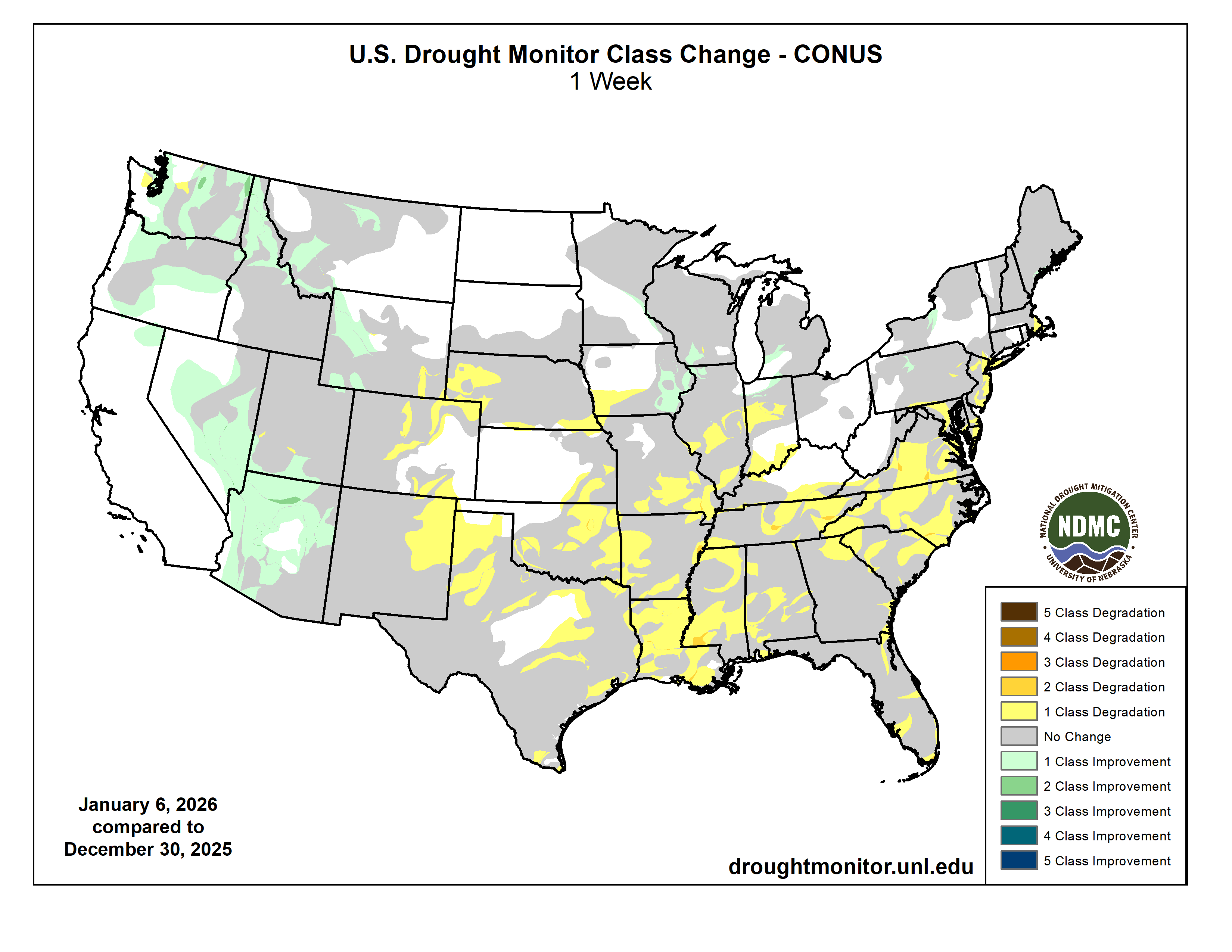
Click on a thumbnail graphic to view a gallery of drought data from the US Drought Monitor website.


Click the link to go to the US Drought Monitor website. Here’s an excerpt:
This Week’s Drought Summary
The past week featured above-normal temperatures across much of the western half of the U.S. Areas west of the Mississippi River generally experienced near- to above-normal temperatures, with portions of the northern Rocky Mountains running 15–20°F above normal for the week. These warm conditions favored rain over snow, which is critical for winter water supply in the West, and many locations continue to experience a slow start to the snow season.
In contrast, cooler-than-normal temperatures dominated the Florida Peninsula, with departures of 5–10°F below normal across southern Florida. Below-normal temperatures were also widespread from the Upper Midwest into the Northeast and Mid-Atlantic, where departures of 5°F or more below normal were common. Parts of New England were particularly cold, with temperatures 10–15°F below normal.
Outside of the West, above-normal precipitation was limited to pockets of the Southeast, Florida, and the Upper Midwest. Much of the West recorded more than 100% of normal precipitation for the week, with large portions of California receiving over 200% of normal…
High Plains
Warmer-than-normal temperatures dominated the region, with departures exceeding 15°F above normal across parts of western Nebraska, western Kansas, northeast Colorado, Wyoming, and southeast Montana. Precipitation was minimal, with the greatest totals confined to northeastern North Dakota.
The continued warm and dry winter has resulted in some areas experiencing their driest start to winter on record. Abnormally dry conditions expanded across southern Nebraska and northeast Kansas, as well as southeast Kansas, where moderate drought also increased. Moderate and severe drought expanded across southeast Wyoming, western Nebraska, northeast Colorado, and southeast Colorado…

West
The largest positive temperature departures occurred in the West, with areas from central Montana into western Wyoming and northwest Colorado experiencing temperatures more than 15°F above normal. These warm conditions pushed snow to higher elevations and increased rainfall at lower elevations. While many areas received above-normal precipitation, snowpack remains critically low, and significant snow drought persists across numerous mountain ranges, including the Cascades, Oregon’s Blue Mountains, Idaho’s Bitterroot Range, and the central Rocky Mountains of Colorado.
It was a wet week for much of the region, with nearly all of California recording above-normal precipitation, along with much of Nevada and western Arizona. Above-normal precipitation also occurred across eastern Washington and Oregon, Idaho, western Utah, and Montana. Severe and extreme drought improved across northern Montana, with additional improvement to moderate drought in the southwest part of the state.
Continued wet conditions led to improvements in moderate and severe drought across Nevada, Arizona, eastern Oregon and Washington, and the Idaho Panhandle. Abnormally dry conditions expanded across northeast New Mexico, while extreme and exceptional drought expanded across central Colorado. Extreme drought was removed from southwest Wyoming, and moderate drought improved across western Wyoming. In Washington, abnormally dry conditions were adjusted to reflect recent precipitation while also accounting for persistent snow drought in the Cascades…
South
Nearly the entire region was dry, with only isolated precipitation observed in Mississippi and southwest Tennessee. Temperatures were above normal across most areas, with portions of the Texas and Oklahoma panhandles running more than 12°F above normal.
Drought conditions deteriorated across every state in the region. Moderate drought expanded across northern and southern Mississippi. Central and eastern Tennessee saw expansion of moderate and severe drought, while moderate drought increased in western Tennessee. Moderate and severe drought expanded across much of Louisiana and southern and western Arkansas. Severe drought expanded in northeast and northwest Arkansas and into northeast Oklahoma. Severe and extreme drought spread from southwest into central Oklahoma, while moderate drought continued to fill in across eastern Oklahoma.
Across Texas, moderate drought and abnormally dry conditions expanded over much of the Panhandle, while moderate and severe drought grew across east Texas and coastal southeast Texas. Drought conditions continued to intensify in far south Texas…
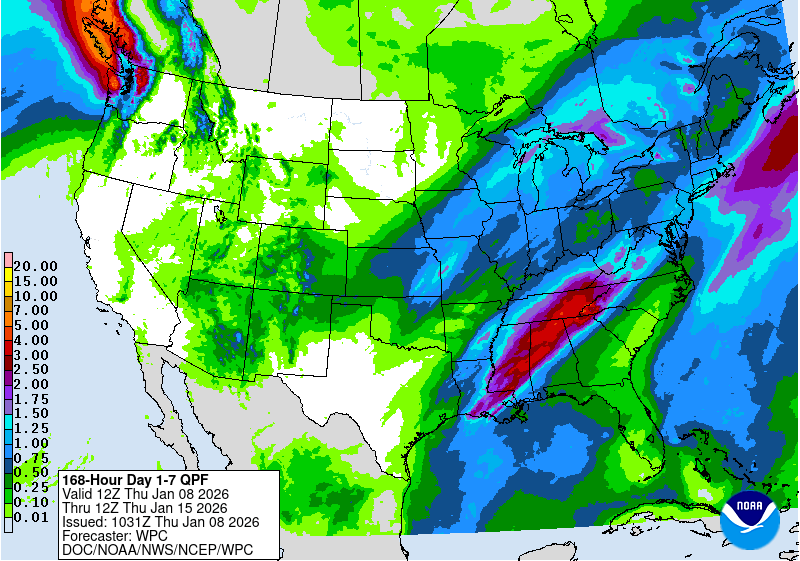
Looking Ahead
Over the next five to seven days, the pattern over the continental U.S. appears to be active with many areas showing a strong probability of precipitation. Areas from the Central Plains into the Midwest and Great Lakes areas are anticipated to receive up to an inch of precipitation. Further south, areas from Louisiana northeast into Kentucky are expected to receive the greatest amount of precipitation with several inches expected. From the Pacific Northwest into the Rocky Mountains and Southwest, widespread precipitation is anticipated. The driest areas are expected to be over the northern Great Plains, California, central and southern Texas and from the Carolinas into the Florida peninsula. Temperatures are expected to remain warmer than normal over much of the country. Only the areas along the southern tier of the U.S. will be near to below normal. The warmest departures are expected over the central to northern Plains, with some areas of Montana predicted to be 10-15 °F above normal.
The 6-10 day outlooks show that the likelihood of above-normal temperatures is projected over almost the entire U.S., with the exception of the Southeast and south Texas. The greatest chances of above-normal temperatures are over the West Coast, as well as the northern Plains and northern Rocky Mountains. The best chances of below-normal precipitation are over the Western U.S. and into the southern Plains. Above-normal chances of above-normal precipitation are anticipated over the central to northern Plains, Florida and along the coast of the Carolinas, as well as Alaska and Hawaii.