
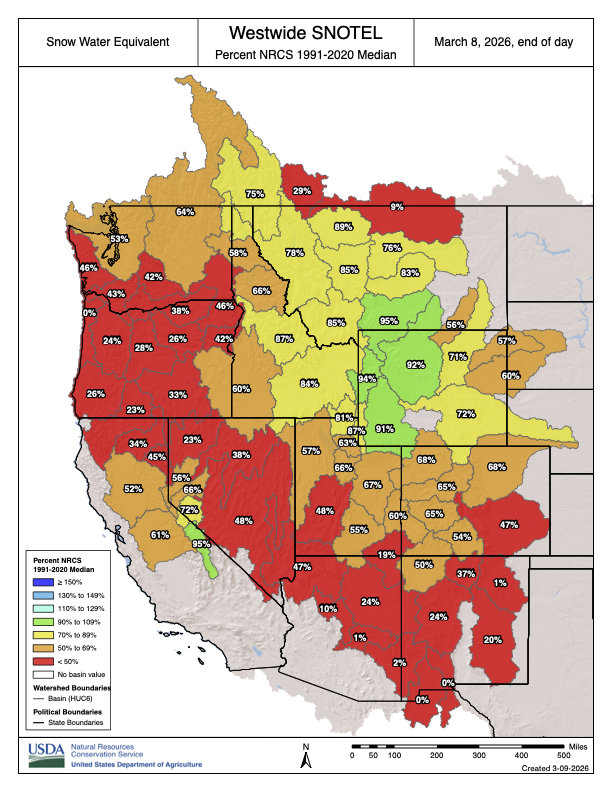
Click the link to read the article on the AZCentral website (Brandon Loomis). Here’s an excerpt:
March 7, 2026
Key Points
- A warm, dry winter has resulted in a disappointing snowpack across the intermountain West, affecting the Colorado River’s water supply.
- Projected inflow to Lake Powell is at a near-historic low, complicating efforts to manage water shortages among states.
- Arizona’s local water supplies, on the Salt and Verde rivers, are in better condition than last year, though still below average.
The federal government’s Colorado Basin River Forecast Center’s March report noted much of the drainage, especially in the mountains of Colorado and Utah, had experienced their worst snowpack since at least 1981. When meteorological winter ended on March 1, both Phoenix and Salt Lake City had broken records for maximum mean winter temperatures by 2 degrees Fahrenheit. The warmth that pervaded the West had melted much of the existing snowpack or caused it to fall as rain instead, encouraging evaporation and plant uptake and reducing the amount that will reach reservoirs this spring and summer.
“It’s not a pretty picture here,” forecast center hydrologist Cody Moser said while reviewing a color-coded watershed map emblazoned with red to indicate vast areas projected to deliver relatively little runoff.
The result, as of early March, was a projected Colorado River inflow to the critical storage pool in Lake Powell of just 2.3 million acre-feet, or 36% of the 1991-2020 average. If that projection holds up, it would be the lowest April-July boost for Lake Powell since the disastrous year of 2002 firmly entrenched this age of megadrought...This profound snow drought comes at an especially awkward time, compounding a quarter-century of regional aridification that has drained the nation’s two largest reservoirs to precarious depths. Lake Powell started March at just 24% of capacity, with much of that water functionally unavailable to flow downstream to Lake Mead and the Southwest because it’s below Glen Canyon Dam’s hydropower and bypass intakes. Lake Mead began the month at 34% of capacity. Both began this century essentially full. The lack of storage complicates the U.S. Bureau of Reclamation’s efforts to adopt new dam-operating and shortage-sharing guidelines without triggering a lawsuit from states and water users. Unless they do that by October, the current rules imposing cutbacks on Arizona and others will lapse, potentially worsening the shortage. Yet Arizona has panned the options that the agency initially studied because, officials say, they unfairly target the state for bigger losses while not enforcing the Colorado River Compact’s call for upstream states to let a minimum amount of water pass through.