Could the production of Guayule save Western farmers?

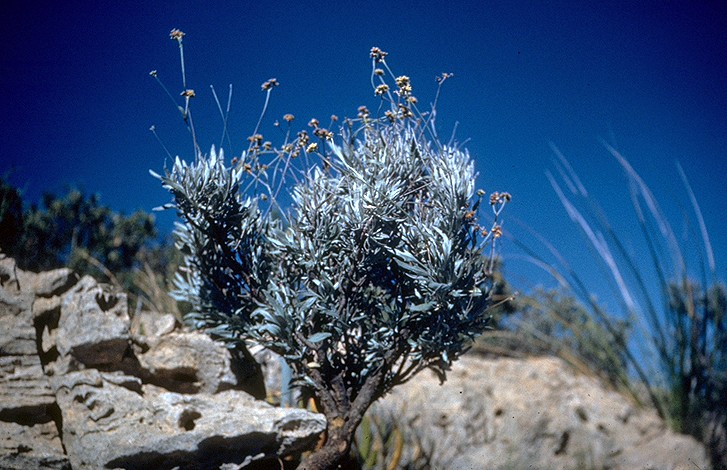
While it looks like a dusty, silver-gray desert shrub, guayule – which originated in Northern Mexico, is essentially a “living rubber factory. As of 2026 the plant gaining serious traction as a potential savior for farmers in the American Southwest—particularly in Arizona and California—who are facing catastrophic cut to their use of Colorado River water.1

A close-up of a shrub with silver-green leaves growing near rocky terrain under a clear blue sky.

Why Guayule may be a “Rescue” Crop

Farmers in the West are in a bind: water intensive crops like alfalfa, corn, and cotton are becoming nearly impossible to grow with dwindling water allotments. Guayule is stepping into that gap for several reasons:

Extreme Water Efficiency: Guayule uses roughly 50% less water than cotton or alfalfa. In Pinal County, Arizona, it’s estimated that switching to guayule could save 15% of the total agricultural water usage.2

Heat & Salt Tolerance: It doesn’t just survive the desert heat; it thrives in it. It can also handle the high-salinity soil that often plagues fields where irrigation water has evaporated over decades.

Domestic Rubber Security: Currently, almost all the world’s natural rubber comes from Hevea trees in Southeast Asia. Guayule provides a domestic, “Made in the USA” source of rubber for tires and medical supplies.3

Hypoallergenic Latex: Unlike traditional rubber, guayule latex lacks the proteins that cause “Type I” latex allergies, making it a premium material for surgical gloves.

The “Catch”

The hurdle isn’t growing the guayule; it’s the infrastructure. Farmers can’t switch overnight because they need specialized processing plants to extract the rubber from the shrub’s bark. However, companies like Bridgestone have been scaling up commercial-grade tire production using guayule, signaling that the supply chain is finally catching up to the climate reality.4

Other Resilient Contenders

While Guayule is the heavy hitter for the Southwest, a few other “underreported” crops are being trialed to rescue Western and Plains farmers in 2026:

Kernza: A perennial grain with 10-foot-deep roots. It doesn’t need to be replanted every year, preventing soil erosion and sequestering massive amounts of carbon.

Teff: An ancient Ethiopian grain that is highly drought-tolerant and serves as a high-value, water-wise forage for horses and livestock.

Amaranth: A “pseudo-cereal” that requires very little water and produces highly nutritious seeds and leaves, often used in health-food markets.

Hemp: Industrial hemp requires significantly less water per kilogram than cotton and other crops. So it can flourish with less irrigation, making it ideal for regions with scarce water resources. Hemp’s deep roots improve soil structure, which aids in water retention and prevents soil erosion and its cultivation helps to minimize agricultural runoff.

Mountain towns see record-breaking temps as #snowpack and ski season take a hit — Summit Daily

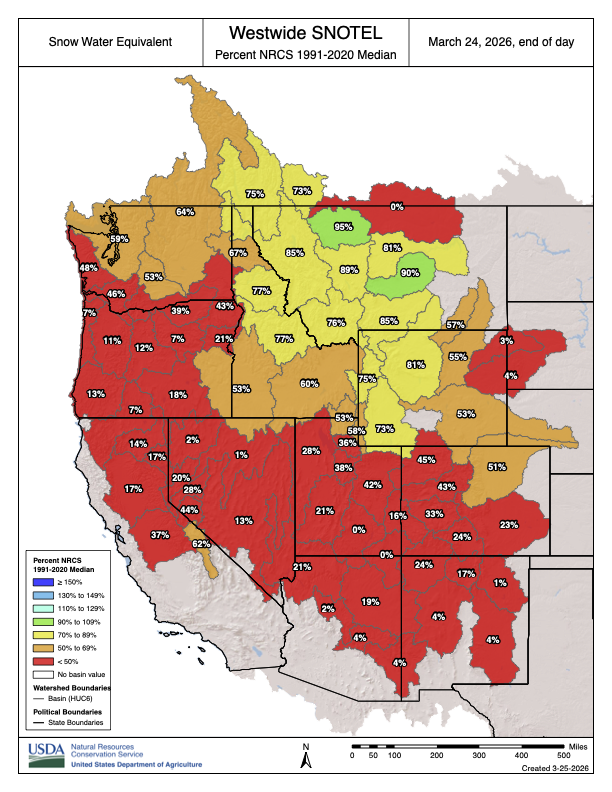
Westwide SNOTEL basin-filled map March 24, 2026.

Click the link to read the article on the Summit Daily website (Andrea Teres-Martinez). Here’s an excerpt:

March 23, 2026

With cooler weather finally in sight following a mid-March heat wave, Colorado’s snowpack is reporting an early meltdown

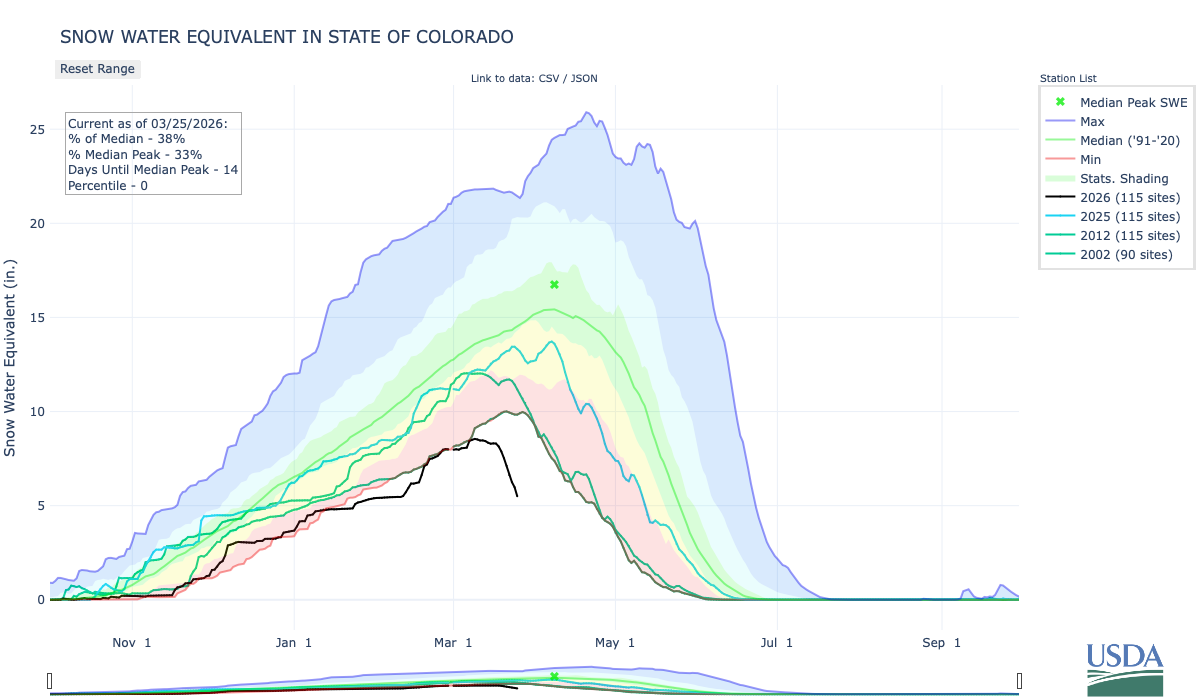
Several Western Slope mountain towns experienced record-breaking temperatures last week, with some towns logging the hottest day on record in up to 65 years. On average, most towns recorded temperatures between 20-30 degrees above normal, according to National Weather Service Meteorologist Brianna Bealo…Recent warm temperatures have meant early closures for some mountain resorts. Ski Cooper, Powderhorn Mountain and Sunlight Mountain resorts all closed for the season on March 22, with other resorts limiting terrain due to little natural snow. Other areas didn’t open at all, including Cranor Ski Area in Gunnison, Lee’s Ski Hill in Ouray and the Hesperus Ski Area. The addition of another week of warmer temperatures spells bad news for Colorado’s rapidly dwindling snowpack. As of March 23, snow water equivalent in Colorado is at 44% of median with 16 days left to go until the median peak. The snowpack’s state will likely only get worse throughout the week thanks to the warm and dry weather. Historically, the state’s snowpack reaches its peak in early April before the mountain snow drains away by June or July. A warm winter compared with early snowmelt, however, means the snowpack likely already reached its peak around March 10, Bealo said, and could melt out earlier in the spring.

“It looks like we’ve already reached peak, and we’re melting out pretty rapidly,” Bealo said. “Even though we’ve only really just started seeing melt-out occurring, if we continue at the same rate that we’re seeing, we’d probably be melted out somewhere towards the end of April, early May.”

#Arizona hires high-powered law firm, setting the stage for a legal battle over #ColoradoRiver water — Caitlin Sievers (AZMirror.com)

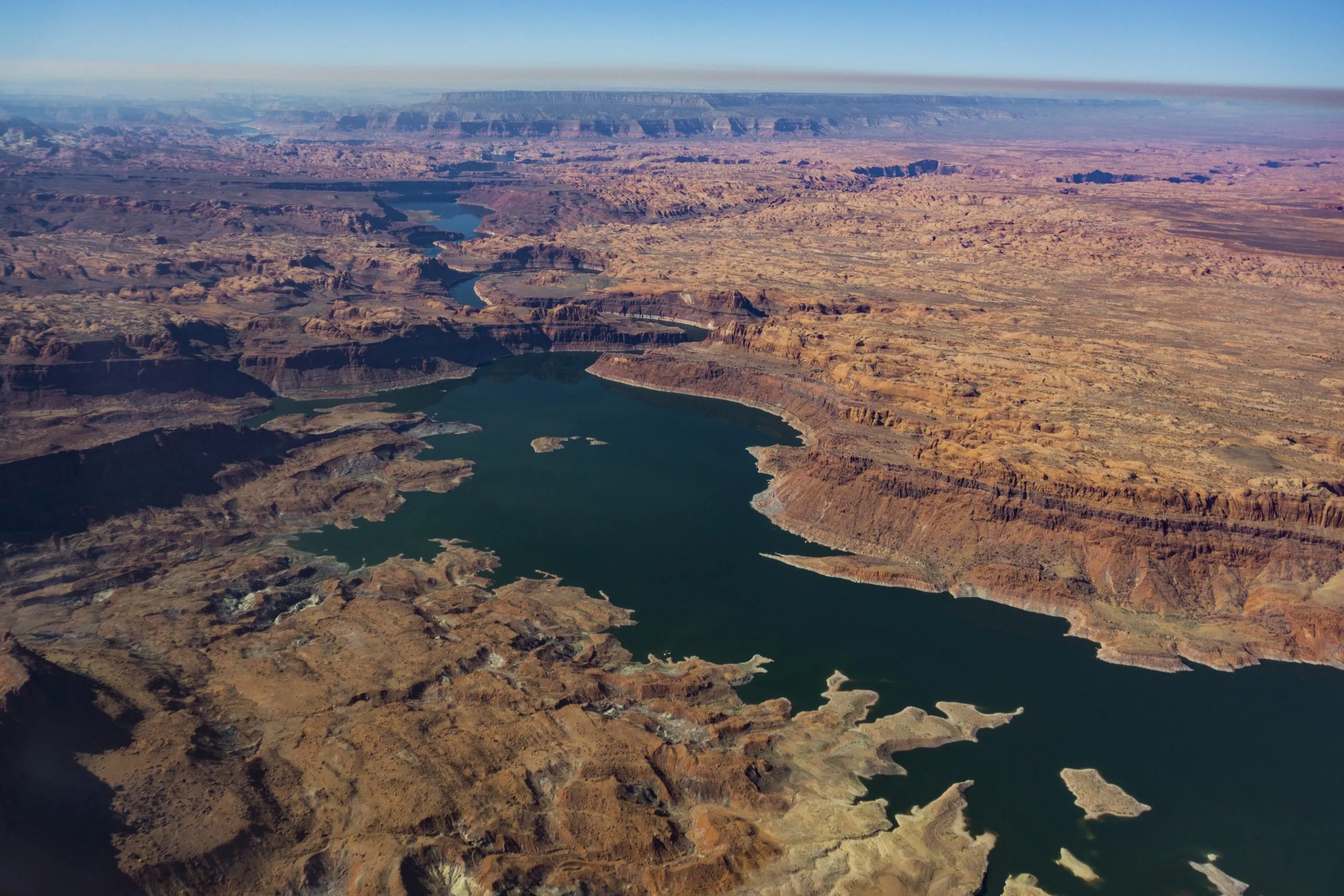
The sun rises over Lake Powell in Glen Canyon National Recreation Area, in Page, Arizona. Lake Powell, a critical Colorado River reservoir, is only at a third of its capacity as drought conditions in the Southwest worsen. CREDIT: ECOFLIGHT

Click the link to read the article on the AZMirror website (Caitlin Sievers):

March 23, 2026

Arizona is preparing for a legal battle over its rights to Colorado River water.

Following an extraordinarily dry winter along the river basin and what’s expected to be an exceptionally hot and dry spring across the West, where high temperatures in March have already blown past records, the pressure to maintain access to the state’s fair share of river water is growing. 

The Colorado River is a vital source of drinking water for 40 million people in the seven basin states, Mexico and 30 Native American tribes, and provides water for farming operations and hydroelectricity. 

Reaching a water usage agreement is imperative to the basin states as the river’s water supply continues to decline, as it has done for the past 25 years due to a persistent drought spurred on by climate change. 

On Monday, the Arizona Governor’s Office announced that it had retained the law firm Sullivan & Cromwell to represent the state in possible litigation among the Colorado River Basin states and the federal government. 

Sullivan & Cromwell is an international firm based in New York City that has represented big names like Microsoft, BP, Goldman Sachs and JPMorgan Chase. The state is using some of the $3 million it put into its Colorado River legal defense fund last year to retain the law firm.

The Governor’s Office doesn’t expect to take any legal action until June at the earliest, but wants to be prepared for the possibility, especially if the dispute ends up before the U.S. Supreme Court. 

The Lower Basin states — Arizona, Nevada and California — and the Upper Basin states — Colorado, New Mexico, Utah, and Wyoming — have been negotiating an updated water usage agreement for more than two years.

But so far the states have blown past two deadlines to do so — one in November and one in February — and are quickly approaching October, when the existing usage agreement expires. 

If the states can’t reach an agreement before that, the federal government will implement one of its draft plans, all of which would place an outsized burden on the Grand Canyon State.

That’s because the Central Arizona Project, a series of canals that supplies Colorado River water to the Valley and the Tucson area, is one of the newest users of the river water, making it legally one of the first to be cut. 

But so far, the Upper Basin states have refused to agree to any water usage cuts of their own, while the Lower Basin states insist that every state take their fair share.

Arizona has offered to reduce its Colorado River allocation by 27%, California by 10%, and Nevada by nearly 17%. 

Negotiators for Arizona also insist that the Upper Basin states be held to the original 1922 Colorado River Compact that requires them to release a 10-year rolling average of at least 75 million acre-feet of water to the Lower Basin, in addition to one-half of the annual allotment owed to Mexico, for a total of about 80.2 million acre-feet. 

An acre-foot of water represents enough to cover an acre of land to a depth of one foot, or about 325,851 gallons. That’s enough to provide three homes in Arizona a year of water, on average.

So far, the Upper Basin states have held to the original release agreement. But as water levels in the two major reservoirs on the river, Lake Mead and Lake Powell, continue to decline, it’s expected that the Upper Basin states will be unable to meet that requirement as early as 2027. 

When the states entered into the original Colorado River Compact in 1922, they allocated 7.5 million acre-feet of water each year to be shared by the Upper Basin states and another 7.5 million to be used among the Lower Basin states. 

Since then, the states have updated their water usage guidelines several times, even though the apportionments remain the same. But Lower Basin states face mandatory cuts during times of drought and Upper Basin states do not. In 2025, for the fifth year in a row, the federal government imposed drought-based cuts, and Arizona’s amounted to a loss of 512,000 acre-feet of water for the year.

Under current allocations, Arizona has rights to 2.8 million acre feet of water per year, and has implemented 800,000 acre feet in reductions per year. In contrast, Colorado has rights to 3.8 million acre feet a year, although it uses an average of 1.9 million acre feet, annually. 

The amount of water that Colorado has access to can be unpredictable because it relies mostly on melted snowpack for its water, which varies from year to year. This year’s snowpack levels are historically low.

The Lower Basin states have undertaken significant conservation efforts for Colorado River water since 2014 and have reduced their consumption from 7.4 million acre-feet in 2015 to just over 6 million in 2024.

The Upper Basin states have increased their usage in the past five years, from 3.9 million acre-feet in 2021 to 4.4 million in 2024. The federal government’s draft plans allow for the Upper Basin states to use even more water.

Gov. Katie Hobbs’s proposed budget for this year would put another $1 million toward the Colorado River Legal Defense fund, and lawmakers earlier this month gave preliminary approval to doing just that.

Even as Arizona prepares for a legal battle, the state plans to continue attempting to reach an agreement with the other river basin states, according to the Governor’s Office. 

“Governor Hobbs is committed to working with the federal government and other Colorado River states to deliver a negotiated settlement that protects Arizona’s fair share of water and stabilizes the system,” spokesman for Hobbs Christian Slater said. “However, it’s critical that Arizona be prepared to defend ourselves in court if an agreement cannot be reached or the Law of the River is violated.”

Water providers across Douglas County urge conservation this irrigation season — Town of #CastleRock

Water stored in Colorado’s Denver Basin aquifers, which extend from Greeley to Colorado Springs, and from Golden to the Eastern Plains near Limon, does not naturally recharge from rain and snow and is therefore carefully regulated. Courtesy U.S. Geological Survey.