River managers need to conserve around 1.7 million acre-feet in Lake Powell to keep the reservoir from dropping below hydropower turbines this year, according to federal government projections. The Bureau of Reclamation, a federal agency that manages dams on the Colorado River, has estimated that reservoir levels could fall below required elevations for hydropower production before August as record-low snowpack turns into pitiful flows in streams and rivers.
“The situation is dire, the stakes have never been higher, and the reservoirs have never been drier,” Estevan Lopez, New Mexico’s negotiator on interstate Colorado River matters, said during a meeting of the Upper Colorado River Commission on Tuesday [March 24, 2026].
The back of Glen Canyon Dam circa 1964, not long after the reservoir had begun filling up. Here the water level is above dead pool, meaning water can be released via the river outlets, but it is below minimum power pool, so water cannot yet enter the penstocks to generate electricity. Bureau of Reclamation photo. Annotations: Jonathan P. Thompson
If water levels fall below required levels for hydropower production, dam managers will be forced to release water through bypass tubes, which are not designed for sustained, high-volume flows. With too much use, the bypasses could fail, turning the dam into a massive plug in the river and shutting off downstream flows. To keep Powell above those critical levels, federal officials can either fill it with water from upstream reservoirs, including some in Colorado, or they can reduce the water it drains from Powell and sends to the Lower Basin (California, Arizona and New Mexico). States are already expressing their views on how those operations should work. Upper Colorado River basin states, including Colorado, want the federal government to achieve the conservation requirement by reducing water releases to downstream states, at least in part. Upper Basin states say upstream reservoirs aren’t enough to save Powell without cuts to Lower Basin water deliveries. Draining the upstream reservoirs could also leave the system without backup supplies in the event of another dry year…The three primary reservoirs that could prop up Powell are Flaming Gorge in Wyoming, Navajo Reservoir in New Mexico, and Blue Mesa Reservoir near Gunnison, Colorado. Of the three, only Flaming Gorge is large enough to contribute the entire 1.7 million acre-feet on its own, and that would require draining the reservoir to halfway full. Blue Mesa and Navajo already stand at around halfway full, and the two reservoirs likely could not provide the water to save Lake Powell even if both were entirely drained.
Colorado River “Beginnings”. Photo: Brent Gardner-Smith/Aspen Journalism
American White Pelican and Double-crested Cormorant at Bill Williams Wildlife Refuge along the Colorado River, Arizona. Photo: Gary Moore/Audubon Photography Awards
Click the link to read the article on the Audubon website (Jennifer Pitt):
March 20, 2026
Audubon and partners cut through the conflict with a unique, basinwide perspective, championing the river’s health for the people and birds that rely on it.
The winter of 2025-2026 has not been kind to the Colorado River. Record-warm temperatures day after day across the mountains that feed the river have led to record-low snow levels. All indications are that spring snowmelt feeding the river will be scant.
That is a huge problem, because Colorado River reservoirs, which historically held vast water reserves, are already depleted, with Lake Powell at 25% and Lake Mead at 34% of capacity. This is bad news for people and birds relying on water from the Colorado River. The U.S. Bureau of Reclamation (Reclamation), the federal agency managing the dams, projects that Lake Powell’s water levels could fall low enough to threaten Glen Canyon Dam’s infrastructure, downstream water delivery, hydropower, and native wildlife in the Grand Canyon including the California Condor and the Western Yellow-billed Cuckoo, among others.
As this crisis plays out, Reclamation has the difficult job of re-tooling systemwide, long-term dam operations on the Colorado River (often referred to as the “Post-2026 Guidelines”). Existing rules, first set nearly two decades ago and tweaked repeatedly to keep up with the declining Colorado River (the result of a warmer and drier climate), expire at the end of this year. As anticipated under this timeline, Reclamation issued a Draft Environmental Impact Statement (Draft EIS) in late January which laid out potential alternatives for federal management and solicited comments from stakeholders. This Draft EIS embraced uncertainty as a central planning condition as they tested different approaches under a broad range of hydrologic conditions. For a long time, the expectation was that the seven U.S. states sharing the river (Arizona, California, Colorado, New Mexico, Nevada, Utah and Wyoming) would develop a consensus-based proposal for Reclamation, but that hasn’t happened and talk of litigation has increased.
Southwestern Willow flycatcher
Reclamation must now figure out next steps. The agency does have legal authorities, but those legal authorities were crafted long ago and do not necessarily spell out how to take meaningful action in this historic crisis. That threatens the water supply for more than 35 million people including the major cities of the American Southwest, Tribes, millions of acres of irrigated farms and ranches, as well as the Colorado River itself and every living thing that depends on its habitats, including hundreds of bird species like the Southwestern Willow Flycatcher, Yuma Ridgway’s Rail, and Summer Tanager.
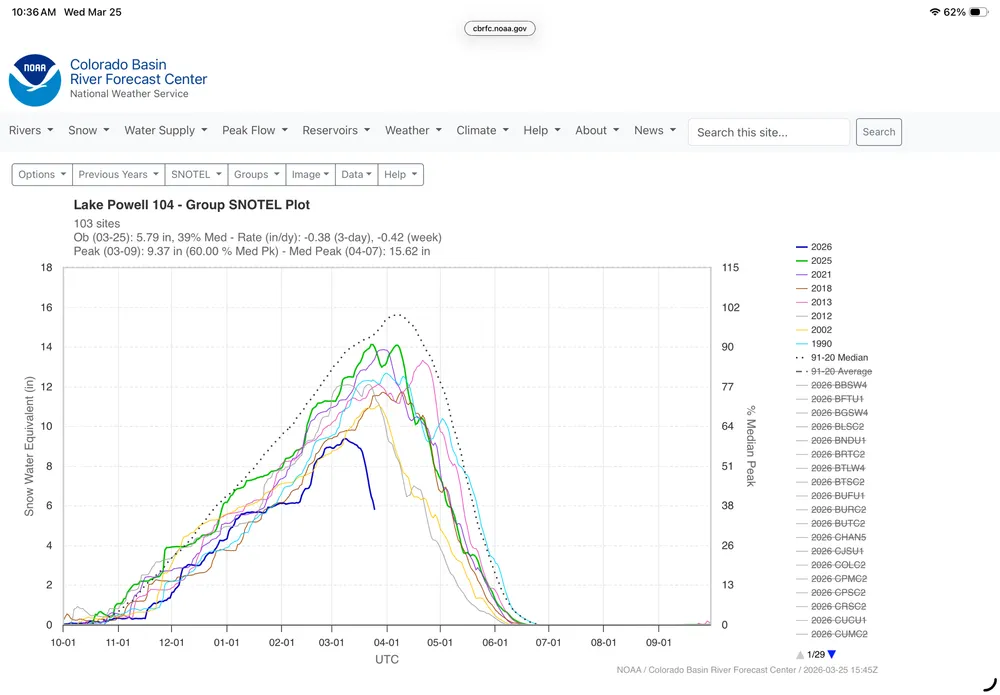
This is a graph of snowpack above LakePowell using 104 snow measuring stations. It was 9 inches of water on March 7, now 6 inches. Other dry years shown.There is no historical analog to this — Brad Udall
Audubon submitted formal comments in response to the Draft EIS, joining conservation partners to weigh in on what comes next for Reclamation’s consideration (read our comment letter here). Dozens of comments were submitted by the Colorado River Basin states, water users, and other stakeholders making their case with Reclamation that their water uses need to be protected at the expense of others. In its comments Audubon emphasized the need to stabilize the Colorado River system from its headwaters to its delta—a unique, basinwide perspective that urges Reclamation to manage risks for people and nature rather than deferring hard decisions until emergency conditions force action. Our comment letter focused on constructive engagement noting the Draft EIS’s strengths in its analytical foundation while identifying and describing targeted refinements that would help ensure the Final EIS fully informs decision-makers about risks and real-world consequences. Specifically, Audubon calls for:
Clarity and predictability
Flexible, adaptive tools for conserving, storing, and managing water
Environmental stewardship embedded into operations
Meaningful and voluntary Tribal participation
Pathways for advancing in-basin mitigation and resilience-building opportunities
Pathways for advancingbinational cooperation with Mexico
Over the next few months, Reclamation still has an opportunity to persuade the Colorado River Basin states into consensus. Whether or not they are successful (and we hope they are), sometime this summer we expect Reclamation to issue a Final EIS that includes refinements to the Draft as well as an indication of their preferred alternative for Colorado River operations. In the meantime, it is urgent Reclamation also prepare for the water supply emergency that is unfolding in 2026.
For much of the last century, Reclamation was a leader in developing the southwestern United States by harnessing the Colorado River and delivering its water across the land. Today, Reclamation must lead in a new way, helping everyone and everything that depends on the Colorado River live with the river we have in a warmer, drier world.
Last week’s heat wave was record-smashing, extraordinary, and impossible to ignore. Given that temperatures were more typical of what we’d expect in June, we’ll try not to judge you if you felt the need to turn on your A/C. 🙂
In this blog post, we’ll provide some climate context on last week’s mind-boggling temperatures and touch on the current drought and snowpack situation. And while we’ll focus on the heat from last week here, it’s worth noting that yesterday, March 25, featured yet another round of record-breaking temperatures across Colorado, including new March high temperature records in Denver (87°F) and Grand Junction (88°F).
Widespread, eye-popping warmth
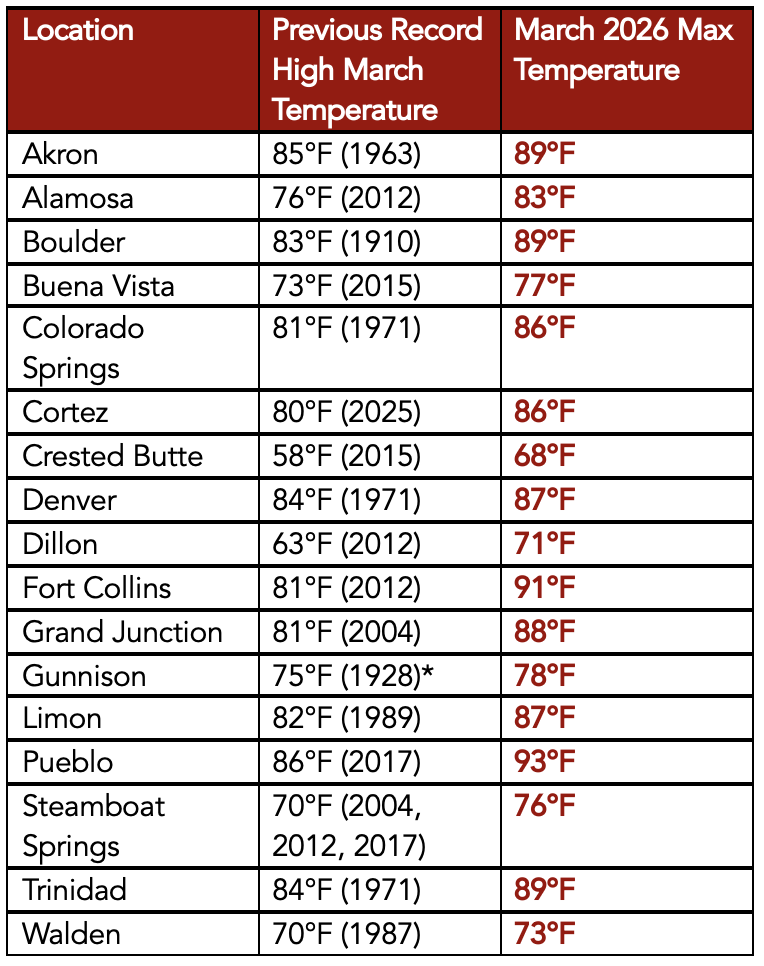
For pretty much all of Colorado, last week brought the warmest March temperatures ever recorded. There were far more stations in the state that broke all-time monthly high records for March than did not. Here’s a look at the records that were set at some of our long-term climate sites:
March maximum temperature records at various long-term weather stations throughout Colorado. Data from ACIS.
From the [table] above, you’ll see that we didn’t just break previous monthly records by a small margin; new records were set by several degrees. It would be noteworthy to have new daily climate records were set by these kinds of margins, but to see monthly records shattered by more than 5°F across numerous stations is truly remarkable.
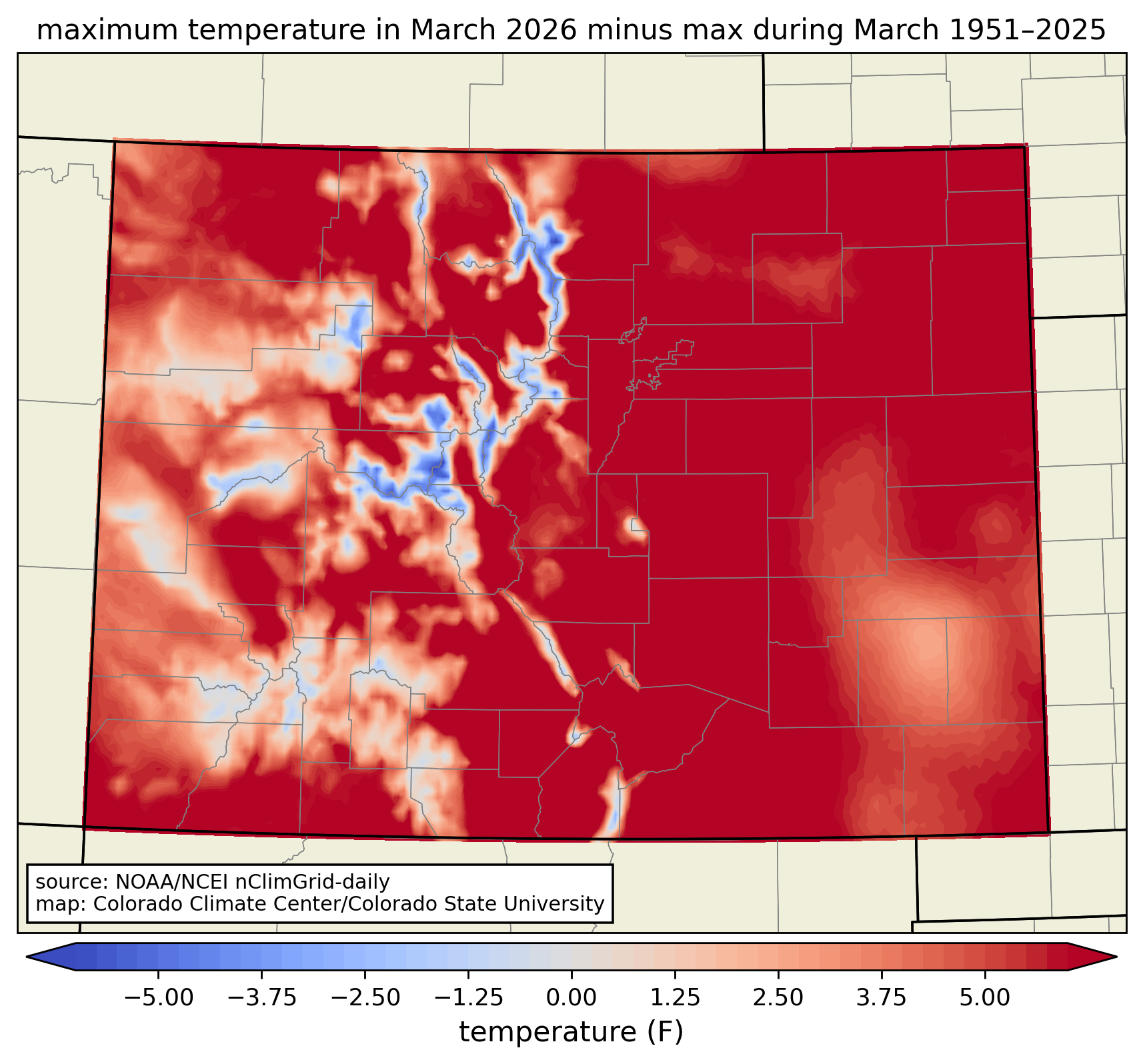
Another way of looking at this is by comparing the highest temperature observed this March (through the 22nd) to the highest temperature observed in all Marches from 1951—2025 in a gridded temperature dataset (in this case, NOAA’s nClimGrid). Nearly the entire state is red, meaning this March broke the previous record over this time period. (The main exception is at the highest elevations, where it was slightly warmer in March 1987.) Furthermore, most of the state saw temperatures at least 5°F higher than had previously been seen in March. The all-time March record for Colorado of 96°F at Holly in 1907 was not broken, but was tied at numerous locations including La Junta, Burlington, Campo, and Walsh.
Warmest day in March 2026 (through March 22nd) compared to the warmest day in all Marches between 1951-2025. Data from NCEI nclimgrid.
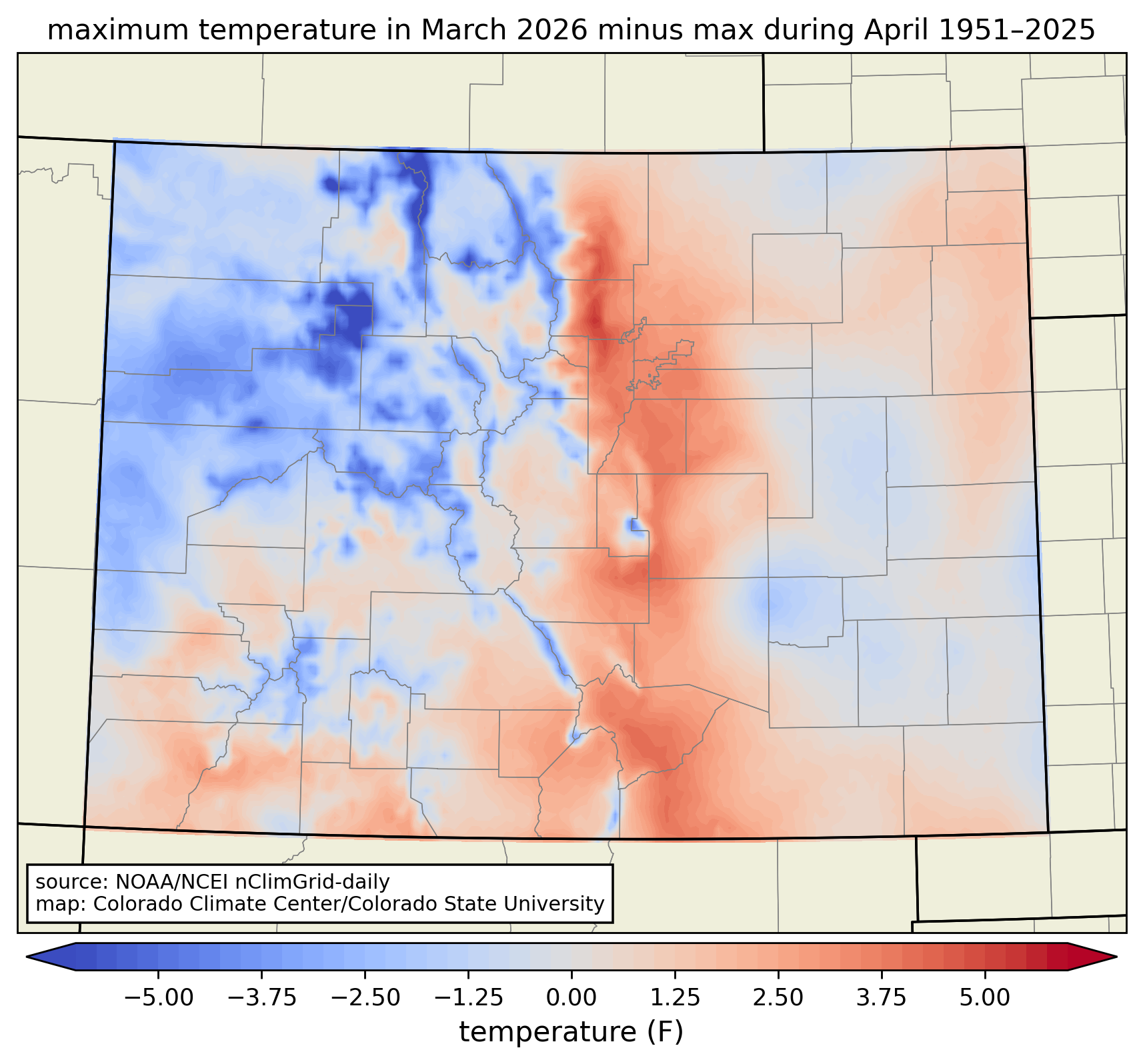
To put an even bigger exclamation point on these incredible records, there were several places in Colorado that not only set new all-time records for March, but they also saw warmer temperatures than their all-time records for April. This includes places like Alamosa (new March record of 83°F; current April record is 80°F) and Fort Collins (new March record of 91°F; current April record is 89°F). Comparing last week’s temperatures to records since 1951, you’ll notice that most of the Front Range Urban Corridor, San Luis Valley, and lower elevations in southeastern Colorado saw warmer temperatures than any March or April day in the past 70+ years:
Same as the previous map, but the warmest March 2026 day is compared to the warmest April days in 1951-2025. Data from NCEI nclimgrid.
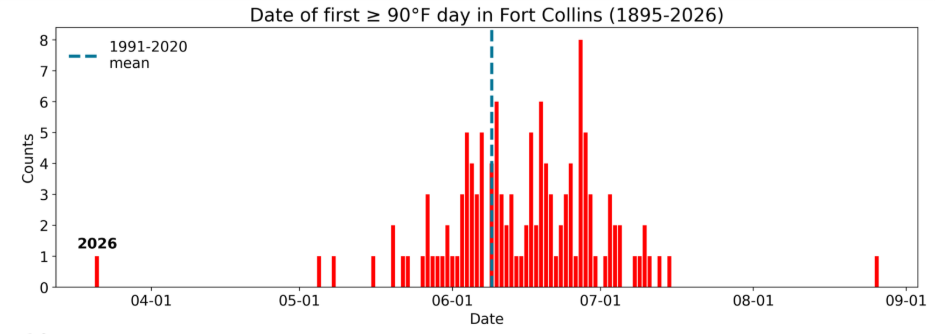
As you might expect, the kind of heat that we saw last week across Colorado is more typical of June or even July. In Fort Collins, the reading of 91°F on March 21 marked Fort Collins’s earliest 90°F or warmer day (the previous record was May 5, set back in 2000). On average, Fort Collins doesn’t see its first 90°F or warmer day until June 15:
Dates of first 90°F or warmer day in Fort Collins from 1895-present. The blue dashed line shows the 1991-2020 mean 90°F or warmer day, which is June 9. Data from ACIS.
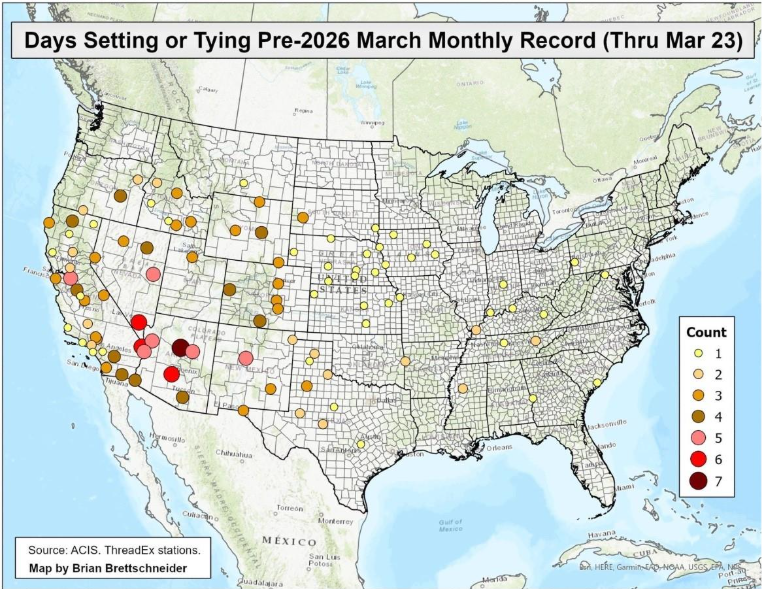
Last week’s heat was not only remarkable in terms of intensity but also longevity. The most significant heat occurred across four days (March 18-21). Over that period, several locations set new monthly records every one of those days, with each day being warmer than the last. This was a common theme throughout much of the western US:
Number of March 2026 days that set or broke monthly March records. From Brian Brettschneider.
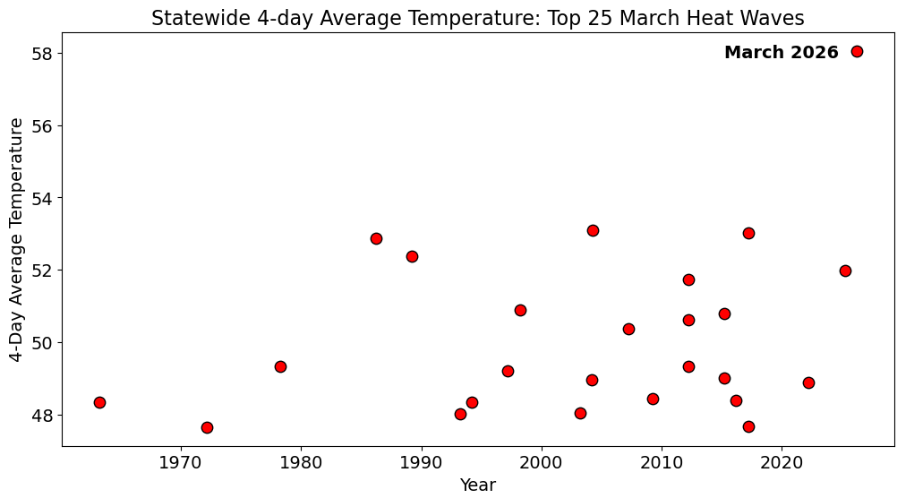
In Colorado, this long-lasting, remarkable heat was far beyond anything we’ve seen in March. Comparing last week’s heat to previous March “heat waves” (defined as days with the warmest 4-day averaged temperatures), it was a step far above the rest. Statewide averaged temperatures during March 18-21, 2026 period were nearly 5°F warmer than Colorado’s 2nd-warmest March heatwave (March 23-26, 2004):
Colorado’s top-25 March heat waves since 1951, defined as 4-day averaged statewide temperatures. Colorado’s warmest heat wave (set last week, March 18-21) eclipsed its previous warmest heat wave (March 23-26, 2004) by nearly 5°F. Data from NCEI nclimgrid.
Snowpack is rapidly declining
One of the most concerning consequences of last week’s is the impact to our snowpack. If you’ve been following along throughout the winter, then you’re well-aware that Colorado has been seeing its worst snowpack in at least 45 years. And the very warm conditions over the past week have exacerbated an already bad situation.
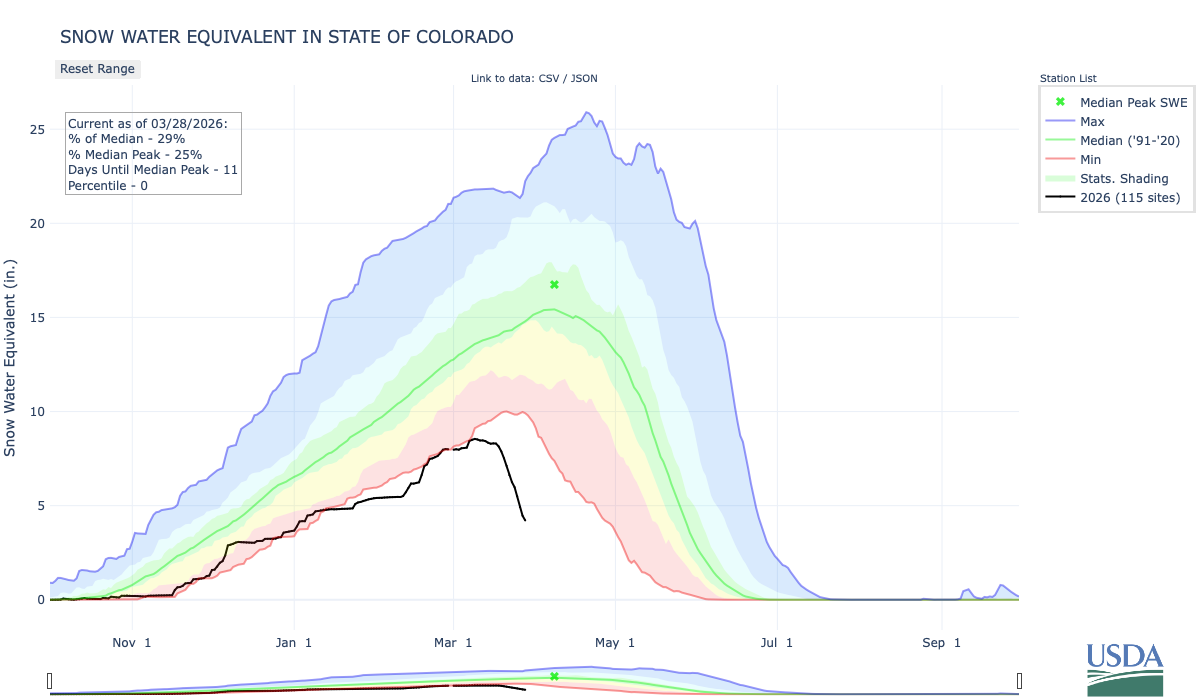
Looking at the statewide water-year-to-date snowpack in the SNOTEL network, it’s clear that snow water equivalent has taken a massive nosedive over the past week or so. On average, Colorado’s peak snowpack date is April 7, meaning that we should still be seeing snowpack accumulate in late March. Instead, averaged over the state, snow water equivalent has declined by over 2.5 inches in the last week. We typically don’t see snowpack melt this quickly until May, so to observe this trend so early in the season is highly concerning.
Statewide snow water equivalent based on the SNOTEL network as of March 28. The black line shows statewide snow water equivalent for Water Year 2026. From NRCS.
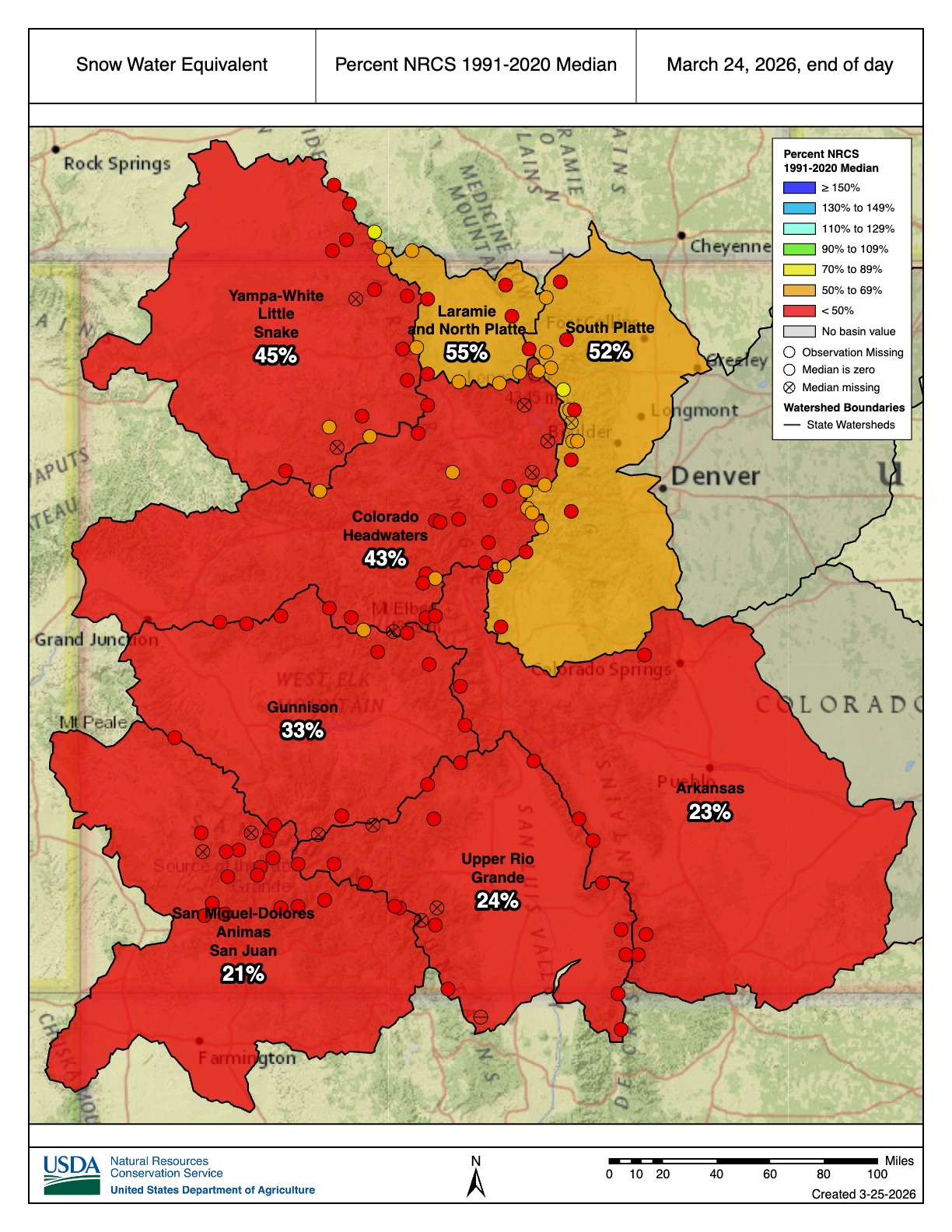
Statewide snowpack currently sits at [29%] of the 1991-2020 median. Given the current conditions and forecasts, it’s very possible that many locations have already seen their peak snowpack. Every major river basin in the state is running way-below average, with 71 of the 92 active SNOTEL stations reporting their lowest values on record:
Percent of average (1991-2020) snow water equivalent in Colorado’s major river basins. From NRCS.
In a previous blog post, we discussed that a combination of SNOTEL data (dating back to the 1980s) and manual snow measurements (dating back to the 1930s) have been used to evaluate how this year’s snowpack stacks up against past winters. Throughout much of the winter, the story has been that this year’s snowpack is very bad, but it hasn’t been quite as bad as the winters of 1976-77 and 1980-81. However, with last week’s rapid early season melting, conditions have deteriorated further. We’ll wait for official confirmation from snow course data at the end of the month,but current data suggests that we’re now sitting at Colorado’s worst snowpack on record, surpassing the winters of 1976-77 and 1980-81.
Drought conditions are deteriorating
When discussing the drought landscape, all eyes have been on the major snow deficits in Colorado’s mountain areas, but that isn’t the only part of the state that’s been seeing worsening drought conditions. Most of Colorado’s lower elevations have also seen substantial precipitation deficits in recent months. As such, drought conditions throughout the state have worsened and expanded over the past few months.
Per the latest US Drought Monitor, approximately 91% of the state is experiencing at least abnormally dry conditions, and ~74% of Colorado is experiencing drought (D1 or worse). Those numbers have increased from 54% and 45%, respectively, since the start of the water year on October 1, 2025. The recent warmth brought particularly large changes to the drought monitor last week, as Colorado’s exceptional drought or worse area (D3 or higher) nearly doubled from ~13% last week to ~24% in the latest drought monitor.
Colorado Drought Monitor for March 24, 2026 (left) compared to September 30, 2025 (right).
Consequences from the low snowpack are growing
Impacts from this year’s low snowpack are increasing as governments agencies and industries that rely on it are beginning to respond and plan for additional effects. The expanding drought (in part due to the low snowpack) has prompted the Colorado Governor’s Office to activate the State Drought Task Force for the first time since 2020. Utility departments and water managers have begun to initiate drought response plans and implement water restrictions. And ski areas are planning to close earlier than expected due to poor conditions. Unfortunately, as we anticipate well-below average runoff this spring, impacts will likely expand further.
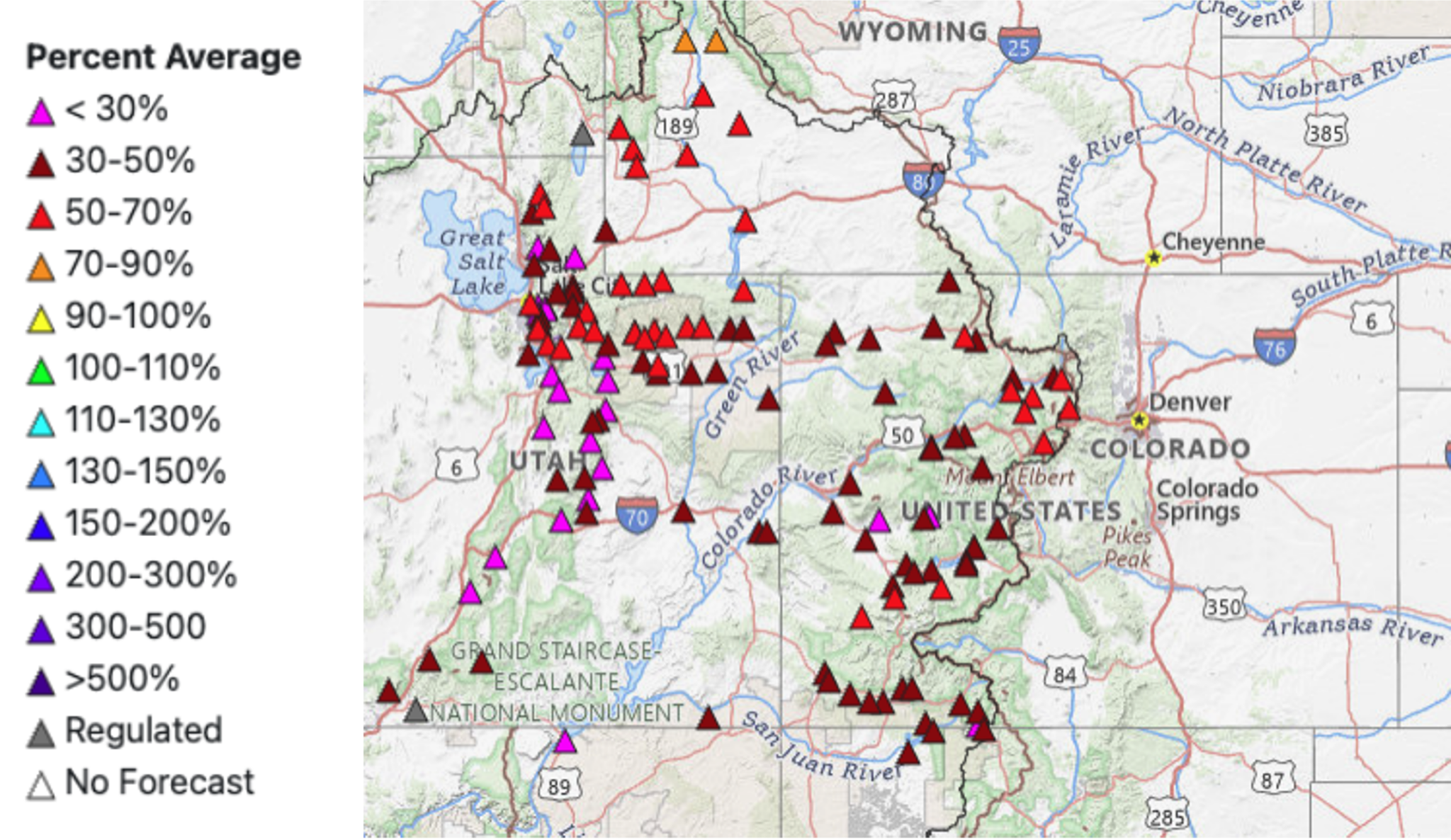
Colorado Basin River Forecast Center percent of average water supply modeled forecast (issued March 25), showing that widespread, well-below average conditions are expected. From the CBRFC.
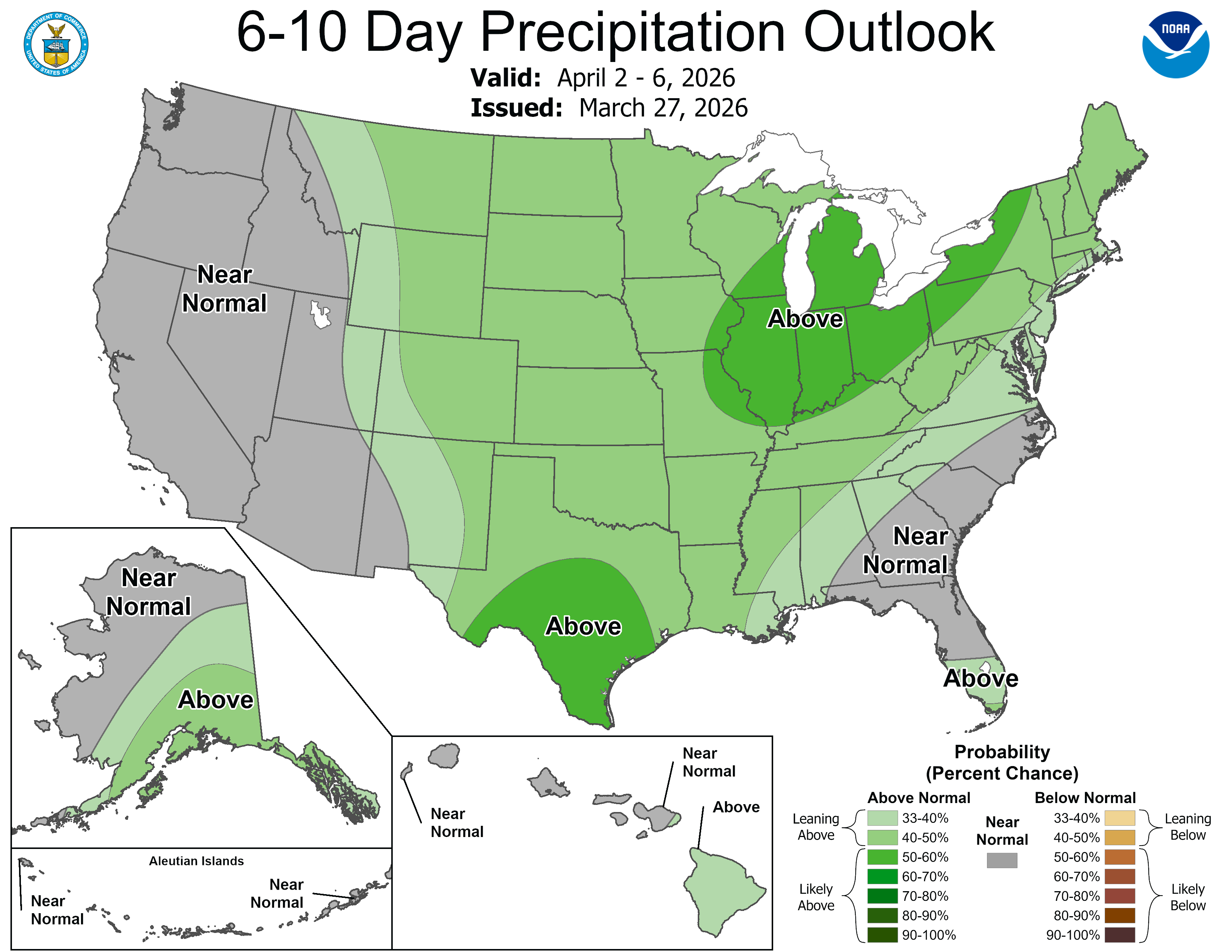
The one piece of potential good news that we’ll end this post with is a pattern shift is likely in early April, which is expected to bring precipitation chances to Colorado. While the moisture won’t be nearly enough to make up for the major deficits we’ve seen accumulate over the last several months, I think we can all agree that we’ll take anything we can get.