Colorado Springs Utilities’ Steve Berry: ‘In looking at the numbers in this executive summary, it does not appear that many of our comments were considered’

transmountaindiversionscoloradostateengineer2011

Last week, the day before the Statewide Roundtable Summit, Western Resource Advocates, et. al., released a report titled, “Meeting Future Water Needs in the Arkansas Basin.” Colorado Springs and Pueblo are taking a hard look at the report, according to this article from Chris Woodka writing for The Pueblo Chieftain. Here’s an excerpt:

There may be a question whether water providers accept the figures used in the reports. “Colorado Springs Utilities was asked to peer review the draft version, and made extensive and substantial comments on it. In looking at the numbers in this executive summary, it does not appear that many of our comments were considered, and many of our suggested changes or corrections were not made,” said Steve Berry, spokesman for Utilities. The largest amounts of water, and presumably the largest conservation and reuse savings, come from Colorado Springs.

The Pueblo Board of Water Works is also reviewing the final report for accuracy, said Alan Ward, water resources manager…

The environmental groups say a combination of projects already on the books — conservation, reuse and temporary ag-urban transfers — could provide as much as 140,000 acre-feet, more than enough to meet the needs. Those numbers are being examined by urban water planners, who say the savings might not be attainable. “In general, we were unable to verify or recreate most of the numbers cited in their report, and their estimates for conservation and reuse are significantly greater than what our water conservation experts have calculated as realistic,” Berry said…

When asked how conservation savings would be applied to new supplies, a practice cities find risky, Jorge Figueroa, water policy analyst for Western Resource Advocates, said they could be put into “savings accounts” for future use. When asked where the water would be stored, he cited the T-Cross reservoir site on Williams Creek in El Paso County that is part of the Southern Delivery System plan…

Drew Peternell, director of Trout Unlimited’s Colorado Water Project, said the group supports [the Southern Delivery System]. Because the project already is under way, the groups look at SDS as a key way to fill the gap. The report also supports programs like Super Ditch as ways to temporarily transfer agricultural water to cities without permanently drying up farmland.

Meanwhile, here’s a look at a report from the Northwest Council of Governments, “Water and Its Relationship to the Economies of the Headwaters Counties,” from Bob Berwyn writing for the Summit County Citizens Voice. From the article:

The report, released in January at a Denver water conference, takes a fresh look at the critical importance to the economy of water in West Slope rivers, and why Colorado leaders may want to take careful thought before making future transmountain diversion policy decisions. Visit the NWCCOG website for the full 95-page report.

“This report makes an important contribution to the on-going dialogue about adverse economic impacts associated with losing water by focusing attention on Eagle, Grand, Gunnison, Pitkin, Routt and Summit counties,” said Jean Coley Townsend, the author of the report. “This has never been done before. The report provides an important counterbalance to earlier studies that show economic impacts of losing water from the Eastern Plains.”

Balancing the supply and demand of water could be the State’s most pressing issue. The report does not take issue with Front Range municipal or Eastern Plains agricultural water users — all parties have important and worthy concerns and points of view — but is meant as a thorough review of water as an economic driver of headwaters economic development.

The report provides a balance to the existing solid body of work that measures the potential economic effects of less water on the Front Range and the Eastern Plains and the loss of agriculture in those parts of the state.

“If we … are going to solve our Statewide water supply shortage challenges there must first be statewide mutual respect and true understanding of each other’s water supply challenges,” said Zach Margolis, Town of Silverthorne Utility Manager. “The report is a remarkable compilation of the West Slope’s water obligations and limitations as well as the statewide economic value of water in the headwater counties of Colorado.”

More transmountain/transbasin diversions coverage here.

Pueblo Dam: The proposal for a hydroelectric generation facility at the north outlet works is moving through the bureaucracy

puebloreservoir.jpg

From The Pueblo Chieftain (Chris Woodka):

The Bureau of Reclamation in December accepted a lease of power privilege proposal by the Southeastern Colorado Water Conservancy District, Colorado Springs and the Pueblo Board of Water Works. “This is a big deal that will give us broader options for power in the Arkansas River basin,” said Jim Broderick, executive director of the Southeastern District.

The next step is for the partners to sign an agreement and gain approval from Reclamation for its plan to build hydropower at Pueblo Dam. The generation facilities would be built in the next 10 years, Broderick said. The cost estimates and timeline for the agreement are slated to be discussed by the Southeastern board in February.

More hydroelectric coverage here and here.

Southern Delivery System update: Construction of two Pueblo County sections of the pipeline are underway

sdspreferredalternative.jpg

From The Pueblo Chieftain (Chris Woodka):

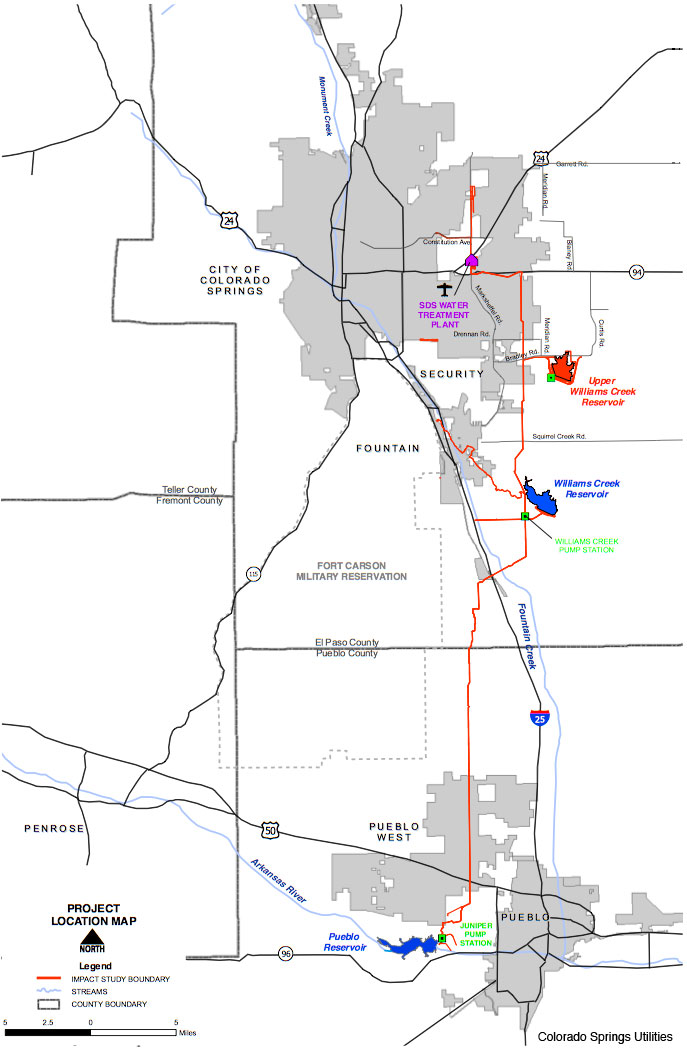
A 6.4-mile pipeline section through Pueblo West and a 7.6-mile line through Walker Ranches are under way. Later this month, crews will begin construction on a 4.3-mile line from Pueblo Dam to Pueblo West. Construction on the entire 66-inch-diameter line through Pueblo County is expected to be complete by the end of this year. Pueblo City Council this week approved a $198,000 payment from Colorado Springs for an easement across the Honor Farm land. That will include about 27 acres of temporary easements, 16 acres of permanent easements and continuing access to the pipeline for maintenance and repairs. Work along the Pueblo West section has been going on for several weeks, although not all claims have been settled.

“They’ve already dug two big holes in my backyard,” said Dwain Maxwell, one of about seven property owners who are awaiting court action on how much they will be paid for SDS easements…

Construction has begun on Walker Ranches as well. Gary Walker has allowed access, and said he is working with contractors on construction details. But his lawyers are still negotiating the price of that access. Construction also has begun on the North Outlet Works connection at Pueblo Dam, 4.3 miles of raw pipeline in El Paso County and treated water pipelines in Colorado Springs. A contract for the Juniper Pumping Plant was recently awarded as well.

More Southern Delivery System coverage here and here.

Colorado River Basin: What are the reasonable water management options and strategies that will provide water for people, but also maintain a healthy river system?

coloradoriverbasin.jpg

Here’s a guest commentary written by Eric Kuhn, David Modeer and Fred Krupp running in The Denver Post. The trio are issuing a call to arms of sort, asking for input for the Colorado River Basin Study. Here’s an excerpt:

Management of the Colorado River is a complex balancing act between the diverse interests of United States and Mexico, tribes, the seven basin states, individual water users, stakeholders, and communities. The challenges posed by new growth and climate change may dwarf anything we faced in the past. Instead of staring into the abyss, the water users, agencies, and stakeholder groups that make managing the Colorado River responsibly their business are working together, using the best science available to define the problem, and looking for solutions.

We’re calling our inquiry the Colorado River Basin Study, and we want your help. As Colorado River management professionals, we have a lot of knowledge and ideas, but we know that we don’t have them all. We want ideas from the public, from you, but we need your input by February 1. You can submit your suggestions by completing the online form at: http://on.doi.gov/uvhkUi.

The big question we need to answer is: What are the reasonable water management options and strategies that will provide water for people, but also maintain a healthy river system? We don’t believe there’s a single silver bullet that will resolve all of our challenges. We want to continue to explore the benefits and costs of every possibility, from conservation to desalination to importing water from other regions.

The West was built on innovation and hard work, and that spirit is still strong. Our landscapes and communities are unparalleled in their beauty, resilience, and character. The economic well-being of our rural and urban communities in the Colorado River basin is inextricably linked to Colorado River and its environmental health.

That’s why we are asking for the public’s input to help us craft a study showing a path forward that supplies our communities with the water they need to thrive and protects the health of the Colorado River-and the ecosystems and economies it supports.

More Colorado River basin coverage here.

How much water will the Niobrara shale play under eastern Colorado Springs require and where will it come from?

niobrarashale.jpg

From the Colorado Springs Independent (Pam Zubeck):

Colorado Springs Utilities is required to serve Banning Lewis Ranch under the annexation agreement, in which the annexor relinquishes the land’s water rights to the city forever, except for 2,000 acre feet of groundwater on the south end. That water, about 652 million gallons, is to be split between the city and annexor.

But Utilities, still building the SDS pipeline, hasn’t heard a water request from Ultra, says spokesman Dave Grossman. He says the city doesn’t know how much is needed, because “fracking is new to our area, so we don’t have past data for planning purposes.” Ultra did not respond to a request for comment for this story, but Montgomery says 1 million to 5 million gallons is used per frack.

If the 326 million gallons to which Ultra would have access under the annexation agreement isn’t enough, and the company doesn’t want to buy water from Utilities, Cherokee Metropolitan District, which serves the 18,000-customer Cimarron Hills enclave east of Powers Boulevard, is open to the idea of selling water, manager Sean Chambers says. Five years ago, Cherokee lost its use of several wells in the Upper Black Squirrel Creek Ground Water Management District, east of its service area, after illegally exporting water from the basin to its customers.

Chambers now wonders if that water, which Cherokee still owns, could be sold to drillers.

“We would consider it, so long as we were assured certain protections and we could confirm our decrees are consistent with what’s allowable,” he says. “The state is a little unsure … They don’t want this oil bonanza to turn into a water problem.”[…]

[Charlie Montgomery, energy organizer of the Colorado Environmental Coalition] says the next battle will be over local control. The Pueblo Chieftain has reported that Rep. Marsha Looper, R-Calhan, wants to require a more comprehensive state accounting of oil and gas drilling’s water needs. Meanwhile, the Longmont Times-Call says that Rep. Matt Jones, D-Louisville, wants to give local governments more control over the industry, including fracking.

More oil and gas coverage here and here.

The Southeastern Colorado Water Conservancy District board approves a $17.2 million budget for 2012

arkansasvalleywateruse2011

From The Pueblo Chieftain (Chris Woodka):

The major portion of the budget, $11.8 million, goes to repay federal costs of constructing the Fry-Ark Project, which includes the Fountain pipeline. Another $270,000 is revenue from state and federal grants.

The operating budget for the district is $5.1 million, with about 60 percent in the general fund, and 40 percent in the enterprise fund.

Of the $3 million district fund, $1.36 million goes toward personnel.

The budget also includes a capital expenditure of $850,000 as the district’s share for purchase of the Red Top Ranch near Lake Granby. That cost will total $1.7 million over two years. The ranch purchase is part of a plan by Front Range water users, including Aurora, Colorado Springs, Denver, Pueblo and the Northern Colorado Water Conservancy District, to provide flows for endangered fish species in the Colorado River. Participation in the program is a condition for importing Fry-Ark water each year.

The major project in the $2.1 million enterprise fund will be the Arkansas Valley Conduit. The U.S. Bureau of Reclamation is preparing an environmental impact statement for the conduit.

More Southeastern Colorado Water Conservancy District coverage here.