Click here to go to the AWRA Colorado Section website for the pitch and to register.

Click here to go to the AWRA Colorado Section website for the pitch and to register.

From email from Reclamation (Kara Lamb):
We saw some demand come up downstream on the Colorado River today–the Fish & Wildlife Service has asked for additional water to bump up the Colorado per the Endangered Species Recovery Program. As a result, this afternoon, we bumped up releases from Ruedi Dam to the Fryingpan River. Flows past the Ruedi gage should now be around 160 cfs. To learn what to anticipate for the rest of summer and early fall, be sure to join us at our annual operations meeting on Wednesday, July 17, at the Basalt Town Hall from 7-8:30 p.m.
From the Bureau of Reclamation (Kara Lamb):
The Bureau of Reclamation has scheduled a public meeting regarding Ruedi Reservoir Water Operations.
July 17: Basalt Town Hall, 101 Midland Avenue, Basalt, Colo., 7 to 8:30 p.m.
The meeting will provide an overview of Ruedi Reservoir’s 2013 spring run-off, and deliver projected operations for late summer and early fall, which are key tourist seasons in Basalt. The meeting will include a public question and answer session.
From Colorado Springs Style (Joe Stone):
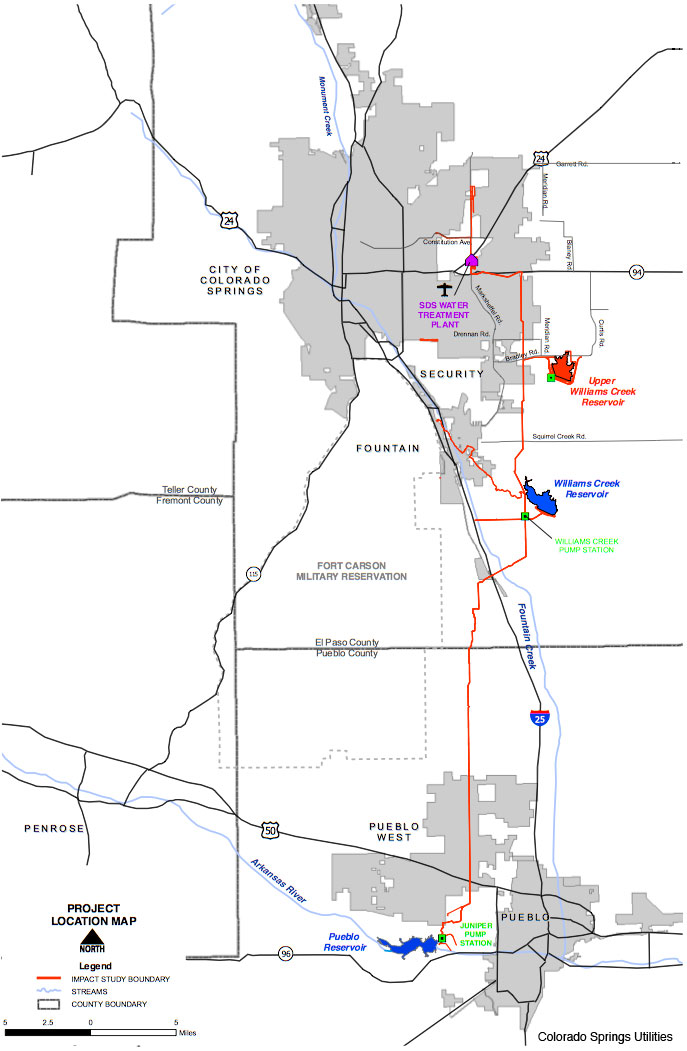
As SDS Program Director John Fredell explains, Colorado water law dictates that water native to Front Range streams and rivers can only be used once. For example, Colorado Springs Utilities can divert Fountain Creek water for use by residential customers, but any of that water not consumed must be treated and released for downstream users. With Western Slope water, Colorado Springs has the right to “use the water to extinction.”
However, Fredell says, no “plumbing”currently exists to allow the Springs to fully consume its Western Slope water. The water gets used once then flows downstream to the Arkansas River via Fountain Creek. By connecting a pipeline from Pueblo Reservoir to the Springs’ water system, the SDS provides the plumbing that will change that. Colorado Springs Utilities will soon be able to exchange water sent down Fountain Creek for water stored in Pueblo Reservoir. “With SDS, we’re basically reusing our water, getting two to three uses of that water, which is extremely valuable.”
Fredell points to several economic benefits of reusing the city’s Western Slope water, including preservation of Arkansas Basin agricultural water rights, which are frequently targeted by growing Front Range cities. Once municipalities acquire agricultural rights and change them to municipal use in Water Court, productive farmland is dried up with little chance of ever being returned to agricultural production.
The immediate benefits of the SDS include revenue for local businesses and jobs for the local workforce. “The SDS is the biggest thing going,” says Fredell, “and we worked hard to get local contractors and companies involved. A lot of people questioned the timing of this project, asking why we would start such a big project during an economic downturn. My answer is, ‘Why wouldn’t you start now?’ You get better pricing on materials and services because of a more competitive market, and you help move the economy forward. This project provides work for over 300 Colorado businesses.” Furthermore, historically low bond rates add up to huge savings over the project’s forty-year finance period.
Officials with Colorado Springs Utilities must also take into account the age of the city’s existing water infrastructure. Bringing Western Slope water to the Springs requires a complex system of twenty-five dams, 200 miles of pipes and four major pump stations in nine counties. That infrastructure is aging, and some parts of the system are more than fifty years old. As parts wear out and fail, the redundancy provided by the SDS will ensure an uninterrupted water supply during repairs and maintenance, which will become more frequent as system components get older.

Here’s an in-depth look at Ruedi Reservoir administration from Hannah Holm writing for the Glenwood Springs Post Independent. Click through and read the whole thing. Here’s an excerpt:
Take, for example, a few water molecules that begin their terrestrial journey as snow in the mountains just East of Aspen. In the spring, they melt and flow into the Frying Pan River, a tributary to the Roaring Fork.
Some of these molecules are captured early and flow east into a tunnel bound for the Arkansas River Valley. Once across the Divide, they may help float a raft or two on their way to a cantaloupe field in Rocky Ford. Other molecules keep flowing west, until they are captured a little ways downstream in Ruedi Reservoir.
Even though these two sets of water molecules are separated soon after birth, their fates remain closely tied.
The molecules in Ruedi Reservoir will stay there, helping provide a pleasant boating and fishing environment, until they are released to flow down to the Roaring Fork and then the Colorado River en route to a Palisade peach orchard that has been relying on water out of the Colorado River since long before any of those tunnels to the Arkansas were drilled.
The ability to store and release water from Ruedi is what permits those other molecules to keep flowing across the Divide, even when water is needed downstream by users with more senior, and therefore higher priority, water rights.

The Super Ditch is asking for a time-out in what the Upper Ark’s Terry Scanga called, “The Mother of all change cases.” Here’s a report from Chris Woodka writing for The Pueblo Chieftain:
The Arkansas Valley Super Ditch has been years in the making and needs time to get established, its lawyers argued in a Division 2 water court filing last week. The Super Ditch, along with the Lower Arkansas Valley Water Conservancy District, filed a motion for a two-year stay in an exchange case that would allow Super Ditch to move water upstream for storage in Lake Pueblo. From there, the water could be leased either to cities or to other farmers in the Lower Arkansas Valley.
The motion, filed Friday, was accompanied by a response to a motion to dismiss that had been filed earlier by opponents of the Super Ditch — Tri-State Generation and Transmission Association and farming groups east of John Martin Reservoir.
Super Ditch attorneys argued in the motion that the two-year period is needed to develop pilot programs that will identify issues of moving water.
The Super Ditch was formed in 2008 to lease water gained from rotational fallowing of fields. Opponents of Super Ditch have argued that the practice will create the need to police hundreds of farms to make sure downstream water users are not being injured. But the Colorado Water Conservation Board already has provided funding to study various aspects of lease-fallowing in the Arkansas River Basin.
One bill signed into state law this year, HB1248, allows the CWCB to operate pilot programs in all areas of the state in order to determine whether other water rights would be injured in water transfer agreements.
Tri-State and its allies are arguing for full review in water court of the change of use as well as exchange applications. Colorado Springs and the Southeastern Colorado Water Conservancy District also filed responses Friday, backing the Lower Ark on some factual points in the case.
In its response to Tri-State, the Lower Ark district chronicled its efforts to establish the Super Ditch since 2006 as a way to prevent further permanent dry-up of farmland in the Lower Ark Valley.
From The Pueblo Chieftain (Chris Woodka):
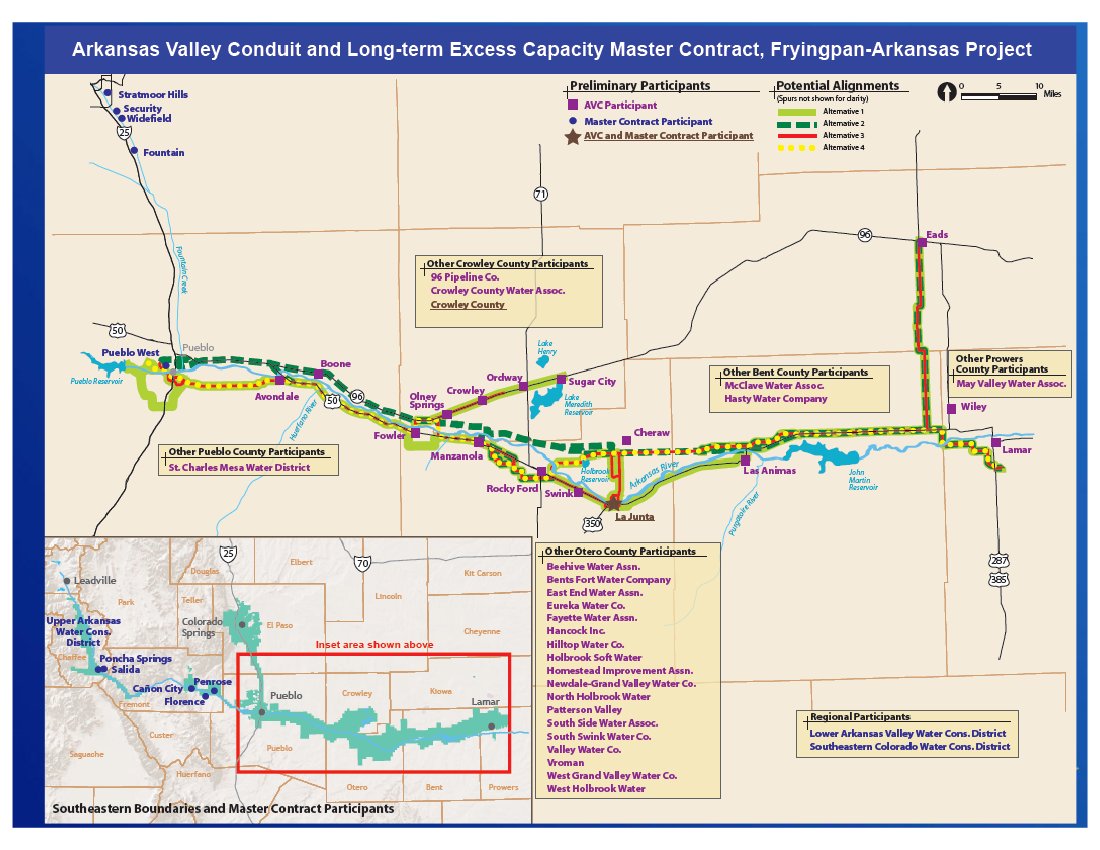
The Arkansas Valley Conduit would swing south of Pueblo, crossing to the north side of the Arkansas River at Avondale in a preferred option identified by the Bureau of Reclamation. Reclamation is expected to complete an environmental impact statement on the conduit, a master storage contract and a cross-connection of outlets at Pueblo Dam by this fall. The pipeline route takes parts of several alternatives that have been considered for the past two years in the EIS.
“By studying all of the elements separately, we were able to take a piece of each to create a new alternative,” said Jim Broderick, executive director of the Southeastern Colorado Water Conservancy District, sponsors of all three projects. “This project alternative addresses the concerns that have been raised.”

From email from Reclamation (Kara Lamb):
Just a quick Memorial Day weekend update on Ruedi Reservoir.
Those of you who joined us for the State of the River meeting last night heard our projection that while we might get close, we do not anticipate filling Ruedi all the way to the top this year. However, we did catch up in portions of our snow pack in the upper reaches of the Fryingpan Basin with the late season snows.
Currently, Ruedi is at a water level elevation of about 7729 feet and rising. We are releasing about 110 cfs from the reservoir to the lower Fryingpan River. The Rocky Fork creek is starting to see some run-off, also, and is contributing an additional 10 or so cfs to the ‘Pan.
The Upper Colorado River Recovery Program and its reservoir operating partners announced today that they will not be employing the Coordinated Reservoirs Operations plan. That means, this run-off season we will not see by-passed inflows from Ruedi Reservoir for the endangered fish program.
From email from Reclamation (Kara Lamb):
Just a quick update about the Fryingpan-Arkansas Project reservoirs as we move into the Memorial Day weekend.
We are starting to see some run-off come into the West Slope Collection System, up above Ruedi Reservoir and Basalt, Colo. As a result, we are diverting and sending water through the Boustead Tunnel to Turquoise Reservoir. The reservoir is currently only about 30% full, but it has started to rise. Today alone it has gained just over a foot in water level elevation. At this time, we are not running water from Turquoise down to the Mt. Elbert Power Plant.
We have been generating power at the Mt. Elbert Power Plant and seeing some water come into Twin Lakes Reservoir. As a result, Twin is just over 60% full. Like Turquoise, we expect to see its water level rise with snow melt run-off.
Further downstream on the Arkansas, Pueblo Reservoir is currently about half full. That is slightly below average for this time of year, but still plenty of water for weekend recreation.
And, as most of you have probably already heard, there will be some water available for the Voluntary Flow Program this summer, thanks to the late season snows.
From The Pueblo Chieftain (Chris Woodka):
The Arkansas Valley Conduit will receive an additional $4 million in federal funds this year thanks to reallocation of unused or leftover funds within the Bureau of Reclamation. “It will allow us to start working on engineering and the drafting of a design,” said Jim Broderick, executive director of the Southeastern Colorado Water Conservancy District, sponsors of the project.
Broderick learned of $3.79 million in additional funds being steered to the conduit during a visit with Reclamation Commissioner Mike Connor in Washington, D.C., earlier this week. The money comes at a time when the district anticipated getting far less than it needed to keep the project moving. Last month, the district’s board received the grim news that under sequestration, only $1 million would be included in the 2014 budget. The district had sought $14 million.

From The Mountain Mail (Casey Kelly):
Arkansas River boaters can expect to see flows bolstered this summer by 10,000 acre-feet of water from the Voluntary Flow Management Program. Roy Vaughan, facility manager for the Bureau of Reclamation’s Pueblo Field Office, confirmed Monday that water will be available for the Voluntary Flow Management Program. “We’ll supply 10,000 acre-feet for rafting and the fishery,” Vaughan said.
The program will supply enough water to keep flows at the Wellsville station at 700 cubic feet per second from July 1 through Aug. 15 this year, according to Vaughan.
He said the bureau’s April 1 forecast called for bringing more than 24,700 acre-feet of water over from the Western Slope. Its May 1 forecast called for 47,230 acre-feet. “That’s almost double what we were forecasting,” Vaughan said. He said recent moisture “changed the outlook for us.”
Rob White, Arkansas Headwaters Recreation Area park manager, told a May 7 Salida City Council work session that outfitters were worried about another low water season and had been told a few months ago that water may not be available this summer for the Voluntary Flow Management Program. “Luckily we were saved by the late-season storms in both March and April,” White said. “As a matter of fact, I got a call from the Bureau of Reclamation (May 6), and they believe they’ll be able to deliver the full 10,000 acre-feet of water for us for the summer flow program.”
Rafting outfitter Mark Hammer, owner of The Adventure Company in Johnson Village, said he does about 75 percent of his summer business during the 6 weeks that augmentation flows will be available. “(The Voluntary Flow Management Program) is extremely helpful,” Hammer said. “The bell curve of river flows doesn’t necessarily coincide with our peak tourism, so this ensures we have enough water in the Arkansas during the later period of our season.”
He said a more average water flow season this year will help outfitters predict when river flows will peak, how high they will be and how long they will last. “We certainly appreciate the collaborative effort of the flow program,” Hammer said. “It’s a benefit to the public, outfitting companies and the whole area’s economy which relies on the river.”
Greg Felt, co-owner of ArkAnglers, said this year is shaping up to be a good year for the fishery. “We’ve been able to see some good hatches and good aquatic insect activity,” Felt said. “Looking ahead, it’s great to see snowpack improve as it has.”
Kara Lamb, Bureau of Reclamation spokeswoman, said, “What makes this program possible is the cooperation, understanding and willingness of those involved to work together. Their cooperation helps the diverse groups reach the mutual goals of the water owners, operators and users, municipalities and government agencies. The Flow Program has created a model for all rivers in the West, and one Coloradans can be proud of.”
More Fryingpan-Arkansas Project coverage here.

From The Mountain Mail (Joe Stone):
Recent weather patterns in the Upper Arkansas River Valley precipitated discussion of snowpack and water supplies during the Thursday meeting of the Upper Arkansas Water Conservancy District. District hydrologist Jord Gertson reported that all district reservoirs are full, except for DeWeese Reservoir in Custer County, which is at 89 percent of capacity.
Gertson presented Natural Resources Conservation Service data compiled May 1 that show Upper Arkansas River Basin snowpack at 93 percent of average and 287 percent of 2012 snowpack levels. Gertson said Snowpack Telemetry sites at Fremont Pass and Brumley show the snow water equivalent at 101 percent and 109 percent of median, respectively. The Fremont Pass SNOTEL site also reports precipitation at 106 percent of average for the current water year, which began Oct. 1. Gertson also showed snowpack charts indicating measurements at upper basin SNOTEL sites are “way better than last year,” including sites at Porphyry Creek, Independence Pass and St. Elmo.
District directors also reported good news about the Frying Pan-Arkansas Project, which is expected to import 47,000 acre-feet of water from the Western Slope this year, compared to 14,000 acre-feet in 2012. Diversions of Fry-Ark Project water into the Arkansas Basin average approximately 52,000 acre-feet of water per year. In 2011, the project imported 98,000 acre-feet of Western Slope water, the second highest amount in the project’s 50-year history of operations.
In other business, directors heard a legislative report from consultant Ken Baker. Baker’s report mainly focused on House Bill 1130, which, he said, targets Arkansas Basin water and is expected to be signed by the governor.
Baker said HB 1130 would create a “selective application” of a 130-year-old Colorado water law. The bill would create the potential for 30 years of interruptible-supply agreements that are currently limited to a maximum of 10 years. The state engineer would have authority to approve these agreements, changing the use of the water and bypassing Water Court proceedings that are currently required to change the use of a water right. Baker said the bill mainly benefits Aurora, allowing the city to take Arkansas Basin water without having to pursue a change-of-use case in Water Court.
To gain the votes needed to pass the bill, Baker said a special exclusion was added that exempts Western Slope water.
In other business, Upper Ark directors:
Approved a modification to a Nestlé Waters North America augmentation agreement for 200 acre-feet of Fry-Ark Project water per year for 35 years. Agreed to stipulate out of Poncha Springs case 09CW138, subject to favorable review of the stipulations by district engineer Ivan Walter. Approved an agreement with law firm Wilderson, Lock and Hill to provide legal counsel for a flat fee of $2,000 per month. Received an update on an integrated water agreement with Buena Vista. Approved a cooperative water agreement with Colorado Parks and Wildlife. Learned that the gate wheel at O’Haver Lake has been replaced after the old one was damaged by a vehicle. Received an update on the Trout Creek Ditch exchange case, 08CW106, which is scheduled to go to trial June 11 if the Department of Corrections, division engineer and Colorado Water Conservation Board do not agree to proposed stipulations.
From The Mountain Mail (Joe Stone):
Upper Arkansas Water Conservancy District directors heard a report about the potential for underground water storage in Chaffee County during their Thursday meeting. Tammy Ivahnenko and Ken Watts with the U.S. Geological Survey said areas identified for further study include aquifers near Salida, Nathrop, Johnson Village, Buena Vista and north of Buena Vista.
Watts said the locations were identified based on slope (less than 3 percent), soil texture at a depth of 5 feet (loam, sandy loam or gravel preferred) and surface geology (alluvial or gravel deposits).
Another important factor, Watts said, is the “stream-accretion response time factor,” which provides an indication of how long water will stay in an aquifer before draining into a stream.
Ivahnenko described “water budgets” she developed for Cottonwood, Chalk and Browns creeks and the South Arkansas River.
The water budgets include irrigated acres, consumptive use by crops and amount of water diverted for irrigation, and help determine how much water may be available for storage at a given time.Watts said he conducted “slug tests” at 29 wells to determine hydraulic properties in the aquifers, including conductivity and permeability. He also reported on findings from Colorado State University monitoring wells. Hourly readings from the monitoring wells documented seasonal changes in water level and temperature, showing seasonal changes in groundwater levels and surface-water infiltration.
Some wells showed significant influence from surface irrigation while others indicated a more stable, natural water level.
Upper Arkansas Water Conservancy District officials are developing plans to increase water storage capacity in the Upper Arkansas River basin. An important component of those plans is underground storage in alluvial aquifers, which would eliminate evaporative water losses and provide augmentation water through natural recharge to surface waters.Conservancy district officials said they will rely on USGS findings to help determine possible locations for underground water storage projects.
More Upper Arkansas Water Conservancy District coverage here.
From The Pueblo Chieftain (Chris Woodka):
U.S. Sen. Michael Bennet, D-Colo., is asking the Senate energy appropriations subcommittee to provide additional funding for the Arkansas Valley Conduit. The conduit’s funding stream hit a snag in the 2014 budget request by President Barack Obama, which allocates $1 million. The Southeastern Colorado Water Conservancy District had asked the Bureau of Reclamation for $15 million to keep the project moving forward.
At April’s meeting, the Southeastern board learned that Reclamation projects across the board had been slashed, including some already under construction. “I don’t know what will happen,” said Southeastern Executive Director Jim Broderick. “We are going to Washington in a couple of weeks to try to learn more.”
In a letter to committee chairman Sen. Dianne Feinstein, D-Calif., and Sen. Lamar Alexander, R-Tenn., Bennet pointed out other long-term projects in California and Idaho that had received additional funding. “As the subcommittee prepares for the coming fiscal year, we must ensure that states and local communities have the resources to continue work on large-scale, multiyear projects,” Bennet said.
The conduit’s environmental impact statement is being prepared by Reclamation, and the conduit already has a built-in repayment mechanism through 2009 legislation that devotes Fryingpan-Arkansas contract revenue to conduit costs.
The cost of the project is estimated at $500 million. It would deliver fresh drinking water from Pueblo Dam to 40 communities as far east as Lamar. Many of those communities could face even higher treatment costs if the conduit is not completed.

From The Mountain Mail (Joe Stone):
Salida City Councilman Jay Moore was sworn in recently as a director on the Southeastern Colorado Water Conservancy District board. Moore replaced Reed Dils as the Chaffee County representative on the board, and he also serves on the Upper Arkansas Water Conservancy District board and the Arkansas Basin Roundtable.
A retired physician, Moore moved to Salida about 9 years ago and was elected to Salida City Council in 2005. He said the fact that he is term-limited as a Salida councilman should help assure county residents that he will not “over-represent Salida.”
Moore stressed the importance of water issues to the local economy and said his experience with water issues through the Upper Ark district and the roundtable makes the new position a good fit. Moore said he promised local municipal and county officials prior to his appointment to the board that he would pass along important water information.
As an example, Moore said, he will be reporting to local officials that flows at the Thomasville gauge recently exceeded 100 cubic feet per second, allowing water to be imported into the Arkansas Basin from the Western Slope – good news for everyone from Arkansas Basin irrigators to rafting companies. Moore added that his first task as a board member is simply to get educated: “The Southeastern district gives me a huge expansion of information I need to learn.”
The district, which now encompasses a nine-county area, was created April 29, 1958, to develop and administer the Fryingpan-Arkansas Project. On Aug. 16, 1962, Congress authorized the construction of the Fry-Ark Project, which transports water via tunnel under the Continental Divide into the Arkansas River basin for storage in mountain lakes and Pueblo Reservoir. The project delivers an average of 69,100 acre-feet of fully consumable water per year into the Arkansas Basin. But as Moore pointed out, the amount of imported project water can vary greatly. For example, the project imported 97,000 acre-feet of water in 2011 but only 12,000 acre-feet in 2012.
“Water is terribly important to us,” Moore said, which is why he takes his role as a “water information conduit” seriously. On the other hand, “just knowing this stuff is fun,” Moore said.
More Southeastern Colorado Water Conservancy District coverage here.
From The Pueblo Chieftain (Chris Woodka):
Colorado Springs may be spending nearly $46 million on stormwater projects this year, but Pueblo County commissioners are trying to determine if the money is being spent in the right places. “It’s fine that they’re spending the money, but it really doesn’t answer our question about whether the list of pre-2009 projects is being addressed,” said Commissioner Sal Pace.
Colorado Springs Mayor Steve Bach and Council President Keith King Thursday responded to questions raised earlier in the week by commissioners about whether stormwater spending is fulfilling the 1041 permit conditions for Southern Delivery System designed to mitigate flooding on Fountain Creek caused by increased growth from SDS. “Considering these tough economic times and the daunting task of ongoing fire recovery efforts, we are pleased that staff was able to find a way to more than triple the initial projections of funding for stormwater improvements in 2013,” Bach and King wrote in a letter to commissioners and Pueblo City Council.
On Monday, Pueblo County commissioners expressed concern about the progress of a stormwater task force in El Paso County. The task force was formed last year and determined there are more than $900 million in stormwater needs that should be addressed on a regional basis.
Bach, however, is seeking an independent accounting of the $686 million in projects that represent Colorado Springs’ share of the burden. He has advocated for Colorado Springs taking care of its own obligations.
Pueblo County commissioners want to know which of the projects on the list are among the $500 million in identified needs in 2009, when Colorado Springs indicated a stormwater enterprise was in place as part of conditions for the SDS permit. Colorado Springs City Council abolished the stormwater enterprise on a split vote following a 2009 election. Last year, city attorney Chris Melcher offered an opinion that Colorado Springs should be spending at least $13 million annually on stormwater to fulfill its SDS obligations.
“It seems like there is a lot of additional money being spent to address new flooding threats because of the Waldo Canyon Fire,” Pace said Thursday. “Colorado Springs has to meet that need, but that doesn’t replace what they should already be addressing.”
More coverage from the Chieftain:
Colorado Springs this week provided an accounting of $45.7 million in planned expenditures this year to address stormwater concerns.
$14.2 million for new grade structures, stabilization projects, operation, maintenance and salaries. $681,000 for Waldo Canyon Fire mitigation projects. $12.8 million for Colorado Springs Utilities projects, including stabilization of lines crossing creeks, and repair of damage from washouts related to the Waldo Canyon Fire. $8.8 million for Camp and Douglas Creek restoration. $1.4 million for Colorado Springs Airport drainage projects. $350,000 for Pikes Peak Highway drainage. $7.5 million for remedial work on the Waldo Canyon Fire emergency watershed projects.
From email from Reclamation (Kara Lamb):
It’s been an interesting couple of weeks. We will be re-evaluating our spring operations at Ruedi Reservoir once we’ve had a chance to incorporate new information from the May 1 forecast into our own models.
Meanwhile, spring is here and it is time to change the release regime from Ruedi Dam to the Fryingpan River. Most years around May 1 we make this adjustment. We are required to release the lesser of inflow or 110 cfs. As a result, today at 5 p.m. and again tomorrow and 10 a.m., we’ll increase releases from the dam to the river by about 33 cfs. By this time tomorrow, the release from Ruedi Dam to the lower Fryingpan will be about 110 cfs.
We have seen quite a bit of snow in the upper reaches of the Fryingpan River Valley. Our crews spent the last two weeks in the high country opening the sixteen diversion dams of the Fryingpan-Arkansas Project. To see photos, check out the Ruedi webpage.
Currently, Ruedi is about 60% full. It will likely continue to drop slowly until run-off. I will send notices when we make changes.
From The Pueblo Chieftain (Chris Woodka):
Pueblo County commissioners want to explore the possibility of jumpstarting projects on Fountain Creek with advance payment of money promised by Colorado Springs Utilities as a condition for Southern Delivery System.
“We need clarity on the acceptability of using the $50 million, using it in advance,” Commissioner Terry Hart said.
Under its 1041 permit for the Southern Delivery System, a $1 billion pipeline that takes water from Pueblo Dam to El Paso County, Colorado Springs promised to pay $50 million for flood control projects south of the city that benefit Pueblo County.
The money is scheduled to begin arriving in five installments to the Fountain Creek Watershed Flood Control and Greenway District in 2016, after SDS goes online.
But $600,000 already has been paid to the district — $300,000 for a flood control study and $300,000 that was used to complete a master corridor study and as its share to provide interim funding to the district.
Last week, Hart, who sits on the Fountain Creek board, was approached with the idea of asking for another $100,000 from the Colorado Springs fund to continue interim funding until the district settles on a strategy for securing a funding source. Commissioner Sal Pace asked attorneys if the county could ask for the entire $50 million to be paid sooner.
“If we bring it in sooner, it could be used to leverage other money,” Pace said.
Commissioner Liane “Buffie” McFadyen said flooding on Fountain Creek is likely to be more intense after the Waldo Canyon Fire and supported using the money sooner, rather than later.
Ray Petros, the county’s water attorney, was uncertain if advance payment is possible. Colorado Springs asked for the five-year schedule for mainly financial reasons, and the payment is just one of a series of conditions that must be met over time. “We’d have to be careful from our side that we weren’t acknowledging that SDS wouldn’t be suspended for some other reason,” Petros said.
From The Pueblo Chieftain (Chris Woodka):
County staff and Colorado Springs Utilities are discussing the adequacy of revegetation requirements on the pipeline route of Southern Delivery System through Pueblo West.
The pipeline is buried, but cuts a 100-foot-wide swath through 7 miles of Pueblo West on its way from Pueblo Dam to Colorado Springs.
As part of Pueblo County 1041 conditions for SDS, Colorado Springs is bonded for two years while revegetation is completed. Although droughtresistant species are being used, seeds must be irrigated to sprout. That raised some questions Monday in a work session on SDS issues.
“We’re in the throes of a drought, and my question is whether this is a good time to do revegetation,” Commissioner Terry Hart said. “If we’re going to be irrigating it for two years and suddenly pull off the water, what happens?”
Attorney Gary Raso said experts from Colorado Springs Utilities and the county’s consultant, Warren Keammerer, are meeting on the issue, but the results likely won’t be known at the end of two years. The county is concerned that too many “weedy” species will take hold, rather than beneficial grasses.
“It became clear to me that at the end of two years, the best you could conclude is that it was going in the right direction,” Raso said. “The experts don’t like being tied to (the two-year limit).”
Hart questioned what recourse the county would have if problems surfaced five years after revegetation was deemed complete. The county has in the past altered the 1041 conditions with Colorado Springs on $2.2 million for dredging Fountain Creek through Pueblo and accepting a $15 million payment for restoration of Pueblo West roads damaged during construction.
There also are unresolved revegetation issues with the portion of the pipeline that crosses Walker Ranches north of Pueblo West.
Commissioners agreed that they need to further discuss issues with Keammerer.
From The Pueblo Chieftain (Chris Woodka):
Pueblo County commissioners want Colorado Springs to explain its stormwater plan as soon as possible, and hinted Monday that a hearing on the 1041 permit for Southern Delivery System could be necessary if answers aren’t forthcoming. “We as a community are very concerned that when the stormwater enterprise disappeared, the conditions in the 1041 permit disappeared,” Commission Chairman Terry Hart said. “The community has been patient.”
Colorado Springs City Council in 2009 eliminated its stormwater enterprise and $13 million annual funding for identified needs. Since then, a new majority of the council has been elected in 2011 and 2013, and Steve Bach was elected mayor under a new governance system. A regional stormwater task force has formed, but apparently it does not have Bach’s support and it won’t begin making recommendations on funding nearly $1 billion in projects until July at the earliest.
At a workshop Monday, commissioners reviewed several parts of the 1041 permit, including revegetation of the pipeline scar through Pueblo West and Walker Ranches and the potential for acceleration of $50 million in payments for improving Fountain Creek. But the big issue was stormwater. The commissioners want an accounting of which projects were on the Colorado Springs stormwater list, what was addressed when the fee was in place and what remains to be done. “My central issue is that we need a concrete plan to identify stormwater needs and how they are going to pay for it,” Hart said.
Colorado Springs Utilities has asked Pueblo County to wait until July to hold an explanatory meeting, in order to allow stormwater task force committees to complete their work.
From The Pueblo Chieftain (Chris Woodka):
The funding pipeline for the Arkansas Valley Conduit has sprung a leak. Federal funding pressures could reduce conduit funding to one-third of its current levels and far less than Southeastern Colorado Water Conservancy District officials had hoped for in next year’s budget. “The conduit is not the only project affected. There are projects under construction that got cut,” Southeastern lobbyist Christine Arbogast told the board Thursday. “Delays cost money, so it’s going to make it more difficult as we move forward.”
The district discussed a figure of $14 million to begin design and construction of the conduit in 2014. However, the budget President Barack Obama submitted to Congress last week included only $1 million for the conduit. The Bureau of Reclamation is on pace to complete an environmental impact statement for the conduit by the end of this year. But several other water projects already being built saw cuts of 75 percent or more in the president’s budget.
If Congress adopts another continuing resolution, rather than a budget, the conduit might retain its current level of funding, $3 million, in 2014, said Executive Director Jim Broderick. Otherwise, the district appears to be out of options to increase funding. “It’s clear the game is different than it used to be,” Broderick said, recounting last week’s visit to Washington, D.C. “This doesn’t stop the project, but it will move at a different pace.”
A federal law in 2009 provided a way to repay the federal government for conduit costs through storage contract payments to Reclamation for use of the Fryingpan-Arkansas Project. But payments would not start until after the project is completed.
The conduit could cost up to $500 million to build and would deliver fresh drinking water from Pueblo Dam to 50,000 people in 40 communities along the Arkansas River. “We’re concerned about the drop in funding, but we’re still in the pre-construction phase,” Broderick said.
From email from Reclamation (Kara Lamb):
Those of you driving past Ruedi Dam over the next week or two might notice a Reclamation drill crew along the retaining wall just north of the dam. The crew is taking samples of the wall as part of our regular and on-going maintenance program across all of our facilities.
Meanwhile, we continue to release about 40 cfs to the Fryingpan River. We are storing what we can behind the dam in anticipation of a below-average run-off.
More Fryingpan-Arkansas Project coverage here.

From the Colorado Springs Independent (Pam Zubeck):
Here’s an update on SDS’s progress in 2012:
Nearly 30 miles of pipeline installed to date — more than half the total pipeline for Phase 1; Nearly all pipeline installed in Pueblo County — with only approximately 0.3 miles remaining; Completion and successful testing of the new Pueblo Dam connection; • Began construction of the first phase of power supply infrastructure for the future Bradley Pump Station in El Paso County; Achieved significant milestone of 500,000 hours worked with no “lost-time” safety incidents; Completed 100 percent design on the water treatment plant and worked closely with contractor to competitively bid construction work packages to achieve best possible price; Advanced design on the raw water pump stations to 90 percent and restructured procurement approach to maximize competition for construction and deliver best value; Acquired all the land needed for construction in Pueblo County with transactions finalized on more than 204 parcels of the nearly 300 total required project-wide; Negotiated cooperative agreement with Mountain View Electric Association allowing Colorado Springs Utilities to provide power service to the Williams Creek Pump Station at lower rates and retaining full long-term operational and financial control of this critical asset; and Hosted multiple, regional business outreach events to encourage local contractor participation — to date, a total of nearly 170 Colorado businesses have performed work on SDS.
Staff continues to execute a rigorous program management plan to drive for efficiencies and reduce costs in the planning and implementation of the project. The project is currently forecasting completion about $68 million below budget. Greater certainty about the final project cost will be achieved with the execution of construction contracts for the water treatment plant and raw water pump stations, anticipated by early 2013.
From The Pueblo Chieftain (Chris Woodka):
Secretary of Interior Ken Salazar’s upcoming resignation and the political climate in Washington could have consequences for the Arkansas Valley Conduit. “We need to double our effort at Interior to secure funding for the conduit,” lobbyist Christine Arbogast told the Southeastern Colorado Water Conservancy District Thursday.
Salazar, who battled for the conduit when he served in the U.S. Senate, understood the project, which is being studied by the Bureau of Reclamation, which is part of Interior, she said. “If funding slips, the schedule slips and the costs go up,” she said.
The environmental impact study for the $500 million conduit should be complete before the end of this year. Reclamation will decide the best route for the pipeline which would supply water to 50,000 people in 40 communities east of Pueblo. While funding for the study has remained in place through shaky fiscal times in Washington, the funding for the conduit itself never has been guaranteed. If everything stays in place, the conduit could be built by 2022. That implies annual appropriations would be made by Congress.
“Water resources are not a priority with this Congress,” Arbogast said. “Water is a back-burner issue. It has a low profile and a low priority.”
The conduit was part of the 1962 Fryingpan-Arkansas Project, but was not built because of the expense. A 2009 bill passed by Congress provided funding through excess-capacity contract revenues to repay the costs of building the conduit.

From The Pueblo West View (Christing Ina Casillas):
Water and wastewater rates…will change come Jan. 1 for Pueblo West residents now that the budget process has been completed and approved unanimously by the Pueblo West Metropolitan District Board of Directors.
The 2013 proposed budget calls for an increase in both water and wastewater rates. A rate study presented to the board in early 2012 anticipated an eight percent increase in water rates and a 13.5 percent increase in wastewater rates, according to the budget.
Four new staff members will be employed in the Water and Wastewater Department and will consist of three utility workers and a water conservation/pretreatment coordinator. The coordinator is tasked to develop, implement and evaluate conservation measure and programs, develop manageable water-use plan for high water consumption customers, among other duties, according to the budget.
Along with water and wastewater, the district approved capital projects in this year’s budget, including $1 million for the Southern Delivery System, $1.8 million for river pump station connection to SDS, $4.2 million for the construction of the Wild Horse pipeline and $1.5 for the completion of the construction of the bio-solid stabilization pons in the wastewater enterprise fun.
More infrastructure coverage here.

From The Grand Junction Daily Sentinel (Gary Harmon):
The largest water provider in the Grand Valley will join the other large providers in bumping rates in 2013, but Ute Water Conservancy District is devoting the revenue to buying water. Ute, which serves a population of 80,000 people with water stored on Grand Mesa, will raise its base rate from $15 to $17 for 3,000 gallons. Customers who use more water will see a 10-cent increase in each of the usage tiers. The additional revenue will be devoted to preparing the district for a forecast in which the population more than doubles to 197,000 people by 2045.
Ute will use the new revenue to buy water from Ruedi Reservoir, which feeds the Fryingpan River. The purchase of 12,000 acre feet of water annually from Ruedi, which is owned by the Bureau of Reclamation, will do double duty, both to help Ute prepare for population growth and to shore up supplies in the event of another drought next year, Ute spokesman Joe Burtard said. The purchase, which is the largest single water purchase ever by the 56-year-old district, will cost roughly $15.5 million and go a little more than halfway toward preparing the district to supply 197,000 people, Burtard said.
Ute expects to need 21,400 acre feet of additional supply by 2045. The Ruedi purchase leaves 9,400 acre feet remaining to be acquired and Ute hopes to close that gap by enlarging reservoirs on Grand Mesa, Burtard said.
Ute Water is working to enlarge existing Monument Reservoir No. 1 by 4,700 acre feet and Hunter Reservoir by 1,300 acre feet, Burtard said.The district has yet to decide what other measures it will take to obtain the remaining 3,000 acre feet of water, Burtard said. An acre-foot of water is the volume needed to cover one acre one foot deep and is frequently considered to be equal to the water usage of one suburban household per year, though conservation measures can reduce residential use to a quarter of an acre foot per year.
Recreation and endangered fish also will benefit from the purchase, as additional water will flow out of Ruedi above Basalt, down the Fryingpan River and into the Roaring Fork and then into the Colorado River at Glenwood Springs, Burtard said.
Ute Water has a Colorado River pump station which can be used in an emergency and will have to be enlarged for regular use, Burtard said.
Ute will pay $850,000 to the Bureau of Reclamation for each of the next two years and will pay the remainder of the purchase with cash and financing, Burtard said.
The Colorado River Water Conservation District also is purchasing Ruedi water from the Bureau of Reclamation. The River District is buying 4,500 acre feet of water.
Purchases by Ute and the River District, as well as others, ensure that water from Ruedi, which was built with federal money, won’t revert to federal ownership, River District spokesman Chris Treese said. 2019 is the end of the 40-year repayment for Ruedi, which was built with federal funding as compensatory Western Slope storage for the Fryingpan-Arkansas Project. If arrangements weren’t made in time, the federal government could choose what would happen to the water stored behind Ruedi for which there was no purchase contract, Treese said.
From The Pueblo Chieftain (Chris Woodka):
The Southern Delivery System work at Pueblo Dam and pipeline through Pueblo County is substantially complete, and work will begin next year on the pump station below Pueblo Dam. “There are a lot of moving parts, but actually we are ahead of schedule in getting pipeline in the ground,” Allison Mosser, an engineer with Colorado Springs Utilities, told the Fountain Creek Watershed Flood Control and Greenway District board Friday.
About 14 miles of 51∕ 2foot diameter pipeline through Pueblo West and Walker Ranches is in the ground, as well as some connections that will be needed for the North Outlet Works and Juniper Pump Station. Work is beginning on the pipeline in El Paso County, as well. Some distribution lines already are in the ground. In all, 28 of 50 miles of pipeline are complete, Mosser said.
Ground will be broken for a water treatment plant in northern Colorado Springs next year and SDS should be in operation in early 2016, Mosser said.
The district will be asked next month to decide on pipelines and power lines that will cross Fountain Creek on the east side of Interstate 25 near the Pikes Peak International Speedway.
Mosser also updated the board on progress of Fountain Creek wetlands and realignment work at Clear Springs Ranch, south of Fountain, that is required under Pueblo County 1041 regulations for SDS. That sparked a sharp reaction from board member Jane Rhodes, who lives and farms on Fountain Creek in Pueblo County. “This organization was formed four years ago,” Rhodes said. “A little more ought to be be done to help us. We need projects further down south.”
Carol Baker of Colorado Springs Utilities stepped in and explained that $50 million has been earmarked for use on Fountain Creek when the project is completed in 2016. “The design (for the Clear Springs Ranch project) is part of the master plan, and will help lots when we’re designing projects further downstream.”
From The Pueblo Chieftain (Chris Woodka):
No surprise: Winter water storage is at about half of last year’s levels, and less than 40 percent of average. The program, administered under a water court decree by the Southeastern Colorado Water Conservancy District, allows 11 Arkansas Valley ditches to store water from Nov. 15 to March 15. The water can be used either to start crops in a dry spring or finish them in a dry summer.
But in the midst of a drought, there is just not much to store.
The first accounting of storage this year, on Nov. 30, showed just 9,764 acrefeet had been stored. The 20year average is 24,600 acrefeet. By the same time last year, 19,500 acrefeet had been stored.
That doesn’t bode well for the next few months if dry conditions don’t let up.
Last year, winter water netted 121,000 acrefeet, about 85 percent of average.
River flows on the Arkansas River continue to lag far behind normal levels. Snowpack in the Arkansas River basin, as well as the Upper Colorado River basin, which provides supplemental water to the valley, is at just 25 percent of average.
Rainfall in the Pueblo area is just 4.7 inches, about 40 percent of normal and the driest year since 2002.
Meanwhile, the Fryingpan-Arkansas Project Board is planning to pony up $18.8 million in 2013 for various costs including $1.8 million for to enhance streamflow in the Colorado River. Here’s a report from Chris Woodka Writing for The Pueblo Chieftain:
The Southeastern Colorado Water Conservancy District board Thursday approved the 2013 budget with $18.8 million in expenditures, most of which will go to the federal government to repay the FryingpanArkansas Project.
The district also approved the expenditure of about $1.8 million toward a ranch to provide water for Colorado River flows. Southeastern is joining other water providers to buy the Red Top Ranch near Granby for water rights that will be used to protect endangered fish in the Colorado River. That includes some money budgeted this year, but not spent because of delays in contract negotiations.
Revenues to the district are expected to be about $16.2 million through a 0.935 mill levy in parts of nine counties, water sales, payments from enterprise members and investments.
Most of the money will go toward repaying federal contracts for the FryingpanArkansas Project to the Bureau of Reclamation — $6.5 million to repay the agricultural share of the project and $5.3 million for the Fountain Valley Conduit (paid only in El Paso County).
The budget also includes about $500,000 for continued work on the master lease contract, Arkansas Valley Conduit and outlet interconnection at Pueblo Dam.
More Arkansas River Basin coverage <a href="http://coyotegulch.blog/category/colorado-water/arkansas-basin/
From the Aspen Daily News:
The city of Aspen is considering buying water from Ruedi Reservoir, which would give it more long-range flexibility if climate change curtails the natural streamflow of area rivers.
In a rare opportunity, the U.S. Bureau of Reclamation, which manages Ruedi allotments, is putting the available water up for sale.
The city is considering spending around $500,000 on the rights for 400 acre feet per year. Controlling that amount of water would mean that, in a dry year, the city could would have a cushion if downstream users on the Colorado River that have rights senior to Aspen’s “call out” water rights. This happens when water is too scarce to meet everyone’s needs.
Aspen City Council heard information on the proposal at Monday night’s meeting, and is expected to vote on the matter at a meeting next week.
Phil Overeynder, former utility department head who works on a consulting basis with the city, said that acquiring the water rights would essentially provide a hedge against global warming.
While current conditions in Maroon and Castle creeks, and also some groundwater wells the city uses, are adequate to supply the town with water in historically dry years, that may not be the case in the future, because of changes in snowpack and runoff patterns that may result from climate change, Overeynder said.
If less water is available, it might harm the city’s ability to pursue things like runoff-capturing ponds and a system that would take water from the sanitation district facility and pump it back up the hill to the golf course.
More Fryingpan-Arkansas Project coverage here.

From The Pueblo Chieftain (Chris Woodka):
Two water court applications, filed in 2000, claiming storage rights in Lake Pueblo and Turquoise Lake are being pulled because federal legislation has stalled. “Because we don’t have the federal legislation on (dam) enlargement, we wouldn’t be able to meet the canandwill provisions of state law,” said Jim Broderick, executive director of the Southeastern Colorado Water Conservancy District.
The district filed for the storage rights after its Preferred Storage Options Plan was completed. The plan identified enlargement of Lake Pueblo and Turquoise Lake as the best ways to increase storage in the Arkansas River basin. But after 12 years, PSOP looks increasingly unlikely.
The district sought federal legislation to study enlargement of the reservoirs, which were built as part of the FryingpanArkansas Project, but hit its first snag when it opposed Aurora’s inclusion in storage plans. A revised version of PSOP included Aurora, which made certain concessions to the Southeastern district in 2003. New agreements were reached with the city of Pueblo in 2004 that would have allowed PSOP to progress.
Ken Salazar, DColo., attempted to broker a settlement among 11 entities that would have allowed PSOP to progress in 2007, but those efforts failed when the Lower Ark sued the Bureau of Reclamation over its storage contract with Aurora.
Since then, Aurora has dropped its insistence to be included in the legislation.
Meanwhile, the “reoperations” of Lake Pueblo — another part of PSOP that defines how nonproject water is stored — have moved ahead through longterm excess capacity contracts for the Pueblo Board of Water Works, Aurora and the Southern Delivery System. The Bureau of Reclamation also is considering a master contract sponsored by the Southeastern district. Southeastern continues to fund studies related to reservoir enlargement, with $132,000 included in next year’s proposed budget, to be adopted in December.

From The Pueblo Chieftain (Chris Woodka):
A move by Front Range water providers to protect fish in the Colorado River will add about $1 million to the Southeastern Colorado Water Conservancy District’s 2013 budget.
Finance manager Tina White walked the district’s board through the $18 million budget at a public hearing Thursday. The board will vote on adoption of the budget at its December meeting.
Southeastern is joining other water providers to buy the Red Top Ranch near Granby for water rights that will be used to protect endangered fish in the Colorado River. This year, it will cost the district $1.09 million. The district also will spend about $600,000 toward a plan to add hydroelectric generation at Pueblo Dam. Both are multiyear projects that involve other partners, and were financed through reserves.
The district expects to generate $16.2 million in revenues through its general fund and enterprise. The money comes from a 9.35mill property tax over a ninecounty area, enterprise fee collection and grants. Most of the money will go toward repaying federal contracts for the FryingpanArkansas Project to the Bureau of Reclamation — $6.5 million to repay the agricultural share of the project and $5.3 million for the Fountain Valley Conduit (paid only in El Paso County). The municipalindustrial portion of the FryArk Project was paid off first because it carried interest, while the agricultural share does not. About $42.4 million is still owed. The largest operating expenses in the budget are $2.2 million for human resource, personnel and overhead, and $1.2 million for outside services, studies or partnerships.
The budget also includes about $500,000 for continued work on the master lease contract, Arkansas Valley Conduit and outlet interconnection at Pueblo Dam.
More Southeastern Colorado Water Conservancy District coverage here.
From The Pueblo Chieftain (Chris Woodka):
Pueblo District Attorney Bill Thiebaut is challenging Pueblo’s response to water quality issues on the Arkansas River. In documents filed Tuesday by Thiebaut’s environmental attorney, John Barth of Hygiene, Thiebaut asked the Colorado Water Quality Commission to deny extension of temporary modifications for selenium and sulfate levels in the Arkansas River from Fountain Creek to Avondale. The commission will decide the matter at a Dec. 10 hearing.
Thiebaut, who leaves office in January, said he filed the challenge because that reach of river will deteriorate from increased flows down Fountain Creek when Southern Delivery System goes on line. “We have serious water quality problems in Pueblo County that pose a threat to our health, economy and environment,” Thiebaut said. “The SDS system will only make our water quality problems worse.”
Pueblo has requested temporary modifications for another five years, until 2018, after obtaining extensions from the original waiver in 1998.
From The Pueblo Chieftain (Chris Woodka):
As the Arkansas Valley Conduit moves closer to reality, there has been some “nervousness” among participants.
“We have been meeting with some (smaller) communities to answer questions,” said Jim Broderick, executive
director of the Southeastern Colorado Water Conservancy District Thursday. “We have new people coming into
the discussion.”While the cost of the conduit is estimated at $500 million in a draft environmental impact statement by the Bureau
of Reclamation, nearly half of that represents contingency costs that reflect a low level of engineering, Broderick
said.“We think these numbers will drop,” Broderick said.
The district’s own engineering is further along, and indicates costs will be in line with earlier estimates in the $300
million to $400 million range.Public meetings on the conduit were conducted last month and produced about seven comments, mostly in favor
of the conduit. A final EIS should be released sometime next year. The next step is to review the costbenefit
analysis. “We are putting time into it in order to make sure the right details are in it when benefits are calculated,”
Broderick said.The project has been seriously discussed for the past decade and would not be built for another decade, if federal
funding is in place. In the meantime, water providers large and small are dealing with increased water quality
requirements, particularly for radionuclides and salinity.Communities may be uncertain of the process and actions they need to take in the meantime, Broderick said.
More frequent updates of the conduit’s progress are planned to keep them informed, he added.
From email from Reclamation (Kara Lamb):
We will be cutting releases from Ruedi back again today, this time by only about 25 cfs. This will put a flow of about 50 cfs by the gage below the dam. The change is scheduled for 5 p.m. today, October 9. We are currently bypassing inflow, which is around 39 cfs, plus some contract water. We are no longer delivering water to the endangered fish Recovery Program.
More Fryingpan-Arkansas Project coverage here.
From email from Reclamation (Kara Lamb):
Today, October 1, at 5 p.m., we curtailed Ruedi releases some more. As water for the Upper Colorado River Endangered Fish Recovery Program wraps up for the year, we continue to reduce releases from the dam. Today’s change dropped releases another 50 cfs, resulting in a flow of about 140 cfs at the gage below the dam. Releases will continue to drop over the course of the week. Changes will be made in 50 cfs increments until we reach about 80 cfs in the Fryingpan.

From The Pueblo Chieftain (Chris Woodka):
Besides providing a reliable amount of water, the Arkansas Valley Conduit would improve water quality for the 40 communities that have indicated an interest in the project.
Salinity and radiation in local water supplies exceed federal drinking standards. The levels have created regulatory pressure from the Colorado Department of Public Health and Environment to find sources of better water, said Signe Snortland, who heads the Bureau of Reclamation team evaluating the conduit.
Meetings were held last week in Salida, Pueblo, La Junta and Lamar on the draft environmental impact statement.
Of the conduit participants, 14 are in violation of radiation standards.
Meanwhile, Reclamation has cut a contract with Vine Laboratories in Denver to do the geological work. Here’s a report from Chris Woodka writing for The Pueblo Chieftain:
The Bureau of Reclamation has awarded a $715,000 contract to Vine Laboratories of Denver to conduct geologic investigations, including drilling, testing and sampling of unconsolidated material and bedrock necessary for design of the proposed Arkansas Valley Conduit project. The contract will provide some preliminary data describing geological conditions and other variables.
Here’s the release from Reclamation (Kara Lamb):
The Bureau of Reclamation has awarded a $715,477.50 contract to Vine Laboratories of Denver, Colo., to conduct geologic investigations, including drilling, testing, and sampling of unconsolidated material and bedrock necessary for design of the proposed Arkansas Valley Conduit project.
Vine Laboratories is a woman-owned small business in Colorado.
“Reclamation is pleased to award this contract to one of Colorado’s small businesses,” said Michael J. Ryan, Great Plains Regional Director.
The contract will provide some preliminary data describing geological conditions and other variables.
If constructed, the AVC would convey water from Pueblo Reservoir to communities in southeastern Colorado.
For more information, please visit www.usbr.gov/avceis.

From email from Reclamation (Kara Lamb):
Today around 5 p.m., the release from Ruedi Dam to the Fryingpan River will be curtailed by about 50 cfs.
The reason for the slight decline is that water for the endangered fish program is almost at an end for the year. Releases related to that program will now start ramping down.
As of this evening, Friday, Sept. 28, flows in the Fryingpan at the Ruedi Dam gage should be about 190 cfs.
From The Pueblo Chieftain (Chris Woodka):
The costs of building the Arkansas Valley Conduit would be about $500 million no matter which alternative is chosen, according to a preliminary analysis by the Bureau of Reclamation. Four routes from Pueblo Dam are being considered and the costs of annual maintenance range from $3.4 million-$4.6 million. More detailed cost estimates are being prepared and will be released in a report later this year, said Signe Snortland, who is heading a Reclamation team evaluating the conduit, master storage contract for Lake Pueblo and an interconnection at Pueblo Dam. The projects have been requested by the Southeastern Colorado Water Conservancy District.
More coverage from Chris Woodka writing for The Pueblo Chieftain. From the article:
While the Arkansas Valley Conduit would meet water supply and quality needs of 40 communities east of Pueblo, it first has to make it out of the city. “The conduit must go through or around Pueblo,” said Signe Snortland, head of a Bureau of Reclamation team evaluating the environmental impacts of the conduit and two other projects. Reclamation hosted two hearings in Pueblo on Tuesday on the conduit, a $500 million project that would bring clean drinking water to the Lower Arkansas Valley. Few comments were received, but the public has until Oct. 30 to provide input. Other hearings have been at Salida and La Junta. The hearings end today in Lamar.
Here’s the release from Reclamation (Kara Lamb):
The Bureau of Reclamation announces five public hearings to be held as part of the public comment period for the Arkansas Valley Conduit and Long-Term Excess Capacity Master Contract Draft Environmental Impact Statement. Comments will be accepted through October 30, 2012.
Meetings will be held September 24-28 in Salida, Pueblo, La Junta and Lamar, Colo. There will be an afternoon and an evening meeting in Pueblo. For dates and locations, please visit the website at http://www.usbr.gov/avceis.
The hearings will include an open house, presentation, question and answer forum, and an opportunity for oral comments from the public. The schedule for evening meetings is 6:30 pm open house and exhibits, 7:00 pm presentation with questions and answers, and 7:30 pm hearing. The afternoon meeting starts at 1 pm with the open house and exhibits, 1:30 pm presentation with questions and answers, and 2 pm hearing.
In compliance with the National Environmental Policy Act, Reclamation is analyzing three proposed federal actions for the AVC and Master Contract that would tie into its Fryingpan- Arkansas water project. The Draft EIS summarizes the analyses to date and can be accessed via the aforementioned website.
“Public comments are a key component to our environmental compliance process,” said Mike Ryan, Regional Director for Reclamation’s Great Plains Region.
Comments outside of the hearings must be sent to the attention of J. Signe Snortland, Reclamation Environmental Specialist, via mail or e-mail at Bureau of Reclamation, Dakotas Area Office, PO Box 1017, Bismarck ND 58502; or jsnortland@usbr.gov.
For more information please contact Kara Lamb at (970) 962-4326 or klamb@usbr.gov.
More coverage from Chris Woodka writing for The Pueblo Chieftain. From the article:
A series of meetings this week will give area residents the opportunity to review a draft environmental impact statement for the Arkansas Valley Conduit. The meetings will be hosted by the Bureau of Reclamation, which prepared the draft EIS on the conduit and a master storage contract requested by the Southeastern Colorado Water Conservancy District. Comments on the draft EIS will be accepted through Oct. 30. The draft EIS does not list a preferred alternative for the conduit.
From The Prowers Journal (Russ Baldwin):
Residents along the Arkansas River will be given an opportunity to comment on an environmental impact statement regarding the Arkansas River Conduit project, running between Pueblo and Lamar.
The Bureau of Reclamation has set up a series of public hearings between September 24 and 27 in various locations. One will be held in La Junta on Wednesday, September 26 at Otero Junior College from 6:30pm to 8pm and one will be held in Lamar, Thursday, September 27 in the multi-purpose room at the Lamar Community Building, also between 6:30 and 8pm. Each of the public hearings will be preceded by an Open House. The Reclamation Bureau will accept written comments on the EIS until October 30, 2012.
From email from Reclamation (Kara Lamb):
We have a couple of adjustments coming to our release from Ruedi Dam to the Fryingpan River. Today, 9-13, at 5 p.m., releases will increase to 241 cfs. Tomorrow, around noon, they will increase to 266 cfs. The total increase in releases is 50 cfs.
Today’s change is due to the senior water right call down on the Colorado River near Grand Junction. That call requires us to pass the inflow to Ruedi on downstream. Inflows went up with the recent rains, so to meet this water right, we increased 25 cfs today, 9-13.
Tomorrow’s change is per the U.S. Fish & Wildlife Service on behalf of the endangered fish and their critical habitat in the Colorado River. The Colorado, like the rest of the state, saw a very hot and dry August.
More Fryingpan-Arkansas Project coverage here.
From email from Reclamation (Kara Lamb):
Just a quick note to let you know we are dropping the release from Ruedi Dam by about 25 cfs this afternoon [September 5]. This will put flows in the ‘Pan by the Ruedi gage around 222 cfs by 5:30 this afternoon.
Here’s the release from Reclamation (Kara Lamb):
The Bureau of Reclamation announces the public comment period for the Arkansas Valley Conduit and Long-Term Excess Capacity Master Contract Draft Environmental Impact Statement. Comments will be accepted through October 30, 2012.
“Public comments are a key component to our environmental compliance process,” said Mike Ryan, Regional Director for Reclamation’s Great Plains Region.As part of the National Environmental Policy Act, Reclamation is analyzing three proposed federal actions for the AVC and Master Contract that would tie into its Fryingpan-Arkansas water project. The Draft EIS summarizes the analyses to date.
To access the Draft EIS, Executive Summary, and supporting technical reports please visit http://www.usbr.gov/avceis. A list of libraries where the Draft EIS is available is also included on the website.
In late September, Reclamation will host five public hearings to present the Draft EIS to the public, answer questions, and accept both written and oral comments. The hearings will include an open house, presentation, question and answer forum, and an opportunity for oral comments from the public. Meetings will be held in Salida, Pueblo, La Junta and Lamar, Colo. For dates, times and locations, please visit the website at http://www.usbr.gov/avceis.
Comments outside of the hearings must be sent to the attention of J. Signe Snortland, Reclamation Environmental Specialist, via mail or e-mail at Bureau of Reclamation, Dakotas Area Office, PO Box 1017, Bismarck ND 58502; or jsnortland@usbr.gov.
More coverage from Chris Woodka writing for The Pueblo Chieftain. From the article:
The Bureau of Reclamation Wednesday released a draft environmental impact statement for the conduit and a master storage contract proposed by the Southeastern Colorado Water Conservancy District…
The 40 communities that would receive clean drinking water from the conduit would pay some of the costs, but many face more costly alternatives to remove salts and radionuclides.
The master contract would provide more certainty for long-term storage of nonproject water in Lake Pueblo both for use by the conduit participants and other users within the Southeastern district. The 400-page report does not recommend an alignment for the conduit, but instead lists a no-action alternative, five possible alternatives for the conduit and an alternative that includes only the master contract.
Meetings are planned next month to discuss the report in Salida, Pueblo, La Junta and Lamar.
From The Pueblo Chieftain (Chris Woodka):
The Lower Arkansas Valley Water Conservancy District has made a formal request to the Bureau of Reclamation to reopen environmental studies for the Southern Delivery System because the 2008 study assumed a Colorado Springs stormwater enterprise was in place…
“It seems like Colorado Springs Utilities and city officials are doing a lot of talking,” said Jay Winner, general manager of the Lower Ark district Wednesday. Forming a regional task force isn’t enough, he said. “They talk as if this could be done by the end of the year, but that’s not going to happen. While they meet with a task force, we’re the ones who suffer.”
Last week’s letter identified broad concerns about the repeal of the stormwater enterprise, while this week’s letter from Peter Nichols, attorney for the district, deals with more specific points related to SDS documents. The letter points out that the $15 million annually generated by the former stormwater enterprise would have been sufficient to cover the nearly $500 million in backlog of stormwater projects and maintenance identified in Colorado Springs. “Reclamation has a continuing duty to analyze significant changes in conditions that affect the environment and that call into question the original decision,” the letter stated.
From The Pueblo Chieftain (Chris Woodka):
“We’re still in good shape in terms of having a reserve, but we’ll probably have to throttle back onetime leases next year,” said Alan Ward, water resources manager for the [Pueblo Board of Water Works]. “We may lease very little water or none at all on the spot market next year.”
The water board leases have been an important source of water for farmers on the Bessemer Ditch and for well augmentation groups this year. This year the water board was able to lease 14,000 acre-feet — the equivalent of half the metered water supply for Pueblo.
The situation shouldn’t affect the board’s long-term leases to Aurora, Xcel’s Comanche power plant and other businesses.
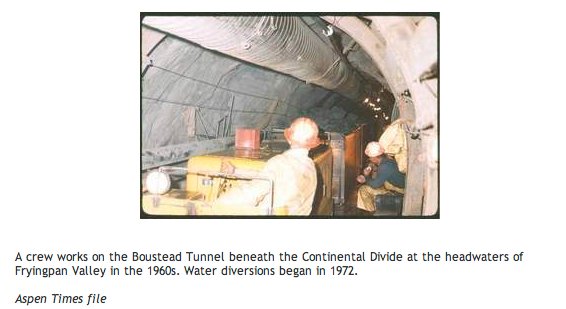
Here’s an in-depth look at the Fryingpan-Arkansas Project from Scott Condon writing for The Aspen Times. Click through and read the whole article. Here’s an excerpt:
The Fry-Ark water diversion plan was hatched shortly after World War II ended, when the cities and counties of Colorado’s Arkansas River Valley started looking for water to fuel growth aspirations. The initial plan was to divert 357,000 acre-feet of water annually from the Gunnison River and other tributaries of the Colorado River to the Arkansas Valley, according to the website of the Southeastern Colorado Water Conservancy District.
The proposal sparked a political battle in the 1950s between Western Slope residents who didn’t want “their” water taken and Arkansas Valley resident who saw the water as the key to their future. [Mark Fuller, executive director of the Ruedi Water and Power Authority] said residents of the West Slope of Colorado had an ingrained “mistrust” of the Front Range, which had more people, more money and more power…
The Roaring Fork River basin’s loss is the Arkansas Valley’s gain. Reclamation bureau spokeswoman Kara Lamb said Fry-Ark water irrigates 265,000 acres of some of the most productive farm land in Colorado. “This is Rocky Ford cantaloupes and the onions that the Arkansas Valley is so famous for,” she said.
In addition, 720,000 residents of the southeastern part of the state receive supplementary water from the project. They live from Salida in the west to Lamar in the east, and from Colorado Springs down to Pueblo…
The Fry-Ark system diverts an annual average of 54,000 acre feet. To put that amount in perspective, it’s a little more than half the total held by Ruedi Reservoir when full. Last year, when the snow kept piling up late into the spring, the system diverted its second highest amount of water ever at about 98,000 acre feet. This year, during the drought, it diverted only 14,000 acre feet…
Ruedi Reservoir — which now dominates the Fryingpan Valley’s identity — wasn’t in the initial plans for the diversion system. “It was a political solution,” Lamb said. The reservoir was created for compensatory water storage for the Western Slope. To a layman, the legal purpose of Ruedi is essentially a way for water attorneys to make the books balance. In a practical sense, the reservoir has created one of the biggest recreational draws in the Aspen area…
Aspen residents get a direct benefit from the Ruedi dam. The hydro-electric plant owned and operated by the city of Aspen produces 20 to 25 million kilowatt hours of power per year. That is the equivalent of 35 to 40 percent of Aspen’s annual demand, according to Fuller.
From The Pueblo Chieftain:
U.S. Sen. Michael Bennet, U.S. Rep. Scott Tipton and others are scheduled to attend a 50th anniversary celebration at 9 a.m. Saturday at the Lake Pueblo State Park Visitors Center, 640 Pueblo Reservoir Road.
The Fryingpan-Arkansas project is a water diversion and storage project constructed to deliver water to families, producers and municipalities throughout the lower Arkansas Valley, as well as to provide supplemental irrigation water.Slated to join Bennet and Tipton at the event are John Stulp, special policy adviser to the governor for water; Mike Collins, Bureau of Reclamation area manager for Eastern Colorado; Jennifer Gimbel, executive director, Colorado Water Conservation Board; John Singletary, chairman of the board, Parks and Wildlife Commission; and Angela Giron, state senator from Pueblo.
From The Pueblo Chieftain (Chris Woodka):
As water is used and reused along the Arkansas River, it picks up and releases salt. By the time the Arkansas River reaches the state line, it can be up to 10 times more saline than at Pueblo. In addition, many of the wells used to supply water to the cities and towns of the Arkansas Valley have radionuclide (a class of atom that exhibits radioactivity) contamination. As state restrictions tighten, they will be forced to either clean the water or turn to a new supply through the conduit. Building the conduit always has been a chicken-or-egg proposition. The population of the valley has never been large enough to afford the conduit, but it is vital for its future growth…
The Bureau of Reclamation is doing an environmental impact study for the conduit — along with associated long-term storage contracts — that should be completed next year.
From The Pueblo Chieftain (Chris Woodka):
“It is still a struggle to provide good water to newcomers,” said Bill Long, the conduit’s most tireless advocate…
Long is a Las Animas businessman, Bent County commissioner and president of the Southeastern Colorado Water Conservancy District. His view of the Fry-Ark Project is one in which future generations will enjoy the work going on today.

From The Pueblo Chieftain (Chris Woodka):
As water use shifted from farms to cities, so did its use. As Colorado River water entered the Arkansas River basin, Twin Lakes was the key transfer point.
Farmers from Crowley County recognized the value of the lakes — formed by glacial advances and retreats — in the late 1800s, and built a dam to store water high in the mountains until it was needed in the fields. Initially, the lake was filled by exchange, diverting water into one reservoir, while releasing flows from another.
But by the 1930s, it was clear more water was needed to satisfy needs on the Colorado Canal, a ditch with relatively junior water rights in Crowley County. A tunnel was completed during the Great Depression to bring more water from the Colorado River near Independence Pass.
From The Pueblo Chieftain (Chris Woodka):
The tunnel is named for Charles H. Boustead, the first general manager of the Southeastern Colorado Water Conservancy District, who died in 1966, shortly after work on the tunnel began. The tunnel is 10.5 feet high and 5.4 miles long, and is capable of bringing over 945 cubic feet (about 166 bathtubs full) per second of water through the mountains. Water from the north and south side collection systems flows into the tunnel on the west side of the mountains and travels by gravity into Turquoise Reservoir. There is rarely enough water to fill the tunnel’s capacity. Water comes in a rush as snowpack melts, usually from late May until July. The amount varies widely. There were record imports in 2011, followed by one of the lowest years ever in 2012.
From The Pueblo Chieftain (Chris Woodka):
“It was great for people other than in Lake County. We’re left with an economy devoid of any of the benefits promised by President Kennedy,” [Former Lake County Commissioner Ken Olsen] said. The Fry-Ark Project projected large increases in visitor days to Turquoise and Twin Lakes as a result of enlargement. But Forest Service policies have restricted visitor use and eroded the local tax base, Olsen said. The Bureau of Reclamation’s operation fills and lowers reservoirs in a way that’s out-of-sync for tourism benefits, he said.
From The Pueblo Chieftain (Chris Woodka):
The Mount Elbert Power Plant generates peak power through two giant turbines that act as pumps, drawing down and refilling the Mount Elbert Forebay. During peak hours, summer days when air conditioners are running, the water flows by gravity from the forebay through the turbines. At night, when the lights go out, water is pumped back uphill through those same turbines…
The turbines can generate up to 200 megawatts of power, and since it began operating in 1981 has generated more than 350 million kilowatt hours of electricity — enough to power 44,000 homes, according to Reclamation.

The project got its start with a visit to Pueblo from President Kennedy back in 1962. Here’s the first installment from Chris Woodka writing for The Pueblo Chieftain. Click through and read the whole article, Woodka is a terrific writer. Here’s an excerpt:
But on that day [August 17, 1962], work began to address the problem. Kennedy came to Pueblo to celebrate the signing of the Fryingpan-Arkansas Act the previous day. Local water leaders will celebrate the 50th anniversary of the Fry-Ark Project Saturday at Lake Pueblo…
The Twin Lakes Tunnel was constructed by the Colorado Canal Co. during the Great Depression, while the old Carlton railroad tunnel was used by the High Line Canal Co. to bring in water. In addition, Colorado Springs and Aurora were already building the Homestake Project, which would be intertwined with the Fry-Ark Project as both were built.
But the government project, a scaled-down version of an earlier, larger plan to bring water from the Gunnison River basin, represented a larger cooperative effort between farmers and municipal leaders in nine counties.
Since the first water was brought over in 1972, about 2.1 million acre-feet of water has been brought into the Arkansas River basin for irrigation and municipal use. The project also generates electric power at the Mount Elbert Power Plant.
Woodka details some of the early water history along the Arkansas River mainstem in this report running in today’s Chieftain. Here’s an excerpt:
The Water Development Association of Southeastern Colorado was incorporated in 1946. Pueblo business leaders worked with valley water interests to investigate a Gunnison-Arkansas Project. By 1953, the project was scaled back to the Fryingpan-Arkansas Project, and the first hearings began in Congress.
During the congressional hearings in subsequent years, the project evolved from one primarily serving agriculture to one that included municipal, hydroelectric power, flood control and recreation as well.
The Southeastern Colorado Water Conservancy District formed in 1958.
The U.S. House passed the Fry-Ark Act on June 13, 1962; the U.S. Senate, Aug. 6, 1962. President John F. Kennedy signed it into law on Aug. 16, 1962.
Here’s a short look at Jay Winner, current general manager of the Lower Arkansas Water Conservancy District, from Chris Woodka Writing for The Pueblo Chieftain. From the article:
Back in the 1960s, his father Ralph Winner was the construction superintendent for Ruedi Reservoir, the first part of the Fry-Ark Project to be constructed and his family lived on the job site. His father came back in the late 1970s to supervise construction of one of the last parts of the collection system to be built, the Carter-Norman siphon. The siphon draws water across a steep canyon.
For three summers, Winner, then a college student, worked on the latter project. “It was the most fun I ever had,” he laughed. “I got to play with dynamite.”
From The Pueblo Chieftain (Chris Woodka):
A retired outfitter, [Reed Dils] is now a Southeastern Colorado Water Conservancy District board member and a former representative from the Arkansas River basin on the Colorado Water Conservation Board. “Initially, the flows got worse,” Dils said. “They (the Southeastern district and the Bureau of Reclamation) had chosen to run water in the winter…
“It became apparent to everyone there was another way to run the river,” Dils said. “Why the Fry-Ark act was passed, recreation mainly meant flatwater recreation. Over time, they learned there are other types of recreation.”
Here’s the release from Reclamation (Kara Lamb):
Reclamation and the Southeastern Colorado Water Conservancy District invite the public to celebrate the Fryingpan-Arkansas Project’s 50th Anniversary at Lake Pueblo State Park on Sat., Aug. 18. The event is located at Lake Pueblo State Park Visitor’s Center from 9 a.m.to 2 p.m.
Reclamation, the District and Colorado State Parks and Wildlife are offering free pontoon boat tours around Pueblo Reservoir and free tours of the fish hatchery located below Pueblo Dam. There will also be historical displays and several guest speakers.
Signed into law by President John F. Kennedy in 1962, the Fryingpan-Arkansas Project is a multipurpose trans-basin water diversion and delivery project serving southeastern Colorado.
The Fryingpan-Arkansas Project provides:
– Water for more than 720,000 people
– Irrigation for 265,000 acres
– The largest hydro-electric power plant in the state
– World renowned recreation opportunities from the Fryingpan River to the Arkansas River.For more information the 50th Anniversary Celebration – and to see a teaser of the upcoming film! – visit our website at www.usbr.gov/gp/ecao.
More Fryingpan-Arkansas Project coverage here and here.

Meanwhile, Alan Hamel is retiring from the Pueblo Board of Water Works this month:
From The Pueblo Chieftain (Chris Woodka):
“Little did I know how important the Fryingpan-Arkansas Project would be as I was watching the president’s car traveling down Abriendo Avenue that day,” Hamel said. “Look at all that it has done for our basin and what it will do in the future.”
Hamel became executive director of the water board in 1982, and was president of the Southeastern Colorado Water Conservancy District, the local agency that oversees the Fry-Ark Project, from 2002-04. He is currently serving on the Colorado Water Conservation Board.
More Pueblo Board of Water Works coverage here.
From email from Reclamation (Kara Lamb):
We’ve seen inflows to Ruedi decrease over the weekend as the afternoon storms have slowed. As a result, we have less water to pass on down to the Colorado River. Today around 5 p.m. we will scale releases from Ruedi Dam to the Fryingpan back by about 28 cfs. This will put flows past the Ruedi Dam gage at about 213 cfs.
More Fryingpan-Arkansas Project coverage here.

Here’s the latest installment in The Pueblo Chieftain’s series for Colorado Water 2012. Jean Van Pelt describes the Fryingpan-Arkansas Project. Here’s an excerpt:
…the Fryingpan-Arkansas Project has provided Southeastern Colorado with 50 golden years of benefits. The Fryingpan-Arkansas Project is a transmountain diversion that supplies Southeastern Colorado with supplemental water for irrigation, municipal and industrial uses, hydroelectric power, and recreational opportunities. The project also provides flood control and is designed to maintain or improve fish and wildlife habitats. The project acquired its name from the fact that it collects about 54,800 acre-feet of water each year from the Fryingpan River basin on the Western Slope of the Continental Divide and delivers it via the Arkansas River to the water-short Eastern Slope…
The North and South Side Collection System and Ruedi Dam and Reservoir are located on the Western Slope in the Fryingpan River basin. Sugar Loaf Dam and Turquoise Lake; Mount Elbert Conduit, Forebay Dam, Reservoir and Power Plant; Halfmoon Diversion Dam; Twin Lakes Dam and Reservoir; and Pueblo Dam and Reservoir are all located on the Eastern Slope in the Arkansas River basin.
More Colorado Water 2012 coverage here.
From email from Reclamation (Kara Lamb):
As we continue to balance inflows and outflows with the demands downstream along the Colorado River, we have adjusted releases from both Green Mountain and Ruedi Dams today [August 6].
Green Mountain has increased by about 40 cfs to 405 cfs.
Ruedi has increased 30 cfs to 225 cfs.
From email from Reclamation (Kara Lamb):
After the coordination call [yesterday], it was determined that the afternoon rainstorms are no longer contributing much to the Colorado River Basin. As a result, we have bumped releases from Ruedi Dam to the Fryingpan River back up to 195 cfs.
More Fryingpan-Arkansas Project coverage here.