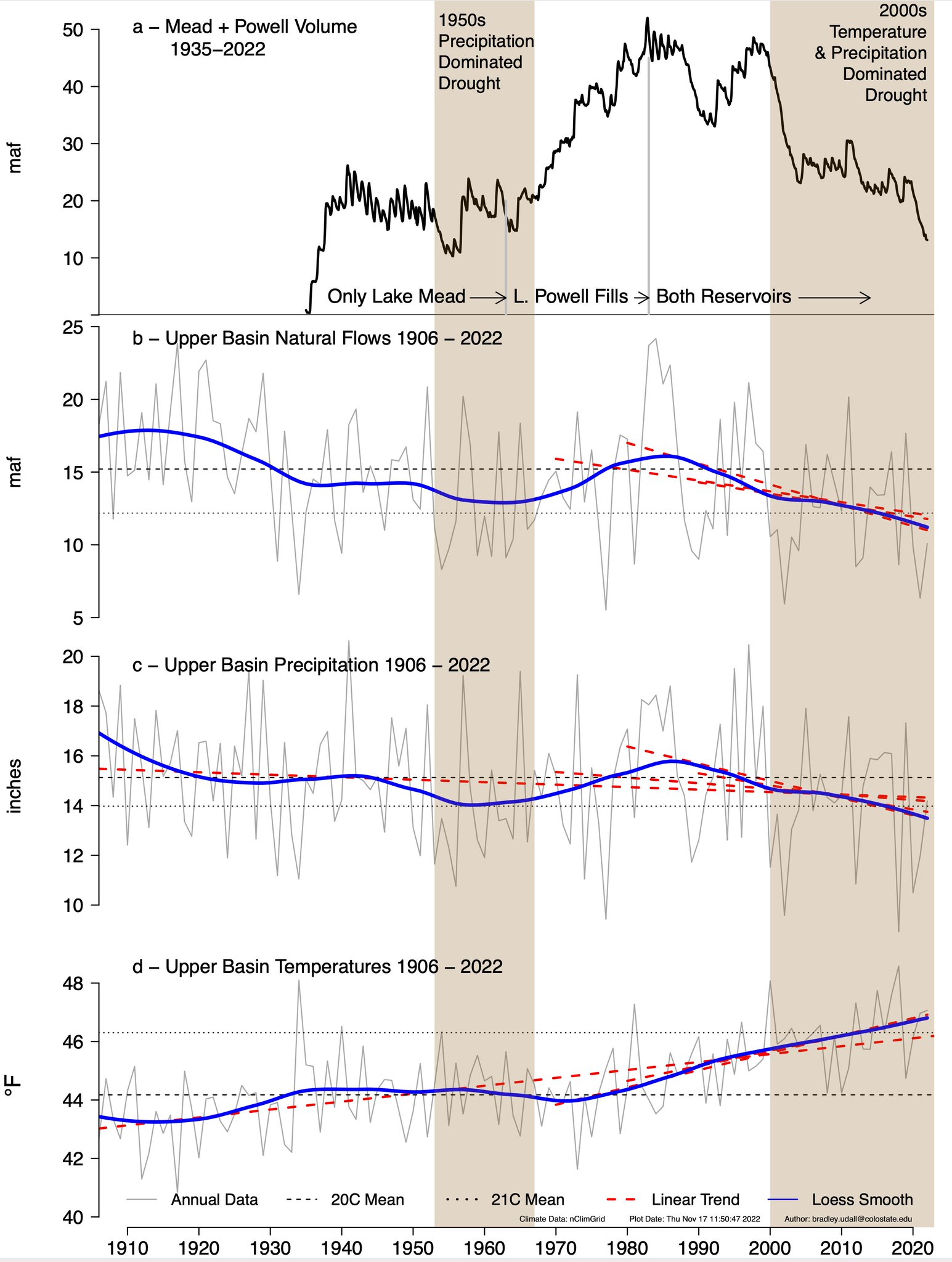
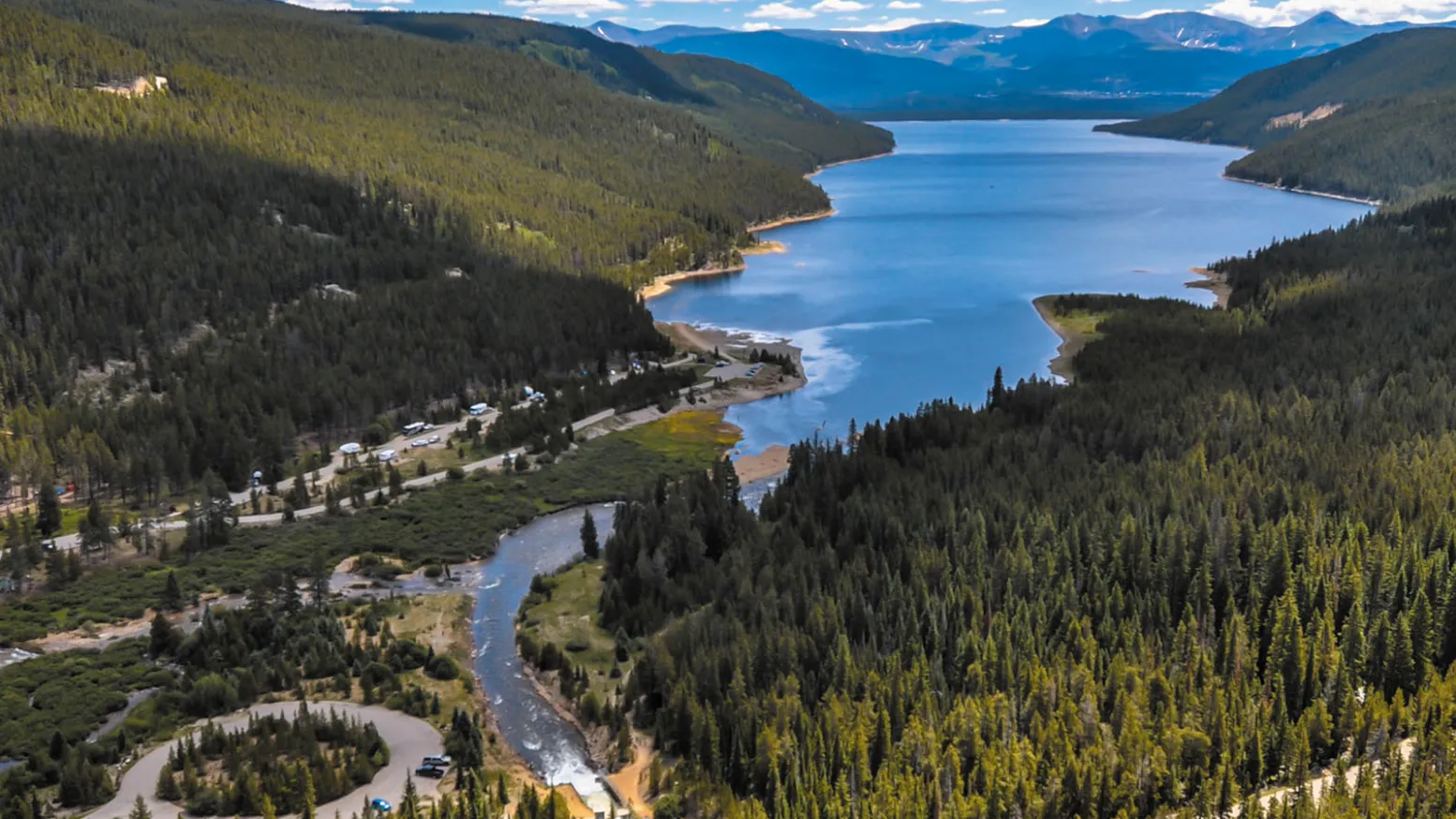
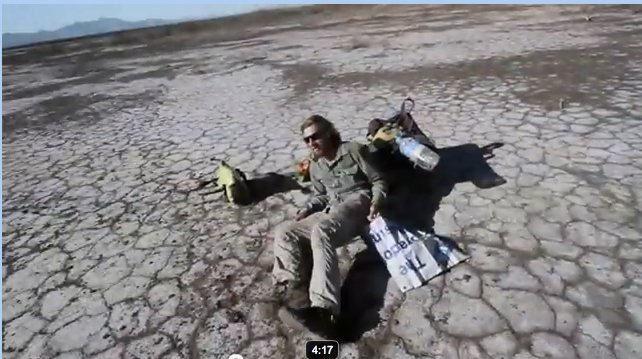
Water users are urgently trying to keep Lake Powell on the Utah-Arizona border from dropping to a point where Glen Canyon Dam can no longer generate electricity. (Source: Bureau of Reclamation)
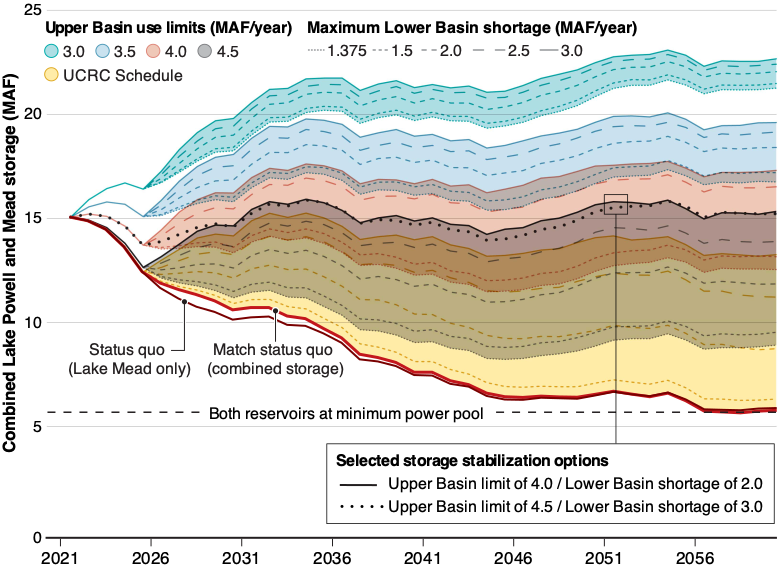
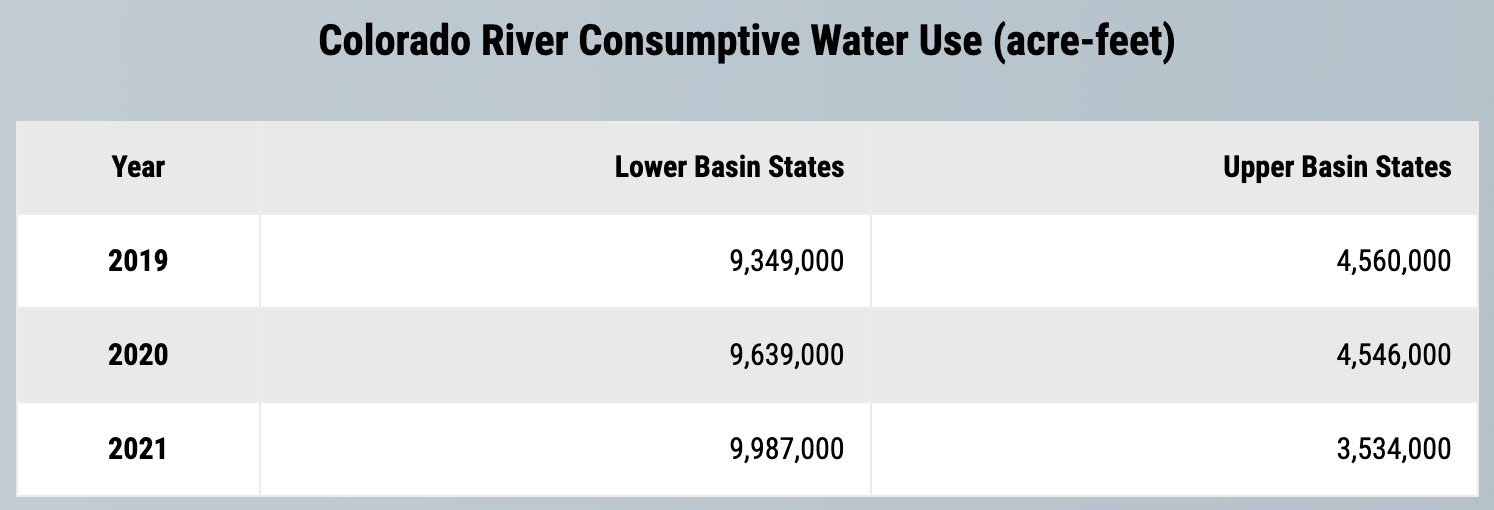
Nevada water managers have submitted a plan for cutting diversions by 500,000 acre-feet in a last-ditch effort to shore up flows on the Colorado River before low water levels cause critical problems at Glen Canyon and Hoover dams. But the Silver State’s plan targets cuts in Utah and the river’s other Upper Basin states, not in Nevada, whose leaders contend it already is doing what it can to reduce reliance on the depleted river system that provides water to 40 million in the West.
“It is well past time to prohibit the inefficient delivery, application, or use of water within all sectors and by all users; there simply is no water in the Colorado River System left to waste and each industrial, municipal, and agricultural user should be held to the highest industry standards in handling, using, and disposing of water,” states a Dec. 20 letter the Colorado River Commission of Nevada sent to the Interior Department. “It is critical that Reclamation pursue all options that will help reduce consumptive uses in the Basin and provide water supply reliability.”
[,,,]
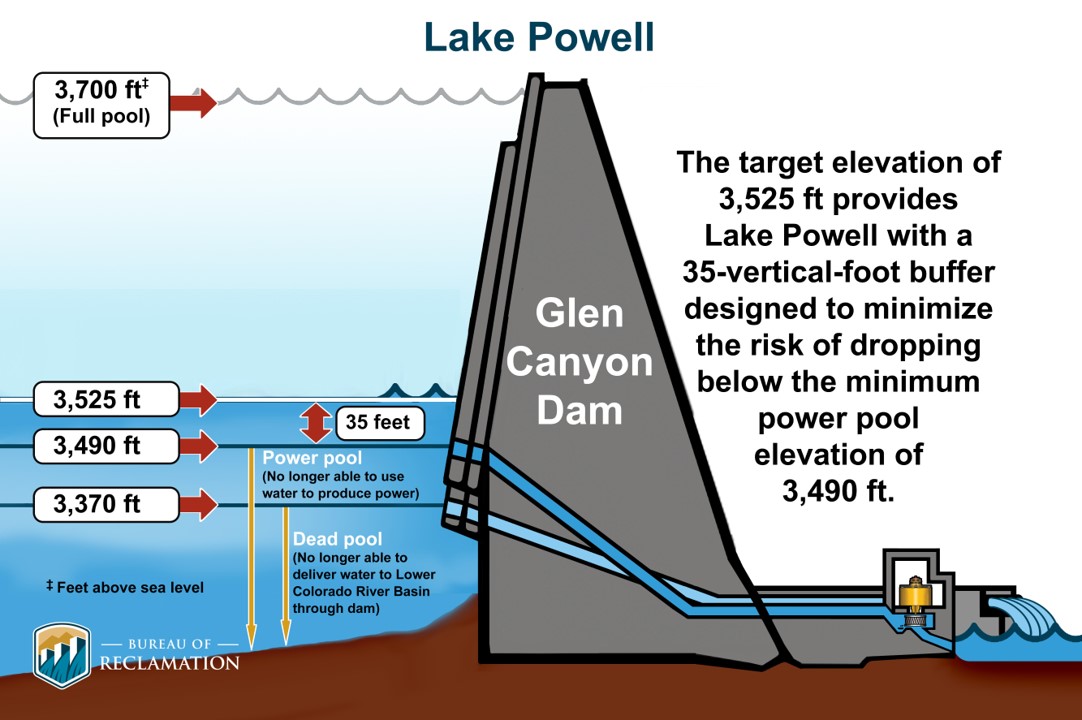
One option Nevada offers is for Utah, Colorado, New Mexico and Wyoming to accept substantial cuts in the amount of river they tap to ensure enough water reaches Lake Powell to keep Glen Canyon Dam’s hydropower turbines spinning and Lake Powell functioning as a reservoir…The proposal comes in the form of Nevada’s official comments to the supplemental environmental impact statement the Bureau of Reclamation is preparing for proposed changes to the operations of the drought-depleted reservoirs. One of three Lower Basin states, Nevada called on the Upper Basin states to reduce their withdrawals by a combined 500,000 acre-feet if Lake Powell’s level is projected to drop below 3,550 feet above sea level at the start of the coming calendar year…Today, the lake’s level is already far below than that, at 3,525.7 feet, just 35 feet above the point at which Glen Canyon Dam’s turbines would be damaged if water passes through the penstocks.
Lake Powell key elevations. Credit: Reclamation
“The reason [The Upper Colorado River Commision’s] five-point plan doesn’t have any specific numbers is because we don’t know what’s ahead of us. We don’t know whether the runoff is going to be 7 million acre-feet or 20 million acre-feet,” Shawcroft said. “The real challenge is the hydrology. But we know for a fact that that we’re not going to be able to continue operating the river like we always have. The majority of the water gets used in the lower basin states, but does that mean that Upper [Basin] states are off the hook? I don’t think they are.”
Last week’s snow gave Colorado holiday skiers plenty to rejoice over, but the state’s drought-hammered mountains and plains continue to see just average, and in some cases far below average, conditions.
“An average snow year is a whole heck of a lot of snow, even in a year when we’re below average. It’s a great year for skiing but it may or may not translate into a great year for water,” said Russ Schumacher, Colorado’s state climatologist.
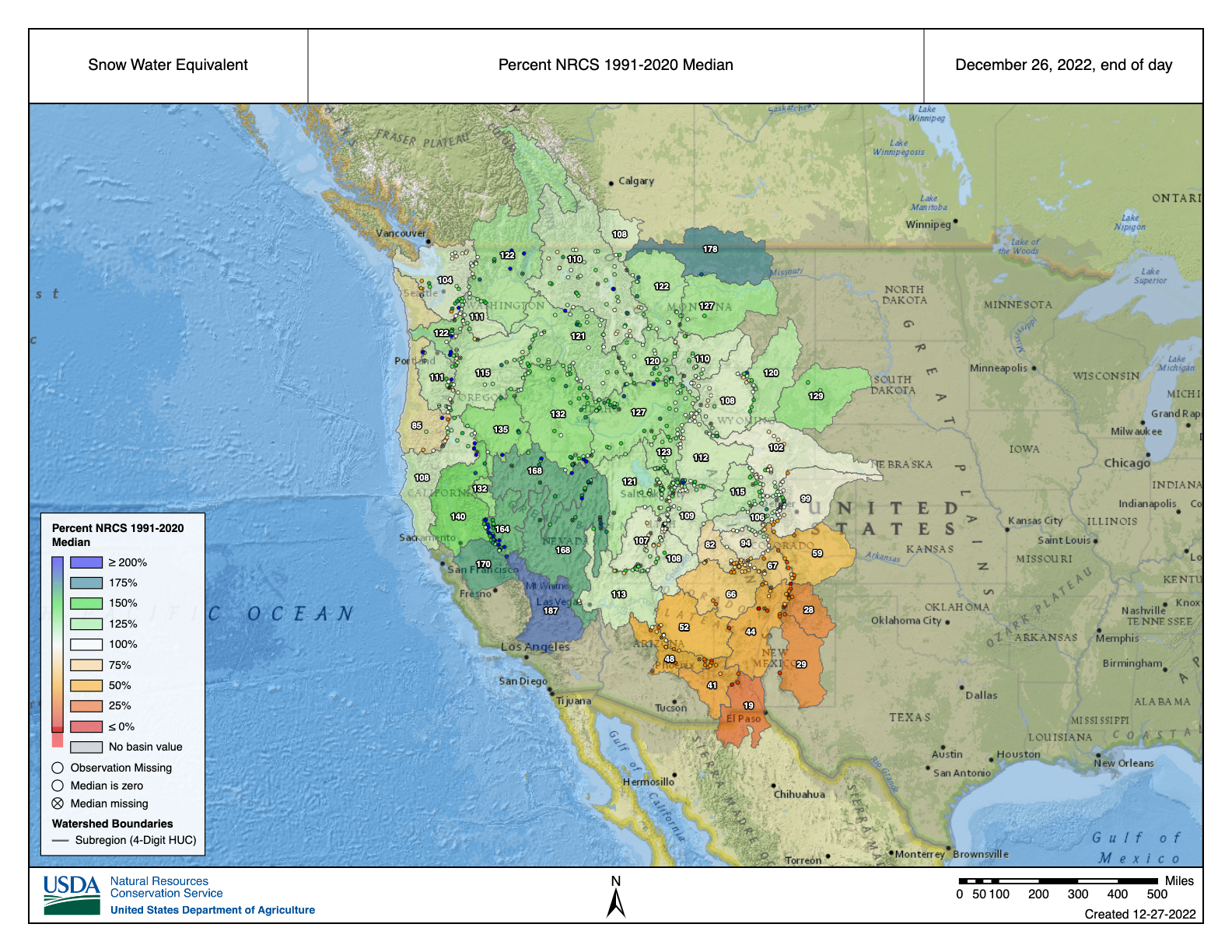
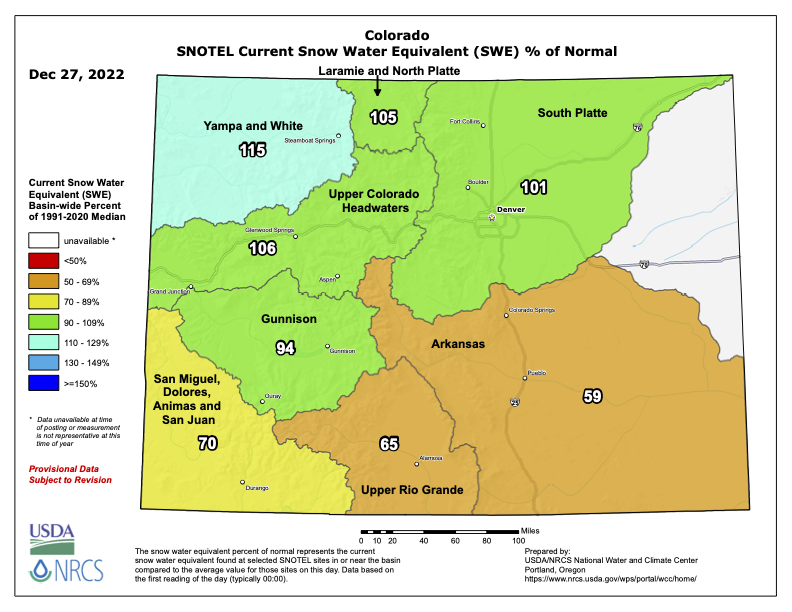
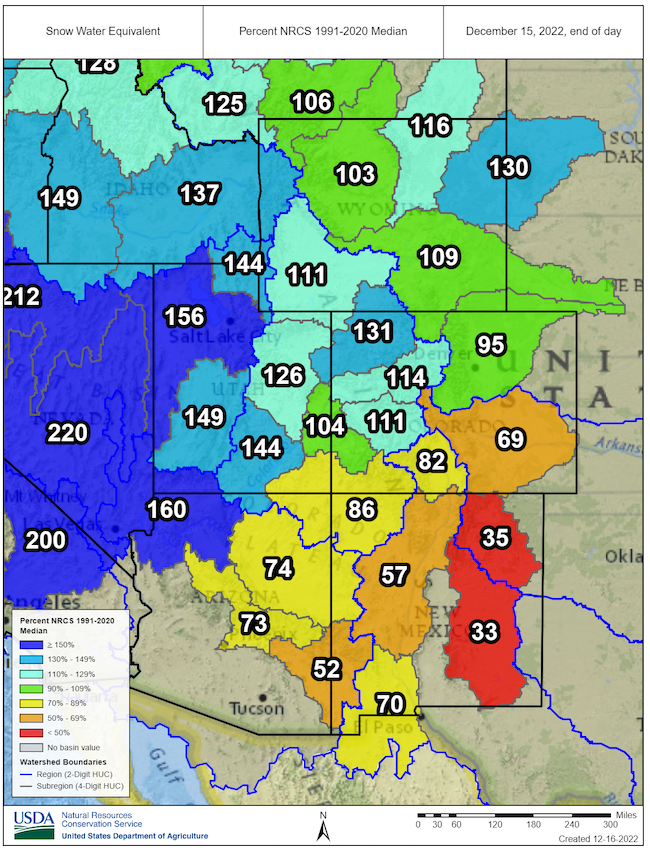
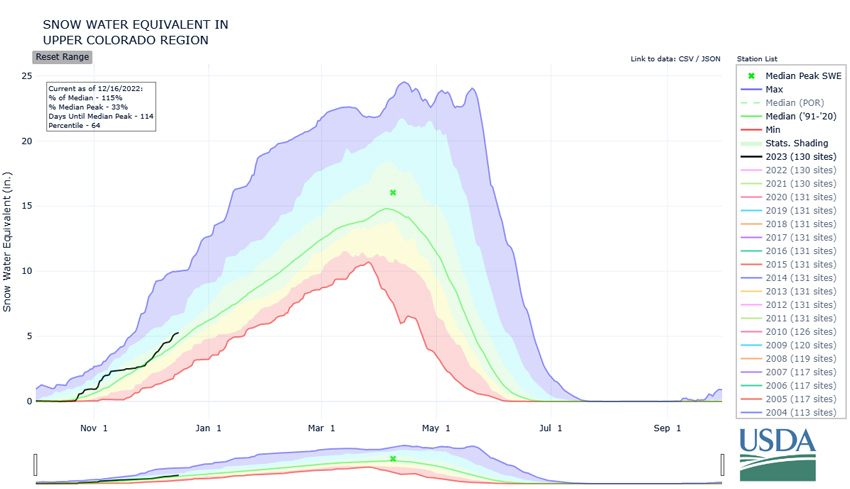
As of Dec. 27, the statewide snowpack is registering at 102% of normal, according to the Natural Resources Conservation Service (NRCS).
And while that number doesn’t provoke much excitement among hydrologists, it is still substantially higher than it was at this time last year, when statewide snowpack was just 74% of normal, according to Karl Wetlaufer, a hydrologist and assistant snow survey supervisor at the NRCS in Lakewood.
Mountain snow levels are tracked closely because when they melt, they provide much of the state’s annual water supplies. Hydrologists, using a time period known as the water year that begins Oct. 1, begin monitoring with the first snows in the late fall, and continue through May 1 when the spring melt and runoff begin. Spring snowstorms can sometimes dramatically boost the water forecast, though there is not much hope for that this year.
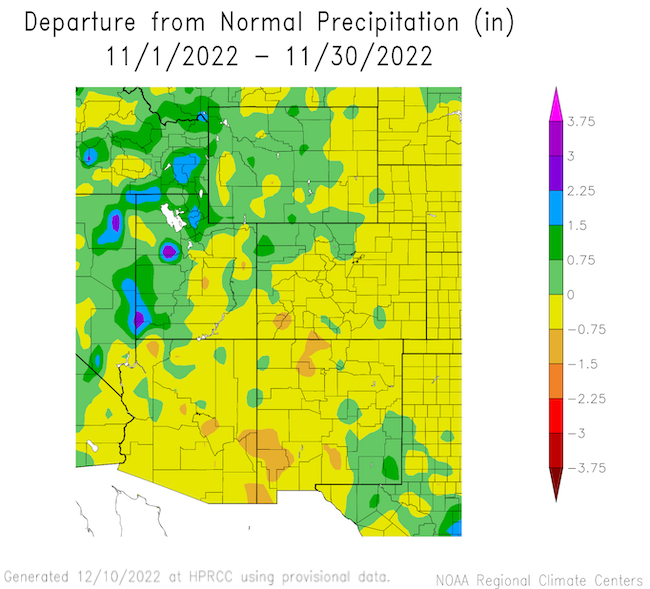
Colorado and much of the American West remain mired in a devastating drought, thought to be the worst in 1,200 years. But thanks to a third year of what’s known as a La Niña weather pattern, in which warm temperatures in the Pacific bring heavy moisture over the northern parts of the Rockies, Colorado’s northern regions are seeing above average snowpacks.
“In general, Northern Colorado has been faring quite a bit better with regard to snowpack accumulation than the southern parts of the state,” Wetlaufer said.
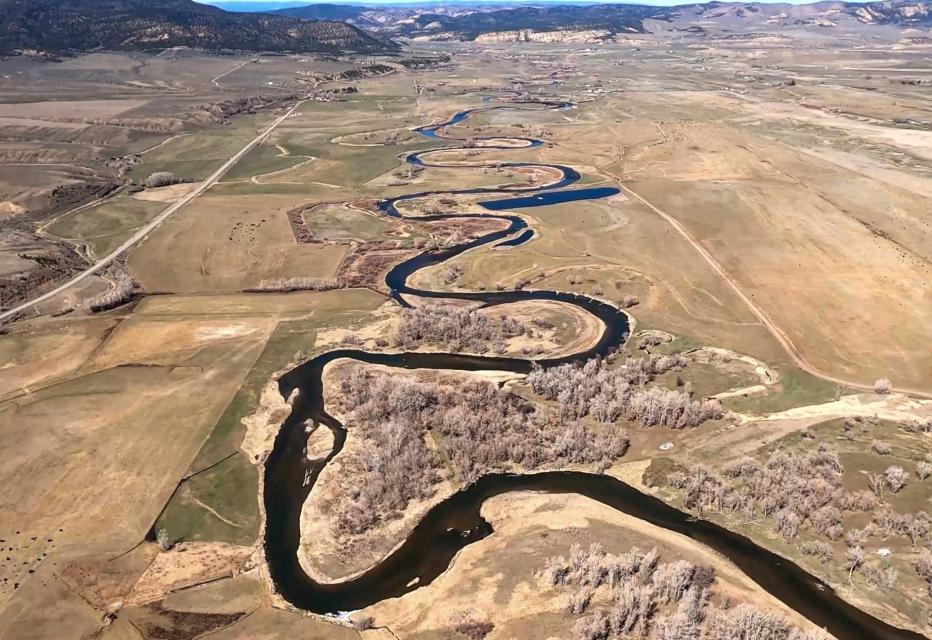
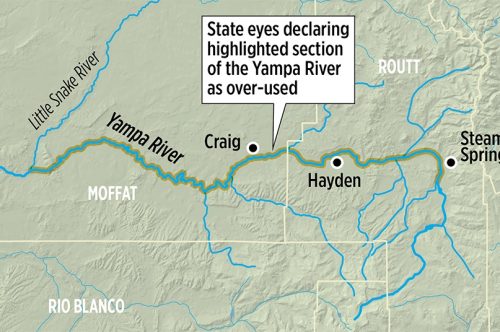
The Yampa River Basin, home to Steamboat Springs, and the neighboring White River Basin have the healthiest snowpacks right now, registering at 115% percent of average, with the South Platte Basin, home to Denver, Greeley and Fort Collins, registering 101%.
And as has been the case for the last several years, the southern part of the state is suffering the most.
The Rio Grande Basin, for instance, is at just 65% of normal, while the San Miguel-Dolores Basin stands at 70% of normal. The Arkansas River Basin is the lowest of anywhere in the state, at 59%.
Meanwhile, the Colorado River Basin, the heart of the giant seven-state system that is on the brink of collapse, is at 106% of normal, while the Gunnison River Basin, a major tributary to the Colorado, is at 94% of normal, according to the NRCS. The Yampa, White and San Miguel-Dolores basins also feed into the Colorado River system, but farther downstream and beyond Colorado’s borders.
With the winter off to a just-okay start, there is some good news. This past summer’s monsoons helped boost soil moisture levels to their highest point in eight years, and that means as snows start to melt next spring more of the water should find its way into streams and reservoirs, rather than being absorbed by the ultra-dry soils that have become a hallmark of this drought.
“It is really, really encouraging that we are going into the season with substantially more soil moisture,” Wetlaufer said.
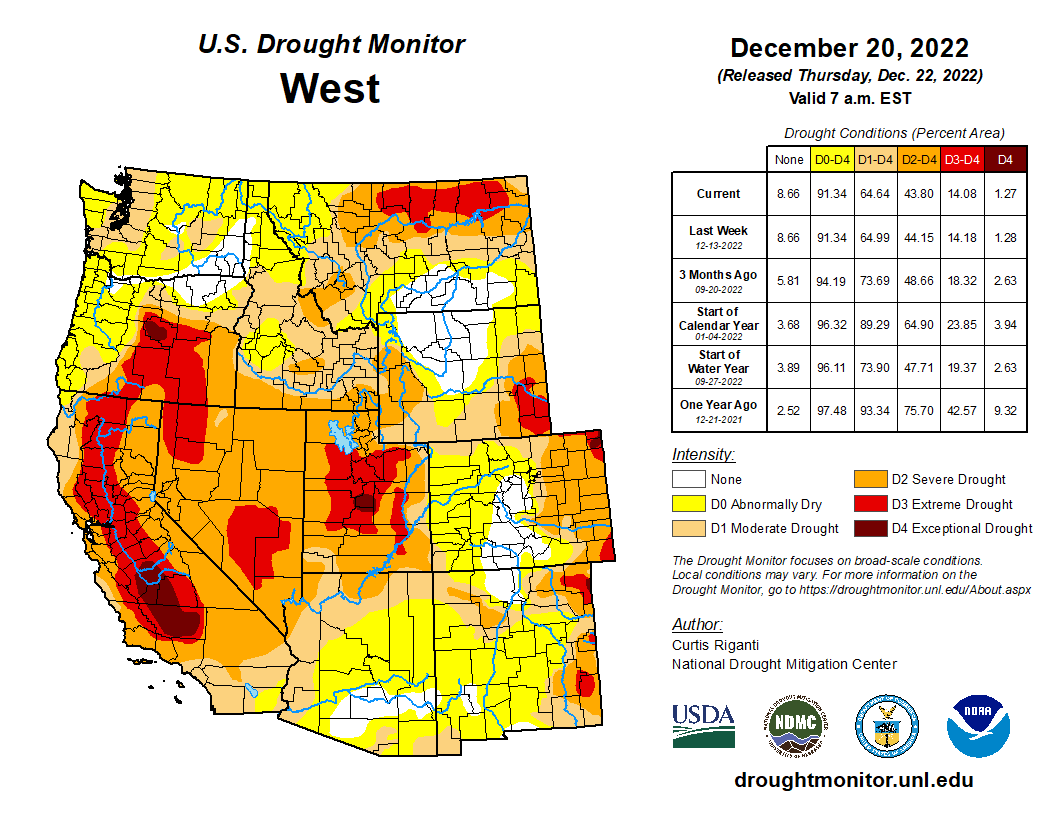
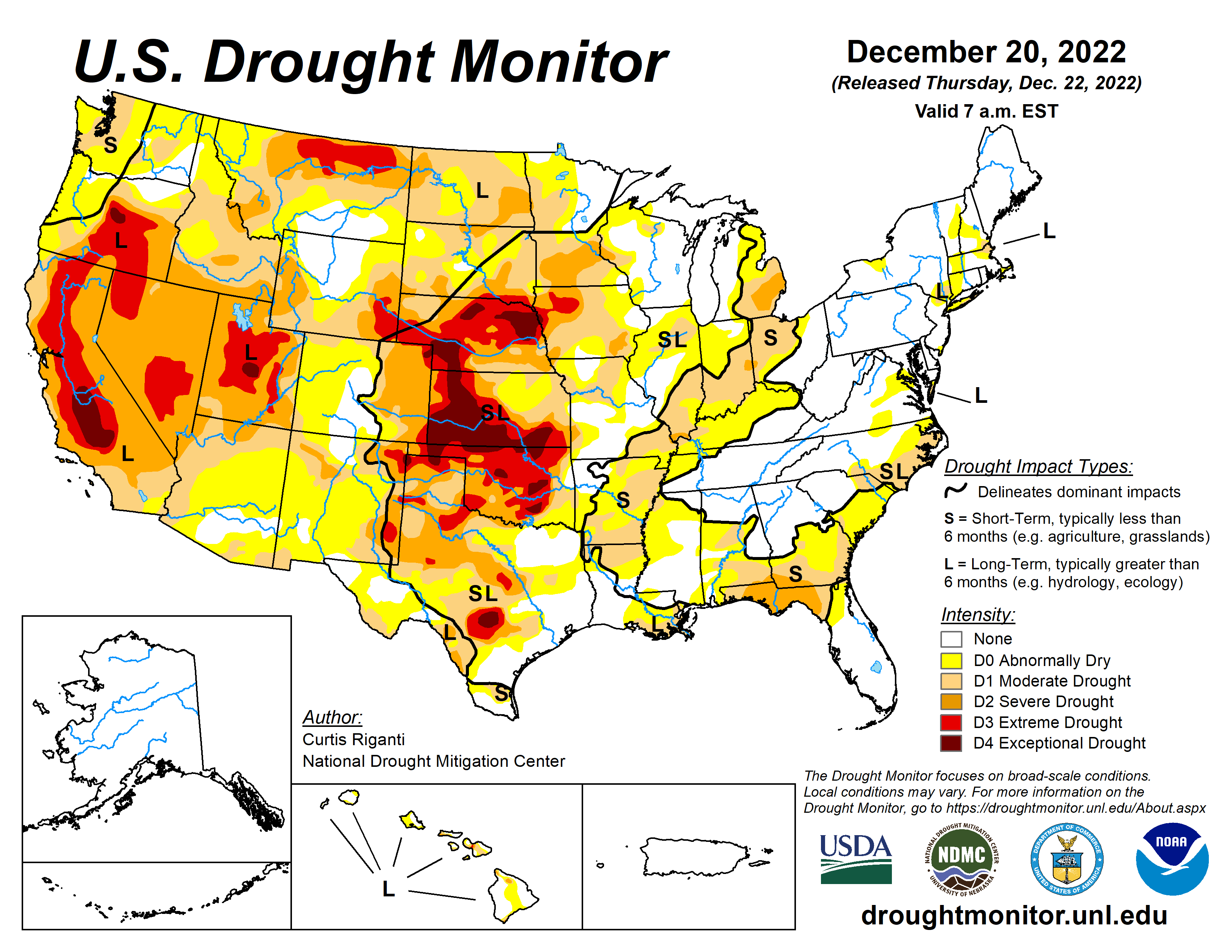
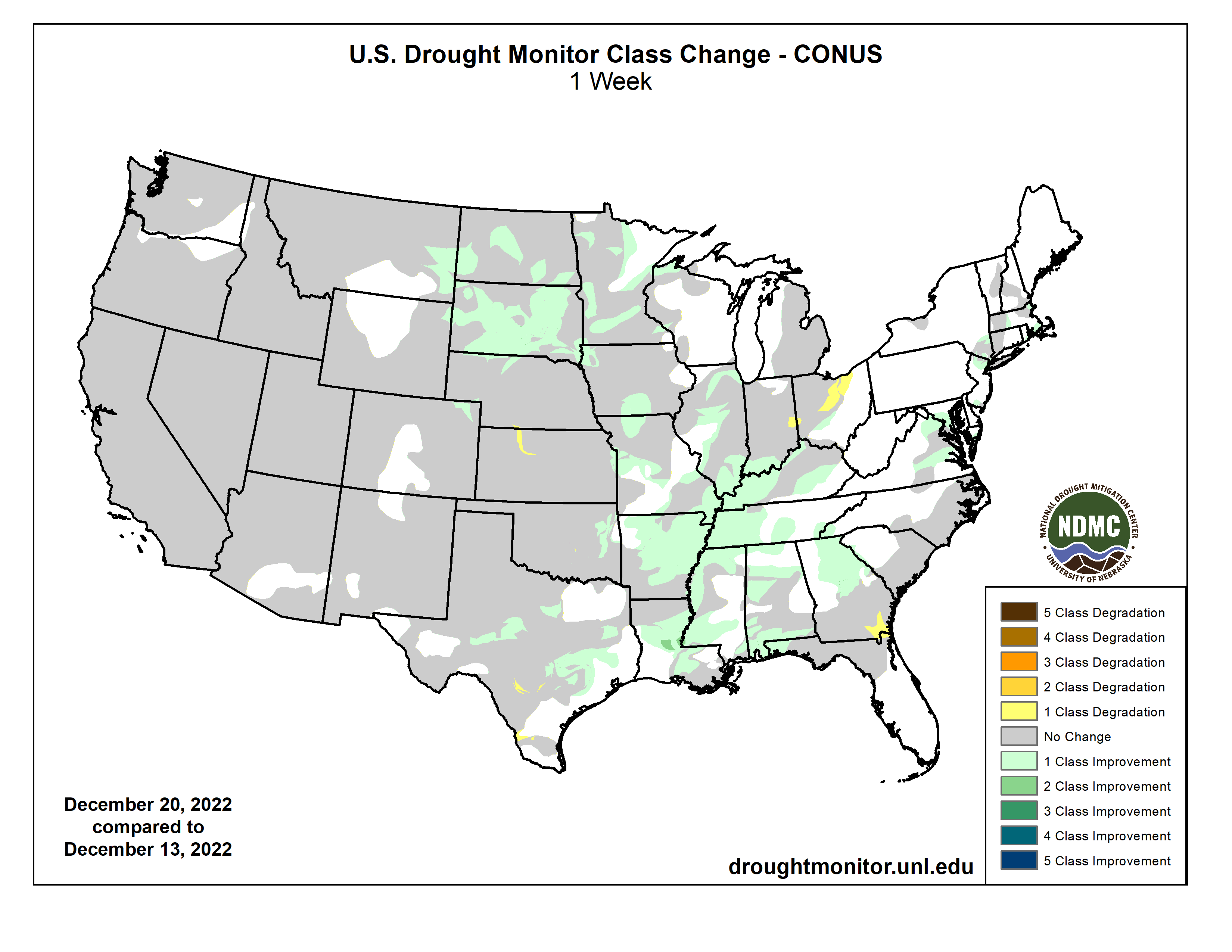
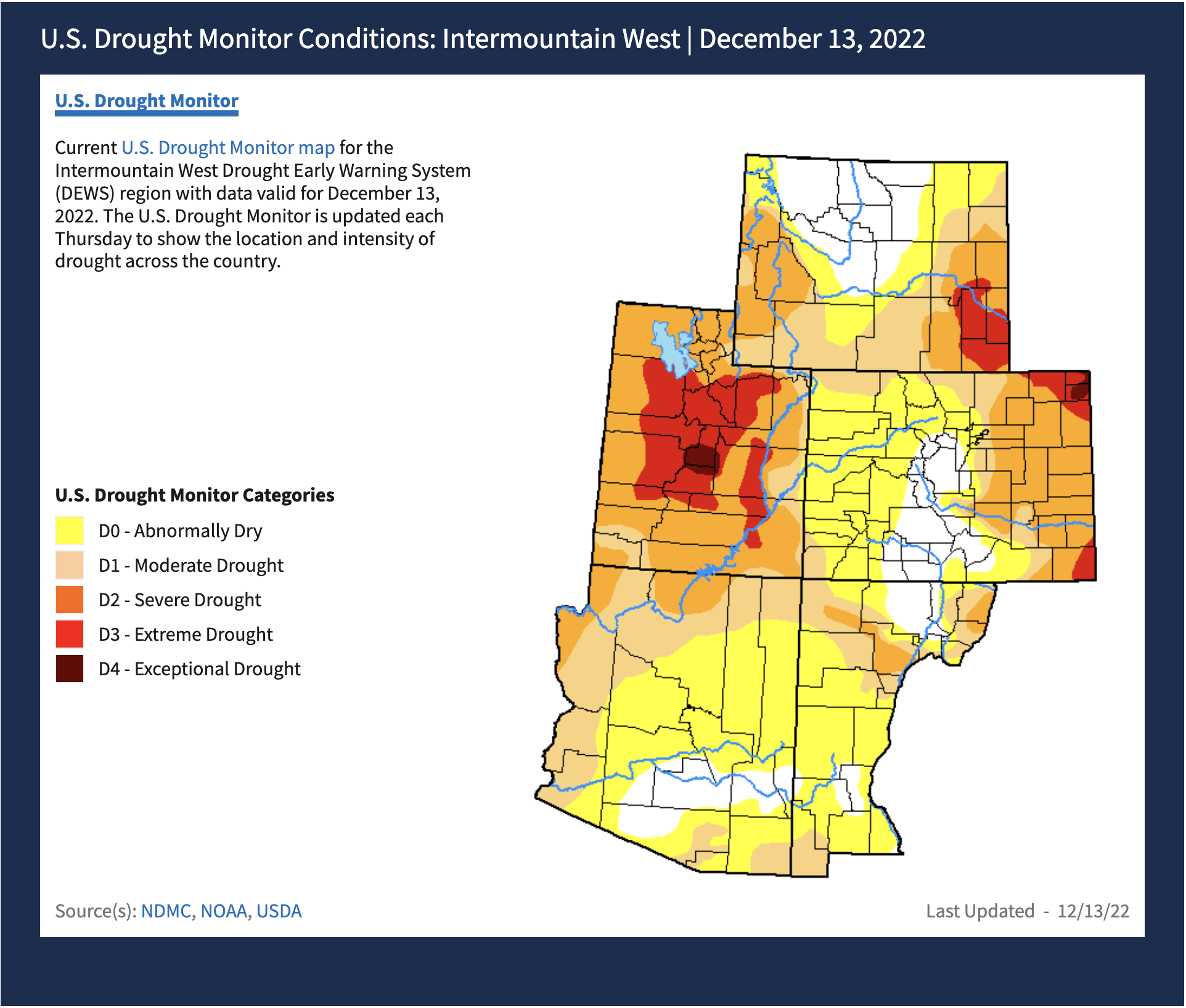
West Drought Monitor map December 20, 2022.
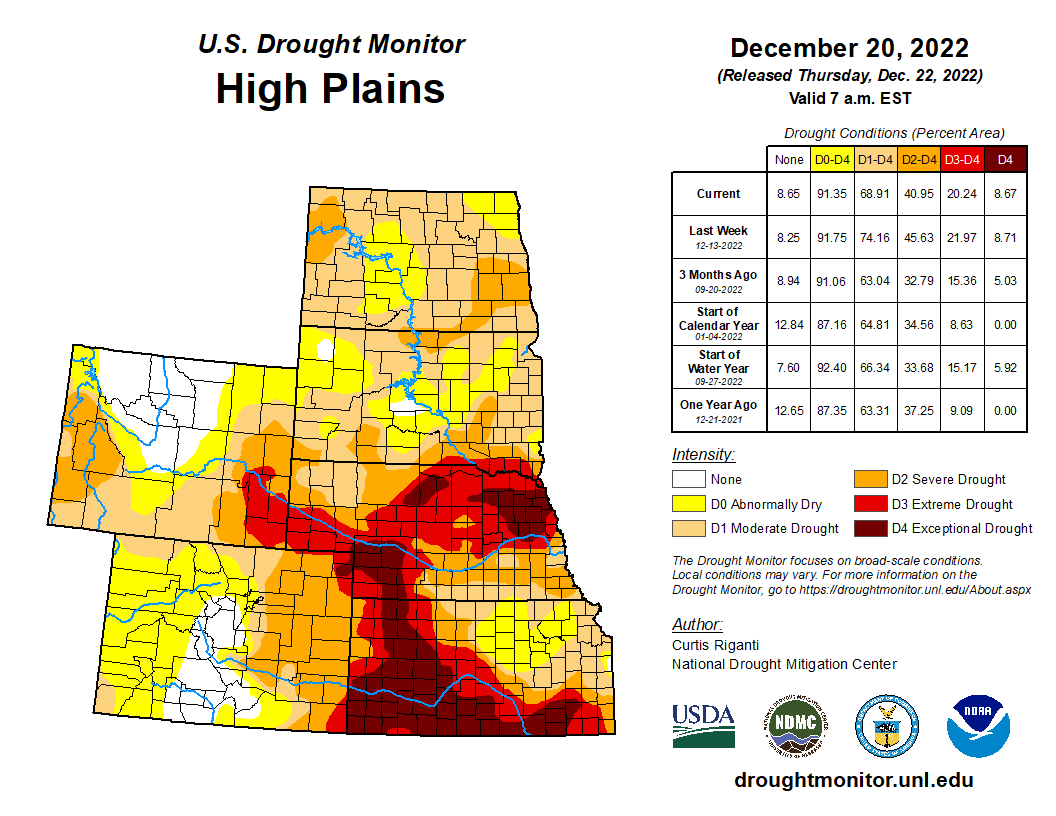
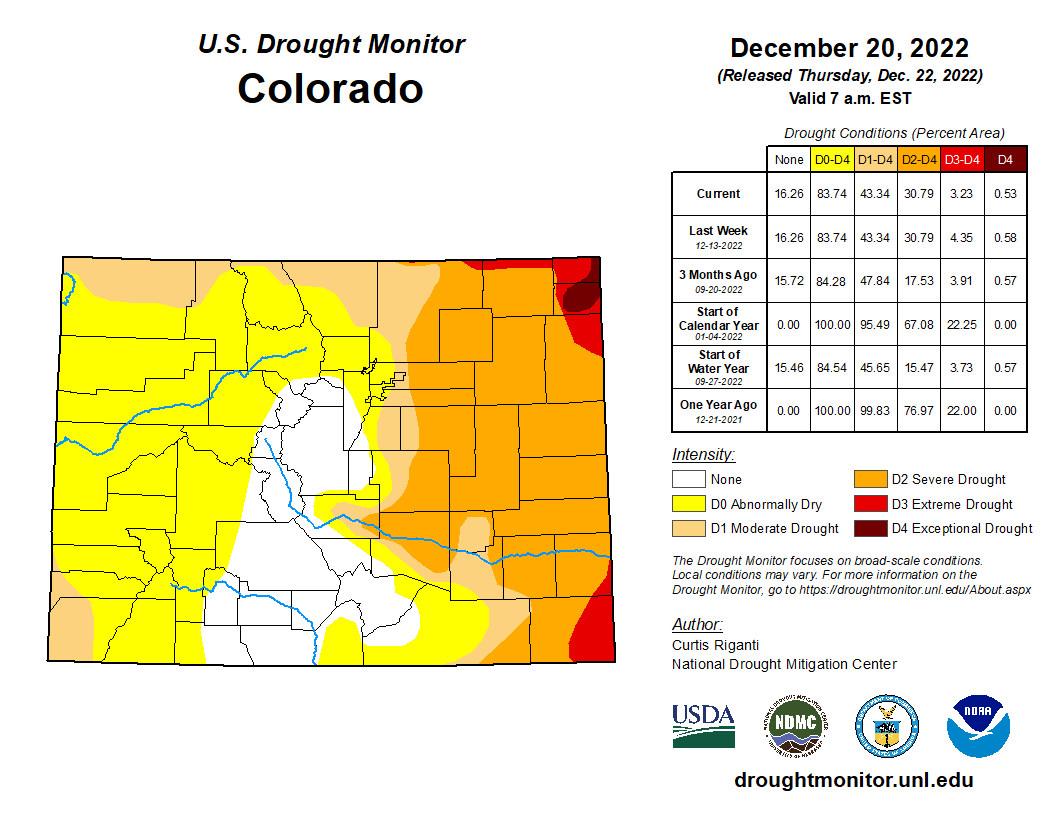
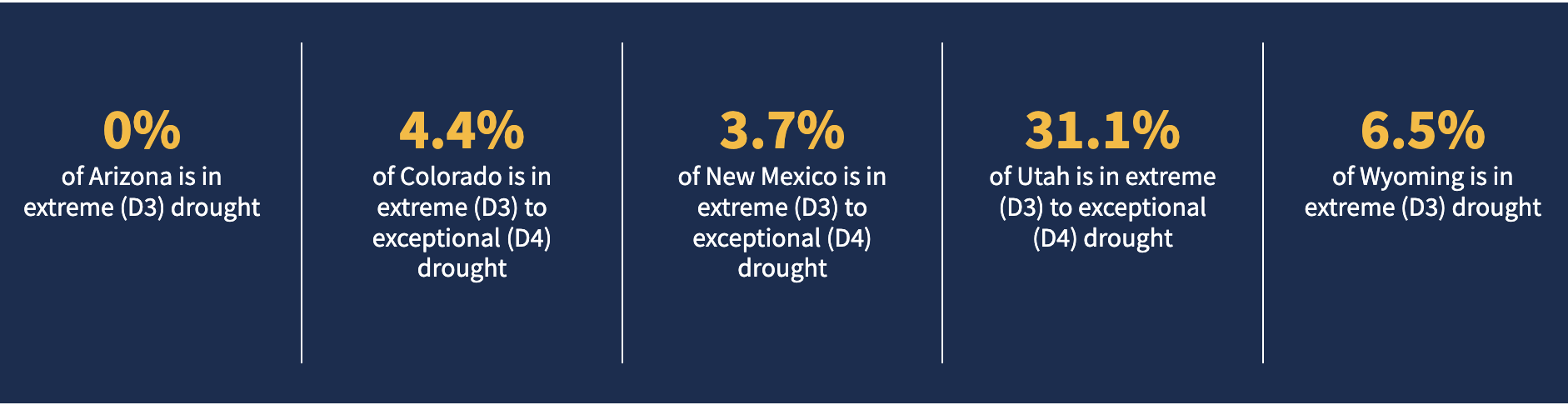
In addition, the U.S. Drought Monitor shows that much of Colorado is pulling out of the most severe stages of drought, with portions of the central mountains being completely free of drought, and the West Slope and Front Range showing just abnormally dry to moderate drought levels. Drought ranging from severe to exceptional still remains across most of the Eastern Plains.
The warming climate and the stubborn drought continue to keep hydrologists and weather watchers on high alert.
The Colorado River’s two giant reservoirs, lakes Powell and Mead, are at critical lows and even an average snowpack this year isn’t going to provide much help, Schumacher said.
“Here in Colorado our water is very much determined by how much snow we get in any individual winter,” said Schumacher. “But the situation in lakes Powell and Mead is that we need year after year of way above average snowpack and that does not appear to be the pattern that we are in.
“The way that weather and climate has been going in the last 20 years is not in our favor,” he said.
Jerd Smith is editor of Fresh Water News. She can be reached at 720-398-6474, via email at jerd@wateredco.org or @jerd_smith.
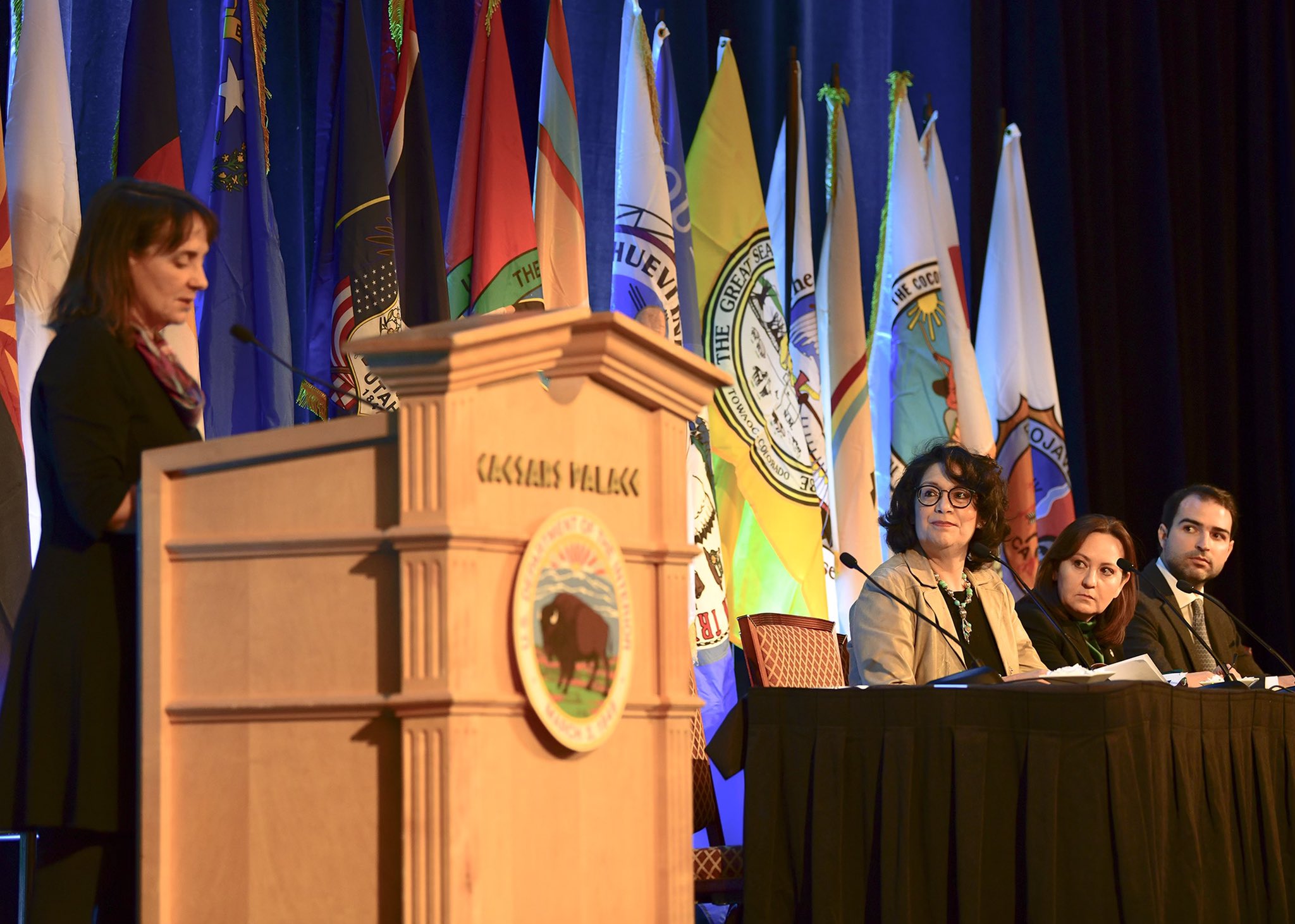
Colorado Water Conservation Board Executive Director and commissioner to the Upper Colorado River Commission Becky Mitchell, center, speaks on a panel with representatives of each of the seven basin states at the annual Colorado River Water Users Association conference in Las Vegas Thursday. The UCRC released additional details of a water conservation program at the CRWUA2022 Conference. CREDIT: HEATHER SACKETT/ASPEN JOURNALISM
Click the link to read the article on the KJZZ websits (Ron Dungan). Here’s an excerpt:
Colorado River Basin states recently gathered in Las Vegas for their annual water users convention. The states are trying to figure out how to get by with less water. The conference focused on a variety of topics, such as new technology, conservation and funding that will guide water users into the next century. But federal water managers say that new conservation measures need to be put in place or they will impose cuts.
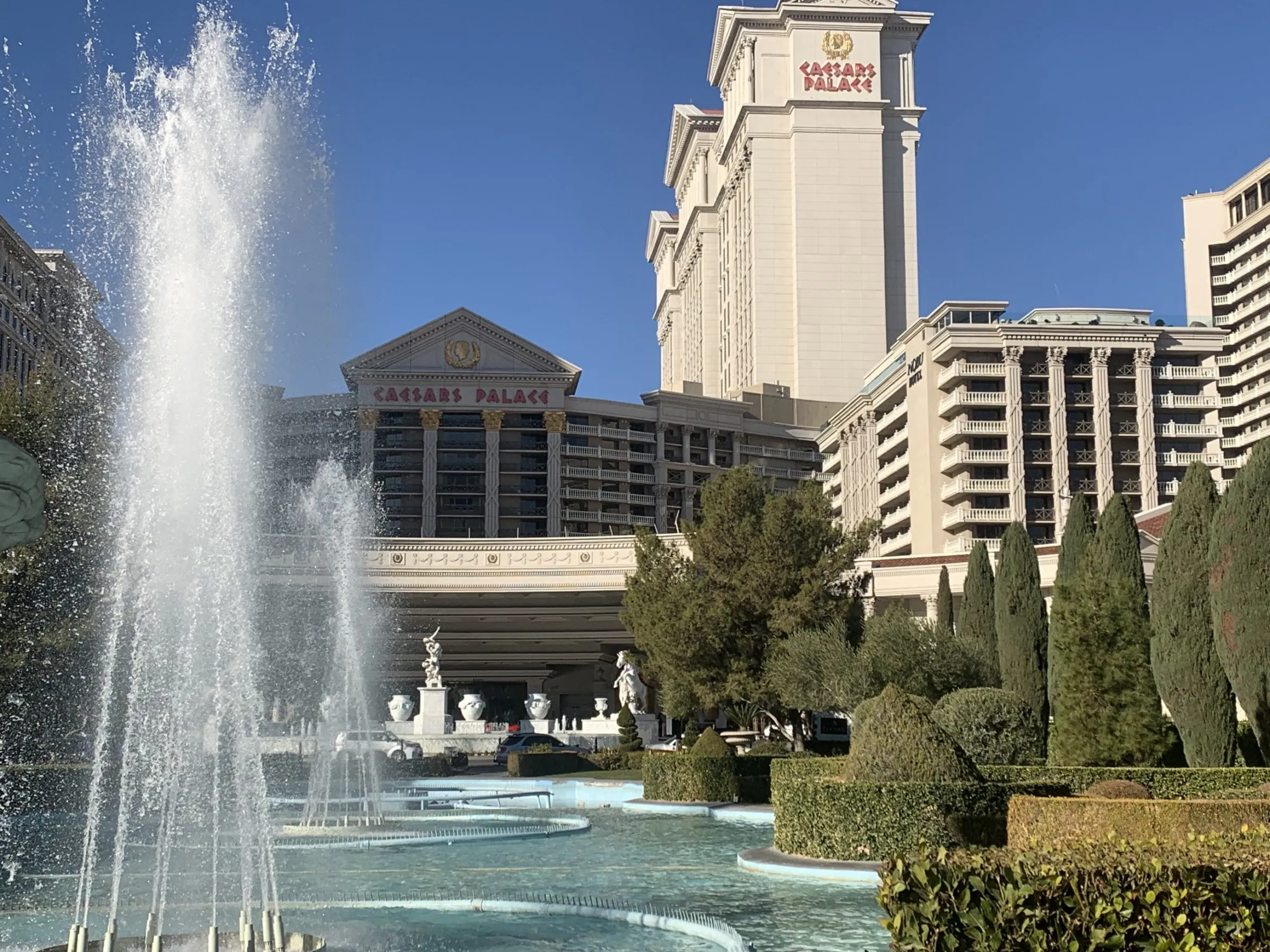
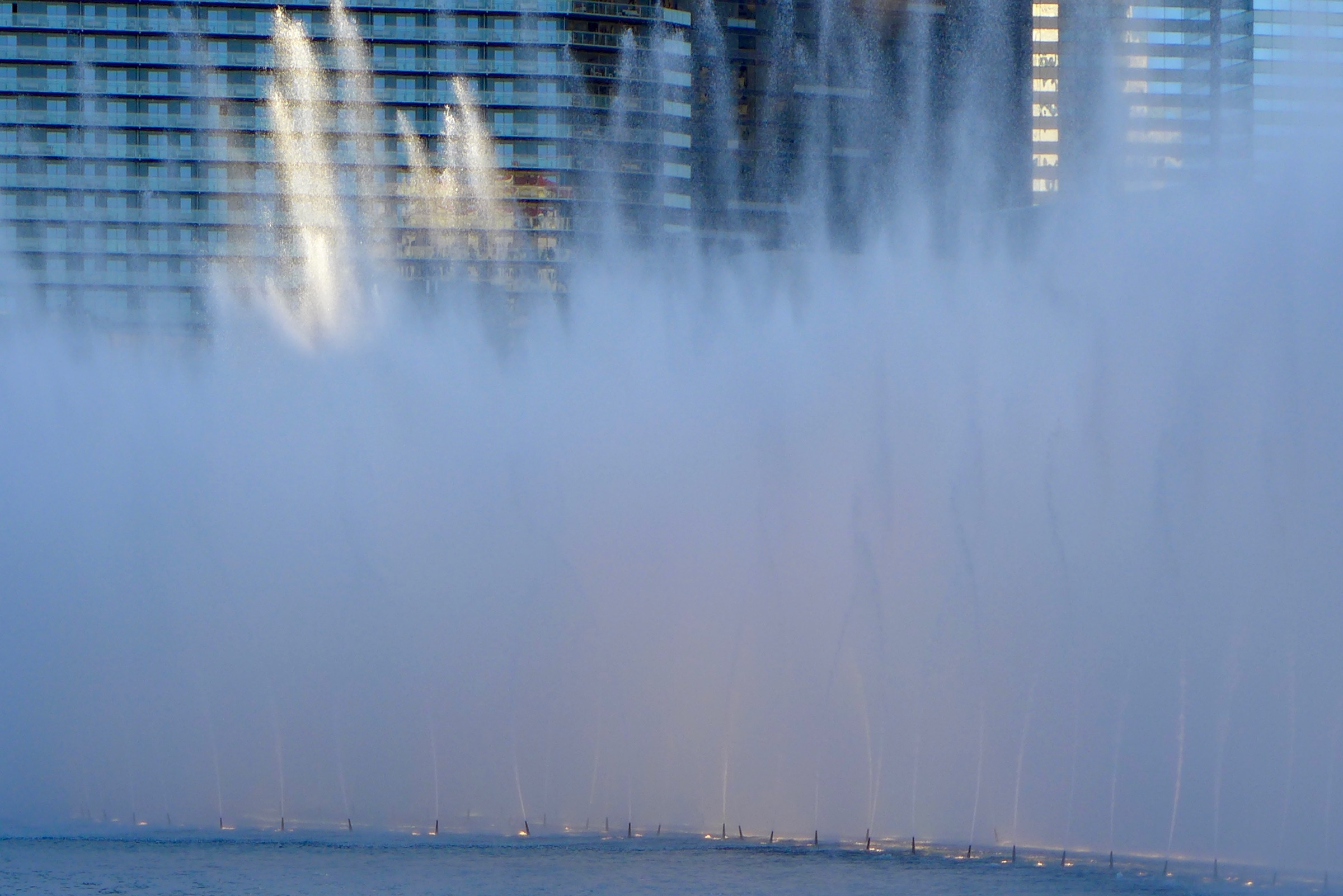
Fountains shoot water from the Colorado River into the air outside of Caesar’s Palace in Las Vegas Friday. The resort hosts the annual Colorado River Water Users Association conference. CREDIT: HEATHER SACKETT/ASPEN JOURNALISM
Click the link to read the latest edition of The Runoff newsletter from the Aspen Journalism website:
Cities versus agriculture
Some water managers at CRWUA acknowledged a truth that is widely known but rarely stated so candidly: As the Colorado River crisis deepens, water to cities will not be cut off in favor of continuing to grow hay in the desert, no matter what the law of the river — which grants the most powerful water rights to the mostly agricultural users who got here first — says.
“If the literal enforcement of the law is that 27 million Americans don’t have water, those laws will not be enforced,” said John Entsminger, general manager of the Southern Nevada Water Authority.
The wisdom of building mega-cities in arid regions aside, the fact is that Denver, Phoenix, Las Vegas and L.A. exist now and rely on the Colorado River. And denying people water at their taps would be a public health catastrophe and moral failure.
“People migrate toward opportunity and you can’t stop it only at great moral cost,” said Kathryn Sorenson, a professor at Arizona State University and former director of Phoenix Water Services. “The cities have an obligation to provide water to the people who arrived.”
The setting of the 2021 disaster shocked Boulder County residents and scientists. While the original cause is still under investigation, the blaze got rolling in protected grasslands before hurricane-force winds rocketed it into suburban communities far outside the mountains…
“We’ve ignored grasslands in terms of fire risk. We’ve concentrated a lot on forests — and we need to really better understand the differences,” [Kathryn] Suding said.
One critical distinction is the resilience of deep-rooted grasslands. No burn scar is visible from Suding’s perch above the fire zone, proving how quickly fuels can return to prairie landscapes. In woodlands, by contrast, studies show thinning trees and removing low branches can reduce dangerous wildfire fuels for years. Suding said the challenge is even trickier due to climate change, which has brought drier summers and falls to the Front Range and packed areas with quick-burning thatch. She said the result is a “high window of risk that wasn’t there before.”
[…]
A year after the disaster, here are five ideas local governments in Boulder County are considering to guard against future grassfires.
1. Hardening homes
In November, Boulder County voters approved ballot issue 1A, which will raise $11 million annually to fund wildfire mitigation efforts. The money will expand Wildfire Partners, a program that previously helped mountain and foothills homeowners make their homes less vulnerable to fire…
2. Mowing
Other methods reduce fuel in natural landscapes rather than the built environment. That task is especially important in places where grasslands border homes, giving wildfires a clear and dangerous pathway into communities…
3. Grazing
Grazing is another method Boulder County communities already use to reduce grassland fuels. One question is whether it could be deployed even closer to suburban neighborhoods…
4. Landscape wetting
Through her research, Suding also plans to investigate plans to build stone structures across grassland drainages. The hope is that will help retain water, keeping plants wetter throughout the year and less vulnerable to fires…
5. Prescribed fire
The Front Range is no stranger to wildfires. Before Euro-American settlers brought a culture of fire suppression, North American prairies burned every two to 12 years, helping to reduce future fire risk and preserving rangeland for wildlife.
Colorado’s Joint Committee on Legislative Council has approved a slate of bills put forward by various interim committees to be introduced and considered in the next legislative session, ranging from a bill to create a new office for youth eating disorder prevention to one that would create a new task force to look into high altitude water storage.
The Legislative Council, which is made up of nine senators and seven representatives, is required to review bills put forward by the committees that meet outside of the legislative session. The bills they approve then get introduced in the session as a committee bill.
The council approved two items from the Interim Committee on Judicial Discipline, which was formed last legislative session in response to allegations of a quid pro quo to deter a former Judicial Branch chief of staff from going public with evidence of alleged misconduct.
“Senate Bill 22-201, which created this particular interim committee, did make some important changes in statute concerning flow of information about judicial discipline and, for the first time, codified independent funding for the commission. But statutory change alone did not and could not address the fundamentals of the system,” state Rep. Mike Weissman, an Aurora Democrat, said.
Both items passed out of the interim committee unanimously to be considered by the Legislative Council.
“These constitute meaningful and necessary changes to our judicial discipline process. They reflect all of us grappling hard with the 17 different points in our charge,” Weissman said.
One of the items from the interim committee, a concurrent resolution, would ask Colorado voters in 2024 to change some constitutional framework for judicial discipline. Primarily, it would make judicial discipline matters public and create an Independent Judicial Discipline Adjudicative Board that would replace the role of “special masters” in imposing sanctions.
The other item, a companion bill, fleshes out some of the details from the concurrent resolution.
Bills to address water storage, wildfire mitigation
The Legislative Council approved a bill from the Water Resources and Agriculture Review Committee that would create a task force to study the feasibility of high altitude water storage and whether snowmaking would result in meaningful storage. The task force would submit its report by June 2024.
The task force would focus on whether the idea could “augment water storage in a creative way,” Democratic state. Sen Kerry Donovan of Vail said. “That will be a very interesting bill to see what thoughts it produces.”
The council also approved a bill that would make the Water Resources and Agriculture Review Committee a year-round committee.
“If we could move it to a year round committee, then there will be that consistency of focus and consistency of knowledge base that will then allow the General Assembly to be much more engaged with Colorado’s water future,” Donovan said.
Of the five bills presented by the Wildfire Matters Review Committee and approved by the council, two concern workforce development.
“We’ve heard for the past couple of years in this committee how workforce issues are becoming a real problem and felt like it was time to move forward and assist,” Rep. Lisa Cutter said during a Sept. 28 meeting. “We’ve put a lot of funds towards wildfire mitigation programs over the past few years, and now our workforce is lagging. If we don’t have the workforce to accomplish those programs, then it’s not going to make any difference.”
East Troublesome Fire. Photo credit: Northern Water
One bill would direct the Colorado state forest service to develop materials on work opportunities to be distributed in high schools, provide partial reimbursements for interns at wildfire mitigation entities, create a new forestry program within the community college system and appropriate money from the general fund to recruit educators.
Cutter said the committee will continue to “listen and refine” the bill to make sure it is compatible with existing programs.
Another bill from the committee would create a timber, forest health, and wildfire mitigation industries workforce development program within the state forest service. It would provide partial reimbursement for interns through an income tax credit.
Youth bill to create office on eating disorders
The council approved three bills from the Youth Advisory Council, which considers issues concerning the state’s young people.
“We have some very bright and intelligent young people that put forward these ideas. I think they are very eager to see these policies and ideas advance with bipartisan support. By no means are these bills in their final form, and I think they’d be really willing to consider any changes to make sure they do pass with that broad base of support,” Senate Majority Leader Dominick Moreno, a Democrat who served as the vice chair of the Youth Advisory Council, said.
One would establish an office of disordered eating prevention within the Colorado Department of Public Health and Environment that would have wide authority to work with other departments to provide and compile resources, collaborate with advocacy groups and educate the public, particularly young people, on disordered eating prevention methods. It would also create a grant program until 2027 to support research on the topic.
This would take an “upstream approach to eating disorders and make sure we’re doing the most we can to not only prevent eating disorders in our state but be a trailblazer across the country in spearheading this public health effort,” committee member Aimee Resnick, who lives in Centennial, said during a Sept. 30 bill discussion when the committee voted on which bills to put forward to the Legislative Council.
Another bill would create a committee within the Department of Education to develop a uniform practice for schools to identify students who may need treatment for substance abuse. The third bill put forward by the committee and approved by the Legislative Council would require school boards to adopt a policy to address disproportionate disciplinary practices in public schools.
The Colorado Legislature convenes for its next session on Jan. 9, 2023.
Have you ever walked or driven by a lake covered with a thick scum that looks like pea soup? This could be caused by blue-green algae, a cyanobacteria (“cyan” means “blue-green”) that is frequently found in freshwater ponds and lakes. Cyanobacteria are often confused with green algae because both can produce dense mats that may smell bad and hamper activities like swimming and fishing. However, unlike most green algae, blue-green algae can produce cyanobacterial harmful algal blooms (cyanoHABs). The highly potent toxins they make, called cyanotoxins, can harm people, animals, aquatic ecosystems, the economy, drinking water supplies, property values, and recreational activities.
For over a century, copper-based algaecides have been a popular way to control and eradicate all kinds of algae. However, the copper can harm fish and other aquatic species. These algaecides can also cause the cyanobacteria algae cells to burst, creating even higher levels of cyanotoxins in the surrounding water.
EPA researchers wanted to look at alternative ways to inhibit the development of cyanoHABs. CyanoHABs occur because of excessive amounts of nitrogen and phosphorous compounds in water, which mainly come from fertilizers and other human activities. All microorganisms need nitrogen and phosphorous compounds to survive and grow. However, because cyanobacteria make their own food through photosynthesis, they can out-compete other microorganisms, like proteobacteria, for access to the nitrogen and phosphorous compounds. As a result, cyanobacteria numbers can increase rapidly, causing an algal bloom.
The most common fresh-water cyanobacterium in U.S. waters are Microcystis, which produce the toxin microcystin. Therefore, the study focused on how to reduce Microcystis numbers and microcystin toxin levels. EPA researchers wanted to find out if adding a food source (glucose) would allow other bacteria to better compete with the cyanobacteria and prevent or reduce the development of cyanoHABs.
After two weeks incubation. The flask on the left shows lake water with no glucose added (the control) and the flask on the right shows the water treated with glucose. Photo credit: EPA
It’s All in the Timing
EPA scientist Dr. Jingrang Lu’s research team had previously shown that Microcystis toxin genes and nutrient utilization genes could be measured before the microcystin toxin itself was detectable in the water. Dr. Lu explains, “These genes can provide a one-week advanced notice of a coming bloom, making it a key time for prophylactic, or preventive, action.”
The researchers collected weekly water samples from an Ohio lake during the 2021 bloom season. Early in the summer they measured low levels of both cyanobacteria and proteobacteria in the lake water. Later in June, the warning signs indicated a coming cyanoHAB and researchers were prompted to begin the experiment.
In the controlled environment of the laboratory, scientists filled two sets of flasks with lake water. Glucose was then added to some flasks while nothing was added to the control flasks. After two weeks of incubation, researchers measured the amount of microcystin toxin in each flask. The lake water treated with glucose had 80 to 90 percent less microcystin compared to the control flasks.
Researchers also quantified the number of Microcystis cells in the glucose treated and control flasks. Almost no Microcystis cells were detected in the glucose treated flasks, while the number of proteobacteria increased.
Next Steps
Although the glucose inhibited the cyanoHABs development in the laboratory, scientists would like to test this approach in lakes. There are other considerations as well. For example, although proteobacteria and other bacteria are less toxic than cyanobacteria, their growth may potentially produce other problems. As EPA scientist Dr. Steve Vesper notes, “The long-term solution to cyanoHABs is to reduce the quantity of nitrogen and phosphorous compounds entering rivers and lakes. The use of glucose is only a stop-gap measure on the way to finding a permanent solution to the problem of cyanoHABs.”
It wouldn’t be hyperbole to call it the most important water-related U.S. Supreme Court (SCOTUS) case to come along in a generation. Indeed, the outcome of Sackett v. Environmental Protection Agency (EPA), the first case to be heard in the court’s 2022–2023 term, will determine the future efficacy of the Clean Water Act by deciding whether wetlands are—or aren’t—deserving of federal protection.
Given the close relationship between wetlands and the larger system of streams, rivers, and tributaries to which they belong, the court’s ruling is certain to have a profound impact on the health and quality of all of America’s waterways. Here’s why.
The background of the Supreme Court’s clean water case
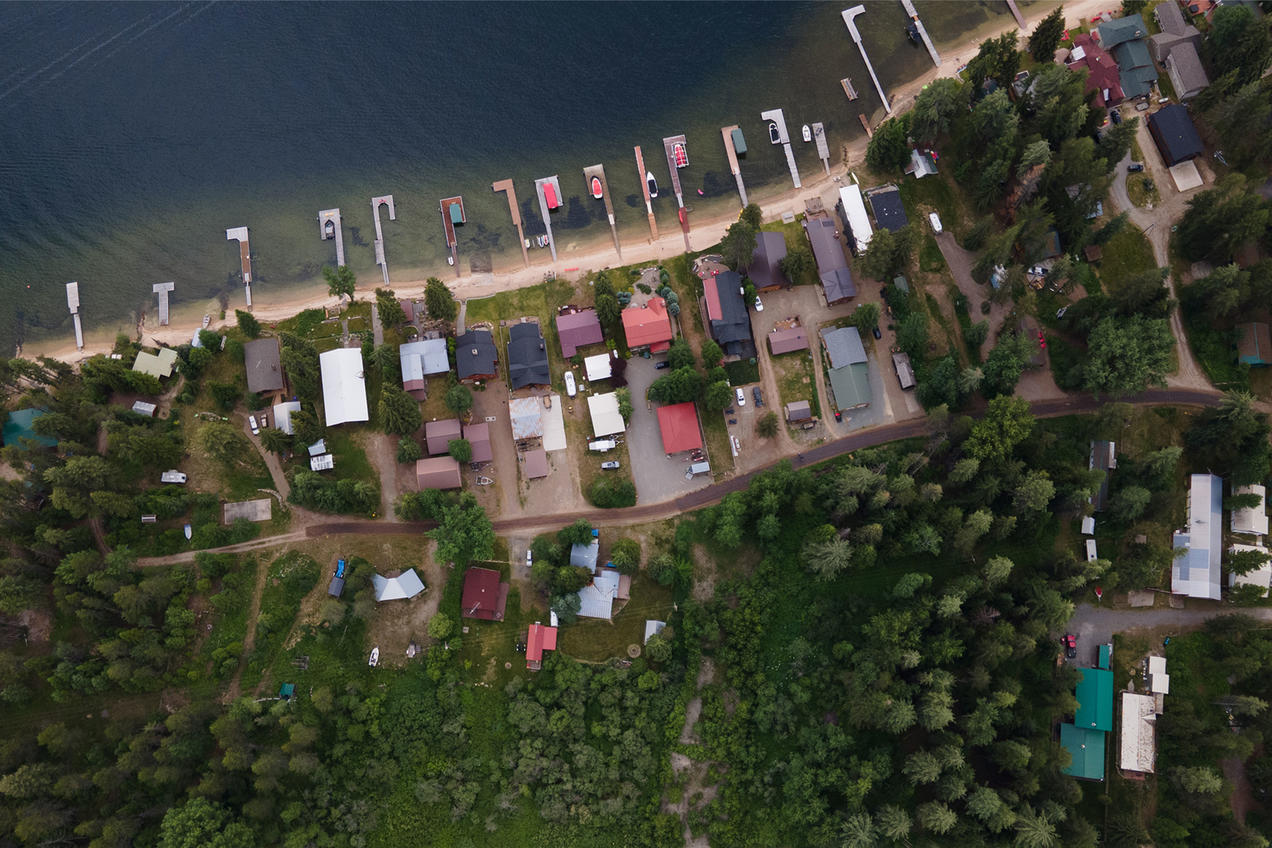
Michael and Chantell Sackett, who ran an excavation company, sought to develop property a few hundred feet from Priest Lake, a popular vacation site in the Idaho Panhandle, with plans to build a home there. To prepare the lot for construction, the Sacketts began to fill it with gravel. In 2007, the EPA halted the work after determining that the Sacketts’ lot contained a federally protected wetland. Under the authority granted to it by the Clean Water Act, the agency ordered the couple to remove the gravel and cease any further construction. The Sacketts sued in 2008, and the case wound its way through the federal court system for the next 14 years. Now, before the Supreme Court, their lawyers will argue, among other things, that the wetland the Sacketts filled is not, jurisdictionally speaking, a “water of the United States,” and thus not subject to EPA regulation.
What are the “waters of the United States”?
Since 1972, the Clean Water Act has played an essential role in protecting the country’s diverse array of aquatic environments from pollution and keeping them safe for fishing, swimming, and wildlife (not to mention as sources of drinking water for millions of people). And for roughly that same amount of time, the act has also been the target of polluters and developers who would like to limit its regulatory scope. One way they’ve attempted to do so? By focusing on a particular—and pivotal—bit of language found in the law, five simple words that carry enormous legal weight: “waters of the United States” (or WOTUS, for short).
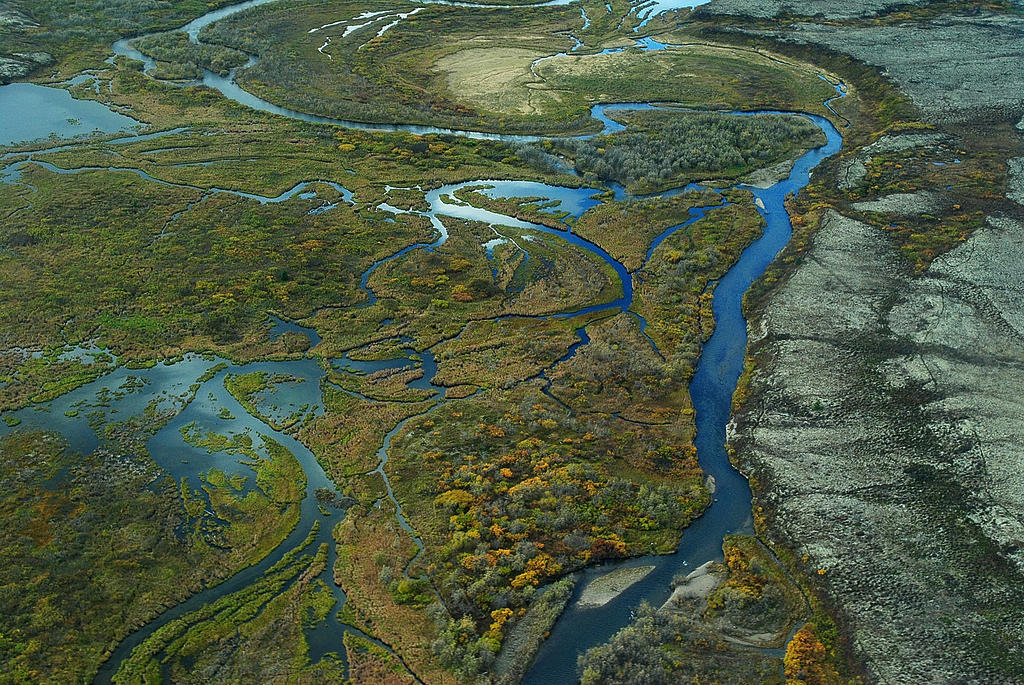
Aerial view of wetlands and tundra typical of the Bristol Bay watershed in Alaska. Utilizing the Clean Water Act, the EPA is currently in the process of vetoing the Pebble Mine in Alaska’s Bristol Bay, which would pose a critical threat to the area’s wetlands. Photo credit: EPA
Numerous pollution control programs in the Clean Water Act apply only to WOTUS, and for most people, defining the term is a pretty straightforward matter: The phrase refers to—or at least seems like it would be referring to—the many different bodies of water to be found within the geographical borders of our nation. And according to Jon Devine, the director of NRDC’s federal water policy team, that’s pretty much the correct way to define it.
“Congress intended the phrase to be interpreted very broadly,” says Devine. When lawmakers were drafting the Clean Water Act half a century ago, he says, they envisioned its protections as extending to all the various bodies of water that make up a watershed, many of which people use for recreation, fishing, and drinking-water supply. And while those lawmakers may not have been hydrologists, they nevertheless understood the fundamental interrelatedness of these different bodies of water. “So the very earliest regulations set forth by the EPA were inclusive,” Devine notes. As a jurisdictional matter, WOTUS comprised “all the relevant parts of an aquatic ecosystem, including streams, wetlands, and small ponds—things that aren’t necessarily connected to the tributary system on the surface, but that still bear all kinds of ecological relationships to that system and to one another.”
Still, given the restrictions on how people could interact with these protected waters, interested parties were inclined to litigate the meaning of the term over the decades. “There were always fights about it,” Devine says. “A developer who wanted to bulldoze a wetland, or a polluter who was being prosecuted for dumping into a small stream, would question whether that particular feature should really be considered a water of the United States.” But, as Devine notes, “they largely lost.” And as a result, the more inclusive definition prevailed—or at least it did until the early 2000s, when cracks in that foundation began to develop.
SCOTUS on WOTUS
The most significant development on this front took the form of two separate opinions authored by Supreme Court justices Antonin Scalia and Anthony Kennedy in a 2006 case, Rapanos v. United States. Like Sackett v. EPA, it also involved filling wetlands without a permit to do so. In their individual opinions, Scalia and Kennedy outlined two contrasting ways of identifying which waters merited protection under the Clean Water Act. For Scalia, those that qualified had to be either so-called navigable waters (think rivers, lakes, basically anything that can accommodate a boat), regularly flowing tributaries to those waters, or wetlands—so long as those wetlands had a continuous surface connection to a body of water that already enjoyed federal protection.
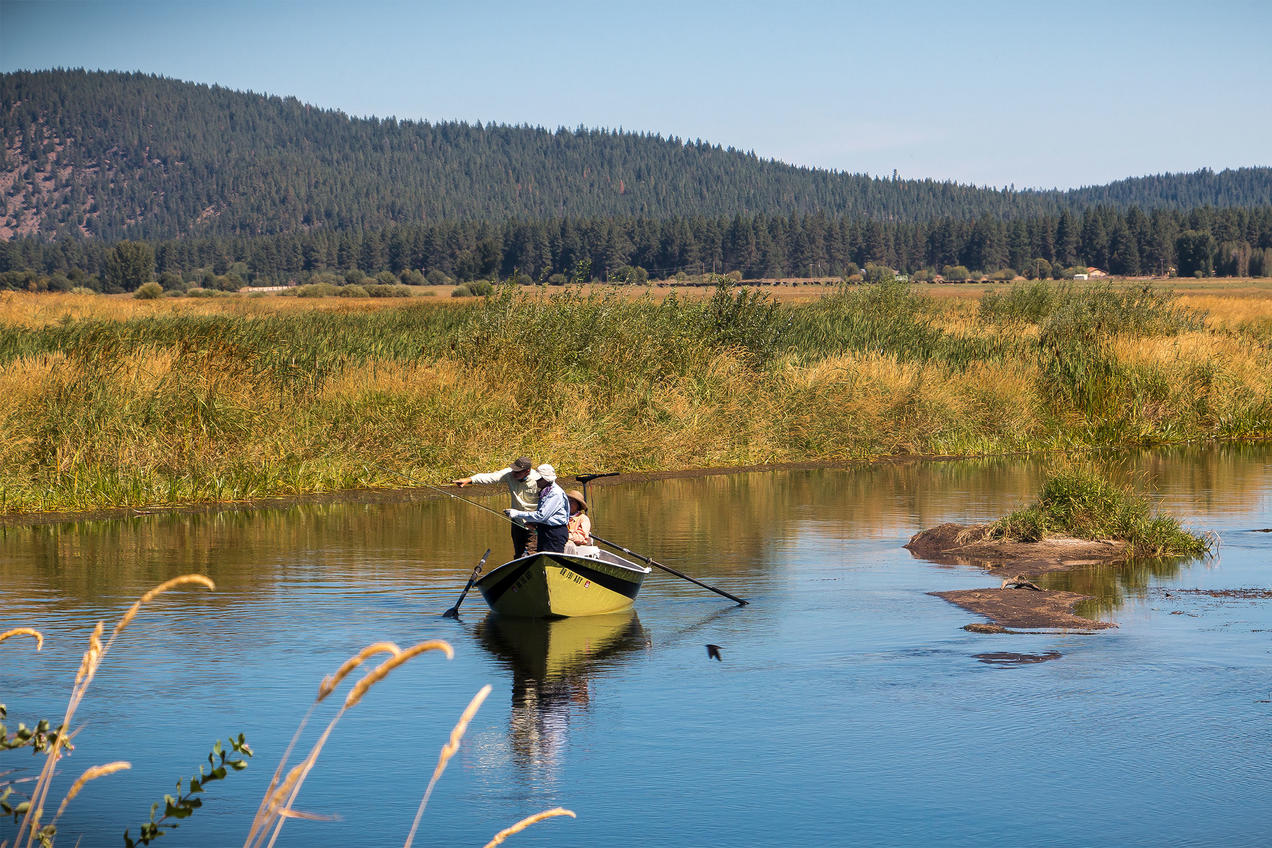
The Wood River Wetland in southern Oregon is home to an array of biodiverse vegetation and is a freshwater ecoregion. Photo credit: Bureau of Land Management
Kennedy saw things differently. He maintained that the connection between wetlands and other bodies of water didn’t necessarily have to be visible—i.e., continuous, and on the surface—but could be measured in other ways. For Kennedy, the far more important question was: Does a given wetland share a significant nexus with another protected body of water? Or (in somewhat plainer English), would polluting or destroying certain wetlands affect the physical, chemical, or biological health of the second body of water? If the answer was yes, Kennedy believed, then both deserved the same level of protection, regardless of whether a boat could easily journey between them.
Although the lower courts consistently ruled that wetlands satisfying Kennedy’s test must be protected (consistent with the views of both the Bush and Obama administrations), polluting industries kept arguing that Scalia’s view should govern. The Trump administration adopted a definition based on the Scalia approach, but it was quickly struck down in court. Which brings us to 2022, and to Sackett—and to the dangerous possibility of a Supreme Court ruling that will adopt a radically narrow view.
The stakes for our wetlands—and water
Wetlands are hugely important. In the words of the EPA, they “are among the most productive ecosystems in the world, comparable to rainforests and coral reefs.” By regulating water flow, they can dramatically lessen the impact of both floods and droughts. They provide habitat for all manner of fish, birds, mammals, insects, reptiles, and amphibians. And they do all of these things while storing massive amounts of carbon in their abundant vegetation—making safeguarding wetlands a valuable natural climate solution.
Colorado River headwaters tributary wetland in Rocky Mountain National Park photo via Greg Hobbs.
In a better world, perhaps, those reasons would be enough to ensure that wetlands receive the maximum level of federal protection, but the main question before the Supreme Court right now is: When wetlands are intrinsically connected to other indisputably protected waters, does the Clean Water Act prevent their unregulated pollution and destruction? If not, then the Sacketts’ efforts to get rid of the one on their property wouldn’t need a federal permit, and developers and polluters can celebrate. But if wetlands that are intrinsically connected to other waters are protected, then destroying or polluting them is tantamount to destroying or polluting a lake or a river: an indisputable violation of the Clean Water Act.
For Devine, the answer is clear—so clear that he and his colleagues at NRDC and the Southern Environmental Law Center felt compelled to file a friend-of-the-court brief on the matter, in support of the EPA, that was entered into the court’s docket earlier this year. In that document, Devine says, more than 100 conservation and community organizations argue that “based on the history of the Clean Water Act, and on prior Supreme Court cases, the law—at the very least—protects the kinds of things found on the Sacketts’ property.” Not only is the wetland in question spitting distance from a huge lake that’s also a popular recreational spot, but this particular wetland is also part of a larger complex of wetlands through which water flows, underground, to the lake. And like nearly all other wetlands, it provides all kinds of water purification, water regulation, and wildlife habitat. “The law should protect these wetlands that, the science shows, have such an important effect on downstream waters,” Devine says.
Water flows in all sorts of ways: aboveground; belowground; rapidly, down rivers and streams; and also slowly, through the cleansing filters of the reeds, soils, and grasses that make up a wetland. “The notion that the law can’t protect a body of water, simply because there’s a road between it and another body of water that’s unquestionably protected, is absurd and unscientific,” says Devine. “And it would defeat the purpose of the Clean Water Act.”
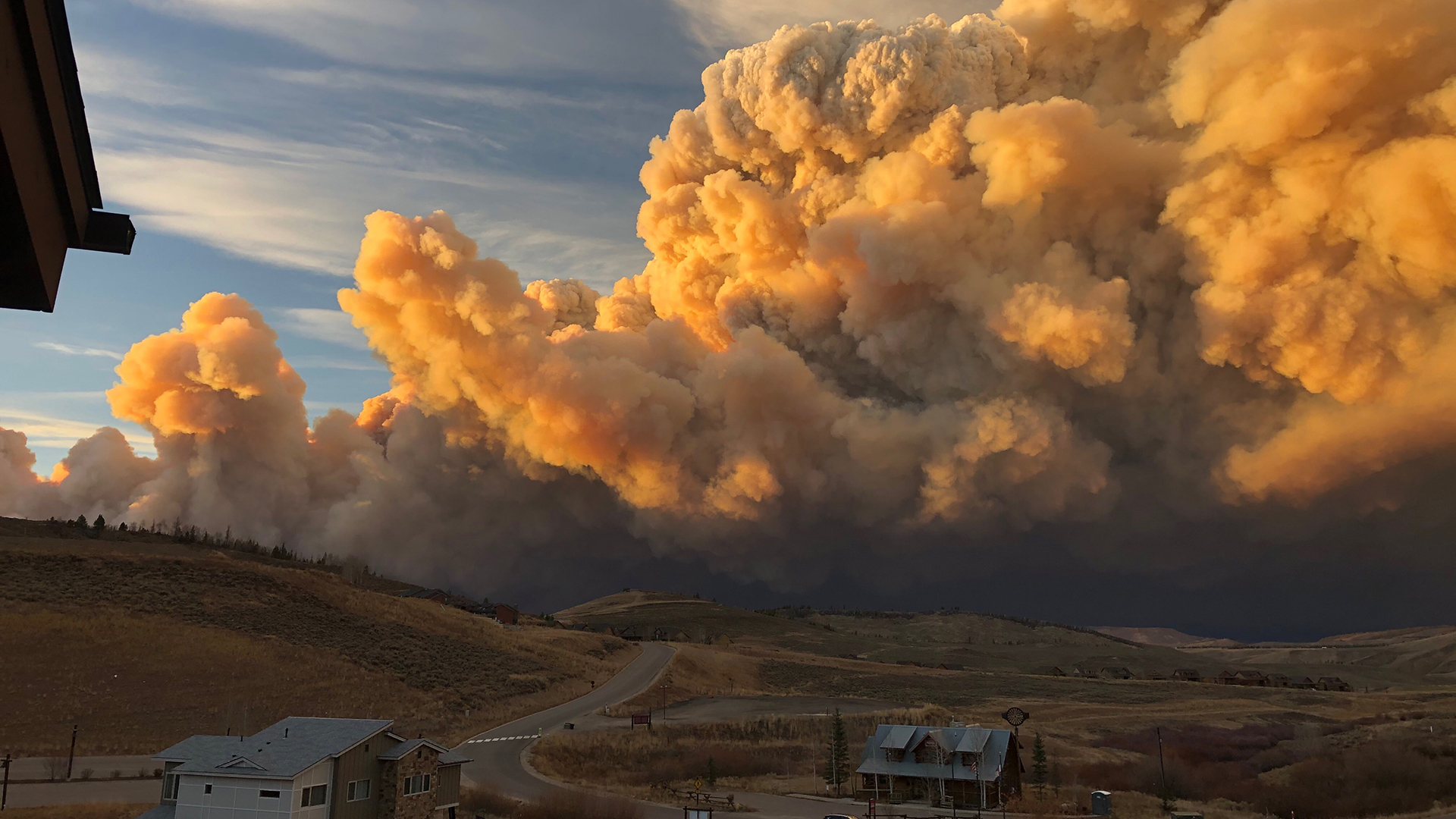
Marshall Fire December 30, 2021. Photo credit: Boulder County
Click the link to read the article on the ProPublica website (Jennifer Oldham):
ProPublica is a Pulitzer Prize-winning investigative newsroom. Sign up for The Big Story newsletter to receive stories like this one in your inbox.
Sheriff’s deputies driving 45 mph couldn’t outpace the flames. Dense smoke, swirling dust and flying plywood obscured the firestorm’s growth and direction, delaying evacuations.
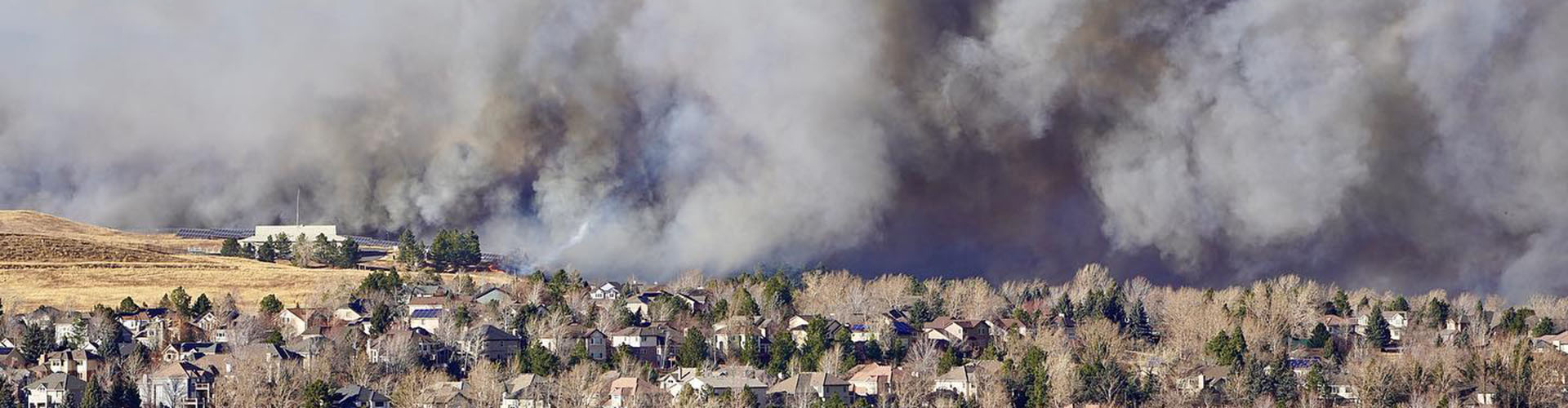
Within minutes, landscaped islands in a Costco parking lot in Superior, Colorado, caught fire as structures became the inferno’s primary fuel. It consumed the Element Hotel, as well as part of a Tesla service center, a Target and the entire Sagamore neighborhood. Across a six-lane freeway, in the town of Louisville, flames rocketed through parks and climbed wooden fences, setting homes ablaze. They spread from one residence to the next in a mere eight minutes, reaching temperatures as high as 1,650 degrees.
On Dec. 30, 2021, more than 35,000 people in Superior and Louisville, as well as unincorporated Boulder County, fled the fire — some so quickly they left barefoot and without their pets. Firefighters abandoned miles of hose in neighborhood driveways to escape.
The Marshall Fire, the most destructive in Colorado history, killed two people and incinerated 1,084 residences and seven businesses within hours. Financial losses are expected to top $2 billion.
The blaze showed that Colorado and much of the West face a fire threat unlike anything they have seen. No longer is the danger limited to homes adjacent to forests. Urban areas are threatened, too.
Yet despite previous warnings of this new threat, ProPublica found Colorado’s response hasn’t kept pace. Legislative efforts to make homes safer by requiring fire-resistant materials in their construction have been repeatedly stymied by developers and municipalities, while taxpayers shoulder the growing cost to put out the fires and rebuild in their aftermath.
Many residents are unaware they are now at risk because federal and state wildfire forecasts and maps also haven’t kept pace with the growing danger to their communities. Indeed, some wildland fire forecasts model urban areas as “non-burnable,” even though the Marshall Fire proved otherwise.
The disaster put an exclamation point on what scientists, planners and federal officials warned for years: Communities outside the traditional wildland-urban interface, or WUI, are now vulnerable as a changing climate, overgrown forests and explosive development across the West fuel ever-unpredictable fire behavior. Fire experts define the WUI, pronounced woo-ee, as areas where plants such as trees, shrubs and grasses are near, or mixed with, homes, power lines, businesses and other human development.
They now agree that instead of a threat confined to the WUI, the entire state, including areas far from forests, may be at risk of a conflagration.
“The Marshall Fire was a horrible, tragic event that served as a wake-up call for the rest of our state,” said state Rep. Lisa Cutter, a Democrat who represents mountain and foothill areas. “I don’t think we realized how much wildfire could impact communities that aren’t deep in the forest — it’s not something any of us are immune to.”
Unheeded Warnings
An early warning of the growing danger to suburban communities arrived in 2001. That year, the U.S. Department of Agriculture and other federal agencies identified scores of Colorado municipalities adjacent to public lands as being at high risk of a wildland blaze-turned-urban conflagration. Some of these areas burned in the Marshall Fire.
Waldo Canyon Fire
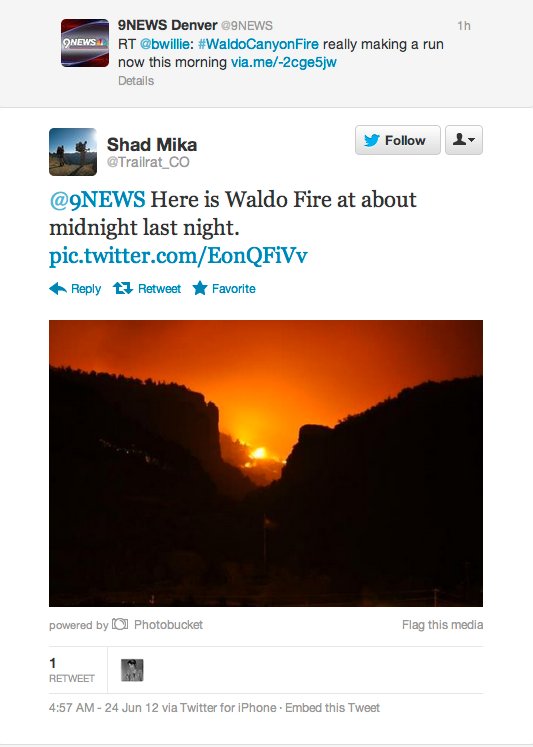
A decade later, in 2012, another warning came, as an unprecedented weather-driven inferno, the Waldo Canyon Fire, destroyed several Colorado Springs neighborhoods.
Afterward, fire experts urged state lawmakers to adopt a model building code that communities in high-risk areas could enact. Such codes have been scientifically proven to reduce risk for residents and rescuers and to increase the odds structures will withstand a blaze by requiring fire-resistant materials on siding, roofs, decks and fences, along with mesh-covered vents that prevent embers from entering.
But lawmakers bowed to pressure from building and real estate lobbyists as well as municipal officials who demanded local control over private property.
Meanwhile, the number of new homes built in Colorado’s WUI — as defined by researchers several years ago — more than doubled between 1990 and 2020. And nationwide, the WUI is growing by 2 million acres a year. Homes in 70,000 communities worth $1.3 trillion are now within the path of a firestorm, according to a June report from the U.S. Fire Administration that featured photos of the Marshall Fire’s destruction.
In the months that followed the Marshall Fire, there were again calls to consider a statewide building code. A last-minute amendment to a fire mitigation bill in May would have created a board to develop statewide building rules, but it was pulled after builders, real estate agents, municipalities and others opposed it.
It wasn’t the first time the state’s powerful building industry asserted its influence over policy. Whenever a wildfire bill comes to the state legislature, well-heeled lobbyists routinely represent the industry, records kept by the Colorado secretary of state show. The state’s culture of local control and the construction industry’s $25 billion annual contribution to the economy hampered lawmakers’ ability to find middle ground on a minimum statewide building code.
ProPublica’s review of legislation introduced from 2014 to 2022 found only 15 out of 77 wildfire-related bills focused primarily on helping homeowners mitigate their risk from fires. Most of the 15 proposals offered incentives to homeowners and communities through income tax deductions or grants — some of which required municipalities to raise matching funds — to clear vegetation around structures.
None called for mandatory building requirements in wildfire-prone areas, even as 15 of the 20 largest wildfires in state history have occurred since 2012.
The lack of uniform regulations has cost the Centennial State millions in federal grant money: The Federal Emergency Management Agency denied the state grants from the agency’s resilient infrastructure funds, which from fiscal 2020 to 2022 totaled $101 million.
Colorado remains one of only eight states without a minimum construction standard for homes.
Municipalities Weigh Prevention and Its Cost
Developers have also influenced municipalities’ recent decisions, as homes decimated by the Marshall Fire are rebuilt in Boulder County, and the cities of Superior and Louisville located within it. The debate has reflected difficult tradeoffs between the cost of making homes more fire-resistant — particularly in an era of high inflation and unpredictable supply chains — and residents’ tolerance for risk.
Lawmakers in Louisville, where 550 homes and businesses burned, voted to remove a fire sprinkler requirement for homes, citing cost, despite evidence such systems reduce the risk of dying in a home fire by 80%. The City Council also voted to allow residents to choose whether to follow new energy efficiency requirements estimated to add $5,000 to $100,000 to the cost of a new home.
By contrast, in unincorporated Boulder County, which lost 157 homes to the Marshall Fire, commissioners in June voted to require fire-resistant materials on all new and renovated homes. Before the inferno, the eastern grasslands were exempt. (Mountain residents, who since 1989 have been required to follow mitigation practices, have seen the effectiveness of such codes: Eight out of 10 of their homes survived the Fourmile Canyon Fire in 2010.)
In Superior, which lost 378 structures, the Board of Trustees voted down a proposed citywide WUI building code in May. After residents of the leveled Sagamore neighborhood requested they revisit their decision, trustees reconsidered in July.
The financial pressures facing Superior officials and their constituents were evident as they considered whether to require fire-resistant materials solely for homes destroyed by the Marshall Fire or for the entire city.
“This is all a huge cost we cannot bear,” said Robert Lousberg, a resident who wants to rebuild several homes. “I understood this is a once-in-a-lifetime fire.”
Some neighbors disagreed.
“Sagamore burned down in less than an hour — one of my neighbors ended up in the hospital after trying to escape the fire on foot — that’s the main reason we need these codes, to slow the spread of fire,” Dan Cole said. “We have an opportunity to build a more fire-resistant neighborhood right now, and it would be foolish and short sighted not to take it.”
Builders estimated that costs for tempered-glass windows, fire-resistant siding and other materials could reach $5,500 to $30,000 per home. Procuring the materials and labor to install them could delay rebuilding.
Like residents, town trustees were divided about whether the cost outweighed safety benefits to residents and first responders should there be another conflagration.
“To me, it’s unconscionable to have people rebuilding in an unsafe manner,” said Trustee Laura Skladzinski, who did not seek reelection last month. “I would rather have residents pay $20,000 now. If they cannot afford it, how are they going to be able to afford it when their house burns down?”
Some noted that most residents didn’t have enough insurance to cover the cost of rebuilding their homes.
Trustee Neal Shah said the city should have adopted tougher codes after the 2012 Waldo Canyon Fire in Colorado Springs, which prompted calls for a voluntary statewide building code that communities could institute requiring fire-resistant materials in homes.
“I fundamentally believe in WUI standards,” Shah said, “what I can’t solve is the math.”
The body voted 5-1 to institute the code, then added an opt-out clause for those rebuilding their residences.
Colorado Springs Fire Foreshadowed the Risks
A decade before the Marshall Fire, a blaze was burning in the mountains above Colorado Springs on a 101-degree June day. That afternoon a thunderstorm caused a sudden shift in the wind, pushing a wall of burning debris out of the Rocky Mountain foothills into the state’s second-largest city.
Firefighters fled the 750-foot-high fire front — as tall as a 53-floor building — as it chewed through pine, pinyon and juniper dried by a record-hot spring. Sixty-mile-per-hour gusts peeled back the door on a fire truck. Fist-sized embers rained down on the city’s Mountain Shadows community. The fire incinerated 79 homes per hour, or 1.3 per minute, over 5 ½ hours, a report found.
In the aftermath of the Waldo Canyon Fire, which destroyed 347 homes and killed two people, Colorado Springs drew lessons from which residences had survived and capitalized on fresh memories of burned neighborhoods to institute tougher building requirements.
Standing recently in the shade of a still-scorched tree behind her home, Patty Johnson described how her house was relatively unscathed, even as eight of her neighbors lost their residences. She credited ignition-resistant materials, including stucco walls, siding, a composite deck and a concrete tile roof. Drought-resistant landscaping also helped. Her family sold the home in September to move into a smaller place in the city.
After-action reports found neighbors’ work clearing vegetation around homes helped firefighters save 82% of residences in the 28-square-mile burn area.
FEMA estimated that minimal expenditures to protect Colorado Springs neighborhoods had paid off. In Cedar Heights, $300,000 in mitigation had prevented about $77 million in losses.
“The Waldo Canyon Fire was shocking, but it could have been so much worse if the city of Colorado Springs had not spent decades getting ready,” said Molly Mowery, co-founder of the Community Wildfire Planning Center.
Even so, the fire reached 2,000 degrees and moved so fast it incinerated some homes with fire-resistant material and fire-proof safes inside.
Nevertheless, the city followed a 30-year pattern and took its lessons to heart to institute additional building requirements to fortify homes in wildfire-prone areas. Timing was everything, Mowery’s nonprofit concluded in a recently released analysis.
The city had done the same in 2002. With smoke still in the air following the Hayman Fire — which started about 35 miles northwest of the city and destroyed 600 structures — a coalition of fire officials, homeowners’ associations and local builders and roofing contractors devised rules that banned wood roofs on all new homes and repairs greater than 25% of the total roof area.
Similarly, after the Waldo Canyon Fire, as heavy machinery cleared charred neighborhoods, the city updated its code to increase the distance trees had to be from homes and require fire protection systems, ignition-resistant siding and decks, and double-paned windows for all new or reconstructed homes in hillside areas.
Fire officials used spatial technology to hone the city’s definition of the WUI. The tool identified a 32,655-acre area — one of the largest high-risk regions in the United States. The city recruited homeowners to educate neighbors in the threatened area about fire-resistant practices.
Peer pressure worked, said Ashley Whitworth, wildfire mitigation program administrator at the Colorado Springs Fire Department. If a homeowner’s property is flagged red on the city’s online risk assessment map (denoting it needs work), neighbors reach out to learn why they haven’t completed mitigation.
Colorado Springs’ voters overwhelmingly approved the allocation of $20 million in city funds toward incentives to gird wildfire-prone properties.
Days after the vote in November 2021, the Marshall Fire unfolded 90 miles to the north across communities with little history of wildfire mitigation.
Scientists, some of whom lived in Boulder County and were evacuated, proclaimed it a “climate fire.” They cited the extreme weather that preceded it: Abnormally high levels of snow and rain in spring and summer had nurtured abundant 4-foot grasses that baked to a crisp during a historically dry fall. Chinook winds blasted the region for an unusual nine-hour period and propelled the firestorm. And even though there’s growing understanding that fire season is now year-round, no one believed a December blaze could ravage entire cities.
While it began as a wildfire in grassland, once it reached nearby communities it transformed into an urban conflagration — the type of fire that destroyed Chicago in 1871 and San Francisco in 1906 and that until the early 20th century consumed more property than any other type of natural disaster.
“Was this a wildland fire or an urban fire?” Sterling Folden, deputy chief of the Mountain View Fire Protection District, asked during a July legislative committee meeting. “I had five fire trucks in the entire downtown of Superior — I had 20 blocks on fire — I usually have that many for one house on fire.”
Whitworth, of the Colorado Springs Fire Department, said there were more lessons to learn about the threat of wildfire.
“The Marshall Fire was a really big hit for people here because it happened in December and it happened just like that,” Whitworth said. “Everyone said to me, ‘It could happen here,’ and I said, ‘You’re absolutely right.’”
Is the Entire State Now Vulnerable to Wildfire?
With the 2023 legislative session days away, fire chiefs, county commissioners, scientists and planners are once again calling on Colorado lawmakers to institute statewide rules that mandate fire-resistant materials in high-risk areas.
Cutter, who will be sworn in as a state senator in January, is developing a bill that would require the state to create a WUI code board to write minimum fire-resistant building requirements. It’s patterned in part after the amendment that failed at the Capitol this spring.
Such laws save lives, said Mike Morgan, director of the Colorado Division of Fire Prevention and Control. The 36-year fire service veteran cited studies from the nonprofit Fire Safety Research Institute and the federal National Institute of Standards and Technology showing that building codes work.
“Firefighters take extraordinary risk to protect lives and property,” he added. “If we start building communities and structures out of materials more resistive to fire, we are upping our odds of success — we’ve got to do something different and do it better.”
The insurance industry is also warning that if Colorado lawmakers and communities don’t reinforce homes against wildfire, mounting claims from blazes could put premiums out of reach for many. The industry supports a statewide building code.
“Unlike other disasters, wildfire is one of those risks there is much we can do from a mitigation standpoint to put odds at least in favor of that home surviving,” said Carole Walker, executive director of the Rocky Mountain Insurance Information Association.
“We’ve got to get it done,” she added. “Colorado right now is at … a tipping point with concerns about keeping insurance here and keeping insurance available.”
But such rules won’t be adopted without a compromise among local control advocates, builders and fire officials.
Construction industry representatives who met with Cutter and Morgan recently said builders are wary of one-size-fits-all requirements imposed by the state. Together with the insurance industry and municipal governments, they have met the past few months seeking to influence the bill’s language.
“It’s important to make sure we match codes with risk,” said Ted Leighty, chief executive of the Colorado Association of Home Builders. His members “are not opposed to talking about what a code board might look like — if we were to adopt a model code that local governments could adopt to match their communities’ needs.”
The idea for such a board emerged after the Colorado Fire Commission received a letter from Gov. Jared Polis in July 2021.
The first-term Democrat, who was reelected in November, sent the missive following conflagrations in 2020 that exhibited unimaginable fire behavior: The 193,812-acre East Troublesome Fire traveled 25 miles overnight and incinerated 366 homes; and the 208,913-acre Cameron Peak Fire, which torched 461 structures, burned for four months despite firefighters’ efforts.
Polis wrote that legislators in 2021 had failed to “address a critical piece of the wildfire puzzle in Colorado: land use planning, development and building resiliency in the wildland-urban interface.”
Instead, lawmakers focused on fire response, restoration of burned lands and voluntary mitigation by communities.
In answer to Polis’ missive, a little-known subcommittee, which included state, county and city fire officials, met between August 2021 and April. The 51-member group agreed it’s time to rethink which communities are prone to wildfire, offering a new definition of the WUI: The group concluded “almost the entire state of Colorado falls within the WUI,” according to minutes from a Feb. 10 meeting, “which could make a strong argument for adopting a minimum code.”
Fire officials also countered the long-held belief that communities favor local control over building requirements. They pointed to a 2019 law that established a minimum energy code that local jurisdictions must adopt when they update local building codes. About 86% of the state’s 5 million residents now live in a community that mandates such measures.
“There is minimal evidence that people voluntarily regulate themselves,” committee members concluded, according to minutes of their Feb. 28 meeting.
Rebuilding Like Before
A report on the Marshall Fire released in October by the Colorado Division of Fire Prevention and Control noted how wooden fences abutting grasslands had accelerated the blaze’s spread, leading flames from the grass directly to homes. Firefighters also described fence pickets flying past at 80 mph and landing to start new fires.
This month, as homes were being rebuilt on Cherrywood Lane in Louisville, in one of the hardest-hit neighborhoods, evidence remained of first responders’ frantic efforts to cut down fences to prevent them from spreading flames to neighboring homes.
New homes are going up across the 9-square-mile burn zone. A recent drive through the area revealed many are being rebuilt with the same kinds of fences. With no building code dictating that the fences be made of fire-resistant materials, homeowners are using flammable materials that have been standard in the past, unaware it will again put them at risk in the next blaze.
Wooden fences such as these touch homes and grasslands in communities up and down the eastern edge of the Rocky Mountains.
Rebuilding without ignition-resistant barriers leaves the homes vulnerable to the next climate-driven wildfire, said Morgan, the state fire chief.
This month, with snow on the ground and temperatures in the 40s, another blaze ignited not far from where the Marshall Fire burned. Thirty-five-mile-per-hour winds spread the flames and forced evacuations before the threat subsided.
“I’ve heard people say the Marshall Fire was just a fluke,” he said. “I would disagree — there are literally thousands of communities along the Front Range of the Rockies from Canada to New Mexico subject to these Chinook winds multiple times a year, and when the conditions are right this can happen.”
Water supplies are shrinking throughout the Southwest, from the Rocky Mountains to California, with the flow of the Colorado River declining and groundwater levels dropping in many areas. The mounting strains on the region’s water supplies are bringing new questions about the unrestrained growth of sprawling suburbs. [Kathleen] Ferris, a researcher at Arizona State University’s Kyl Center for Water Policy, is convinced that growth is surpassing the water limits in parts of Arizona, and she worries that the development boom is on a collision course with the aridification of the Southwest and the finite supply of groundwater that can be pumped from desert aquifers.
For decades, Arizona’s cities and suburbs have been among the fastest growing in the country. In most areas, water scarcity has yet to substantially slow the march of development. But as drought, climate change and the chronic overuse of water drain the Colorado River’s reservoirs, federal authorities are demanding the largest reduction ever in water diversions in an effort to avoid “dead pool” — the point at which reservoir levels fall so low that water stops flowing downriver. Already, Arizona is being forced to take 21% less water from the Colorado River, and larger cuts will be needed as the crisis deepens…
To deal with those reductions and access other supplies to serve growth, the state is turning more heavily to its underground aquifers. As new subdivisions continue to spring up, workers are busy drilling new wells. Ferris and others warn, however, that allowing development reliant solely on groundwater is unsustainable, and that the solution should be to curb growth in areas without sufficient water.
“What we’re going to see is more and more pressure on groundwater,” Ferris said. “And what will happen to our groundwater then?”
“We pray for the rains to come, for the snow to fall, for moisture in the earth. Not just for the Hopi, but for everybody. For every living thing that’s out there.” – Dennis Hopper, Hopi Elder
The Green and Colorado river systems form the backbone of the American West. Once spanning a 1,450-mile journey from the Rocky Mountains to the Gulf of California, today, none of the sediment-rich water reaches the Pacific Ocean. Instead, its water lies stymied in reservoirs and siphoned off to feed and nurture 40 million people from Salt Lake to Los Angeles.
One hundred and fifty years after John Wesley Powell’s historic descent of the Green and Colorado rivers, an unlikely crew of scientists, artists, educators, and river lovers repeated his journey on a trip that was simultaneously a celebration of modern river life and a critical look at how we interpret the Colorado River’s history and use its waters.
As the demand we place on the water of the Colorado continues to exceed its supply, we are forced to face uncomfortable truths about decisions made in our past. And we are reminded that the way we think about water—and all those dependent upon it—needs to shift if we want things to change for our future.
“Water is a life force for all of us. It has a spiritual and physical being to it that deserves respect. It’s not something that you take for granted.” – Lyle Balenquah, Hopi archaeologist
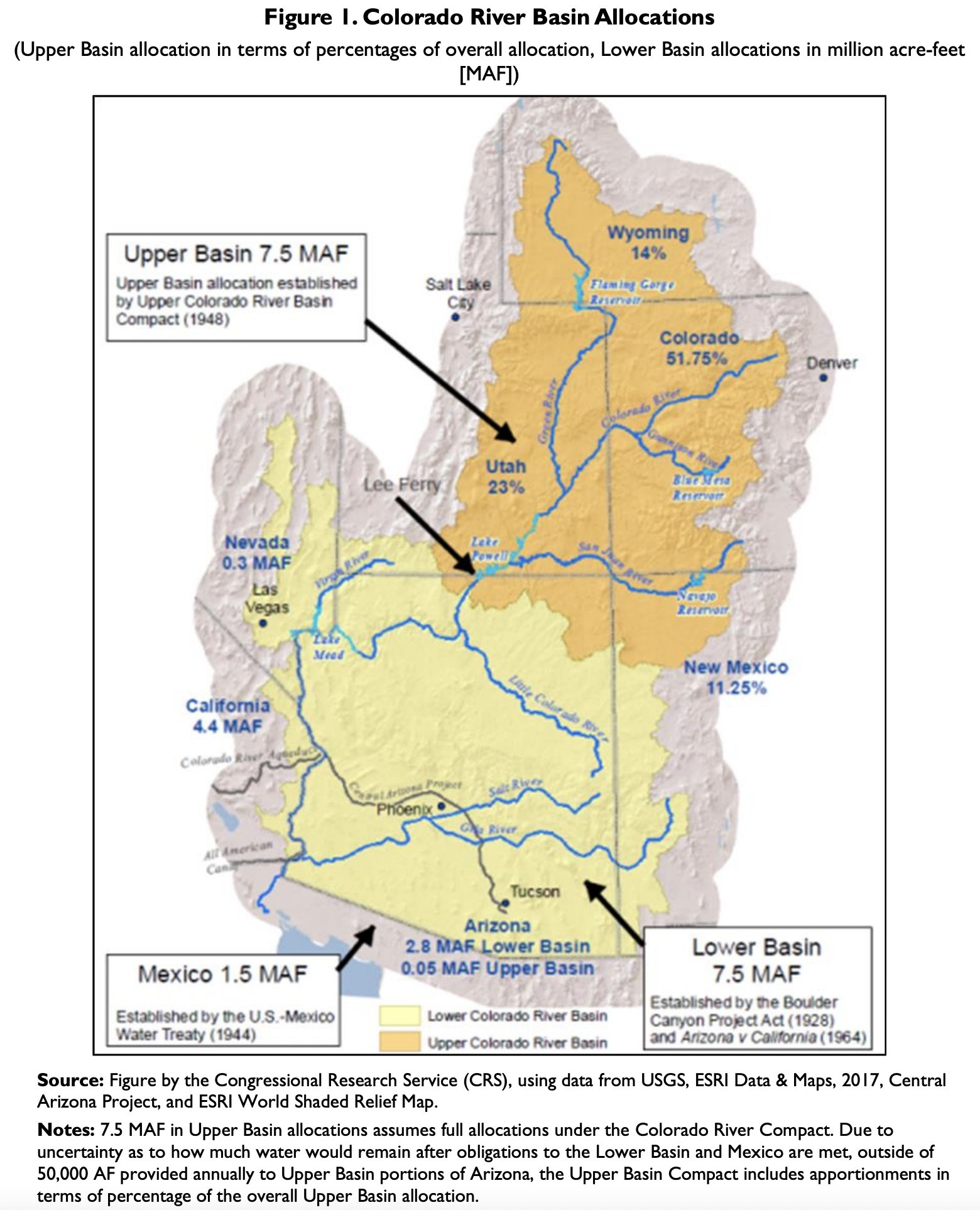
Map of the Colorado River drainage basin, created using USGS data. By Shannon1 Creative Commons Attribution-Share Alike 4.0
(Pictured: Director Gregor MacGregor with Student Deputy Directors Ellen Beckert, Cameron Abatti, Mary Slosson, Jackson Dunivan, and Oliver Skelly. Not Pictured: Student Deputy Director Grace Jimenez.)
“It is an incredible honor to accept the award on behalf of the hundreds of students, dozens of supervising attorneys, and many community partners who have advanced environmental justice for Colorado’s acequias over the past decade,” remarked Gregor MacGregor, faculty fellow at the University of Colorado Law School and director of the Acequia Assistance Project. “My special thanks to Professor Sarah Krakoff, Peter Nichols ’01, and Sarah Parmar for launching the Project. A further thank-you to alumnus Don Brown ’89 and the University’s Outreach Office, whose generous funding allows us to support Colorado’s acequias and the professional growth of our students. And finally, my sincerest gratitude goes out to the acequia members who continue to invite us to work and learn in their beautiful community. The Deputy Directors and I are honored to continue the Project’s work on behalf of our community partners and students. Thank you.”
The Acequia Assistance Project is an environmental justice program at the University of Colorado Law School that provides pro bono legal services to southern Colorado’s Hispanic agricultural community. For the last ten years, law students, faculty, and pro bono attorneys have helped these irrigation ditches, acequias, to realize their water rights after the Acequia Recognition Act remedied 120 years of exclusion from Colorado’s water law regime.
Photo credit: Colorado Law
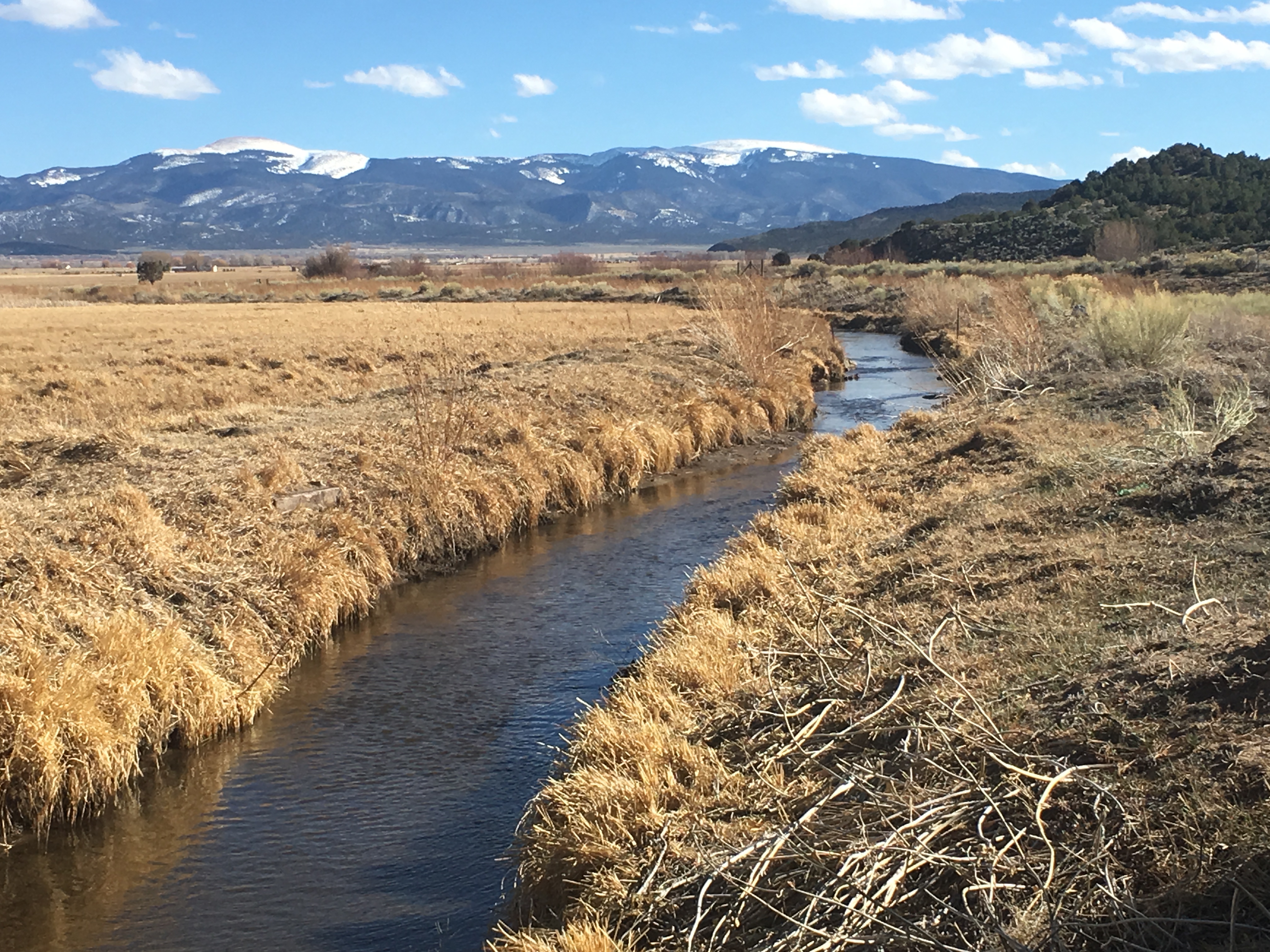
Acequia is an Arabic word that means “water bearer.” An acequia is a physical irrigation system but the term “acequia” in northern New Mexico and southern Colorado also describes a philosophy about water and community– that water is so essential to life that it is a communal resource, one which must be shared. Acequias are found along the southernmost part of Colorado – including four of the state’s poorest counties: Costilla, Conejos, Huerfano, and Las Animas. While water is wealth throughout the arid West, to the small-scale farmer in these traditional communities the acequia culture represents even more: Acequias are how you support your family and how you participate in your community.
Founded as a passion project by Professor Sarah Krakoff, Colorado Law alumnus water attorney Peter Nichols ‘01, and Colorado Open Lands’ Sarah Parmar, the Project provides Hispanic farmers with a full suite of legal services related to their water rights, including: representation in Colorado’s Water Courts; researching legal issues pertinent to the community as a whole; title research; bylaws drafting and amending; mediation; incorporation; water rights historic use collection; and drafting water rights purchase and sale agreements.
For the 2021-2022 school year, the Project included 42 students, 5 pro bono attorneys, and 15 cases. In 2019, the last full year pre-COVID, the Project provided nearly $300,000 of legal services with an operating budget of only $8,000 from the University’s Outreach funding. Funding covers the costs of student travel, filing fees, and other incidental costs. All attorney and student participation is entirely voluntary.
“I could not be more proud to see the Acequia Project’s many years of dedicated efforts recognized in such a profound way,” commented dean of the law school Lolita Buckner Inniss. “The students, alumni, faculty, and community partners’ dedication to promoting these communities’ access to the courts and effective management of resources is inspiring. Its role in instilling a commitment to environmental justice in hundreds of Colorado’s best and brightest future attorneys is truly invaluable.”
On December 15th, 2022, the Senate voted to pass the National Defense Authorization Act in which the Water Resources Development Act of 2022 (WRDA 2022) is included. It was passed by a vote of 83-11. Last week, the House passed the bill on December 8th with an overwhelming majority of 350-80. It will now go to President Biden’s desk for signing into law.
This is the largest Water Resources Development Act (WRDA) in history and comes in at a time when our nation needs it most. The bill provides authorization for the Army Corps of Engineers to carry out water resources infrastructure projects to address flooding, waterway transportation, and ecosystem restoration. Importantly, this bill includes provisions to support Tribal and underserved communities, and address climate change.
American Rivers has worked with Congress to include provisions to protect and restore our nation’s rivers and floodplains. Below are some of the key provisions that we are most excited about.
Sections8111. Tribal Partnership Program; 8112. Tribal Liaison; 8113. Tribal Assistance; 8114. Cost sharing provisions for the territories and Indian Tribes; and 8115. Tribal and Economically Disadvantaged Communities Advisory Committee are valuable provisions. We support these efforts to improve outreach to, and engagement with, these communities and give them a seat at the table. We are also pleased to see the initiative to build out the Corps of Engineers workforce through outreach in schools, colleges, and universities with a prioritization of recruiting from economically disadvantaged communities. We believe these steps will serve both the Corps and the communities well.
With climate change impacting the nation, promoting nature-based approaches on a project and watershed level scale is imperative to adapt to increasing floods and water scarcity. WRDA 2022 includes several provisions that will help promote the use of nature-based approaches and better serve and protect our communities while promoting ecosystem resilience through more responsible levee management and floodplain restoration.
Section8103 – Shoreline and riverbank protection and restoration mission calls for restoring the natural functions and values of rivers and shorelines throughout the United States. Section 8121– Assessment of Corps of Engineers levees, will assess for opportunities for modification of levees, including for restoring connections with adjacent floodplains. American Rivers also worked to include language for the Corps to identify floodplain reconnection opportunities on federal lands. While this provision was not included in the final bill, we will work with the Corps to support sections 8103 and 8121, while continuing to work on getting additional federal levees assessed.
General currents upstream and downstream from a low-head dam. Graphic via Bruce a. Tschantz
American Rivers worked diligently with our partners at American Whitewater and the Theodore Roosevelt Conservation Partnership to include section8122- National Low-Head Dam Inventory. This inventory will contribute significantly to public safety as low-head dams are known public safety hazards, and yet not inventoried nationally, and making this information publicly available will help river users identify life-threatening low-head dams. We also hope that this inventory will help the public identify obsolete structures that continue to pose a safety hazard and would be suitable for removal. In areas where dam removal is not an option, we support additional funding to go towards grants for signage and public education about low-head dams
Section 8123– Expediting hydropower at Corps of Engineers facilities, allows for retrofitting Corps dams with hydropower. We support this provision with the understanding that the structures in question are already serving their legislatively authorized purpose and will continue to do so for the foreseeable future. Recognizing that retrofitting a non-powered Corps dam with hydropower is not always feasible, we will continue to advocate for the diligent assessment of these projects and their use to determine if they would better serve the taxpayers, community, and local ecosystem by being disposed of instead of extending their life solely for non-power purposes.
Wetlands, which are havens of biodiversity, offer priceless ecological benefits. As wetlands are lost to development nationwide, critics of the dam project worry about its local impact.
(Photo Credit: John Fielder via Writers on the Range)
The consideration of reforestation in section 8137is an exciting and forward-thinking provision that encourages measures to restore swamps and other wetland forests in studies for water resources development projects. This is another important step towards focusing on ecosystem restoration. The benefits of flood control and water quality improvements that come from healthy swamps and wetlands are incalculable.
There are several provisions related to river restoration and protection and better river management, including section 8144 – Chattahoochee River Program, section 8145 – Lower Mississippi River Basin demonstration program, andsection 8219 – Hydraulic evaluation of Upper Mississippi River and Illinois River. The Chattahoochee River program will provide assistance to non-federal interests for water-related resource protection and restoration projects affecting the Chattahoochee River Basin. The Lower Mississippi program will provide assistance to non-federal interests for projects focused on flood or coastal storm risk management or aquatic ecosystem restoration. The hydraulic evaluation of the Upper Mississippi River and Illinois River basins will provide studies on the flows for rivers in the upper basin, which we hope will contribute to more effective management and restoration plans.
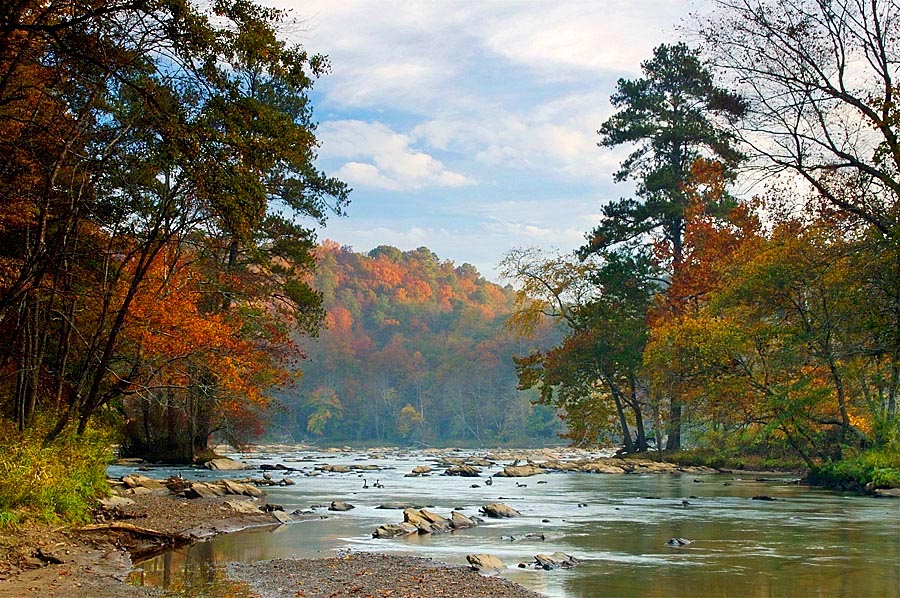
Chattahoochee River in Georgia. Photo credit: The Department of Interior
The Government Accountability Office (GAO) studies authorized in section 8236 are encouraging, especially the review of mitigation projects and the evaluation of their performance. These studies will require a report on the results of projects and activities to mitigate fish and wildlife losses that occurred as a result of a water resources development project. Within this section, we also support the study on the integration of information into the national levee database as this information is essential to the management and improvement of our nation’s levees.
We are pleased to see section 8140 – Policy and technical standards directing the Secretary to update the agency standards. With this update, the Corps will have to include climate change and nature-based solutions in their practices. We look forward to the report on the Corps of Engineers reservoirs under section 8153 so that Congress may further evaluate the operation, utility, and future of these reservoirs.
Overall, we applaud the safety and environmental provisions in this bill and the passing of this paramount piece of legislation to protect our natural and engineered water infrastructure and the people that rely on it.
Section by section summary can be found here and the full WRDA bill can be found here.
This blog was written by Katie Schmidt. Jaime Sigaran, Ted Illston, Brian Graber, and Eileen Shader
Creating a balance of water that’s taken from aquifers and water that replenishes aquifers is an important aspect of making sure water will be available when it’s needed.
Image from “Getting down to facts: A Visual Guide to Water in the Pinal Active Management Area,” courtesy of Ashley Hullinger and the University of Arizona Water Resources Research Center
Click the link to read the guest column on The New York Times website (Natalie Koch). Here’s an excerpt:
Arizona’s water is running worryingly low. Amid the worst drought in more than a millennium, which has left communities across the state with barren wells, the state is depleting what remains of its precious groundwater. Much of it goes to private companies nearly free, including Saudi Arabia’s largest dairy company.
Thanks to fresh scrutiny this year from state politicians, water activists and journalists, the Saudi agricultural giant Almarai has emerged as an unlikely antagonist in the water crisis. The company, through its subsidiary Fondomonte, has been buying and leasing land across western Arizona since 2014. This year The Arizona Republic published a report showing that the Arizona State Land Department has been leasing 3,500 acres of public land to Almarai for a suspiciously low price. The case has prompted calls for an investigation into how a foreign company wound up taking the state’s dwindling water supplies for a fee that might be as low as one-sixth the market rate.But the focus on the Saudi scheme obscures a more fundamental problem: pumping groundwater in Arizona remains largely unregulated. It’s this legal failing that, in part, allows the Saudi company to draw unlimited amounts of water to grow an alfalfa crop that feeds dairy cows 8,000 miles away. Even if Fondomonte leaves the state, it will be only a matter of time before Arizona sucks its aquifers dry. While a 1980 state law regulates groundwater use in a handful of urban areas, water overuse is common even in these places. The situation is worse in the roughly 80 percent of Arizona’s territory that falls outside these regulations. In most of rural Arizona, whoever has the money to drill a well can continue to pump till the very last drop…
Many more agricultural operations are drawing down the state’s underground water reserves for free. And most of them are U.S.-owned. Minnesota’s Riverview Dairy company, for example, has a farm near Sunizona, Ariz., that has drained so much of the aquifer that local residents have seen their wells dry up. Meanwhile, some California-based farms, facing tougher groundwater regulations at home, are looking to relocate to neighboring Arizona for cheap water. These companies and other megafarms can afford to drill deep wells, chasing the rapidly sinking water table.
And it’s not just farming operations. Other sectors like mining and the military, which have a huge presence in the state, also benefit from Arizona’s lax water laws. It’s difficult to know how much water is being used up by one of the state’s largest employers, Raytheon Missiles and Defense, which, like Almarai, has a footprint in Arizona and Saudi Arabia. But manufacturing missiles has a water cost, too. And like Fondomonte’s alfalfa, Raytheon’s product is being shipped to Saudi Arabia.
The Saudi farm scandal may have helped to spotlight the severity of Arizona’s water crisis, but the state will have to go further to address the root cause. Arizona needs to apply groundwater pumping regulations across the entire state, not just in its metropolitan areas. It won’t be easy. This year special interest groups scuttled a far more modest effort that would have allowed rural communities to opt in to groundwater enforcement. In all likelihood, when these groups have to pay fair prices for water, they will have to give up on growing water-hungry crops like alfalfa in the desert. This kind of race-to-the-bottom approach to water in Arizona is insupportable today, if it ever was.
Click the link to read the white paper on the Family Farm Alliance website (Dan Keppen and Mike Wade). Here’s an excerpt:
Alfalfa is often the target of journalists and some critics of irrigated agriculture who frequently rely upon simplistic explanations to heap scorn upon growing a forage crop in the West, particularly in times of drought. The attack on alfalfa has intensified in the wake of U.S. Bureau of Reclamation Commissioner Camille Touton’s June 14, 2022 appearance before a Senate committee, where she called on water users across the Colorado River Basin to take actions to prevent Lake Powell and Lake Mead from falling to critically low elevations that would threaten water deliveries and power production.
When the states failed to meet the mid-August deadline set by Commissioner Touton for them to propose 15% to 30% cuts to their water use, critics of irrigated agriculture ramped up their focus on the perceived easy “fix” to the complicated challenges facing the Colorado River: stop growing crops that they believe use lots of water….like alfalfa.
The “shot across the bow” against alfalfa production was fired by the witness who testified immediately after Commissioner Touton at the June 14th Senate hearing. The general manager of the Southern Nevada Water Authority (SNWA), whose member agencies serve more than 2.2 million residents in Southern Nevada, summarized the impressive urban efforts to reduce per-capita water use and further suggested that farmers reconsider growing crops like alfalfa. The solution, he said, is working toward “a degree of demand management previously considered unattainable.”
He also noted that SNWA is planning to serve a population that will swell to 3.8 million by 2072.
In August, SNWA followed up with a strongly worded letter to the Biden administration, demanding action on several fronts, including creating “beneficial use criteria for Lower Basin water users, eliminating wasteful and antiquated water use practices and uses of water no longer appropriate for this Basin’s limited resources”.
In the following weeks, a steady stream of media coverage, including a 1,600-word essay in High Country News, have carried a similar message: Growing less hay is the only way to keep the Colorado River’s water system from collapsing.
Some journalists love going after crops that use lots of water. Almond growers in California’s Central Valley were subjected to a merciless multi-year “one almond uses one gallon of water” campaign during the last “unprecedented” drought that hit the Golden State in the last decade.
Guess what? Years later, Central Valley farmers still grow them because consumers around the globe love almonds and consume them in mass quantities for their great taste and dense nutritional punch.
Simplistic examinations of alfalfa in terms of water demand vs. supply must be enhanced and balanced with discussion of productivity, economic return, food production, and the environment to be truly productive. A former Imperial Irrigation District (IID) board member once said that the definition of a low-value crop is one that’s grown with the water someone else wants.
On behalf of the California Farm Water Coalition and the Family Farm Alliance, we offer this brief bit of continuing education to help you understand the rest of the story about alfalfa production in the Colorado River Basin and other parts of the American West.
Alfalfa 101: The Rest of the Story
The alfalfa sales pitch is a good one, because there’s such a good story behind it. That’s not just a load of hay you see rumbling by on Western highways during summer months. Those hay bales form the foundation of rural agriculture in many Western rural communities. Alfalfa is not only a food source for livestock, it also has important environmental attributes.
Importantly, alfalfa actually has a key role to play in the water-uncertain future of the West due to its high flexibility during times of insufficient or excess water.
Why Do We Grow Alfalfa Today?
Most people understand that Western farmers grow alfalfa as livestock feed for the beef industry. Many people also overlook the fact that alfalfa is the major food source for dairy cows. Dairy cows provide dairy products, another important part of a balanced diet.
Alfalfa hay is essentially dried alfalfa. It is normally cut at a relatively mature stage of growth and left to dry out completely. As a result, the moisture content of hay is very low, but during the drying process some nutrients can be lost.
Alfalfa haylage is alfalfa that has been cut earlier and at a younger stage of growth than hay and left to wilt for a shorter period of time in the field before being baled and wrapped in several layers of plastic or chopped and ensiled.
The difference between haylage and hay is that, while the conservation of hay relies on the removal of moisture, the conservation of haylage relies on the exclusion of oxygen which prevents mold growth.
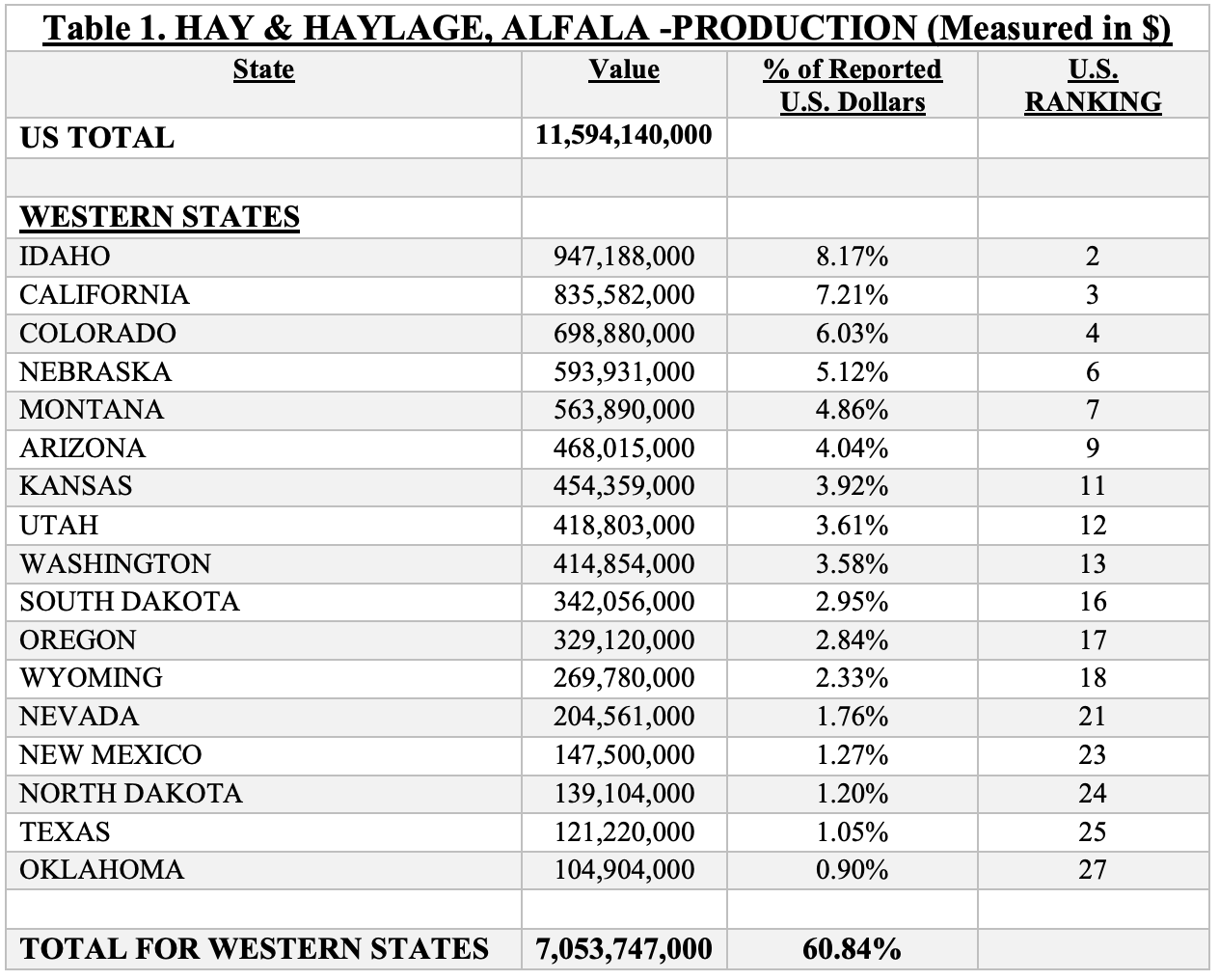
Tables 1 and 2 (below) summarizes hay and haylage in terms of production and value, respectively, for Western states. Not shown is Wisconsin, the number one producer of alfalfa in the country at over 6.9 billion tons (or 16.4 % of the national total) of dry alfalfa hay and haylage. In terms of dollars, the Badger State generated over $1.2 billion in 2021, or 10.4 % of all the nation’s alfalfa production value. (Source: USDA National Agricultural Statistics Service Information).
As you can see from this table, nearly 61% of all the alfalfa production value in the nation derives from Reclamation states. Behind Wisconsin, Idaho is the number two producer of alfalfa in the country. Idaho hay is known for its high-protein content, and is marketable for dairy and horse operations around the world. Idaho’s high elevations and arid climate create ideal drying conditions. Major alfalfa seed companies have facilities in Idaho and develop superior genetics tailored to Idaho’s climate.
California – the third ranking producer of alfalfa in the country – also happens to be the No. 1 dairy state in the nation. California dairies generate 41.8 billion pounds of milk (18.5% of U.S. 2021 total output) from 1.7 million dairy cows. Of that total milk production, 46 percent is used to generate 2.5 billion pounds of cheese. California also leads the nation in the production of butter (534 million pounds), ice cream (528 million pounds), and yogurt (442 million pounds).
Alfalfa is considered to be the “secret ingredient” for the dairy industry; it is essential for higher milk production. Given its protein, calcium and fiber content, alfalfa is universally considered one of the highest-quality forages available for livestock.
Alfalfa also allows dairy producers to blend other crop by-products into their daily feed mix. – things like almond hulls, grape pomace and rice straw -that would otherwise not be utilized. Modern feeding practices now balance multiple feed sources to meet the nutritional needs of dairy cows. As the demand has risen for milk and other dairy products, such as yogurt, cheese, and ice cream, the amount of alfalfa required to meet those needs has remained relatively steady.
Western farmers also grow alfalfa as a seed crop to sell to other farmers around the world. When alfalfa is grown for seed, it flowers. Those alfalfa flowers attract bees and bees produce honey. How sweet it is! More honey is made from alfalfa than any other crop…
Benefits of Alfalfa
Alfalfa fields are the beginning of a food chain for a host of wildlife. The fields attract insects, which attract songbirds. Alfalfa fields also entice gophers, ground squirrels, and other rodents who make their homes there because alfalfa fields are not plowed under each year. All this activity draws the attention of nature’s hunters and predators such as hawks, raptors and foxes looking for prey. Studies have shown several endangered and threatened species use alfalfa habitats. Alfalfa fields are host to beneficial insects that help control harmful pests.
Large wild mammals like deer and elk are drawn to alfalfa for the same reasons dairy cows do. Although they can be annoying to farmers and ranchers at times, deer and elk herds are common sights in rural alfalfa fields in many parts of the West.
Alfalfa promotes healthy soil. It has an extensive root structure that creates channels in the soil and secretes organic acids, which contribute to an improved crumbly soil structure called tilth. Both of these benefits help other types of crops planted later in the same field.
By growing alfalfa as a rotation crop, farmers reduce the need for chemical fertilizers in subsequent crops. Alfalfa is an excellent source of nitrogen, which is an important soil nutrient. Being a legume, alfalfa extracts and “fixes” nitrogen into the soil from the air. For many Western farmers and ranchers, it is the only economic legume crop that can be produced, which makes it a very valuable part of a crop rotation. Not only does alfalfa break pest cycles, it also builds up the soil nutrient levels. This keeps soil sustainable and makes it suitable for organic crop production after the alfalfa is harvested.
Alfalfa roots also protect the soil from erosion in several ways. Since alfalfa fields are not plowed as often as fields growing other crops, the extensive roots hold the soil in place, and the plants provide a canopy that prevents rain from loosening the soil.
That was Executive Director Julie Chacon early Friday with the news she had been hoping and waiting for out of Washington, D.C. Congress through its last-minute maneuvering adopted the reauthorization of the Sangre de Cristo Heritage Area and two other national heritage areas in Colorado.
Julie Chacon, SdCNHA executive director
“I’m beyond ecstatic that we have been reauthorized for another 15 years. We still have so much that we want to do in our national heritage area. We want the world to learn our history, cultures, and traditions in our little corner,” Chacon said.
Chacon had watched other national heritage areas in the country go through a congressional reauthorization process in past years. She knew the road would be winding and there would be peaks and valleys once the Sangre de Cristo Heritage Area, Cache La Poudre National Heritage Area, and South Park National Heritage Area all came due for reauthorization and began pressing their case in 2022 through a bill sponsored by Colorado’s two U.S. senators, Michael Bennet and John Hickenlooper.
What she wasn’t prepared for were the last days of the congressional session and the ups and downs as Congress moved specific legislative items in and out of the $1.7 trillion funding bill that became the focus in the final days of 2022.
The Sangre de Cristo National Heritage Area encompasses 3,000 square miles in Alamosa County, Conejos County, and Costilla County, with 11,000 years of documented human habitation. It is among 55 congresionally designated national heritage areas in the U.S., governed through nonprofit boards. | SdCNHA map
ITH support from the lobbying efforts of The Alliance of National Heritage Areas and good old-fashioned letter writing and phone calling to congressional members, the U.S. House followed up on what the U.S. Senate sent over and signed off Thursday evening on the heritage area’s reauthorization.
Listen HERE to SdCNHA Board member, writer and Valley historian Herman Martinez on The Valley Pod.
“I am extremely proud to be a part of the ANHA! It’s definitely been a roller-coaster ride!!!,” Chacon emailed.
“We received tons of letters, emails, and calls of support from our elected officials, partners, and locals to submit to Congress.”
The legislation funds Colorado’s three national heritage areas through September 2036, provided of course that Congress finds a way each year to adopt a federal budget. It was this congressional session’s roller coaster ride of adopting an omnibus bill that gave Chacon and others who were following the reauthorization process a taste of how the wheels of federal bureaucracy turn.
“For months, the bill was being sent back and forth between the House and Senate with markups and amendments. Tons of strategic meetings and calls were taking place,” Chacon said in describing the experience. “We kept getting tabled to the next session. After Thanksgiving, our bill had still not passed, and we knew it had to be approved by the end of December, or we would have to start all over. It was now or never!”
Now won, and the Sangre de Cristo National Heritage Area – the birthplace of Colorado – can continue to showcase its story.
Researchers in Colorado State University’s Department of Atmospheric Science have developed a tool for predicting heavy rainfall that is now used daily by the Weather Prediction Center, part of the National Weather Service.
Example CSU-MLP forecast, for the extreme rainfall associated with the remnants of Hurricane Ida in the mid-Atlantic states in September 2021. The left panel shows the forecast probability of excessive rainfall, available on the morning of August 31, over a day in advance of the event. The forecast includes a “high risk” (probability exceeding 50%) for an area from Maryland through Pennsylvania, New Jersey and New York. The right panel shows the resulting observations of excessive rainfall (including flash flood reports and rainfall totals exceeding specified thresholds). The CSU-MLP correctly highlighted the corridor where widespread heavy rain and flooding would occur.
By working with the Weather Prediction Center over the past several years, Associate Professor Russ Schumacher and his group were able to tailor the tool to suit forecasters’ needs.
A concept-to-operations success story
Excessive rainfall is difficult to forecast, and Weather Prediction Center forecasters needed a tool to help them generate Excessive Rainfall Outlooks, which are issued for the contiguous United States one to three days in advance. These outlooks predict the probability for rainfall that may lead to flash flooding, so they are important for alerting people in harm’s way.
WPC forecasters examine many different data sources in creating Excessive Rainfall Outlooks, and the number of data sources have multiplied in recent decades. Given the tight turnaround, WPC meteorologists were interested in a tool that could synthesize at least some of the data and give them a reasonable starting point.
Enter machine learning plus atmospheric science Ph.D. student Greg Herman, whose undergraduate background included computer science and meteorology. Computers are good at quickly filtering huge datasets into a comprehensible output, and Herman and Schumacher harnessed that strength for the Colorado State University Machine Learning Probabilities system.
“The CSU-MLP prediction system provided the first such forecast, and represents the first machine-learning tool incorporated into WPC’s operations,” said Mark Klein, the Weather Prediction Center’s Science and Operations Officer. “Its forecasts have proven very skillful when compared to observations, and thus it has become a critical tool for our meteorologists.”
NOAA’s reforecasts, retrospective forecasts run with today’s improved numerical models, made it possible for Herman and Schumacher to train their machine-learning model using a consistent dataset. The CSU-MLP algorithm searches historical data from the reforecasts and rainfall record for conditions similar to the current weather forecast. It is able to quickly determine whether those conditions led to heavy rain.
The machine-learning model calculates the probability for heavy rain across the entire U.S., and it has adapted over time based on regional differences.
Herman and Schumacher first presented the tool to a testbed, the annual Flash Flood and Intense Rainfall experiment, in 2017. Based on user feedback from the testbed and WPC forecasters, they fine-tuned the model until it was ready for operations in late 2019. Schumacher’s group continued to work with forecasters to make improvements and released an update in 2020.
“Transitioning research work to operations at NWS is difficult; this project is one of few success stories,” Klein said. “Russ’ group has proven to be one of the best collaborators in academia that WPC has worked with.”
The forecast model is intended to make forecasters’ jobs easier by giving them a starting point to build on with their expertise and meteorological knowledge of the area.
“I’m really proud of the work my group and our partners at WPC have done on this,” said Schumacher, who is also Colorado’s state climatologist and director of the Colorado Climate Center. “It’s really satisfying to see a project go from the research idea all the way to the end product that you know somebody’s looking at every day.”
How much rain is ‘excessive’?
One challenge to forecasting excessive rain is defining what that means for a given area. A few inches of rain can be a bigger deal in Colorado than Louisiana, for example.
Forecasters go by how unusual the amount is for that area and whether it will cause flooding, which is also difficult to predict because terrain is an important factor. The same amount of rain will impact a burn scar very differently than a field.
Professor Russ Schumacher and his research group developed a tool for predicting heavy rainfall that is used daily by the Weather Prediction Center.
“We’ve used average recurrence intervals as our definition of excessive rain,” Schumacher said. “Does this amount of rain typically occur at this particular location once a year, twice a year, and so on. That helps to identify how unusual the rainfall is for that area.”
Schumacher’s group has adjusted the threshold for excessive rain to make their model more accurate for specific areas, but there’s still no consensus on what constitutes excessive rain.
“The heavier the rain is, the more difficult it is to forecast in general,” he said.
With a warmer climate expected to bring more heavy rain because warmer air can hold more water vapor, the CSU-MLP tool will be useful in predicting the extreme flooding that will follow.
Schumacher’s group, including research scientist Aaron Hill, recently received funding to work on extending the CSU-MLP system’s forecast range to four to eight days. They also are collaborating with the Storm Prediction Center to apply the CSU-MLP system to other types of hazardous weather, including tornadoes, hail and damaging winds.
Development of the CSU-MLP system was funded by NOAA’s Joint Technology Transfer Initiative. Schumacher and his colleagues wrote about this model and collaboration in the paper, “From Random Forests to Flood Forecasts: A Research to Operations Success Story,” published in the Bulletin of the AMS. Herman graduated from CSU with his Ph.D. in 2018 and now works as a research scientist for Amazon.com.
Known for its breathtaking scenery, the Dominguez-Escalante National Conservation Area is a fine example of the spectacular canyon country of Colorado’s Uncompahgre Plateau. Red-rock canyons and sandstone bluffs hold geological and paleontological resources spanning 600 million years, as well as many cultural and historic sites. The Ute Tribes today consider these pinyon-juniper–covered lands an important connection to their ancestral past. The Escalante, Cottonwood, Little Dominguez and Big Dominguez Creeks cascade through sandstone canyon walls that drain the eastern Uncompahgre Plateau. Unaweep Canyon on the northern boundary of the NCA contains globally significant geological resources. Nearly 30 miles (48 km) of the Gunnison River flow through the Dominguez-Escalante NCA, supporting fish, wildlife and recreational resources. The Old Spanish National Historic Trail, a 19th Century land trade route, also passes through it. A variety of wildlife call the area home, including desert bighorn sheep, mule deer, golden eagle, turkey, elk, mountain lion, black bear, and the collared lizard. There are 115 miles (185 km) of streams and rivers in the NCA, and there is habitat suitable for 52 protected species of animals and plants. By Bob Wick; Bureau of Land Management – Dominguez-Escalante NCA, Public Domain, https://commons.wikimedia.org/w/index.php?curid=42092807
by Abrahm Lustgarten
ProPublica is a Pulitzer Prize-winning investigative newsroom. Sign up for The Big Story newsletter to receive stories like this one in your inbox.
On a crisp day this fall I drove southeast from Grand Junction, Colorado, into the Uncompahgre Valley, a rich basin of row crops and hayfields. A snow line hung like a bowl cut around the upper cliffs of the Grand Mesa, while in the valley some farmers were taking their last deliveries of water, sowing winter wheat and onions. I turned south at the farm town of Delta onto Route 348, a shoulder-less two-lane road lined with irrigation ditches and dent corn still hanging crisp on their browned stalks. The road crossed the Uncompahgre River, and it was thin, nearly dry.
The Uncompahgre Valley, stretching 34 miles from Delta through the town of Montrose, is, and always has been, an arid place. Most of the water comes from the Gunnison River, a major tributary of the Colorado, which courses out of the peaks of the Elk Range through the cavernous and sun-starved depths of the Black Canyon, one rocky and inaccessible valley to the east. In 1903, the federal government backed a plan hatched by Uncompahgre farmers to breach the ridge with an enormous tunnel and then in the 1960s to build one of Colorado’s largest reservoirs above the Black Canyon called Blue Mesa. Now that tunnel feeds a neural system of water: 782 miles worth of successively smaller canals and then dirt ditches, laterals and drains that turn 83,000 Western Colorado acres into farmland. Today, the farm association in this valley is one of the largest single users of Colorado River water outside of California.
I came to this place because the Colorado River system is in a state of collapse. It is a collapse hastened by climate change but also a crisis of management. In 1922, the seven states in the river basin signed a compact splitting the Colorado equally between its upper and lower halves; later, they promised additional water to Mexico, too. Near the middle, they put Lake Powell, a reserve for the northern states, and Lake Mead, a storage node for the south. Over time, as an overheating environment has collided with overuse, the lower half — primarily Arizona and California — has taken its water as if everything were normal, straining both the logic and the legal interpretations of the compact. They have also drawn extra releases from Lake Powell, effectively borrowing straight out of whatever meager reserves the Upper Basin has managed to save there.
This much has become a matter of great, vitriolic dispute. What is undeniable is that the river flows as a much-diminished version of its historical might. When the original compact gave each half the rights to 7.5 million acre-feet of water, the river is estimated to have flowed with as much as 18 million acre-feet each year. Over the 20th century, it averaged closer to 15. Over the past two decades, the flow has dropped to a little more than 12. In recent years, it has trickled at times with as little as 8.5. All the while the Lower Basin deliveries have remained roughly the same. And those reservoirs? They are fast becoming obsolete. Now the states must finally face the consequential question of which regions will make their sacrifice first. There are few places that reveal how difficult it will be to arrive at an answer than the Western Slope of Colorado.
In Montrose, I found the manager of the Uncompahgre Valley Water Users Association, Steve Pope, in his office atop the squeaky stairs of the same Foursquare that the group had built at the turn of the last century. Pope, bald, with a trimmed white beard, sat amid stacks of plat maps and paper diagrams of the canals, surrounded by LCD screens with spreadsheets marking volumes of water and their destinations. On the wall, a historic map showed the farms, wedged between the Uncompahgre River and where it joins the Gunnison in Delta, before descending to their confluence with the Colorado in Grand Junction. “I’m sorry for the mess,” he said, plowing loose papers aside.
Colorado Rivers. Credit: Geology.com
What Pope wanted to impress upon me most despite the enormousness of the infrastructure all around the valley was that in the Upper Basin of the Colorado River system, there are no mammoth dams that can simply be opened to meter out a steady release of water. Here, only natural precipitation and temperature dictate how much is available. Conservation isn’t a management decision, he said. It was forced upon them by the hydrological conditions of the moment. The average amount of water flowing in the system has dropped by nearly 20%. The snowpack melts and evaporates faster than it used to, and the rainfall is unpredictable. In fact, the Colorado River District, an influential water conservancy for the western part of the state, had described its negotiating position with the Lower Basin states by claiming Colorado has already conserved about 28% of its water by making do with the recent conditions brought by drought.
You get what you get, Pope tells me, and for 15 of the past 20 years, unlike the farmers in California and Arizona, the people in this valley have gotten less than what they are due. “We don’t have that luxury of just making a phone call and having water show up,” he said, not veiling his contempt for the Lower Basin states’ reliance on lakes Mead and Powell. “We’ve not been insulated from this climate change by having a big reservoir above our heads.”
He didn’t have to point further back than the previous winter. In 2021, the rain and snow fell heavily across the Rocky Mountains and the plateau of the Grand Mesa, almost as if it were normal times. Precipitation was 80% of average — not bad in the midst of an epochal drought. But little made it into the Colorado River. Instead, soils parched by the lack of rain and rising temperatures soaked up every ounce of moisture. By the time water reached the rivers around Montrose and then the gauges above Lake Powell, the flow was less than 30% of normal. The Upper Basin states used just 3.5 million acre-feet last year, less than half their legal right under the 1922 compact. The Lower Basin states took nearly their full amount, 7 million acre-feet.
Colorado River Basin Plumbing. Credit: Lester Doré/Mary Moran via Dustin Mulvaney and Twitter
All of this matters now not just because the river, an unwieldy network of human-controlled plumbing, is approaching a threshold where it could become inoperable, but because much of the recent legal basis for the system is about to dissolve. In 2026, the Interim Guidelines the states rely on, a Drought Contingency Plan and agreements with Mexico will all expire. At the very least, this will require new agreements. It also demands a new way of thinking that matches the reality of the heating climate and the scale of human need. But before that can happen, the states will need to restore something that has become even more scarce than the water: trust.
The northern states see California and Arizona reveling in profligate use, made possible by the anachronistic rules of the compact that effectively promise them water when others have none. It’s enabled by the mechanistic controls at the Hoover Dam, which releases the same steady flow no matter how little snow falls across the Rocky Mountains. California flood-irrigates alfalfa crops destined for cattle markets in the Middle East, while Arizona takes water it does not need and pumps it underground to build up its own reserves. In 2018, an Arizona water agency admitted it was gaming the timing of its orders to avoid rations from the river (though it characterized the moves as smart use of the rules). In 2021, in a sign of the growing wariness, at least one Colorado water official alleged California was repeating the scheme. California water officials say this is a misunderstanding. Yet to this day, because California holds the most senior legal rights on the river, the state has avoided having a single gallon of reductions imposed on it.
Updated Colorado River 4-Panel plot thru Water Year 2022 showing reservoirs, flows, temperatures and precipitation. All trends are in the wrong direction. Since original 2017 plot, conditions have deteriorated significantly. Brad Udall via Twitter: https://twitter.com/bradudall/status/1593316262041436160
By this spring, Lake Powell shrank to 24% of its capacity, its lowest levels since the reservoir filled in the 1960s. Cathedral-like sandstone canyons were resurrected, and sunlight reached the silt-clogged floors for the first time in generations. The Glen Canyon Dam itself towered more than 150 feet above the waterline. The water was just a few dozen feet above the last intake pipe that feeds the hydropower generators. If it dropped much lower, the system would no longer be able to produce the power it distributes across six states. After that, it would approach the point where no water at all could flow into the Grand Canyon and further downstream. All the savings that the Upper Basin states had banked there were as good as gone.
In Western Colorado, meanwhile, people have been suffering. South of the Uncompahgre Valley, the Ute Mountain Ute tribe subsists off agriculture, but over the past 12 months it has seen its water deliveries cut by 90%; the tribe laid off half of its farmworkers. McPhee Reservoir, near the town of Cortez, has teetered on failure, and other communities in Southwestern Colorado that also depend on it have been rationed to 10% of their normal water.
Across the Upper Basin, the small reservoirs that provide the region’s only buffer against bad years are also emptying out. Flaming Gorge, on the Wyoming-Utah border, is the largest, and it is 68% full. The second largest, Navajo Reservoir in New Mexico, is at 50% of its capacity. Blue Mesa Reservoir, on the Gunnison, is just 34% full. Each represents savings accounts that have been slowly pilfered to supplement Lake Powell as it declines, preserving the federal government’s ability to generate power there and obscuring the scope of the losses. Last summer, facing the latest emergency at the Glen Canyon Dam, the Department of Interior ordered huge releases from Flaming Gorge, Blue Mesa and other Upper Basin reservoirs. At Blue Mesa, the water levels dropped 8 feet in a matter of days, and boaters there were given a little more than a week to get their equipment off the water. Soon after, the reservoir’s marinas, which are vital to that part of Colorado’s summer economy, closed. They did not reopen in 2022.
South Canal. Photo credit: Delta-Montrose Electric Association via The Mountain Town News
As the Blue Mesa Reservoir was being emptied last fall, Steve Pope kept the Gunnison Tunnel open at its full capacity, diverting as much water as he possibly could. He says this was legal, well within his water rights and normal practice, and the state’s chief engineer agrees. Pope’s water is accounted for out of another reservoir higher in the system. But in the twin takings, it’s hard not to see the bare-knuckled competition between urgent needs. Over the past few years, as water has become scarcer and conservation more important, Uncompahgre Valley water diversions from the Gunnison River have remained steady and at times even increased. The growing season has gotten longer and the alternative sources, including the Uncompahgre River, less reliable. And Pope leans more than ever on the Gunnison to maintain his 3,500 shareholders’ supply. “Oh, we are taking it,” he told me, “and there’s still just not enough.”
On June 14, Camille Touton, the commissioner of the U.S. Bureau of Reclamation, the Department of Interior division that runs Western water infrastructure, testified before the Senate Committee on Energy and Natural Resources and delivered a stunning ultimatum: Western states had 60 days to figure out how to conserve as much as 4 million acre-feet of “additional” water from the Colorado River or the federal government would, acting unilaterally, do it for them. The West’s system of water rights, which guarantees the greatest amount of water to the settlers who arrived in the West and claimed it first, has been a sacrosanct pillar of law and states’ rights both — and so her statement came as a shock.
Would the department impose restrictions “without regard to river priority?” Mark Kelly,, the Democratic senator from Arizona, asked her.
“Yes,” Touton responded.
For Colorado, this was tantamount to a declaration of war. “The feds have no ability to restrict our state decree and privately owned ditches,” the general manager of the Colorado River District, Andy Mueller, told me. “They can’t go after that.” Mueller watches over much of the state.Pope faces different stakes. His system depends on the tunnel, a federal project, and his water rights are technically leased from the Bureau of Reclamation, too. Touton’s threat raised the possibility that she could shut the Uncompahgre Valley’s water off. Even if it was legal, the demands seemed fundamentally unfair to Pope. “The first steps need to come in the Lower Basin,” he insisted.
Each state retreated to its corners, where they remain. The 60-day deadline came and went, with no commitments toward any specific reductions in water use and no consequences. The Bureau of Reclamation has since set a new deadline: Jan. 31. Touton, who has publicly said little since her testimony to Congress, declined to be interviewed for this story. In October, California finally offered a plan to surrender roughly 9% of the water it used, albeit with expensive conditions. Some Colorado officials dismissed the gesture as a non-starter. Ever since, Colorado has become more defiant, enacting policies that seem aimed at defending the water the state already has — perhaps even its right to use more.
For one, Colorado has long had to contend with the inefficiencies that come with a “use it or lose it” culture. State water law threatens to confiscate water rights that don’t get utilized, so landowners have long maximized the water they put on their fields just to prove up their long-term standing in the system. This same reflexive instinct is now evident among policymakers and water managers across the state, as they seek to establish the baseline for where negotiated cuts might begin. Would cuts be imposed by the federal government based on Pope’s full allocation of water or on the lesser amount with which he’s been forced to make do? Would the proportion be adjusted down in a year with no snow? “We don’t have a starting point,” he told me. And so the higher the use now, the more affordable the conservation later.
Colorado and other Upper Basin states have also long hid behind the complexity of accurately accounting for their water among infinite tributaries and interconnected soils. [ed. emphasis mine] The state’s ranchers like to say their water is recycled five times over, because water poured over fields in one place invariably seeps underground down to the next. In the Uncompahgre Valley, it can take months for the land at its tail to dry out after ditches that flood the head of the valley are turned off. The measure of what’s been consumed and what has transpired from plants or been absorbed by soils is frustratingly elusive. That, too, leaves the final number open to argument and interpretation.
All the while, the Upper Basin states are all attempting to store more water within their boundaries. Colorado has at least 10 new dams and reservoirs either being built or planned. Across the Upper Basin, an additional 15 projects are being considered, including Utah’s audacious $2.4 billion plan to run a new pipeline from Lake Powell, which would allow it to transport something closer to its full legal right to Colorado River water to its growing southern cities. Some of these projects are aimed at securing existing water and making its timing more predictable. But they are also part of the Upper Colorado River Commission’s vision to expand the Upper Basin states’ Colorado River usage to 5.4 million acre-feet a year by 2060.
It is fair to say few people in the state are trying hard to send more of their water downstream. In our conversation, Mueller would not offer any specific conservation savings Colorado might make. The state’s chief engineer and director of its Division of Water Resources, Kevin Rein, who oversees water rights, made a similar sentiment clear to the Colorado River District board last July. “There’s nothing telling me that I should encourage people to conserve,” Rein said. “It’s a public resource. It’s a property right. It’s part of our economy.”
In November, Democratic Gov. Jared Polis proposed the creation of a new state task force that would help him capture every drop of water it can before it crosses the state line. It would direct money and staff to make Colorado’s water governance more sophisticated, defensive and influential.
I called Polis’ chief water confidante, Rebecca Mitchell, who is also the director of the Colorado Water Conservation Board and the state’s representative on the Upper Colorado River Commission. If the mood was set by the idea that California was taking too much from the river, Mitchell thought that it had shifted now to a more personal grievance — they are taking from us.
On a day in late May [2022] when wildfire smoke obscured the throat of an ancient volcano called Shiprock in the distance, I visited the Ute Mountain Ute farming and ranching operation in the southwestern corner of Colorado. Photo credit: Allen Best/Big Pivots
Last month, Mitchell flew to California for a tour of its large irrigation districts. She stood beside a wide canal brimming with more water than ever flows through the Uncompahgre River, and the executive of the farming company beside her explained that he uses whatever he wants because he holds the highest priority rights to the water. She thought about the Ute Mountain Ute communities and the ranchers of Cortez: “It was like: ‘Wouldn’t we love to be able to count on something? Wouldn’t we love to be feel so entitled that no matter what, we get what we get?’” she told me.
What if Touton followed through, curtailing Colorado’s water? I asked. Mitchell’s voice steadied, and then she essentially leveled a threat. “We would be very responsive. I’m not saying that in a positive way,” she said. “I think everybody that’s about to go through pain wants others to feel pain also.”
Here’s the terrible truth: There is no such thing as a return to normal on the Colorado River, or to anything that resembles the volumes of water its users are accustomed to taking from it. With each degree Celsius of warming to come, modelers estimate that the river’s flow will decrease further, by an additional 9%. At current rates of global warming, the basin is likely to sustain at least an additional 18% drop in its water supplies over the next several decades, if not far more. Pain, as Mitchell puts it, is inevitable.
The thing about 4 million acre-feet of cuts is that it’s merely the amount already gone, an adjustment that should have been made 20 years ago. Colorado’s argument makes sense on paper and perhaps through the lens of fairness. But the motivation behind the decades of delay was to protect against the very argument that is unfolding now — that the reductions should be split equally, and that they may one day be imposed against the Upper Basin’s will. It was to preserve the northern states’ inalienable birthright to growth, the promise made to them 100 years ago. At some point, though, circumstances change, and a century-old promise, unfulfilled, might no longer be worth much at all. Meanwhile, the politics of holding out are colliding with climate change in a terrifying crash, because while the parties fight, the supply continues to dwindle.
Average combined storage assuming drought conditions continue
Average end-of-year combined Lake Powell and Lake Mead storage is shown, assuming hydrologic conditions of the Millennium Drought continue. Results show combined reservoir contents using a range of Upper Basin consumptive use limits (colored ribbons) along with a range of Lower Basin maximum consumptive use reductions (line styles) triggered when the combined storage falls below 15 million acre-feet (MAF). The status quo lines use the 2016 Upper Colorado River Commission (UCRC) projections and existing elevation-based shortage triggers. All water use and shortage values are annual volumes (MAF/year).
Recently, Brad Udall, a leading and longtime analyst of the Colorado River and now a senior water and climate scientist at Colorado State University, teamed with colleagues to game out what they thought it would take to bring the river and the twin reservoirs of Mead and Powell into balance. Their findings, published in July in the journal Science, show that stability could be within reach but will require sacrifice.
If the Upper Basin states limited their claim to 4 million acre-feet, or 53% of their due under the original compact, and the Lower Basin states and Mexico increased their maximum emergency cuts by an additional 45%, the two big reservoirs will stay at roughly their current levels for the next several decades. If the basins could commit to massive reductions below even 2021 levels for the Upper Basin and to more than doubling the most ambitious conservation goals for the south, the reservoirs could once again begin to grow, providing the emergency buffer and the promise of economic stability for 40 million Americans that was originally intended. Still, by 2060, they would only be approximately 45% full.
Any of the scenarios involve cuts that would slice to the bone. Plus, there’s still the enormous challenge of how to incorporate Native tribes, which also hold huge water rights but continue to be largely left out of negotiations. What to do next? Israel provides one compelling example. After decades of fighting over the meager trickles of the Jordan River and the oversubscription of a pipeline from the Sea of Galilee, Israel went back to the drawing board on its irrigated crops. It made drip irrigation standard, built desalination plants to supply water for its industry and cities, and reused that water again and again; today, 86% of the country’s municipal wastewater is recycled, and Israel and its farmers have an adequate supply. That would cost a lot across the scale and reach of a region like the Western United States. But to save the infrastructure and culture that produces 80% of this country’s winter vegetables and is a hub of the nation’s food system for 333 million people? It might be worth it.
A different course was charted by Australia, which recoiled against a devastating millennium drought that ended 13 years ago. It jettisoned its coveted system of water rights, breaking free of history and prior appropriation similar to the system of first-come-first-served the American West relies on. That left it with a large pool of free water and political room to invent a new method of allocating it that better matched the needs in a modern, more populous and more urban Australia and better matched the reality of the environment.
In America, too, prior appropriation, as legally and culturally revered as it is, may have become more cumbersome and obstructive than it needs to be. Western water rights, according to Newsha Ajami, a leading expert at Lawrence Berkeley National Laboratory and the former director of the urban water policy program at Stanford University, were set up by people measuring with sticks and buckets, long before anyone had ever even considered climate change. Today, they largely serve powerful legacy interests and, because they must be used to be maintained, tend to dissuade conservation. “It’s kind of very archaic,” she said. “The water rights system would be the first thing I would just dismantle or revisit in a very different way.”
This is probably not going to happen, Ajami said. “It could be seen as political suicide.” But that doesn’t make it the wrong solution. In fact, what’s best for the Colorado, for the Western United States, for the whole country might be a combination of what Israel and Australia mapped out. Deploy the full extent of the technology that is available to eliminate waste and maximize efficiency. Prioritize which crops and uses are “beneficial” in a way that attaches the true value of the resource to the societal benefit produced from using it. Grow California and Arizona’s crops in the wintertime but not in the summer heat. And rewrite the system of water allocation as equitably as possible so that it ensures the modern population of the West has the resources it needs while the nation’s growers produce what they can.
What would that look like in Colorado? It might turn the system upside down. Lawsuits could fly. The biggest, wealthiest ranches with the oldest water rights stand to lose a lot. The Lower and Upper Basin states, though, could all divide the water in the river proportionately, each taking a percentage of what flowed. The users would, if not benefit, at least equally and predictably share the misery. Pope’s irrigation district and the smallholder farmers who depend on it would likely get something closer to what they need and, combined with new irrigation equipment subsidized by the government, could produce what they want. It wouldn’t be pretty. But something there would survive.
The alternative is worse. The water goes away or gets bought up or both. The land of Western Colorado dries up, and the economies around it shrivel. Montrose, with little left to offer, boards up its windows, consolidates its schools as people move away, and the few who remain have less. Until one day, there is nothing left at all.
‘Colorado River “Beginnings”. Photo: Brent Gardner-Smith/Aspen Journalism
Reclamation’s Ernie Rheaume talks about the Federally recognized Tribes in the Colorado River Basin and how Tribal engagement and consultation are on the forefront of Reclamation’s activities.
Click the link to read the article on the KUNC website (Rae Solomon). Here’s an excerpt:
“The yields are off,” [Ruben] Richardson explained. “We’re a little bit short of water. This soil – you have to water a bunch every day to maintain it.” He had to use a lot more water in his fields than usual this year, just to produce any crop under drought conditions. That water was delivered by 58 center pivot sprinklers, across Richardson’s fields of irrigated corn and sugar beets. The sprinklers were fed, in turn, by 45 high-capacity wells pumping groundwater out of the Ogallala Aquifer, far below the ground…
Ogallala Aquifer. Credit: Big Pivots
Picture a bathtub. But this bathtub has a very rocky, jagged bottom. When you pour in the water, the tub doesn’t fill evenly. Instead, it forms pools of different sizes within the crags and pits of that rocky floor. Now imagine that bathtub is huge: 175,000 square miles huge. It stretches across 8 stations, from South Dakota all the way down to Texas, including parts of eastern Colorado. Also, the whole thing is deep underground. That is the Ogallala Aquifer. A vast, but uneven reserve of freshwater stored under the earth. The people who live on top of the aquifer pump it out of the ground. More than 90 percent of Ogallala water is used for agriculture, and that water transformed the high plains dust bowl of eastern Colorado into highly productive farmland.
But according to Meagan Schipanski, an associate professor at Colorado State University and Co-Director of the Ogallala Water Coordinated Agriculture Project, the aquifer has its limits. The water has been over-allocated for decades. The current drought is exacerbating the shortage. “That water is a nonrenewable resource,” Schipanski said, “we’re going to use it faster than it can recharge itself.”
The hydrology and terrain of the aquifer is highly variable, making it difficult to generalize about just how much water has been depleted. But across northeastern Colorado, on average the aquifer is down about 30% from where it started before groundwater irrigation became widespread in the mid 20th-century.
Click the link to read the article on the NOAA website (BREANNA ZAVADOFF AND MARYBETH ARCODIA):
This is a guest post by Breanna Zavadoff and Marybeth Arcodia. Dr. Zavadoff is an Assistant Scientist at the University of Miami Cooperative Institute for Marine and Atmospheric Studies. Her current research focuses on U.S. West Coast atmospheric rivers as well as subseasonal Madden-Julian Oscillation predictability. Dr. Arcodia is a Postdoctoral Researcher at Colorado State University working in the Barnes Group. Her current research explores sources of climate predictability from subseasonal to decadal timescales using explainable artificial intelligence techniques. She also writes for the Seasoned Chaos blog, a subseasonal to seasonal forecasting blog for scientists and non-scientists alike. The blog was created by five graduate students and features posts on atmospheric and climate phenomena described in fun and digestible ways (some linked in this post), including quality graphics and even some code!
When looking at the forecast on your favorite weather app, it may be hard to imagine that forecast could be connected to atmospheric and ocean conditions all the way across the globe. Fortunately for us, these connections can allow us to make predictions weeks to months in advance. How is this possible?
Buckle up! It’s time to go for a ride on our planet’s information superhighway.
When the jet stream interacts with an atmospheric Rossby wave, it develops crests and troughs that create alternating high (red) and low (blue) pressure zones in the upper atmosphere. These connected climate patterns—teleconnections—travel along the jet stream like vehicles on a globe-spanning highway. NOAA Climate.gov image.
What is a teleconnection?
Teleconnections are significant relationships or links between weather phenomena at widely separated locations on earth, which typically entail climate patterns that span thousands of miles. Many teleconnection patterns behave like a seesaw, with atmospheric mass/pressure shifting back and forth between two distant locations—an increase in, say, atmospheric pressure in one location results in a decrease in pressure somewhere far, far away [1]. There is even evidence of Viking settlers noticing the opposing pressure patterns between Greenland and Europe dating back to ~1000 AD, which today is referred to as the North Atlantic Oscillation (NAO) [2,3].
Late winter temperatures compared to the 1981-2010 average when the North Atlantic Oscillation (NAO) was strongly negative (top, Jan-March 2010) and when it was strongly positive (bottom, January-March 1990). Winters are often cooler than average across the mid-latitudes when the NAO is negative, and warmer than average when it is positive. NOAA Climate.gov image, based on data from the Physical Sciences Lab.
If you’re thinking to yourself that you’ve seen this teleconnection business before, you are absolutely right! One of the most famous drivers of teleconnection patterns is our good buddy ENSO (perhaps we are a little biased) a.k.a the El Niño/Southern Oscillation. The “Southern Oscillation” refers to changes in sea-level pressures that are centered over the eastern tropical Pacific and over Indonesia (learn more here and here). Followed closely in notoriety is the Pacific-North American pattern, an oscillatory pressure pattern over the Pacific Ocean and North America, which influences North American and European temperature and precipitation.
Difference from average sea level pressure during winters when the Southern Oscillation Index is strongly positive (top) or negative (bottom). During La Niña (positive SOI), the pressure is higher than average (red) over the central Pacific near Tahiti, and lower than average (gray) over Australia. During El Niño, the SOI is negative, and the anomalies are reversed. NOAA Climate.gov image, based on data from the NOAA Physical Science Lab.
Rossby waves: the original global delivery service
How do these teleconnections relate to weather patterns around the globe? Let’s move into high gear on atmospheric dynamics! Don’t worry, we won’t throw equations at you. Foundational to teleconnection patterns are large-scale atmospheric waves, specifically Rossby waves, named after the world-renowned meteorologist Carl-Gustaf Rossby. Rossby waves can persist from days to months and can vary from a few hundred miles long to spanning the entire planet! We’re calling the routes that Rossby waves travel “information superhighways,” as the waves carry information that can affect weather along their paths.
What exactly is this information that Rossby waves carry? When you see a wave traveling along the surface of water, there are peaks and troughs in the water height. The same happens in the atmosphere with a traveling Rossby wave – as the Rossby wave travels through the atmosphere, the peaks and troughs of the wave produce regions of high and low air pressure. These resultant pressure patterns, i.e. the “information” carried by Rossby waves, influence temperature, rainfall, wind, etc. In short, Rossby waves are fundamental to teleconnection patterns! (footnote 1)
When a Rossby wave perturbs the Northern Hemisphere mid-latitude jet stream, warmer, high-pressure air is transported poleward into the wave crests, and cooler, lower-pressure air is transported equatorward into the troughs. The jet stream becomes a waveguide, steering the oscillation of the Rossby wave. NOAA Climate.gov image.
Where do they come from? Where do they go?
Rossby waves differ a bit from the large waves we are used to seeing in the ocean, which move up and down (vertically). Instead, Rossby waves in the atmosphere travel in the north-south direction (horizontally) due to the Earth rotating faster at the equator than at the poles. This leads to the Coriolis force, which causes moving air parcels to turn to the right as they move away from the equator toward the North Pole, where the effect (i.e., apparent deflection) of the Coriolis force is stronger. These rightward deflections turn the air back towards the equator, then the air is once again redirected back towards the poles as we move higher in latitude (footnote 2). This balancing act of air moving towards the poles and back towards the equator results in the development of an oscillating wave, which is how many planetary Rossby waves are formed (footnote 3).
Atmospheric Rossby waves (footnote 4) exist on time scales from just days to months and can be triggered by air flowing over Earth’s complex geography, like mountain ranges, as well as circulation patterns that arise due to unequal temperature heating (the equator gets more sunlight than the poles). Large regions of towering showers and thunderstorms near the equator, which are related to phenomena like ENSO and the MJO can also be responsible for revving the engine (i.e. triggering) of Rossby waves [4, 5] by disrupting the atmosphere via the heating that occurs when water vapor condenses into clouds. This heating causes rippling waves to form—much like dropping a stone in a lake.
Rossby waves are often rerouted and carried along by the jet streams, which are often considered as “waveguides” for Rossby waves. In other words, the jet streams set up the routes for the Rossby waves to flow through, similar to how a carved path in the sand is where water tends to flow. Whisked along by the jet streams, Rossby waves transport heat and momentum from the tropics toward the poles (south-to-north) and polar air towards the tropics (north-to-south). Thus, the location, strength, and even waviness of the jet stream dictates a substantial portion of the mid-latitude weather, including whether or not Arctic air will be dipping down into your neighborhood.
Rossby waves can be either stationary or transient. While stationary Rossby waves simply undulate over a region, meaning the peaks and troughs of the wave do not change location (like the standing wave in this previous ENSO blog post), transient Rossby waves traverse the globe, traveling west-to-east over thousands of miles. Scientists and forecasters study both types of Rossby waves due to their wide-ranging impacts and use them to predict where and how the weather may change anywhere from a few days to a few months in the future.
Signed, sealed, delivered
When transporting goods from one place to another, one could argue the transport isn’t complete until everything has been unloaded from the vehicle. In other words, it’s not enough to simply get from point A to point B. The same goes for the Rossby waves traveling along our global information superhighway. While all Rossby waves carry important information, some deposit larger signals along their shipping routes than others through a phenomenon called “Rossby wave breaking”. When Rossby waves break (imagine an ocean wave breaking on the beach or a towel folding) information is exchanged from the Rossby waves to the rest of the atmosphere through both the vertical and horizontal mixing of air parcels [6,7], completing the information transfer journey that began thousands of miles away.
The oscillation of the Rossby wave can become so exaggerated that the wave breaks. Embedded air masses spin out of the jet stream: clockwise from ridges (in the Northern Hemisphere) and counterclockwise from the troughs. The breaking waves “hand off” the information they were carrying to the local atmosphere. NOAA Climate.gov image.
The information transfer facilitated by Rossby wave breaking has been associated with a multitude of phenomena around the globe. In the midlatitudes, breaking Rossby waves have been shown to modulate the phase of the North Atlantic Oscillation, the location of landfalling atmospheric rivers along the western coastlines of the United States and Europe [8,9,10,11] and the onset/dissipation of atmospheric blocking events [12,13,14]. When Rossby waves break more frequently closer to the equator they can also create an unfavorable environment for tropical convection [15,16,17], which serves to induce dry spell episodes in the Indian summer monsoon [18] and reduce the number of tropical cyclones that develop in the North Atlantic [19,20].
The frequency and location of Rossby wave breaking is primarily controlled by the jet stream [21,22], A.K.A. the backbone of the global information superhighway. The jet stream, in turn, is modulated by climate patterns of variability that exist on subseasonal (Madden-Julian Oscillation; [23,24], interannual (El-Nino Southern Oscillation; [25,26]) and multi-decadal (Pacific decadal oscillation, Atlantic multi-decadal oscillation; [27,28,29]) timescales. Each of these climate patterns can alter the infrastructure of our information superhighway by causing roadblocks, forcing detours, and/or building new routes. This means that, depending on the phases of the different climate patterns, Rossby waves that enter our information superhighway at the same on-ramp could end up with completely different MapQuest directions (remember those!?), travel times, and final destinations!
Last Stop!
In the atmospheric science community, Rossby waves are considered to be some of the most fundamental and important components of our weather and climate systems. Guided along by the jet stream, these Rossby waves serve as the foundation for teleconnection patterns, which provide a pathway for information (like temperature and pressure) to be transferred to and affect weather patterns in places thousands of miles away. Rossby waves are the vehicles that travel along our global information superhighway that keep our climate system fully connected and in constant communication. Thank you for traveling with us, we hope you enjoyed the ride!
Lead editors: Tom DiLiberto and Nat Johnson.
Footnotes
1) For those more math-inclined folks, Rossby waves can be derived from the non-divergent barotropic vorticity equation which describes conservation of absolute vorticity. By further applying assumptions and getting into some nitty-gritty algebra, we can also derive properties of Rossby waves, such as the dispersion relation (how waves relate to each other), phase speed (speed at which waves propagate), and group velocity (velocity of the wave packet). [30, 31]
2) Rossby waves specifically form from the conservation of potential vorticity. As fluids move from the equator towards the poles and are influenced by the Coriolis force, the conservation of potential vorticity acts as a restorative force to maintain the north-south direction of the oscillating wave. (Vallis, Geoffrey K. Atmospheric and oceanic fluid dynamics. Cambridge University Press, 2017.)
3) To better understand how Rossby waves are formed, let’s follow a parcel of air through the following thought experiment. The deflection of air can be thought of as a source of “spin” or rotation of a parcel of air and a parcel of air has to conserve its “total spin” (the Earth’s spin + the atmosphere’s relative spin). Think of a parcel of air that is pushed northward (in the Northern Hemisphere). The parcel moves into an area where the Coriolis force (i.e., the earth’s contribution to the spin) is larger. Because the parcel conserves its spin, its relative spin has to decrease or move in the opposite direction of the Earth’s spin. That corresponds to a clockwise rotation, which pushes the air that was originally displaced northward back to the south. When that air overshoots its original position, it then has to start spinning clockwise to conserve total spin, pushing the air back northward. And thus, the basic Rossby wave is formed.
4) Rossby waves don’t just exist in the atmosphere though, they also can form in the ocean! Oceanic Rossby waves are massive undulations of water traveling horizontally across ocean basins, usually taking months or years to cross. Interestingly, oceanic Rossby waves displace surface water on the order of inches, but water deep below the surface (~200ft down) undulates on the order of feet!
References
[1] Barnston, A. G., and R. E. Livezey, 1987: Classification, seasonality and persistence of low-frequency atmospheric circulation patterns. Mon. Wea. Rev., 115, 1083-1126.
[2] Van Loon, Harry, and Jeffery C. Rogers. “The seesaw in winter temperatures between Greenland and northern Europe. Part I: General description.” Monthly Weather Review 106.3 (1978): 296-310.
[3] Stephenson, David B., et al. “The history of scientific research on the North Atlantic Oscillation.” Geophysical monograph-American Geophysical Union 134 (2003): 37-50.
[4] Hoskins, Brian J., and David J. Karoly. “The steady linear response of a spherical atmosphere to thermal and orographic forcing.” Journal of the atmospheric sciences 38.6 (1981): 1179-1196.
[5] Arcodia, Marybeth C., Ben P. Kirtman, and Leo SP Siqueira. “How MJO teleconnections and ENSO interference impacts US precipitation.” Journal of Climate 33.11 (2020): 4621-4640.
[6] Scott, R., and J. Cammas, 2002: Wave breaking and mixing at the subtropical tropopause. J. Atmos. Sci., 59 (15), 2347-2361.
[7] Holton, J. R., P. H. Haynes, M. E. McIntyre, A. R. Douglass, R. B. Rood, and L. Pfister, 1995: Stratosphere-troposphere exchange. Rev. Geophys., 33 (4), 403-439.
[8] Payne, A. E., and G. Magnusdottir, 2014: Dynamics of landfalling atmospheric riversover the North Pacific in 30 years of MERRA reanalysis. J. Climate, 27 (18), 7133-7150.
[9] Zavadoff, B. L., and B. P. Kirtman, 2020: Dynamic and Thermodynamic Modulatorsof European Atmospheric Rivers. J. Climate, 33 (10), 4167-4185.
[10] Mundhenk, B. D., E. A. Barnes, E. D. Maloney, and K. M. Nardi, 2016: Modulationof atmospheric rivers near Alaska and the USWest Coast by northeast Pacific height anomalies. J. Geophys. Res. Atmos., 121 (21), 12751-12765.
[11] Hu, H., F. Dominguez, Z. Wang, D. A. Lavers, G. Zhang, and F. M. Ralph, 2017: Linking Atmospheric River Hydrological Impacts on the US West Coast to Rossby Wave Breaking. J. Climate, 30 (9), 3381-3399.
[12] Nakamura, H., 1994: Rotational evolution of potential vorticity associated with a strong blocking flow configuration over Europe. Geophys. Res. Lett., 21 (18), 2003-2006.
[13] Masato, G., B. Hoskins, and T. J. Woollings, 2012: Wave-breaking characteristics of midlatitude blocking. Quart. J. Roy. Meteor. Soc., 138 (666), 1285-1296.
[14] Tyrlis, E., and B. Hoskins, 2008: The morphology of Northern Hemisphere blocking. J. Atmos. Sci., 65 (5), 1653-1665.
[15] Knippertz, P., 2007: Tropical-extratropical interactions related to upper-level troughs at low latitudes. Dyn. Atmos. Oceans, 43 (1-2), 36-62.
[16] Kiladis, G. N., and K. M. Weickmann, 1992: Extratropical forcing of tropical Pacific convection during northern winter. Mon. Wea. Rev., 120 (9), 1924-1939.
[17] Allen, G., G. Vaughan, D. Brunner, P. T May, W. Heyes, P. Minnis, and J. K Ayers, 2009: Modulation of tropical convection by breaking Rossby waves. Quart. J. Roy. Meteor. Soc., 135 (638), 125-137.
[18] Samanta, D., M. Dash, B. Goswami, and P. Pandey, 2016: Extratropical anticyclonic Rossby wave breaking and Indian summer monsoon failure. Clim. Dyn., 46 (5-6),1547-1562.
[19] Zhang, G., Z. Wang, T. J. Dunkerton, M. S. Peng, and G. Magnusdottir, 2016: Extratropical impacts on Atlantic tropical cyclone activity. J. Atmos. Sci., 73 (3),1401-1418.Zhang, G., Z. Wang, M. S. Peng, and G. Magnusdottir, 2017: Characteristics and Impacts of Extratropical Rossby Wave Breaking during the Atlantic Hurricane Season. J. Climate, 30 (7), 2363-2379.
[20] Zhang, G., Z. Wang, T. J. Dunkerton, M. S. Peng, and G. Magnusdottir, 2016: Extratropical impacts on Atlantic tropical cyclone activity. J. Atmos. Sci., 73 (3),1401-1418.Zhang, G., Z. Wang, M. S. Peng, and G. Magnusdottir, 2017: Characteristics and Impacts of Extratropical Rossby Wave Breaking during the Atlantic Hurricane Season. J. Climate, 30 (7), 2363-2379.
[21] Thorncroft, C., B. Hoskins, and M. McIntyre, 1993: Two paradigms of baroclinic wavelife-cycle behaviour. Quart. J. Roy. Meteor. Soc., 119 (509), 17-55.
[22] Peters, D., and D. W. Waugh, 1996: Influence of barotropic shear on the poleward advection of upper-tropospheric air. J. Atmos. Sci., 53 (21), 3013-3031.
[23] MacRitchie, K., and P. Roundy, 2016: The two-way relationship between the Madden-Julian oscillation and anticyclonic wave breaking. Quart. J. Roy. Meteor.Soc., 142 (698), 2159-2167.
[24] Moore, R. W., O. Martius, and T. Spengler, 2010: The modulation of the subtropicaland extratropical atmosphere in the Pacific basin in response to the Madden-Julian oscillation. Mon. Wea. Rev., 138 (7), 2761-2779.
[25] Martius, O., C. Schwierz, and H. Davies, 2007: Breaking waves at the tropopausein the wintertime Northern Hemisphere: Climatological analyses of the orientation and the theoretical LC1/2 classification. J. Atmos. Sci., 64 (7), 2576-2592.
[26] Ryoo, J.-M., Y. Kaspi, D. W. Waugh, G. N. Kiladis, D. E. Waliser, E. J. Fetzer, andJ. Kim, 2013: Impact of Rossby wave breaking on US west coast winter precipitation during ENSO events. J. Climate, 26 (17), 6360-6382.
[27] Kwon, Y.-O., H. Seo, C. C. Ummenhofer, and T. M. Joyce, 2020: Impact of Multidecadal Variability in Atlantic SST on Winter Atmospheric Blocking. J. Climate,33 (3), 867-892.
[28] Zavadoff, B. L., and B. P. Kirtman, 2019: North Atlantic summertime anticyclonic Rossby wave breaking: Climatology, impacts, and connections to the Pacific Decadal Oscillation. J. Climate, 32 (2), 485-500.
[29] Zavadoff, B. L., and B. P. Kirtman, 2020: The Pacific Decadal Oscillation as a modulator of summertime North Atlantic Rossby wave breaking. Clim. Dyn., 56, 207-225.
[30] Vallis, G. K., 2006. Atmospheric and Oceanic Fluid Dynamics. Cambridge University Press, 745 pp.)
Interior celebrates the 200th anniversary of diplomatic relations between 🇲🇽 and 🇺🇸 at @CRWUA_water to honor the crucial role of the U.S. International Boundary Waters Commission and Comisión Internacional de Límites y Aguas entre México y Estados Unidos – Sección Mexicana in ensuring the equitable and sustainable use of the Colorado River for the benefit of us all. Photo credit: Tanya Trujillo’s Twitter Feed
Click the link to read the article on the KUNC website (Alex Hager). Here’s an excerpt:
The most powerful policymakers in the arid Southwest spent three days in Las Vegas, reviewing the grim state of a river that supplies 40 million people from Wyoming to Mexico. Federal and state authorities emphasized the need for collaboration to avert catastrophe, but have been reticent to make sacrifices during negotiations over plans that would reduce demand for water. This year marked the 76th meeting of the Colorado River Water Users Association and the event’s first ever sold-out attendance. Journalists, scientists, farmers and city officials packed the conference center at Caesar’s Palace to watch water managers hash out the river’s future in the public eye.
“There’s no substitute for being face-to-face,” said John Entsminger, general manager of the Southern Nevada Water Authority, which supplies Las Vegas. “It’s a lot easier to talk a little smack, call some people some names, when you’re not looking them in the eye.” […]
The current guidelines for the river are set to expire in 2026, and states are largely focused on coming up with new ones before that deadline. A century-old agreement governs how water is allocated across the arid Southwest, Meanwhile, some experts suggest that agreement, the Colorado River Compact, should be replaced to meet the modern demands of a region with sprawling fields of crops and booming urban populations.
“I think there is some heavy optimism that hopefully everyone will come to something that we can all agree on,” said Becky Mitchell, director of the Colorado Water Conservation Board, the state’s top water policy agency. “But it is going to take real cuts to everyone.”
Updated Colorado River 4-Panel plot thru Water Year 2022 showing reservoirs, flows, temperatures and precipitation. All trends are in the wrong direction. Since original 2017 plot, conditions have deteriorated significantly. Brad Udall via Twitter: https://twitter.com/bradudall/status/1593316262041436160
Click the link to read the article on the Bloomberg Law website (Bobby Magill). Here’s an excerpt:
“We are trying to be part of the decision-makers and what’s happening,” said Manuel Heart, chairman of Colorado’s Ute Mountain Ute Tribe, speaking Thursday at the conference. “We, too, have needs.” […]
Manuel Heart at the Colorado River Water Users Association Conference December 2022. Photo credit: Peter Mayer via his Twitter feed.
But as water in the Colorado River diminishes, nobody knows yet how much of it belongs to the the Navajo Nation and other regional tribes, since their water rights have never been quantified. There already isn’t enough water for all the Colorado River Basin’s 40 million people, and tribes could be entitled to as much as 25% of it, according to the multistate, multitribe Water & Tribes Initiative.
“It would be difficult to overstate the importance of tribal water rights as a wild card. They’re very significant,” Jason Robison, a law professor at the University of Wyoming who is affiliated with the Water and Tribes Initiative, said before the conference…
Heather Tanana, a law professor at the University of Utah who is Navajo, said tribes’ lack of resources to tap Colorado River water for their residents has had devastating public health consequences.
As many as 40% of Navajo residents don’t have access to running water and have to haul it to their homes, which created a public health crisis on the Navajo Reservation during the Covid-19 pandemic, she said.
“If their water rights had been settled and quantified, and actually delivered, then hundreds—thousands—of lives would be saved during the pandemic,” Tanana said. “It’s a life or death matter connected to public health.”
The need for tribal water rights agreements is urgent because tribes need to be able to use the water they’re entitled to and the states need to know how much water they can use as the West dries up, Weiner said.
Derek Heckman, who farms near Lamar in eastern Colorado, is implementing various soil health practices to build the organic matter of his soil, improve water retention, and stretch limited water supplies farther. Credit Allen Best
This simple statistic may shock you: Each time a farmer plows his or her field, the soil loses three-quarters of an inch of moisture.
The solutions? They’re more complicated and part of new and expanding soil health programs that seek to help farmers explore how to retain water, improve fertility, and create greater resilience to buffer weather extremes.
Now, with the aid of $25 million in new federal funding, the Colorado Department of Agriculture plans to expand a program called STAR — an acronym for Saving Tomorrow’s Agricultural Resources — from 124 producers, including both farmers and ranchers, to 450. The conduit has been through 16 of the state’s 74 conservation districts, along with three organizations representing corn, sugar beet, and other crop growers. The funding comes through the U.S. Department of Agriculture’s Partnerships for Climate-Smart Commodities Project.
It’s a “game changer,” says Jim Pritchett, an agriculture economist at Colorado State University who grew up on a farm in southeastern Colorado.
“In my career and my childhood in Colorado, I’ve never seen this much direct investment at the producer level,” Pritchett said in September when the grant was announced.
The expanded program, called STAR Plus, will allow Colorado to assist six other Western states in implementing soil health practices and advancing learning. The states are Idaho, Montana, New Mexico, Utah, Wyoming and Washington. CSU, with a $6 million share of that grant, will be the focal point for quantification, verification and other research.
State officials say that fostering techniques to improve soils, making them more sponge-like, can help Colorado improve water quality and use existing water more efficiently. Agriculture continues to account for more than 80% of Colorado’s water use.
For example, healthier soils can absorb moisture from hard rains, while unhealthy soils allow the water to run off. That improved retention also sets the soils up to better withstand dry periods and greater heat. Some techniques in particular, such as less frequent tilling and use of cover crops, can help farmers in the face of rising temperatures.
In 2021, Colorado legislators passed two bills to ramp up efforts to improve soil health. One bill, HB21-1181, authorized creation of a voluntary soil health program housed within the Colorado Department of Agriculture and overseen by an advisory committee composed of representatives from around the state. Another bill, SB21-235, appropriated $2 million in state stimulus funding for the program. With other grants and funding sources, the three-year program had $5 million to work with through 2022.
Colorado Commissioner of Agriculture Kate Greenberg said her department began asking farmers and ranchers in 2019 how adoption of soil health practices might best be accelerated.
The resulting programs are both voluntary and incentive based. They also are highly tailored to individual growers. Instead of top-down regulation, which Greenberg says would “quelch imagination” and necessary innovation, the Star Plus program seeks collaboration, recognizing that farmers bring much expertise to the table and that great uncertainties remain about how best to achieve soil health objectives.
Improvements in soil health won’t occur immediately. The programs have three-year terms for participants during which they will get technical help, including soil testing. CSU researchers meanwhile have been testifying the efficacy of various techniques.
Crop residue. Photo credit: Joel Schneekloth
Experts say that five principal tools enhance soil health including keeping the soil covered; keeping living roots in the soil; diversifying crops; minimizing disturbances—for example using no till or minimal till field preparation—and incorporating livestock grazing into land management.
Soil health can be defined as the continued capacity of soil to function as a vital living ecosystem that sustains plants, animals and people.
“The key thing in that definition is that soil is alive,” said Shawn Bruckman, an educator and former professional composter who is on the Eagle County Conservation District Board of Directors. She is also on Colorado’s soil health advisory committee.
“When we are looking at soil health, we are not looking at certain properties of the soil independently,” said Bruckman. “We are looking how it all works together as a whole.”
Bruckman emphasized that soil health varies greatly depending upon climate, soil types and other factors. It can vary greatly even within close proximity, from one field to another.
Given that variability, the Star and Star Plus programs were designed with flexibility as a high value. “You can’t cut and dry the approaches and put them in boxes,” said Bruckman. “They vary so much.”
Some producers may feel comfortable only adopting one or perhaps two of the approaches.
Derek White Heckman values the voluntary nature of the program. He has implemented cover crop, rotation and other soil health practices on 200 acres in the Arkansas River Valley near McClave, Colorado. Next spring he expects to add another 120 acres of the 1,000 acres that he and his father farm.
“I do believe that soil health is very beneficial,” he says. “It has helped our farm out. But I don’t want to ever see things being forced on guys. It really turns them off.”
Allen Best grew up in eastern Colorado, where both sets of grandparents were farmers. Best writes about the energy transition in Colorado and beyond at BigPivots.com.
Municipalities of Los Angeles, San Diego, Phoenix, Tucson, Las Vegas, Denver, Salt Lake City, Albuquerque, and Tijuana rely heavily on the river for their water supplies. About 70% of the water is used to irrigate nearly 5.7 million acres (2.3 million hectares) of agriculture. The basin is home to 30 recognized Native American Tribes that hold senior legal rights to divert substantially more water than they currently use. Between 2000 and 2021, the average annual energy generation from the two major dams was 7.6 terawatt-hours (TWh)/year, enough to serve 2.5 million people. The river’s landscapes and ecosystems provide critical habitat for federally protected species and support an extensive recreation-based economy. Today, the entire flow is diverted along its 1400-mile course. In its lower reaches, only 10% of the natural flow reaches Mexico; rarely does the river flow to the Gulf of California…
Current reservoir storage levels could, however, be stabilized if consumptive uses decrease under different scenarios (see fig. S1). If the Upper Basin commits to limit water uses to 4.5 MAF/year (60% of their 7.5 MAF/year allocation, approximately 0.8 MAF/year higher than recent use), then the Lower Basin and Mexico must commit to more than doubling their current maximum reductions in existing use to 3.0 MAF/year (see the figure and fig. S1). In this scenario, the Lower Basin and Mexico receive 66.7% of their allocation, nearly matching the Upper Basin percentage. If the Upper Basin limits their depletions to 4.0 MAF/year (53.3% of their allocation, 0.3 MAF/year higher than recent use), then the Lower Basin and Mexico would need to decrease uses by approximately 2.0 MAF/year to stabilize the reservoirs (see the figure and fig. S1), assuring 77.8% of their allocation. This is close to recently proposed maximum Lower Basin and Mexico commitments to reduce existing use, which would not be invoked until Lake Mead declines further by 3 MAF. Delaying these reductions until then would result in greater loss of storage and stabilization occurring at lower levels than shown in the figure…
Our results show that although current policies are inadequate to stabilize the Colorado River if the Millennium Drought continues, various consumptive use strategies can stabilize the system. However, these measures must be applied swiftly. Although these concessions by both basins may seem unthinkable at present, they will be necessary if recent conditions persist.
Average combined storage assuming drought conditions continue
Average end-of-year combined Lake Powell and Lake Mead storage is shown, assuming hydrologic conditions of the Millennium Drought continue. Results show combined reservoir contents using a range of Upper Basin consumptive use limits (colored ribbons) along with a range of Lower Basin maximum consumptive use reductions (line styles) triggered when the combined storage falls below 15 million acre-feet (MAF). The status quo lines use the 2016 Upper Colorado River Commission (UCRC) projections and existing elevation-based shortage triggers. All water use and shortage values are annual volumes (MAF/year).
The Sambrito Wetlands at Navajo State Park will undergo a project to restore 34 acres of the wetlands and streamside habitat beginning the first week of January. John Livingston/CPW
A project to restore an additional 34 acres of wetland and streamside habitat is set to begin its final phase in January at the Sambrito Wetlands Complex at Navajo State Park. The area will be closed to the public during construction and will be well marked with closure signs.
This project, coordinated by the Bureau of Reclamation, Colorado Parks and Wildlife and Ducks Unlimited, will bring to life the vision of a myriad of partners who have participated in various planning efforts for the project during the last decade.
“We are happy to see this project come to fruition after multiple years of work and planning,” said CPW Deputy Southwest Region Manager Heath Kehm. “Through the work of key partners and funding through several grants, we are eager to see this area of Navajo State Park restored for the benefit of wildlife, wildlife viewing and waterfowl hunting here in southwest Colorado.”
The Sambrito Wetlands are on federal land owned by the Bureau of Reclamation and managed under agreement by CPW. Sambrito is part of a wetland complex in Colorado that was enhanced to benefit wildlife during construction of Navajo Dam on the San Juan River.
Since its construction, the water infrastructure and ditches have fallen into disrepair, resulting in diminished environmental and recreational benefits.
In 2012, CPW commissioned a management plan that identified several areas where infrastructure improvements could be made to restore wetland function and increase recreational opportunities. In 2013, CPW funded an initial phase of work which was completed in 2016.
This current project will continue and complete all work identified in the management plan published in 2013 to restore the Sambrito Wetlands to full functionality.
The Sambrito and adjacent Miller Mesa Wetlands Complex were intensively managed for wildlife between 1964 and 1993 through habitat improvements, food production units and wetland creation and enhancements. However, the complexes were not as actively managed in the intervening years and became dilapidated because of limited resources.
The New Mexico meadow jumping mouse (Zapus hudsonius luteus) is native to the southern Rocky Mountains. It is 7 to 9 inches long including its tail, which is more than half of its length. The mouse is a jumper, making use of its inch-long back feet. It lives among dense, tall, herbaceous (non-woody) plants that are next to flowing streams and eats a variety of plant material, such as grass seeds and flowers. Photo credit: National Park Service
The current project will reinvigorate waterfowl habitat and improve recreational opportunities by renovating and repairing the existing water diversion and conveyance system, which will deliver water from West Sambrito Creek (Vallejo Arroyo) to five wetland impoundments. The project will also restore hydrologic functions to a section of West Sambrito Creek and potentially benefit the endangered New Mexico meadow jumping mouse.
Strategies to avoid and minimize impacts to the New Mexico meadow jumping mouse and its habitat guided development of the project, and Bureau Reclamation staff will be onsite to monitor construction activities occurring in critical habitat.
Ducks Unlimited designed and engineered the wetland improvements and will lead as the project manager. Geringer Construction, a contractor from the San Luis Valley experienced in wetland restoration, will work on the project from early winter through spring 2023.
“We are very excited to move forward with this project,” said John Denton, Colorado Manager of Conservation Programs for Ducks Unlimited, Inc. “The habitat improvement work in this unique and important wetland complex will highlight this great conservation partnership and will pay dividends for wildlife and the public for years to come.”
CPW will provide any ongoing management and maintenance for the wetlands.
CPW’s Wetlands for Wildlife Program is a voluntary, collaborative and incentive-based program to restore, enhance and create wetlands and riparian areas in Colorado. Funds are allocated annually to the program, and projects are recommended for funding by a CPW committee with final approval by the Director.
Navajo State Park is a major recreational facility in southwest Colorado, drawing more than 300,000 visitors every year. The 2,100-acre park offers boating, fishing, trails, wildlife viewing, 138 camp sites and three cabins.
The next coordination meeting for the operation of the Navajo Unit is scheduled for Tuesday, January 17th 2023, at 1:00 pm. This meeting is open to the public and will be held as a hybrid meeting with the following attendance options:
In-person: Farmington Civic Center, 200 West Arrington, in Farmington, New Mexico.
Virtual attendance: For those who wish to remain remote, there is a Teams video option at this link. This link should open in any smartphone, tablet, or computer browser, and does not require a Microsoft account You will be able to view and hear the presentation as it is presented.
Phone line: You can call-in from any phone using the following information: (202) 640-1187, Phone Conference ID 775 074 607#. You will not be able to see the presentation with this option. A copy of the presentation will be distributed to this email list and posted to our website prior to the meeting for those who wish to listen by phone.
We hope the options provided make it possible for all interested parties to participate as they are able and comfortable. If you are using a virtual/phone option, please try to log on at least 10 minutes before the meeting start time. For technical issues, feel free to call the number below.
A copy of the presentation and meeting summary will be distributed to this email list and posted to our website following the meeting. If you are unable to connect to the video meeting, feel free to contact me (information below) following the meeting for any comments or questions.
The meeting agenda will include a review of operations and hydrology since August, current soil and snowpack conditions, a discussion of hydrologic forecasts and planned operations for remainder of this water year, updates on maintenance activities, drought operations, and the Recovery Program on the San Juan River.
If you have any suggestions for the agenda or have questions about the meeting, please call Susan Behery at 970-385-6560, or email sbehery@usbr.gov. Visit the Navajo Dam website at https://www.usbr.gov/uc/water/crsp/cs/nvd.html for operational updates.
Hoover Dam’s intake towers protrude from the surface of Lake Mead near Las Vegas, where water levels have dropped to record lows amid a 22-year drought. (Source: Bureau of Reclamation)
Water authorities in the Western U.S. don’t have a crystal ball, but rapidly receding reservoirs uncovering sunken boats and other debris lost in their depths decades ago give a clear view of the hard choices ahead.
If western states do not agree on a plan to safeguard the Colorado River — the source of the region’s vitality — there won’t be enough water for anyone.
Water managers, researchers, agricultural producers and others from across the drought-stricken river basin met in Las Vegas last week for the Colorado River Water Users Association annual convention to face hard truths about the state of the river and historically-low levels of its biggest reservoirs.
Two decades of drought and poor planning have caused the river’s biggest reservoirs — Lakes Mead and Powell — to drop to their lowest collective volume since they were filled. [ed. emphasis mine]
“Time is not on our side. Hydrology is not on our side. That’s the frightening reality,” said Rebecca Mitchell, director of the Colorado Water Conservation Board. The hydrology “is going to force us to do something because we will have no other choices. Every day that passes this problem gets harder and harder to solve.”
Water storage in Lakes Mead and Powell is at a fraction of what it was two decades ago, and could drop below what’s needed to generate power as soon as next year, said water experts.
To put it in perspective, this winter both reservoirs were about a quarter full. In December 1999, Lake Powell was at 88% capacity, and Lake Mead was at 96% capacity, according to analysts.
Lower basin states faced their first-ever federally declared water shortage, which directs how much states can draw from the Colorado River in 2021. Deeper cuts were subsequently declared this year.
Water experts say more water cuts for lower basin states – including Nevada – are likely in 2024 due to even lower water levels.
Even further restricting water allocation “doesn’t mean the lakes won’t go lower than that,” said Ted Cooke, the general manager for the Central Arizona Project.
If nothing is done, there is a real possibility water levels in both reservoirs will drop so low in the next two years that water will no longer flow downstream to the 40 million people in the West who rely on the Colorado River.
Colorado Water Conservation Board Executive Director and commissioner to the Upper Colorado River Commission Becky Mitchell, center, speaks on a panel with representatives of each of the seven basin states at the annual Colorado River Water Users Association conference in Las Vegas Thursday. The UCRC released additional details of a water conservation program this week.
CREDIT: HEATHER SACKETT/ASPEN JOURNALISM
Faulty numbers and an over-allocated river
At the center of discussions last week was one of the most important legal documents governing how the river’s waters are shared: the 1922 Colorado River Compact, which allocated 7.5 million acre-feet for each basin, based on a faulty model that assumed the river system could supply 15 million acre-feet annually.
Today, officials acknowledge only 12.4 million acre-feet flows from the river each year, meaning western states will have to agree on massive cuts to their water supply for the sake of the river — a politically perilous decision.
Despite clear evidence of diminishing water supplies over the past century, not much has changed in terms of how states allocate and use water.
But those in charge are starting to understand that western states are getting to a tipping point that will force them to adjust their attitudes and change their consumption habits.
In June, Bureau of Reclamation Commissioner Camille Touton issued an ultimatum to states: Develop a plan to save 2 million to 4 million acre-feet of water by next year — roughly one-fifth of the water currently allocated to states—or the federal government will step in.
During a panel discussion at last week’s convention in Las Vegas, representatives for the seven western states who rely on the Colorado River said reaching a compromise will be their collective priority for the next six months.
They agree that the longer it takes to stabilize the river and conserve the water needed to keep the river functional, the more likely reservoir levels will continue to plummet, leaving states with fewer and fewer options.
Water managers also agree that about 75% of future water cuts will need to come from lower basin states — including Nevada — to reach reductions large enough to protect critical elevations in the reservoirs.
Lower basin states — Nevada, Arizona, and California — use nearly all their 7.5 million acre-feet Colorado River allocation compared to the 4.5 million acres-feet used by the upper basin states, said water managers.
“Yes, the lower basin will have to take the lion’s share of the reductions,” said John Entsminger, the general manager of the Southern Nevada Water Authority. “I’m a big believer in the law, I’m a big believer in food security, but I’m an even bigger believer in math.”
Nevada uses only a small share of the river’s water and has made great strides in conservation, but Arizona and California are still far from a deal. Both states will need to make painful reductions and incur massive expenses to stabilize their water use, say water experts.
Just last week, all of Southern California was declared to be in a drought emergency by the Metropolitan Water District, the main water supplier for Los Angeles county.
Lower basin states argue that upper basin states — Colorado, Wyoming, Utah, and New Mexico — also need to make a firm commitment to lower their water use.
Officials for the U.S. Bureau of Reclamation warned that aridification, the long-term shift to a drier climate, means even less snow runoff is making it to the river each year.
“It’s really hard to come up with solutions” based on who has priority water rights, said Tom Buschatzke, director of the Arizona Department of Water Resources. If cities in lower-basin states “wipe out every drop of their water, it’s still not going to stabilize the system,” said Buschatzke.
The upper basin has committed to looking into the feasibility of cutting back their water use — a move critics say amounts to “planning to make a plan.”
Upper basin states have not released an estimate of how much water they are able or willing to cut. However, the Upper Colorado River Commission says they are slowly taking steps to create a management plan with potential water cuts.
“We live within the means of the river every day,” said Becky Mitchell, the director of the Colorado Water Conservation Board. “What we like to do is under-promise and over-deliver, and make sure if there is a number out there it is a number that can actually be achieved.”
Reservoirs in upper basin states are currently providing what amounts to 19% of their annual water usage to Lake Powell, based on a 2019 drought response agreement.
“Those releases have had significant impacts, huge impacts on the local communities,” Mitchell said. “What you’re asking for is a big ask. We are willing to look at this, but we also need to look at the impacts at the same time.”
Water managers representing the four upper basin states released details of a temporary conservation plan last week.
One critical component of the plan is the reauthorization of the System Conservation Pilot Program, a program that paid water users to reduce their use, with the goal of implementing it by the summer.
It’s unclear how much water the pilot program will successfully conserve as a voluntary and temporary solution. The original program saved about 47,000 acre-feet of water at a cost of about $8.6 million over the four years.
“The System Conservation Pilot Program is called a pilot program for a reason,” said Gene Shawcroft, general manager of the Central Utah Water Conservancy District. “We believe we will learn a lot from that. We believe that it can easily be transitioned into a management plan.”
‘This is going to be painful’
Brandon Gebhart, the top water official in Wyoming, said previous conservation programs that depend on voluntary cuts were not as effective as water managers had hoped, but a recent shift in mentality among water users could make the difference.
Another change that could make the difference is the nearly $4 billion set aside for the Colorado River that would allow the Bureau of Reclamation to pay users to voluntarily forgo water use.
“There are positives. The funding that is coming in provides opportunity. It provides the ability to change,” said Mitchell, the director of the Colorado Water Conservation Board.
Still, water managers say the federal government will need to invest even more money into the river.
“If you look at the federal investment in Florida, after one hurricane they got an order of magnitude more federal assistance than the entire Colorado basin is getting in the face of this crisis,” said Entsminger, the Southern Nevada Water Authority general manager.
Western states will need all the assistance they can get to find ways to run their economies with less water, and time is running out.
A recent survey by the American Farm Bureau Federation found that more than 650 farmers in 15 Western states saw a 74% reduction in harvests, and 42% switched crops due to the drought.
It took Western states five years to agree on a short-term five year plan to address the region-wide drought that is set to expire in 2026, said Entsminger.
“We don’t have five months to come up with an operation plan for 2023,” Entsminger said. “It’s time to set aside the talking points and get real.”
Climate change has shrunk the river’s flows roughly 20% in the past two decades, and scientists predict they will shrink nearly 10% more with each additional degree of temperature rise.
“We have to move quickly and we’re committed to that,” said Mitchell. “We need to accept the situation we’re in and we need to reduce demands. All of us, every sector, every state, every water user. There isn’t any other way.”
“We have to accept that we can not cling to our entitlements or allocations. If they are not there none of it matters,” Mitchell continued. “Folks in the room have to be willing to let us make hard decisions, because this is going to be painful.”
Nevada Current is part of States Newsroom, a network of news bureaus supported by grants and a coalition of donors as a 501c(3) public charity. Nevada Current maintains editorial independence. Contact Editor Hugh Jackson for questions: info@nevadacurrent.com. Follow Nevada Current on Facebook and Twitter.
Updated Colorado River 4-Panel plot thru Water Year 2022 showing reservoirs, flows, temperatures and precipitation. All trends are in the wrong direction. Since original 2017 plot, conditions have deteriorated significantly. Brad Udall via Twitter: https://twitter.com/bradudall/status/1593316262041436160
Thomas Mehner’s research team has spent the past few years wading through ponds in Brandenburg — the state surrounding Germany’s capital city, Berlin. It wasn’t the increasingly hot summers that forced them into the cool water. They were collecting samples for analysis — something not many other people are doing.
“Northeast Germany is blessed with lakes, so if you talk with people about ponds, they say, ‘Are they so important?’” says Mehner, a researcher at the Leibniz-Institute of Freshwater Ecology and Inland Fisheries in Friedrichshagen, Berlin.
The answer, it turns out, is yes.
Ponds take so many forms across the world that the word “pond” can be quite difficult to define. Typically, however, they’re smaller and shallower than lakes. As to their importance, research suggests that ponds are better for biodiversity than many larger bodies of water. They’ve been found to support more plants and animals overall, including many endangered species.
That’s part of what guides Mehner’s research on ponds. His team gathers information on insect larvae and environmental DNA to detect the presence of fish and amphibians. They also collect traces of greenhouse gases like methane and carbon dioxide to examine the link between the biodiversity of water bodies and its impact on emissions in the environment.
Their work is part of a larger effort.
Mehner is the German partner for POND Ecosystems for Resilient Future Landscapes in a changing climate — PONDERFUL, for short. The international project examines hundreds of ponds across Europe — and beyond — to see how they can help provide climate change solutions and boost conservation.
But for these often-ignored water bodies to help us and support wildlife, researchers say ponds also need protections.
Establishing Safeguards
Ponds can be just as diverse as the ecosystems they support. In Germany, for example, ponds were typically carved out by glaciers during the last ice age, says Mehner. In the United Kingdom, they were largely excavated by farmers for rearing cattle. Some ponds are a permanent fixture of the landscape, while others only exist during certain periods of the year.
Regardless of their origins, ponds have helped provide refuge for wild animals and plants. Unfortunately, despite decades of research showing ponds’ importance to biodiversity, they’re often overlooked by policymakers and the public.
The current policy that covers standing waters in the U.K. and European Union — the EU Water Framework Directive — largely excludes bodies of less than 50 hectares.
As a result, ponds are essentially ignored, which means they’re not monitored by authorities and are allowed to languish, blocking potential climate and biodiversity benefits.
PONDERFUL hopes to change this. One of its major goals is to gather data that can be shared with policymakers to highlight the importance of ponds so they’re given more attention.
A PONDERFUL project in Switzerland. Photo: Julie Fahy (CC-BY-NC-ND)
Disappearing Ponds
Time is of the essence.
Some of the ponds that Mehner studies are located in the small municipality of Schöneiche, on the border of Berlin and Brandenburg, where ponds are disappearing.
“This is really a reflection of climate change,” he says. The lack of rain in recent years has depleted the ponds, which also suffer from urban pressures. Berlin consumes a lot of groundwater from surrounding areas, further pushing the groundwater-fed ponds to the breaking point.
Unlike in Brandenburg, in these countries the loss of ponds has been linked to agricultural intensification, with farms either filling in the ponds, ploughing over them or draining them.
Global Action
Whatever the reason for their perilous states, researchers hope that better data can help guide government policy.
There’s evidence elsewhere that it can.
Elias Bizuru, director of research and innovation at the University of Rwanda, helped to build the Rwanda Biodiversity Information System. Starting in 2018, researchers collected data from wetlands and other freshwater habitats and made it all available on one system.
“The information related to biodiversity in Rwanda was scattered across institutions, and getting that information was a very, very big challenge,” says Bizuru. Without the information at hand, researchers like himself found it difficult to make suggestions on the kind of actions decisionmakers should take to protect wetlands.
When they do have easily accessible data, Bizuru says, the Rwandan government can be quite successful in its interventions. The Nyandungu Eco-Tourism Park, for example, was a degraded wetland six years ago. Now, after a restoration project, it’s host to a wide range of native species, including dragonflies, snakes, amphibians, birds and a range of plants.
Another restoration project in Switzerland created hundreds of new ponds and managed to increase the regional populations of eight endangered frogs, toads and newts, especially helping the European tree frog. The effort helped boost those regional populations by 52%.
In the U.K., the Norfolk Pond Project has conducted similar work. Carl Sayer and Helen Greaves, colleagues in the geography department at University College London, have together helped to restore more than 200 ponds originally dug for agricultural purposes.
To restore them, Sayer and Greaves would simply clear up mud and remove trees from the area, letting nature do the rest. A study published by the pair in 2020 highlighted significant increases in aquatic plants, invertebrates and amphibians after their interventions.
A European tree frog. Photo: Nicholas Turland (CC BY-NC-ND 2.0)
“You’re almost reinstating natural processes, really, because in a natural state ponds are disturbed,” Sayer says.
Cascading Effects
Ponds don’t only exist in rural areas.
Zsófia Horváth, a community ecologist at the Institute of Aquatic Ecology in Budapest, runs a citizen science campaign for ponds in urban areas across Hungary. Her research team has collected biodiversity data from 386 ponds and surveyed more than 800 pond owners to find out which interventions people can take to make their ponds more biodiverse.
During a previous research project in Austria, she found that if one pond disappears, others suffer.
She tells me that ponds function for the species they host the same way islands might for humans at sea. The more islands are lost, the more precarious it becomes for a seafarer to access the resources they need to survive.
“You’re taking out these important members of the network,” she says. Their research looked into zooplankton populations — crustaceans and rotifers — since the 1950s and found that species loss correlated with a reduction in the number of ponds in the area.
The idea that it’s important to create networks of ponds is also shared by Sayer, and it’s a long-term goal of the Norfolk Pond Project.
“I’d love to see whole areas joined, where we restore ponds in one landscape and another, and then we link it all up,” he says.
Ensuring such networks become a reality, however, requires more data, Horváth says.
“It’s so easy to ignore a habitat if you don’t know what kind of service it can offer humanity,” she says. “It’s kind of a very profane, human-oriented point of view — but this is how policymakers and the general public work.”
San Diego’s proposal to build its own $5 billion pipeline to the Colorado River and bypass paying Los Angeles for water is now in a state of the undead –technically lifeless unless local water officials choose to revive it again.
The San Diego County Water Authority last resurrected the idea to build its own pipeline from the major water source in September 2020. It was an effort to free its dependence on the Los Angeles Metropolitan Water District, which owns the only aqueduct – and San Diego’s only connection – to the Colorado River.
Dan Denham, the Water Authority’s deputy general manager, confirmed Thursday that it’s “pencils down” on the water wholesaler’s sixth attempt to study the pipeline project since the 1990s. The reason this time is that Water Authority is in court with Metropolitan over what LA charges to transport almost 60 percent of San Diego’s water, but there’s hope for common ground.
“I think both parties are willing and ready to sit down and talk about a settlement,” Denham said.
A San Francisco court is expected to rule early next year on whether San Diego should be credited for water it used to buy from Metropolitan but now purchases from the Imperial Valley – though it all flows through the same straw from the Colorado River owned by Los Angeles. Denham said they’re stepping back from pursuing a parallel pipeline over hopes for either a settlement or a court win.
“I know five billion sounds like a lot of money, and it is, but when you talk about what (we’re) paying to get the water here in today’s dollars, over time there’s an economic argument that can be made (for it),” Denham said.
Consultants hired by the Water Authority to study the zombie pipeline predicted Los Angeles’ water and transportation rates would be so high in the future, San Diego could get river water through its own straw by 2048 at $1,000 less than Metropolitan would charge. Currently, though, water from Metropolitan is San Diego’s cheapest supply.
San Diego took LA to court in 2010 alleging Metropolitan tacked costs on top of that Imperial Valley deal that the Water Authority customers shouldn’t have to pay. Bad blood over the cuts San Diego experienced during the drought and subsequent fights over the Imperial Valley water deal fueled the resurfacing of the parallel pipeline – an effort to break from Metropolitan completely.
Metropolitan officials didn’t publicly view San Diego’s project as a threat. Former General Manager Jeffrey Kightlinger said he was “agnostic” to it when it was reintroduced two years ago. San Diego is one of Metropolitan’s biggest customers and, losing those sales would leave the rest of Los Angeles’ customers to pay for maintenance of it sprawling system, but Kightlinger said there was plenty of time to plan for the departure in the years it would take San Diego to execute the project. General Manager Adel Hagekhalil declined to comment for this story.
JB Hamby, a director on Imperial Valley Irrigation District’s board, said a member of the Water Authority board recently assured him the pipeline was dead. Hamby called for San Diego to stop its pursuits of the parallel pipeline in YouTube videos during his 2020 campaign. He sees its renewed demise as a positive sign San Diego and Los Angeles are playing nice.
“You’ve had turnover on the board, the general manager and chairpersons … There’s a reset that’s happened between the two agencies that’s very healthy and promising for the future,” Hamby said.
San Diego has long blamed Los Angeles for water rate increases. The region used to buy all its water from Los Angeles until a drought and mandatory water cuts in the 1990s encouraged the Water Authority to diversify its sources. San Diego still gets most of its water from the Colorado River through the same set of pipes connecting the region to Los Angeles, but who they buy it from has changed.
A huge 2003 deal with Imperial Valley means San Diego now buys much of its river water from their eastern neighbor, and the money is used to pay farmers and support Imperial’s utility. Farmers don’t physically send the water westward through canals or pipes to make that exchange. San Diegans are instead consuming “paper water,” as it’s known in the water world, or a legal instrument used to track who is paying for and consuming water molecules circulating throughout the West.
The Water Authority’s governing board approved $1.8 million to re-study the parallel pipeline by a slim margin in November 2020.
That duplicate pipe San Diego wanted to build would sit parallel to the one Met uses now and wouldn’t produce any savings for ratepayers until at least 2063 – costing two generations of ratepayers at least $5 billion to build. The Water Authority estimates the pipe could save ratepayers other billions – eventually.
The Water Authority studied the pipe dream at least five other times in the past. The route it was most excited about was the same one it ditched in 1996 because it was more expensive than the others at that time.
The route stretches 132 miles from the southern tip of the Salton Sea, along state Route 78 through Anza Borrego State Park. It would tunnel underneath the Volcan Mountains, Mesa Grande Reservation and Cleveland National Forest, along the northern border of San Pasqual Reservation, eventually terminating at the Twin Oaks Valley Water Treatment Plant.
Proponents argued it would give San Diego control over its water infrastructure costs, the primary driver of ever-rising water rates. Critics didn’t understand why San Diegans should spend billions on a project that wouldn’t bring any new water to the region.
Tom Kennedy, general manager for Rainbow Municipal Water District in northern San Diego County, which is currently undergoing its own separate fight to divorce from the Water Authority due to high water costs, argued the pipeline would make San Diego too dependent on the Colorado River.
If San Diego built its own pipeline to the Colorado River, Kennedy said, then it couldn’t benefit from other water that Metropolitan provides Southern California from rivers in Northern California.
“I think putting all your eggs in a basket on the Colorado River is a bad idea,” Kennedy said. “Why would you spend billions of dollars on one supply?”
Denham said if the Water Authority board chose to pick up the project again, it would have to re-do all the cost estimates of the project since inflation has driven up construction and labor prices since the board paid a consulting firm just under $2 million to study the idea.
Updated Colorado River 4-Panel plot thru Water Year 2022 showing reservoirs, flows, temperatures and precipitation. All trends are in the wrong direction. Since original 2017 plot, conditions have deteriorated significantly. Brad Udall via Twitter: https://twitter.com/bradudall/status/1593316262041436160
Click the link to read the article on the Circle of Blue website. Here’s an excerpt:
It was perhaps the shock that Colorado River users needed.
A basin that is spending down its water savings was jolted in June when the U.S. government ordered the seven states to correct a longstanding misalignment of water supply and demand.
Camille Touton, commissioner of the Bureau of Reclamation, told the states to cut their take from the river next year by between two million and four million acre-feet of water. At the high end, that equals one-third of the Colorado’s recent annual flow. Unless the states acted, she said, the federal government would “protect the system” and apply its own remedy.
John Entsminger, the head of the Southern Nevada Water Authority, which supplies the Las Vegas area, affirmed the groundbreaking nature of the pronouncement. The requested conservation volumes, he said, were of a magnitude “previously considered unattainable.”
They still haven’t been attained. The states missed an August deadline and remain in fractious negotiations about how to divide the cuts.
Lake Mead, absent unprecedented action or a miraculous winter, remains in peril. It is projected to shrink more than 20 feet by the end of 2023, when the reservoir would be just 22 percent of capacity.
SNOTEL automated data collection site. Credit: NRCS
Click the link to read the release on the Reclamation website (Chelsea Kennedy):
The Bureau of Reclamation selected eight solutions to each receive $10,000 and continue in the Counting Every Drop Challenge. This challenge is seeking precipitation measurement devices that are reliable, accurate, low maintenance, and able to operate in remote areas in extreme weather conditions.
The Counting Every Drop Challenge is a two-phase prize competition totaling up to $300,000 in prizes. The ideal solution will not require fluids, such as antifreeze, to operate.
“Better precipitation monitoring stands to enhance water management. We are excited by the innovative concepts of the phase one winners and look forward to how they progress and perform in phase two,” said Senior Advisor for Research and Development Levi Brekke. “The goal of this prize competition is to develop new devices that increase accuracy and reliability while reducing maintenance so they can operate cost-effectively in extremely remote areas.”
The winning solutions selected to move onto phase two include:
Rixel – Their solution is a fluid-free and active precipitation station that measures any form of precipitation. It can operate in harsh environments from extreme cold to hot. The eco-friendly design discharges only water into the environment.
The Planet Earth – Their solution is a fluid-free precipitation metering device that includes a pot that is mounted on a load cell. After completing the precipitation weighing process, the precipitation will be discharged into the environment using a wiper that cleans the pot continuously.
Orion Labs -Their system provides a fluid-free solution for accurate precipitation detection and measurement and builds upon existing rain gauge collection methods, adds enhancements with software capabilities, and a custom-designed collection unit for a unique, low-power, low-cost redundant solution.
PGRAWS – Their Precipitation Gauge with Redundant Array of Weight Scales known as PGRAWS is a novel catching-style precipitation gauge based on weight measurement of all forms of precipitation. Redundant collection buckets with independent mechanical operation contribute to high instrument reliability.
PMASS – The Precipitation Measurement with Advanced Solid-state Sensors solution, known as PMASS combines a downward-facing pulsed coherent radar, a camera-based sensor, and a temperature sensor. The machine learning solution estimates rates and accumulated depth of precipitation from features extracted from the radar and camera subsystems.
Rahavi Brothers – Their device benefits from the massive energy stored in propane. We use this energy to melt solid precipitation during extremely cold weather. An AI-powered control board is responsible for controlling the process to increase accuracy and performance.
Top Solvers – Their device uses an array of precipitation sensors together with a custom control unit. Which meets and exceeds all the challenge requirements, providing the required accuracy and fail-safe redundancy.
The selected teams will build their prototype and a preliminary review will be conducted during this phase. Up to five of the eight teams will receive $15,000 to continue prototype development during this phase. Teams that ship their prototype for testing will receive a $3,000 milestone award. The top solution that meets all the requirements and is fluid free will receive $100,000. Other solutions will share $30,000 in innovation awards.
Reclamation is partnering with the USDA Natural Resources Conservation Service, NASA Tournament Lab, Geonor, Inc., and Freelancer for this prize competition.
Reclamation conducts prize competitions to spur innovation by engaging a non-traditional, problem-solver community. Please visit Reclamation’s Water Prize Competition Center to learn more.
This is an installment of the Landline, a fortnightly newsletter from High Country News about land, water, wildlife, climate and conservation in the Western United States. Sign up to get it in your inbox.
Is overpopulation the environmental elephant in the room?
Last month, the United Nations announced that the Earth’s population had reached 8 billion. The organization’s leaders don’t see all those humans as something to fear, but rather as, in the words of Secretary General António Guterres, “an occasion to celebrate diversity and advancements while considering humanity’s shared responsibility for the planet.”
But judging from the letters I get after almost every environment-related piece I write, I suspect that some readers would disagree.
“I am an avid ‘environmentalist,’” a reader recently wrote. “Simple, plain truth fact: Whether it is climate change, wildlife habitat, immigration, and yes, even gun violence. We will NEVER make much progress … until we make significant gains in stabilizing and ultimately reducing the cancer of human population growth.”
This note echoes hundreds of other responses I’ve received over the last couple decades. The basic idea is that all aspects of environmental degradation — along with traffic congestion and the housing crisis — are rooted in overpopulation. And, the argument goes, not mentioning this in environmental stories is irresponsible, verging on dishonest. “Population growth is the environmentalists’ ‘elephant in the room,’” another reader wrote. “We ignore the issue at our peril.”
We at Landline would like to use the 8-billion benchmark as an opportunity to stop ignoring population. But, fair warning: You might not like what we have to say.
No, I’m not going to tell you to stop worrying about population growth. Even as the U.N. celebrates the advances in medicine and nutrition that make it possible for billions of people to exist on Earth, it acknowledges the challenges presented by rapidly growing numbers in places like Nigeria. And no, I’m not going to deride every overpopulationist as a racist or eco-fascist or eugenicist. While it’s true that fear of overpopulation is often used to justify racism or eco-fascist views or xenophobia, there are plenty of folks who are genuinely concerned about the planet’s ability to sustain 8 billion people, no matter where or who or what color those people may be.
But I will suggest that you’re barking up the wrong tree.
Most folks would agree that the real worry here is not the sheer numbers, but their collective impact on the environment. We — the planet’s human inhabitants — are clearing land, leveling forests and mountains, mining and drilling minerals and burning fossil fuels in order to sustain ourselves and our lifestyles. That, in turn, is diminishing biodiversity, driving species to extinction and stretching the planet’s carrying capacity to a snapping point, thereby imperiling our own species’ survival. The problems are exacerbated as planet-warming greenhouse gas emissions soar, further diminishing freshwater stores and hurting food production.
And the environmental impacts, put simply, are the product of population multiplied by per capita consumption. It would stand to reason that with every added unit of humanity comes a corresponding and proportional increase in environmental impact. The thing is, per capita consumption varies widely across the globe and the demographic spectrum, vastly outweighing simple population numbers in our impact equation.
14 Percent by which total global energy consumption has increased over the last decade.
11 Percent by which total global population increased during that same period.
6 Percent by which total global carbon emissions from energy use increased over the decade.
That is to say, the affluent consume far more than everyone else and therefore have a much greater environmental impact, throwing the aforementioned equation into disarray. The richest 10% of the globe’s population are responsible for nearly half of all “lifestyle consumption emissions,” according to Oxfam, while the poorest half is responsible for just 10% of those emissions. Another way to look at this is that each person at the top of the global wealth ladder emits about 31.25 metric tons of carbon dioxide-equivalent each year, while each of the globe’s poorest 50% emits about 1.25 tons of CO2. That’s because folks in the so-called “developed” world burn through a heck of a lot more fossil fuels, food, water, minerals, Big Macs — you name it — than those in less-affluent, rapidly growing regions.
Increases in population still result in increases in overall environmental impact. But per capita consumption plays a far bigger role. It’s runaway consumption, not unhindered population growth, that is most responsible for the habitat loss, land-use changes and resource exploitation that most threaten biodiversity and cause the runaway greenhouse gas emissions that are altering the climate.
4.7 billion Metric tons of carbon dioxide emitted from energy use in the United States in 2021.
3.8 billion Metric tons of carbon dioxide emitted by Europe energy use in 2021.
1.3 billion Metric tons of carbon dioxide emitted by Africa from energy use in 2021.
This equation — combined with the disproportional influence of consumption over sheer population numbers — holds true even at a regional level.
Perhaps the most prominent example of a system in the West that has exceeded the carrying capacity is the Colorado River. The population has dramatically increased in the seven Colorado River Basin states over the last few decades. And, during that same time, demand for the river’s water has come to vastly exceed the supply.
At first glance, it would appear that a larger population has resulted in greater consumption, thereby draining the reservoirs. But the data doesn’t back this up. While Colorado River consumption climbed along with population for decades after the Colorado River Compact was signed a century ago, that demand leveled over the last couple of decades, even as the population exploded. Yes, consumptive use of the Colorado River’s waters held steady or even dropped as the population climbed, as counterintuitive as that may seem.
The Bellagio fountains in Vegas. The fountain is fed by a private well from a now-defunct golf course, not by the Colorado River. Credit: Brent Gardner-Smith/Aspen Journalism
750,000 Amount by which the Las Vegas metro area population increased between 2002 and 2021.
26 billion gallons Amount by which the Las Vegas metro area overall water use decreased during that same period.
500,000 acre-feet Estimated amount of Colorado River water used to irrigate alfalfa fields in a single California irrigation district per year, or nearly twice the Las Vegas area’s total annual consumption.
It’s not just the billionaires. Americans in general tend to favor relatively giant automobiles and lawns and houses — the average home size in Colorado Springs is almost 2,800 square feet. These, in turn, require more energy, wider roads, more water and lead to residential sprawl, which gobbles up farmland and open space and wildlife habitat. Bigger physical footprints almost always have bigger environmental footprints.
This isn’t the result of 8 billion people on the planet or cross-border immigration. It’s the natural outcome of the dominant culture, which values affluence, economic growth and corporate profit above all else. It’s societal greed and an emptiness that always yearns for more, in part because corporate marketing schemes have convinced us that the more we accumulate, the happier we are. But Americans don’t have the highest quality of life, they just lead the most profligate lives, throwing away enough food each year, for example, to feed an entire nation.
161 to 335 billion tons Estimated amount of food wasted in the U.S. supply chain each year, which amounts to as much as 1,032 pounds per person.
140 million Acres of land required to grow food that is wasted each year in the U.S.
5.9 trillion Gallons of water used to grow food that is wasted each year in the U.S.
Trying to control the population — whatever that might look like — isn’t going to solve those problems. Only a rejiggering of the system, a suppression of the collective capitalist appetite, a debunking of the belief that all growth is good and that more is more, will right the sinking ship we’re on. [ed. emphasis mine]
Meanwhile, policymakers and thinkers and environmentalists should focus more on reducing consumption and changing what is consumed, especially by the affluent. Because when it comes to the environment, that’s the real elephant weighing down the planet.
On a day in late May [2022] wildfire smoke obscures the throat of an ancient volcano called Shiprock,. Ute Mountain Ute farming and ranching operation in the southwestern corner of Colorado. Photo credit: Allen Best/Big Pivots
A warm breeze slips down from Sleeping Ute Mountain, stirring fields of alfalfa and corn across the Ute Mountain Ute Tribe Farm & Ranch Enterprise in the arid flats of southwestern Colorado. The state-of-the-art farm, with its ultra-efficient drip irrigation, satellite-guided tractors, and sought-after Bow & Arrow brand of non-GMO cornmeal, is an intense source of pride for the 2,000-member Ute Mountain Ute Tribe. It’s also an important income source for its 553,000-acre reservation in the Four Corners Region, where Arizona, Colorado, New Mexico, and Utah meet.
In normal times, the enterprise employs several dozen tribal members and distributes more than $1 million in paychecks annually. But these are not normal times. The epic Southwest drought, whose severity has been fueled by climate change, has hit the farm hard. Today, it scrapes by on just 10 percent of the water normally flowing along a clay canal from the McPhee Reservoir. As a result, corn harvests have been cut by 75 percent, and half of the 50-person workforce, mostly tribal members, were laid off. Overall, the tribe lost an estimated $4 million to $6 million in the last year alone. Now, longtime general manager Simon Martinez squeezes everything he can from a drop of water. “We can’t do any more than that,” he says.
To the Ute Mountain Ute, grappling with its water supply is an ongoing challenge. Despite having senior water rights dating back to 1868, when the Kit Carson Treaty created the reservation, the tribe received none of its rightful water for decades as non-Native settlers dammed rivers and diverted flows. And like many tribes across the Southwest, it still struggles to properly quantify and settle some of the water claims already validated by a long stream of court decisions. Even when tribes have been able to secure their water rights, they have often lacked the expensive infrastructure for getting it to their reservations, which means their water gets used, without payment, by non-native groups. And whenever states have wrangled over distribution of Colorado River Basin water, as they have during this drought, Native Americans were generally left out of the conversation.
But more recently, that’s begun to change.
View of Native American (Ute) scout party on horseback; they cross the Los Pinos River, La Plata County, Colorado; three men have rifles, one a pistol; all wear moccasins, fringed leggings, blankets, shirts, and braided hair; four have feathers in hair; all horses have bridles and saddles. Photo credit: Poley, H. S. (Horace Swartley) via Denver Public Library
The Southwest drought has actually led to a push by tribes to address long-standing water supply issues and with good reason: Of the 30 Colorado River Basin tribes, 22 already have federally recognized rights to about a quarter of the river’s water. Some, such as the Ute Mountain Ute, still have claims awaiting settlement, which means that the percentage of water going to tribes is likely to climb. Most of the claims date back to the creation of their reservations in the 19th century, making tribes among the river’s most senior claim holders as well as some of the most historically judicious users. Given those facts, their inclusion in shaping ongoing water policy is essential to both advancing environmental justice and to facing the ongoing effects of climate change on the region.
It’s time for Native Americans to be part of that discussion, says Ute Mountain Ute Chairman Manuel Heart. “But we need to prioritize our own needs first, our water use and future endeavors, and then we can work in partnership. We are willing to help out areas where we can and create a better management plan.”
The water crisis and the Colorado Basin
Certainly, the stakes could not be higher for the troubled Colorado River Basin. The 246,000-square-mile watershed typically provides water for more than 40 million people across seven western states and supports a $15 billion agriculture industry. But its storage reservoirs, Lake Mead and Lake Powell, are currently at 27 and 25 percent of capacity, respectively. That’s a historic low. If the drought continues and they get much lower, water simply won’t flow out, creating a situation known as “dead pool.” That would also shut down hydroelectric generators currently providing enough power for 2.5 million homes.
Members of the Colorado River Commission, in Santa Fe in 1922, after signing the Colorado River Compact. From left, W. S. Norviel (Arizona), Delph E. Carpenter (Colorado), Herbert Hoover (Secretary of Commerce and Chairman of Commission), R. E. Caldwell (Utah), Clarence C. Stetson (Executive Secretary of Commission), Stephen B. Davis, Jr. (New Mexico), Frank C. Emerson (Wyoming), W. F. McClure (California), and James G. Scrugham (Nevada)
CREDIT: COLORADO STATE UNIVERSITY WATER RESOURCES ARCHIVE via Aspen Journalism
In a way, many of the basin’s fundamental water problems can be traced straight back to the 1922 Colorado River Compact, which first defined how river water would be shared between the states and shaped much of the federal infrastructure funding that followed. Tribes were not included in this negotiation nor was it clear how much water they were guaranteed. (That came later via a U.S. Supreme Court decision.) The apportioning of the river was also based on the overly optimistic premise that nearly 20 million acre-feet of water would flow through it each year. (An acre-foot is enough to cover an acre of land in one foot of water.) In reality, average river flows hovered around 15.2 million acre-feet, dropping down to 12.5 million feet as the drought took hold two decades ago.
Colorado River Allocations: Credit: The Congressional Research Service
Since then, the region’s water needs have continued to increase along with its population. Arizona, California, Nevada, and New Mexico—all primarily dependent upon an already over-allocated Colorado River—are home to some of the nation’s fastest-growing counties.
Then, there are the impacts of climate change. The drought has generated the driest two decades in the region in at least 1,200 years, and experts estimate that 42 percent of its severity can be attributed to human-related causes. This has led to increased wildfires and changing weather patterns, which have, in turn, impacted culturally vital plants. It’s an unsustainable situation that now has states wrangling over agonizing water cuts.
“Everybody’s realizing that we’re all at risk,” says Sharon Megdal, director of the University of Arizona Water Resources Research Center. “If Lake Mead goes down to dead pool, and water can’t flow, it doesn’t matter what the priority of the Yuma farmers is. It doesn’t matter what the priority of the Imperial Irrigation District farmers is. We’re all in this together. And that includes the tribal communities.”
A call for change
Tribal leaders have had to fight for their inclusion. For the first time, in 2019, they played a central role in crafting the Colorado River Basin Drought Contingency Plans, which prescribed a series of water cuts among most of the states the river serves. But then the U.S. Bureau of Reclamation (BOR), which oversees the river, ordered states and tribes to reach another agreement by August 15 of this year, with a goal of conserving up to four million more acre-feet. In response, 14 of the Basin Tribes stated they were largely not consulted in the ongoing process—yet again. The deadline passed without an agreement. And, on October 28, the U.S. Department of the Interior (parent agency to the BOR) announced that it could soon impose its own cuts on the states.
That failure to reach a consensus illustrates how broken the old system is, says Jay Weiner, a water attorney for southeastern Arizona’s Quechan Tribe and a leadership team member of the Water & Tribes Initiative, which works to expand tribal policymaking influence. “Everyone has realized that the historical arrangements are not working. It has compromised the river and fundamentally needs to be rethought.” [ed. emphasis mine]
Devising new approaches has been the work of groups like the Ten Tribes Partnership, a coalition led by Chairman Heart that recently participated in an annual conference of the high-powered Colorado River Water Users Association. Tribes also created the Colorado River Basin Tribal Coalition as a strategy forum. And last year, the consortium known as the Inter Tribal Council of Arizona (ITCA) signed a memorandum with the BOR to ensure participation in river management negotiations. In a statement, ITCA President Bernadine Burnette called the agreement a “historic step toward protecting the significant water rights and entitlements of ITCA member tribes.” More recently, the Colorado Basin Tribes sent a letter to the U.S. Secretary of the Interior, Deb Haaland—the first Indigenous person to serve as a cabinet secretary—seeking to further clarify tribal involvement. “Our perspective, which is undoubtedly shared by others in the basin, is that we should all be working together as soon as possible,” the letter stated.
Aside from proper involvement, there is the traditional Indigenous reverence for water that holds lessons for an increasingly thirsty Southwest. Some, such as the Ute Mountain Ute, use extremely efficient farming methods, from computerized irrigation systems to water-stingy pivot sprinklers. Others, such as the Gila River Indian Community near Phoenix, demonstrate how wise use of water can result in habitat restoration, highly effective groundwater recharge programs, and a revival of water-related cultural practices. Today, that wisdom is needed more than ever.
Gila River watershed. Graphic credit: Wikimedia
Still, it’s too soon to know whether the tribes’ guidance will be honored, according to Heather Tanana, a member of the Navajo Nation, and an assistant professor at the University of Utah’s S.J. Quinney College of Law. In an e-mail, she writes that the tribes are “being very vocal about the need and expectation for tribal inclusion going forward. But what does actual tribal involvement mean and look like? I don’t think we quite know yet.”
There are already examples of how that process has yielded mixed results. For instance, in recent years, several tribes have agreed to help the region by leasing a portion of their water allocations to non-Indigenous users. In 2021, the Gila River Indian Community and the Colorado River Indian Tribes also agreed to help bolster Lake Mead by leaving a combined 179,000 acre-feet of their allocations in the reservoir. But the Gila River Indian Community reversed course in August after states failed to meet the BOR deadline for agreeing to more cuts. Gila Governor Stephen Roe Lewis told reporters that his tribe “has been shocked and disappointed to see the complete lack of progress” in reaching a larger agreement. Then last month, incentivized by potential funds from the Bipartisan Infrastructure Law, the tribe announced that it would conserve its supplies, thereby freeing up some of its water to help maintain Lake Mead.
Of course, there are still tribes fighting just to resolve and protect their water rights. In November, the Supreme Court agreed to hear a case involving the Navajo Nation and its claims of the right to divert water from the Colorado River. The ruling will have huge ramifications for community members and their ability to access safe drinking water.
Acknowledging a history of betrayal, and building a better future
The work of these tribes to assert their influence is, at its most basic level, an attempt to correct a legacy of injustice.
Almost every issue they face is rooted in racist government policies that forcibly drove them off their ancestral lands and onto reservations, which are now proven to be more climate vulnerable. Then they were given water rights that were largely ignored for decades. They got no support to develop infrastructure to access that water, even as the federal government lavished funds on non-Indigenous water projects throughout the basin, heavily subsidizing those interests while delaying water rights negotiations.
The effects still linger. Many, such as the Ute Mountain Ute, have no way of getting their water to their reservations due to the very high costs of building delivery canals and installing pumps. On the nearby Southern Ute Indian Reservation, 15 percent of residents pay to have tanks of water hauled to their houses, while 40 percent of tribal members on the 27,000-square-mile Navajo Nation still lack running water in their homes.
North American Indian regional losses 1850 thru 1890.
Some restitution is finally coming, thanks to the Bipartisan Infrastructure Law. It will inject $13 billion into tribal communities to begin addressing these deficits. The measure also includes $2.5 billion for water delivery infrastructure and $1.7 billion to fulfill Indian water rights settlements. Hopefully, the money will help at least 12 of those tribes—including the Ute Mountain Ute—finalize their water claims. And thanks to revenue from tribal casinos and gas and oil royalties, most of the tribes are able to hire top-notch water attorneys to ensure a proper resolution.
Still, the fact that they even have to fight for their water rankles Tanana. “It’s not like the tribes all of a sudden had those rights,” she says. “We’re still catching up from historic racism underlying systems of bureaucracy.”
It’s a lot to overcome. Nonetheless, Chairman Heart hopes the newfound appreciation for tribal rights will bring his people the water they need, for sustenance and for their souls. “Water is from our creator,” he says. “For human beings, for the animals that roam the lands, whether they are four-legged, two-legged, fish or plants, water is life.”
Leading chemical manufacturer 3M announced it will exit per- and polyfluoroalkyl substance (PFAS) manufacturing and work to discontinue the use of the “forever chemical” across its product portfolio by the end of 2025. 3M’s decision signals a significant market shift away from the chemical industries’ reliance on PFAS for nonessential products, and an opportunity to end PFAS contamination at its source.
PFAS are toxic chemicals used in an array of products, from cookware and clothing to paint and firefighting foam. They have been linked to numerous health risks in people, including cancers, liver disease, and much more. PFAS have contaminated the drinking water of an estimated 200 million Americans.
The following is a statement from Sujatha Bergen, Director of Health Campaigns at NRDC:
“This announcement signals significant market and regulatory push-back on the production of these harmful chemicals, and an opportunity for other manufacturers to follow suit.
“Polluters must be held accountable for cleaning up their messes. 3M has been accused of contaminating local communities and water supplies for decades and today’s announcement should not excuse them from addressing these injustices.
“We can and must create a future without PFAS. Market shifts like this are crucial and must be accompanied by federal and state-level policy changes to protect the public from further harm.”
A journey through yesterday's temperatures as observed by @ColoradoMesonet 5-min weather stations. You can envision the front moving south and west through the pm. The holdout on the right is Westcliffe, where the front didn't pass until after 1am. @NWSBoulder@NWSPueblo#cowxpic.twitter.com/9mJiah8fhf
Russian olive is an invasive species that spreads aggressively and deprives native species of important resources like water, according to Julia Clover Clark, natural resources manager at the High Line Canal Conservancy.
“We don’t want the canal to become a vector for Russian olive to spread throughout open spaces,” she said.
With a recent $41,100 grant from Great Outdoors Colorado, the High Line Canal Conservancy will continue efforts to rid the canal of the invasive species. Working with the Mile High Youth Corps, they will spend four weeks eliminating Russian olive along the corridor in Greenwood Village and Cherry Hills Village.
“It’s just such an exciting opportunity because not only (does) it allow us to get out there and do this important work of mitigating Russian olive along the corridor, but it really aligns with our values to be able to have a partnership with (the youth corps),” Clark said.
The grant program is implemented in partnership with the Colorado Youth Corps Association, a coalition of eight accredited conservation service corps that employ and train people aged 14-25 in the natural resource sector…Last year, the High Line Canal Conservancy also received the grant, which it used to started Russian olive mitigation along 20 miles of the canal corridor. This pilot project covered parts of the corridor in Denver, unincorporated Arapahoe County, Centennial and Greenwood Village during the summer of 2022. At the end of that project, a 5.5 mile gap between the project areas remained. This year, their work will address the gap.
“After (the corps’) work is completed, there will be 27 continuous miles (with no Russian olive),” Clark said.
Old cottonwoods line the banks and trails of the historic Highline Canal, which is being converted into an ultra modern stormwater system even as its trail systems continue to serve metro area residents. July 21, 2020 Credit: Jerd Smith via Water Education Colorado
FORT CARSON, Colo. – 4th Combat Aviation Brigade, 4th Infantry Division receives first CH-47 Chinook helicopters at Butts Army Airfield on Fort Carson, Colo., Jan. 22, 2013. Crew members conduct their post flight checks. The Chinooks are the first CH-47s to arrive to the new combat aviation brigade. (Photo by Sgt. Jonathan C. Thibault, 4th Combat Aviation Brigade, 4th Infantry Division Public Affairs NCOIC/Released)
For over a century, the U.S. Army has been plagued by the lasting consequences of its negligent use, storage and disposal of hazardous chemicals. As a result, countless troops and dependents residing on contaminated bases regularly came into contact with toxins known to trigger adverse health effects and deadly diseases.
In high-profile cases like North Carolina’s Camp Lejeune, nearly 1 million service members and their families were exposed to deadly toxins for over 30 years (1953-1987), including health hazards like benzene, vinyl chloride, trichloroethylene, perchloroethylene, and per/polyfluoroalkyl substances — PFAS.
Also known as “forever chemicals,” PFAS are a group of over 12,000 artificial compounds that represent a distinct environmental concern due to their resilient molecular structure, which prevents natural decomposition, allowing them to easily permeate the soil and contaminate drinking water sources. Exposure to PFAS has been linked to testicular cancer, organ damage (liver, kidneys), high cholesterol, decreased vaccine efficiency in children, and impaired reproduction.
On Camp Lejeune and more than 700 army bases across the US, PFAS contamination is directly linked to aqueous film-forming foam used since the early 1970s to extinguish difficult fuel blazes. In 2016, the EPA established a health advisory of 70 parts per trillion for PFOA and PFOS, the main PFAS compounds.
Although service members and their relatives are the most burdened, contamination originating from military sources plays a larger role in an insidious pattern of discrimination that affects marginalized minority communities.
Due to discriminatory redlining policies, land in minority neighborhoods was significantly undervalued and became a cost-efficient solution to situate army bases, industrial facilities, landfills, traffic routes, and other sources of toxic pollution. The higher toxic burden that vulnerable minority communities experience due to systemic prejudice is better known as “environmental racism.”
A 2021 report notes that Colorado has the highest PFAS footprint in the country, with approximately 21,000 sites suspected of using or storing such compounds. Although industrial activities are the primary driver of PFAS’ prevalence, frontline communities also have to contend with contamination from several military sources.
(Widefield aquifer via the Colorado Water Institute.)
Nine army bases in Colorado are known to have been affected by PFAS due to aqueous film-forming foam, with the most contaminated including Schriever Air Force Base (870,000 ppt), Buckley Space Force Base (formerly Buckley Air Force Base, 205,000 ppt), Fort Carson (156,000 ppt), U.S. Air Force Academy (72,000 ppt) and Peterson Space Force Base (formerly Peterson Air Force Base, 15,000 ppt). Significantly, PFAS from Peterson has previously contaminated the drinking water sources of downstream communities, with a CDC study finding PFAS compounds in the blood of residents in one exposed community registering concentrations 1.8 to 8.1 times the national average.
While the Air Force and Department of Defense have been involved in some remediation efforts, from distributing bottled water to installing filters and building treatment plants, their contributions are considered limited by Coloradans, given the lack of actual PFAS cleanup projects. Unlike Camp Lejeune, none of the contaminated Colorado bases are listed as Superfund sites.
Frontline communities exposed to higher health risks due to environmental racism’s lingering effects rely on state and federal authorities to establish a legal framework that keeps polluters accountable and protects vulnerable citizens. Since 2020, Colorado has enacted some of the country’s most stringent PFAS laws and adopted a PFAS narrative policy that closely follows the EPA’s 2016 advisories.
Federally, the National Defense Authorization Act will see aqueous film-forming foam phased out by 2024 and finance PFAS cleanup projects on contaminated installations, while the Bipartisan Infrastructure Law will provide impacted communities with crucial investments to address pollution and other causes of environmental injustice. The Honoring Our PACT Act will provide improved health benefits and compensation for veterans and military families exposed to toxins in highly contaminated locations like Camp Lejeune.
Despite these encouraging developments, the DoD has yet to commence cleanup on any of the most affected bases in the country per NDAA’s provisions, and diseases resulting from exposure to PFAS aren’t recognized as presumptive conditions under HOPA. Moreover, while Colorado adopted the EPA’s 2016 guidelines, it falls behind other states that employ even stricter standards.
Still, Colorado has the opportunity to stay ahead of the game by implementing more effective PFAS standards that align with the EPA’s most current efforts to regulate these toxic compounds. With the goal of setting enforceable maximum contaminant levels in drinking water, the EPA has drastically reduced its non-binding advisories for PFOA and PFOS in June 2022 to a paltry 0.004 ppt and 0.02 ppt, respectively, illustrating the dangers these substances represent even at exceedingly low concentrations.
Products that contain PFAS. Graphic credit: Riverside (CA) Public Utilities
Fryingpan-Arkansas Project water from the headwaters of the Colorado River flows into Turquoise Lake in the Arkansas Basin via the Boustead Tunnel (photo by Klambpatten, U.S. Bureau of Reclamation https://commons.wikimedia.org/wiki/File:Turquoise_Reservoir.JPG).
As part of a new water conservation program, the Upper Colorado River Commission “is seeking proposals immediately for the voluntary, compensated, and temporary water conservation projects for 2023.”
Colorado, New Mexico, Utah and Wyoming are Commission members, and the U.S. Bureau of Reclamation is a partner in the new conservation program, according to a statement issued Wednesday, Dec. 14, at the Colorado River Water Users Association meeting in Las Vegas, Nevada.
To be considered for funding, proposals for conservation projects will need to be submitted by Feb. 1, 2023. Details are available here.*
The Commission touts the new program as “a key component of the Upper Division States’ 5-Point Plan to address the impacts of the ongoing drought and depleted (water) storage in the Upper Colorado River Basin.”
The new conservation program is relevant here in the Arkansas River Basin because about 130,000 acre-feet of water per year, up to 23 percent of Arkansas River flows, are imported from the Colorado Basin according to Colorado Division of Water Resources data.
The Bureau of Reclamation operates the Fryingpan-Arkansas Project, which imports an average of 57,000 acre-feet of water per year. Colorado Springs, Pueblo and Pueblo West combine to import the other 73,000 acre-feet. Fry-Ark Project water supports local agriculture, cities, towns and industry.
Fry-Ark water and infrastructure also underpin the Voluntary Flow Management Program, which supports the multimillion-dollar recreation economies of Upper Ark communities as well as the Arkansas River’s Gold Medal fishery.
Colorado Water Conservation Board Director Becky Mitchell expressed support for the new program in a statement Wednesday. She emphasized, “The most impactful thing that can be done to manage the Colorado River System is to reduce uses in dry years.”
Mitchell noted that Colorado’s “strict administration of water rights based on hydrology” effectively achieves drought-year water-use reductions. “In 2021, administration impacted water use on over 203,000 acres within the Colorado River Basin in Colorado.”
Mitchell cited preliminary data from the Upper Colorado River Commission showing that the four Upper Basin states used 25% less water in 2021 than in 2020” in response to limited water availability.
“We must continue to live within the means of what the river provides year to year,” Mitchell said, “and we ask others to do the same. This is the only way the system will continue as we know it into the future.”
In requesting that others “live within the means of what the river provides,” Mitchell implicates the three Lower Colorado River Basin states – California, Arizona and Nevada.
The 1922 Colorado River Compact divided Colorado River water between the four Upper Basin states and the three Lower Basin states. The Compact requires the Upper Basin states, where most of the precipitation falls, to deliver a 10-year rolling average of 7.5 million acre-feet (maf) of water to Lees Ferry, Arizona, just south of the Utah state line. Of that water, California is entitled to 4.4 maf, Arizona, 2.8 maf, and Nevada, 0.3 maf.
The Compact also established a benchmark of 16.5 million acre-feet (maf) of water per year for Colorado River flows. However, data from NOAA show that average flows from 2000 to 2021 have dropped to 12.3 maf per year.
To date, the Upper Basin states have consistently met the 7.5-maf Compact requirement. At a meeting of Colorado’s Interbasin Compact Committee earlier this year, Mitchell shared statistics showing that Upper Basin states have significantly reduced water usage while Lower Basin states have not.
Colorado River Consumptive use graphic credit: Heart of the Rockies Radio
As the numbers reveal, Lower Basin states’ water usage – more than 2 maf per year beyond the 7.5 maf delivered by the Upper Basin – has trended higher, even as the 10-year rolling average dropped to 11.78 maf for 2012-21.
Specifically, 2019 saw Colorado River flows of 17.75 maf, a rare yearly surplus of 3.8 maf. In 2020, flows dropped to 9.6 maf, 4.5 maf less than the water used that year.
In 2021, flows dropped further, to 7.1 maf. Even with Upper Basin states reducing their water use by more than a million acre-feet in 2021, total water use in the Basin exceeded Colorado River flows by 6.4 maf, dropping water levels in lakes Mead and Powell to record low levels.
* The Upper Colorado River Commission’s Dec. 14 statement notes that full implementation of the water conservation program “is contingent on the passage of pending legislation in Congress” and finalization of an funding agreement between the Commission and the Bureau of Reclamation.
Hayfield message to President Obama 2011 via Protect the Flows
Click the link to read the column on the Esquire website (Charles P. Pierce). Here’s an excerpt:
A lot of people are going to be unhappy as a dwindling Colorado River reshapes the U.S.
There is a very large portion of the 48 contiguous United States in which non-nomadic human beings were not meant to live. The reason for this is that there’s not enough water for them, and human beings need water to live. According to some estimates, 40 million human beings live there at the moment, and a lot of effort has been made over the centuries to bring water to them so that they can drink it, water 5 million acres of crops with it, and basically continue to live. Central to this has been the Colorado River. And now, due to extended drought, overuse, and the climate crisis, the Colorado River is dying, and if something isn’t done quickly, it’s going to have a lot of company…
The strange and violent political moment through which we are presently living does not fill me with optimism about the federal government’s ability to get seven states to agree on a breakfast menu, let alone agree to a cooperative strategy that might cause millions of suburban lawns to go brown. In fact, it could be argued that our current strange and violent political moment was born in the western deserts. For 40 years or so, that part of the nation has been central to all kinds of anti-government environmental activism, including actions that come very close to violating the sedition statutes. The “Wise Use Movement,” founded in Nevada in 1988, became an umbrella organization for anti-regulatory activities, many of them financed by corporate money derived from the extraction industries. A great deal of the twisted “freedom” rhetoric we heard from the Capitol steps on January 6, 2021, was beta-tested in what is now the increasingly thirsty West…
One of the most poignant parts of this crisis is that the Colorado River no longer reaches the sea. It peters out in the Sonoran Desert in Mexico. According to the U.S. Geological Survey:
“The river comes to an end just south of the multicolored patchwork of farmlands in the northwestern corner of the image and then fans out at the base of the Sierra de Juarez Mountains. Only about 10 percent of all the water that flows into the Colorado River makes it into Mexico and most of that is used by the Mexican people for farming.”
This is the way so many things die.
Colorado River Delta via 2012 State of the Rockies Report
This week, moderate to heavy precipitation fell over the northern Great Plains, parts of the Upper Midwest and much of the south-central and northeast U.S. This led to widespread improvements in drought conditions and abnormal dryness in these areas, as precipitation deficits lessened and soil moisture and groundwater and streamflow improved. Meanwhile, the West region was much drier this week than the last few, so few changes were made there, and mostly long-term drought and abnormal dryness continued across much of the region. A Kona low affected the Hawaiian islands this week, dumping heavy amounts of precipitation in the form of thunderstorms and high mountain snows on the Big Island, which led to improvements over most of the islands…
Widespread moderate to heavy rain and snow fell over parts of the High Plains region, especially the Dakotas and northern Nebraska. Due to the growing snowpack and lessened precipitation deficits, improvements were made across much of South Dakota and North Dakota, as well as in north-central and northwest Nebraska and the northeast corner of Colorado. Improvements were also made due to recent precipitation in the Kansas City metro area. Farther west in Kansas, dry weather continued this week, and long-term precipitation deficits and soil moisture deficits continued to grow, leading to a small expansion of extreme drought to the east…
Colorado Drought Monitor one week change map December 20, 2022.
Compared to the last several weeks, this week was generally quieter across the West region, with the exception of snowfall in the eastern plains of Montana from the same system that impacted the Dakotas. Some improvements were made in eastern Montana, as this snowpack helped to further alleviate long-term precipitation deficits. Elsewhere across the West, mostly long-term drought and abnormal dryness continued in most parts of the region…
Moderate to heavy rain fell this week across the eastern half of the south region, roughly to the east of Interstate 35 in Texas and Oklahoma. Due to increasing streamflow and soil moisture, and decreasing precipitation deficits, improvements were made across much of the eastern half of the region, including a small part of eastern Oklahoma, much of Arkansas, east Texas, Louisiana, Mississippi and Tennessee. In parts of Texas that missed out on the rains, degradations were made in a few spots where precipitation deficits, and in some cases streamflow deficits, mounted. Widespread severe, extreme and exceptional drought continued across much of central and western Oklahoma and the Texas Panhandle…
Looking Ahead
As the current week leading up to Christmas Day comes to a close, a powerful storm system will drag a strong Arctic cold front through much of the central and eastern U.S. to the east of the Rocky Mountains. Light to moderate precipitation amounts, much of it in the form of snow in the central Great Plains and Midwest, will transition to heavier precipitation as the storm system strengthens in the Great Lakes region late in the week. Moderate to heavy precipitation accumulations are likelier in the eastern Great Lakes, Northeast and Mid-Atlantic. Into early next week (the week of Monday, December 26), heavier precipitation is also likely in northern Idaho and in far northwest California, western Oregon and western Washington.
Looking ahead to December 27 through New Year’s Eve, the National Weather Service Climate Prediction Center’s outlook favors warmer-than-normal temperatures in most of the Lower 48, with the exception of most of the Southeast region. Above-normal precipitation is strongly favored in much of the West, moderately favored from the Great Lakes south to the Gulf Coast and slightly favored in the Central and Northern Great Plains. Below-normal precipitation is favored in central and southern Texas and in New England. In Alaska, above-normal precipitation is favored in the southern half of the state, above-normal temperatures are favored in southeast Alaska and below-normal temperatures are favored in the northwest half of Alaska. For the period spanning December 29 through January 4, above-normal temperatures are favored over the entire Lower 48, and above-normal precipitation is favored over most of the Lower 48 as well. Above-normal precipitation is favored in southern Alaska, while temperatures are likely to vary from warmer than normal in the southeast to colder than normal in the Northwest.
US Drought Monitor one week change map December 20, 2022.
Utah, Colorado, Wyoming and New Mexico revived a program this week aimed at keeping water in the dwindling Colorado River by paying users who take conservation measures. Starting in April 2023, the System Conservation Pilot Program will pay users $150 per acre-foot of water they conserve. The plan is an attempt to keep more high elevation snowmelt flowing to lakes Mead and Powell, the largest reservoirs in the country, which are at historically low levels. The lion’s share of Colorado River water allocated for human consumption goes toward agriculture, and farmers and other users with a claim to the river will soon be able to submit a project proposal, then receive payment for what they conserve. The payments will come from a $125 million chunk of the Inflation Reduction Act, stemming from a $4 billion provision to fight drought in the Colorado River Basin. Participants could be paid more than the $150 per acre-foot rate if they submit a more detailed proposal…
The upper basin’s five-point plan to combat drought
Representatives from Utah, Colorado, New Mexico and Wyoming, which constitute the upper Colorado River Basin, unveiled the program at the annual Colorado River Water User’s Association conference hosted in Las Vegas. The System Conservation Pilot Program is the first step in a five-point plan that the upper basin rolled out this summer in response to the U.S. Bureau of Reclamation’s drastic announcement demanding states conserve at least 2 million acre-feet of water. The upper basin’s plan also includes a drought response plan that would potentially release water from upstream holdings to keep the Glen Canyon Dam operational; consider an “Upper Basin Demand Management program as interstate and intrastate investigations are completed”; use funds from the bipartisan infrastructure law to “accelerate enhanced measurement, monitoring, and reporting infrastructure to improve water management tools”; and “continue strict water management and administration within the available annual water supply.”
Flows in the White River (pictured above) and other Upper Basin tributaries have declined dramatically over the last 20 years, a trend experts warn will worsen as the West becomes hotter and drier. (Source: The Water Desk)
Rio Blanco County Commissioners and staff discussed the nuance and minutiae of water administration in the White River Valley during a special work session Tuesday. “It will be tough for sure” said Commissioner Ginny Love, noting that residents will have to adjust to using less water, or even having water shutoff at certain times of year.
“There’s not much we can do about it, it’s more of how to learn to live with it,” said Colorado River District water commissioner Betty Kracht. She visited with the board to share background info about Rio Blanco Water Conservancy District’s (RBWCD) call on the river and answer questions about how water administration will affect residents of Rio Blanco County.
RBWCD placed a “standing call” on the river using multiple water rights, beginning with a 1966 decree for 620 cubic feet per second (CFS). Kracht explained that once the first right is met, another call (from another junior water right) would then kick in. Whenever the call is in-effect, water rights holders junior to RBWCD’s 1966 decree will be subject to shutoff/curtailment. According to Kracht, about one-third of rights in the drainage are junior to 1966. Senior water rights holders can still use their allocated amount during the call, though Kracht warned they’ll still be affected by administration if they’re not in compliance with state water regulations. “With this call, anyone who wants to irrigate must have a headgate, must have a measuring device,” said Kracht, noting the measurement rules affect the entire county, not just people upstream from the Taylor Draw Dam. Kracht further detailed results of water administration, which will include stricter enforcement of water use. For example, water decreed for irrigation can’t be used for livestock watering, or vice-versa.
Click the link to read the guest column from the Colorado Division of Water Resources on the Steamboat Pilot & Today website:
The Colorado Division of Water Resources staff in Steamboat Springs reminds landowners with existing unpermitted wells, and ponds fed by ground water, to file permits for those water structures by Dec. 31 to be evaluated without the well impacts treated as injurious, or harmful to water rights.
The state water engineer designated the middle Yampa River basin from west Steamboat Springs to the confluence with the Little Snake River west of Maybell, including all of its tributaries, as over-appropriated on March 1. Through the end of 2022, owners of existing unpermitted wells in that area can obtain a well permit without negative impacts if the well owner can demonstrate the well and its uses existed prior to March 1. The wells may include but are not limited to pond wells or other structures that expose groundwater to the atmosphere.
Water resources officials estimate hundreds of unpermitted wells exist in that area. A map of over-appropriated areas is available online at dwr.colorado.gov/division-offices/division-6-office, and click on the link “Report Designating Yampa River as Over-Appropriated.”
For applications for existing unpermitted wells filed on or after Jan. 1, Division of Water Resources staff will consider the injurious impacts from those existing wells when evaluating applications, which may result in a permit issued that considerably limits the use of water from the well. For questions, call the state’s well information desk at 303-866-3587. Permitting information is available online at Dwr.colorado.gov/services/well-permitting.
Credit: Chas Chamberlin via Water Education Colorado
Click the link to read the update on the NIDIS website. Click through for the outlooks and state-based impacts and conditions. Here’s an excerpt:
Key Points
Most of the Intermountain West experienced a cool and wet November.
Exceptional (D4) drought has dropped to less than 0.5% of the region, persisting in central Utah and far northeastern Colorado.
The area in severe (D2) to exceptional (D4) drought is at its lowest in two years.
NOAA’s seasonal outlook for January–March 2023 shows a warmer and drier-than-normal season ahead for the Southwest.
Current Drought Conditions and Outlook
U.S. Drought Monitor Conditions
Exceptional (D4) drought persists in central Utah and northeastern Colorado.
8% of the region is experiencing Extreme (D3) drought or worse, the lowest amount since August 2020.
Extreme (D3) drought conditions have been in place in this region since May 2020.
Moderate (D1) or worse drought has been in the region since August 2009.
November Temperatures and Precipitation
November was another cooler-than-normal month for the Intermountain West.
Statewide November monthly temperature rankings:
Arizona: 15th coolest November and coolest since 2000
Colorado: 29th coolest November and coolest since 2000
New Mexico: 29th coolest November and coolest since 2000
Utah: 14th coolest November and coolest since 2000
Wyoming: 19th coolest November and coolest since 2003
Precipitation in November was generally average to below average across the Intermountain West, with the exception of the Great Basin and Wasatch regions of western and northern Utah.
Departure from Normal Temperature
Departure from normal temperature (ºF) from November 1–30, 2022. Source: High Plains Regional Climate Center.
Departure from Normal Precipitation
Departure from normal precipitation (inches) from November 1–30, 2022. Source: High Plains Regional Climate Center.
Snowpack
Winter precipitation is essential for ameliorating drought in the Intermountain West. Winter snowpack acts as a natural reservoir that adds water to western rivers and streams during the spring melt.
As of December 15, the Upper Colorado River Basin had an average of 114% of normal snow water equivalent for this time of year. The lower Colorado River basin was at 118% of normal.
Snowpack in New Mexico and eastern Arizona is below average for this point in the season; the snow water equivalent for the Rio Grande Basin is at only 69% of the 1991–2020 median.
It’s too early in the season to anticipate the final snowpack for the year. For the Upper Colorado River Basin, the snowpack usually peaks around April 8 (118 days from the writing of this report).
Snow Water Equivalent Percent of Median: Intermountain West
Snow Telemetry (SNOTEL) snow water equivalent (SWE) values for watersheds in the Intermountain West as a percentage of the USDA Natural Resources Conservation Service (NRCS) 1991–2020 median. Valid December 15, 2022.
Snow Water Equivalent in the Upper Colorado
Snow water equivalent (inches) in the Upper Colorado Region, showing the historical range of statistical shading breaks at 10th, 30th, 50th, 70th, and 90th percentiles, the median (green line), and the current water year (black line). Source: USDA Natural Resources Conservation Service.
The biggest hurdle proponents of the Coal Basin methane project might face may not be the layers of bureaucracy they will have to navigate, but convincing Redstone residents that doing something is better than doing nothing. CREDIT: WILL SARDINSKY/ASPEN JOURNALISM
On a dark evening in early October, about 20 people gathered in a dimly lit room on the bottom floor of the Redstone Church. Many of the chairs were empty, but a smattering of locals from around the small, tightknit hamlet of Redstone had come to learn more about a project that could transform Coal Basin, a mountain valley just west of town.
For more than a century, invisible clouds of methane gas have been leaking out of several former coal mines that once operated in the basin. Although methane occurs naturally in coal deposits, ripping a hole in the mountain in the form of a coal mine releases the methane much faster. A potent greenhouse gas, methane is 25 times more powerful than carbon dioxide at trapping heat in the atmosphere over a 100-year time period. (Over a 20-year period, methane is 84 times more powerful.)
Standing in front of the audience, Chris Caskey, a Paonia-based scientist and architect of a proposal to deal with the methane leaks, pulled up a picture of one of the mine portals on a projector screen. The image was taken with an infrared camera, which made visible the methane billowing out from around the concrete header on the mine portal.
“These mines are doing $12 million of damage a year on society,” said Caskey, referring to the social cost of methane, a calculation that seeks to put a dollar figure on the total damages to society as a whole by emitting 1 ton of methane into the atmosphere. This includes, for instance, contributing to climate change, damaging public health and reducing the yield of agricultural ecosystems.
Not everyone was convinced. For many locals, the methane leaking out of the mine was less problematic than the potential changes to what they consider a treasured backyard wilderness, encompassing 6,000 mountainous acres of aspen groves, waterfalls and a new mountain-bike trail system.
The meeting was supposed to inform locals about the project — and ultimately win their support — but it also offered a window into a much deeper debate in the fight against climate change: How can the global benefits of a project that would reduce heat-trapping emissions be reconciled with the impacts the project would inevitably have on the local environment? For Caskey and the other proponents of the Coal Basin methane project, their biggest hurdle might not be the layers of bureaucracy they will have to navigate, but convincing Redstone residents that doing something is better than doing nothing.
Redstone residents Chuck Downey and Gentrye Houghton on Coal Basin Road on Dec. 8, 2022. The scenic valley just west of Redstone, once home to industrial coal mining, is a favorite local recreation destination. Both have expressed concern about the impact of a potential project to capture methane leaking form the shuttered mines.
CREDIT: WILL SARDINSKY/ASPEN JOURNALISM
Identify and authorize
The Coal Basin mines are among thousands of shuttered coal mines across the country currently leaking methane long after they have closed. So far, Caskey has identified 12 major leaks in Coal Basin, but there are probably more, which he hopes to find with a drone or by helicopter. Using a portable methane sensor, Caskey has measured methane from two of those leaks (the only two that are easy to measure) at a combined rate of 100 to 200 tons per year. Extrapolating that number using Environmental Protection Agency data, he believes the Coal Basin mines are, in total, emitting roughly 10,000 tons, or the equivalent of 248,040 tons of carbon dioxide, which is roughly half of Pitkin County’s total annual greenhouse gas emissions.
That situation is untenable to Caskey, a self-described “climate guy” who learned about the problem a few years ago and began thinking of solutions. Backed by almost $900,000 in funding from private companies such as Atlantic Aviation, nonprofits such as Community Office for Resource Efficiency (CORE) and Pitkin County, Caskey hopes he can find a way to deal with the methane leaks. He has proposed capturing the methane and either using it or destroying it, depending on which option proves most viable. The purpose of the meeting was to outline the next steps in the process to identify a project and get it authorized — and hopefully, gain more support from the Redstone community, which appears skeptical based on the sentiment expressed at the October meeting and in subsequent interviews.
Early this month, Caskey submitted clarifications for his proposal to the U.S. Forest Service asking for permission to run a “flow test” this spring or summer at the mines in Coal Basin. The test would deliver more precise information about the methane and other gases coming out of the mines, revealing the exact quantity and quality of the methane — and the best option for dealing with it. If the test reveals that the gas contains a minimum of 18% methane, the most viable project would be destroying the methane through flaring, or burning, it. If the test shows the emissions have more than 30% methane, then it would be possible to capture the methane and convert it to electricity — a much costlier and more environmentally invasive project, involving pumping stations and building a pipe (either above ground or below) to bring the gas down.
Doing nothing is also an option, Caskey said, but, given the urgency of the climate crisis, it was not one he favored.
Chris Caskey stands for a portrait during a hike to shuttered mines in Coal Basin, near Redstone, Colo., in September 2021. Caskey is leading an effort to investigate potential strategies to capture methane leaking from the shuttered mines.
CREDIT: LUNA ANNA ARCHEY/ASPEN JOURNALISM
Reading the room
As the meeting progressed, tensions in the room rose as Caskey described what the flow test would entail. The test requires having to haul up a large, heavy measuring device to the mine portals in Coal Basin. To do that, they would have to reopen the old road, building culverts over the stream crossings so that a truck could get through.
A woman in the audience asked, “Any other way to do this without dragging equipment up there?”
“Will this project kill our dwindling elk herd?” asked Gentrye Houghton, a Redstoneresident.
Caskey assured her that a project to deal with the methane would not kill the elk herd. Still, his affirmations that any project proposal would first undergo environmental impact studies under the National Environmental Policy Act seemed not to have much sway.
“That’s not what the residents want to see up there,” a man said. Another person asked how many diesel generators a methane electrification project would require.
Caskey tried to acknowledge the sentiments diplomatically: “I’m hearing that people have noise concerns,” he said.
Redstone residents Chuck Downey and Gentrye Houghton, pictured here on Dec. 8, 2022, are skeptical that the methane leaking from shuttered mines in Coal Basin, just west of town, is a big enough problem to justify the impacts of a potential project to capture the potent greenhouse gas.
CREDIT: WILL SARDINSKY/ASPEN JOURNALISM
Cost versus benefit
A month after the meeting, I met with Houghton at the Redstone General Store. Thirty-seven years old with short pink hair, Houghton is publisher and editor-in-chief of the Crystal Valley Echo, a local paper, and works as a massage therapist on the side. She moved to Redstone almost 10 years ago, after an internship with Rock and Ice, a now-defunct Carbondale magazine. In 2018, she bought a house — formerly the town laundromat and, at 430 square feet, “literally the smallest home in Redstone,” she said. Coal Basin is where Houghton taught herself to backcountry ski — on a hillside she later found out was not a natural slope but, rather, a mound of old coal tailings. These days, she estimates that she is up in the basin at least once a day to recreate, depending on the season.
Houghton first heard about Caskey’s methane project proposal while scrolling through the minutes from a Pitkin County commissioners meeting. The commissioners had allocated $200,000 to the project, which Houghton said helps illuminate some of her and other Redstone residents’ broader frustrations about the project. “The big sentiment is: Is this big money bulldozing us over?” she said. “Is this just a pet project for billionaires who don’t have to look at it in their backyard?”
Many residents, she said, remember Coal Basin’s reclamation process, a $4 million restoration effort that lasted until 2002 to clean up the environmental disaster left over from the mining operations. They fear that a methane project could undo those decades of progress. Houghton pushed back at the notion that Redstone residents were prioritizing their own interests over addressing climate change. The 10,000 tons produced annually by the Coal Basin mines are just a small fraction of the 570 million tons of methane emissions that occur globally. According to Houghton, many locals are unconvinced that the environmental impacts of the project are worth the benefits.
Chuck Downey, 84, another longtime Redstone resident, echoed those feelings. Growing up in the Fryingpan Valley, he saw how the Ruedi Dam construction in the 1960s forever changed the valley. Afterward, he vowed to fight if another project that would negatively affect his local ecosystem ever arose. Of particular concern to Downey was the electricity-generation option. Initially, Caskey had hoped that the flow-test results would support his idea to convert the methane leaking from the coal mines into electricity. However, based on the lessons learned from the nearby methane-to-electricity power plant at a mine in Somerset (one of only two such facilities in the country), Caskey said he now questions whether electricity generation from the Coal Basin methane will be viable. Downey would be more amenable to Caskey’s other proposal — flaring the methane — but he said he would still not endorse the plan, believing that the amount of methane leaking from the mines is too small to warrant the impacts to national forest land. “The way I see it,” he said, “what’s being proposed is indeed a really good idea, but it’s in the wrong place.”
Coal Creek flows into the Crystal River in Redstone.
CREDIT: WILL SARDINSKY/ASPEN JOURNALISM
Local responsibility
Caskey isn’t surprised that locals are wary of the project. “I run a for-profit company. Anytime one shows up in your town, you should be suspicious,” he said. Overall, he added, the reception to his proposal has been overwhelmingly positive, but the closer you get physically to where the project would occur, the more concerns there are.
At the meeting, proponents expressed how Coal Basin’s mining history and already-disturbed status make it an ideal location for a methane project. “It’s not a pristine mountain area,” a man said. “It’s not even fully restored.”
A lady in a puffy pink jacket objected to his assessment, saying that she hikes in Coal Basin regularly. “I know what I’m talking about,” she said tartly.
For Caskey, the local impacts aren’t the only questions relevant to the methane project. Wealthy Coloradans have benefited from resource exploitation, he said. “The more pertinent question is: ‘What responsibility do we have to clean up the mess related to that exploitation given that it hurts other people?’”
Another proponent reminded the room that Coal Basin’s minerals are owned by the Bureau of Land Management, which manages resources for all Americans, not just the few who live in Redstone. “What if this project could contribute to good?” the person added. “It could be a model for the rest of the world — opportunity for Redstone to rally around in a time when so much is wrong.”
“We need more studies,” said a man in a blue fleece.
“Oh, there will definitely be more studies,” said Caskey, flipping the projector to the next slide.
Editor’s note: Aspen Journalism is supported by the Catena Foundation, which is affiliated with the owner of the parcel home to the mountain-bike trail network referenced in the story. We are also supported by Pitkin County’s Healthy Community Fund. Aspen Journalism is solely responsible for its editorial coverage.
Enough gallivanting around the Mississippi Basin and its rivers; back to the troubled and troublesome Colorado River, currently experiencing its worst dry spell since around 800 CE. The Colorado Rivers, I should maybe say, since for all practical (human) purposes the river is now managed in a quasi-de jure way as two river basins under the Colorado River Compact and subsequent ‘Law of the River’ actions: an Upper Colorado River and a Lower Colorado River.
Previously here, I’ve been exploring the Colorado River Compact at its centennial, in what is certainly the worst year in its century. Here are some things I came up with in that exploration, that I don’t think are getting enough attention in our efforts to search our own souls and the soul of the river in the desert as we try to figure out where we are going from here:
1. The Colorado River Compact is not the ‘foundation of the Law of the River.’ The foundation of the Law of the River is the appropriation doctrine: the body of law that bases the right to use the water of the river and its basin (groundwater too, now) primarily on the seniority of use. First come, first served, for any economically beneficial use for as long as the use continues. Appropriations law is basically a powerful growth engine.
The Colorado River Compact, and all the subsequent laws, treaties, acts of Congress, and other consensual agreements involving the river thus become efforts to deal with the consequences of applying a powerful growth engine to an erratic and relatively modest river – and they fall short to the extent that they too cautiously circle around (or just ignore) the problem of a body of law encouraging unlimited demand on a limited resource.
2. The Compact could not do what its creators set out to do, so they settled for an expedient resolution to facilitate development of the River. The Compact was created because Euro-Americans wanted to control a rambunctious river whose erratic flows made it hard to use for civilized pursuits. But the growth logic of the foundational Law of the River (the appropriation doctrine) made six of the seven Colorado River states fear the pace of development of the seventh state, California, if the river were controlled; California could conceivably lay claim to most of the river’s water before the other states really got settled.
The six states thus wanted an ‘overlay’ to the unconstrained law of appropriation that would assure each state of enough water to meet their own future needs at their own pace. Unfortunately, they did not have – could not have had in the 1920s – enough solid information of what their reasonable future needs were. So they settled for an expedient resolution; they divided the river into two basins, above and below the uninhabited canyon region; each basin was given a little less than half the estimated flow of the river to develop, with the upper river basin committed to deliver a fixed amount of water to the lower river basin (75 million acre-feet over any ten-year period).
Eugene Clyde LaRue measuring the flow in Nankoweap Creek, 1923. Photo credit: USGS
3. Mistakes were made. Much has been made of the fact that the Compact commissioners selected an estimated flow of 15 million acre-feet of water to divide between the two basins, well above what has been proven to be a more realistic estimate of an average annual river flow of 13 million acre-feet by E.C. LaRue and some other Geological Survey scientists. It was, however, well below the optimistic 16.8 million acre-feet estimate by the Bureau of Reclamation.
It was also an ebulliently optimistic time in America – the advent of the Anthropocene, when we thought we were on the verge of freedom from the stodgy limitations of nature. The commissioners acknowledged that they did not have enough information to accurately divide the waters of the river seven ways, and were content to leave that task ‘to the hands of those men who may come after us, possessed of a far greater fund of information.’ We now know that they should have listened to the USGS scientists, but it is easier and kind of superior to tsk-tsk as ex post facto Monday morning quarterbacks, than it is to acknowledge and understand – maybe even regret the loss of – the spirit of the times when the mistake was made.
The Compact commissioners have also been faulted for ‘leaving the Indians out of the Compact.’ That is not entirely accurate; what they said was that ‘Nothing in this compact shall be construed as affecting the obligations of the United States of America to Indian tribes.’ But what was the obligation of the United States to the Indian tribes?
On the one hand, in 1908 the U.S. Supreme Court had decided, in a case involving an Indian reservation in Montana, that when the federal government reserved public lands for any specific purpose, such as an Indian reservation, that it also implicitly reserved enough water to carry out that purpose. In the case of an Indian reservation, this meant enough water to teach the Indians to be farmers rather than hunter-foragers – meaning irrigation water, in the West.
But on the other hand, when the Compact was created in the early 1920s, the federal government was aggressively pursuing the ‘soft genocide’ of forced assimilation. Between 1900 and 1925, the number of Indian youth essentially kidnapped into ‘Indian Boarding Schools’ swelled from around 20,000 to more than 65,000. The official policy was ‘kill the Indian to save the man.’ The Compact commissioners were all white professionals receiving mixed messages from the government, and might be expected to think, even hope (river gods forgive them), that any Indian water claims might fade away if government policy succeeded – which it didn’t, no thanks to federal Indian policies before or since. And a reserved water obligation for the reservations remains an untransacted and pending commitment.
So yes, the Compact kicked some cans down the road, that it’s now time to pick up and deal with. But no one seems to be saying anything about a much larger and more consequential Compact mistake…
4. Dividing a desert river basin into two river basins is not a good idea. It worked – sort of (Arizona didn’t accept it) – as a temporary fix to break the logjam of not knowing enough to make an equitable seven-way division of the waters. What made the two-basin Compact work at all, sort of, was the fact that, until the construction of Glen Canyon Dam, the river itself, flowing unconstrained past Lees Ferry, kept the water supply (nearly all from the Upper River Basin) united with the growing water demand (mostly in the Lower River Basin).
But once the big dam near Lees Ferry was in place, the supply-demand distribution became a management problem that gradually succumbed to bad power politics. The Bueau gave the Lower River Basin its Compact allocation and more, regardless of growing water supply problems upriver, and the Upper River Basin developed a large supply of justifiable but unproductive resentment. The Compact, which confused ‘equitable’ with ‘equal’ in its division between two basins, is broken by the dam that turns it into two rivers, one supplying the other in ways both unequal and inequitable. It’s not the ‘structural deficit’ per se, but the refusal to address it, that breaks the Compact.
So – what can we do?How do we muddle forward from where we are now? No one is asking me, but of course I have some thoughts….
First and foremost, we should reunite the two river basins into one squabbling river basin (with transbasin extensions). Drop the expedient Compact solution of two river basins – a mistake perpetrated by subsequent ‘Law of the River’ measures, and finally fatal when the Colorado River Storage Project Act enabled building a wall – literally – between the two river basins.
This reunion would have to start with a consensual seven-state agreement – a new compact, if you will, to execute the task deemed impossible in 1922: a seven-state division of the river’s use. After a century of development, this has been achieved, de facto, and equitably enough. The lower river basin states get the consumptive use of almost twice as much water as the upper river basin, but they spread it over far more people and quite a bit more (and more productive) ag land.
This will not be easy, of course – but nothing ever is in the Colorado River region. California and Arizona have gotten so used to using ‘undeveloped upper river basin water’ that they’ve forgotten that that ‘surplus’ hasn’t existed for decades. They think the ‘structural deficit’ is an act of God about which nothing can be done, rather than just the consequence of their growing on borrowed water, a loan now being called in. But the hardest part for the lower river basin will come when the firm numbers for present use apportionments by state all have to be converted into percentages of the diminishing whole river – which the upper river basin states have already been doing, living closer to the vagaries of a desert river. The upper river states will no longer have to fear a call from the lower basin states, so long as they stay within their apportioned percentage of what’s there.
The real reunion of the basins into one river might begin when those in the lower river basin acknowledge that the water supply for the river’s desert lands comes mostly from snowfall in mountains in the river’s headwaters. This suggests that the downriver users of a desert river should accept some responsibility for the maintenance and improvement of the river’s mountain headwaters, their water supply. And those in the upper river basin would need to acknowledge the need for that help, especially if it is financial.
‘Maintenance and improvement’ of the water supply? Can we ‘improve’ the water yield from a river’s headwaters? An undigested fact about the mountain headwaters of the Colorado River Basin is the scientists’ consensual estimate that somewhere around 90 percent of the precipitation that falls over the river basin does not make it into the river. It either returns fairly quickly to the heavens as water vapor, or soaks into the ground to be transpired by trees, grasses and other plants back into the atmosphere. Scientists estimate that as much as a third of the precipitation that falls is lost through sublimation in the high headwaters: snow and ice being vaporized by sun and wind without even turning into water first.
Some quantity close to another third of the precipitation is transpired through the forests that form a broad band around the headwaters reaches of the river. Contrary to Forest Service founder Gifford Pinchot, the forests are not ‘father’ to the rivers that work their way through the forests; the forests are just some of the first major ecosystems that depend on the river’s water for their life. We love and need the forests, and they do provide shade and shelter for the snow that makes it through the trees to the ground – but they also drink a lot of water (more as the ambient temperatures increase), and not always for their own betterment; the density and age of forests we have protected from cleansing fires result in the consumption of a lot of water by big old forest trees not really getting enough to be healthy.
Those forests are almost entirely managed by the U. S. Forest Service, management that must include the long-term health and well-being of the forest itself rather than just short-term commodity production. But are there ways to manage a healthy forest that maximizes the Forest Service’s 1897 organic act charge ‘to secure favorable conditions of water flows,’ as well as (or instead of) the charge ‘to furnish a continuous supply of timber’?We don’t really know, because the Forest Service has not paid as much attention to optimal water management as it has to optimal timber management. We do know, however – for one example – that timber managers favor denser stands to produce tall trees with less branchiness, but that density increases the amount of snow intercepted by trees, which increases snow loss through sublimation.
To even learn how to maximize water yield from the headwaters’ rocks, ice and forests will require experimentation, trying things out, and it will require creative scientists and lots of boots on the ground that the perpetually under-funded Forest Service cannot afford. If, however, all forty million users of the Colorado River’s water thought of themselves as part of the whole river’s watershed, top to bottom, they might be willing to pony up a pittance for the health and vitality of the headwaters that produces their water. This is already happening to a modest extent; some of the big dogs in the Lower River Basin – the Metropolitan Water District, the Southern Nevada Water Authority, the Central Arizona Project – are contributing funding to a cloud-seeding project in the river’s headwaters, to increase snowfall from selected storms. That is a beginning.
And the next steps? Well, at some point, we have to descend into the cellar foundation of the Law of the River, and figure out how to adapt the frontier instincts of the appropriations doctrine to a civilization of 40 million. As Tom Buschatzke, Arizona’s Director of Water Resources said, just last week at the meeting of the Colorado River Water Users convention: ‘The single biggest roadblock to solving the problem of stabilizing the river is the priority system.’
There will be more on this imagined reuniting of the two rivers and their basins. Stay tuned.
Updated Colorado River 4-Panel plot thru Water Year 2022 showing reservoirs, flows, temperatures and precipitation. All trends are in the wrong direction. Since original 2017 plot, conditions have deteriorated significantly. Brad Udall via Twitter: https://twitter.com/bradudall/status/1593316262041436160
Click the link to read the post on The Buzz website (Floyd Ciruli):
The NISP project in the North Front Range has just received its critical permit from the U.S. Army Corps of Engineers in compliance with the National Environmental Policy Act. The project, which will cost $2 billion and take years to complete, will provide water to a host of cities and agricultural water districts in Larimer, Weld, Morgan, and Boulder counties.
The review by Colorado and federal environmental agencies took 20 years and added millions in additional cost to the project in scientific study and mitigation, including sending more water down the Poudre River through Fort Collins to maintain flows above what currently exist. It also adds major recreational opportunities and flatwater fishing.
Ciruli Associates provided public relations and public opinion research to the project managers to assist in the regulatory compliance.
After years of opposition and delay, some adversaries now threaten lawsuits, their success after these long environmental reviews has been limited. Most recently, they filed lawsuits to stop the Windy Gap project on the western slope and Gross Reservoir in Boulder County and failed in both.
Fortunately, the region’s water leadership maintained a steady and determined commitment to achieving the project’s approval.
The Chimney Hollow Reservoir Project hosted a groundbreaking event on Aug. 6, 2021. Photo credit: Northern Water
In areas that experience low-severity burns, fire events can serve to eliminate vegetative competition, rejuvenate its growth and improve watershed conditions. But, in landscapes subjected to high or even moderate burn severity, the post-fire threats to public safety and natural resources can be extreme. Photo credit: Colorado State Forest Service
Click the link to read the release on the USDA website:
USDA to Triple Commitment with Initial $2.8 Billion Investment Piloting New Revenue Streams for America’s Climate-Smart Farmers, Ranchers and Forest Landowners, with Additional Projects to Come
Agriculture Secretary Tom Vilsack announced today that the Biden-Harris Administration through the U.S. Department of Agriculture is investing up to $2.8 billion in 70 selected projects under the first pool of the Partnerships for Climate-Smart Commodities funding opportunity, with projects from the second funding pool to be announced later this year. Ultimately, USDA’s anticipated investment will triple to more than $3 billion in pilots that will create market opportunities for American commodities produced using climate-smart production practices. These initial projects will expand markets for climate-smart commodities, leverage the greenhouse gas benefits of climate-smart commodity production and provide direct, meaningful benefits to production agriculture, including for small and underserved producers. Applicants submitted more than 450 project proposals in this first funding pool, and the strength of the projects identified led USDA to increase its investment in this opportunity from the initial $1 billion Vilsack announced earlier this year.
“There is strong and growing interest in the private sector and among consumers for food that is grown in a climate-friendly way,” said Vilsack. “Through today’s announcement of initial selections for the Partnerships for Climate-Smart Commodities, USDA is delivering on our promise to build and expand these market opportunities for American agriculture and be global leaders in climate-smart agricultural production. This effort will increase the competitive advantage of U.S. agriculture both domestically and internationally, build wealth that stays in rural communities and support a diverse range of producers and operation types.”
Earlier this year, Vilsack announced that USDA had allocated $1 billion for the program, divided into two funding pools. Because of the unprecedented demand and interest in the program, and potential for meaningful opportunities to benefit producers through the proposals, the Biden-Harris administration increased the total funding allocation to more than $3 billion, with projects from the second funding pool to be announced later this year. Vilsack made the announcement from the campus of Penn State University, which is the lead partner on one of the selected pilot projects to implement climate-smart practices, quantify and track the greenhouse gas benefits and develop markets for the resulting climate-smart commodities.
Funding for Partnerships for Climate-Smart Commodities will be delivered through USDA’s Commodity Credit Corporation in two pools. Projects announced today are from the first funding pool, which included proposals seeking funds ranging from $5 million to $100 million. USDA received over 450 proposals from more than 350 entities for this funding pool, including nonprofit organizations; for-profits and government entities; farmer cooperatives; conservation, energy and environmental groups; state, tribal and local governments; universities (including minority serving institutions); small businesses; and large corporations. Applications covered every state in the nation as well as tribal lands, D.C. and Puerto Rico. The tentative selections announced today reflect this broad set of applicants and geographic scope, and the proposals include plans to match on average over 50% of the federal investment with nonfederal funds.
USDA will work with the applicants for the 70 identified projects to finalize the scope and funding levels in the coming months. A complete list of projects identified for this first round of funding is available at usda.gov/climate-smart-commodities. These include:
Climate-Smart Agriculture Innovative Finance Initiative: This project, which will cover more than 30 states, will use innovative finance mechanisms to accelerate climate-smart practice uptake by farmers, leveraging private sector demand to strengthen markets for climate-smart commodities. A broad array of partners will provide technical assistance and additional financial incentives to a diverse array of producers across a broad range of commodities, tying climate-smart practice to commodity purchases and creating a scalable model for private sector investment. Lead partner: Field to Market
Scaling Methane Emissions Reductions and Soil Carbon Sequestration: Through this project, Dairy Farmers of America (DFA) climate-smart pilots will directly connect the on-farm greenhouse gas reductions with the low-carbon dairy market opportunity. DFA will use its cooperative business model to ensure that the collective financial benefits are captured at the farm, creating a compelling opportunity to establish a powerful self-sustaining circular economy model benefiting U.S. agriculture, including underserved producers. Lead partner: Dairy Farmers of America, Inc.
The Soil Inventory Project Partnership for Impact and Demand: This project will build climate-smart markets, streamline field data collection and combine sample results with modeling to make impact quantifications accurate and locally specific but also scalable. Targeted farms produce value-added and direct-to-consumer specialty crops as well as the 19 most common row crops in the United States. Lead partner: The Meridian Institute
The Grass is Greener on the Other Side: Developing Climate-Smart Beef and Bison Commodities: This project will create market opportunities for beef and bison producers who utilize climate-smart agriculture grazing and land management practices. The project will guide and educate producers on climate-smart practices most suited for their operations, manage large-scale climate-smart data that will be used by producers to improve decision-making, and directly impact market demand for climate-smart beef/bison commodity markets. Lead university: South Dakota State University
Traceable Reforestation for America’s Carbon and Timber: This project builds climate-smart markets for timber and forest products and addresses the need to expand and recover the nation’s forest estate to balance the demand for wood products with the increasing need for forests to serve as carbon reservoirs. The project will deploy funding, planning, and implementation of reforestation and afforestation activities in lands deforested by wildfire in the Western U.S. and degraded agricultural lands in the Southern U.S. Every acre planted and the volume of forest products generated will have a quantified and verified climate benefit in metric tons of carbon dioxide equivalents (CO2e). Lead partner: Oregon Climate Trust
Spanning up to five years, these 70 projects will:
Provide technical and financial assistance to producers to implement climate-smart production practices on a voluntary basis on working lands;
Pilot innovative and cost-effective methods for quantification, monitoring, reporting and verification of greenhouse gas benefits; and
Develop markets and promote the resulting climate-smart commodities.
The projects announced today will deliver significant impacts for producers and communities nationwide. USDA anticipates that these projects will result in:
Hundreds of expanded markets and revenue streams for producers and commodities across agriculture ranging from traditional corn to specialty crops.
More than 50,000 farms reached, encompassing more than 20-25 million acres of working land engaged in climate-smart production practices such as cover crops, no-till and nutrient management.
More than 50 million metric tons of carbon dioxide equivalent sequestered over the lives of the projects. This is equivalent to removing more than 10 million gasoline-powered passenger vehicles from the road for one year.
More than 50 universities, including multiple minority-serving institutions, engaged and helping advance projects, especially with outreach and monitoring, measurement, reporting and verification.
Proposals for the 70 selected projects include plans to match on average over 50% of the federal investment with nonfederal funds.
Projects were selected based on a range of criteria, with emphasis placed on greenhouse gas and/or carbon sequestration benefits and equity. The Notice of Funding Opportunity included a complete set of project proposal requirements and evaluation criteria.
USDA is currently evaluating project proposals from the second Partnerships for Climate-Smart Commodities funding pool, which includes funding requests from $250,000 to $4,999,999. Projects from this second funding pool will emphasize the enrollment of small and/or underserved producers, and/or monitoring, reporting and verification activities developed at minority-serving institutions. USDA expects to announce these selections later this Fall.
More Information
Partnerships for Climate-Smart Commodities is part of USDA’s broader strategy to position agriculture and forestry as leaders in climate change mitigation through voluntary, incentive-based, market-driven approaches. Visit usda.gov/climate-smart-commodities to learn more about this effort, and usda.gov/climate-solutions for climate-related updates, resources and tools across the Department.
Under the Biden-Harris administration, USDA is engaged in a whole-of-government effort to combat the climate crisis and conserve and protect our Nation’s lands, biodiversity and natural resources including our soil, air and water. Through conservation practices and partnerships, USDA aims to enhance economic growth and create new streams of income for farmers, ranchers, producers and private foresters. Successfully meeting these challenges will require USDA and our agencies to pursue a coordinated approach alongside USDA stakeholders, including State, local and Tribal governments.
USDA touches the lives of all Americans each day in so many positive ways. In the Biden-Harris administration, USDA is transforming America’s food system with a greater focus on more resilient local and regional food production, fairer markets for all producers, ensuring access to safe, healthy and nutritious food in all communities, building new markets and streams of income for farmers and producers using climate smart food and forestry practices, making historic investments in infrastructure and clean energy capabilities in rural America, and committing to equity across the Department by removing systemic barriers and building a workforce more representative of America. To learn more, visit www.usda.gov.